
Life, 1926-11-25 · page 25 of 44
Life — November 25, 1926 — page 25: what you’re looking at
What you’re looking at
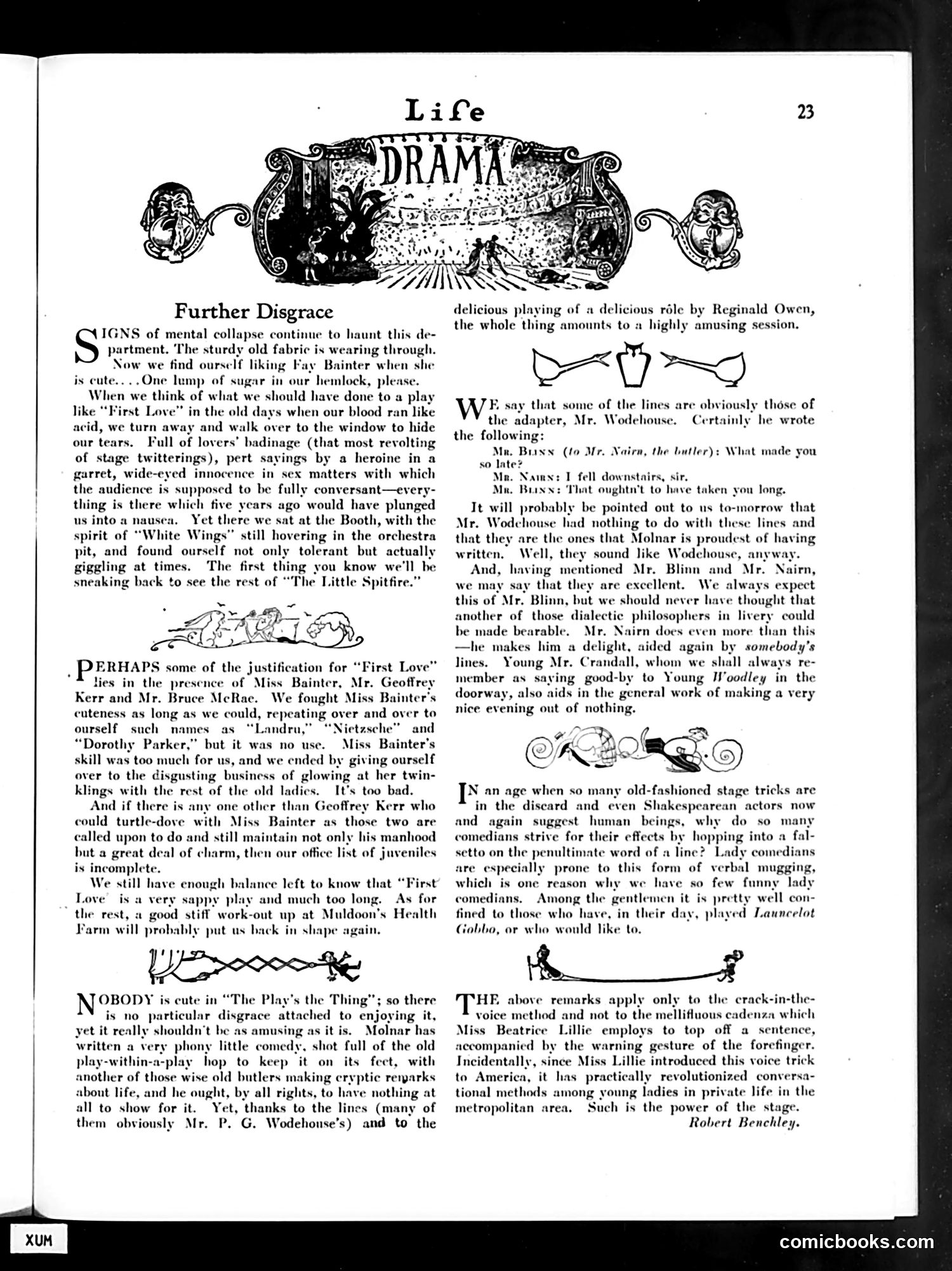
This is a theatrical review column critiquing Broadway productions. The author expresses mock dismay at their own softening critical standards—they're embarrassed to admit they *enjoyed* sentimental plays like "First Love" starring Fay Bainter, which they would have despised years earlier. The satire targets the reviewer's fading cynicism: they invoke names like "Landru" (a serial killer) and "Nietzsche" to steel themselves against Bainter's charm, but fail. They joke about needing a "health farm" to recover their moral rigor. The column also praises "The Play's the Thing" (a Molnár comedy adapted by P.G. Wodehouse), with particular appreciation for the witty dialogue and Reginald Owen's performance. The humor lies in the reviewer's self-aware recognition that they're becoming a sentimental "old lady" rather than the acid-tongued critic they once were—a decline they treat as both amusing and slightly shameful.
📄 Transcribed text from this page (OCR, searchable)
Machine-transcribed from the original scan — historical spelling and the odd misread are preserved.
Further Disgrace IGNS of mental collapse continue to haunt this de- S partment. The sturdy old fabric is wearing through. Now we find ourself liking Fay Bainter when she -One lump of sugar in our hemlock, please. When 4 we think of what we should have done to a play like “First Love” in the old days when our blood ran like acid, we turn away and walk over to the window to hide our tears. Full of lovers’ badinage (that most revolting of stage twitterings), pert sayings by a heroine in a garret, wide-eyed innocence in sex matters with which the audience is supposed to be fully conversant—every- thing is there which five years ago would have plunged us into a nausea, Yet there we sat at the Booth, with the spirit of “White Wings” still hovering in the orchestra pit, and found ourself not only tolerant but actually giggling at times. The first thing you know we'll be sneaking back to see the rest of “The Little Spitfire.” DEKE ELI, ERHAPS some of the justification for “First Love” sin the presence of Miss Bainter, Mr. Geoffrey Kerr and Mr. Bruce McRae. We fought Miss Bainter’s cuteness as long as we could, repeating over and over to ourself such names as “Landru,” “Nietzsche” and “Dorothy Parker,” but it was no use. Miss Bainter’s skill was too much for us, and we ended by giving ourself over to the disgusting business of glowing at her twin- klings with the rest of the old ladies. It's too bad. And if there is any one other than Geoffrey Kerr who could turtle-dove with Miss Bainter as those two are called upon to do and still maintain not only his manhood but a great deal of charm, then our office list of juveniles is incomplete. We still have enough balance left to know that “First Love is a very sappy play and much too long. As for the rest, a good stiff work-out up at Muldoon’s Health Farm will probably put us back in shape again. P OBODY is cute in “The Play's the Thing”; so there is no particular disgrace attached to enjoying it, yet it really shouldn't be as amusing as it is. Molnar has phony little comedy, shot full of the old play-within-a-play hop to keep it on its feet, with is cute. another of those wise old butlers making cryptic remarks about life, and he ought, by all rights, to have nothing at all to show for it. obviously Yet, thanks to the lines (many of them Mr. P. G. Wodehouse’s) and to the delicious playing of a delicious réle by Reginald Owen, the whole thing amounts to a highly amusing session. b= W y that some of the lines are obviously those of the adapter, Mr. Wodehouse. Certainly he wrote the following: Mr. Buss (fo Mr. Nairn, the butler): What made you so late? Mr. Nains: I fell downstairs, sir. Mn. Buss: That oughtn’'t to have taken you long. It will probably be pointed out to us to-morrow that Mr. Wodchouse had nothing to do with these lines and that they are the ones that Molnar is proudest of having written, Well, they sound like Wodehouse, anyv And, having mentioned Mr. Blinn and Mr. Nairn, we may say that they are excellent. We always expect this of Mr. Blinn, but we should never have thought that another of those dialectic philosophers in livery could be made bearable. Mr. rn does even more than this —he makes him a delight, aided again by somebody's lines. Young Mr. Crandall, whom we shall always re- member as saying good-by to Young Woodley in the doorway, also aids in the general work of making a very nice evening out of nothing. an age when so many old-fashioned stage tricks are in the discard and even Shakespearean actors now and again suggest human beings, why do so many comedians strive for their effects by hopping into a fal- setto on the penultimate word of a line? Lady comedians are especially prone to this form of verbal mugging, which is one reason why we have so few funny lady comedians. Among the gentlemen it is pretty well ec fined to those who have, in their day, played Launcelot Gobbo, or who would like to. a HF. above remarks apply only to the crack-in-the- voice method and not to the mellifluous cadenza which Miss Beatrice Lillie employs to top off a sentence: accompanied by the warning gesture of the forefinger. Incidentally, since Miss Lillie introduced this voice trick to America, it has practically revolutionized conversa- tional methods among young ladies in private life in the metropolitan area, Such is the power of the sta Robert Benchley. comicbooks.com