
A complete issue · 44 pages · 1926
Life — October 7, 1926
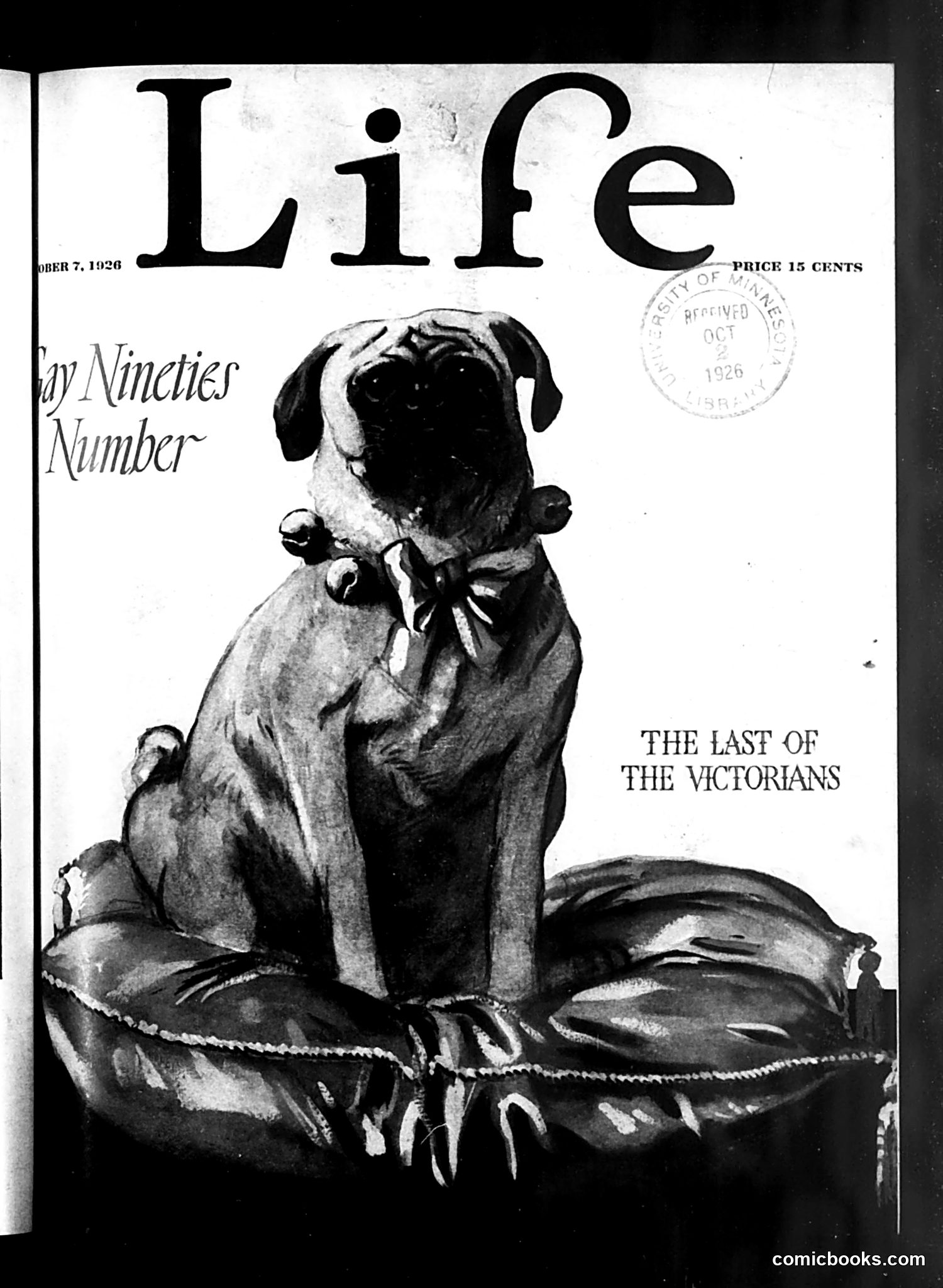
This is a "Gay Nineties Number" issue of *Life* magazine, featuring a pug dog sitting on ornate Victorian cushions, wearing a bow tie. The title "The Last of the Victorians" appears on the right. The satire likely mocks the Victorian era's excess and stuffiness by depicting a pampered pug—a breed associated with luxury and aristocratic pretension—as the final representative of that sensibility. The dog's decorative cushions and formal attire suggest the overwrought aesthetics of the 1890s. By 1926, the Jazz Age was in full swing, making Victorian values seem quaintly obsolete. The joke positions this spoiled lapdog as the dying remnant of outdated, overly ornamental society—a gentle mockery of nostalgia for the "Gay Nineties."
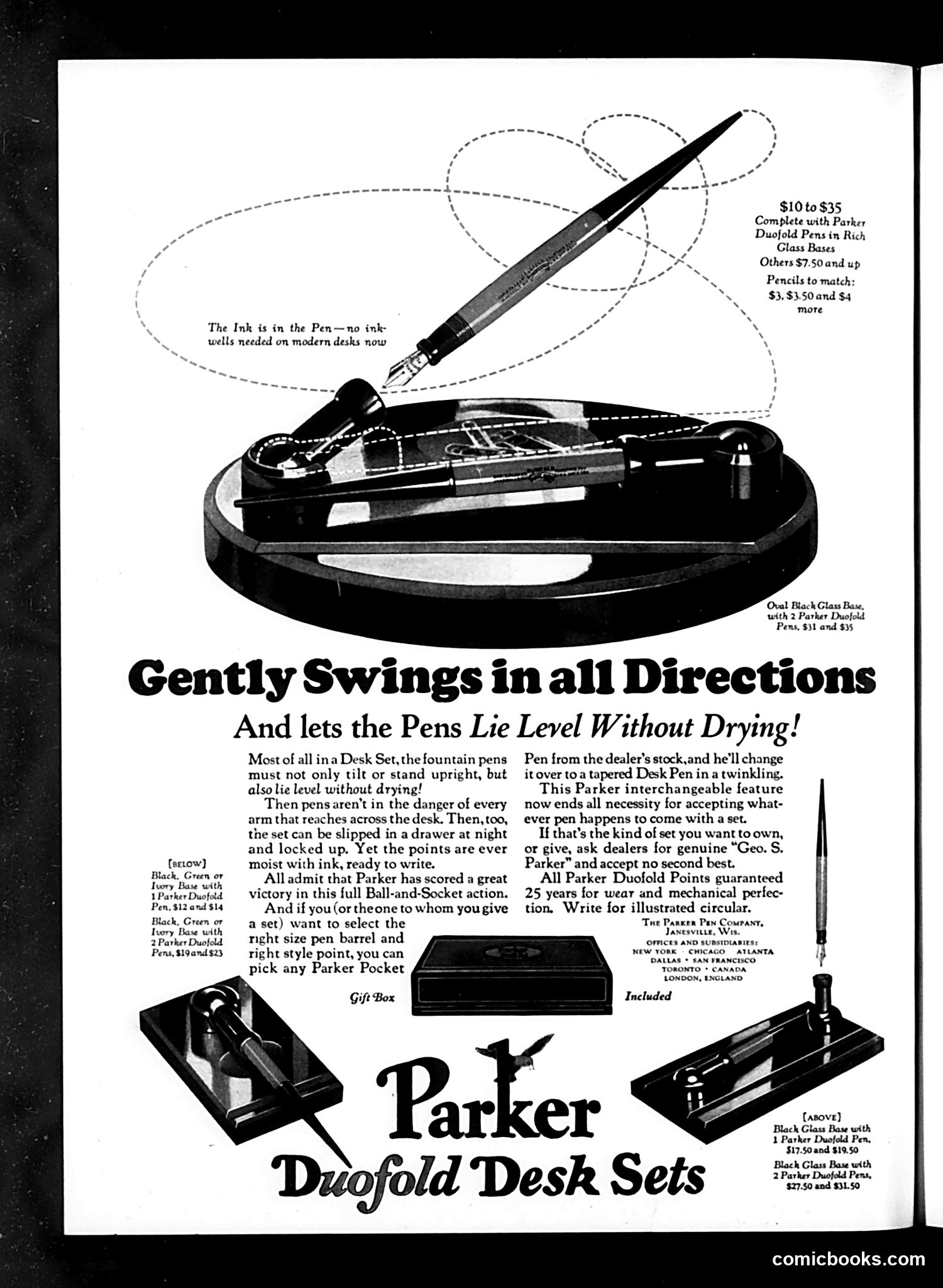
This is **not a political cartoon or satire** — it's a straightforward **advertisement for Parker Duofold Desk Sets**, vintage fountain pens. The page promotes Parker's ball-and-socket desk pen holder mechanism, which allows pens to "swing gently in all directions" and "lie level without drying." This was a practical innovation for the era when fountain pens required special care to prevent ink from drying out or leaking. The ad emphasizes the Duofold's advantages: interchangeable pen points, a 25-year guarantee, and availability in various colors and price points ($10-$35 for desk sets, $7.50+ for matching pencils). There is **no satire or political content** — this is period advertising highlighting genuine product features that would have mattered to mid-20th century office workers and desk enthusiasts.
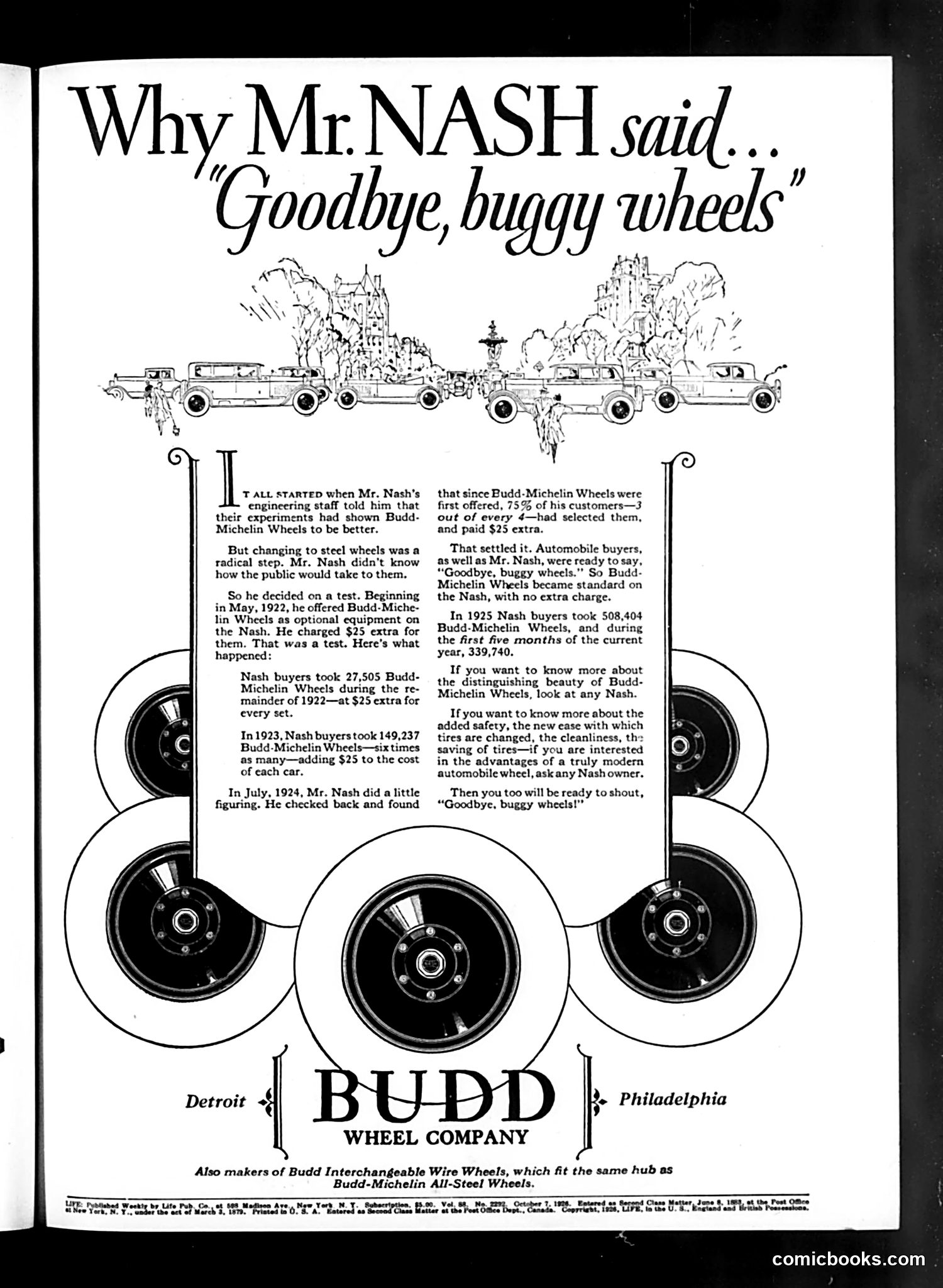
This is primarily **advertising copy, not satire or political commentary**. It's a Budd Wheel Company advertisement disguised as an editorial narrative about Mr. Nash (likely Nash automobile founder Charles W. Nash). The "joke" is that Mr. Nash dismissively said "Goodbye, buggy wheels" when switching from wooden to steel wheels—but then discovered customers preferred the new Budd-Michelin wheels so strongly that he adopted them widely. The advertisement documents sales figures from 1922-1925 showing increasing adoption of these wheels. The three large wheel illustrations at bottom showcase the product itself. This represents early automotive marketing: telling a business anecdote to build brand credibility and establish product superiority through real sales data rather than direct claims.
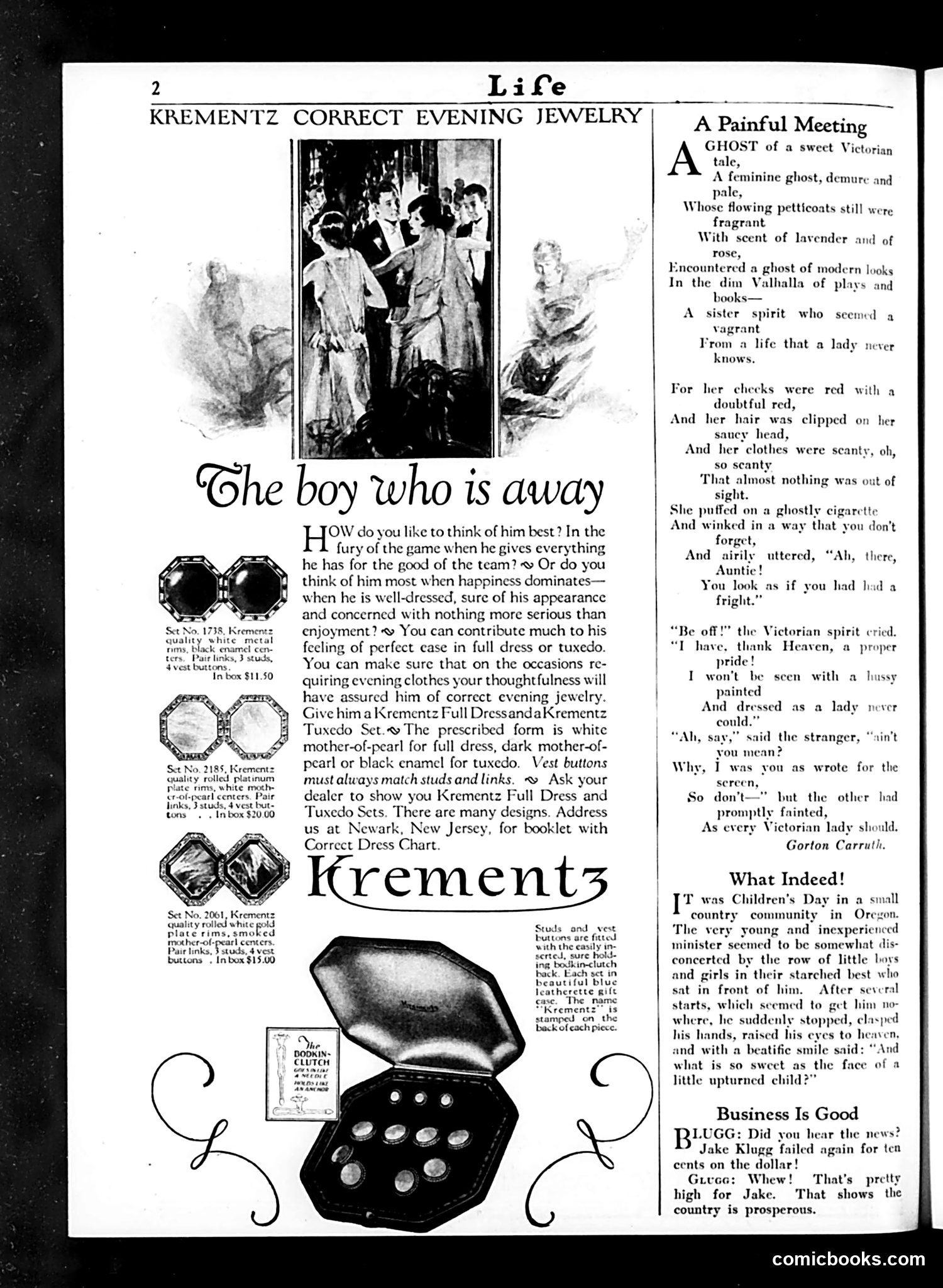
This page is primarily **advertising for Krementz jewelry** (cufflinks, studs, and formal wear accessories), occupying the left two-thirds. The ads showcase various formal dress jewelry sets with prices around $11-$13. The right side contains three short literary/humorous pieces: 1. **"A Painful Meeting"** - A poem by Gordon Carruth about a Victorian ghost encountering modern theatrical women, satirizing period costume drama. 2. **"What Indeed!"** - A brief anecdote about Children's Day in rural Oregon, where a young minister is moved by children's innocence. 3. **"Business Is Good"** - A short dialogue joke where "Jake Klogg" repeatedly fails financially, but this apparent failure is reframed as economic prosperity—likely satirizing optimistic business rhetoric or absurd reasoning during economically uncertain times.
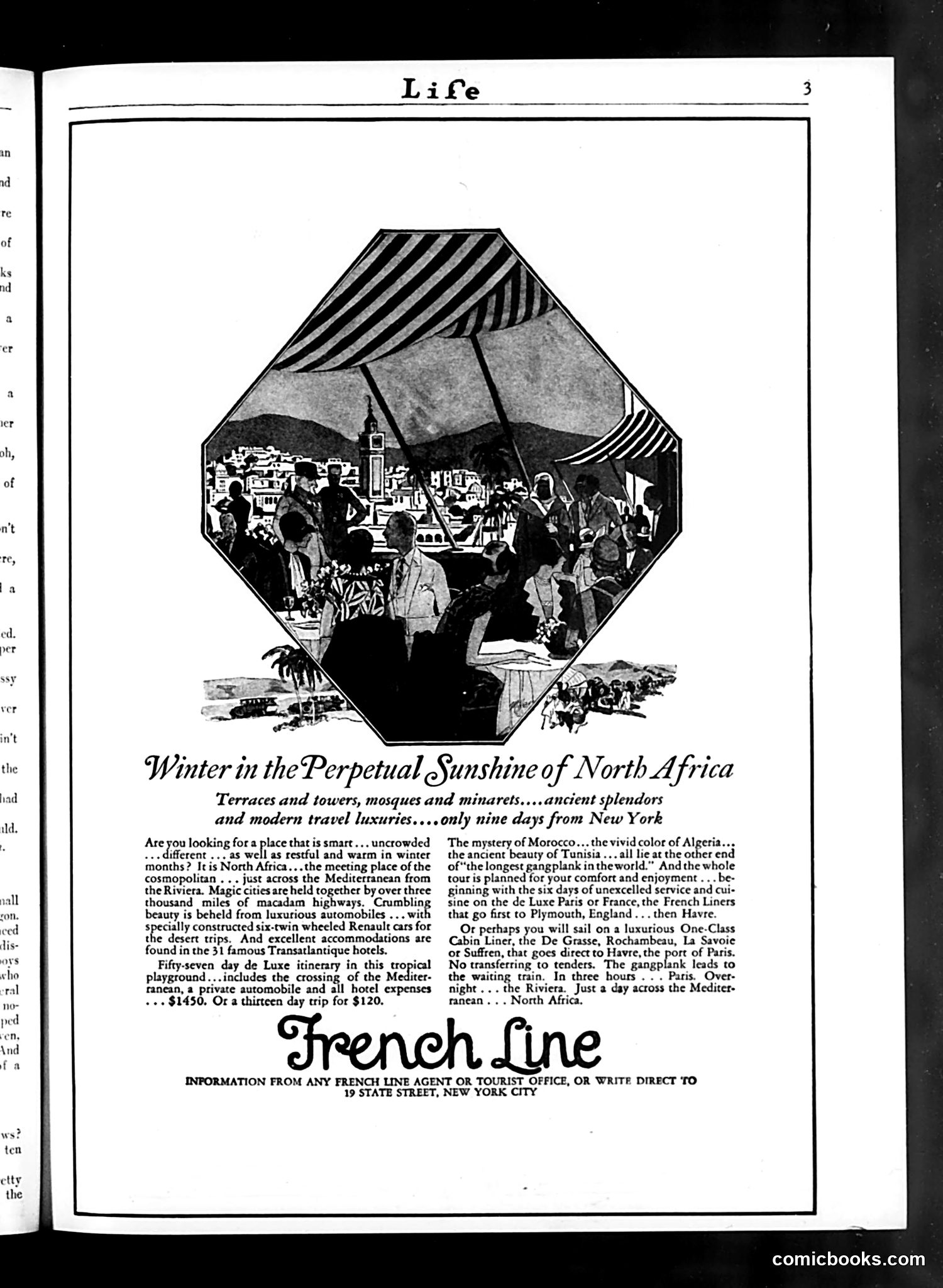
This page is primarily **advertising, not political satire**. It's a French Line travel advertisement promoting luxury cruises to North Africa. The central image depicts a stylized octagonal window or porthole showing a bustling North African city (mosques, minarets, colonial architecture) framed by a ship's deck with passengers and cargo below. The ad emphasizes exotic travel amenities: "Winter in the Perpetual Sunshine of North Africa" with "terraces and towers, mosques and minarets...ancient splendors and modern travel luxuries...only nine days from New York." It mentions specific ships (De Luxe Paris, De Grasse) and promotes affordable package tours starting at $145. This reflects 1920s-30s colonial-era tourism marketing to wealthy American audiences, positioning North Africa as an accessible exotic destination.
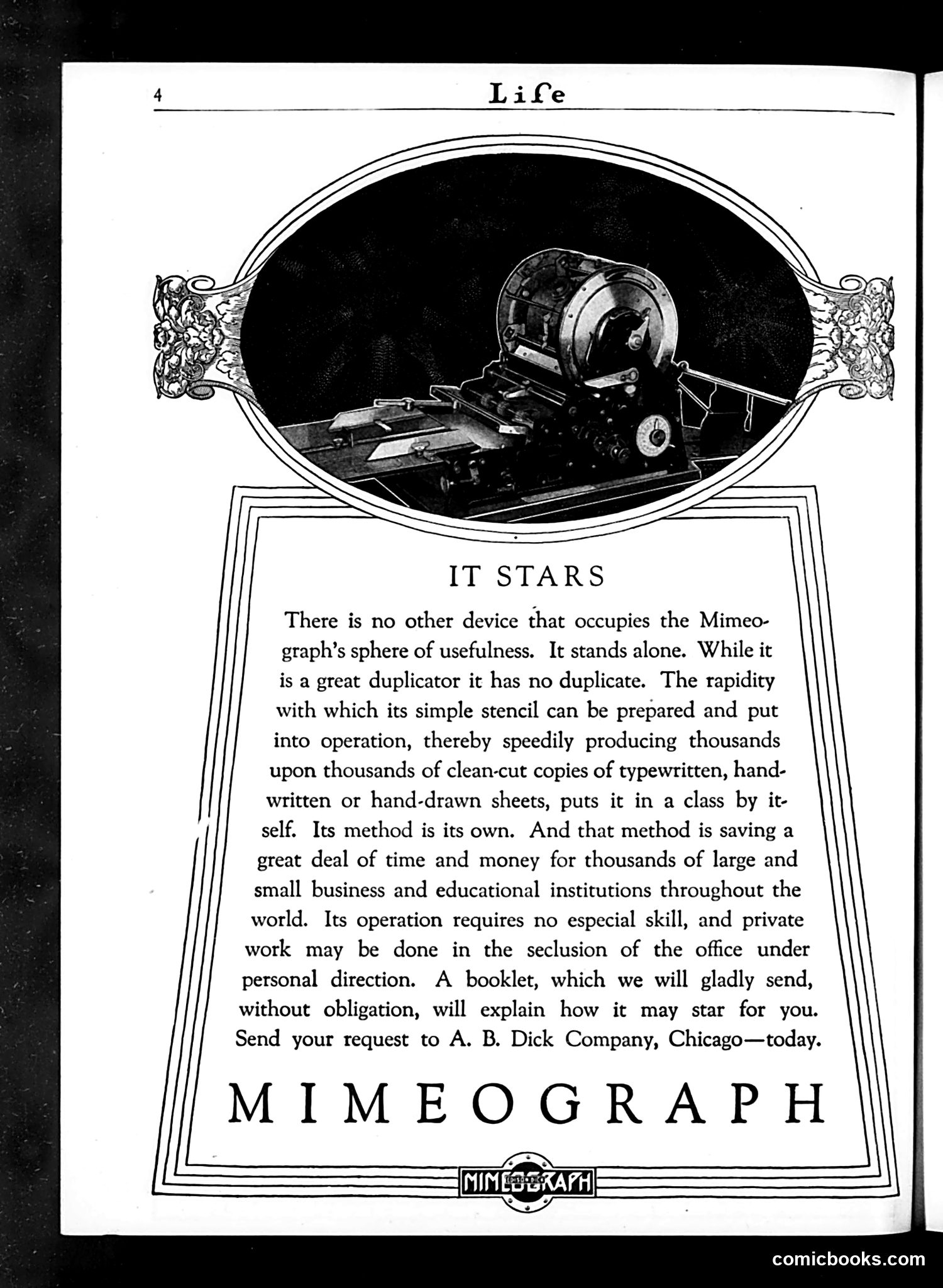
This page is **primarily an advertisement**, not satire or political commentary. It's a Life magazine ad for the Mimeograph machine, published by the A.B. Dick Company of Chicago. The ad's heading "IT STARS" uses theatrical language to promote the device as revolutionary office technology. The mimeograph—a stencil-based duplicating machine shown in the image—is marketed as uniquely useful for producing thousands of clean copies of documents quickly and cheaply. The ad emphasizes its speed, ease of operation, and cost-savings for "business and educational institutions." There is no political cartoon or social satire here. This is straightforward early 20th-century advertising copy emphasizing the machine's practical advantages over competitors and inviting readers to request an informational booklet.
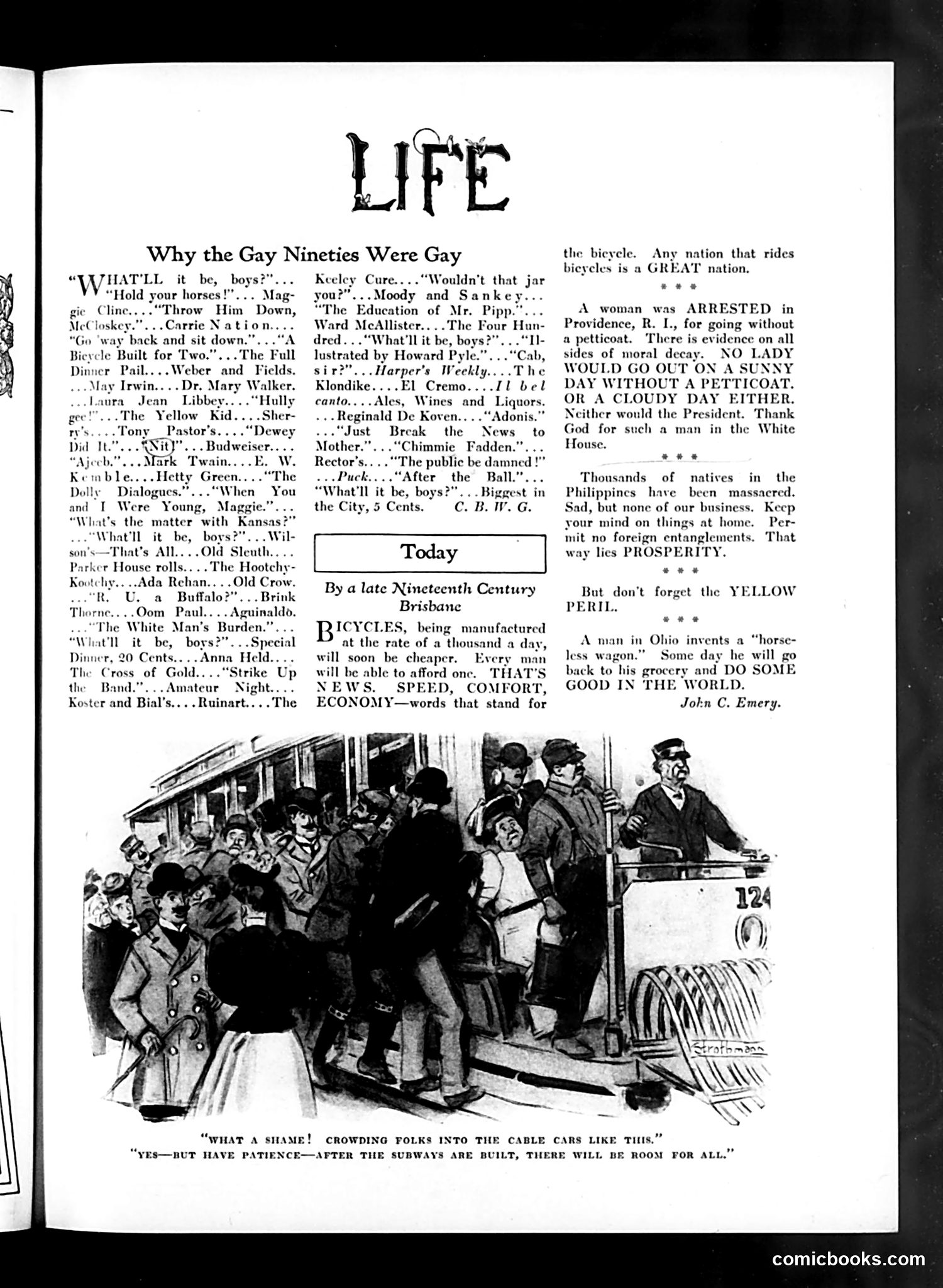
This is a satirical illustration about overcrowded cable cars in what appears to be late 19th-century Brisbane (per the article byline). The cartoon depicts a streetcar (#124) packed with passengers, with the caption expressing frustration about crowding: "WHAT A SHAME! CROWDING FOLKS INTO THE CABLE CARS LIKE THIS." The response below offers reassurance that subways will eventually solve the problem: "YES—BUT HAVE PATIENCE—AFTER THE SUBWAYS ARE BUILT, THERE WILL BE ROOM FOR ALL." The satire targets urban transportation infrastructure inadequacy. The joke assumes readers will recognize the irony: that building subways is a distant, improbable solution to present overcrowding. It mocks both the perpetual inadequacy of public transit and officials' vague promises of future improvements—a timeless urban complaint.
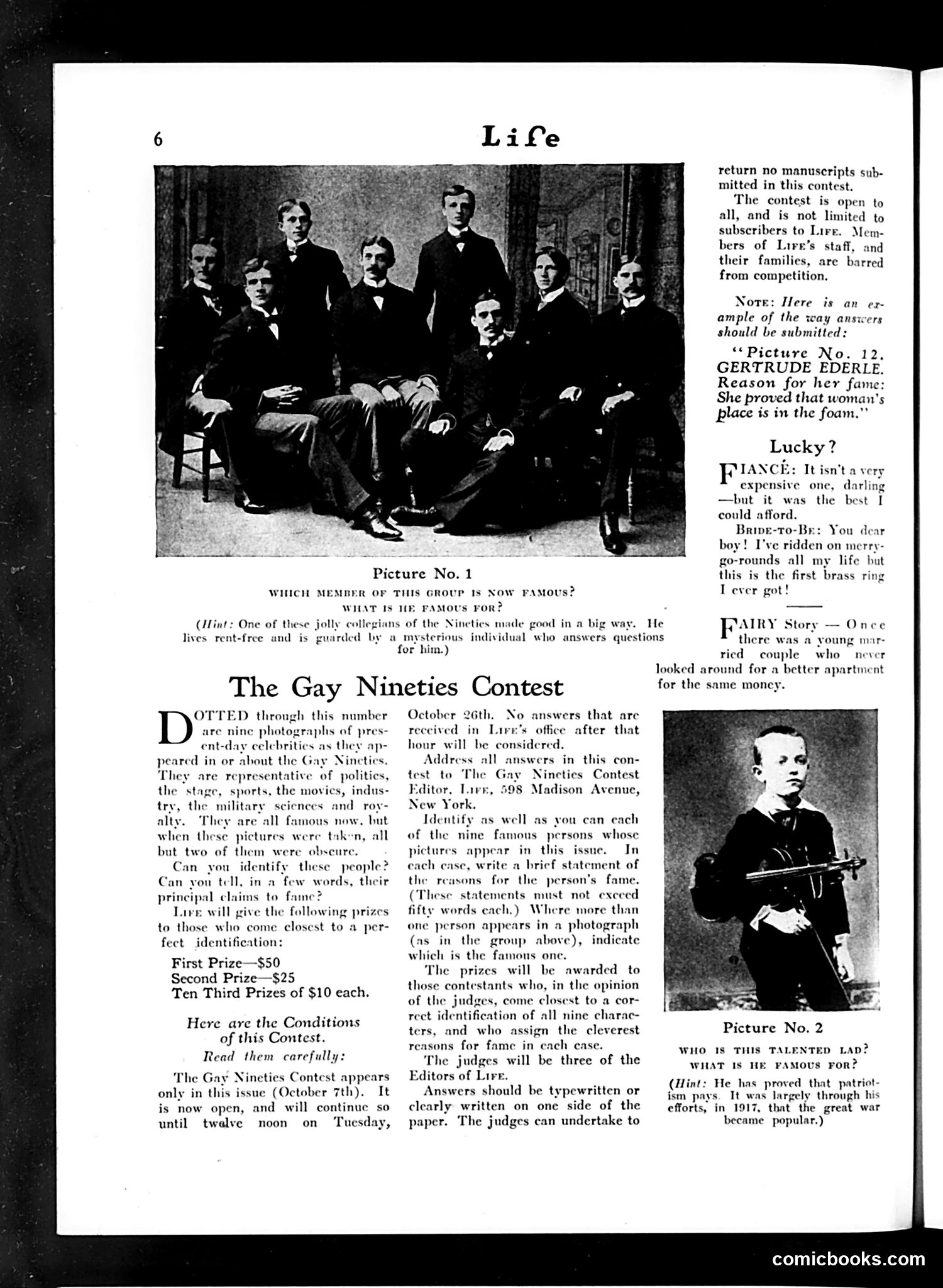
This page announces a contest asking readers to identify nine famous people from the 1890s era whose photographs appear in the issue. The contest features two images: Picture No. 1 shows a group of men in formal 1890s attire, and Picture No. 2 shows a single young man in military dress. Readers must identify which person in each photograph is famous, explain their reasons for identification, and name their claim to fame in fifty words or less. The hint suggests one person in the group photo was involved in business or real estate. The contest offers $50 for first prize, $25 for second, and multiple $10 prizes. This reflects Life magazine's interactive approach to engaging readers with period nostalgia and celebrity recognition.
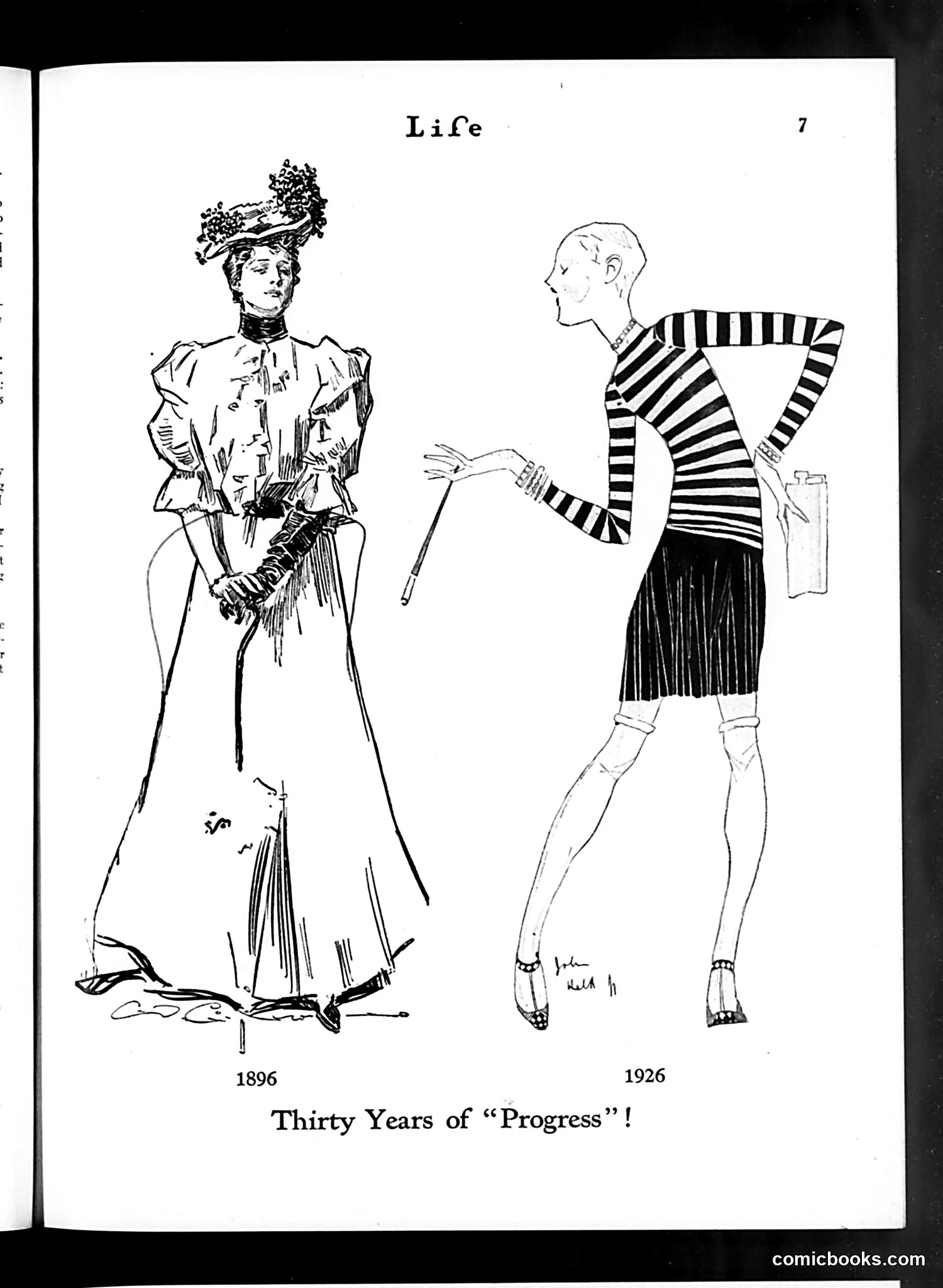
This page from *Life* magazine presents a satirical comparison of women's fashion and social roles across thirty years (1896–1926). The **1896 figure** (left) depicts a woman in elaborate Victorian dress: a long skirt, corseted waist, puffy sleeves, decorative hat, and accessories like a feather boa and walking stick. She embodies restrictive, ornamental femininity. The **1926 figure** (right) shows a dramatically transformed woman in modern 1920s style: short hair, striped sweater, short skirt revealing legs, and a more androgynous silhouette. She appears confident and mobile. The caption "Thirty Years of 'Progress'!" uses ironic quotation marks—the joke likely depends on the viewer's perspective. Conservative readers might see this as mockery of modern women's "unfeminine" appearance; progressive readers might celebrate women's liberation from restrictive Victorian constraints. The satire works through visual contrast alone.
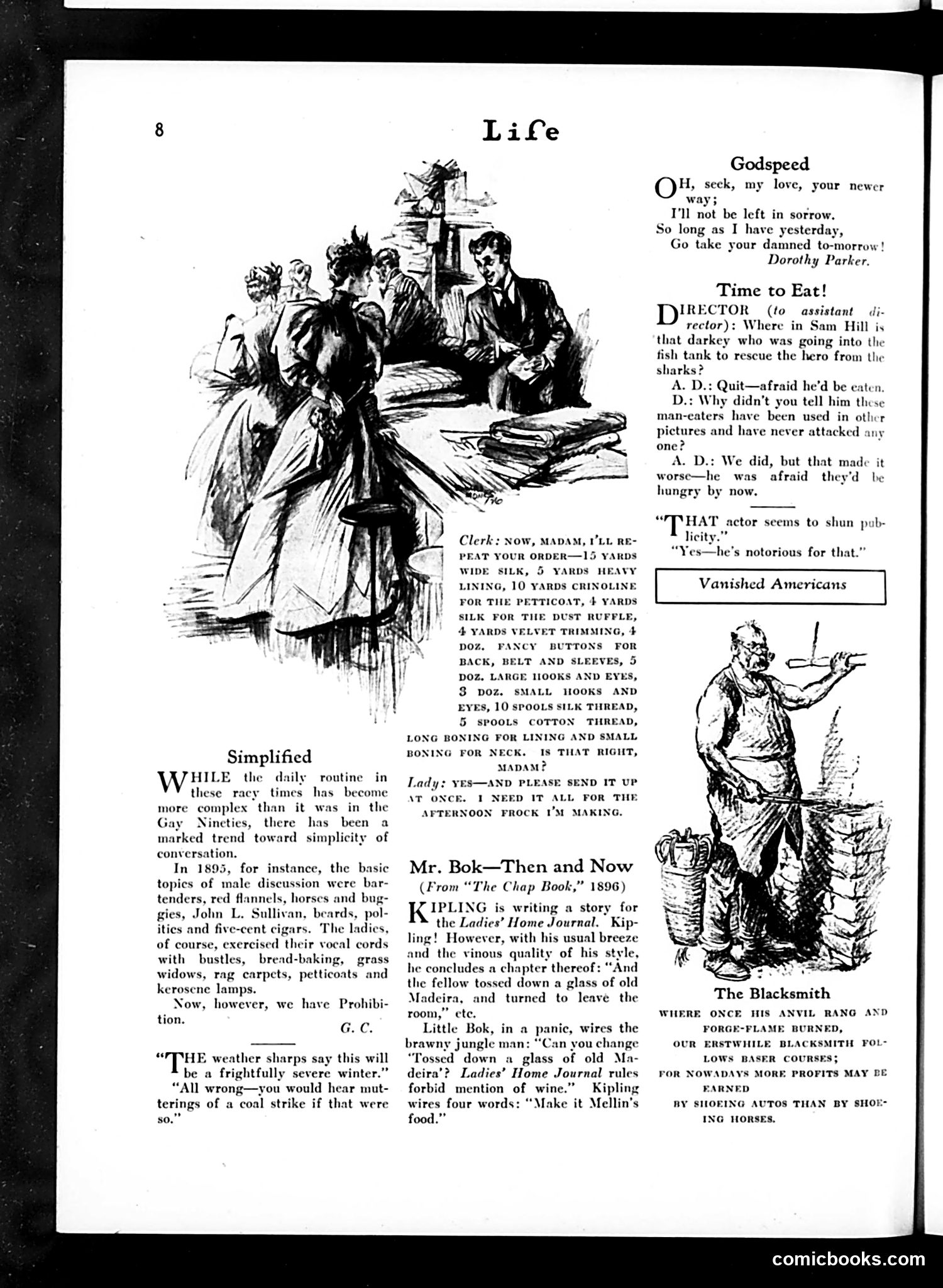
This page contains several satirical pieces rather than a single cartoon. "Simplified" critiques the trend toward simplicity in 1890s fashion and accessories—contrasting elaborate Victorian dress (bustles, ornaments, cigars) with contemporary streamlining. The author (G.C.) uses this to comment on broader cultural shifts toward modernity. "Time to Eat!" mocks film production, showing a director explaining why an actor wasn't warned about sharks in a scene—they feared he'd be too hungry to care, prioritizing the shot over safety. "Mr. Bok—Then and Now" satirizes Edward Bok's contradiction: as *Ladies' Home Journal* editor, he forbids wine mentions, yet Kipling's story violates this rule with "Make it Mellin's food"—exposing editorial hypocrisy. The Blacksmith illustration is a period advertisement.
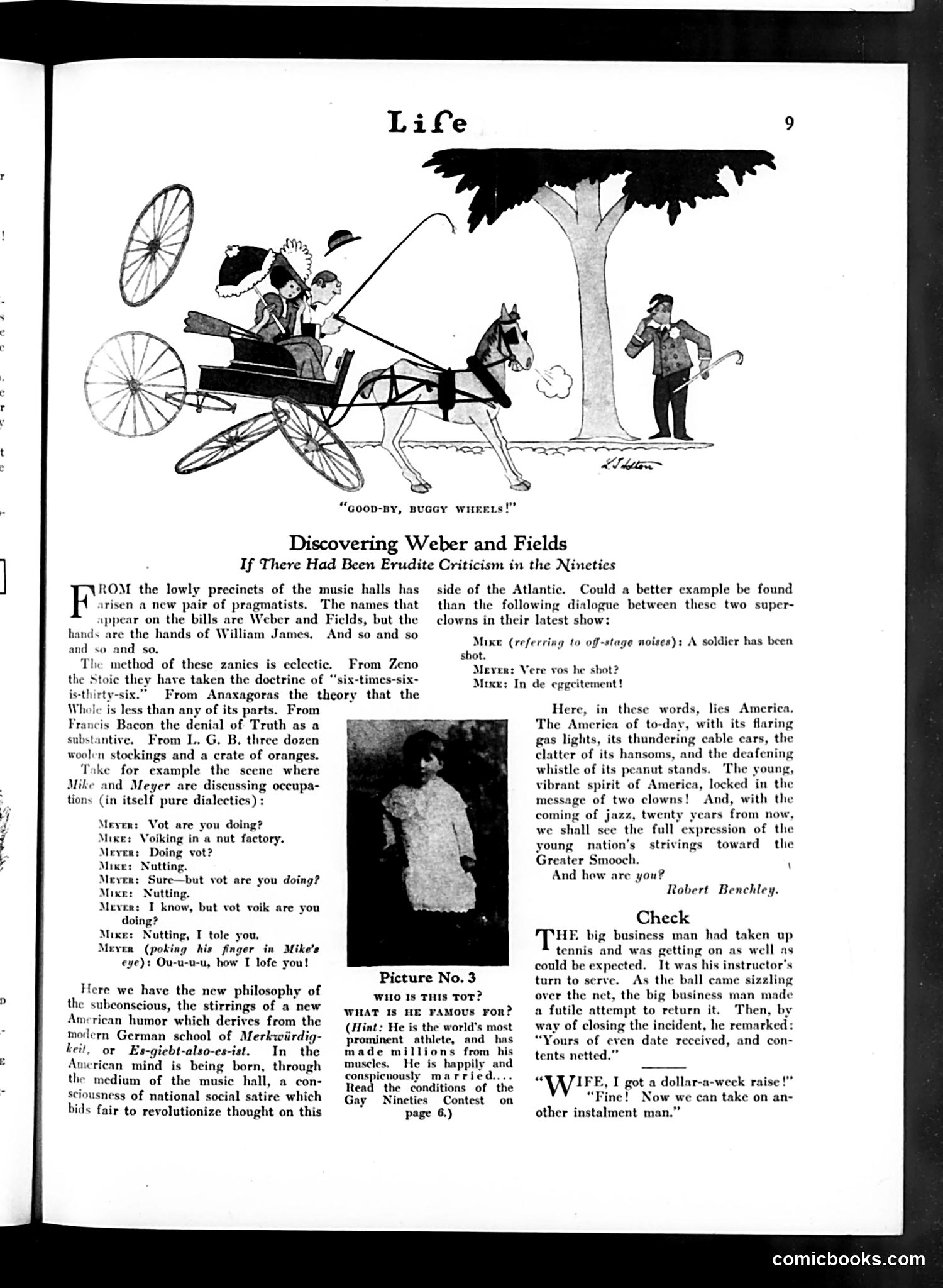
**Top Cartoon:** "Good-by, Buggy Wheels!" depicts a horse-drawn carriage losing its wheels to a bicycle, symbolizing the technological shift from traditional horse transport to bicycles—a major 1890s innovation that threatened established carriage industries. **Main Article:** "Discovering Weber and Fields" satirizes two contemporary comedians (Weber and Fields) by imagining how erudite 1890s critics might have analyzed them using pseudo-intellectual philosophy (referencing Zeno, Anaxagoras, etc.). The satire mocks both the comedians' lowbrow act and pretentious academic over-analysis of popular entertainment. **"Check" Section:** A brief humorous anecdote about a businessman's tennis ambitions and domestic finances—typical light social humor of the period. The page represents Life's signature blend of visual satire and comedic commentary on contemporary culture and society.
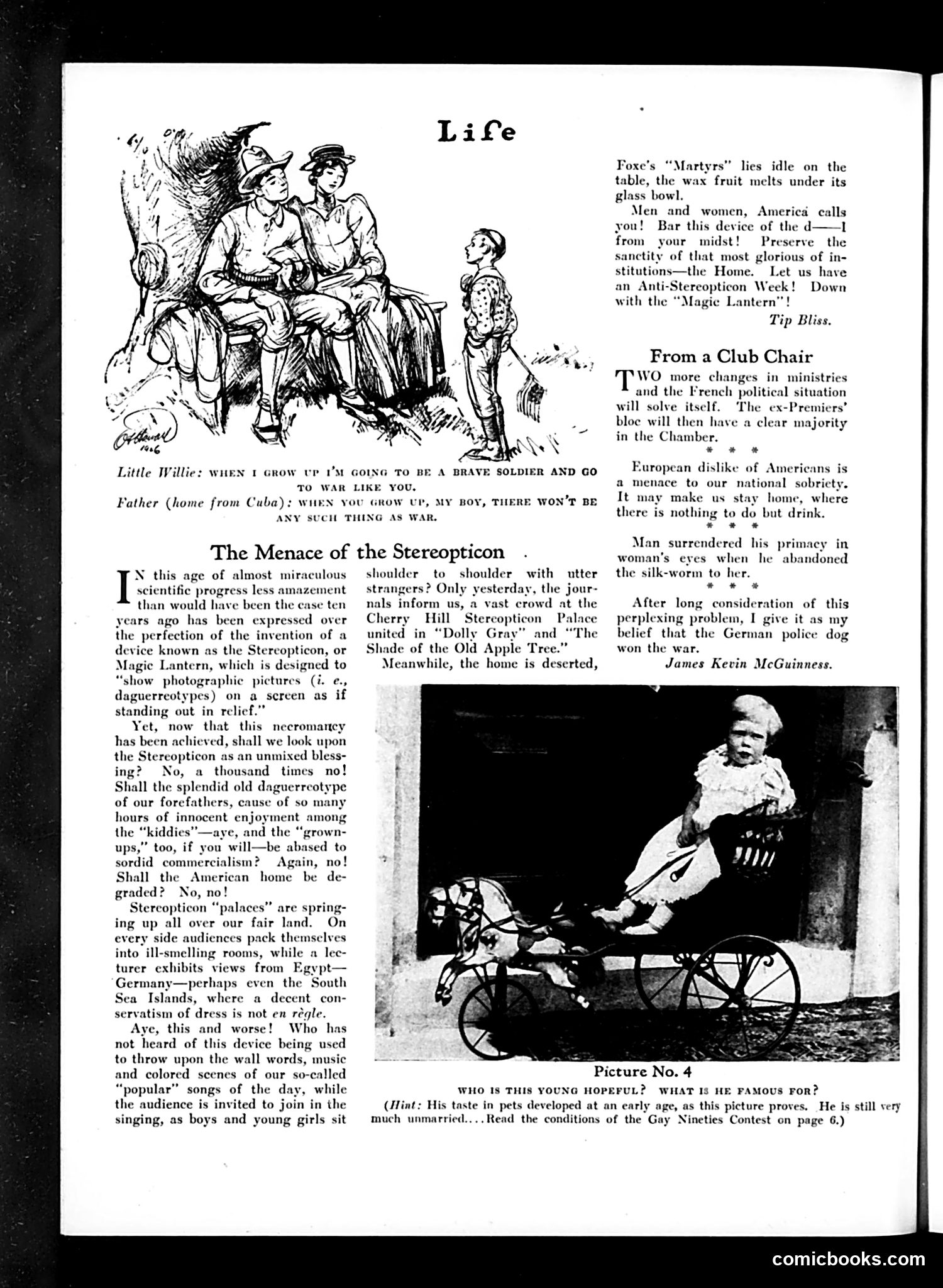
This satirical article criticizes the rapid proliferation of "stereopticon" (magic lantern) shows—early projected-image entertainment devices appearing in public halls across America. The author argues these commercial shows are degrading American culture by replacing traditional home entertainment and family activities with passive spectatorship in "ill-smelling rooms." The piece warns that stereopticon "palaces" are spreading nationwide, even internationally, and fears they're corrupting youth by exposing them to lowbrow entertainment. The author sarcastically questions whether American homes will be "degraded" and whether the daguerreotype tradition—presumably more wholesome—will disappear. Essentially, this is an early critique of commercialized mass entertainment and its perceived threat to domestic life and cultural standards—a recurring anxiety during technological transitions.
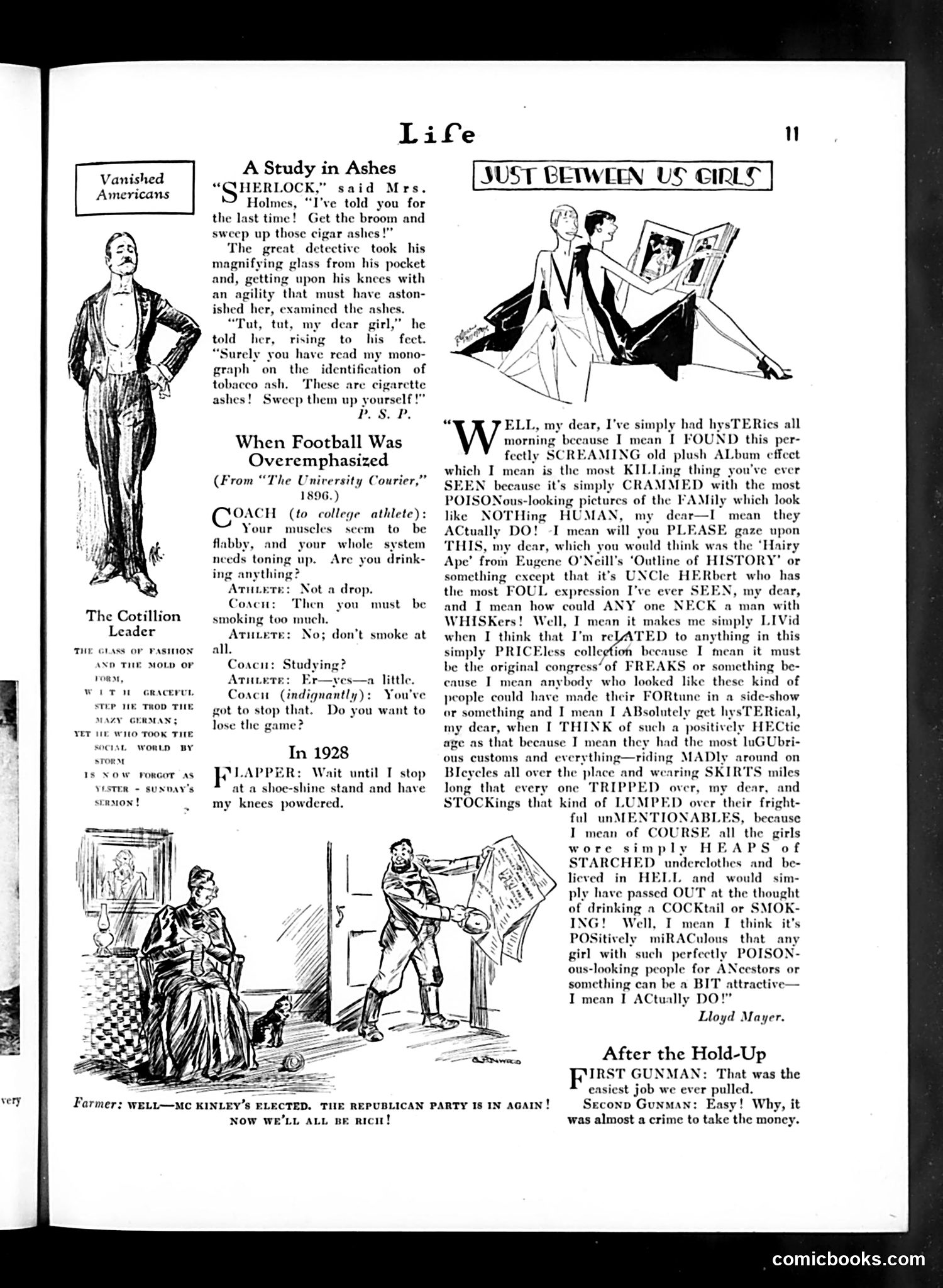
This page contains three separate satirical pieces: 1. **"Vanished Americans"**: Shows a well-dressed man examining cigar ashes with a magnifying glass—a Sherlock Holmes parody. The joke mocks detectives' obsessive analysis of trivial evidence. 2. **"When Football Was Overemphasized"**: Critiques college athletics, showing a coach demanding athletes stop smoking and study instead. It satirizes how universities prioritized sports over academics. 3. **"In 1928"**: A farmer celebrates McKinley's (Republican) election victory, expecting prosperity. This references the 1928 presidential election and pre-Depression optimism, with ironic timing given the 1929 crash's imminence. The right column features a gossipy letter mocking young women's fashion, slang, and behavior—typical Life magazine social commentary targeting frivolous modern youth culture.
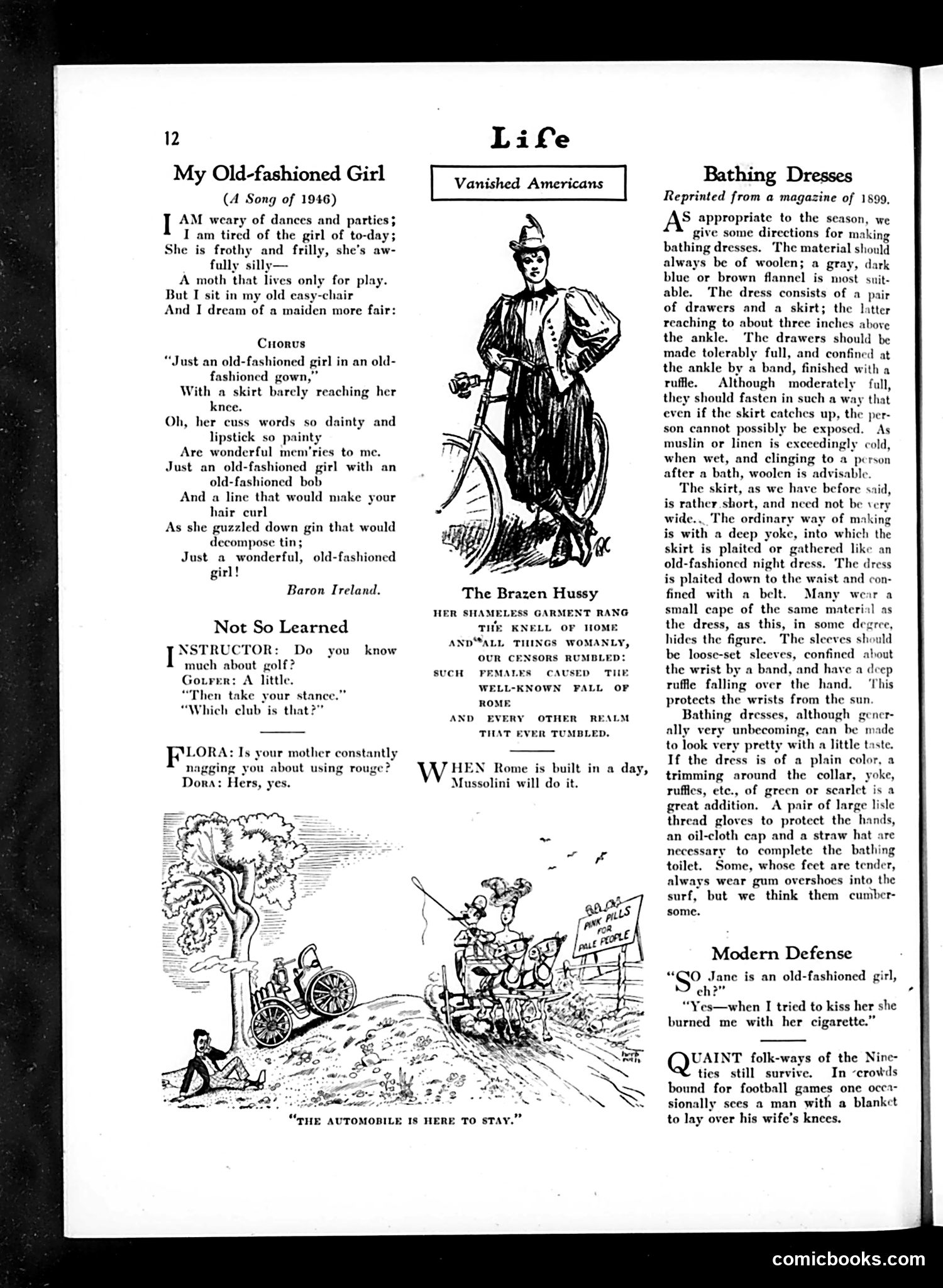
This page contains humor and fashion content rather than political cartoons. **"The Brazen Hussy"** cartoon depicts a woman on a bicycle in bloomers—clothing considered scandalous in the 1890s when this was reprinted from. The caption mocks how "such females caused the well-known fall of Rome," satirizing conservative outrage over women's increasing freedom and practical clothing choices. **"The Automobile is Here to Stay"** shows chaos from early motor vehicles displacing horse-drawn transport, illustrating anxieties about rapid technological change disrupting society. **"Bathing Dresses"** provides practical fashion advice for women's swimwear, while **"Modern Defense"** includes a brief joke about old-fashioned courtship customs. The content reflects early-20th-century social tensions around women's changing roles, fashion, and modernity.
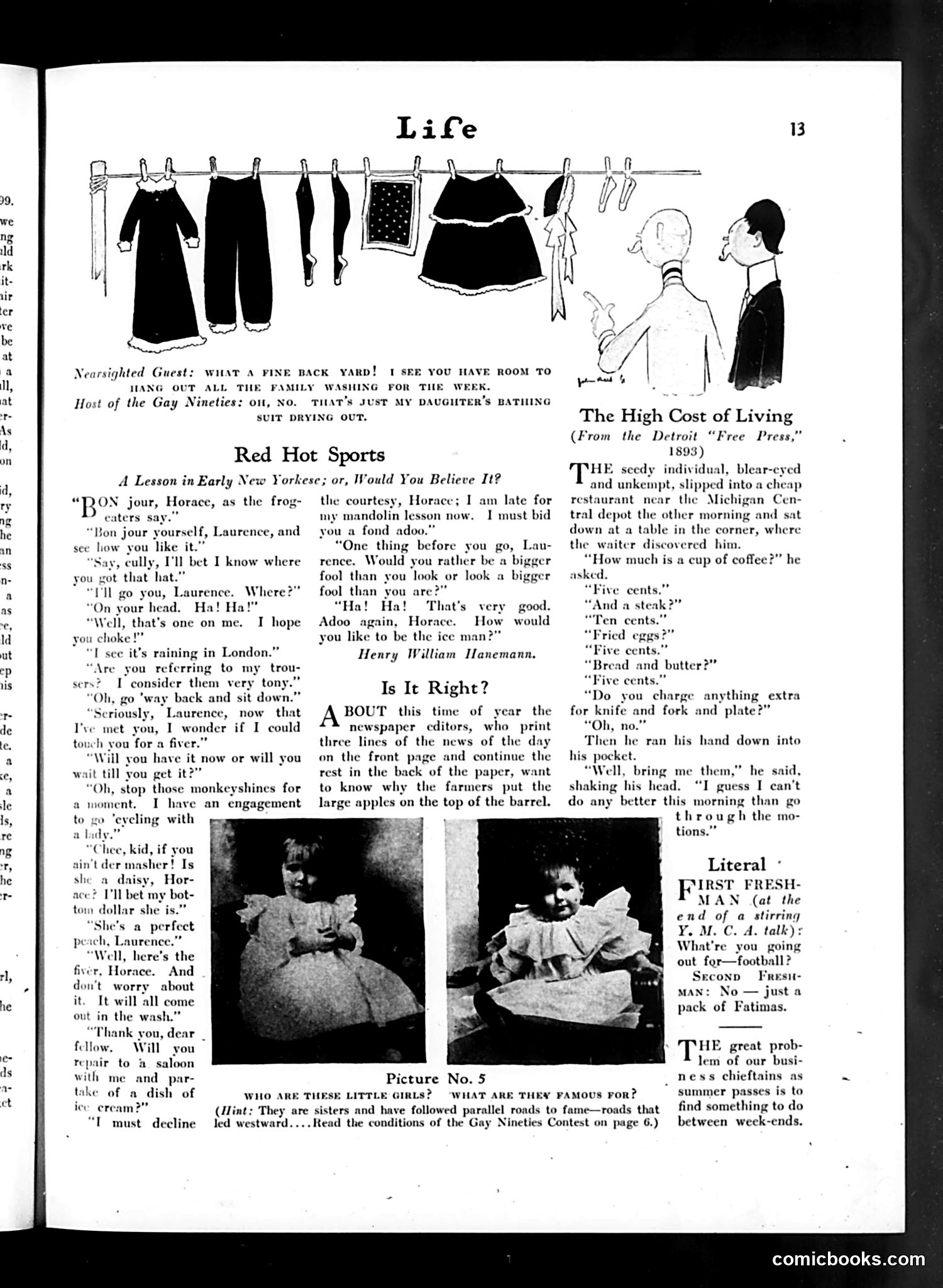
This page contains three distinct pieces of satirical humor typical of Life magazine's style: 1. **"Red Hot Sports"**: A dialogue between characters named Horace and Laurence mocking early New York society's pretensions. The joke hinges on Laurence's confused, snobbish responses to Horace's innocent questions about social activities—satirizing wealthy New Yorkers' affected manners. 2. **"The High Cost of Living"**: A 1893 vignette from the Detroit Free Press depicting economic hardship, where a poor man can only afford a five-cent coffee and minimal food, highlighting the period's cost-of-living crisis affecting working-class Americans. 3. **"Is It Right?"**: Editorial commentary questioning newspaper editors' practice of printing sensational farm stories on front pages while relegating serious agricultural news inside—critiquing journalistic priorities. The photographs show unidentified children in what appears to be a "Gay Nineties" contest reference.
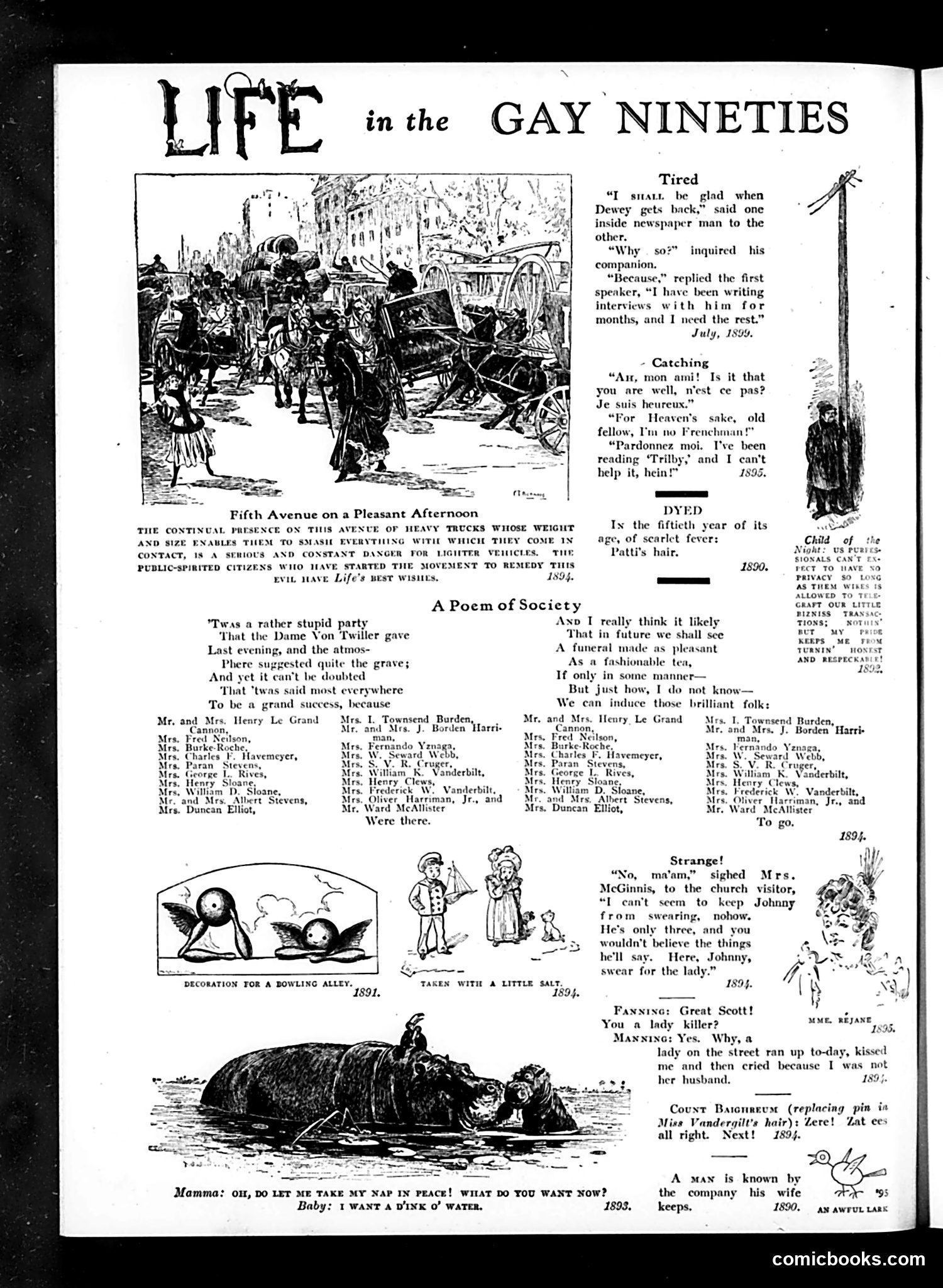
This is a satirical humor page from Life magazine (dated 1894-1895) featuring various social commentary vignettes: **Upper left illustration** shows Fifth Avenue congestion, mocking the wealthy's ostentatious carriages and the citizen-led traffic reform movement of 1894. **"A Poem of Society"** satirizes upper-class social pretension, listing society names while questioning whether a "grand success" funeral would be fashionable—mocking their hollow values. **Lower cartoons** include domestic humor: a woman unable to discipline her swearing three-year-old, a lady who assaulted someone on the street, and a joke about husbands' company reputation. The overall tone ridicules 1890s aristocratic vanity, traffic problems, parenting struggles, and marital dynamics—everyday upper-class absurdities presented as social satire typical of Life's format.
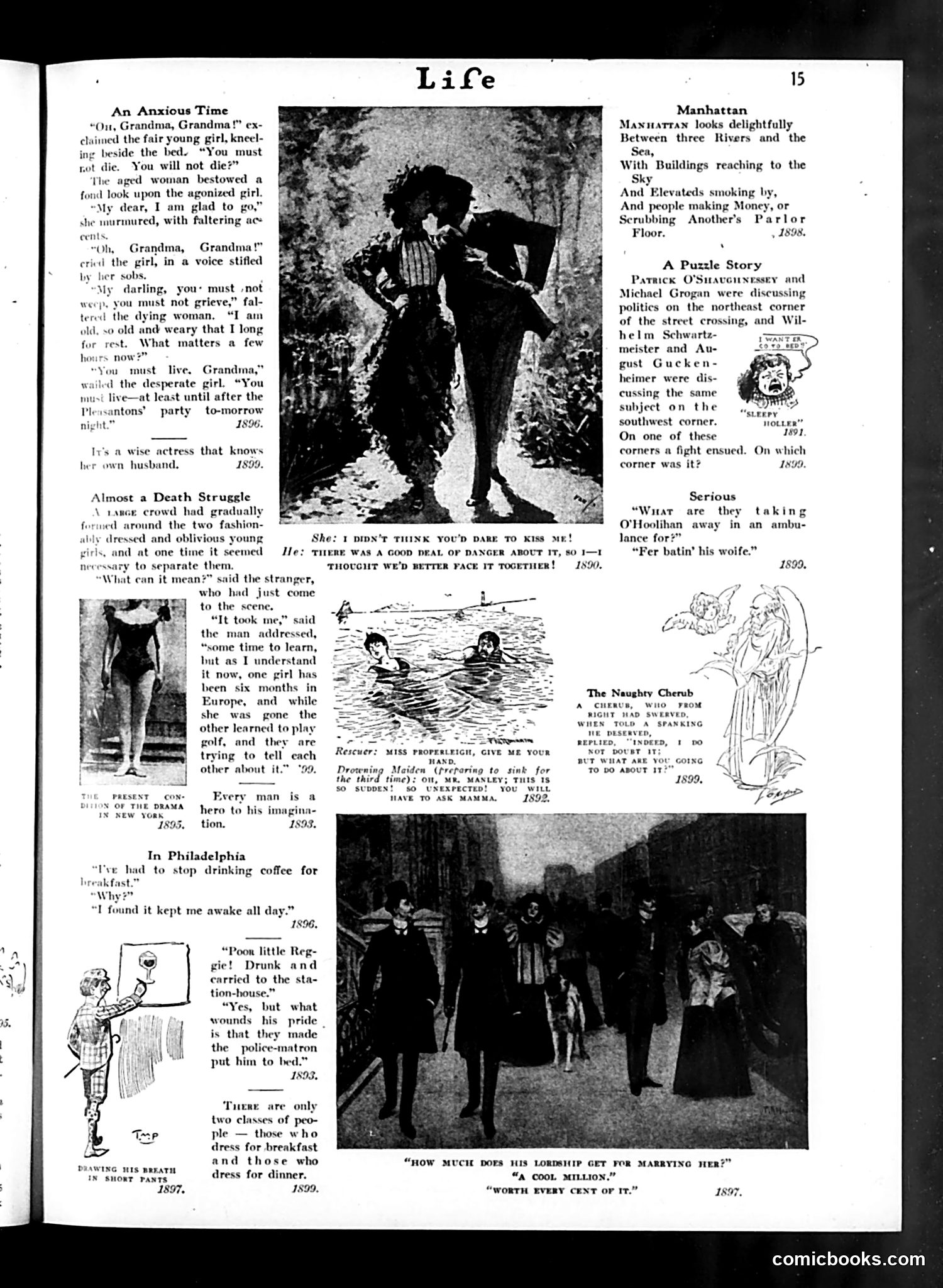
This page from *Life* (1895-1897) contains several satirical vignettes about urban American life and social customs: **"An Anxious Time"** depicts a deathbed scene where an elderly woman insists a young girl must survive—presumably addressing class anxieties about mortality and inheritance. **"Almost a Death Struggle"** shows a crowd preventing a fashionably-dressed couple from separating, satirizing public behavior and social propriety. **"A Puzzle Story"** jokes about street-corner political debates, a common sight in urban centers. **Other sketches** mock social conventions: the Philadelphia coffee habit, formal dress requirements, and courtship rituals. The bottom photograph, captioned "How much does his lordship get for marrying her?" satirizes transatlantic marriages where American heiresses wed titled European men for social prestige—a genuine phenomenon of the Gilded Age.
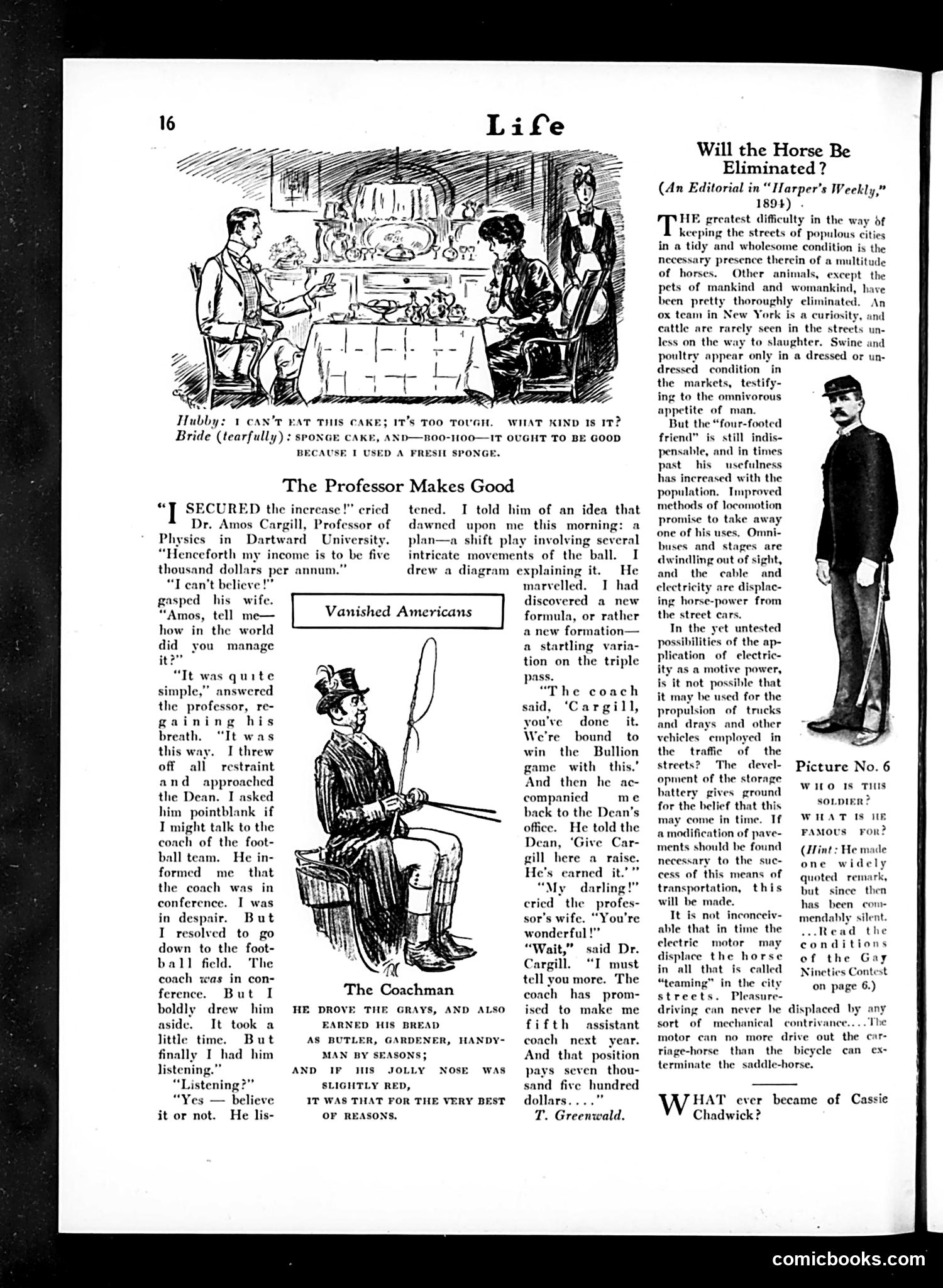
This page contains two satirical pieces: **"The Professor Makes Good"** depicts a Professor of Physics at Dartmouth who secured a $5,000 annual raise by proposing a new "shift play" football formation involving "intricate movements of the ball." The humor lies in the absurdity: the dean accepts this as genuine academic innovation when it's clearly just football strategy. The satire targets academic pretension and the emerging cult of football in universities during the 1890s. **"Will the Horse Be Eliminated?"** (right column) argues that improved urban transportation—electric streetcars and trucks—may eventually displace horses from city streets. The accompanying portrait shows a horse as a "vanishing American," humorously treating the animal's obsolescence as a species-level concern worthy of editorial attention during this period of rapid technological change.
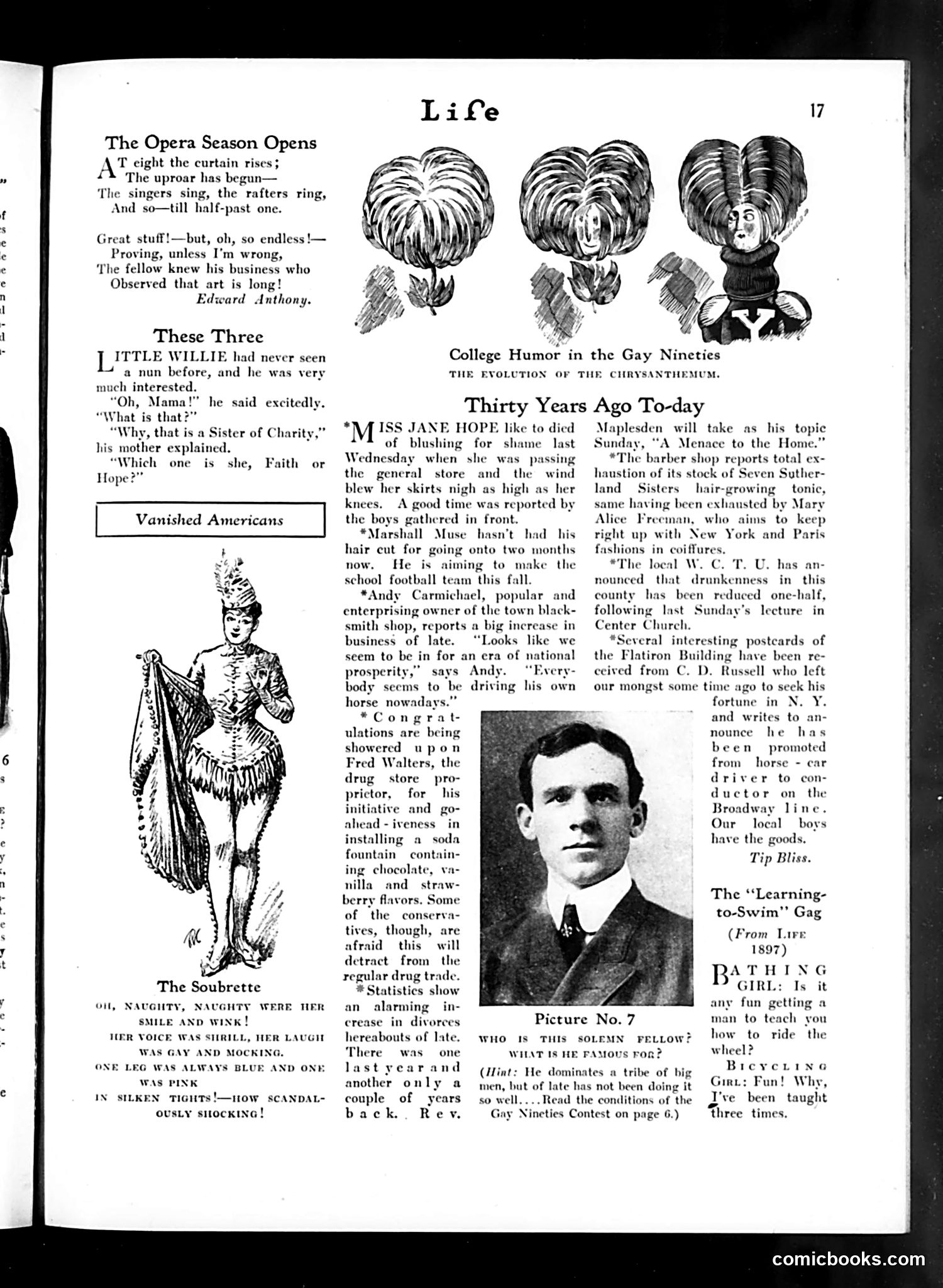
This page contains several satirical pieces typical of early-1900s Life magazine humor: **"The Opera Season Opens"** mocks operatic pretension with a short poem suggesting opera is loud, endless, and requires affected appreciation. **"These Three"** appears to be a humorous anecdote about a child's confusion regarding nuns and religious orders (Sisters of Charity). **"Vanished Americans"** features an illustration labeled "The Soubrette"—a theatrical performer type—satirizing vanishing American social archetypes with exaggerated period costume and moralistic commentary about scandal. **"College Humor in the Gay Nineties"** shows three hairstyle illustrations mocking the "chrysanthemum" coiffure fashionable among college women. **"Thirty Years Ago To-day"** and other brief items provide gossip and social commentary on local news, fashion trends, and business developments, typical of Life's miscellaneous society section.
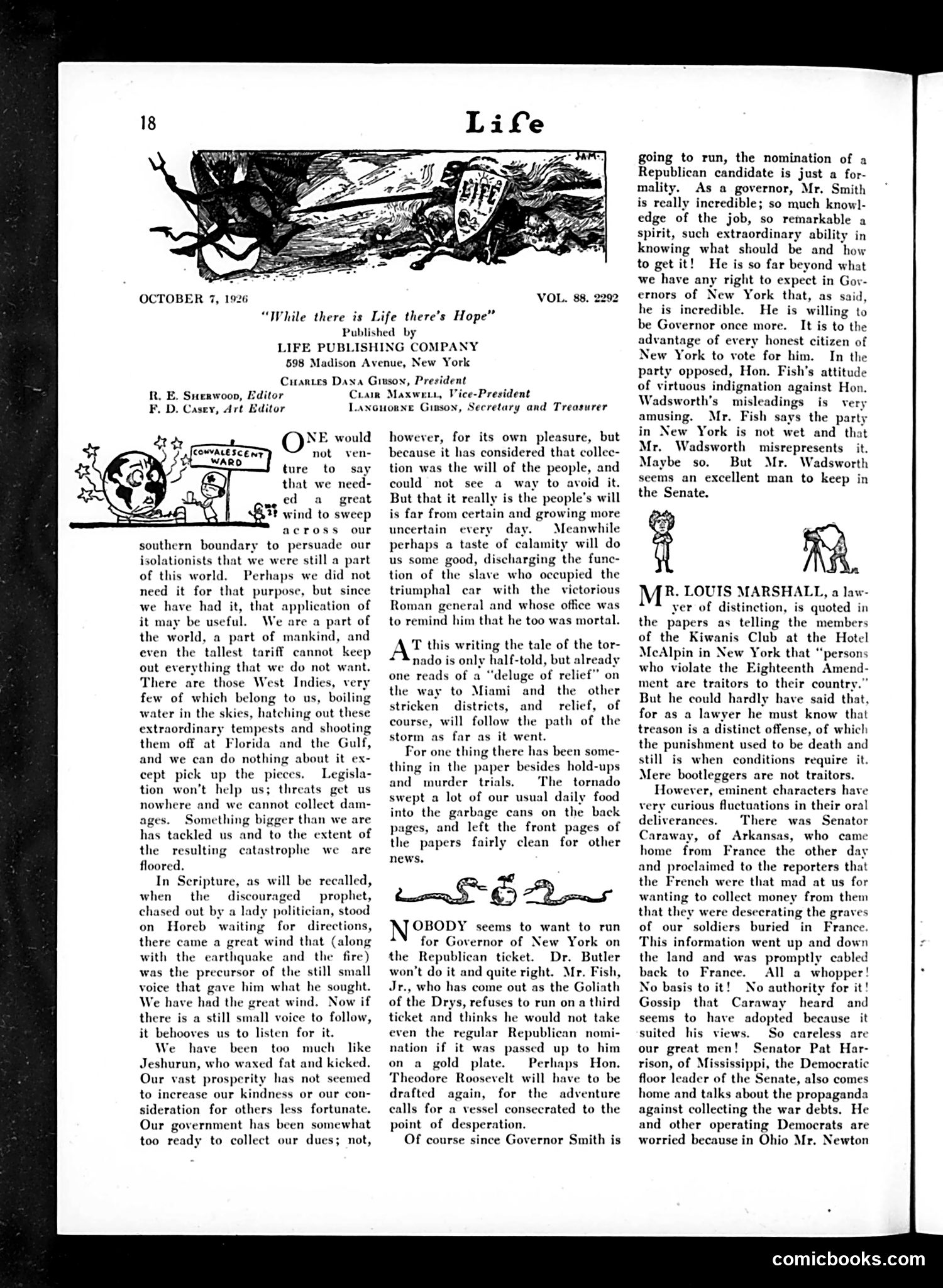
This page contains editorial commentary on two topics: **The Hurricane/Tornado:** The editor argues that the recent natural disaster affecting Florida and the Caribbean demonstrates America's interconnection with the world, countering isolationist sentiment. The biblical reference to Jeshurun ("waxed fat and kicked") suggests prosperity has made Americans complacent and unkind. The disaster serves as a humbling reminder of human limitation. **The New York Gubernatorial Race:** The editorial sarcastically praises incumbent Democratic Governor Al Smith as extraordinarily capable, then notes that Republicans struggle to find a candidate willing to run against him—even prominent figures like Dr. Butler and a prominent "Dry" (Prohibition supporter) refuse the nomination. The editor suggests Theodore Roosevelt may need to be "drafted again," implying desperation. The tone is mocking: Republican nomination appears merely ceremonial given Smith's apparent invulnerability. The cartoons appear decorative rather than substantive commentary.
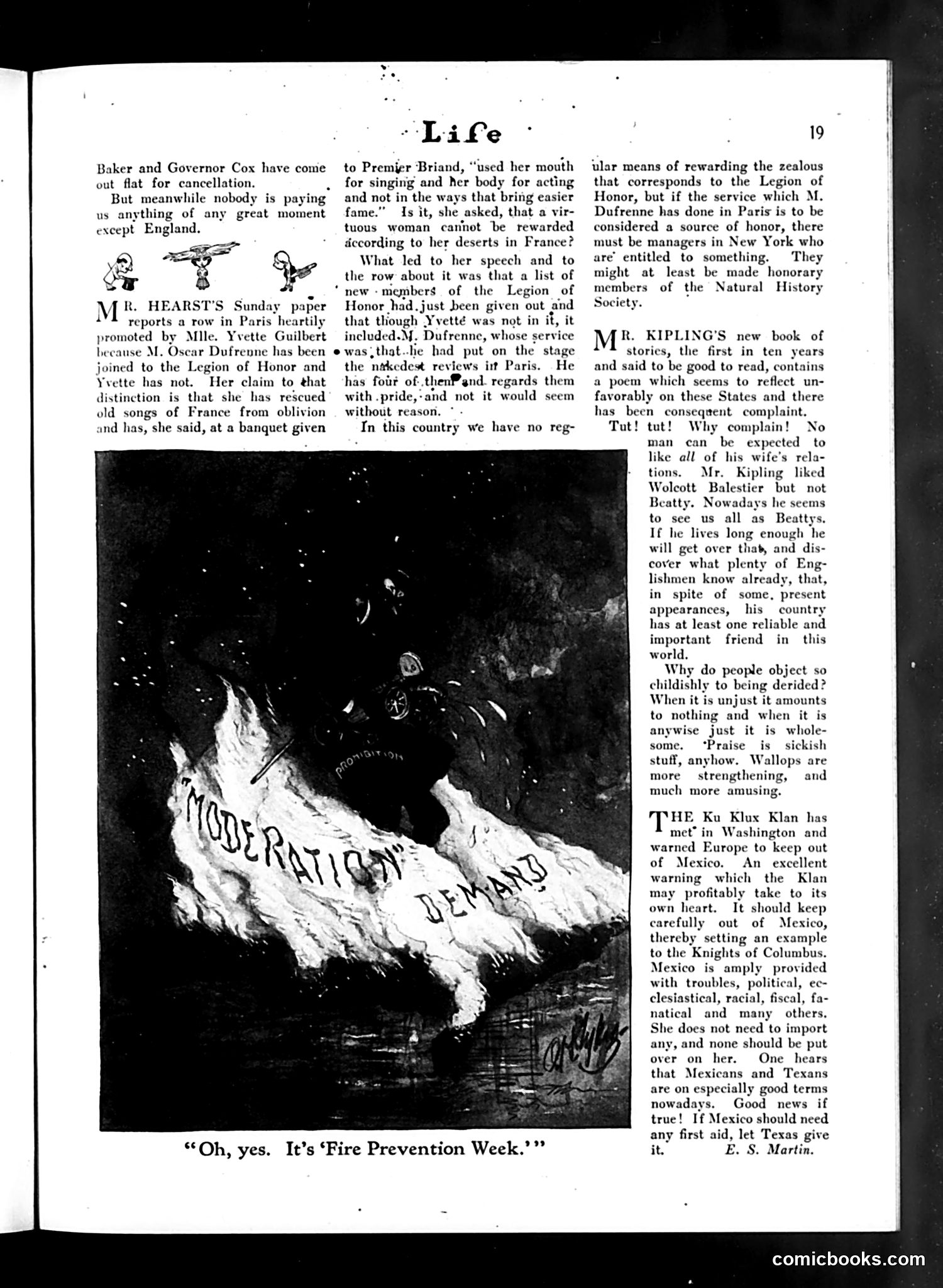
The main cartoon depicts a pig labeled "Moderation" and "Demand" on fire, with the caption "Oh, yes. It's 'Fire Prevention Week.'" **The satire:** This is likely commentary on post-WWI war debt negotiations. The text references Baker and Governor Cox calling for "cancellation" of debts, while "nobody is paying us anything of any great moment except England." The burning pig symbolizes the destruction of moderate financial demands during debt discussions—the irony being that while Fire Prevention Week promotes caution, nations are metaphorically "burning" reasonable expectations for repayment. The cartoon mocks the contradiction between preaching moderation in financial recovery while allowing debts to be largely forgiven or ignored. The accompanying articles discuss French honors disputes and Rudyard Kipling's critical views of America, representing typical Life magazine social commentary of the 1920s era.
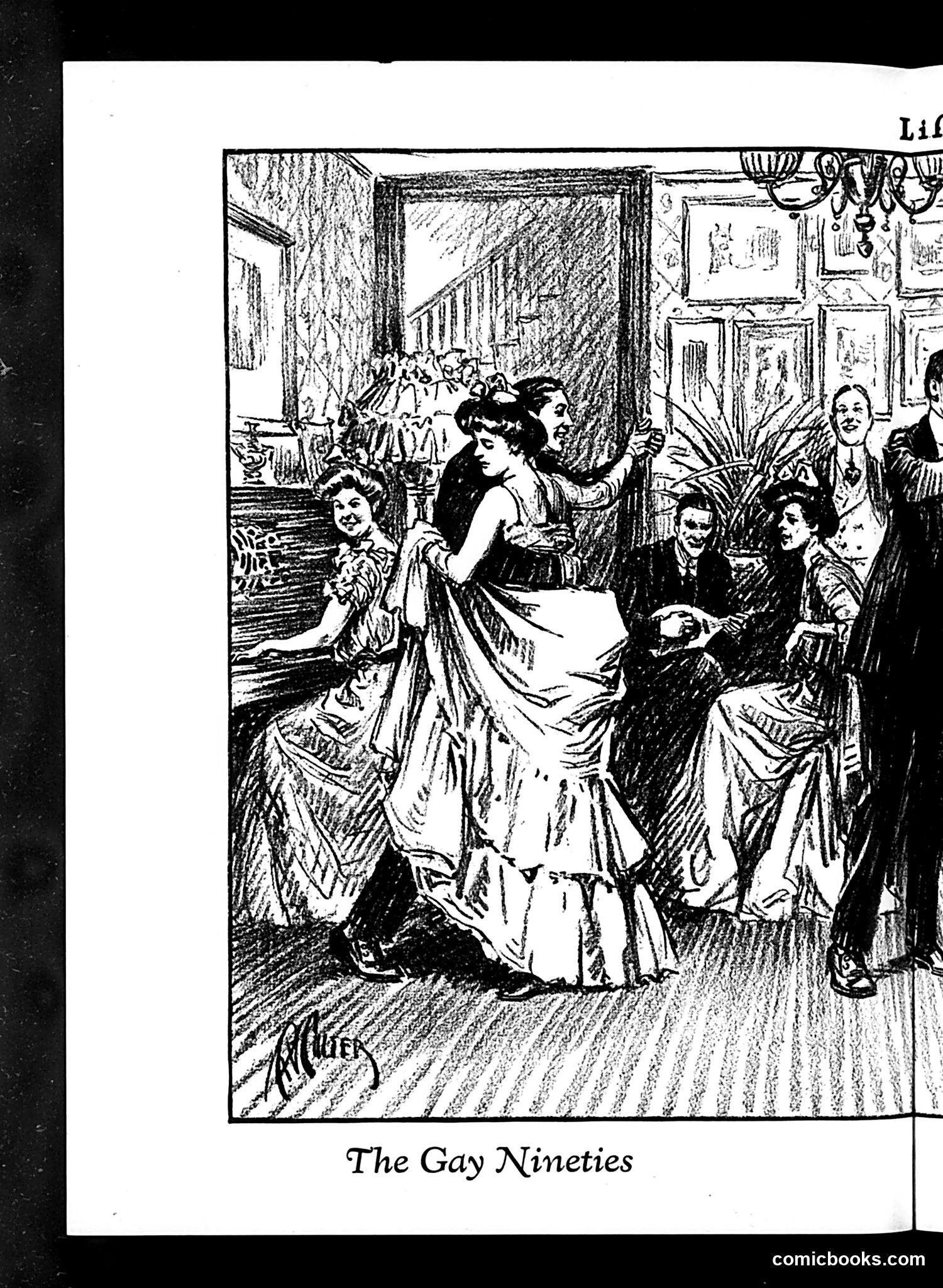
This illustration depicts a fashionable social gathering from the 1890s era, titled "The Gay Nineties." The term "Gay Nineties" was a popular nostalgic reference to the 1890s as a period of elegance, optimism, and social sophistication. The scene shows well-dressed women in elaborate gowns with full skirts characteristic of the 1890s, along with gentlemen in formal attire, gathered in what appears to be an elegant interior with framed pictures and a chandelier. The illustration satirizes or celebrates the fashionable social customs and aesthetic sensibilities of that decade—likely from Life magazine's perspective in a later era, using this period as a reference point for comparison with contemporary fashion and manners.
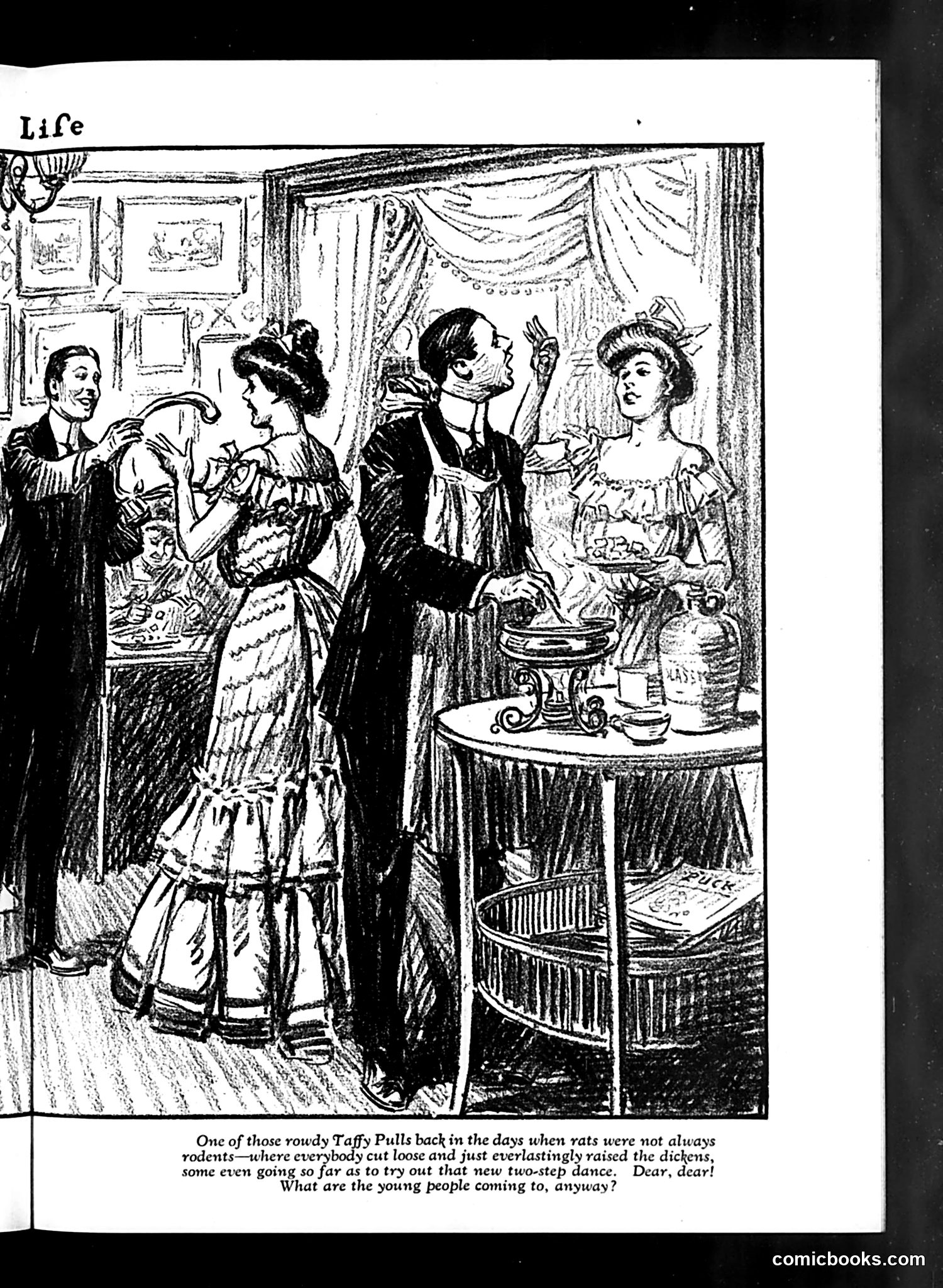
This is a satirical commentary on youth culture and social anxieties. The scene depicts a lively indoor party or "taffy pull" (a popular social gathering where guests pulled candy together). The caption's nostalgic tone—"back in the days when rats were not always rodents"—uses playful language to mock older generations' moral panic about young people. The satire targets generational concern-mongering: elderly observers fret that youth are "raising the dickens" and experimenting with the "new two-step dance," treating these innocent activities as moral threats. The phrase "What are the young people coming to, anyway?" captures the perpetual adult anxiety about youth misbehavior. The cartoon ridicules this overblown worry, suggesting each generation recycles the same fears about the next. The reference to "rats" appears to be coded slang commentary, though the exact meaning remains unclear without additional historical context.
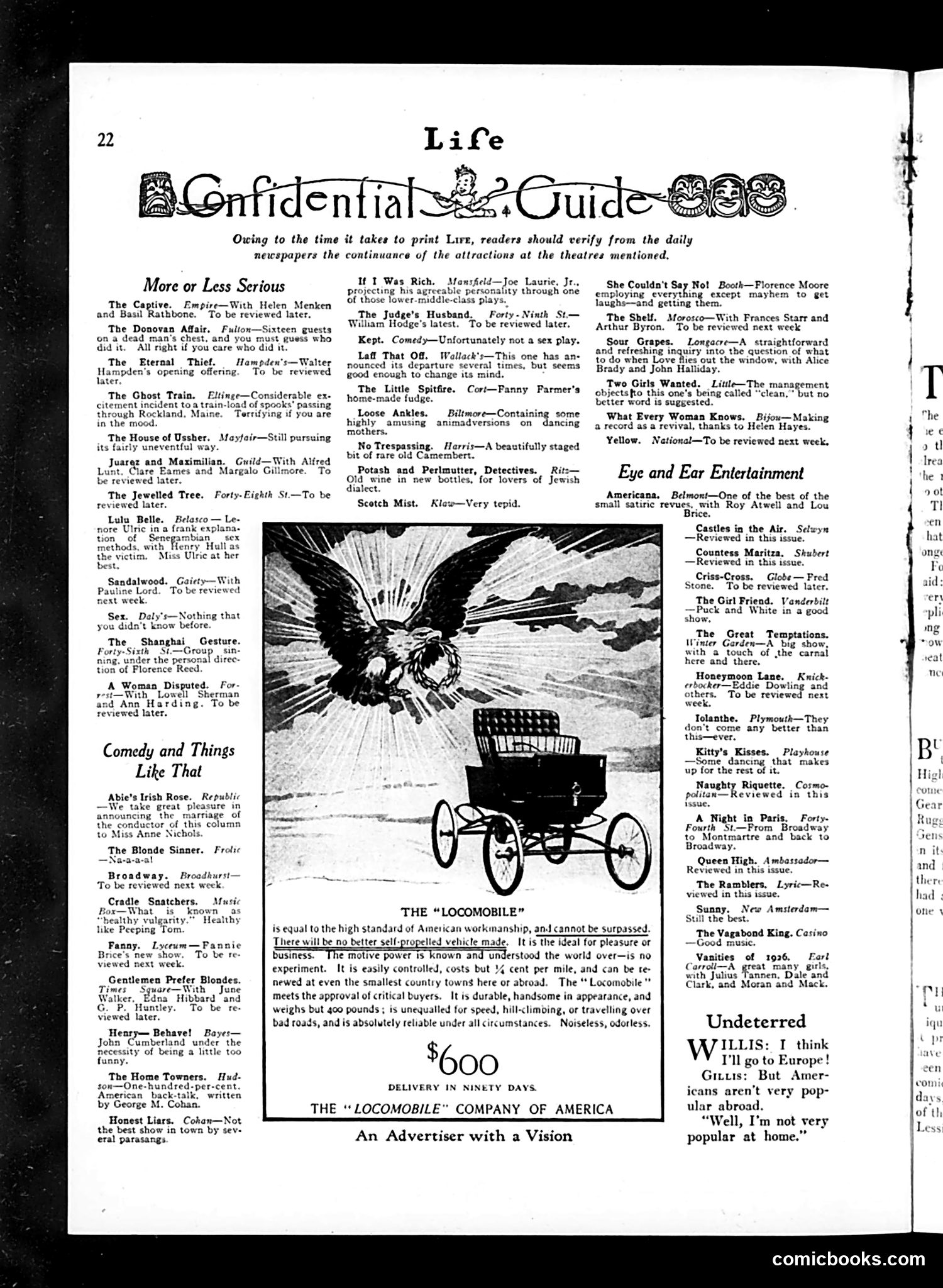
This page is primarily a **theater review guide** with an embedded automobile advertisement, not a political cartoon. The content lists Broadway shows opening that season (1920s era), with brief, often sardonic reviews. The satire is **theatrical and social commentary** rather than political—critics mock predictable plots ("Sex"—"Nothing that you didn't know before"), tired comedies, and formulaic dramas. References like "Abie's Irish Rose" and "Potash and Perlmutter" indicate Jewish-themed comedies popular at the time. The large central image advertises the **"Locomobile" automobile** ($600, delivery in 90 days), presented as modern engineering. The accompanying text emphasizes American manufacturing quality and reliability—standard early-auto marketing emphasizing durability and affordability. The page's humor stems from theatrical criticism's **flip dismissiveness**: shows are reduced to single cutting sentences. This reflects 1920s Life magazine's signature style—irreverent commentary on contemporary entertainment and consumer culture, not political satire.
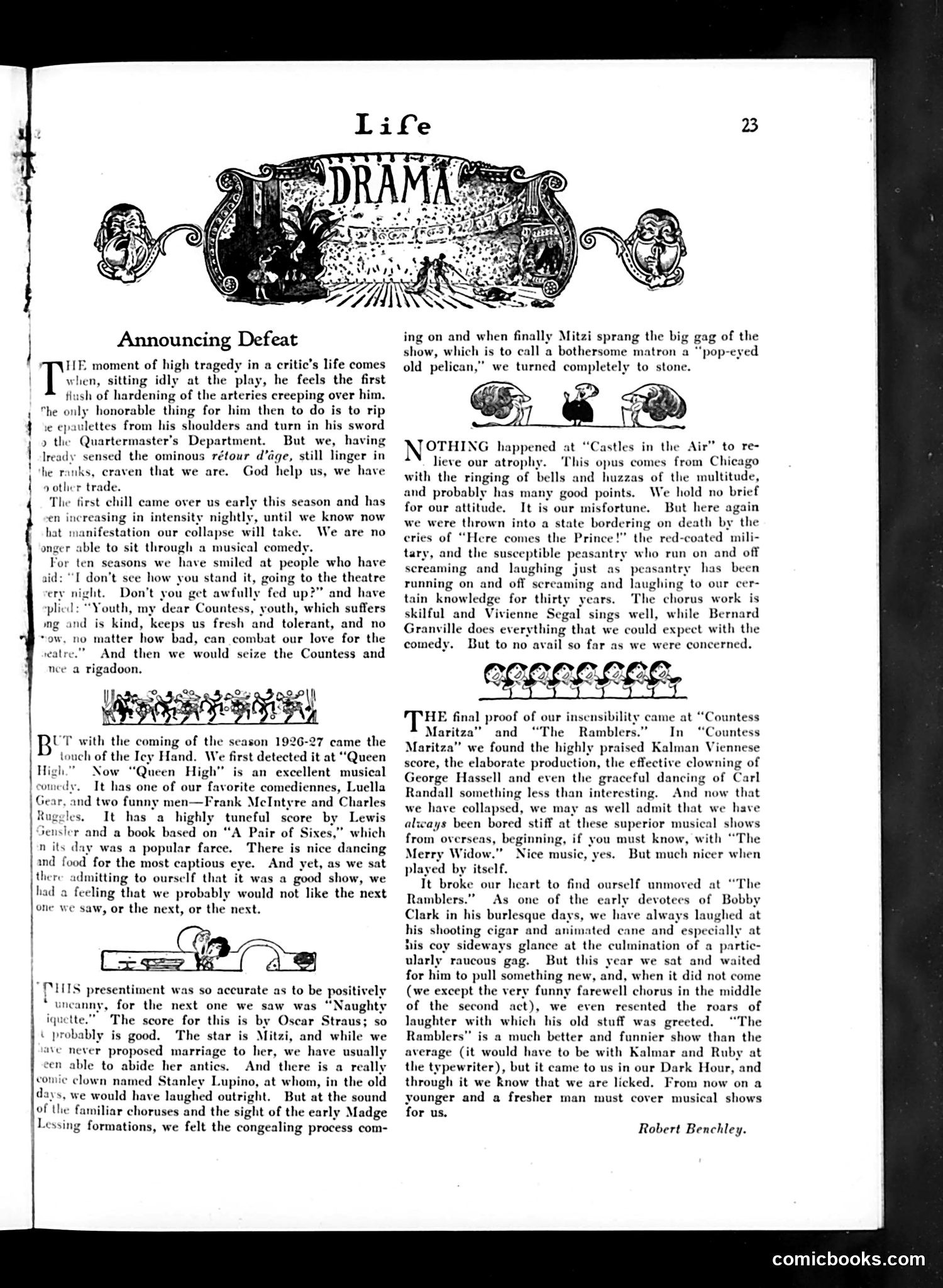
This is a theater critic's confession of professional burnout. The author admits he can no longer enjoy musical comedies—a devastating admission for someone paid to review theater nightly for ten seasons. The piece traces his collapse through the 1926-27 season, citing specific shows: "Queen High," "Naughty Etiquette" (starring Mitzi), "Castles in the Air" (featuring Vivienne Segal), "Countess Maritza," and "The Ramblers." Despite acknowledging these productions have merit—good scores, talented performers, skillful choreography—he finds himself emotionally dead to them. The satire is self-directed: a critic admitting he's become too old and jaded to feel anything. He jokes that "the moment of high tragedy in a critic's life" is realizing his "arteries are hardening." His only honorable option, he suggests mockingly, is resignation—removing his "epaulettes" like a defeated soldier. The small cartoon illustrations (heads/faces) appear decorative rather than specific caricatures of identifiable figures.
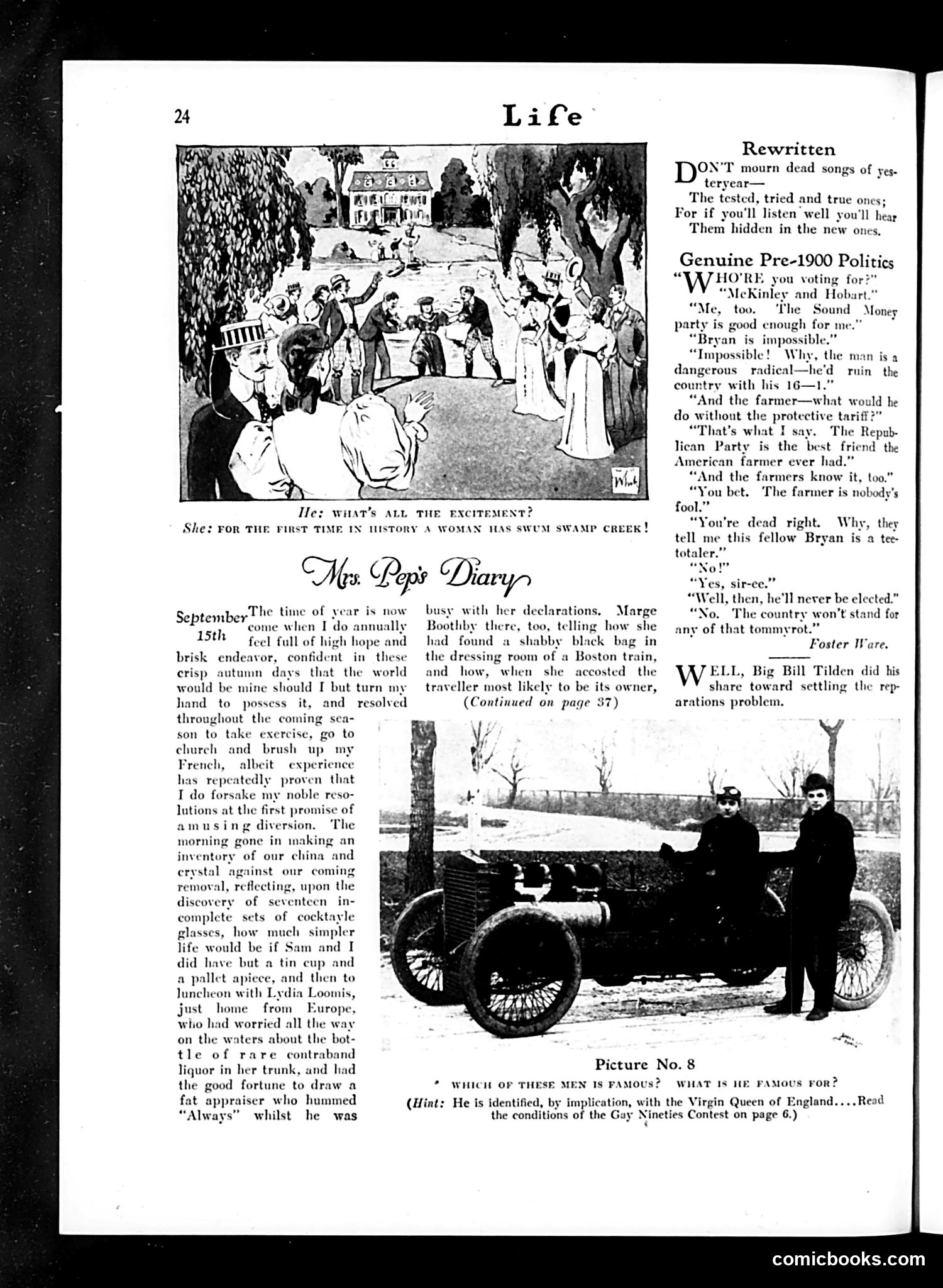
This page contains three satirical pieces from early-1900s Life magazine: **Top cartoon**: Mocks women's athletics. A woman swimming "Swamp Creek" for the first time causes excitement—the joke being that this trivial achievement is treated as momentous, satirizing both women's limited opportunities and the era's sensationalism about female participation in physical activities. **"Mrs. Pep's Diary"**: Social satire about upper-class women's vacuous concerns—inventory of cocktail glasses, gossip about found luggage—contrasted with their stated good intentions (exercise, church, French lessons). **"Genuine Pre-1900 Politics"**: Political satire of the 1896 election era, mocking Republicans' arguments: McKinley/Hobart voters defend the "Sound Money" position, dismiss Bryan as a dangerous radical supporting "16-1" (the free silver ratio), and claim the Republican Party protects farmers. The satire suggests these talking points are hollow and repetitive. **Picture No. 8**: A contest asking readers to identify which man is "famous," hinting at connection to the "Virgin Queen of England"—likely referencing a contemporary figure, though identification is unclear without the referenced page 6.
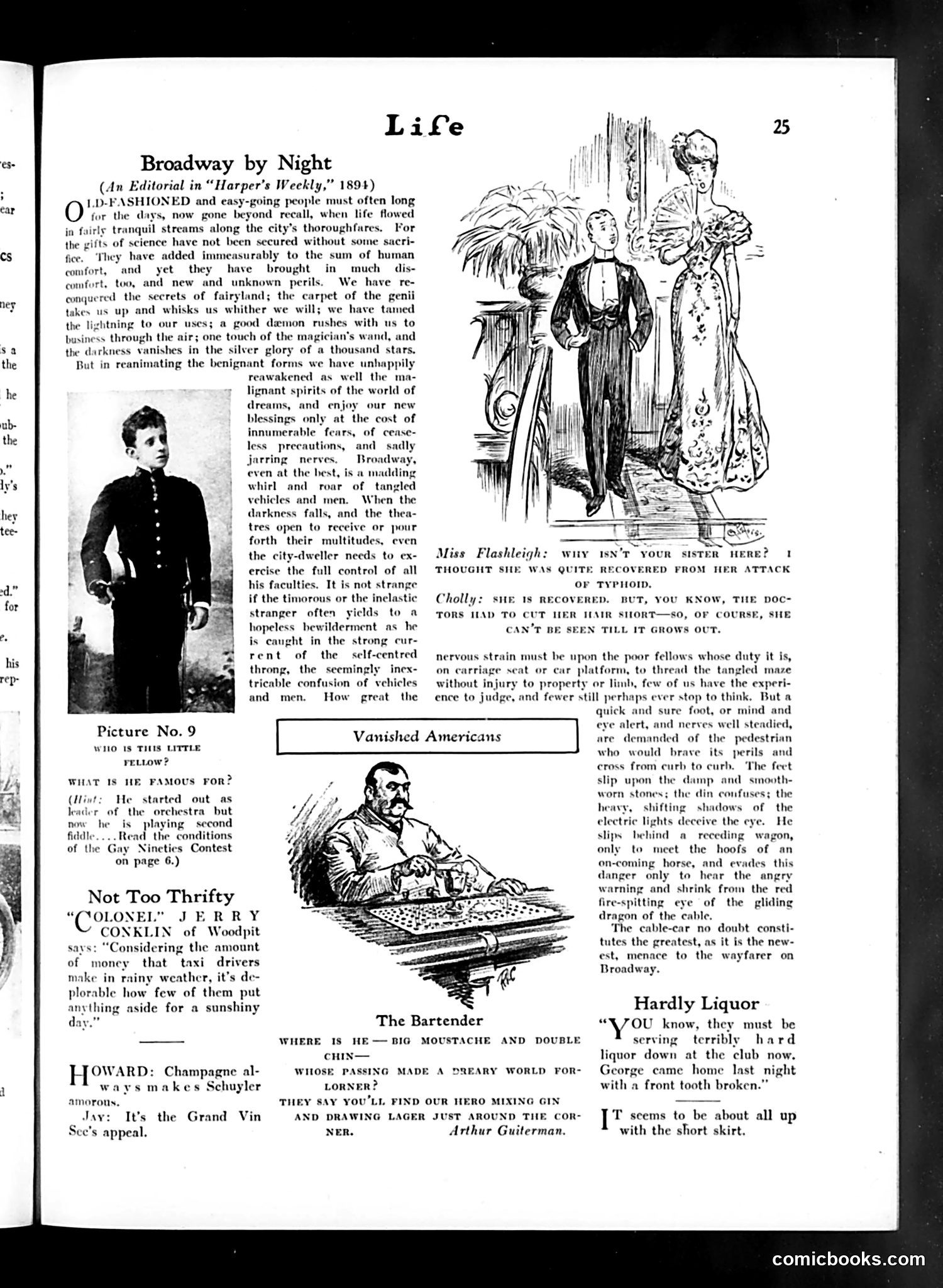
**"Broadway by Night"** is an editorial essay lamenting how modern urban conveniences—electric lights, streetcars, transportation—have made city life more chaotic and dangerous than the "tranquil streams" of earlier times. The piece critiques the nervous strain on pedestrians navigating Broadway's crowded nighttime streets, where cable cars pose the "greatest menace to the wayfarer." **The cartoon vignettes** are satirical social humor unrelated to the editorial: - **"Picture No. 9"**: A quiz asking readers to identify an unnamed "little fellow" famous for being second fiddle in an orchestra (unclear who without more context). - **"Not Too Thrifty"**: Colonel Jerry Conklin ironically laments taxi drivers' poor savings habits despite rainy-weather profits. - **"The Bartender" / "Vanished Americans"**: A bartender's missing double chin and big mustache made a "dreary world" for customers. - **"Hardly Liquor"**: A joke about a man's broken tooth suggesting he drank excessively at his club. The page reflects *Life's* dual purpose: serious social commentary alongside light, gossipy humor about urban characters and manners.
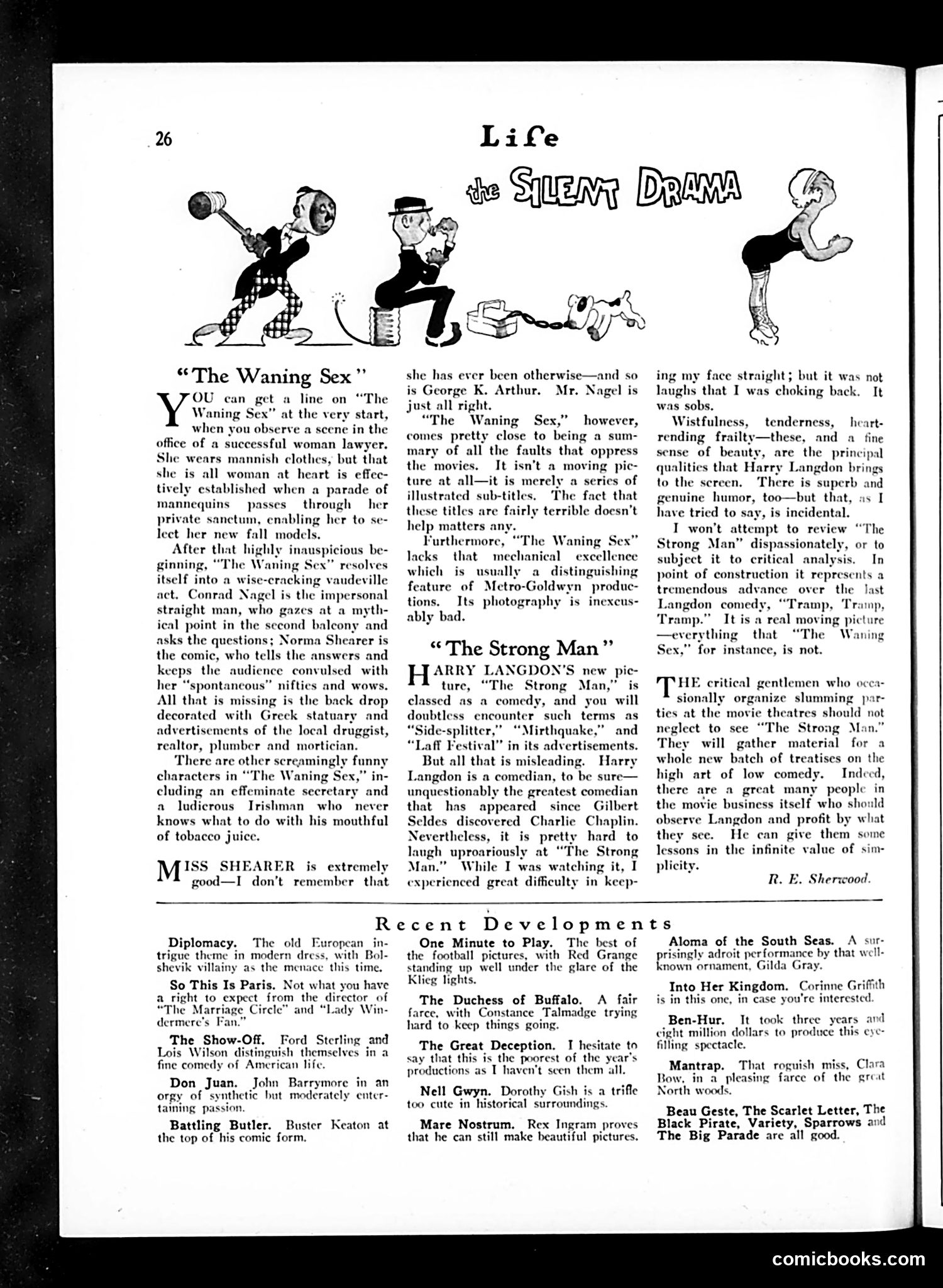
This *Life* magazine movie review page critiques two 1920s silent films. The cartoons at top illustrate "The Waning Sex"—showing a female lawyer in masculine dress selecting fashionable models, satirizing the "New Woman" of the era. The reviews reveal era-specific concerns: *The Waning Sex* is dismissed as merely illustrated title cards with poor photography—a common criticism of early silent films lacking cinematic sophistication. Reviewer R.E. Sherwood praises Harry Langdon's *The Strong Man* as genuinely moving rather than merely comedic, arguing Langdon (discovered after Charlie Chaplin) brings "wistfulness, tenderness, heart-rending frailty" to cinema. The page reflects 1920s cultural anxiety about gender roles (the "waning" femininity) and the emerging medium's struggle between theatrical vaudeville-style comedy and genuine cinematic art. The "Recent Developments" section lists other contemporary films with minimal commentary.
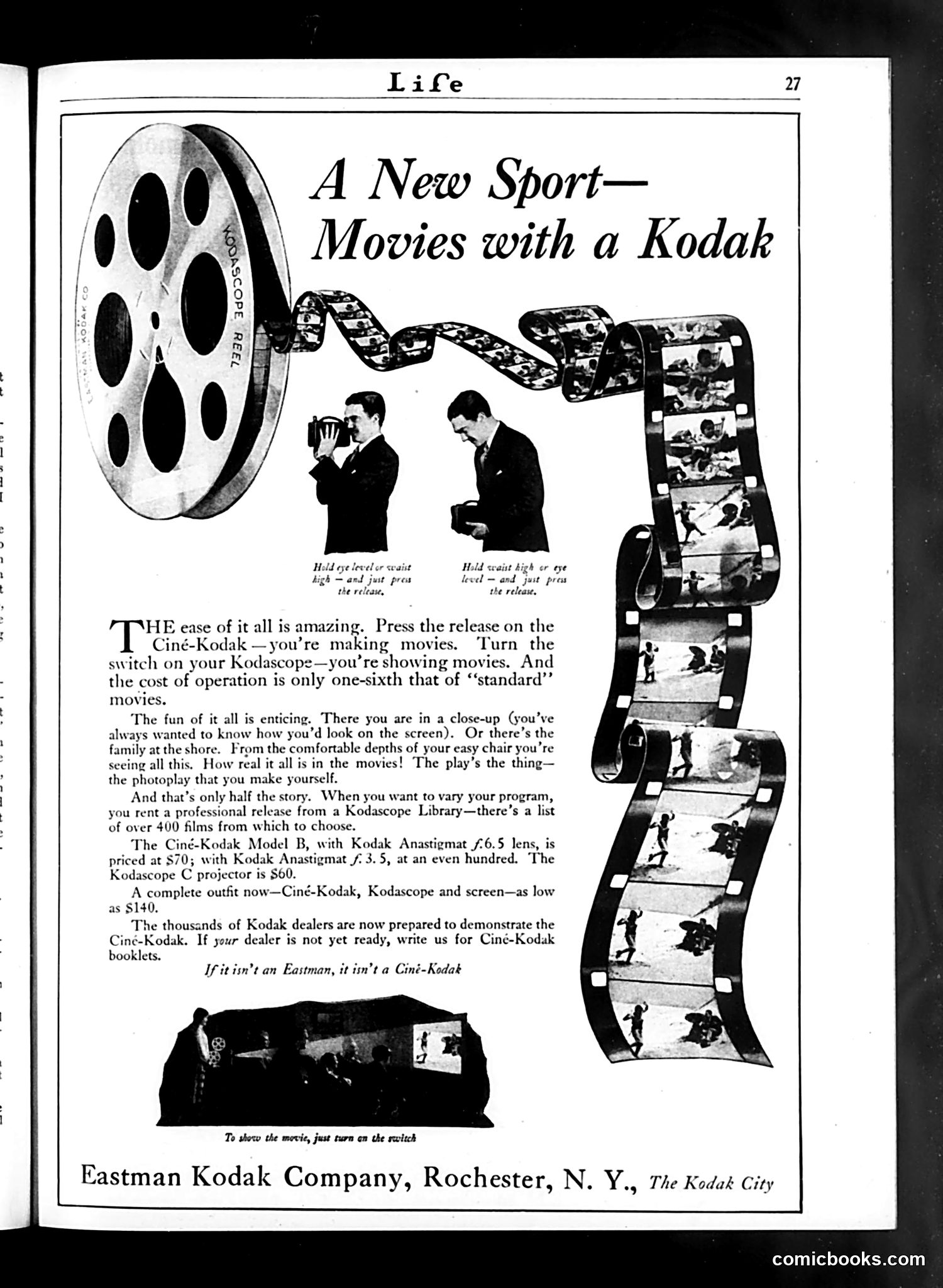
This is **not satire or political commentary**—it's a straightforward product advertisement from Life magazine for Kodak's new home movie camera system (the Ciné-Kodak). The page promotes amateur filmmaking as an accessible hobby. Two men are shown holding the camera at different angles ("Hold eye level or waist high"), demonstrating how easy it is to operate. The film strip displayed shows typical home-movie subjects: family scenes and outdoor activities. The appeal is democratic: ordinary people can now make and watch their own movies affordably—one-sixth the cost of professional filmmaking. The tagline "If it isn't an Eastman, it isn't a Ciné-Kodak" emphasizes brand authority. This reflects 1920s consumer culture enthusiasm: new technology making entertainment accessible to middle-class households. The "sport" framing suggests recreational appeal to modernizing American consumers.
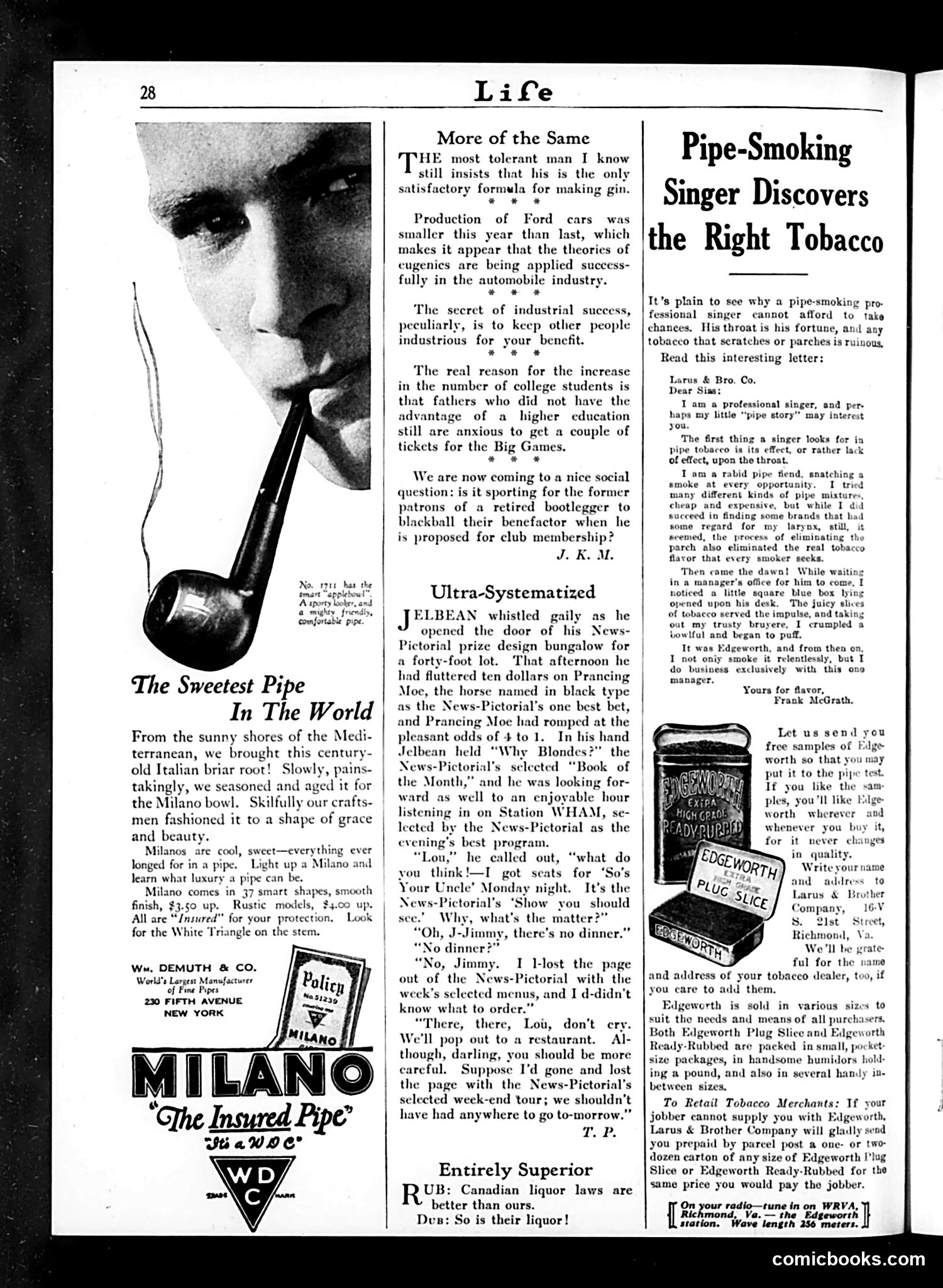
This page is primarily **advertisements and light satirical commentary** from an early 20th-century American magazine. The main content includes: **Milano Pipe Advertisement** (left): A luxurious pipe marketed as imported Italian briar, emphasizing quality and craftsmanship—typical high-end consumer marketing of the era. **"More of the Same"** (column): Brief satirical observations on contemporary American life, including jokes about Prohibition-era gin, Ford's declining production (possibly referencing eugenics theories), and college attendance driven by attending football games rather than education. **"Ultra-Systematized"** (story): A satirical short story mocking blind consumerism and over-reliance on commercial media. The protagonist (Jelbean) depends entirely on the "News-Pictorial" newspaper for all decisions—horse betting, entertainment choices, restaurant menus, weekend plans—illustrating how advertising and media manipulation had saturated American consumer culture. **Pipe Tobacco Advertisement** (right): Features testimonial from a professional singer endorsing Edgeworth tobacco for throat safety. The satire criticizes how modern Americans had become dependent on commercial media to direct their lives.
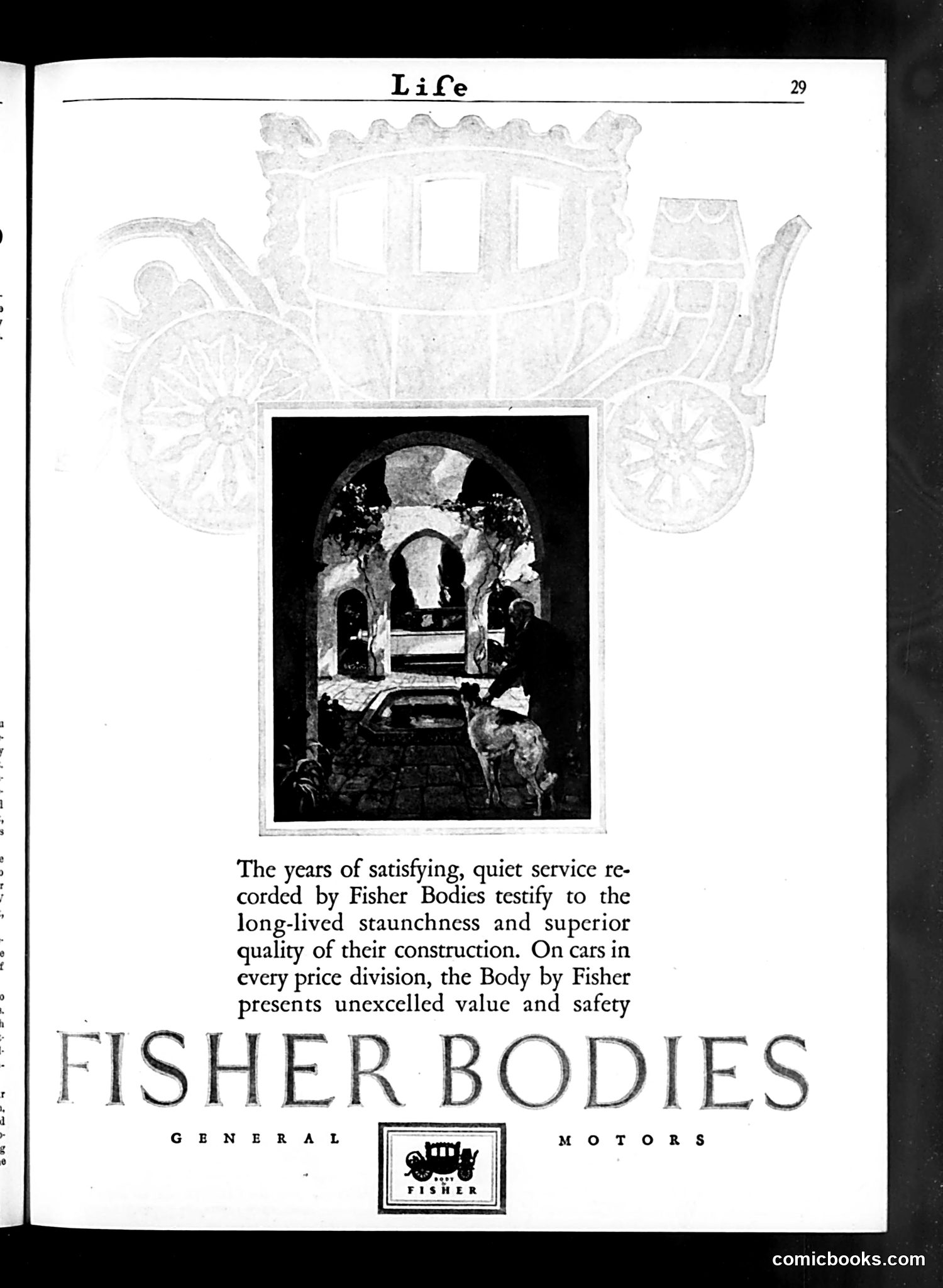
This page is primarily a **product advertisement** for Fisher Bodies, a major automobile body manufacturer of the early-to-mid 20th century. The top illustration shows an ornate horse-drawn carriage, establishing the company's historical pedigree. The central photograph depicts an elegant enclosed automobile interior with arched ceilings and classical architectural details, emphasizing luxury and craftsmanship. The advertisement's text claims Fisher Bodies offer superior quality, durability, and safety across all price ranges. The Fisher logo appears at the bottom alongside the General Motors affiliation—Fisher Bodies was a subsidiary of GM. This is not satire or political commentary, but straightforward corporate advertising emphasizing manufacturing reliability and value to potential car buyers during an era when automobile body construction quality was a significant selling point.
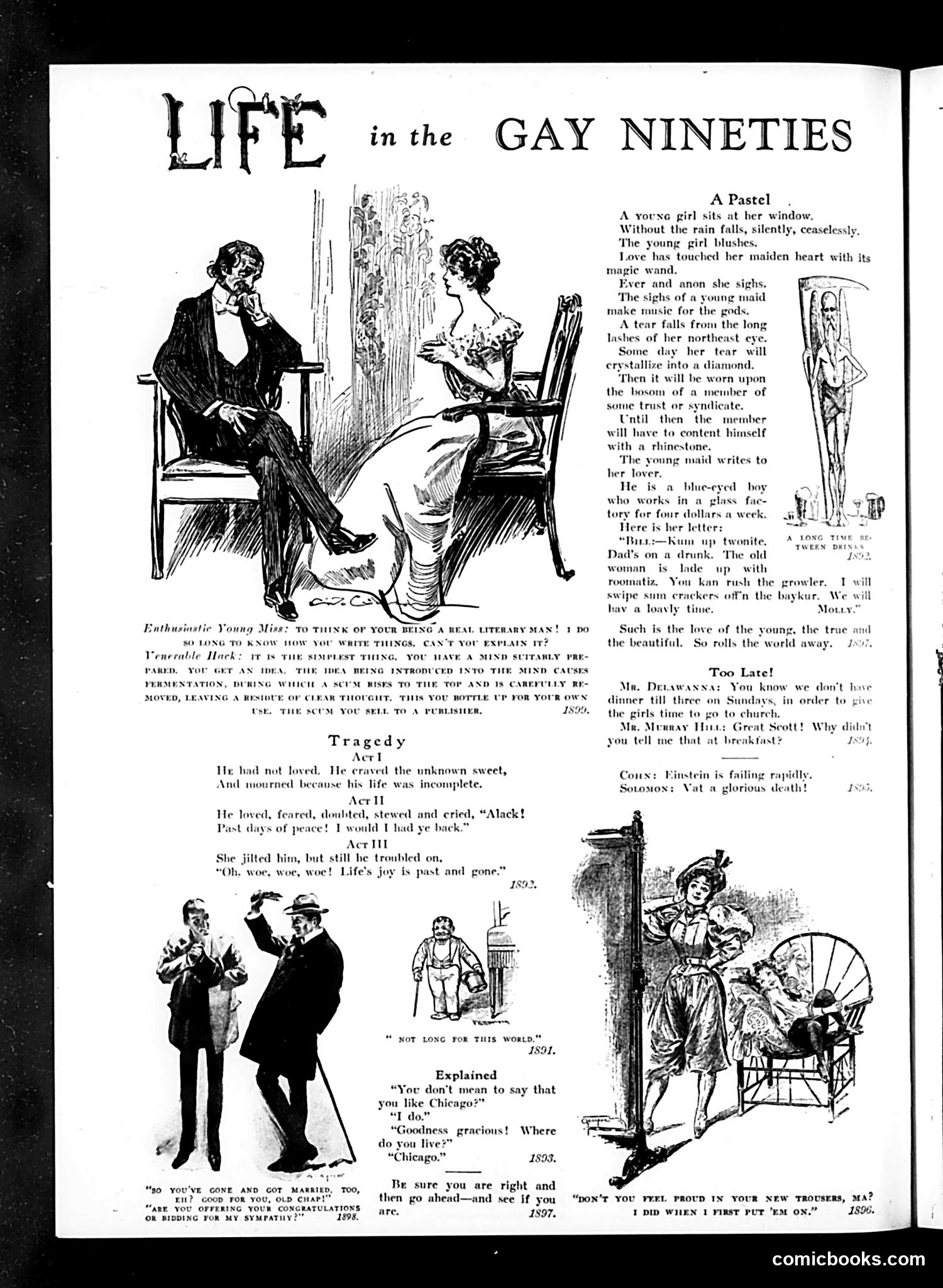
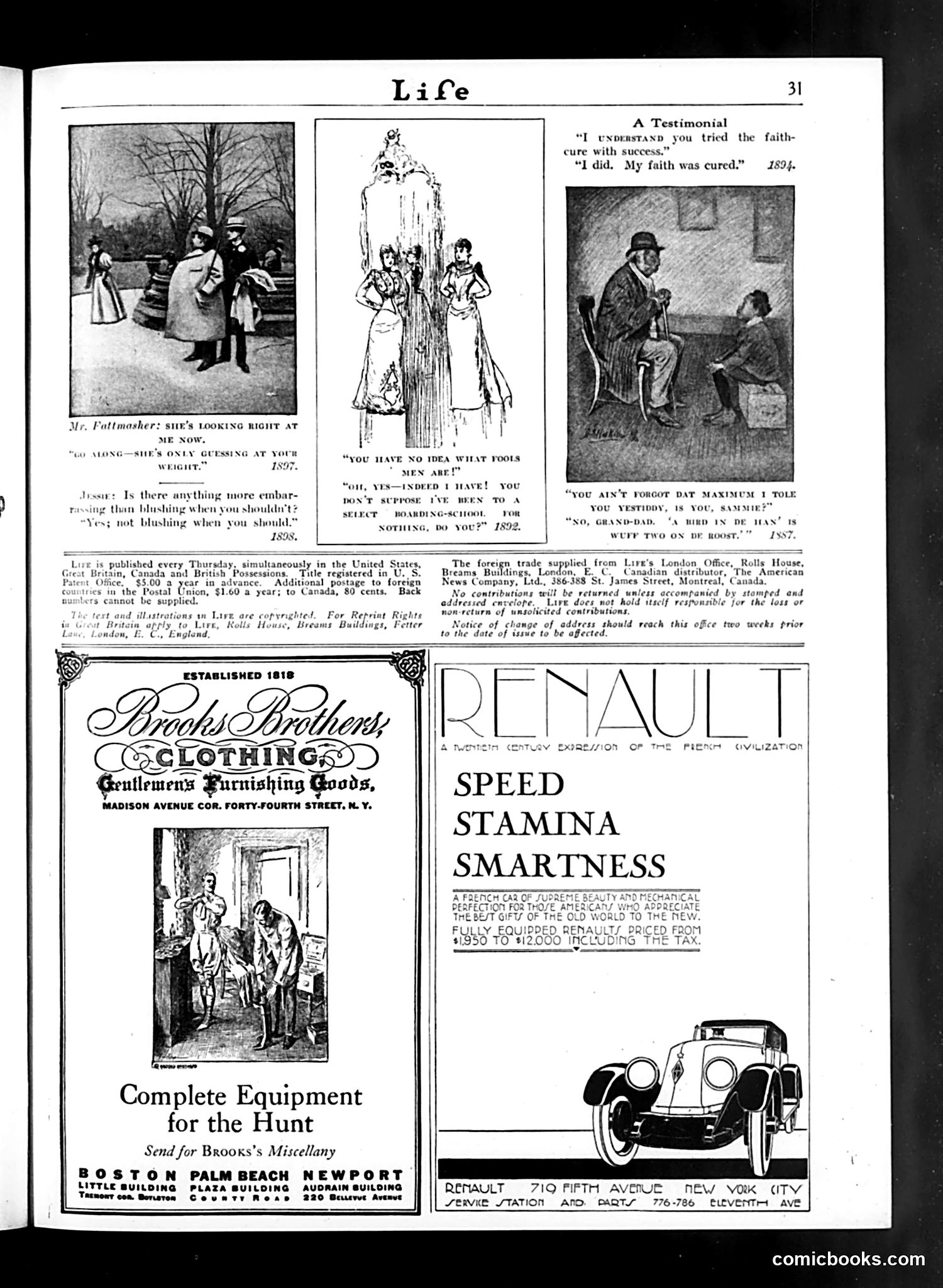
This page contains three brief satirical comics addressing Victorian social etiquette and gender dynamics: **"Mr. Fattmasher"** mocks weight consciousness, with a woman pointedly observing a portly man's appearance while he squirms. **"The Boarding School" cartoon** depicts an intergenerational clash: an older woman interrogates a young girl about her boarding school education, suggesting the girl lacks proper refinement or knowledge expected of her class. **"Dat Maximum"** features dialect-heavy dialogue between what appears to be working-class or immigrant characters discussing a domestic mishap, using exaggerated speech patterns typical of period comic stereotypes. The humor trades on embarrassment, social pretension, class anxiety, and period concerns about proper feminine education and deportment. The ads for Brooks Brothers clothing and Renault automobiles underscore the page's target audience: affluent, status-conscious readers concerned with maintaining social standing.
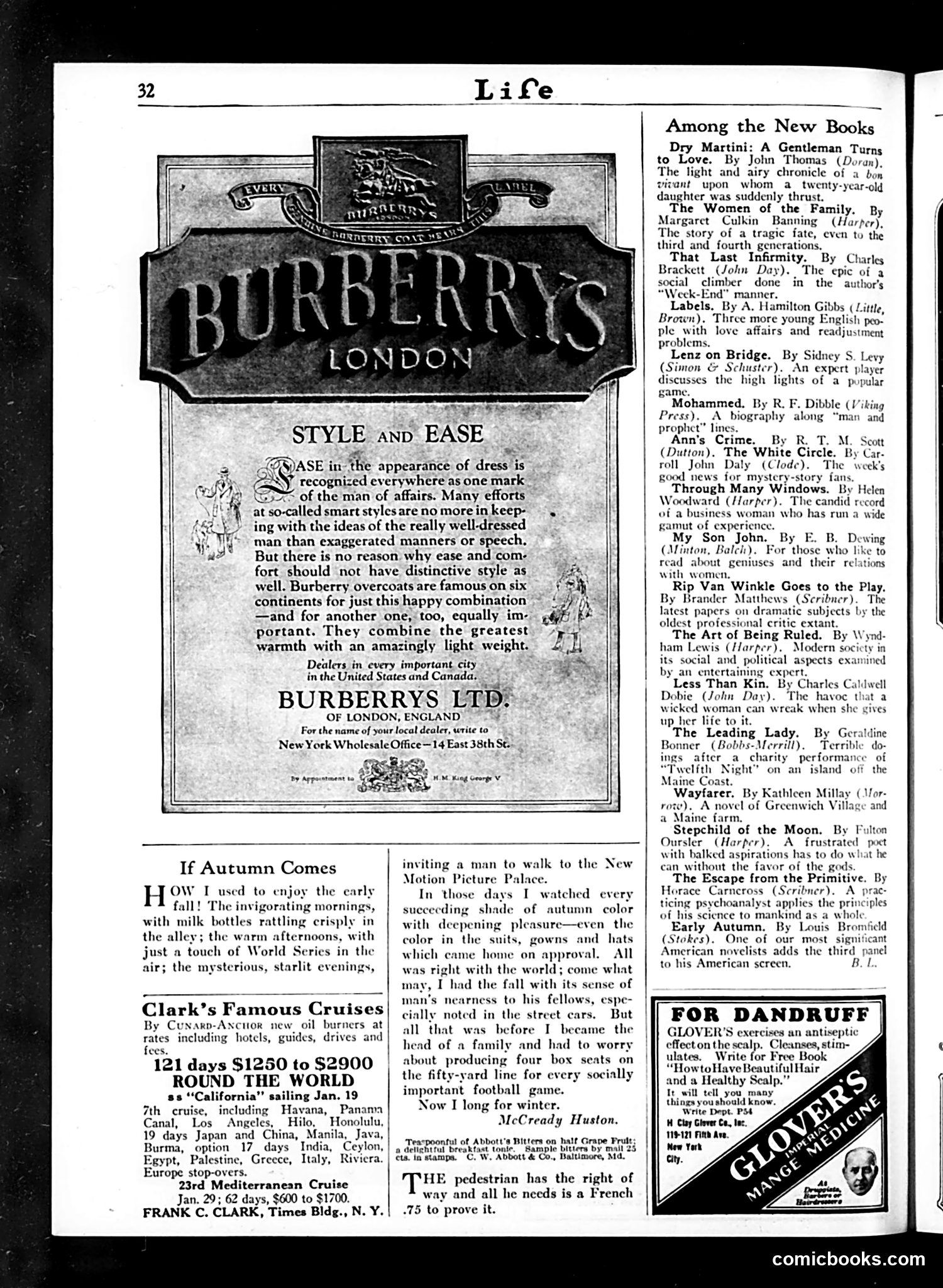
This is primarily a **Burberry's advertisement** (center) emphasizing style and practicality in overcoats—a major fashion statement for the 1920s well-dressed man. The accompanying essay "If Autumn Comes" by McCready Huston is a **humorous lament** about lost innocence. The author recalls enjoying early fall's simple pleasures—crisp mornings, World Series season, romantic walks to movie palaces. But now, as a family man responsible for securing four expensive box seats at football games for "socially important" events, he finds autumn stressful and longs for winter instead. The joke: **adult responsibilities destroy carefree pleasure**. Modern readers might relate to similar sentiments about how parenthood/adulthood transforms once-enjoyable seasons into sources of financial and social anxiety. The page rounds out with book reviews and cruise advertisements—typical Life magazine content from the 1920s-30s era.
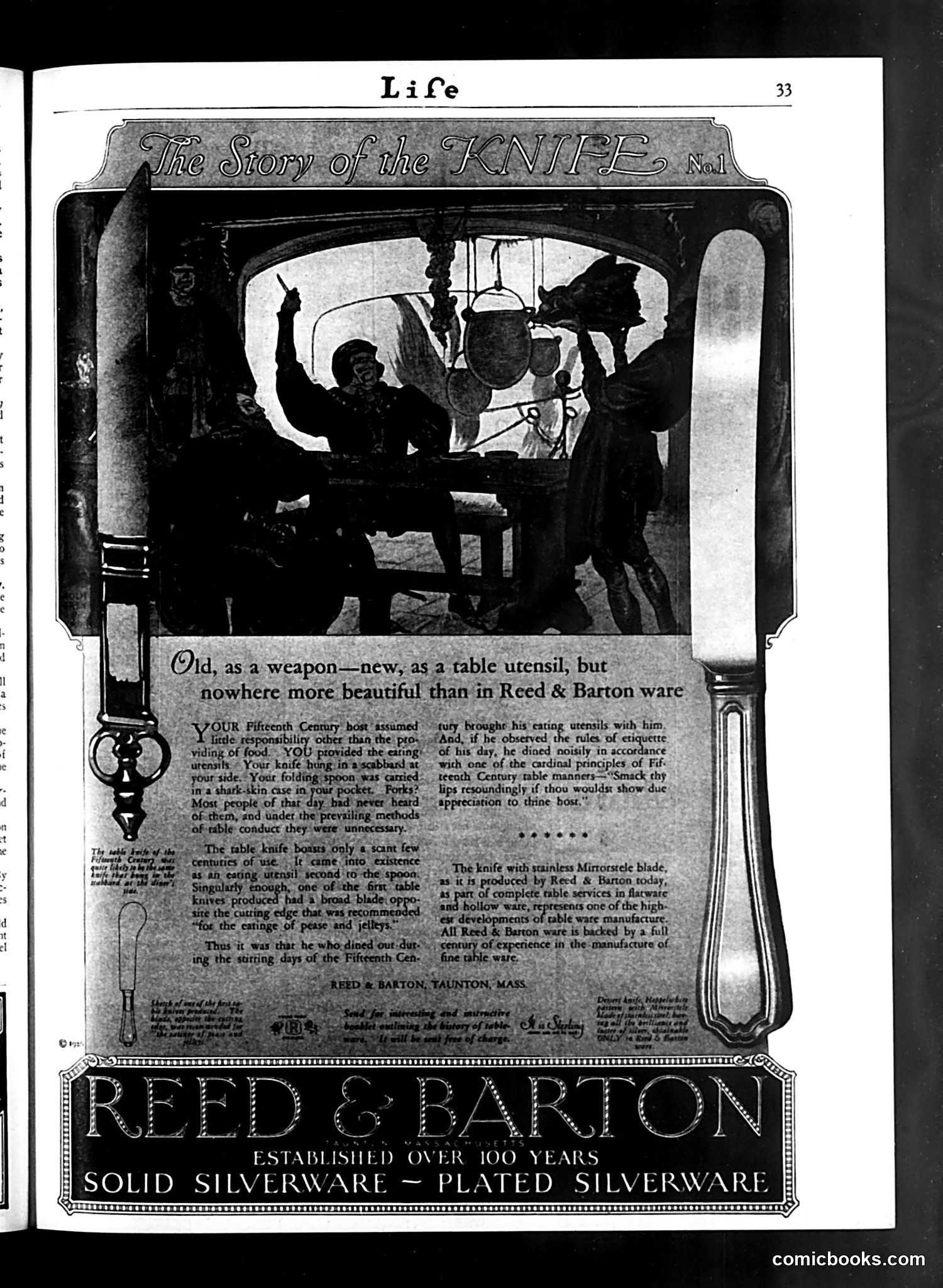
This is primarily a **product advertisement**, not political satire. The page features a staged historical scene depicting 15th-century dining etiquette, illustrating how the table knife evolved from a simple weapon into refined tableware. The image shows period-dressed figures demonstrating proper knife use at a formal dinner, emphasizing the sophistication of Reed & Barton's silverware manufacturing. The accompanying text describes the knife's historical development and positions the company's products as embodying centuries of craftsmanship and fine dining standards. The "satire" is gentle—contrasting crude medieval table manners with refined 15th-century etiquette—but this is fundamentally **commercial content** meant to establish brand prestige through historical narrative rather than social commentary.
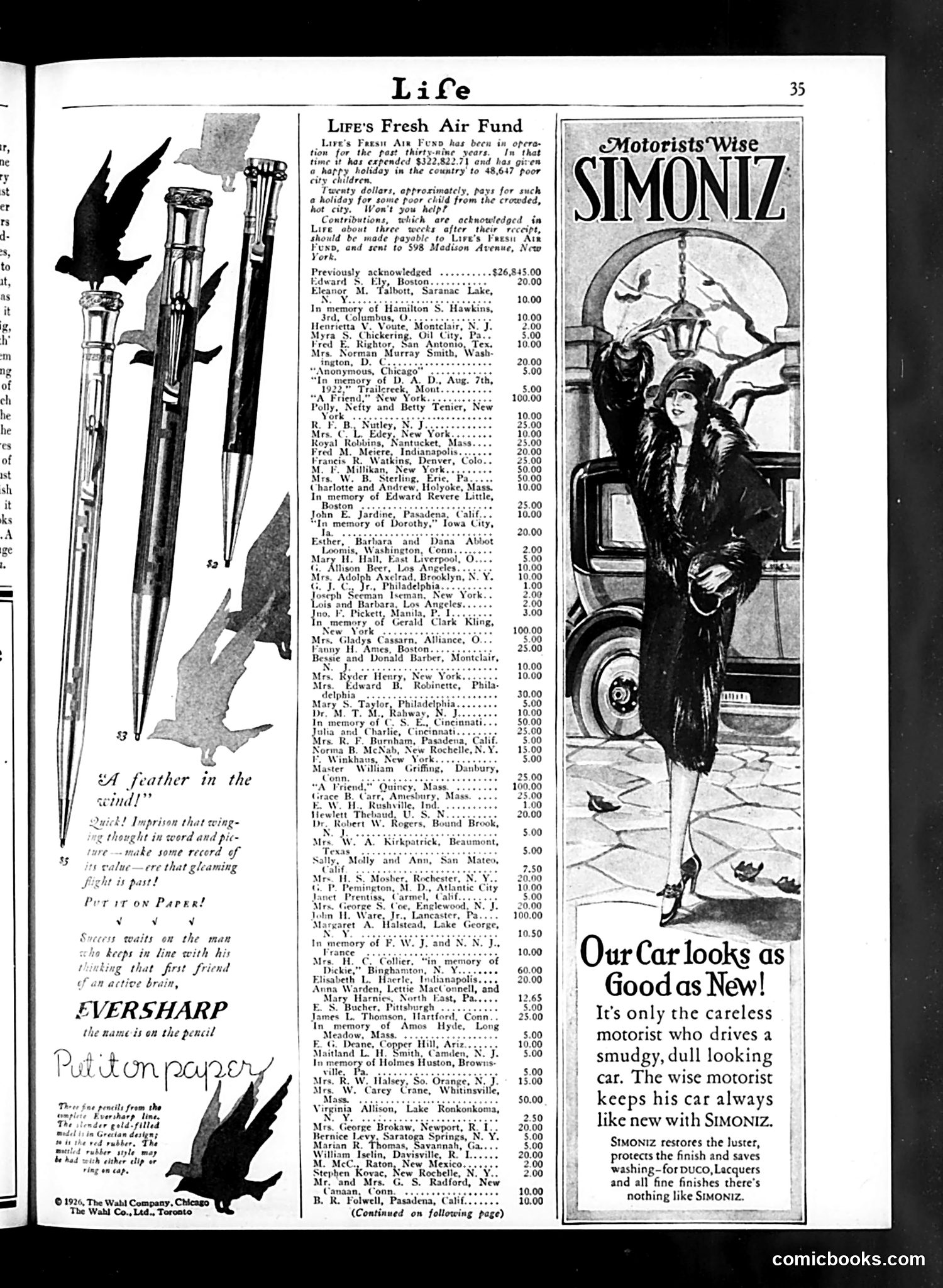
This page contains **advertising and charitable content**, not political cartoons. The left side features **product advertisements**: Eversharp pencils (emphasizing precision and success) and Eversharpe pens, using the metaphor "A feather in the wind" to suggest capturing important thoughts in writing. The center presents **Life's Fresh Air Fund**, a genuine charitable initiative that provided country vacations for poor city children. The extensive donor list documents contributions—typically $5-$100—toward the fund's goal of giving 48,647 children holidays away from crowded urban tenements. This reflects Progressive Era philanthropy. The right side advertises **Simoniz car polish**, targeting the expanding automobile market. The ad contrasts the "careless motorist" with the "wise motorist" who maintains appearance—reflecting 1920s consumer culture and the status symbol of car ownership. **No satire or political commentary is present.** This is a standard magazine page mixing charitable fundraising with commercial advertising typical of 1920s Life magazine.
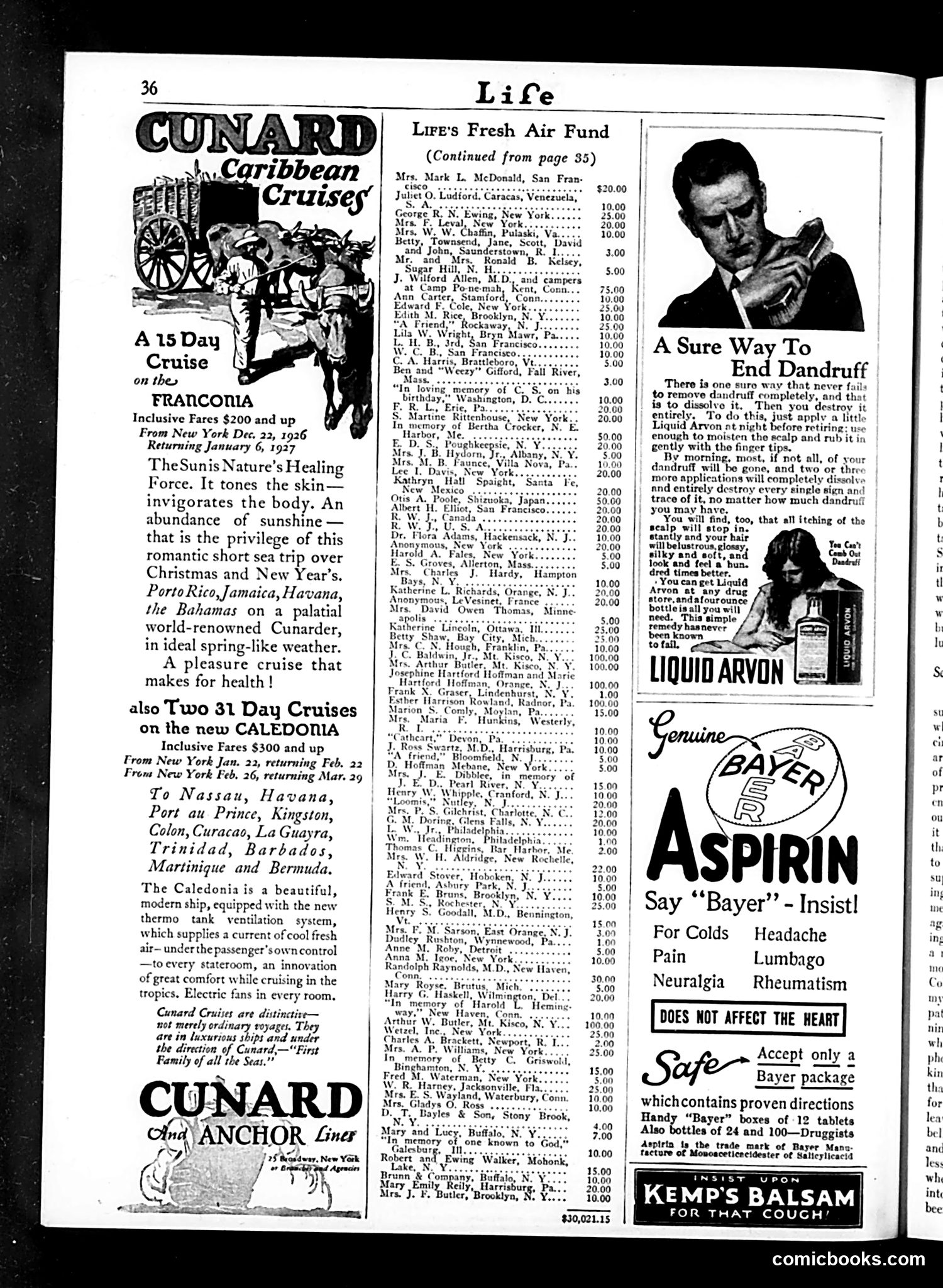
This page is primarily **advertising**, not satire or political commentary. It contains three major advertisements: 1. **Cunard Caribbean Cruises**: Promotes luxury ocean voyages to tropical destinations (Jamaica, Havana, Bahamas) departing December 1926. The ad emphasizes health benefits of sunshine and the prestige of traveling on "Cunard,—'First Family of all the Seas.'" 2. **Life's Fresh Air Fund continuation**: A charitable giving list showing donors' names and amounts contributed to send underprivileged children to camp. 3. **Patent medicines**: Advertisements for Liquid Arvon (dandruff treatment) and Bayer Aspirin, highlighting their uses for colds, headaches, and rheumatism—typical early 20th-century remedies, including the now-dubious claim that Bayer "does not affect the heart." The page reflects 1920s consumer culture: luxury travel marketing, philanthropic causes, and aggressive pharmaceutical advertising to middle-class readers.
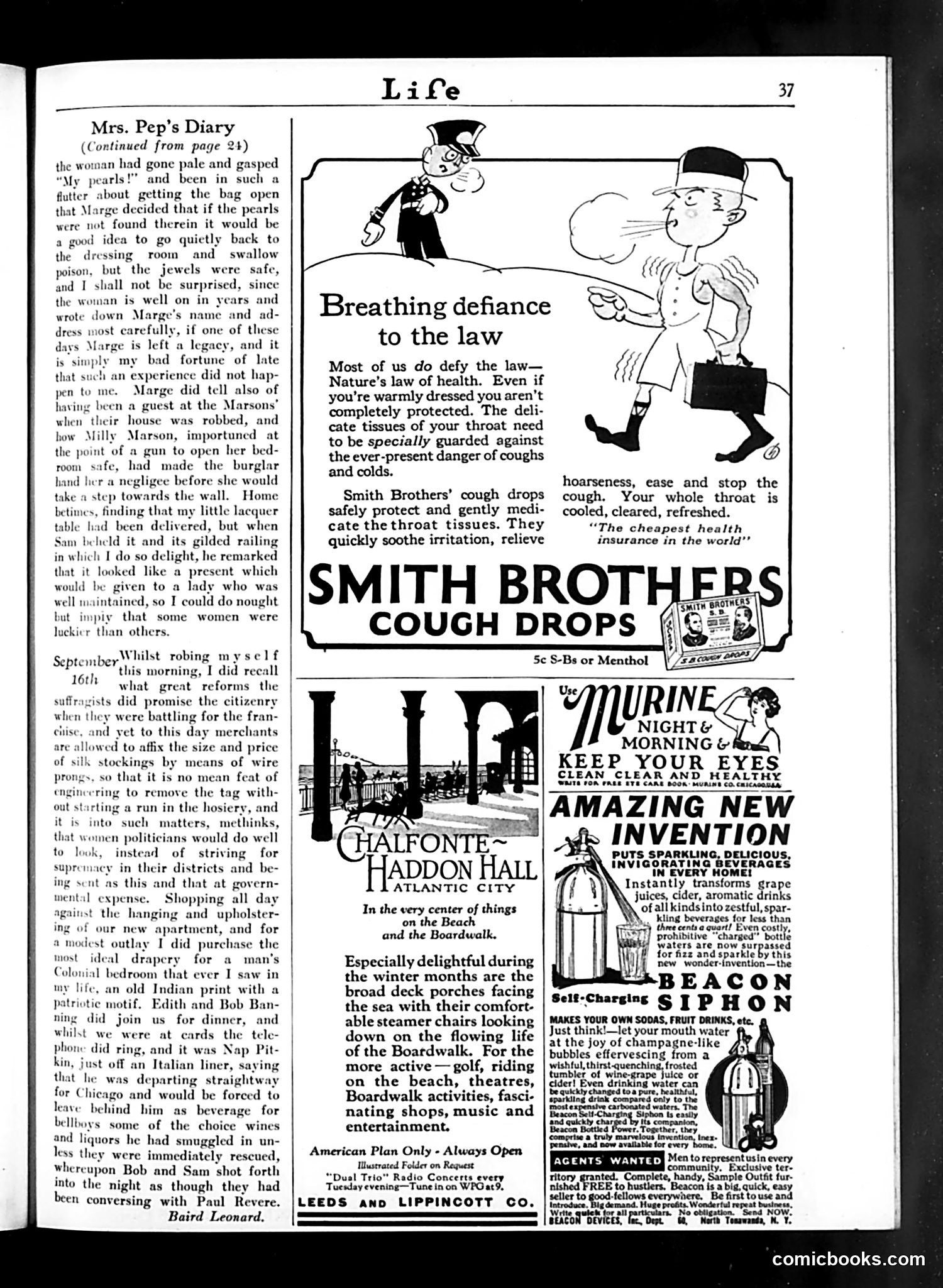
This page contains **Mrs. Pep's Diary**, a satirical society column recounting the author's experiences among wealthy socialites. The humor targets upper-class absurdities: a guest so anxious about her pearls she considers suicide; another woman who, when robbed at gunpoint, demands her negligee before opening her safe—prioritizing modesty over practicality. A September 16th entry mocks female suffragists, suggesting their fight for voting rights proved hollow since they haven't addressed trivial annoyances like price tags on stockings that cause runs. The final anecdote satirizes Prohibition-era hypocrisy: respected citizens (Bob and Sam) eagerly rush into the night to smuggle wine from a returning traveler, treating illegal bootlegging as a patriotic adventure. The page is dominated by period **advertisements** for Smith Brothers cough drops, Murine eye drops, a New Jersey hotel, and a Beacon siphon device—typical 1920s product placements with minimal satirical content.
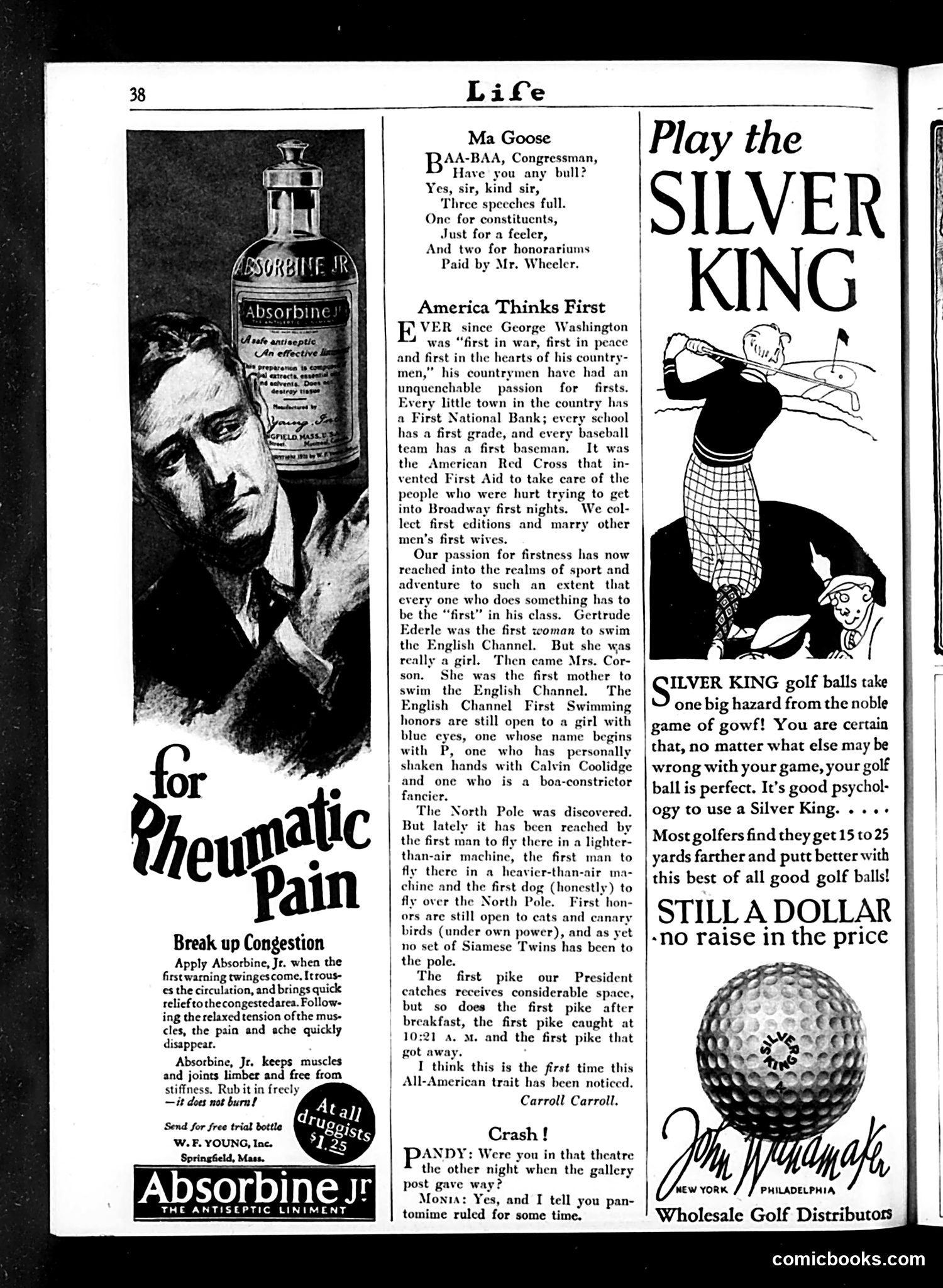
This page mixes advertisements with satirical commentary typical of Life magazine's editorial approach. **"Ma Goose" verse** mocks Congressional dishonesty—a congressman admits to three speeches: one for constituents, one as a "feeler," and two paid for by lobbyist Mr. Wheeler. The satire targets corruption and the gap between public service and private financial interests. **"America Thinks First"** by Carroll Carroll satirizes American obsession with superlatives and "firsts." The essay humorously catalogs how Americans compulsively label achievements as "first"—first National Banks, first grades, first basemen. It references real figures like swimmer Gertrude Ederle and President Coolidge while extending the logic absurdly (first pike caught at specific times; first dogs/cats/Siamese twins to the North Pole). The satire critiques American materialism and vanity disguised as patriotism. **"Crash!"** is a brief joke about theater gallery collapse where pantomime (silent performance) became necessary. The remainder comprises product advertisements (Absorbine Jr. liniment, Silver King golf balls).
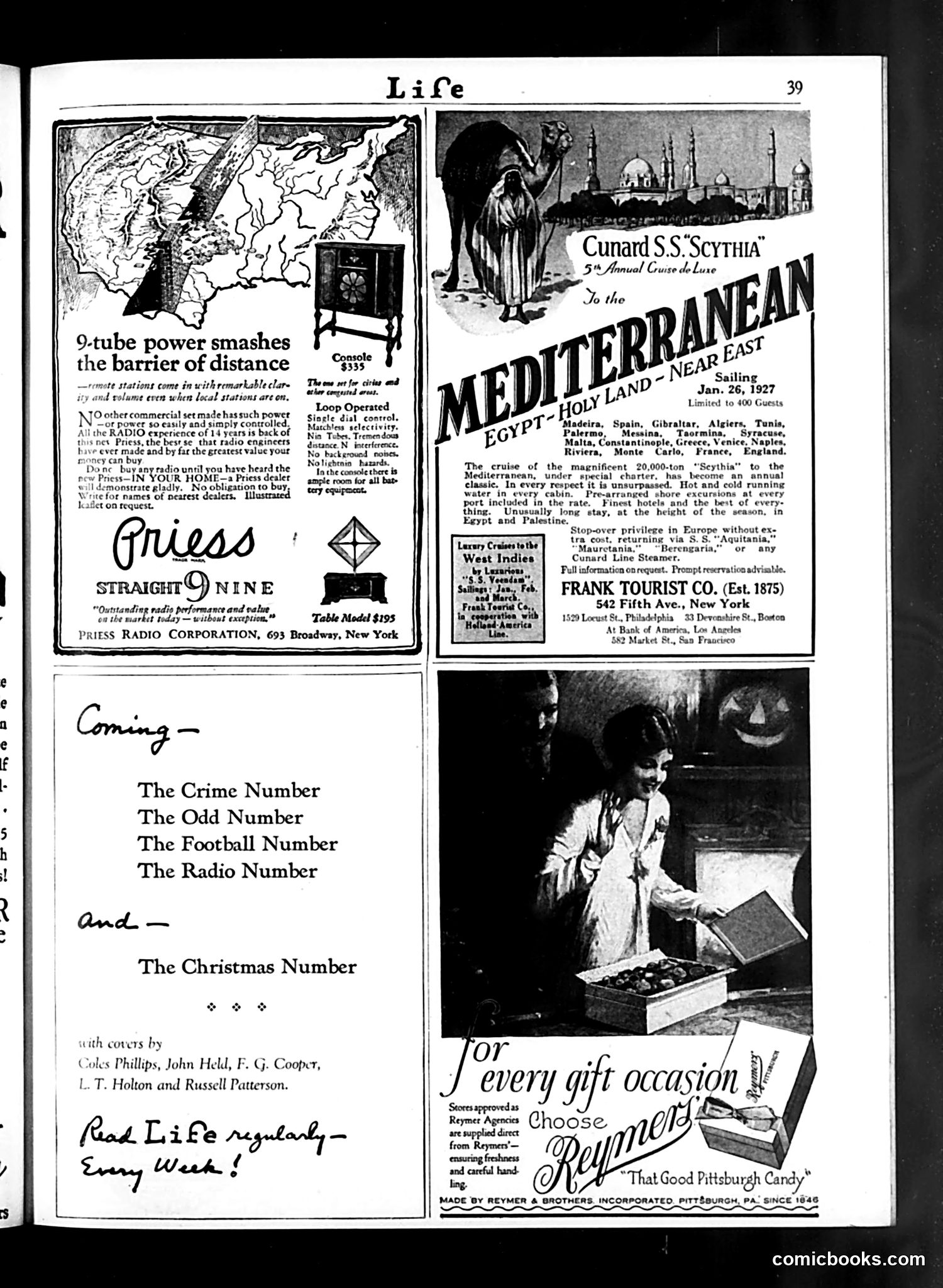
This page is primarily **advertising content** rather than editorial cartoons or satire. It contains four major advertisements: 1. **Priess Radio** (top left): Promotes a 9-tube radio receiver, emphasizing its power to receive distant stations clearly. The technology reference reflects 1920s excitement about radio as a modern marvel that "smashes the barrier of distance." 2. **Cunard S.S. Scythia** (top right): Advertises a Mediterranean cruise departing January 26, 1927, listing ports including Egypt, Palestine, and European destinations. This targets wealthy leisure travelers. 3. **Life Magazine "Coming" section** (bottom left): Teases upcoming special issues (Crime, Odd, Football, Radio, Christmas numbers) with cover artists listed—standard promotional content for the magazine itself. 4. **Reymer's Candy** (bottom right): Shows a child opening a gift box, marketing confections "for every gift occasion." The page reflects 1920s consumer culture and modern conveniences (radio, leisure travel, commercial candy). No political satire or caricature is present—it's a straightforward advertising layout typical of period magazines.
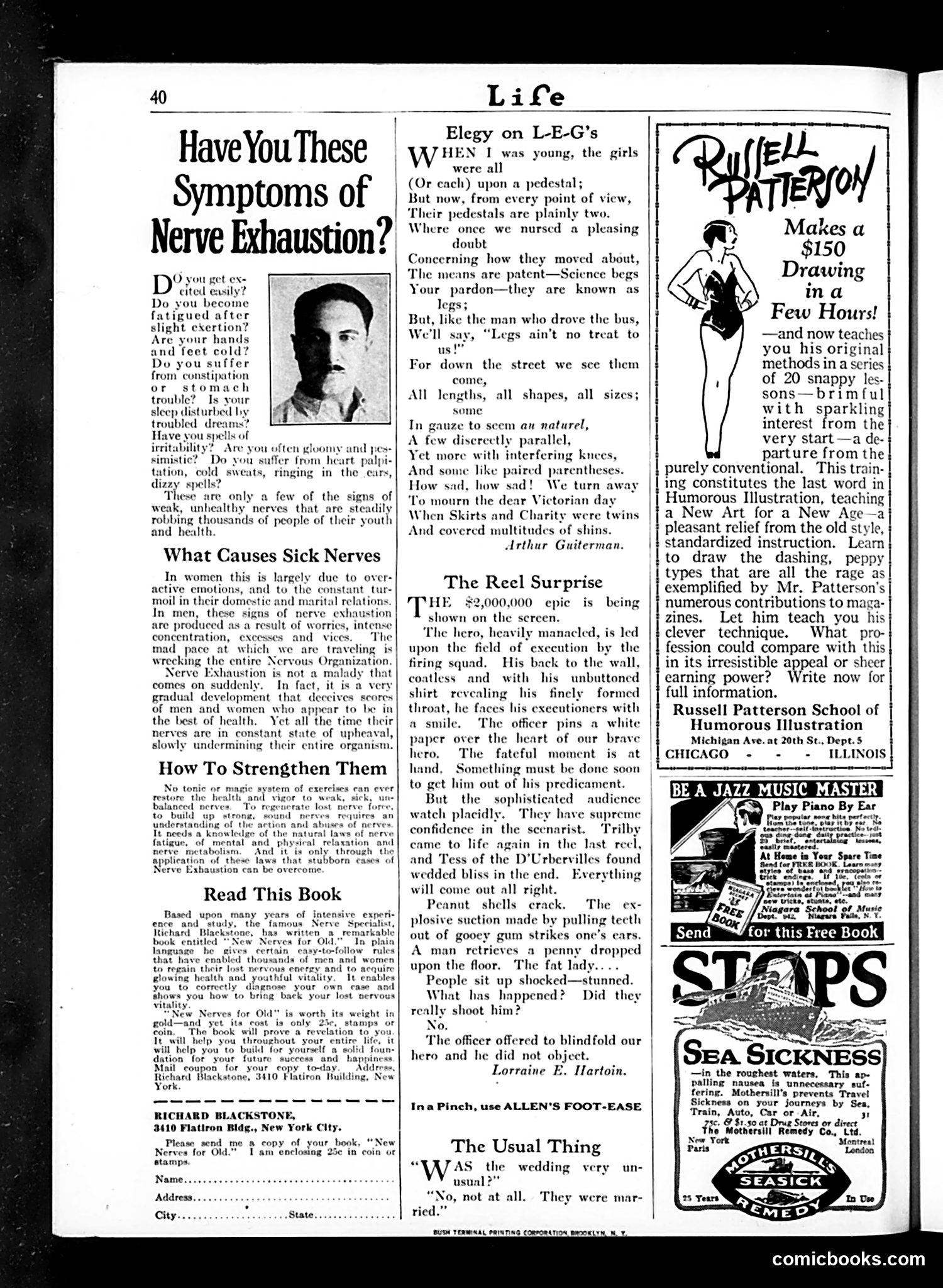
This page contains advertisements and satirical verse rather than political cartoons. The main content includes: **"Elegy on L-E-G's"** by Arthur Guiterman mocks changing social attitudes toward women's legs. It laments that Victorian modesty—when legs were hidden beneath long skirts—has given way to modern fashion showing women's legs openly. The poem satirizes how legs are now visible in various forms (gauze, parallel, interfering knees) and suggests society has lost something by abandoning the mystery and propriety of the earlier era. This reflects genuine 1920s-era social anxiety about women's increasingly visible clothing and changing gender norms. **"The Reel Surprise"** humorously describes audience behavior at silent film screenings, noting how viewers remain calm during dramatic execution scenes, confident the protagonist will escape as in previous melodramas. It captures the predictable conventions of early cinema. The page's left side advertises patent medicines for "nerve exhaustion"—a common marketing approach exploiting health anxieties of the period.
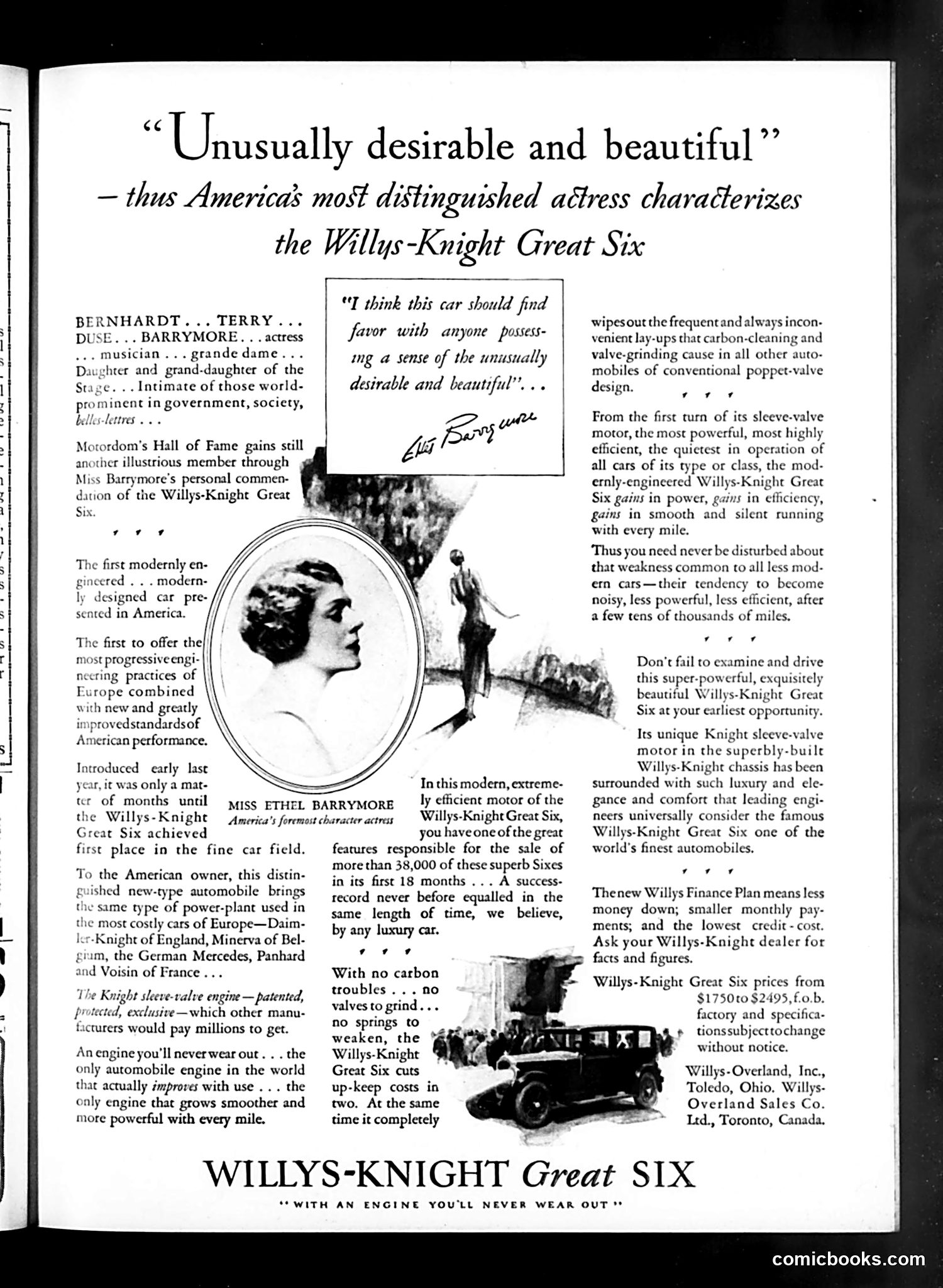
This is a **Willys-Knight automobile advertisement**, not satire or political commentary. It uses celebrity endorsement marketing by featuring **Ethel Barrymore**, identified as "America's foremost character actress." The text references other famous actresses (Bernhardt, Terry, Duse) to establish prestige. The ad emphasizes the car's "Knight sleeve-valve engine"—a real technical innovation claimed to be superior to conventional engines because it improves with use, requires no valve grinding, and produces no carbon buildup. These were genuine selling points in the 1920s when engine maintenance was arduous. The advertisement positions the Willys-Knight Great Six as a luxury automobile comparable to European models (Mercedes, Panhard, Voisin), claiming 38,000 sales in eighteen months. Barrymore's quote calling the car "unusually desirable and beautiful" serves as celebrity validation. For modern readers: this reflects 1920s automotive marketing relying on star power and technical specifications as primary persuasion tools—before modern advertising psychology dominated.
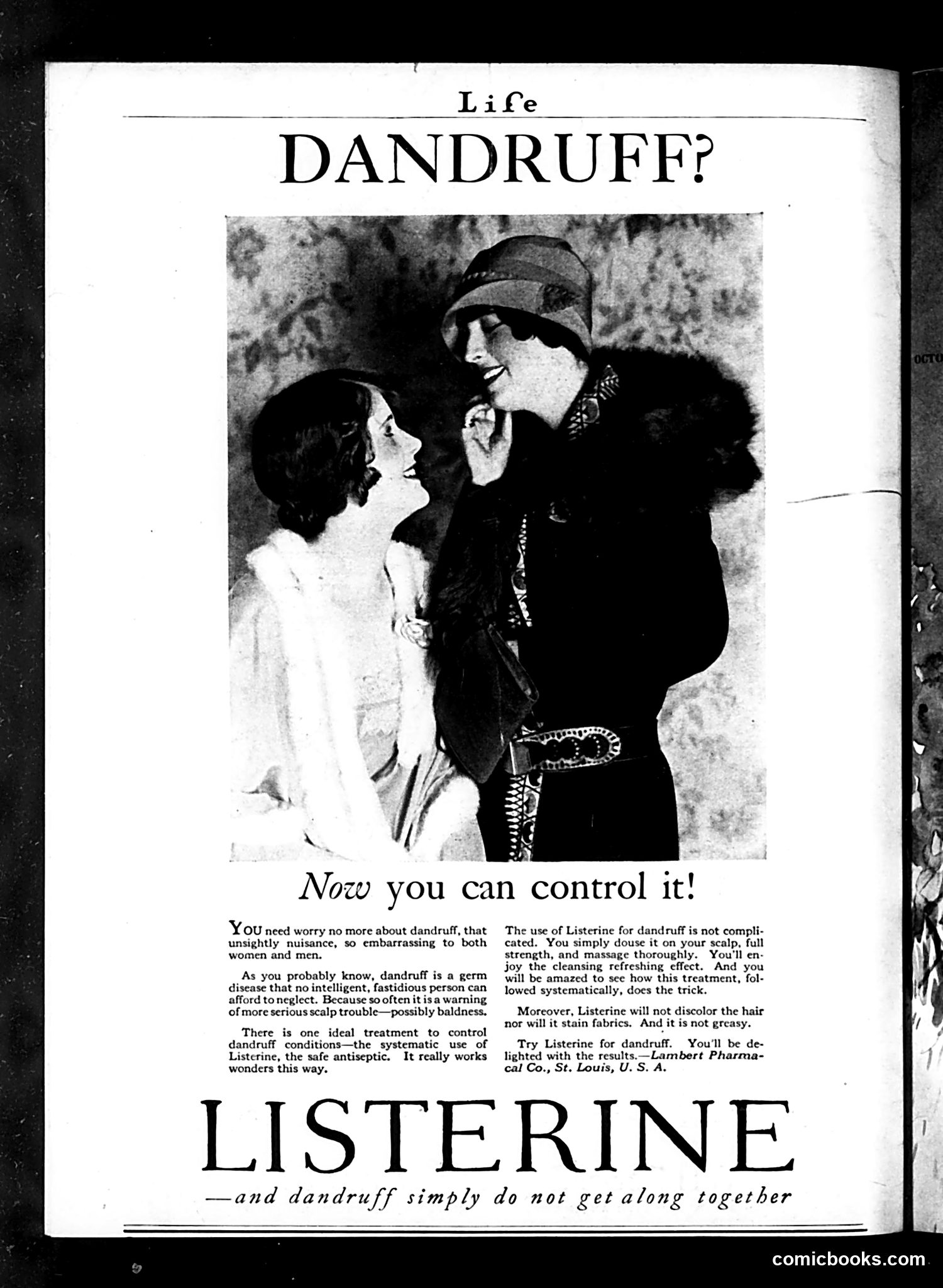
This is a **Listerine advertisement**, not political satire. The page uses social embarrassment as a marketing tactic rather than commenting on current events. The image shows a well-dressed woman in 1920s-30s fashion recoiling from a man—the visual joke being that dandruff makes him socially unacceptable to women. The ad frames dandruff as both a hygiene problem and a serious health concern ("warning of more serious scalp trouble—possibly baldness"). The pitch combines fear-based marketing with reassurance: dandruff is portrayed as an "unsightly nuisance" that an "intelligent, fastidious person" cannot ignore, but Listerine offers an easy solution. The ad emphasizes the product is safe, non-greasy, and won't stain fabrics—practical selling points for the era. This reflects early 20th-century advertising's reliance on social anxiety and medicalization of common conditions to drive product sales.