
Life, 1926-10-07 · page 25 of 44
Life — October 7, 1926 — page 25: what you’re looking at
What you’re looking at
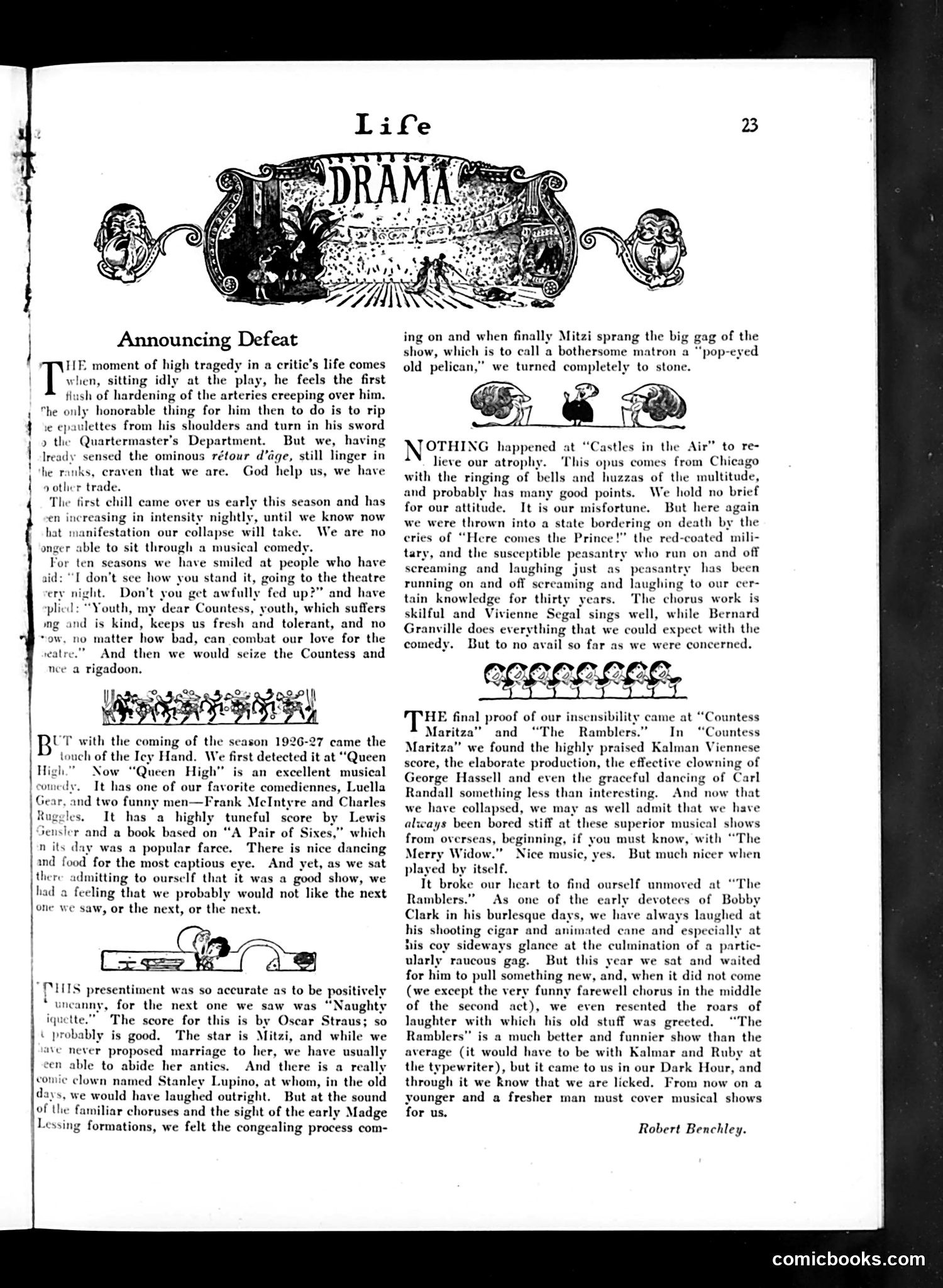
This is a theater critic's confession of professional burnout. The author admits he can no longer enjoy musical comedies—a devastating admission for someone paid to review theater nightly for ten seasons. The piece traces his collapse through the 1926-27 season, citing specific shows: "Queen High," "Naughty Etiquette" (starring Mitzi), "Castles in the Air" (featuring Vivienne Segal), "Countess Maritza," and "The Ramblers." Despite acknowledging these productions have merit—good scores, talented performers, skillful choreography—he finds himself emotionally dead to them. The satire is self-directed: a critic admitting he's become too old and jaded to feel anything. He jokes that "the moment of high tragedy in a critic's life" is realizing his "arteries are hardening." His only honorable option, he suggests mockingly, is resignation—removing his "epaulettes" like a defeated soldier. The small cartoon illustrations (heads/faces) appear decorative rather than specific caricatures of identifiable figures.
📄 Transcribed text from this page (OCR, searchable)
Machine-transcribed from the original scan — historical spelling and the odd misread are preserved.
} Announcing Defeat ‘TNIE moment of high tragedy in a critic’s life comes | T: “n, sitting idly at the play, he feels the first tiush of hardening of the arteries creeping over him. ; “he only honorable thing for him then to do is to rip ve epaulettes from his shoulders and turn in his sword > the Quartermaster’s Department. But we, having | Iready sensed the ominous rétour d’age, still linger in | he ranks, craven that we are. | oother trade. The first chill came over us early this season and has en increasing in intensity nightly, until we know now hat manifestation our collapse will take. We are no onger able to sit through a musical comedy. For ten seasons we have smiled at people who have aid: “I don’t see how you stand it, going to the theatre ery night. Don’t you get awfully fed up?” and have plicd: “Youth, my dear Countess, youth, which suffers mg and is kind, keeps us fresh and tolerant, and no ". no matter how bad, can combat our love for the real And then we would seize the Countess and nee a rigadoon. God help us, we have UT with the coming of the season 1926-27 came the touch of the Icy Hand. We first detected it at “Queen Now “Queen High” is an excellent musical . It has one of our favorite comediennes, Luella ind two funny men—Frank McIntyre and Charles les. It has a highly tuneful score by Lewis jensler and a book based on “A Pair of Sixes,” which n its day was a popular farce. There is nice dancing ind food for the most captious eye. And yet, as we sat jthere admitting to ourself that it was a good show, we had a feeling that we probably would not like the next one we saw, or the next, or the next. i MUIS presentiment was so accurate as to be positively “uncanny, for the next one we saw was “Naughty iquette.” The score for this is by Oscar Straus; so ‘ probably is good. The star is Mitzi, and while we ave never proposed marriage to her, we have usually cen able to abide her antics. And there is a really comic clown named Stanley Lupino, at whom, in the old day s, we would have laughed outright. But at the sound of the familiar choruses and the sight of the early Madge j Lessing formations, we felt the congealing process com- ing on and when finally Mitzi sprang the big gag of the show, wh s to call a bothersome matron a “pop-eyed old pelican,” we turned completely to stone. NOTHING happened at “Castles in the Air” to re- 4 lieve our atrophy. This opus comes from Chicago with the ringing of bells and huzzas of the multitude, and probably has many good points. We hold no brief for our attitude. It is our misfortune. But here i we were thrown into a state bordering on dea y cries of “Here comes the Prince!” the red-coated mili- tary, and the susceptible peasantry who ran on and off screaming and laughing just as peasantry has been running on and off screaming and laughing to our ce tain knowledge for thirty years. The chorus work is skilful and Vivienne Segal sings well, while Bernard Granville does everything that we could expect with the comedy. But to no avail so far as we were concerned, HE final proof of our insensibility came at “Countess Maritza” and “The Ramblers.” In “Countess Maritza” we found the highly praised Kalman Viennese score, the elaborate production, the effective clowning of George Hassell and even the graceful dancing of Carl Randall something less than interesting. And now that we have collapsed, we may as well admit that we have always been bored stiff at these superior musical shows from overseas, beginning, if you must know, with “The Merry Widow. ice music, yes. But much nicer when played by itself. It broke our heart to find ourself unmoved at “The Ramblers.” As one of the early devotees of Bobby Clark in his burlesque days, we have always laughed at his shooting cigar and animated cane and especially at his coy sideways glance at the culmination of a partic- ularly raucous gag. But this year we sat and waited for him to pull something new, and, when it did not come (we except the very funny farewell chorus in the middle of the second act), we even resented the roars of laughter with which his old stuff was greeted. “The Ramblers” is a much better and funnier show than the average (it would have to be with Kalmar and Ruby at the typewriter), but it came to us in our Dark Hour, and through it we Rnow that we are licked. From now on a younger and a fresher man must cover musical shows for us. Robert Benchley. comicbooks.com