
Life, 1926-10-07 · page 11 of 44
Life — October 7, 1926 — page 11: what you’re looking at
What you’re looking at
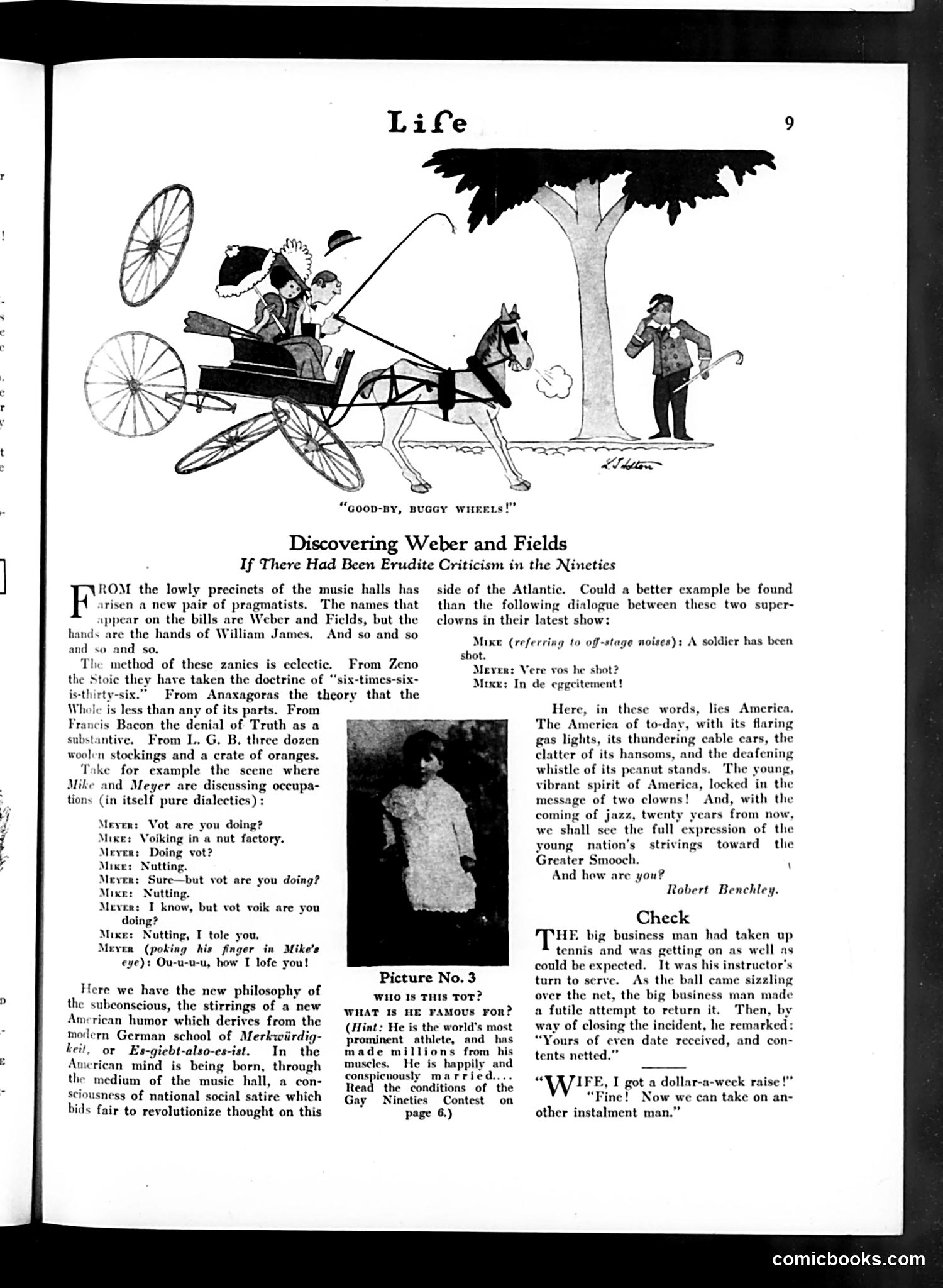
**Top Cartoon:** "Good-by, Buggy Wheels!" depicts a horse-drawn carriage losing its wheels to a bicycle, symbolizing the technological shift from traditional horse transport to bicycles—a major 1890s innovation that threatened established carriage industries. **Main Article:** "Discovering Weber and Fields" satirizes two contemporary comedians (Weber and Fields) by imagining how erudite 1890s critics might have analyzed them using pseudo-intellectual philosophy (referencing Zeno, Anaxagoras, etc.). The satire mocks both the comedians' lowbrow act and pretentious academic over-analysis of popular entertainment. **"Check" Section:** A brief humorous anecdote about a businessman's tennis ambitions and domestic finances—typical light social humor of the period. The page represents Life's signature blend of visual satire and comedic commentary on contemporary culture and society.
📄 Transcribed text from this page (OCR, searchable)
Machine-transcribed from the original scan — historical spelling and the odd misread are preserved.
Shiller “Goop-BY, BUGGY witrELs!” Discovering Weber and Fields If There Had Been Erudite Criticism in the Nineties ROM the lowly precincts of the music halls has side of the Atlantic. Could a better example be found irisen a new pair of pragmatists. The names that than the following dialogue between these two super- ippear on the bills are Weber and Ficlds, but the clowns in their latest show: hands are the hands of William James. And so and so and so and so, The method of these zanies is eclectic. From Zeno the Stoic they have taken the doctrine of imes-six- is-thirty-six.” From Anaxagoras the theory that the Whole is less than any of its parts. From Here, in these words, lies America. Francis Bacon the denial of Truth as a “ee” & The America of to-day, with its flaring substantive. From L. G. B. three dozen De gas lights, its thundering cable cars, the n stockings and a crate of oranges. clatter of its hansoms, and the deafening Take for example the scene where whistle of its peanut stands. The young, Mike and Meyer are discussing occupa- “ vibrant spirit of America, locked in the tions (in itself pure dialectics) : message of two clowns! And, with the coming of jazz, twenty years from now, Mixes Voiking 1 fi we shall see the full expression of the LES Y ODE tn 8. Hat Tectory. young nation’s _ strivi toward the Meyer: Doing vot? : Mixe: Nutting. Greater Smooch. ‘ Sure—but vot are you doing? And how are you? Nutting. Robert Benchley. I know, but vot voik are you doing? : . Check Mixr: Nutting, I tole you. HE big business man had taken up Meyer (poking his finger in Mike's tennis and was getting on as well as eye)? Ou-u-u-u, how T lofe you! could be expected. It was his instructor's Picture No. 3 turn to serve. As the ball came sizzling the sut e Sh WHO 18 THIS TOT? over the net, the big business man made pe Supconseious, the stirrings of anew witag is He FAMOUS For? a futile attempt to return it. Then, by American humor whieh derives from the (Hint: He is the world's most. way of closing the incident, he remarked: modern German school of Merkwiirdig- prominent athlete, and has “Yours of even date received, and con- keit, or Es-giebt-also-es-ist. In the made millions from his tents netted.” American mind is being born, through muscles. He is happily and the medium of the music hall, a con- conspicuously married... “WIE I got a dollar-a-week raise!” Mie (referring to off-stage noises): A soldier has been shot. Meyer: Vere vos he shot? Mixe: In de eggcitement! Meyer: Vot are you doing? fere we have the new philosophy of 5 * A ; ; Read the conditions of the = sciousness of national social satire which Gay Nineties Contest on Fine! Now we can take on an- bids fair to revolutionize thought on this page 6.) other instalment man.” comicbooks.com