
Life, 1926-10-07 · page 28 of 44
Life — October 7, 1926 — page 28: what you’re looking at
What you’re looking at
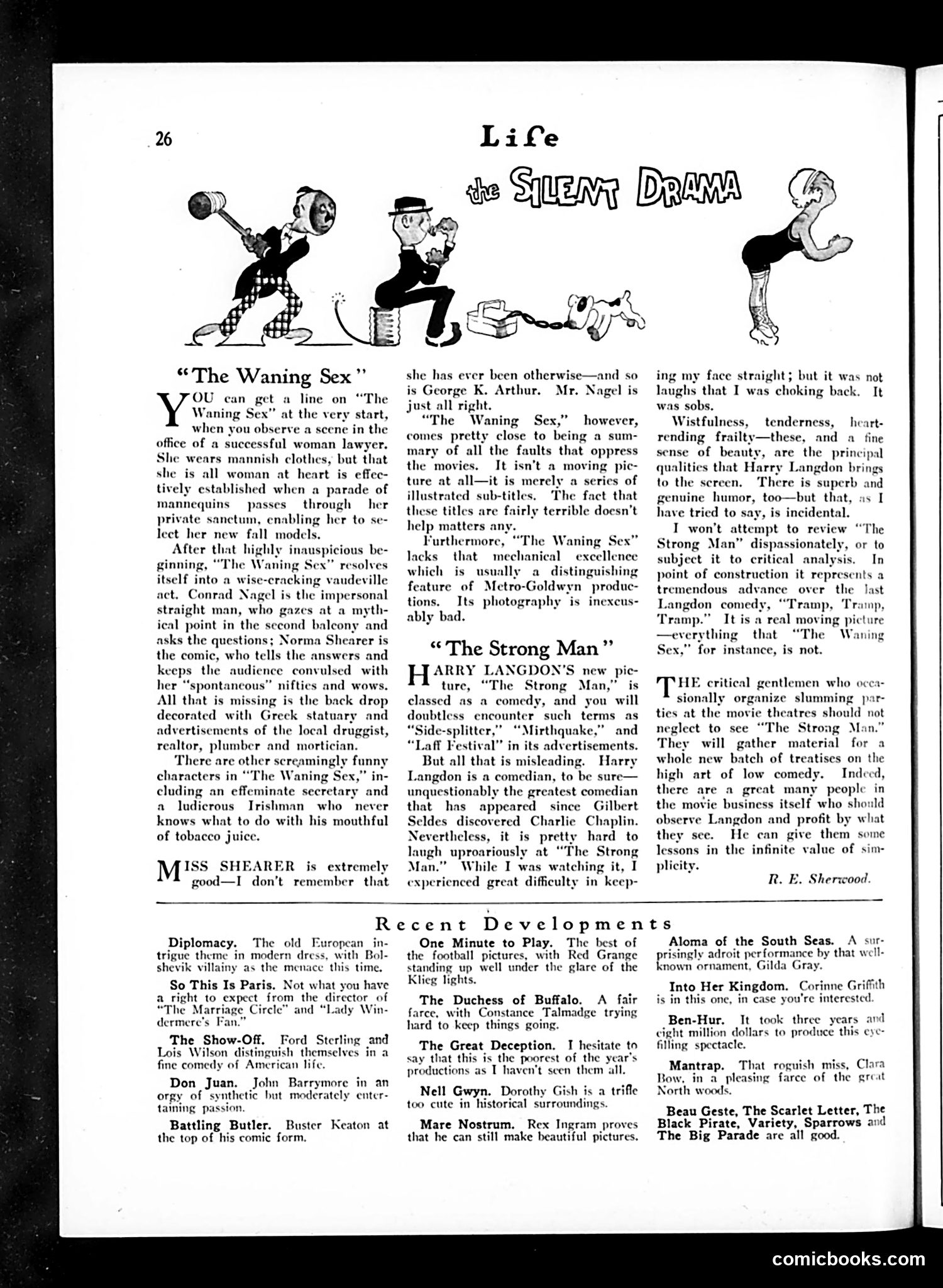
This *Life* magazine movie review page critiques two 1920s silent films. The cartoons at top illustrate "The Waning Sex"—showing a female lawyer in masculine dress selecting fashionable models, satirizing the "New Woman" of the era. The reviews reveal era-specific concerns: *The Waning Sex* is dismissed as merely illustrated title cards with poor photography—a common criticism of early silent films lacking cinematic sophistication. Reviewer R.E. Sherwood praises Harry Langdon's *The Strong Man* as genuinely moving rather than merely comedic, arguing Langdon (discovered after Charlie Chaplin) brings "wistfulness, tenderness, heart-rending frailty" to cinema. The page reflects 1920s cultural anxiety about gender roles (the "waning" femininity) and the emerging medium's struggle between theatrical vaudeville-style comedy and genuine cinematic art. The "Recent Developments" section lists other contemporary films with minimal commentary.
📄 Transcribed text from this page (OCR, searchable)
Machine-transcribed from the original scan — historical spelling and the odd misread are preserved.
“The Waning Sex” OU can get a line on “The Waning Sex” at the very start, when you observe a scene in the office of a successful woman lawyer. She wears mannish clothes, but that she is all woman at heart is effec- tively established when a parade of mannequins through her private sanctum, enabling her to se- lect her new fall models. 1 ily inauspicious be- ing Sex” resolves ing vaudeville act. Conrad Nagel is the impersonal straight man, who a myth- ical point in the second baleony and asks the questions; Norma Shearer is the comic, who tells the answers and keeps the audience convulsed with her “spontaneous” nifties and wows. All that is missing is the back drop decorated with Greek statuary and advertisements of the local druggist, realtor, plumber and mortician. There are other screamingly funny characters in “The Waning Sex,” in- cluding an effeminate secretary and a ludicrous Irishman who never knows what to do with his mouthful of tobacco juice. passes ISS SHEARER is extremely good—I don’t remember that Life de Sen DRAMA she has ever been otherwise—and so is George K. Arthur. Mr. Nagel is just all right. “The Waning Sex,” however, comes pretty close to being a sum- mary of all the faults that oppress the movies. It isn’t a moving pic- ture at all—it is merely a series of illustrated sub-titles, The fact that these titles are fairly terrible doesn’t help matters any. Furthermore, “The Waning Sex lacks that mechanical excellence which is usually a distinguishing feature of Metro-Goldwyn produc- tions. Its photography ‘is inexcus- ably bad. “The Strong Man” Harry LANGDON’S new pic- ture, “The Strong Man,” is classed as a comedy, and you will doubtless encounter such terms as “Side-splitter,” ““Mirthquake,” and “Laff Festival” in its advertisements. But all that is misleading. Harry Langdon is a comedian, to be sure— unquestionably the greatest comedian that has appeared since Gilbert Seldes discovered Charlie Chaplin. Nevertheless, it is pretty hard to laugh uproariously at “The Strong Man.” While I was watching it, I experienced great difficulty in keep- ing my face st laughs that I was sobs. Wistfulness, tenderness, _ heart- rending frailty—these, and a fine sense of beauty, are the principal qualities that Harry Langdon brings to the screen, There is superb and genuine humor, too—but that, as I have tried to say, is incidental. I won't attempt to review “The Strong Man” dispassionately, or to subject it to critical analysis. In point of construction it represents a tremendous advance over the last Langdon comedy, “Tramp, Tramp, Tramp.” It is a real moving picture everything that) “The Waning Sex,” for instance, is not. ght; but it was not choking back. It HE critical gentlemen who occa- sionally organize slumming par- ties at the movie theatres should not neglect to see “The Strong Man.” They will gather material for a whole new batch of treatises on the high art of low comedy. Indeed, there are a great many people in the movie business itself who should observe Langdon and profit by what they see. He can give them some lessons in the infinite value of sim- plicity. R. E. Sherwood. Recent Developments Diplomacy, The old European in- trigue theme in modern dress, with Bol- shevik villainy as the menace this time, So This Is Paris. Not what you have a_right to expect from the director of “The Ma Circle” and “Lady Win- dermere’s Fan. The Show-Off. Lois Wilson distingui fine comedy of Amer! Don Juan. John Barrymore in an orgy of synthetic but moderately enter- taining passion. Battling Butler. Buster Keaton at the top of his comic form. Ford Sterling and h themselves in a an life. One Minute to Play. The best of the football pictures, with Red Grange standing up well under the glare of the Klieg lights. The Duchess of Buffalo. A fair farce, with Constance Talmadge trying hard to keep things going. The Great Deception. I hesitate to say that this is the poorest of the year’s productions as T haven't seen them all. Nell Gwyn. Dorothy Gish is a trifle too cute in historical surroundings. Mare Nostrum. Rex Ingram proves that he can still make beautiful pictures, Aloma of the South Seas. A sur- prisingly adroit performance by that well- known ornament, Gilda Gray. Into Her Kingdom. Corinne Griffith is in this one, in case you're interested Ben-Hur. It took three years and cight million dollars to produce this eye- filling spectacle. Mantrap. That roguish miss, Clara Bow, in a pleasing farce of the great North woods. Beau Geste, The Scarlet Letter, The Black Pirate, Variety, Sparrows and The Big Parade are all good. comicbooks.com