
A complete issue · 40 pages · 1926
Life — September 16, 1926
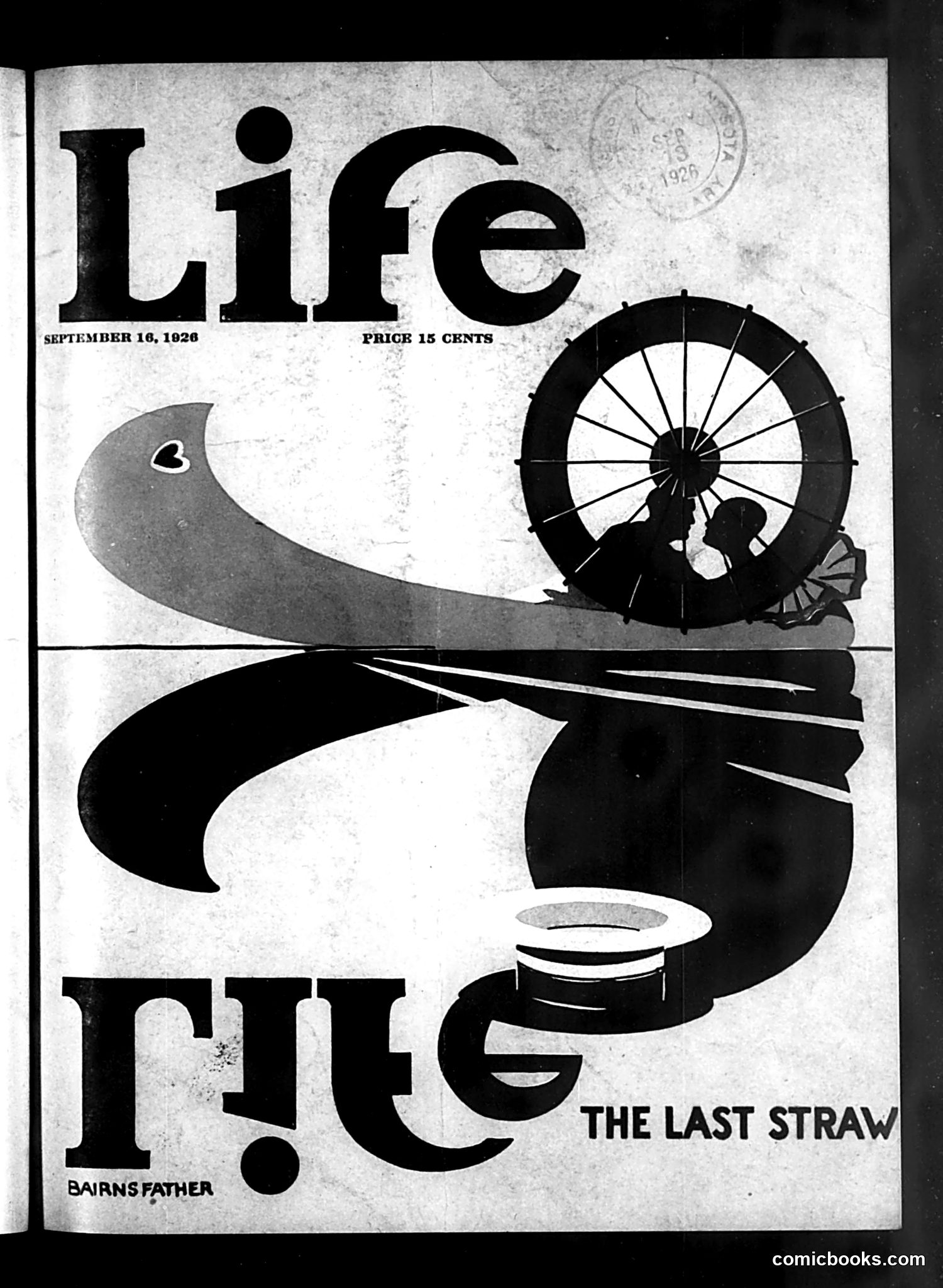
This cover uses visual wordplay to comment on a contemporary crisis. The large letters spelling "LIFE" are cleverly composed of objects: a parachute forming the "L," a person in a barrel (appearing to go over a cliff or in distress) making the "F," and a drinking glass as the final "E." The subtitle "THE LAST STRAW" and artist credit to "BAIRNS FATHER" suggest this references Prohibition-era anxieties. The imagery appears to satirize desperation during this period—people resorting to dangerous or absurd measures (barrel-riding, extreme drinking) as their "last straw" under alcohol prohibition laws. The cover uses dark humor about societal strain caused by restrictive policies.
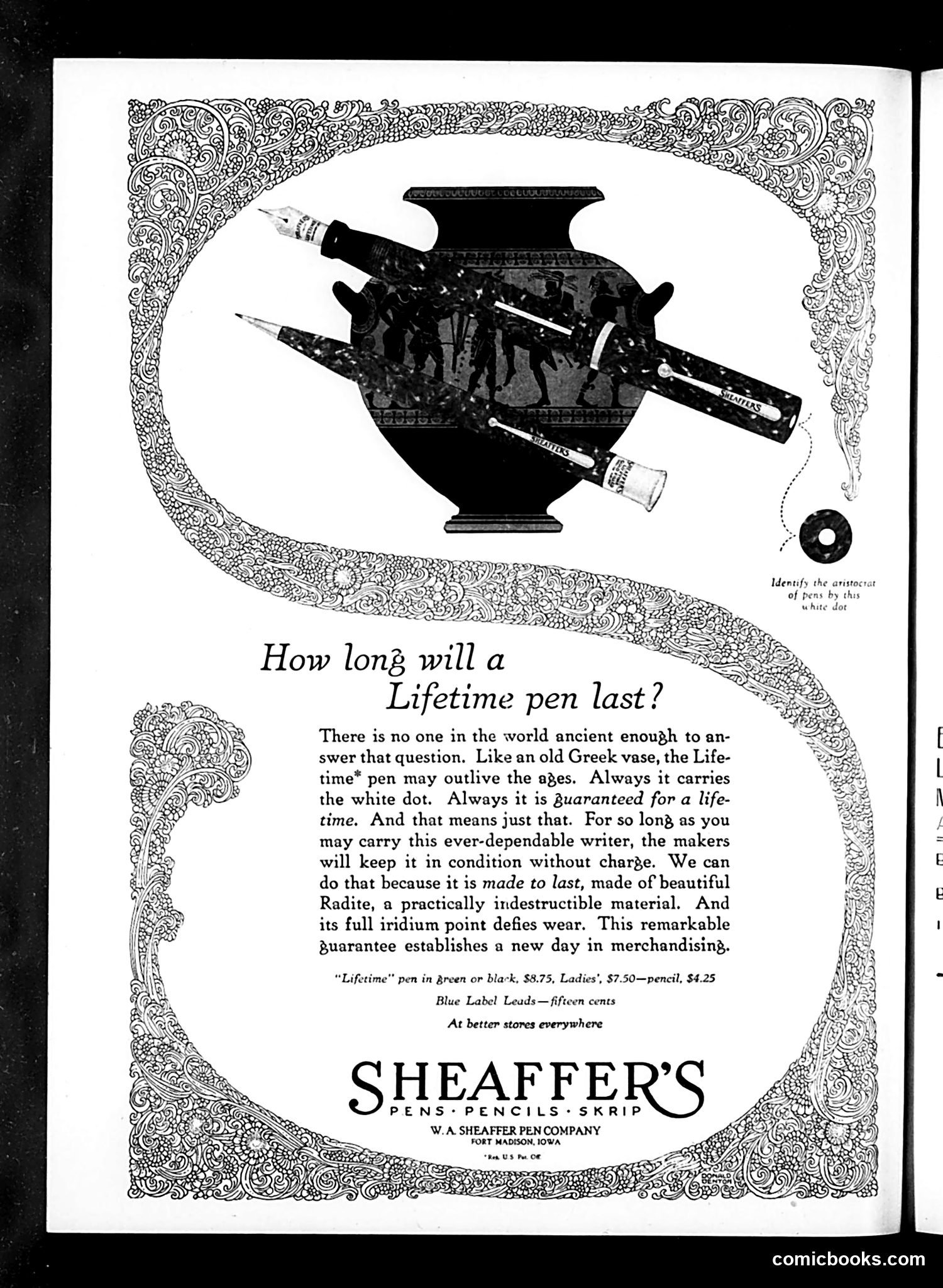
This page is **primarily an advertisement**, not satire or political commentary. It's a vintage Sheaffer pen ad from the W.A. Sheaffer Pen Company (Fort Madison, Iowa). The ad uses a classical Greek vase as its central image—a deliberate comparison suggesting the Lifetime pen is as timeless and durable as ancient artifacts. Pens are arranged like flowers in the vase, emphasizing the product's aesthetic appeal. The headline "How long will a Lifetime pen last?" poses an unanswerable question, then answers it by claiming a lifetime guarantee. The ad emphasizes the pen's "iridium point" and "Radite" material as practically indestructible. Pricing and availability information appears at bottom. This represents typical early-to-mid 20th-century advertising rhetoric—comparing consumer goods to classical civilization to suggest permanence and quality.
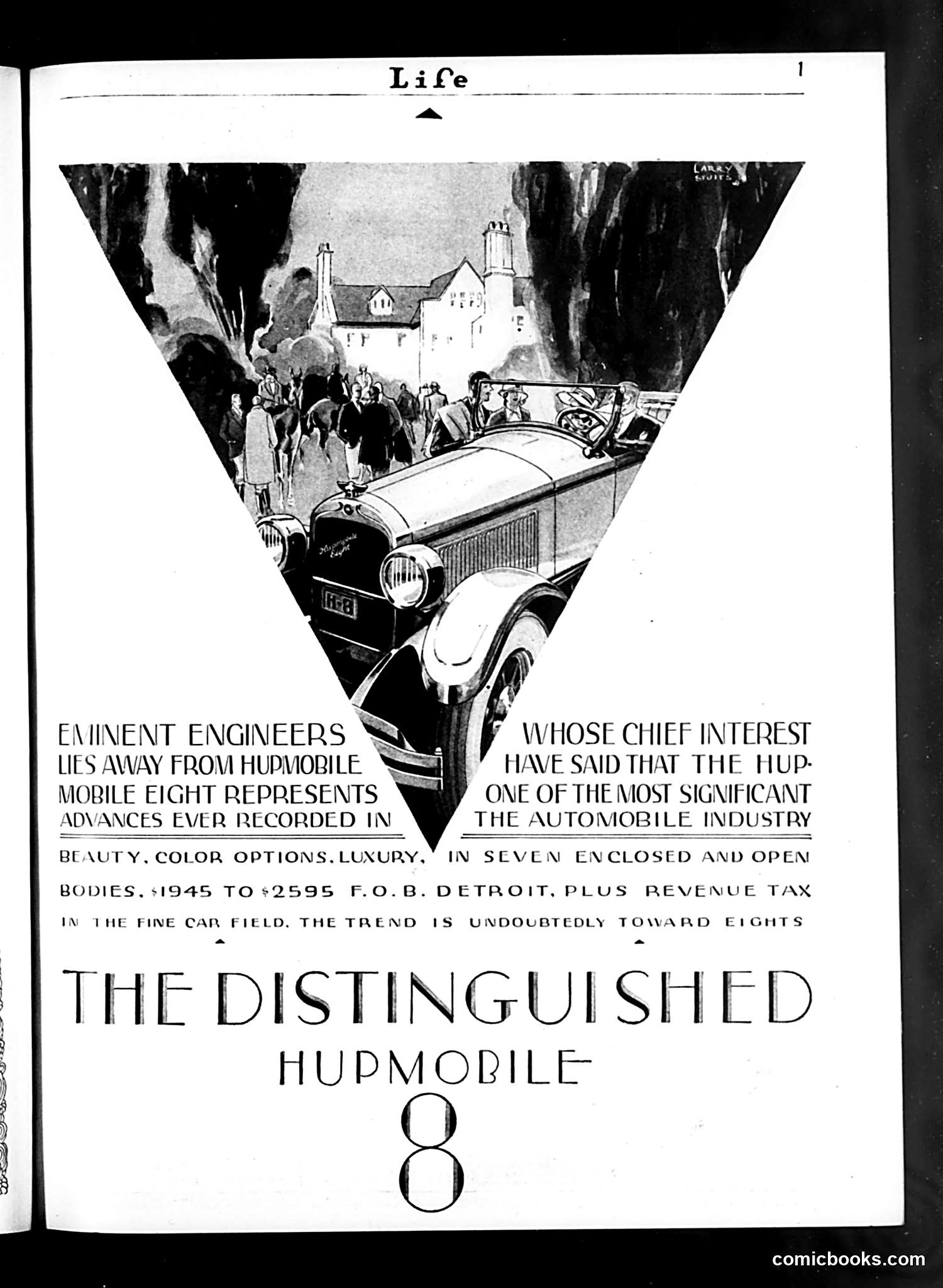
This is a **Hupmobile automobile advertisement** from *Life* magazine, not political satire. The ad promotes the Hupmobile Eight, a luxury car model. The inverted triangle composition shows a sleek 1920s automobile in the foreground with passengers, while a castle and crowd appear in the background—suggesting elegance, travel, and refined leisure. The ad claims eminent engineers consider the Hupmobile Eight "one of the most significant advances ever recorded in the automobile industry," emphasizing its eight-cylinder engine as a major technological achievement. Pricing ranges from $1,945 to $2,595 (F.O.B. Detroit), positioning it as an upscale vehicle. The ad's messaging reflects 1920s automotive marketing trends emphasizing engineering innovation and luxury as status symbols for affluent consumers.
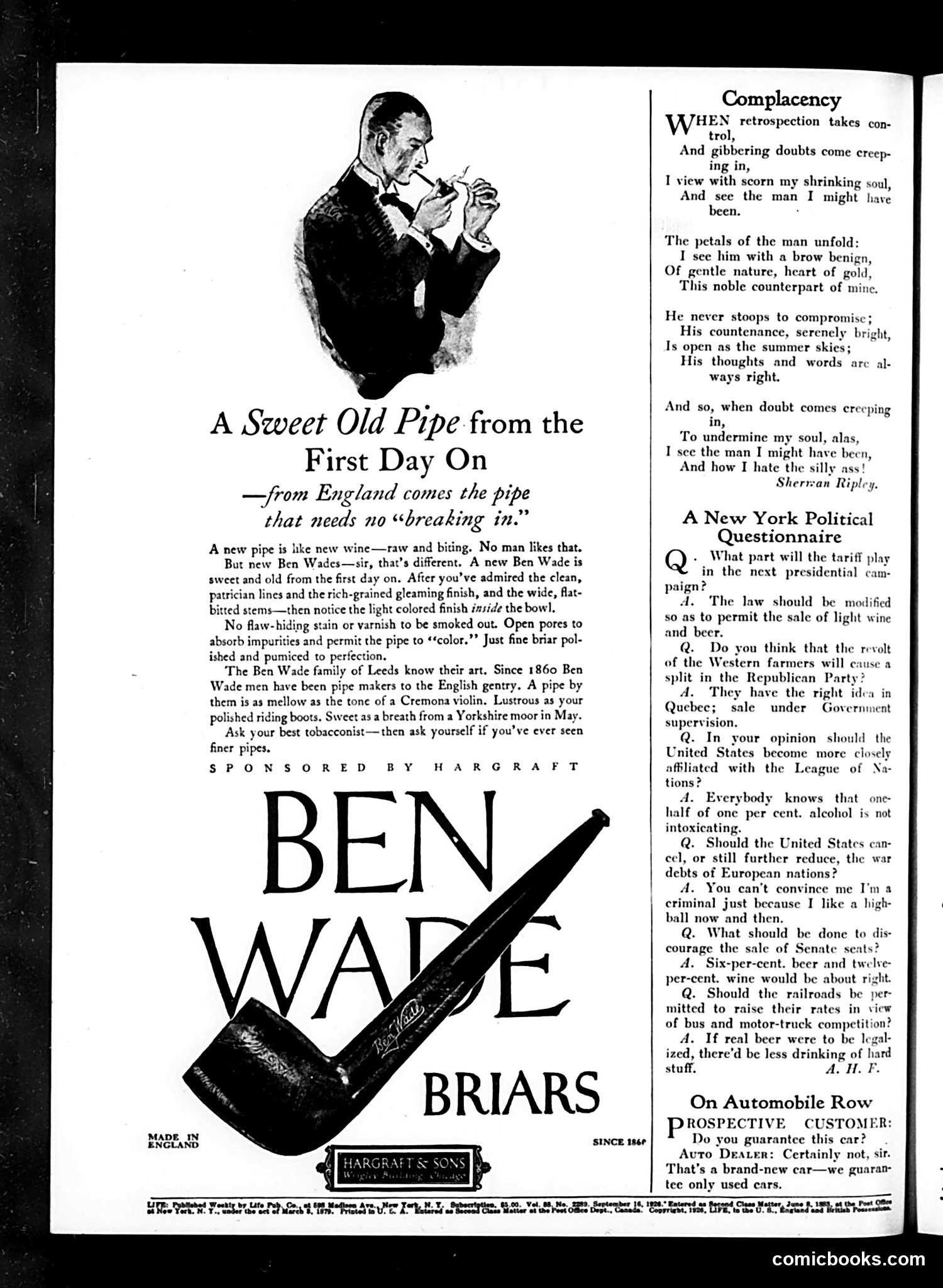
This page contains primarily **advertising** rather than political satire. The dominant feature is a Ben Wade Briars pipe advertisement, emphasizing the pipe's English quality and immediate usability ("needs no 'breaking in'"). The right column includes "A New York Political Questionnaire"—a satirical Q&A mocking various political positions, likely from the Prohibition era (references to wine/beer legalization, war debts, railroad rates). The answers appear to ridicule both political extremes and special interests. The small "Complacency" poem by Sheridan Ripley and the "Automobile Row" dialogue are minor filler pieces using gentle irony rather than sharp satire. **Overall**: This is primarily a commercial page with light satirical content typical of Life magazine's format, rather than hard political commentary.
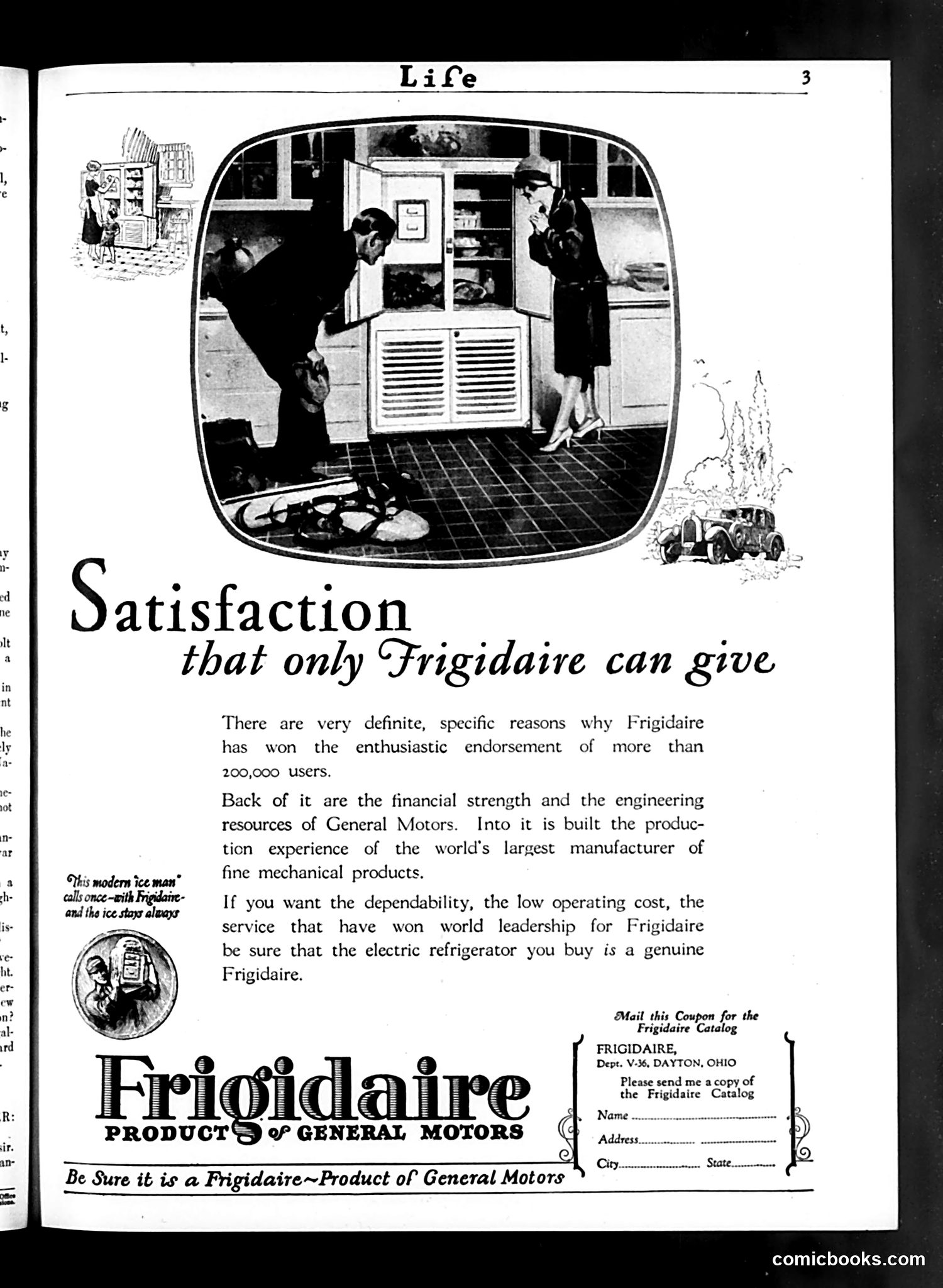
This is primarily a **Frigidaire refrigerator advertisement**, not satire. The main image shows a modern kitchen with two women examining an open refrigerator with organized shelving and storage compartments—depicting the appliance as a marvel of convenience and organization. The ad claims Frigidaire's superiority stems from General Motors' "financial strength and engineering resources." The small circular vignette on the left shows "the modern ice man" making an obsolete house call, implying Frigidaire has eliminated the need for ice delivery—a genuine technological advancement of that era. The advertisement targets middle-class homemakers by emphasizing dependability, low operating costs, and world-leadership credentials. The coupon invites catalog requests. This reflects early 20th-century marketing that positioned electric refrigeration as both a practical necessity and a status symbol.
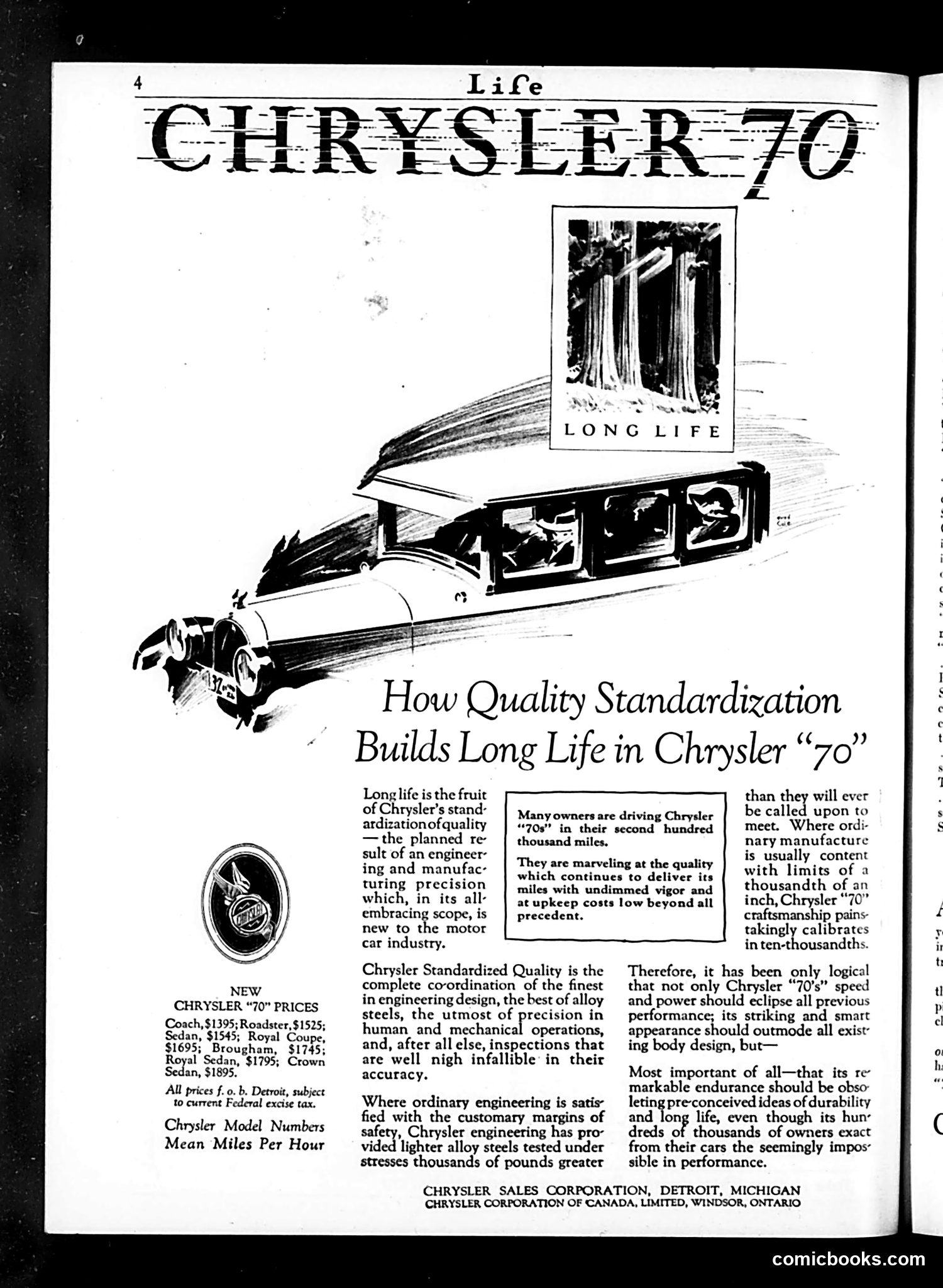
This page is **not a cartoon or satire** — it's a straightforward advertisement for the Chrysler "70" automobile, published in *Life* magazine. The ad emphasizes "Quality Standardization" as a selling point, claiming that precise manufacturing standards ensure durability and longevity. The illustration shows a streamlined car in motion, styled in the art deco fashion typical of 1920s-30s automotive advertising. The small illustration of tall trees labeled "Long Life" is a visual metaphor for endurance. The ad includes pricing information and notes that owners are already driving these vehicles at 200,000+ miles, presented as evidence of reliability. This represents early mass-production marketing, emphasizing that standardized engineering — rather than hand-crafted individuality — actually improves quality and durability.
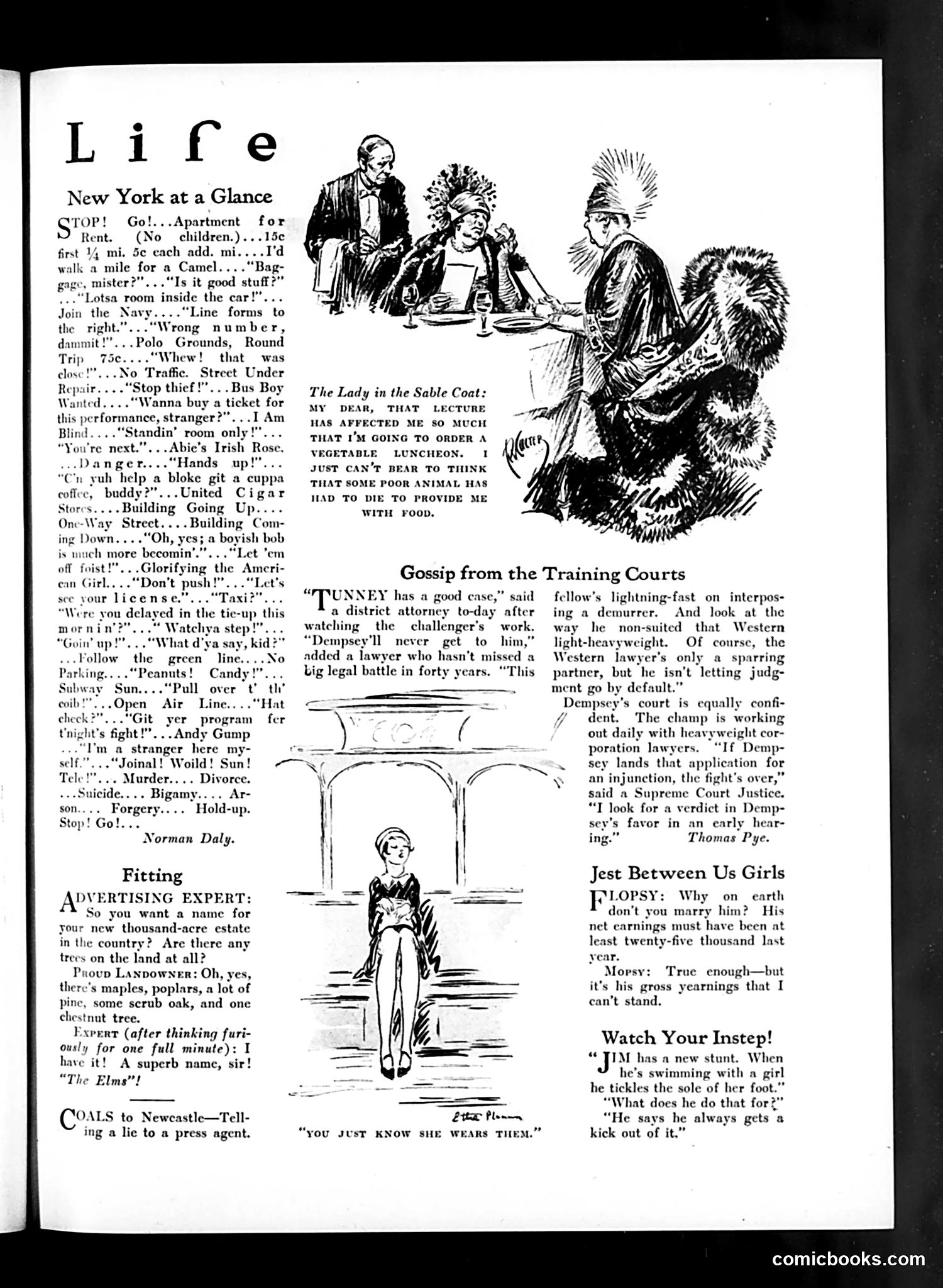
This page from Life magazine contains satirical humor and social commentary typical of early 20th-century American magazines. The "New York at a Glance" section mocks urban life through rapid-fire jokes about apartment hunting, naval recruitment, polo, street traffic, and theater attendance—reflecting anxieties about crowded city living. "The Lady in the Sable Coat" cartoon depicts a wealthy woman concerned about animal welfare, ironically while wearing fur, commenting on class hypocrisy. "Gossip from the Training Courts" discusses legal disputes, likely referencing contemporary court cases involving prominent figures. The remaining sections—"Fitting," "Jest Between Us Girls," and "Watch Your Instep!"—are brief humor pieces about advertising, marriage finances, and practical jokes, representing Life's characteristic blend of urban sophistication and gentle mockery of social conventions.
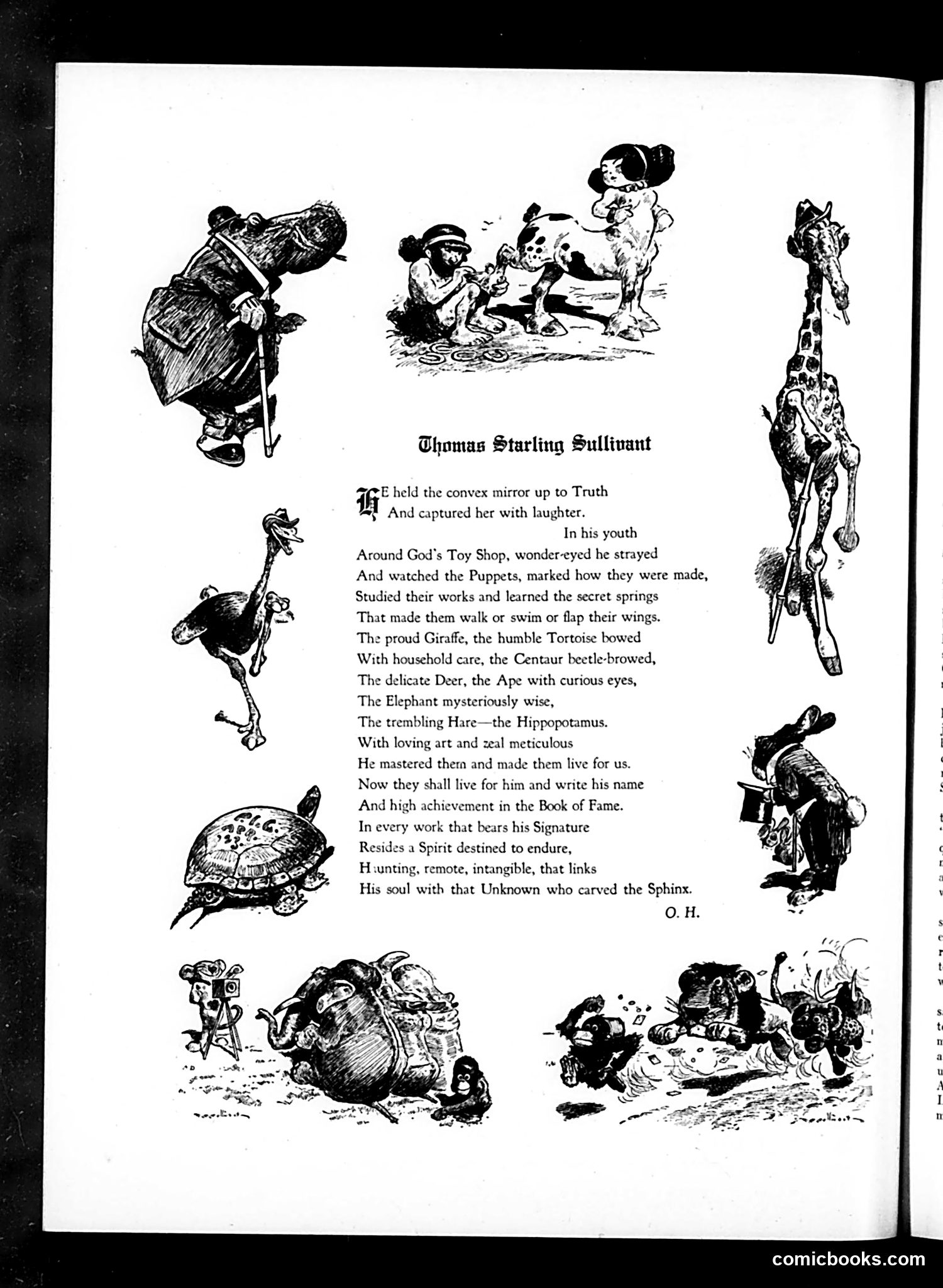
This page celebrates illustrator Thomas Starling Sullivant through a tribute poem by O.H. (likely Oscar Herford) and Sullivant's characteristic animal drawings arranged around the text. The poem praises Sullivant's mastery of animal illustration—describing how he studied puppets and mechanical creatures to understand movement, then brought various animals (giraffe, tortoise, centaur beetle, deer, ape, elephant, hare, hippopotamus) to life in his work. The verses claim his artwork possesses an enduring "Spirit" that transcends the mechanical, linking his soul to "that Unknown who carved the Sphinx"—elevating his craft to near-divine status. The surrounding illustrations showcase his signature style: detailed, anthropomorphic animals rendered in expressive ink drawings, demonstrating the very mastery the poem celebrates.
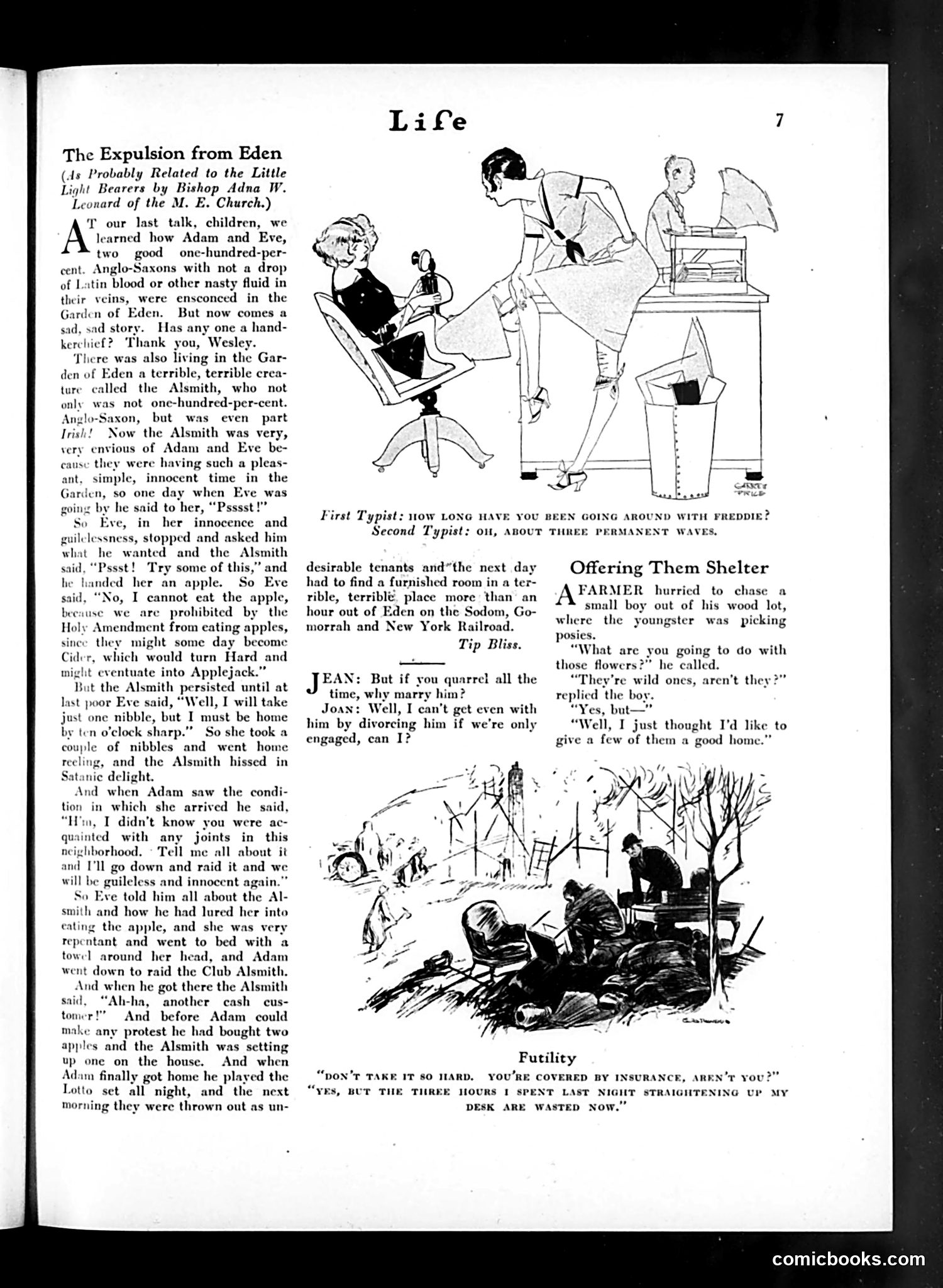
This page contains three satirical pieces about early 20th-century urban life: **"The Expulsion from Eden"** mocks the Alsmith family's misfortunes after moving to New York, playing on the biblical story. An "Alsmith" (possibly a reference to a prominent family) purchases an apple from an street vendor, leading to escalating chaos—eventually requiring them to raid a club and ultimately be evicted. The satire targets the contrast between their pretensions and their actual circumstances. **"Offering Them Shelter"** and **"Futility"** are brief comedic vignettes about housing/tenant issues and insurance claims—typical urban problems of the era. The cartoons reflect Life's focus on satirizing middle-class aspirations, domestic troubles, and the chaotic realities of modern city living.
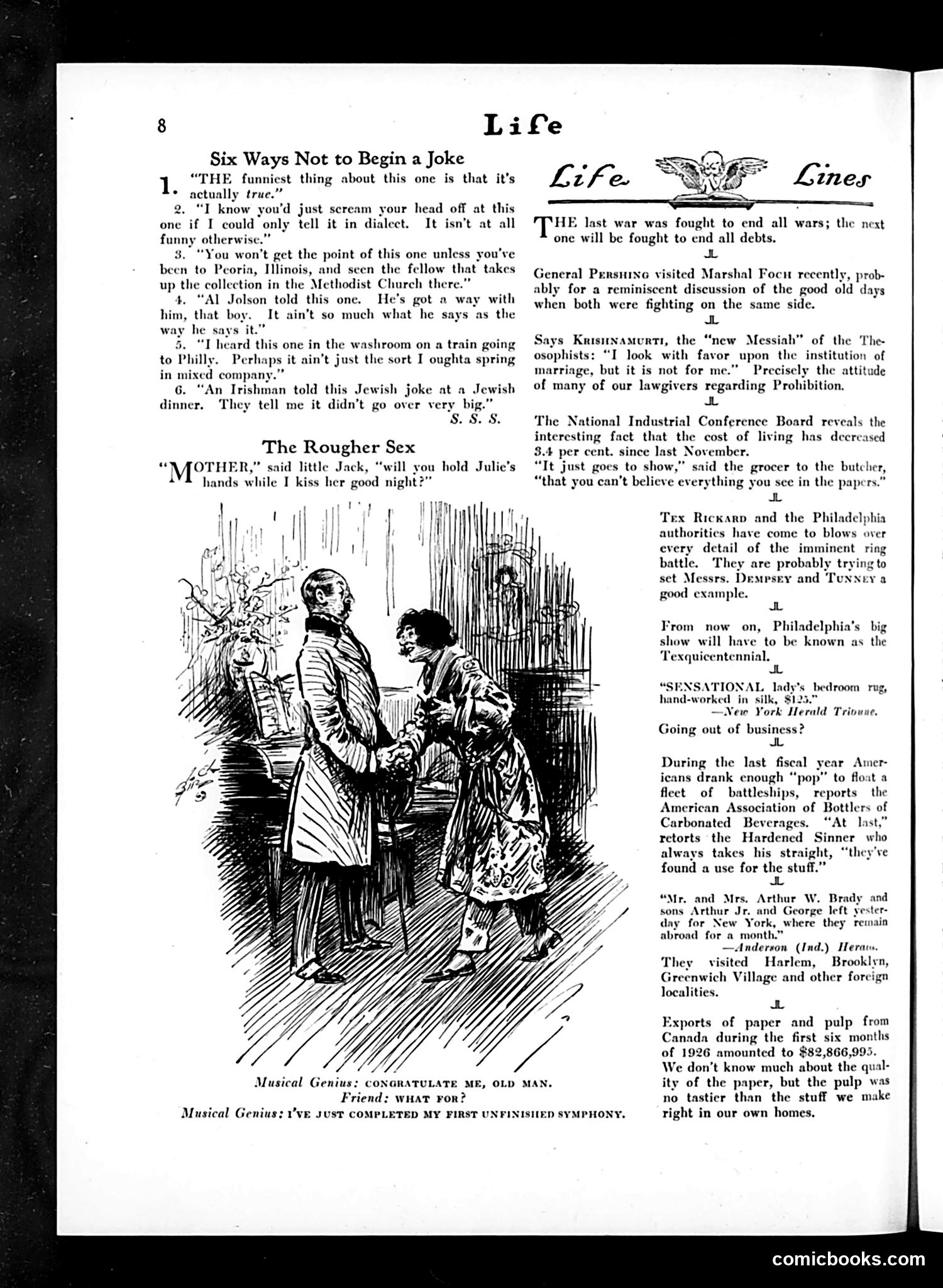
This cartoon depicts a domestic scene where a man holds a woman's hands while kissing her, with the caption: "MOTHER," said little Jack, "will you hold Julie's hands while I kiss her good night?" The satire plays on gender role expectations. The joke inverts the typical "rougher sex" stereotype—rather than men being physically aggressive or forward in romance, here a young man needs his mother's assistance to manage a woman's hands during a kiss, suggesting he's timid or awkward. The humor relies on the absurdity of requiring a chaperone's help for such a simple romantic gesture, mocking both Victorian propriety and masculine inadequacy. The cartoon suggests anxieties about changing courtship norms in the 1920s.
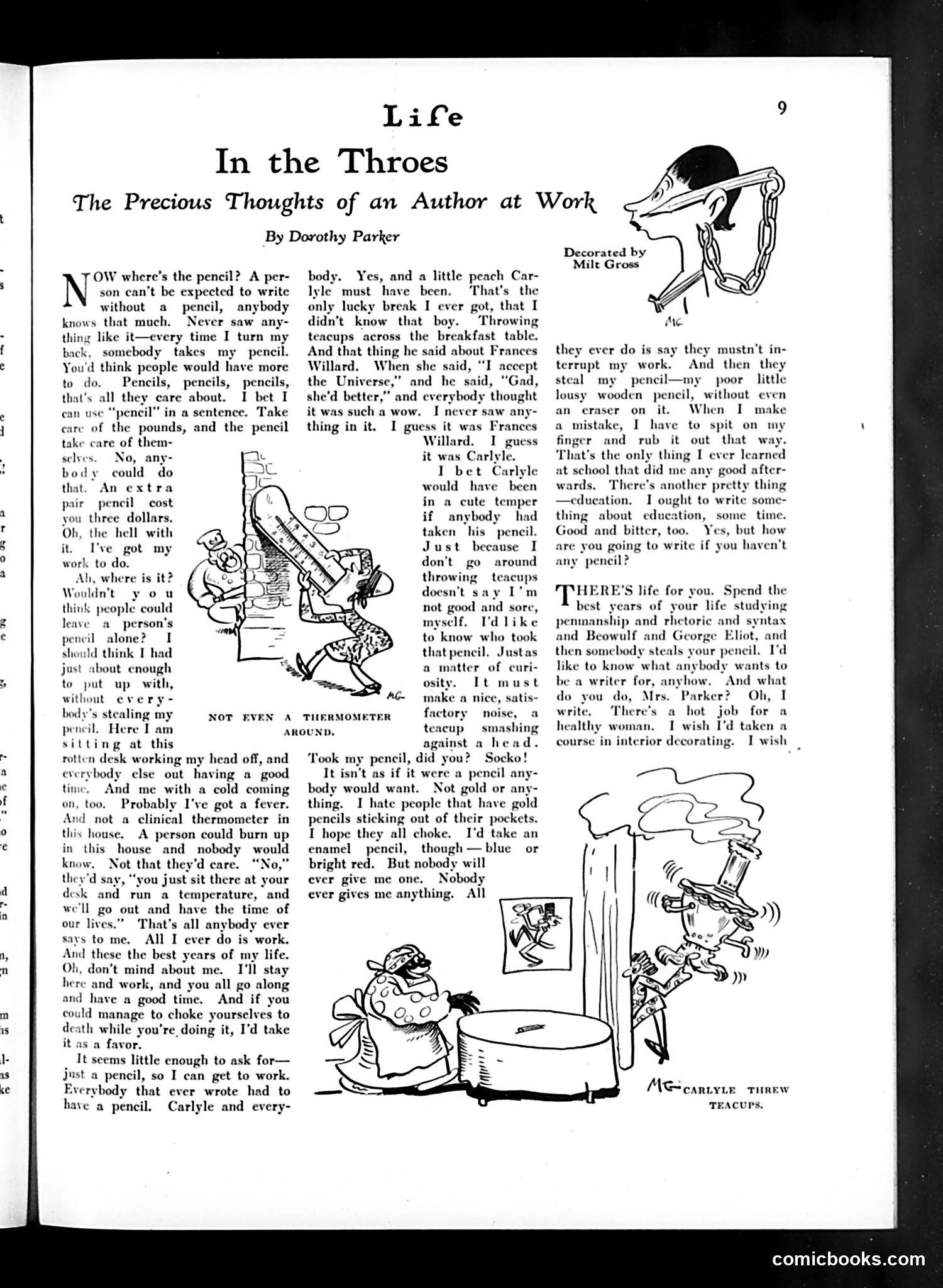
By Dorothy Parker, this satirical essay mocks the romantic notion of authorship. Parker complains humorously about practical annoyances that interrupt writing: lost pencils, teacups on desks, people interrupting with questions, and the inability to simply ask for a replacement pencil without elaborate explanation. The accompanying cartoons by Milt Gross and Carlyle Thrush illustrate these frustrations visually—chaotic desk scenes with teacups causing mayhem and scattered writing implements. The satire targets both the pretensions of serious writers who claim to suffer nobly for their art, and the mundane reality that actual writing involves irritating, unglamorous obstacles. Parker's main point: successful authorship requires nothing more than a functional pencil and freedom from interruption—yet even these basics prove elusive.
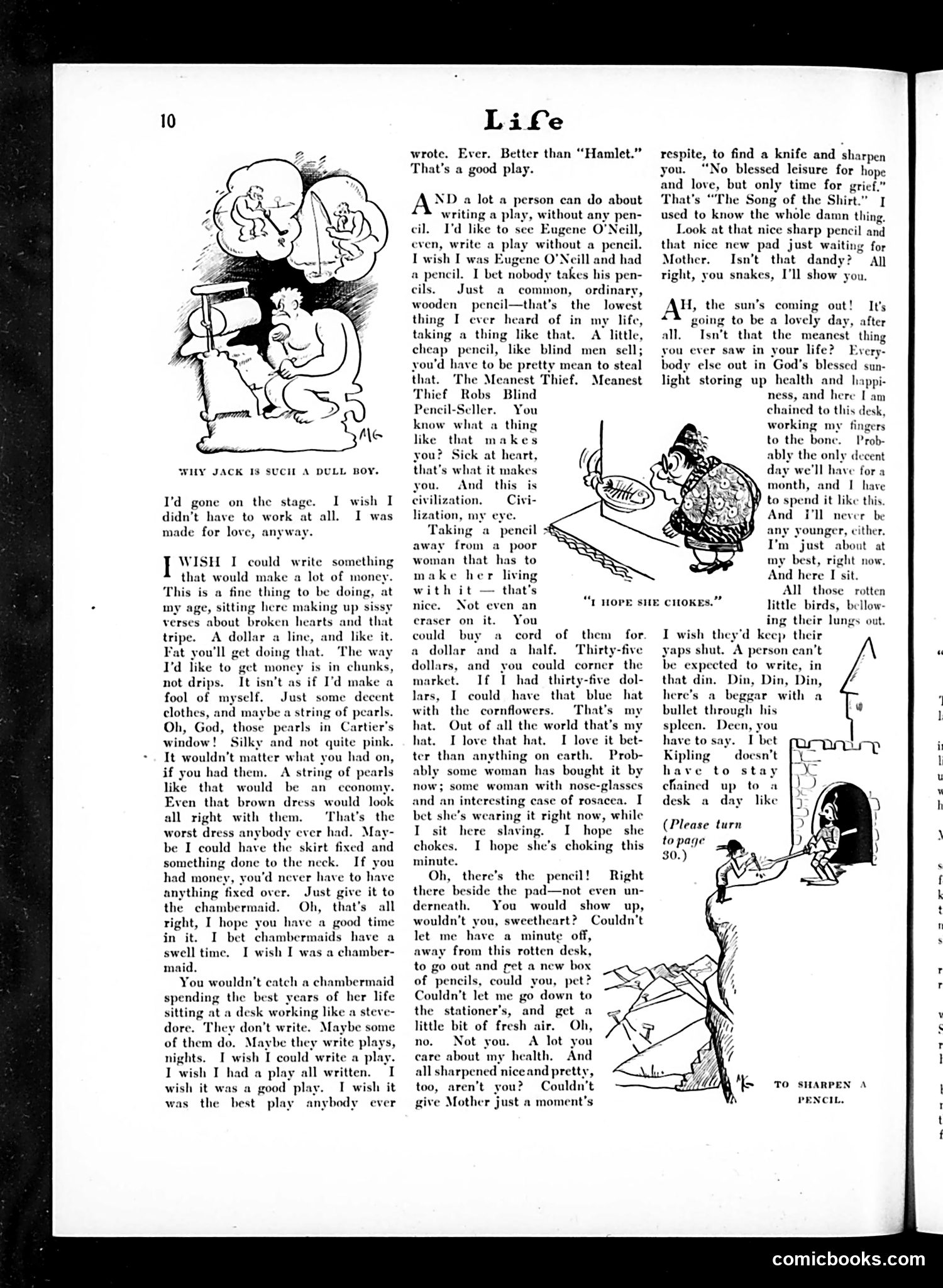
This page features humorous editorial commentary on writing and theater. The main text discusses the difficulty of writing plays without pencils—a tongue-in-cheek complaint from a desk-bound writer. The author laments that even cheap pencils would help create "the best play anybody ever wrote," better than Shakespeare's *Hamlet*. The satirical point mocks the pretensions of struggling writers who blame their tools rather than their talent. The accompanying illustrations show writers at work and a figure labeled "to sharpen a pencil," emphasizing the absurdity of fixating on minor obstacles to creative work. This reflects early 20th-century *Life* magazine's characteristic satirization of artistic aspirations and bohemian affectations among aspiring playwrights.
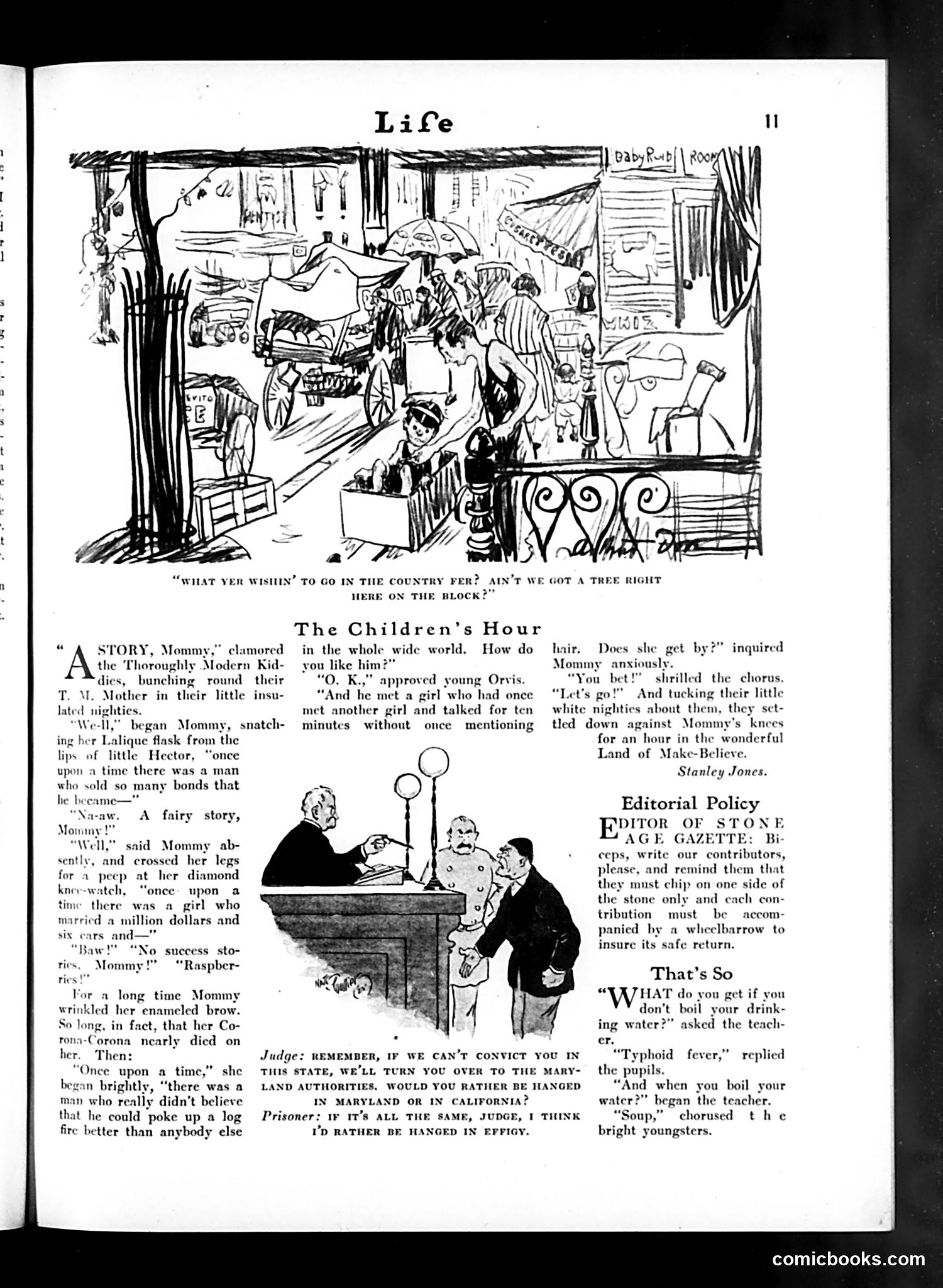
The top cartoon depicts a tenement building scene with children and adults, captioned about wishing "to go in the country" but having only a tree on the block. This satirizes urban poverty—working-class families confined to crowded city streets with minimal access to nature or outdoor space. "The Children's Hour" story below features a mother telling fairy tales to children at bedtime. One anecdote mocks a girl who met another girl and "talked for ten minutes without once mentioning boys"—satirizing early 20th-century social expectations about female conversation. The courtroom cartoon shows a judge addressing a prisoner about capital punishment, likely commenting on contemporary debates about execution methods and state justice systems.
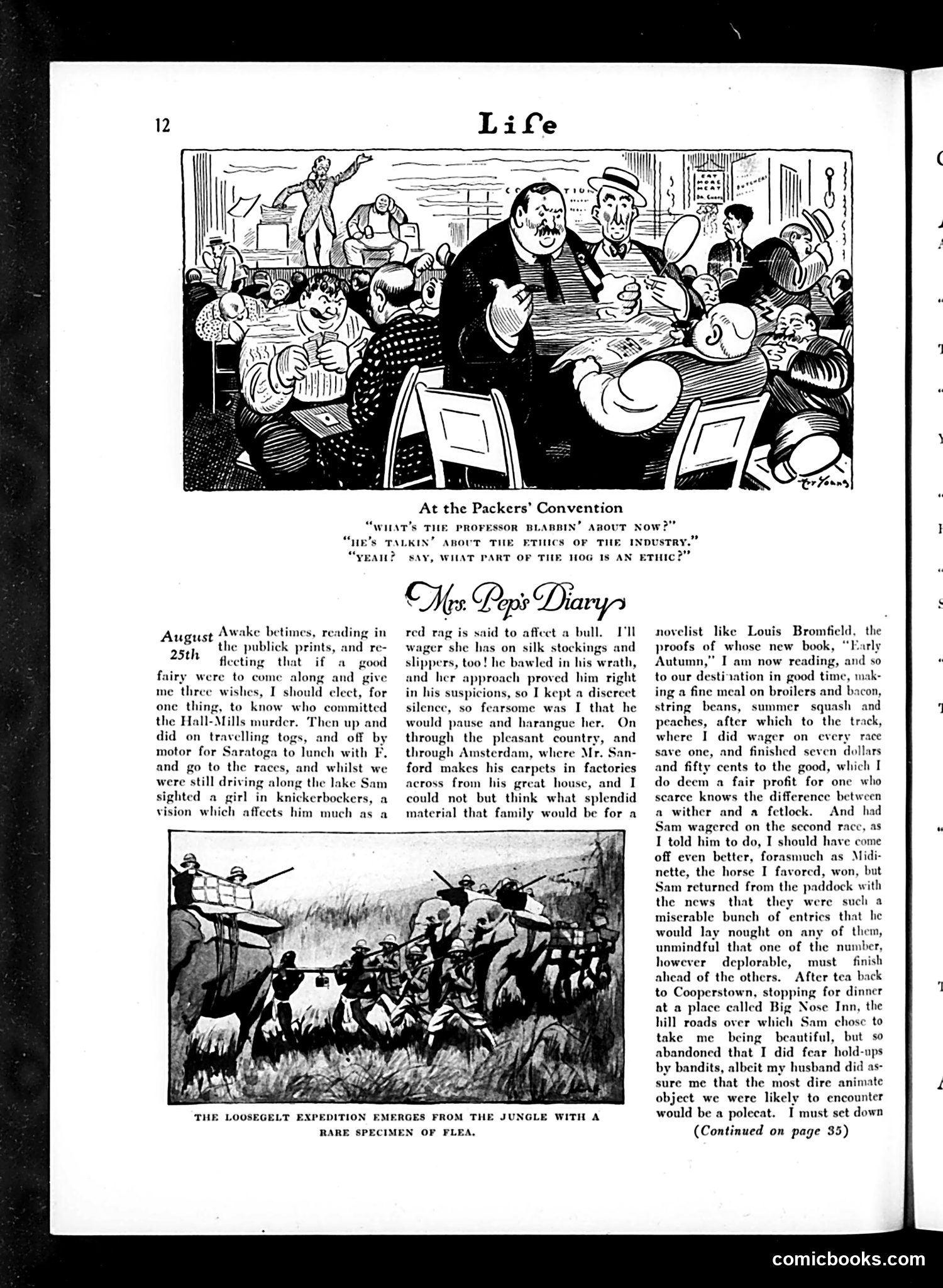
This political cartoon satirizes the meatpacking industry, showing a convention where industry figures discuss ethics while surrounded by abundant meat. The caption's dialogue—"What's the Professor blabbers about now?" and "He's talkin' about the ethics of the industry"—mocks the irony of discussing moral standards in an industry built on slaughtering animals. The final quip, "Yeah? Say, what part of the hog is an ethic?" suggests ethics are irrelevant to meatpackers focused on profit. The cartoon critiques corporate hypocrisy: the industry claims respectability while engaging in practices many considered brutal or unethical. This reflects Progressive Era concerns about unsafe labor conditions and animal treatment in meatpacking plants, famously exposed by Upton Sinclair's *The Jungle* (1906).
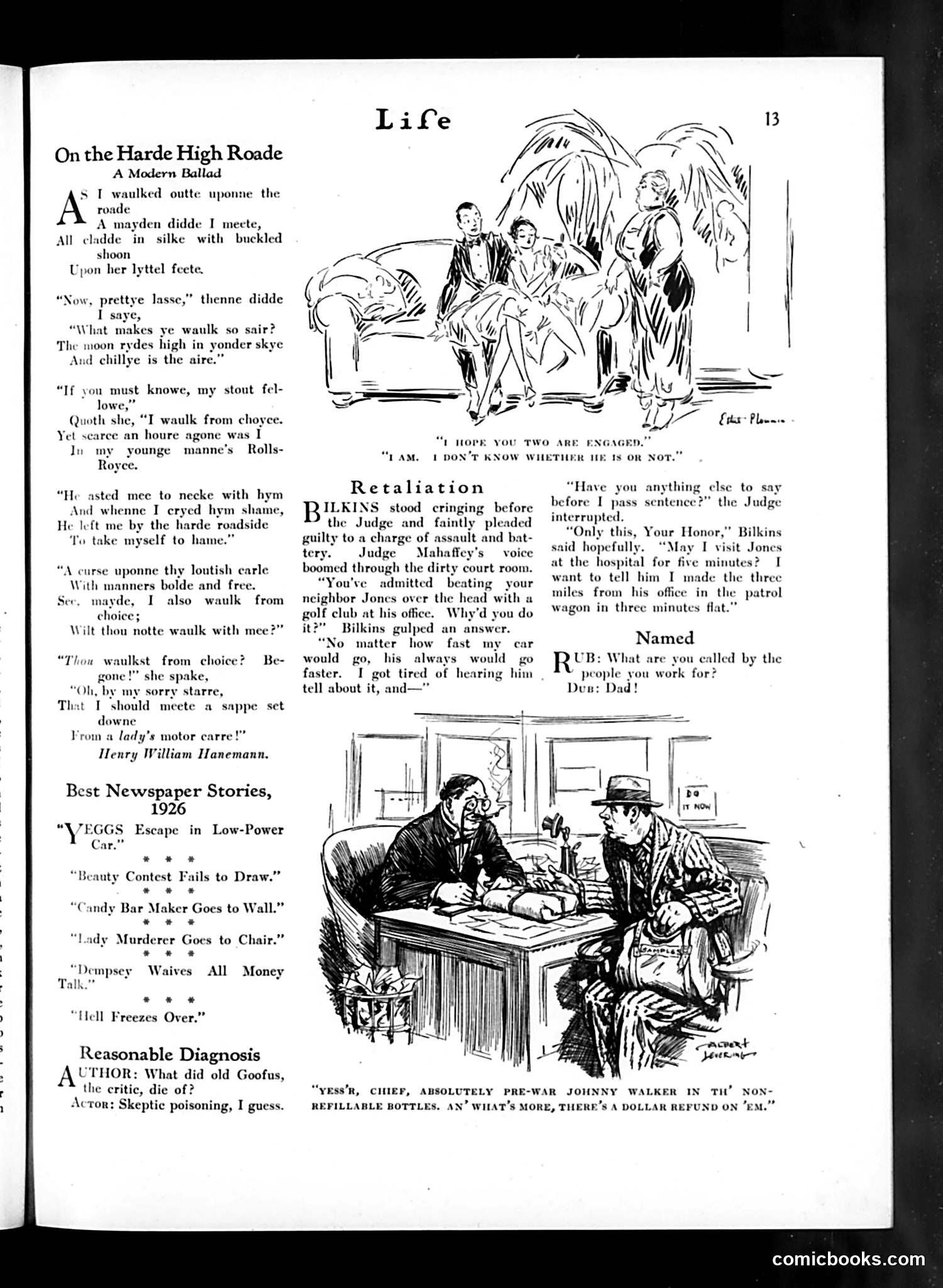
This page from *Life* magazine contains several humorous pieces. The main cartoon depicts two men at a desk—one appearing to be a police officer or authority figure, the other a civilian. The caption references "pre-war Johnny Walker" bottles and a dollar refund, suggesting satire about Prohibition-era alcohol regulations and black-market dealings. The upper section features "On the Harde High Roade," a modern ballad poem about a man encountering a young woman on the road, with period-appropriate romantic/social commentary. Other sections include "Best Newspaper Stories, 1926" (satirizing absurd headlines), "Retaliation" (about someone named Bilkins in a court case), and "Named" (a brief joke about job titles). The overall tone is light social satire typical of 1920s American humor magazines.
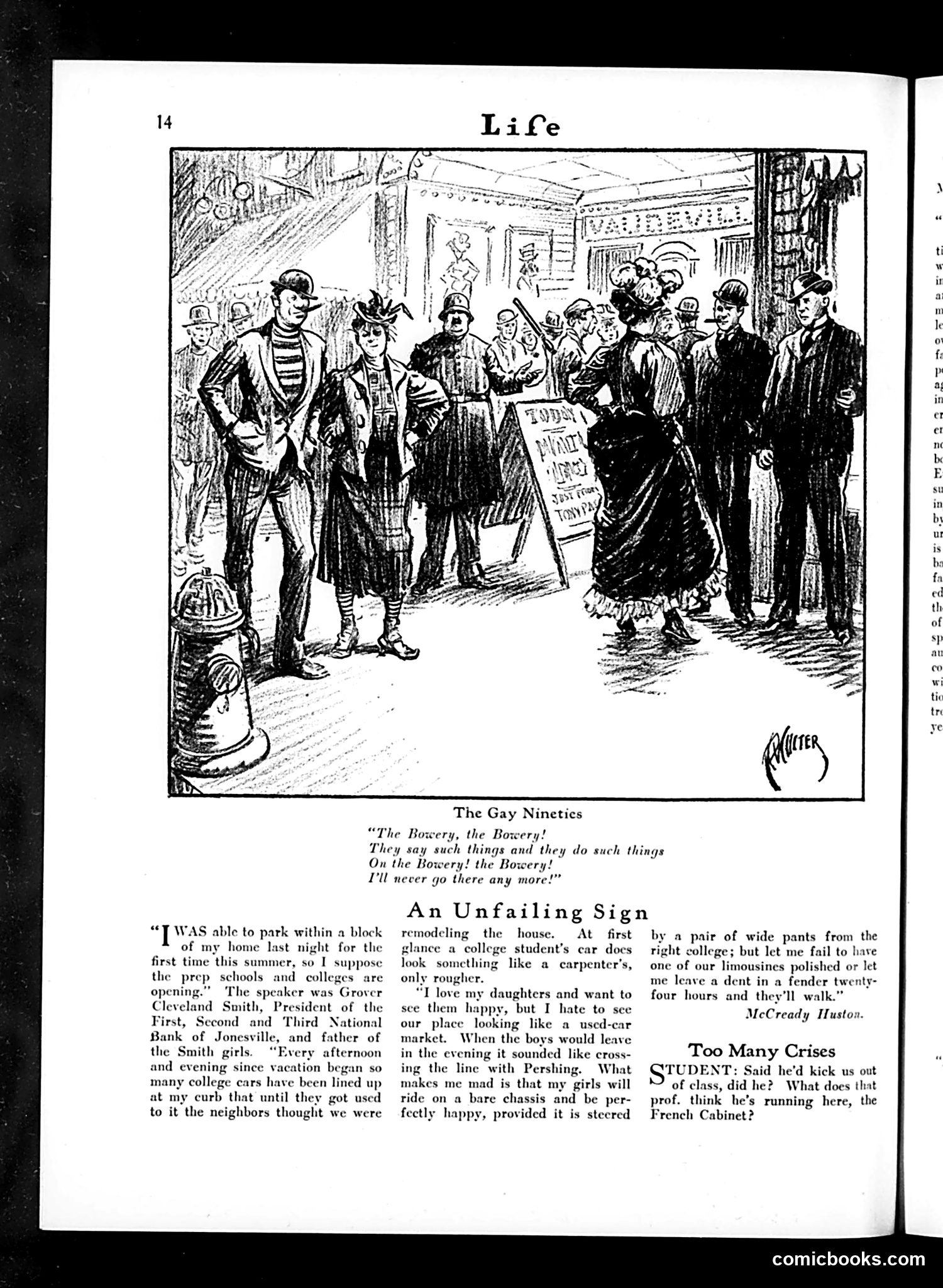
**Main Cartoon: "The Gay Nineties"** This illustration depicts a group of well-dressed men and women in what appears to be an early 1900s indoor venue, with one woman prominently displaying a sign reading "The Bowery." The caption quotes concerns about the Bowery's reputation ("They say such things and they do such things / On the Bowery! the Bowery! / I'll never go there any more!"). The satire likely mocks middle-class anxiety about visiting or associating with the Bowery, a notorious working-class neighborhood in New York known for vice and crime. **"An Unfailing Sign" & "Too Many Crises"** These brief humor pieces reference automobile culture (cars being parked, chassis mentioned) and campus life (a student and professor), typical light satirical content of the era mocking contemporary manners and social situations.
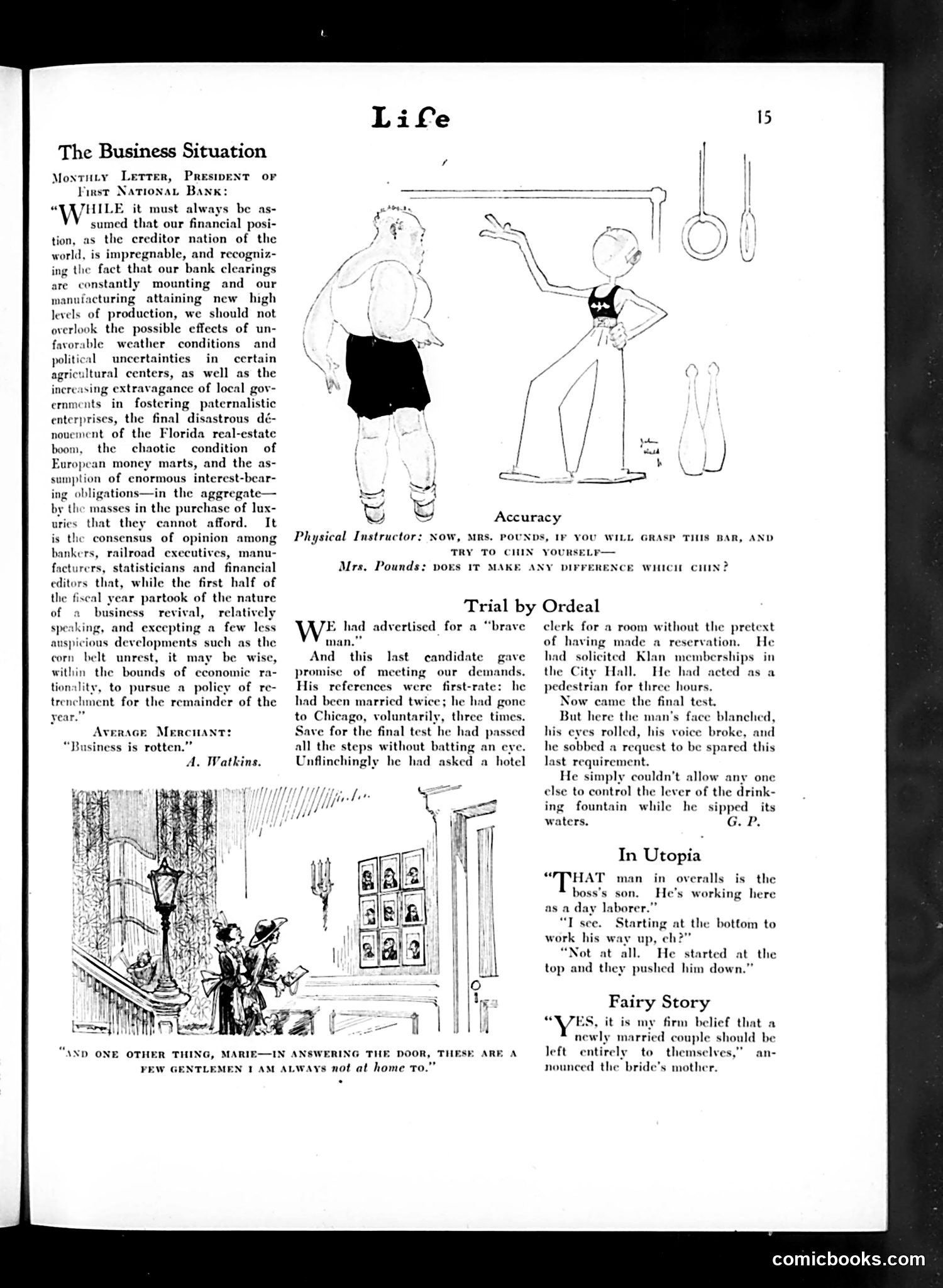
This page contains several satirical humor pieces typical of early 20th-century Life magazine: **"The Business Situation"** presents a lengthy quote from a bank president claiming financial stability despite mounting manufacturing challenges and European market uncertainties—satirizing corporate optimism during uncertain economic times. **"Accuracy"** mocks a physical instructor and client through a visual gag about chin exercises, playing on fitness fads. **"Trial by Ordeal"** humorously describes an awkward job candidate who fails a final test by losing composure at a drinking fountain—satirizing employment interviews. **"In Utopia"** jokes about class mobility through a man in overalls, suggesting workers cannot advance regardless of effort. **"Fairy Story"** concludes with ironic advice about newly married couples, mocking sentimental domestic expectations. The page emphasizes social and economic absurdities through period-appropriate humor.
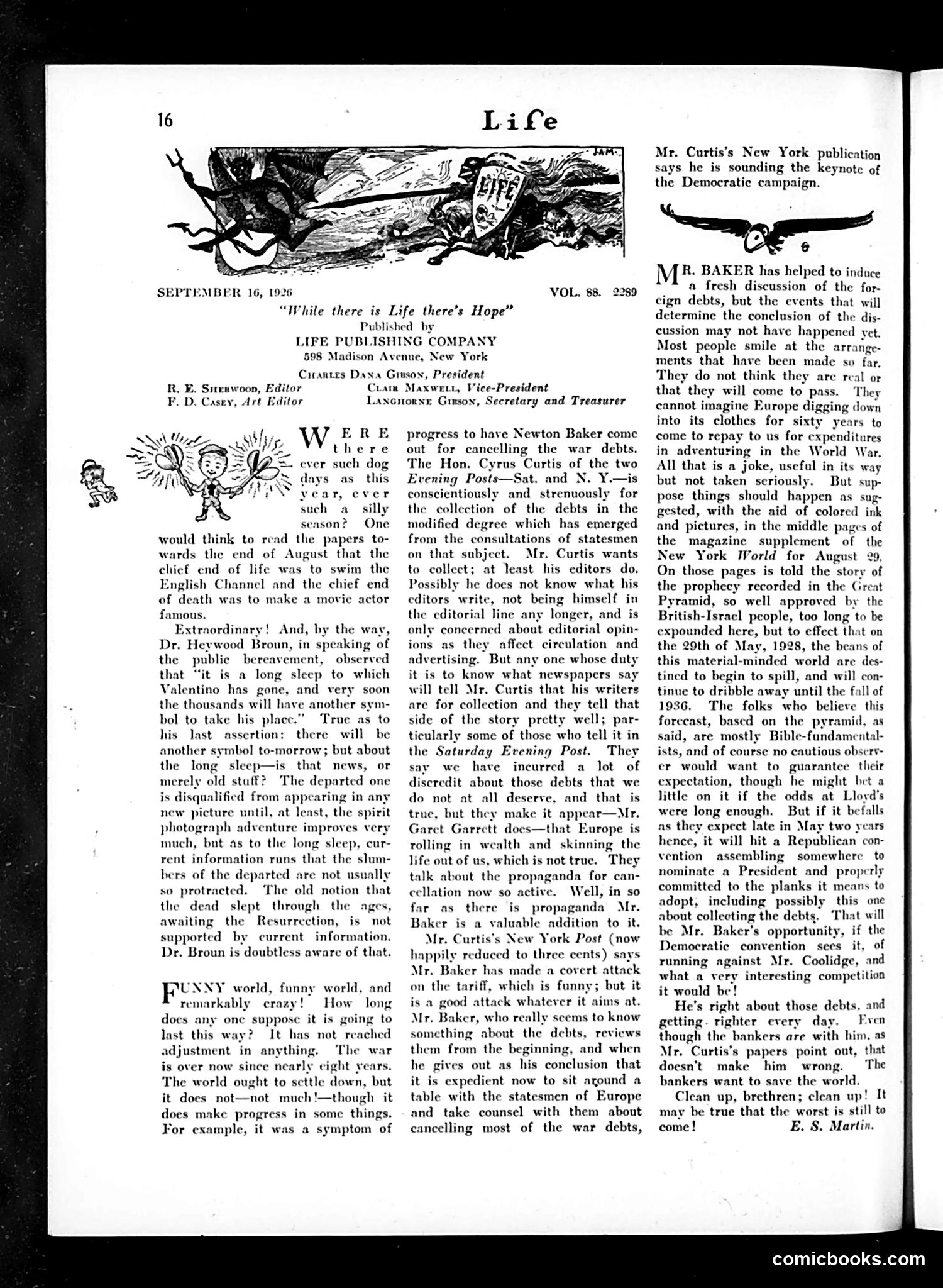
This editorial page discusses Newton Baker's proposal to cancel international war debts from World War I. The masthead cartoon (top) appears to show a figure labeled "LIFE" amid chaotic imagery, likely satirizing the publication's response to current events. The editorial argues Baker's debt-cancellation plan is sensible, though the writer notes Europeans are portrayed as greedy for wanting forgiveness while Americans are depicted as rolling in wealth. The piece defends Baker as contributing valuable perspective to the debt discussion, contrasting him with those making propaganda arguments. The closing comment from E.S. Martin suggests banks should help solve the world's post-war economic problems. The overall satire critiques hypocrisy in how debts and international responsibility are discussed.
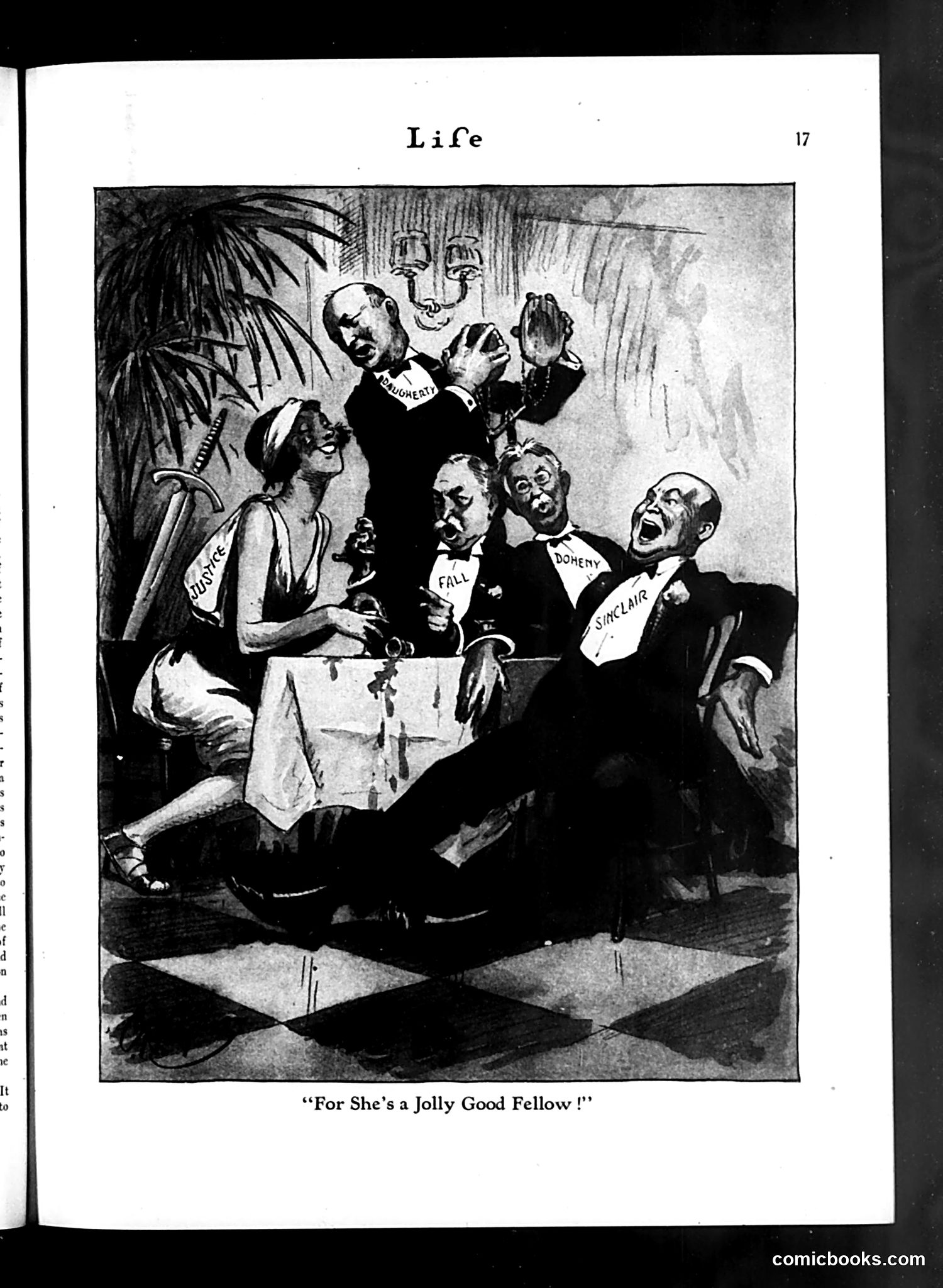
This satirical cartoon depicts a group of men in formal attire gathered around a table in what appears to be a celebratory scene. Several figures wear labels identifying them as "HYPOCRISY," "FALL," "DOHERTY," and "SINCLAIR"—likely prominent political or public figures of the era. The woman on the left holds what appears to be a scroll labeled "DIVORCE." The cartoon satirizes these individuals for hypocritically celebrating or supporting a woman despite personal scandals. The phrase "For She's a Jolly Good Fellow!" (sung as if in tribute) suggests ironic approval despite the moral failings represented by the labeled attributes. The overall message critiques the selective moral standards applied to public figures—celebrating someone while simultaneously acknowledging or ignoring serious personal misconduct or controversial behavior.
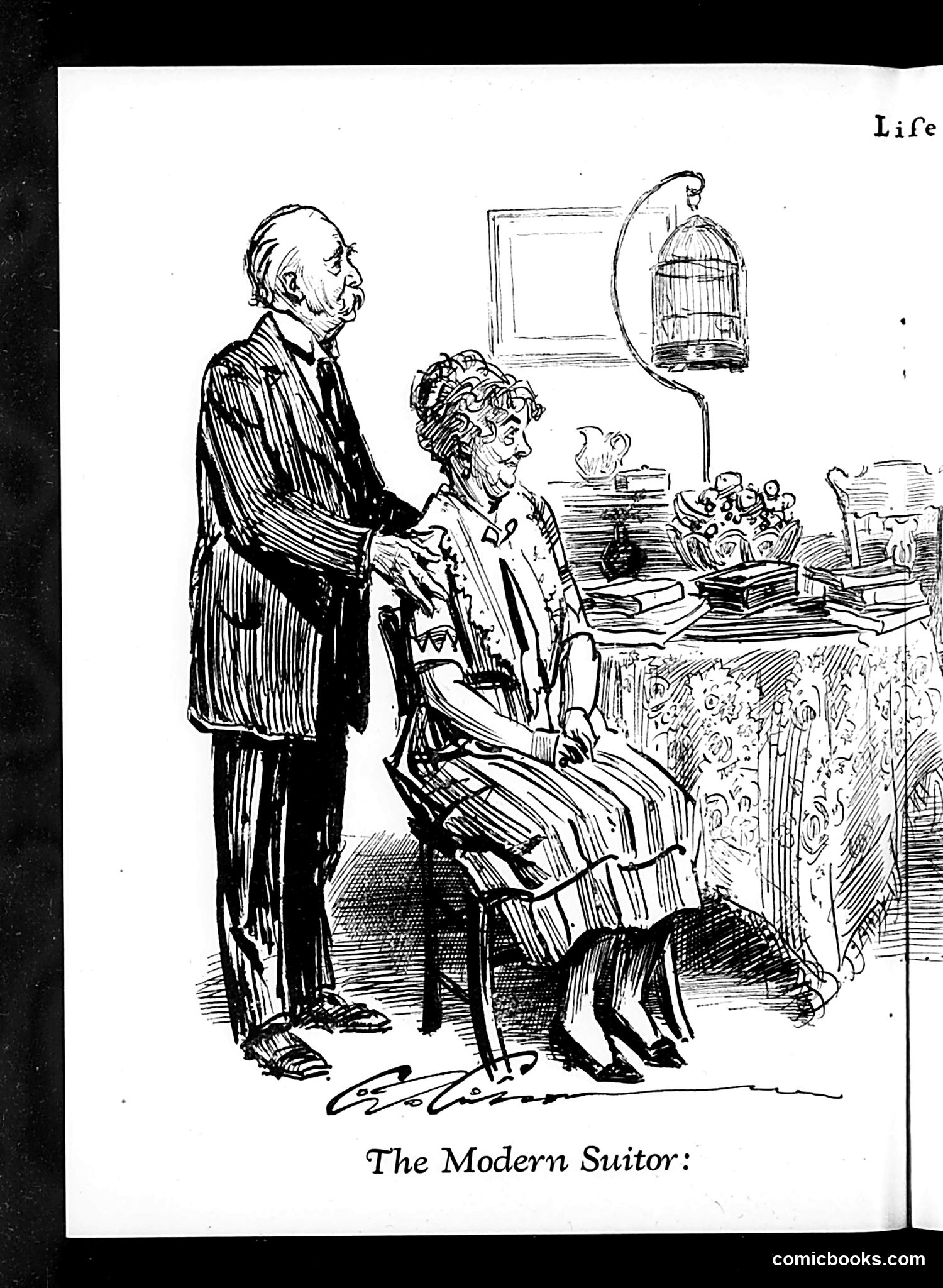
This satirical cartoon depicts a gentleman caller visiting a woman in her home. The title "The Modern Suitor" suggests commentary on contemporary courtship practices, likely from the early 20th century based on the clothing and interior design. The scene shows a formal domestic interaction: the man stands while the woman sits at a desk surrounded by books, papers, and what appears to be a birdcage. The detailed interior suggests a refined, intellectual household. The satire likely critiques either: the formality of modern courtship rituals, changing gender roles as women became more educated and independent, or the awkwardness of proper Victorian/Edwardian social conventions. The woman's prominent positioning at her desk with intellectual materials may suggest irony about how "modern" suitors interact with educated women, though the exact satirical point remains somewhat ambiguous without additional context about Life magazine's editorial stance at the time of publication.
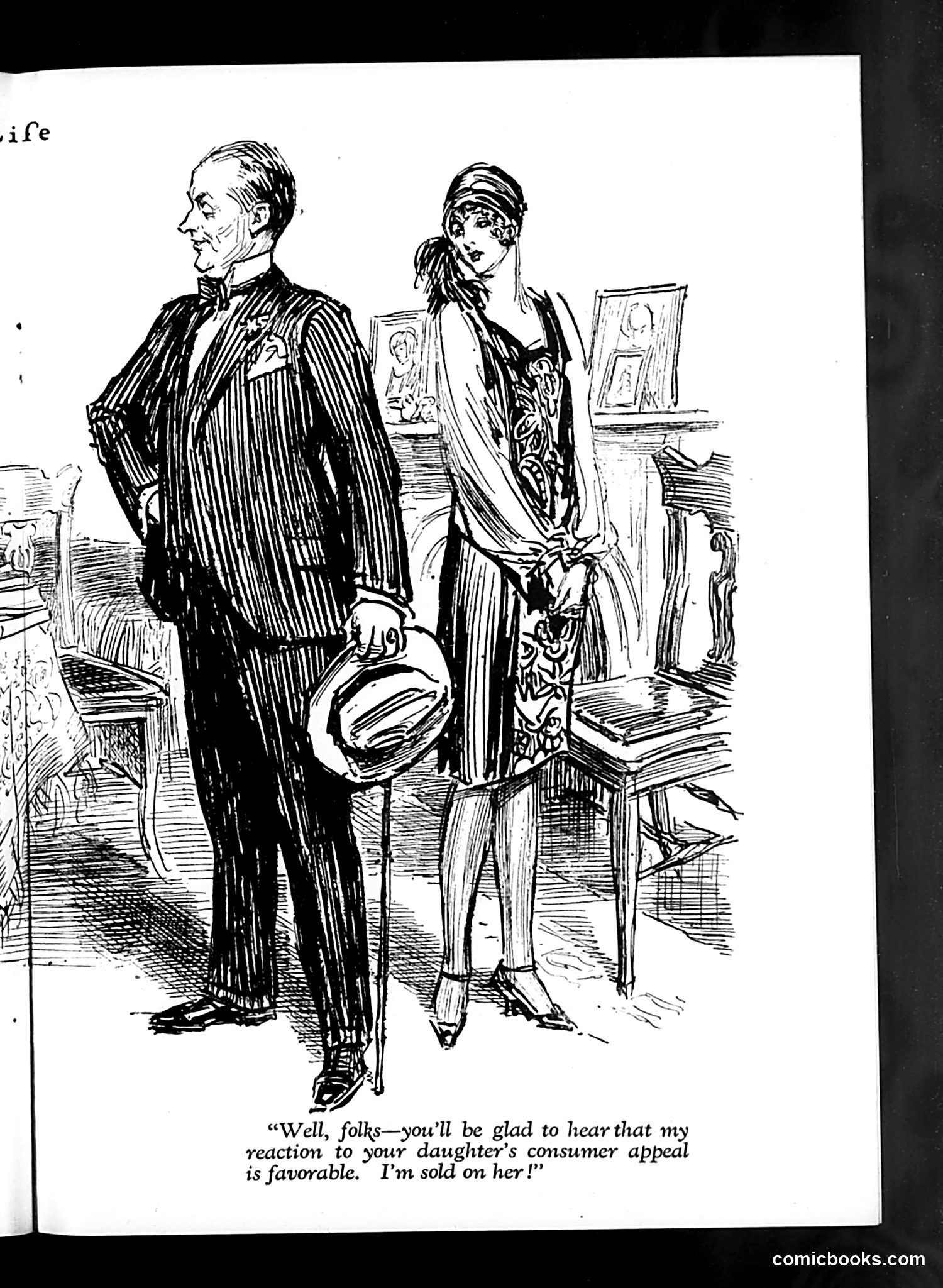
This cartoon satirizes advertising and dating conventions, likely from the early-to-mid 20th century. A well-dressed older man addresses parents about their daughter, using commercial/sales language: he's "sold on her" based on her "consumer appeal." The humor lies in the crude reduction of a young woman to a product being marketed and evaluated. The father figure speaks like a businessman appraising merchandise rather than expressing genuine romantic interest. The cartoon mocks both the commodification of women in courtship and the pervasive influence of advertising language on social interactions during this era. The satire suggests that even intimate human relationships had become colonized by commercial values and marketing terminology.
This is a theater review column addressing recurring reader complaints. Life's editors explain they frequently print "To be reviewed later" because three plays open nightly during theater season, but the magazine goes to print two weeks early—meaning roughly twenty plays haven't opened yet when reviewed. The column then praises two successful Broadway comedies: "The Home Towners" (written by George M. Cohan) and "Loose Ankles." The critic notes these aren't "great shakes" but succeed as popular entertainment. "The Home Towners" humorously depicts small-town American life through character H.P. Bancroft, using typical American wisecracks rather than Cohan's signature comedic style—making it relatable to ordinary audiences who see themselves reflected onstage. The small illustrations appear to be comedic vignettes accompanying the theater discussion.
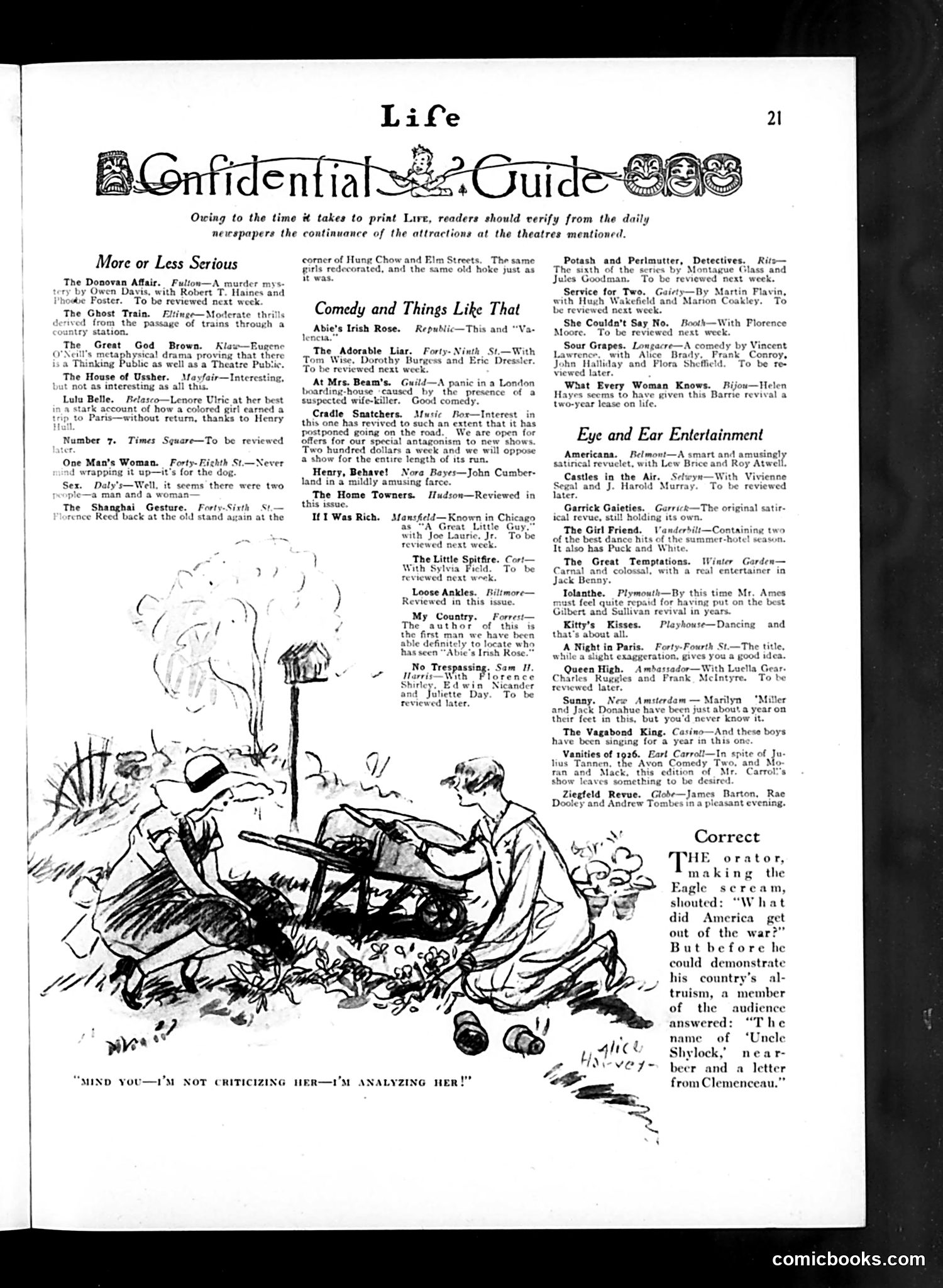
This page is a theater guide listing Broadway and entertainment attractions with brief reviews. The main cartoon depicts a man examining a woman with a magnifying glass, captioned "Mind you—I'm not criticizing her—I'm analyzing her." **The Joke's Context:** This is social satire about gender dynamics in the 1920s. The cartoon plays on the era's pseudo-intellectual trend of "analysis"—likely referencing Freudian psychology, which was becoming fashionable among educated urbanites. The humor stems from the contradiction: a man claims he's merely conducting scientific "analysis" of a woman's appearance/character, when he's obviously just scrutinizing her critically (or romantically). The joke suggests that men used intellectual pretenses to justify examining or judging women, a commentary on how analysis could serve as a socially acceptable cover for objectification or patronizing behavior. It reflects 1920s debates about women's changing social roles during the Jazz Age.
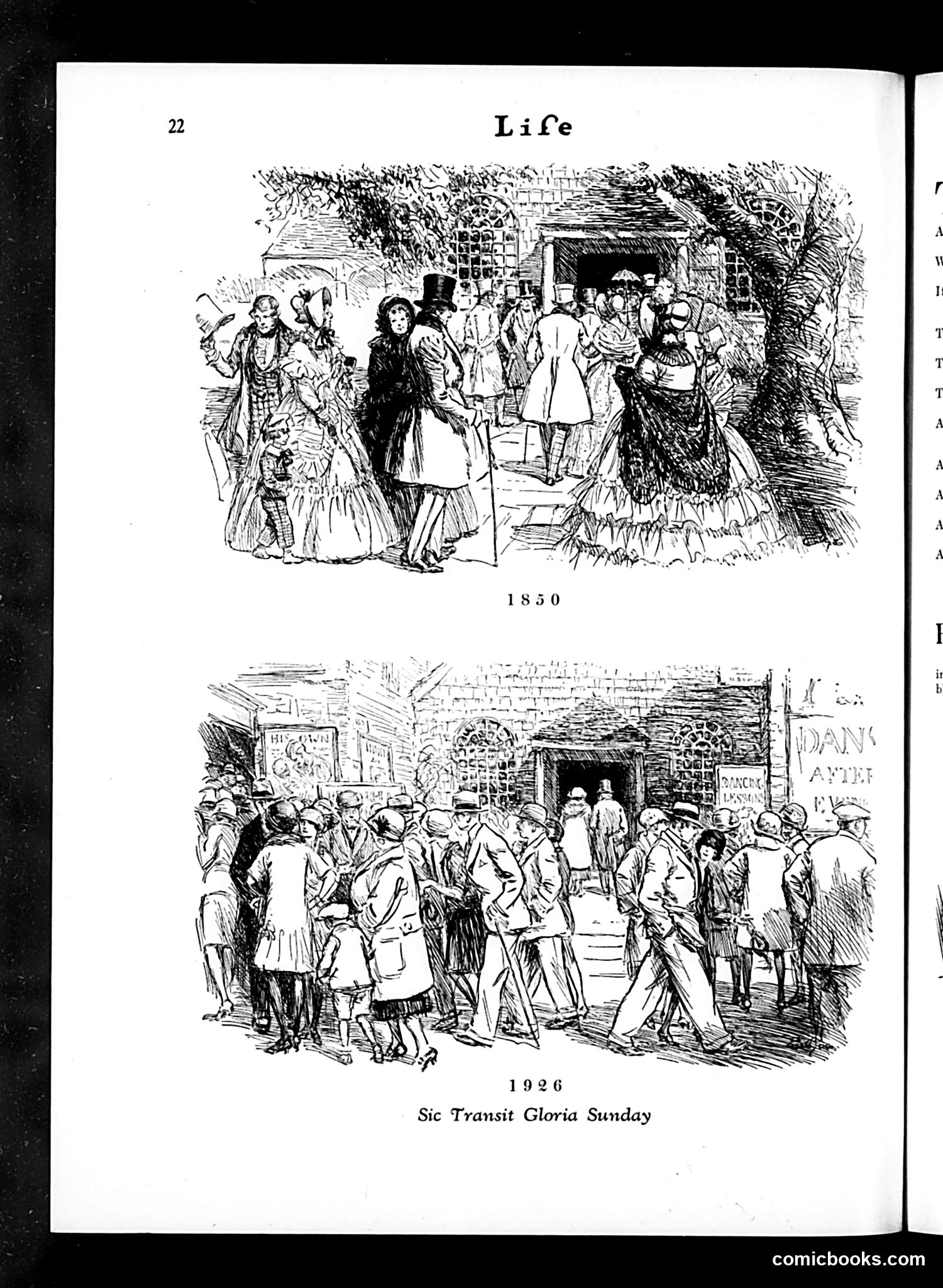
This page presents two satirical sketches comparing Sunday life in 1850 versus 1926, titled "Sic Transit Gloria Sunday" (Latin: "Thus passes the glory of Sunday"). The **1850 image** shows a genteel, orderly street scene with well-dressed Victorian figures, suggesting a respectable, leisured Sunday atmosphere. The **1926 image** depicts a crowded, chaotic urban street teeming with working-class pedestrians, suggesting commercialization and loss of Sunday's traditional reverence. The satire critiques how modernization and commercialization have transformed Sunday from a day of refined leisure and religious observance into a busy, ordinary marketplace day. The contrast implies nostalgia for earlier propriety while satirizing contemporary urban disorder and the decline of Sunday as a sacred day of rest.
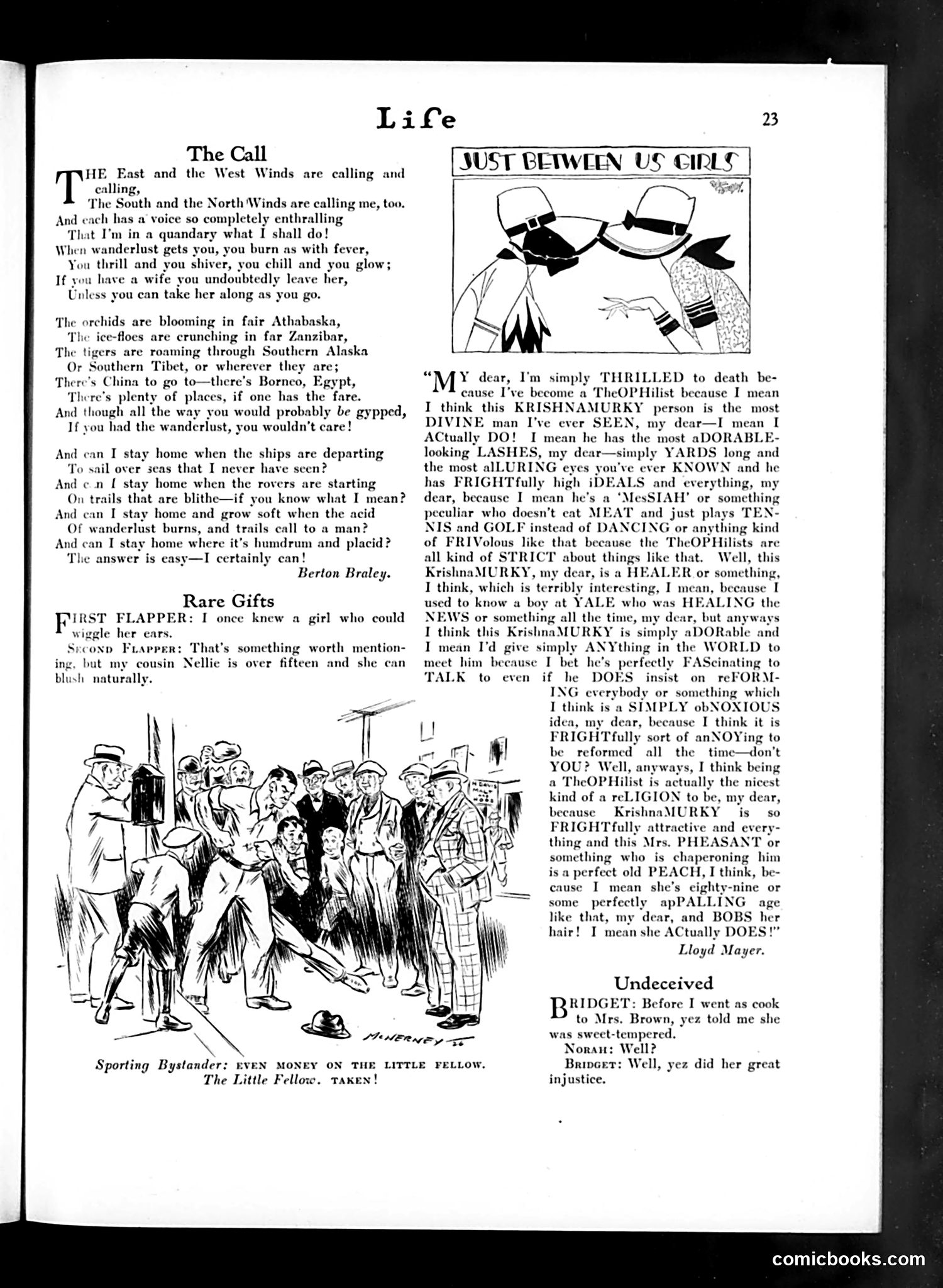
**"The Call" (poem by Berton Braley):** A humorous meditation on wanderlust. The speaker insists the four winds call him to exotic locations (Athabasca, Zanzibar, Tibet, Alaska)—yet concludes he can easily stay home. The satire targets romantic notions of adventure: despite passionate rhetoric about wandering, real life keeps people rooted. **"Rare Gifts":** Two flappers discuss trivial female accomplishments—one girl can wiggle her ears, another (over 15) can blush naturally. The joke mocks shallow social competition among young women. **"Sporting Bystander":** A crowd watches a small boy, with betting odds on "the little fellow." The caption suggests gambling on an underdog. **"Just Between Us Girls":** A breathless monologue (by Lloyd Mayer) from a flapper gushing about a "TheOPHilist" (Theosophist—a spiritual/mystical movement) named Krishna Murky. She's infatuated despite his ascetic ideals (no meat, plays tennis/golf instead of dancing). The satire targets both flapper superficiality and fashionable interest in Eastern spirituality. **"Undeceived":** Brief dialogue—a cook was told her new employer was sweet-tempered but found otherwise. Simple ironic joke.
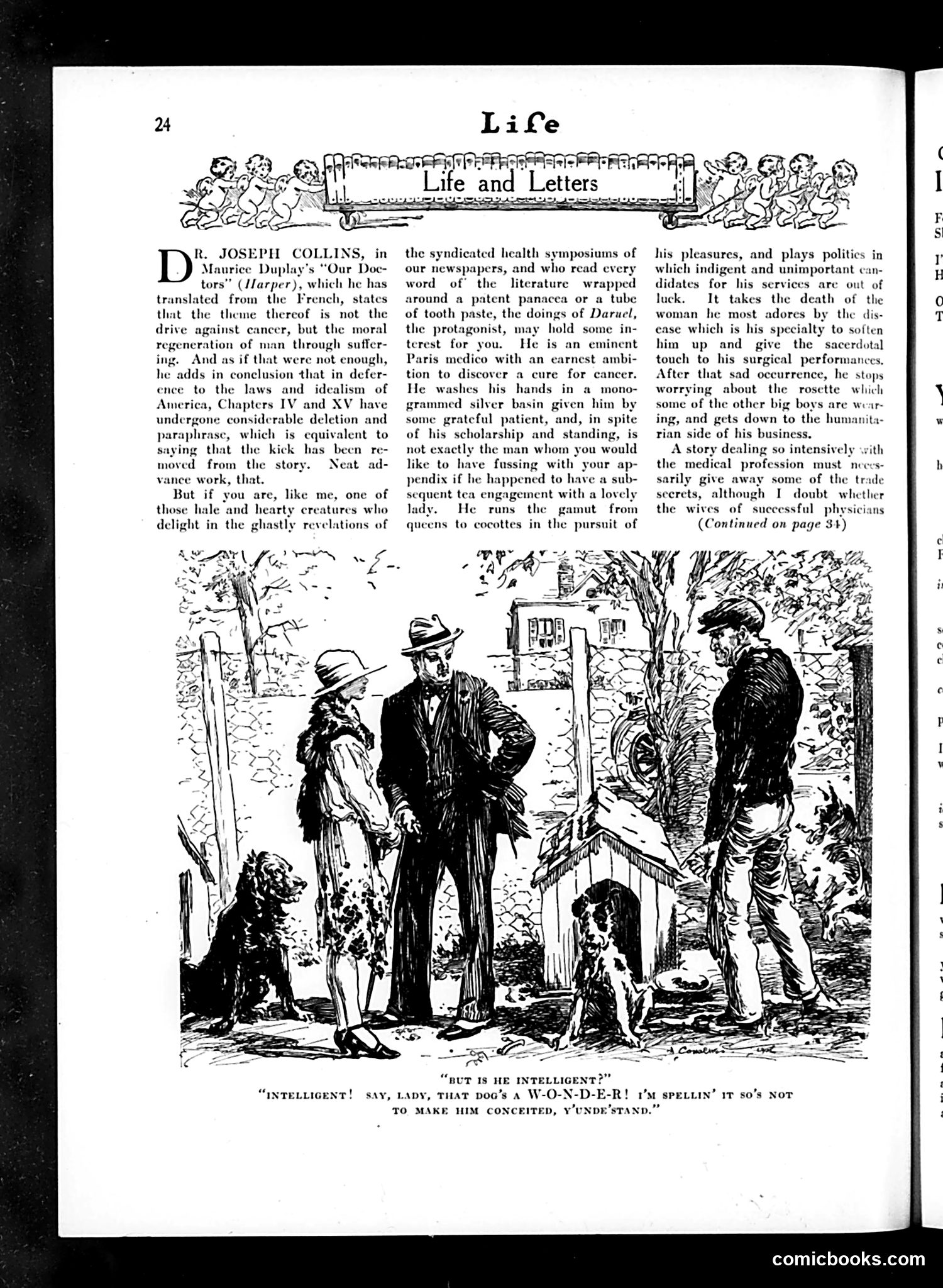
This page reviews a French novel translated as "Our Doctors" (by Joseph Collins), about a Parisian physician named Daruel who pursues a cure for cancer. The text criticizes the book's moral compromises: chapters were deleted to comply with American "laws and idealism," and the protagonist is portrayed as morally questionable—chasing wealthy patients and romantic conquests despite his medical ambitions. Only a woman's death from cancer humanizes him. The cartoon below depicts a conversation about dog intelligence. A man defends his dog's intelligence to a skeptical lady, claiming the dog is "spelling it so's not to make him conceited." The humor lies in the absurd notion that a dog would understand spelling or possess vanity—satirizing people's tendency to anthropomorphize pets and overestimate animal cognition. The page exemplifies *Life* magazine's satirical approach to contemporary culture, literature, and human folly.
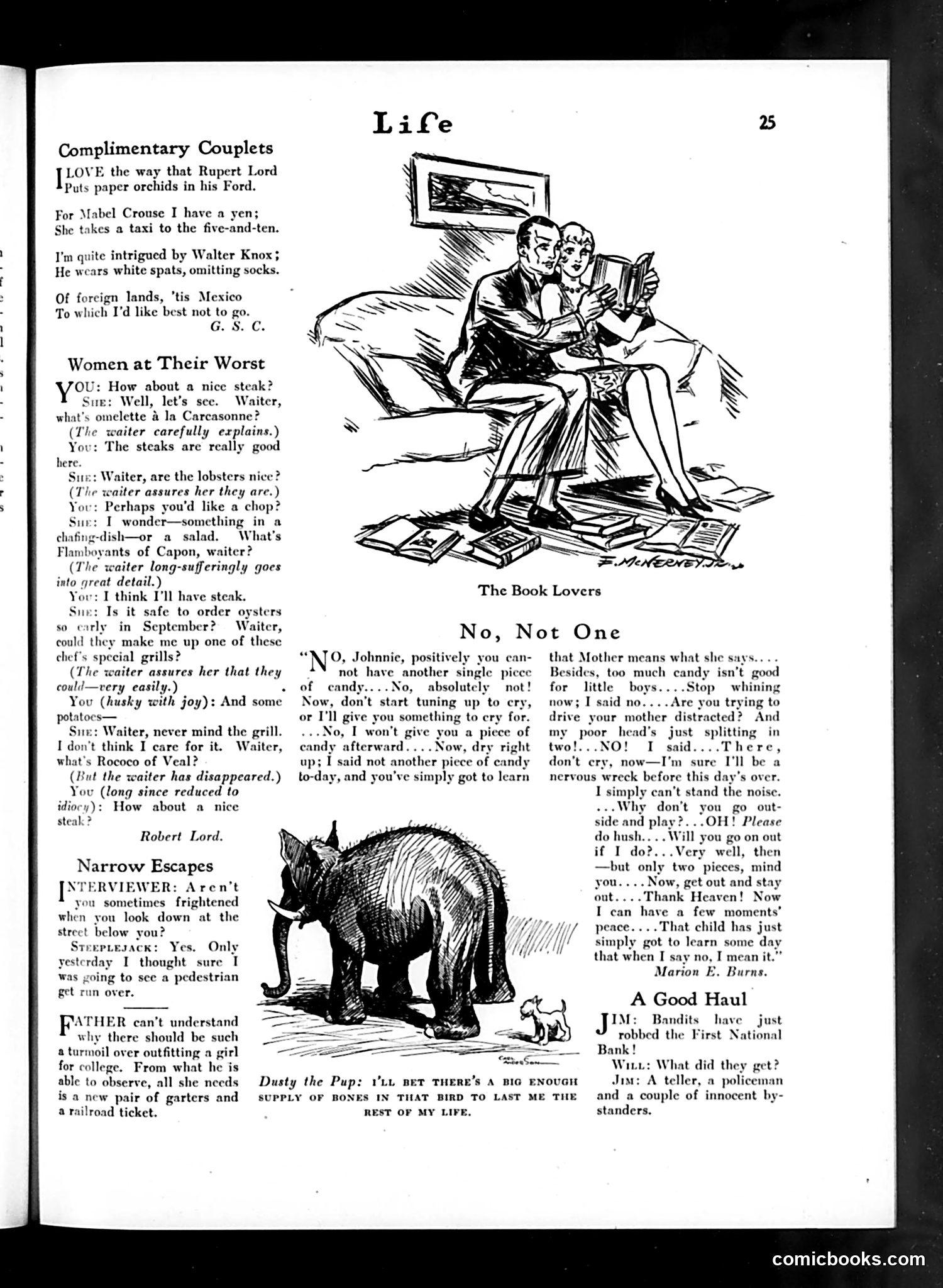
This page collects short humorous pieces mocking contemporary social behaviors: **"Complimentary Couplets"** ridicules affectations of wealthy or fashionable people—men wearing white spats without socks, women putting paper orchids in cars, taking taxis to dime stores. **"Women at Their Worst"** satirizes indecisive female diners who overwhelm waiters with elaborate menu questions while their male companions simply order steak. The joke reflects period gender stereotypes about women's frivolousness. **"Narrow Escapes"** presents absurdist humor: a high-altitude worker fears witnessing a pedestrian accident rather than his own danger; a father bewildered by college expenses thinks girls need only garters and a train ticket. **"The Book Lovers"** depicts a mother relentlessly denying her son candy while explaining her refusals, then yielding to two pieces—mocking parental inconsistency. **"A Good Haul"** makes dark humor from bank robbery, joking that criminals "got" innocent bystanders alongside actual valuables. The cartoons use simple ink drawings to accompany these satirical vignettes targeting class pretension, gender roles, parenting, and modern anxieties.
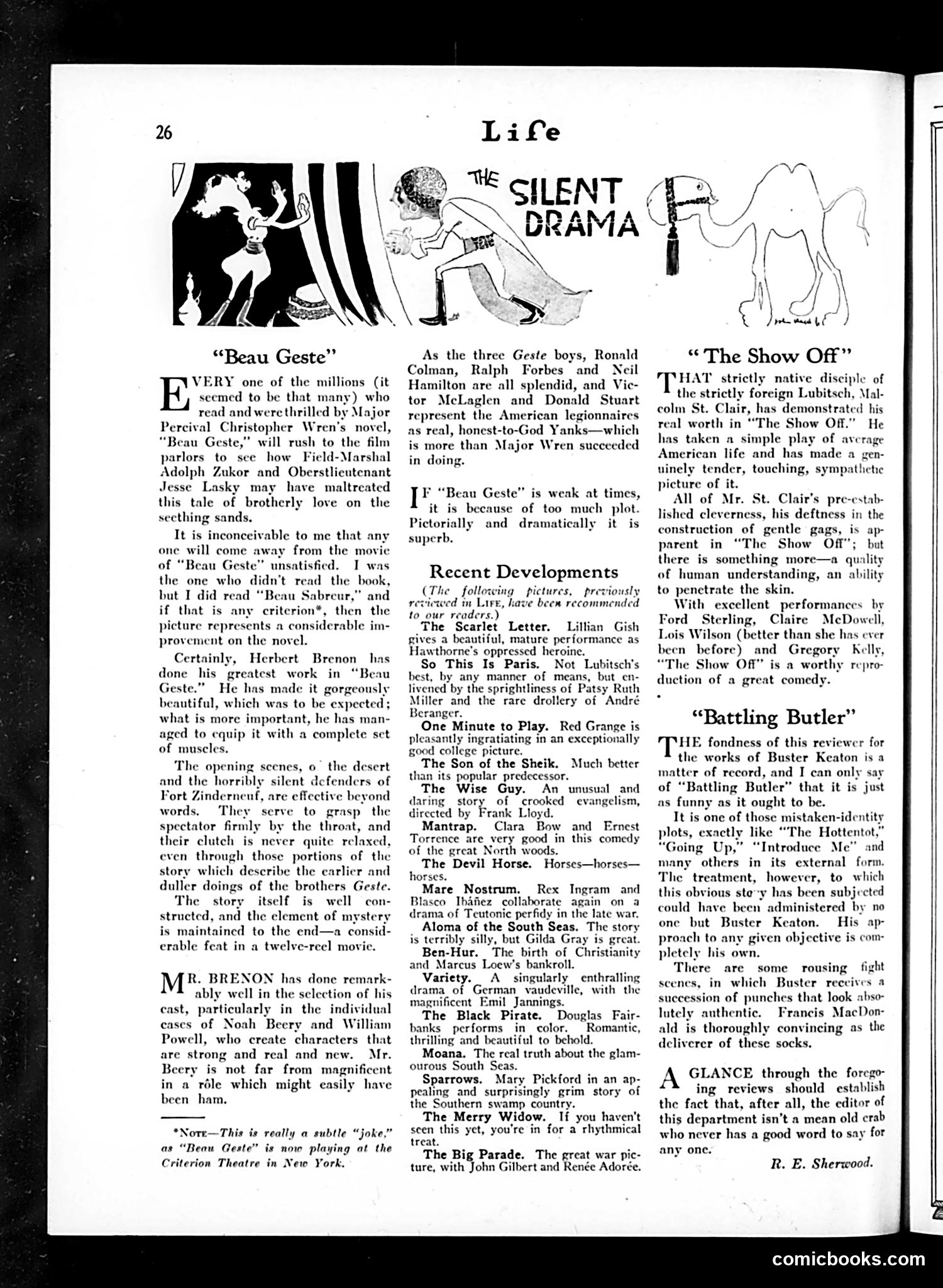
This page reviews the 1926 silent film adaptation of P.C. Wren's popular novel "Beau Geste"—a romantic adventure about brothers in the French Foreign Legion. The reviewer praises director Herbert Brenon's visual execution and the cast (Ronald Colman, Noah Beery, William Powell), calling it an improvement over the source material. The satirical jab appears in a footnote: the reviewer admits he never read the original novel but did read "Beau Sabreur" (the sequel), making his judgment somewhat absurd. This is labeled a "subtle joke"—the reviewer's credibility is undercut by his admission of not knowing the source material he's evaluating. The page also lists other current 1926 releases (featuring Mary Pickford, Douglas Fairbanks, Lillian Gish), reflecting Life's role as entertainment guide for educated urban readers during Hollywood's silent era.
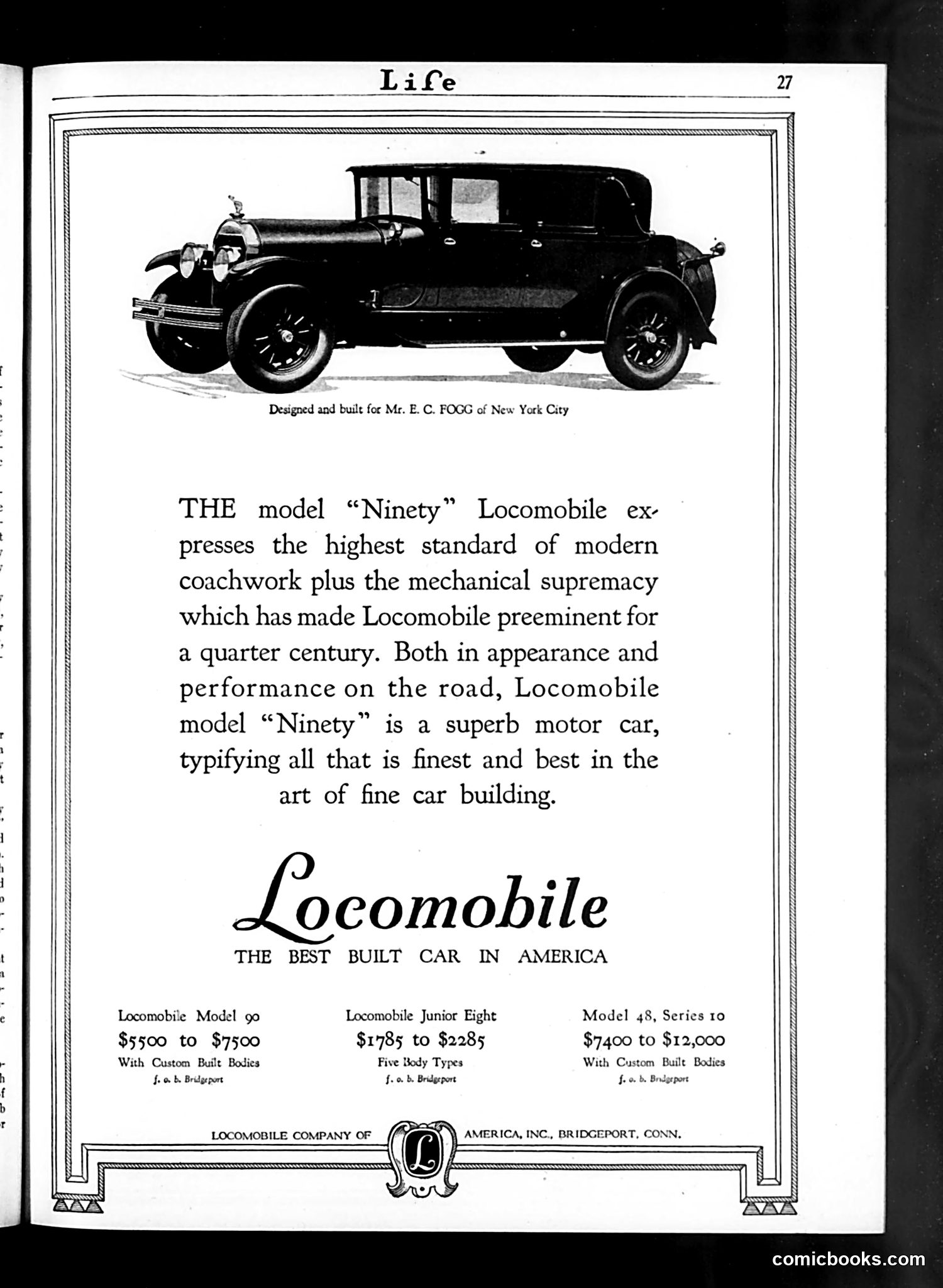
This is primarily a **luxury automobile advertisement**, not a political cartoon. The page features a sleek black Locomobile Model "Ninety" automobile photographed in profile, custom-built for a wealthy New York businessman named E. C. Fogg. The ad emphasizes prestige and craftsmanship, claiming Locomobile has been "preeminent for a quarter century" and represents "the best built car in America." Three models are listed with prices ranging from $1,785 to $12,000—substantial sums indicating these were vehicles for the affluent. There is no satire or political commentary visible. This appears to be a straightforward high-end product advertisement from *Life* magazine's advertising section, designed to appeal to wealthy readers. The "J. & b. Bridgeport" notation likely refers to custom body builders in Bridgeport, Connecticut.
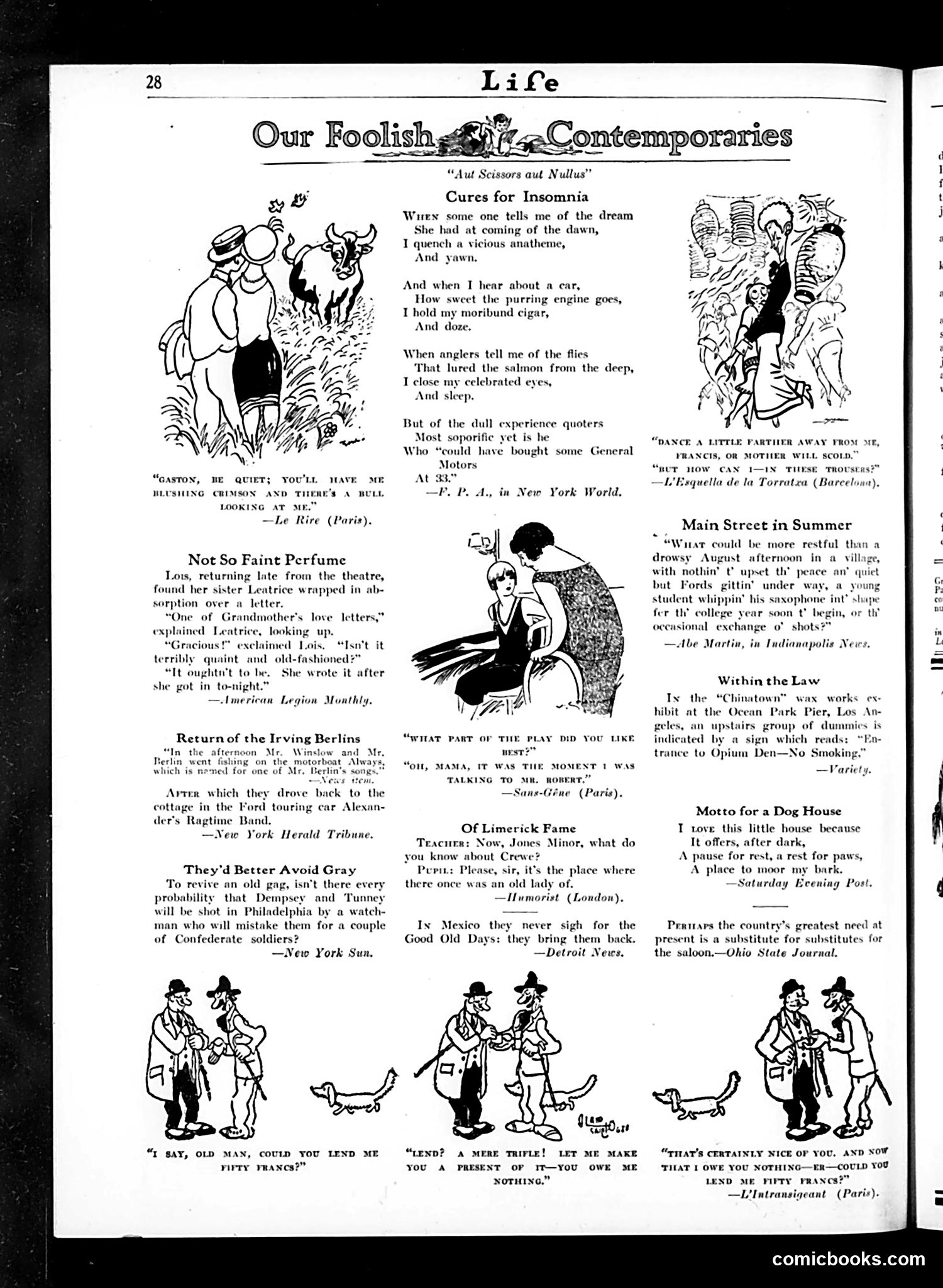
This page collects humorous anecdotes and cartoons mocking everyday social situations and human foibles. Key elements: **The cartoons** show two repeated scenarios of men asking to borrow money, with the punchline that once they've been given something, they immediately ask for a loan—satirizing human ingratitude and opportunism. **The text items** lampoon various topics: theatrical romance, musicians named after Irving Berlin song titles (a play on celebrity naming), mistaking boxers Dempsey and Tunney for Confederate soldiers (referencing their 1926-1927 fights), and insomnia "cures" involving boring conversation about stocks and fishing. **The humor relies on** observational comedy about middle-class life—theater-goers, romantic letter-writing, financial transactions, and social etiquette. Several items reference contemporary figures (Berlin, Dempsey, Tunney) recognizable to 1920s readers. The overall tone mocks human nature's petty contradictions and social awkwardness, typical of Life's satirical approach during this era.
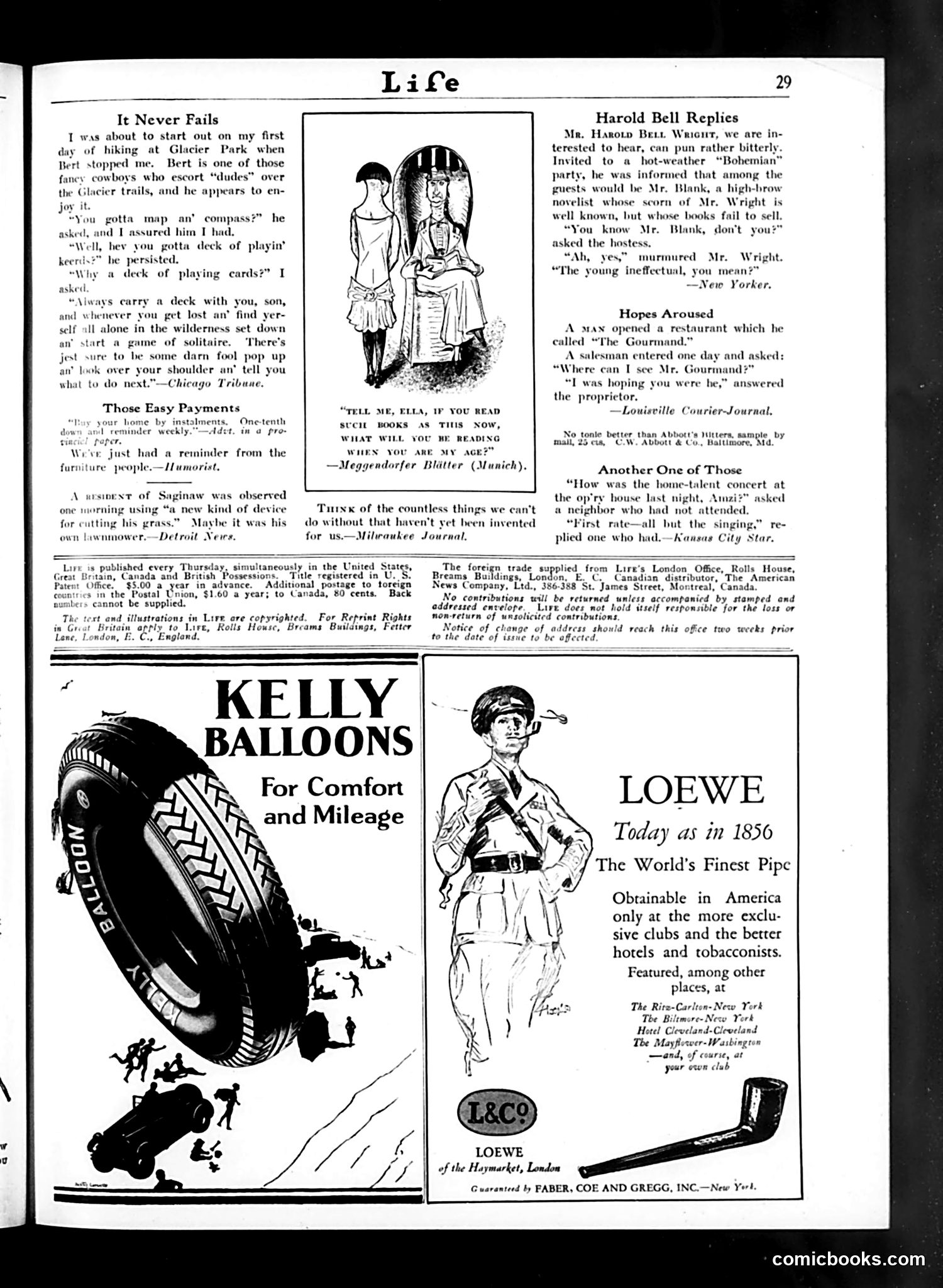
This page contains **humorous anecdotes** rather than political cartoons. The pieces satirize everyday human nature and social conventions: **"It Never Fails"** jokes about tourist behavior in nature—a cowboy guide predicts that if a lost hiker plays solitaire alone in the wilderness, someone will inevitably appear to give unsolicited advice. The satire targets people's compulsion to meddle. **"Harold Bell Replies"** mocks a pretentious novelist named Mr. Blank, whose books fail commercially despite his intellectual reputation. When introduced at a party, Mr. Wright puns bitterly that he hoped the salesman was Mr. Gourmand (the restaurant owner), implying Blank is as insubstantial as a missing proprietor—a dig at his irrelevance despite his snobbery. **"Another One of Those"** satirizes amateur performances—a concert was "first rate—all but the singing," meaning the worst part was the main event. The **advertisements** (Kelly Balloons, Loewe pipes) are period marketing emphasizing luxury and exclusivity rather than satirical content.
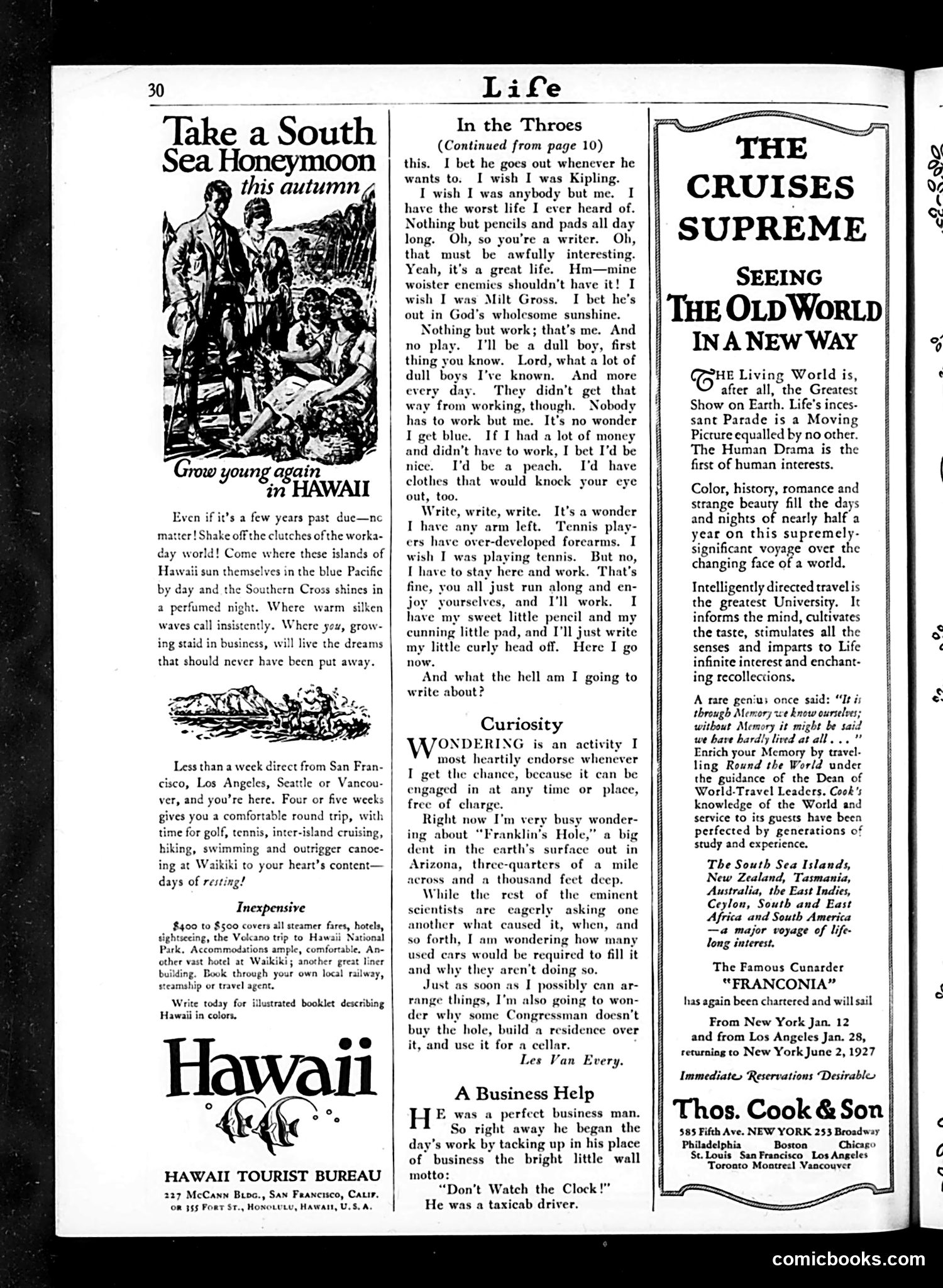
This page contains multiple distinct sections typical of Life magazine's format: **Left side:** A Hawaii tourism advertisement featuring an illustration of a honeymoon couple, promoting travel to Hawaii as an escape from workday drudgery. The copy romanticizes Hawaii as an affordable paradise ("$400 to $500") accessible within a week from the mainland. **Center:** Two humorous prose pieces—"In the Throes" (continued from previous page) depicting an unnamed writer's miserable complaints about his pencil-and-paper job, wishing he were famous writers like Kipling or Milt Gross; and "Curiosity," musing absurdly about Arizona's "Franklin's Hole," joking about filling it with used cars or using it as a congressman's basement. **Right side:** Advertisement for luxury cruises by Thomas Cook & Son, promoting world travel aboard the "Franconia." The satire contrasts the ordinary worker's frustrations with advertisements selling escape—whether through Hawaii or world cruises—reflecting 1920s consumer culture and the white-collar worker's fantasy of leisure. The humor is gentle, self-deprecating, and aimed at Life's educated, middle-class readership.
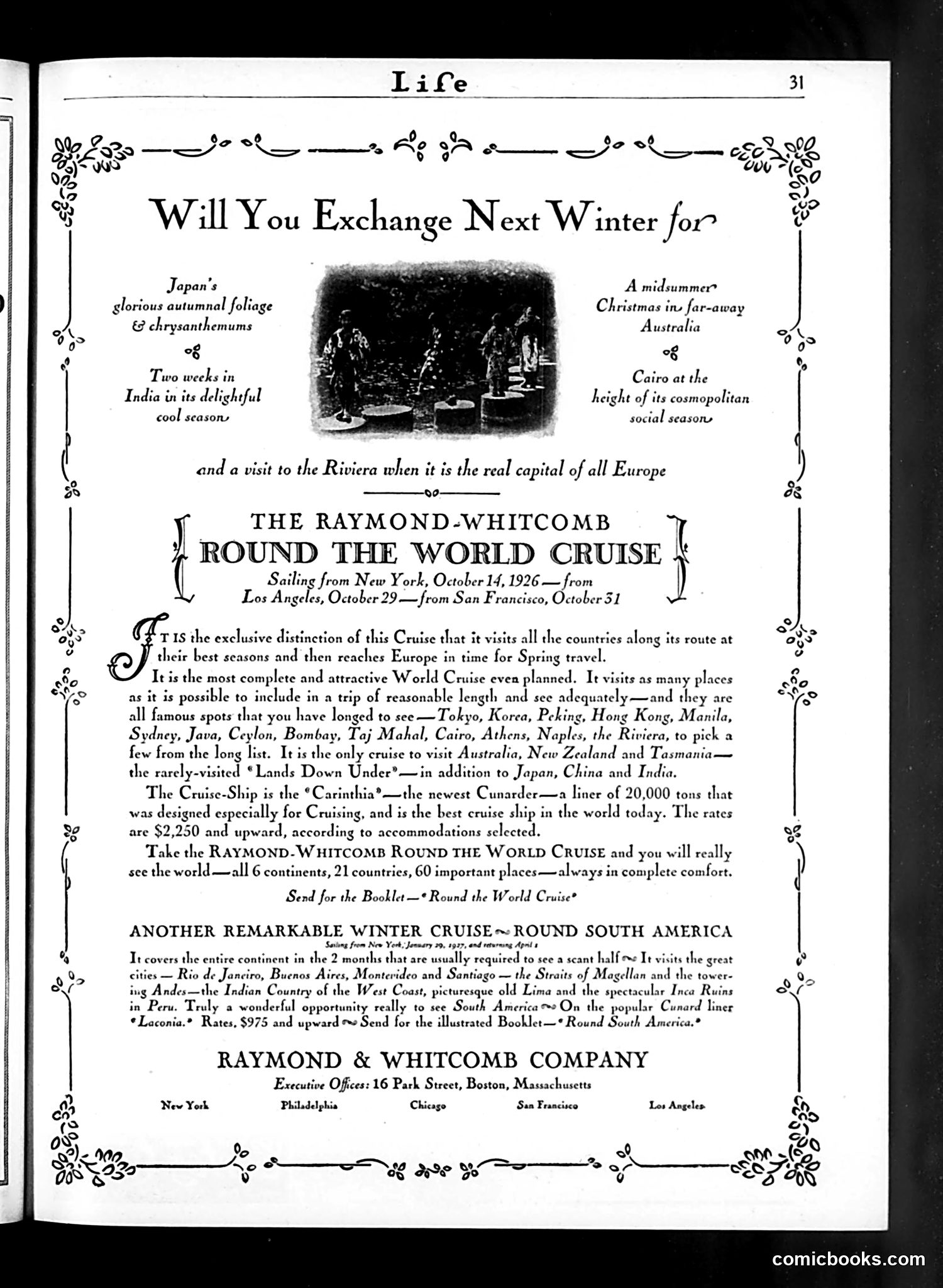
This is **not a cartoon or satire**—it's a full-page travel advertisement from Life magazine (page 31), circa 1926. **Content:** Raymond & Whitcomb Company advertises luxury cruises, primarily a "Round the World Cruise" departing October 1926 from New York, Los Angeles, and San Francisco. The ad promises visits to 21 countries across 6 continents (Tokyo, Cairo, Sydney, the Riviera, etc.) aboard the *Carinthia*, a 20,000-ton Cunard liner, with rates starting at $2,250. **Historical context:** This reflects 1920s-era wealth and leisure culture—extended world travel was exclusively accessible to the affluent. The itinerary emphasizes "best seasons" and famous sites, targeting educated travelers seeking cultural experiences. A secondary ad promotes a South America cruise at lower cost ($975). **Why it appeared in Life:** As a satirical magazine, Life's audience included affluent readers who could afford such trips; the advertisement reflects contemporary consumer aspirations and class divisions of the Jazz Age.
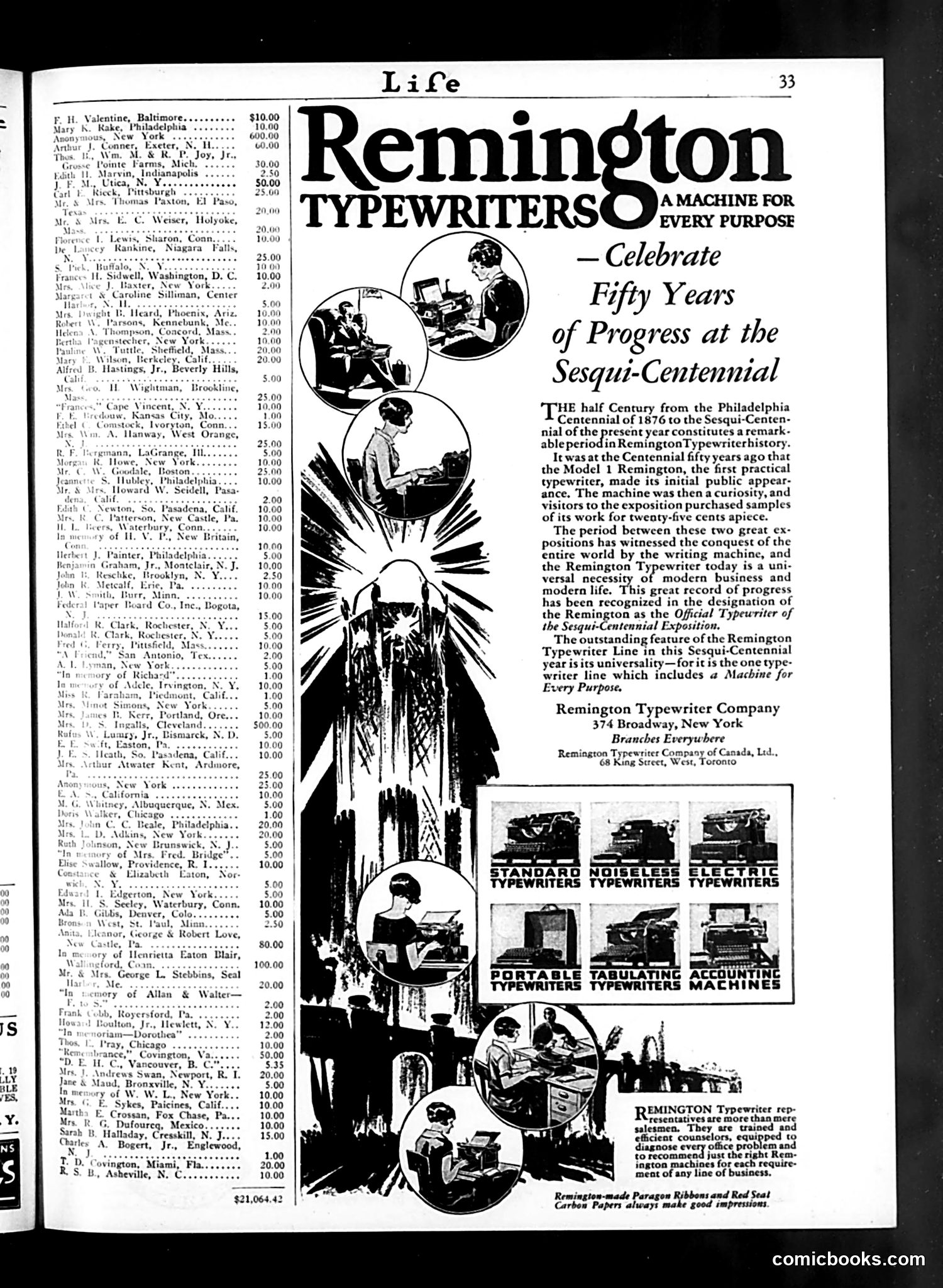
This page is primarily a **Remington Typewriter advertisement** celebrating the company's 50-year history from the 1876 Philadelphia Centennial to the 1926 Sesqui-Centennial (250th anniversary). The central image is not political satire but rather an allegorical illustration showing the "progress" of the typewriter—depicted through multiple circular vignettes of people using typewriters in various business and office settings, arranged vertically like a tower or monument of achievement. The advertisement emphasizes that Remington's Model 1 typewriter debuted at the 1876 Centennial and claims the machine has since conquered the world. It boasts the typewriter as "a universal necessity of modern business and modern life" and promotes Remington as the "Official Typewriter of the Sesqui-Centennial Exposition." The bottom section shows six typewriter variants (Standard, Noiseless, Electric, Portable, Tabulating, Accounting) to demonstrate product range. This is **corporate advertising**, not satirical commentary.
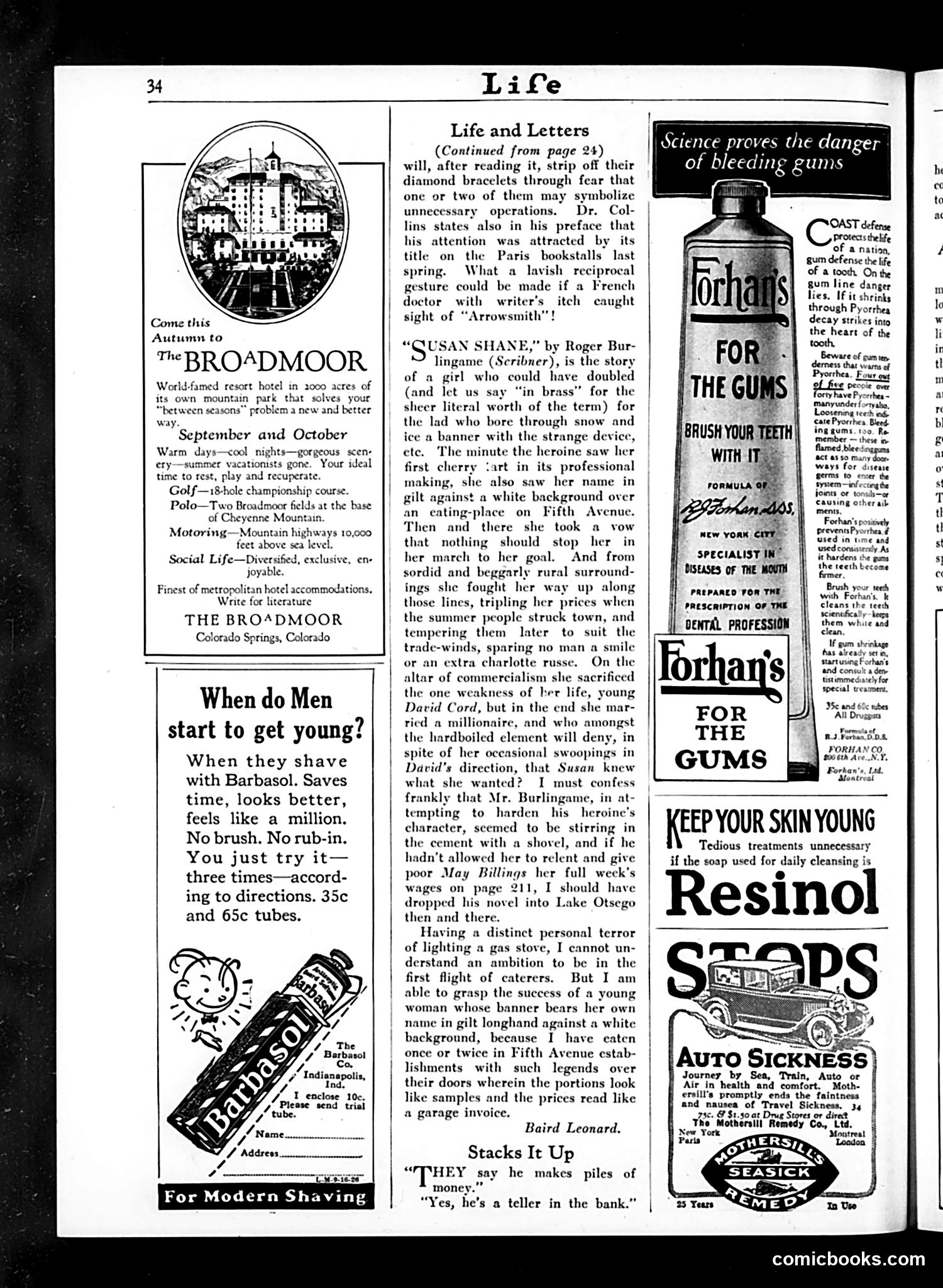
This page is primarily **advertising and literary review**, not political satire. The main content includes: **Literary Review Section ("Life and Letters"):** Baird Leonard reviews "Susan Shane" by Roger Burlingame, a novel about an ambitious woman who rises from rural poverty to open a successful Fifth Avenue restaurant, ultimately marrying a millionaire. Leonard praises her determination while critiquing the author's heavy-handed character development. **Advertisements:** Multiple product ads dominate the page—The Broadmoor resort, Barbasol shaving cream, Forhan's toothpaste for gum disease, and Resinol soap. **Humor:** A brief joke at bottom ("Stacks It Up") plays on the double meaning of "piles of money"—the punchline reveals the man is a bank teller, literally stacking money. The page reflects 1920s consumer culture and literary tastes rather than political commentary.
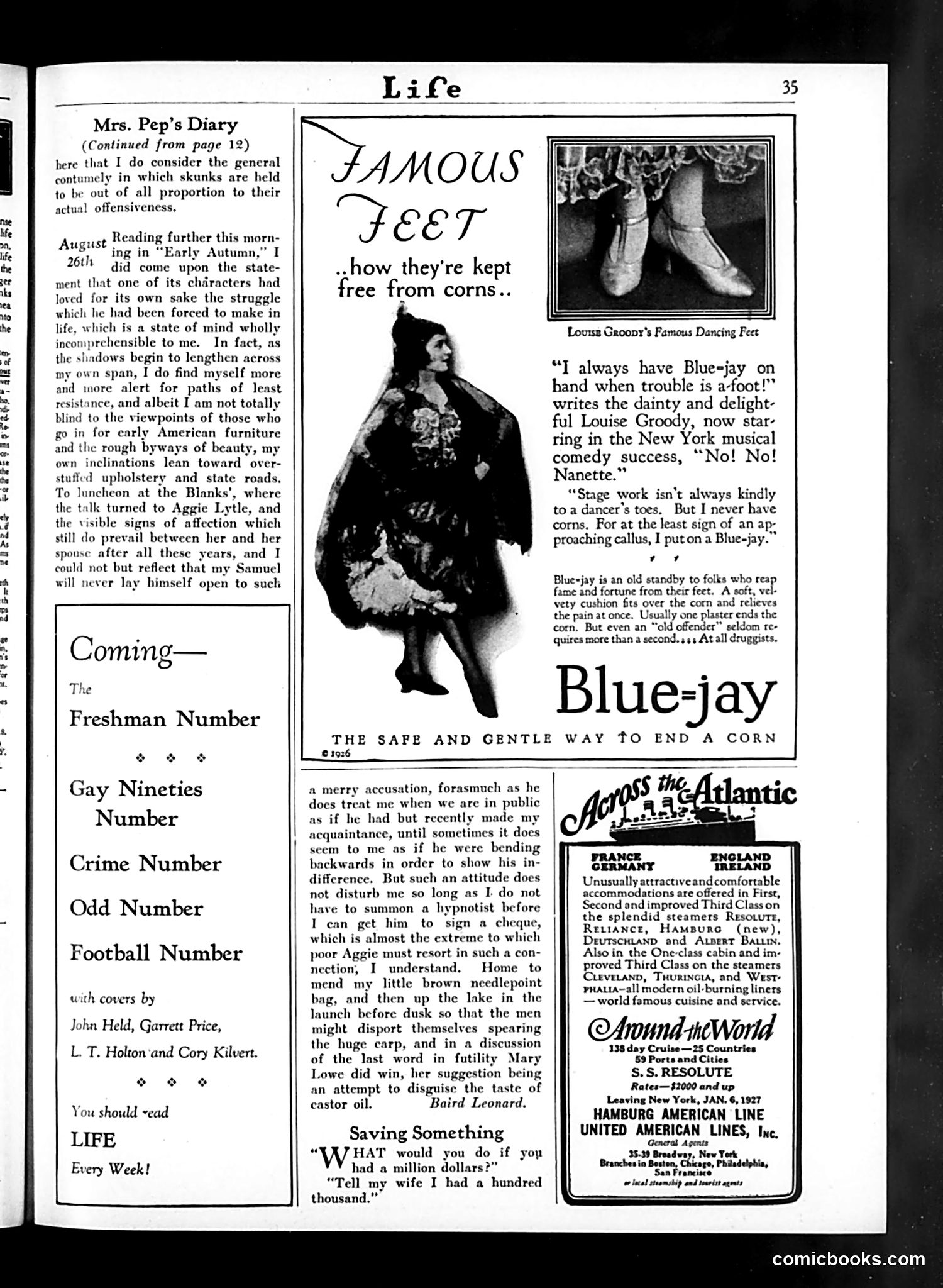
This page contains a diary excerpt, a product advertisement, and cruise line ads—primarily advertising material rather than political satire. The main featured advertisement is for "Blue-jay," a corn remedy endorsed by actress Louise Groody, who starred in the 1925 musical comedy "No! No! Nanette." The ad uses her celebrity status to sell a soft cushioned plaster that supposedly painlessly removes corns. The humor is gentle—testimonial-style endorsement from a performer whose livelihood depends on healthy feet. "Mrs. Pep's Diary" (continued from an earlier section) is a satirical social commentary column mocking upper-class domestic life and attitudes toward marriage and propriety. The brief "Saving Something" joke plays on marital financial deception—a husband claiming poverty to his wife. The page announces upcoming special issues of *Life* magazine (Freshman, Gay Nineties, Crime, Odd, Football numbers) and includes cruise ship advertisements for transatlantic voyages. This is primarily a commercial page; any satire is gentle social humor rather than pointed political commentary.
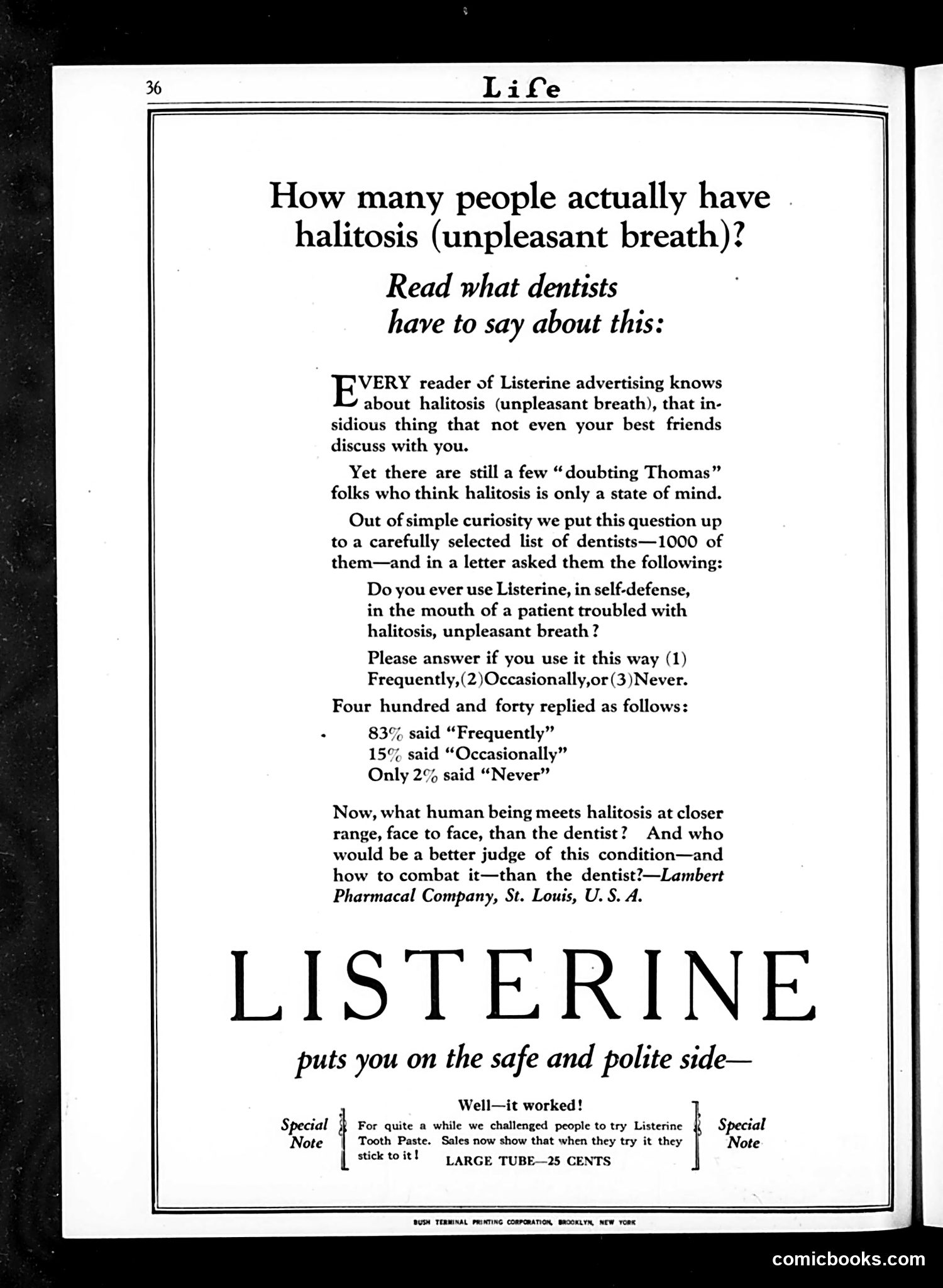
This is a **Listerine advertisement**, not satire or editorial content. It uses a common early-20th-century advertising strategy: presenting survey data as scientific evidence. The ad addresses "halitosis"—a term Listerine's marketing actually popularized to create consumer anxiety about bad breath. It surveys 1,000 dentists about Listerine use, reporting that 83% use it "frequently" with patients. The rhetorical trick: the ad frames dentists as credible authorities ("who would be a better judge?"), implying their endorsement validates the product. However, the survey only asked *if* dentists use Listerine, not whether they recommend it or believe it works—a subtle distinction the ad exploits. This exemplifies vintage advertising's combination of pseudo-scientific claims and appeals to professional authority to overcome consumer skepticism. The "Doubting Thomas" reference mocks people who question whether halitosis is a real problem, pressuring readers toward purchase through social embarrassment.
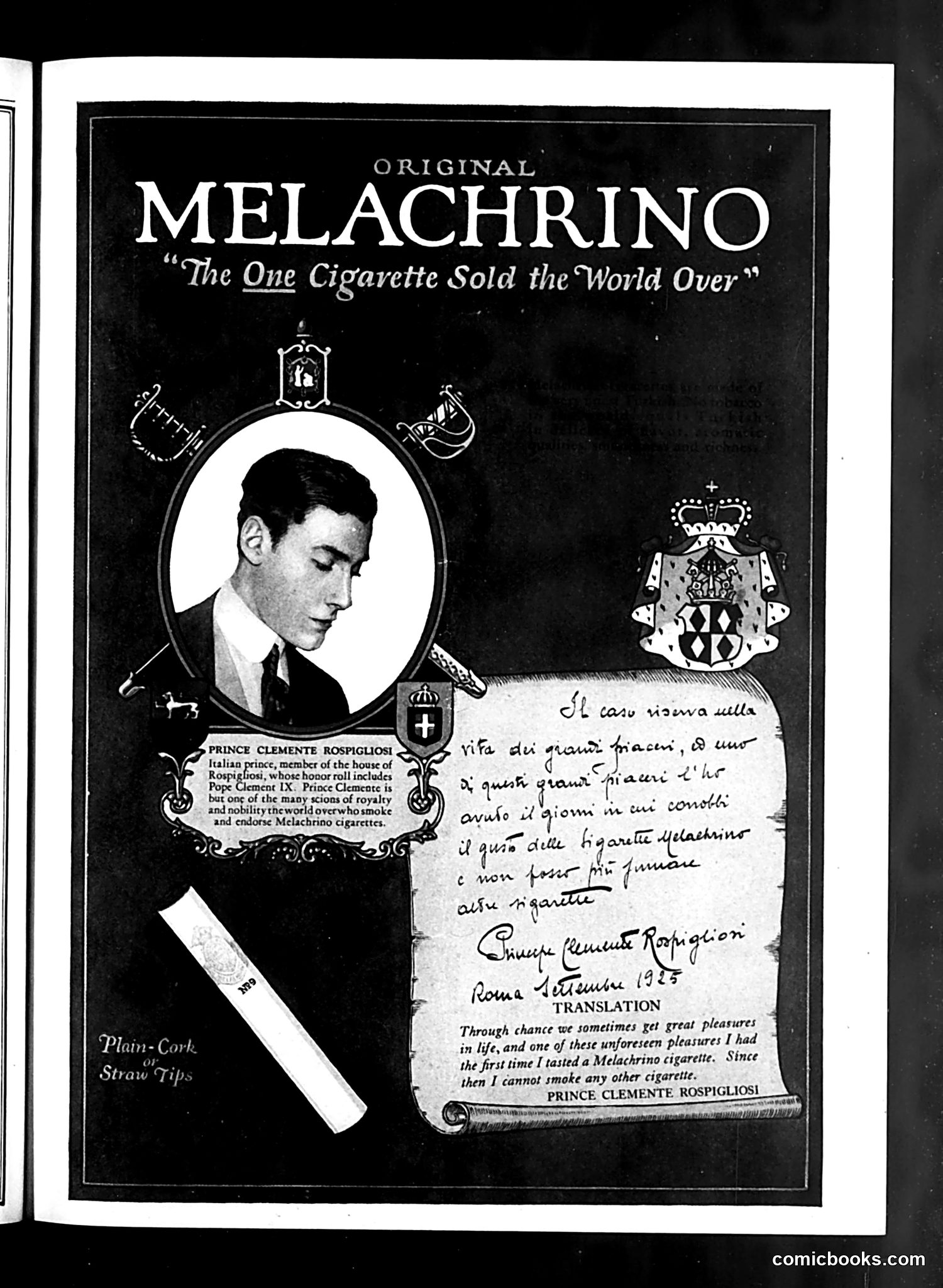
This is a cigarette advertisement, not political satire. It features Prince Clemente Rospigliosi, an Italian nobleman whose family lineage includes Pope Clement IX, endorsing Melachrino cigarettes as "The One Cigarette Sold the World Over." The ad's appeal relies on **aristocratic prestige**: by associating the product with European nobility and papal heritage, it suggests smoking Melachrino conveys sophistication and status. The handwritten testimonial from the Prince adds false authenticity—a common advertising technique of the era. The "Plain-Cork" and "Straw Tips" details emphasize product features meant to appeal to quality-conscious consumers. This represents early 20th-century luxury brand marketing that exploited social hierarchy and inherited status to sell consumer goods. Modern readers would recognize this as transparently manipulative celebrity endorsement advertising.
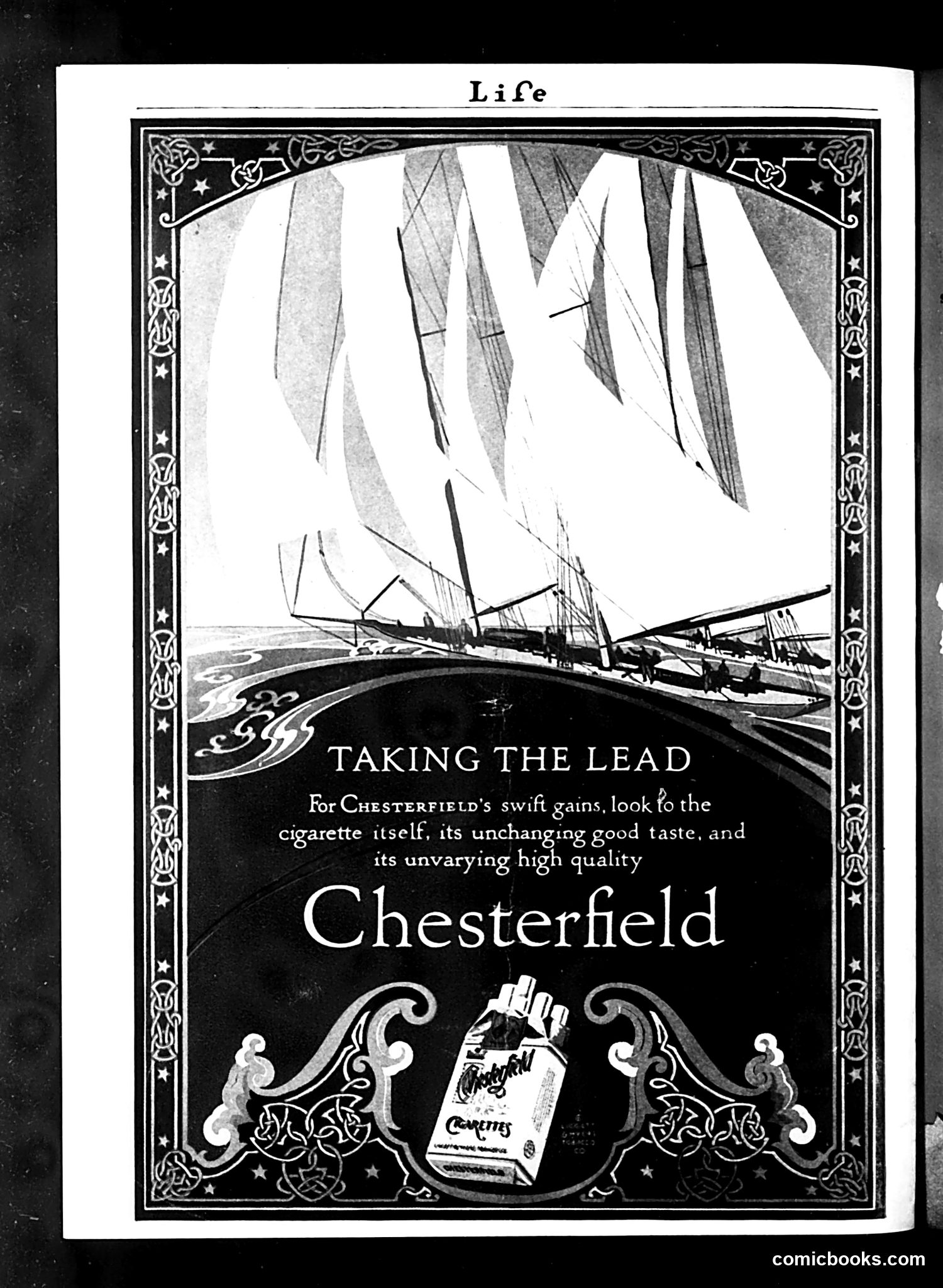
This is a **cigarette advertisement**, not satirical content. It appears in *Life* magazine and promotes Chesterfield cigarettes using the metaphor "Taking the Lead"—illustrated by a sailboat racing ahead of competitors on the water. The ad claims Chesterfield cigarettes maintain consistent quality and taste, positioning the brand as a market leader. The ornate border and classical sailing imagery suggest sophistication and reliability. A Chesterfield cigarette pack is displayed prominently at the bottom. This represents early-to-mid 20th century advertising standards, when cigarette companies advertised freely in major magazines without health warnings. The "swift gains" reference appeals to consumers seeking a winning, superior product.