
Life, 1926-09-16 · page 28 of 40
Life — September 16, 1926 — page 28: what you’re looking at
What you’re looking at
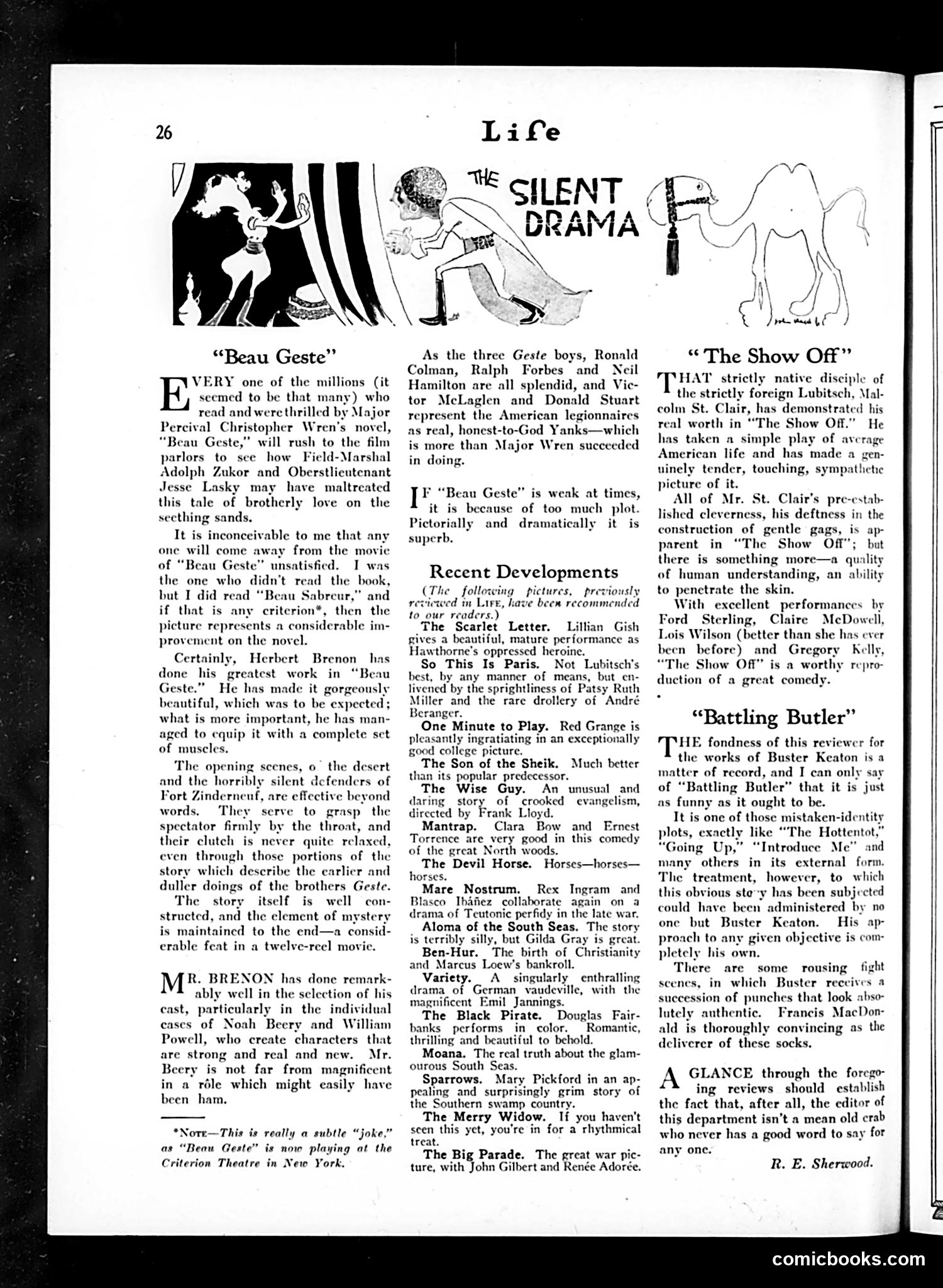
This page reviews the 1926 silent film adaptation of P.C. Wren's popular novel "Beau Geste"—a romantic adventure about brothers in the French Foreign Legion. The reviewer praises director Herbert Brenon's visual execution and the cast (Ronald Colman, Noah Beery, William Powell), calling it an improvement over the source material. The satirical jab appears in a footnote: the reviewer admits he never read the original novel but did read "Beau Sabreur" (the sequel), making his judgment somewhat absurd. This is labeled a "subtle joke"—the reviewer's credibility is undercut by his admission of not knowing the source material he's evaluating. The page also lists other current 1926 releases (featuring Mary Pickford, Douglas Fairbanks, Lillian Gish), reflecting Life's role as entertainment guide for educated urban readers during Hollywood's silent era.
📄 Transcribed text from this page (OCR, searchable)
Machine-transcribed from the original scan — historical spelling and the odd misread are preserved.
“Beau Geste” VERY one of the millions (it seemed to be that many) who read and were thrilled by Major Percival Christopher Wren’s novel, “Beau Geste,” will rush to the film parlors to sce how Field-Marshal Adolph Zukor and Oberstlicutenant Jesse Lasky may have maltreated this tale of brotherly love on the secthing sands, It is inconceivable to me that any one will come away from the movie of “Beau Geste” unsatisfied. I was the one who didn’t read the book, but I did read “Beau Sabreur,” and if that ion*, then the picture represents a considerable im- provement on the novel. Certainly, Herbert Brenon has done his greatest work in “Beau Geste.” He has made it gorgeously beautiful, which was to be expected; what is more important, he has man- aged to equip it with a complete set of muscles. The opening scenes, 0° the desert and the horribly silent defenders of Fort Zinderneuf, are effective beyond words, They serve to grasp. the spectator firmly by the throat, and their clutch is never quite relaxed, even through those portions of the story which describe the earlier and duller doings of the brothers Geste. The story itself is well con- structed, and the element of mystery is maintained to the end—a consid- erable feat in a twelve-reel movie. R. BRENON has done remark- ably well in the selection of his cast, particularly in the individual cases of Noah Beery and William Powell, who create characters that are strong and real and new. Mr. Beery is not far from magnificent in a réle which might easily have been ham. *Nore—This is really a subtle “joke,” “Beau Geste” is now playing at the Criterion Theatre in New York, Life As the three Geste boys, Ronald Colman, Ralph Forbes and Neil Hamilton are all splendid, and Vic- tor McLaglen and Donald Stuart represent the American legionnai as real, honest-to-God Yanks—which is more than Major Wren succeeded in doing. I ’ “Beau Geste” is weak at times, it is because of too much plot. Pictorially and dramatically it is superb, Recent Developments following pictures, prez ly wed in Lire, have been recommended to our readers.) The Scarlet Letter. Lillian Gish gives a beautiful, mature performance as Hawthorne's oppressed heroine. So This Is Paris. Not Lubitsch’s best, by any manner of means, but en- livened by the sprightliness of Patsy Ruth Miller and the rare drollery of André Beranger. One Minute to Play. Red Grange is pleasantly ingratiating in an exceptionally good college picture. The Son of the Sheik. than its popular predecessor. The Wise Guy. An unusual and daring story of crooked evangelism, directed by Frank Lloyd. Mantrap. Clara Bow and Ernest Torrence are very good in this comedy of the great North woods. The Devil Horse. Horses—horses— horses. Mare Nostrum. Rex Ingram and Blasco Tbafiez collaborate again on a drama of Teutonic perfidy in the late war, Aloma of the South Seas. The story is terribly silly, but Gilda Gray is great. Ben-Hur. The birth of Christianity and Marcus Loew’s bankroll. Variety. A singularly enthralling drama_of German vaudeville, with the magnificent Emil Jannings. The Black Pirate. Douglas Fair- banks performs in color. Romantic, thrilling and beautiful to behold. Moana. The real truth about the glam- ourous South Seas. Sparrows. Mary Pickford in an ap- pealing and surprisingly grim story of the Southern swamp country. The Merry Widow. If you haven't seen this yet, you're in for a rhythmical treat. The Big Parade. The great war pic- ture, with John Gilbert and Renée Adorée. Much better J tea “ The Show Off” HAT strictly native disciple of the strictly foreign Lubitsch, Mal- colm St. Cl has demonstrated his real worth in “The Show Off.” He has taken a simple play of average American life and has made a gen- uinely tender, touching, sympathetic picture of it. All of Mr. St. Clair’s pre-estab- lished cleverness, his deftness in the construction of gentle gags, is ap- parent in “The Show Off"; but there is something more—a quality of human understanding, an ability to penetrate the skin. With excellent performances by Ford Sterling, Claire McDowell, Lois Wilson (better than she has ever becn before) and Gregory Kelly, “The Show Off” is a worthy repro- duction of a great comedy. “Battling Butler” HE fondness of this reviewer for the works of Buster Keaton is a matter of record, and I can only say of “Battling Butler” that it is just as funny as it ought to be. It is one of those mistaken-identity plots, exactly like “The Hottentot,” ‘Going Up,” “Introduce Me’ and many others in its external form. The treatment, however, to which this obvious ste-y has been subjected could have been administered by no one but Buster Keaton. His ap- proach to any given objective is com- pletely his own. There are some rousing fight scencs, in which Buster reevives 4 succession of punches that look abso- lutely authentic. Francis MacDon- ald is thoroughly convincing as the deliverer of these socks. GLANCE through the forego- ing reviews should establish the fact that, after all, the editor of this department isn’t a mean old crab who never has a good word to say for any one. R. E. Sherwood. comicbooks.com