
Life, 1926-09-16 · page 26 of 40
Life — September 16, 1926 — page 26: what you’re looking at
What you’re looking at
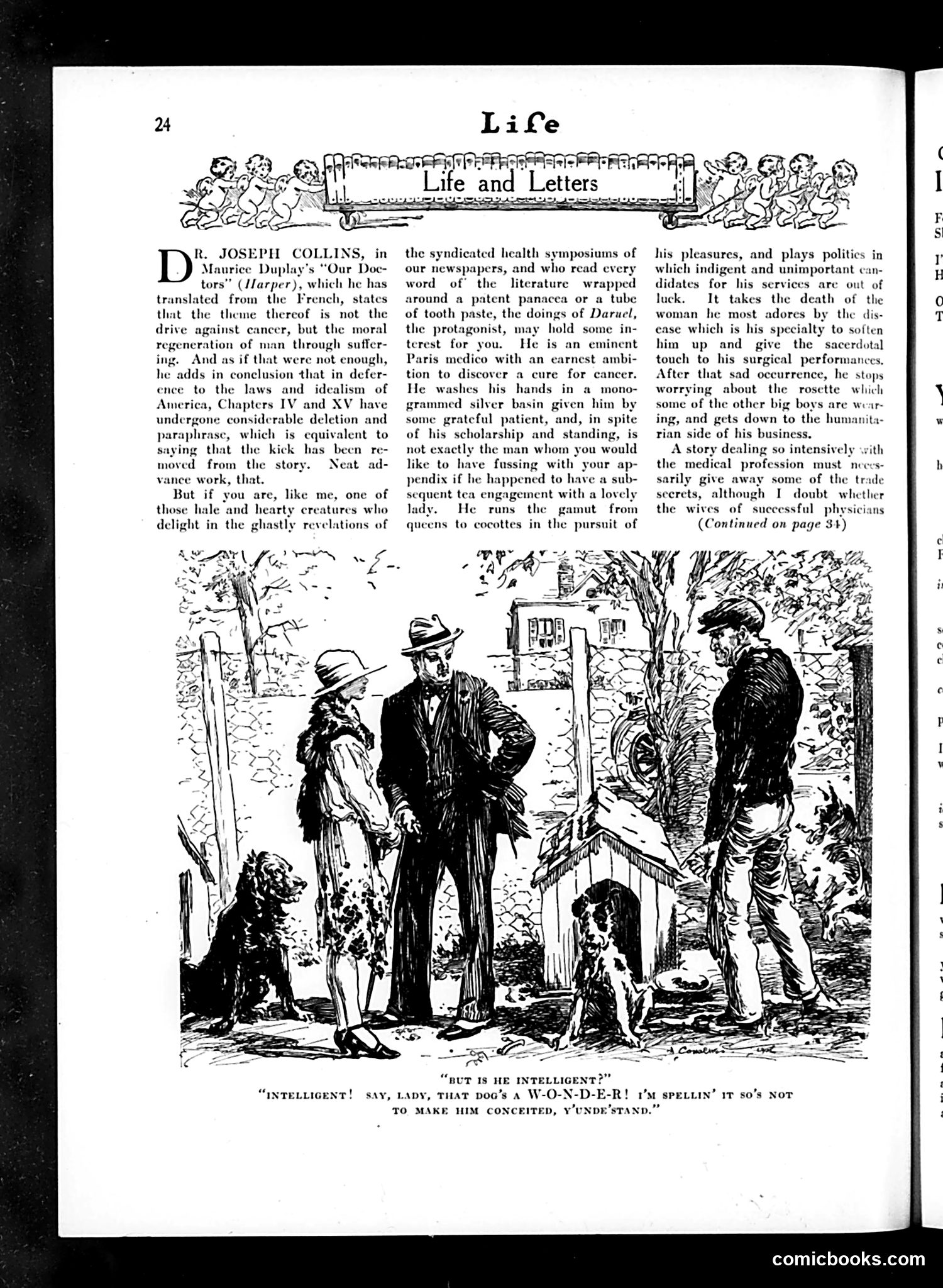
This page reviews a French novel translated as "Our Doctors" (by Joseph Collins), about a Parisian physician named Daruel who pursues a cure for cancer. The text criticizes the book's moral compromises: chapters were deleted to comply with American "laws and idealism," and the protagonist is portrayed as morally questionable—chasing wealthy patients and romantic conquests despite his medical ambitions. Only a woman's death from cancer humanizes him. The cartoon below depicts a conversation about dog intelligence. A man defends his dog's intelligence to a skeptical lady, claiming the dog is "spelling it so's not to make him conceited." The humor lies in the absurd notion that a dog would understand spelling or possess vanity—satirizing people's tendency to anthropomorphize pets and overestimate animal cognition. The page exemplifies *Life* magazine's satirical approach to contemporary culture, literature, and human folly.
📄 Transcribed text from this page (OCR, searchable)
Machine-transcribed from the original scan — historical spelling and the odd misread are preserved.
EPH COLLINS, in Duplay’s “Our Doe- tors” (Jlarper), which he has translated from the French, states that the theme thereof is not the drive against cancer, but the moral rege! ion of man through suffer- i And as if that were not enough, he adds in conclusion that in defer- ence to the laws and idealism of America, Chapters IV and XV have undergone considerable deletion and paraphrase, which equivalent to saying that the kick has been re- moved from the story. Neat ad- vance work, that. But if you are, like me, one of those hale and hearty creatures who delight in the ghastly revelations of “INTELLIGENT! Say, Life Life and Letters ieee the syndicated health symposiums of our newspapers, and who read every word of’ the literature wrapped around a patent panacea or a tube of tooth paste, the doi of Daruel, the protagonist, may hold some in- terest for you. He is an eminent Paris medico with an earnest ambi- tion to discover a cure for cancer. He washes his hands in a mono- grammed silver basin given him by some grateful patient, and, in spite of his scholarship and standing, is not exactly the man whom you would like to have fussing with your ap- pendix if he happened to have a sub- sequent tea engagement with a lovely lady. He runs the gamut from queens to cocottes in the pursuit of Lapy, THAT poG’s a W-O- TO MAKE HIM CONCEITED, Y’UND! his pleasures, and plays politics in which indigent and unimportant can- didates for his services are out of luck. It takes the death of the woman he most adores by the dis- case which is his specialty to soften him up and gi the sacerdotal touch to his surgical performances, After that sad occurrence, he stops worrying about the rosette which some of the other big boys are wear- ing, and gets down to the humanita- rian side of his business, A story dealing so intensively swith the medical profession must neces- sarily give away some of the trade seerets, although I doubt whether the wi of successful physicians (Continued on page 3+) R! 1’M specuin’ 17 so’s NoT AND.” comicbooks.com ns a sO Te