
Life, 1926-09-16 · page 22 of 40
Life — September 16, 1926 — page 22: what you’re looking at
What you’re looking at
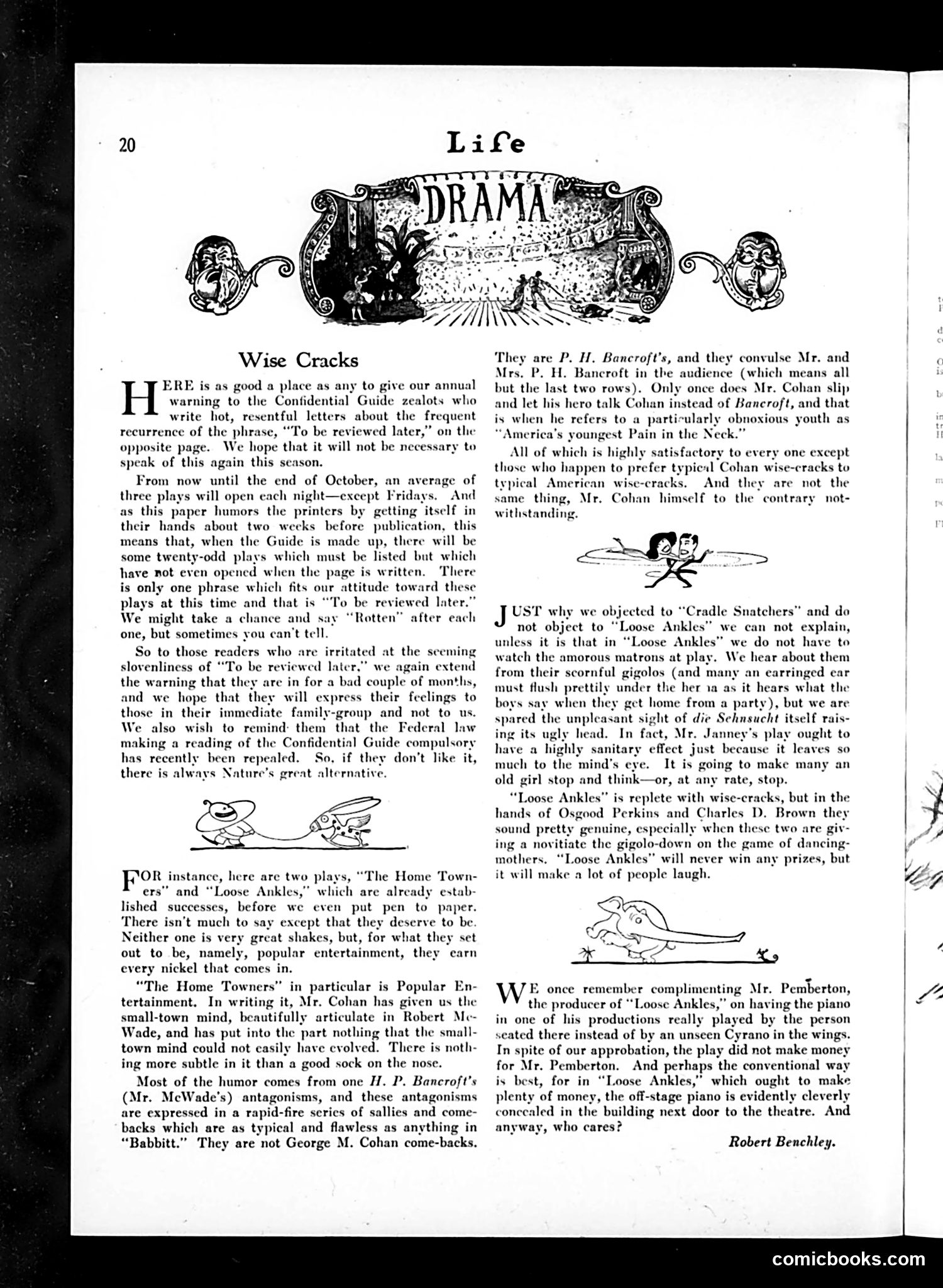
This is a theater review column addressing recurring reader complaints. Life's editors explain they frequently print "To be reviewed later" because three plays open nightly during theater season, but the magazine goes to print two weeks early—meaning roughly twenty plays haven't opened yet when reviewed. The column then praises two successful Broadway comedies: "The Home Towners" (written by George M. Cohan) and "Loose Ankles." The critic notes these aren't "great shakes" but succeed as popular entertainment. "The Home Towners" humorously depicts small-town American life through character H.P. Bancroft, using typical American wisecracks rather than Cohan's signature comedic style—making it relatable to ordinary audiences who see themselves reflected onstage. The small illustrations appear to be comedic vignettes accompanying the theater discussion.
📄 Transcribed text from this page (OCR, searchable)
Machine-transcribed from the original scan — historical spelling and the odd misread are preserved.
Wise Cracks H ERE is as good a place as any to give our annual warning to the Confidential Guide zealots who write hot, resentful letters about the frequent recurrence of the phrase, “To be reviewed later,” on the opposite page. We hope that it will not be necessary to speak of this again this season. From now until the end of October, an average of three plays will open each night—except Fridays. And as this paper humors the printers by getting itself in their hands about two weeks before publication, this means that, when the Guide is made up, there will be some twenty-odd plays which must be listed but which have not even opened when the page is written. There is only one phrase which fits our attitude toward these plays at this time and that is “To be reviewed later.” We might take a chance and say “Rotten” after each one, but sometimes you can't tell. So to those readers who are irritated at the seeming slovenliness of “To be reviewed later.” we again extend the warning that they are in for a bad couple of months, and we hope that they will express their feelings to those in their immediate family-group and not to us. We also wish to remind: them that the Federal law making a reading of the Confidential Guide compulsory has recently been repealed. So, if they don’t like it, there is always Nature's great alternative. (YOR instance, here are two plays, “The Home Town- ers” and “Loose Ankles,” which are already estab- lished successes, before we even put pen to paper. There isn’t much to say except that they deserve to be. Neither one is very great shakes, but, for what they set out to be, namely, popular entertainment, they earn every nickel that comes in. “The Home Towners” in particular is Popular En- tertainment. In writing it, Mr. Cohan has given us the small-town mind, beautifully articulate in Robert Mc- Wade, and has put into the part nothing that the small- town mind could not casily have evolved. There is noth- ing more subtle in it than a good sock on the nose. Most of the humor comes from one H. P. Bancroft’s (Mr. McWade’s) antagonisms, and these antagonisms are expressed in a rapid-fire serics of sallies and come- backs which are as typical and flawless as anything in “Babbitt.” They are not George M. Cohan come-backs. They are P. H, Bancroft's, and they convulse Mr. and Mrs. P. H. Bancroft in the audience (which means all but the last two rows). Only once does Mr. Cohan slip and let his hero talk Cohan instead of Bancroft, and that is when he refers to a particularly obnoxious youth as “America’s youngest Pain in the N All of which is highly satisfactory to every one except those who happen to prefer typicsl Cohan wise-cracks to racks. And they are not the himself to the contrary. not- typical American wis same thing, Mr. Col withstanding. < AW~ S26) .- — ry a. a) UST why we objected to “Cradle Snatchers” and do not object to “Loose Ankles’ we can not explain, unless it is that in “Loose Ankles” we do not have to watch the amorous matrons at play. We hear about them from their scornful gigolos (and many an earringed ear must flush prettily under the her 1a as it hears what the boys say when they get home from a party), but we are spared the unpleasant sight of die Sehnsucht itself rais- ing its ugly head. In fact, Mr. Janney’s play ought to have a highly sanitary effect just because it leaves so much to the mind’s eye. It is going to make many an old girl stop and think—or, at any rate, stop. “Loose Ankles” is replete with wise-cracks, but in the hands of Osgood Perkins and Charles D, Brown they sound pretty genuine, especially when these two are giv- ing a ne ate the gigolo-down on the game of dancing- mothers. “Loose Ankles” will never win any prizes, but it will make a lot of people laugh. E once remember complimenting Mr. Pemberton, the producer of ‘Loose Ankles,” on having the piano in one of his productions really played by the person seated there instead of by an unseen Cyrano in the wings. In spite of our approbation, the play did not make money for Mr. Pemberton. And perhaps the conventional way is best, for in “Loose Ankles,” which ought to make plenty of money, the off-stage piano is evidently cleverly concealed in the building next door to the theatre. And anyway, who cares? Robert Benchley. comicbooks.com