
Life, 1926-09-16 · page 18 of 40
Life — September 16, 1926 — page 18: what you’re looking at
What you’re looking at
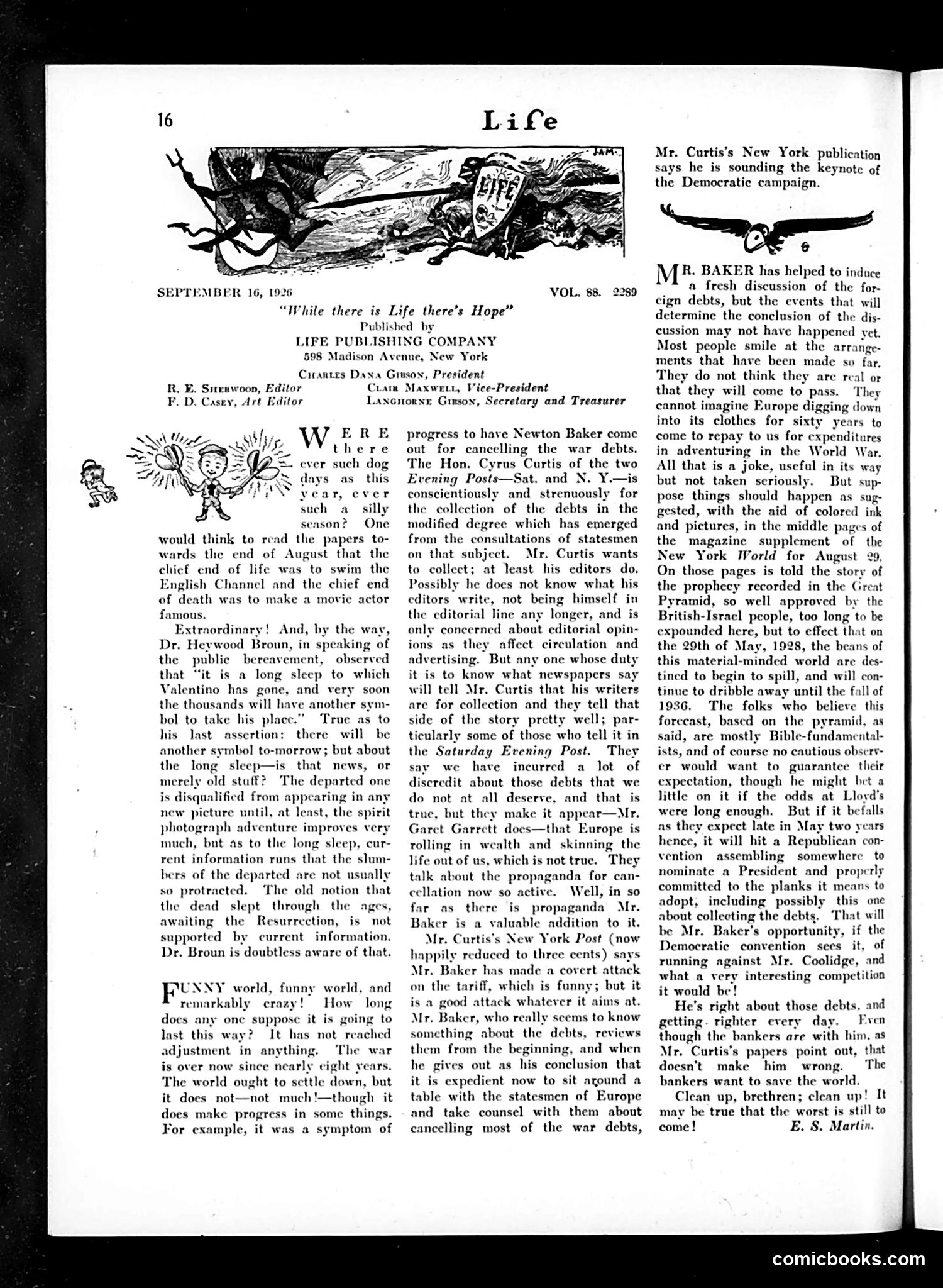
This editorial page discusses Newton Baker's proposal to cancel international war debts from World War I. The masthead cartoon (top) appears to show a figure labeled "LIFE" amid chaotic imagery, likely satirizing the publication's response to current events. The editorial argues Baker's debt-cancellation plan is sensible, though the writer notes Europeans are portrayed as greedy for wanting forgiveness while Americans are depicted as rolling in wealth. The piece defends Baker as contributing valuable perspective to the debt discussion, contrasting him with those making propaganda arguments. The closing comment from E.S. Martin suggests banks should help solve the world's post-war economic problems. The overall satire critiques hypocrisy in how debts and international responsibility are discussed.
📄 Transcribed text from this page (OCR, searchable)
Machine-transcribed from the original scan — historical spelling and the odd misread are preserved.
SEPTEMBER 16, 1926 VOL. $8. 2289 “While there is Life there’s Hope” Published by LIFE PUBLISHING COMPANY 598 Madison Avenue, New York Cirantes Dana Gruson, President E.. Surawoon, Editor , Art Editor ERE there ever such dog ys as this over such a_ silly season? One would think to read the papers to- wards the end of August that the chief end of life was to swim the English Channel and the chief end of death was to make a movie actor famous. Extraordinary! And, by the way, Dr. Heywood Broun, in speaking of the public bereavement, observed that “it is a long sleep to which Valentino has gone, and very soon the thousands will have another sym- bol to take his place.” True as to his last assertion: there will be another symbol to-morrow; but about the long sleep—is that news, or merely old stuff? The departed one is disqualified from appearing in any new picture until, at least, the s photograph adventure improves very much, but as to the long sleep, cur- rent information runs that the slum- bers of the departed are not usually so protracted. The old notion tl the dead slept through the ages, awaiting the Resurrection, not supported by current information. Dr. Broun is doubtless aware of that. QUNNY world, funny world, and remarkably crazy! How any one suppose it is going to last this way? It has not reached adjustment in anything. The war is over now since nearly cight y The world ought to settle down, but it does not—not much!—though it does make progress in some things. For example, it was a symptom of long does ars. Cram Maxweit, Vice-President Lanoutorne Ginson, Secretary and Treasurer progress to have Newton Baker come out for cancelling the war debts. The Hon. Cyrus Curtis of the two Evening Posts—Sat. and N. Y.—is conscientiously and strenuously for the collection of the debts in the modified degree which has emerged from the consultations of statesmen on that subject. Mr. Curtis wants to collect; at least his editors do. Possibly he does not know what his editors write, not being himself in the editorial line any longer, and is only concerned about editorial opin- as they affect circulation and advertising. But any one whose duty it is to know what newspapers say will tell Mr. Curtis that his writere are for collection and they tell that side of the story pretty well; par- ticularly some of those who tell it in the Saturday Evening Post. They say we have incurred a lot of discredit about those debts that we do not at all deserve, and that is true, but they make it appear—Mr. Garet Garrett does—that Europe is rolling in wealth and skinning the life out of us, which is not true. They talk about the propaganda for can- cellation now so active. Well, in so far as there is propaganda Mr. Baker is a valuable addition to it. Mr. Curtis’s New York Post (now happily reduced to three cents) says Mr. Baker has made a covert attack on the tariff, which is funny; but it is a good attack whatever it aims at. Mr. Baker, who really scems to know something about the debts, reviews them from the beginning, and when he gives out as his conclusion that it is expedient now to sit around a table with the statesmen of Europe and take counsel with them about cancelling most of the war debts, Mr. Curtis’s New York publication says he is sounding the keynote of the Democratic campaign. & M R. BAKER has helped to induce a fresh discussion of the for- cign debts, but the events that will determine the conclusion of the dis- cussion may not have happened yet. Most people smile at the arrange- ments that have been made so far. They do not think they are real or that they will come to pa They cannot imagine Europe digging down into its clothes for sixty years to come to repay to us for expenditures in adventuring in the World War. All that is a joke, useful in its way but not taken seriously. But sup- pose things should happen as sug- gested, with the aid of colored ink and pictures, in the middle pages of the magazine supplement of the New York World for August 29. On those pages is told the story of the prophecy recorded in the Great Pyramid, so well approved by the British-Isracl people, too long to be expounded here, but to effect that on the 29th of May, 1928, the beans of this material-minded world are des- tined to begin to spill, and will con- tinue to dribble away until the fall of 1936. The folks who believe this forecast, based on the pyramid, as said, are mostly Bible-fundamental- ists, and of course no cautious observ- er would want to guarantce their expectation, though he might bet a little on it if the odds at Lloyd's were long enough. But if it befalls as they expect late in May two years hence, it will hit a Republican con- vention assembling somewhere to nominate a President and properly committed to the planks it means to adopt, including possibly this one about collecting the debts. That will be Mr. Baker’s opportunity, if the Democratic convention sees it, of running against Mr. Coolidge, and what a very interesting competition it would be! He's right about those debts. and getting. righter every day. Even though the bankers are with him, as Mr. Curtis’s papers point out, that doesn’t make him wrong. The bankers want to save the world. Clean up, brethren; clean up! It may be true that the worst is still to come! E. S. Martin. comicbooks.com