
A complete issue · 41 pages · 1926
Life — June 24, 1926
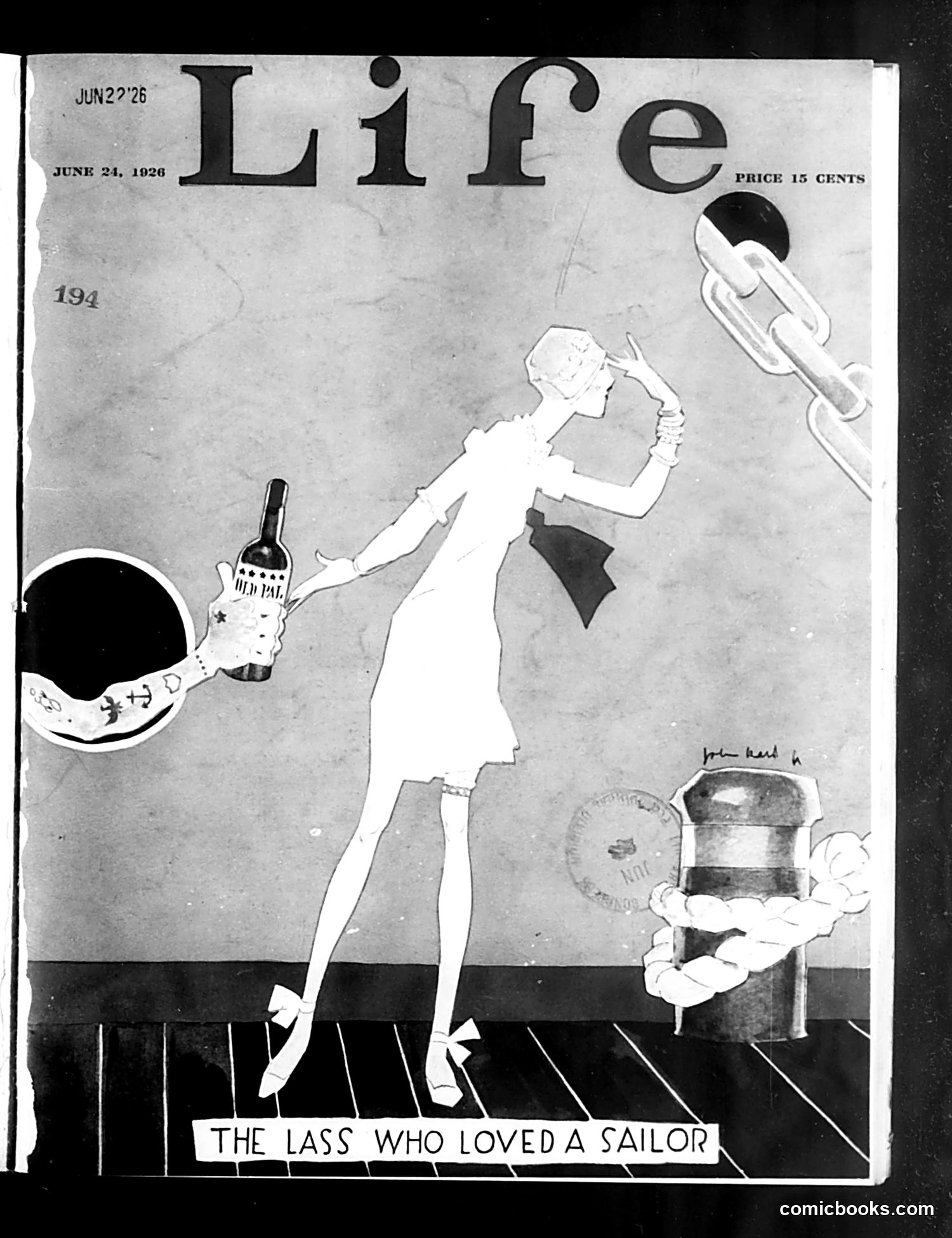
This cover illustrates "The Lass Who Loved a Sailor" — a romantic comedy scenario typical of 1920s popular culture. The illustration depicts a stylized woman in evening dress being courted by or interacting with a sailor (suggested by nautical elements). The satire appears to target the romantic idealization of sailor-sweetheart relationships, a popular theme in contemporary entertainment. Visual elements include wine (left), a ship's wheel, and what appears to be a sailor's hat or vessel (right), establishing the nautical context. The art deco styling and the woman's fashionable appearance reflect 1920s aesthetics and the era's modern, liberated portrayal of women. The specific satirical point remains somewhat unclear without additional context, but likely mocks either sentimental romance narratives or contemporary dating customs.
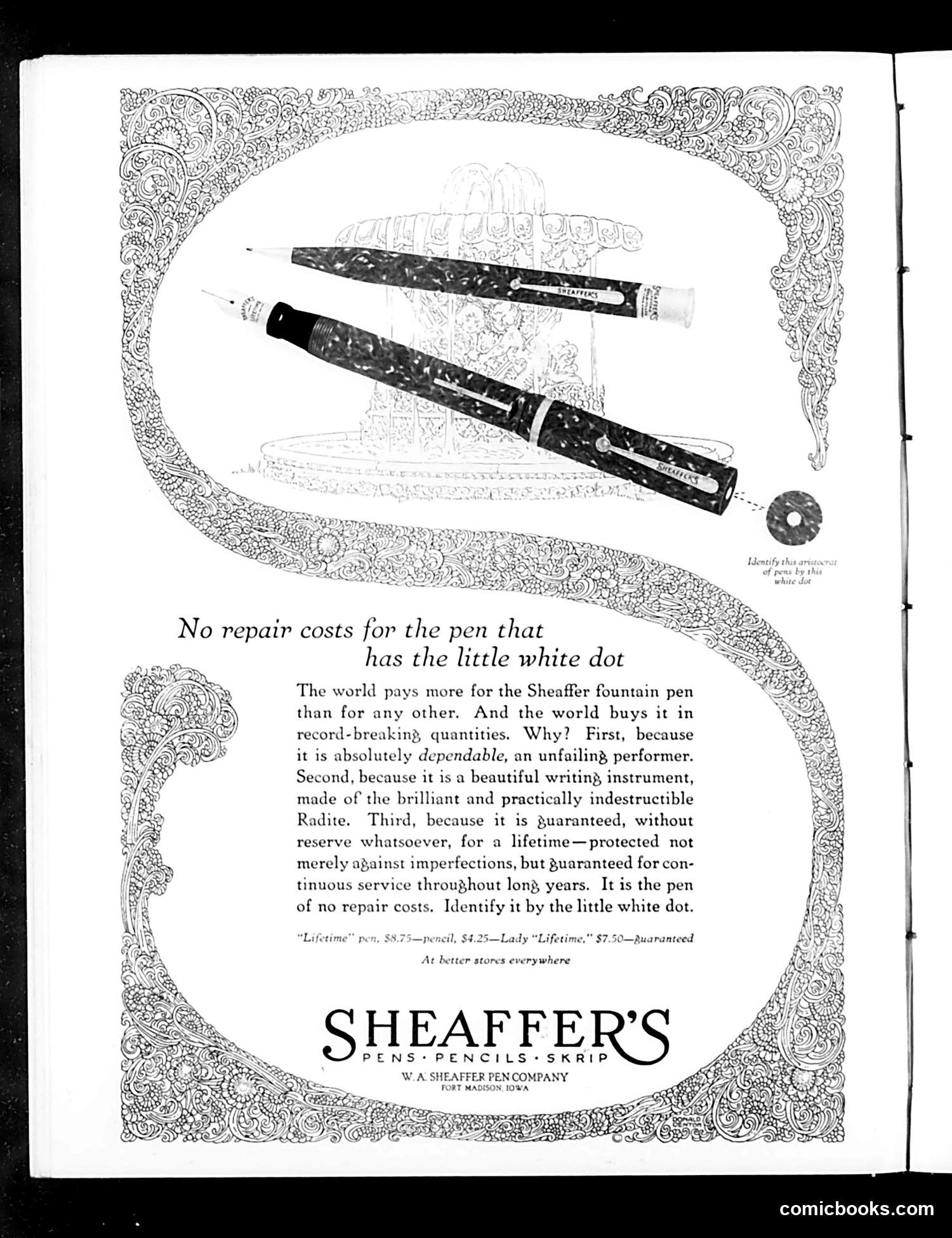
This is **not a cartoon or satire page** — it's a straightforward **advertisement for Sheaffer fountain pens**, placed in Life magazine. The ad promotes the "Lifetime" model, identified by a distinctive white dot on the pen. The three pens shown (with one disassembled) display the product and its components. The ornate decorative border is typical of early 20th-century advertising design. The sales pitch emphasizes three claims: reliability ("unfailing performer"), aesthetic quality (made of "Radite" material), and a lifetime guarantee protecting against imperfections. The headline "No repair costs for the pen that has the little white dot" is the main marketing hook. This appears to be a vintage advertisement, likely from the 1920s-1930s era when Sheaffer was a major American pen manufacturer.
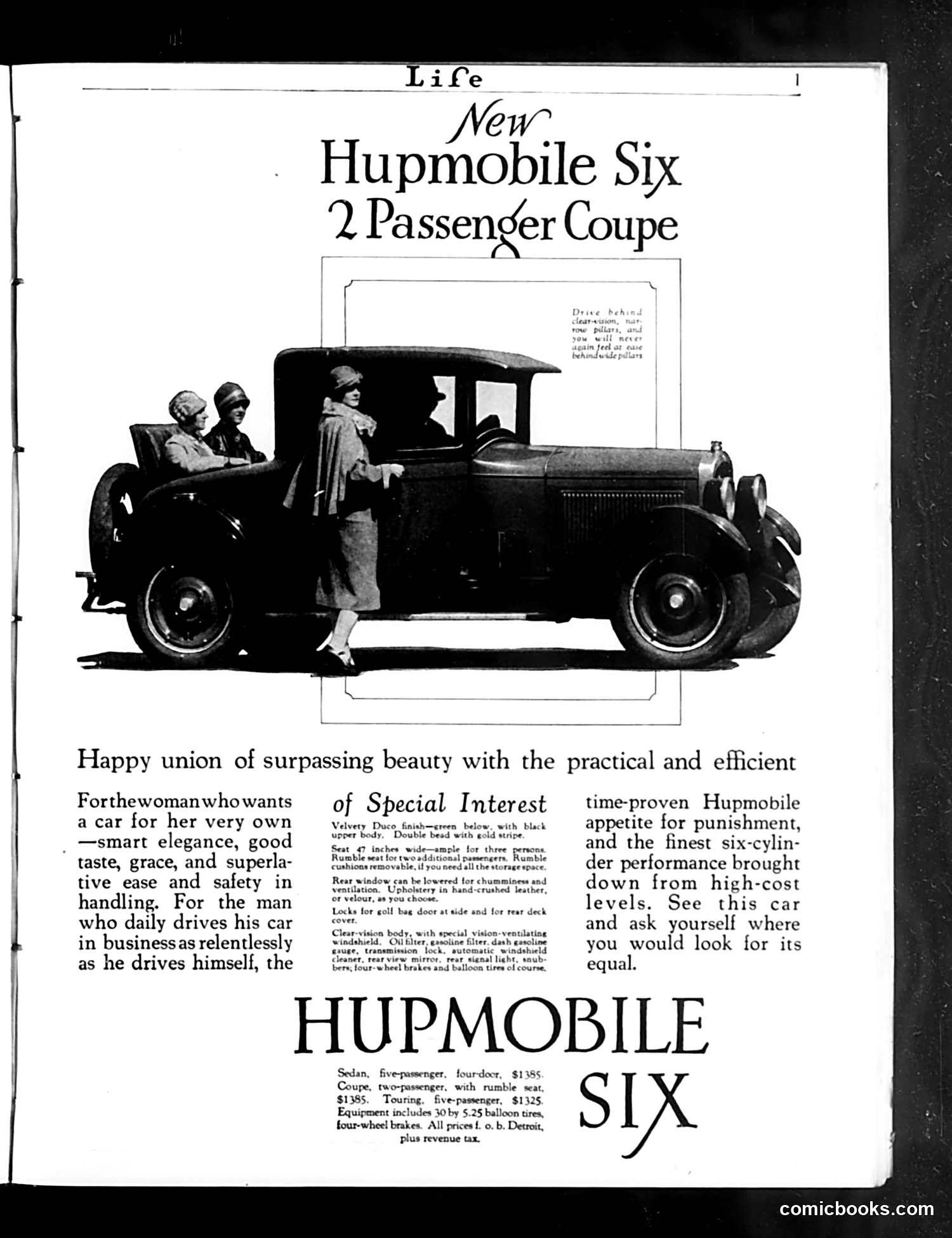
This is primarily an **automobile advertisement**, not a political cartoon. It advertises the Hupmobile Six, a 2-passenger coupe. The page features a staged promotional photograph showing two women in 1920s clothing examining the vehicle. The ad copy appeals to different buyers: women wanting "smart elegance" and practicality, and businessmen seeking reliable daily transportation. The advertisement emphasizes the car's features—spacious seating, good visibility, safety, and performance ("six-cylinder" engine). Pricing information is provided at bottom ($1,185 for the coupe). There is **no political satire** on this page. It's a straightforward commercial from the 1920s era promoting the Hupmobile brand, targeting both female and male consumers during the early automobile market expansion.
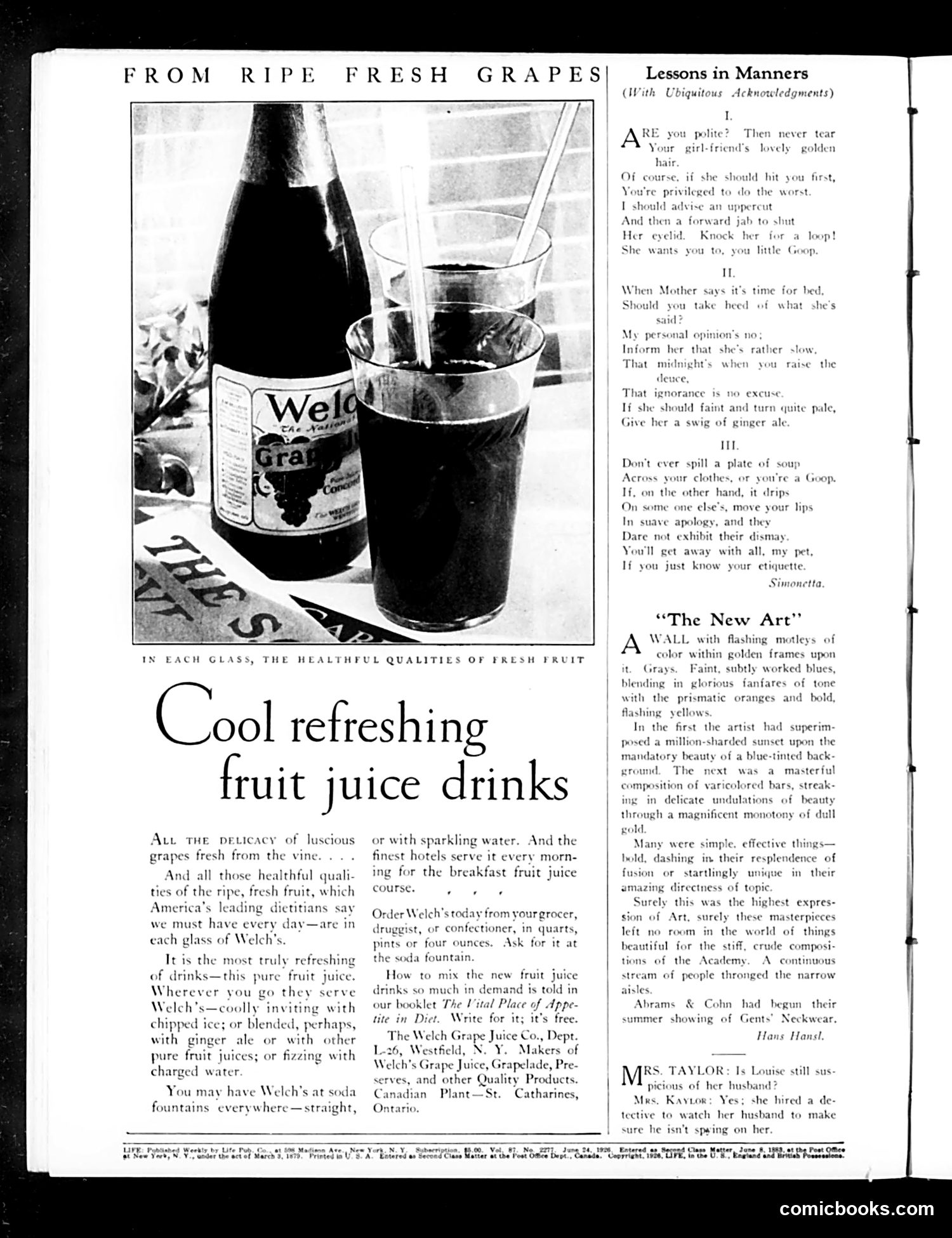
This page is primarily **advertising**, not political satire. The left side features a Welch's Grape Juice advertisement showing a bottle and filled glasses, promoting "cool refreshing fruit juice drinks" as a healthful beverage available at soda fountains and grocers. The right side contains two unrelated items: 1. **"Lessons in Manners"** — humorous etiquette advice with satirical tips (e.g., "Don't ever spill a plate of soup / Across your clothes"), credited to "Simonetta." 2. **"The New Art"** — a brief article discussing modernist painting and color theory, praising bold artistic compositions. No political cartoons or recognizable caricatures appear. This is a typical early-20th-century magazine page mixing product promotion with light humor and cultural commentary.
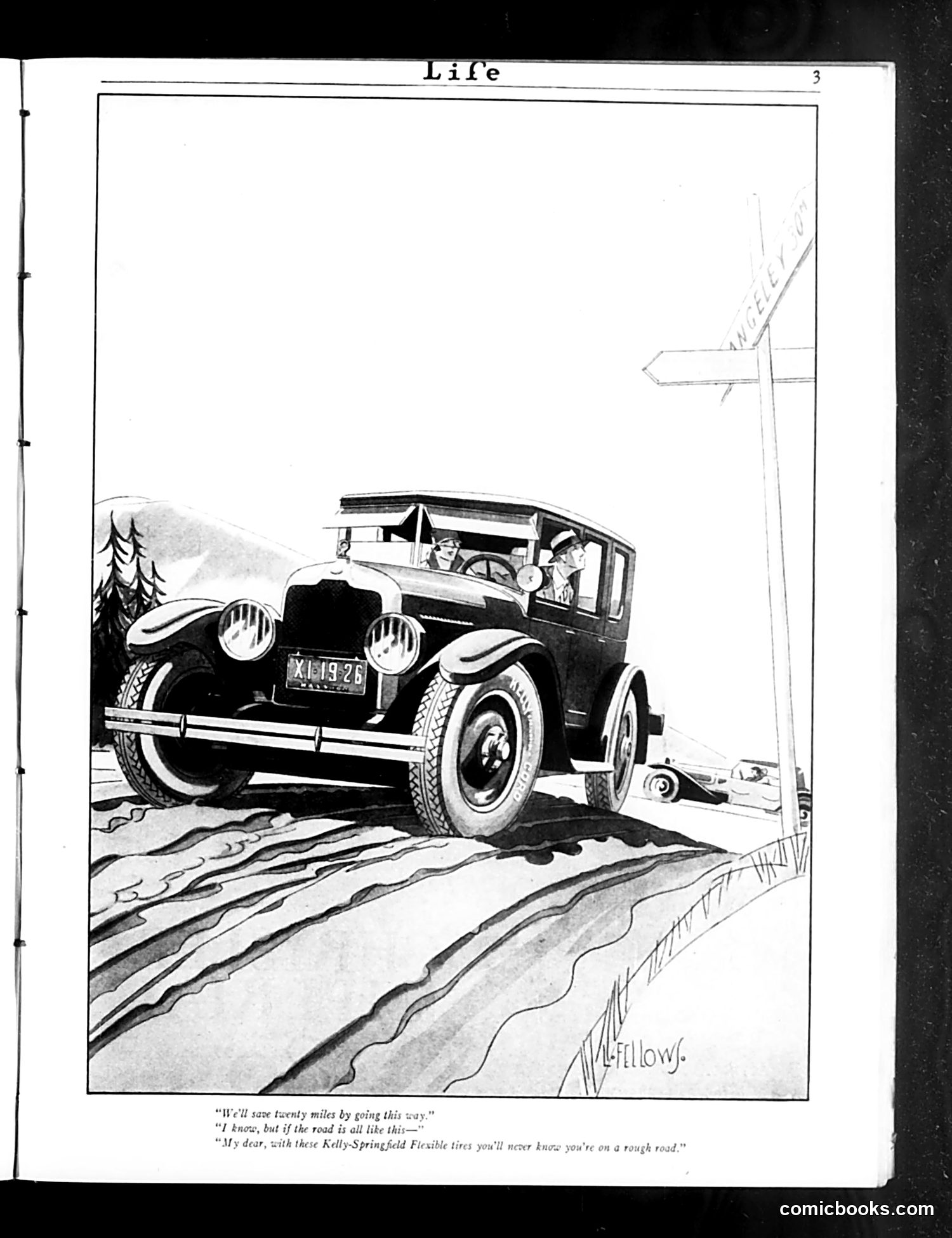
This is an advertisement for Kelly-Springfield Flexible tires, presented as a cartoon dialogue. Two drivers discuss a scenic mountain route; one worries about road conditions, while the other confidently asserts that Kelly-Springfield tires ensure safe driving "on a rough road." The illustration depicts a 1920s automobile navigating a rutted, unpaved mountain road—reflecting the era when many American roads were primitive. The "joke" is the contrast between the rough terrain and the driver's casual confidence, attributing safety entirely to superior tire technology. This represents early automotive advertising's strategy of emphasizing durability and grip as key selling points when vehicle travel on poor roads was genuinely hazardous. The cartoon format made product claims more memorable than straightforward advertising.
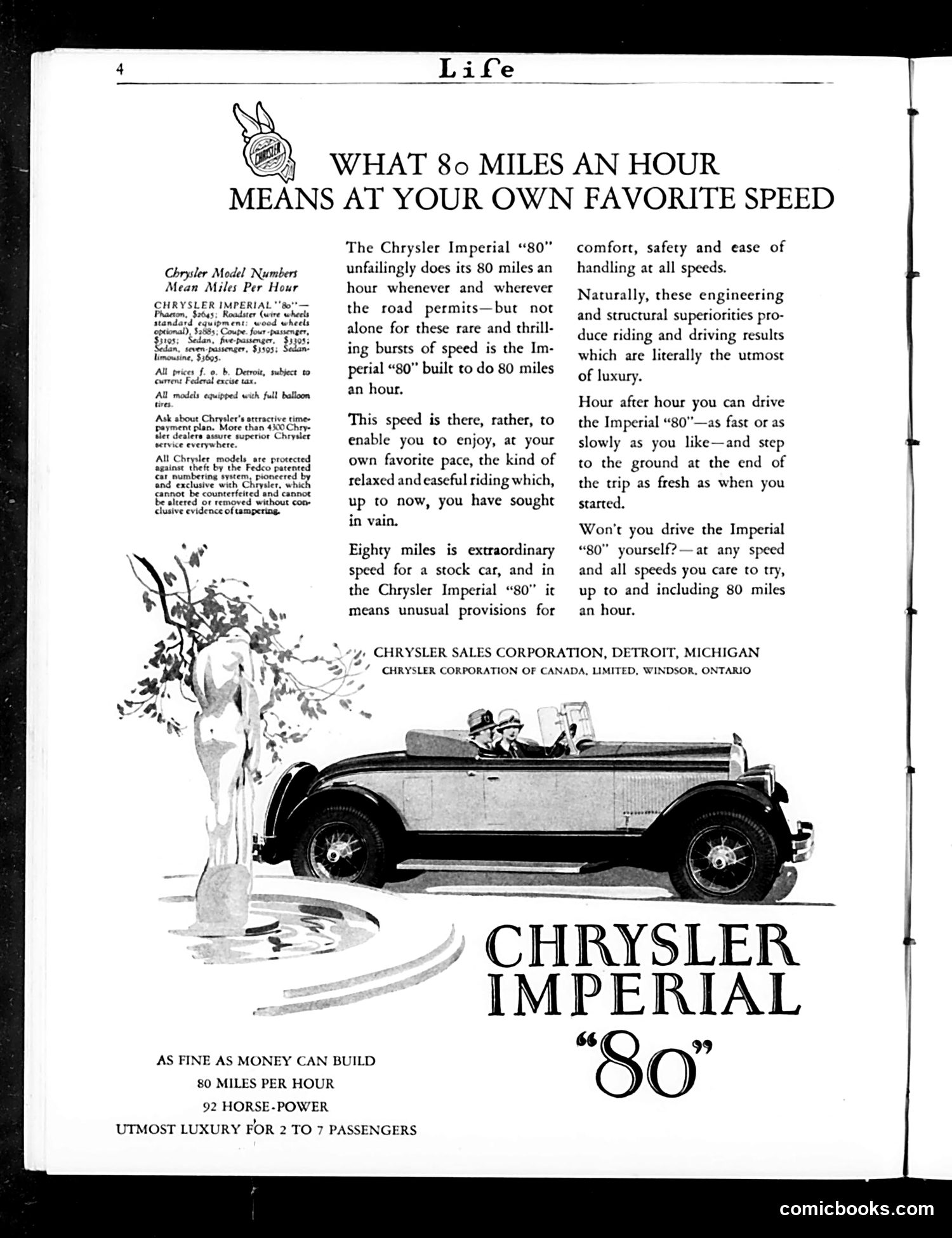
This is **not a satirical cartoon page**, but rather a **Chrysler automobile advertisement** from *Life* magazine. The ad promotes the Chrysler Imperial "80" model, emphasizing its capability to achieve 80 miles per hour—a significant selling point for the era when such speeds were considered luxurious and noteworthy. The advertisement includes: - Technical specifications (92 horsepower, capacity for 2-7 passengers) - Marketing copy emphasizing comfort and safety at high speeds - An illustration of the open-air roadster with passengers - Decorative artistic elements (a stylized tree, figures) The page represents early automotive advertising's focus on speed and performance as markers of prestige. There is no political satire or social commentary present—this is straightforward commercial promotion typical of *Life*'s advertising content.
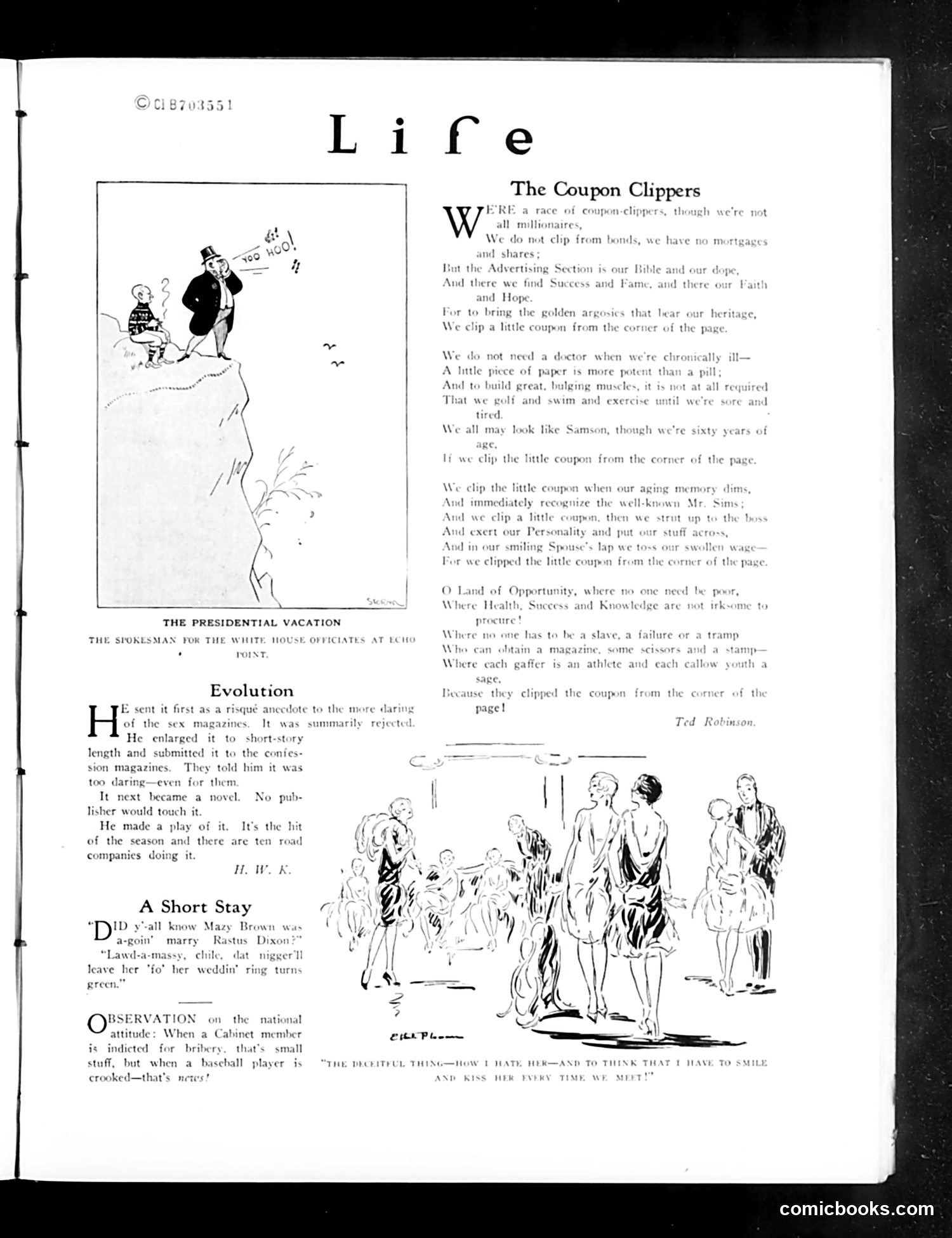
This page contains several short humor pieces and illustrations typical of Life's satirical style. **"The Coupon Clippers"** (main poem) mocks a specific social class—wealthy people who live off investment coupons rather than working. The satire suggests these individuals claim athletic vigor and self-reliance while actually depending entirely on passive income. The phrase "clipped the coupon from the corner of the page" appears repeatedly as the satirical refrain. **"Evolution"** briefly discusses how a risqué anecdote evolved into a short story submitted to magazines, suggesting the magazine's commentary on changing standards. The illustration at bottom shows a social gathering, captioned with dialogue about uncomfortable social etiquette—likely mocking upper-class pretension. The overall tone is gentle mockery of wealthy leisure-class culture and their self-deceptions.
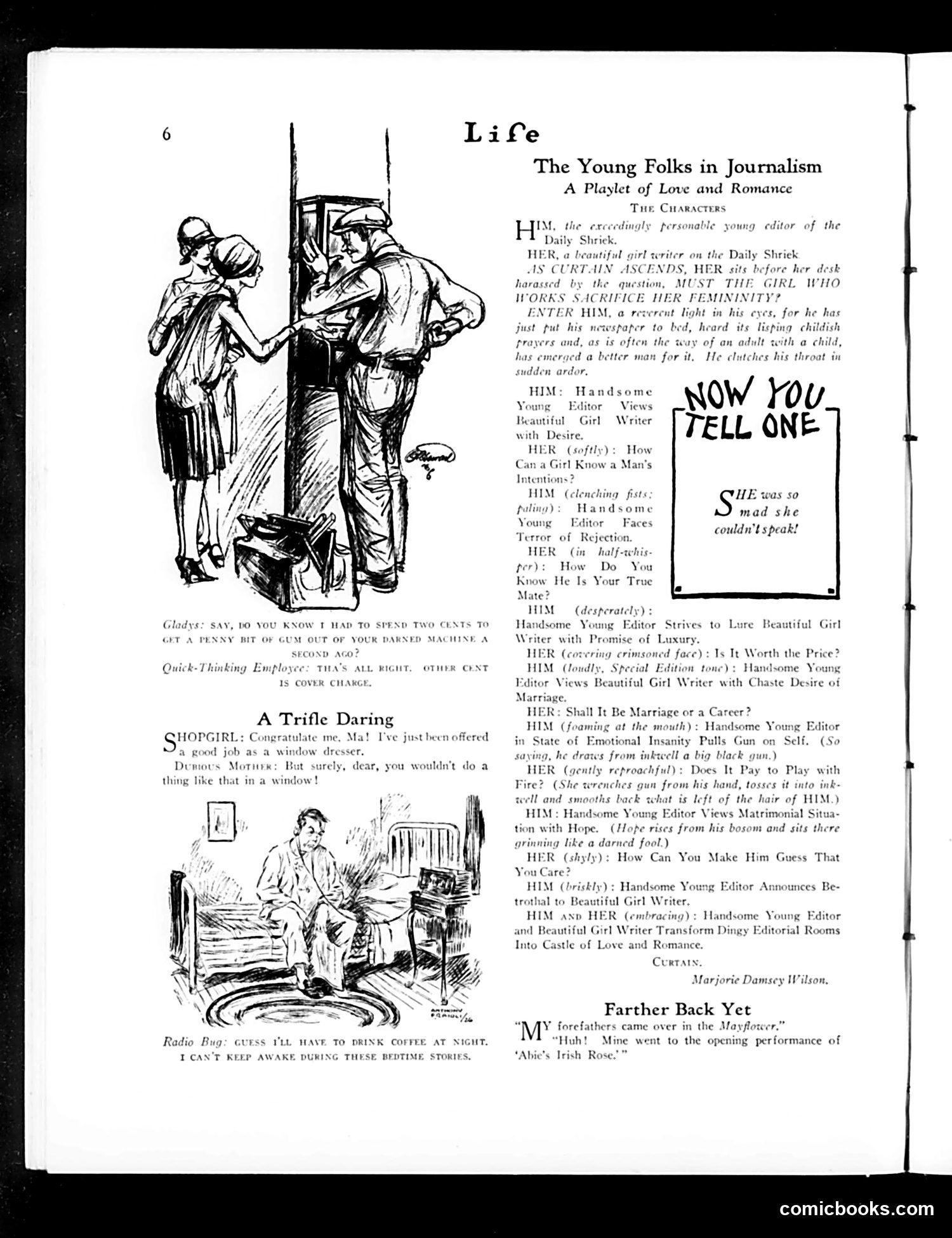
This page presents a satirical playlet titled "The Young Folks in Journalism: A Playlet of Love and Romance" by Marjorie Damasey Wilson. The satire mocks workplace romance and gender dynamics in journalism offices of the era. It depicts a beautiful female writer caught between professional ambitions and romantic entanglement with a handsome young editor. The playlet's title questions whether a woman can maintain her career or must choose marriage ("Shall It Be Marriage or a Career?"). The accompanying cartoons illustrate workplace absurdities: one shows an employee reluctantly working night shifts, another depicts a shopgirl receiving unwanted attention. The satire critiques the tension between women's emerging professional roles and persistent Victorian expectations that women prioritize matrimony over careers—a common early 20th-century anxiety about "modern women" in the workforce.
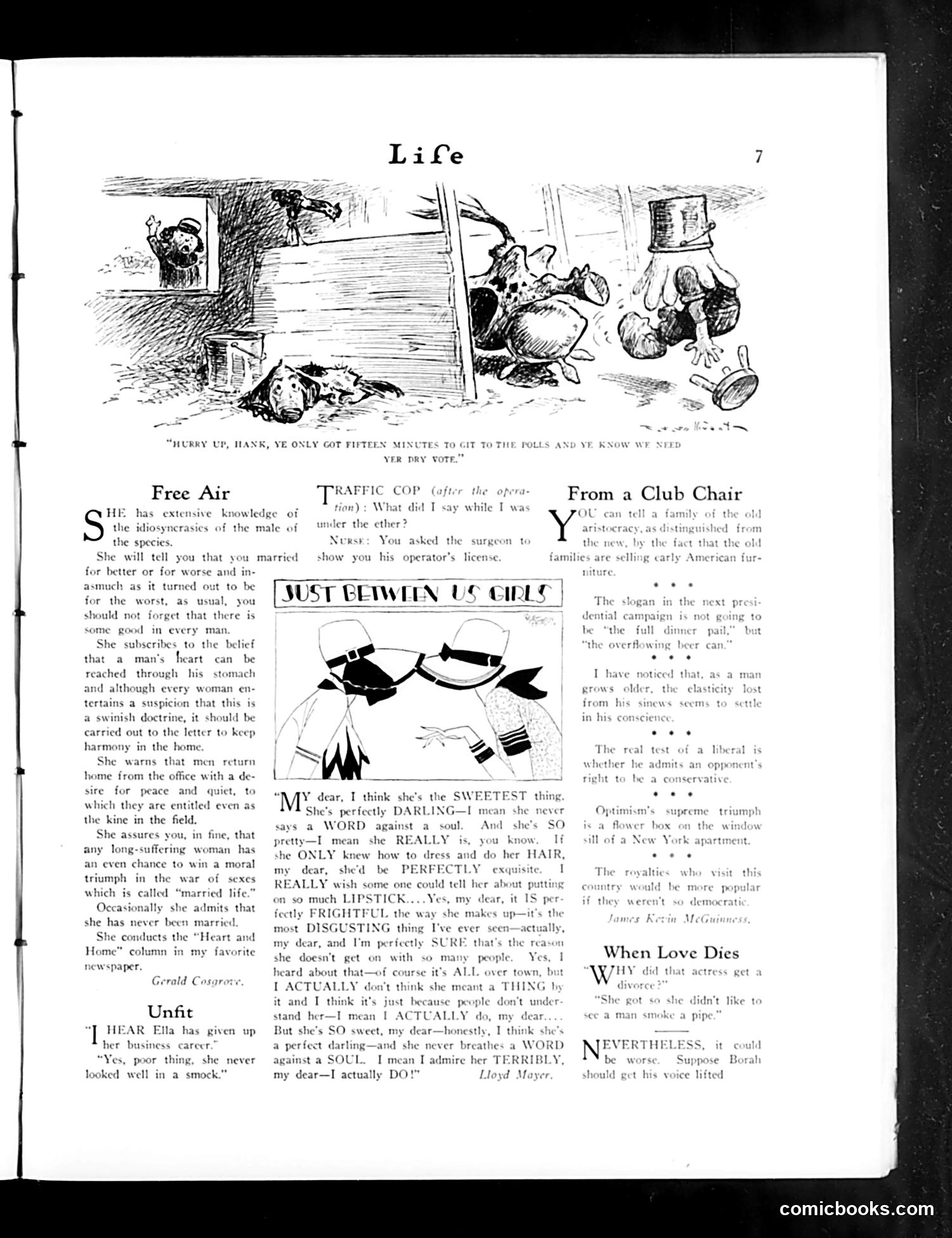
This page contains satirical commentary and humor pieces typical of Life magazine's format. The main cartoon at top depicts a chaotic voting scene with the caption "HURRY UP, HANK, YE ONLY GOT FIFTEEN MINUTES TO GIT TO THE POLLS AND YE KNOW MY NEED YER DRY VOTE" — satirizing rural voters being pressured about voting obligations. The central illustration titled "JUST BETWEEN US GIRLS" appears to show two figures with bows, likely mocking gossip or women's intimate conversations. The text sections include satirical pieces titled "Free Air," "Traffic Cop," "From a Club Chair," "Unfit," and "When Love Dies" — these are opinion/humor columns commenting on social behaviors, relationships, and contemporary life. The tone suggests mockery of pretension, marital dynamics, and social conventions of the era.
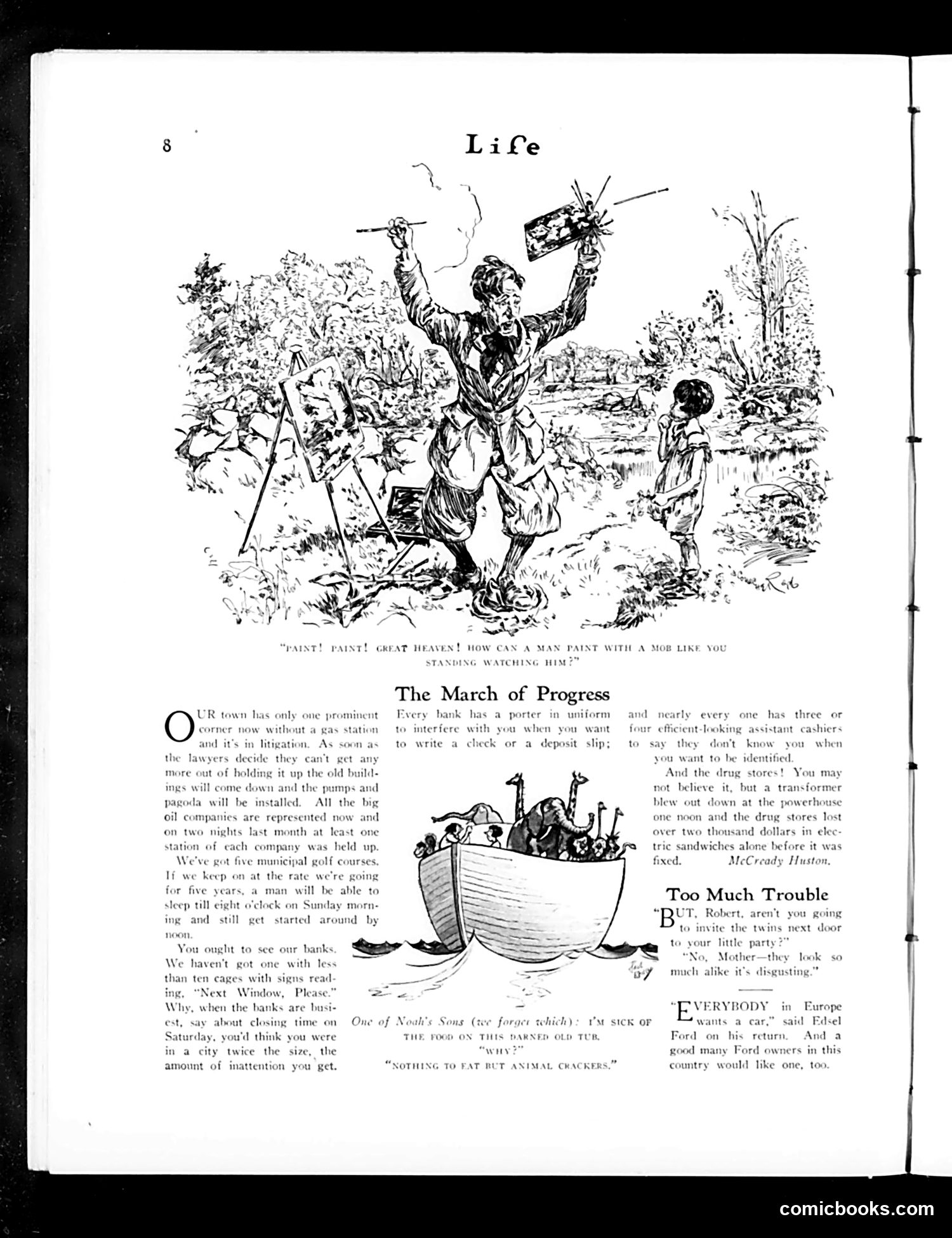
This page contains two satirical pieces about modern American life: **"The March of Progress"** criticizes urban infrastructure and bureaucratic inefficiency. The top cartoon shows a frustrated man painting while a mob watches—mocking public works delays. The text complains that towns now require gas stations, that lawyers interfere with basic services, and that banks employ numerous gatekeepers to obstruct simple transactions like check-writing or deposits. **"One of Noah's Sons"** depicts animals in an ark, captioned "I'm sick of the food on this darned old tub—Why?" and "Nothing to eat but animal crackers." This appears to be wordplay humor about actual food versus the children's snack. **"Too Much Trouble"** is a brief domestic joke about twins being socially undesirable party guests. The overall tone satirizes modern inconveniences and social pretension.
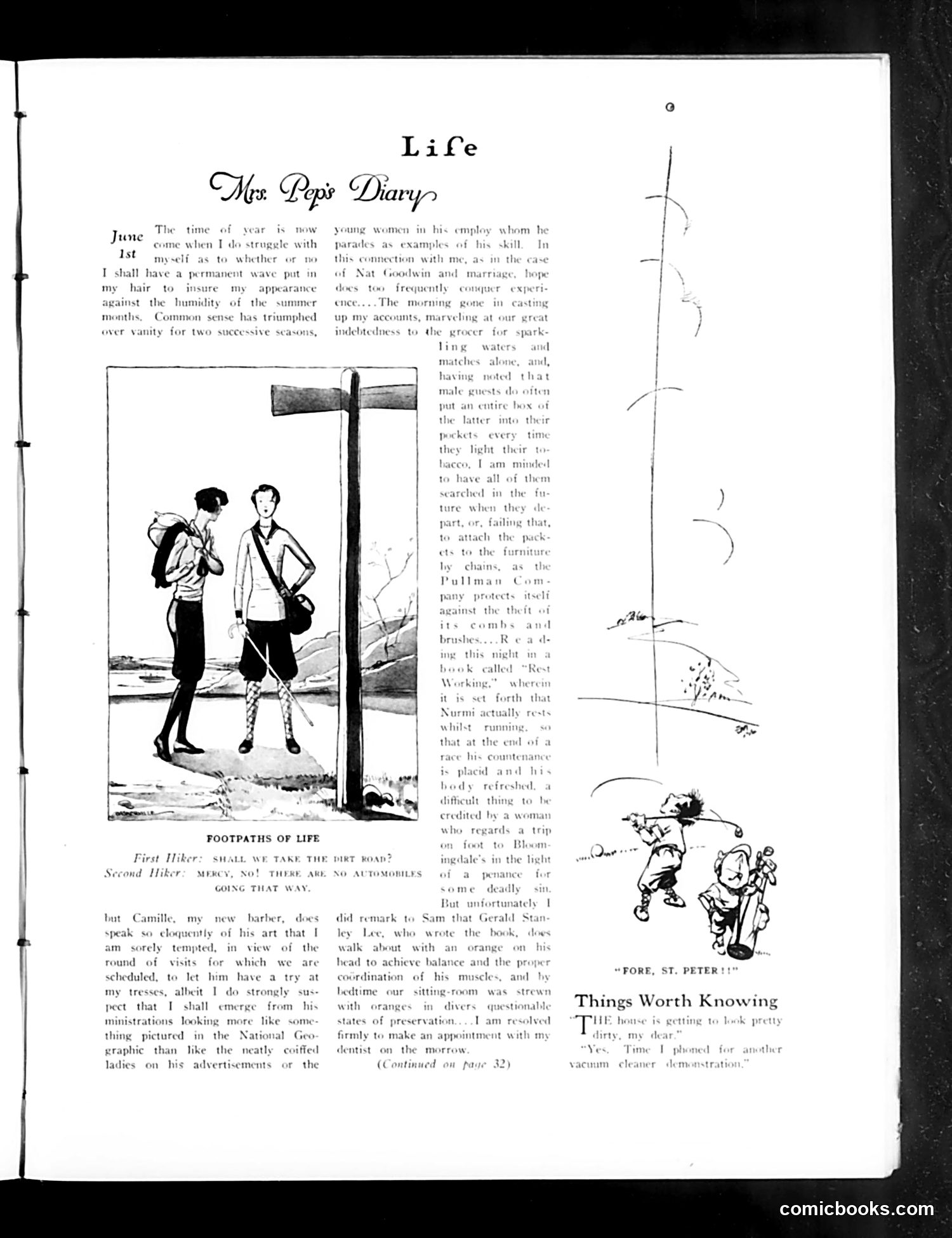
This is a lifestyle/humor column page from *Life* magazine's "Life" section. The main cartoon, titled "Footprints of Life," shows two hikers at a signpost with the caption: "First Hiker: 'Shall we take the dirt road?' / Second Hiker: 'Mercy, no! These are no automobiles going that way.'" The joke satirizes early 20th-century attitudes toward automobiles—specifically that unpaved roads are now avoided because they lack car traffic, reversing traditional preferences. It mocks how quickly car culture reshaped American society and recreational choices. The accompanying "Mrs. Pep's Diary" column discusses domestic life, summer heat management, and hiring a barber named Camille. The small illustration "Fore, St. Peter!" and "Things Worth Knowing" section appear to be typical magazine fillers of the era.
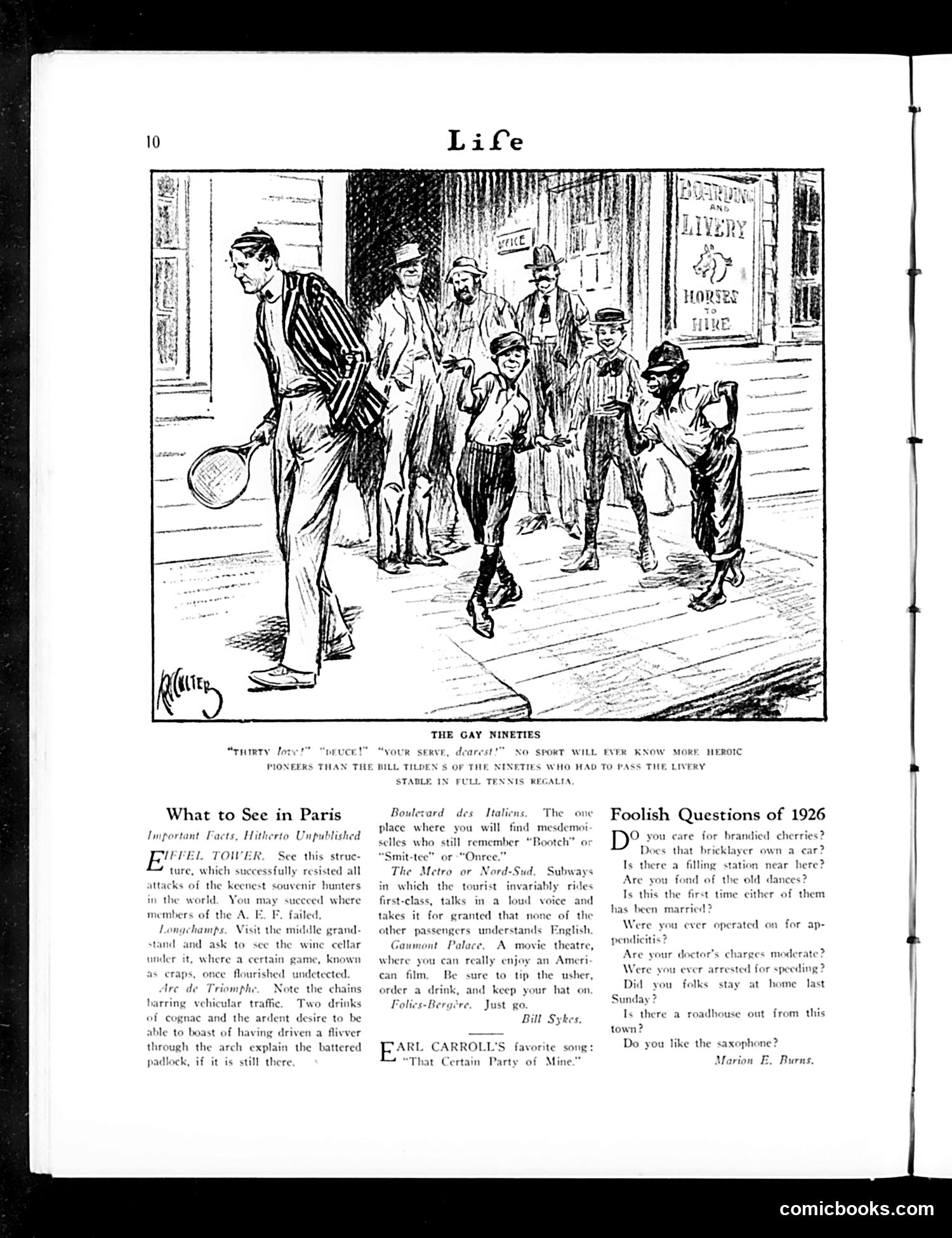
This cartoon satirizes nostalgia for the 1890s. An adult man swings a tennis racket at children in a street scene outside a livery stable, captioned with mock-heroic language praising "bill tides' s of the nineties" as heroic pioneers. The joke targets sentimental romanticization of the past: the caption's grandiose tone contrasts absurdly with the mundane, slightly chaotic reality depicted—children playing, ordinary street life. The man's aggressive tennis swing adds physical comedy. The satire suggests that those who idealize "the good old days" ignore or exaggerate their actual character. By comparing ordinary 1890s street activity to "heroic pioneers," the cartoonist mocks the tendency to mythologize recent history rather than see it clearly.
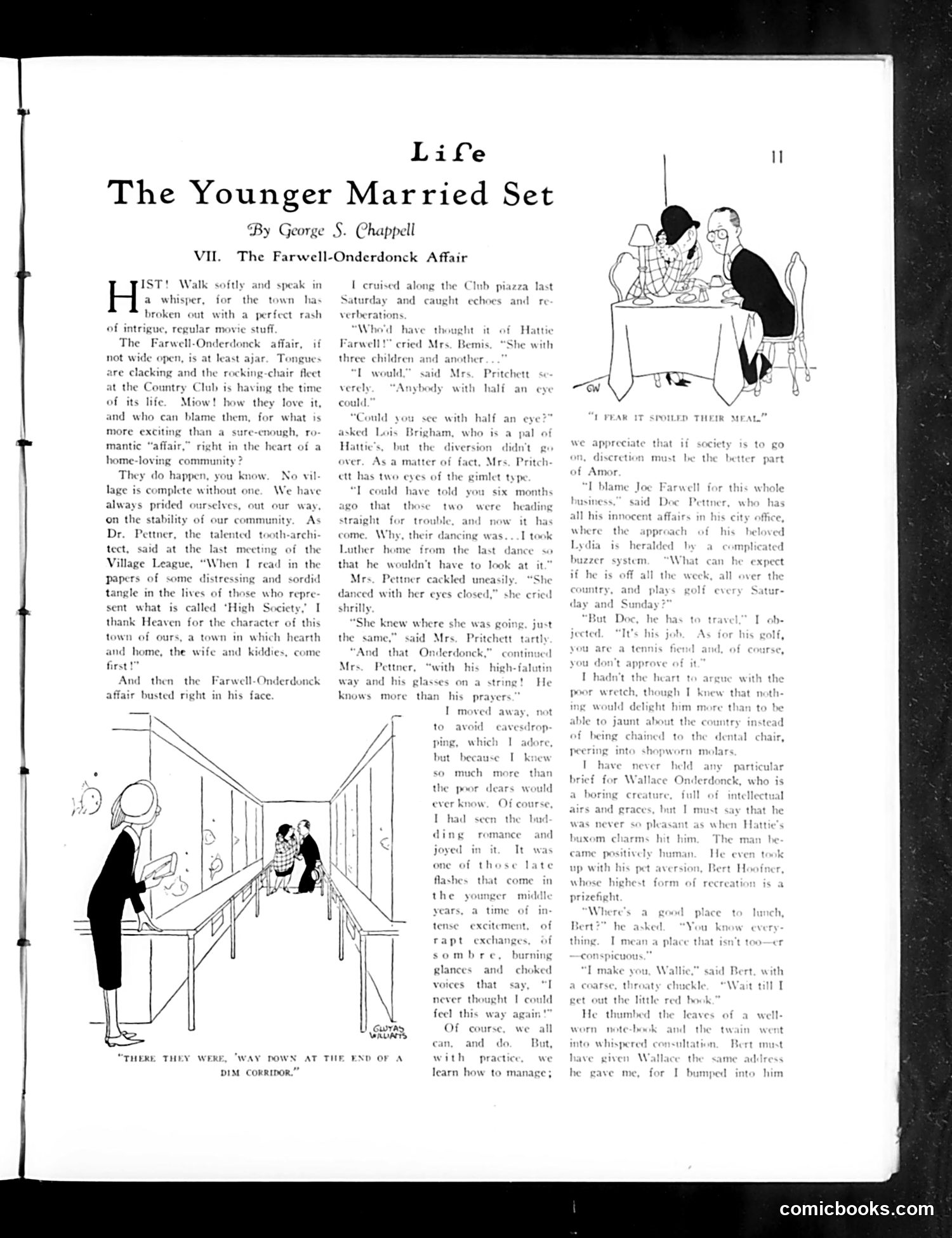
This is a satirical short story by George S. Chappell titled "The Farwell-Onderdonck Affair," part of *Life* magazine's "Younger Married Set" column. The narrative mocks upper-class social gossip and marital drama. The story concerns two couples in their social circle: the Farwells and the Pettietts. Mrs. Pettett is scandalized by rumors that Mrs. Farwell danced with half-closed eyes at a club—apparently scandalous behavior. The narrator dismisses this as trivial gossip, calling the situation a non-event blown out of proportion by idle society women. The accompanying illustrations show characters in an elegant corridor and at a dining table, depicting the world of country-club leisure where such minor social infractions become major talking points. The satire targets how wealthy, idle people create drama from nothing.
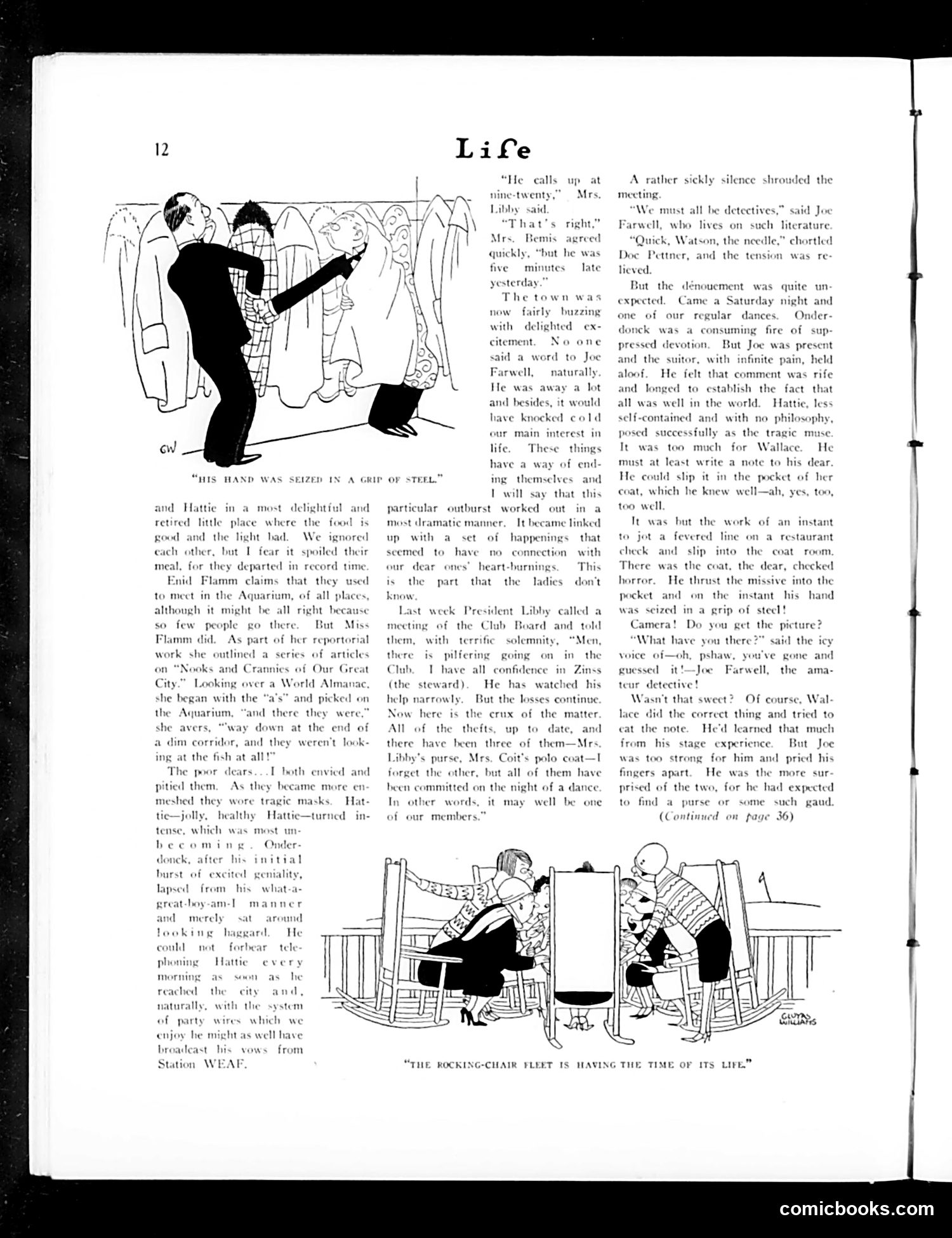
This page contains two illustrations satirizing urban social life. The top cartoon shows a man kicking his leg up in a crowded venue, captioned "His hand was seized in a grip of steel." The accompanying text discusses club members and social gatherings, suggesting satire about pretentious social clubs or dance venues. The bottom illustration, captioned "The rocking-chair fleet is having the time of its life," depicts people in rocking chairs, likely satirizing older residents or retirees enjoying leisure activities. The image appears to mock sedentary lifestyles or perhaps elderly social groups. Both cartoons use physical comedy and exaggeration typical of early-to-mid 20th-century American humor magazines, targeting middle-class social pretensions and stereotypes about different age groups.
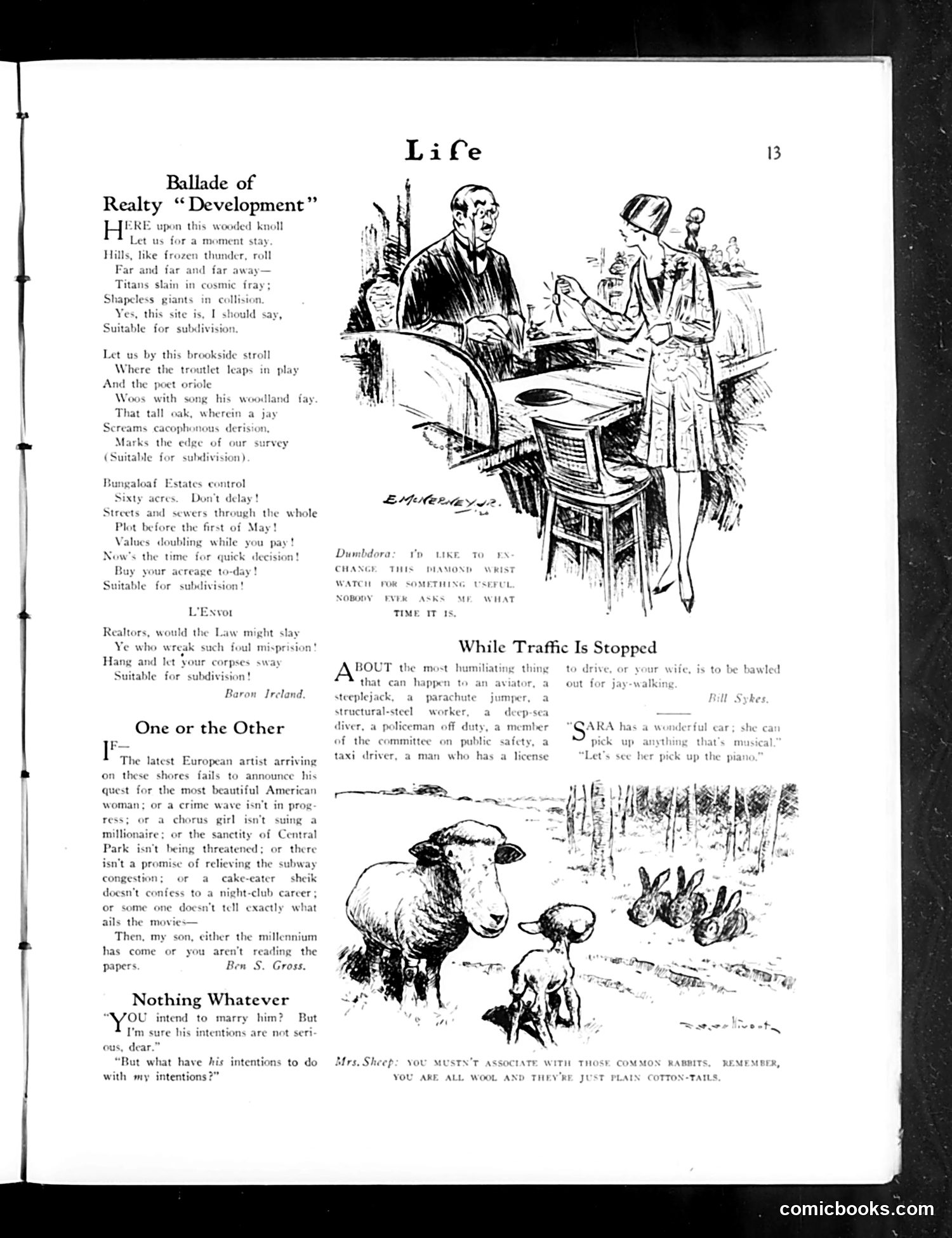
This page contains several satirical pieces targeting early 20th-century American consumer culture and real estate speculation: **"Ballade of Realty 'Development'"** mocks aggressive land developers and subdivision salesmen who promote hastily-developed properties with exaggerated claims about future value and convenience. **"One or the Other"** is a brief satirical poem about a European artist seeking the "most beautiful American woman" - likely poking fun at both pretentious artistic types and American vanity. **"While Traffic Is Stopped"** features a cartoon about mundane life during traffic delays, with the joke appearing to be about the absurdity of everyday situations. **"Nothing Whatever"** shows a dialogue between a man and woman about marriage intentions - satirizing romantic uncertainty and miscommunication. The illustrations use typical period pen-and-ink style to accompany these short comedic pieces typical of Life's satirical format.
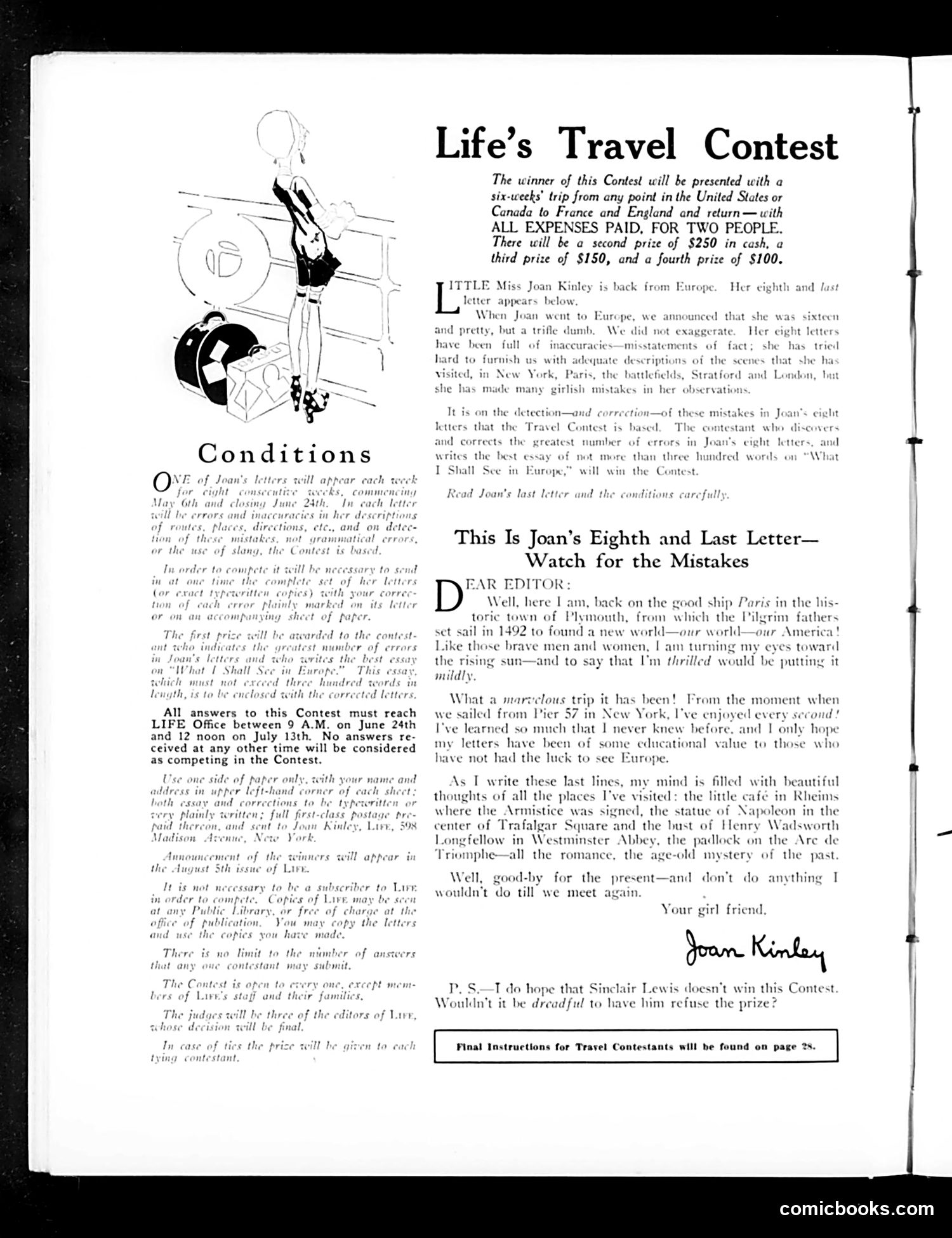
This page announces a reader contest where the grand prize is a six-week European trip for two people, with additional cash prizes. The contest mechanism is straightforward: readers must identify factual errors in letters written by "Joan Kinley" about her recent European travels. Joan's eighth and final letter appears here, describing her arrival in Plymouth, England. The satire lies in the premise itself—readers are challenged to spot geographical, historical, and observational mistakes Joan has supposedly made throughout her correspondence. The P.S. joke references "Sinclair Lewis," the famous American novelist, humorously suggesting concern he might win the contest. This represents early 20th-century magazine engagement: combining travel narrative, reader participation, and subtle humor about American tourism and European culture.
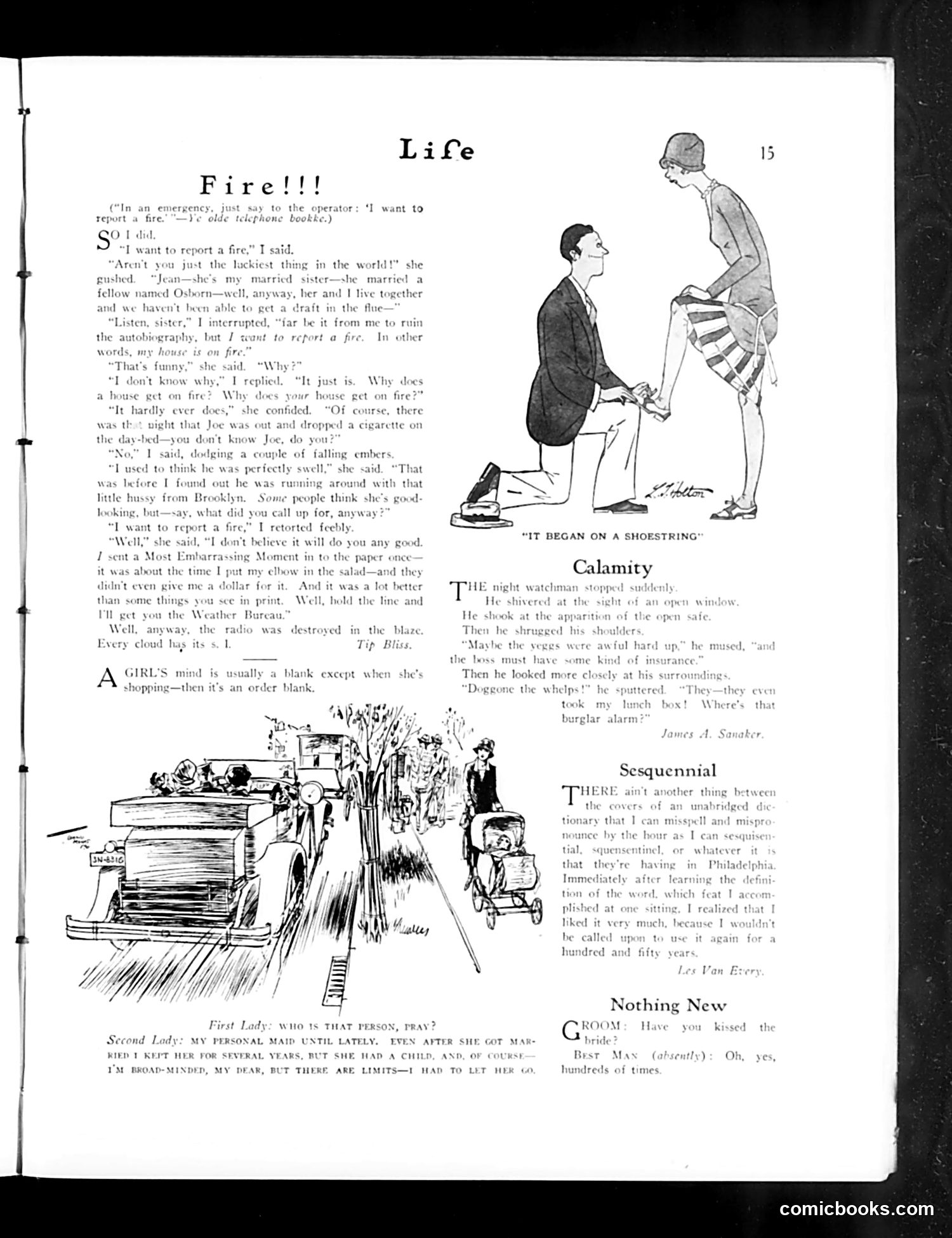
This page contains several short humorous pieces typical of Life's satirical format: **"Fire!!!"** mocks the bureaucracy of reporting emergencies. A woman calls to report her house fire but gets trapped in absurd dialogue about *why* houses catch fire, eventually being redirected to the Weather Bureau. The satire targets inefficient telephone operators and institutional runaround. **"It Began on a Shoestring"** shows a couple in an intimate moment—likely satirizing romantic clichés or engagement stories. **The lower cartoon** depicts a chaotic street scene with a fire truck, apparently illustrating the "Fire" anecdote above about emergency response. The remaining pieces—"Calamity," "Sesquennial," and "Nothing New"—appear to be short comic vignettes about everyday situations, typical of Life's format as a humor and satire publication.
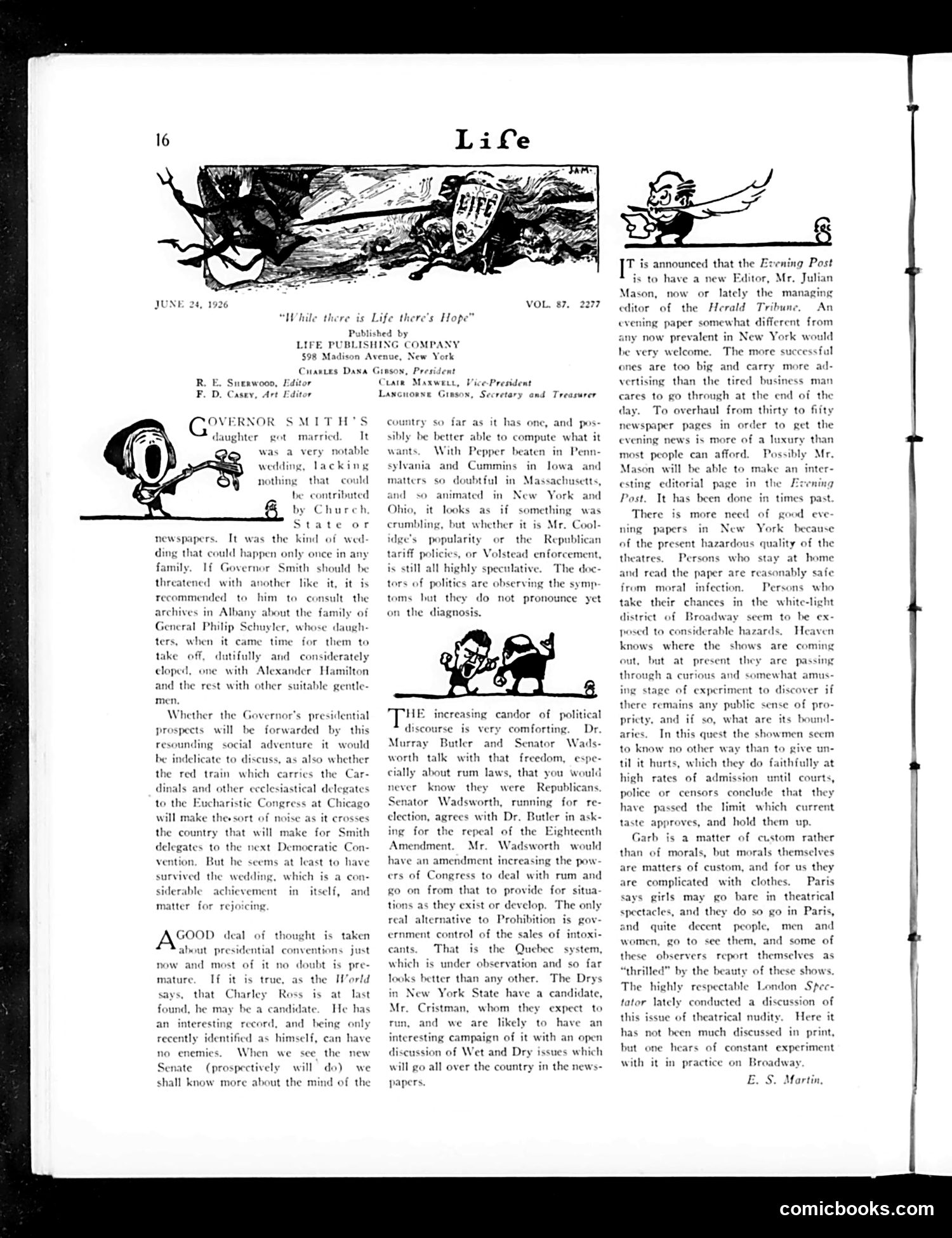
This page contains editorial commentary rather than a cartoon. The main article discusses **Governor Smith's daughter** and her marriage, using it as a springboard to critique political hypocrisy. The writer notes that while various politicians (Church, Pepper, Cummins, Volstead) have loudly crusaded on moral issues, the editorial suggests their actual positions are inconsistent or self-serving. The piece appears to mock the contradiction between politicians' public moral stances and their private conduct or true beliefs, particularly regarding Prohibition and related social issues. The editorial also discusses presidential prospects and upcoming Democratic conventions, suggesting the political landscape remains in flux regarding these contentious moral questions.
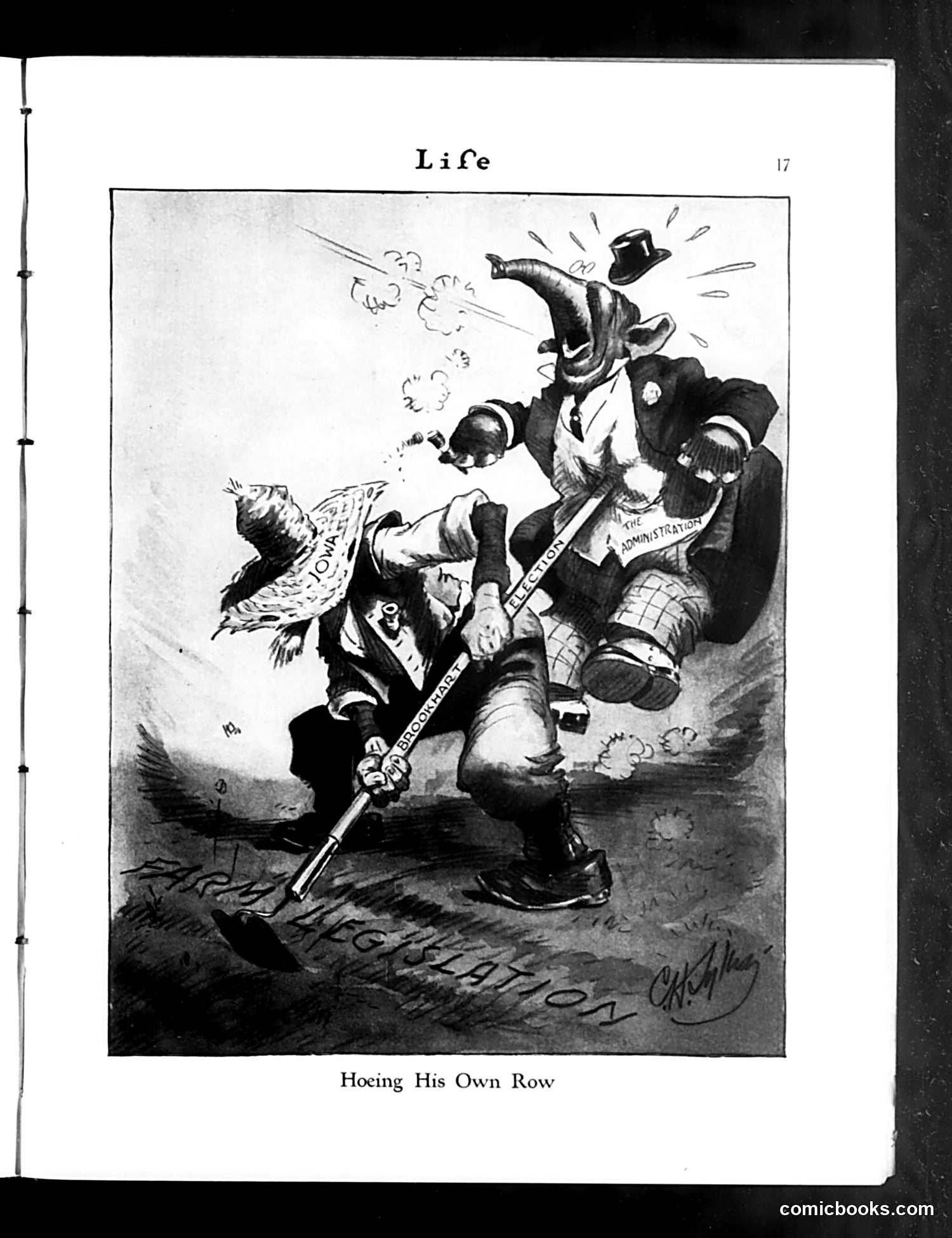
This political cartoon depicts a rotund figure in formal dress and top hat wielding a hoe, apparently struggling with agricultural labor. The figure appears distressed, with his hat flying off and various items scattered around him—suggesting incompetence or chaos. The title "Hoeing His Own Row" is an idiom meaning to handle one's own problems independently. The cartoon likely satirizes a government official or politician forced to manage his own affairs or take personal responsibility for failures, rather than delegating or evading consequences. The detailed caricature and formal attire suggest a figure of authority or high position. Without the publication date visible, the specific subject remains unclear, but the satire mocks someone struggling with self-sufficiency or accountability.
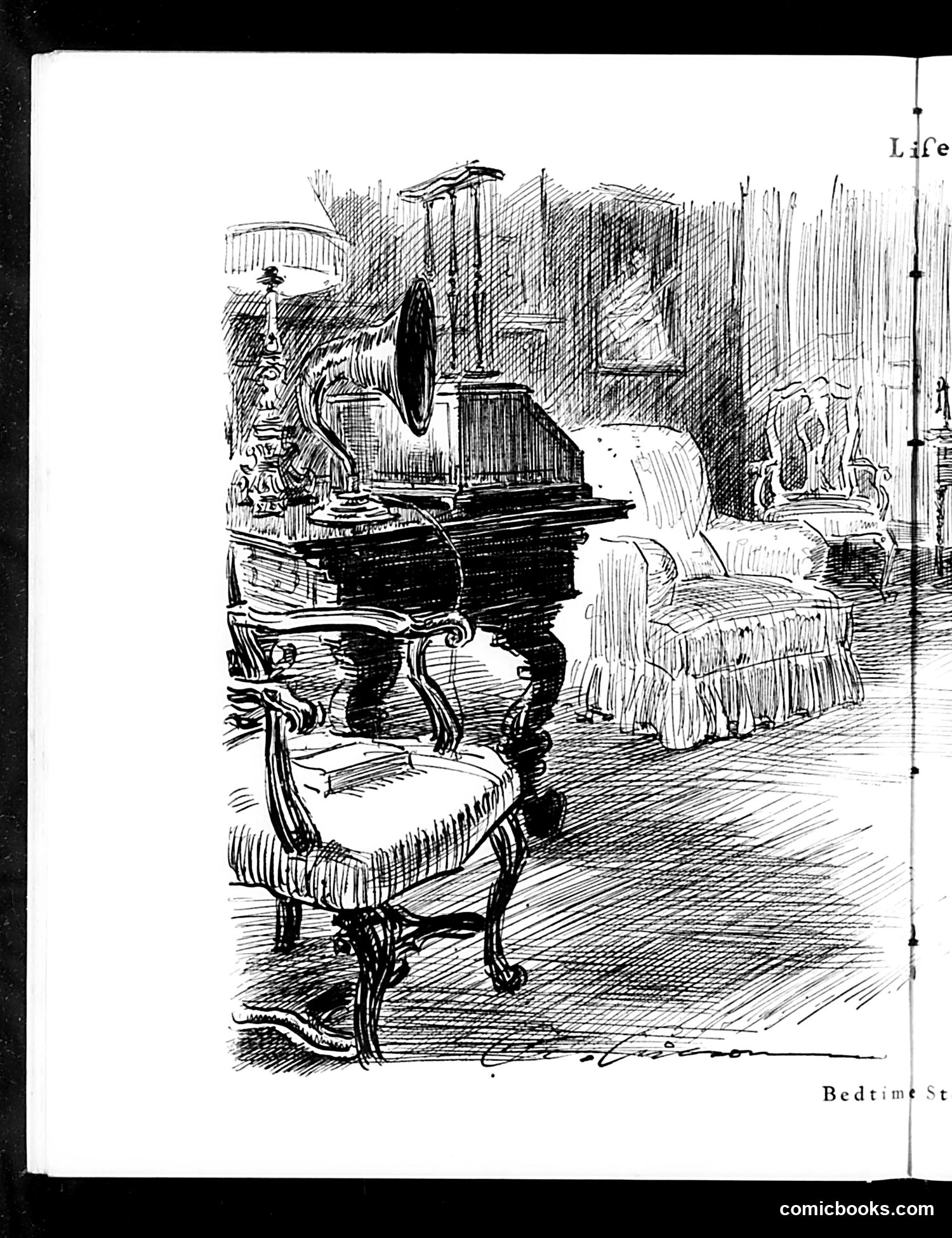
This appears to be a domestic interior sketch titled "Bedtime St[ory]" from *Life* magazine. The drawing shows a bedroom scene with period furniture—an ornate chair in the foreground, a piano or desk in the background, and an upholstered chair on the right. The detailed cross-hatching is characteristic of early 20th-century magazine illustration. However, the OCR text is heavily corrupted and provides no readable caption or dialogue that would explain the cartoon's satirical point. Without legible text, I cannot identify specific figures, social commentary, or the intended joke. The image alone—showing domestic furnishings—doesn't clearly convey satire or political meaning to a modern viewer. **I cannot reliably explain what this cartoon means without readable OCR text.**
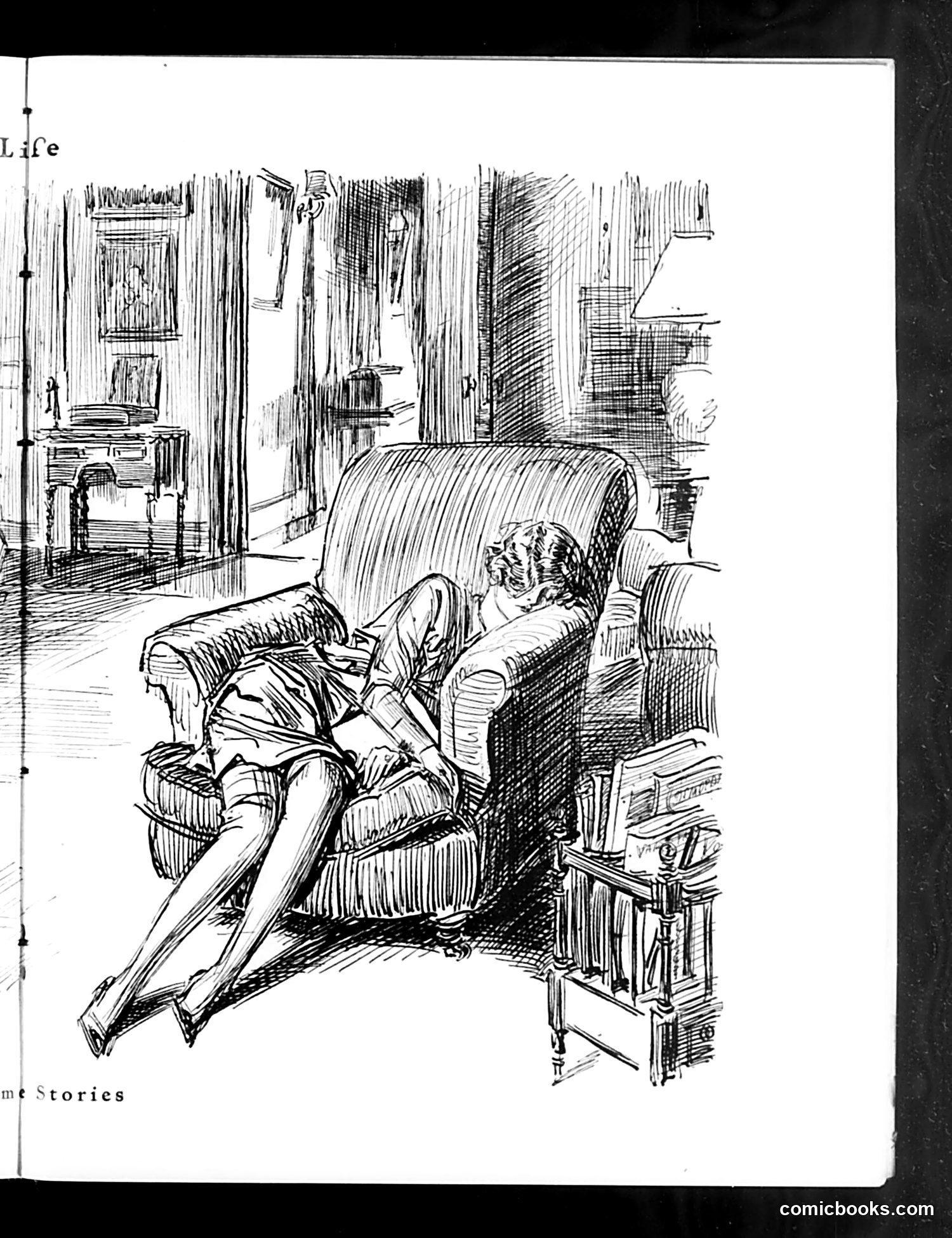
This appears to be a section titled "Life" with partial text reading "me Stories" visible at bottom left. The illustration shows a figure reclining in an armchair in what appears to be a domestic interior, drawn in pen-and-ink style typical of early-to-mid 20th century magazine illustration. The figure has an exaggerated posture and expression suggesting idleness or leisure. Without additional visible text or caption explaining the specific satirical point, the exact subject of the satire is unclear. The drawing style and composition suggest social commentary on domestic life or leisure habits, but the particular target—whether about laziness, wealth, gender roles, or another social condition—cannot be definitively determined from the image alone.
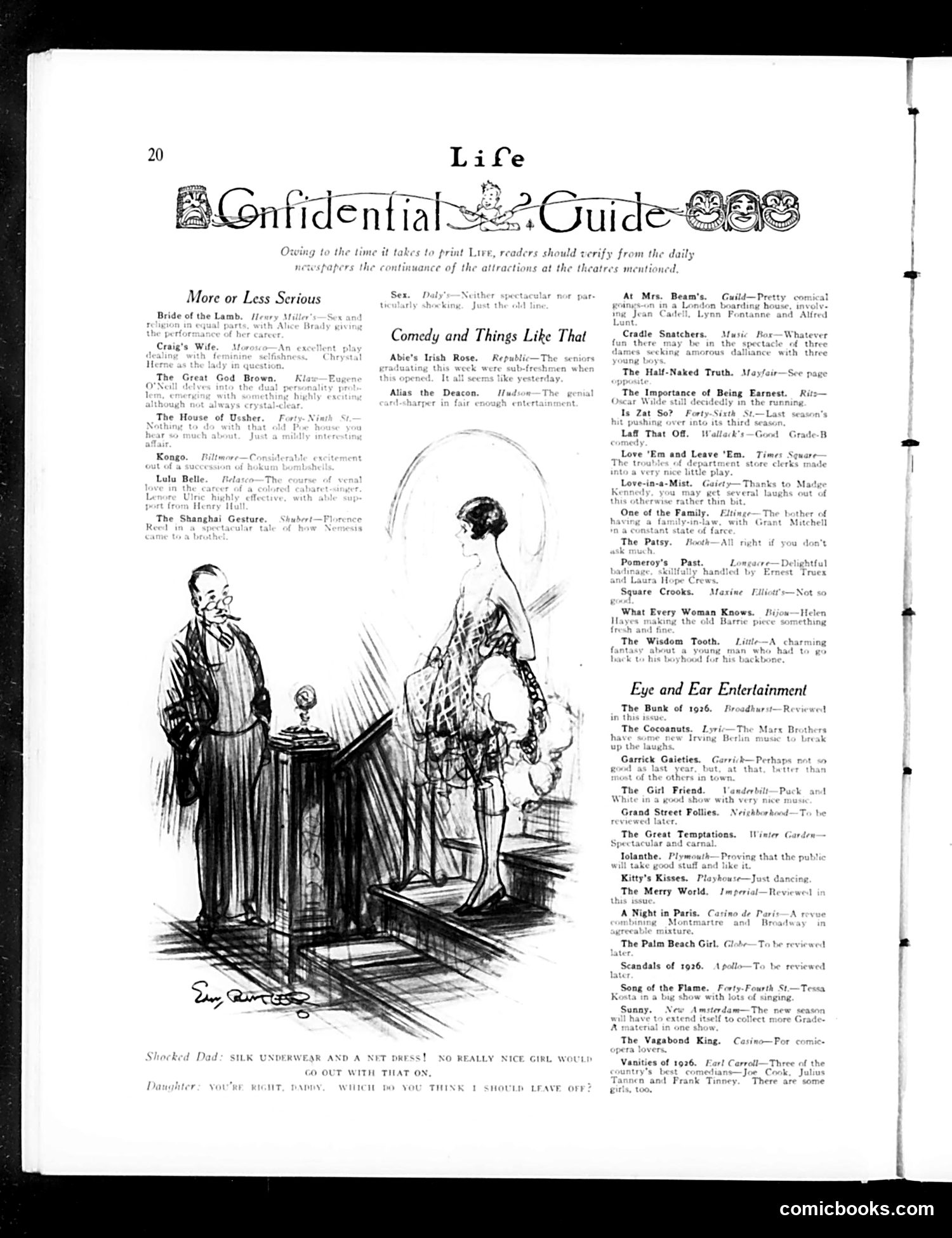
This page is a theatrical review section from Life magazine listing current Broadway shows and films. The main cartoon depicts a shocked father confronting his daughter about her revealing outfit—"silk underwear and a net dress." The satire targets 1920s social anxieties about modern youth fashion and morality. The "shocked dad" objecting to his daughter's scanty attire reflects genuine generational conflict of the Jazz Age, when shorter skirts, looser clothing, and "flapper" style represented rebellion against Victorian modesty standards. The daughter's retort ("which do you think I should leave off?") humorously captures youth defiance of parental authority—a recurring Life magazine theme mocking both conservative elders and modern youth culture. Below are theatrical listings for current Broadway productions and films, providing entertainment recommendations with brief critical notes.
This is a theater criticism column discussing Broadway revues and shows. The author critiques "The Merry World," a British-influenced comedy sketch revue, praising its humor but noting it lacks the polish of professional American productions. The piece also discusses "The Bunk of 1926," a show that moved from an intimate downtown theater to the larger Broadhurst Theatre uptown. When relocated and professionally managed, it lost its original charm and intimacy—the insertion of a "little pep into the proceedings" and removal of ad-libs stripped away the show's appeal. The author contrasts semi-amateur, intimate revues with slick Broadway productions, suggesting there's value in rawer, less polished entertainment. The column also mentions "Iolanthe" (a Gilbert & Sullivan operetta) as a superior theatrical experience. No specific political satire is evident; this is straightforward entertainment criticism reflecting 1920s theater culture.
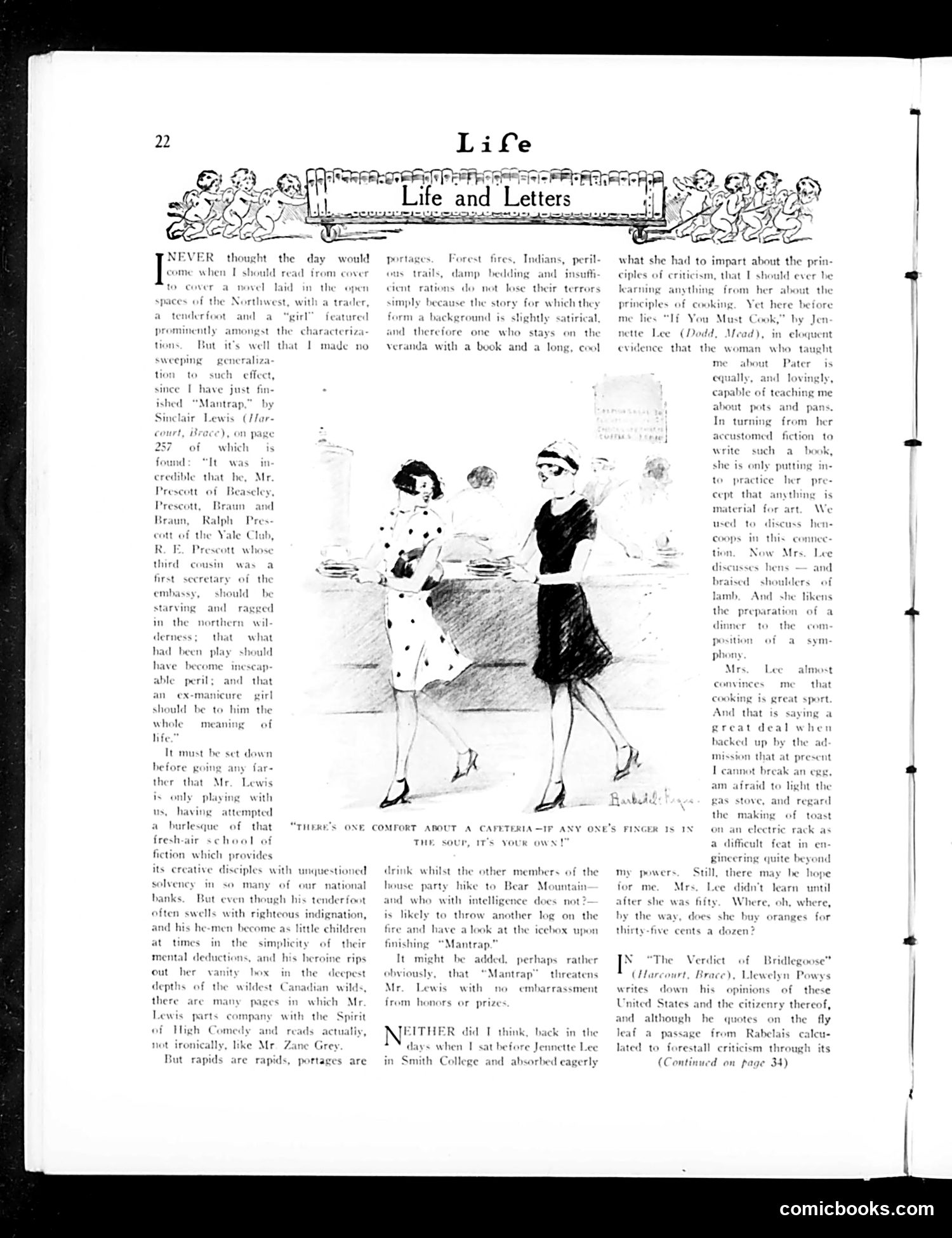
This page features a satirical cartoon about cafeteria dining, captioned: "THERE'S ONE COMFORT ABOUT A CAFETERIA—IF ANY ONE'S FINGER IS IN THE SOUP, IT'S YOUR OWN!" The joke targets the impersonal, self-service nature of cafeteria dining—a relatively modern institution at this time. The humor relies on the anxiety that cafeteria food might contain unsanitary elements (a finger in the soup being the gross extreme). The satire's point: cafeterias eliminate the usual assurance that trained restaurant staff maintain hygiene standards, since diners serve themselves. It's a commentary on the trade-off of convenience versus trust in food preparation. The surrounding text discusses Sinclair Lewis's novel "Mantrap" and literary matters unrelated to the cartoon. The illustration style—sketch-like drawings of two women at a cafeteria line—is typical of Life's satirical cartoons from this era.
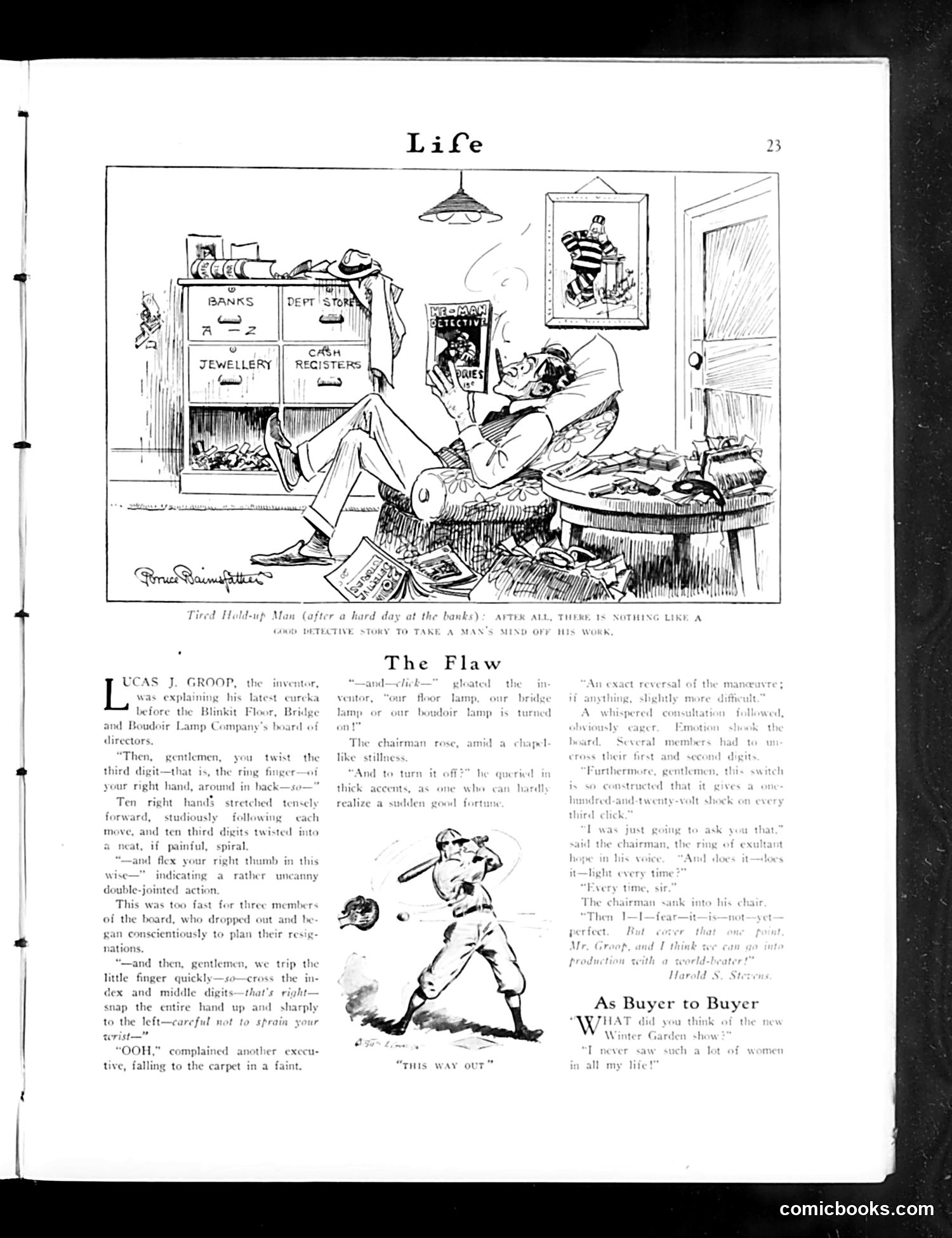
**Top Cartoon:** This is a satirical illustration of a tired businessman reclining in his office, surrounded by scattered papers and reading detective fiction. The caption explains he's a "Tired Hold-up Man (after a hard day at the banks)" who uses pulp detective stories as mental escape from work. The satire mocks both the exhausting nature of banking work and the era's popular cheap fiction as a working-man's stress relief. **"The Flaw" Article:** Below, a story describes Lucas J. Groop, an inventor at the Boudoir Lamp Company, demonstrating a complex hand-twisting mechanism to activate a lamp. The narrative humorously recounts how the elaborate procedure (requiring precise finger movements) is impractical—one executive faints attempting it. The satire targets over-engineered products that sacrifice usability for mechanical novelty. **Context:** This reflects early 20th-century American consumer culture's fascination with mechanical gadgetry, often resulting in unnecessarily complicated devices. The humor mocks both inventors' hubris and consumers' willingness to embrace complexity.
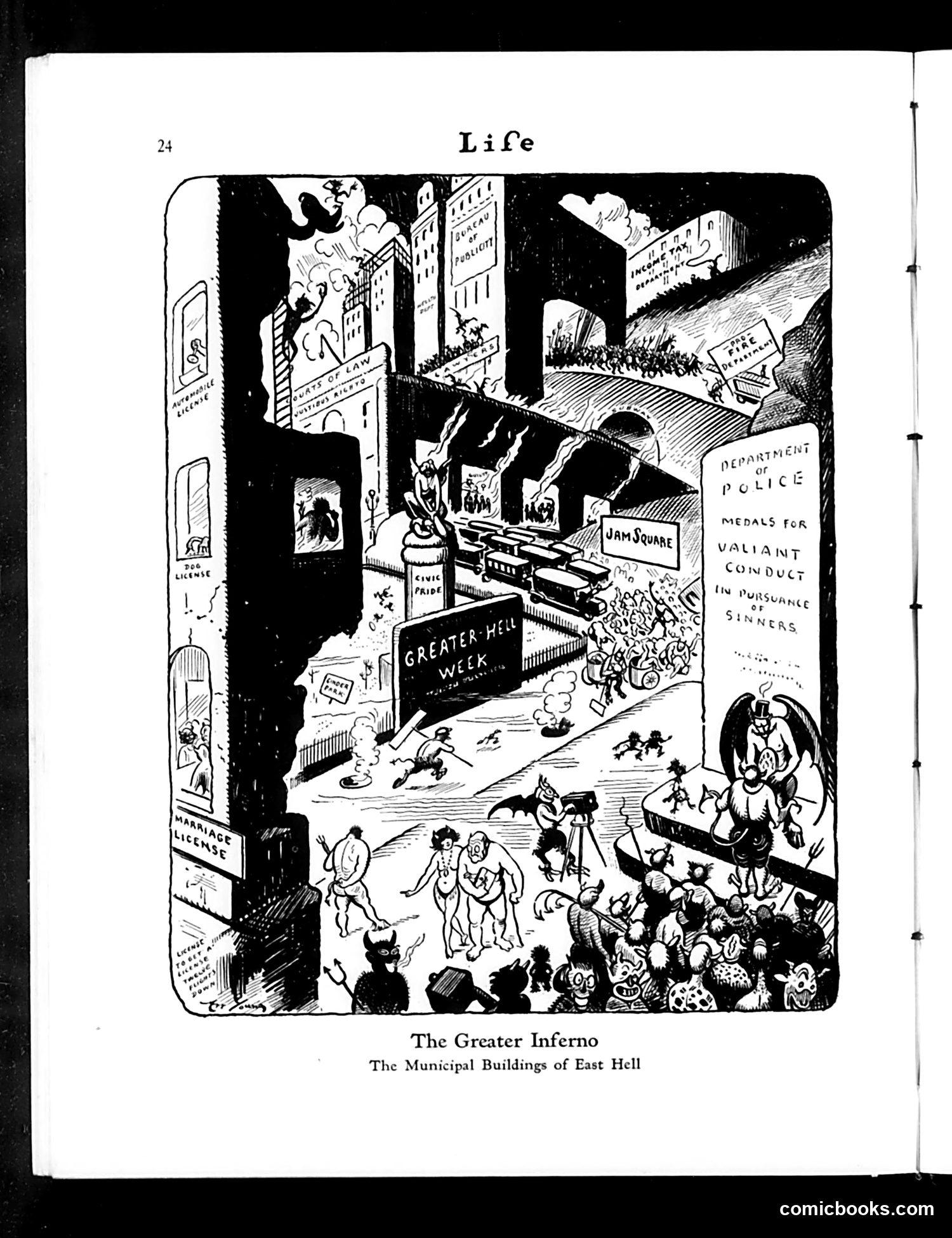
This satirical cartoon depicts a hellish bureaucratic landscape labeled "The Greater Inferno: The Municipal Buildings of East Hell." The image mocks municipal corruption and vice through an infernal allegory. Visible signage references "Jam Square," "Greater Hell Week," and a "Department of Police" offering "Medals for Valiant Conduct in Pursuit of Sinners"—sarcastically suggesting authorities reward questionable behavior. The crowded street teems with demonic and human figures engaged in vice and mayhem, with various municipal buildings surrounding them. The satire targets urban government institutions as inherently corrupt or complicit in enabling immorality. By framing city hall as literal hell with bureaucratic departments, the cartoonist critiques how municipal systems supposedly protect or reward wrongdoing rather than preventing it.
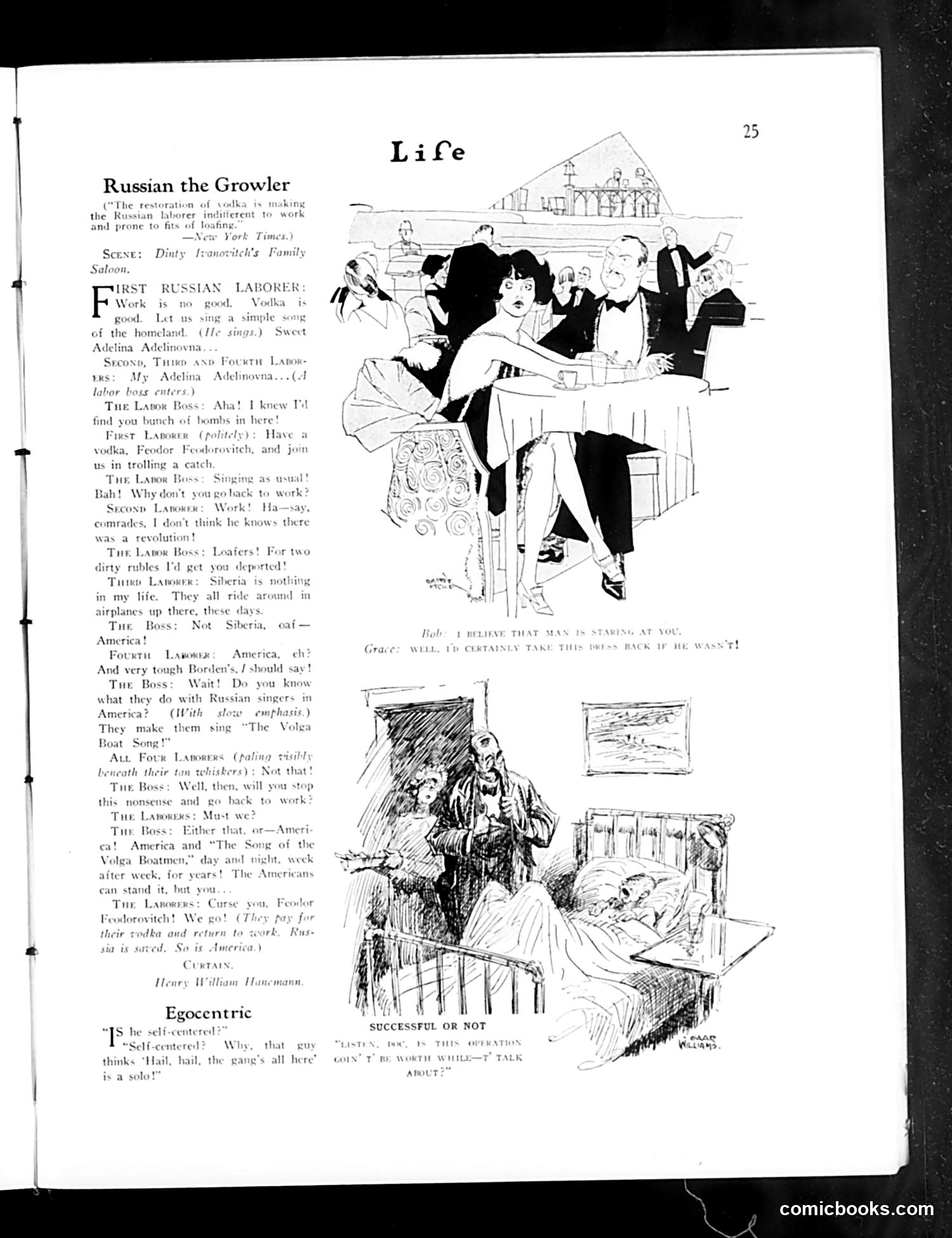
This 1920s satire depicts Russian laborers in a saloon debating work and national pride. The "Growler" refers to a bucket used to carry beer, a working-class fixture. **The Satire:** The joke centers on Russian workers' complaints about conditions while citing American resilience. When the boss mentions Americans endure "The Song of the Volga Boatmen" repeatedly and still work, the laborers respond that Americans "can stand it"—implying Russians cannot. **Historical Context:** Post-WWI America had significant Russian/Eastern European immigrant communities. The humor plays on stereotypes of Russian workers as complainers versus the idealized American work ethic. The reference to vodka restoration suggests post-Prohibition America (likely 1920s). **The Point:** American superiority in labor endurance and work tolerance, mocking Russian (immigrant) resilience as inferior—a common xenophobic trope of the era reflecting anti-immigrant sentiment.
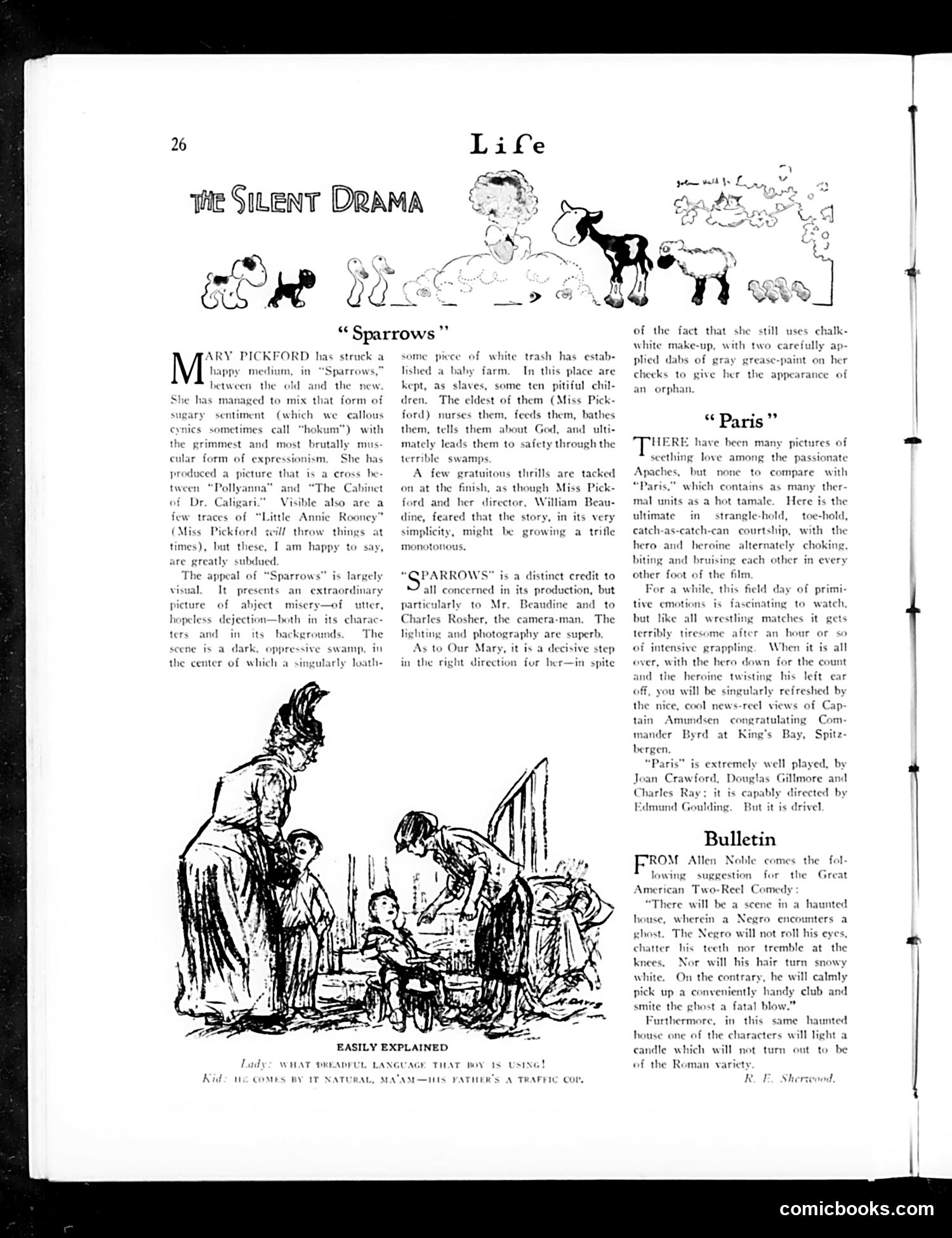
This page reviews three silent films from the 1920s era. The main content discusses Mary Pickford's "Sparrows," a drama about orphans in a baby farm, praising her blend of emotional realism with expressionist techniques. The reviewer notes the film avoids excessive sentimentality while delivering genuine pathos. The "Paris" review criticizes a Joan Crawford romantic film as melodramatic "drivel," describing its passionate but exhausting combat-like courtship scenes with exaggerated physical comedy. The cartoon "Easily Explained" at bottom depicts a woman scolding a boy for foul language; the caption's joke relies on period-typical class humor—the boy learned profanity from his father, a traffic cop, suggesting working-class men were naturally crude speakers. The "Bulletin" section presents Allen Noble's satirical suggestion for comedic scenes depicting African Americans without racial stereotypes—avoiding exaggerated eye-rolling or fear responses—which ironically underscores how prevalent such caricatures were in contemporary films.
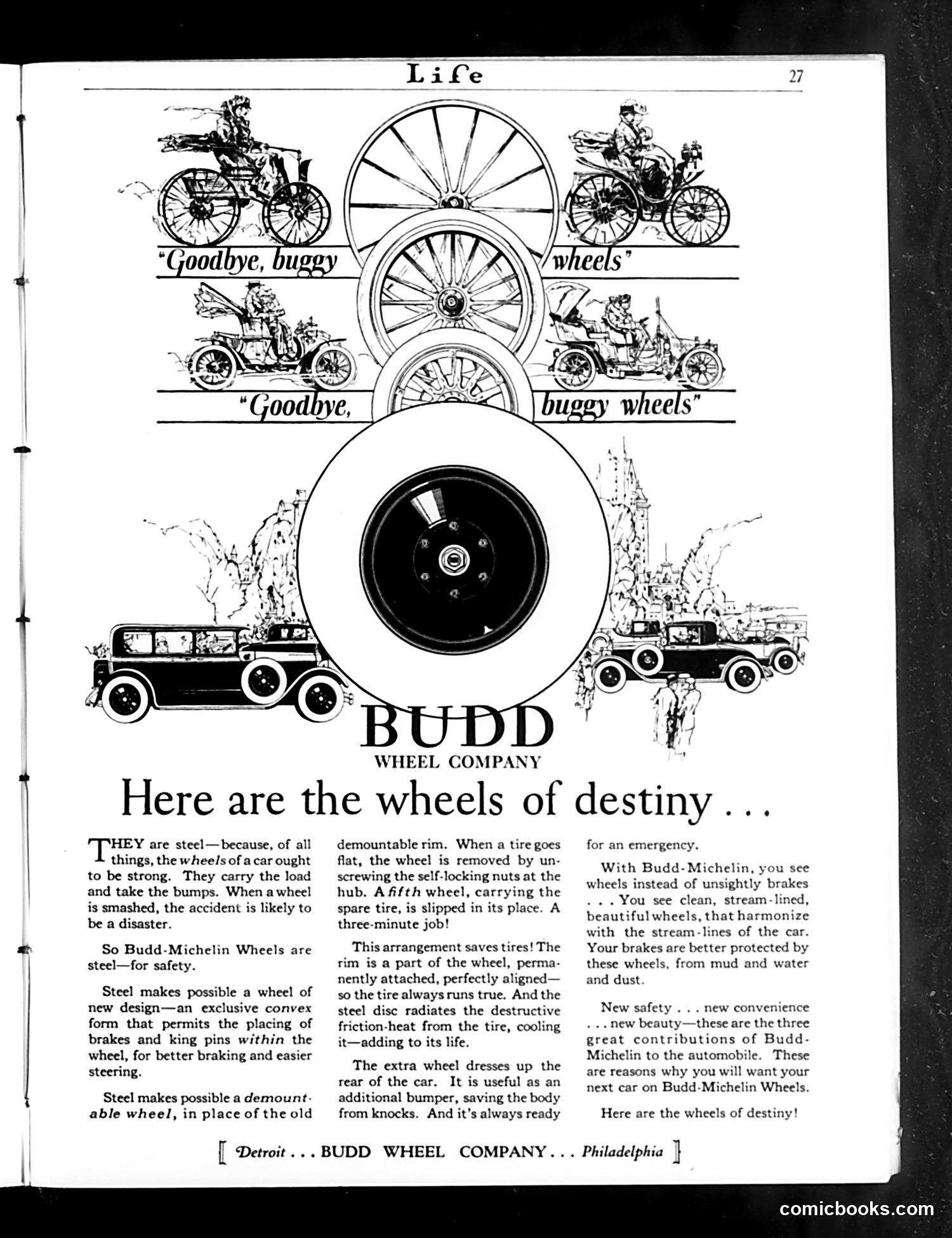
This is primarily **automobile advertising**, not political satire. The page advertises Budd-Michelin Wheels, emphasizing their steel construction and modern design innovations. The visual progression shows the evolution from horse-drawn buggies (top) to early automobiles to contemporary 1920s cars—illustrating progress and modernity. The phrase "wheels of destiny" romanticizes automobiles as agents of social change. The text highlights technical advantages: steel construction for safety, a new "demountable" wheel design allowing quick tire changes, integrated brakes and steering components, and a decorative fifth spare wheel on the rear. These were genuine innovations for the era. The tagline "Here are the wheels of destiny" reflects period optimism about automobiles transforming society. Rather than satirical, this is earnest marketing leveraging the cultural excitement around automotive technology in what appears to be the 1920s-1930s.
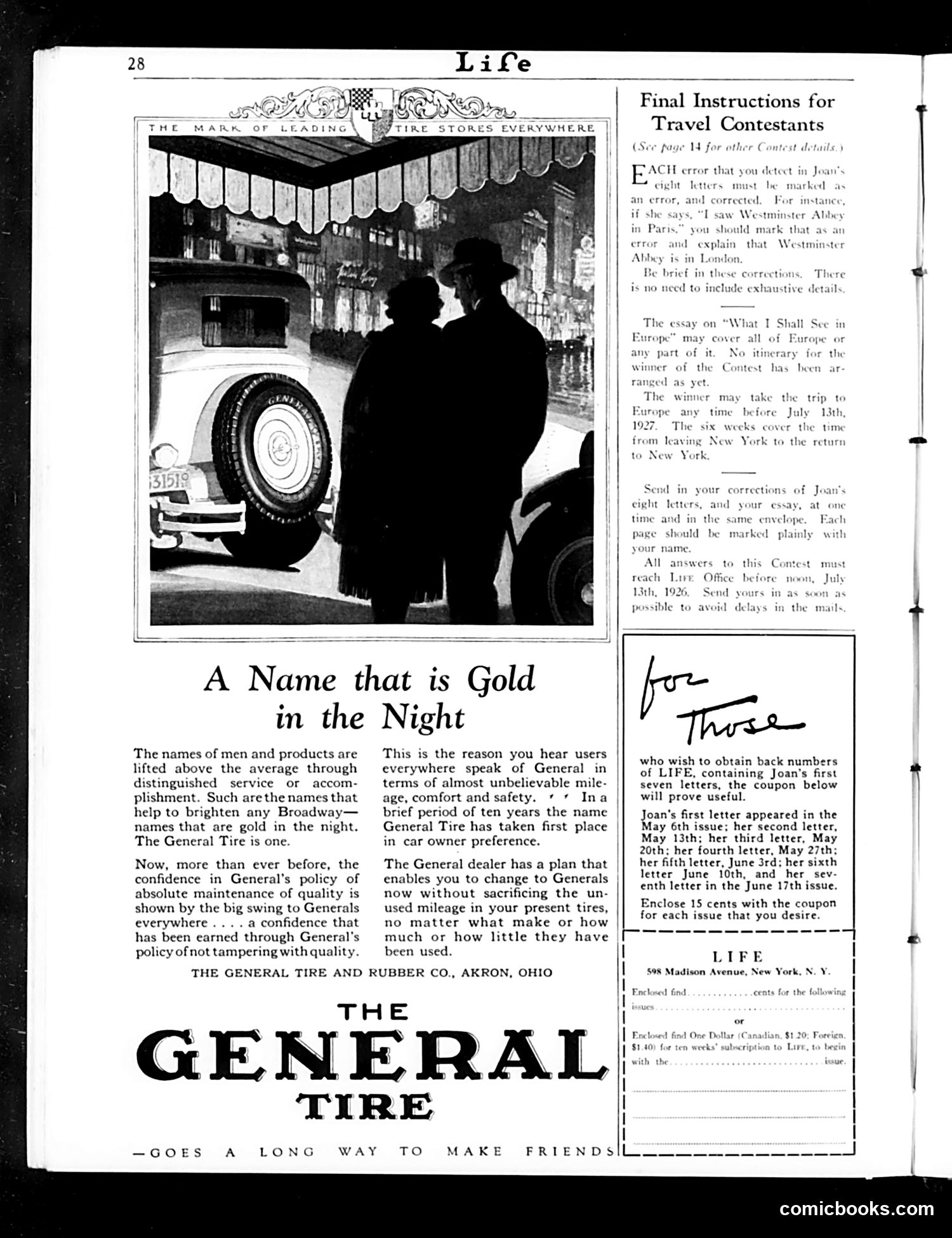
This page combines **advertising with a travel contest announcement**. The primary content is a General Tire ad featuring an elegant showroom scene with two men examining a tire—meant to evoke sophistication and quality ("A Name that is Gold in the Night"). The tagline "goes a long way to make friends" uses social aspiration as a sales pitch, suggesting tire ownership signals refined taste. The right column presents **"Final Instructions for Travel Contestants,"** referencing an ongoing contest featuring a character named Joan who wrote eight letters about European travel across six Life issues (May-June 1926). Readers could submit corrections to Joan's letters and essays for a chance to win a six-week European trip departing before July 13, 1927. This reflects **1920s consumerism and mass media engagement**—magazines encouraged reader participation through contests while companies advertised luxury goods. The contest promoted both Life magazine subscriptions and aspirational travel fantasies during the prosperous pre-Depression era.
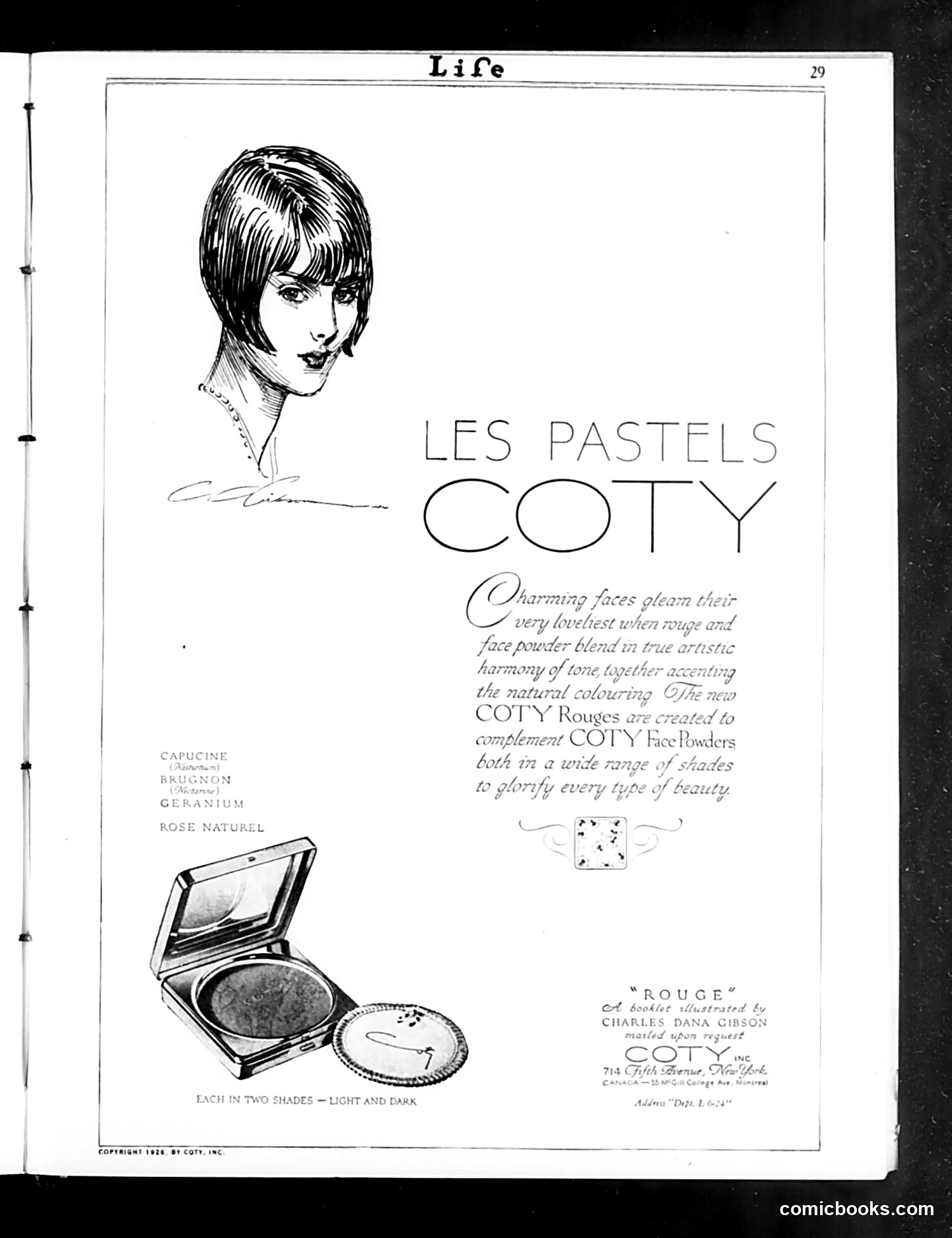
This is an advertisement page, not a political cartoon. It promotes "Les Pastels Coty," a cosmetics line by Coty, Inc. (located at 714 Fifth Avenue, New York). The ad features a stylized illustration of a young woman's face with 1920s styling—short bobbed hair and defined features—exemplifying the modern "flapper" aesthetic of that era. The copy emphasizes that Coty's rouge and face powder work together in "true artistic harmony" to complement natural coloring and enhance beauty across various skin tones. The product shown is a compact rouge case available in two shades (light and dark), including colors like "Capucine," "Brugnon," "Geranium," and "Rose Naturel." This represents typical 1920s cosmetics marketing targeting fashionable women.
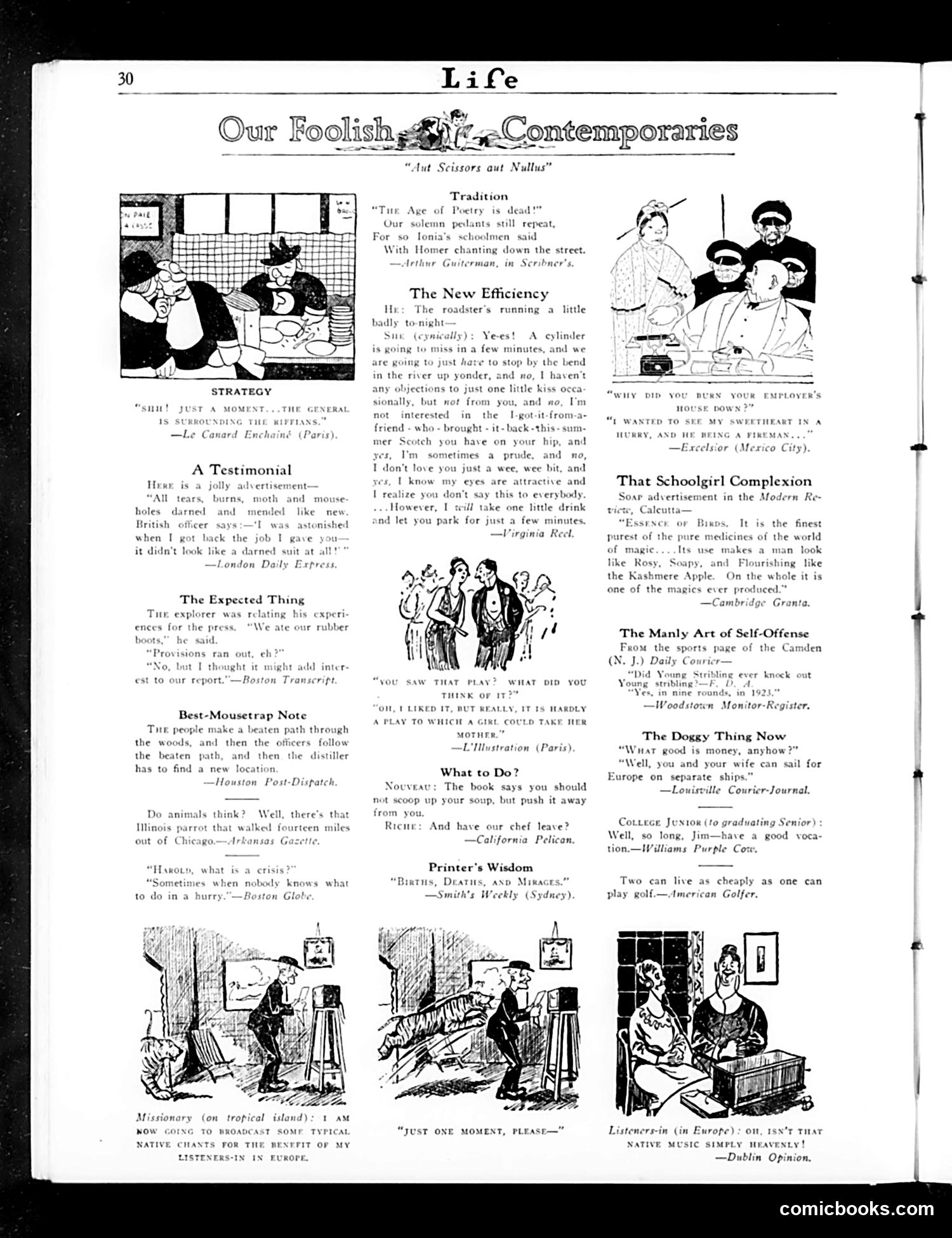
This is a humor collection mocking contemporary social trends and public statements. Key satirical pieces include: **"The New Efficiency"**: A young couple in a car; the man cynically predicts mechanical failure, using it as a pickup line. Satire targets men's calculated seduction tactics disguised as circumstance. **"That Schoolgirl Complexion"**: Mocks beauty product advertising claims that cosmetics possess almost magical transformative powers. **"The Manly Art of Self-Offense"**: A boxing headline joke—"Young Stribling" apparently knocked *out* (defeated) another fighter, inverting expected terminology for humor about sports reporting. **"Printer's Wisdom"**: A missionary broadcasting "native chants" to Europe via radio; Europeans find it heavenly. Satirizes both colonial attitudes toward indigenous cultures and the novelty of radio technology. The cartoons use exaggerated scenarios to mock pretension, false expertise, seduction tactics, advertising hype, and condescending attitudes toward non-Western peoples—typical early 20th-century Life magazine satirical targets.
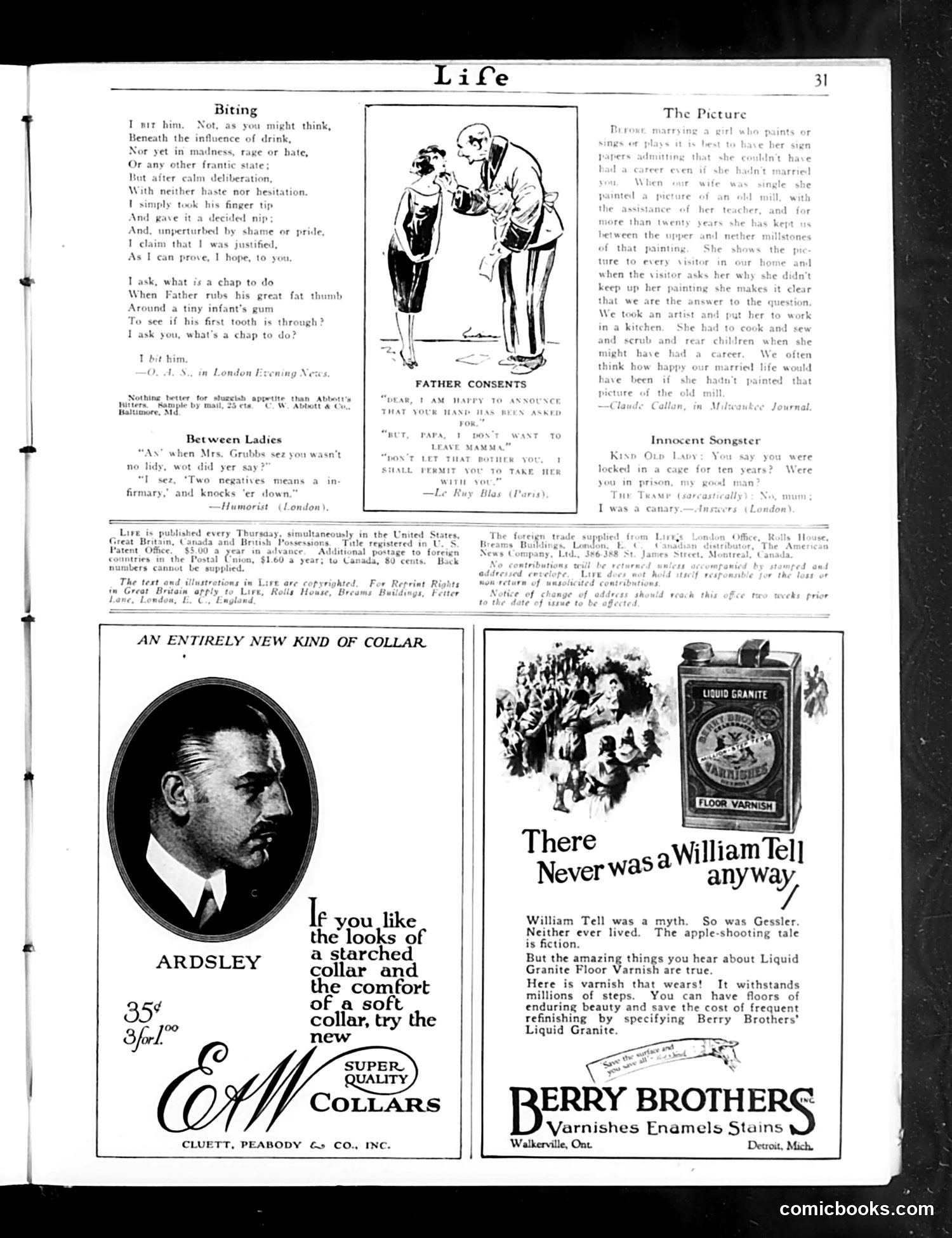
This page contains three distinct items: **Top Section - "Biting" and "The Picture":** Humorous anecdotes about domestic life. "Biting" describes a drunk man's behavior toward his wife—she bites his finger when he tries to check if he's truly intoxicated. "The Picture" jokes about a wife who paints to maintain the fiction that they're cultured and wealthy. **Advertisement - Ardsley Collars:** A standard product ad featuring a portrait of a well-dressed man, promoting starched collars that offer both formal appearance and comfort. **Advertisement - Liquid Granite Floor Varnish:** A more creative ad debunking the William Tell legend (the apple-shooting tale is "fiction"), then pivoting to claim that reports about Liquid Granite's durability are conversely "true." This uses historical myth-busting as a rhetorical device to sell floor varnish—if we can't trust old legends, trust this product's actual performance. The page is primarily advertising, typical of Life's mixed content format combining humor, commentary, and commercial messages.
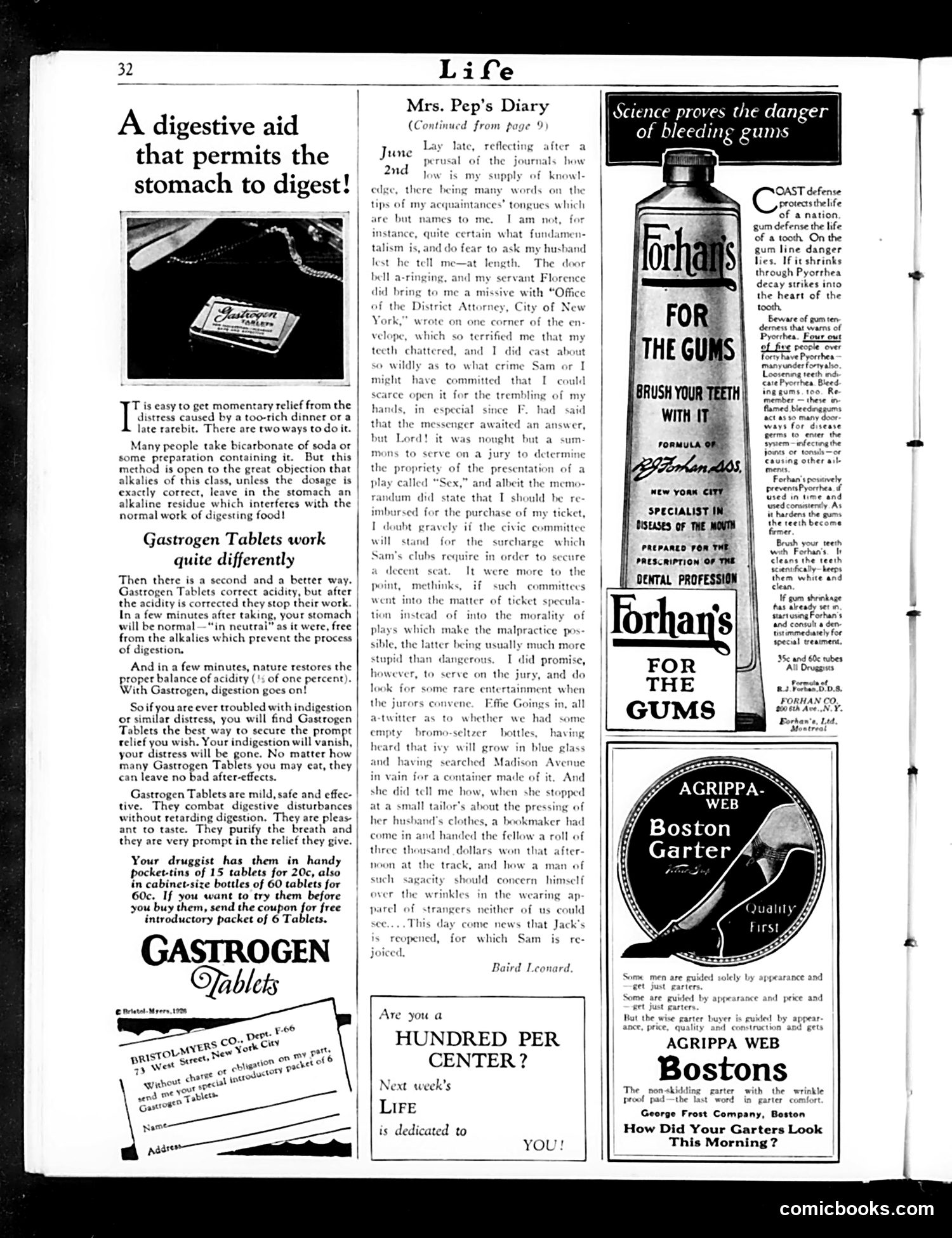
This page primarily contains **advertisements and a gossip column**, not political satire. **Mrs. Pep's Diary** (center) is a humorous society column where the narrator describes receiving a jury summons that terrified her, discussing trivial upper-class concerns: serving on a jury, theater ticket costs, and club surcharges. The satire is gentle—mocking wealthy people's anxiety over civic duty and their disconnect from real consequences (she notes committees should police ticket speculation rather than police morality in plays). **Advertisements** dominate: Gastrogen Tablets (digestive aid), Forhan's toothpaste, and Boston Garter socks. These are straightforward product pitches typical of 1920s *Life* magazine. The final reference—"Are you a HUNDRED PER CENTER?"—likely references the nativist/patriotic "100% American" movement of the post-WWI era, advertising next week's issue. No significant political cartoons or caricatures appear on this page.
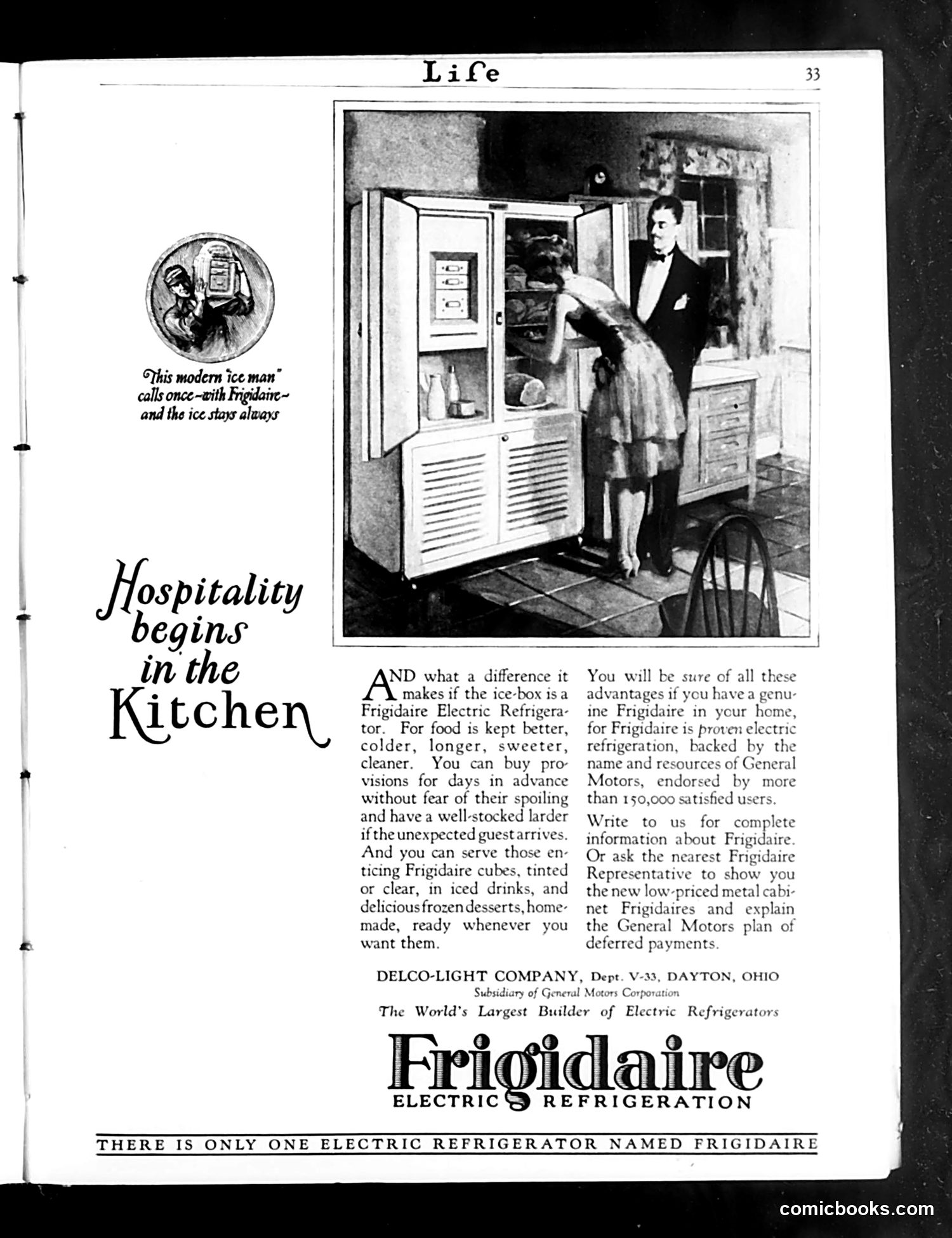
This is primarily a **product advertisement**, not political satire. The page promotes Frigidaire electric refrigerators by Delco-Light Company (General Motors subsidiary). The small circular cartoon at top left depicts the "modern ice man"—a reference to the obsolete profession of ice delivery. The joke: with Frigidaire's electric refrigeration, homeowners no longer need frequent ice deliveries ("calls once...and the ice stays always"), making traditional icemen unnecessary. The main photograph shows a well-dressed man and woman at an open Frigidaire unit, illustrating how the appliance enables hospitality: one can store provisions in advance and serve frozen desserts and cold drinks without depending on the iceman's schedule. The advertisement emphasizes reliability (backed by General Motors), affordability (deferred payment plans), and social prestige—presenting electric refrigeration as a marker of modern, hospitable living that replaces outdated ice-box culture.
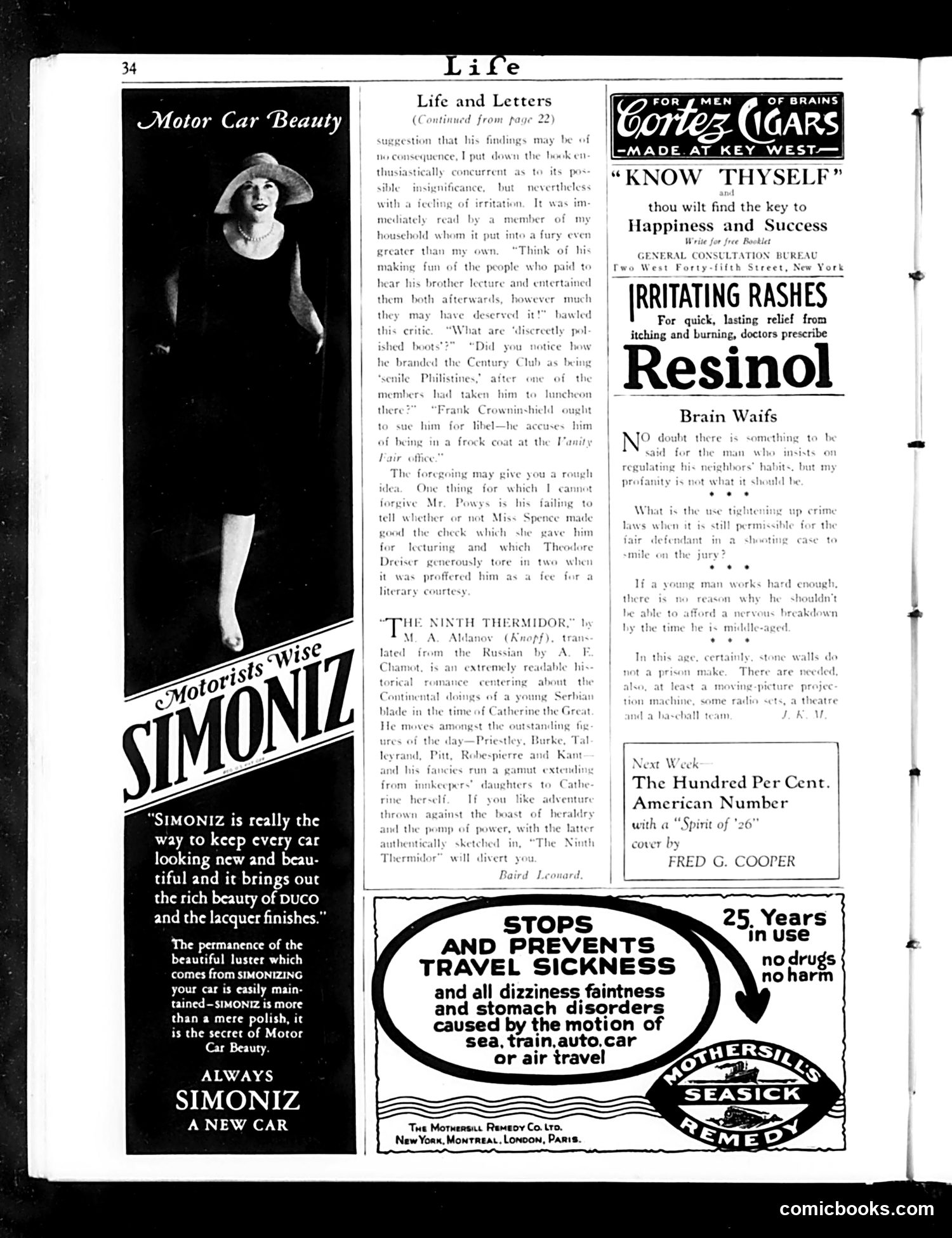
This page is primarily **advertising**, not political commentary. It contains: 1. **Simoniz car polish ad** (left): Features a glamorous woman in 1920s fashion, promoting automobile wax as essential for maintaining vehicle appearance and luster. 2. **Product advertisements** (right side): - Cortes Cigars ("Know Thyself") - Resinol for skin rashes - Mothersill's Seasick Remedy (25 years in use, "no drugs, no harm") 3. **Literary content** (center): A book review discussing "The Ninth Thermidor" by M.A. Aldanov, a Russian historical novel about Catherine the Great's era. 4. **Upcoming content notice**: References next week's "Hundred Per Cent. American Number" with Fred G. Cooper cover art. The page reflects 1920s consumer culture—emphasizing modern conveniences (car care), personal grooming, and travel remedies. There is **no apparent political satire or social commentary** on this particular page; it's a standard mix of editorial content and period advertising.
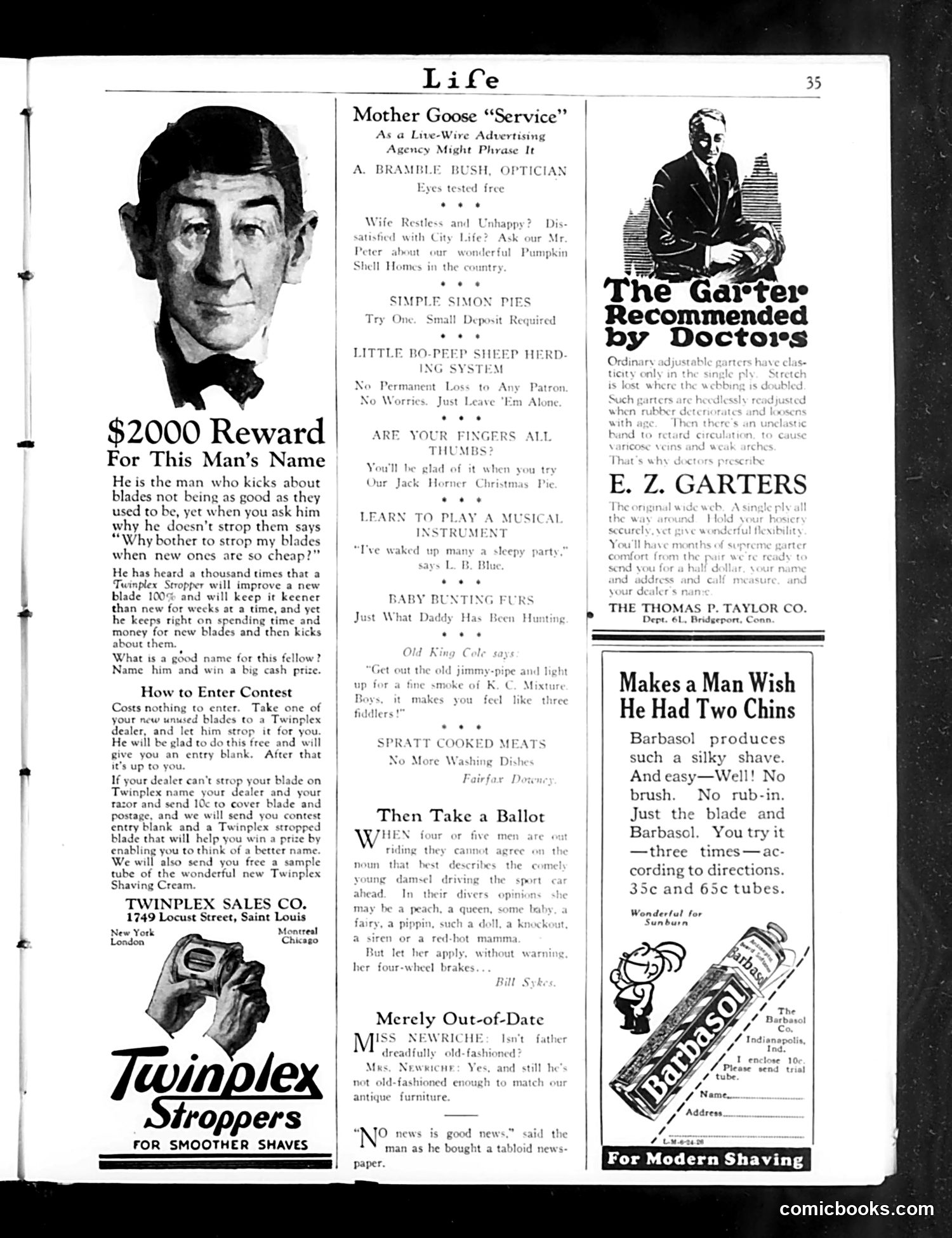
This is primarily an **advertising page** from Life magazine, circa early 20th century, with one notable satirical element. The main content features a **Twinplex razor stropper contest**: a $2,000 reward for naming a hypocritical man who complains that razor blades aren't as good as they used to be, yet refuses to strop (sharpen) them because new blades are cheap. The satire targets consumer laziness and false economy—spending more money overall while avoiding the small effort of proper blade maintenance. The page is otherwise dominated by period advertisements, including: - Mother Goose–themed product pitches (optician, pie company, sheep herding system) - A "Then Take a Ballot" piece about disagreement among drivers - A brief "Merely Out-of-Date" comic exchange about old-fashioned furniture - Shaving product ads (Barbasol, E.Z. Garters) The Twinplex contest represents typical Life magazine humor: mocking everyday human contradictions and consumer behavior through gentle satire.
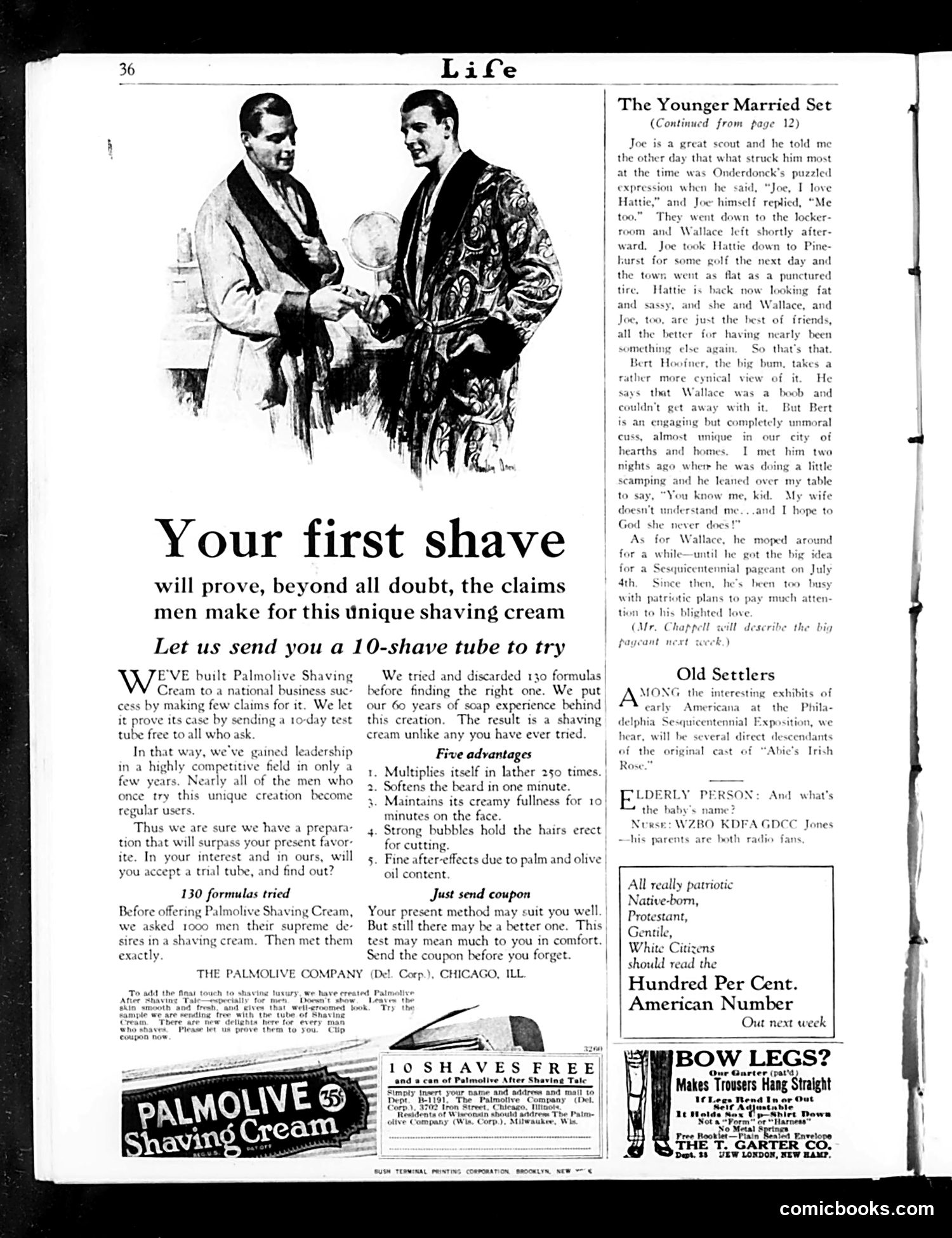
This page is primarily **advertising**, not political satire. The dominant content is a Palmolive Shaving Cream advertisement occupying roughly two-thirds of the space. The ad features two men in business attire examining a product, with copy emphasizing the cream's superiority through testing (130 formulas tried, 60 years of soap experience). The right column contains a serialized story titled "The Younger Married Set" discussing romantic entanglements among young married people—typical Life magazine social commentary of the era. Below that is a brief satirical piece called "Old Settlers" making light of patriotic American genealogy during what appears to be a Sesquicentennial celebration. The page concludes with minor classified-style advertisements for leg garters and other products. **No significant political cartoons or caricatures appear on this page.** It represents typical 1920s-era Life magazine content: humor, lifestyle features, and period advertising.
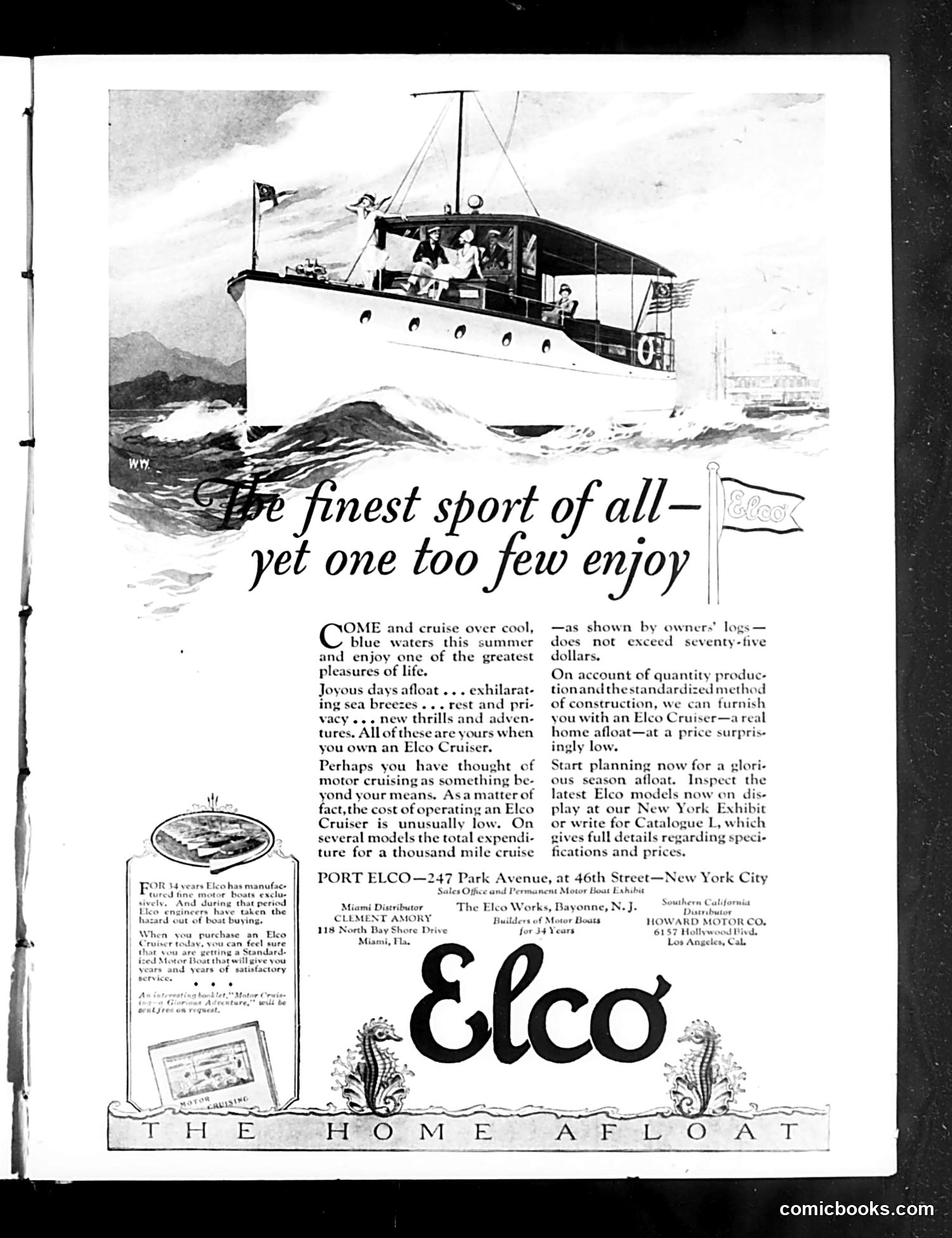
This is primarily **advertising copy**, not political satire. It's a full-page advertisement for Elco Cruisers (motor boats) from the 1920s era. The page features an illustrated luxury motorboat with passengers aboard, sailing through choppy waters. The headline "The finest sport of all—yet one too few enjoy" frames boat ownership as aspirational but attainable. The advertisement's central pitch addresses a key barrier to purchase: **cost**. It emphasizes that operating an Elco Cruiser is "unusually low"—a thousand-mile cruise costs only seventy-five dollars. This appeals to middle-class readers by making luxury seem accessible through mass production and "standardized method of construction." The social context: This reflects 1920s prosperity and the democratization of leisure goods. Boat ownership isn't presented as exclusively wealthy; it's marketed to ordinary people who might afford it. Contact information and distributors (Miami, New York, New Jersey, California) suggest national reach. No political figures or satire are present—this is straightforward consumer marketing.
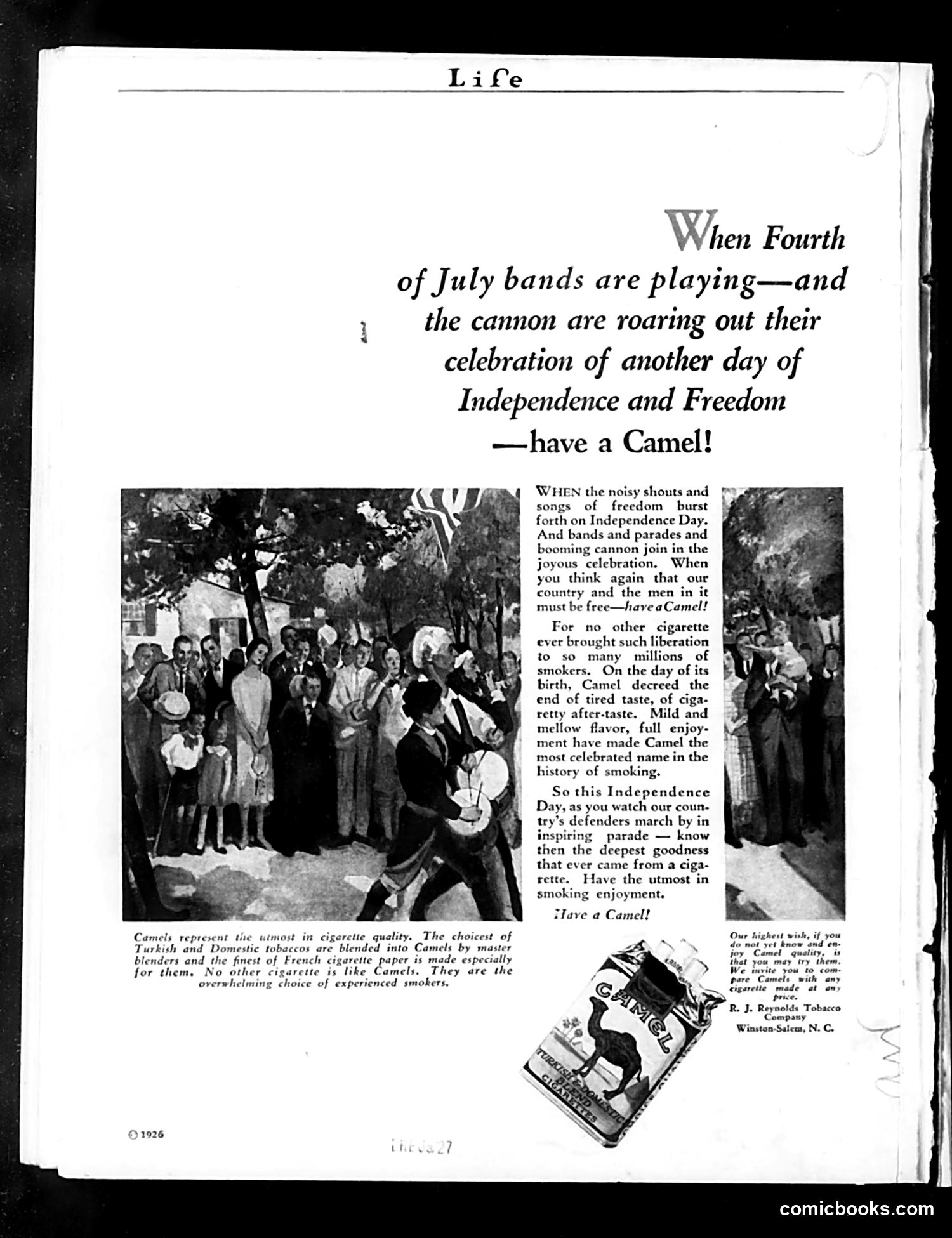
This is a **commercial advertisement**, not political satire. The R.J. Reynolds Tobacco Company uses Fourth of July patriotism to market Camel cigarettes. The ad conflates smoking with American freedom and national pride. When bands play and cannons boom on Independence Day, the copy urges readers to "have a Camel"—equating cigarette enjoyment with patriotic duty. The text claims Camel "brought liberation to so many millions of smokers," deliberately mirroring Revolutionary War language. Two photographs show crowds celebrating Independence Day, establishing patriotic atmosphere. The product image displays the distinctive Camel pack. **Why this matters today:** This represents pre-regulation tobacco advertising that explicitly weaponized patriotism to sell cigarettes. Modern readers may be shocked by the brazen association between national freedom and smoking, or that such advertising was legal and appeared in mainstream magazines. This reflects 1920s attitudes toward tobacco's acceptability and advertising practices now prohibited.

I'm unable to provide a reliable analysis of this page. The image is extremely dark and low contrast, making it nearly impossible to discern specific cartoon illustrations, text, or details clearly. While I can see there appears to be some kind of patterned or decorative elements in the center and a white margin on the left side, I cannot identify figures, read captions, or determine the satirical content with confidence. To properly analyze this Life magazine page as a political cartoon historian would require a higher quality or higher contrast version of the image where the actual artwork and text are legible.