
Life, 1926-06-24 · page 28 of 41
Life — June 24, 1926 — page 28: what you’re looking at
What you’re looking at
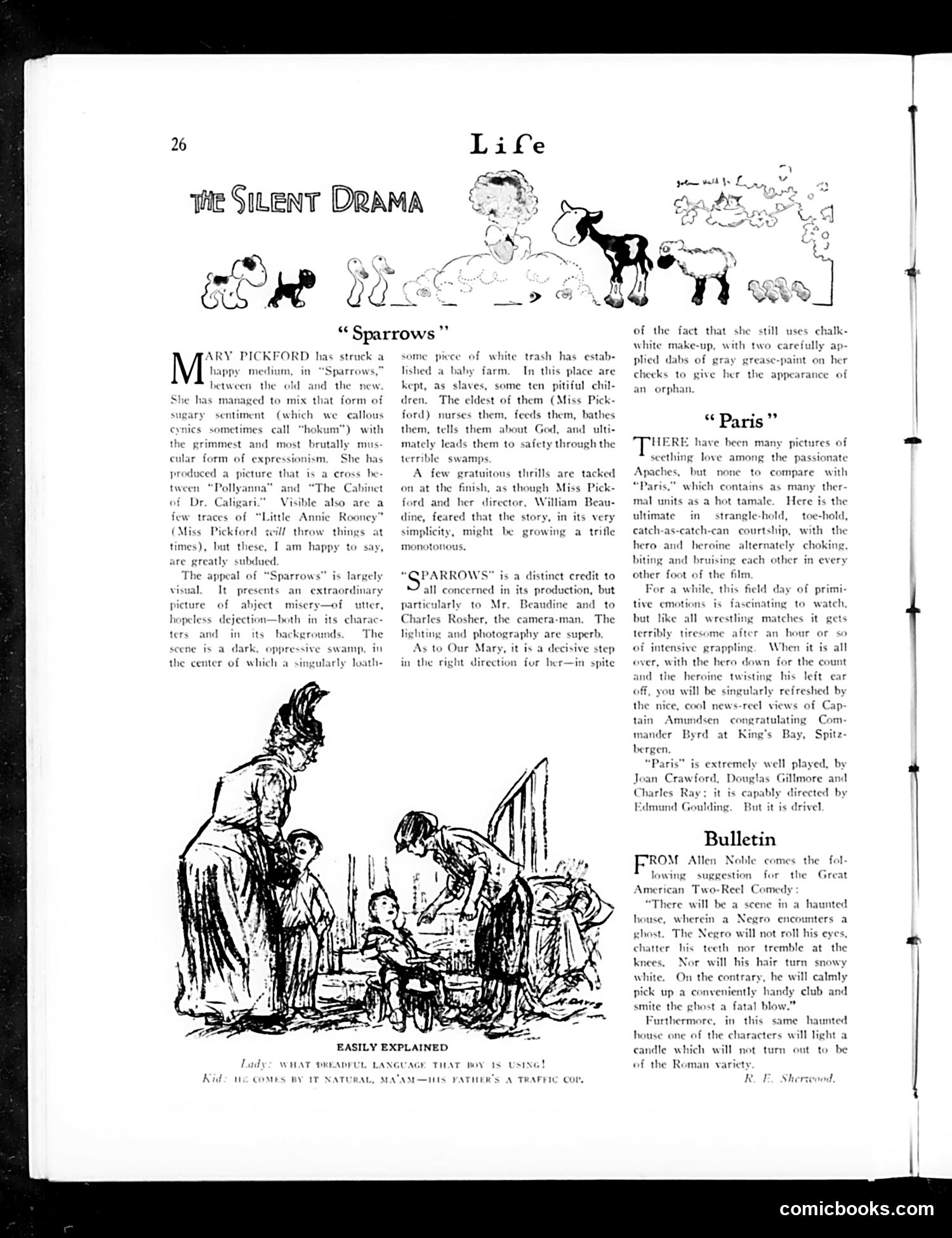
This page reviews three silent films from the 1920s era. The main content discusses Mary Pickford's "Sparrows," a drama about orphans in a baby farm, praising her blend of emotional realism with expressionist techniques. The reviewer notes the film avoids excessive sentimentality while delivering genuine pathos. The "Paris" review criticizes a Joan Crawford romantic film as melodramatic "drivel," describing its passionate but exhausting combat-like courtship scenes with exaggerated physical comedy. The cartoon "Easily Explained" at bottom depicts a woman scolding a boy for foul language; the caption's joke relies on period-typical class humor—the boy learned profanity from his father, a traffic cop, suggesting working-class men were naturally crude speakers. The "Bulletin" section presents Allen Noble's satirical suggestion for comedic scenes depicting African Americans without racial stereotypes—avoiding exaggerated eye-rolling or fear responses—which ironically underscores how prevalent such caricatures were in contemporary films.
📄 Transcribed text from this page (OCR, searchable)
Machine-transcribed from the original scan — historical spelling and the odd misread are preserved.
whe Sitenr DRAMA i je? be ee “ Sparrows” of the fact that she still uses ¢ . 7 ; white make-up, with two caref ARY PICKFORD has struck a some picce of white trash has est plied dabs of gray grease-paint on her happy medium, in “Sparrows,” lished a baby farm. In this place are cheeks to give her the appearance of between the old and the new. — kept, as slaves, some ten pitiful chil- d to mix that form of dren. The eldest of them (Miss Pick- ment (which we callous ford) nurses them, feeds them, bathes ‘ +99 cynics sometimes call “hokum") with — them, tells them about God, and. ulti- Paris the grimmest most brutally mus- mately leads them to safety through the HERE have been many pictures of > cular form of expressionism, She has terrible swamps seething love among the passionate produced a picture that is a cross be A few gratuitous thrills are tacked Apaches, but none to compare with tween * and “The Cabinet on at the finish, as though Miss Pick- “Paris,” which contains as many ther of Dr Visible also are a ford and her director, William Beau- mal units as a hot tamale. Here is the few traces of “Little Annie Rooney” dine, feared that the s (Miss Pickford ill throw things at times), but these, I am happy to say, in its very ultimate in strangle-hold, toe-hold, be growing a trifle catch-as-catch-can courtship, with the hero and heroine alternately chokin bitin 1 bruising each other in ev largely “QPARROWS" is a distinct credit to other foot of the film. field day of primi- are greatly sub T al. It picture of abject’ misery—of utter, particularly to Mr. Beaud h ents an extraordinary all concerned in its production, but For a while, this and to — tive emotions is inating to watch, Jess dejection—both in its charac- Charles Rosher, the camera-man, The — but like all wrestling matches it gets and in its backgrounds. The — lighting and photography are superb. terribly. tire after an hour or so scene is a dark, oppressive swamp. in As to Our Mary, it is a decisive step of intensive grappling. When it is all the center of which a larly loath- in the right direction fur her—in spite ever, with the hero down for the count | and the heroine twisting his left: ear off, you will be singularly refreshed by | the nice, cool news-reel views of Cap: t Amun: atulating Com mander Byrd at King’s Bay, Spitz- nm cong bergen. “Paris” is extremely well played, by + Joan Crawford, Douglas Gillmore Charles Ray; it is capably directed. by Edmund Goulding. But it is drivel. Bulletin FFROM Allen Noble comes. the fot wing suggestion for the Great American Two-Reel Comedy “There will be a cene in a haunted . Wherein a Negro encounters a The Negro will not roll his eyes, er his teeth nor tremble at the knees. Nor will white. On the contrary, he will calmly weniently handy club and his hair turn snowy kupac smite the ghost a fatal bh Fi ermore, in this same haunted house one of the characters will light a EASILY EXPLAINED candle wh Lady: WHAT DREADFUL LANGUAGE THAT BoY Is USING! of the Roman variety h will not tur ont to be COMES BY IT NATURAL, MATAM—IUIS FATIFER’S A TRAFFIC Cor, R. EF. Sherwood. comicbooks.com