
A complete issue · 52 pages · 1926
Life — May 6, 1926
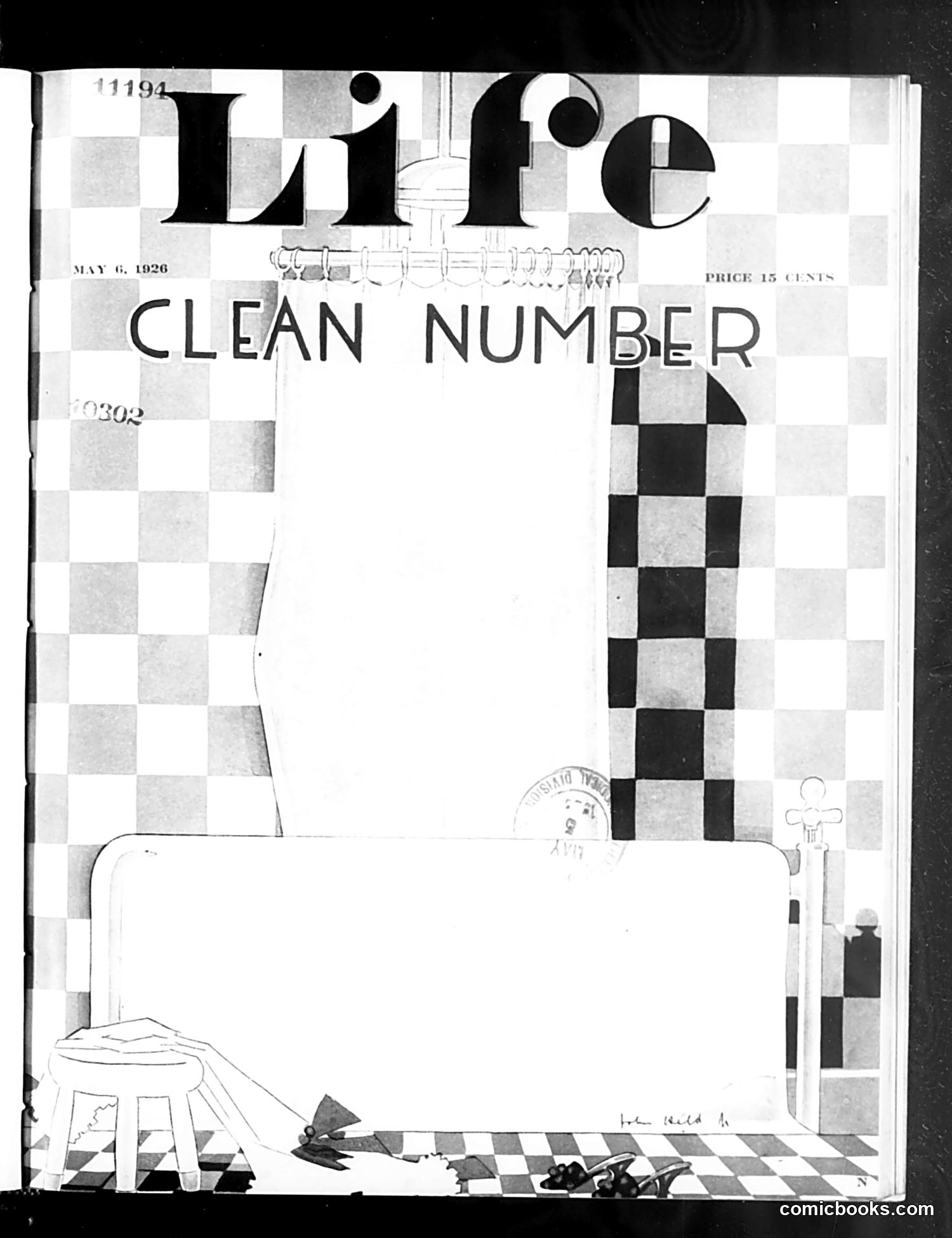
**May 6, 1926 | Price 15 cents** This is the cover of *Life* magazine's "Clean Number" issue. The design features a stark black-and-white checkerboard pattern with bathroom fixtures—a toilet and what appears to be cleaning supplies—arranged as visual elements. The checkerboard motif continues down the right side of the page. The satire appears to target cleanliness or sanitation concerns of the 1920s era. The "Clean Number" designation suggests the issue focused on hygiene, domestic sanitation, or possibly social/moral "cleanliness" as a topical subject. The deliberate, geometric Art Deco-style design emphasizes order and cleanliness through its pristine checkerboard pattern, reinforcing the theme visually.
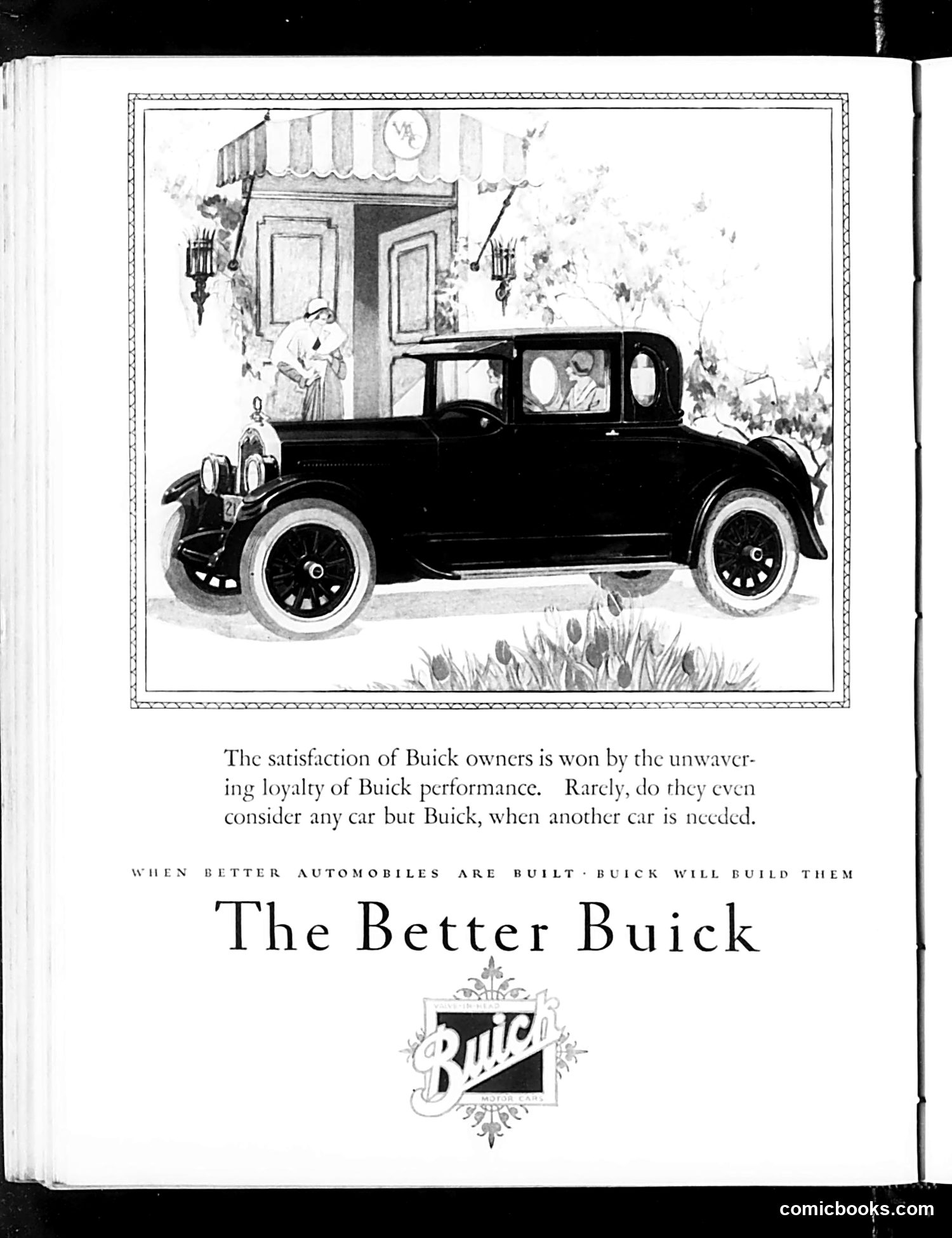
This is **not satire or political commentary**—it's a straightforward advertisement for Buick automobiles, likely from the 1920s based on the vehicle's design. The image shows a well-dressed couple in a Buick sedan parked outside an elegant storefront. The ad's message is aspirational: Buick owners supposedly enjoy such unwavering loyalty to the brand that they rarely consider competitors. The tagline "When Better Automobiles Are Built, Buick Will Build Them" emphasizes quality and prestige. The refined setting—upscale shopping district, fashionable clothing—targets affluent consumers. This represents typical vintage automotive advertising that associated car ownership with sophistication and social status rather than transportation practicality.
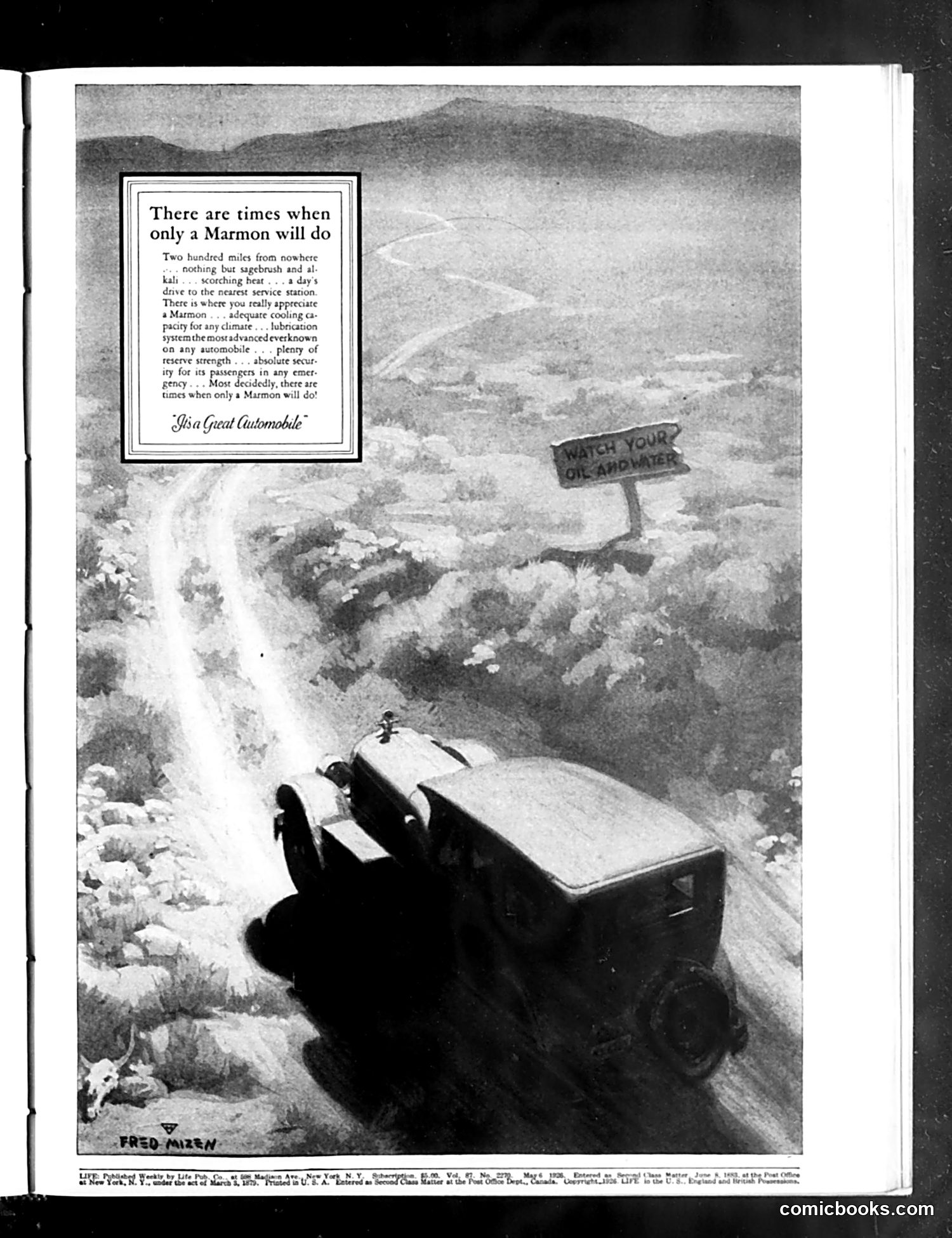
This page is primarily a **Marmon automobile advertisement**, not political satire. The ad headline reads "There are times when only a Marmon will do," emphasizing the vehicle's reliability in extreme conditions. The accompanying illustration shows a Marmon navigating a treacherous desert mountain road past a "Watch Your Oil and Water" warning sign. The ad's text highlights specific advantages: the car's superior cooling system, lubrication technology, and ability to handle harsh terrain—qualities essential for remote travel where repair stations don't exist. This represents typical early-20th-century automotive marketing: emphasizing durability and technical superiority through dramatic imagery of challenging environments. The credited photographer is Fred Mizen.
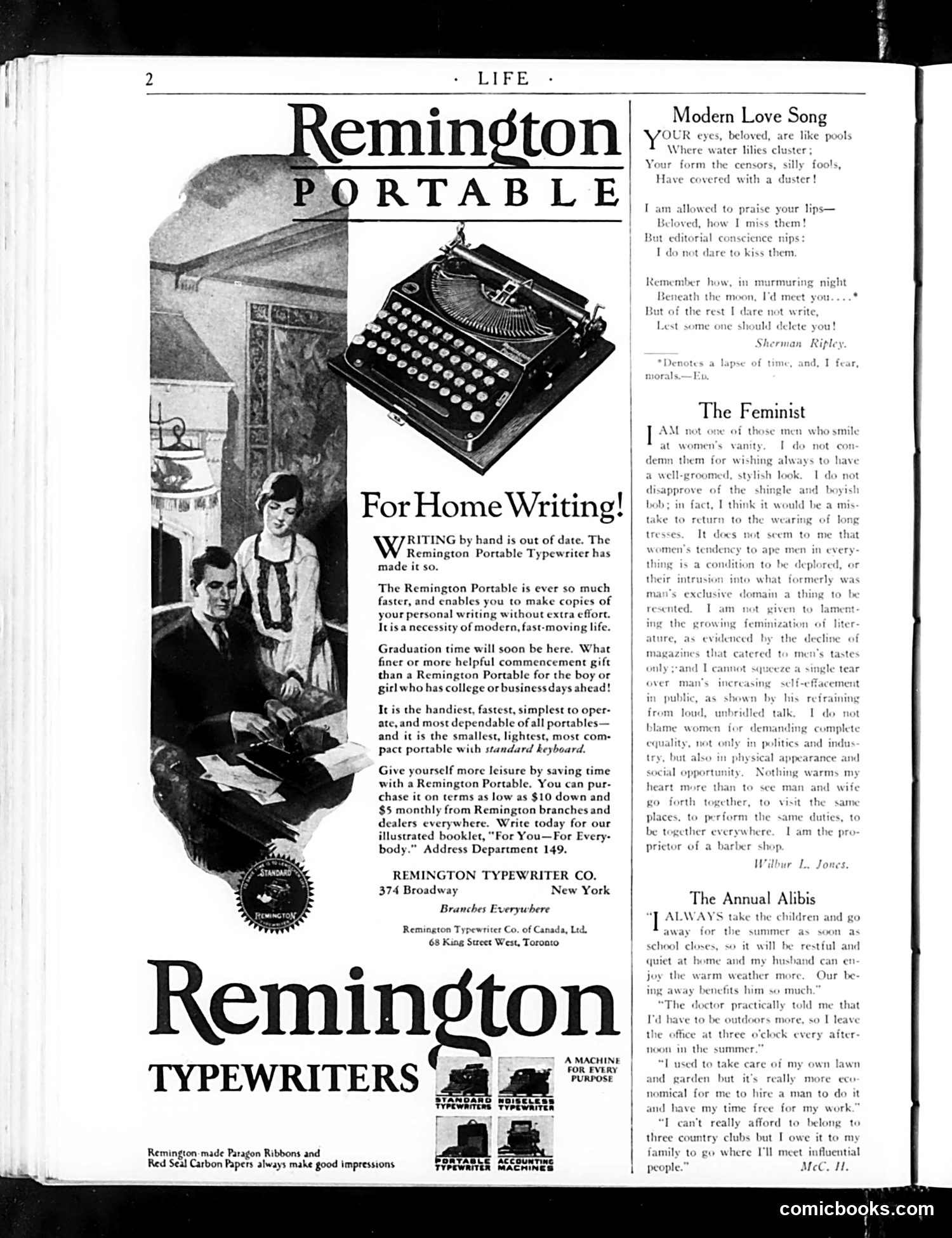
This page is **primarily advertising** for Remington Portable Typewriters, not political satire. The top advertisement shows a typewriter positioned as ideal "For Home Writing," targeting both general consumers and graduation gift-givers. The accompanying illustration depicts a woman using the typewriter while a man observes—reflecting early 20th-century marketing that positioned typewriters as labor-saving devices for domestic use. The right column contains three short literary pieces: "Modern Love Song," "The Feminist" (a satirical essay), and "The Annual Alibis." These are brief opinion/humor pieces typical of *Life* magazine's content, not political cartoons. "The Feminist" piece gently mocks feminist literature's declining readership among men—social commentary rather than hard satire. The page reflects 1920s attitudes toward women, technology, and changing social roles.
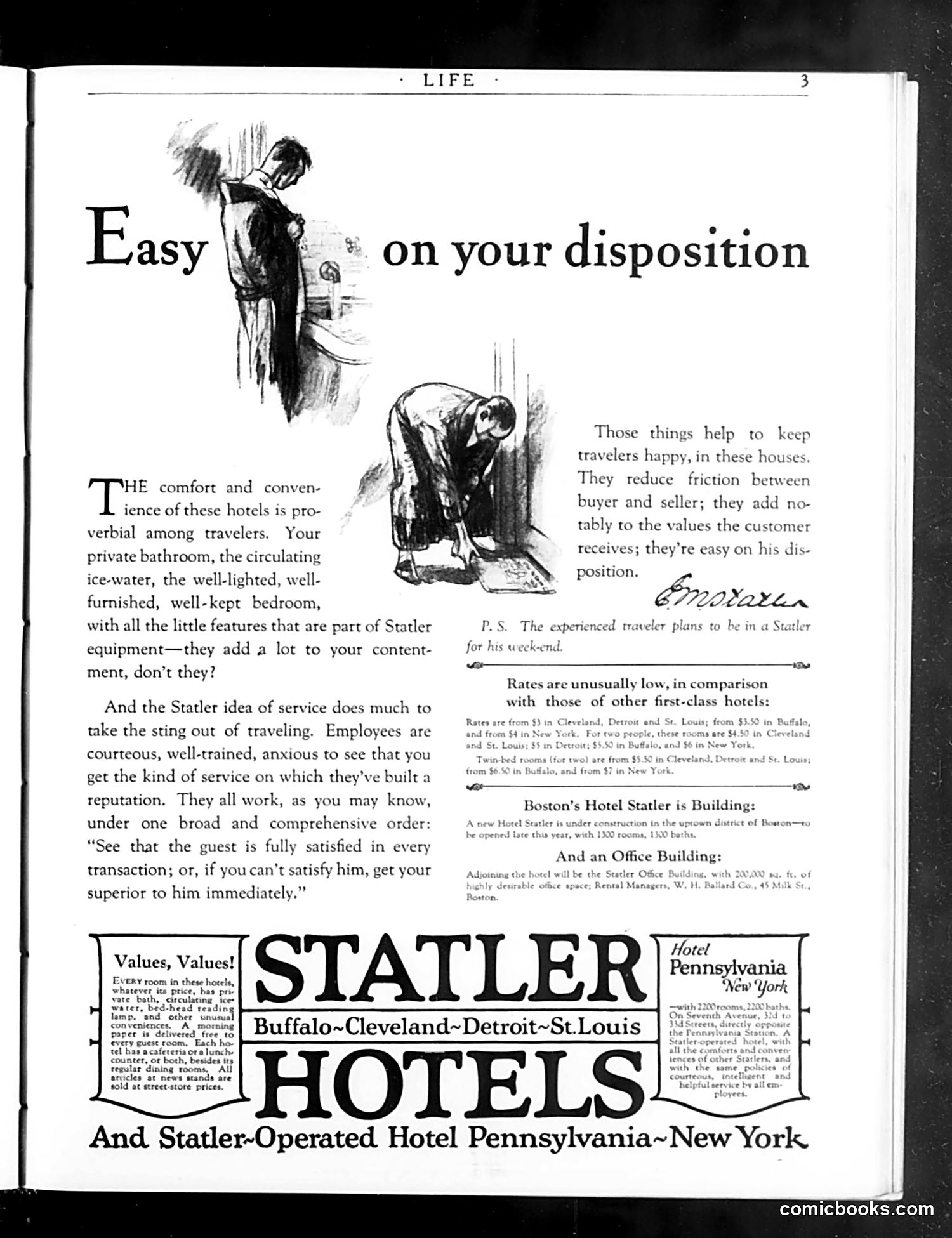
This page is primarily **advertising**, not satire or political commentary. It's a Statler Hotels advertisement from *Life* magazine promoting their chain's customer service philosophy. The two sketched figures illustrate hotel service: one shows a bellhop or porter assisting a guest, the other depicts a maid or housekeeper working. These images support the text's claim that Statler Hotels emphasize employee training and guest satisfaction—their staff motto being "See that the guest is fully satisfied in every transaction." The advertisement highlights competitive pricing, modern amenities (private bathrooms, ice water), and new construction in Boston and New York. The signature "Gnoodzlen" appears to be the artist's mark. This represents straightforward early-20th-century hotel marketing rather than satirical content.
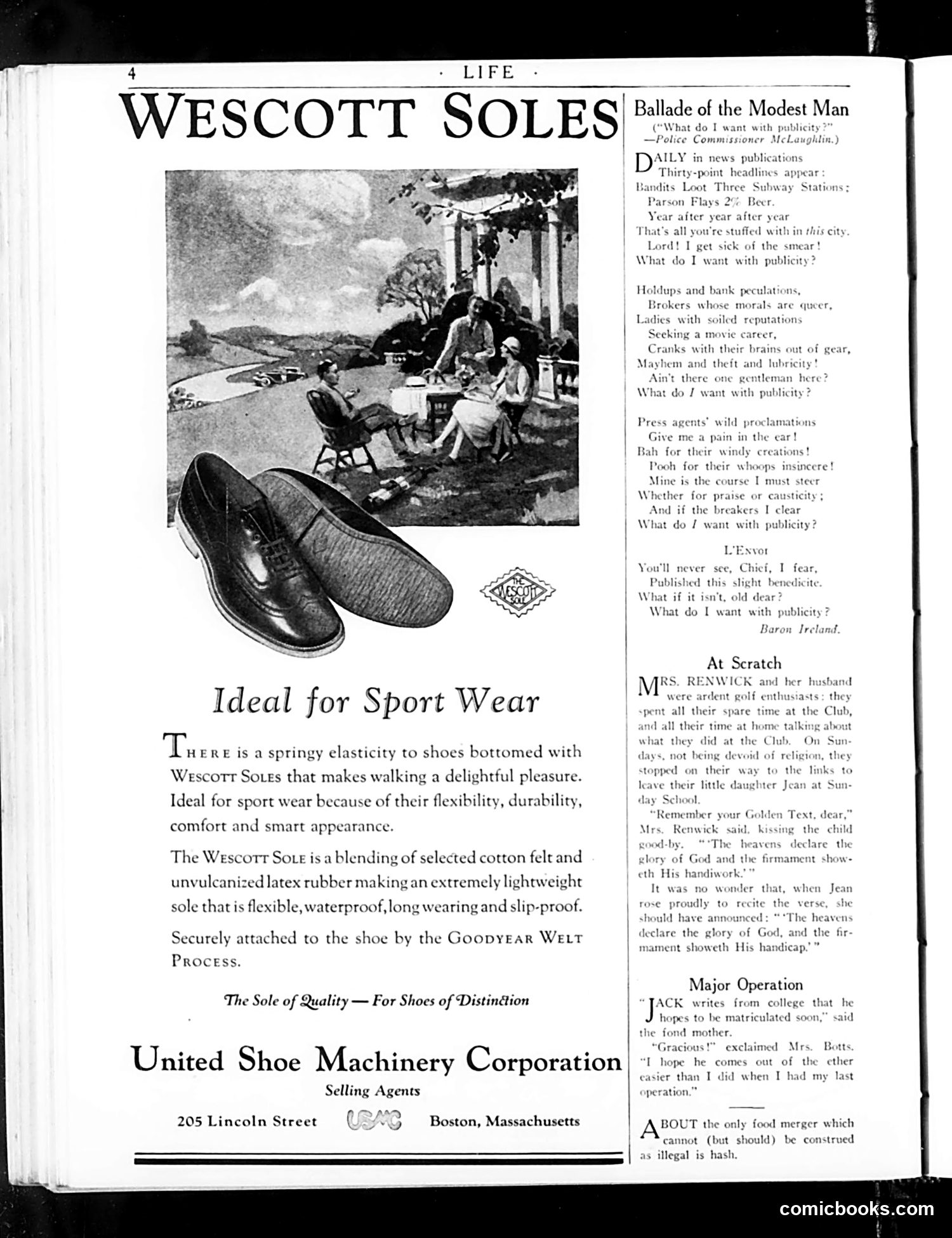
This page is primarily **advertising** for Wescott Soles shoes, occupying the left two-thirds. The main image shows a leisurely scene of people relaxing on a veranda, promoting the product as "Ideal for Sport Wear." The ad emphasizes the shoe's flexibility, durability, and waterproof qualities. The right column contains three separate short pieces: "Ballad of the Modest Man" (a poem satirizing newspaper sensationalism and press agents), "At Scratch" (a brief domestic anecdote about golf enthusiasts), and "Major Operation" (a humorous note about food mergers). These are filler content typical of Life magazine—light social satire and humor rather than political commentary. They mock middle-class vanities and contemporary social foibles without referencing specific events or public figures.
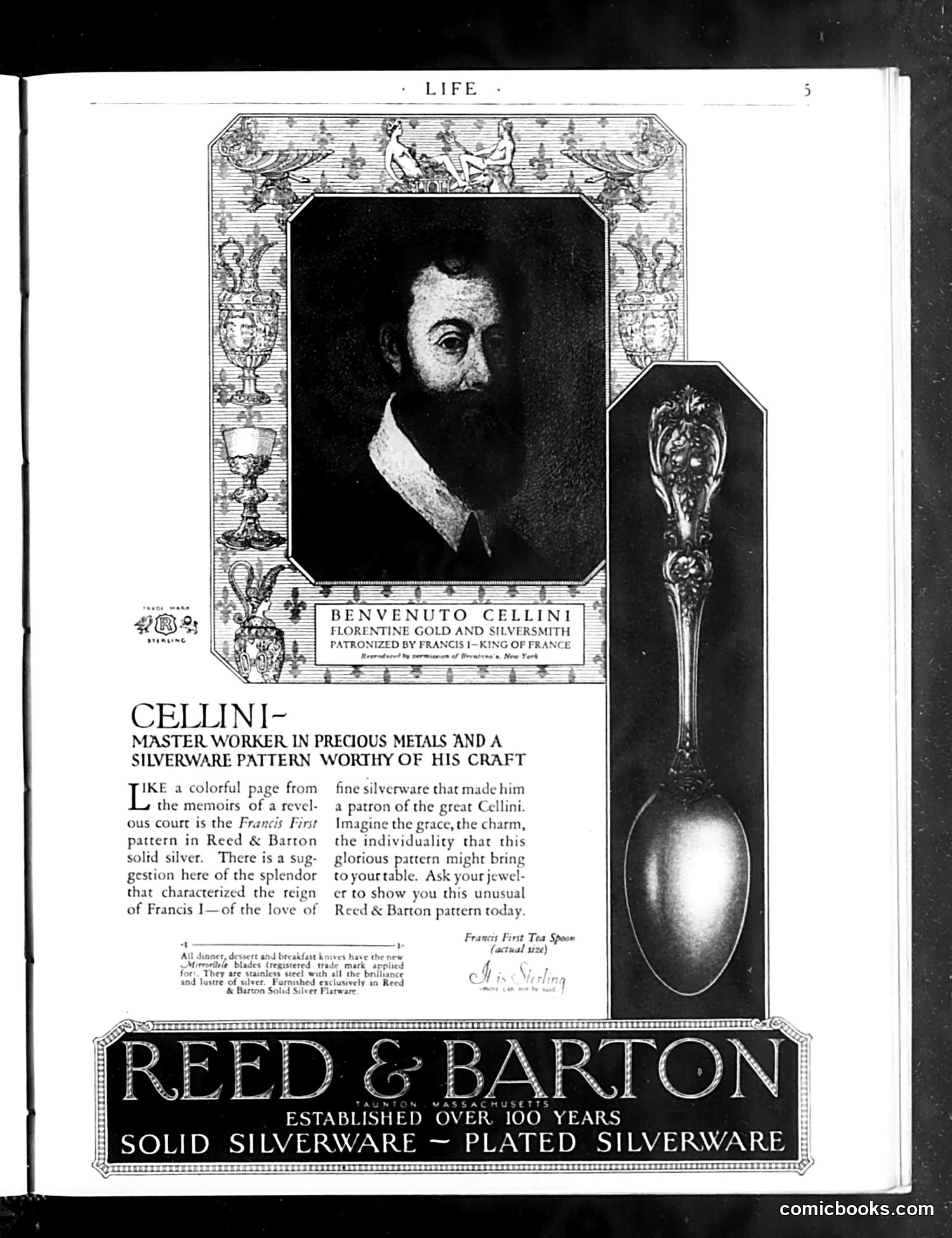
This is an **advertisement, not a cartoon or satire**. The page features a portrait of Benvenuto Cellini, the Renaissance Florentine goldsmith and silversmith (1500-1571), identified in the caption as patronized by Francis I of France. The ad promotes Reed & Barton silverware, a Massachusetts company established over 100 years prior to this publication. The text draws a parallel between Cellini's reputation for fine metalwork and Reed & Barton's silverware quality, suggesting their products are worthy successors to that craft tradition. The image of a decorative tea spoon (labeled "Francis First Tea Spoon") serves as the product display. This is purely aspirational marketing—connecting a commercial silverware brand to historical prestige and artisanal excellence.
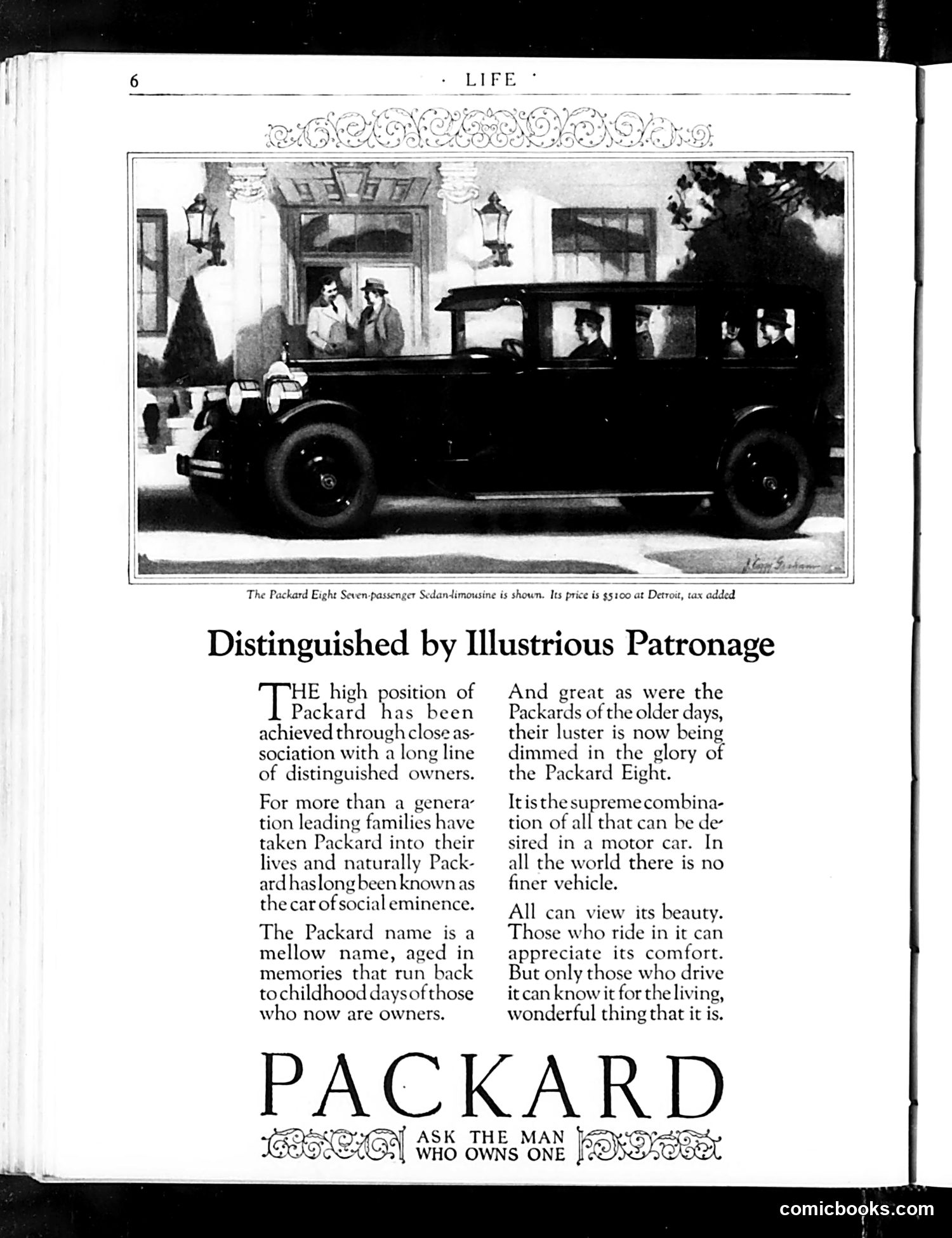
This is a **Packard automobile advertisement**, not a political cartoon. The page shows a luxury sedan and promotes Packard cars as vehicles of "social eminence" associated with "distinguished owners" and "leading families." The ad's appeal is explicitly about **class status**: it argues that Packard's reputation stems from long association with wealthy, prominent people. The text claims the car represents "the supreme combination of all that can be desired in a motor car" and emphasizes that only those who *drive* it (not merely ride in it) can truly understand its quality. This reflects early 20th-century advertising strategy: selling luxury goods by connecting them to social prestige and established wealth rather than mechanical features. The tagline "Ask the Man Who Owns One" invokes peer testimony from the privileged class.
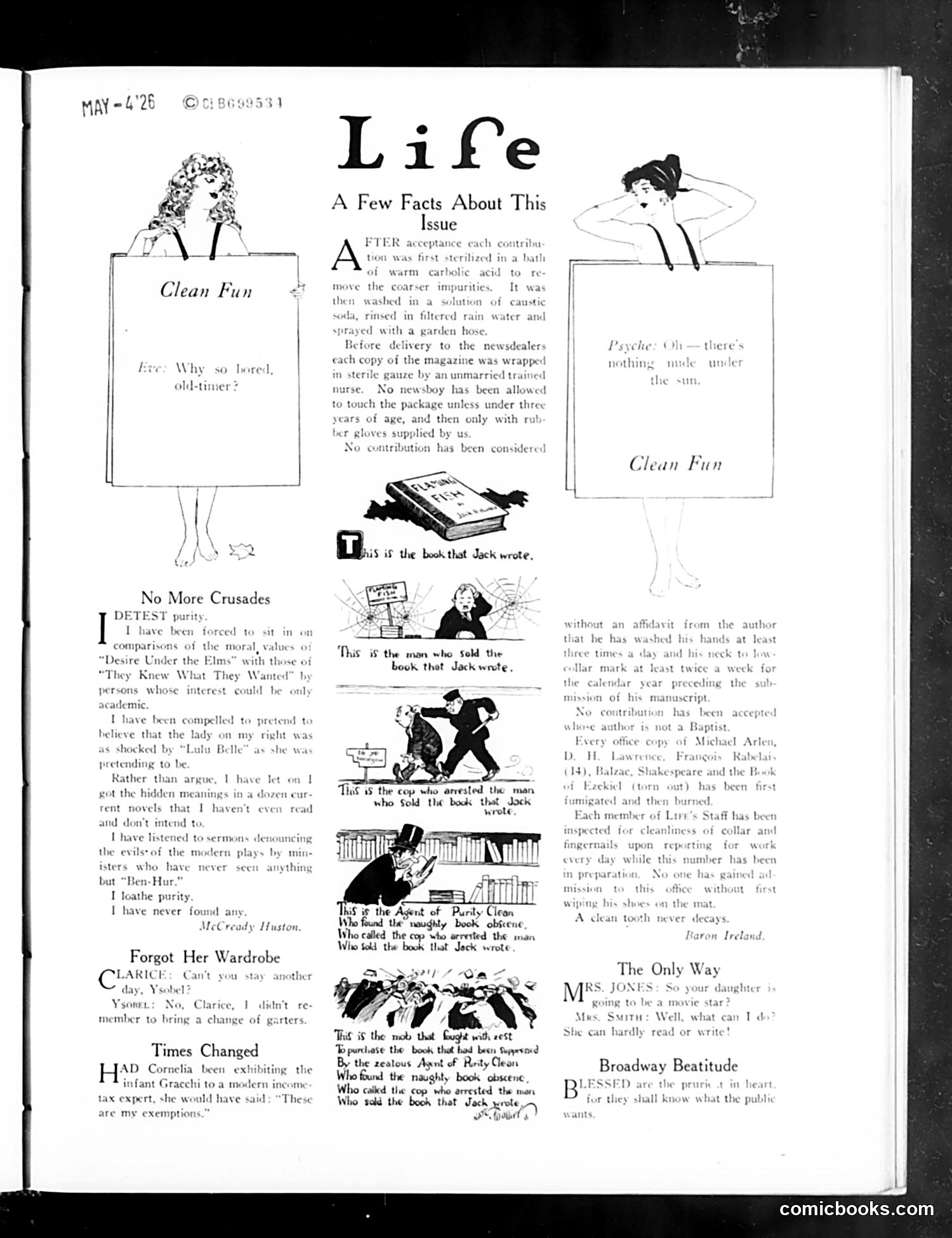
This page contains multiple humorous vignettes satirizing 1920s social conventions and publishing practices: **"Clean Fun"** features flapper-era characters joking about boredom and hidden meanings in literature. **"No More Crusades"** appears to mock purity campaigns and moral crusading, with a character named McCready Huston complaining about forced attendance at comparative moral-values discussions. **Central cartoon sequence** satirizes publication protocols, showing a chain of custody joke: "This is the book that Jack wrote," passed through various gatekeepers (the man who told about it, the cop who arrested him, the agent of Purity Crusades, etc.)—suggesting bureaucratic absurdity around content control. **"Forgot Her Wardrobe"** and other brief items continue light social satire typical of Life's humor department. The page emphasizes Jazz Age anxieties about morality, censorship, and social propriety.
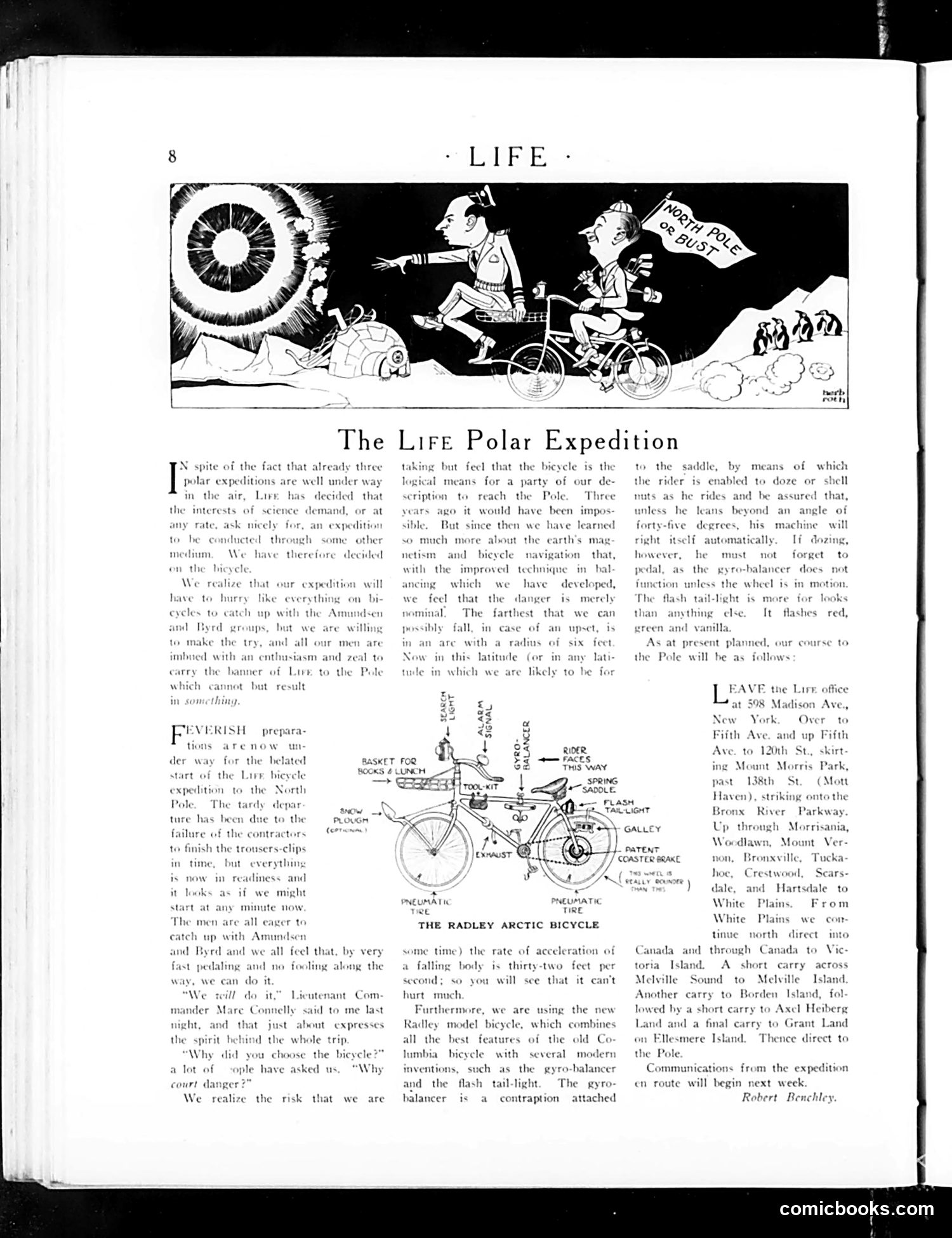
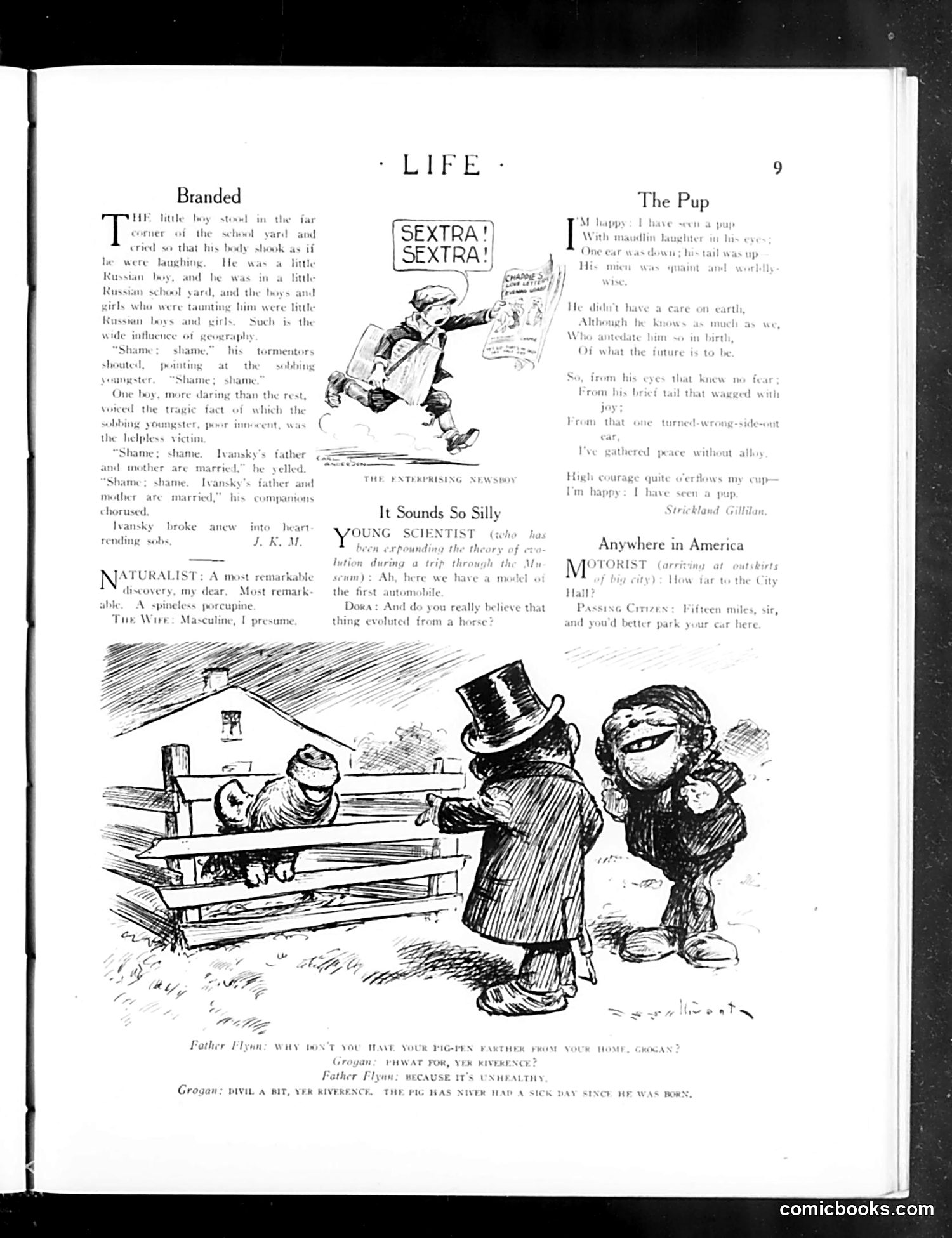
This page contains three separate humorous pieces typical of early-20th-century satirical magazines: 1. **"Branded"** - A text anecdote mocking a schoolboy's shameful moment when his father is caught using a Russian school's geographic influence to avoid social embarrassment. 2. **"The Pup"** - A sentimental poem celebrating a fearless puppy's innocent joy and optimism, contrasting with human anxieties. 3. **"It Sounds So Silly"** - A joke where a young scientist proposes evolution theory (that things evolved from horses), prompting a wife's skeptical response. 4. **"Anywhere in America"** - A motorist joke about parking in large cities. 5. **Bottom cartoon** - A Father Flynn dialogue about keeping pigs at home, debating hygiene versus food practicality—typical rural/urban class humor of the era. These represent genteel satirical humor targeting educated middle-class readers.
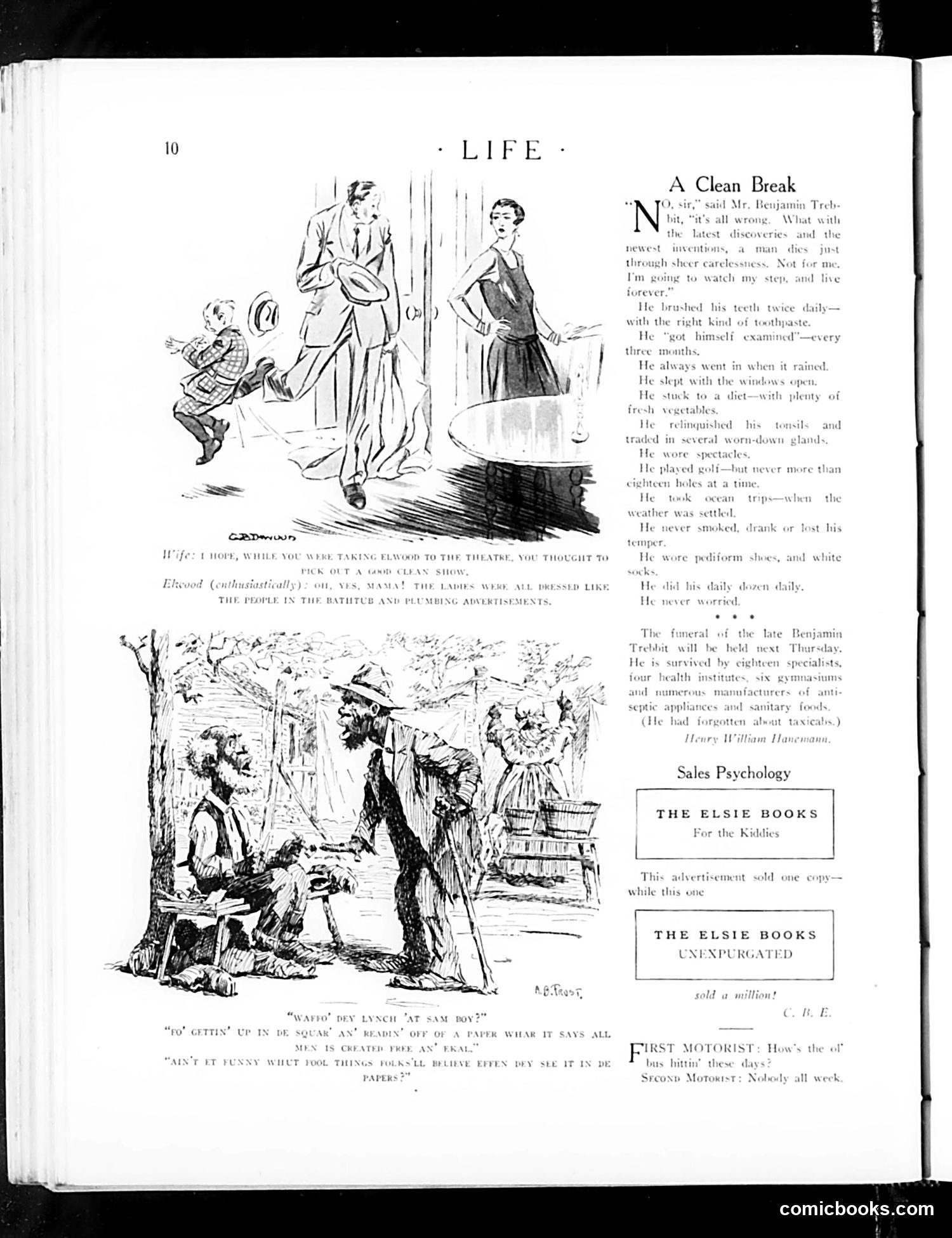
This page features a satirical article about Mr. Benjamin Trebbit, a man who has decided to reform his life through obsessive health practices: brushing teeth twice daily, regular medical exams, fresh vegetables, open windows, spectacles, moderate golf (eighteen holes maximum), ocean trips in good weather, avoiding smoking and alcohol, wearing proper shoes and white socks, and daily dozen exercises. The two cartoons illustrate the absurdity of this hyper-vigilant lifestyle. The top cartoon shows him startling his family with this sudden transformation. The bottom cartoon depicts a market scene, likely satirizing how his rigid adherence to health rules makes him an odd figure in everyday society. The satire mocks the era's emerging "health fad" culture and obsessive self-improvement movements.
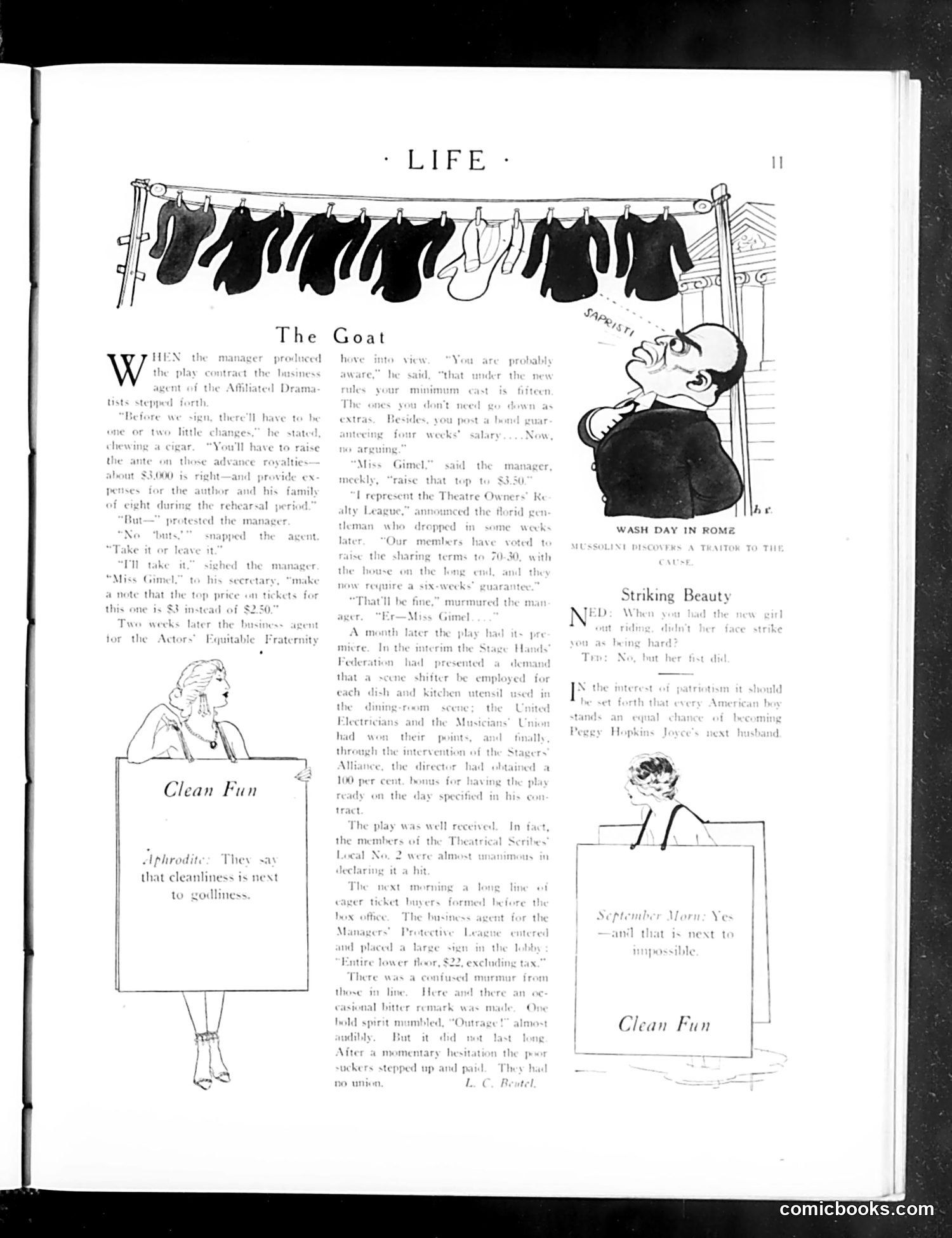
This page from *Life* magazine contains three satirical pieces about theater business disputes: **"The Goat"** (main story): A narrative about contractual disputes between a theater manager and business agents for the Actors' Equitable Fraternity. The "goat" is the scapegoat—the manager who must absorb costs and contractual disputes. The story mocks how theater professionals haggle over minimum pay, ticket sales percentages, and guarantees. **"Clean Fun"** (sidebar cartoon): A woman holds a sign with Aphrodite's cleaning maxim—satirizing how moral respectability is marketed alongside entertainment. **"Striking Beauty"** (right column): A brief piece about a young female rider, likely mocking society's obsession with attractive women in fashionable pursuits. The page satirizes early-20th-century theater labor conflicts and entertainment industry pretensions.
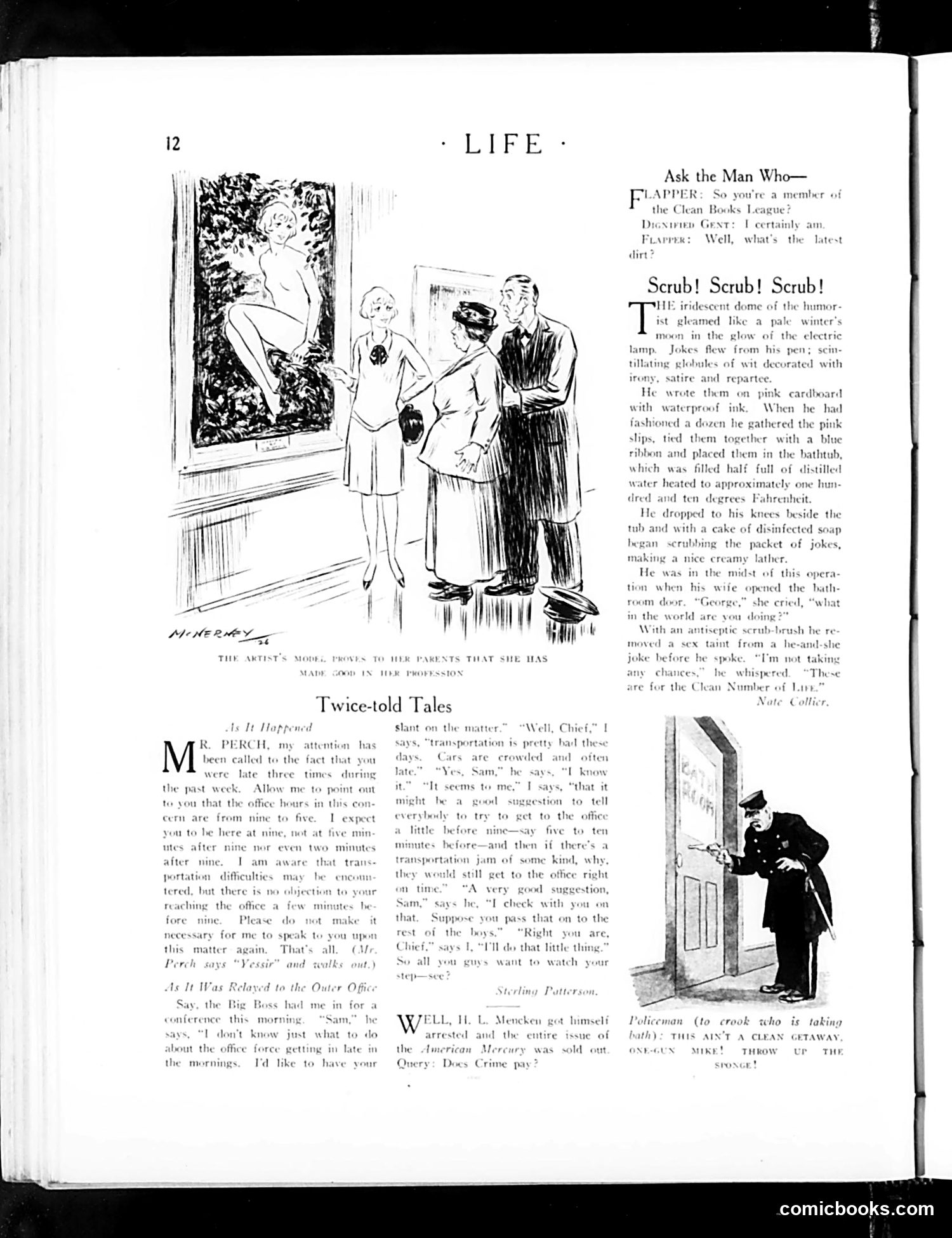
This page from *Life* magazine contains humor pieces rather than political cartoons. The main illustrated content shows: **Top cartoon**: A woman displaying artwork to what appear to be her parents, captioned "The Artist's Model Proves to Her Parents That She Has Made Good in Her Profession." This is satirical commentary on the social controversy surrounding artist's models—a profession considered morally questionable in early 20th-century America, as models often posed partially nude. The joke hinges on middle-class anxiety about respectability. **Text sections**: Include humorous anecdotes about office commuting troubles and a policeman arresting H.L. Mencken over a *Mercury* magazine sales issue (a real historical reference to obscenity censorship debates). The bottom illustration depicts a crooked cop—standard *Life* fodder for satirizing urban corruption and police misconduct. These are light social satire rather than serious political commentary.
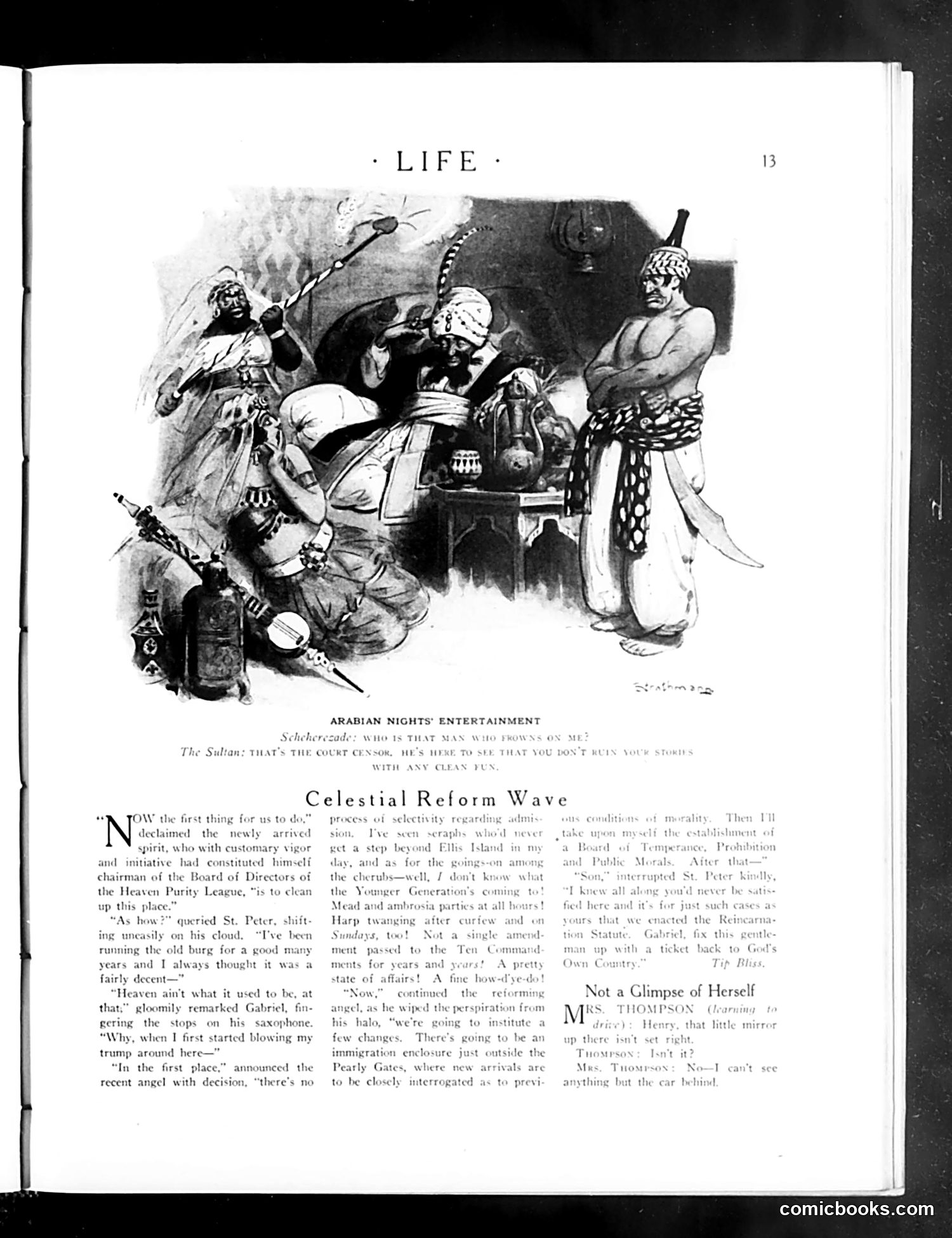
This cartoon satirizes celestial (heavenly) reform efforts. The illustrated scene shows what appears to be a Sultan or Middle Eastern ruler being confronted by reform-minded angels or heavenly officials about his governance—specifically regarding a "court censor" and maintaining moral standards. The satire mocks overzealous reform movements by placing them in a fantastical "Arabian Nights" setting. The joke plays on the incongruity of strict moral reformers (depicted as celestial beings) trying to impose puritanical standards on a traditionally hedonistic ruler, suggesting such reform efforts are equally fanciful and impractical. The accompanying text discusses a "Celestial Reform Wave" with angels debating whether to institute various restrictions, poking fun at contemporary American reform movements—likely Prohibition and similar moral crusades of the early 20th century.
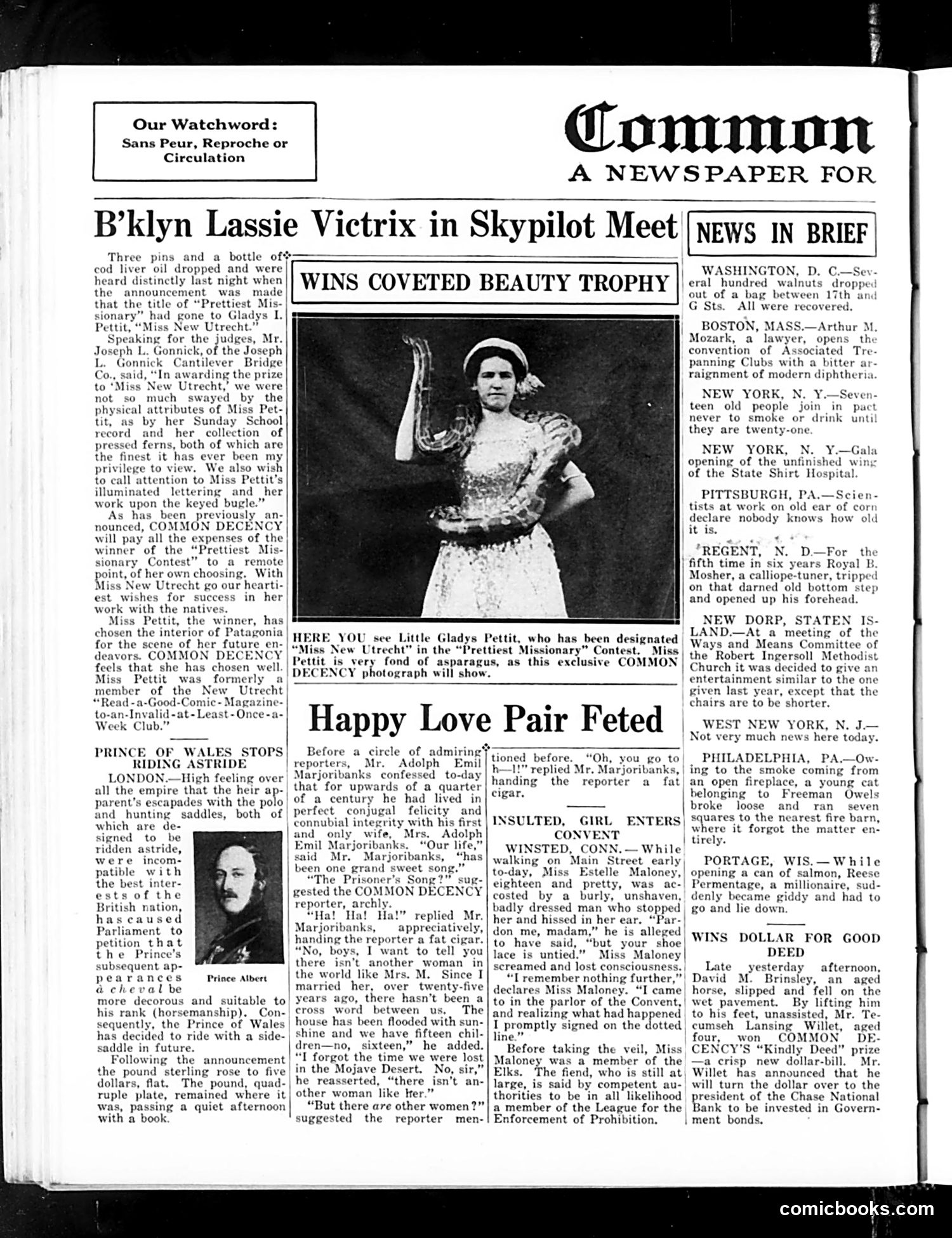
This page from *Common*, a satirical newspaper, contains several human-interest stories rather than political cartoons. The main content includes: **"B'klyn Lassie Victrix in Skypilot Meet"** — A contest where young Gladys L. Pettit won the "Prettiest Missionary" title, with judges praising her Sunday School record and charitable work. *Common Decency* will fund her missionary work. **"Prince of Wales Stops Riding Astride"** — A humorous piece about Prince Albert reportedly riding sidesaddle, mocking British aristocratic propriety and suggesting the Prince made an unusual decision for effect. **"Happy Love Pair Feted"** — A romantic anecdote about a couple getting married after a quarter-century courtship. The page is primarily lighthearted social commentary rather than sharp political satire, typical of early 20th-century American humor magazines.
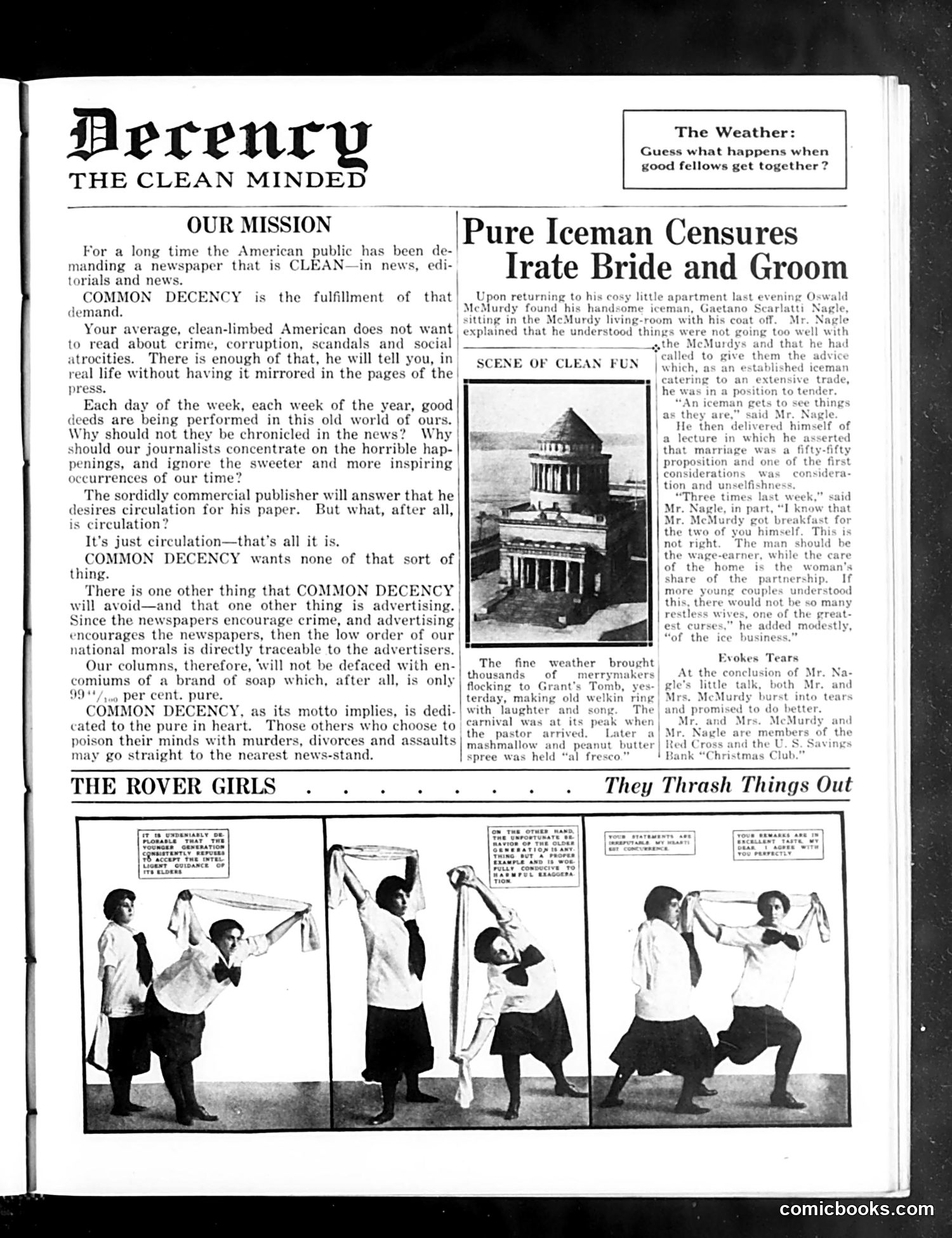
This page from Life magazine presents three distinct pieces: 1. **"Our Mission"** editorial: Explains Common Decency's commitment to publishing only positive news—good deeds, inspiring occurrences—while avoiding crime, corruption, and scandals. The satire critiques sensationalist journalism by suggesting readers want uplifting rather than scandalous content. 2. **"Pure Iceman Censures Irate Bride and Groom"**: A humorous article about an iceman delivering a lecture to newlyweds about marriage being a "fifty-fifty proposition." The joke mocks overly-moralistic social commentary in an era when such advice columns were common. 3. **"The Rover Girls... They Thrash Things Out"**: A comedic photo-sequence showing young women fighting over laundry, with dialogue about discussing disagreements. This appears to satirize both women's lib discussions and domestic conflict resolution. The overall tone is lighthearted satire of American social attitudes.
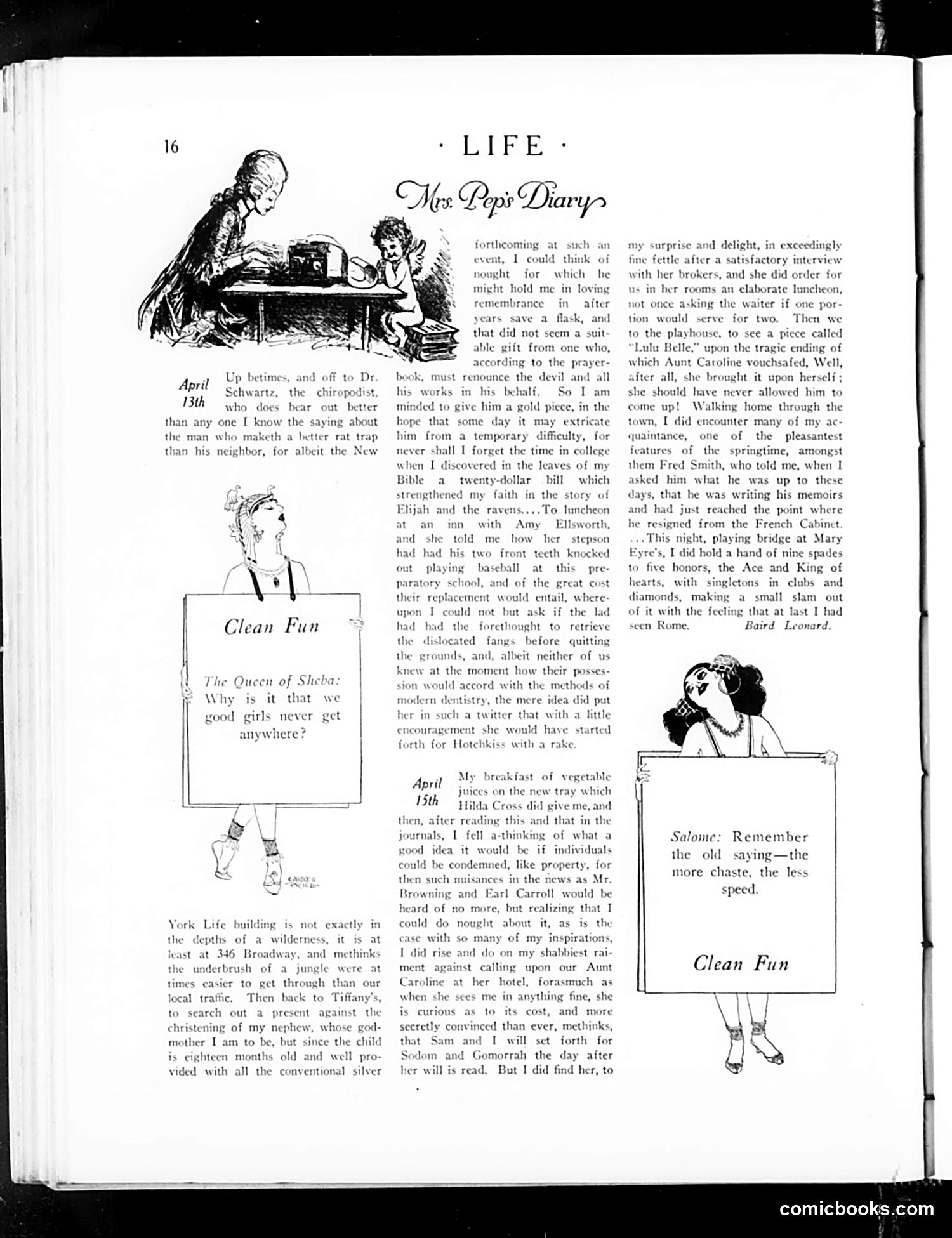
This page presents **Mrs. Pepis Diary**, a personal essay with accompanying illustrations and a humor section titled "Clean Fun." The main cartoon shows a figure presenting a quote from "The Queen of Sheba" asking "Why is it that we good girls never get anywhere?" This appears to satirize women's social frustrations—specifically the ironic complaint that virtuous women are overlooked while others succeed. The diary entries (April 13th and 15th) describe mundane social activities: visiting a chiropodist, lunch with friends, bridge games, and gift shopping. The accompanying sketches humorously depict these ordinary domestic moments. The "Clean Fun" section offers light, family-friendly humor reflecting early 20th-century magazine conventions. The overall tone satirizes both women's limited social spheres and their preoccupations with minor social matters.
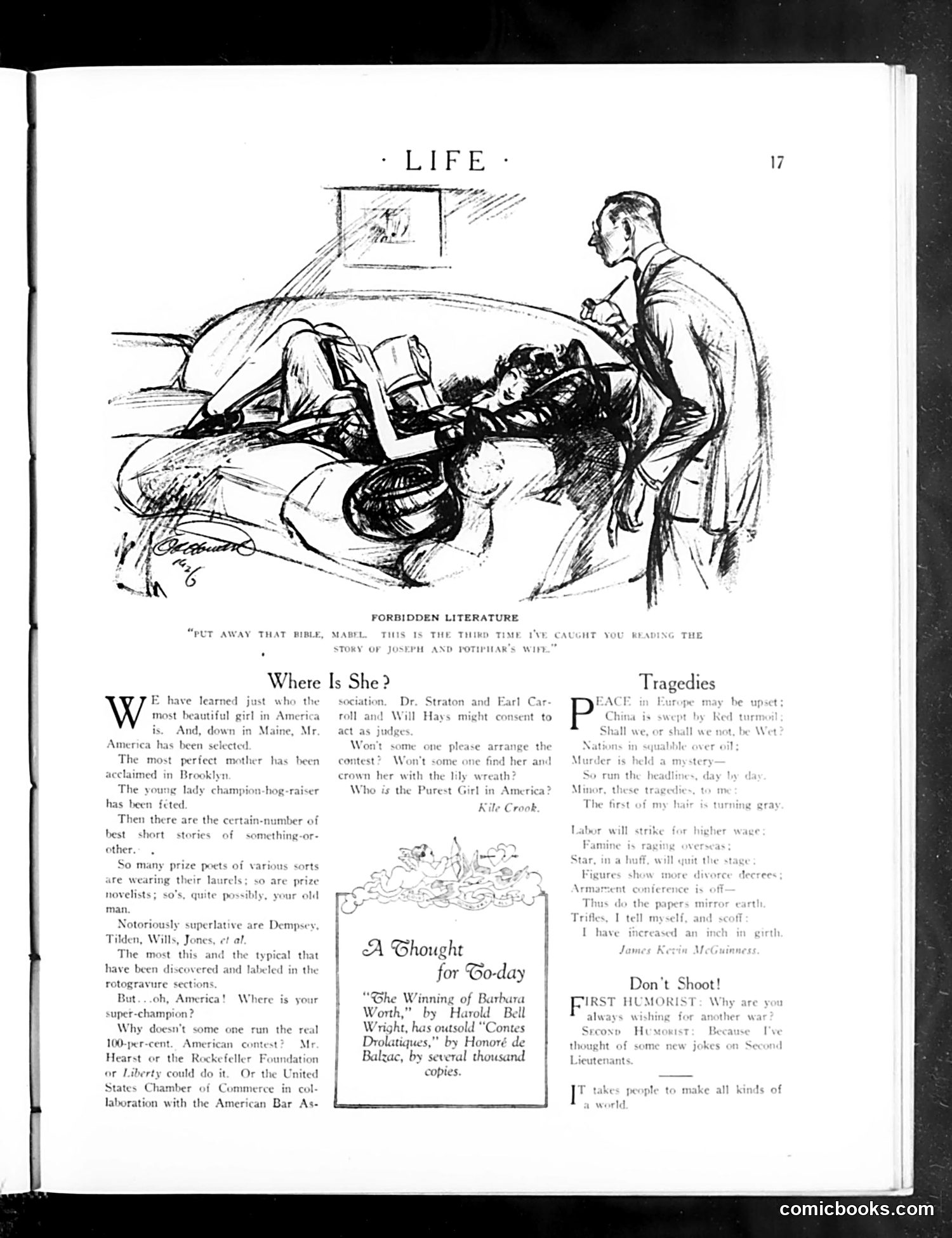
The top cartoon depicts a parent discovering a young woman reading what appears to be risqué literature—specifically a Bible passage about Joseph and Potiphar's wife (a seduction narrative). The parent's shock illustrates anxiety about youth accessing "forbidden" content, even religious texts with adult themes. The "Where Is She?" article satirizes America's obsession with crowning champions and "superlatives"—beauty queens, prize poets, athletic heroes. The author mocks this contest culture, asking where America's true "super-champion" is, and suggesting wealthy institutions (Hearst, Rockefeller) could sponsor an official competition. "A Thought for To-day" notes that Harold Bell Wright's moralistic novel *She, the Winning of Barbara Worth* outsold Balzac's sophisticated *Contes Drolatiques*—commenting ironically on American preference for sentimental, "pure" literature over literary sophistication. The poems address European instability and anti-war sentiment post-WWI.
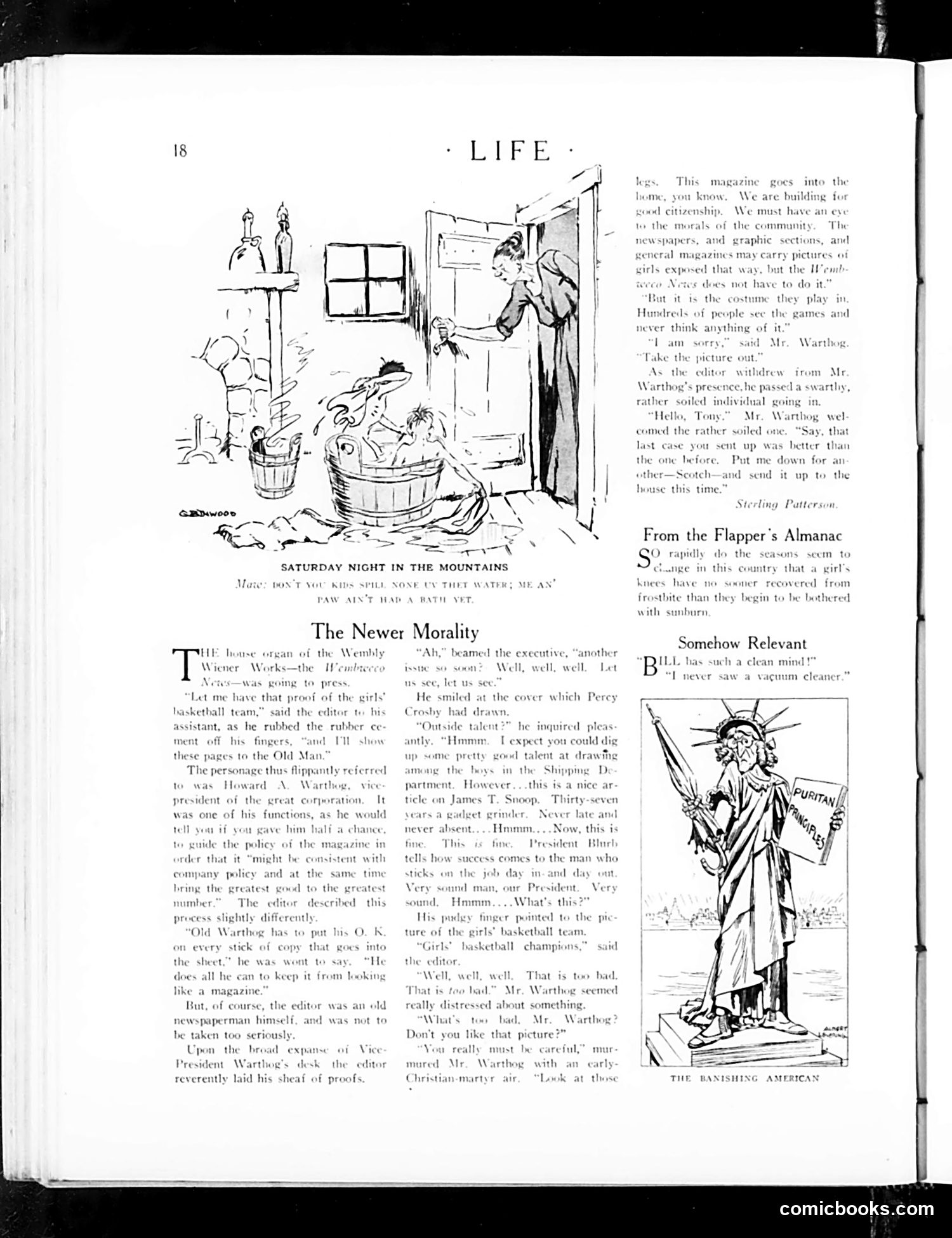
This page satirizes editorial standards and corporate morality at a magazine (likely *Life* itself). The main article, "The Newer Morality," depicts Vice-President Warthog (a caricatured executive) pressuring the editor to remove a girls' basketball team photo from publication because it shows girls in athletic costumes—deemed inappropriate for a family magazine despite being innocent. The satire targets the hypocrisy: Warthog claims moral concern for "good citizenship" and community values, yet his actual motive is controlling public perception through censorship. The editor acquiesces despite recognizing the absurdity. The accompanying cartoon "Saturday Night in the Mountains" and other sketches provide lighter comic relief on the same page. The piece reflects 1920s anxieties about women's changing social roles (athletic participation, shorter skirts) and institutional gatekeeping of acceptable imagery—criticizing how magazines claimed moral authority while practicing arbitrary censorship.
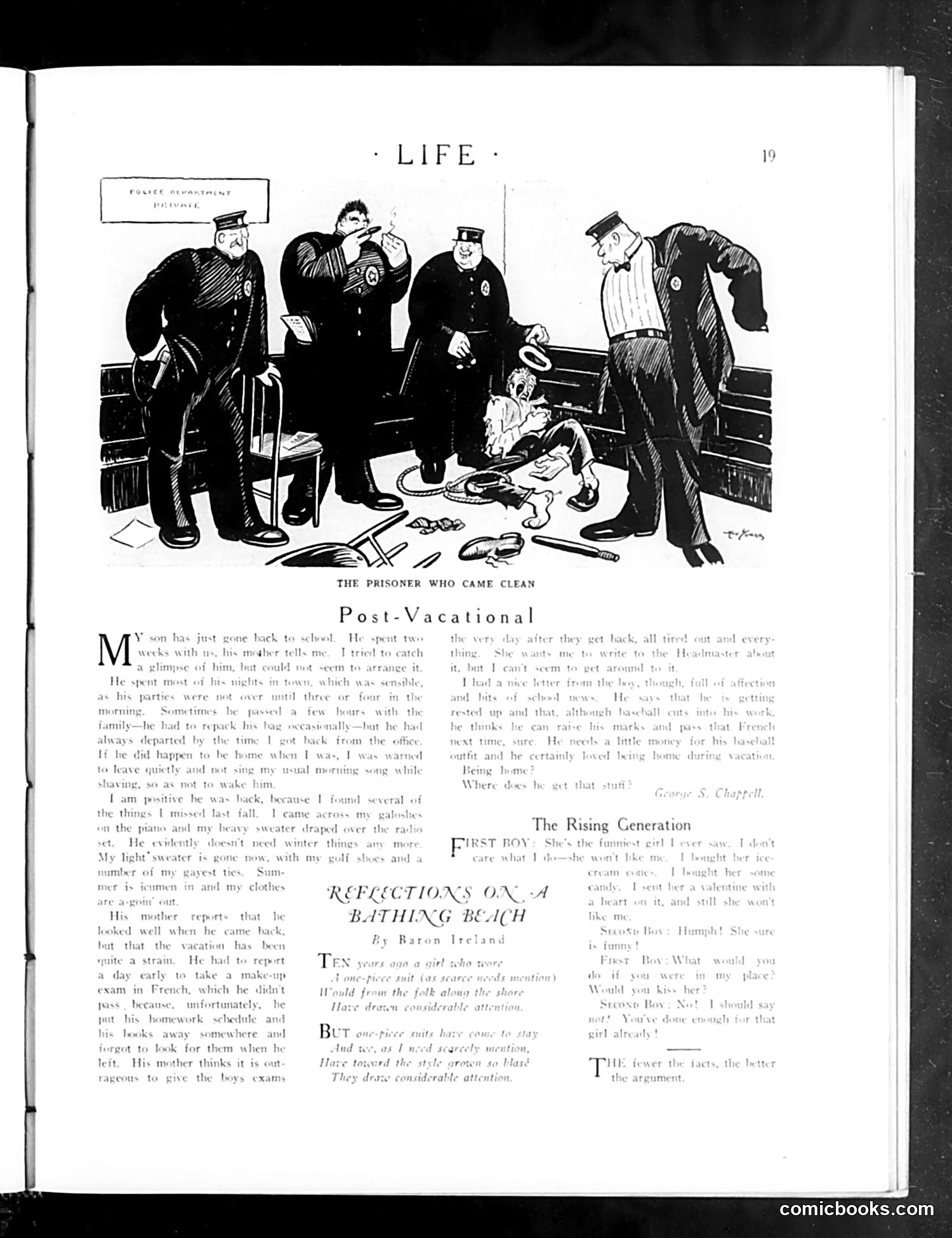
The top cartoon, "The Prisoner Who Came Clean," depicts police officers questioning a disheveled man sitting on a bench, surrounded by scattered items. The satire appears to mock either police interrogation tactics or a prisoner's confession—the title suggests ironic commentary on someone finally admitting guilt or wrongdoing. Below, "Post-Vacational" is a brief humorous piece about a boy returning to school after vacation, describing his mother's frustration with his summer idleness and his own reluctance to resume studies. "The Rising Generation" and "Reflections on a Bathing Beach" appear to be short comic dialogues satirizing youth behavior and social interactions, likely poking fun at young people's romantic pretensions or dating customs of the era. The overall page targets domestic life, education, and youth culture with gentle, observational humor typical of Life's satirical style.
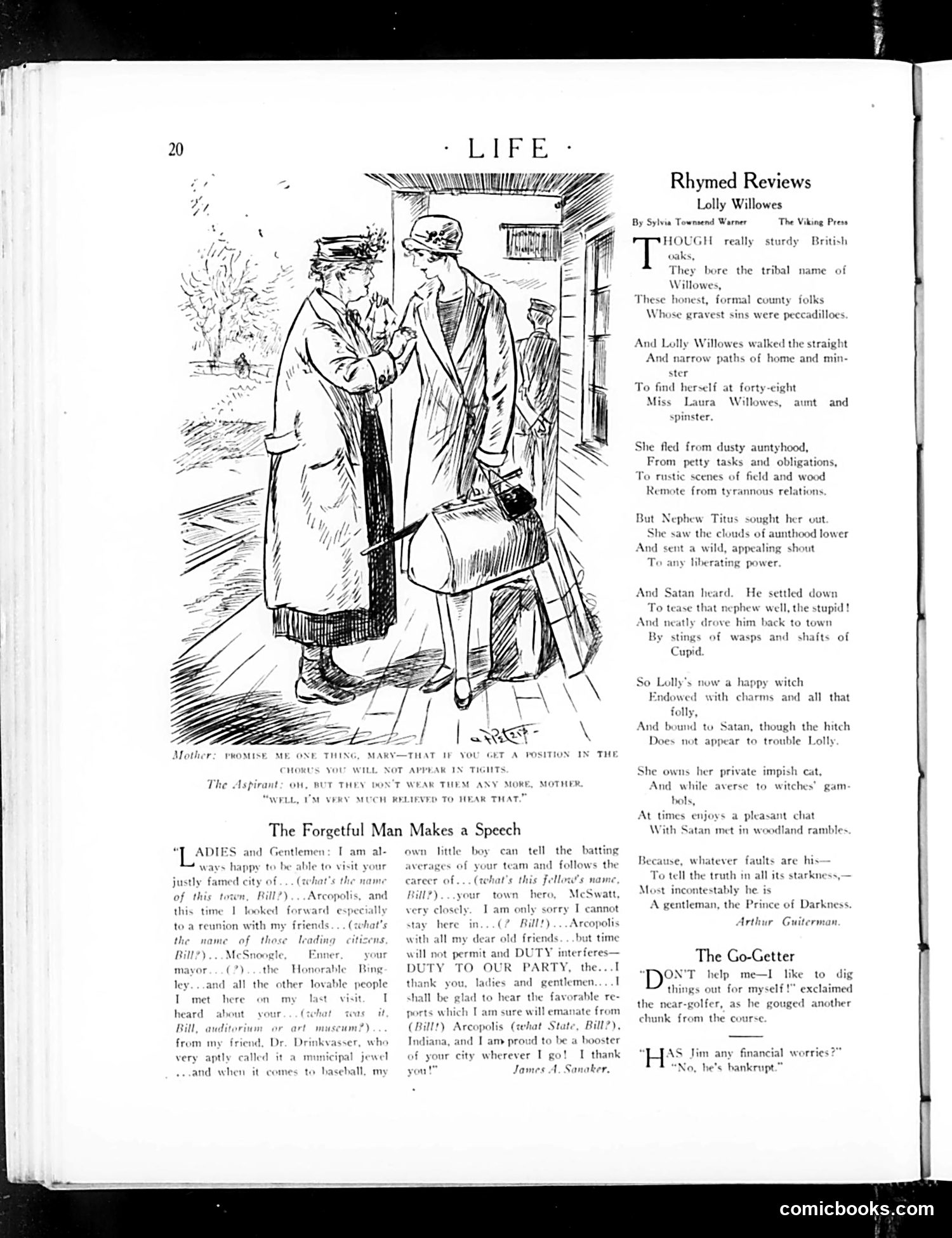
This page contains three distinct pieces of satirical humor: **"The Forgetful Man Makes a Speech"**: A politician delivers a rambling, incoherent speech full of parenthetical asides and name-dropping. The satire targets politicians who lose their train of thought, fail to communicate clearly, and invoke duty and local pride while saying nothing substantive—a timeless critique of empty political rhetoric. **"Lolly Willowes" (Rhymed Review)**: A book review in verse about a woman who escapes conventional domestic life to become a witch in the countryside. The humor lies in presenting witchcraft as liberation from family obligation and praising Satan as "a gentleman"—inverting Victorian morality for comedic effect. **"The Go-Getter"**: A brief joke about a golfer who aggressively digs up the golf course while insisting on self-reliance, then admits financial bankruptcy. The satire mocks the American "self-made man" mythology—someone destroying things while refusing help, yet failing anyway. All three pieces use exaggeration and inversion to mock social pretension and hypocrisy.
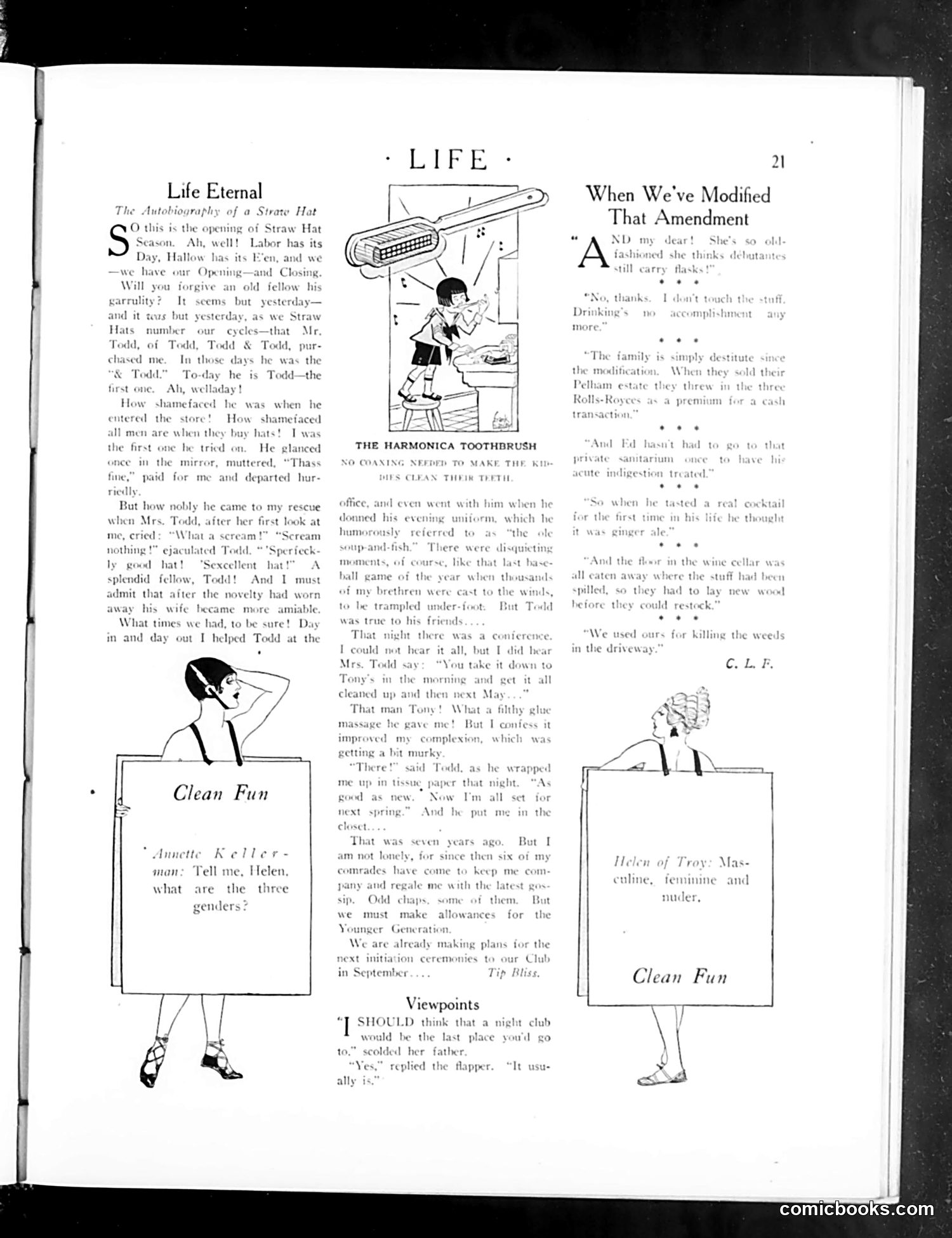
This page contains three pieces of satirical content from Life magazine (likely 1920s-1930s based on style): **"Life Eternal"** mocks a man named Todd who becomes obsessed with a novelty straw hat purchased on opening day, treating it as a cherished possession for years. The satire targets male sentimentality and consumerism. **"The Harmonica Toothbrush"** is a cartoon showing a device combining a harmonica with a toothbrush—absurdist humor mocking unnecessary product innovation and gadgetry. **"When We've Modified That Amendment"** appears to reference women's changed behavior following passage of an amendment (likely the 19th Amendment granting women's suffrage, 1920). The dialogue suggests women are now adopting behaviors previously associated with men (implied drinking references with "cocktail" and "wine cellar"). The satire expresses conservative anxiety about how women's newfound freedom and equality might alter traditional gender roles and propriety. The "Viewpoints" section presents a father disapproving of nightclubs—reflecting era-typical parental concern about flapper culture.
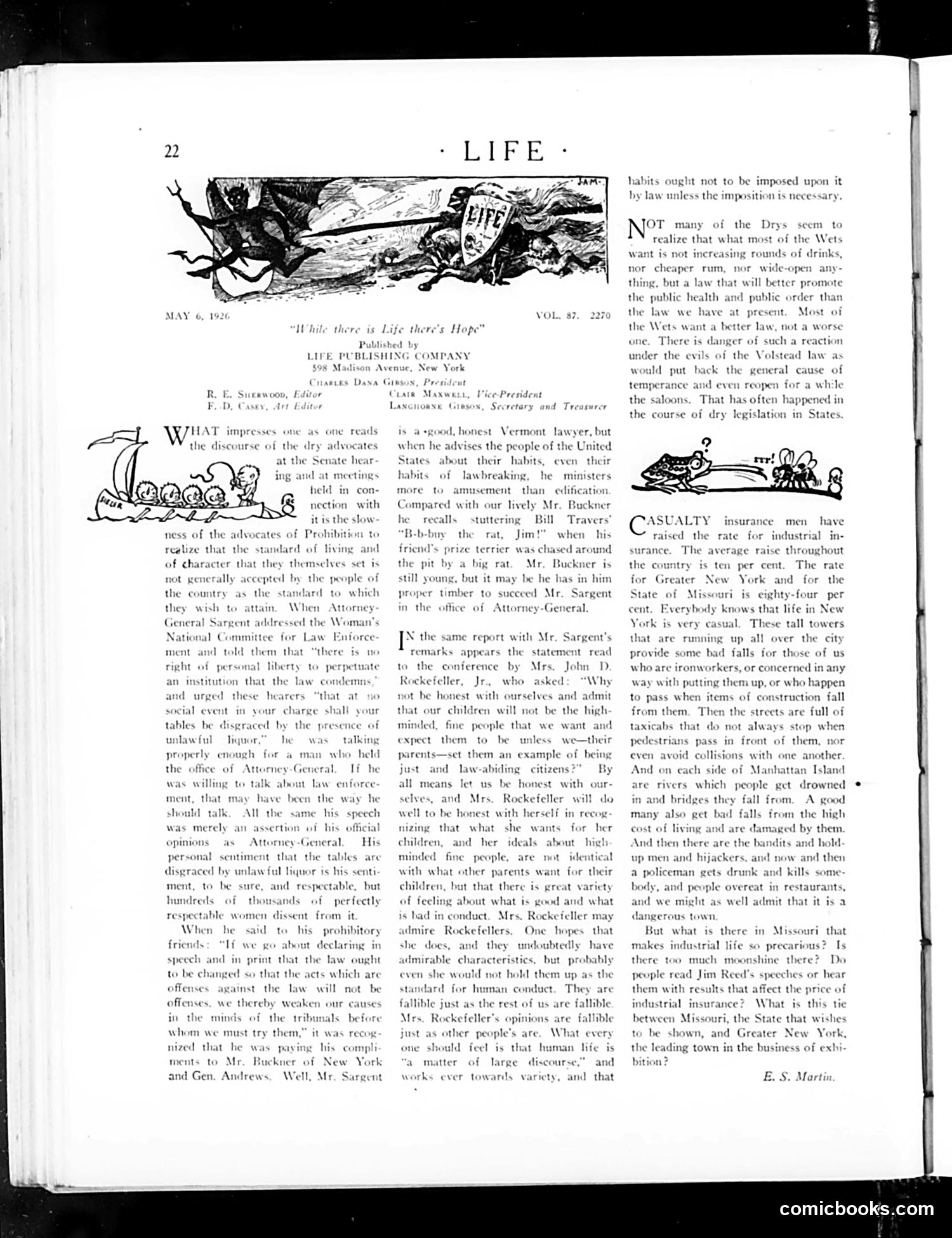
This page from *Life* magazine debates Prohibition enforcement through commentary on recent Senate hearings. The article criticizes **Attorney General Sargent** for his rigid stance on enforcing alcohol laws while addressing the Senate. The satire mocks his solemn pronouncements about legal morality coming from someone who, the writer suggests, lacks the personality or persuasive charm needed for public discourse. The piece also references **Mrs. John D. Rockefeller Jr.**, who advocated that parents model law-abiding behavior to inspire children—a position the author finds naively idealistic. The central argument warns that overzealous Prohibition enforcement risks backlash that could harm the temperance movement itself. The cartoons and illustrations (visible but difficult to parse in detail) appear to satirize the self-righteousness of Prohibition advocates. Overall, the page reflects 1926 tensions between strict "dry" enforcement and more moderate calls for practical alcohol regulation.
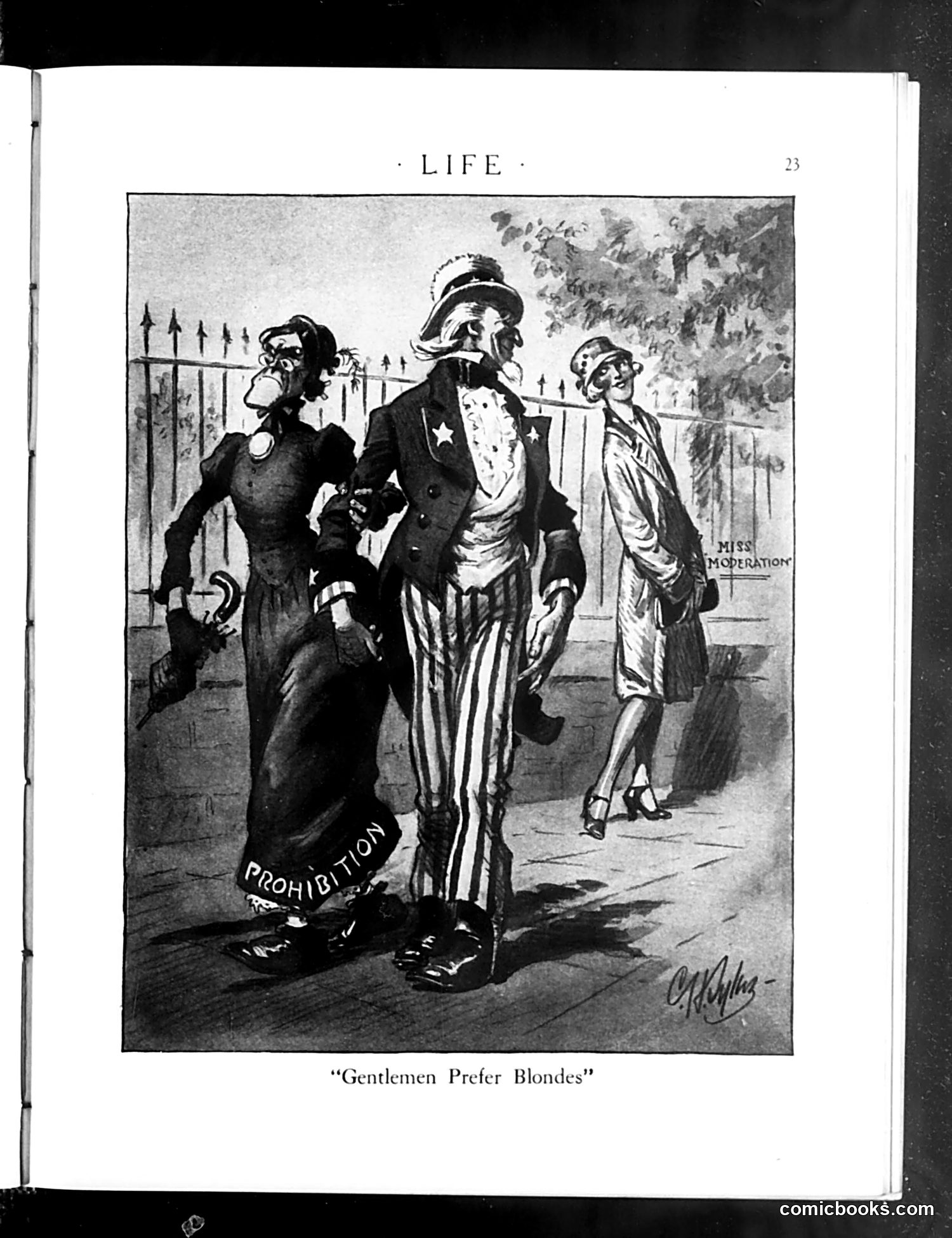
This Life magazine cartoon satirizes the famous 1920s cultural phenomenon referenced by the title phrase. The central figure represents Uncle Sam (identifiable by stars, striped pants, and top hat) being escorted by three women labeled "Prohibition," "Miss Moperation" (likely "Miss Operation"), and an unnamed blonde woman. The satire critiques Prohibition enforcement during the Jazz Age. Uncle Sam appears to be caught between temperance advocates pushing him toward strict enforcement and the allure of blonde women—symbolizing the era's hedonistic culture that defied Prohibition laws. The cartoon mocks how American gentlemen (and the nation itself) preferred the pleasures of the "blonde" lifestyle over the serious moral crusade of Prohibition, suggesting the policy was fundamentally at odds with American social desires.
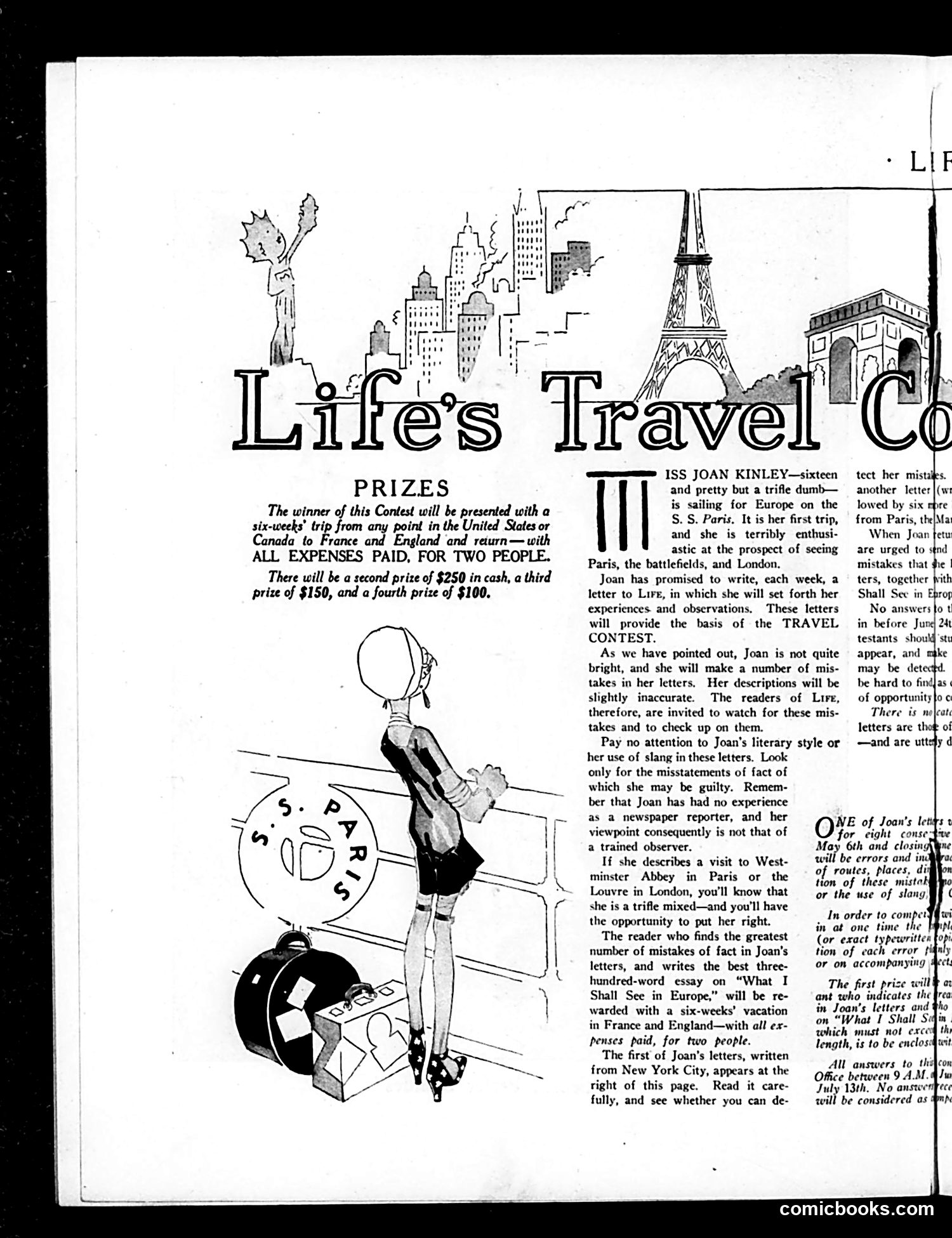
This page announces Life's "Travel Contest," a reader participation game. Sixteen-year-old Joan Kinley—described as "pretty but a trifle dumb"—is sailing to Europe and will send weekly letters to Life documenting her experiences. **The joke:** Joan will deliberately make factual errors in her letters (misidentifying landmarks, confusing locations, etc.), and readers compete to spot these mistakes and write essays about "What I Shall See in Europe." The winner receives an all-expenses-paid six-week European vacation for two. The cartoon shows Joan surrounded by travel luggage, establishing her as an amateur traveler. The satire targets both Joan's naïveté and, implicitly, readers' eagerness to prove themselves more knowledgeable than a foolish young woman. The contest exploits 1920s assumptions about female intellect while encouraging reader engagement—a clever marketing strategy disguised as participatory entertainment.
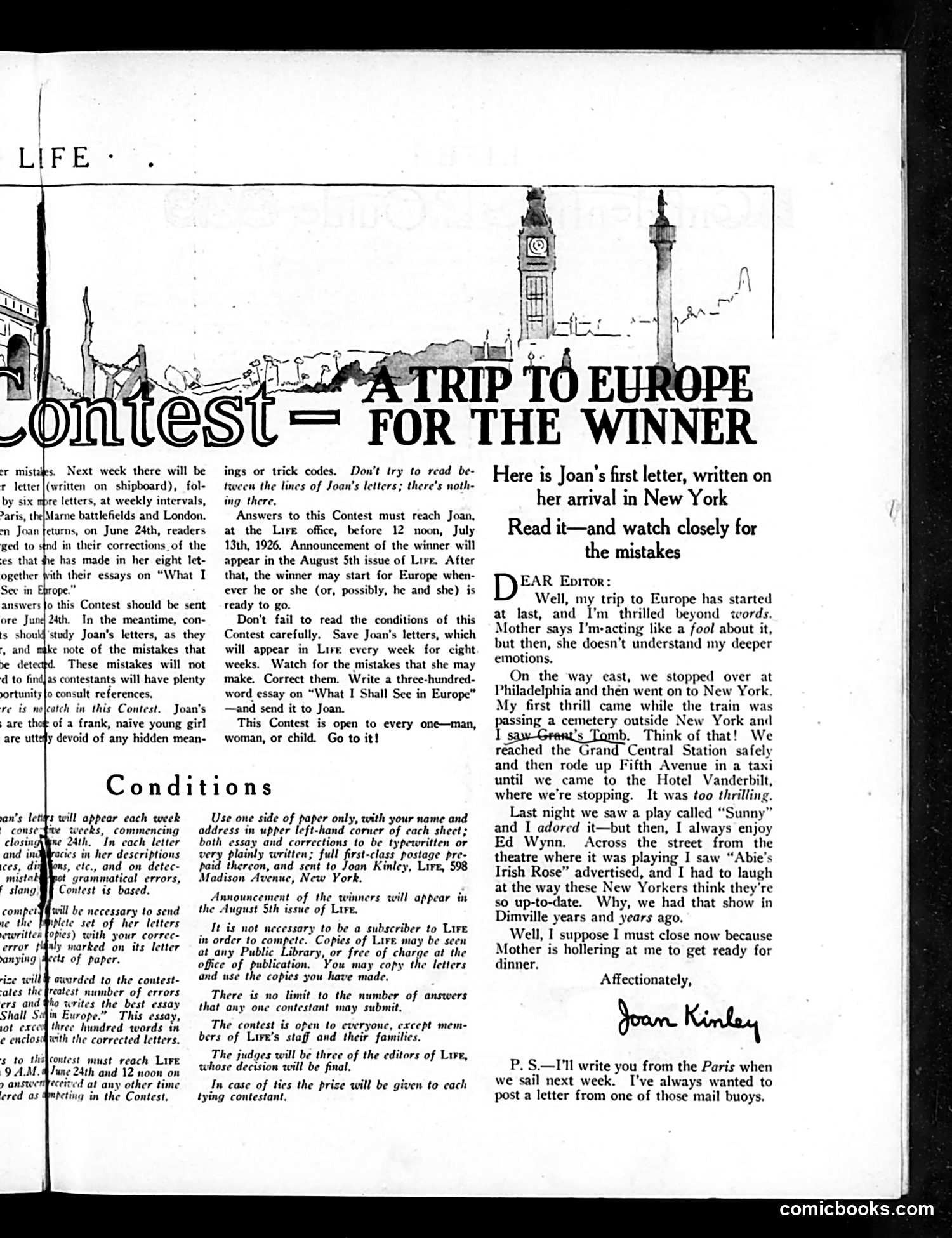
This page from *Life* magazine announces a reader contest (circa 1926) offering "A Trip to Europe for the Winner." Readers must identify deliberate errors in a series of letters written by "Joan Kinley," a young woman traveling to Europe, then submit corrections plus a 300-word essay on "What I Shall See in Europe." The first letter is included as an example. Joan describes arriving in New York with breathless enthusiasm—visiting Grand Central, Fifth Avenue, seeing a play called "Sunny." The satire targets her as a naive, excitable young tourist who misses obvious details and speaks in clichés ("thrilled beyond words"). The contest itself is *Life's* satirical commentary on American cultural pretension: readers compete to catch a foolish girl's mistakes while imagining their own European adventures. The humor rests on the gap between Joan's superficial observations and what sophisticated readers believe real travel wisdom should be.
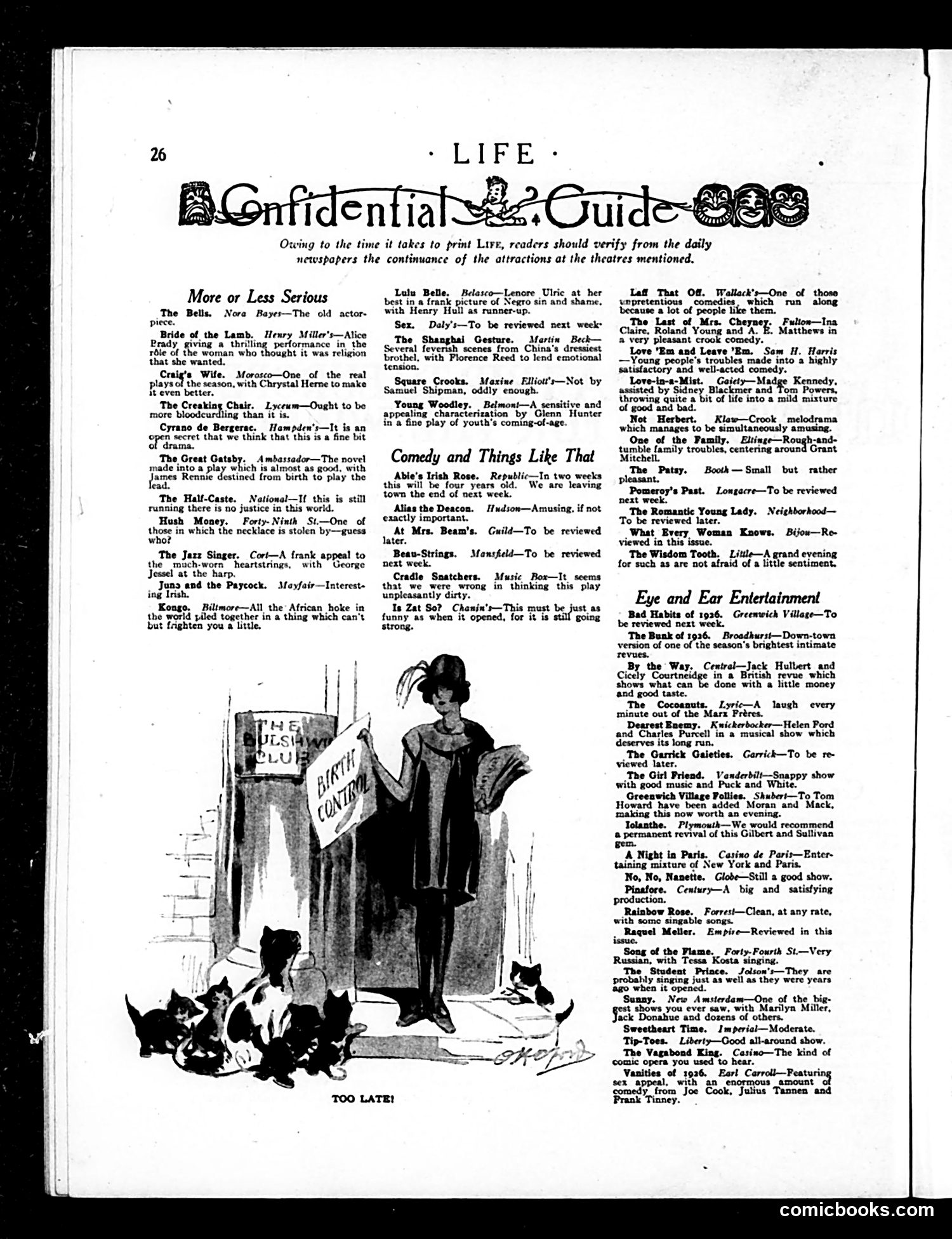
The cartoon depicts a woman in fashionable 1920s dress standing before theater advertisement boards, surrounded by black cats. The caption reads "TOO LATE!" **The Joke:** This is a visual pun on superstition. The woman appears to be trying to enter a theater, but is blocked or delayed by numerous black cats—traditionally considered bad luck omens. The "too late" caption suggests she's missed her show due to the superstitious impediment these cats represent. **Context:** This appears on a theater review page, so the humor plays on the old theatrical superstition that black cats bring misfortune. The cartoon gently mocks both superstitious beliefs and theater-goers' anxieties about missing performances. The illustration style and fashion suggest the 1920s Jazz Age, when such superstitions remained culturally prevalent despite modernization. The cartoon serves as light entertainment accompanying the page's serious theater reviews and listings.
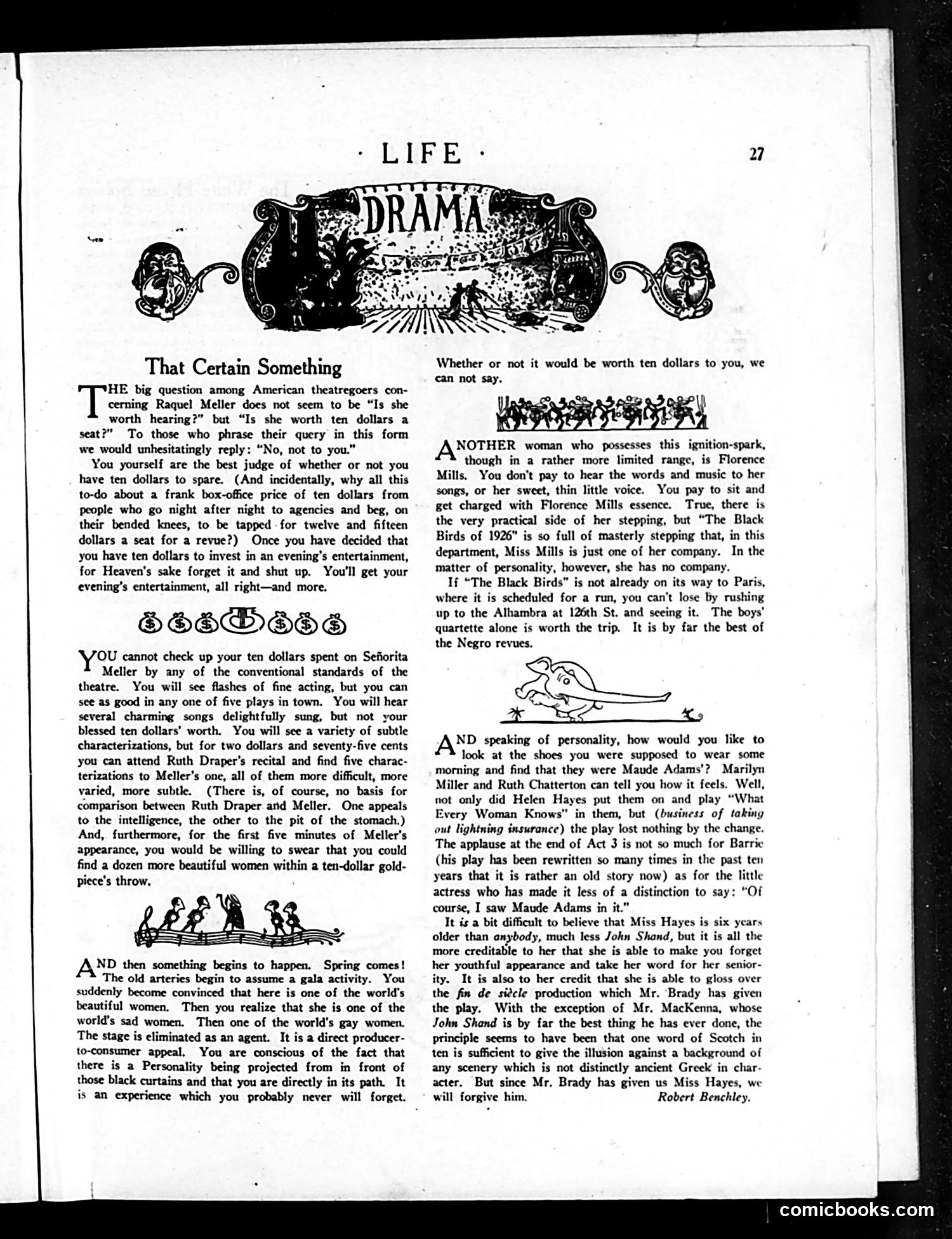
This page critiques the theatrical phenomenon of performer "personality" versus conventional talent. The writer argues that Spanish singer Raquel Meller's ten-dollar ticket price cannot be justified by objective measures—her acting, singing, or dancing aren't exceptional compared to cheaper alternatives like Ruth Draper's recitals. However, the article describes a mysterious transformation: once Meller performs, audiences experience pure charisma—a direct "personality" projection that transcends the stage itself. The writer compares this to Florence Mills, the African American performer whose essence captivates audiences at the Alhambra Theatre's "Black Birds of 1926" revue. The piece celebrates this indefinable star quality, arguing that certain performers—like Helen Hayes—possess an almost magical ability to elevate mediocre material simply through their presence. The satire targets theater-goers who demand rational justification for emotional, personality-driven entertainment while simultaneously patronizing agencies for expensive tickets.
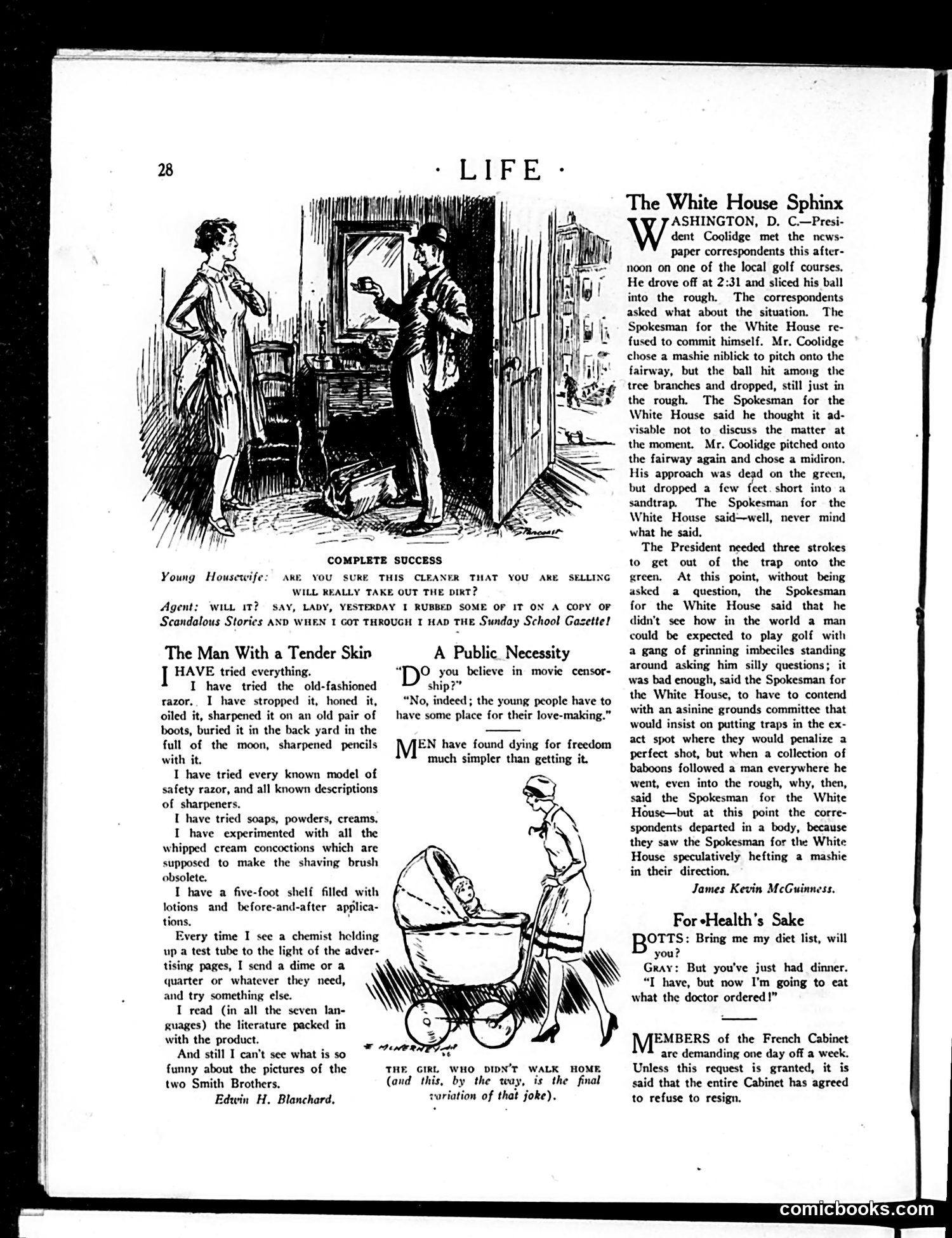
This satirical page from *Life* magazine (likely 1920s based on references) contains several humorous pieces mocking contemporary society: **"Complete Success"** ridicules advertising claims through a cleaner product so powerful it transforms "Scandalous Stories" into "Sunday School Gazette"—satirizing both exaggerated product advertising and moral panic about "scandalous" literature. **"The White House Sphinx"** targets President Coolidge's legendary taciturnity. While golfing, his spokesman refuses to comment on "the situation" (likely economic/political issues), deflecting every question. The joke: Coolidge communicates nothing even when not asked, and his spokesperson becomes so frustrated he threatens reporters with a golf club. It mocks both presidential evasiveness and press relations. **"The Man With a Tender Skin"** catalogs failed shaving products—a consumer complaint piece satirizing the proliferation of dubious personal-care products. Minor items mock movie censorship, French Cabinet labor demands, and diet fads. The overall tone is typical *Life* magazine wit: urbane, topical satire targeting advertising excess, political evasion, and consumer gullibility.
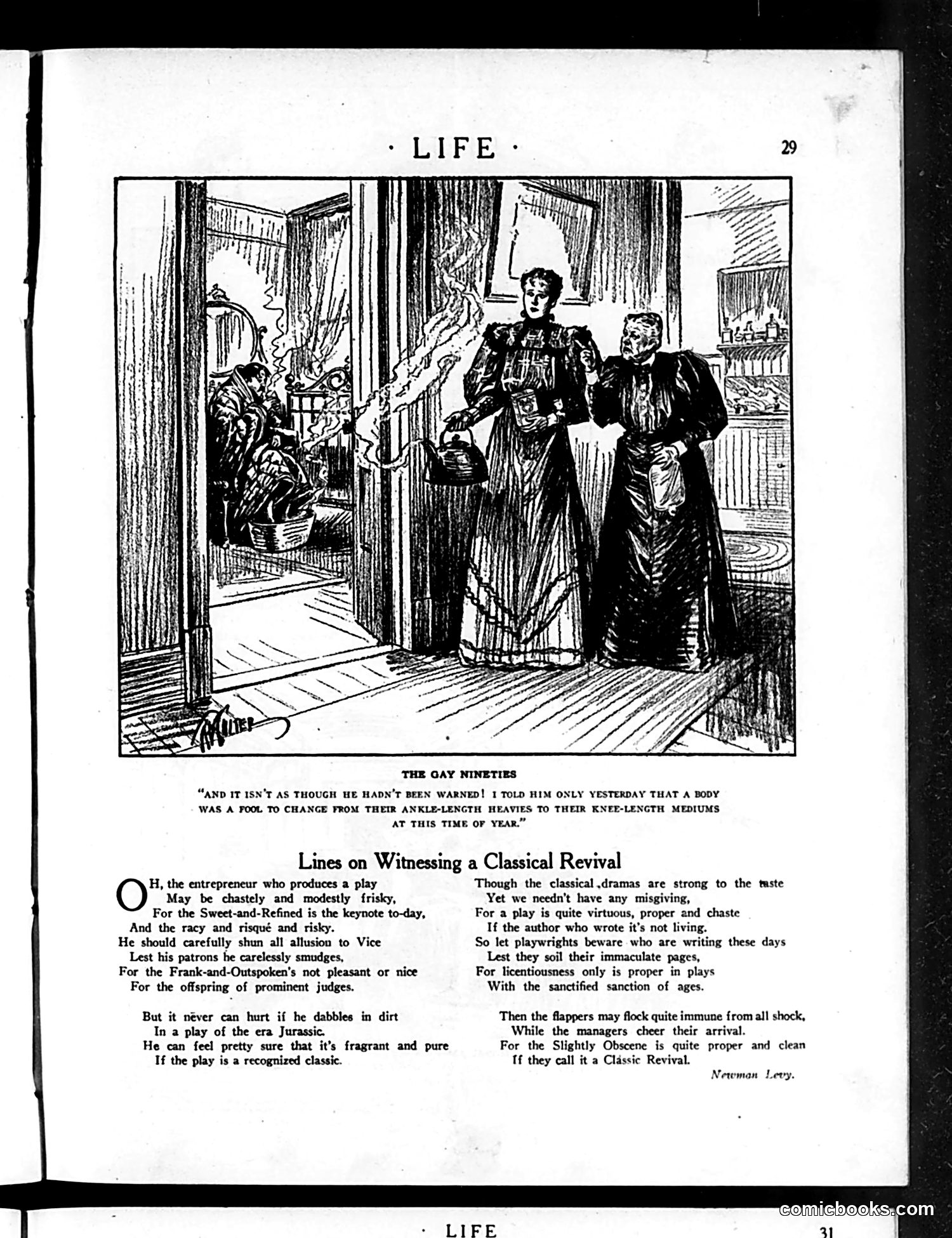
This page satirizes the hypocrisy of 1920s theatrical censorship through two pieces: **The cartoon** depicts what appears to be a domestic scene where a woman scolds a man about changing from "ankle-length heavies to knee-length mediums"—a joke about women's hemlines, which were becoming shorter and more scandalous in the 1920s. The humor lies in the woman's concern about propriety at "this time of year." **The poem "Lines on Witnessing a Classical Revival"** (by Newman Levy) mocks the double standard: theater producers must avoid anything risqué or "improper," yet the same shocking content is deemed perfectly acceptable if presented as a "classic revival"—a classical play by a dead author. The poem's final couplet captures the absurdity: "The Slightly Obscene is quite proper and clean / If the play is a recognized classic." The satire targets 1920s moral gatekeepers (protective of "prominent judges'" children) who enforce strict theatrical censorship while paradoxically allowing identical content under the veneer of classical legitimacy. "Flappers" (modern young women) could attend these revivals "immune from all shock" simply because society granted classical works cultural sanctification.
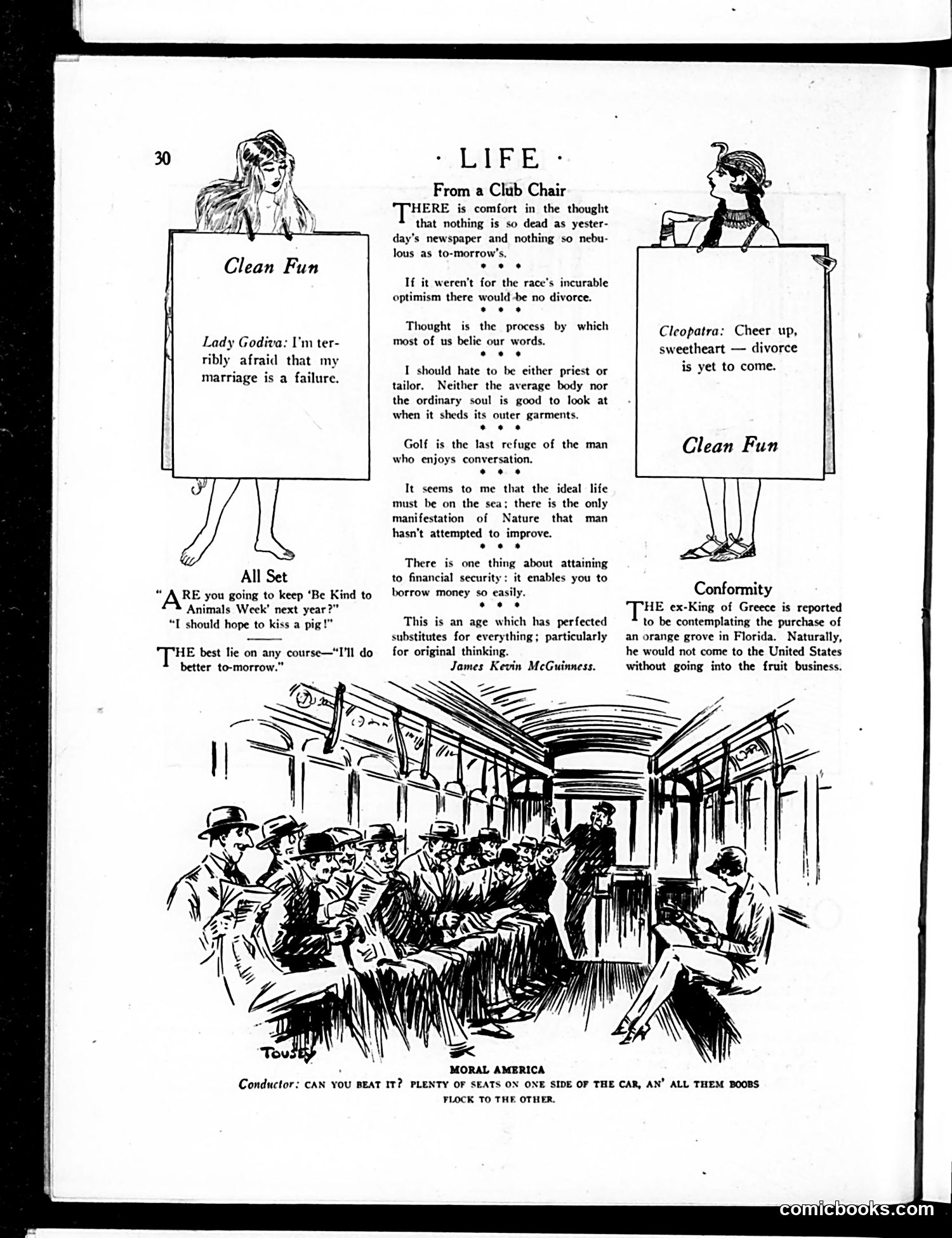
This page from *Life* magazine satirizes American social and cultural attitudes through several brief jokes and observations. The "Clean Fun" section presents witty one-liners mocking contemporary concerns: Lady Godiva fears her marriage is failing; a golf joke references endless conversation; financial security supposedly makes borrowing easier; and an observation that modern society has perfected "substitutes for everything; particularly for original thinking." The Lady Godiva and Cleopatra exchanges joke about divorce as inevitable—both historical figures humorously reassure distressed women that marital dissolution is forthcoming. The "Moral America" cartoon depicts crowded streetcar passengers, satirizing public behavior—the conductor notes that when one side fills, passengers oddly prefer the opposite side rather than sitting nearby. A final quip mocks the ex-King of Greece's reported interest in a Florida orange grove, suggesting exiled royalty must engage in commerce rather than maintain aristocratic pretense. The overall tone is sophisticated satire targeting modern life's contradictions: divorce culture, failed optimism, conformity, and commercial necessity.
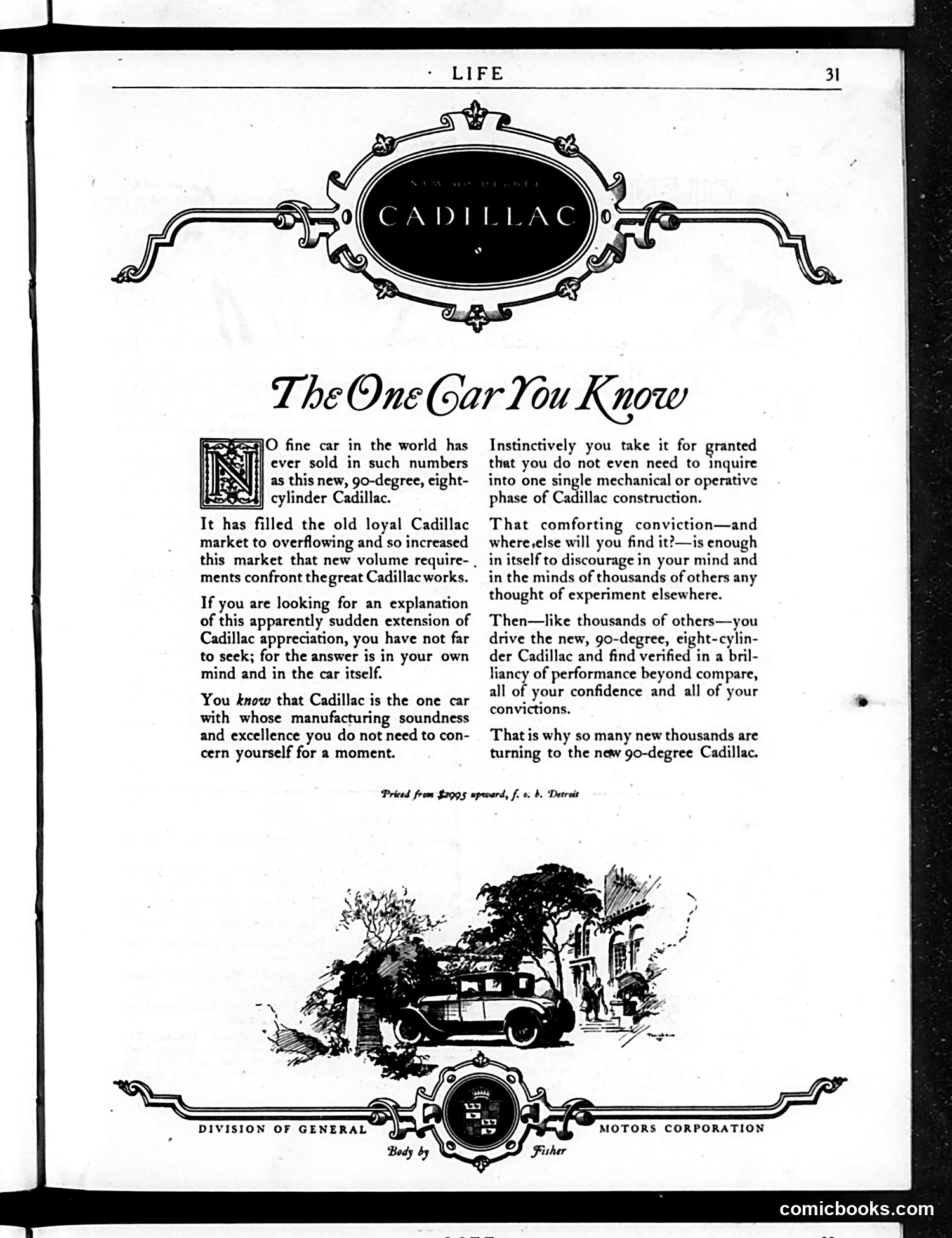
This is a **straightforward automobile advertisement**, not satire or political commentary. It appears in *Life* magazine (likely 1920s-1930s based on styling) and promotes Cadillac's new 90-degree, eight-cylinder engine. The ad's rhetorical strategy appeals to consumer confidence: Cadillac's reputation for manufacturing excellence is so established that buyers trust it without needing technical reassurance. The text argues this reputation, combined with the new engine's verified superior performance, explains the car's sales surge. The illustration shows a Cadillac near a mansion, suggesting the vehicle's association with luxury and wealth. The price ($2,995 upward) indicates this is an aspirational product for affluent buyers. There is no political satire here—this is corporate messaging emphasizing brand trust and mechanical innovation as sales drivers.
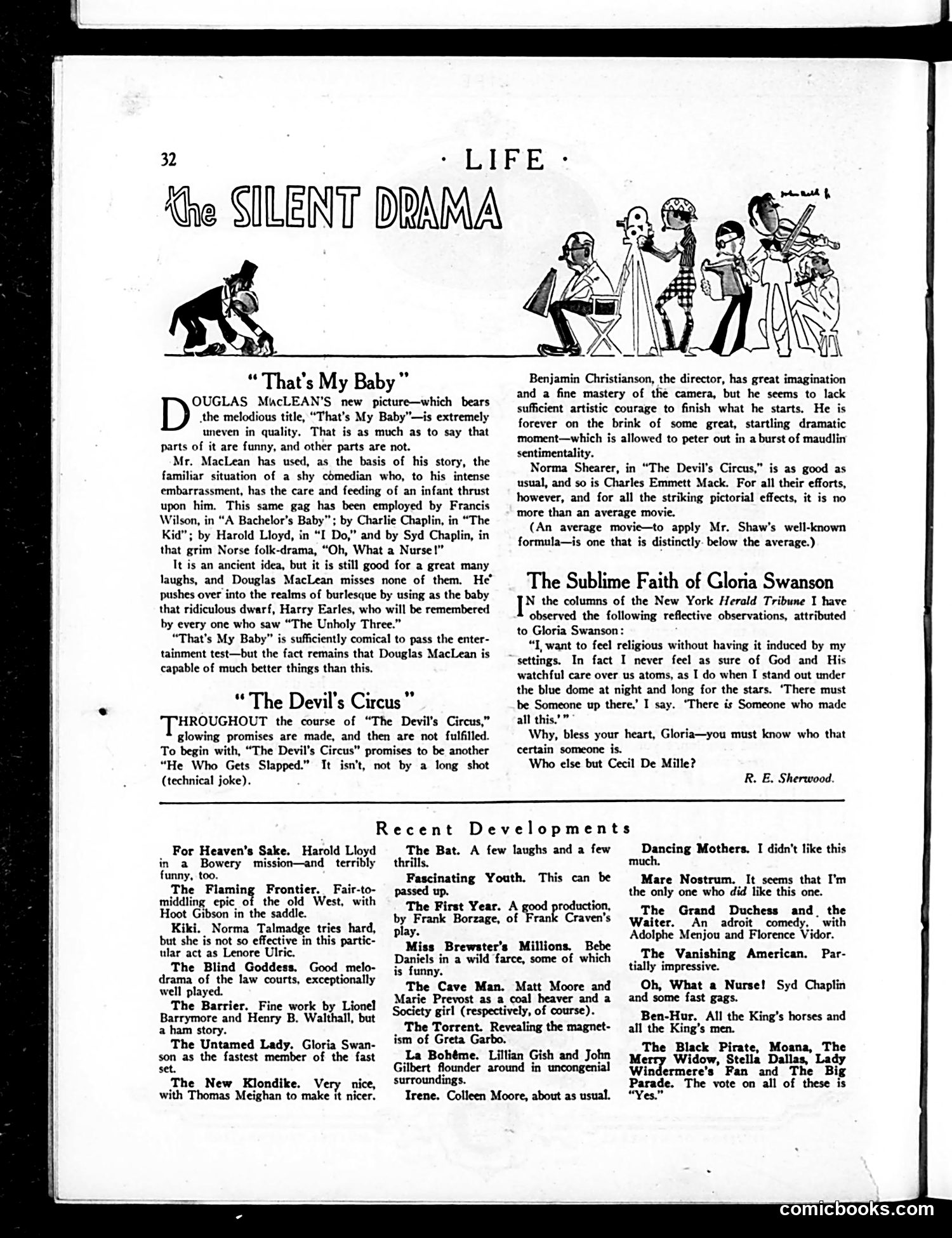
This page reviews recent silent films from the 1920s. The top cartoon depicts Douglas MacLean struggling with an infant, illustrating the plot of "That's My Baby"—a familiar comedy premise the critic notes has been used by Chaplin, Harold Lloyd, and others. The reviews are mixed. "That's My Baby" is deemed funny but uneven; "The Devil's Circus" promises greatness but fails to deliver, though Norma Shearer and Charles Emmett Mack perform well. The satire section mocks Gloria Swanson's pretentious spiritual musings published in the Herald Tribune. Critic R.E. Sherwood suggests the "Someone" she credits for creation is actually Cecil De Mille—the famous director who made her a star. This is a jab at both Swanson's pseudo-intellectual religiosity and Hollywood's director-worship. The page concludes with brief capsule reviews of other current releases, rating their quality from acceptable to skippable.
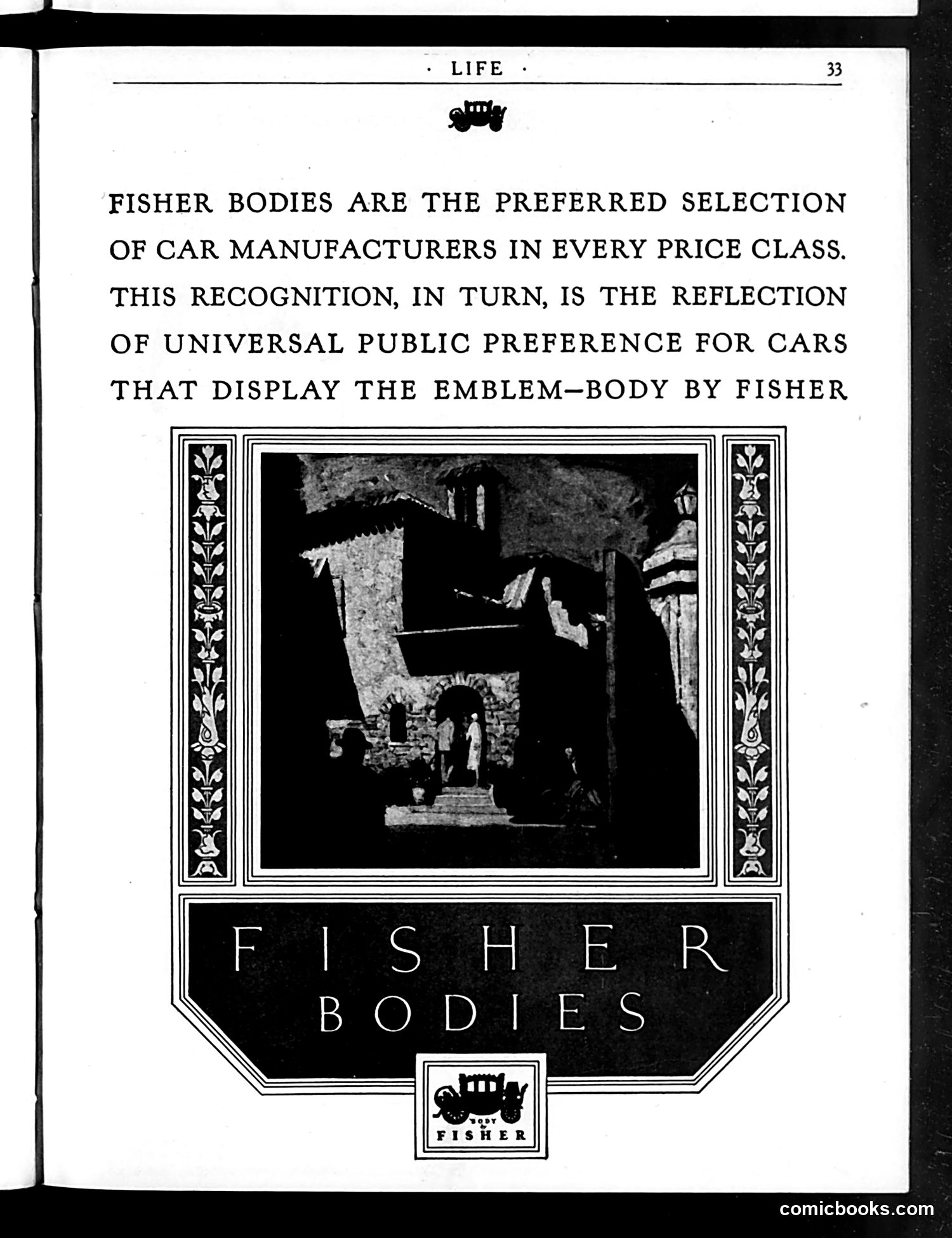
This is a **Fisher Body advertisement**, not political satire. Fisher Body was a major automobile coachwork manufacturer that supplied car bodies to various auto manufacturers. The ad claims Fisher bodies were the preferred choice across all price classes and price points, reflecting public demand. The image shows an ornate classical architectural scene—likely meant to evoke luxury and craftsmanship. The "emblem-body by Fisher" refers to Fisher's branding strategy: cars bearing Fisher's label signaled quality to consumers. This was essentially early corporate branding, where Fisher's reputation transferred prestige to whatever vehicle bore their body. There's no political content here—it's purely commercial promotion from the automotive industry.
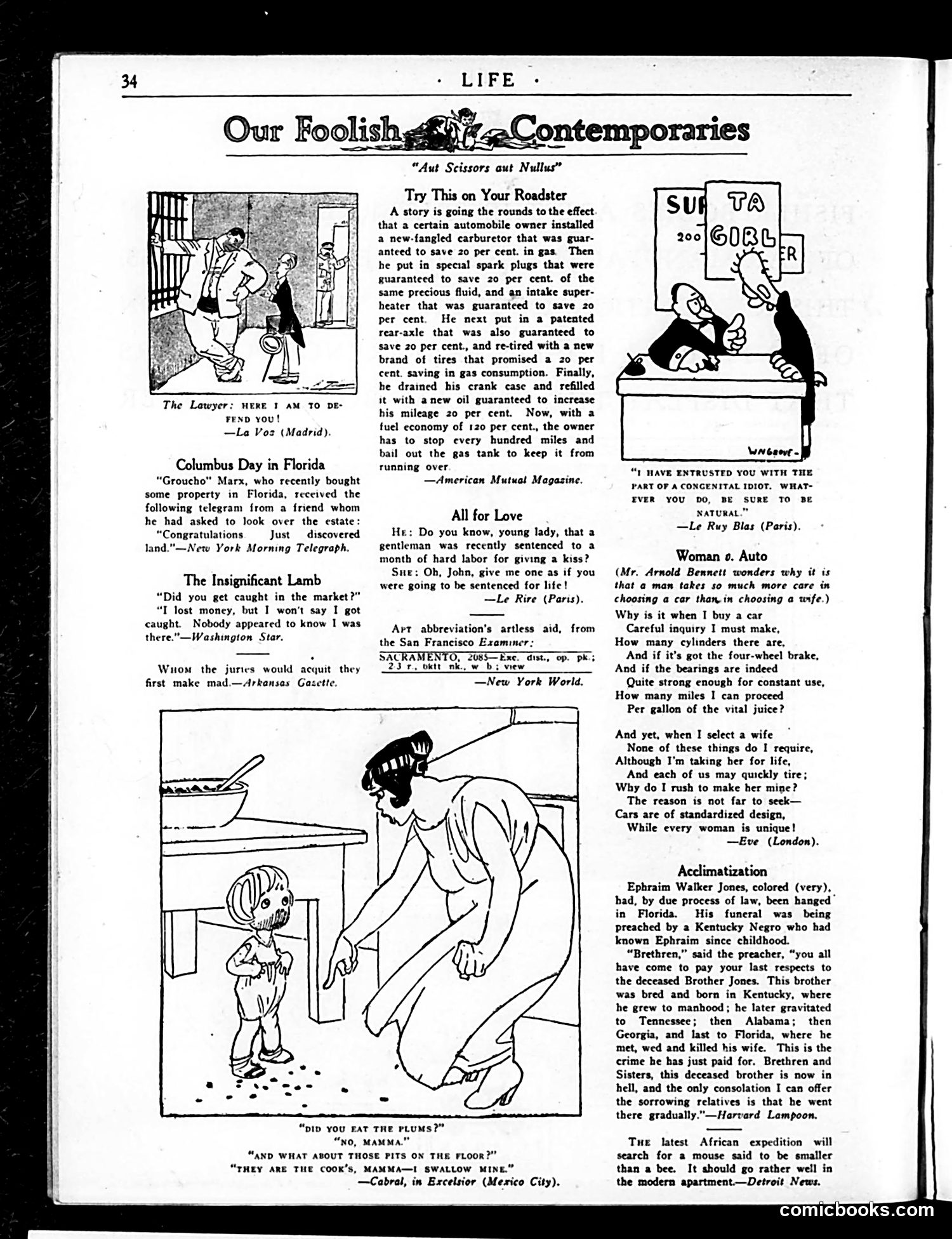
This page collects humorous anecdotes and cartoons satirizing modern life's absurdities. **Key items:** The carburetor story mocks automobile owners who fall for gadgets promising fuel savings—installing multiple devices each guaranteeing 20% savings, leading to absurd 120% fuel economy, forcing him to drain excess gas. The "Woman & Auto" poem satirizes men's illogical priorities: they meticulously research car specifications (cylinders, brakes, mileage) but carelessly choose wives without similar scrutiny—yet marriage is supposedly permanent unlike standardized cars. The irony: every woman is unique, so rational evaluation seems impossible. The "Acclimatization" piece uses dark humor about an execution in Florida, with a preacher offering grim "consolation" that the hanged man "went there gradually"—moved through states committing crimes progressively worse until execution. The cartoons and brief jokes throughout target vanity, credulity, romantic impulses, and social hypocrisy—typical of Life magazine's satirical mission during this era.
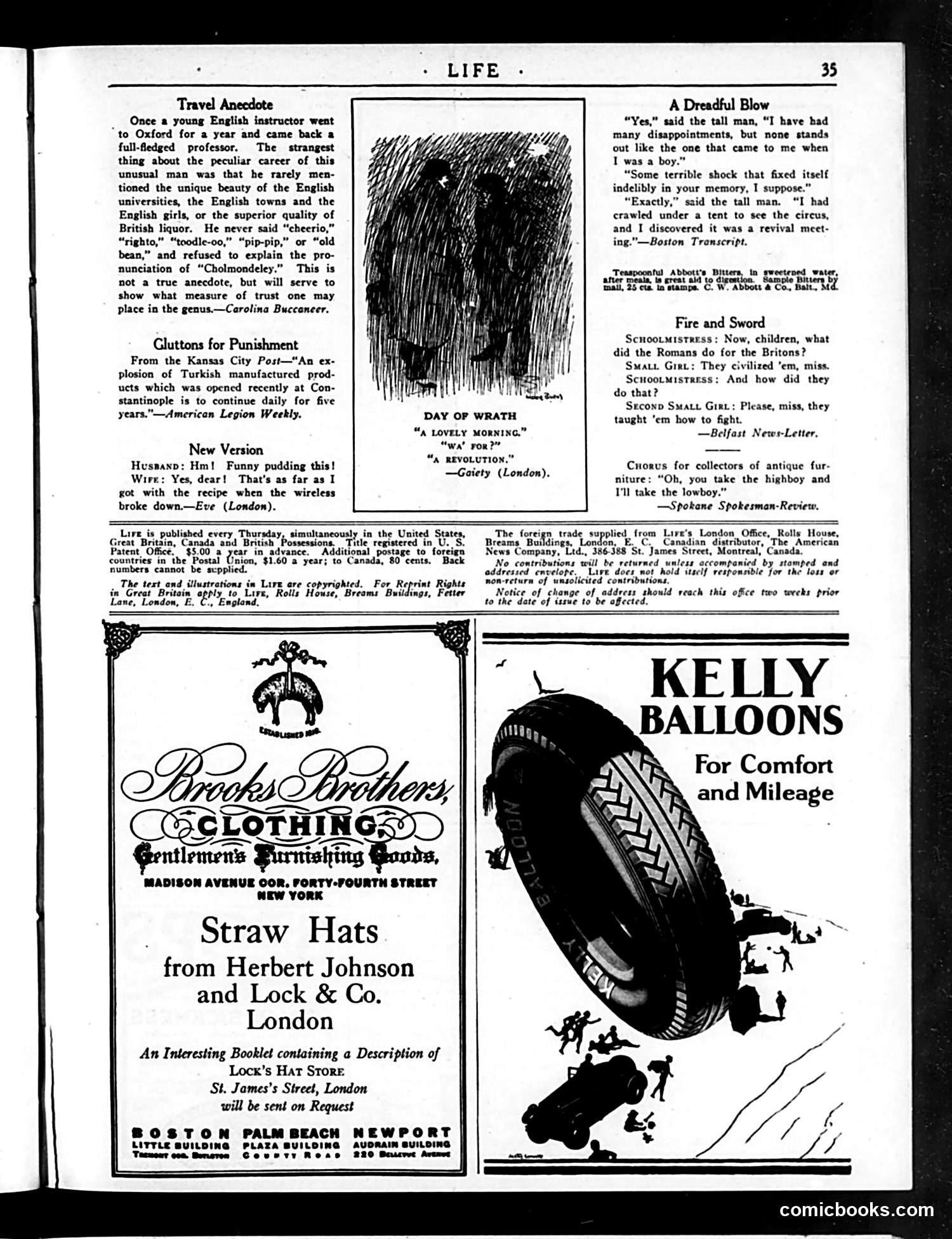
This page contains **humorous short jokes and anecdotes** rather than political cartoons. The content reflects early 20th-century Anglo-American humor: **"Travel Anecdote"** mocks people who exaggerate their sophistication after brief foreign travel, particularly the affectation of British mannerisms. **"A Dreadful Blow"** is a anticlimax joke: a man describes a devastating childhood disappointment—which turns out to be stumbling upon a revival meeting instead of a circus. The humor lies in the contrast between the dramatic setup and mundane letdown. **"Fire and Sword"** presents a schoolmistress asking what Romans did for Britons; children answer "civilized them" and "taught them to fight"—a gentle jab at romanticized imperial history and British militarism. The remaining jokes are light domestic humor about cooking and furniture. **The page is mostly advertising** (Brooks Brothers clothing, Kelly Balloons, Lock & Co. hats), typical of *Life* magazine's format. The jokes assume educated, middle-class readers familiar with British culture and period social conventions.
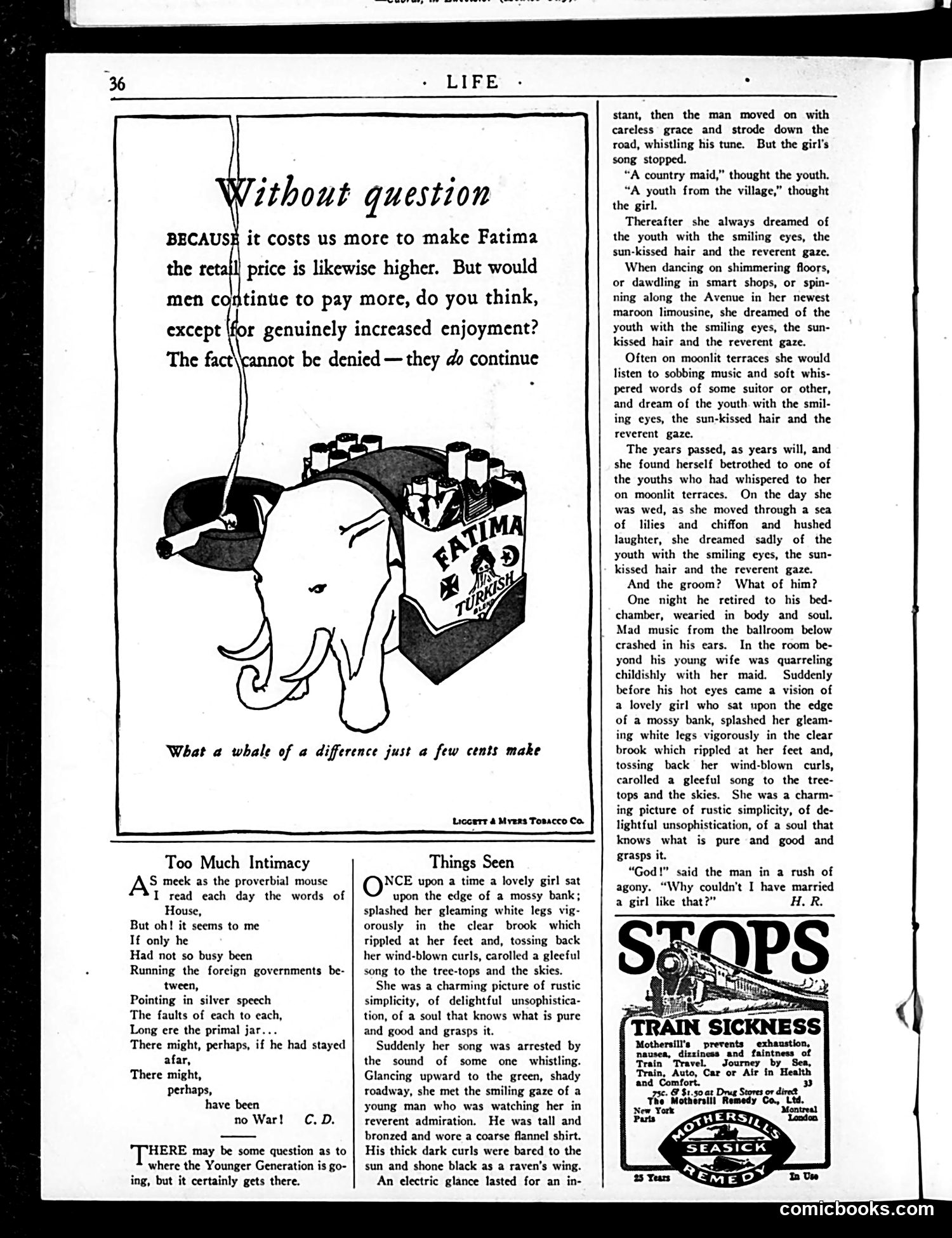
This page contains two satirical pieces and advertisements from an American satirical magazine. **"Without Question" (Fatima Cigarettes Ad):** An elephant carries cigarette boxes, illustrating that slight price increases for Fatima cigarettes don't deter buyers—the implication being consumers will pay more for genuinely superior products. This is commercial satire. **"Too Much Intimacy" (Poem by C.D.):** A political commentary, likely about American diplomatic interventions. It suggests that if a political figure (appears to reference Theodore Roosevelt or similar interventionist leader) had stayed out of foreign affairs, World War I might not have occurred. The "Younger Generation" reference and anti-war sentiment suggest post-WWI disillusionment. **"Things Seen":** A romantic short story satirizing social class and nostalgia. A country girl and village boy share a fleeting moment; she marries a wealthy suitor, he marries a disagreeable woman. Both pine for that lost rustic innocence—mocking how modern civilization (limousines, ballrooms) cannot satisfy human longing for simpler authenticity.
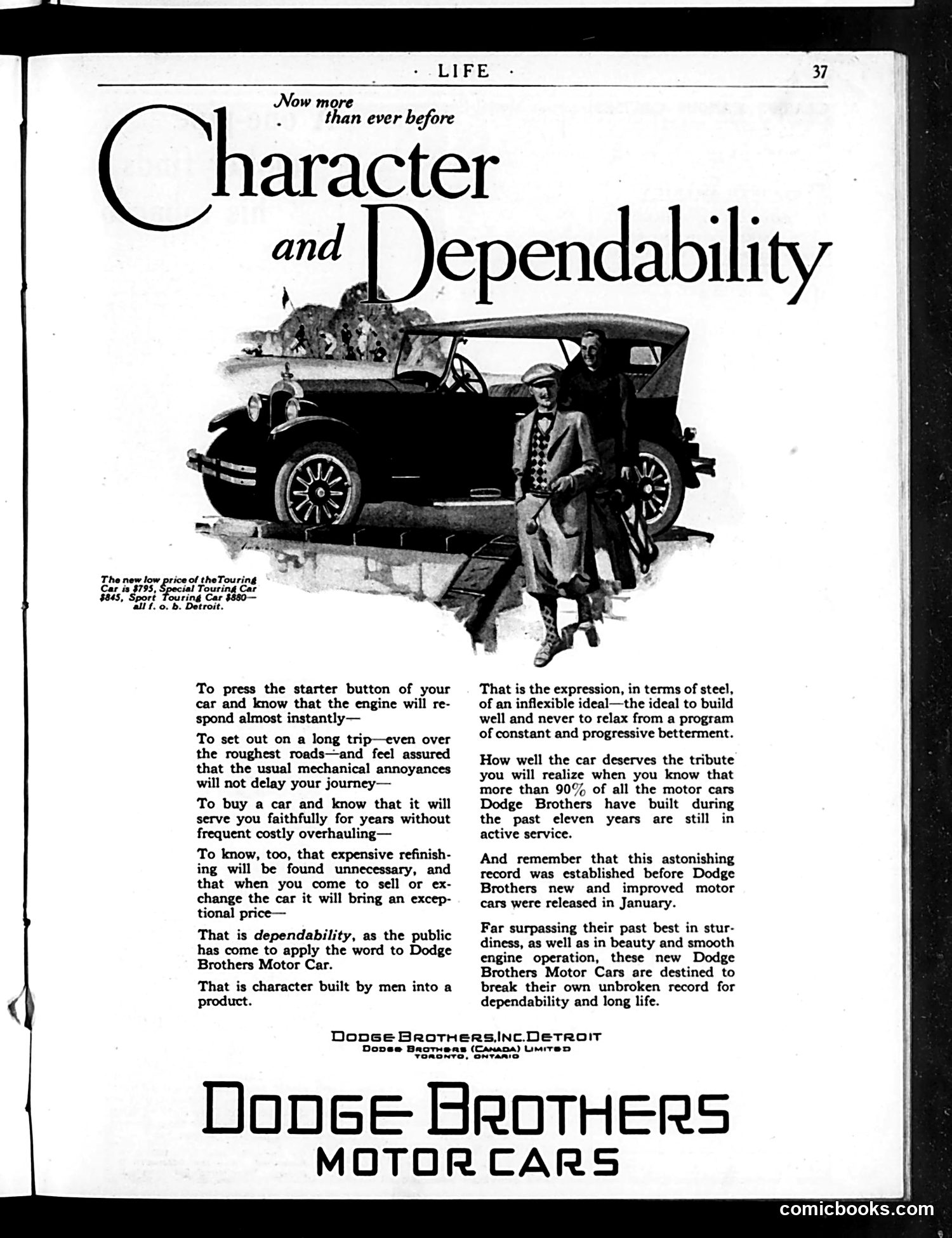
This is not a cartoon or satire—it's a **full-page advertisement for Dodge Brothers Motor Cars** in *Life* magazine. The ad emphasizes "Character and Dependability" as selling points, claiming that over 90% of Dodge cars built in the past eleven years remain in active service. The copy appeals to practical concerns: reliable engine starting, durability on rough roads, minimal maintenance costs, and strong resale value. The illustrated figure appears to be a well-dressed man standing beside a touring car, representing the reliable, respectable customer who owns such a vehicle. The ad notes new improved models were "released in January" and promises these will "break their own unbroken record." This reflects 1920s automotive marketing, when reliability and longevity were novel selling points in a rapidly expanding car market. The tone—serious and dignified rather than humorous—is typical of *Life's* advertising content, distinct from the magazine's satirical editorial material.
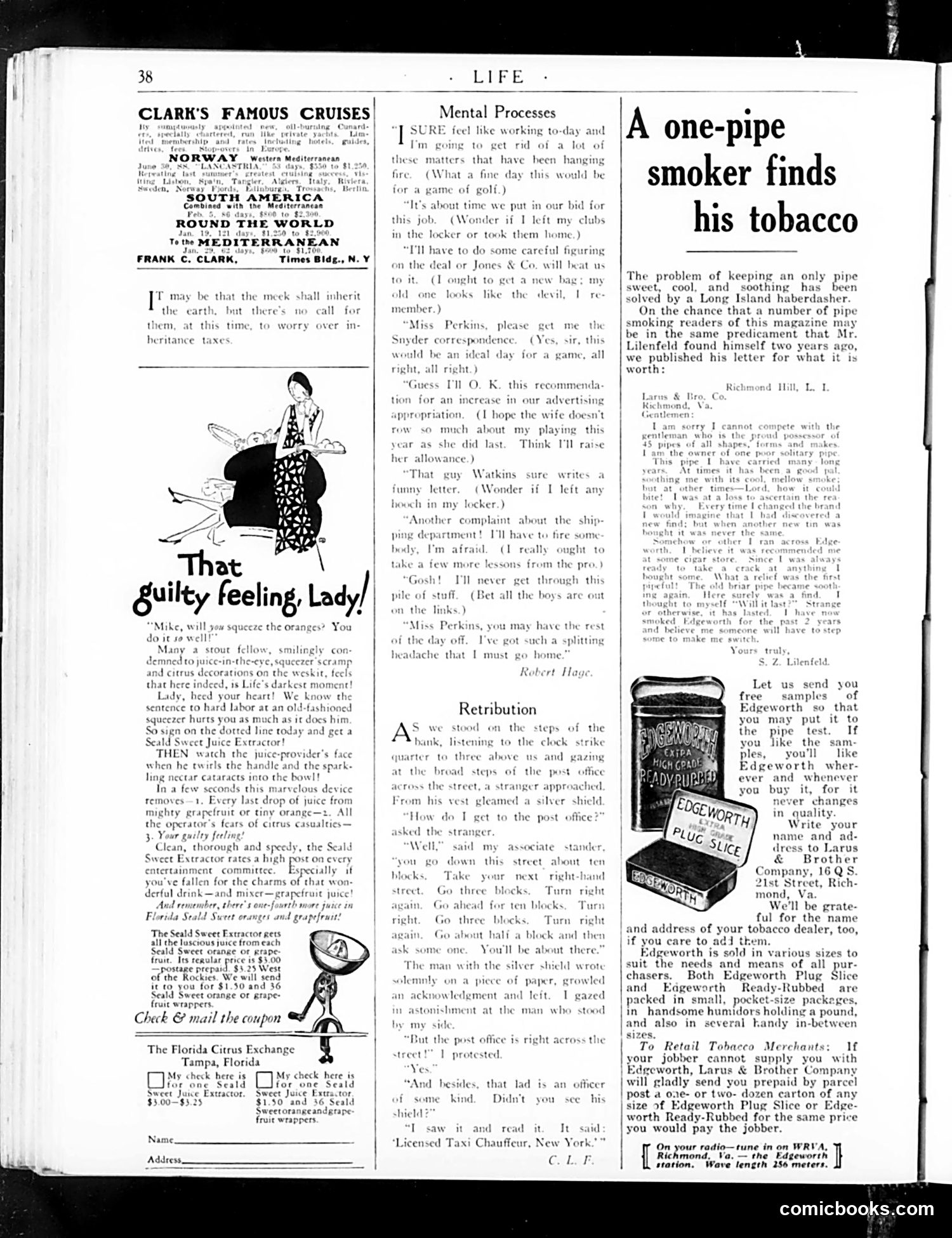
This page contains two distinct elements: **satirical comic strips** and **period advertising**. ## The Comic Strips The main cartoon titled "That guilty feeling, Lady!" depicts a businessman's stream-of-consciousness thoughts throughout his workday. The humor relies on **satirizing corporate workers' divided attention**—he mentally juggles golf games, salary negotiations, office complaints, and domestic concerns while supposedly working. This reflects early 20th-century anxieties about male breadwinners' constant preoccupation with advancement and leisure. The second strip, "Retribution," shows a stranger giving convoluted directions to the post office as apparent revenge for some unspecified prior offense. The joke plays on **everyday frustration and petty revenge**. ## The Advertising The page heavily features **product advertisements**: Seald Sweet juice extractors, tobacco products (Edgeworth Plug Slice), and cruise lines. The ads use testimonial formats and humor typical of the era. The tobacco advertisement particularly targets pipe smokers, suggesting their difficulty maintaining a "sweet, cool" smoking experience—a niche market concern now largely obsolete.
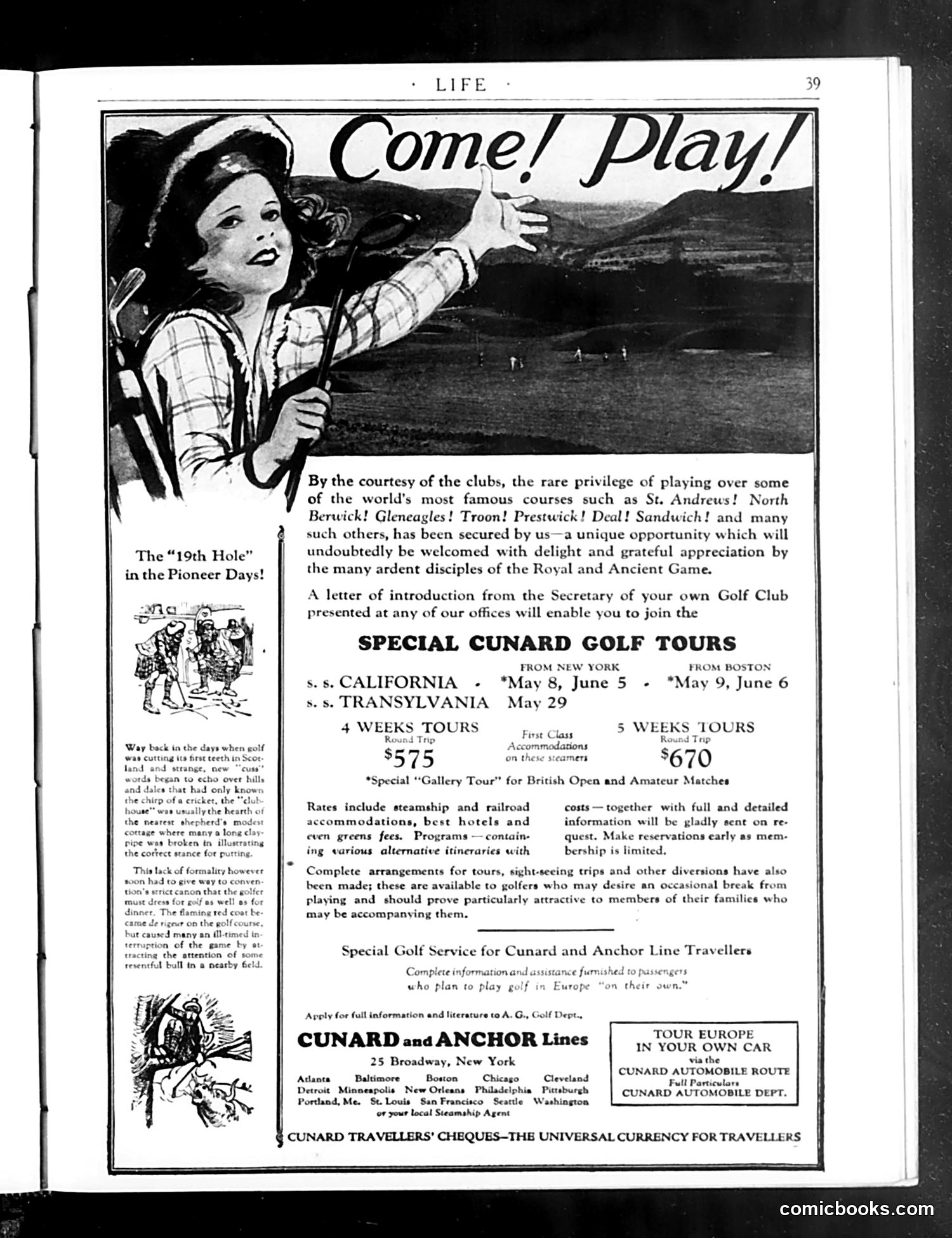
This is primarily a **Cunard shipping line advertisement** disguised as editorial content in Life magazine, not political satire. The page promotes luxury golf tours to famous Scottish and British courses (St. Andrews, Troon, Prestwick, etc.) aboard Cunard steamships. The small cartoons on the left—labeled "The '19th Hole' in the Pioneer Days"—are nostalgic illustrations depicting early golf history, not commentary on current events. They show golfers in old-fashioned attire, playing informally. The main image shows a woman in 1920s sportswear inviting readers to "Come! Play!" on prestigious golf courses. This reflects the era's marketing of golf as fashionable leisure for the wealthy. The advertisement emphasizes exclusivity: membership is limited, letters of introduction from golf clubs are required, and tours cost $575-$670 (substantial sums in this period). This targets affluent travelers seeking prestige travel experiences. **No political satire is present here**—this is straightforward consumer advertising for transatlantic golf tourism.
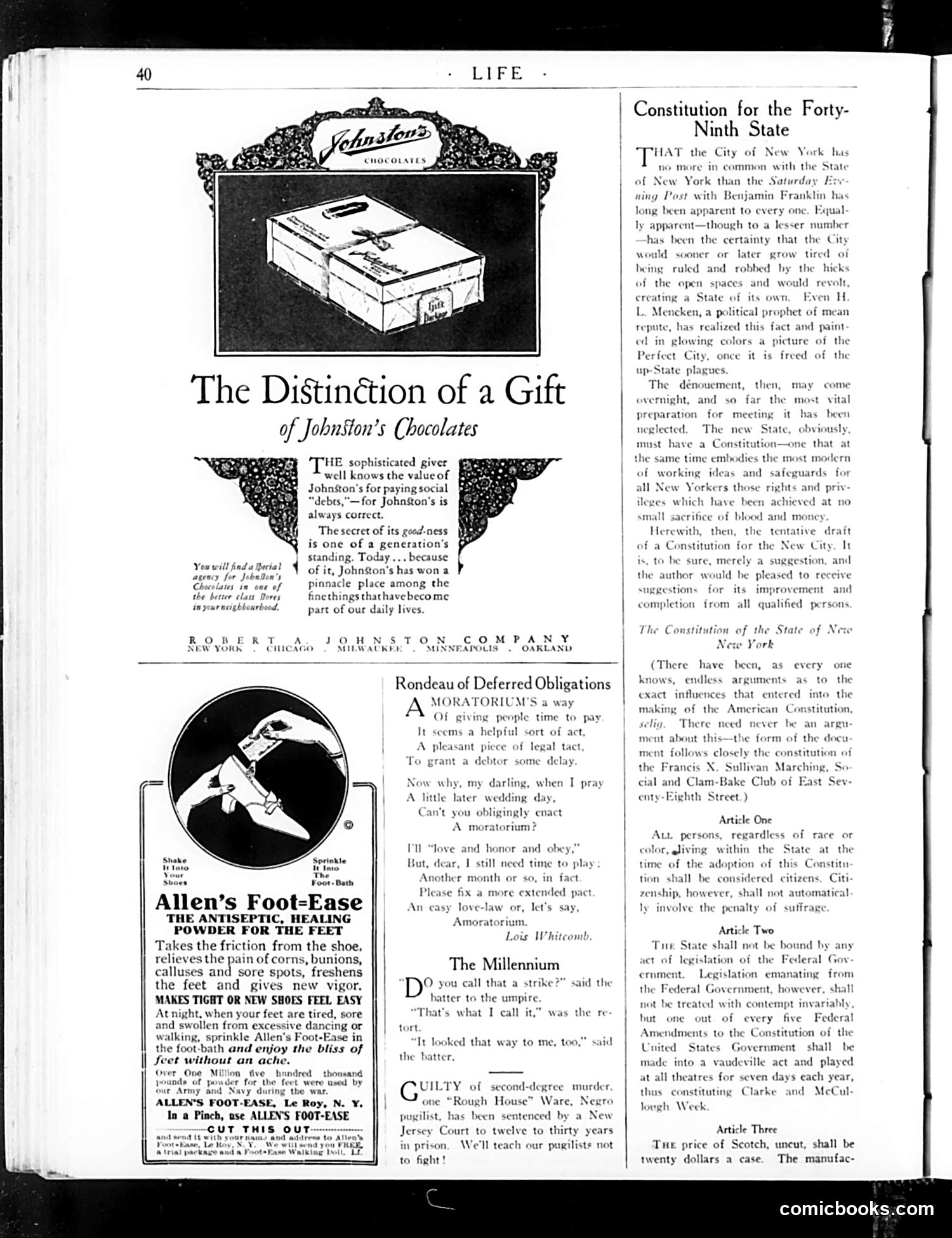
This page mixes **advertisements** with **satirical political commentary**. The main satire is "Constitution for the Forty-Ninth State"—a humorous proposal for New York City to secede from upstate New York. The author argues the city has nothing in common with rural areas ("the hicks of the open spaces") and would eventually rebel against being "ruled and robbed" by the state government. The piece presents a tongue-in-cheek draft constitution for an independent NYC, poking fun at both separatist sentiment and the endless debates about constitutional design. Supporting humor appears in "Rondeau of Deferred Obligations," mocking the concept of "moratoriums" (financial delays) by applying it absurdly to marriage vows—a husband wants to defer "love and honor and obey" to keep playing. The advertisements (Johnston's Chocolates, Allen's Foot-Ease) are straightforward period marketing, though presented with typical early-20th-century earnestness that modern readers find quaint.
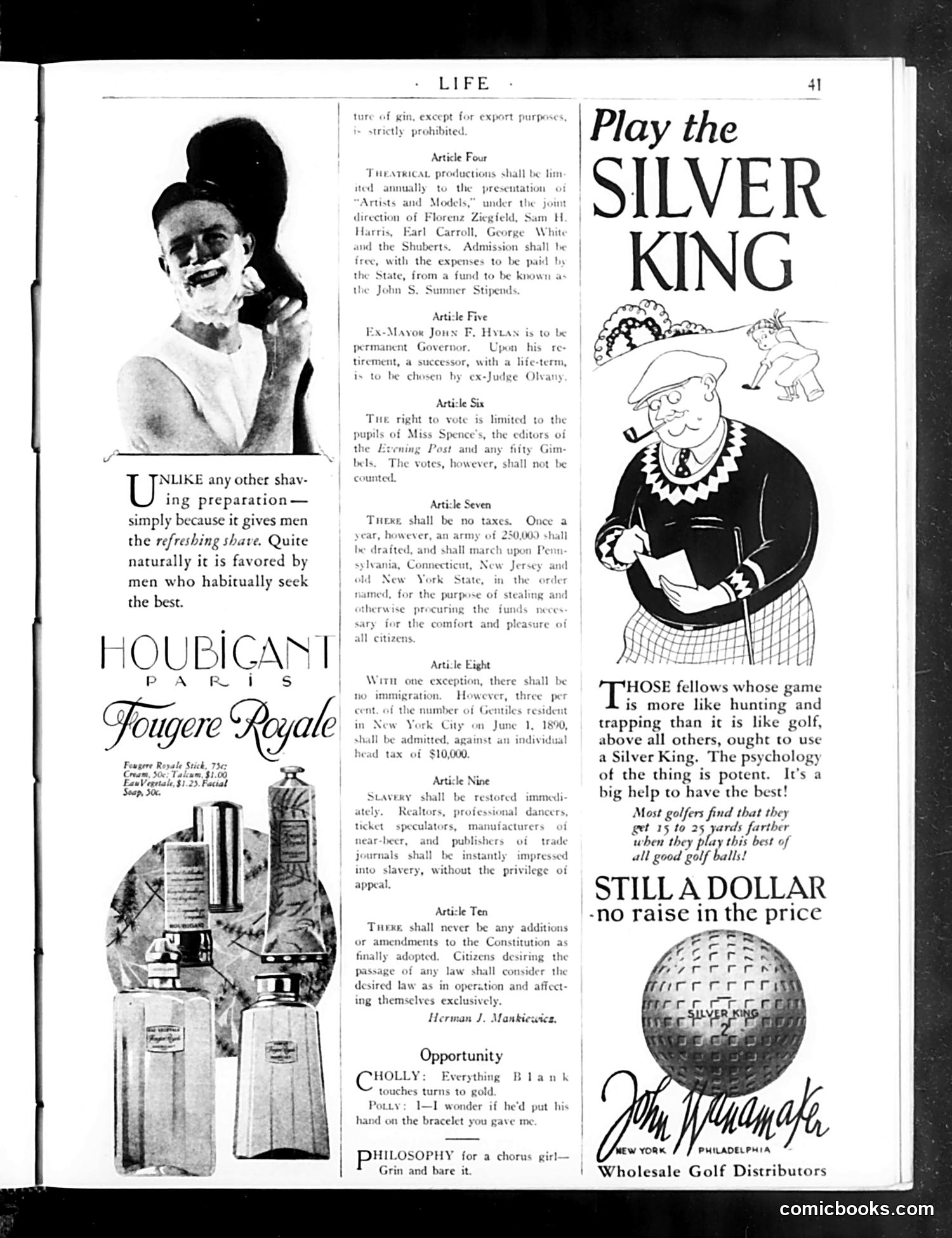
This page contains a satirical piece presenting a mock "Constitution" for what appears to be an imaginary utopian (or dystopian) society, attributed to Herman J. Mankiewicz. The articles parody both idealistic reform proposals and absurd governance ideas popular in the 1920s. Key satirical points include: eliminating taxes entirely (Article Seven), drafting armies of 250,000 annually, enslaving publishers and ticket speculators (Article Nine), and permanently freezing the Constitution against amendment (Article Ten). The reference to ex-Mayor John F. Hylan becoming "permanent Governor" suggests mockery of NYC political figures and their ambitions. The satire targets progressive Era reform rhetoric—taking sincere-sounding utopian proposals to logical absurdities. The Fougère Royale shaving cream and Silver King golf ball advertisements bookend the content, typical of Life's format mixing editorial satire with commercial ads.
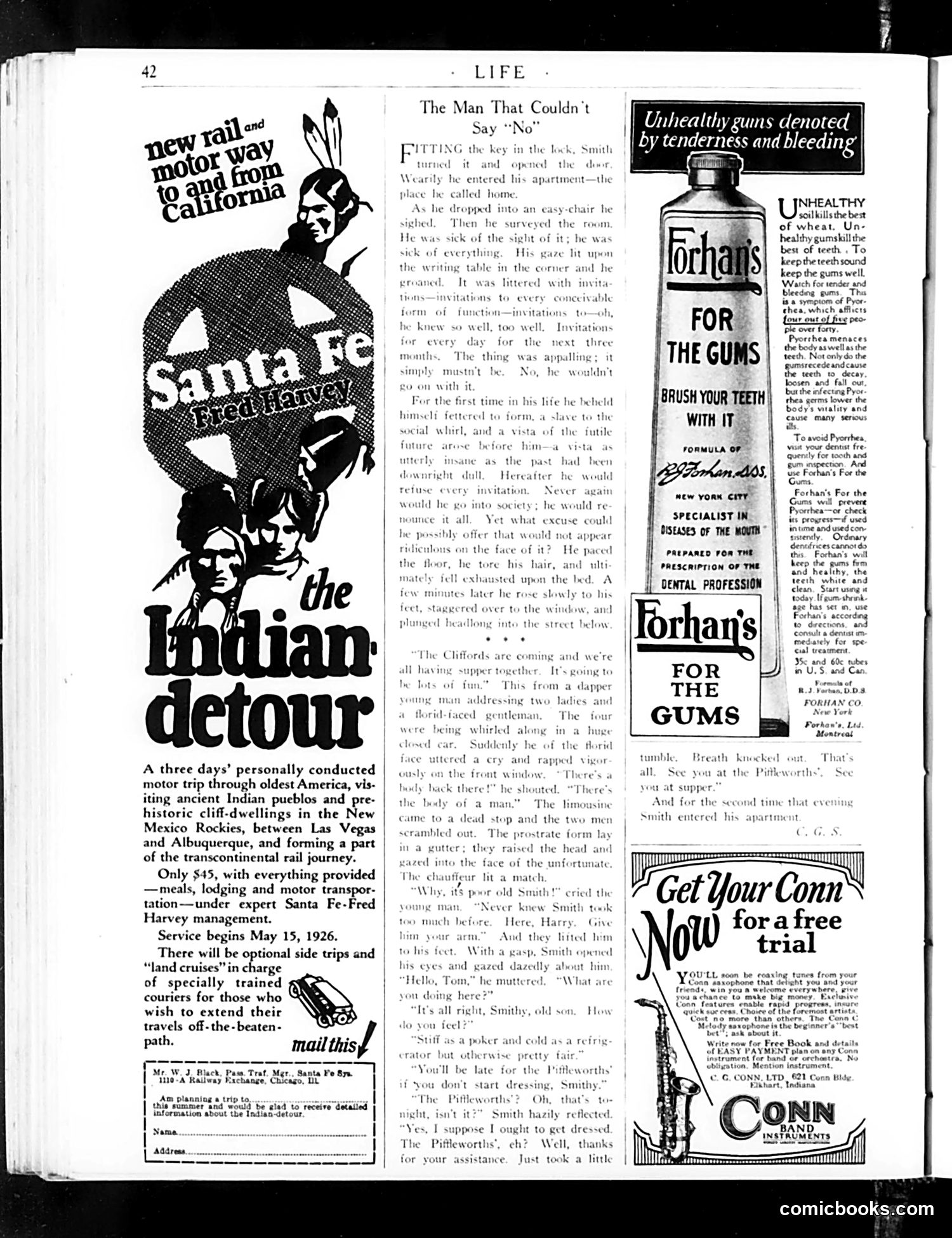
This story satirizes social weakness and the tyranny of obligation. The protagonist Smith, a man unable to refuse invitations, finds his apartment overwhelmed with social engagements—every conceivable event for the next three months. Exhausted by this relentless social whirl, he attempts to escape by attending a dinner, only to be repeatedly accosted by acquaintances demanding his attendance at yet more functions (the "Clifford" supper, the "Pillworths"). The joke targets a recognizable modern anxiety: the inability to set boundaries. Smith's predicament—drowning in unwanted social commitments—would resonate with readers as both comedic and cautionary. The satire suggests that chronic people-pleasing leads to social chaos and personal misery, not harmony. The page also features period advertisements for a Santa Fe Railway tour and Forhan's toothpaste, typical of Life's mixed editorial-advertising format.
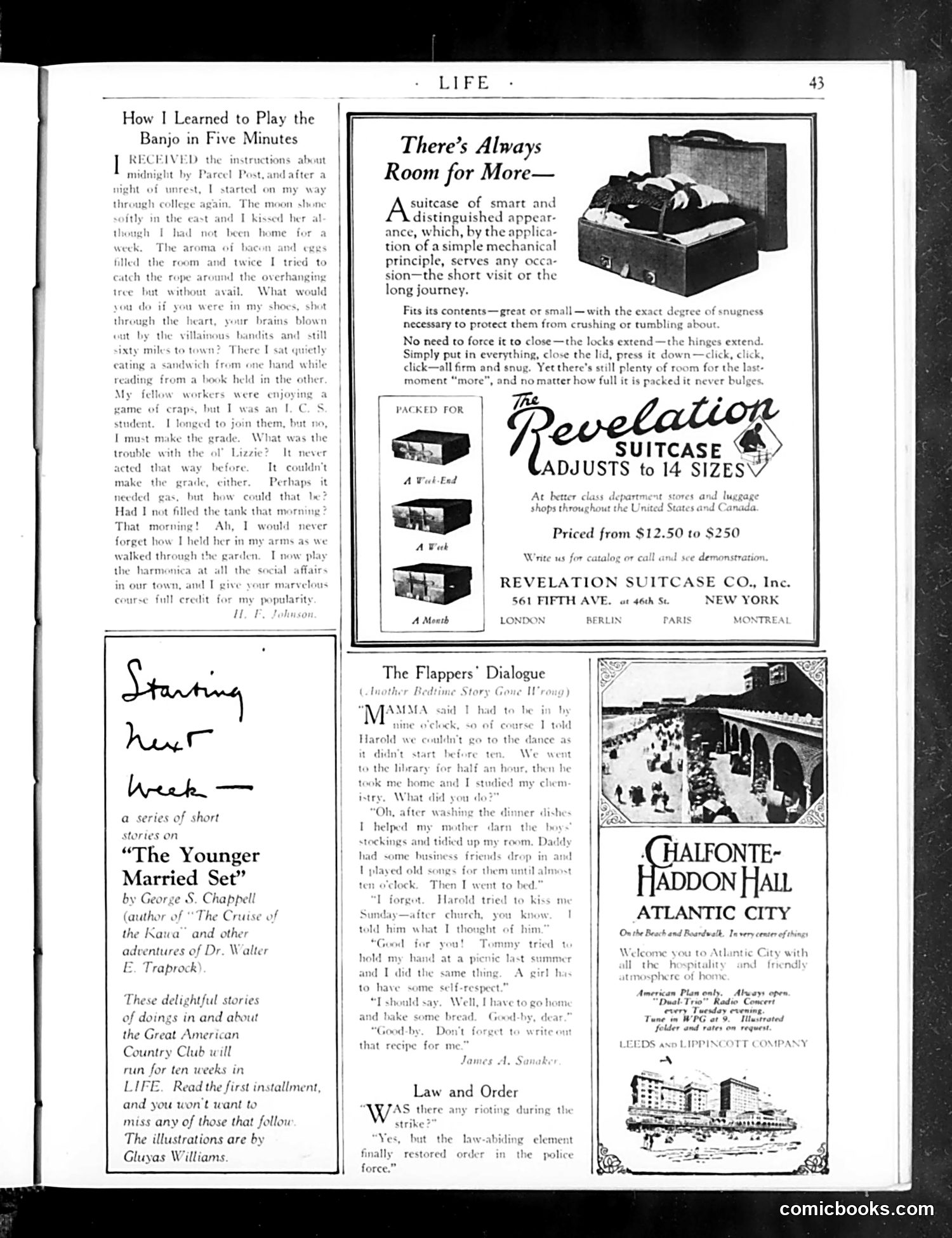
This page is primarily **advertising and literary promotion** rather than political satire. The main content includes: **"How I Learned to Play the Banjo in Five Minutes"** — a humorous first-person anecdote (by H.F. Johnson) about a moonlit mishap involving a banjo, rope, and tank-filling that somehow led to learning harmonica and gaining social popularity. It's gentle comedy about urban/college life. **The Revelation Suitcase advertisement** dominates the right side, promoting luggage that "adjusts to 14 sizes" with smart engineering features—targeting travelers of the 1920s era. **"The Flappers' Dialogue"** advertises an upcoming serialized story by George S. Chappell about "The Younger Married Set," targeting readers interested in contemporary domestic humor. **"Law and Order"** appears to be another story preview about police restoring order after strikes—likely referencing labor unrest common in this period. The page reflects 1920s consumer culture and entertainment interests rather than political commentary.
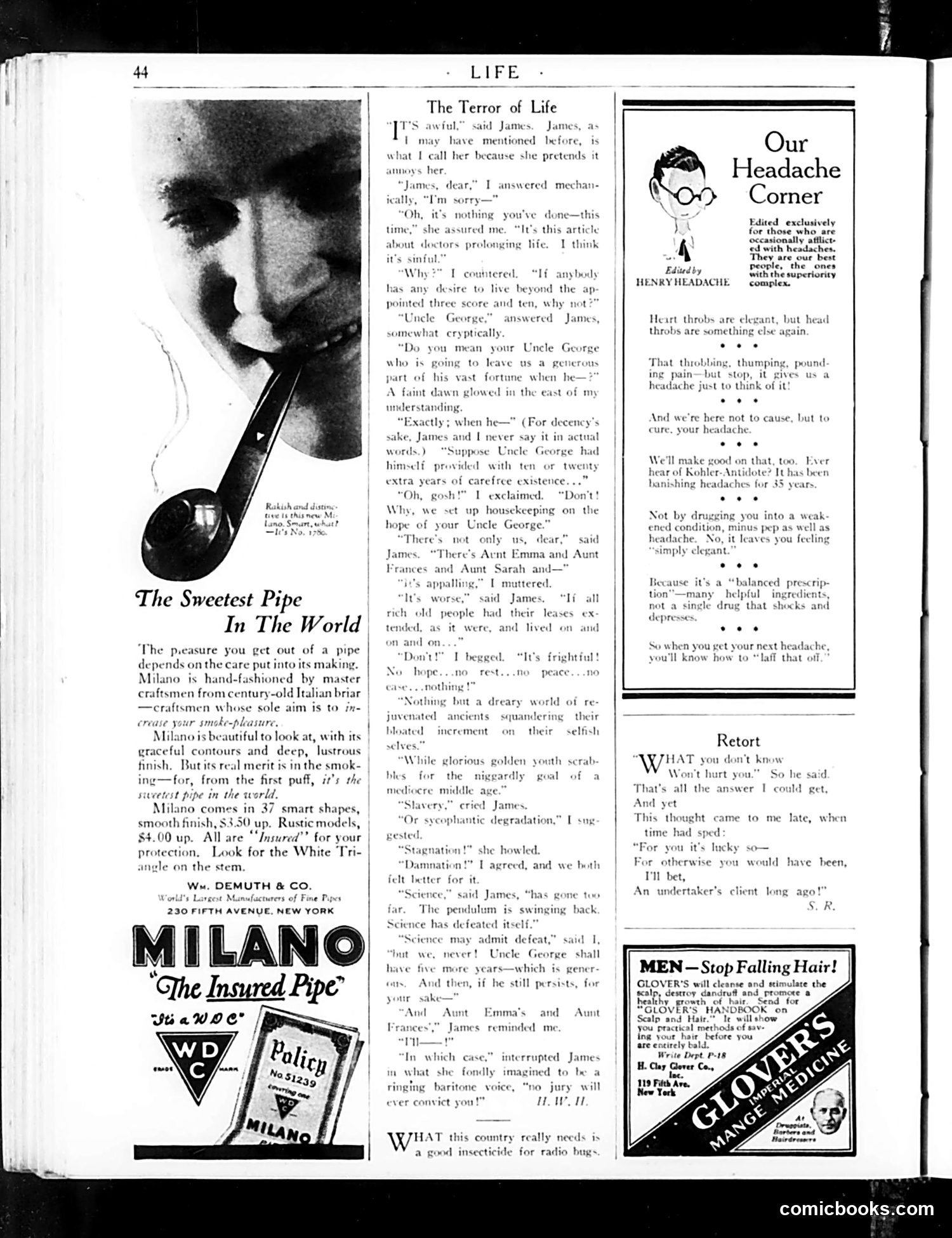
This page is primarily **advertising and advice columns** rather than political satire. The main content includes: **"The Terror of Life"** — A conversational piece where characters debate whether doctors should extend human lifespans beyond "three score and ten" (70 years). The satirical point: extending life creates a nightmare of perpetual old age—elderly relatives like Uncle George clinging to existence while squandering inheritance, trapped in stagnation. The dark humor suggests prolonging life without purpose is worse than mortality itself. **Advertisements** dominate: Milano pipes, Glover's hair tonic, and a headache remedy occupy significant space, typical of 1920s-era Life magazine's revenue model. **"Our Headache Corner"** offers tongue-in-cheek medical advice about headaches, positioning itself as helpful while subtly advertising remedies. The overall tone reflects Jazz Age anxieties about aging, mortality, and consumer culture's promises of solutions to life's problems. No specific political figures are caricatured.
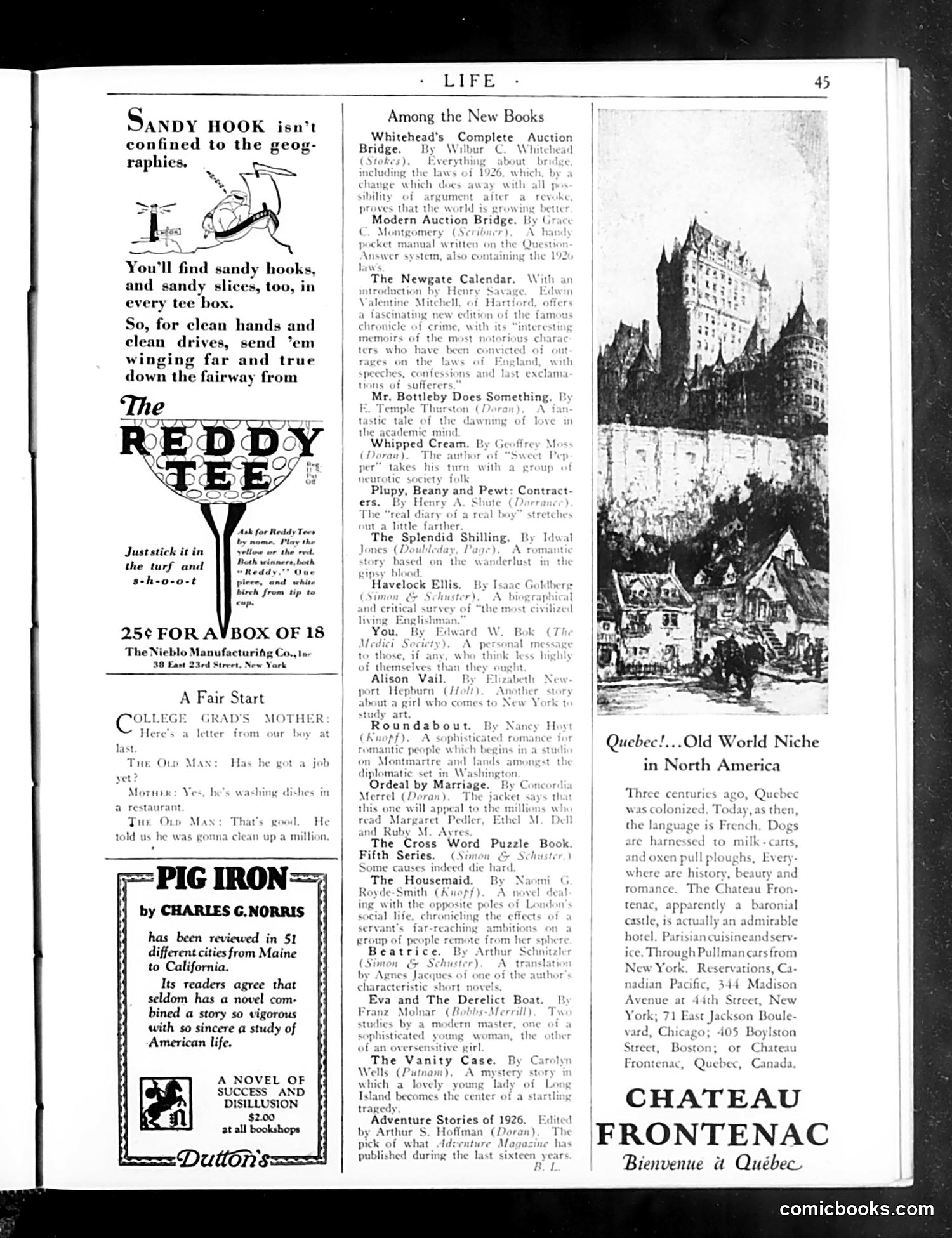
This page contains **no political cartoons**—it's primarily advertising and book reviews from *Life* magazine. The main visual element is a **golf equipment advertisement** for "Reddy Tees," which uses a pun on "Sandy Hook" (a geographic location) to humorously suggest that golfers encounter sandy terrain at the tee box. The cartoon shows a simple golfer figure, but it's purely commercial humor, not satire. The page also includes: - An advertisement for Charles G. Norris's novel *Pig Iron*, described as a study of "American life" - A humorous dialogue ("A Fair Start") between a college graduate's mother and "the Old Man" about the son's job prospects—light domestic comedy, not political satire - Book reviews and a tourism advertisement for Chateau Frontenac in Quebec **No political or social satire is present.** This is a typical magazine page mixing commercial advertising with light entertainment content.
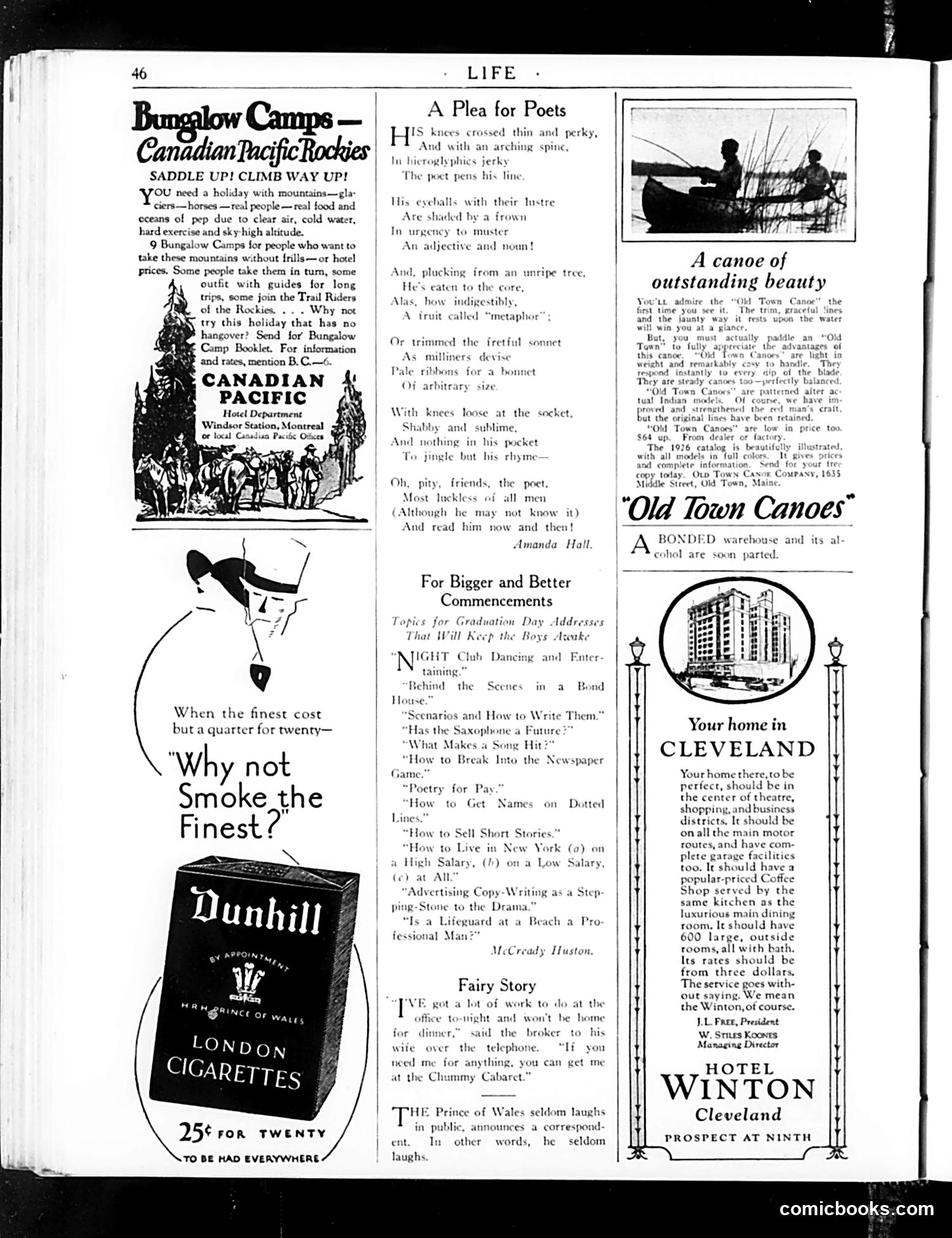
This page combines satirical poetry and advertisements from what appears to be the 1920s-30s era. **"A Plea for Poets"** by Amanda Hall mocks struggling poets as impoverished, disheveled figures—knees "loose at the socket," nothing in their pockets but rhymes. The poem satirizes their pretentious creative process (eating unripe fruit and calling it "metaphor," trimming sonnets with "pale ribbons"). The satirical point: poets are pitiful, broke dreamers deserving pity, not respect. **"Fairy Story"** is a brief joke about a broker's wife who, told she can reach him at "the Chummy Cabaret," realizes he's using an excuse to go out drinking rather than work. **The final joke** plays on Prohibition-era hypocrisy: a bonded warehouse's "alcohol are soon parted"—meaning customers steal it, contradicting the supposed security of bonded storage. The remaining content is straightforward advertising for Canadian Pacific Hotels, Dunhill cigarettes, Old Town Canoes, and the Winton Hotel in Cleveland.
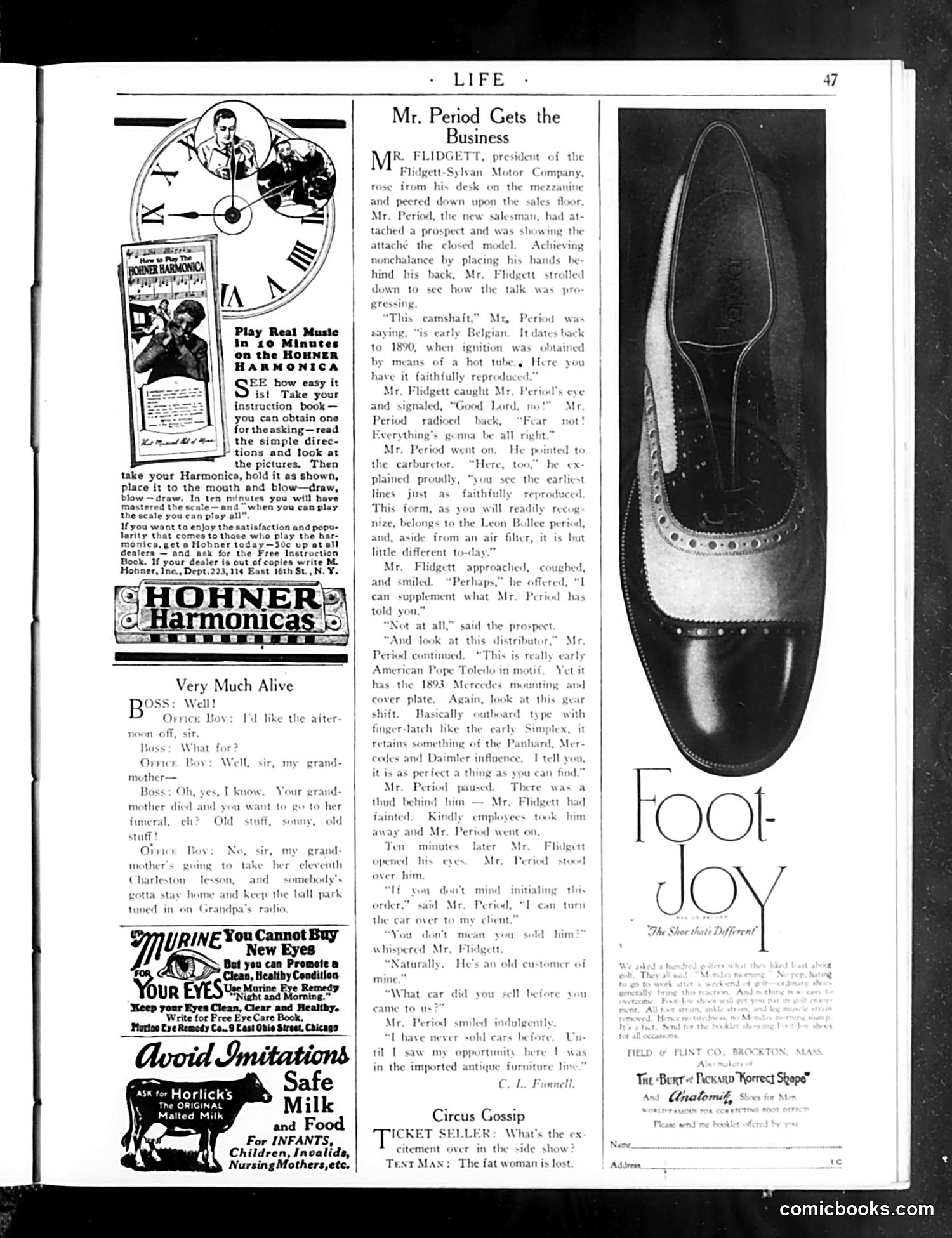
This humorous article satirizes an overeager car salesman named Mr. Period who bores a prospect with exhaustive historical details about automobile components. The joke centers on Period's relentless, pedantic monologue—explaining how a camshaft dates to 1890 Belgian design, tracing influences from Leon Bollee, Pope Toledo, and Mercedes engineering. The satire targets salesmanship excess: Mr. Period's boss, Mr. Flidgett, watches anxiously from above, ultimately fainting from the ordeal. Despite the prospect's clear disinterest ("Not at all"), Period persists for ten minutes before Flidgett collapses. The humor lies in the contrast between Period's technical pomposity and the simple transactional reality: a customer wants to buy a car, not a automotive history lecture. The accompanying comic vignettes (boss/office boy exchange about funerals; circus gossip) reinforce the magazine's satirical approach to everyday American absurdities.
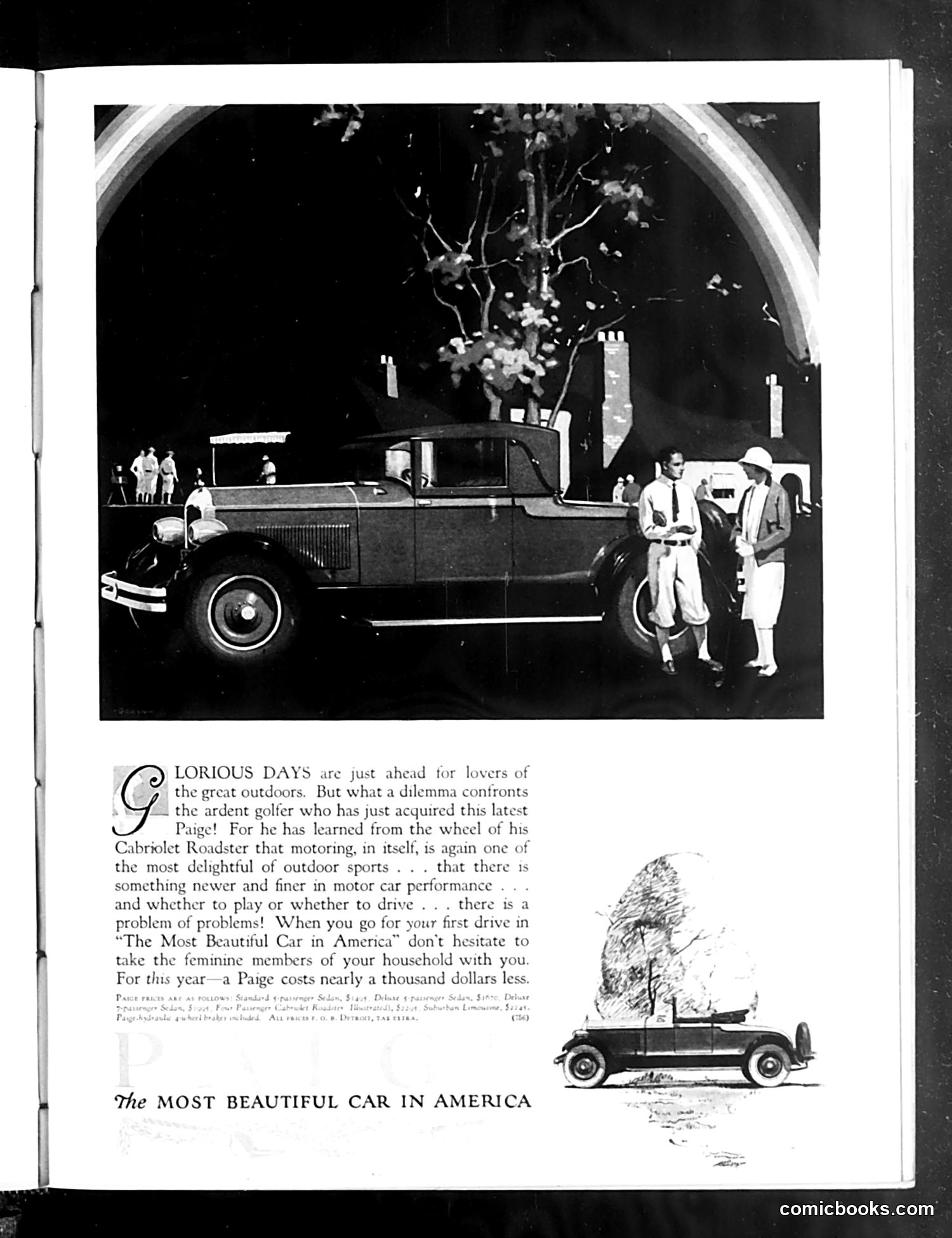
This is a **Paige automobile advertisement**, not political satire. The ad presents a humorous "dilemma" for a wealthy golfer: now that he owns this stylish Paige Cabriolet Roadster, he's torn between golfing and driving—motoring itself has become an equally appealing leisure activity. The joke targets affluent readers: the car is so pleasurable that recreational driving competes with established gentleman's sports. The staged nighttime photo shows the car as a glamorous social centerpiece, with well-dressed figures admiring it. The pitch emphasizes the car's beauty, performance, and that this year's model costs "nearly a thousand dollars less"—appealing to wealthy but price-conscious buyers. The suggestion to bring "feminine members of your household" reflects 1920s-era advertising that positions cars as family entertainment. This is straightforward luxury marketing using humor, not commentary on social or political issues.
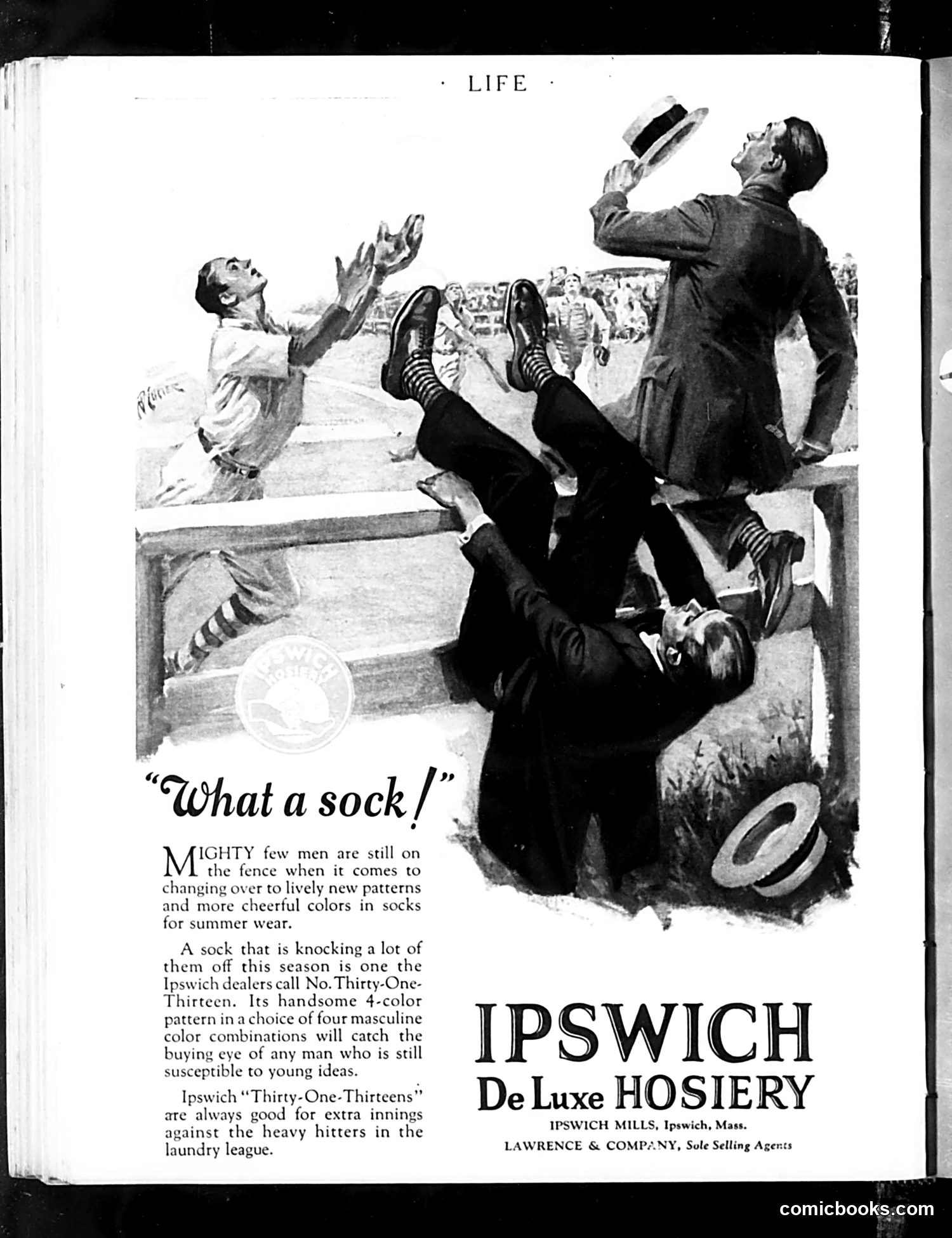
This is primarily an **advertisement for Ipswich De Luxe Hosiery**, not political satire. The humor is gentle and commercial rather than satirical. The illustration shows men at a baseball game enthusiastically reacting to socks—one man tosses his hat in celebration while another reclines with legs up, displaying colorful socks. The joke plays on the idea that stylish socks are exciting enough to warrant passionate fan-like reactions, mimicking baseball stadium enthusiasm. The text uses sports metaphors ("extra innings," "heavy hitters in the laundry league") to market the socks' durability and appeal. The phrase "What a sock!" is a pun—"sock" meaning both hosiery and an exclamation of surprise or approval. This reflects 1920s-30s advertising humor: treating mundane products (socks) as worthy of excitement to appeal to male consumers hesitant about adopting brighter colors and patterns for summer wear.