
Life, 1926-05-06 · page 28 of 52
Life — May 6, 1926 — page 28: what you’re looking at
What you’re looking at
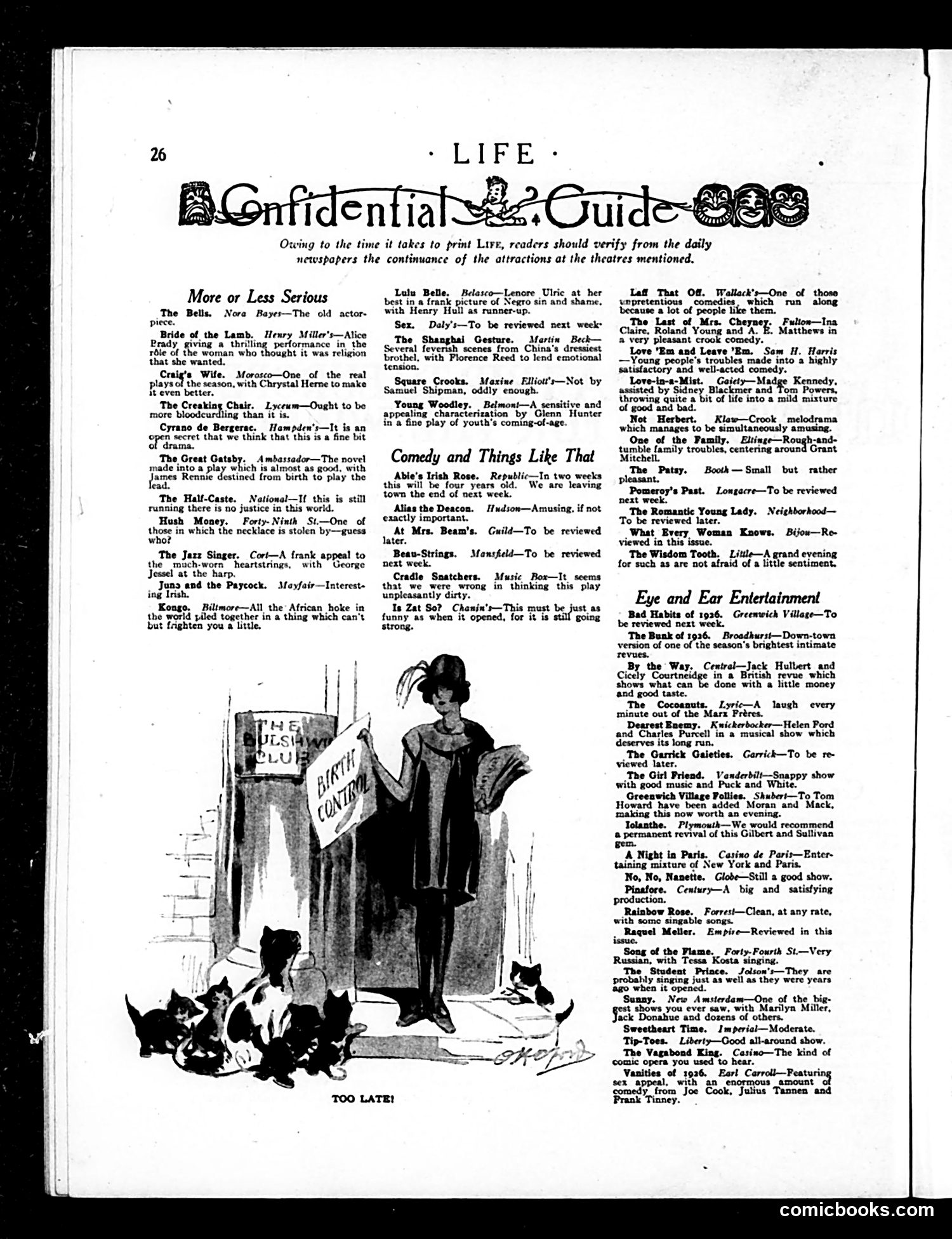
The cartoon depicts a woman in fashionable 1920s dress standing before theater advertisement boards, surrounded by black cats. The caption reads "TOO LATE!" **The Joke:** This is a visual pun on superstition. The woman appears to be trying to enter a theater, but is blocked or delayed by numerous black cats—traditionally considered bad luck omens. The "too late" caption suggests she's missed her show due to the superstitious impediment these cats represent. **Context:** This appears on a theater review page, so the humor plays on the old theatrical superstition that black cats bring misfortune. The cartoon gently mocks both superstitious beliefs and theater-goers' anxieties about missing performances. The illustration style and fashion suggest the 1920s Jazz Age, when such superstitions remained culturally prevalent despite modernization. The cartoon serves as light entertainment accompanying the page's serious theater reviews and listings.
📄 Transcribed text from this page (OCR, searchable)
Machine-transcribed from the original scan — historical spelling and the odd misread are preserved.
wing to the time it takes to print Lire, readers should verify from the daily newspapers the continuance of the attractions at the theatres mentioned. Lulu Belle, Belasco—Lenore Ulric at h Laff That Off, Wallack's—One of those More or Less Serious best in a frank picture of Negro sin and shame, unpretentious _ comedies which “run along The Bells, Nora Bayes—The old actors With Henry Hull as runner-up. Decaune a lot of peoste Fulion—Ina piece. Fas 5 The Last of Bride of the Lamb. Henry Miller's—Alice <= pee sd ied oe aoe peg’ Relind! voung sod’ wa va Matthews in Brady, giving a thrilling performance in. the several fevertsh scenes from China's dressicst "Love Bm and Leave Em. Som H. Harris role of the woman who thought it was religion brothel, with Plorence Reed to lend emotional Young people's troubles made into a tighly inte es eatin eh Chey eae cae “eek Greeks Maichmmute=Metity” ot Lancione ena Kennedy, Reken betters ow te Chrystal Heme tomake s.otel' Shipman, oddly enough. assisted by Sidney Blackmer and foo Powers, The Creaking Chair. Lyceum—Ought tobe Young Woodley. Belmoni—A sensitive and {"owin Gute 9 bit of life into a mild miners more bloodcurdling than it is. appealing characterization by Glenn Hunter Not Herbert. Klow—Crook_ melod Cyrano de Bergerac. Hampden's—It is an i 4 fine play of youth’s coming-of-age. which manages to be simultaneously amusing. a secret that we think that this is a fine bit One of the Family. Eltinge—Rough-and- ofdrama, tumble family troubles, centering around Grant The Great Gataby. | 4 mbassodor—The novel Comedy and Things Like That — Mitchen ic i t 00d, ith _ fstined from birth to play the _ Able's Irish Rose. Republic—In two weeks pinta, Paty Booth Small but rather made into a play w janes Rennie L. this will be four years old. We are leaving Pomeroy’s Past. Longacre—To be reviewed The Half-Caste. National—It this is stil WT the end of next week. ane sece— To be reve running there is no justice in this world. Alias the Deacon. Hudion—Amusing. if not “The Romantic Young Lady. Neighborhood— Hush Money. Forty-Ninth St.—One of exactly important. To be reviewed later. those in which the necklace is stolen by—guess At Mrs. Beam's. Guild—To be reviewed What Every Woman Knows. Bijou—Re- who? later. viewed in this issue. The Jazz Singer. Cor'—A frank appeal to __Beau-Strings. Mansfeld—To be reviewed The Wisdom Tooth, Litil—A grand evening the much-worn heartstrings, with George next week. for such as are not afraid of a little sentiment. Jessel at the harp. Cradle Snatchers. Music Bor—It seems Juno and the Paycock. Mayfair—Interest- that we were wrong in thinking this play ing Inah. unpleasantly dirty. Eye and Ear Entertainment Kongo. Biltmore—All the j{iricen toke in Is Zat So? Chanin's—This must be just as the world piled together in a thing which can't funny as when it opened, for it is stilf going | Bad Habits of 1926. Greenwich Village—To but frighten you a little, strong. “Ine Bunk of 1926. Broadhurst—Down-town version of one of the season's brightest intimate revues. By the Way. Central—Jack Hulbert and Cicely Courtneldge in a British revue which shows what can be done with a little money good taste. ‘The Cocoanuts. Lyric—A laugh every minute out of the Mars Freres. Dearest Enemy. Keicherbocker—Hielen Pord and Charles Purcell in a musical show which deserves its long run. The Garrick Gaieties. Garrick—To be re- viewed later. The Girl Priend. Vanderbilt—Snappy show with good music and Puck and White. Greenwich Village Follies. Shuber—To Tom Howard have been added “Moran and Mack, making this now worth an evening. Tolanthe. Plymouth—We would recommend a permanent revival of this Gilbert and Sullivan gem. Night in Paris. Casino de Paris—Enter- taining mixture of New York and Paris. No, No, Nanette. Globe—Still a good show. Pinafore. Century—A big and satisfying juction, Rainbow Rose. Forrest—Clean, at any rate, with some singable songs. , Raquel Meller. Empire—Reviewed in this issue. Song of the Flame. Forty. Fourth St—Very Russian, with Tease Kosta singing. a, Student Prince. Jolson's —They are probably ining just as weil as they were y ago "when! it opened. rote if Sunny. New Amsterdam—One of the big- t shows you ever saw, with Marilyn Miller, Jock "Donattuc and dosens of of Sweetheart Time. Jmperial—Moderate. Tip-Toes. Liberty—Good all-around show. ‘The Vagabond King. Cosino—The kind of comic opera you used to hear. Vanities, of 1926. Earl Nor ppeal, sh Somedy from Joe Cool. Julius Tannen and Frank Tinney. comicbooks.com