
Life, 1926-05-06 · page 29 of 52
Life — May 6, 1926 — page 29: what you’re looking at
What you’re looking at
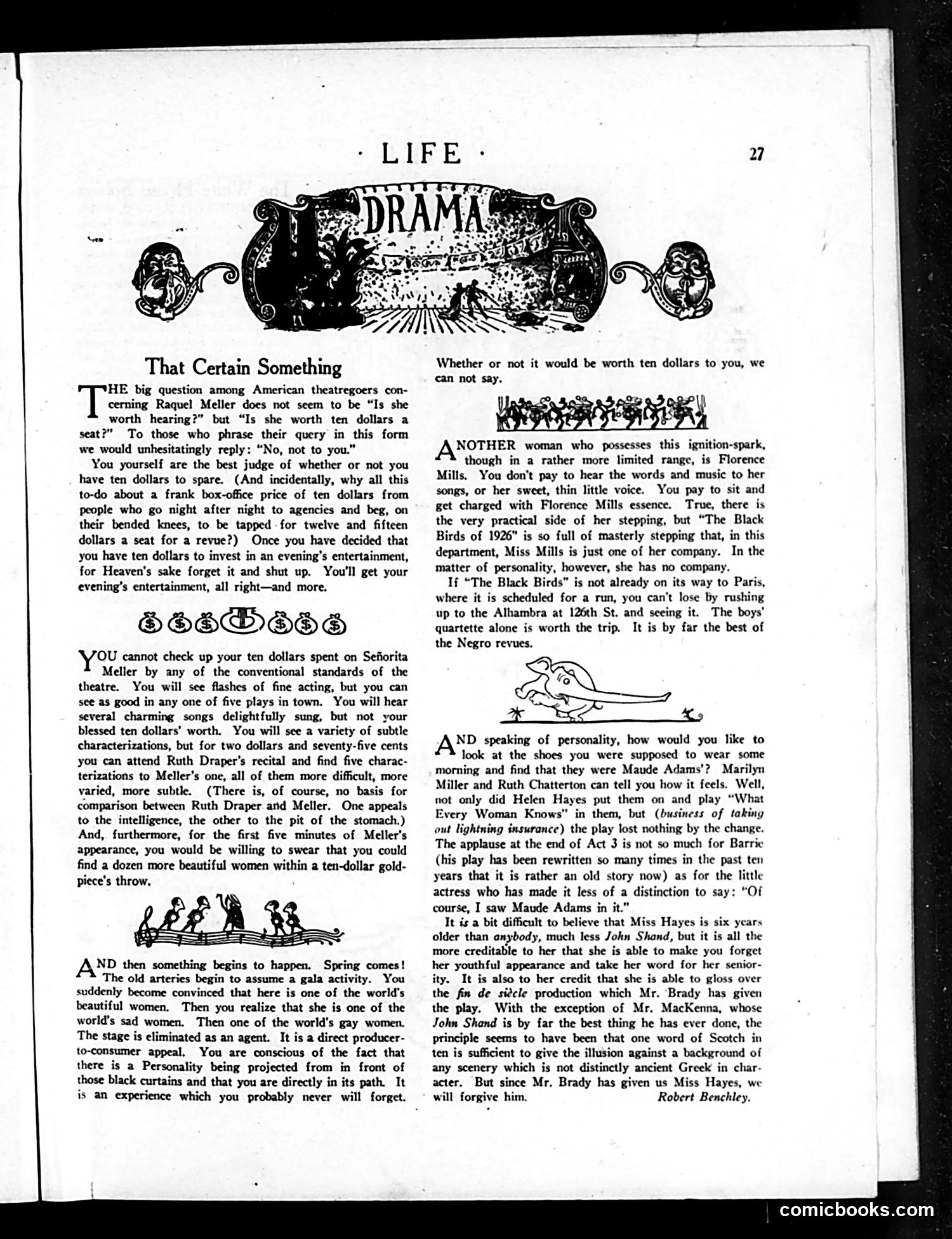
This page critiques the theatrical phenomenon of performer "personality" versus conventional talent. The writer argues that Spanish singer Raquel Meller's ten-dollar ticket price cannot be justified by objective measures—her acting, singing, or dancing aren't exceptional compared to cheaper alternatives like Ruth Draper's recitals. However, the article describes a mysterious transformation: once Meller performs, audiences experience pure charisma—a direct "personality" projection that transcends the stage itself. The writer compares this to Florence Mills, the African American performer whose essence captivates audiences at the Alhambra Theatre's "Black Birds of 1926" revue. The piece celebrates this indefinable star quality, arguing that certain performers—like Helen Hayes—possess an almost magical ability to elevate mediocre material simply through their presence. The satire targets theater-goers who demand rational justification for emotional, personality-driven entertainment while simultaneously patronizing agencies for expensive tickets.
📄 Transcribed text from this page (OCR, searchable)
Machine-transcribed from the original scan — historical spelling and the odd misread are preserved.
That Certain Something HE big question among American theatregoers con- cerning Raquel Meller does not seem to be “Is she worth hearing?” but “Is she worth ten dollars a seat?” To those who phrase their query in this form we would unhesitatingly reply: “No, not to you.” You yourself are the best judge of whether or not you have ten dollars to spare. (And incidentally, why all this to-do about a frank box-office price of ten dollars from people who go night after night to agencies and beg, on their bended knees, to be tapped -for twelve and fifteen dollars a seat for a revue?) Once you have decided that you have ten dollars to invest in an evening's entertainment, for Heaven's sake forget it and shut up. You'll get your evening’s entertainment, all right—and more. NENG ENON) you cannot check up your ten dollars spent on Sefiorita Meller by any of the conventional standards of the theatre. You will see flashes of fine acting, but you can see as good in any one of five plays in town. You will hear several charming songs delightfully sung, but not your blessed ten dollars’ worth. You will see a variety of subtle characterizations, but for two dollars and seventy-five cents you can attend Ruth Draper’s recital and find five charac- terizations to Meller’s one, all of them more difficult, more varied, more subtle. (There is, of course, no basis for comparison between Ruth Draper arid Meller. One appeals to the intelligence, the other to the pit of the stomach.) And, furthermore, for the first five minutes of Meller’s appearance, you would be willing to swear that you could find a dozen more beautiful women within a ten-dollar gold- piece’s throw, A®D then something begins to happen. Spring comes! The old arteries begin to assume a gala activity. You suddenly become convinced that here is one of the world’s beautiful women. Then you realize that she is one of the world’s sad women. Then one of the world’s gay women. The stage is eliminated as an agent. It is a direct producer- to-consumer appeal. You are conscious of the fact that there is a Personality being projected from in front of those black curtains and that you are directly in its path. It is an experience which you probably never will forget. 27 Whether or not it would be worth ten dollars to you, we can not say. ANOTHER woman who possesses this ignition-spark, though in a rather more limited range, is Florence Mills. You don't pay to hear the words and music to her songs, or her sweet, thin little voice. You pay to sit and get charged with Florence Mills essence. True, there is the very practical side of her stepping, but “The Black Birds of 1926” is so full of masterly stepping that, in this department, Miss Mills is just one of her company. In the matter of personality, however, she has no company, If “The Black Birds” is not already on its way to Paris, where it is scheduled for a run, you can’t lose by rushing up to the Alhambra at 126th St. and seeing it. The boys’ quartette alone is worth the trip. It is by far the best of the Negro revues. Ax? speaking of personality, how would you like to look at the shoes you were supposed to wear some morning and find that they were Maude Adams’? Marilyn Miller and Ruth Chatterton can tell you how it feels. Well, not only did Helen Hayes put them on and play “What Every Woman Knows” in them, but (business of taking out lightning insurance) the play lost nothing by the change. The applause at the end of Act 3 is not so much for Barrie (his play has been rewritten so many times in the past ten years that it is rather an old story now) as for the little actress who has made it less of a distinction to say: “Of course, I saw Maude Adams in it.” It is a bit difficult to believe that Miss Hayes is six years older than anybody, much less John Shand, but it is all the more creditable to her that she is able to make you forget her youthful appearance and take her word for her senior- ity. It is also to her credit that she is able to gloss over the fin de siécle production which Mr. Brady has given the play. With the exception of Mr. MacKenna, whose John Shand is by far the best thing he has ever done, the principle seems to have been that one word of Scotch in ten is sufficient to give the illusion against a background of any scenery which is not distinctly ancient Greek in char- acter. But since Mr. Brady has given us Miss Hayes, we will forgive him. Robert Benchley. comicbooks.com