
A complete issue · 52 pages · 1926
Life — April 8, 1926
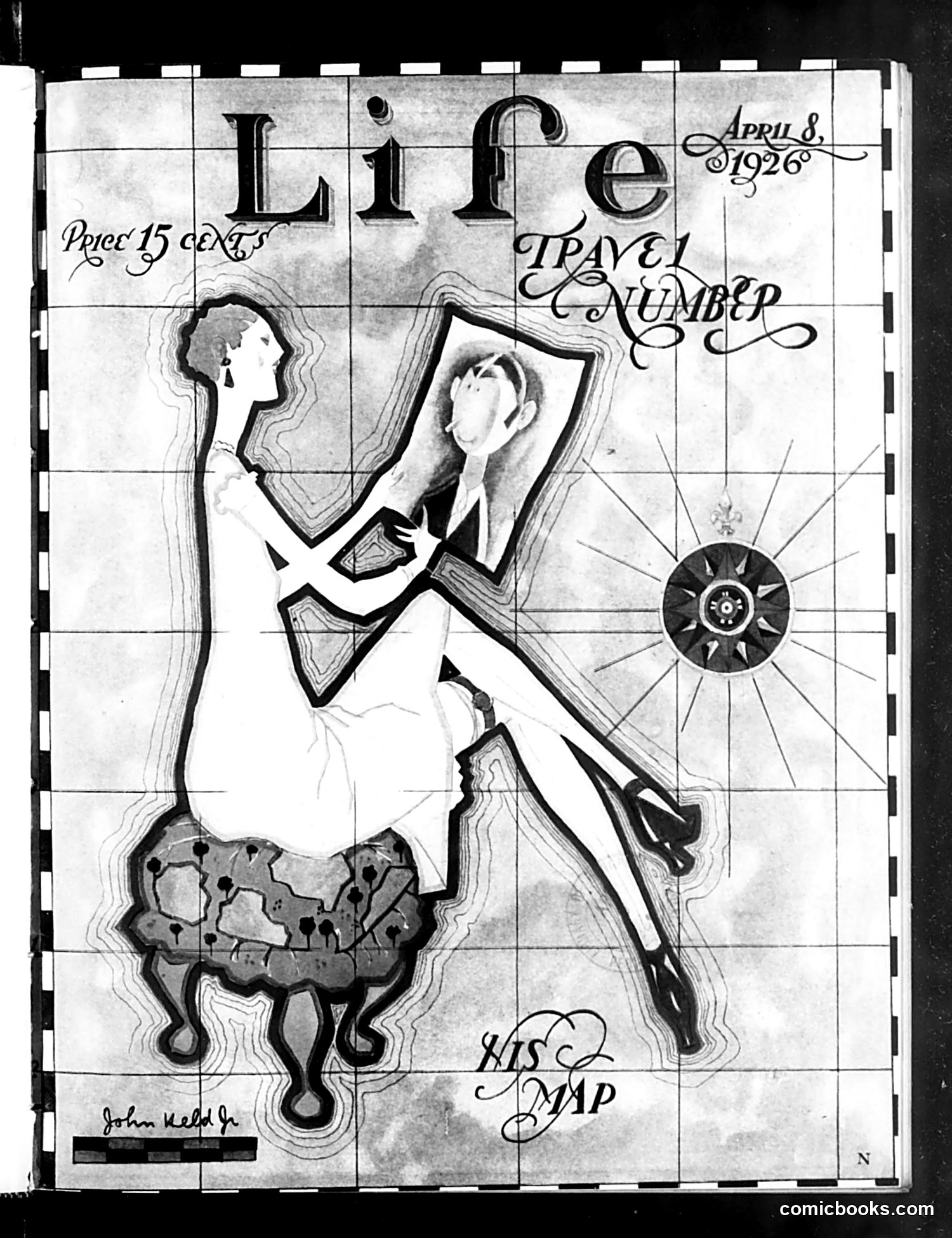
This is a "Travel Number" cover priced at 15 cents, featuring Art Deco-style illustration by John Held Jr., a renowned 1920s artist. The image depicts a fashionable young woman in a short dress holding a mirror, gazing at her reflection—a visual pun on vanity and self-regard. The "his map" reference (bottom) suggests travel or journey themes. The stylized sun and decorative elements reinforce the travel issue's focus. The woman's modern appearance—bobbed hair implied, fashionable attire—reflects 1920s "flapper" culture and women's growing independence and leisure travel during this prosperous era. The satirical angle likely mocks how travel had become a status symbol for the fashionable set.
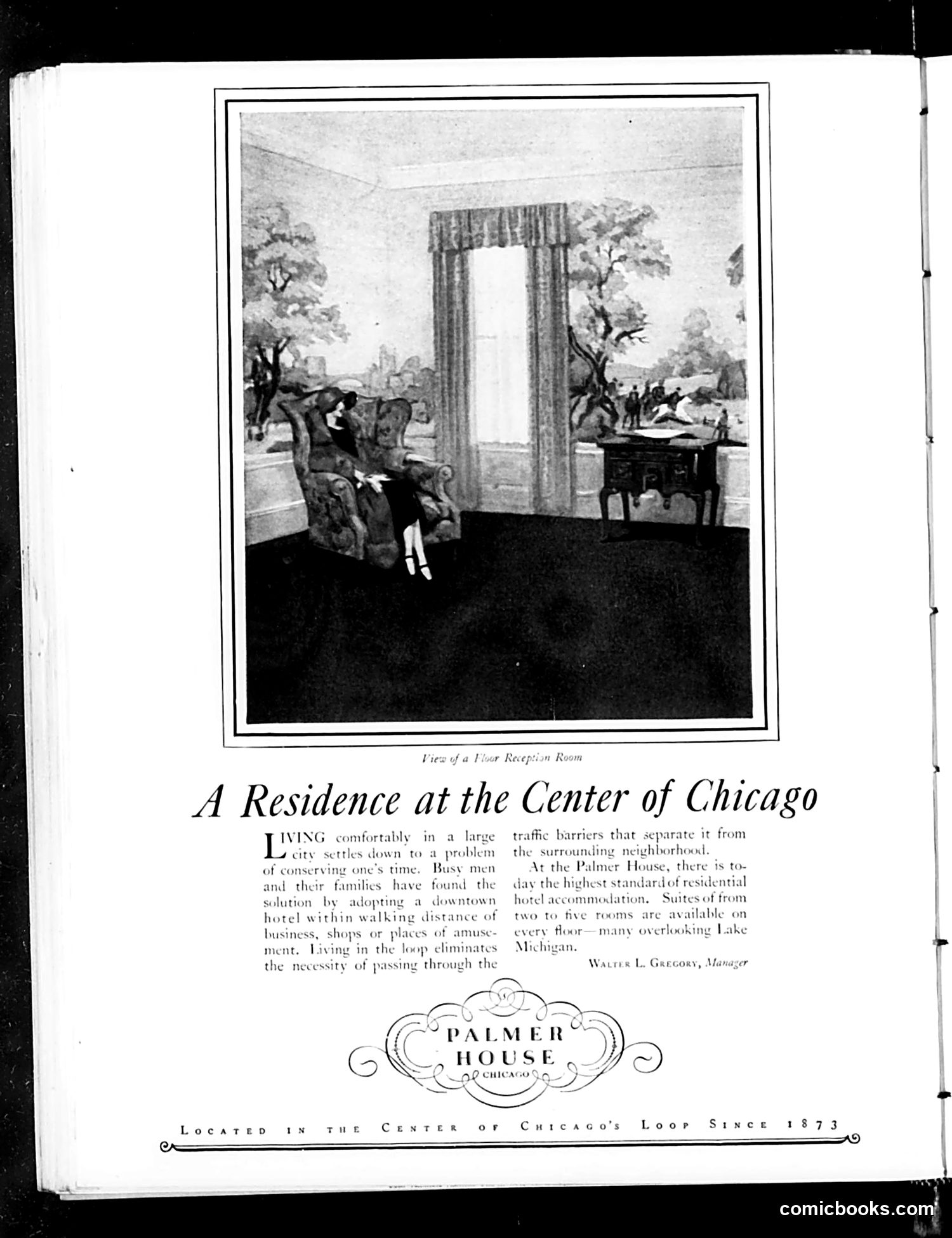
This page is **primarily advertising**, not political satire or comics. It's a promotional feature for the Palmer House hotel in Chicago's downtown Loop district. The image shows an elegant early-20th-century hotel reception room with period furnishings, decorative murals, and a figure seated in a chair. The accompanying text emphasizes the hotel's advantages for busy professionals and families seeking downtown urban living—convenience to business, shops, and entertainment without neighborhood traffic. The Palmer House advertises suite accommodations on multiple floors with Lake Michigan views. Walter L. Gregory is listed as manager. The page represents the aspirational lifestyle marketing typical of the era, targeting affluent city dwellers, not satirizing any political or social issue.
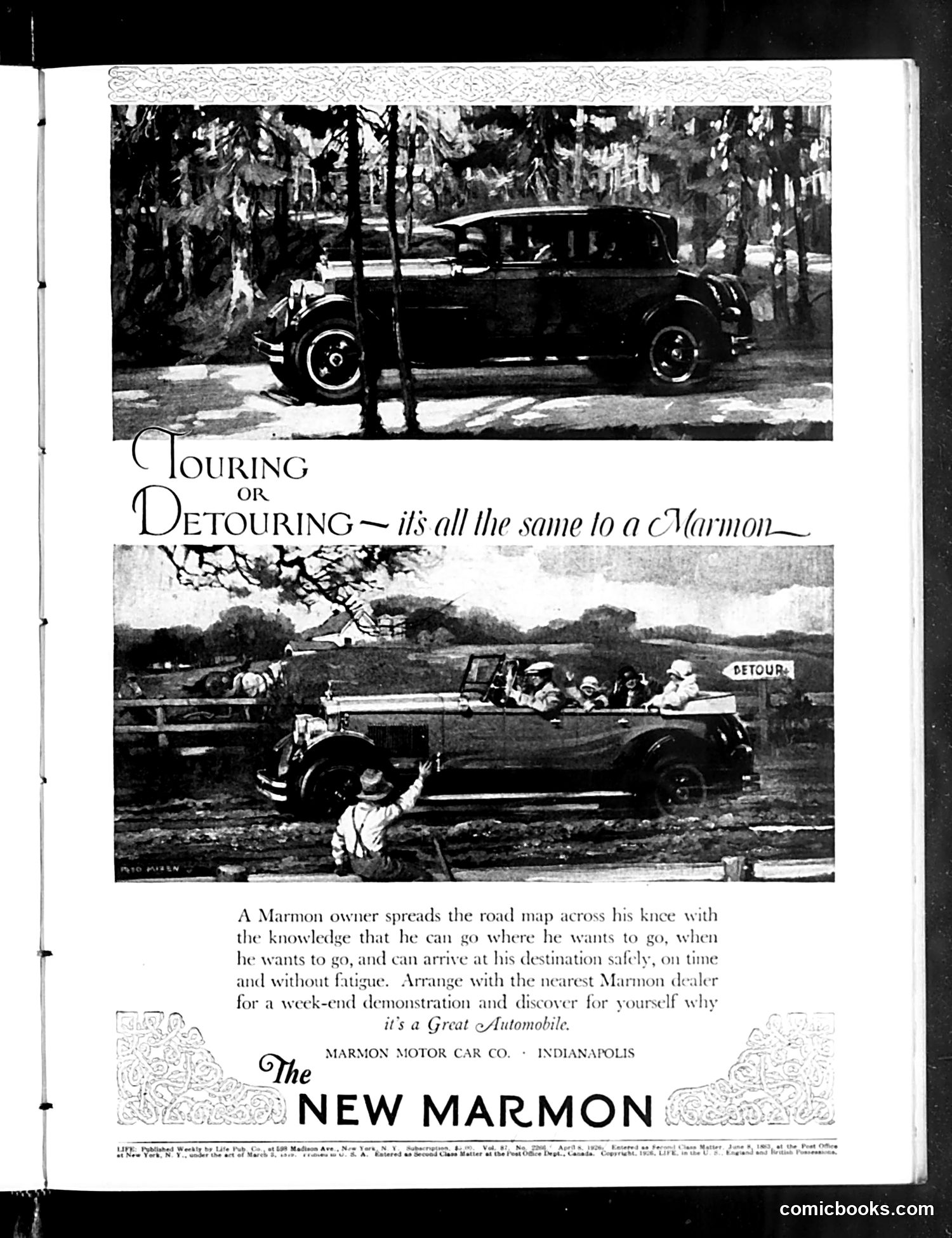
This is a **Marmon automobile advertisement**, not satire or political cartoon. The page promotes the "New Marmon" car manufactured by Marmon Motor Car Co. in Indianapolis. The ad uses two photographs showing the vehicle's versatility: one parked in a tree-lined street, another in a rural setting with passengers. The headline "Touring or Detouring—it's all the same to a Marmon" emphasizes the car's reliability for both planned and impromptu travel. The advertising copy claims Marmon owners can "go where he wants to go, when he wants to go, and can arrive at his destination safely, on time and without fatigue." This was typical early-automotive advertising, highlighting durability and comfort as selling points to middle-class buyers considering automobile ownership.
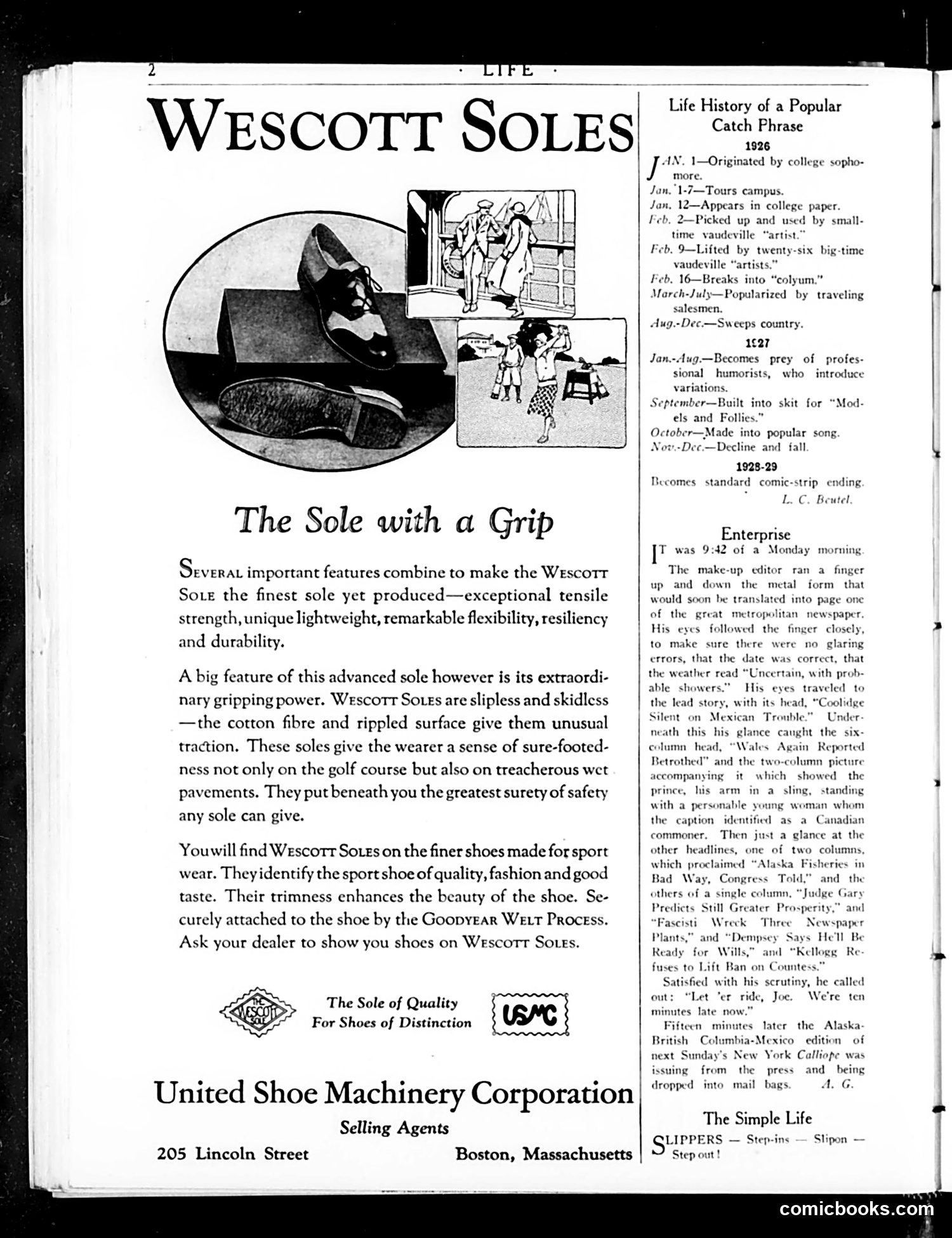
This page is primarily a **commercial advertisement**, not political satire. It promotes Wescott Soles, a shoe sole product made by United Shoe Machinery Corporation in Boston. The advertisement emphasizes the sole's "gripping power" and superior traction on wet surfaces—features marketed as essential for both golf courses and "treacherous wet pavements." Small comic illustrations show the sole's practical applications. The right column contains "Enterprise," a brief humorous piece about a newspaper makeup editor's morning routine, and "The Simple Life," a short joke about slippers. These are filler content typical of Life magazine's format, unrelated to the main advertisement. This reflects early 20th-century magazine advertising conventions blending product promotion with entertainment.
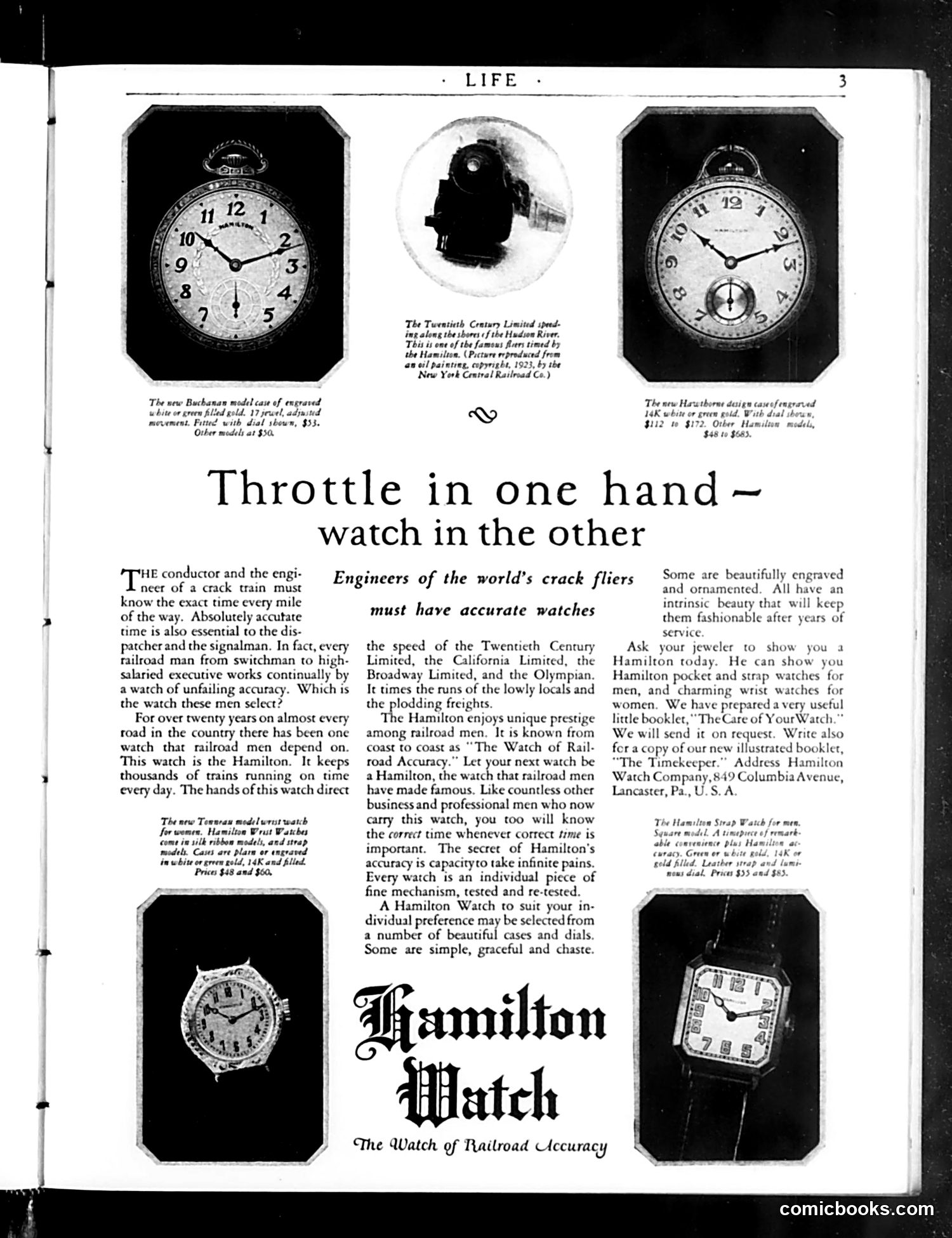
This is primarily **advertising content, not satire or editorial cartooning**. The page features a Hamilton Watch advertisement aimed at railroad professionals. The headline "Throttle in one hand—watch in the other" directly addresses train conductors and engineers, positioning Hamilton watches as essential tools for railroad workers who need precise timekeeping. The text emphasizes that accurate time-keeping is critical for train safety and scheduling, particularly for "crack fliers" (high-speed trains like the Twentieth Century Limited and California Limited mentioned). The various watch models displayed around the page showcase different styles and price points ($33-$172). The tagline "The Watch of Railroad Accuracy" reinforces the brand's professional credibility among transportation workers. This represents typical early 20th-century trade advertising rather than political commentary or humor.
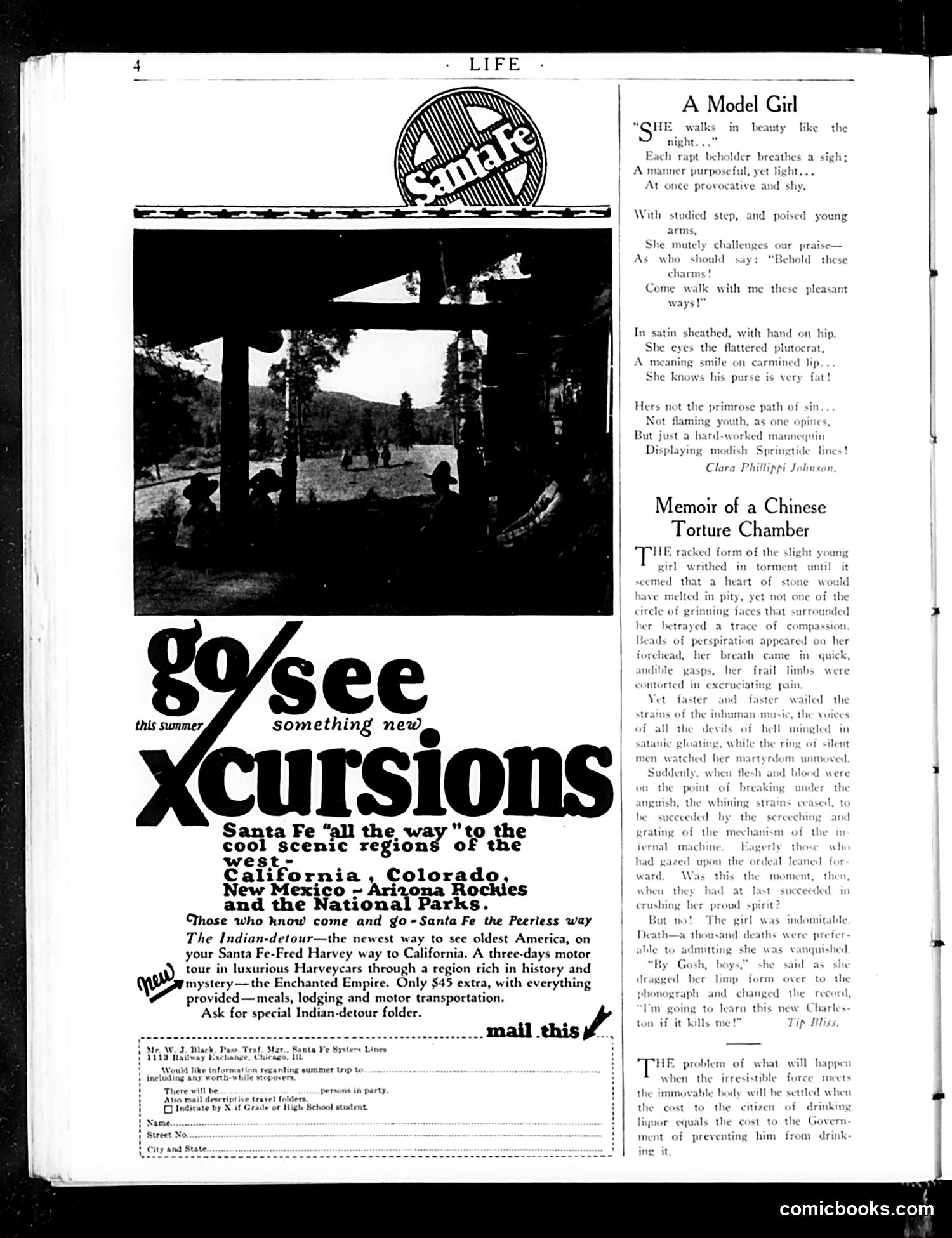
This page mixes literary content with period advertising rather than political cartoons. **Left side:** A Santa Fe Railway advertisement for "excursions" to Western scenic destinations (California, Colorado, New Mexico, Arizona, National Parks). The ad emphasizes tourism and includes a mail-in coupon for trip information. **Right side:** Two literary pieces—"A Model Girl" (a poem by Clara Phillips Johnson about a young woman's graceful manner) and "Memoir of a Chinese Torture Chamber" (prose describing graphic suffering, apparently a social commentary on inhumane practices). The contrast is striking: leisure-travel advertising sits beside graphic descriptions of human cruelty. This likely reflects Life magazine's typical blend of light satirical content, literary pieces, and social commentary, rather than coherent editorial messaging.
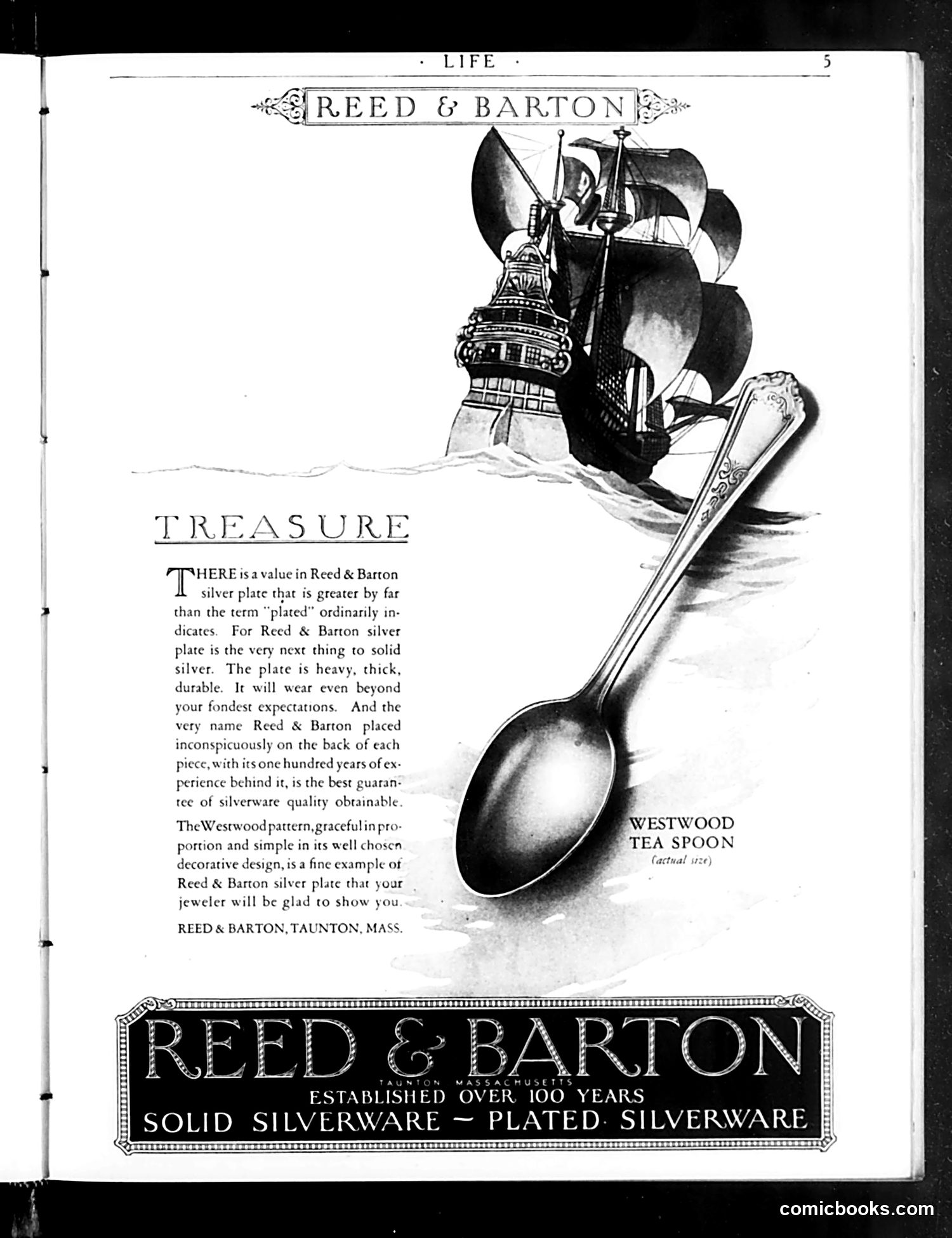
This page is primarily **advertising, not satire or political content**. It features a full-page advertisement for Reed & Barton silverware, specifically promoting their "Westwood" tea spoon pattern. The ad includes an illustration of a decorative ship (likely a galleon) and the featured spoon. The text emphasizes Reed & Barton's quality—"over 100 years" of experience—and claims their silver plate is "heavy, thick, durable" and nearly equivalent to solid silver. The only potentially satirical element is subtle: the grandiose language ("treasure") applied to mass-produced tableware. However, this appears to be standard luxury marketing rhetoric rather than deliberate satire. This is simply a magazine advertisement from Life's commercial pages.
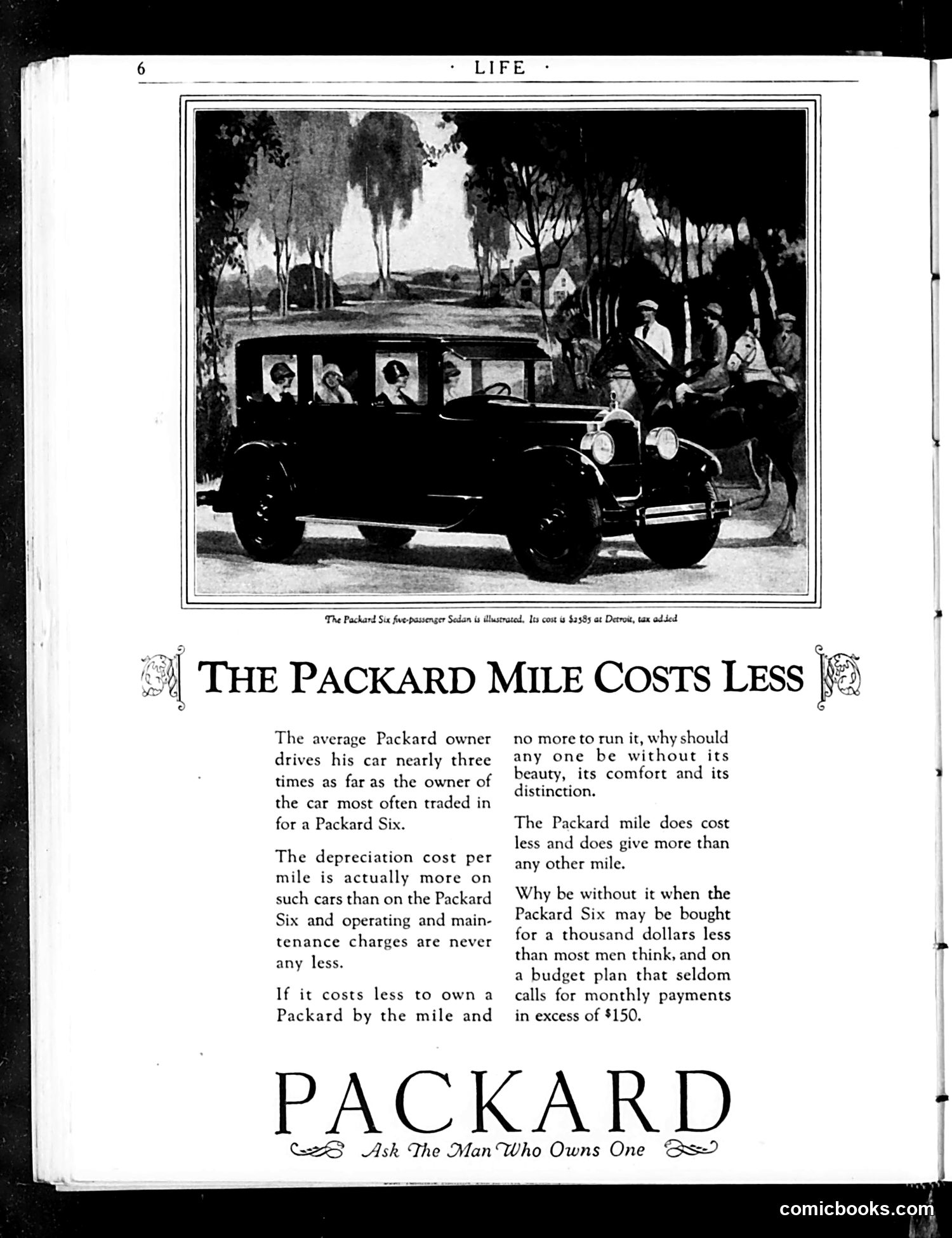
This page is primarily a **Packard automobile advertisement**, not political satire. The image shows a 1920s-era luxury car with passengers and onlookers in what appears to be a scenic location. The ad's argument is economic rather than political: it claims Packard automobiles offer superior value—lower cost-per-mile than competitors, despite higher initial purchase price. The text emphasizes depreciation costs favor Packard ownership and suggests financing options make the car affordable ("a thousand dollars less than most men think"). The phrase "Ask The Man Who Owns One" was Packard's famous marketing slogan, appealing to satisfied customers as endorsement. There is **no political cartoon or satire** on this page—it's a straightforward luxury goods advertisement from the early automobile era.
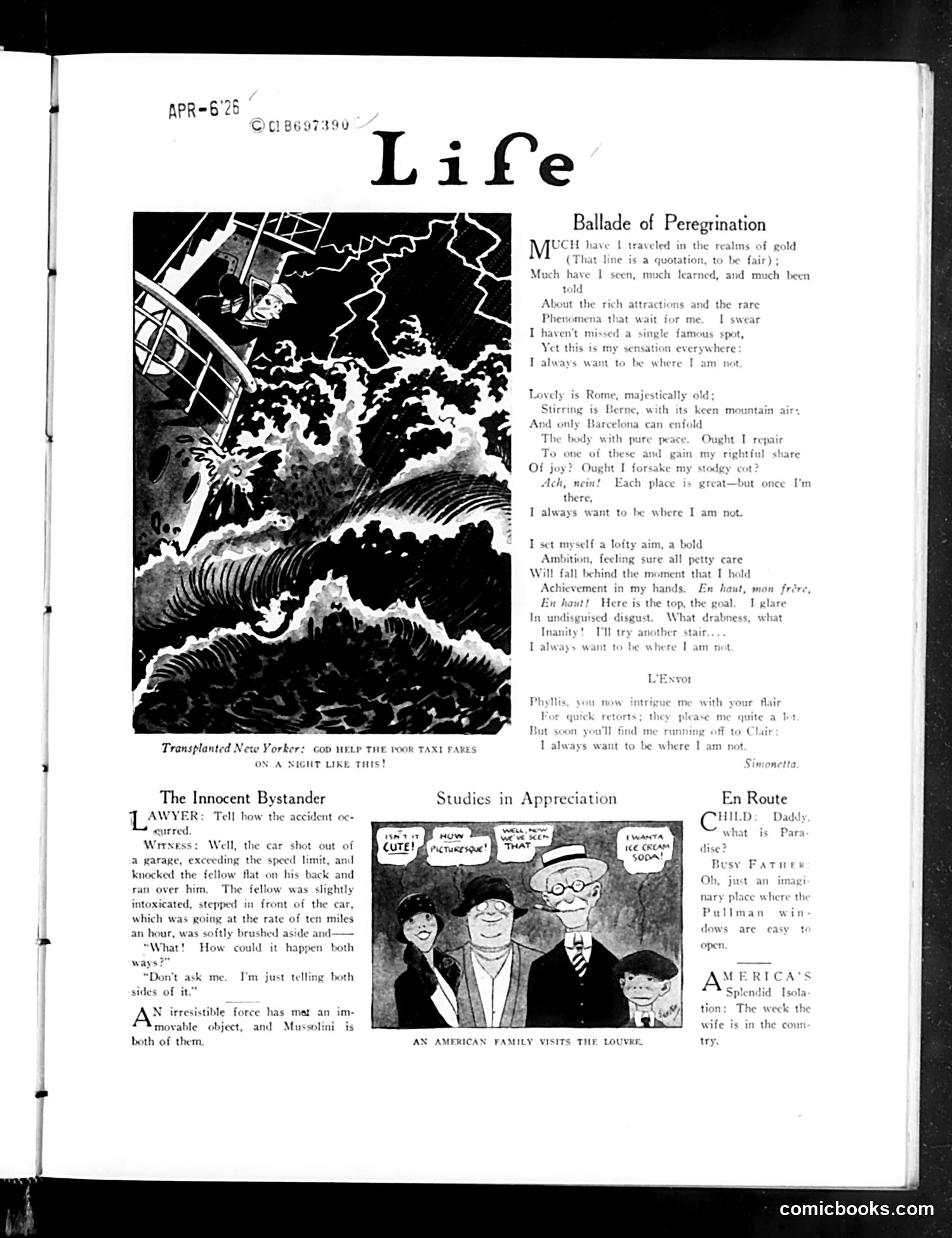
This page contains three distinct pieces of satirical content: 1. **"Ballade of Peregrination"** — A poem about restless travel desires, mentioning Rome, Berne, Barcelona, and other European cities. It expresses the wanderlust common among affluent Americans of the era. 2. **"The Innocent Bystander"** — A brief dialogue between a lawyer and witness about a car accident, satirizing legal proceedings and witness testimony's unreliability. 3. **"Studies in Appreciation" cartoon** — Shows an American family at the Louvre museum in Paris. The figures appear bewildered by the art, with one asking "How's the ice cream soda?" This satirizes American tourists abroad as culturally uninterested, prioritizing comfort and familiar foods over artistic appreciation. The overall theme critiques post-WWI American travel culture and cultural sophistication.
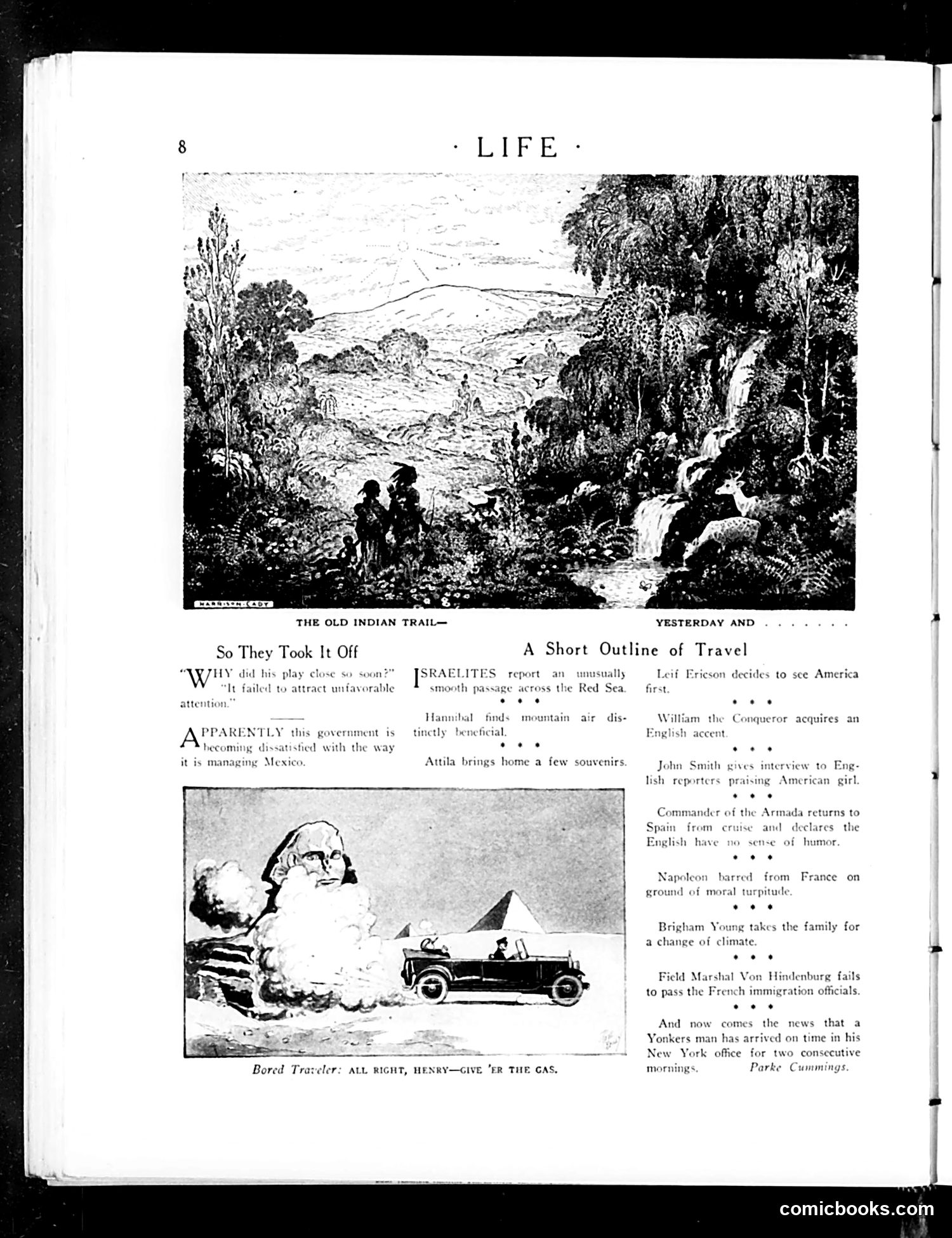
This page contains two distinct items: **Top illustration:** "The Old Indian Trail—Yesterday and..." depicts a romantic landscape with two figures viewing wilderness scenery, contrasting past and present America. **"So They Took It Off" / "Bored Traveler":** The cartoon shows a car beside the Great Sphinx of Giza with the caption "All right, Henry—give 'er the gas." This satirizes American tourists' casual, impatient approach to world landmarks. The joke suggests Americans treat even ancient wonders as mere photo stops during road trips—"give her the gas" implying they want to speed through rather than appreciate the monument's historical significance. **Right column:** "A Short Outline of Travel" is a humorous news digest of notable travelers and travel anecdotes from contemporary society.
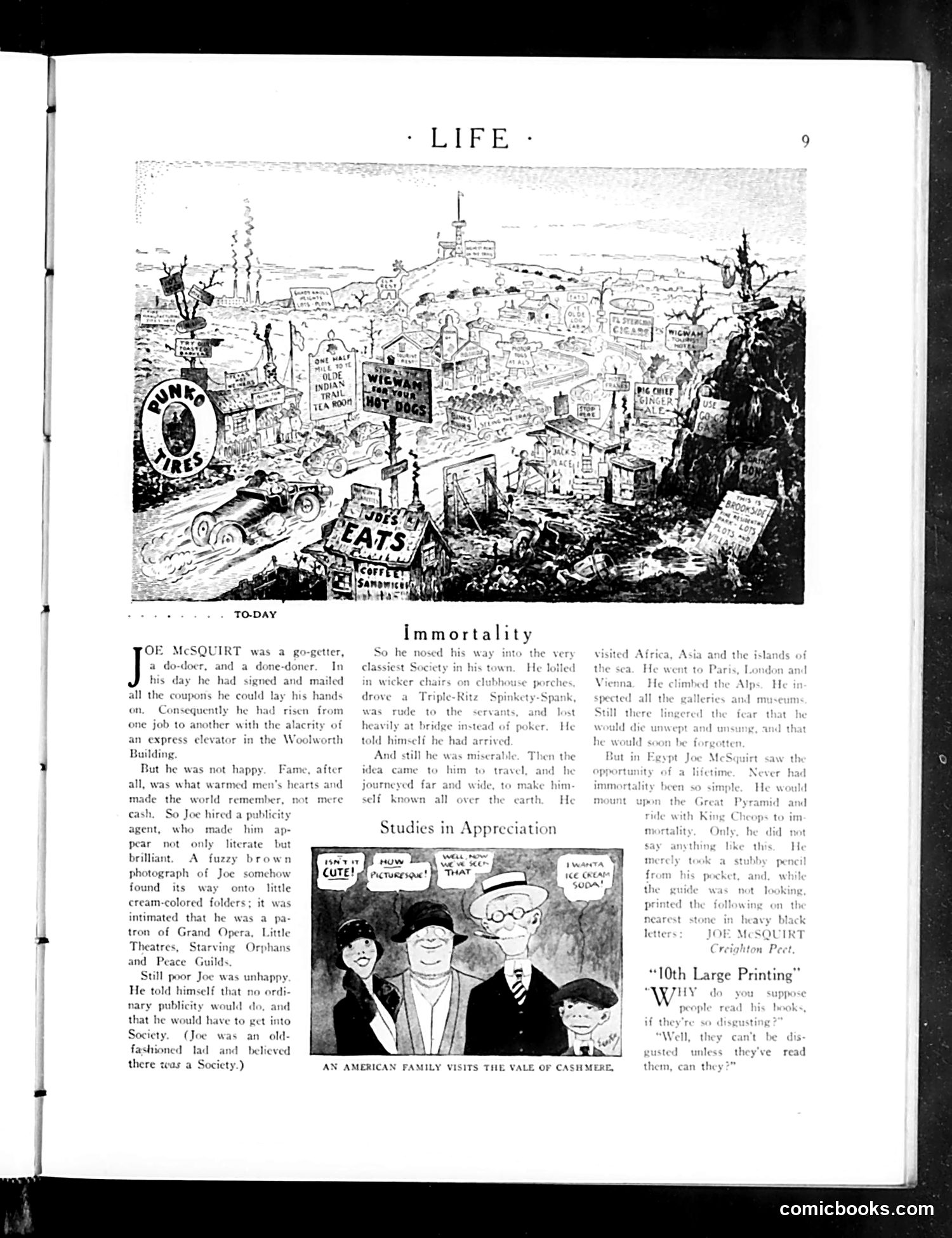
The main cartoon, titled "An American Family Visits the Vale of Cashmere," depicts four figures—a man with glasses, a woman, and two children—observing scenic attractions. The caption suggests this is satirizing American tourists abroad, likely mocking their consumption of famous destinations. The page's lead story, "Immortality," concerns Joe McSquirt, a publicity-seeking man who craves fame. The satire critiques his desperate attempts at notoriety through increasingly absurd methods (hiring publicists, creating spectacles). The "Studies in Appreciation" section humorously presents dialogue about reading his book, suggesting the story itself mocks vanity and self-promotion in American culture. Overall, the page targets American materialism, tourism, and celebrity-seeking behavior.
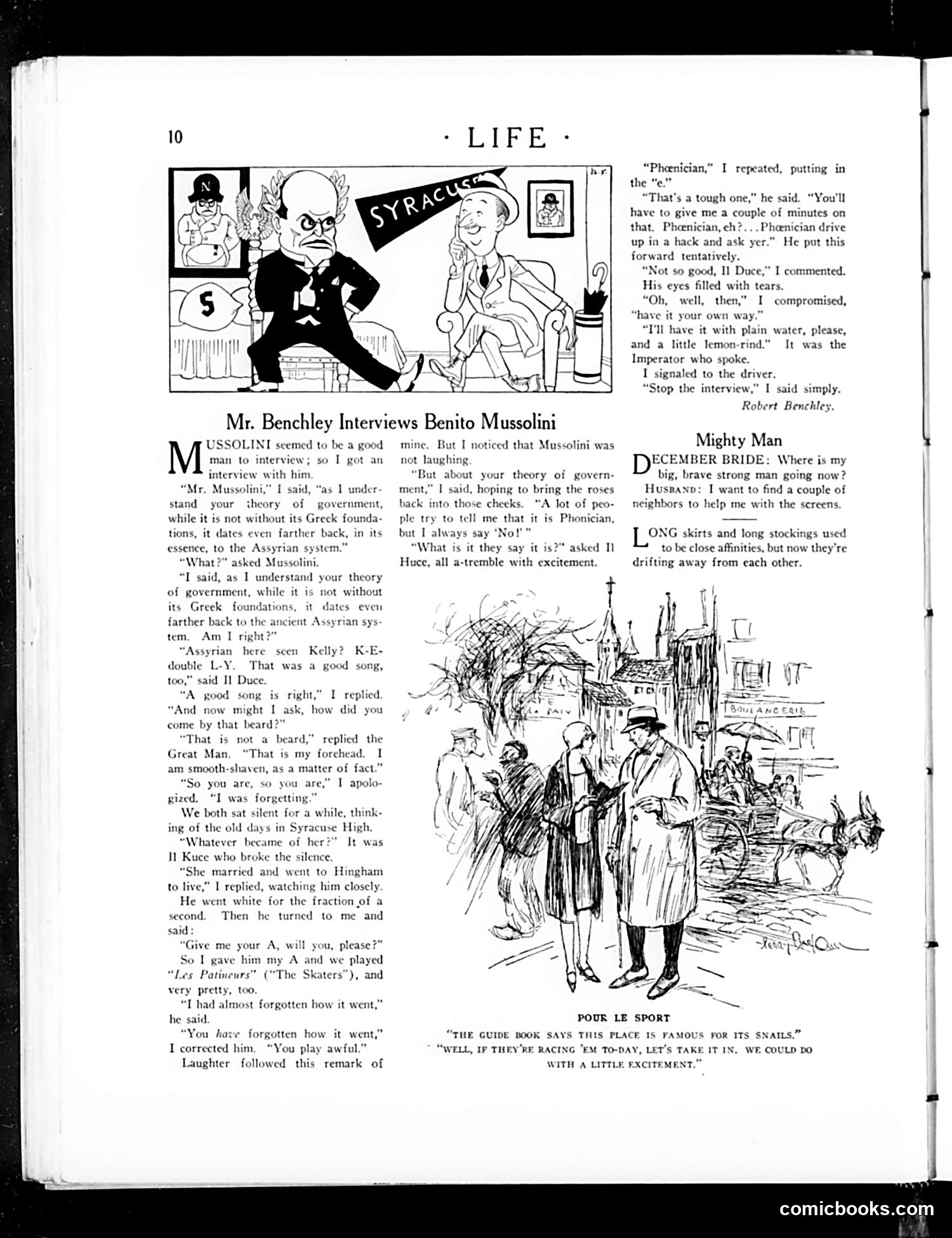
The top cartoon depicts **Mr. Benchley interviewing Benito Mussolini**. The caricatured Mussolini has an exaggerated, protruding jaw—a common feature in anti-Mussolini propaganda. Benchley (likely humorist Robert Benchley, a Life contributor) questions Mussolini about his governmental theory, which the dictator claims dates to ancient Assyrian systems. The satire mocks Mussolini's grandiose historical pretensions and contradictory statements about governance. The lower section, titled "Mighty Man" and "Poore Le Sport," shifts to gentler domestic satire about changing fashion (long skirts and stockings) and leisure activities, unrelated to the political content above. This page likely dates to the 1920s-1930s when Life magazine regularly satirized international political figures through humor.
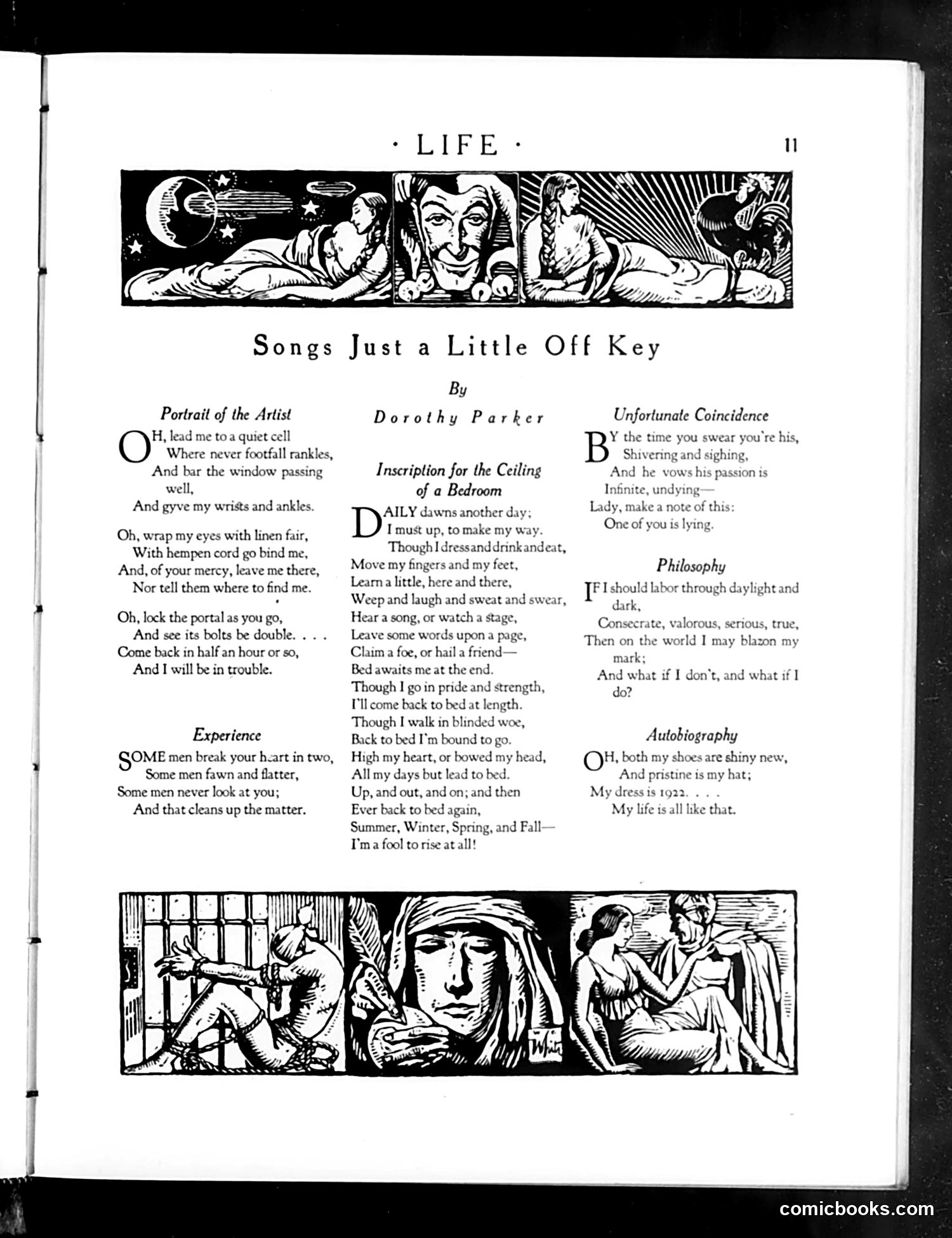
This page presents five poems by Dorothy Parker, a renowned wit and satirist of the 1920s-30s. Rather than political cartoons, these are literary pieces using Parker's characteristic sardonic humor about everyday life and relationships. The poems mock conventional sentiments: "Portrait of the Artist" satirizes romantic confinement; "Experience" cynically dismisses heartbreak; "Inscription for the Ceiling of a Bedroom" mocks daily tedium; "Unfortunate Coincidence" suggests infidelity; "Philosophy" questions life's purpose; and "Autobiography" reduces existence to material trivialities. The decorative woodcut illustrations frame the text thematically. The satire targets romantic idealism, social expectations, and existential pretense—Parker's signature subjects. These represent literary rather than political commentary.
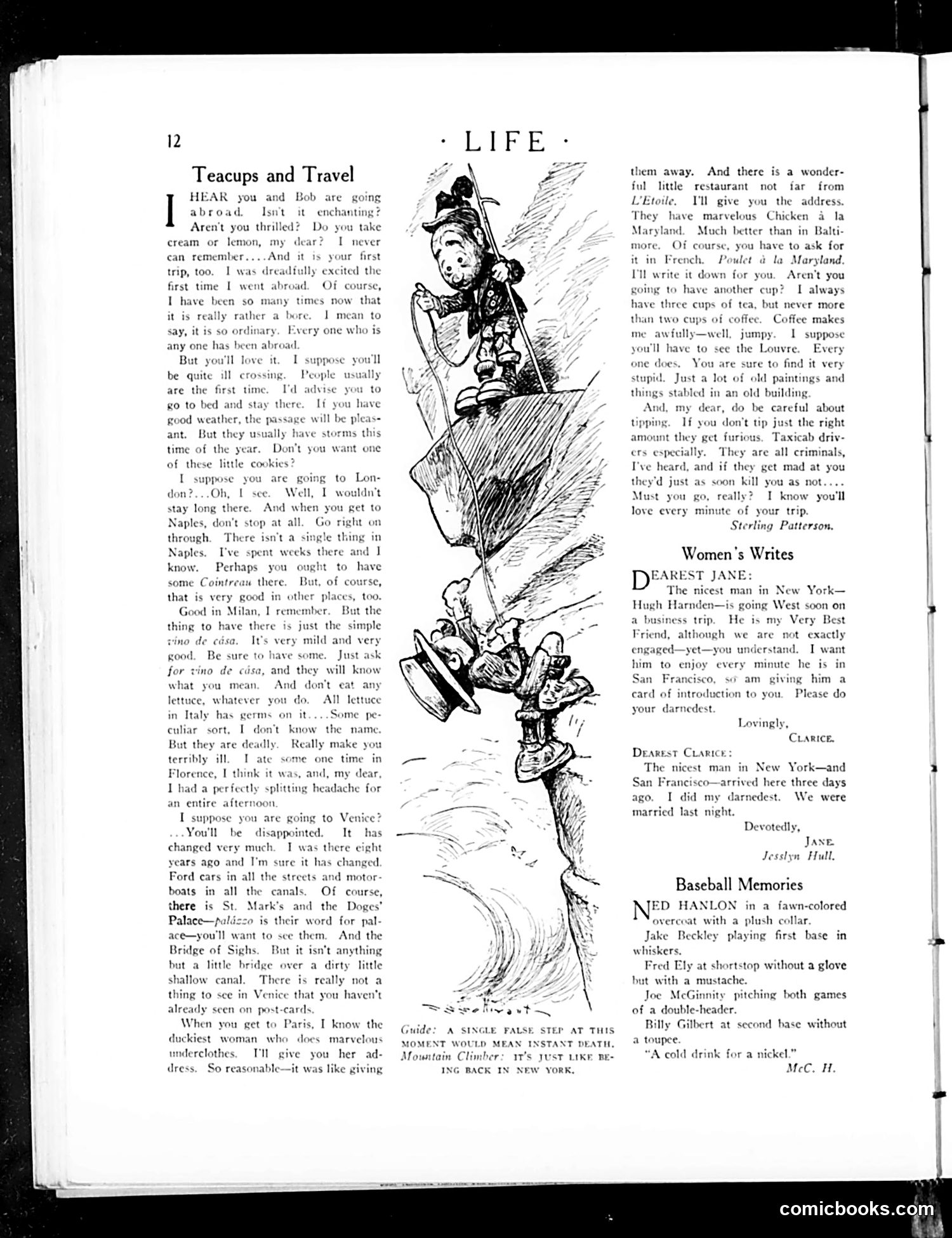
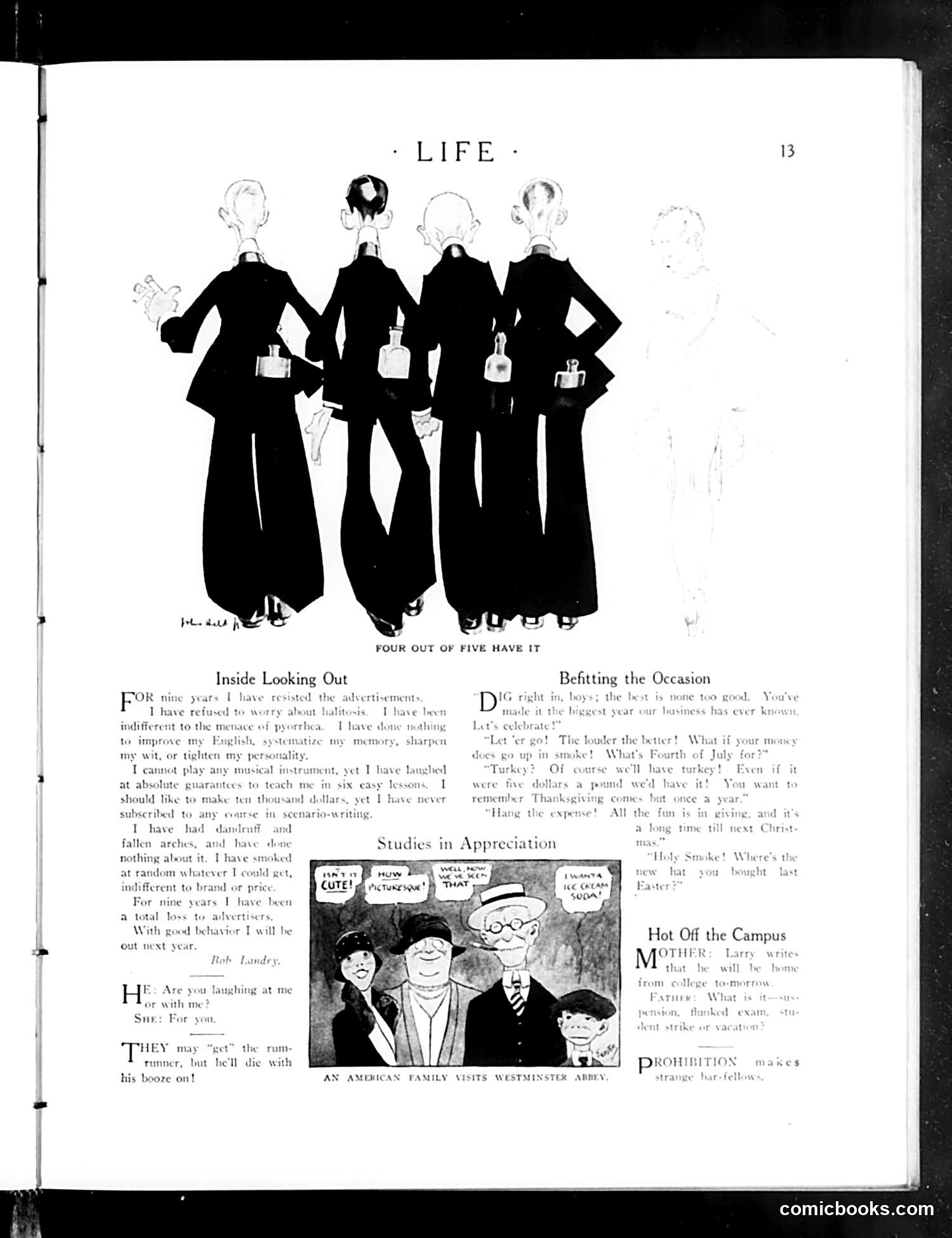
This page contains several cartoon commentaries on contemporary American life, likely from the Prohibition era (1920s-1930s). The top illustration shows four businesswomen in dark suits holding briefcases, captioned "Four Out of Five Have It," satirizing women's increasing workforce participation and independence. The central cartoon, "An American Family Visits Westminster Abbey," depicts tourists in formal dress examining the historic English cathedral—poking fun at wealthy Americans' cultural tourism and attempts at sophistication. The accompanying text sections mock various social anxieties: business excess, college behavior, and Prohibition's effects ("strange bar-fellows"). The overall tone critiques both commercial American culture and unintended consequences of restrictive laws, while observing changing gender roles in the workplace.
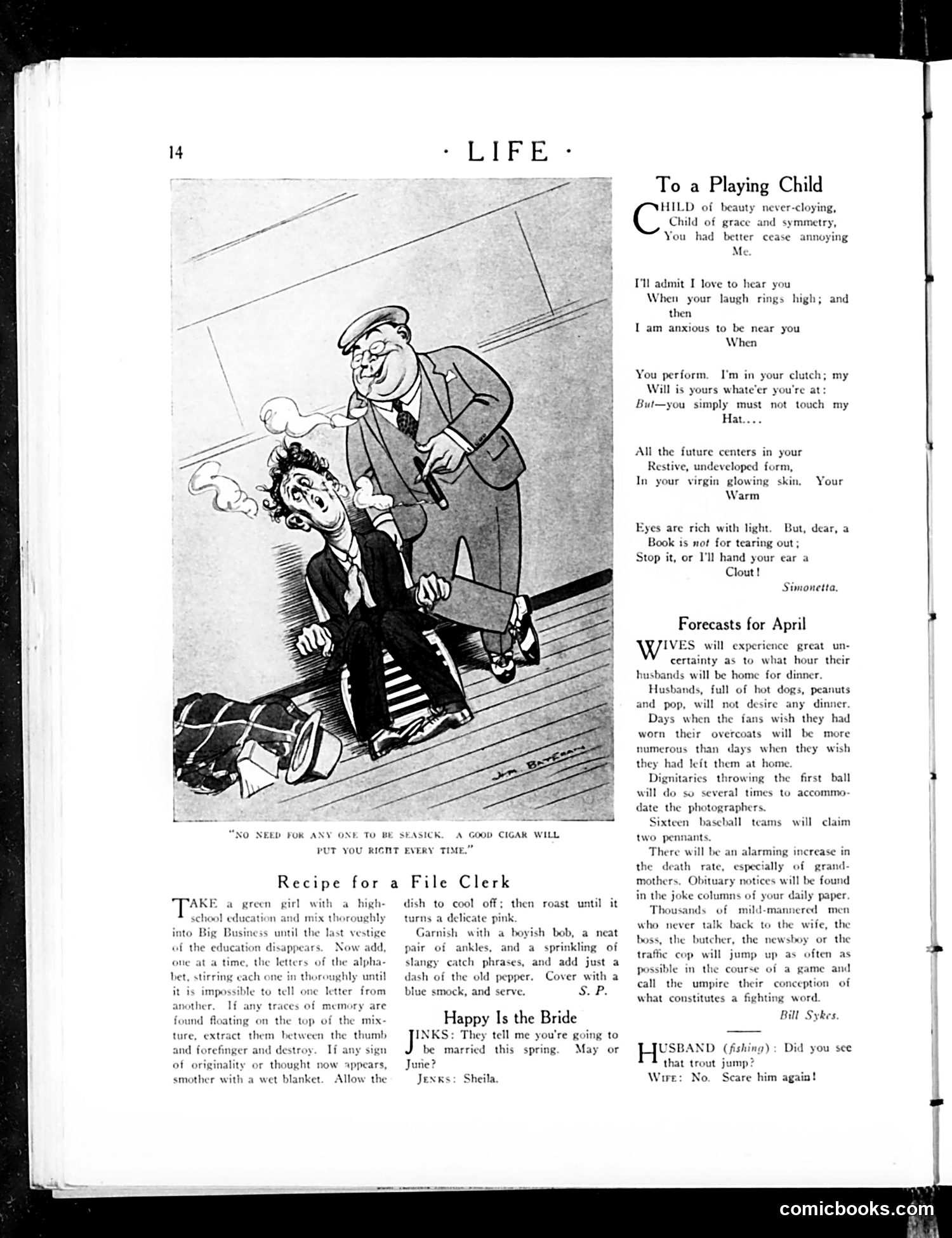
The main cartoon depicts a man forcibly grabbing a woman's ear, with the caption "No need for any one to be seasick. A good cigar will put you right every time." This appears to be dark humor about using cigars as a remedy for seasickness—but the image shows physical coercion rather than medical treatment, suggesting the "cure" is worse than the ailment. The exaggerated, grotesque caricature style was typical of early-20th-century satirical magazines. The page also contains humorous advice pieces like "Recipe for a File Clerk" (treating secretarial work as mechanically grinding down employees) and lighter social commentary in sections titled "Happy Is the Bride" and "Forecasts for April," mocking domestic life and baseball season expectations. The overall tone reflects Life's satirical approach to contemporary American social conventions.
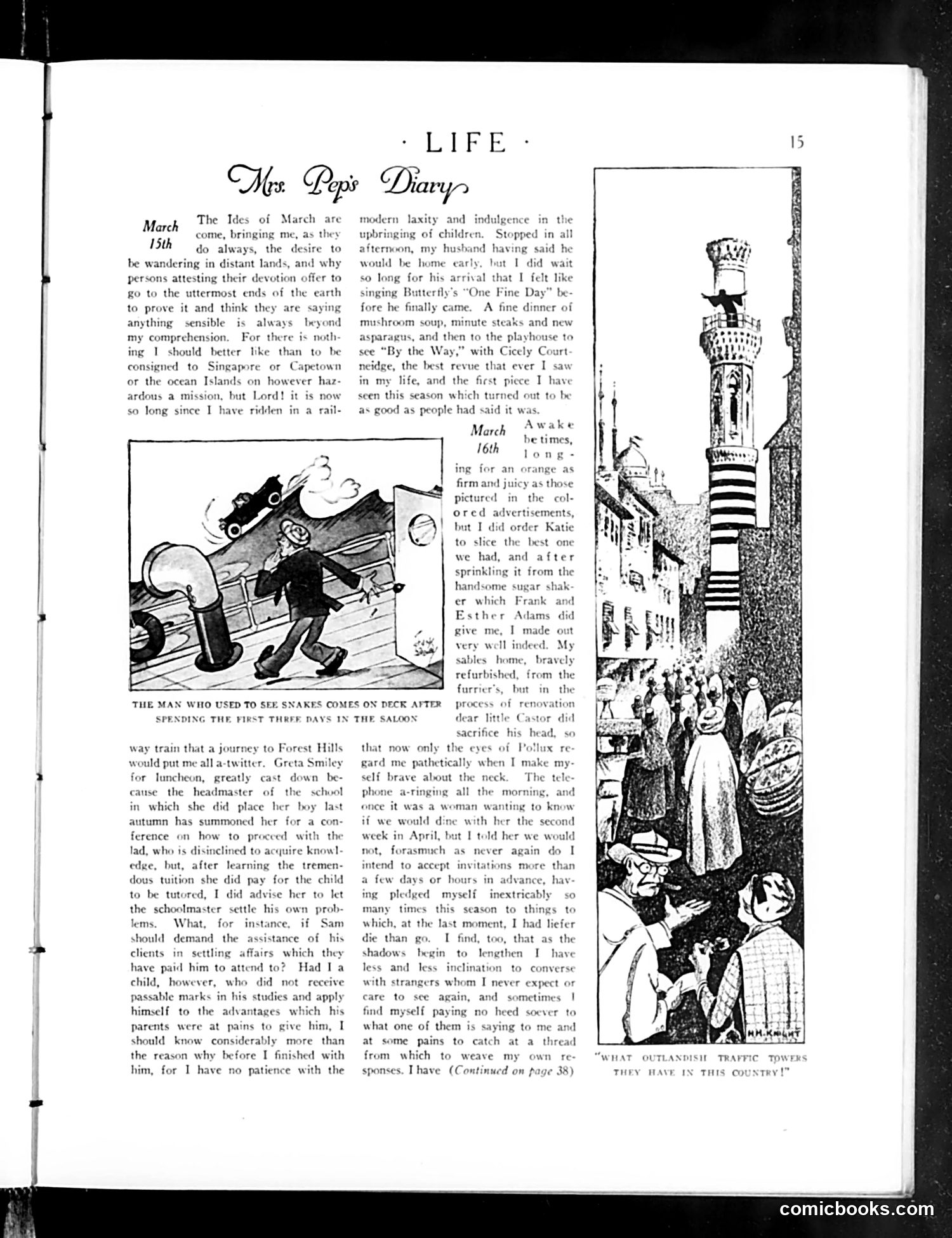
This page presents a diary entry from "Mrs. Pops" dated March 13th-16th, mixing domestic observations with social commentary. The left cartoon, captioned "THE MAN WHO USED TO SEE SNAKES COMES ON DECK AFTER SPENDING THE FIRST THREE DAYS IN THE SALOON," depicts a disheveled man stumbling about—likely satirizing excessive drinking during sea travel, a common vice of the era. The right illustration shows an ornate tower or building with crowds, captioned "WHAT OUTLANDISH TRAFFIC TOWERS THEY HAVE IN THIS COUNTRY!" This appears to mock American urban architecture or infrastructure as peculiar to foreign observers. The diary discusses domestic life—renovations, children's tutoring, marital duties, and social obligations—reflecting upper-middle-class concerns of the period. The overall tone suggests gentle satire of modern domesticity and social pretension.
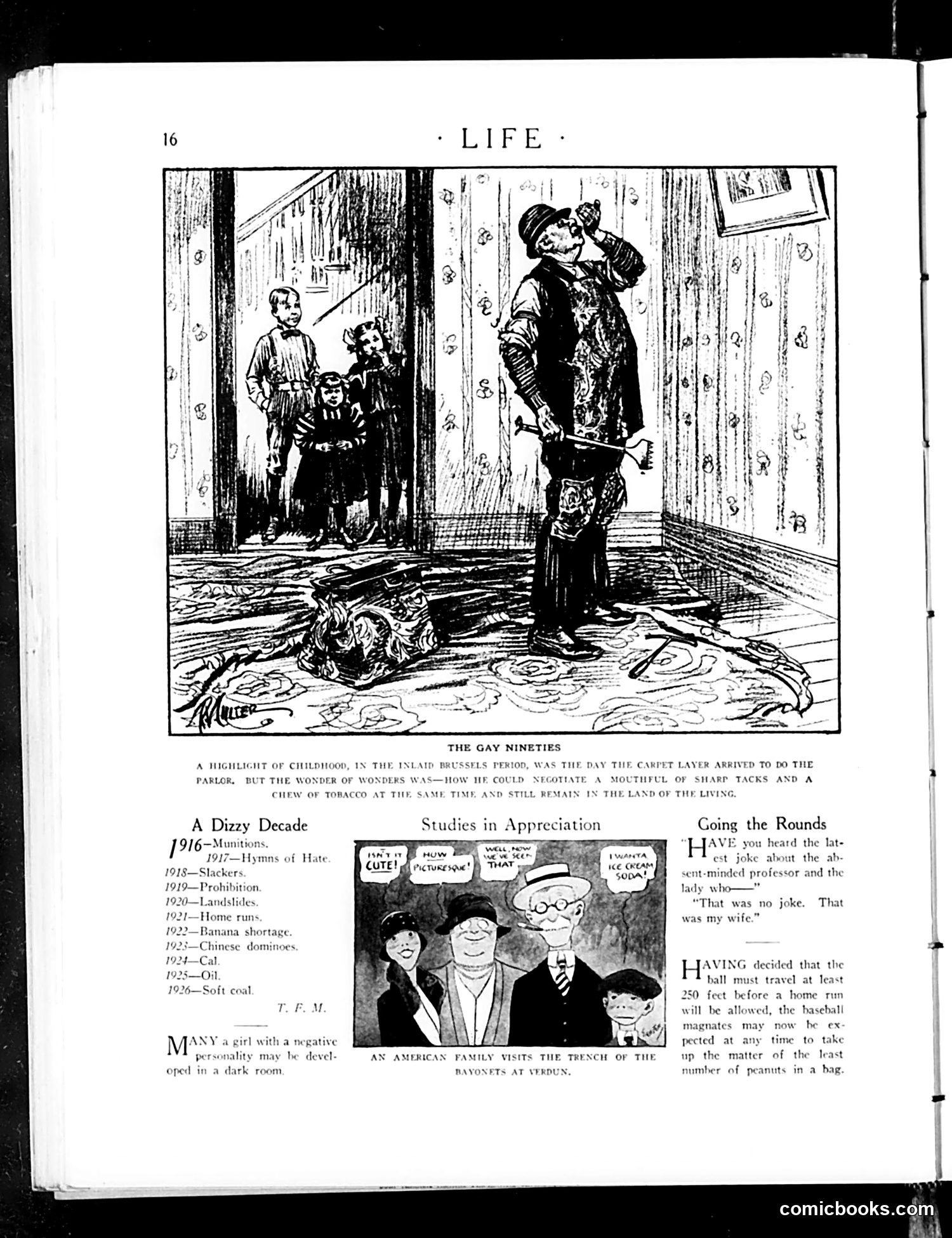
**Top Illustration - "The Gay Nineties":** This depicts a wealthy Victorian-era family encountering a worn carpet layer in their parlor. The caption notes this "highlight of childhood" shows how people negotiated with tradesmen—balancing curiosity about their work with maintaining social distance. **"A Dizzy Decade" - List:** A humorous chronicle of 1916-1926 fads and events (munitions, slackers, Prohibition, flappers, etc.), satirizing the chaotic pace of modern American life during this turbulent decade. **"Studies in Appreciation" - Comic:** A cartoon family critiques an artwork, each offering vapid opinions ("How cute!", "How picturesque!"), mocking superficial art appreciation and pretentious gallery visitors. **"Going the Rounds" - Text Joke:** A brief anecdote about a professor and his wife—likely a marital humor piece typical of Life's comedy sections.
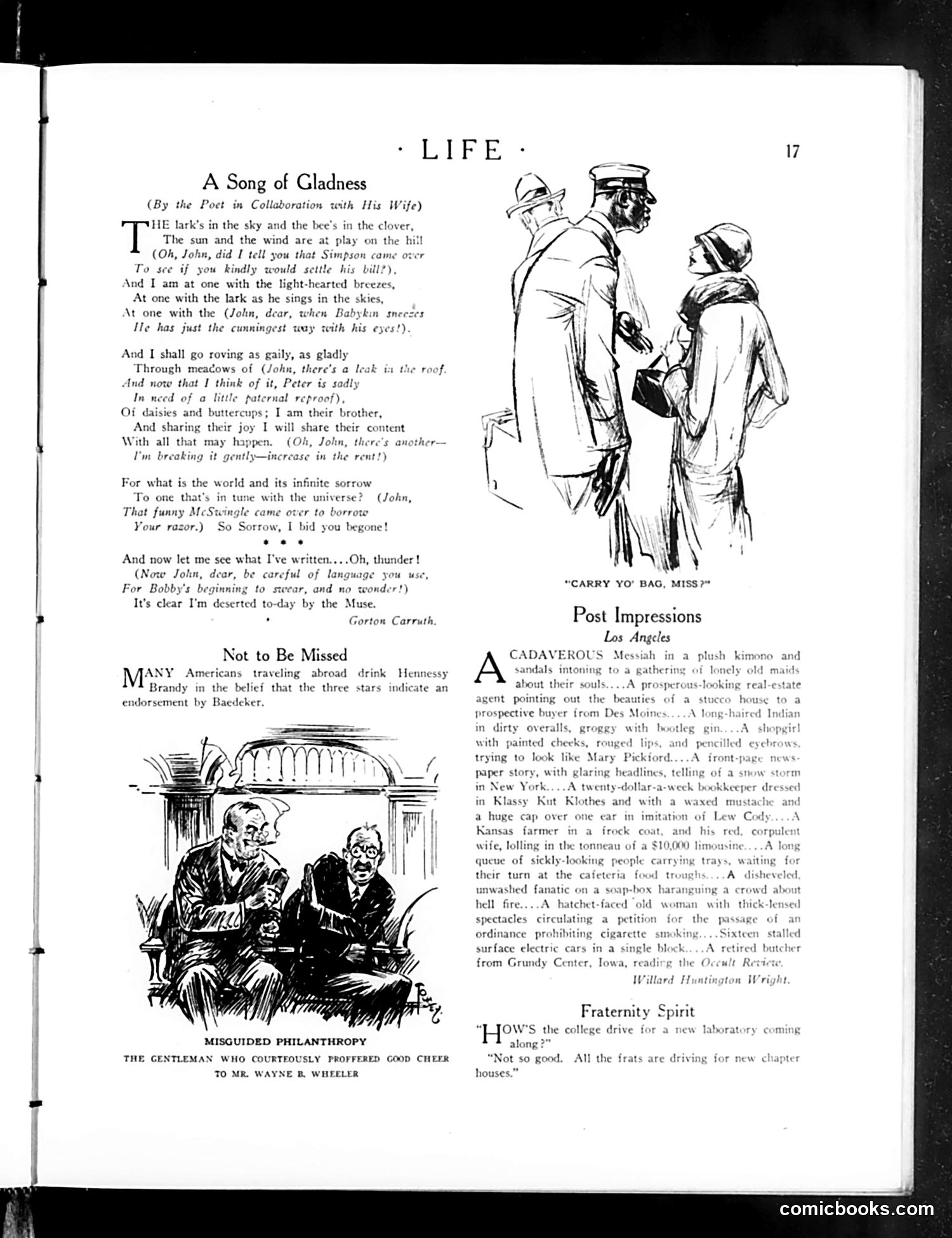
**"A Song of Gladness"** is a humorous poem about marital life, where a husband attempts romantic, poetic musings about nature and contentment—constantly interrupted by his wife's practical concerns (the baby sneezing, Peter needing reproof, the rent increasing). The satire targets the gap between idealistic male sentimentality and domestic reality. **"Not to Be Missed"** mocks Americans abroad who drink Hennessy Brandy believing Baedeker's (the famous travel guide) three-star endorsement signals quality, when they're actually just following guidebook authority blindly. The cartoon shows two men sharing this misguided "philanthropy." **"Post Impressions"** catalogs absurd Los Angeles social types—a cadaverous religious figure, overeager real estate agents, poorly dressed people in limousines, etc. It satirizes the city's pretension and social climbing. **"Fraternity Spirit"** presents a brief joke: college fraternity members claim they're driving for a "new laboratory," but actually they're just seeking new chapter houses—exposing their self-interest disguised as noble purpose. The page reflects Life's satirical focus on American social pretension, domestic comedy, and consumer culture.
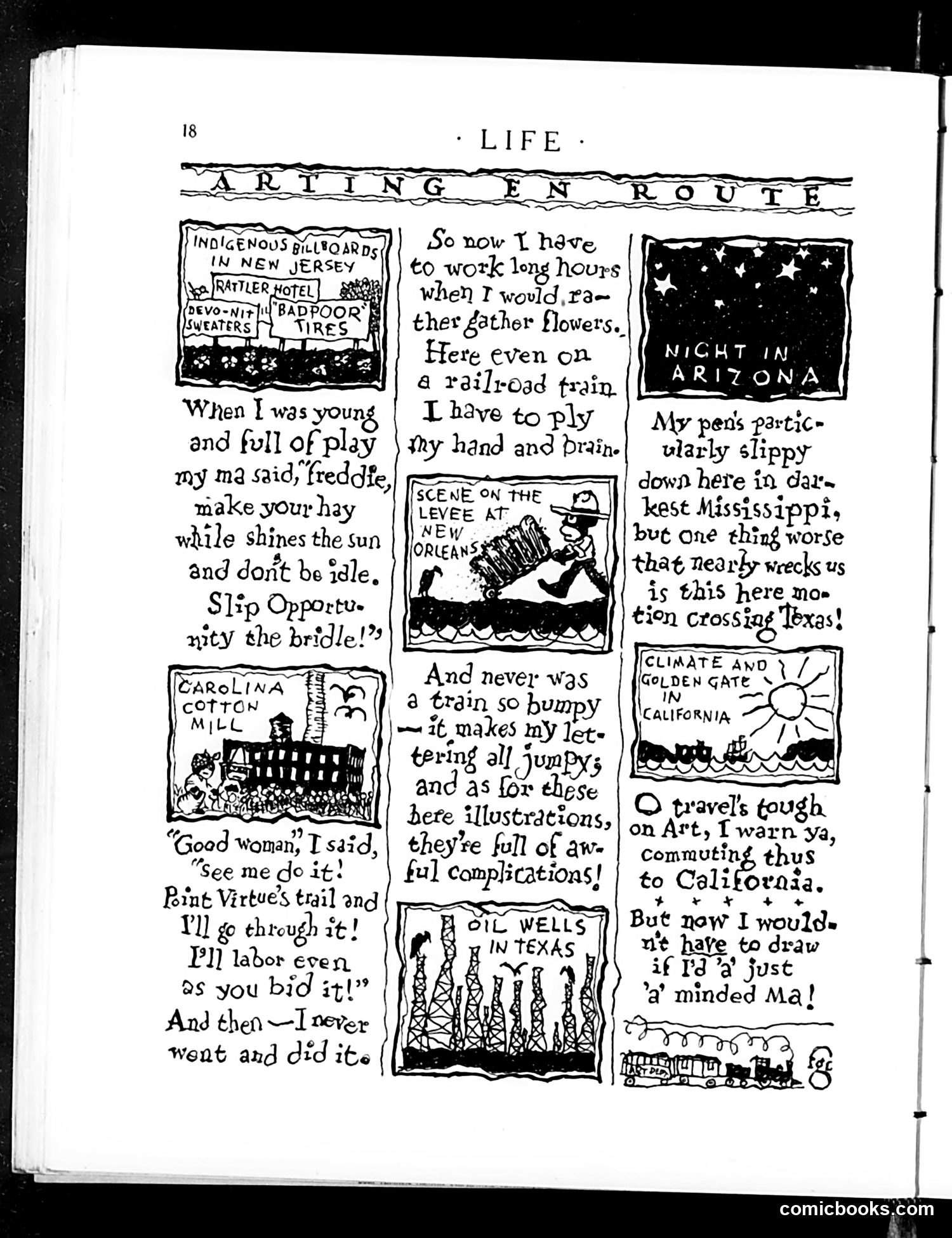
This is a satirical autobiographical piece about an artist's conflicted journey. The narrator recalls their mother's advice to work hard and seize opportunity ("make your hay while shines the sun"), promising to follow virtue's path. However, they never actually did. Instead, the cartoon depicts the artist's actual life: traveling by train across America (illustrated panels show scenes from New Jersey, New Orleans, Texas oil wells, and Arizona) while working as a commercial illustrator rather than pursuing artistic dreams of gathering flowers and creating fine art. The satire targets the gap between youthful idealism and adult compromise—the speaker wanted leisure for art but instead endures exhausting travel, a "bumpy" train ride, and the practical demands of commercial work. The complaint about commuting to California suggests the speaker now regrets not heeding their mother's work ethic, having traded genuine artistic aspiration for commercial illustration labor.
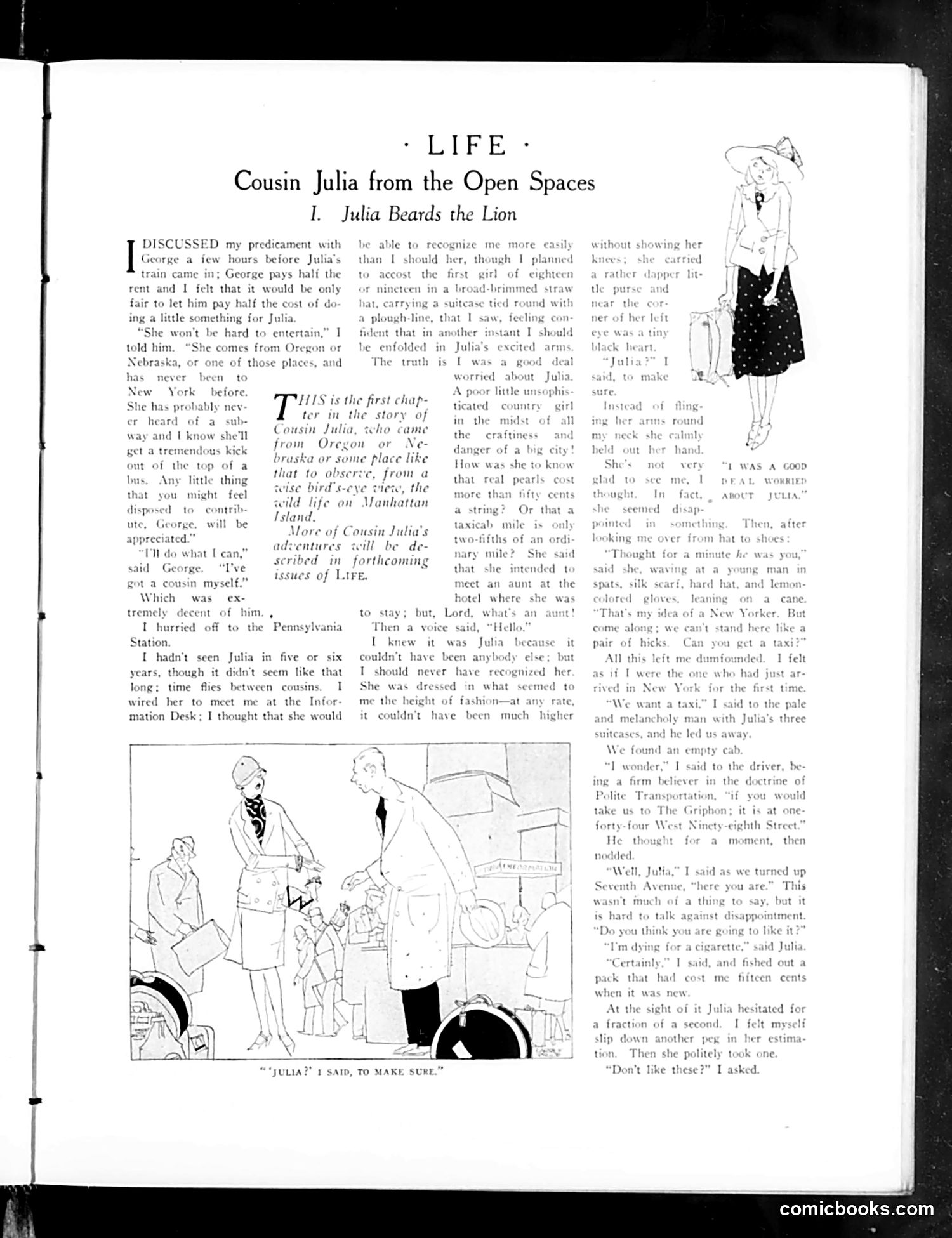
This is the opening installment of a satirical serial about a country cousin visiting from the American West (Oregon or Nebraska). The humor centers on the clash between rustic and urban sophistication. The narrator expects Julia to be unsophisticated and difficult to entertain in New York City. The illustration shows Julia arriving at what appears to be Pennsylvania Station, dressed in Western attire (wide-brimmed hat, simple clothing). The caption "Julia! I said, to make sure" suggests the narrator barely recognizes her. The satire targets both urban snobbery and rural stereotypes—the sophisticated New York cousin assumes a Western visitor will be uncouth, yet the text hints Julia may prove more capable and impressive than expected. This "country mouse visits the city" setup was a popular early-20th-century satirical format in *Life* magazine, playing on class and regional prejudices of the era.
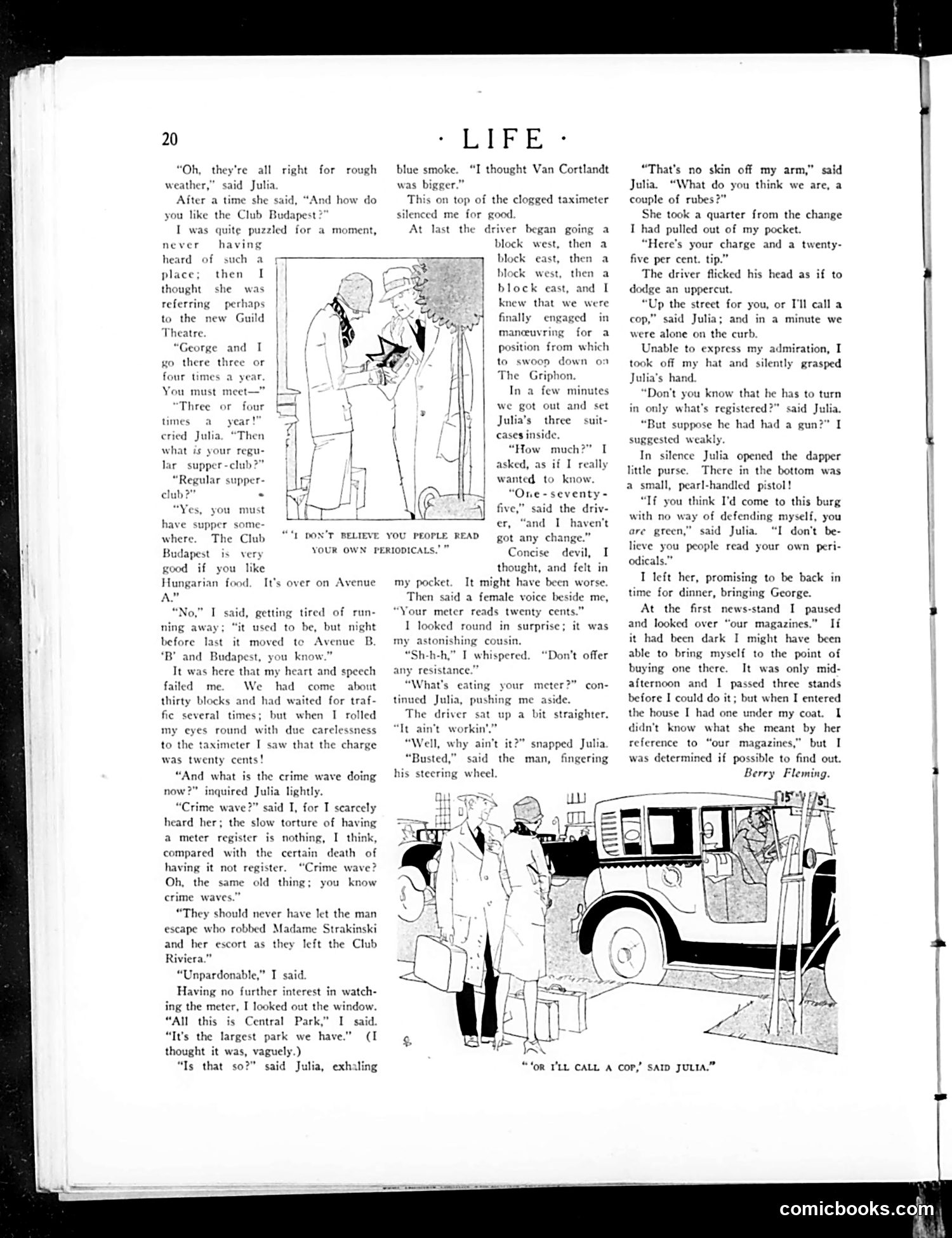
This is a humorous short story with two accompanying illustrations satirizing early 1920s urban life and taxi culture. **The Main Joke:** A naive male narrator is taken on a circuitous cab ride through New York City by his cousin Julia, who is portrayed as a tough, streetwise woman. The taxi driver deliberately drives in circles (block west, block east) to inflate the meter charge—a common scam. The narrator is too embarrassed or timid to object. **The Satire:** Julia represents the "new woman" of the Jazz Age—confident, pragmatic, and unafraid. She: - Immediately spots the driver's scam - Calls him out directly - Tips generously (25%) but on her own terms - Carries a pearl-handled pistol casually - Dismisses the narrator's concerns about crime waves **Social Context:** The piece mocks both taxi driver dishonesty (a real complaint of the era) and male passivity. Julia's casual possession of a gun and her toughness suggest 1920s anxieties about changing gender roles—she's competent where the narrator is helpless. References to "our magazines" suggest contemporary crime reporting was a popular reading topic.
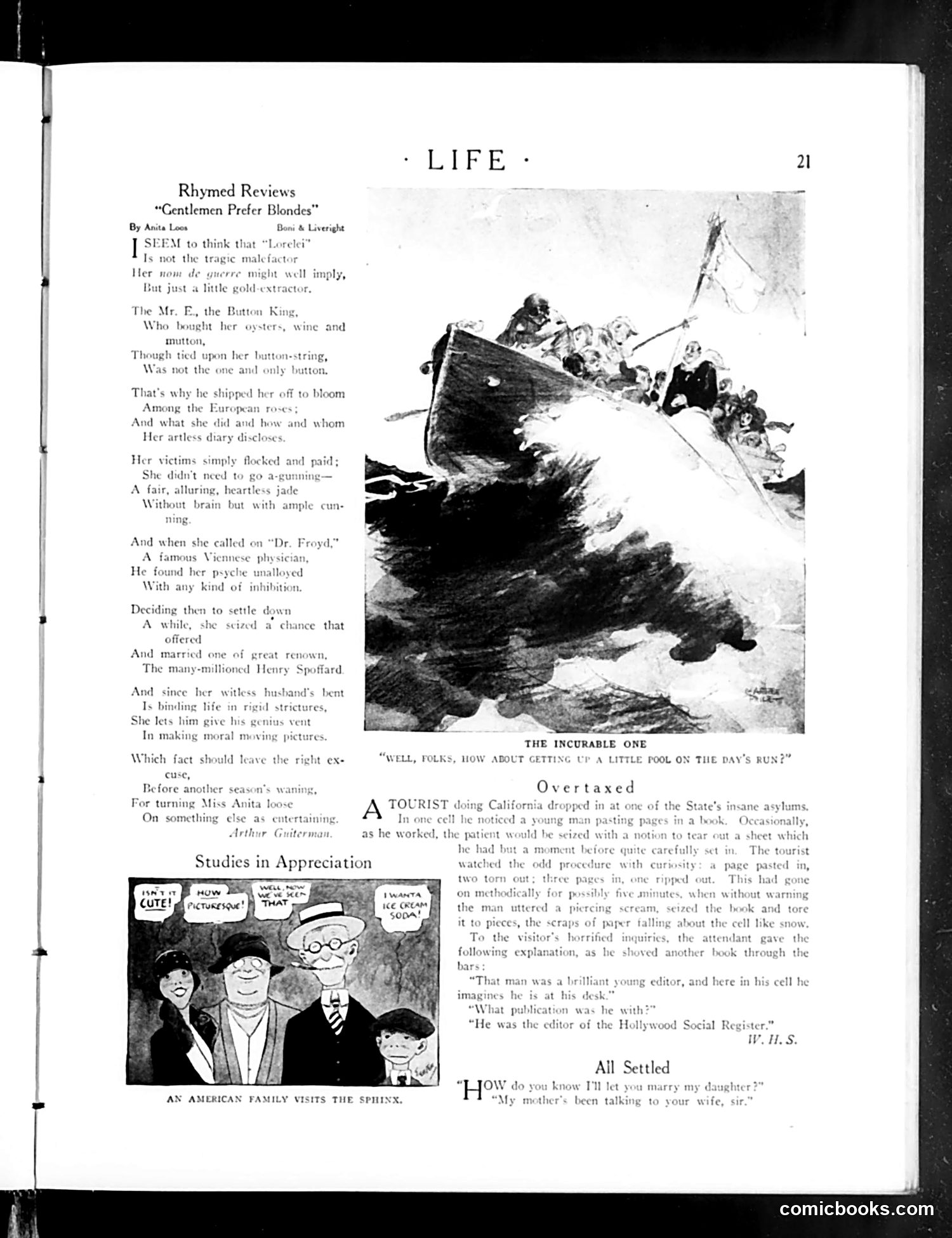
This Life magazine page (page 21) contains satirical content about 1920s American society: **"Gentlemen Prefer Blondes" Review**: A poem mocking Anita Loos's popular novel about a morally flexible blonde woman who extracts money from wealthy men. The satire criticizes both the protagonist's manipulative nature and society's tolerance of her scheme. **"The Incurable One" cartoon**: Shows a boat scene with the caption about "getting a little fool on the day's run"—likely satirizing frivolous leisure activities of the wealthy. **"Studies in Appreciation" cartoon**: Depicts an American family visiting the Egyptian Sphinx, with dialogue suggesting cultural tourism and misunderstanding—poking fun at American tourists abroad who lack genuine appreciation for historical monuments. **"Overtaxed" anecdote**: A humorous story about a patient in an asylum who tears up books. The punchline reveals he was the editor of the *Hollywood Social Register*—satirizing entertainment industry publications as beneath serious consideration. **"All Settled"**: A brief joke about marriage negotiations between families. The page reflects 1920s attitudes toward wealth, morality, tourism, and popular culture.
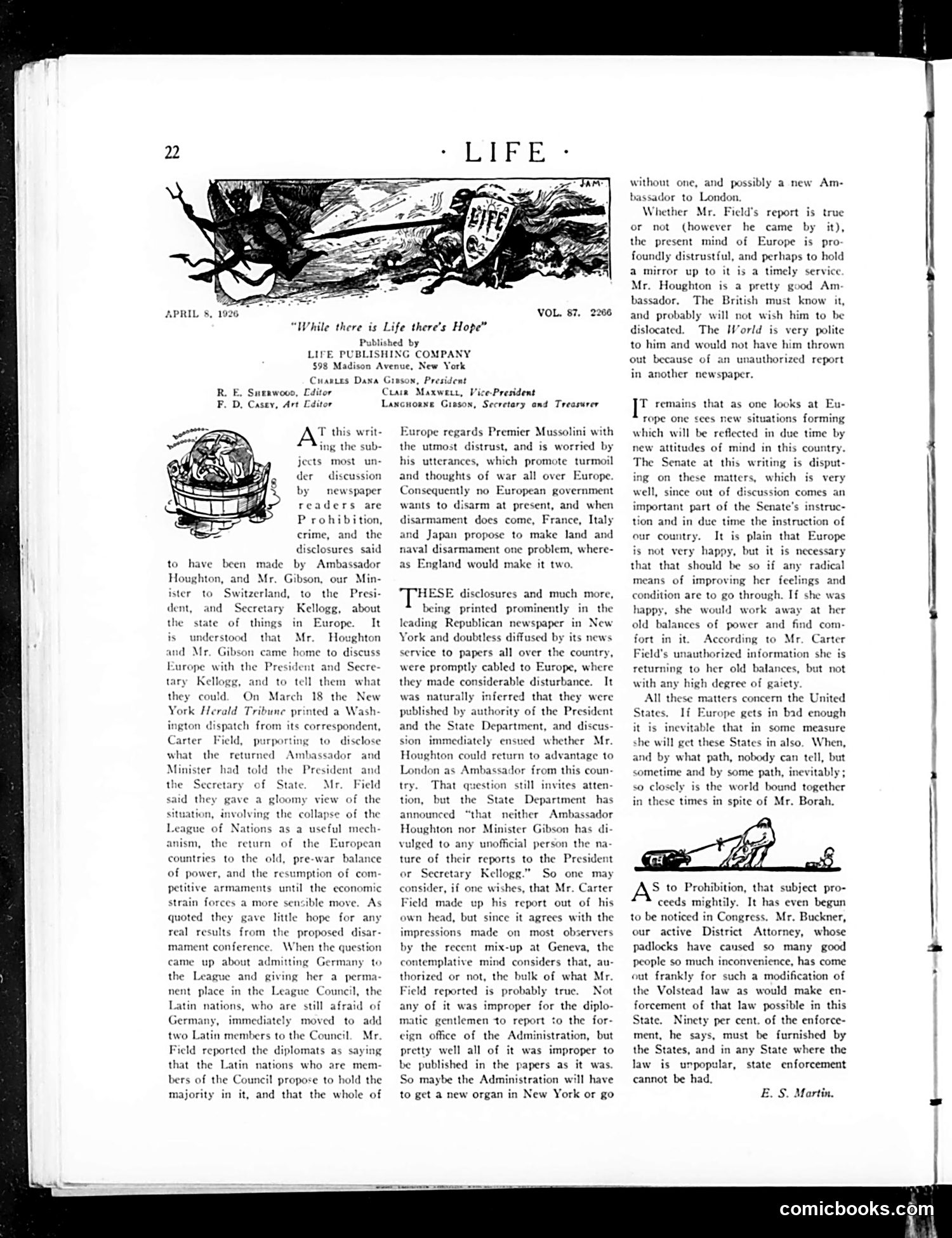
This editorial page discusses a political scandal involving leaked diplomatic reports. Ambassador Alanson B. Houghton and Minister Hugh Gibson allegedly disclosed pessimistic assessments of European conditions to President Coolidge and Secretary Kellogg—including concerns about Mussolini, disarmament failures, and resurgent nationalism. **The Cartoon:** "While there is Life there's Hope" depicts what appears to be a gravestone or tomb, darkly suggesting Europe's dire political situation is nearly terminal. **The Issue:** Journalist Carter Field published these confidential reports in the *Herald Tribune*. Though the State Department denied authorization, the leak embarrassed U.S. diplomacy internationally. **The Satire:** The editors criticize both the leaked pessimism about European stability and the impropriety of publishing classified diplomatic discussions—suggesting the government may need a new official press organ, or go without one entirely. This reflects 1920s concerns about American isolationism, European instability post-WWI, and tensions between press freedom and diplomatic confidentiality.
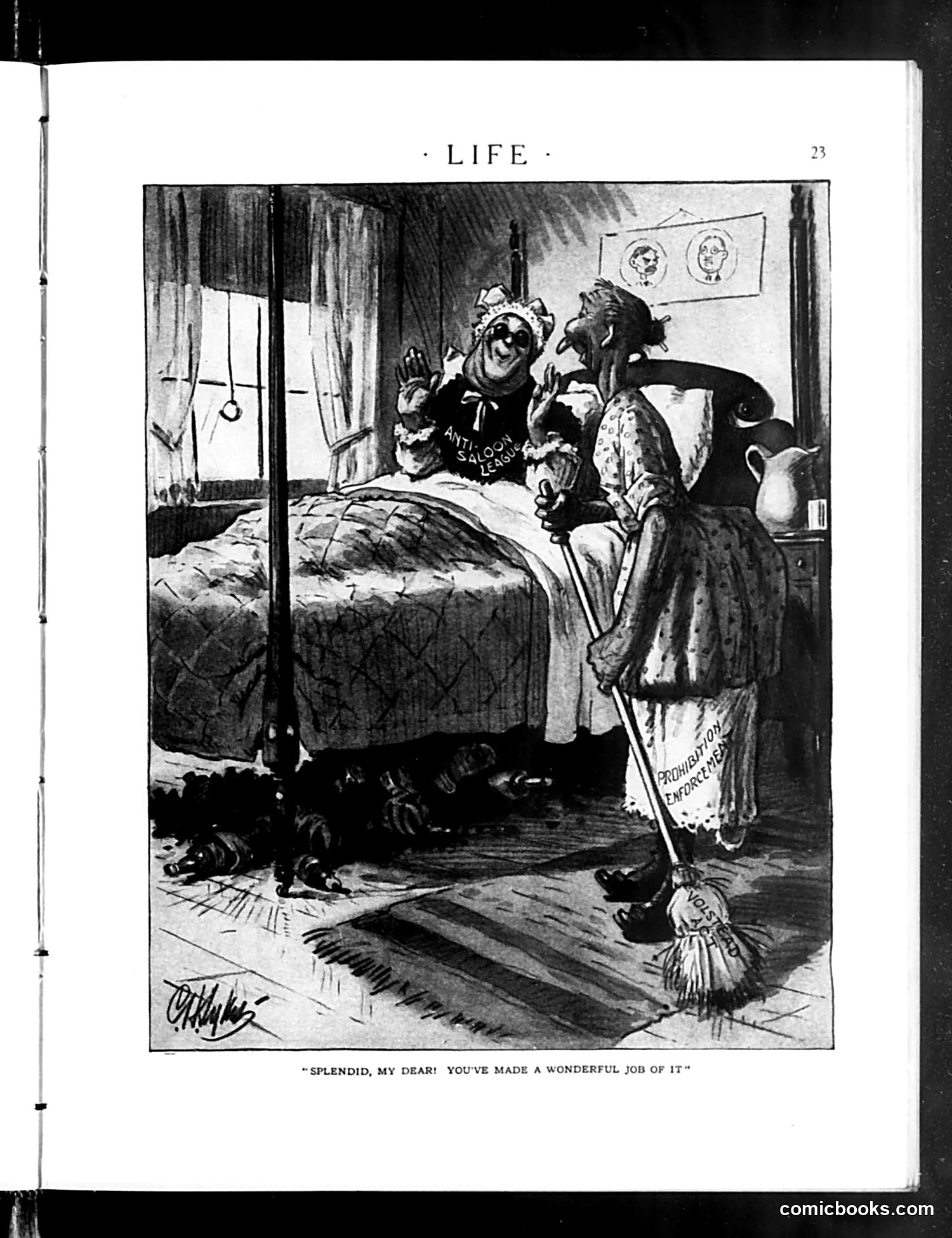
This cartoon satirizes domestic labor, likely from the early 20th century. A woman stands exhausted, holding a mop and broom, while a man in bed praises her housekeeping work with the caption "Splendid, my dear! You've made a wonderful job of it." The satire targets the disconnect between male appreciation and female labor: the man offers verbal praise from his comfortable position while the woman performs grueling physical work. There's a dog sleeping on the floor, adding to the domestic scene. The cartoon critiques gender roles and the undervaluation of housework—women receive only words while doing all the actual labor. This reflects early feminist commentary on domestic inequality, a recurring theme in Life magazine's satirical social commentary.
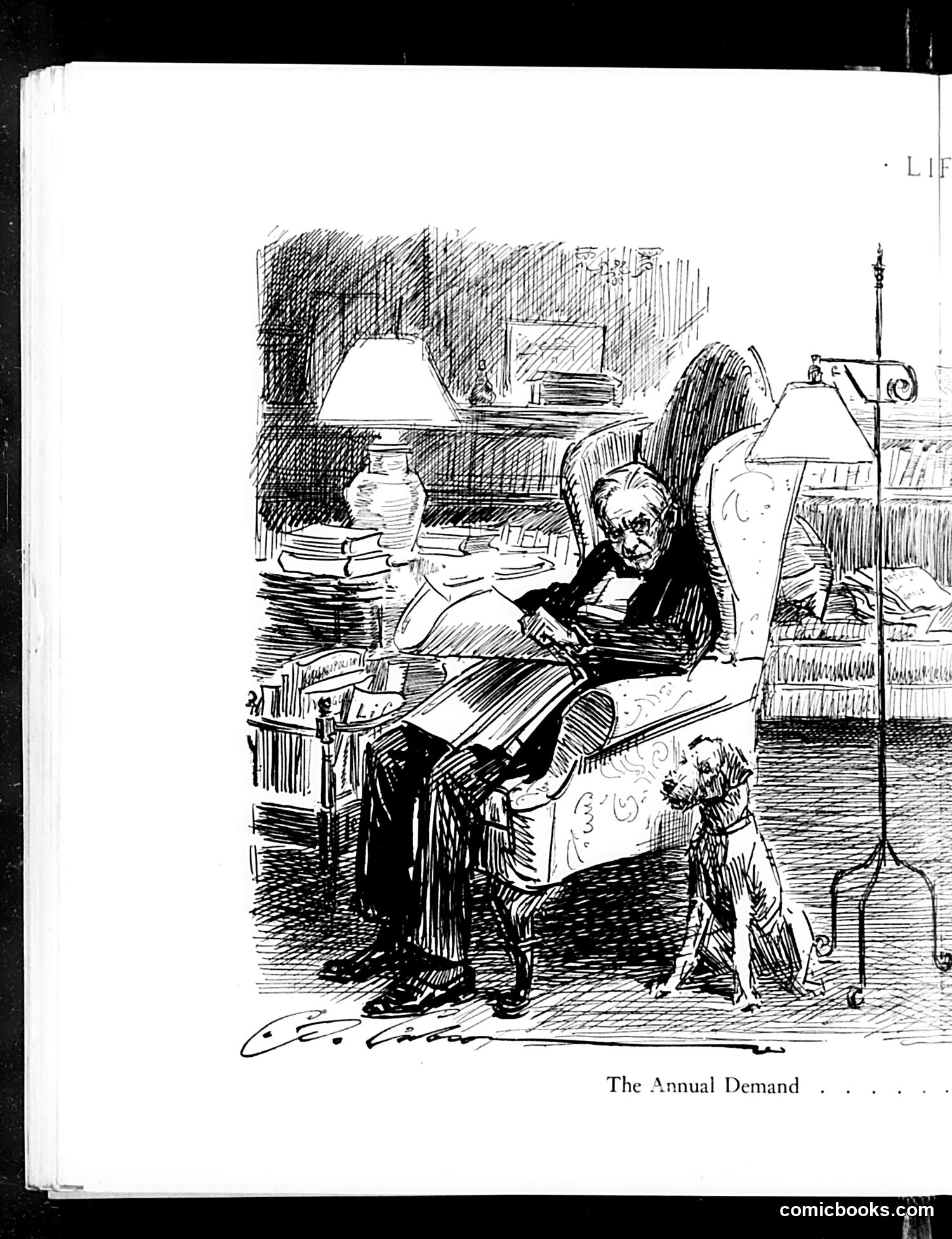
This satirical sketch depicts a well-dressed woman seated indoors, reading what appears to be financial documents or bills. A small dog sits at her feet looking up expectantly. The cartoon critiques the predictable, recurring nature of household expenses—likely rent, taxes, or other annual financial obligations that demand payment regardless of one's wishes. The humor lies in the parallel between the woman's resigned posture while reviewing financial demands and the dog's simple, direct expectation. Both represent forms of "demand" that cannot be ignored or postponed. The domestic interior setting emphasizes that even in one's home, financial obligations are inescapable. The title "The Annual Demand" suggests satirizing the relentless cycle of yearly expenses that drain household finances.
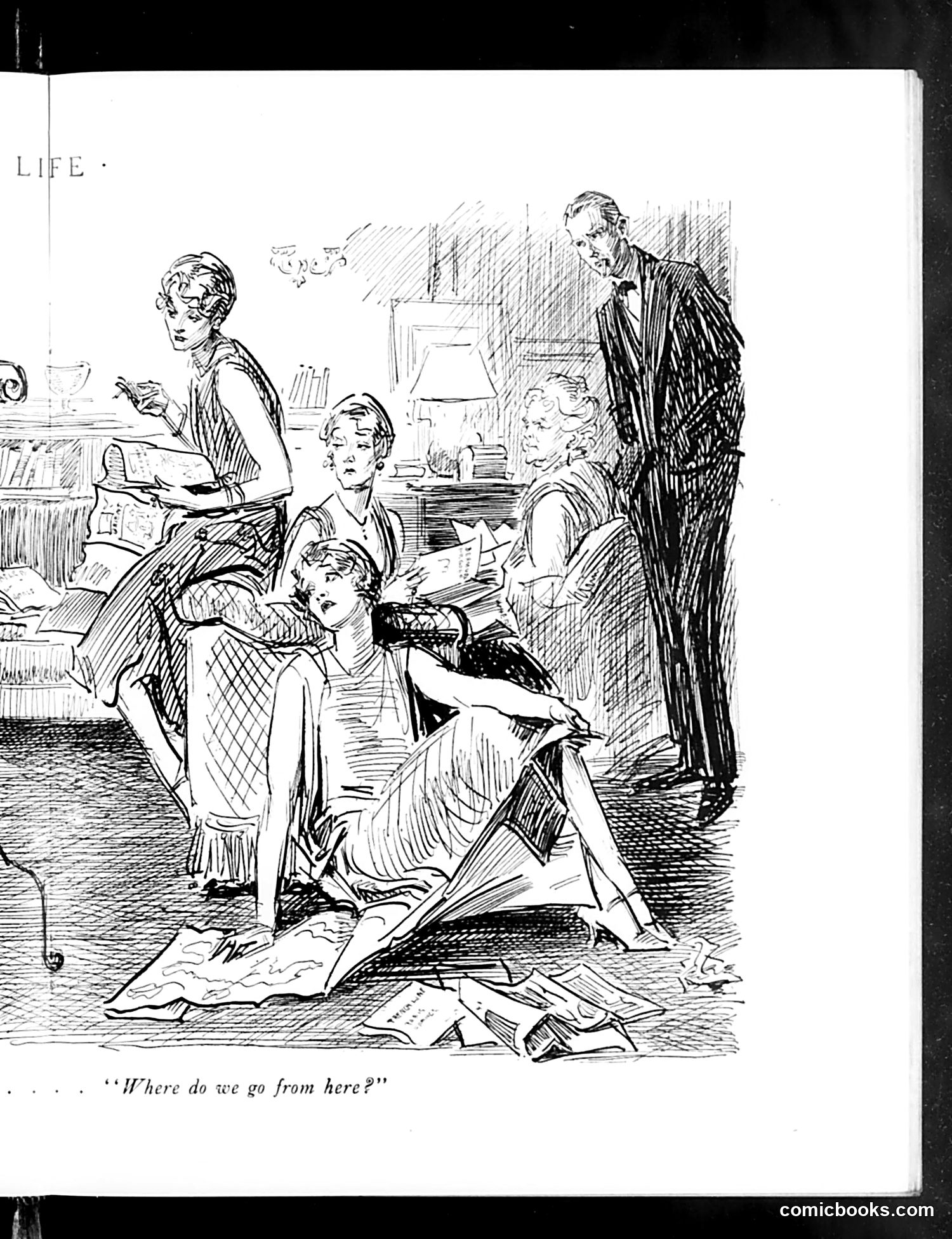
This pen-and-ink cartoon depicts a domestic crisis scene. A woman sits amid scattered papers on the floor, appearing distressed, while asking "Where do we go from here?" Around her stand several other figures—including what appears to be a man in a suit (possibly a financial advisor or authority figure), other family members, and observers. The scattered papers suggest financial documents or bills, indicating this scene concerns economic hardship or financial ruin. The woman's posture and question suggest desperation about the family's future prospects. Without a specific date visible, the cartoon likely satirizes Depression-era anxiety about household finances and economic uncertainty. The composition emphasizes the woman's vulnerable position while authority figures observe, possibly critiquing how such crises were addressed (or ignored) by those in power.
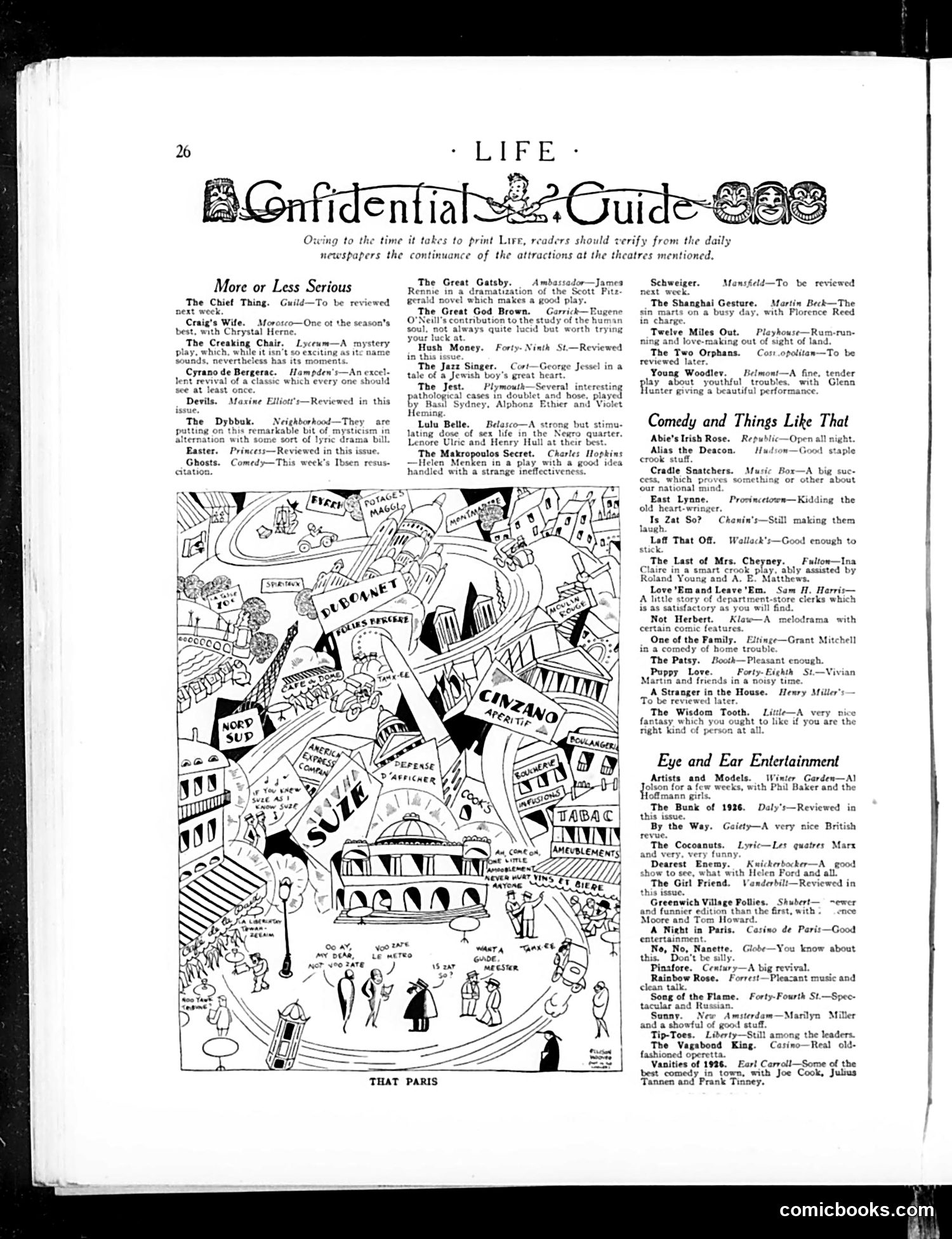
This illustrated map depicts the theatrical heart of New York City's entertainment district, likely Times Square/Broadway area. The central cartoon shows a bird's-eye view of theaters, nightclubs, and streets labeled with venue names (visible: Cinzano, Suez, Tabac, and various theater marquees). The surrounding text is a "Life Confidential Guide" — essentially theater listings and reviews for the current week's productions. These include major shows like *The Great Gatsby*, *The Jazz Singer*, and *Abie's Irish Rose*, along with brief critical assessments. The satire targets the overwhelming density and commercialization of entertainment venues packed into Manhattan's theater district, with their competing marquees, advertisements, and crowds. The whimsical illustration style mocks the chaotic energy of 1920s nightlife during Prohibition — note references to "Cinzano" (a liqueur brand), suggesting speakeasies operating despite the alcohol ban. For modern readers: this captures the pre-Depression boom in American entertainment and the specific cultural moment when Broadway dominated popular leisure.
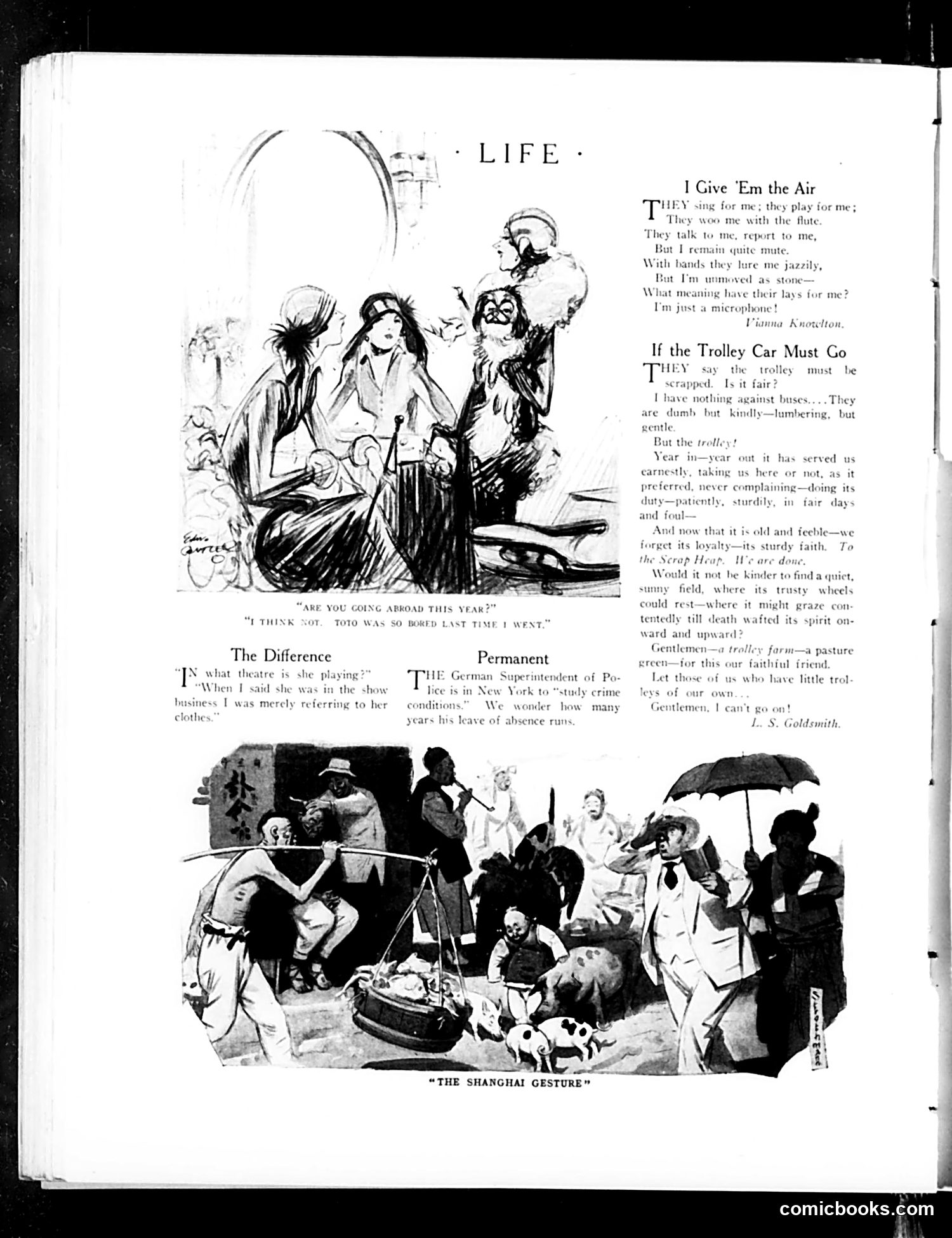
This page contains three distinct satirical pieces: **"I Give 'Em the Air"** (top): A poem mocking someone (likely a performer or public figure) who ignores their audience despite their devotion. The speaker claims indifference to admirers' efforts, suggesting narcissistic detachment. **"The Difference"** (middle left): A brief joke contrasting theater with fashion—a woman claims she was "in the show business" when actually she merely meant she was wearing fashionable clothes. **"Permanent"** (right): Commentary on scrapping old trolley cars. The author argues sentimentally against discarding these faithful public servants, suggesting they deserve retirement rather than destruction. This likely references early 20th-century transit debates as automobiles displaced streetcars. **"The Shanghai Gesture"** (bottom illustration): References a 1919 David Belasco play about Shanghai. The image shows what appears to be colonial-era characters in an exotic setting, satirizing Western attitudes toward Asian locations and people as spectacle. The page exemplifies *Life*'s blend of social commentary, theatrical satire, and gentle mockery of contemporary American attitudes.
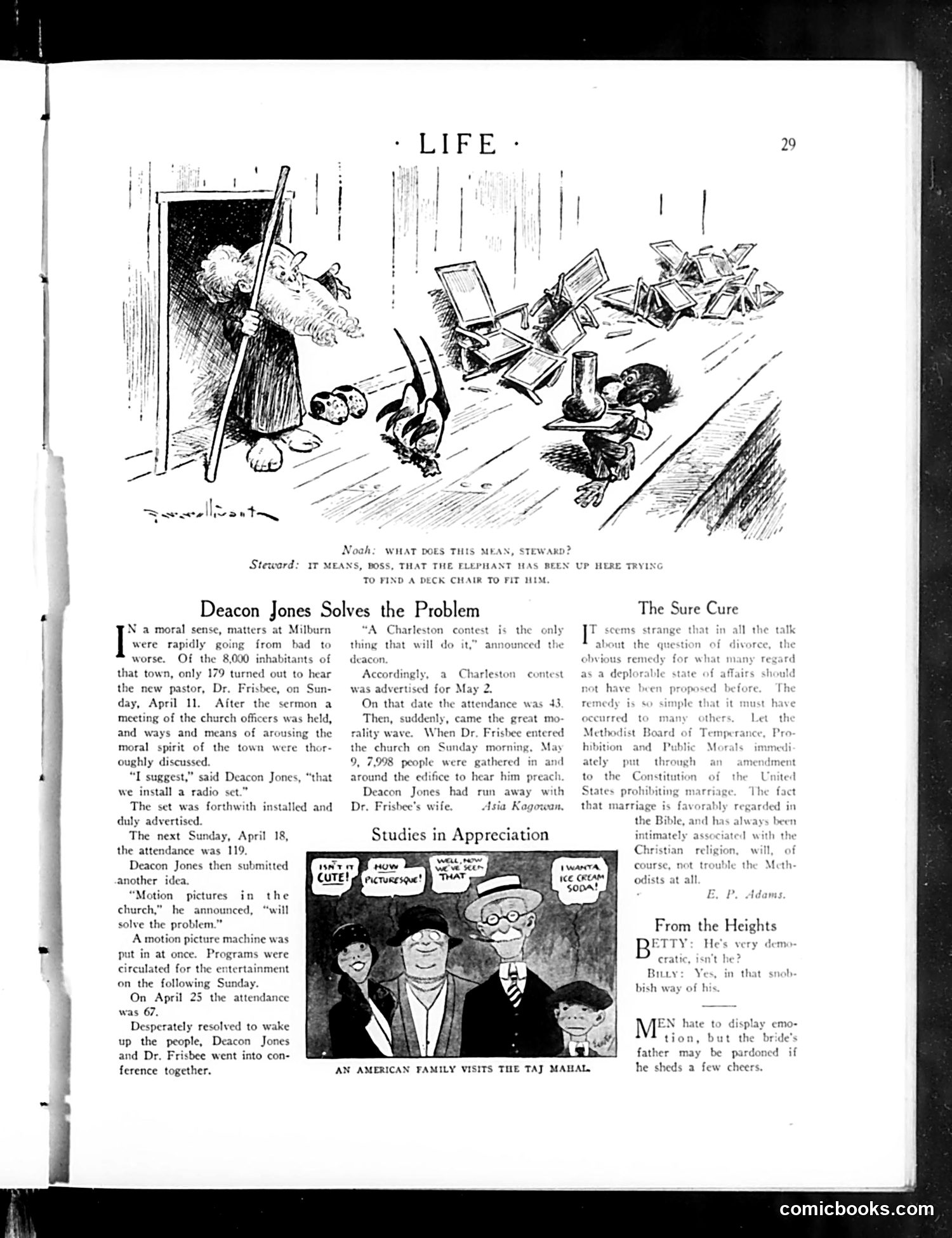
This satirical story mocks shallow attempts to modernize religion and boost church attendance. Deacon Jones suggests installing a radio to attract parishioners to a struggling church in Milburn. When attendance actually *decreases* (from 179 to 119 to 67), he proposes adding motion pictures—which further flops. The joke's punchline: the church finally succeeds when Dr. Frisbee elopes with a woman named Asia Kagowan, drawing nearly 8,000 people—not from piety, but from scandal and gossip. The satire targets two things: (1) the notion that modern technology (radio, movies) can revitalize religion, and (2) the reality that people are more attracted to moral transgression and gossip than genuine spirituality. The joke undercuts both the church's misguided strategies and its congregation's priorities.
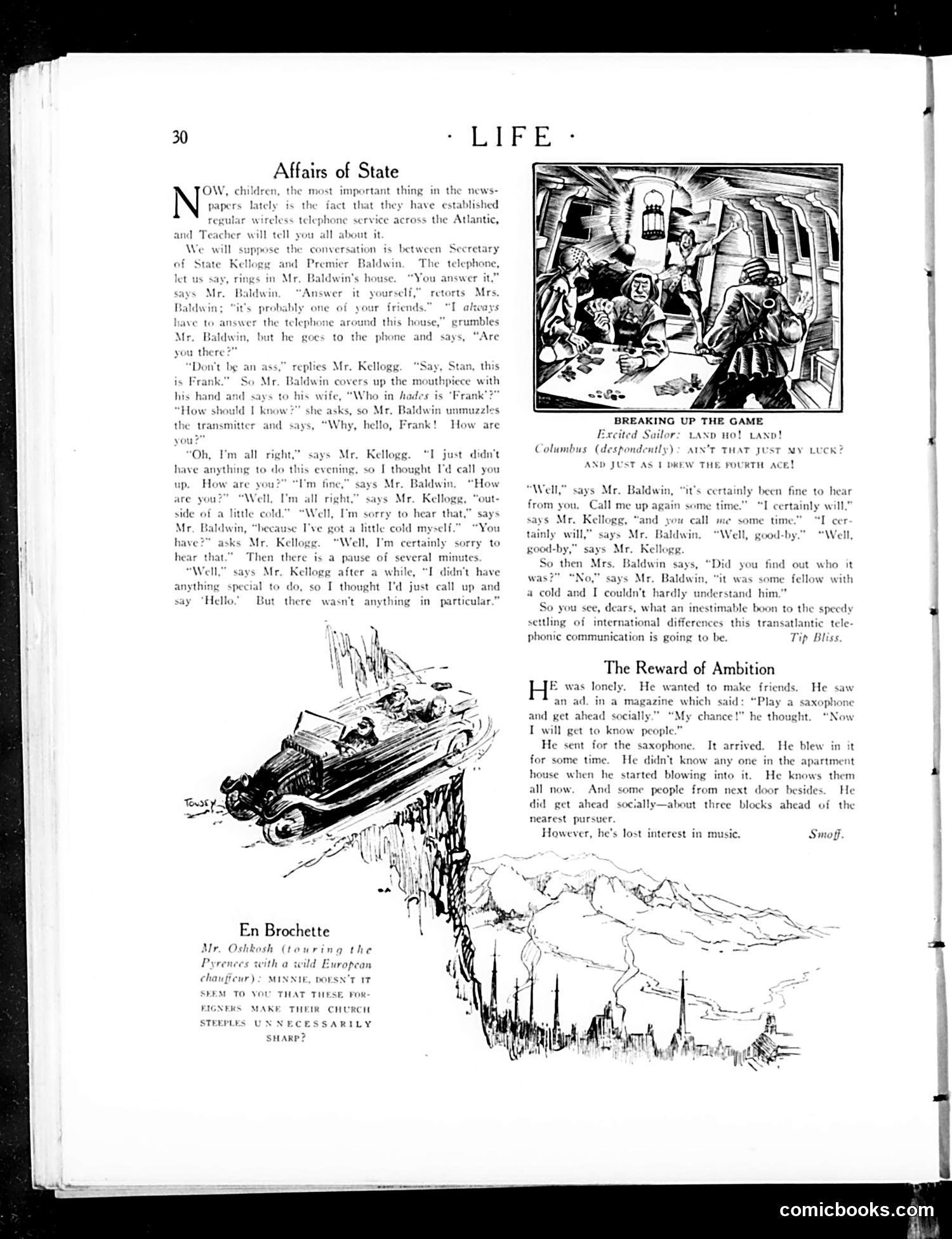
This page satirizes three topics: **"Affairs of State"** mocks the recently established transatlantic wireless telephone service (likely 1920s). The joke: a trivial domestic call between Secretary Kellogg and Premier Baldwin demonstrates the technology's impracticality—they reach each other only to exchange pleasantries about colds, making international telephone communication seem pointless rather than revolutionary. **"Breaking Up the Game"** shows a sailor's complaint that Columbus interrupted his card game just as he drew a fourth ace—a dig at Columbus Day celebrations or historical reverence, suggesting even momentous discoveries are merely inconvenient interruptions to ordinary people. **"En Brochette"** features a European (likely French or German based on the dialogue) asking why foreigners make church steeples unnecessarily sharp—possibly satirizing European architectural pretension or continental affectations that Americans found absurd. The overall tone is typical American satirical magazine humor: deflating grandeur through domestic mundanity and gentle ethnic humor.
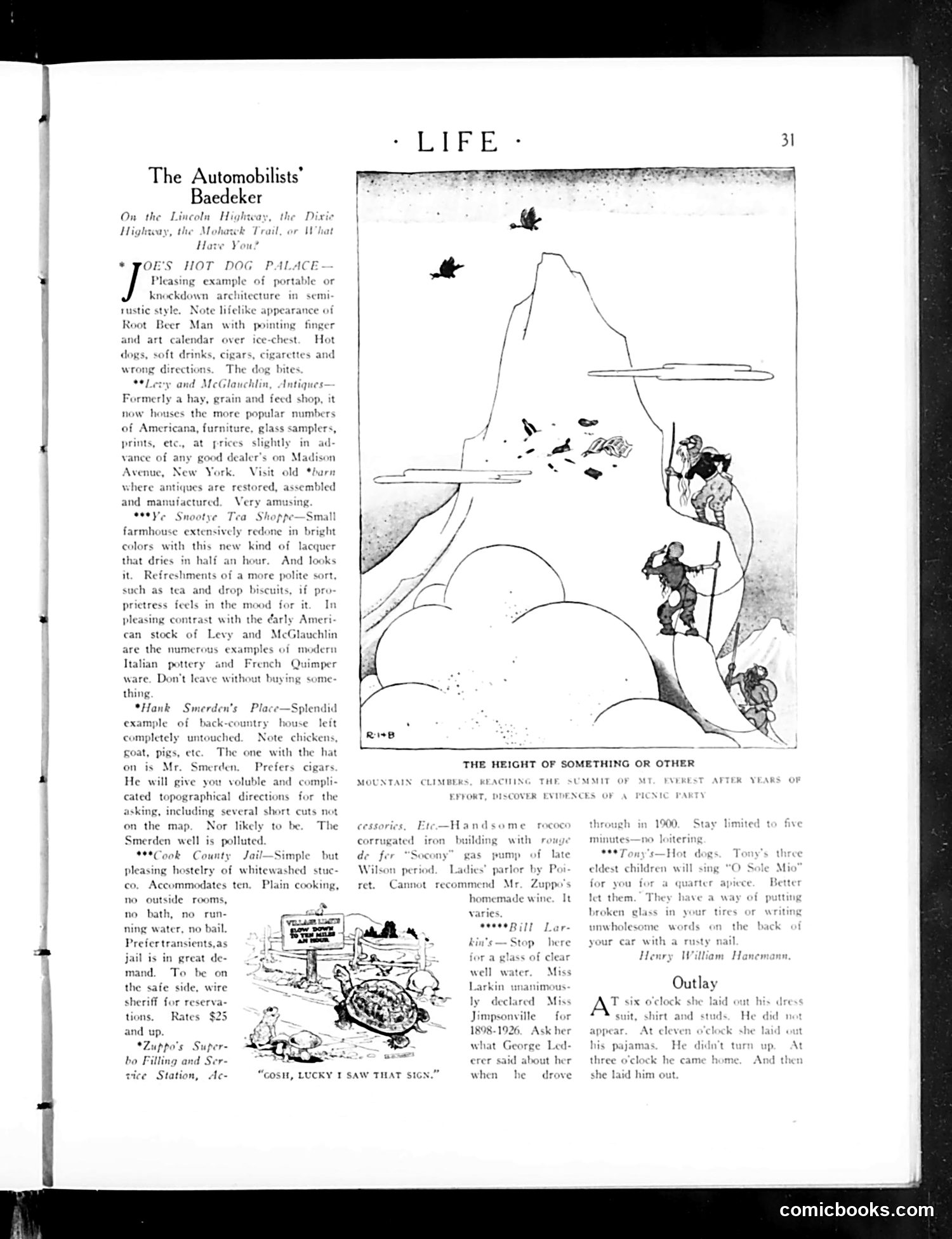
This page satirizes early 20th-century automobile tourism and roadside culture. The main cartoon—"The Height of Something or Other"—mocks mountain climbers who discover litter and debris at a summit, suggesting that even remote wilderness has been spoiled by careless tourists and their refuse. The left column provides humorous "travel guide" entries for various establishments along American highways—cheap hot dog stands, rustic lodgings, and filling stations. The satire targets the proliferation of tacky, commercialized roadside attractions and their often dubious cleanliness and service ("Smerden's well is polluted"). The piece ridicules both the nouveaux-riche automobile tourists seeking "authentic" rural experiences and the opportunistic small-business owners who cater to them with slapdash accommodations. It's commentary on how automobile culture was commercializing and degrading the American countryside during the motor-car boom of the 1920s.
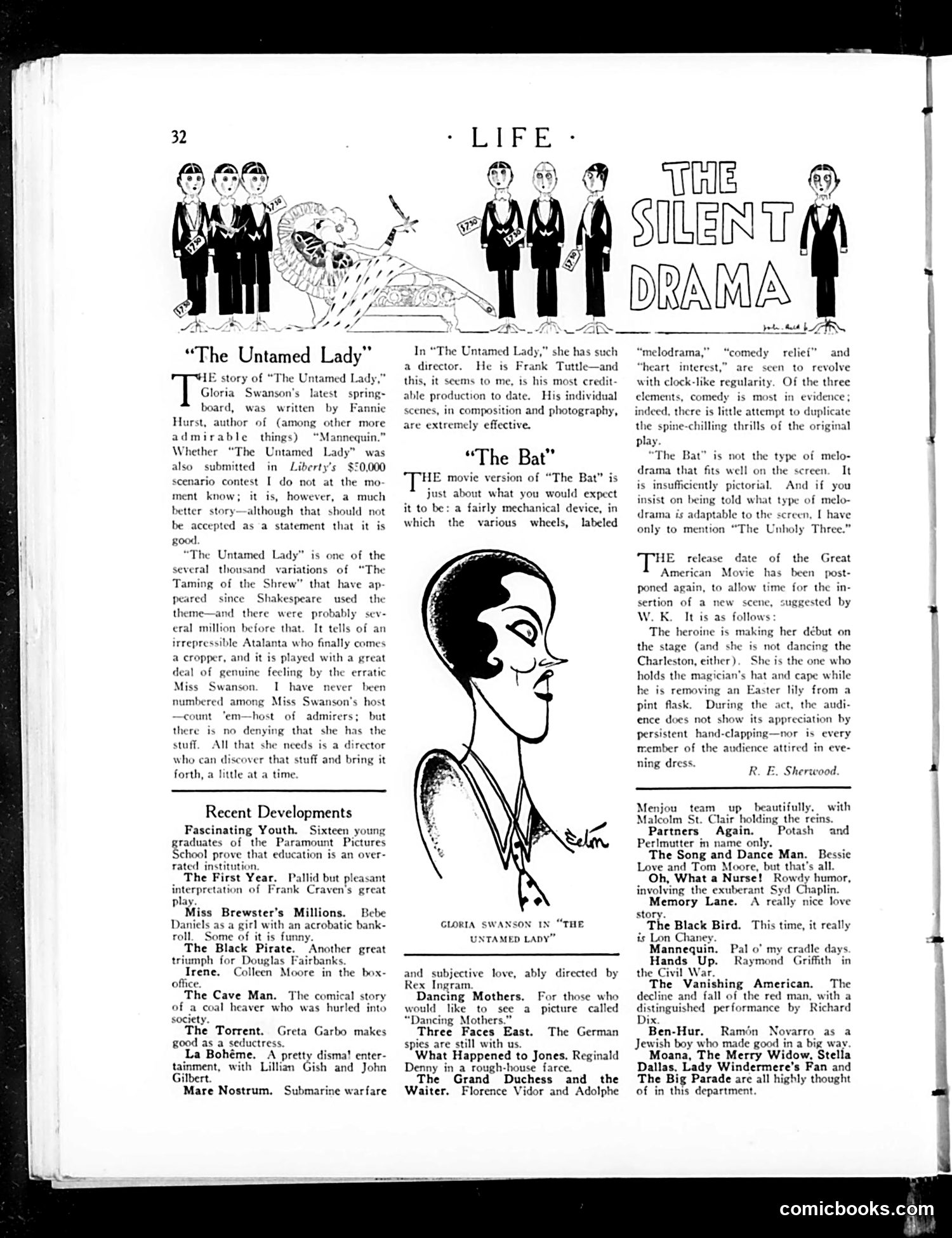
This page reviews recent silent films for modern readers unfamiliar with 1920s cinema. The main cartoon shows Gloria Swanson (labeled in the illustration) as "The Untamed Lady," depicting the actress in profile with dramatic styling typical of silent film publicity. The reviews critique several films, including Swanson's vehicle (another "Taming of the Shrew" variation), "The Bat" (criticized as mechanically plotted but not cinematic enough), and other releases featuring Douglas Fairbanks and Greta Garbo. Key context: This represents early Hollywood's reliance on literary adaptations and theatrical plots. The reviewer's complaint that "The Bat" is "insufficiently pictorial" reflects silent cinema's struggle to adapt stage plays—without dialogue, visual storytelling became paramount. Swanson was a major star, though the critic admits to never being an admirer despite acknowledging her talent.
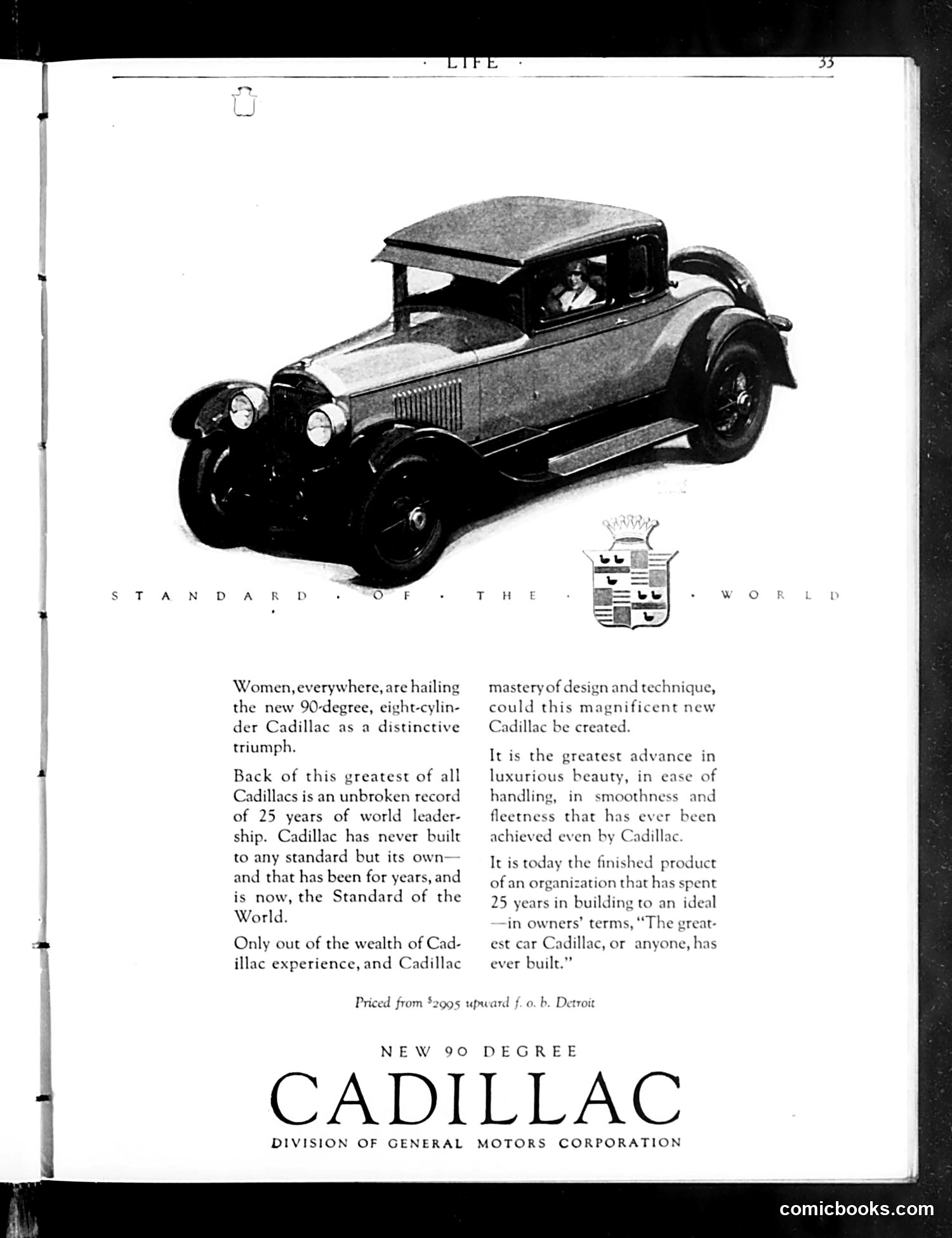
This is not a cartoon or satire—it's a **luxury automobile advertisement** for Cadillac's new 90-degree, eight-cylinder model. The page features a black-and-white photograph of the car and promotional copy emphasizing its prestige. The ad appeals to aspirational readers by claiming Cadillac's "25 years of world leadership" and positioning the vehicle as a status symbol for women ("Women, everywhere, are hailing"). The language is hyperbolic—calling it the "Standard of the World" and "the greatest car...anyone has ever built"—typical of 1920s advertising excess. The price point ($2,995 upward) and emphasis on luxury features (smoothness, ease of handling, design mastery) target wealthy buyers. There is no political satire here; *Life* magazine ran substantial advertising alongside its editorial content. This represents the magazine's commercial function rather than its satirical voice.
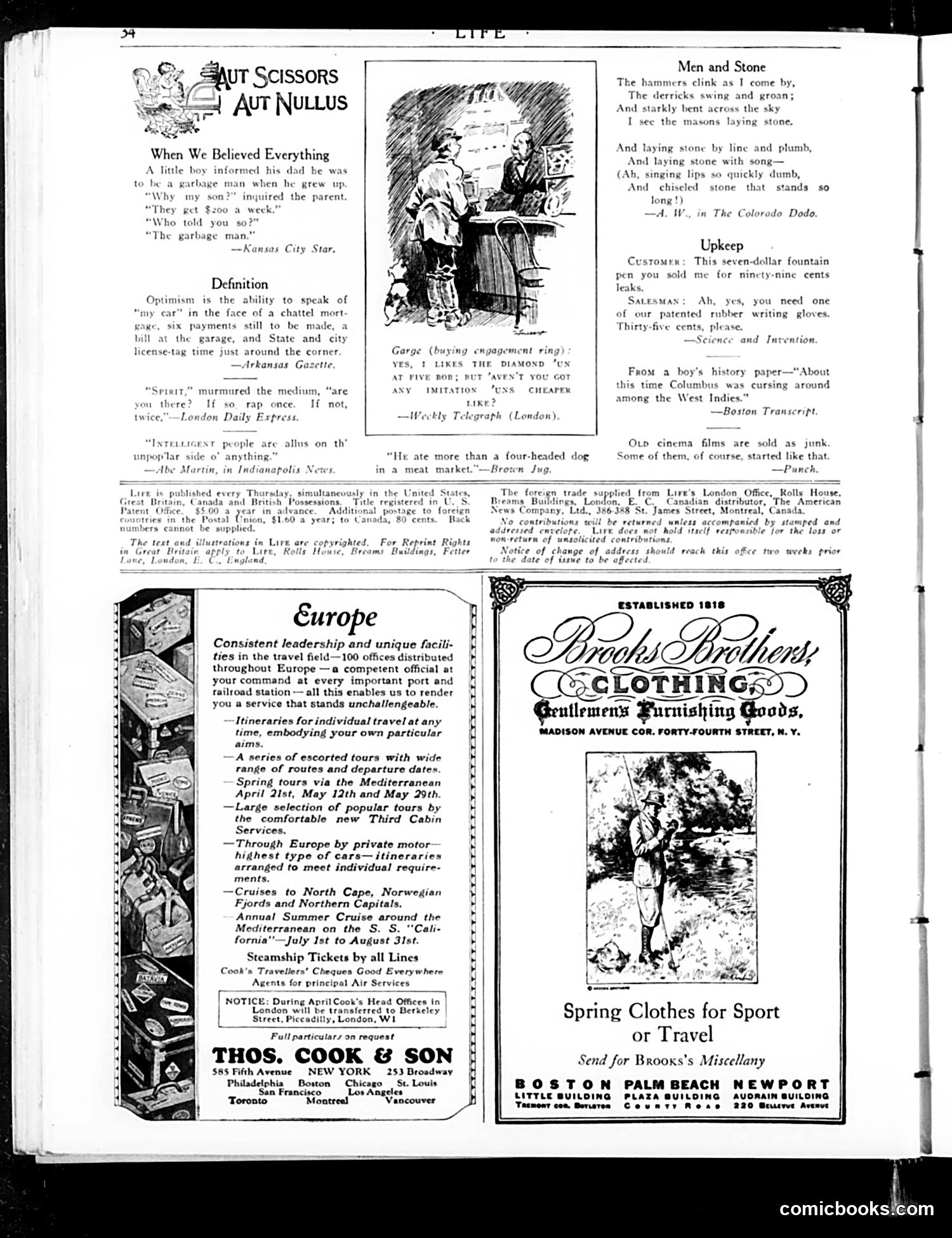
This page contains several brief humorous items typical of Life's satirical format: **"When We Believed Everything"** mocks naive childhood—a boy assumes garbage men earn $200/week because they work, not realizing society undervalues such labor. **"Definition"** jokes about middle-class financial anxiety: a man who still owes payments on a car describes himself as "optimistic" for speaking positively about it despite debt. **The cartoon** shows a couple at what appears to be a jewelry counter. The man's engagement ring comment is interrupted by the salesman mentioning cheaper imitations, satirizing both consumerism and perhaps the difference between genuine and artificial expressions of love/commitment. **"Men and Stone"** is a poem celebrating laborers' dignity and song while building. **"Upkeep"** jokes about planned obsolescence—a fountain pen leaks after minimal use, and the salesman suggests buying expensive rubber gloves as a "fix" rather than replacing it. The remaining items are similar quick-hit satirical observations about cinema, seances, and social attitudes. This reflects Life's format of brief, accessible comedy targeting middle-class readers' everyday frustrations.
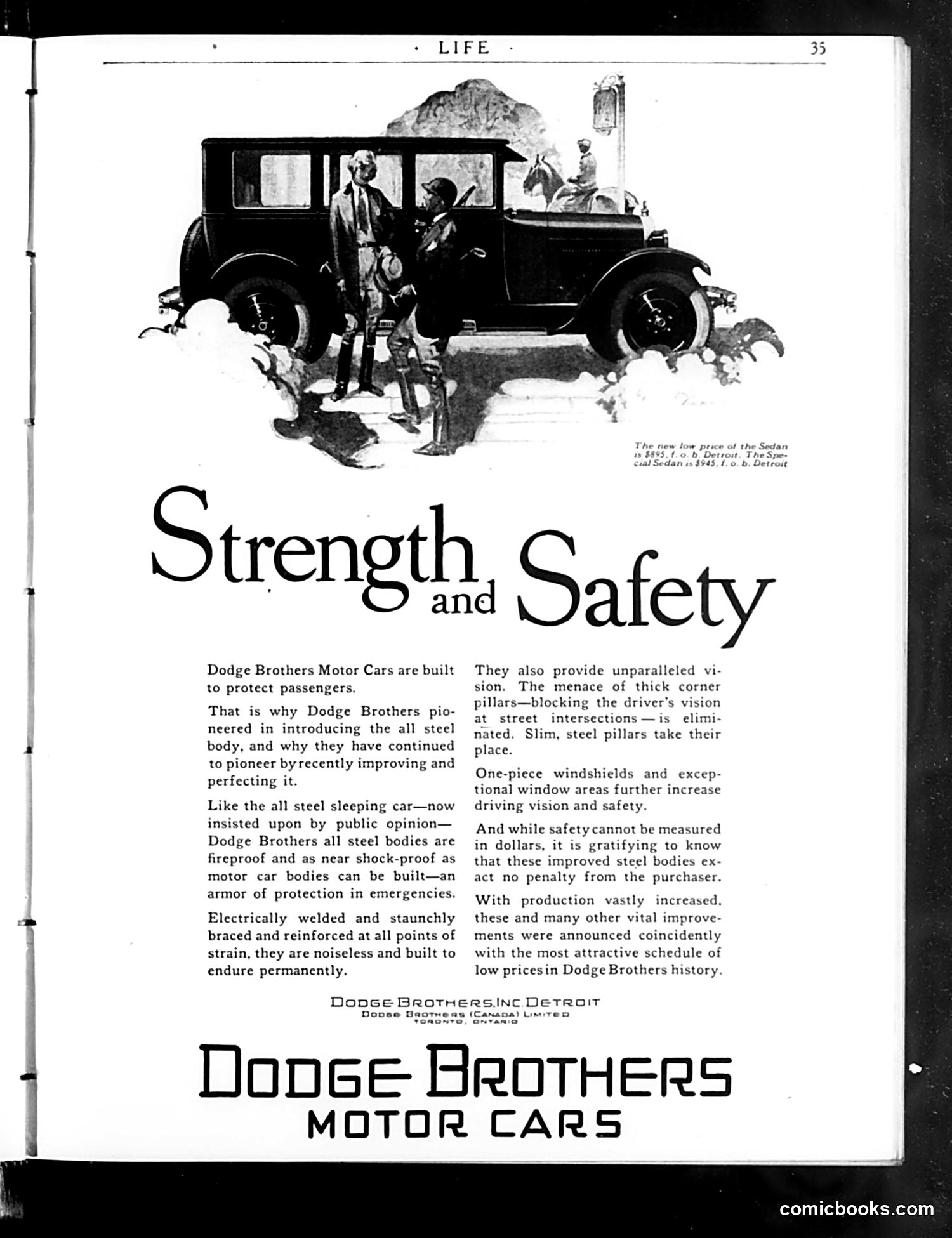
This is **not a political cartoon or satire**—it's a straightforward automobile advertisement for Dodge Brothers Motor Cars, appearing in *Life* magazine (page 35). The illustration depicts a 1920s sedan with passengers and pedestrians, serving as a visual centerpiece for advertising copy emphasizing safety features: all-steel bodies, slim corner pillars for improved visibility, one-piece windshields, and reinforced construction. The ad compares Dodge's safety standards to "all steel sleeping cars," referencing public demand for protective design. It emphasizes that these improvements incur "no penalty from the purchaser"—meaning no price increase—while announcing lower prices and increased production. This represents early automotive marketing focused on safety as a selling point, a relatively novel concept in the 1920s when standardized safety features were still being established as industry norms.
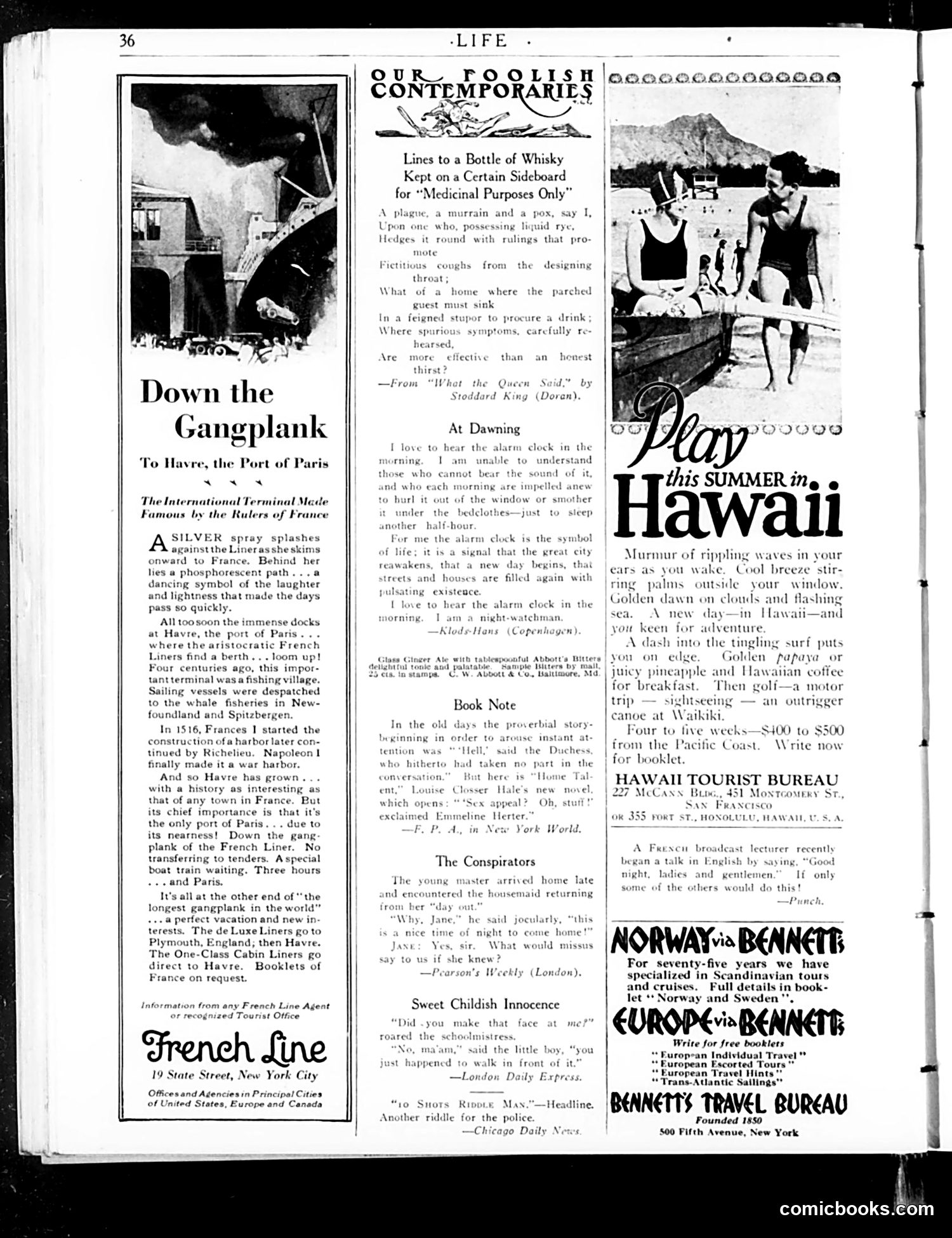
This page from *Life* magazine is primarily **advertising and travel promotion**, not political satire. The main content includes: **Left side:** An advertisement for the French Line shipping company, promoting travel from New York to Havre (Le Havre), France's primary port. It emphasizes the convenience of direct passage to Paris. **Center:** A section titled "Our Foolish Contemporaries" featuring humorous literary quotes and anecdotes mocking human behavior—including pretentious medicinal whisky-drinking, city dwellers' sleep habits, and domestic servants' observations. These are mild social satire rather than political commentary. **Right side:** Travel advertisements for Hawaii, Norway/Scandinavia, and Europe via Bennett's Travel Bureau. The page reflects early-to-mid 20th century leisure travel marketing and light satirical humor about everyday upper-middle-class life, rather than substantive political commentary or political cartooning.
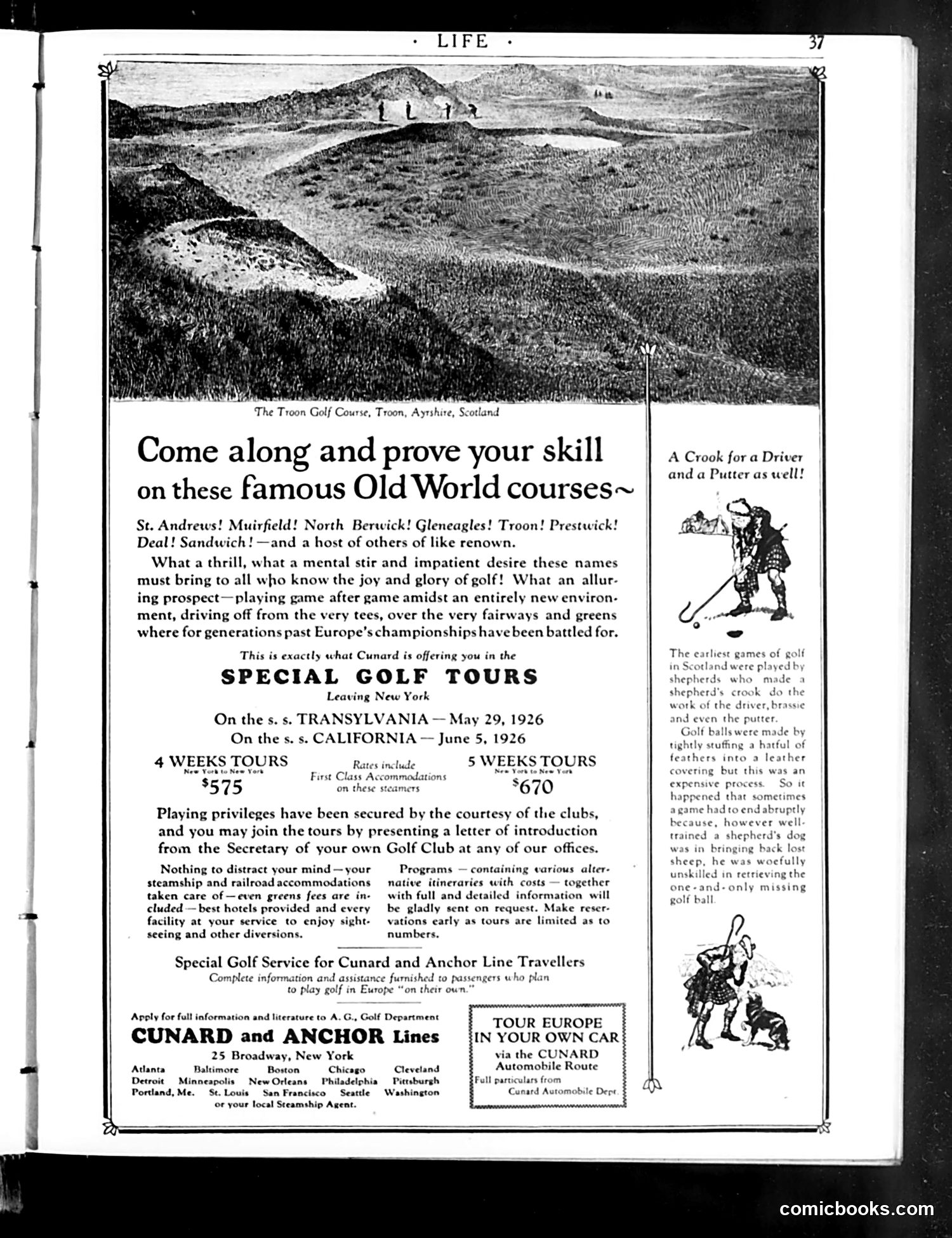
This page is primarily a **Cunard steamship advertisement** promoting golf tours to Scotland, with minimal satirical content. The main advertisement offers wealthy Americans passage on luxury liners (the *Transylvania* and *California*) to play famous Scottish golf courses like St. Andrews and Muirfield. Tours cost $575-$670 (substantial sums in 1926) and include first-class accommodations and playing privileges. The **right-side illustrations** appear to be historical humor about golf's origins, depicting Scottish shepherds using their crooks as makeshift golf clubs and putters, and noting that golf balls were expensively hand-made from leather and feathers. This serves as genteel context rather than satire. **The satire is subtle**: the advertisement implicitly mocks wealthy American golfers' aspirations to play "prestigious" Old World courses, positioning luxury travel as the ultimate status symbol. The historical vignettes humorously contrast golf's humble Scottish shepherd origins with its transformation into an exclusive pursuit for affluent tourists. Essentially, this is upscale marketing with light historical garnish—not sharp political commentary.
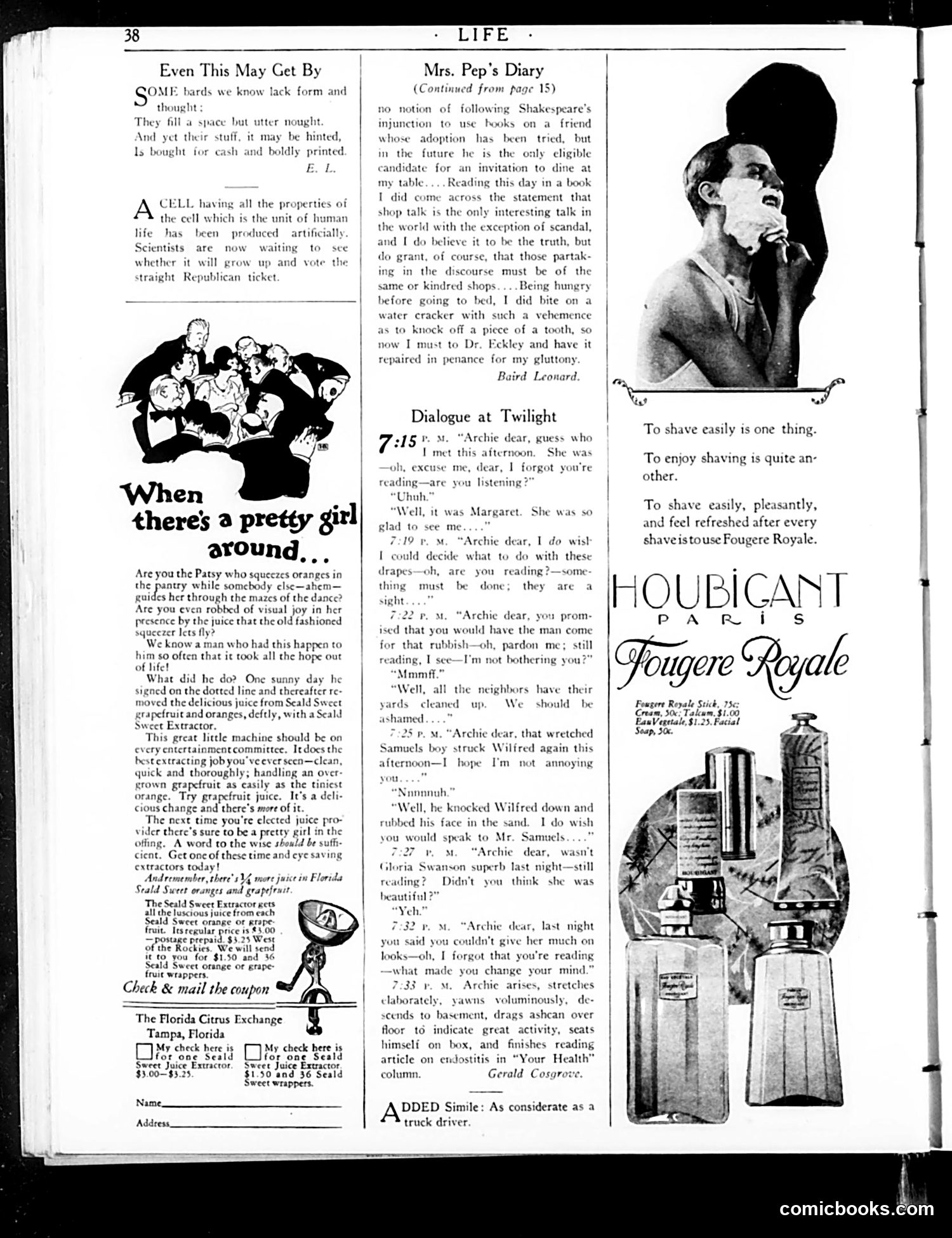
This page contains three distinct sections: **"Even This May Get By"** satirizes politicians who lack substance. The poem mocks empty political rhetoric—figures who "fill a space but utter naught" yet get published and funded. The accompanying cell joke jabs Republican politics: a synthetic cell is created artificially, then scientists wait to see "whether it will grow up and vote the straight Republican ticket"—equating Republican voters with artificial, mindless organisms. **"When There's a Pretty Girl Around"** is a product advertisement disguised as humor, promoting a citrus juicer by mocking men who squeeze oranges for women at social events. **"Mrs. Pep's Diary" and "Dialogue at Twilight"** humorously depict a wife repeatedly trying to engage her husband in conversation while he reads, receiving only monosyllabic responses. This satirizes domestic life and marital inattention—a common social theme of the era. The page is primarily advertising with satirical framing typical of *Life* magazine's style.
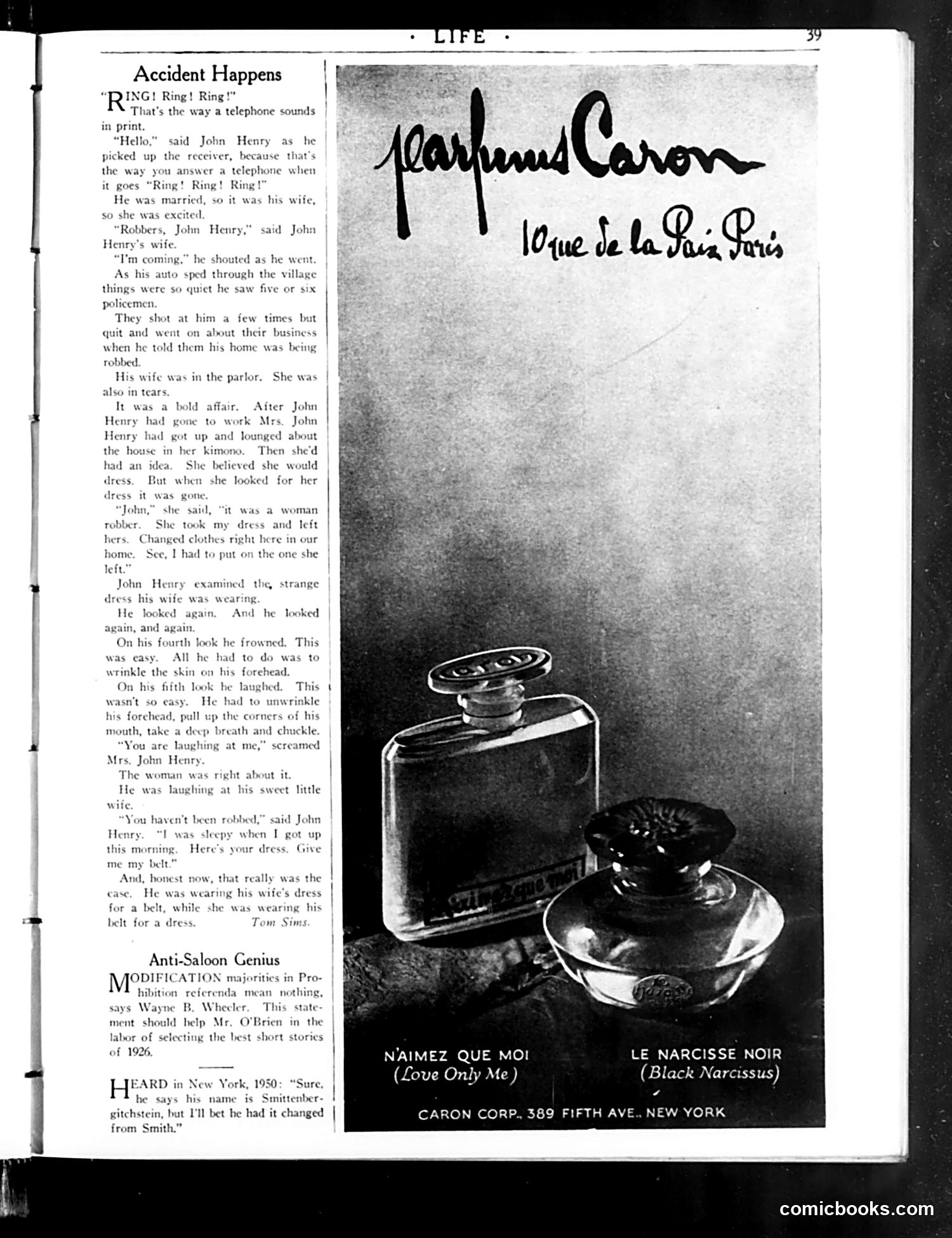
This page contains two distinct elements: **Left side:** A humorous short story titled "Accident Happens" by Tom Sims. A married couple experiences a home robbery while the husband is at work. The twist: a female burglar steals the wife's dress, forcing her to wear the robber's clothes instead. When John Henry returns home wearing his wife's dress (using it as a belt), he initially frowns but then laughs—realizing he's actually wearing *her* dress, not a stolen one. The joke plays on marital confusion and role reversal. **Right side:** Perfume advertisement for Caron fragrances, featuring two bottles. The ad includes signatures (appears to be celebrity endorsements) and French names for the scents: "Naimez Que Moi" (Love Only Me) and "Le Narcisse Noir" (Black Narcissus). This is straightforward product advertising targeting the magazine's affluent readership. The page blends satirical fiction with luxury goods marketing, typical of Life's 1920s format.
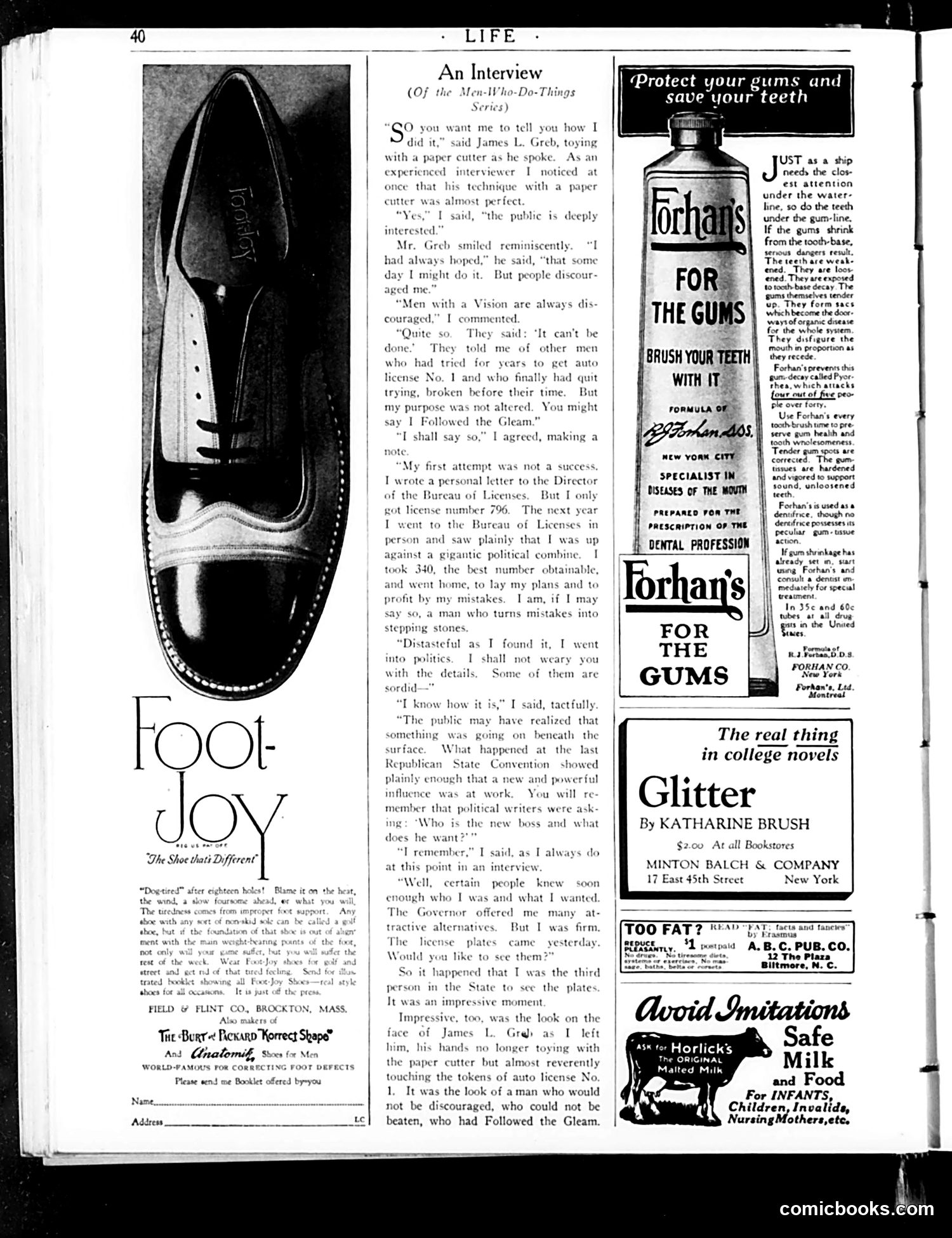
This page features **an interview with James L. Greb** about obtaining an automobile driver's license—a satirical commentary on bureaucratic corruption and political influence, likely from the 1920s-30s. **The Satire:** Greb describes his years-long struggle to obtain a license, revealing that success required entering "politics" and "a gigantic political combine." He's awarded license number 340, implying the system is rigged—persistence and merit mean nothing without political connections. His final reverent moment touching the license symbolizes how corrupt bureaucracies devalue honest achievement. The story satirizes the mundane yet infuriating reality that ordinary citizens need political strings pulled to accomplish routine tasks. **Supporting Context:** The shoe advertisement on the left page is incidental. The "Foot-Joy" ad and dental hygiene ads fill remaining space—typical magazine layout of the period. The interview mocks how thoroughly American civic institutions had been compromised by backroom politics, making even basic licensing absurd theater requiring insider knowledge.
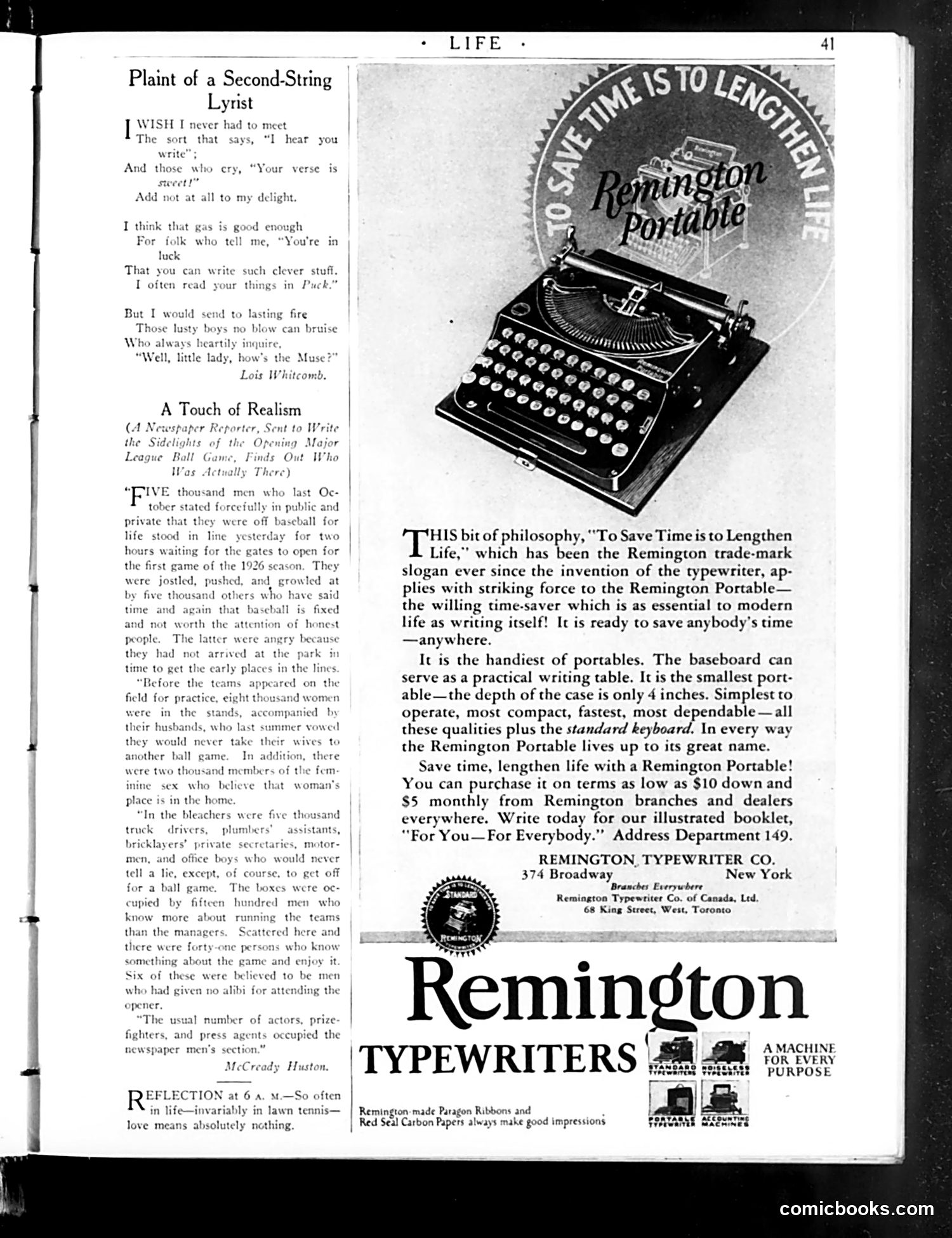
This page contains two distinct pieces: **Left column:** Poetry/humor pieces mocking aspiring writers. "Plaint of a Second-String Lyrist" satirizes amateur poets who receive unwanted criticism, while "A Touch of Realism" humorously describes five thousand men attending a 1926 baseball game opening—many there solely to see women rather than the sport itself. The piece gently mocks working-class male behavior (truck drivers, bricklayers, etc.) occupying bleacher seats primarily for social rather than sporting interest. **Right side:** A full-page **Remington Portable typewriter advertisement**—not satirical content. It promotes the machine using Remington's slogan "To Save Time is to Lengthen Life," targeting modern professionals and students who need portable writing equipment. The ad emphasizes practicality, compactness, and affordability ($10 down, $5 monthly). The page juxtaposes satirical literary commentary with commercial advertising—typical Life magazine content mixing humor with revenue-generating ads.
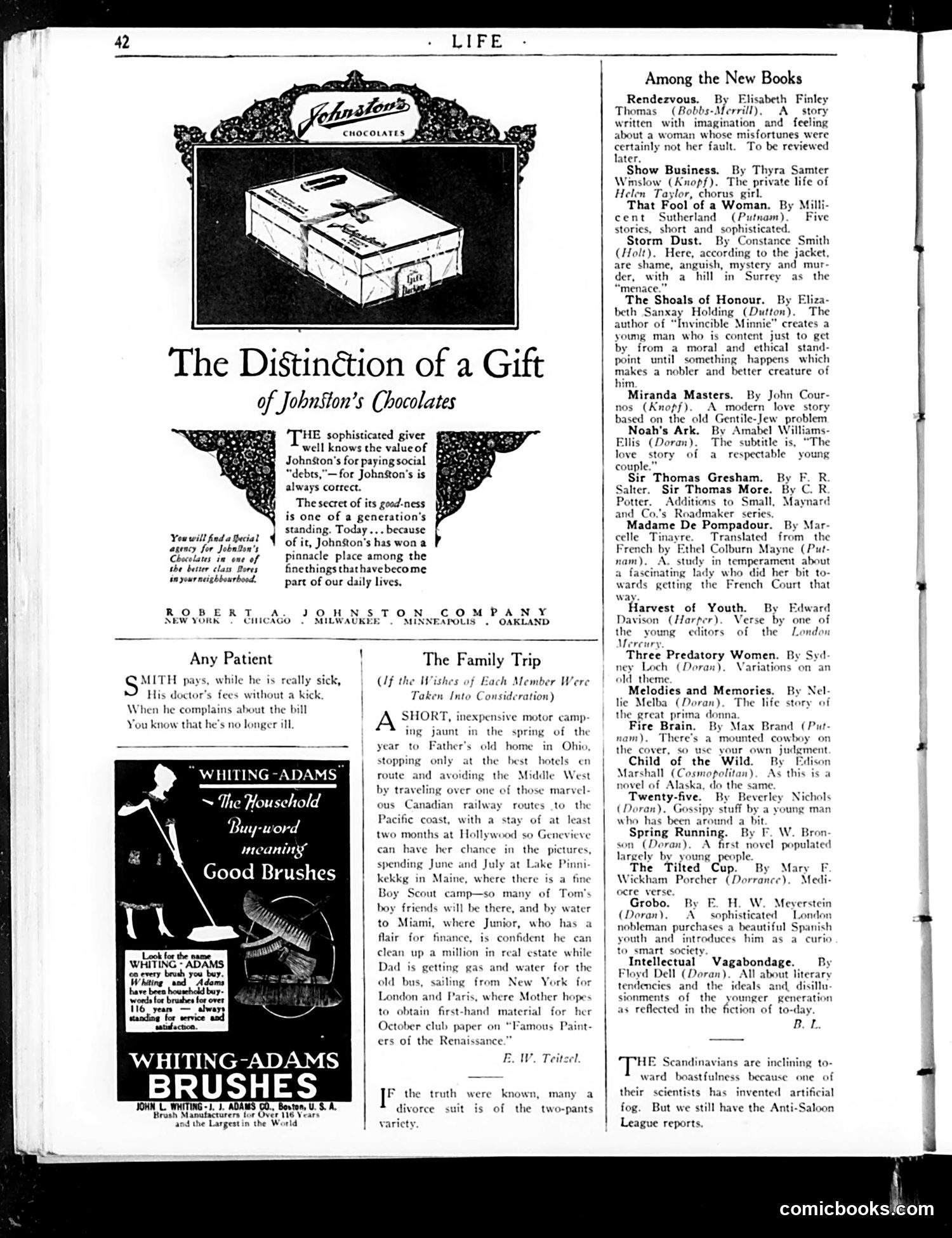
This Life magazine page (from the 1920s) contains three satirical pieces targeting upper-middle-class aspirations: **"The Family Trip"** mocks the pretensions of wealthy families planning an economical vacation. The joke is that despite claiming to economize with a "short, inexpensive motor camping jaunt," each family member's plans are absurdly extravagant: the daughter seeks Hollywood stardom, the son plans to make a million in real estate, the mother researches French Renaissance painters. The final line—"If the truth were known, many a divorce suit is of the two-pants variety"—suggests such financial strain causes marital breakdown. **"Any Patient"** is a brief joke: a sick man pays doctor bills without complaint, but once he complains about the bill, you know he's recovered. It mocks hypochondria and malingering. The page otherwise contains product advertisements (Johnston's Chocolates, Whiting-Adams Brushes) and a book review section—typical of Life's mixed advertising and editorial content during this era.
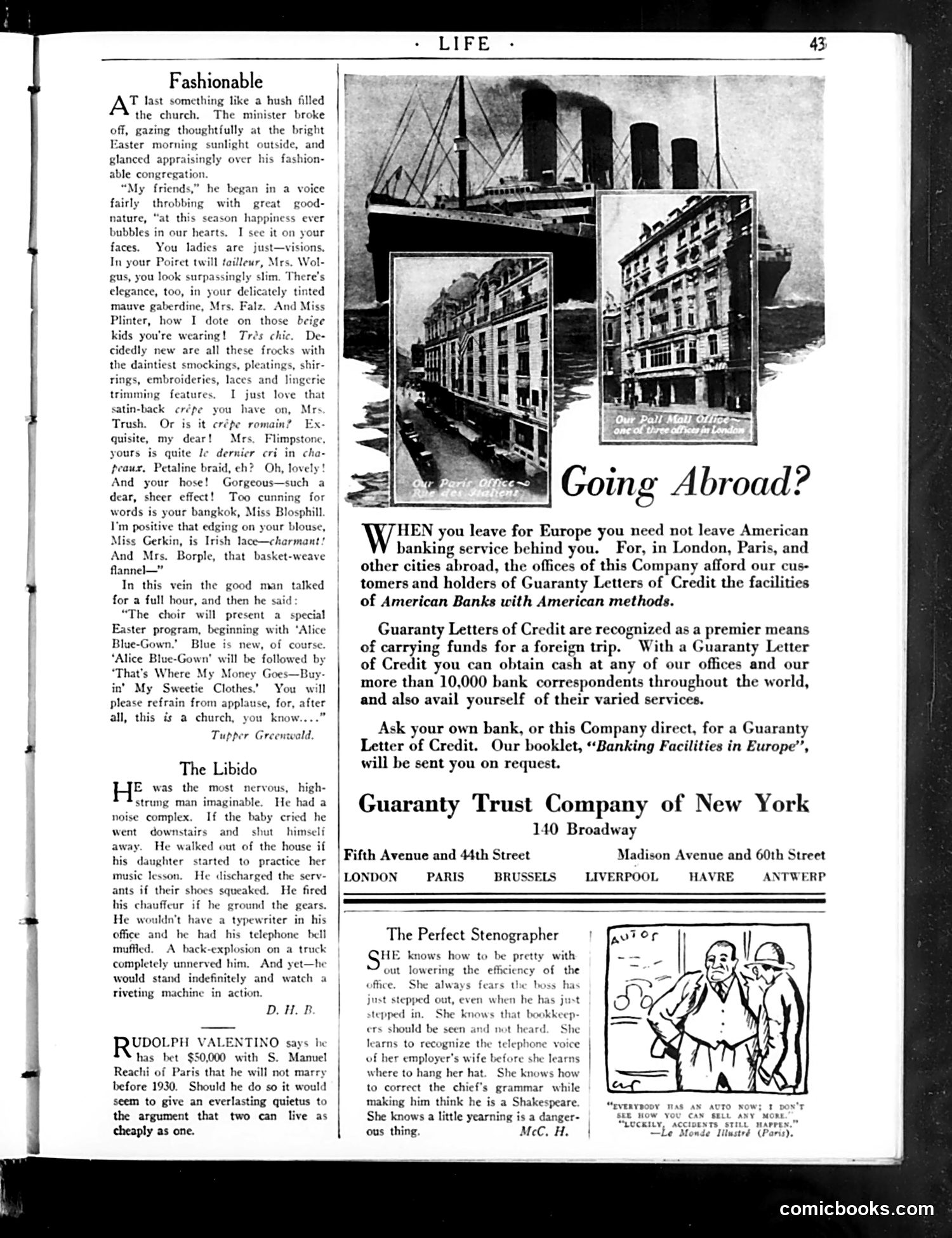
This article by Tupper Greenwald satirizes a minister who delivers an Easter sermon obsessed entirely with parishioners' **high-fashion clothing** rather than spiritual matters. The joke: Instead of preaching Christian values, he spends an hour complimenting women's designer outfits—mentioning specific fabrics (Poiret faille, mauve gaberdine, crepe romain) and accessories (Bangkok hose, Irish lace). He's so consumed by materialism and vanity that his "sermon" becomes a fashion commentary. The satire targets **1920s consumer culture** and religious hypocrisy—how wealthy congregations prioritized displaying wealth over genuine piety. The minister's fawning compliments about "beige kids" and "satin-back" garments mock both shallow religiosity and the era's obsession with conspicuous consumption, especially among fashionable society women. It's biting social commentary on commercialism disguised as spirituality during the prosperous Jazz Age.
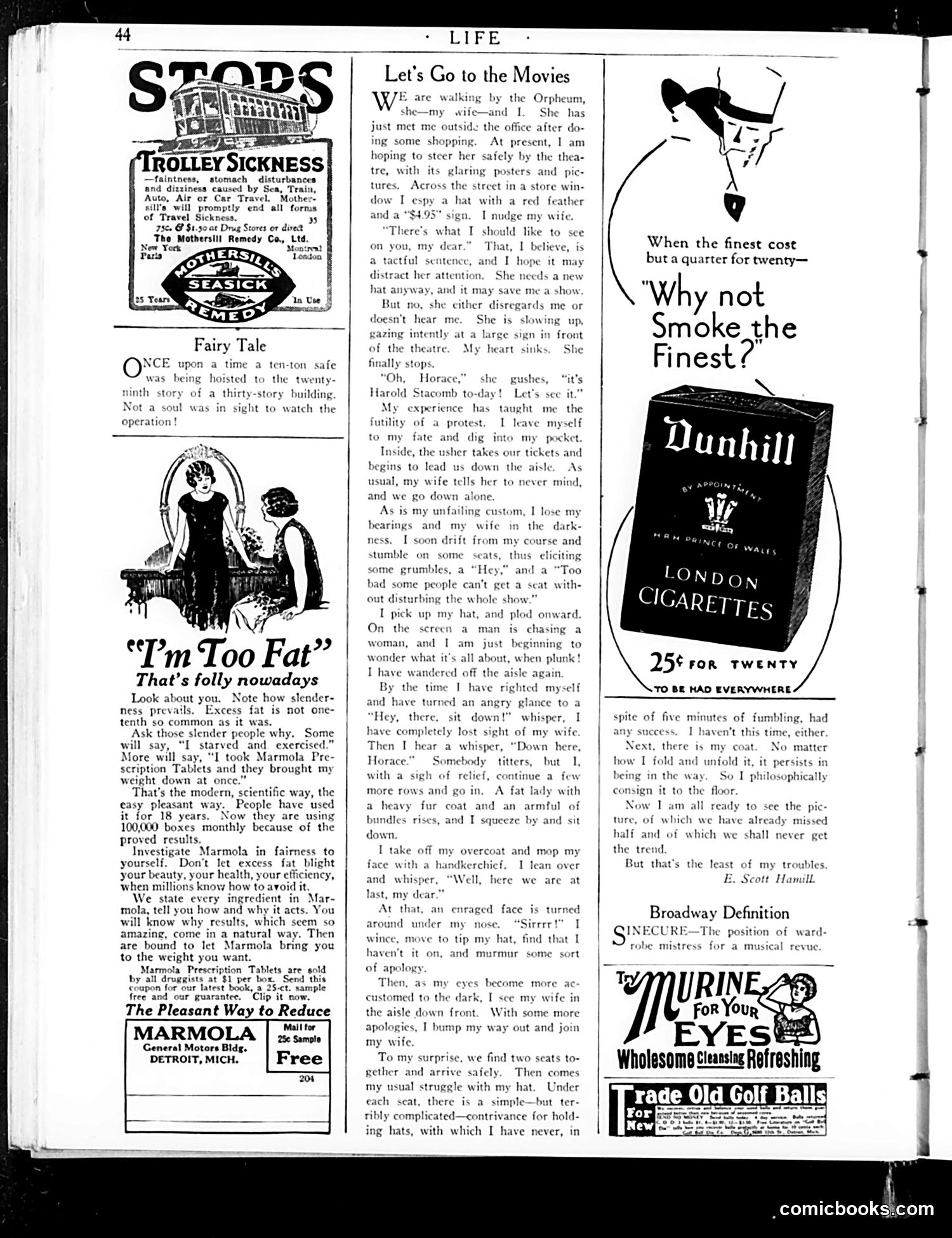
This humorous essay satirizes the frustrations of attending a cinema in the early 20th century. The unnamed male narrator describes a comedic series of mishaps: losing his wife in the dark theater, repeatedly wandering from his seat and disturbing other patrons, bumping into a heavyset woman with bundles, losing his hat, and generally creating chaos while trying to watch the film. The satire targets several period concerns: the distraction of advertising (the hat in the shop window), wives' shopping impulses, the difficulty of navigating crowded theaters, and the chaos of finding seats. The piece humorously illustrates how the simple act of watching a movie required patience and endurance, mocking both the theater experience and the social incompetence of the average male patron. The irony is that despite all this turmoil, the couple finally succeeds—offering a gentle, relatable conclusion to domestic frustration.
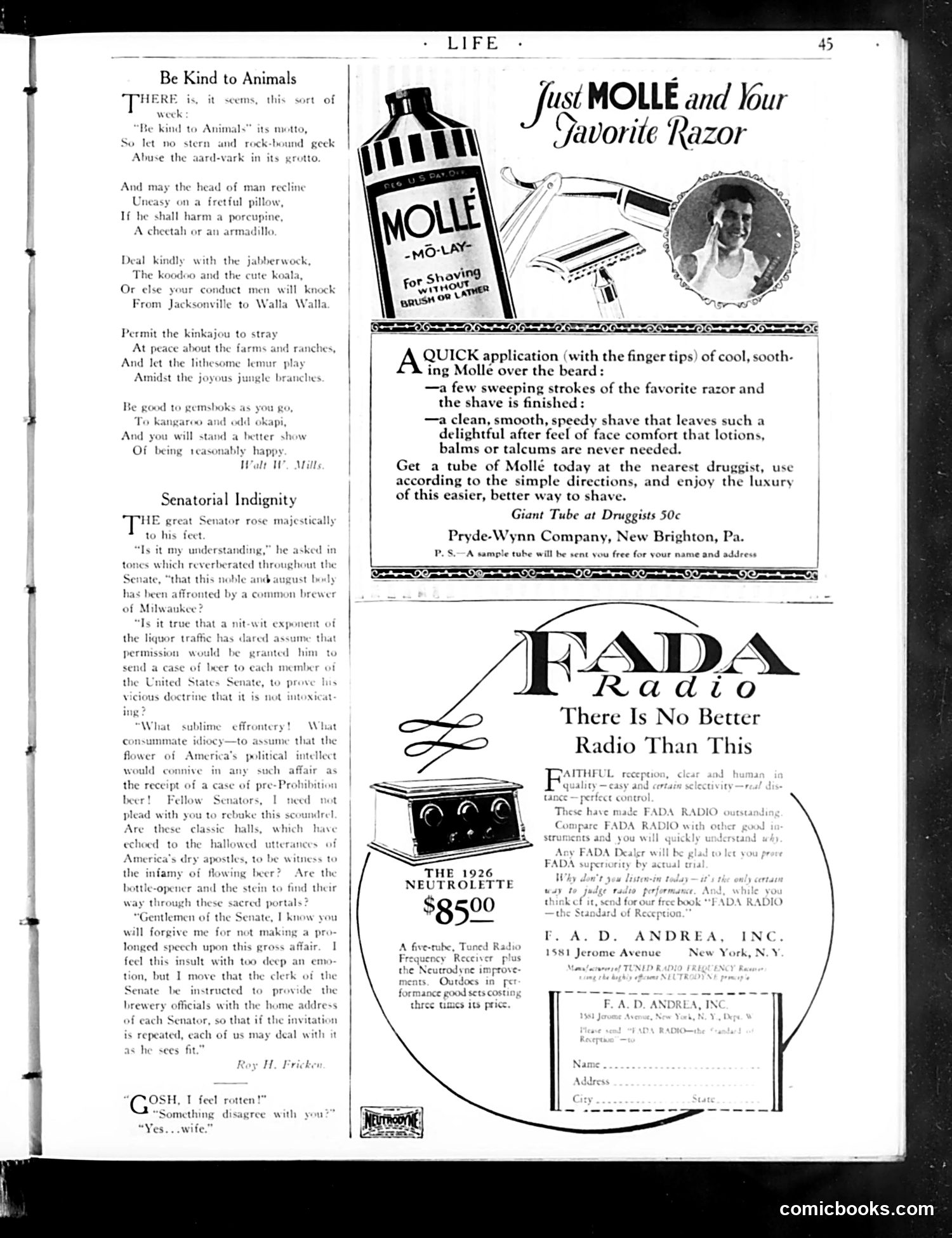
This page contains two satirical pieces: **"Be Kind to Animals"** is a humorous poem mocking the "Be Kind to Animals" movement (a real Victorian-era cause). It absurdly lists fictional and real creatures—jabberwock, aardvark, koala—with exaggerated warnings that harming them will cause cosmic consequences ("knock / From Jacksonville to Walla Walla"). The joke: treating animals with excessive sentiment is ridiculous. **"Senatorial Indignity"** satirizes a senator's outrage over receiving pre-Prohibition beer as a gift. The senator dramatically objects, calling it an insult to Congress's dignity and demanding the brewery receive senators' home addresses—so senators can retaliate. The satire: the senator's overwrought offense about receiving free alcohol is absurd, especially given Prohibition's context (1920s alcohol ban). The rest of the page consists of period advertisements for Mollé razors and Fada radios.
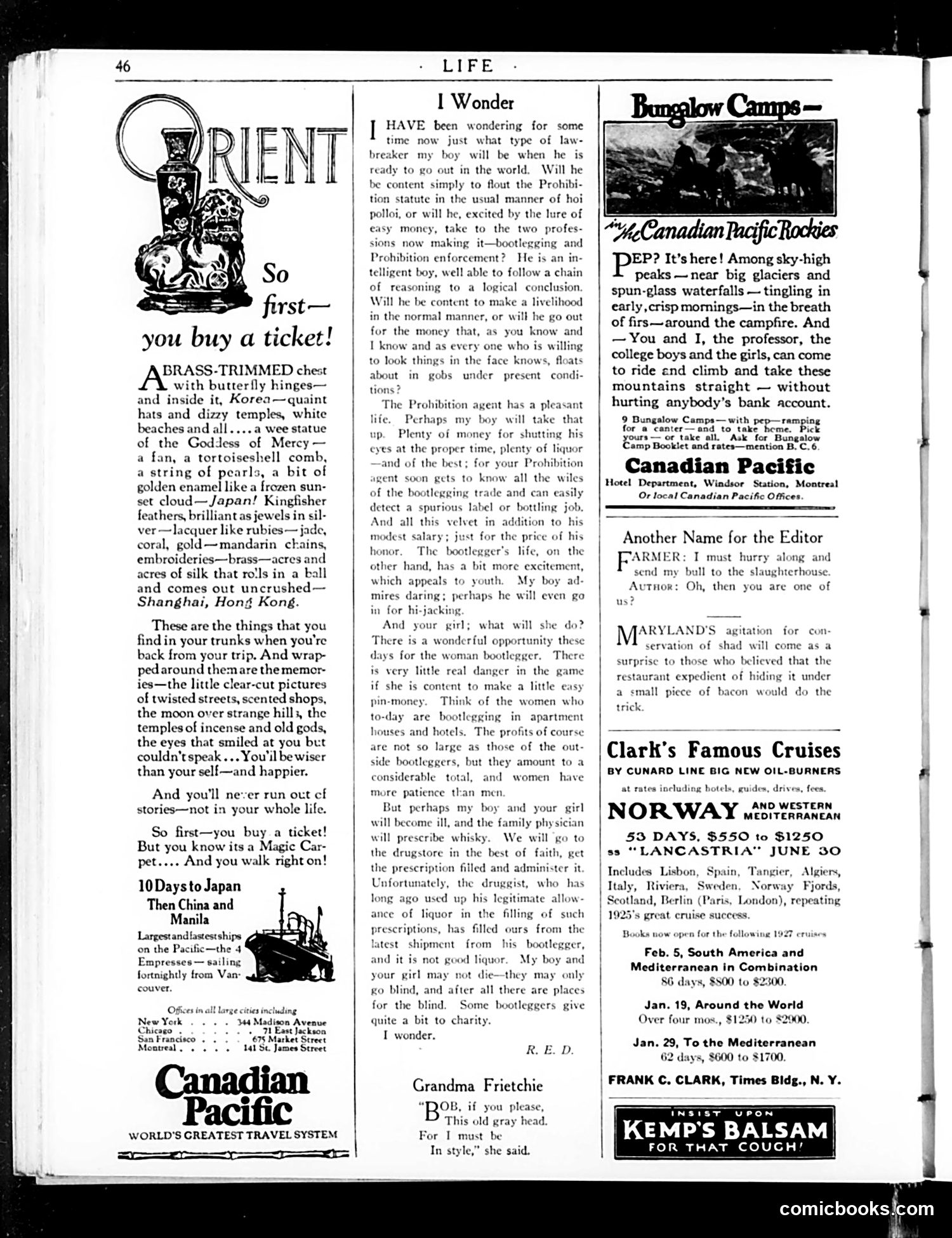
This page satirizes American Prohibition and its perverse social consequences. The left side features aspirational travel advertising—a Canadian Pacific cruise promoting exotic Asian destinations as escapist fantasies. The irony is intentional. The main article "I Wonder" by R.E.D. presents a darker commentary: the author worries his son will become either a bootlegger (illegal liquor seller) or a Prohibition enforcement agent—both criminal enterprises offering easy money through corruption. He similarly anticipates his daughter becoming a female bootlegger, noting women face "little real danger" running illegal alcohol operations from apartment hotels. The satire's bite: Prohibition (1920-1933) created widespread criminality rather than virtue. Honest livelihoods pale against lucrative illegal options. Even physicians and druggists must obtain whisky through bootleggers, risking poisoned liquor that could blind consumers. The piece mocks Prohibition's fundamental failure—it didn't eliminate drinking but criminalized society, corrupting enforcement officials and normalizing criminal enterprise among respectable citizens.
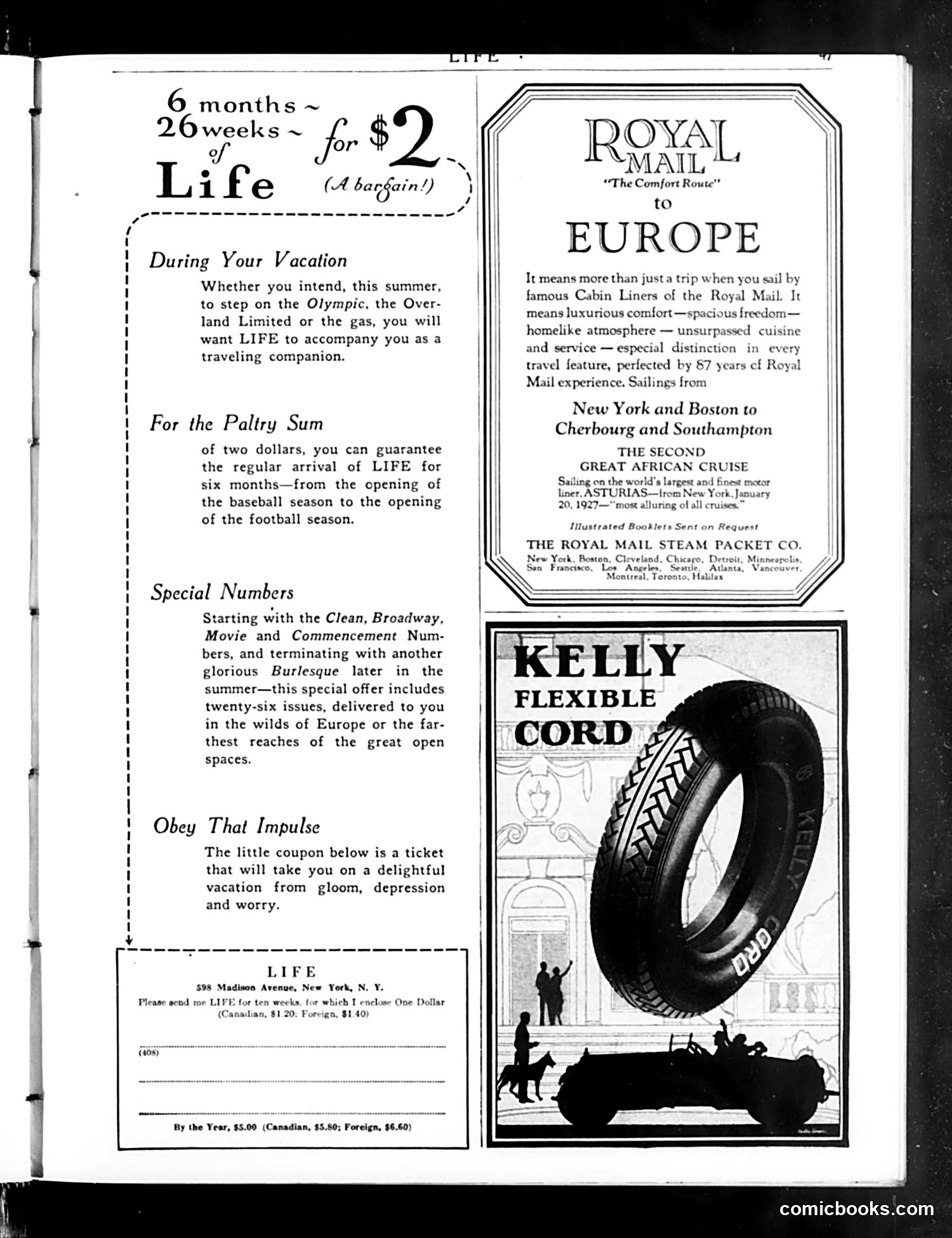
This page is primarily **advertising and subscription promotion**, not political satire. The left side promotes Life magazine subscriptions—six months for $2, marketed as ideal for summer vacationers traveling by train (Olympic, Overland Limited) or car. Life promises special issues including "Clean, Broadway, Movie and Commencement Numbers" and a "glorious Burlesque," positioning itself as entertainment for escaping "gloom, depression and worry." The right side contains two advertisements: Royal Mail cruise lines promoting transatlantic luxury voyages to Europe (1927), and Kelly Flexible Cord tires, shown with a stylized tire and racing car silhouette. There is **no political cartoon or satire present**. The page reflects 1920s consumer culture and leisure travel marketing to affluent readers.
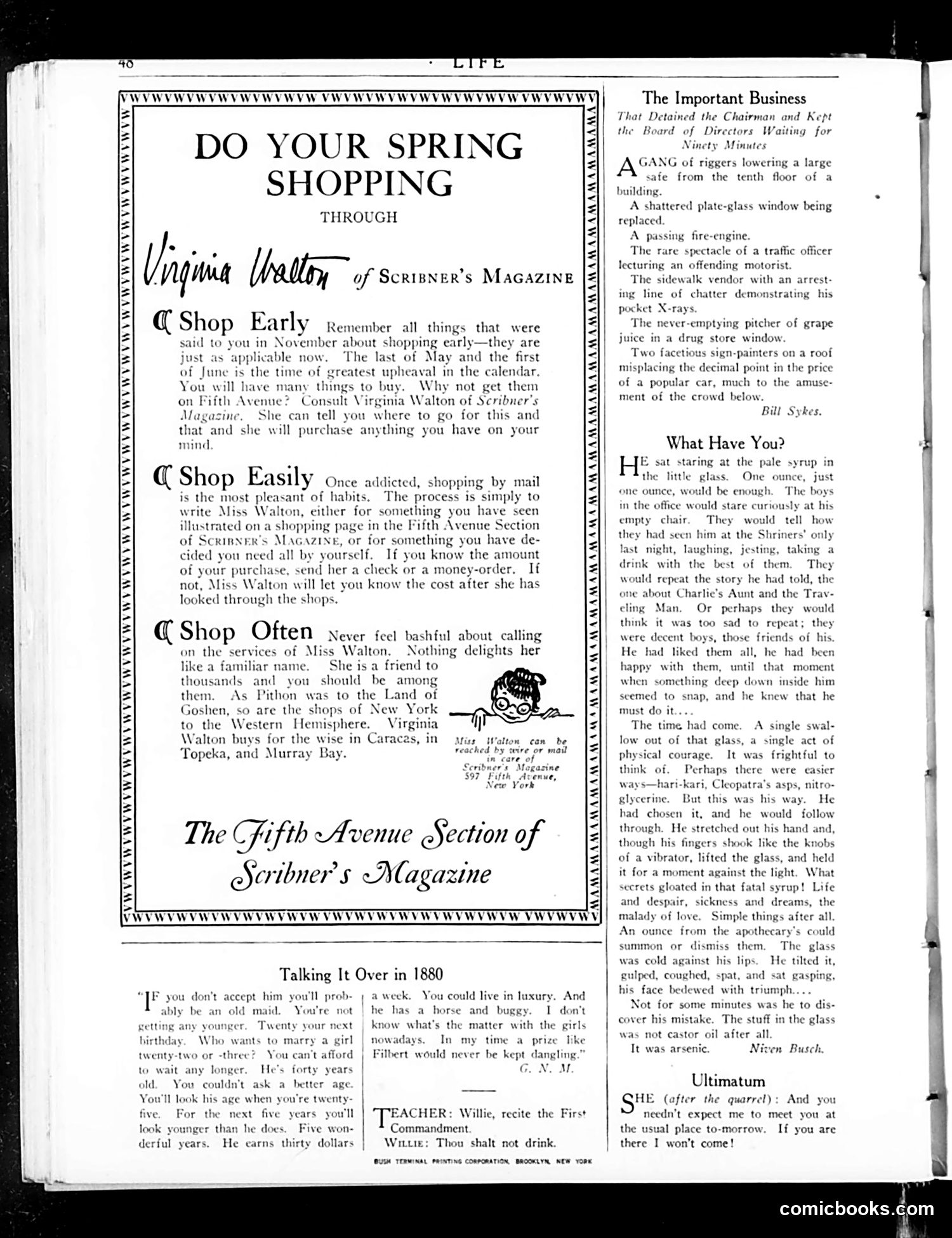
This page is primarily **advertising and editorial content**, not political satire. It consists of: 1. **"Do Your Spring Shopping" advertisement** promoting Scribner's Magazine's Fifth Avenue shopping service, managed by Virginia Walton. The pitch emphasizes shopping "early," "easily," and "often" through mail-order convenience. 2. **"The Important Business" piece** by Bill Sykes—a humorous list of mundane street scenes (window replacements, traffic violations, sign painters) that supposedly detained a board of directors' meeting for 90 minutes. The satire gently mocks how easily business gets disrupted by trivial urban spectacles. 3. **"What Have You?" and other fiction fragments**—short story excerpts unrelated to satire. 4. **"Talking It Over in 1880"** excerpt—a period piece contrasting marriage prospects then versus present day. The page lacks political cartoons or pointed social commentary. It's a typical Life magazine spread mixing advertising, light humor, and serialized fiction—aimed at middle-class readers interested in consumer goods and entertainment.
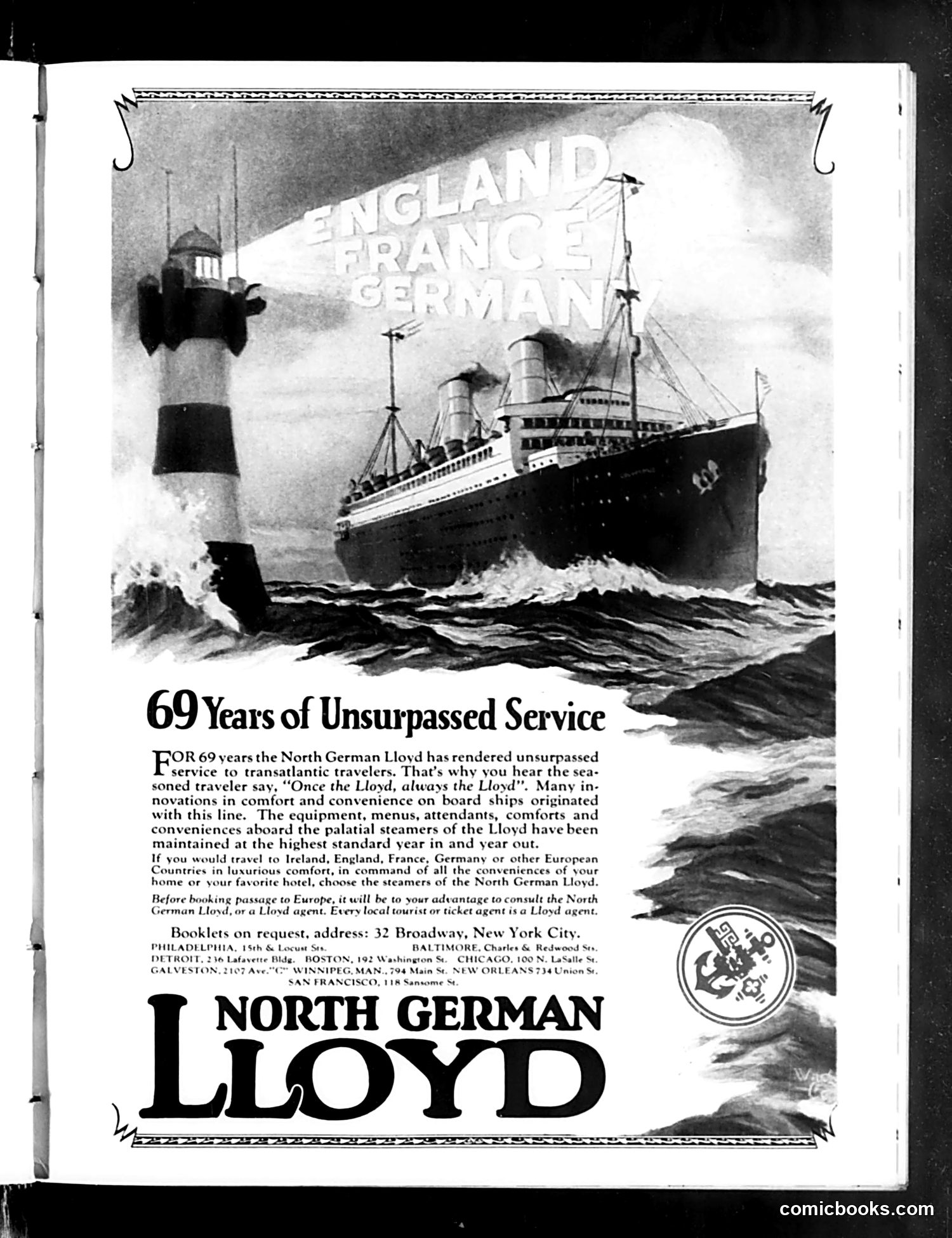
This is a **straightforward advertisement**, not satire. It promotes the North German Lloyd shipping line's transatlantic passenger service, emphasizing 69 years of reliable operation to European destinations (England, France, Germany, Ireland). The image shows a steamship passing a lighthouse, visually conveying safe, established maritime travel. The text highlights luxury amenities—equipment, service, comfort—and includes contact information across major U.S. cities. **Historical context**: This appears pre-WWI or interwar period, when ocean liners were the primary means of transatlantic travel. The ad's confident tone about German shipping reflects the era before tensions that would affect such services. There is **no political satire or cartoon here**—it's purely commercial messaging typical of early 20th-century magazine advertising.
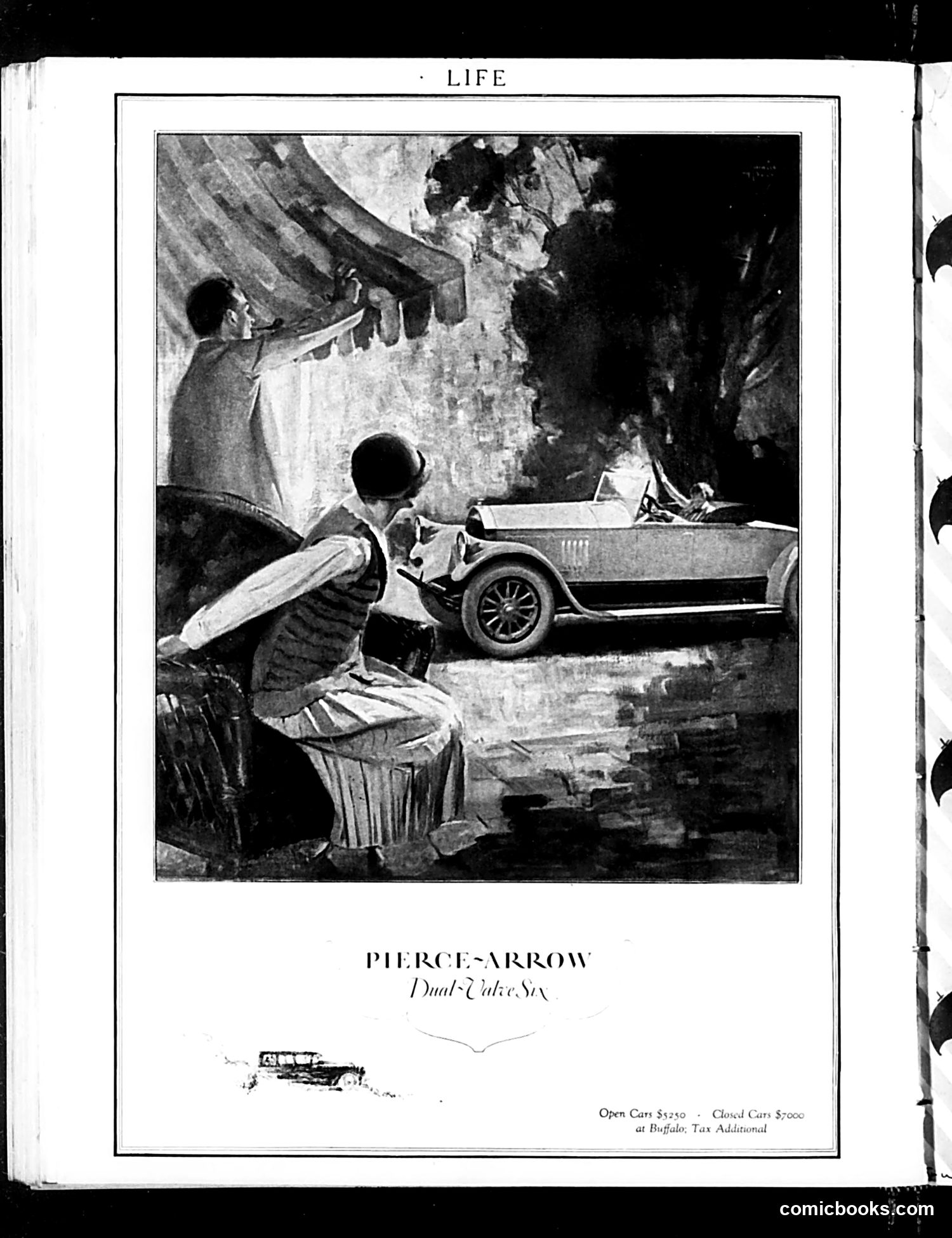
This is a **automobile advertisement**, not political satire. The page features the Pierce-Arrow "Dual-Valve Six" luxury car, positioned in what appears to be a Mediterranean or European seaside setting. The image shows two well-dressed figures admiring the vehicle—one seated in foreground, another standing near the car. The scene emphasizes elegance and leisure, appealing to wealthy consumers. The pricing notation ("Open Cars $1250 - Closed Cars $2000 at Buffalo, Tax Additional") indicates this was a high-end American automobile from the early 1900s. This represents typical early automotive advertising strategy: associating the product with sophistication, travel, and social status rather than practical transportation features.