
Life, 1926-04-08 · page 24 of 52
Life — April 8, 1926 — page 24: what you’re looking at
What you’re looking at
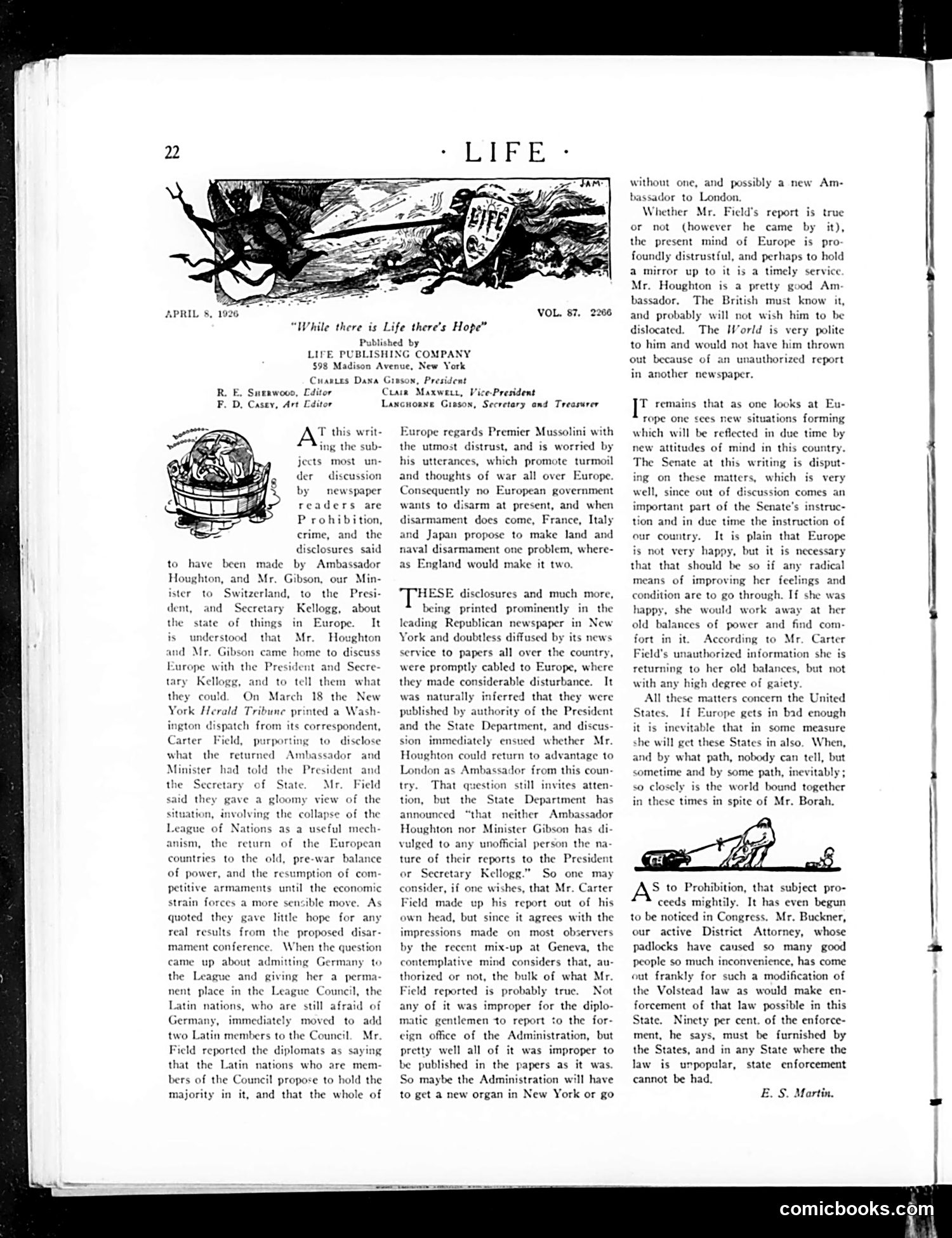
This editorial page discusses a political scandal involving leaked diplomatic reports. Ambassador Alanson B. Houghton and Minister Hugh Gibson allegedly disclosed pessimistic assessments of European conditions to President Coolidge and Secretary Kellogg—including concerns about Mussolini, disarmament failures, and resurgent nationalism. **The Cartoon:** "While there is Life there's Hope" depicts what appears to be a gravestone or tomb, darkly suggesting Europe's dire political situation is nearly terminal. **The Issue:** Journalist Carter Field published these confidential reports in the *Herald Tribune*. Though the State Department denied authorization, the leak embarrassed U.S. diplomacy internationally. **The Satire:** The editors criticize both the leaked pessimism about European stability and the impropriety of publishing classified diplomatic discussions—suggesting the government may need a new official press organ, or go without one entirely. This reflects 1920s concerns about American isolationism, European instability post-WWI, and tensions between press freedom and diplomatic confidentiality.
📄 Transcribed text from this page (OCR, searchable)
Machine-transcribed from the original scan — historical spelling and the odd misread are preserved.
APRIL 8, 1926 “While there is Life there’s Hope’ Published by LIFE PUBLISHING COMPANY $98 Madison Avenue, New York Cuantes Dana Giason, President R. E. Surawovo, Cditor F. D, Casey, Art Editor T this writ- ing the sub- jects. most un- der discussion by newspaper readers are P rohibition, crime, and the disclosures said to have been made by Ambassador Houghton, and Mr. Gibson, our Min- ister to Switzerland, to the Presi- dent, and cretary Kellogg, about the state of things in Europe. It is understood that Mr. Houghton and Mr. Gibson c. me home to discuss Europe with the President and Secre- tary Kellogg, and to tell them what they could. On March 18 the New York Herald Tribune printed a Wash- ington dispatch from its correspondent, Carter Field, purporting disclose what the returned Ambassador and Minister had told the President and the Secretary of State. Mr. Field said they gave a gloomy view of the uation, involving the collapse of the Leag anism, the return of the European countries to the old, pre-war balance of Nations as a useful mech. of power, and the resumption of com petitive armaments until the economic strain forces a more sensible move. As quoted they gave little hope for any real results from the proposed disar- mament conference. When the question came up about admitting Germany to the League and giving her a perma- nent place in the League Council, the Latin nations, wh ce moved to add two Latin members to the Council. Mr. e still afraid of many, immedia' Field reported the diplomats as saying that the Latin nations who are mem- bers of the Council propose to hold the majority in it, and that the whole of Cua Maxweut, Vice-President Lancnoane Giason, Secretary and Treasurer Europe regards Premier Mussolini with the utmost distrust, and is worried by his utterances, which promote turmoil and thoughts of war all over Europe. Consequently no European government wants to disarm at present, and when disarmament does come, France, Italy and Japan propose to make land and naval disarmament one problem, where- as England would make it two. HESE disclosures and much more, being printed prominently in the leading Republican newspaper in New York and doubtless diffused by its news service to papers all over the country, were promptly cabled to Europe, where they made considerable disturbance. It was naturally inferred that they were published by authority of the President and the State Department, and discus- sion immediately ensued whether Mr. Houghton could return to advantage to London as Ambassador from this coun- try. That ques jon still invites atten tion, but the State Department has announced “that neither Ambassador Houghton nor Minister Gibson has di- vulged to unoffic ture of their reports to the President or Secretary Kellogg.” So one may consider, if one wishes, that Mr. Carter Field made up his report out of his person the na- own head, but since it agrees with the impressions made on most observers by the recent mix-up at Geneva, the contemplative mind considers that, au- thorized or not, the bulk of what Mr. Field reported is probably true. Not any of it was improper for the diplo- matic gentlemen to report to the for- cign office of the Administration, but pretty well all of it was improper to be published in the papers as it was. So maybe the Administration will have to get a new organ in New York or go without one, and possibly a new Am- bassador to London. Whether Mr. Field's report is true or not (however he came by it), the present mind of Europe is pro. foundly distrustful, and perhaps to hold a mirror up to it is a timely service Mr. Houghton is a pretty good Am bassador. The British must know it, and probably will not wish him to be dislocated. The World is very polite to him and would not have him thrown out because of an unauthorized report in another newspaper. T remains that as one looks at Eu- rope one sees new situations forming which will be reflected in due time by new attitudes of mind in this country. The Senate at this writing is disput- ing on these matters, which is very well, since out of discussion comes an important part of the Senate's instruc- tion and in due time the instruction of our country. It is plain that Europe is not very happ . but it is necessary that that should be so if any radical means of improving her feelings and dition are to go through. If she was happy, she would work away at her old balances of power and find com- fort in it. According to Mr. Carter Field's unauthorized information she is returning to her old balances, but not with any high degree of gaiety All these matters concern the United States. If Europe gets in bad enough it is inevitable that in some measure she will get these States in also. When, and by what path, nobody can tell, but sometime and by some path, inevitably; so closely is the world bound together in these times in spite of Mr. Borah. co S to Prohibition, that subject pro- ceeds mightily. It has even begun to be noticed in Congress. Mr. Buckner, our active District Attorney, whose padlocks have caused so many good people so much inconvenience, has come out frankly for such a modification of the Volstead law as would make en- forcement of that law possible in this ‘ate. Ninety per cent. of the enforce- ment, he says, must be furnished by the States, and in any State where the law is unpopular, state enforcement cannot be had. S. Martin. comicbooks.c m |