
Life, 1926-04-08 · page 22 of 52
Life — April 8, 1926 — page 22: what you’re looking at
What you’re looking at
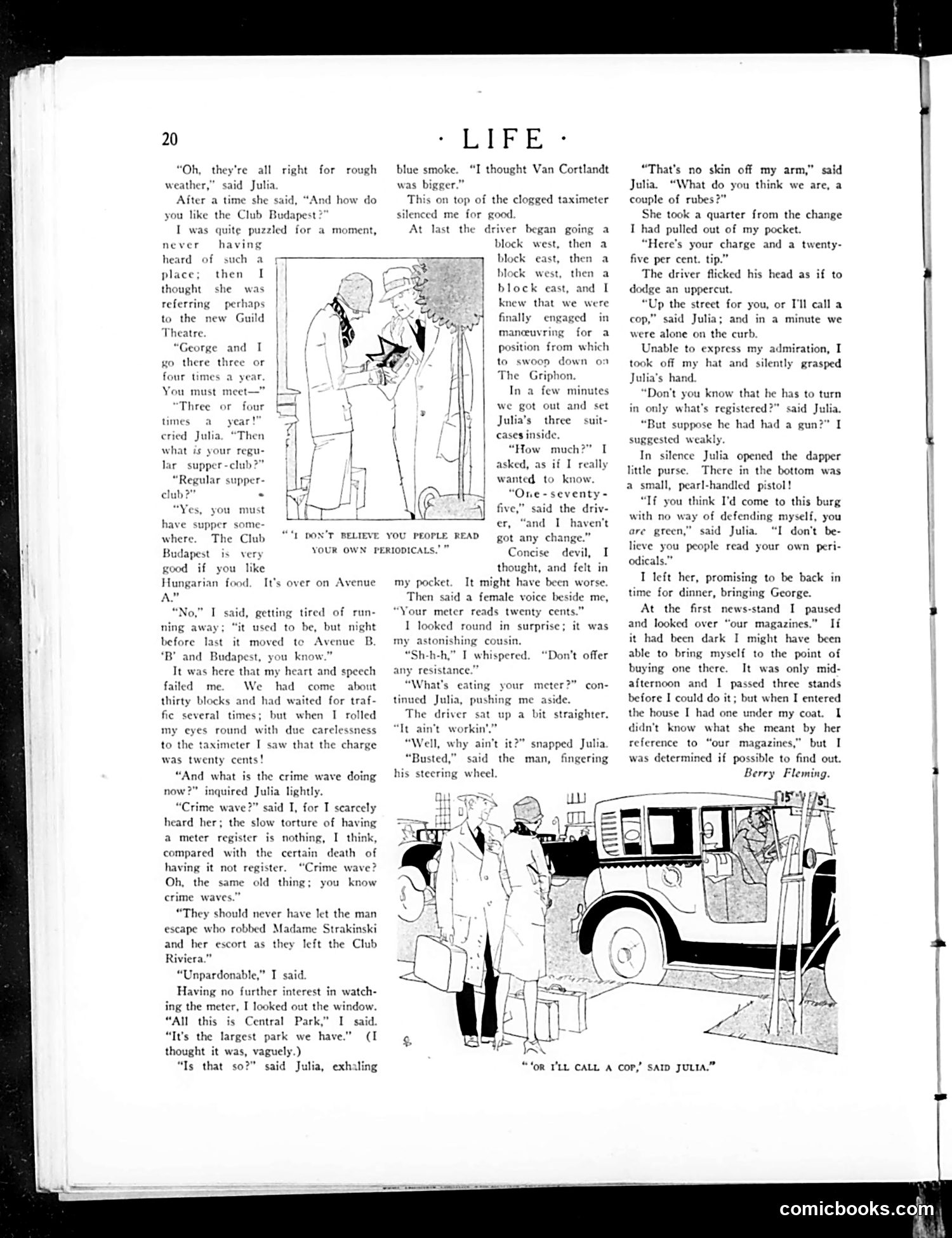
This is a humorous short story with two accompanying illustrations satirizing early 1920s urban life and taxi culture. **The Main Joke:** A naive male narrator is taken on a circuitous cab ride through New York City by his cousin Julia, who is portrayed as a tough, streetwise woman. The taxi driver deliberately drives in circles (block west, block east) to inflate the meter charge—a common scam. The narrator is too embarrassed or timid to object. **The Satire:** Julia represents the "new woman" of the Jazz Age—confident, pragmatic, and unafraid. She: - Immediately spots the driver's scam - Calls him out directly - Tips generously (25%) but on her own terms - Carries a pearl-handled pistol casually - Dismisses the narrator's concerns about crime waves **Social Context:** The piece mocks both taxi driver dishonesty (a real complaint of the era) and male passivity. Julia's casual possession of a gun and her toughness suggest 1920s anxieties about changing gender roles—she's competent where the narrator is helpless. References to "our magazines" suggest contemporary crime reporting was a popular reading topic.
📄 Transcribed text from this page (OCR, searchable)
Machine-transcribed from the original scan — historical spelling and the odd misread are preserved.
20 “Oh, they're all right for rough weather,” said Julia After a time she said, you like the Club Budapest? I was quite puzzled for a moment, never having 1 how do - LIFE - blue smoke. “I thought Van Cortlandt was bigger.” This on top of the clogged taximeter silenced me for good heard of such a place; then I || thought she was referring to the new Theatre ge and I yo there three or four tim You must Three 1 nes ay ‘ ed Julia. “Then what is your regu- lar supper-club “Regular s pper- you must At last the driver began going a Dlock west, then a block east, then a Se ] block west, then a Te | block east, and I knew that we were finally eng: manceuvri position from w to swoop down on The Griphon. In a few minutes we got out and set Julia’s three suit- cases inside. “How much?” I asked, as if I really wanted to know. “One-seventy five,” said the driv- have supper some- where. The Club Budapest very good if you like Hungarian food. It's over on A “"T DON'T BELIEVE ue i) aid, getting tired of run- ning away; “it used to be, but night before last it moved te Avenue B. ‘B’ and Budapest, you know.’ It was here that my heart speech failed me. We had come about thirty blocks and had waited for traf- fic several times; but when I rolled ‘areles my eyes round with duc to the taximeter I saw that was twenty cents! ess charge “And what is the crime wave doing now?" inquired Julia lightly. “Crime wave said I, for I scarcely heard her; the slow torture of having a meter register is nothing, I think, compared with the certain death of having it not register. “Crime wave? Oh, the same old thing; you know crime waves.” “They should never have let the man escape who robbed Madame Strakinski and her escort as they left the Club Ri “Unpardonable,” I said Having no further interest in watch- ing the meter, I looked out the window. “All this is Central Park,” I said. “It’s the largest park we hav (I thought it was, vaguely.) “Is that so?” said Julia, exhaling YOUR OWN PERIODICALS. er, “and I haven't got any chang Concise devil, I thought, and felt in my pocket. It might have been worse. Then said a female voice beside me, “Your meter reads twenty cents.” I looked round in surprise; it was You Ped my astonishing cousin. c ” T whispered. “Dc any resistance.” offer “What's cating your meter?” con- tinued Julia, pus ide. The driver s; vit straighter. “It ain't: workin’! “Well, why ain't it?” snapped Julia “Busted,” s his steering wheel ng me up a the man, fingering “That's no skin off my arm,” said Julia. “What do you think we are, a couple of rube: She took a quarter from the change I had pulled out of my pocket. “Here's your charge and a twenty- five per cent. tip.” The driver flicked his head as if to dodge an uppercut. “Up the street for you, or I'll call a cop,” said Julia; and in a minute we were alone on the curb. Unable to express my admiration, I took off my hat and silently grasped Julia’s hand. “Don't you know that he has to turn in only what's registered?” said Julia. mf suppose he had had a gun sug, In silence Julia opened the dapper little purse. There in the bottom was a small, pearl-handled pistol! “If you think I'd come to this burg with no way of defending myself, you are green,” said Julia. “I don't be- lieve you people read your own peri- odicals.” I left her, promising to be back in time for dinner, bringing George. ested weakly. At the first news-stand I paused and looked over “our magazines.” If it had been dark I might have been able to bring myself to the point of buying one there. It was only mid- afternoon and I passed three stands before I could do it; but when I entered the house I had one under my coat. I didn’t know what she meant by her reference to “our magazines,” but I was determined if possible to find out. Berry Fleming. “‘or I'LL CALL A CoP,’ SAID JULIA.” comicbooks.cor