
A complete issue · 44 pages · 1926
Life — March 18, 1926
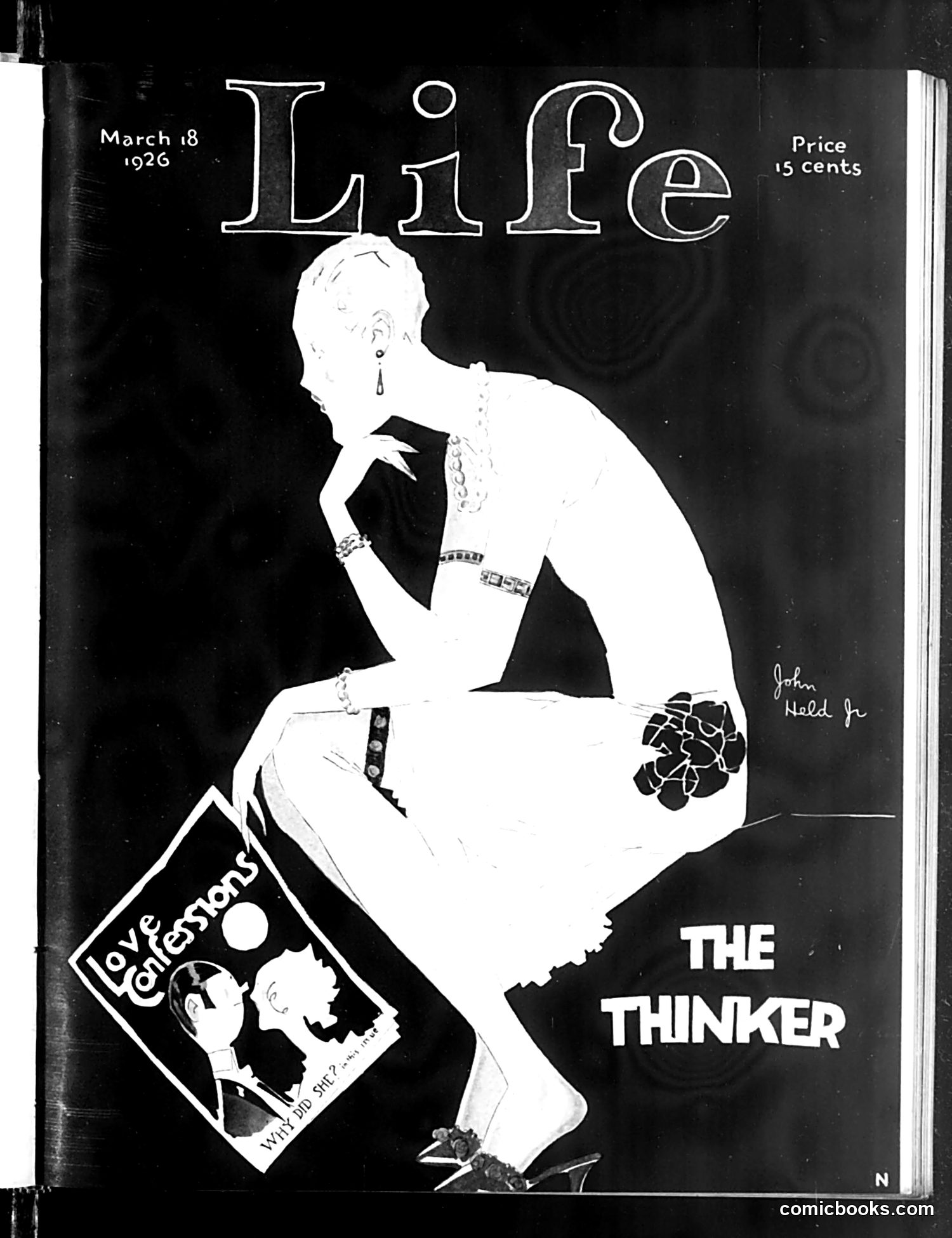
This cover by John Held Jr. depicts a fashionable woman in 1920s attire sitting in Rodin's famous "The Thinker" pose. The satire contrasts the sculpture's serious philosophical intent with modern femininity and consumerism. The woman wears jewelry, makeup, and styled hair—markers of the "flapper" era—while a "Love Confessions" magazine sits beside her, suggesting shallow entertainment rather than intellectual contemplation. The joke critiques both 1920s women's culture (reduced to romance and fashion) and perhaps society's assumptions about women's intellectual capacity. By positioning a fashionable woman in art's most iconic thinking pose, Held ironically questions what modern women actually ponder versus what serious thinkers should consider.
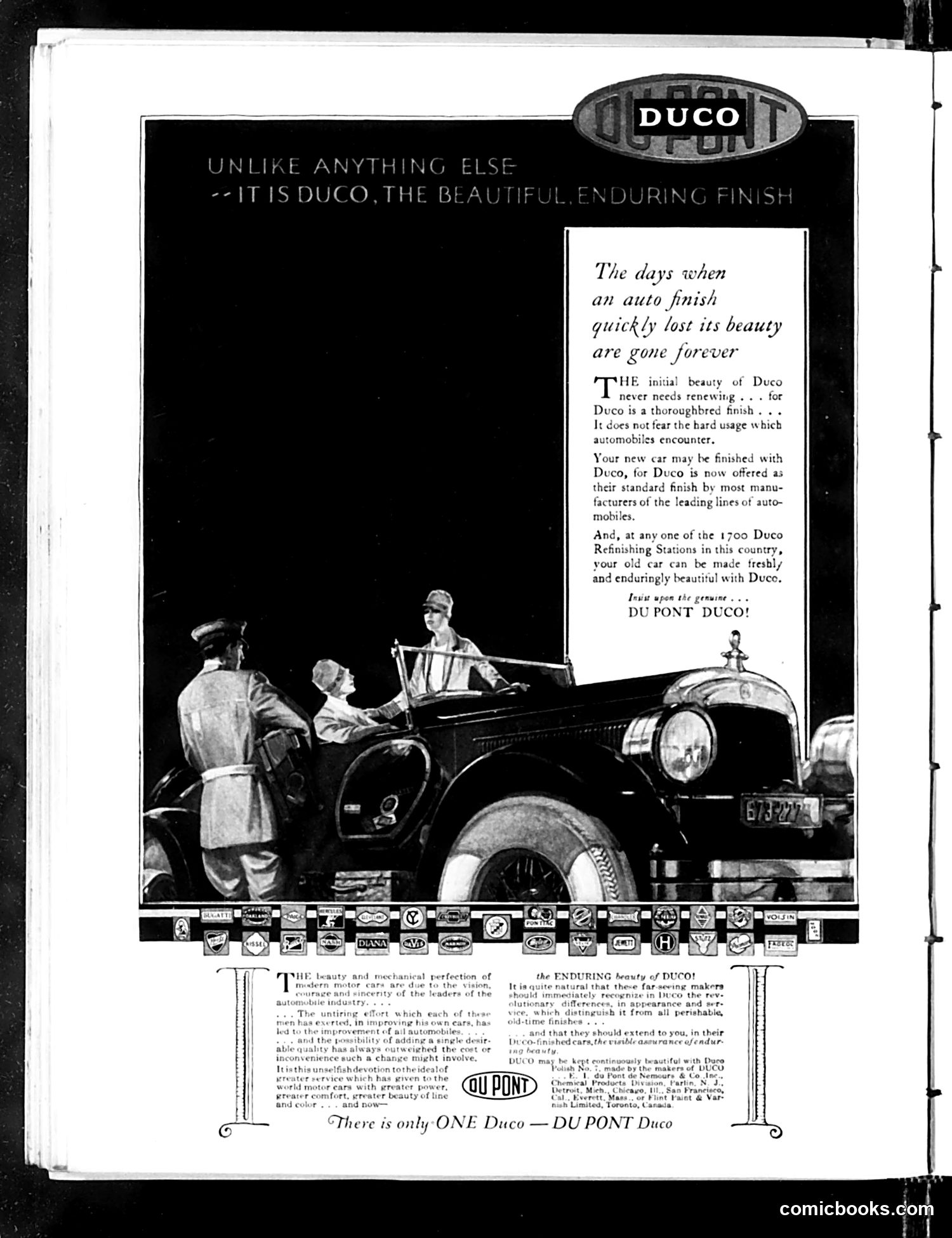
This page is **primarily an advertisement**, not political satire. It promotes DuPont Duco automotive paint, a real product from the early 20th century. The ad features an illustration of a well-dressed couple admiring a gleaming car, with a uniformed attendant. The copy emphasizes that Duco provides an "enduring finish" that resists the wear automobiles normally encounter—a sales pitch addressing a genuine consumer concern of that era when car paint degraded quickly. The extensive text below lists automobile manufacturers who used Duco as standard equipment (visible logos indicate Packard, Cadillac, and others), lending credibility through association with luxury brands. There is **no political cartoon or satire** present. This is straightforward commercial advertising leveraging aspirational imagery and testimonials from prestigious manufacturers.
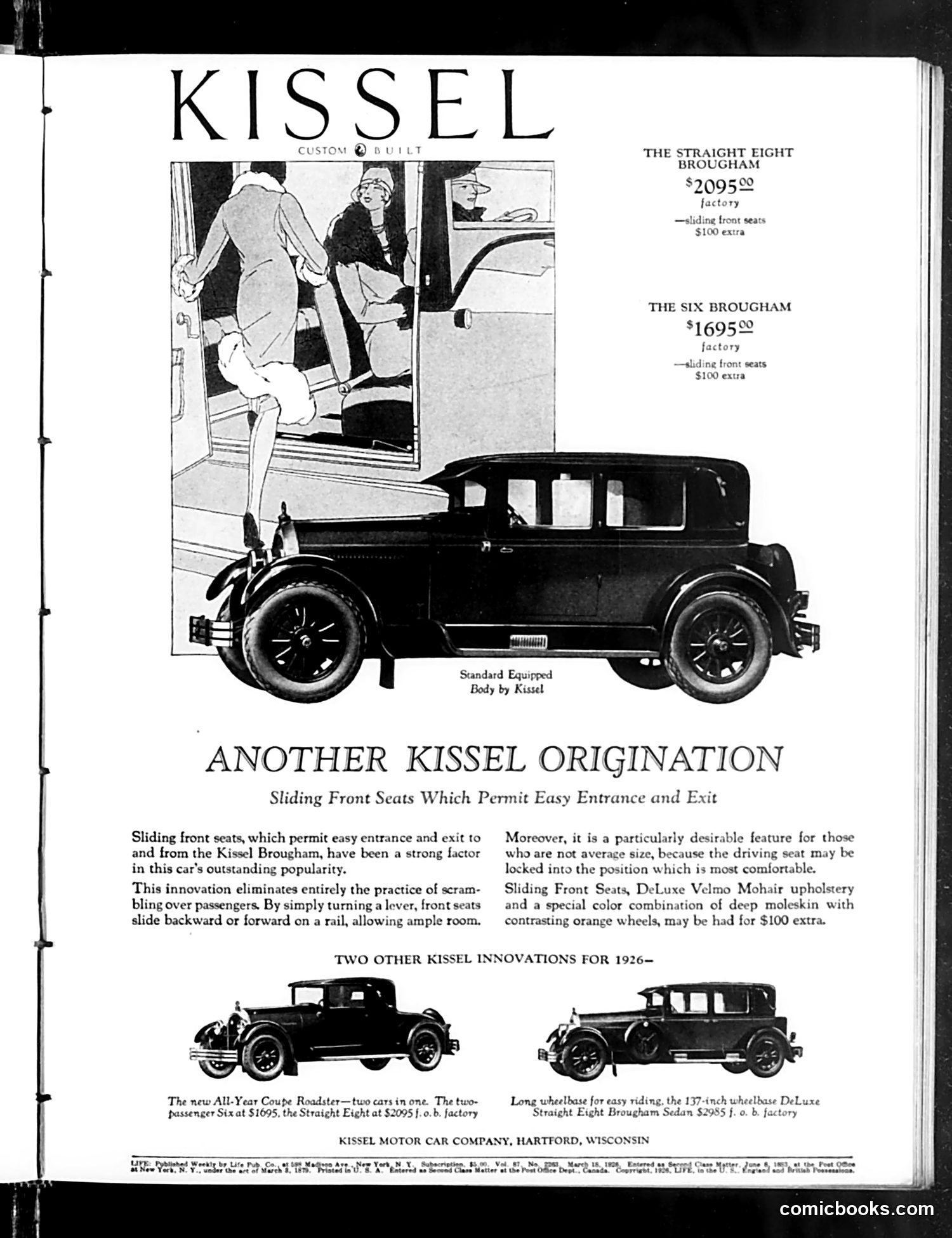
This page is **primarily automobile advertising**, not political satire or editorial content. It advertises Kissel Motor Cars from Hartford, Wisconsin, featuring three models: - The Straight Eight Brougham ($2,095) - The Six Brougham ($1,695) - Two other 1926 models The illustration at top depicts a fashionable woman entering a car, emphasizing the vehicle's "sliding front seats which permit easy entrance and exit"—a practical feature marketed as desirable for elegance and comfort. The page reflects 1920s consumer culture and gender marketing: the illustration appeals to affluent female buyers by highlighting convenience and style alongside automotive specifications. This represents typical advertising strategy of the era rather than political commentary.
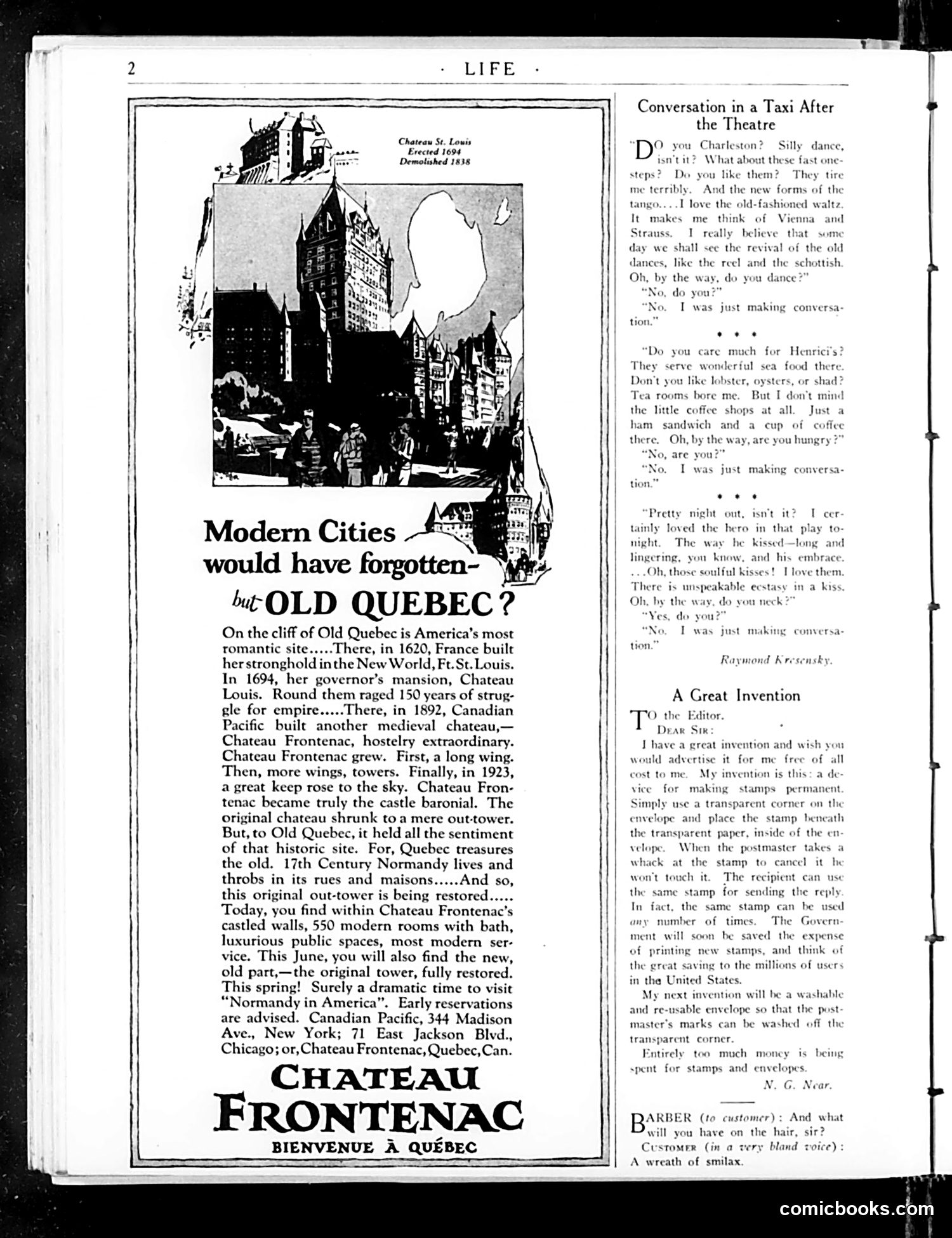
This page contains primarily **advertising and light social commentary**, not political satire. The main advertisement promotes **Chateau Frontenac** in Quebec City, emphasizing its historical significance (built 1620) and romantic appeal. The illustrated cityscape shows the castle-hotel dominating Old Quebec's skyline. The right column features two brief humor pieces: 1. **"Conversation in a Taxi After the Theatre"** — a dialogue about dancing preferences (Charleston vs. waltz), with the punchline being the woman was merely "making conversation," not genuinely interested. Light social satire on empty social pleasantries. 2. **"A Great Invention"** and **"Barber"** — brief joke submissions from readers about permanent stamps and a barber's pun ("wreath of smilax"). This is typical Life magazine filler: tourism promotion and reader-submitted humor pieces.
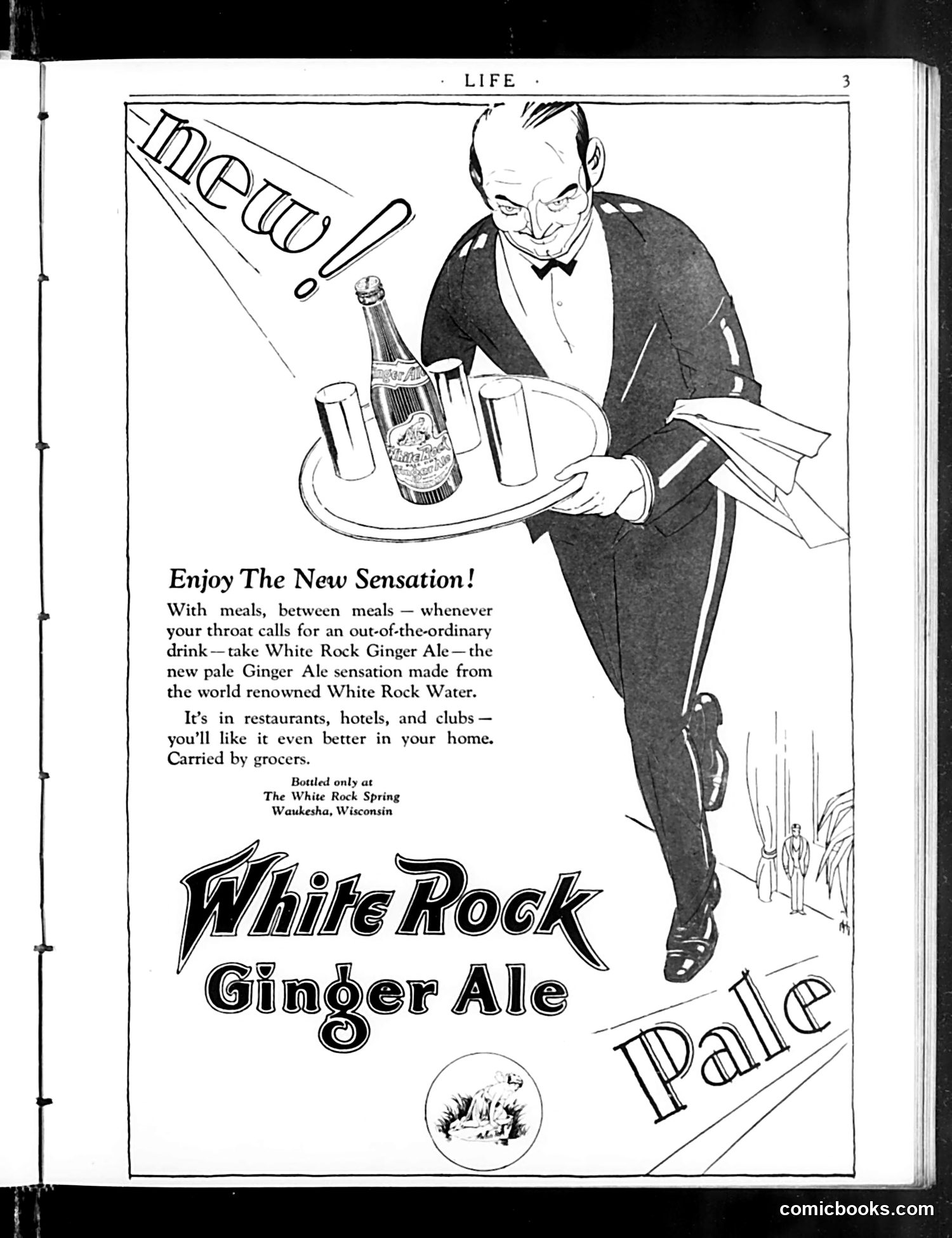
This is a commercial advertisement, not political satire. It promotes White Rock Ginger Ale, a beverage from White Rock Spring in Wauksha, Wisconsin. The ad features a well-dressed male server or waiter in formal attire carrying a tray with a bottle and glasses. The "New!" exclamation mark and "Enjoy The New Sensation!" headline suggest this product launch was recent to the magazine's publication date. The advertisement markets the ginger ale as suitable "with meals, between meals" and available in restaurants, hotels, clubs, and via grocers for home consumption. The illustration's style and advertising approach are typical of early-to-mid 20th century product marketing, emphasizing sophistication and accessibility to middle-class consumers.
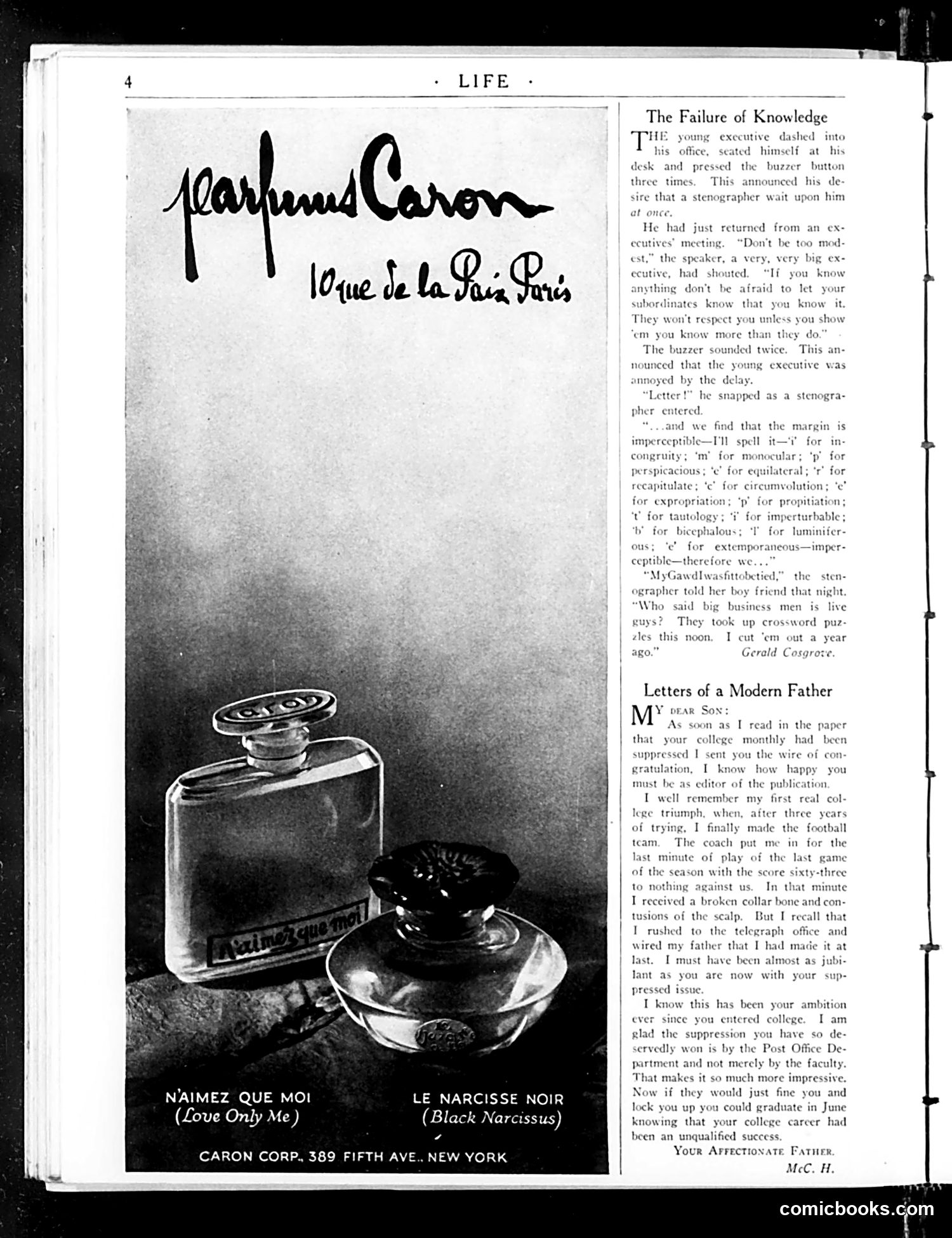
This page combines **advertising and satirical content** from Life magazine. **Left side:** A Caron Corp. perfume advertisement featuring two French fragrances ("Love Only Me" and "Black Narcissus"), signed by what appears to be a celebrity endorser. **Right side:** Two satirical pieces: 1. **"The Failure of Knowledge"** - A joke about a young executive whose boss tells him that subordinates won't respect him unless he displays superior knowledge. When the executive later spells out accounting abbreviations to seem knowledgeable, his stenographer responds dismissively that businessmen solve crossword puzzles, implying his pedantic display is pointless. 2. **"Letters of a Modern Father"** - A father congratulates his son on the college publication's suppression, suggesting his athletic achievement (making the football team) is more impressive than academic credentials. Both pieces satirize workplace pretension and misplaced priorities.
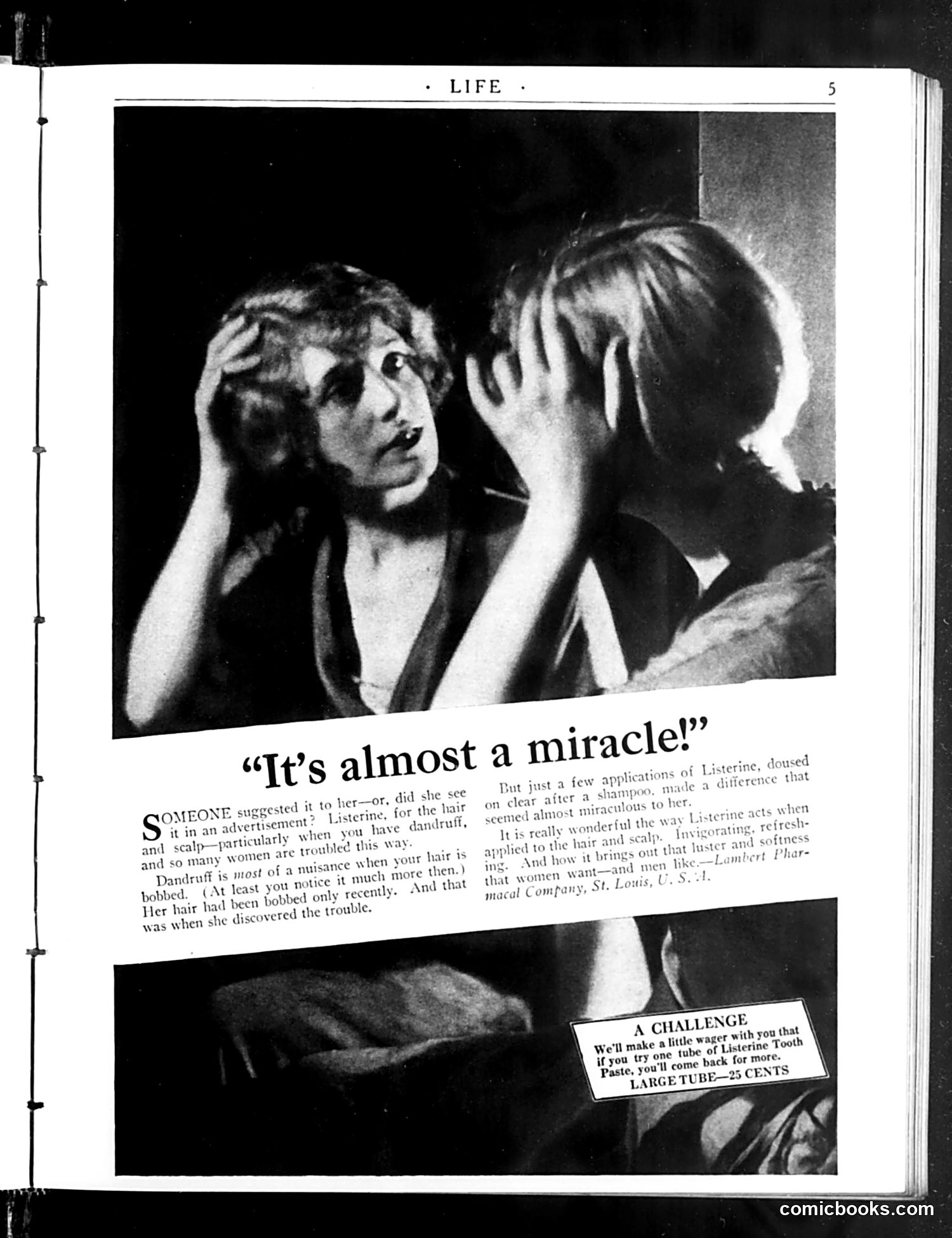
This page is primarily a **Listerine mouthwash advertisement** rather than political satire. The ad uses a before-and-after narrative about dandruff ("a nuisance of a scalp condition"). The visual shows a woman discovering her hair problem and presumably finding relief through Listerine products. The headline "It's almost a miracle!" emphasizes the product's claimed effectiveness. The ad includes testimonial text praising how Listerine works when applied to hair and scalp, claiming it brings "that lustre and softness that women want." A promotional challenge at bottom offers a wager: customers trying the large tube (25 cents) will allegedly become repeat buyers. This represents typical early-20th-century advertising strategy—using emotional narratives and product endorsements to market everyday goods to consumers.
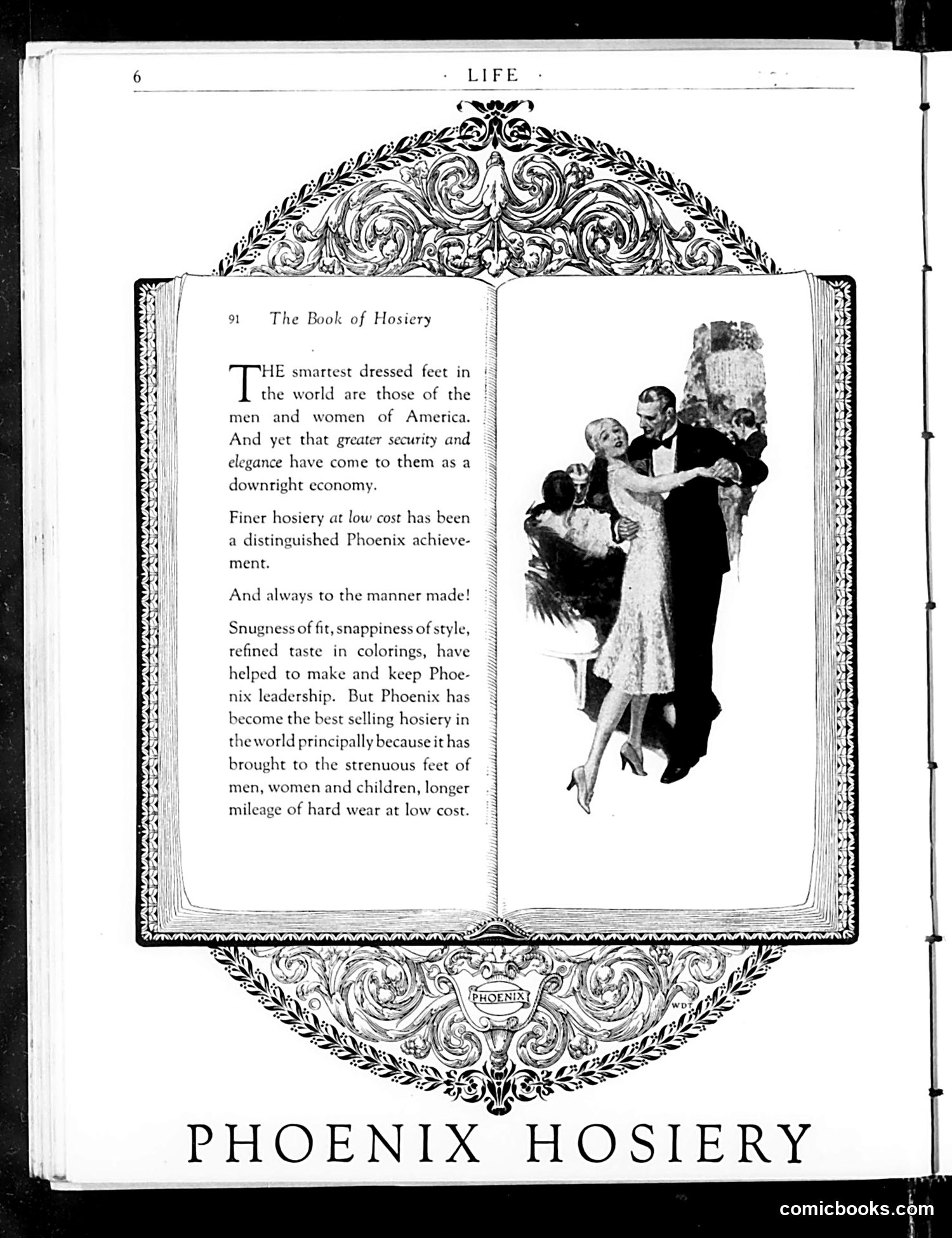
This is a **commercial advertisement**, not political satire. The page promotes Phoenix brand hosiery to American consumers, emphasizing affordable quality. The illustration shows well-dressed figures in formal attire, suggesting respectability and social status. The text claims that Americans—particularly "men, women and children"—now enjoy fine hosiery at low cost through Phoenix's manufacturing achievement. The advertisement's appeal combines **social aspiration with economy**: it promises that wearing Phoenix hosiery allows one to appear refined and fashionable ("snugness of fit, snappiness of style") without financial burden. The ornate decorative border frames the pitch as a premium product despite its affordability—a key marketing strategy for early 20th-century mass-market goods targeting middle-class consumers.
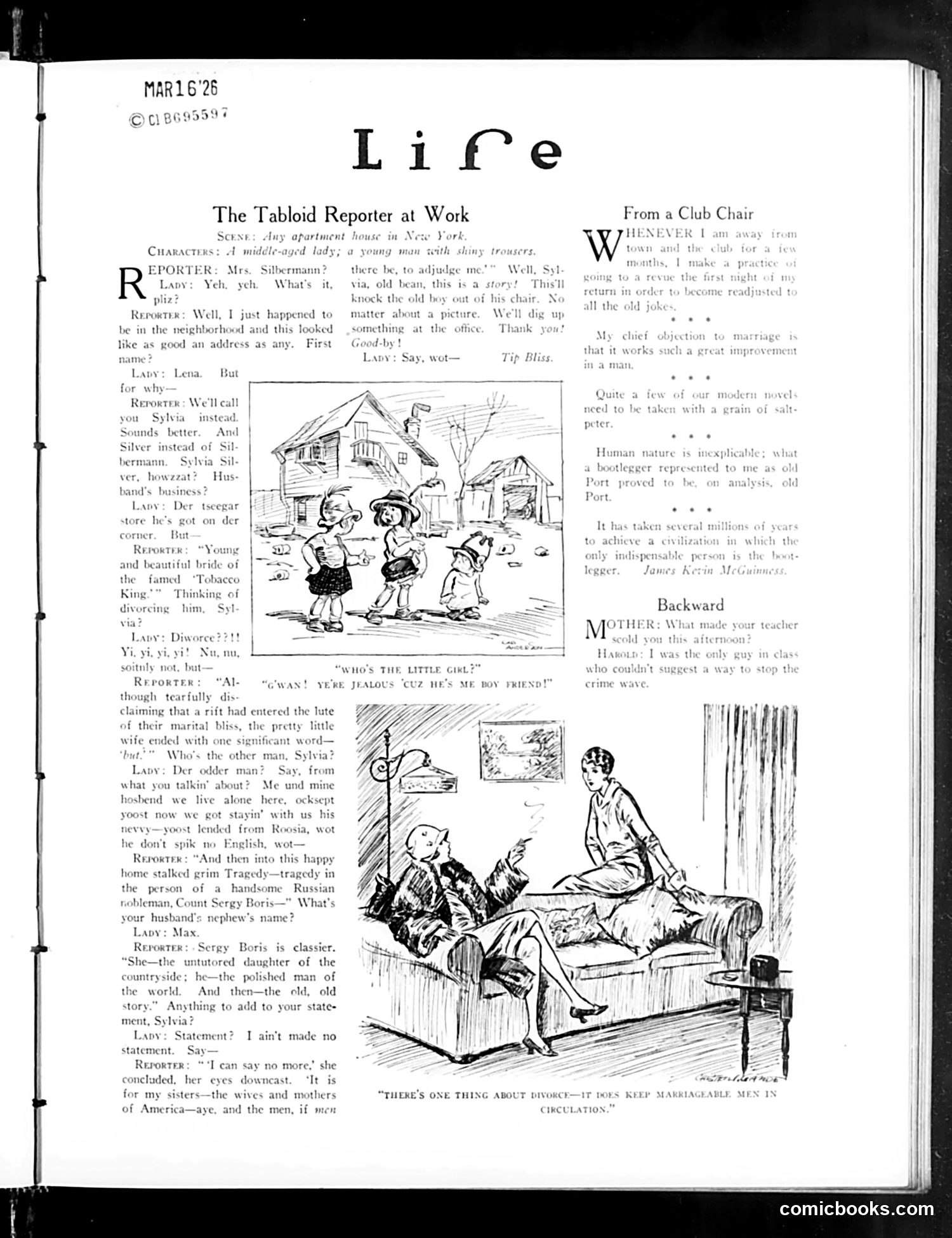
This page contains two satirical sketches with accompanying dialogue: **"The Tabloid Reporter at Work"** (left) depicts a reporter interviewing a woman about a sensational domestic story. The satire targets tabloid journalism's invasive questioning and appetite for scandal—the reporter presses for lurid details ("divorce?") while the subject tries to deflect. **"Backward"** (right) shows a mother and son discussing crime prevention. The joke appears to satirize both naive parenting advice and youth crime: Harold claims he was the only boy in class who didn't commit a crime, inverting expected moral logic for humorous effect. Both sketches mock early 20th-century American social anxieties: tabloid sensationalism and juvenile delinquency. The humor relies on exaggerated character types common to *Life's* satirical style.
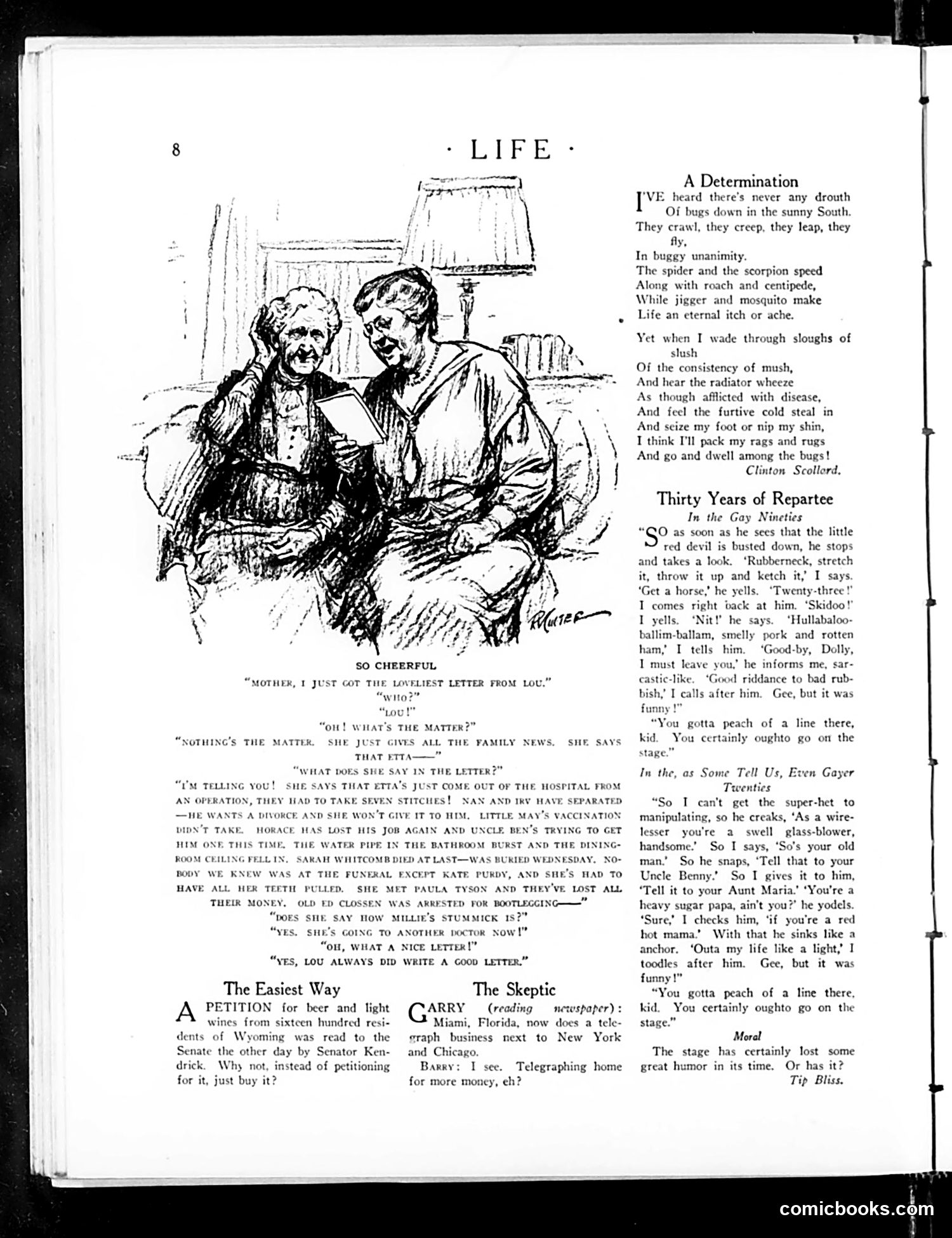
This page contains literary humor and light satire rather than political cartoons. The central illustration shows two figures (appears to be a mother and son or family members) reading correspondence together indoors. The content includes three humorous pieces: "A Determination" (a poem about insects in the American South), "Thirty Years of Repartee" (dialogue featuring characters named Dolly and Skidoo with period slang), and "The Easiest Way" (satirizing Wyoming residents' petition for beer, suggesting buying it directly rather than petitioning). "The Skeptic" presents brief comic dialogue between newspaper characters discussing telegraph business between Miami and New York. The satire targets everyday American life—family communication, regional quirks, bureaucratic inefficiency—rather than major political figures or events. The humor relies on wordplay and situational comedy typical of early 20th-century American magazines.
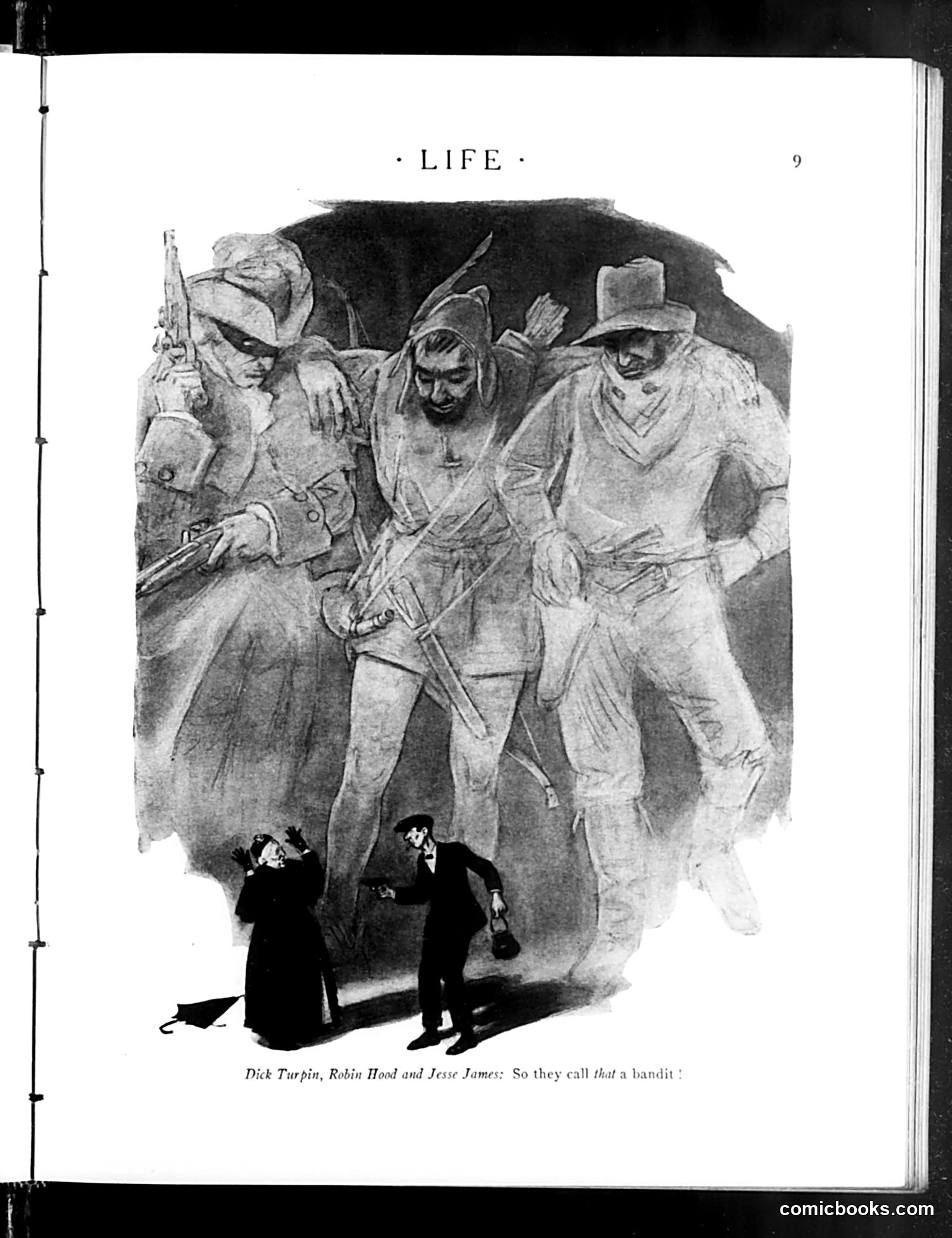
This is a satirical cartoon from *Life* magazine depicting three legendary outlaws—Dick Turpin, Robin Hood, and Jesse James—as towering, menacing figures looming over two small, contemporary men in bowler hats below them. The caption reads: "So they call that a bandit!" The satire compares historical outlaws (romanticized folk heroes) with a modern criminal, suggesting that today's criminals lack the grandeur or notoriety of their legendary predecessors. The joke implies either that contemporary bandits are unimpressive by comparison, or possibly critiques how society mythologizes historical criminals while dismissing modern ones. The scale difference emphasizes this disparity—the historical figures dominate while the modern figures appear diminished.
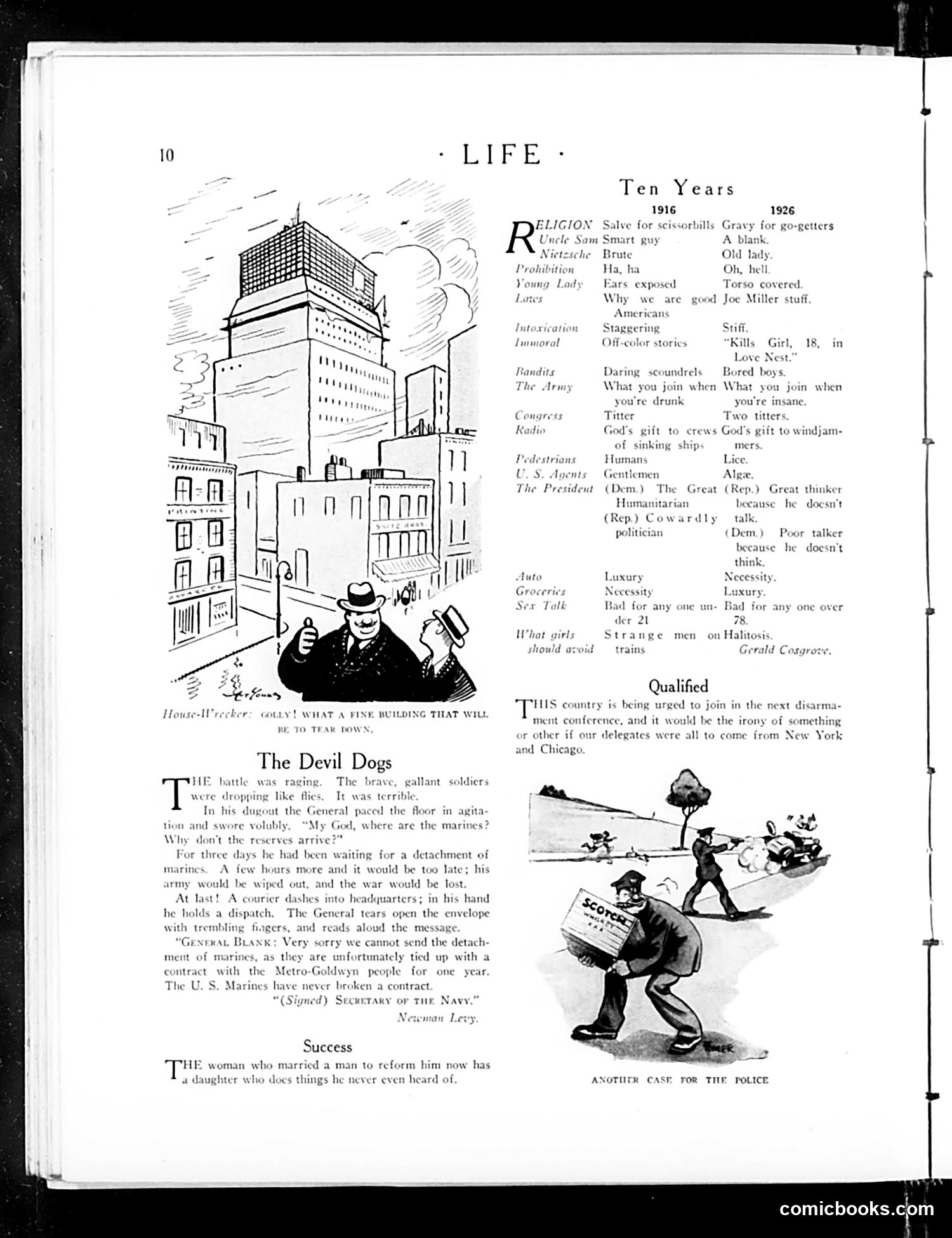
This page from *Life* magazine contrasts cultural changes across a decade. The left cartoon shows a man with a wrecking ball destroying a tall building, captioned about tearing down "fine buildings"—likely satirizing urban demolition and modernization debates. The "Ten Years" chart humorously catalogs shifts in attitudes: religion moved from "Salve for scoundrels" to "Gravy for go-getters"; prohibition changed from preventing "Young Lady" ear exposure to covering "Torso"; what people think of Americans evolved from "Why we are good" to "The Miller stuff." The bottom sections—"The Devil Dogs" (praising Marines), "Success" (mocking women reformers), and "Another Case for the Police"—present typical *Life* satirical commentary on contemporary social issues, morality, and law enforcement concerns of the 1920s.
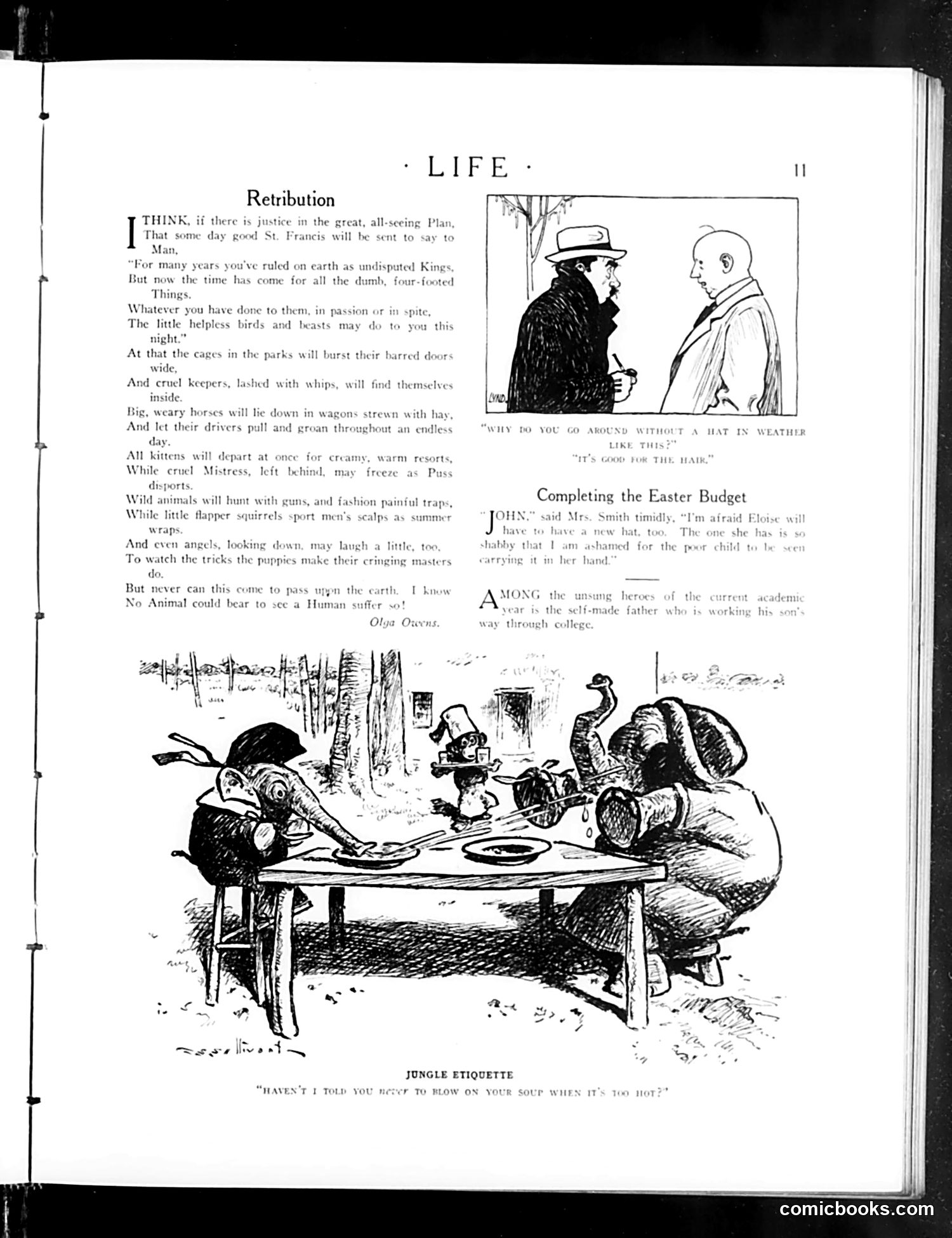
This page contains two distinct pieces: 1. **"Retribution"** - A poem by Olga Owens imagining divine punishment for human cruelty to animals. It describes caged animals, mistreated horses, and other creatures being freed to torment their abusers in an afterlife. 2. **"Jungle Etiquette"** - A humorous cartoon showing anthropomorphic animals (appears to be a lion and hippopotamus) dining together at a table. The caption reads: "Haven't I told you never to blow on your soup when it's too hot?" The joke satirizes civilized dining etiquette by depicting wild jungle creatures attempting to follow human social conventions—the absurdity lies in instructing a wild animal on proper soup-eating manners. This reflects early 20th-century humor mocking both pretentious etiquette rules and the notion of "civilizing" nature.
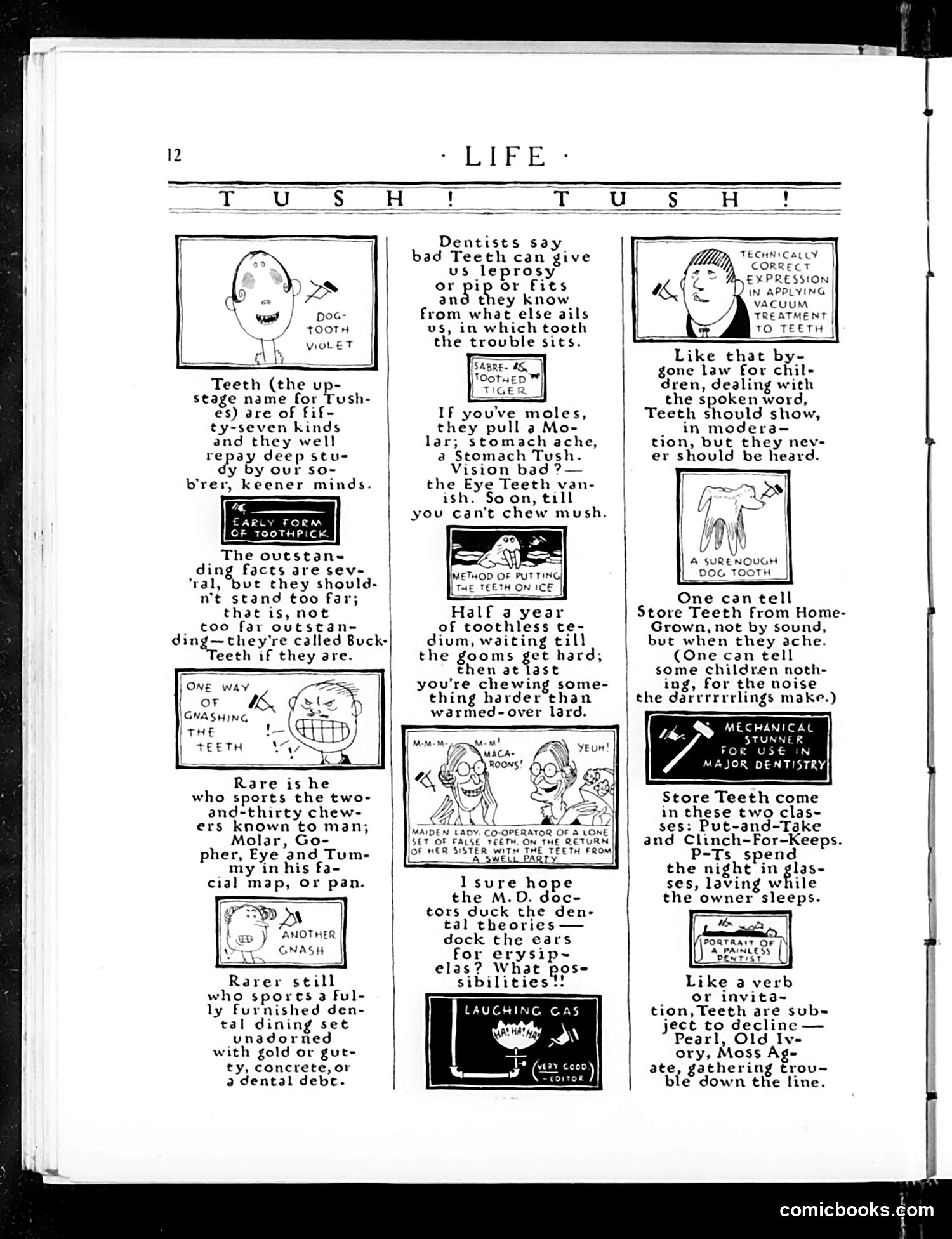
This page is a humorous essay on dental problems and dentistry, using cartoon vignettes to mock various tooth-related issues and dental practices. The satire targets: 1. **Bad teeth causes**: The cartoons joke that teeth problems lead to various ailments (moles, stomach aches, eye problems) 2. **Dental solutions**: It mocks contemporary dental treatments like "putting teeth on ice" and false teeth options 3. **Dentists' theories**: The text sarcastically hopes doctors "duck the dental theories" and questions their credibility regarding tooth-related health claims 4. **False teeth commerce**: It satirizes the market for store-bought dentures marketed as cosmetic solutions The overall point: dentistry in this era mixed legitimate concerns with dubious pseudo-scientific claims, and the page ridicules both overzealous dental theorizing and commercial tooth-selling schemes targeting the self-conscious public.
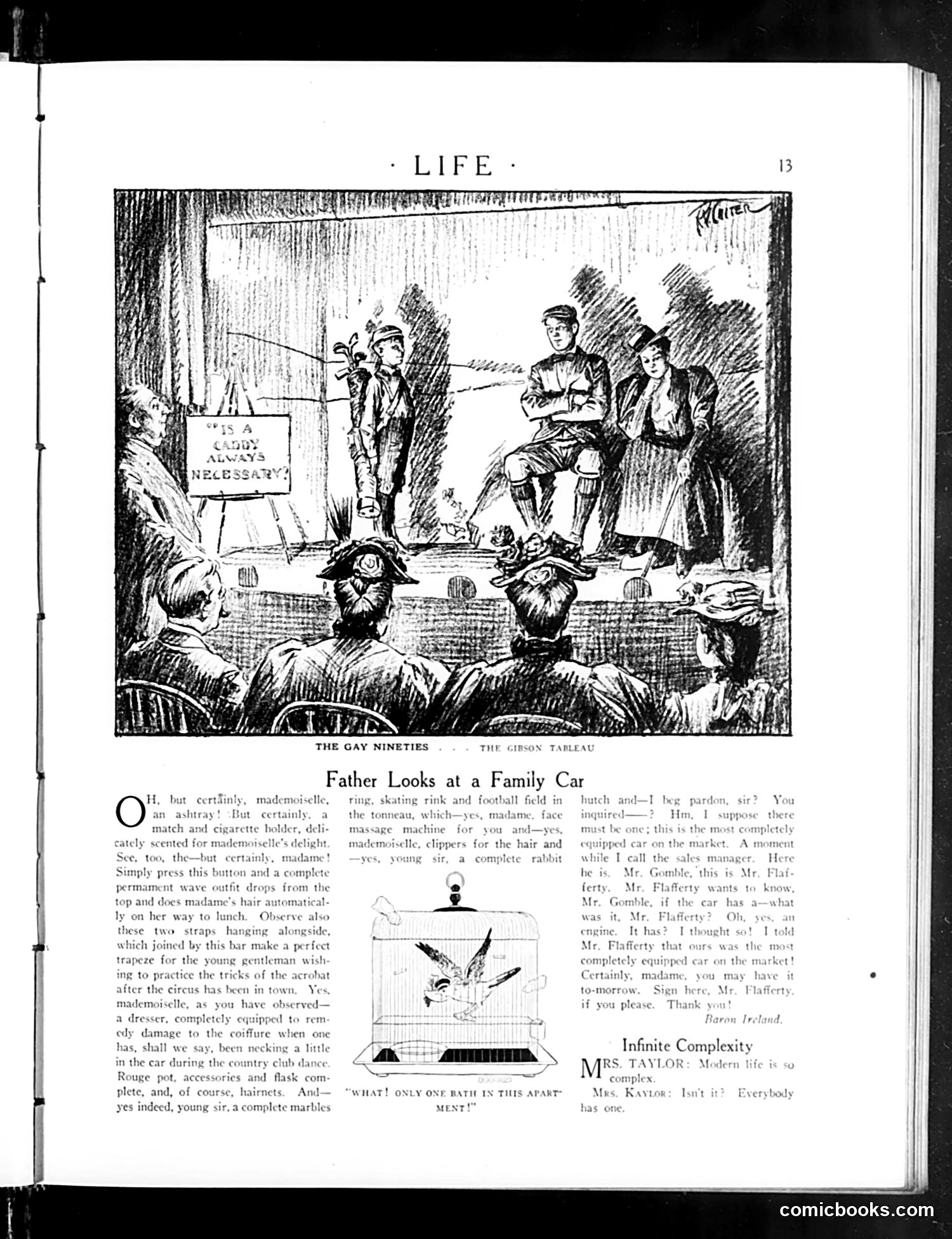
This page contains two satirical pieces about early 20th-century consumer culture and modern life. **"Father Looks at a Family Car"** (top): A Gibson Girl-style illustration mocks the complexity of automobiles. A salesman explains that a fully-equipped car requires numerous accessories—hair clippers, massage machines, rabbit fur trapeze—presented as absurdly unnecessary features. The satire targets both automobile marketing hyperbole and the era's trend of over-engineered luxury goods marketed to wealthy families. **"Infinite Complexity"** (bottom): A brief dialogue between Mrs. Taylor and Miss Kaylor jokes that "modern life is so complex" that "everybody has one" (of something—unclear what). This likely comments on how complexity has become universal rather than exceptional. Both pieces satirize the excesses and absurdities of consumer culture during the prosperous pre-1920s era.
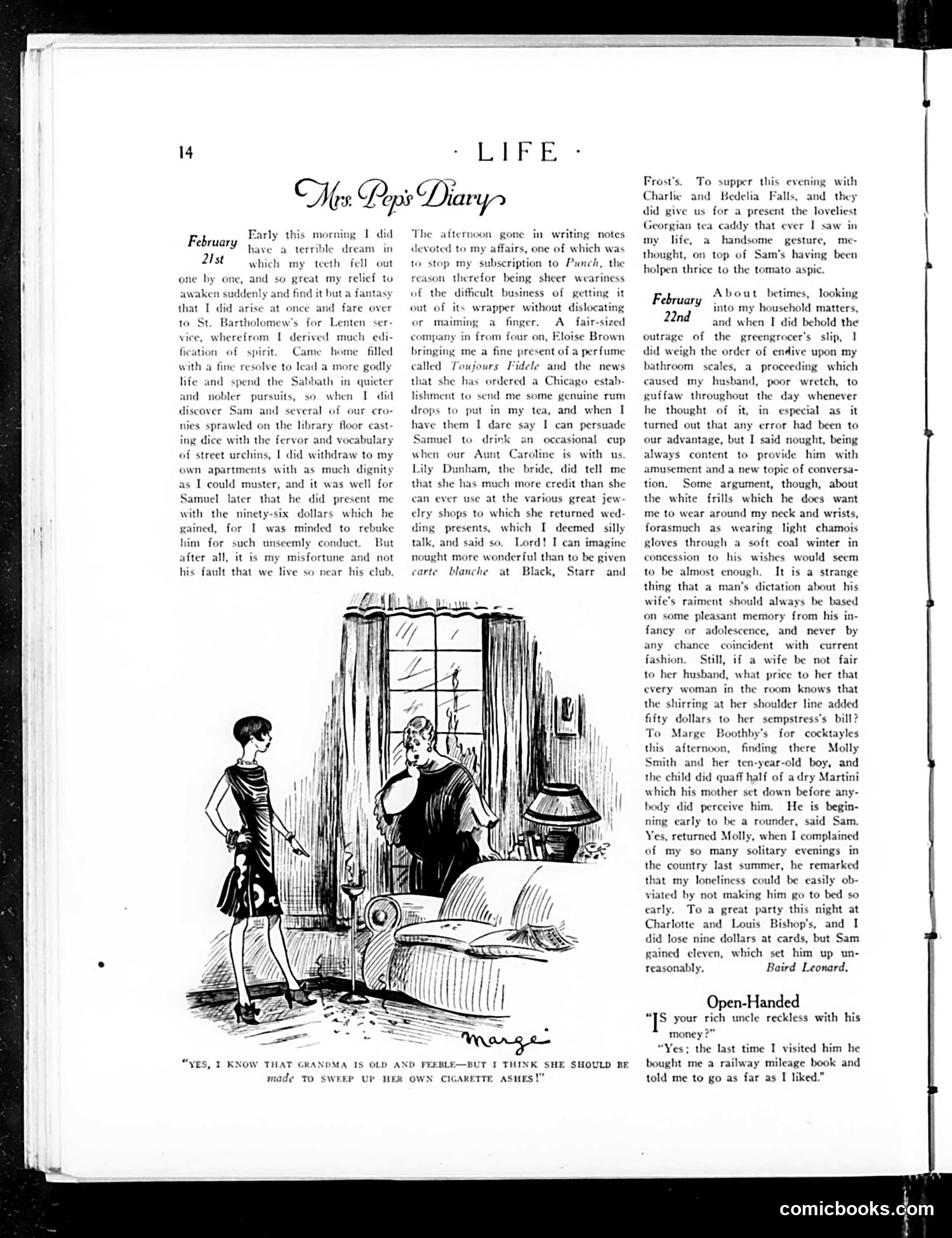
This page presents a domestic diary satirizing upper-middle-class life. The cartoon depicts a woman at a window speaking to a man, with the caption: "Yes, I know that Grandma is old and feeble—but I think she should be made to sweep up her own cigarette ashes!" The satire targets the contrast between professed concern for elderly relatives and actual callousness. The diarist describes trivial domestic complaints—greengrocer errors, missing bathroom scales—alongside larger social observations about marriage, fashion, and household management. References include *Punch* magazine (subscription troubles), perfume imports, and Chicago establishments, suggesting 1920s-era upper-class preoccupations. The humor lies in the narrator's self-aware recognition of her own petty concerns and marital anxieties, creating gentle satire of privileged women's lives.
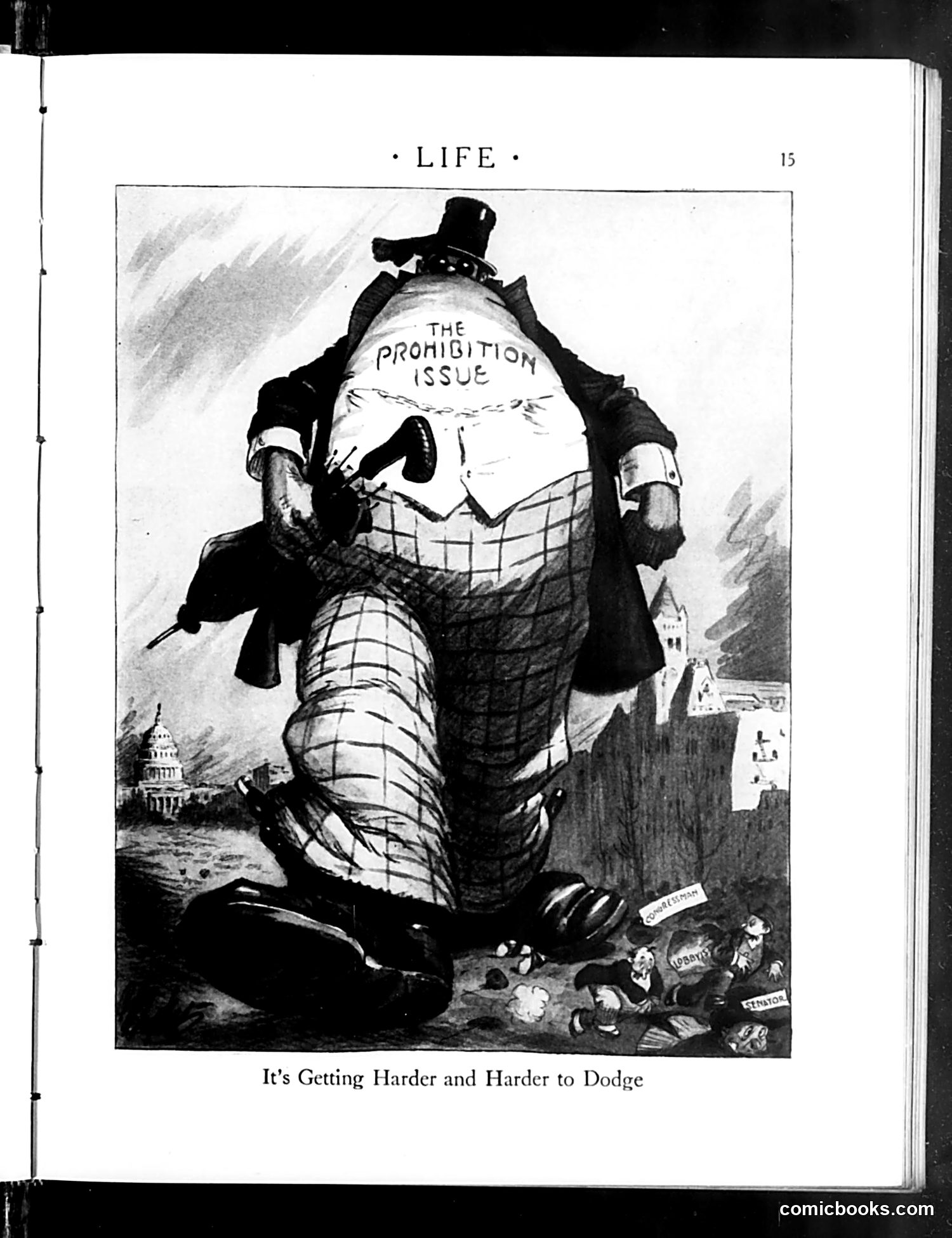
This Life magazine cartoon satirizes Prohibition enforcement during the 1920s-1930s. A large, rotund figure labeled "THE PROHIBITION ISSUE" is being manipulated by two men in formal dress (likely representing politicians or enforcement officials). The figure's body is wrapped in bandages, suggesting the issue is wounded or deteriorating. At the bottom, small figures appear to represent various political actors—possibly congressmen, senators, or interest groups—trying to manage the problematic policy. The Capitol building is visible in the background, establishing the political context. The caption, "It's Getting Harder and Harder to Dodge," suggests that politicians can no longer avoid addressing Prohibition's failures. The cartoon mocks how the issue had become unwieldy and difficult for lawmakers to control, reflecting growing public opposition to Prohibition enforcement.
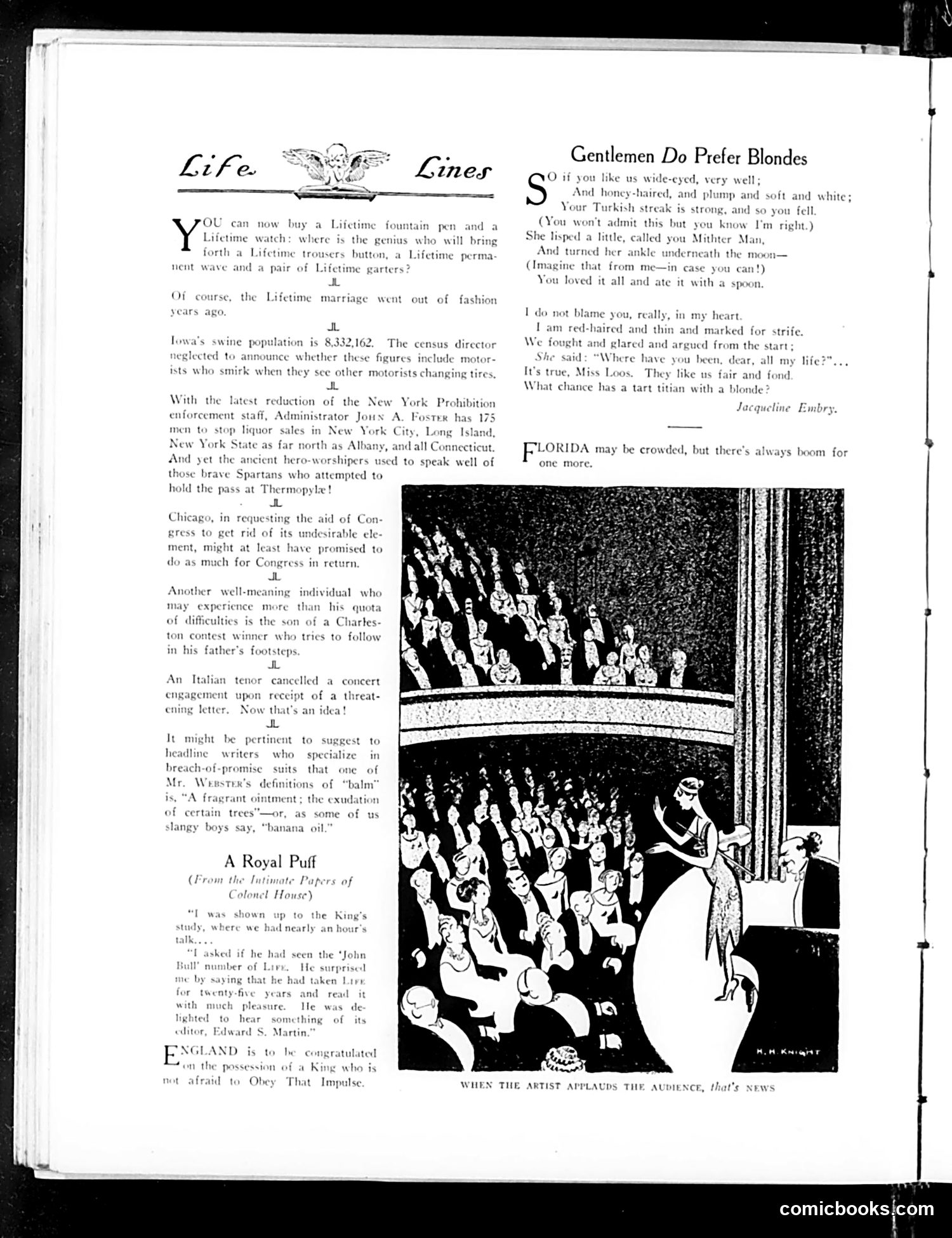
This page contains satirical commentary and a cartoon titled "When the Artist Applauds the Audience, That's News." The cartoon depicts a formal theatrical or concert venue with an audience in balconies above and below. An elegantly dressed figure (the artist/performer) stands at right, applauding the seated audience—reversing the normal convention where audiences applaud performers. The joke's point: typically the artist receives applause from the audience. Here, the satire inverts this relationship, suggesting either an exceptionally responsive/remarkable audience, or more likely, mocking pretentious artistic circles where artists might excessively praise their own audiences. The surrounding "Life Lines" column contains miscellaneous satirical observations about American life, including references to Iowa's population, New York Prohibition enforcement, and Chicago politics—typical magazine filler humor of the era.
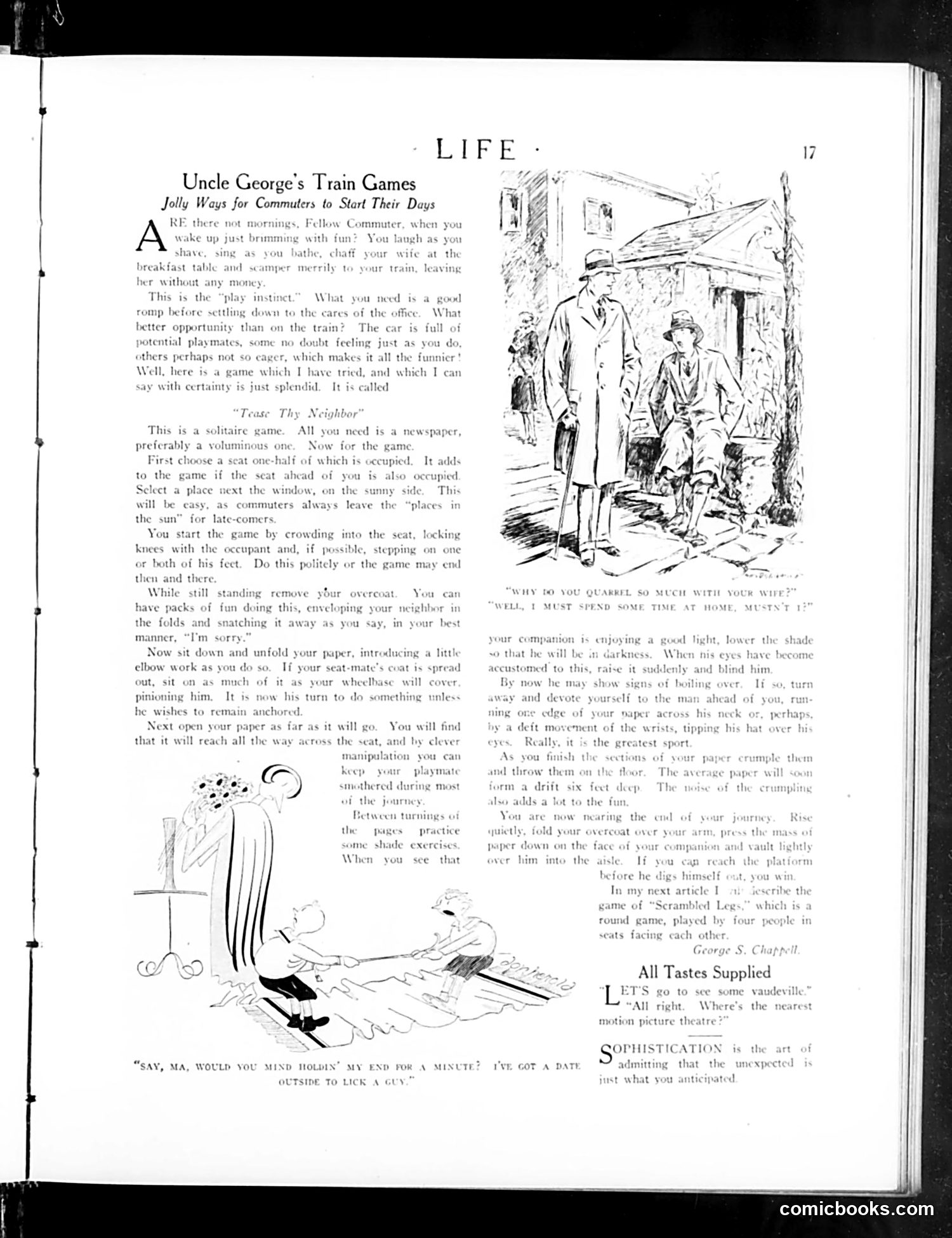
This is a humorous advice column by George S. Chappell about commuter games to enliven tedious morning train rides. The satirical point targets the tedium of daily commuting in the early 20th century. The games described involve deliberately annoying fellow passengers—crowding into seats, monopolizing space with newspapers, elbowing seatmates, and generally creating minor chaos. The accompanying cartoons show commuters engaging in these petty conflicts: a man and woman quarreling over newspaper space, and another scene of physical jostling. The humor works by endorsing socially inconsiderate behavior as a "ramp" to shake off the day's stresses before reaching the office. It's satirizing both commuter frustration and the era's genteel social hypocrisy—suggesting respectable people secretly want to behave badly toward each other. The games mock the constraints of polite society while implicitly commenting on commuting's dehumanizing effects.
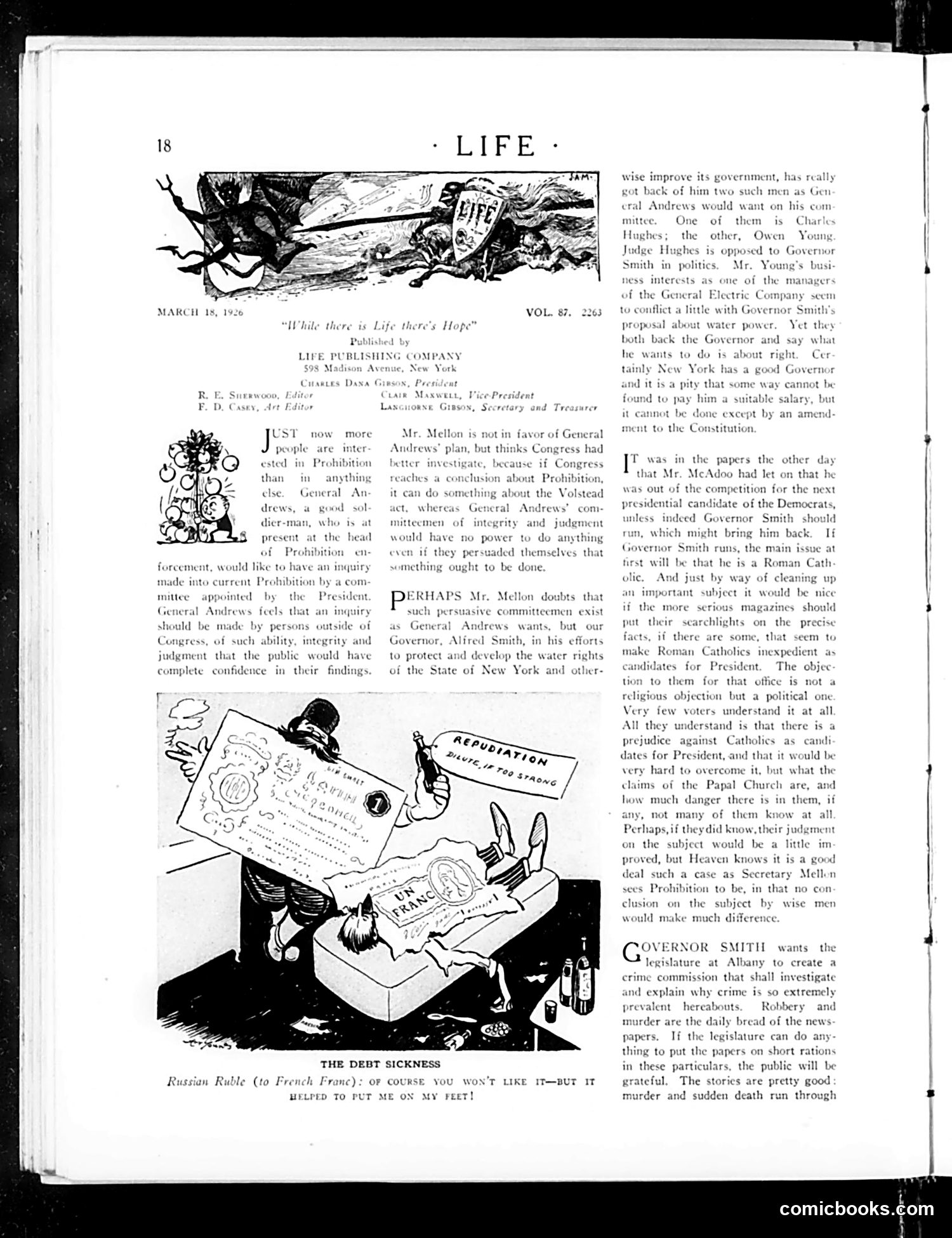
This page discusses 1920s New York politics, particularly Governor Al Smith's potential presidential ambitions and related controversies. **Main Cartoon ("The Debt Sickness"):** A Russian ruble, personified and burdened with heavy debts and financial documents, complains to France about the weight of obligations. This satirizes post-WWI international debt disputes—likely referencing America and European nations' competing claims over war debts and reparations. **Political Commentary:** The text discusses General Andrews' push for a Prohibition investigation committee. It notes opposition from Judge Hughes and Owen Young (General Electric), whose business interests conflict with Governor Smith's water-power proposals. **Subtext:** The piece addresses anti-Catholic prejudice against Smith as a presidential candidate, noting that voters conflate religious objection with political opposition—an important 1920s controversy, as Smith was Catholic. The governor also wants a crime commission to investigate why crime is "so extremely prevalent."
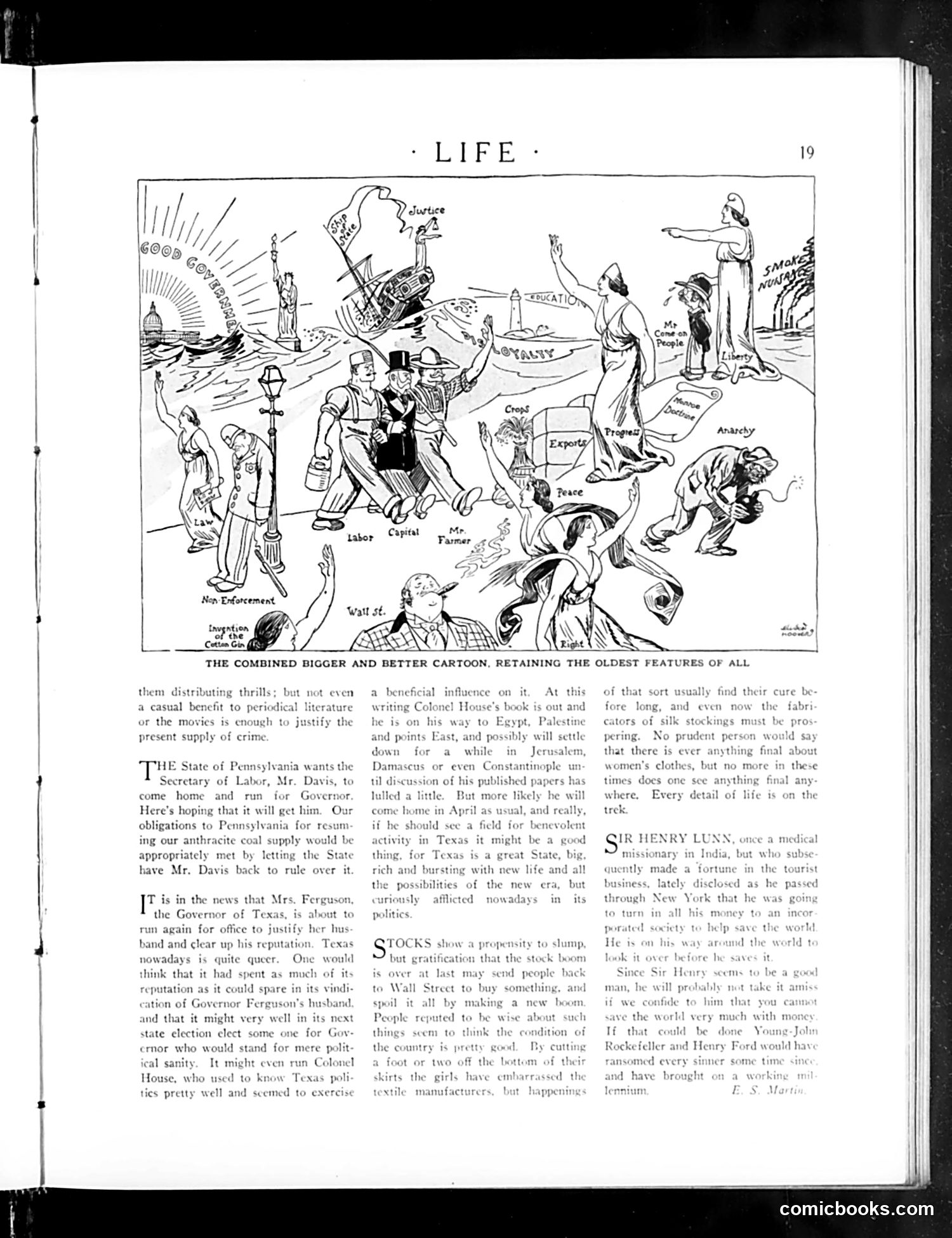
This page features a large composite political cartoon satirizing American life and governance. The central image shows allegorical figures representing various social forces—labeled with terms like "Justice," "Education," "Capital," "Labor," "Farmer," "Anarchy," and "Prosperity"—engaged in chaotic struggle or interaction. The accompanying text discusses several contemporary political matters: Pennsylvania's Secretary of Labor seeking the governorship; Texas Governor Ferguson's wife running for office to rehabilitate her husband's reputation; stock market volatility; and the activities of wealthy philanthropists like Henry Lunn and Henry Ford. **The cartoon's point**: American society comprises competing interests (labor, capital, justice, etc.) in perpetual tension. The satire mocks political corruption, opportunism by spouses seeking to restore tainted reputations, and the contradictions of wealthy elites claiming philanthropic motives while the broader social order remains unstable. The "oldest features" caption suggests this combines traditional allegorical cartooning with contemporary scandal commentary.
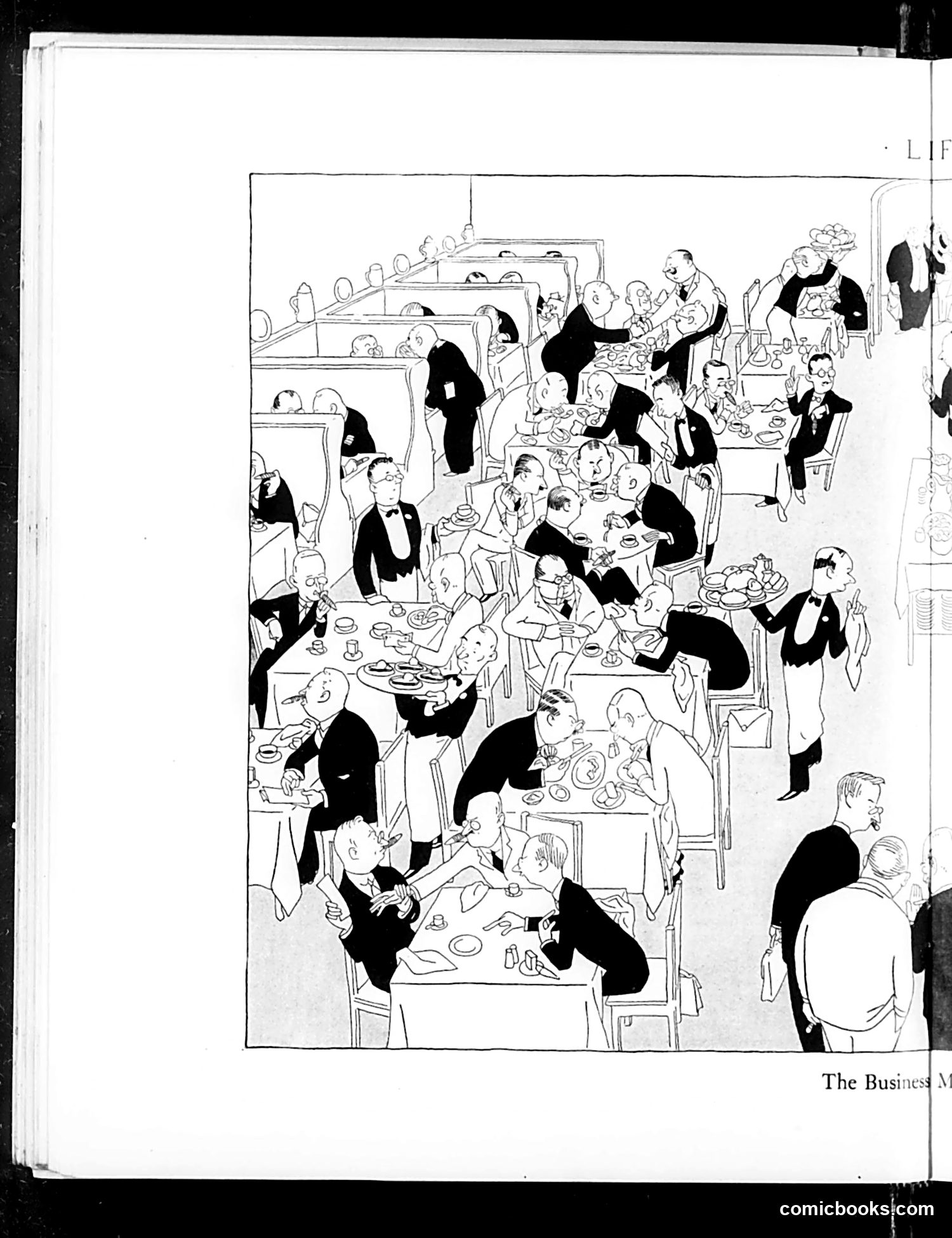
This is a single-panel cartoon depicting a formal business dining scene, likely from an early-to-mid 20th century *Life* magazine. The illustration shows numerous men in tuxedos seated at multiple tables in what appears to be an upscale restaurant or banquet hall, with waiters serving them. The partial caption reads "The Busines§ M[...]" (text cut off), suggesting this satirizes a business meeting or formal corporate gathering. The cartoon's humor appears to derive from the contrast between the formal, dignified setting and the crowded, somewhat chaotic social dynamics on display—multiple conversations happening simultaneously, varied body language, and the general bustle of high-level business socializing. Without the complete caption, the specific satirical target remains unclear, though the focus on corporate formality and networking rituals is evident.
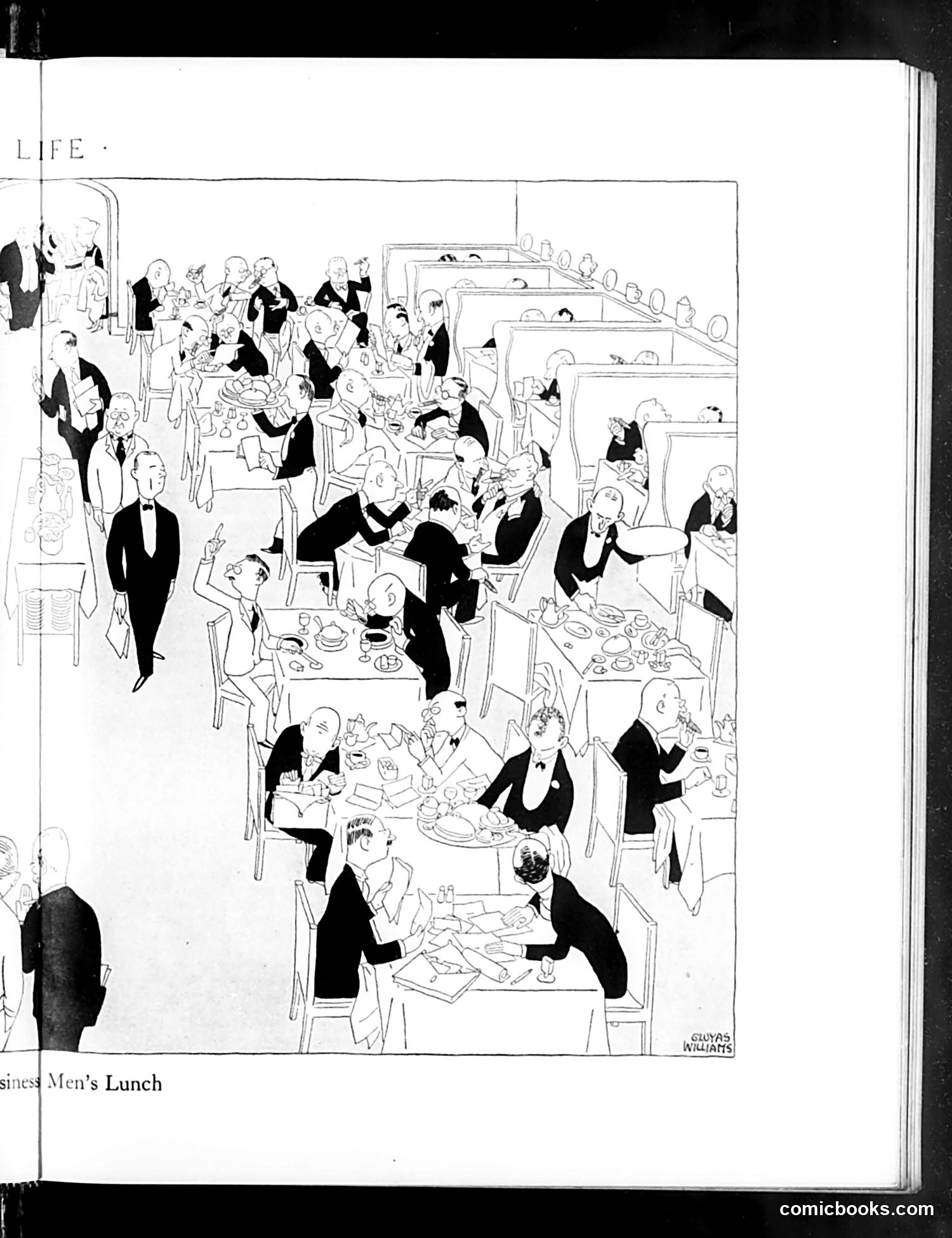
This satirical cartoon depicts a crowded, chaotic business lunch scene. All the men wear formal black tuxedos and bow ties, establishing a supposedly refined, professional setting. However, the illustration humorously shows them behaving badly—eating messily, gesturing wildly, and generally acting undignified despite their formal dress. The satire targets the contrast between businessmen's pretense of sophistication and their actual conduct. The packed, disorganized restaurant with food scattered on tables undermines any notion of civilized behavior. The artist (credited as Gluyas Williams) uses exaggerated caricature to mock the self-importance of the business class—all dressed formally yet behaving chaotically. This reflects early-to-mid 20th century social commentary on American business culture and masculine pretense.
This page reviews Marc Connelly's play "The Wisdom Tooth," a "fantastic comedy" about a timid office clerk (played by Thomas Mitchell) who regresses to childhood to learn self-reliance from his younger self, then returns to work with newfound confidence—only to be fired for his quixotic stance. The reviewer (Robert Benchley, bylined at bottom) praises the play's unusual simplicity and emotional impact, particularly crediting child actor Edwin Philips as "Skeeter" for moving audiences to tears. The piece also briefly dismisses Marjorie Rambeau's current vehicle, "The Night Duel," as melodramatic fluff about a woman choosing between a bachelor's apartment and her husband's jail sentence. The decorative header and rabbit illustrations are typical Life magazine ornamental design elements.
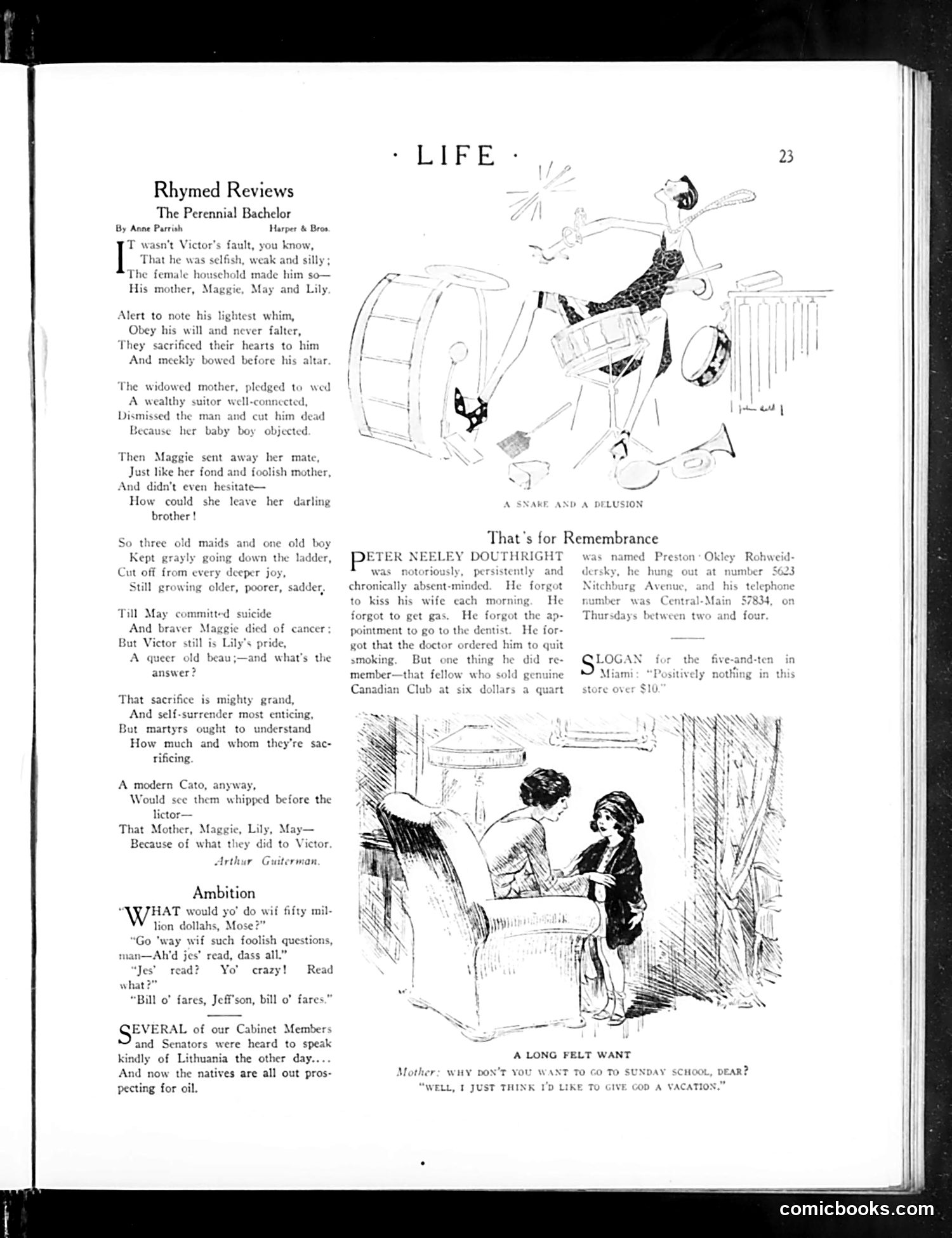
This page contains literary reviews and satirical commentary typical of early 20th-century Life magazine. **"The Perennial Bachelor"** review critiques Anne Parrish's novel about Victor, a selfish man enabled by female relatives (mother, sisters Maggie, May, Lily). The satire attacks how women's self-sacrifice perpetuates male weakness—a commentary on gender dynamics and family codependency. **"That's for Remembrance"** mocks Peter Neeley Douthwright, a chronically absent-minded man who forgets basic obligations (kissing his wife, dental appointments, smoking cessation). The accompanying cartoon shows domestic frustration. **"A Long Felt Want"** depicts a mother-child dialogue where the child wants Sunday off from school; the mother agrees, wanting "to give God a vacation"—humor based on religious observance and parental exhaustion. **"Ambition"** uses dialect humor (African American vernacular) about wealth aspirations, where "Mose" claims he'd only read restaurant menus—playing on period stereotypes. The final item satirizes politicians' sudden interest in Lithuania after hearing Cabinet members speak favorably of it, now hoping to exploit oil resources—commentary on opportunistic geopolitics.
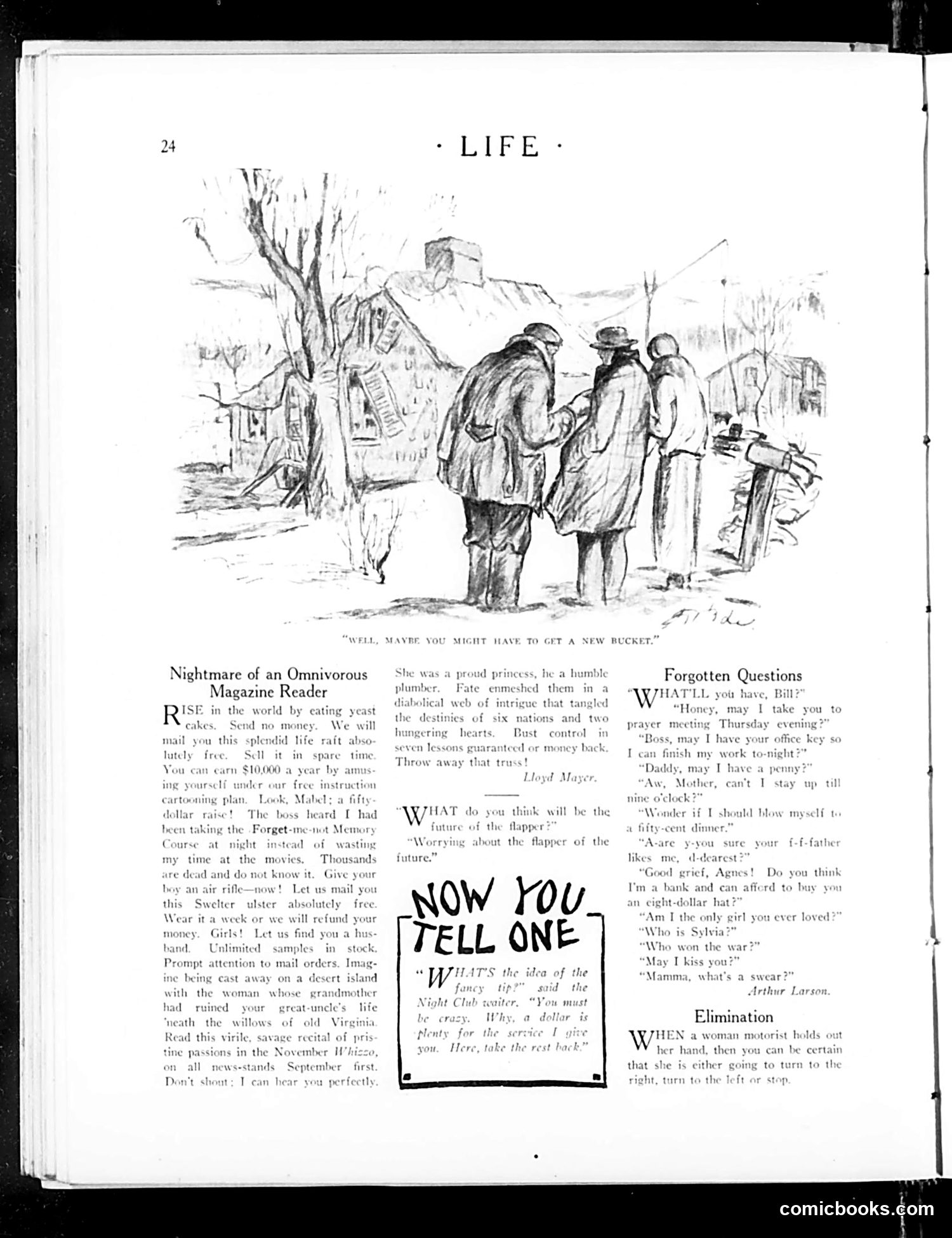
This page contains three distinct satirical pieces targeting early 20th-century anxieties: **"Nightmare of an Omnivorous Magazine Reader"** mocks get-rich-quick schemes and mail-order scams prevalent in magazines. It satirizes the absurd promises (earning $10,000 annually, "free instruction") that preyed on desperate readers. **"Forgotten Questions"** humorously catalogs mundane domestic and romantic inquiries (children asking "What's a swear?", romantic uncertainty, marital concerns). The satire appears to mock how people obsess over trivial matters while ignoring larger issues. **"Elimination"** jokes about women drivers, a contemporary concern when automobiles were still relatively new and women's driving was controversial. The humor suggests women motorists are unpredictable—you can't tell which direction they'll turn based on hand signals. The sketch at top shows men discussing a broken bucket, possibly illustrating one of the magazine-promoted schemes or consumer anxieties. Overall, the page satirizes period advertising fraud, domestic preoccupations, and emerging social changes like women's increasing independence.
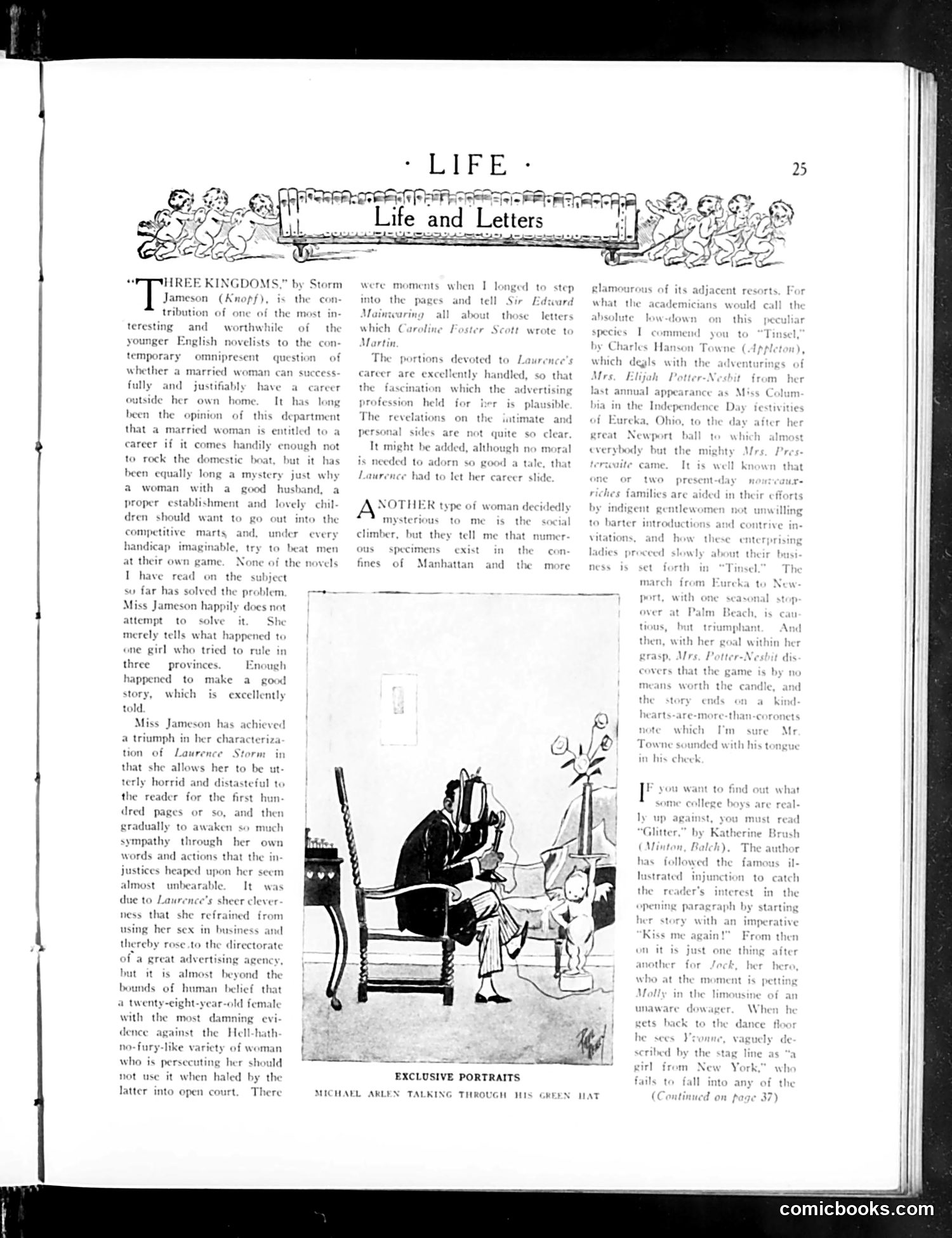
This illustration satirizes author **Michael Arlen**, who wrote the popular 1924 novel *The Green Hat*. The cartoon depicts him literally speaking through an oversized green hat, a visual pun mocking the novel and its pretensions. The surrounding article discusses how contemporary women authors tackle "the woman problem" — whether married women should pursue careers. The text praises Storm Jameson's novel *Three Kingdoms* for addressing this intelligently. The joke targets Arlen's work as superficial or affected: he's "talking through his hat" (meaning speaking nonsense) while promoting a book focused on fashionable surface concerns. This reflects *Life* magazine's satirical stance toward literary trends — mocking Arlen's popular but perhaps overhyped novel as shallow compared to more serious women's fiction examining real social questions. The image appears in an article section called "Life and Letters," emphasizing the magazine's critical take on contemporary literature.
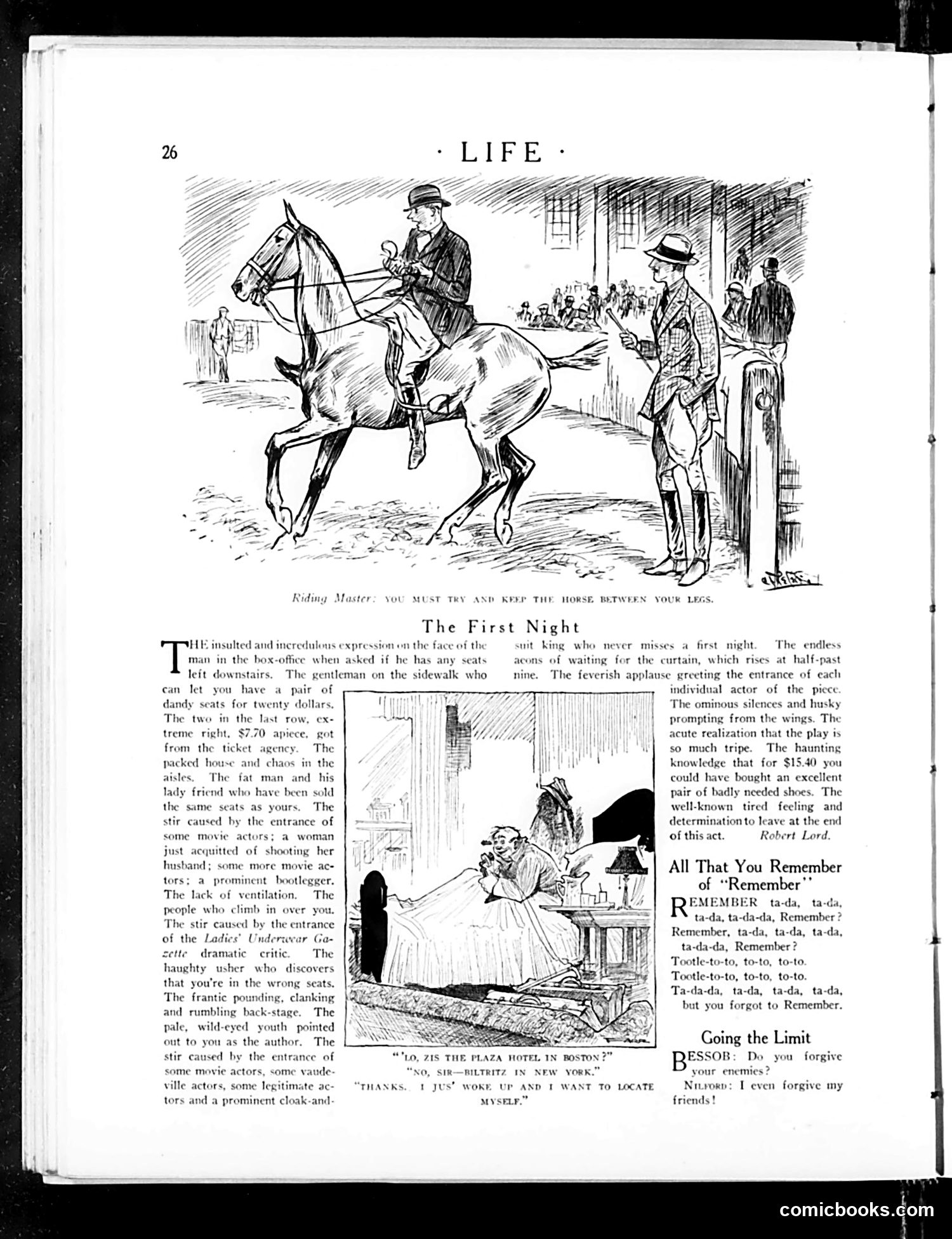
This page from *Life* magazine contains satirical commentary on theater-going culture and includes several short humorous pieces. **"The First Night"** (main article with illustration) satirizes the Broadway theater experience by cataloging all the annoyances that ruin opening nights: overpriced seats, overcrowding, disruptive audience members (including minor celebrities and a woman who shot her husband), poor ventilation, and usher conflicts. The author concludes that after paying $15.40, one realizes the play is worthless and the money could have bought needed shoes instead. **"All That You Remember"** mocks a popular song by reducing its lyrics to meaningless syllables—satirizing forgettable popular music. **"Going the Limit"** is a brief joke about a man at the Plaza Hotel in Boston who, when corrected that he's actually in Biltritz, New York, declares he forgives his enemies and even his friends—suggesting extreme emotional overwhelm. The riding instruction cartoon at top appears unrelated editorial content.
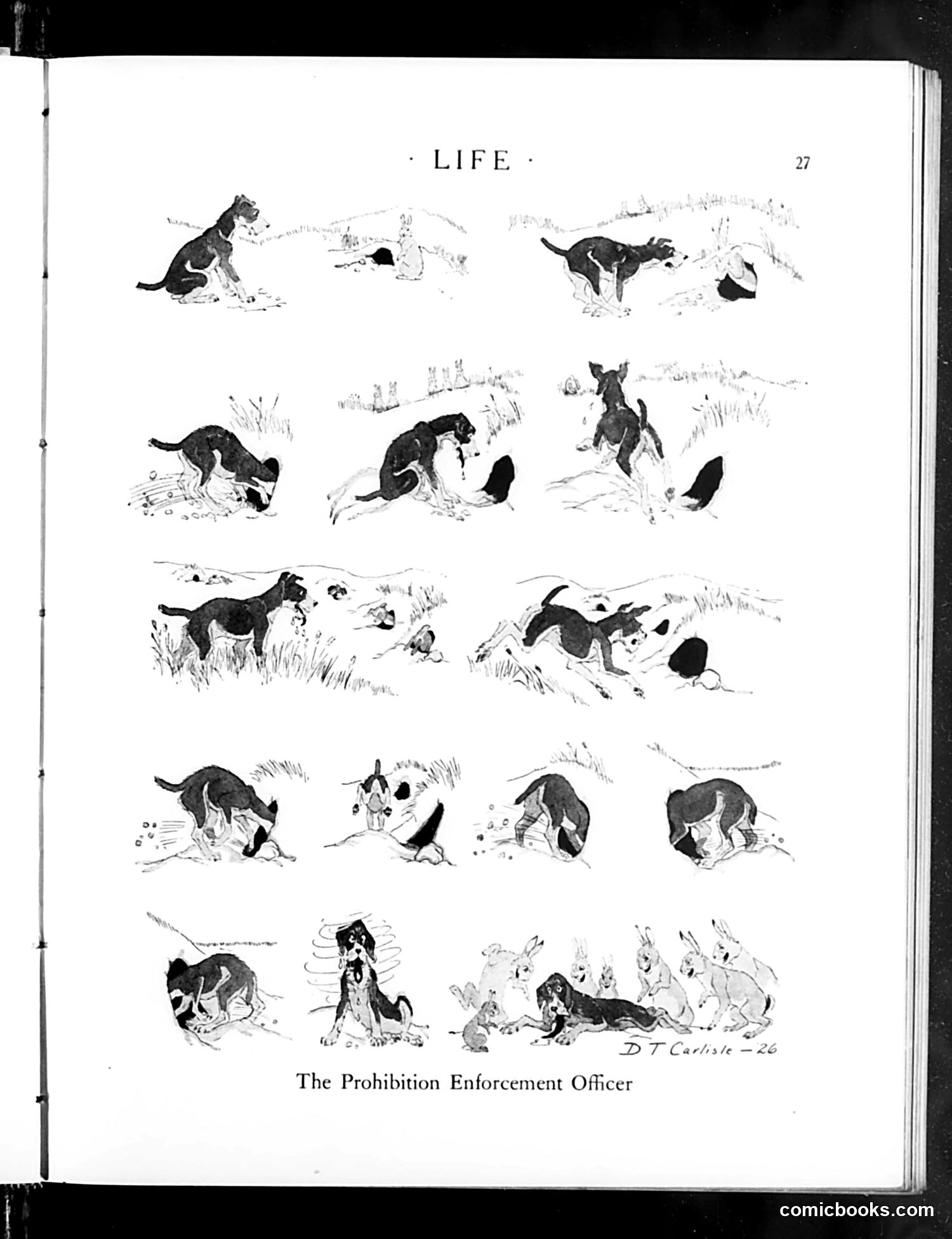
This satirical cartoon by D.T. Carlisle depicts a dog attempting to enforce Prohibition—the ban on alcohol (1920-1933). The sequential panels show the dog's futile efforts: sniffing out hidden bottles, digging in the ground, investigating suspects, and ultimately being overwhelmed by bootleggers (illegal alcohol producers) who outnumber and mock the enforcement officer. The joke critiques the inadequacy of Prohibition enforcement during the 1920s-early 1930s. By using a dog as the enforcement officer, Carlisle suggests the task is not just difficult but absurd—even a loyal animal cannot manage the impossible job. The cartoon reflects widespread frustration with Prohibition's failures: widespread public defiance, organized crime's growth, and law enforcement's inability to stop illegal alcohol production and distribution. It's social commentary on a deeply unpopular policy.
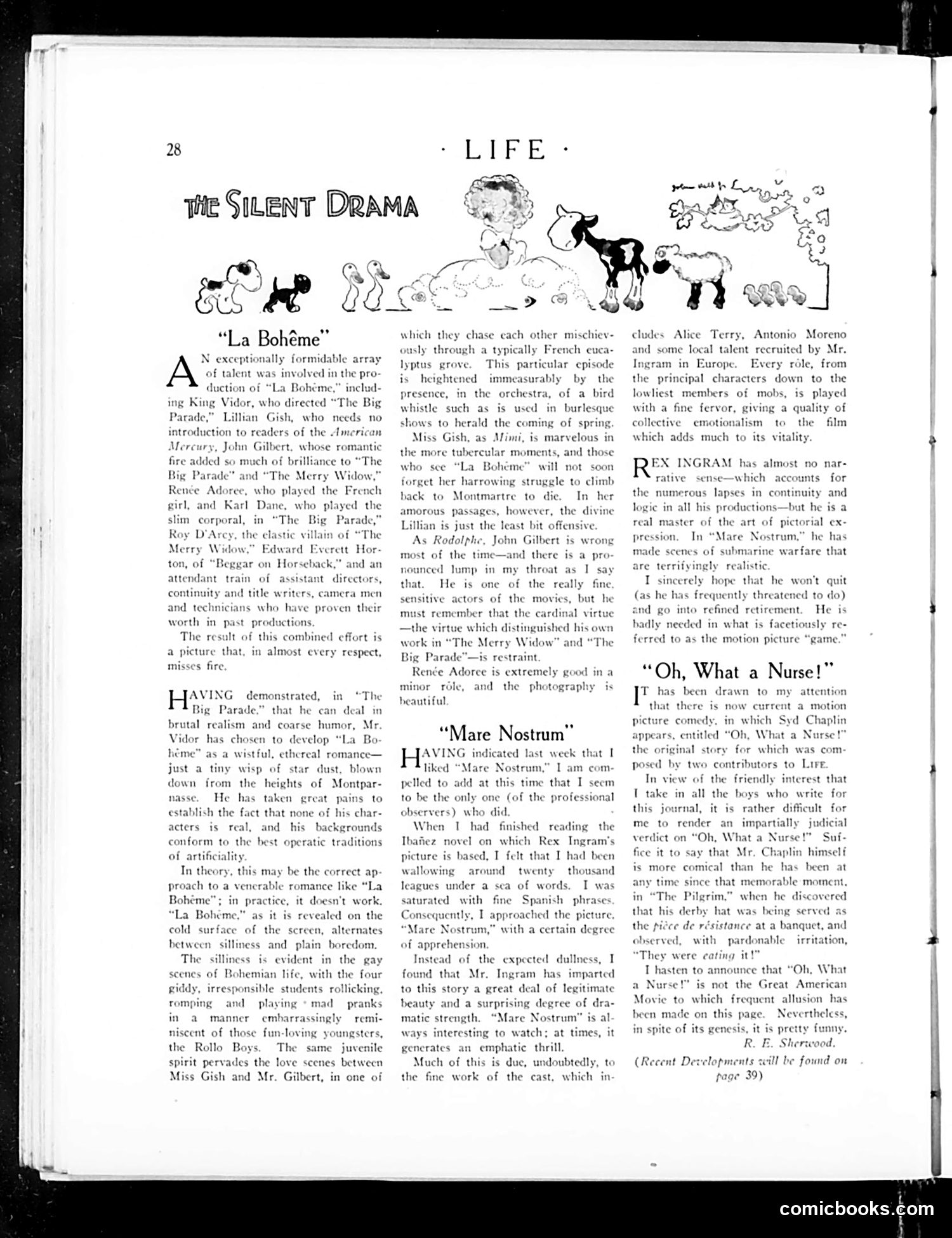
This page contains two film reviews from Life's cinema column, critiquing silent movies of the 1920s. **"La Bohème"** is harshly reviewed despite an impressive cast including Lillian Gish and John Gilbert, directed by King Vidor. The critic praises the production's ambition but argues the film fails by attempting an ethereal, artificial interpretation of the classic romantic story. The humor feels juvenile, the students' antics embarrassingly reminiscent of children's adventures, and even Gish's portrayal—moving in dramatic moments—becomes "offensive" through excess sentimentality. **"Mare Nostrum"** receives more favorable treatment. The reviewer initially approached Rex Ingram's adaptation of the Ibáñez novel with skepticism after struggling through the source material's dense prose. However, Ingram has successfully translated it to screen with "legitimate beauty" and dramatic strength. The cast—including Alice Terry and Antonio Moreno—performs with genuine fervor throughout, elevating even minor roles. Both reviews exemplify early 20th-century film criticism's concern with artistic merit and emotional authenticity in silent cinema.
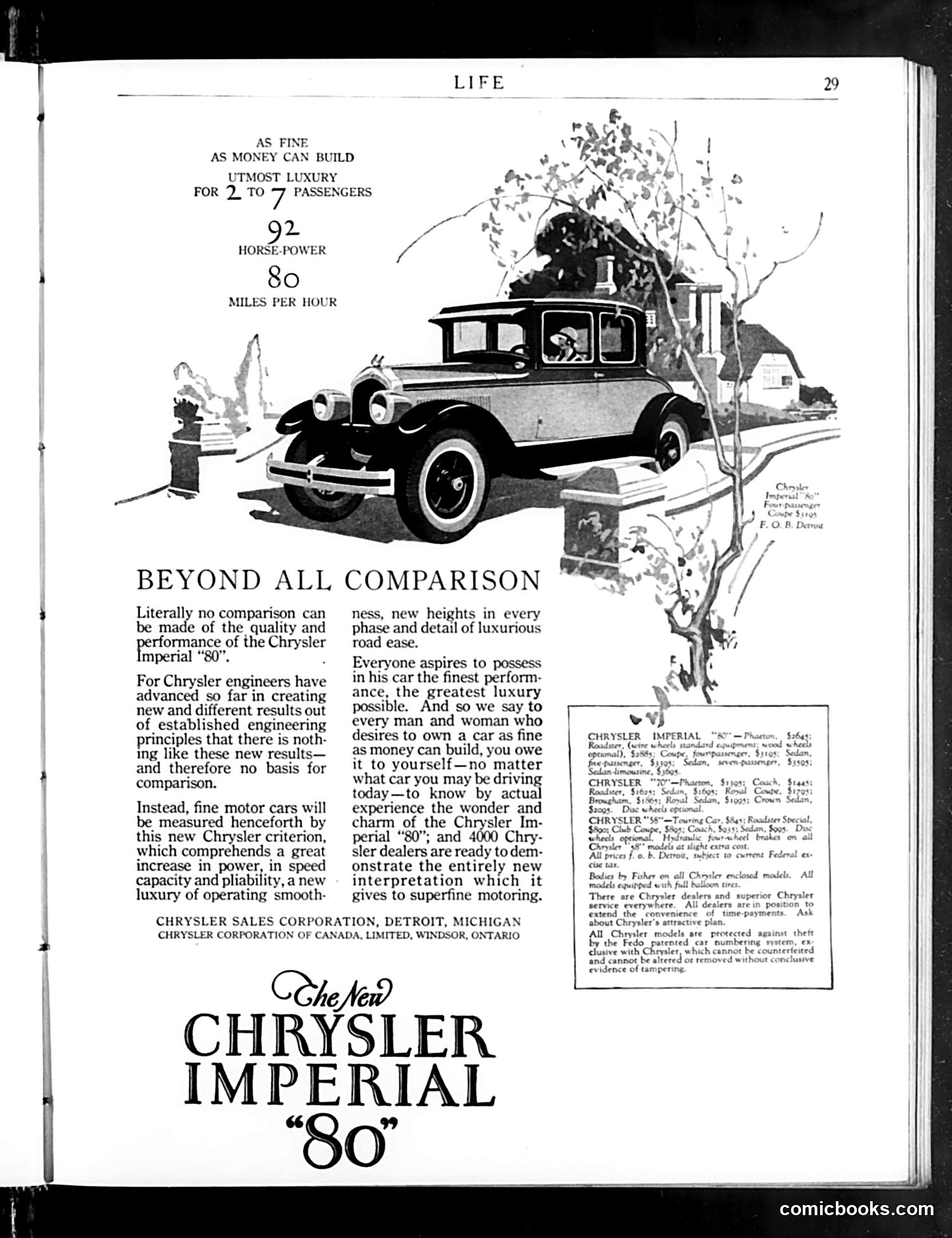
This is a **car advertisement**, not political satire. It promotes the Chrysler Imperial "80" luxury automobile to affluent 1920s readers. The ad emphasizes the car's specifications (92 horsepower, 80 mph, seating for 2-7 passengers) and appeals to aspirational buyers by claiming the vehicle sets a new standard beyond comparison—literally stating competitors cannot be measured against it because it represents entirely "new" engineering principles. The illustration shows the car in an idealized suburban setting with a pleasant home and landscaping, visually communicating wealth and leisure. The tagline "as fine as money can build" directly targets wealthy consumers. This reflects 1920s-30s advertising strategy: positioning luxury automobiles as status symbols for the prosperous middle and upper classes during the pre-Depression era. The "Imperial" branding itself suggests prestige and superiority.
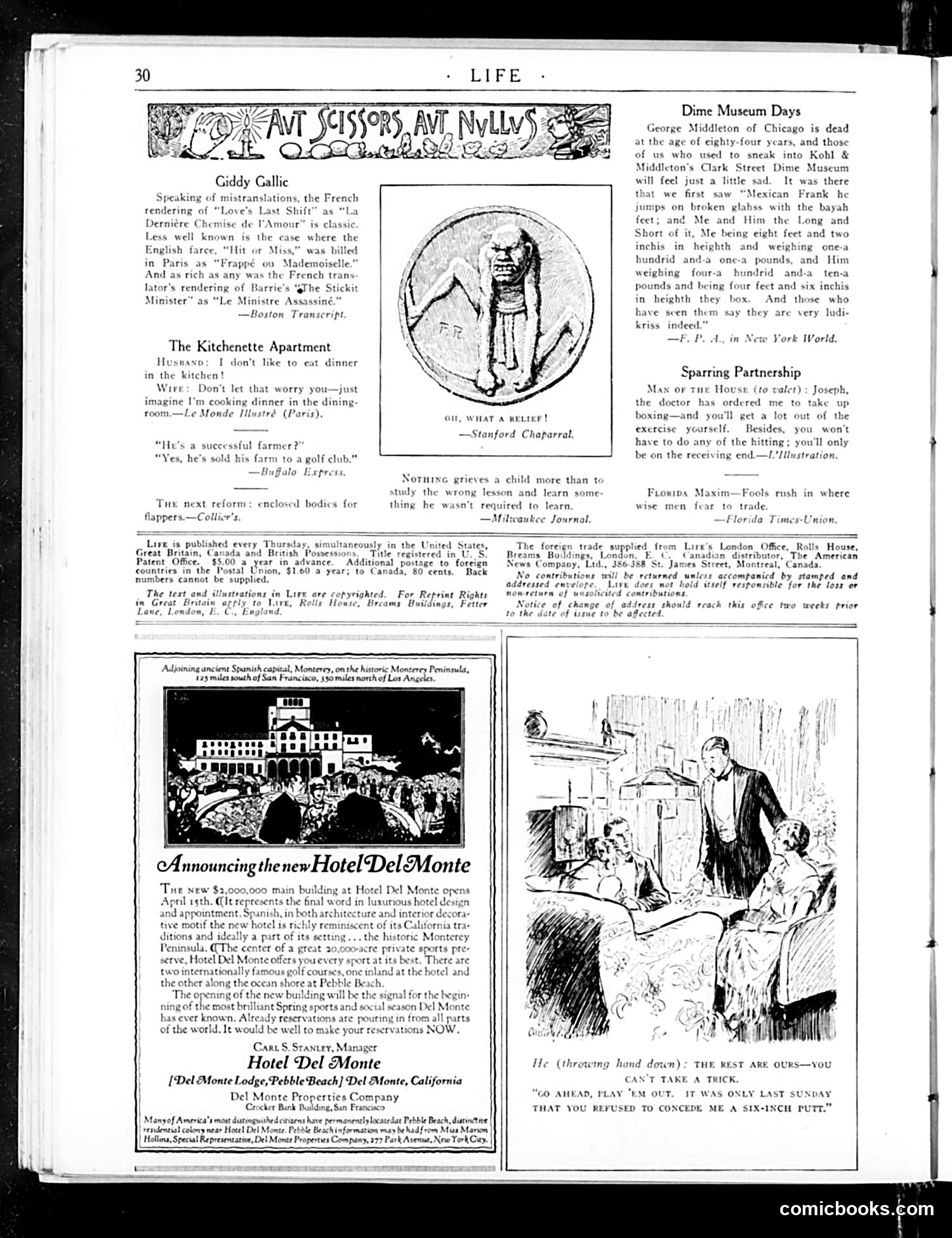
This page from *Life* magazine (a satirical publication) contains several short humor pieces targeting social pretensions and linguistic absurdities: **"Giddy Gallic"** mocks French mistranslations of English titles—notably the mangled rendering of Barrie's play as "Le Ministre Assassiné" (The Assassinated Minister) instead of the intended meaning. **"The Kitchenette Apartment"** jokes about a husband's class anxiety: he refuses to eat dinner in the kitchen because it suggests poverty, preferring his wife pretend she cooks in the dining room instead. **"Dime Museum Days"** nostalgically recalls a Chicago attraction displaying human curiosities, including a man with extreme proportions ("eight feet two inches"). **"Sparring Partnership"** satirizes a wealthy man's hypocrisy: he orders his valet to box for exercise while refusing to exert himself. The page also contains a large **Hotel Del Monte advertisement**, emphasizing its Spanish colonial architecture and luxury amenities on California's Monterey Peninsula.
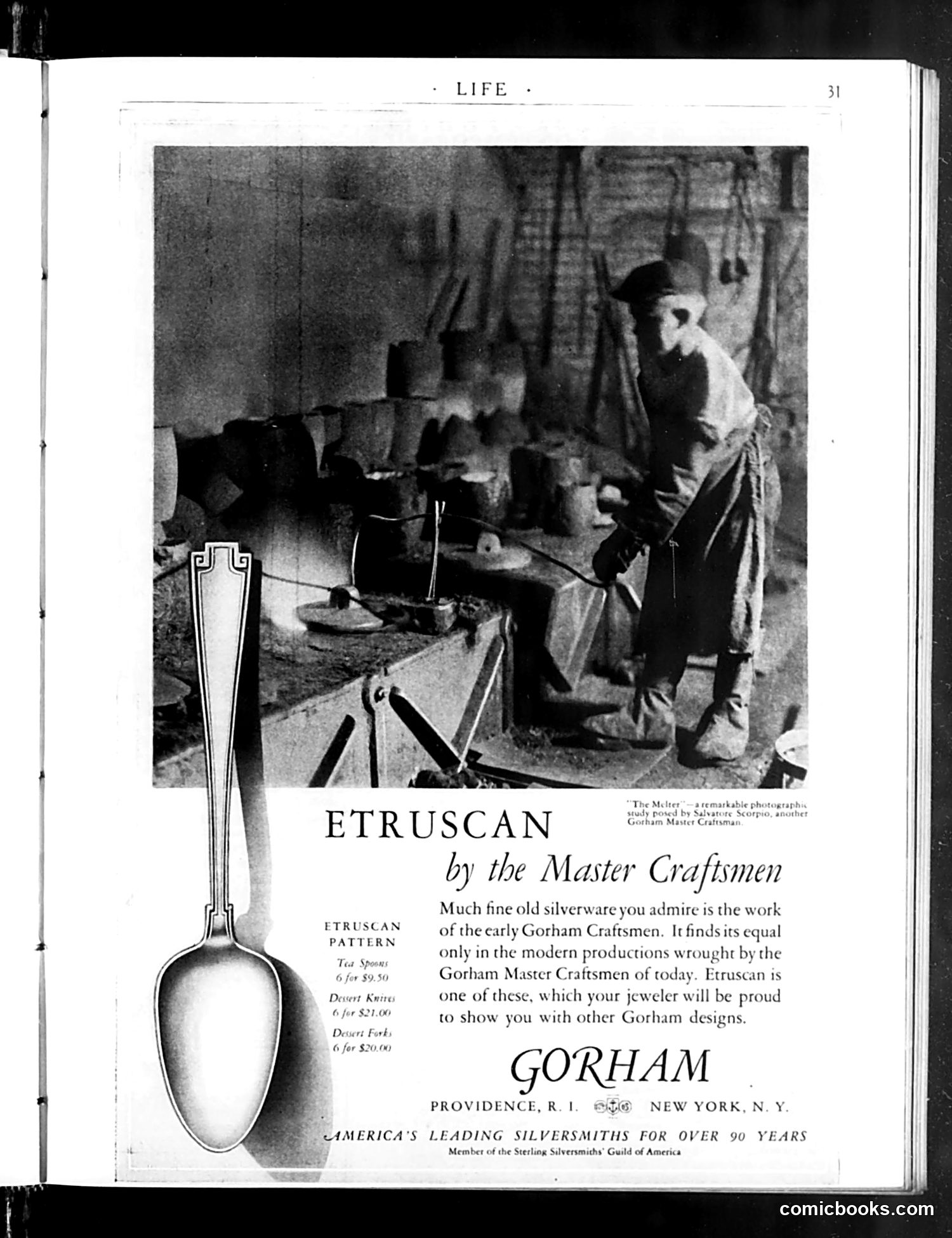
This page is primarily a **Gorham silverware advertisement**, not political satire. The image shows craftsmen working in what appears to be a workshop, demonstrating the handmade quality of Gorham's "Etruscan" silverware pattern. The photograph aims to establish authenticity and skilled craftsmanship by showing artisans at work. The ad's appeal relies on associating modern Gorham products with historical prestige—comparing them to "fine old silverware" from "early Gorham Craftsmen" while claiming modern pieces equal that quality. The Etruscan pattern name itself evokes classical antiquity, lending sophistication to the product. This represents typical early 20th-century luxury advertising strategy: linking contemporary manufactured goods to tradition, handcraft, and historical excellence to justify premium pricing (spoons at $9.50-$21.00 per set—substantial sums then).
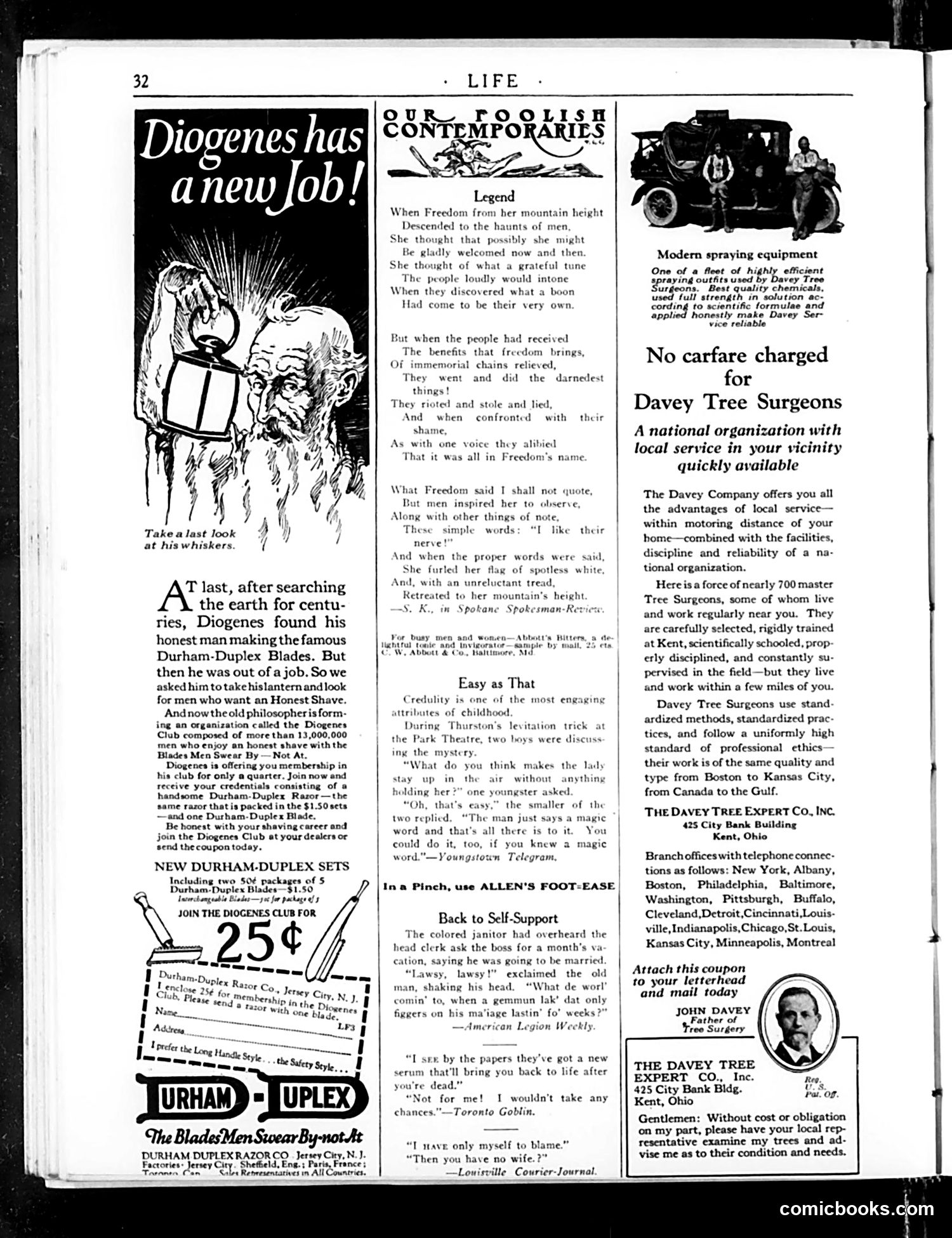
This page mixes advertisements with satirical commentary typical of Life magazine's format. **Left side:** A Durham-Duplex razor blade advertisement uses the classical figure **Diogenes** (ancient Greek philosopher famous for searching with a lantern for an honest man) as its spokesperson. The satire suggests that finding an honest man is so rare that even Diogenes finally succeeded—by discovering one making razor blades. The joke plays on consumer skepticism about advertising claims and manufacturing integrity. **Center:** "Our Foolish Contemporaries" column features a poem about **Freedom** personified as a goddess. The satire criticizes citizens who received freedom from oppression but then abused it through rioting, theft, and lying—all "in Freedom's name." Freedom, disappointed, retreats to her mountain. This likely reflects post-WWI disillusionment about democratic society's failures. **Right side:** Primarily advertisements for Davey Tree Surgeons and Allen's Foot-Ease products. **Bottom:** Brief humorous anecdotes mocking human credulity and social pretense, common filler content for the era.
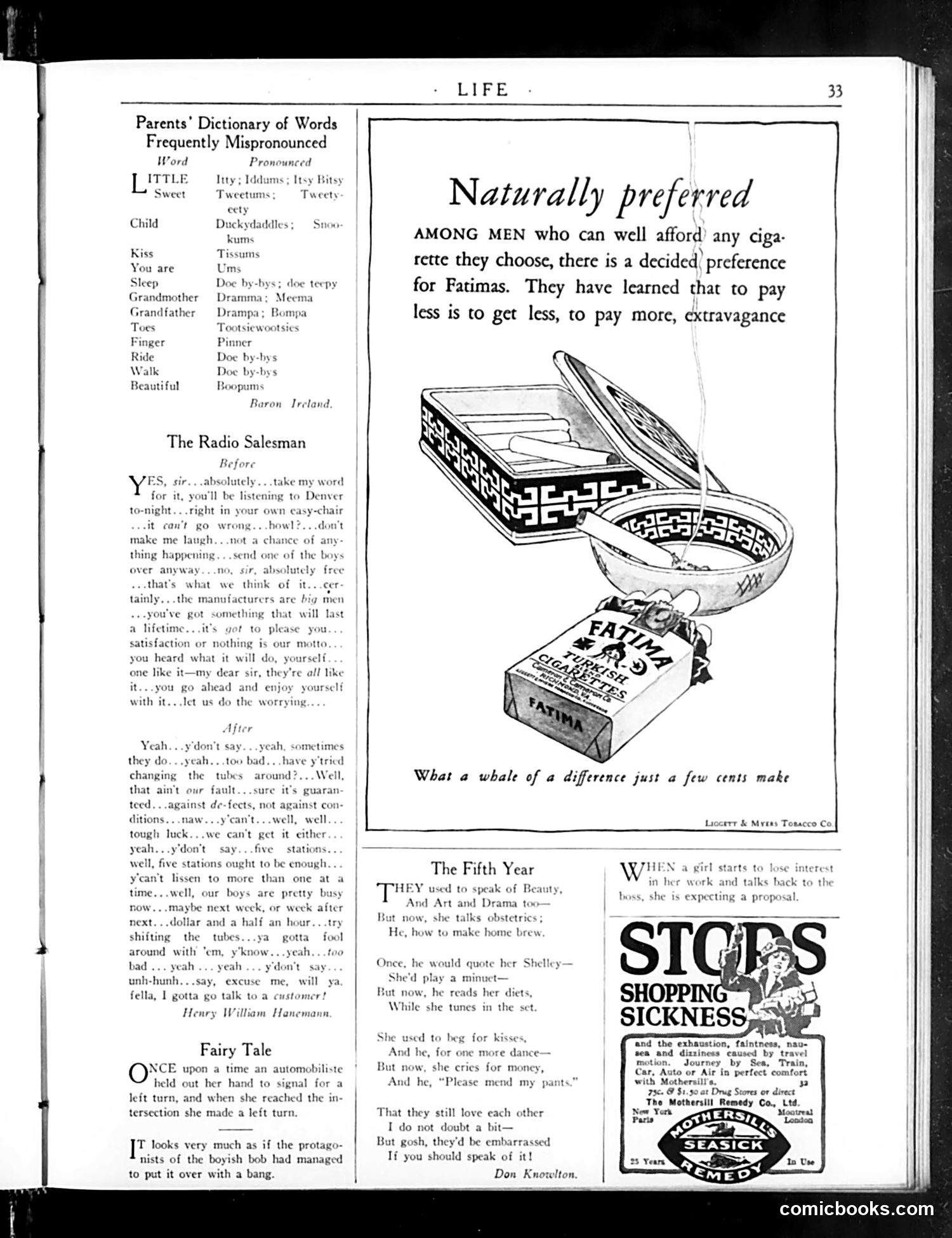
This page contains several distinct pieces of satirical content: **"Parents' Dictionary"** mocks how adults use exaggerated baby-talk pronunciations ("itty," "duckydaddles," "snoo-kum") when speaking to children—a common parenting practice the era found worthy of ridicule. **Fatima Cigarette Advertisement** presents a tongue-in-cheek endorsement claiming wealthy men "naturally prefer" this cheaper cigarette brand, with the ironic message that paying less actually gets you less quality, but somehow that's desirable. This satirizes consumer behavior and advertising claims. **"The Radio Salesman"** depicts a pushy sales pitch, mocking the emerging radio industry's aggressive marketing tactics and dubious quality guarantees—a new technology still gaining acceptance in American homes. **"The Fifth Year"** humorously traces how marriage changes couples: from romantic poetry and dance to discussing diets, home brewing, and demanding practical favors. It satirizes marital disenchantment. **"Fairy Tale"** briefly jokes about women drivers, suggesting a female motorist's hand signal at an intersection was so unclear the result looked accidental rather than intentional—reflecting era-typical sexist humor about women drivers.
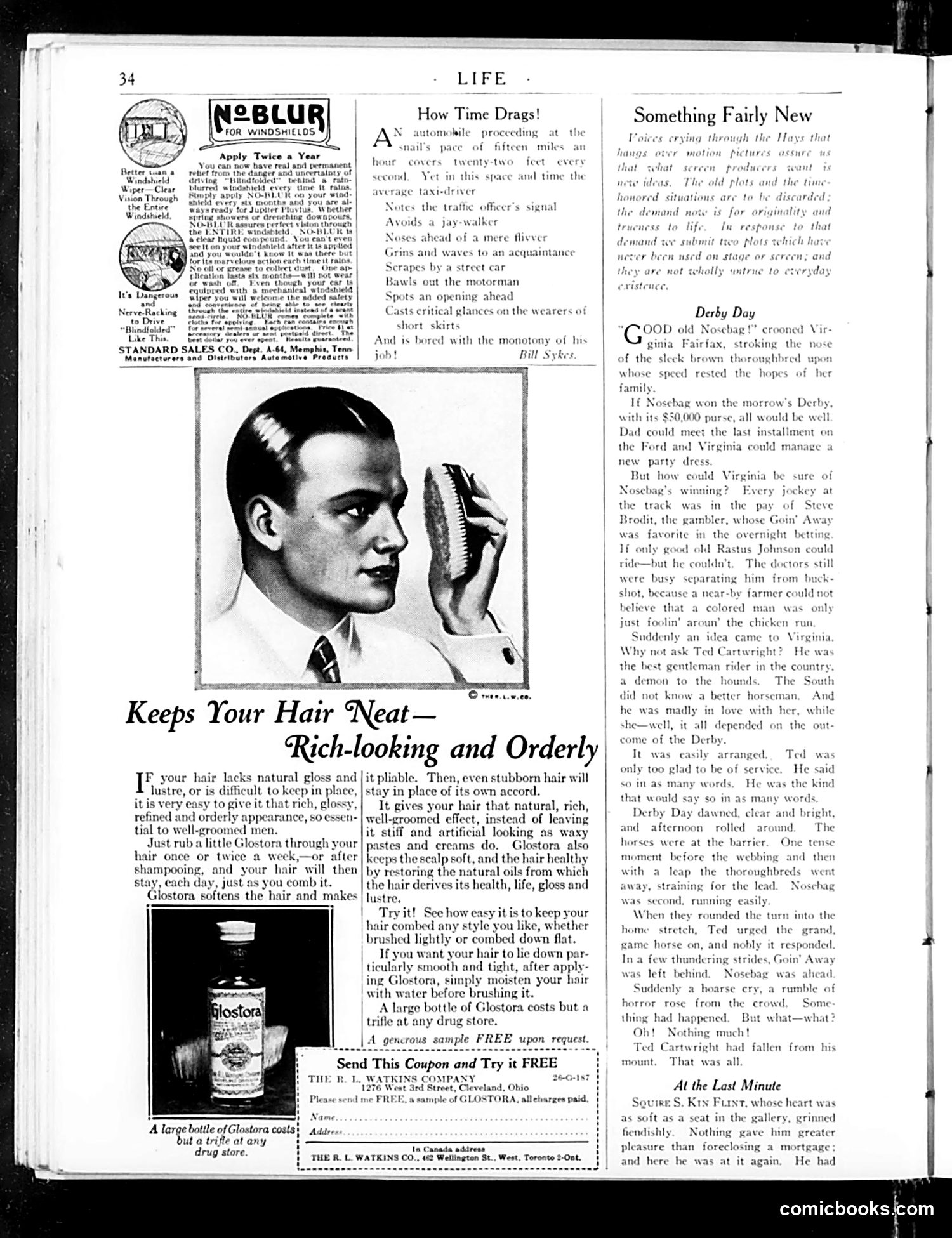
This page contains primarily **advertising and fiction** rather than political satire. The main content includes: 1. **"How Time Drags"** — A humorous piece by Bill Sykes contrasting a car traveling at 15 mph (mathematically described as covering 22 feet per second) with the subjective experience of time feeling slow during a taxi ride. The joke plays on the gap between objective speed and human perception of boredom. 2. **Glostora Hair Product Advertisement** — A substantial ad for a men's hair grooming product, featuring a photograph of a well-groomed man and promotional copy about maintaining neat, lustrous hair. 3. **"Derby Day"** — A serialized short story about a horse race, involving romantic entanglement and gambling intrigue among wealthy characters (Virginia Fairfax, Ted Cartwright). No political satire is evident. The page represents typical Life magazine content from the early 20th century: humor, advertising, and serialized fiction rather than political commentary.
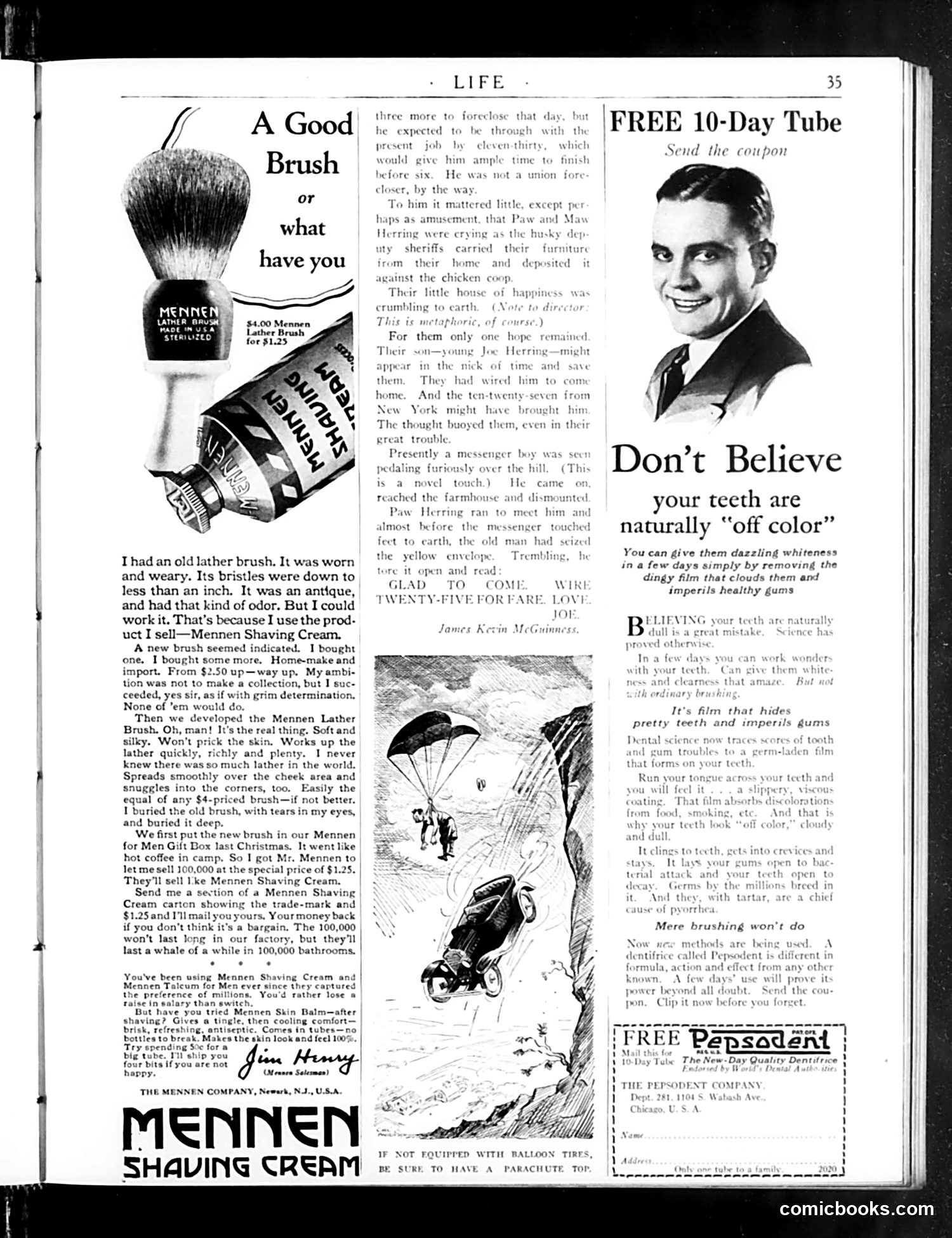
This page contains **advertising, not political satire**. It features three commercial advertisements from the 1920s-30s era: 1. **Mennen Shaving Cream** (left): A salesman's testimonial about developing a superior lather brush to accompany the product, offering 100,000 brushes at $1.25—framed as an affordable luxury item. 2. **Pepsodent Toothpaste** (right): Claims teeth appear "off color" due to a dingy film that brushing alone won't remove. Offers a free 10-day trial, promoting a new "film-removing" dentifrice formula. 3. **Cartoon illustration** (center): Depicts parachutists, likely illustrating an unrelated article ("If not equipped with balloon tires, be sure to have a parachute top"). The ads reflect early 20th-century consumer marketing targeting middle-class men concerned with grooming and health. No political commentary or satire is evident—this is straightforward product promotion typical of Life magazine's advertising revenue model.
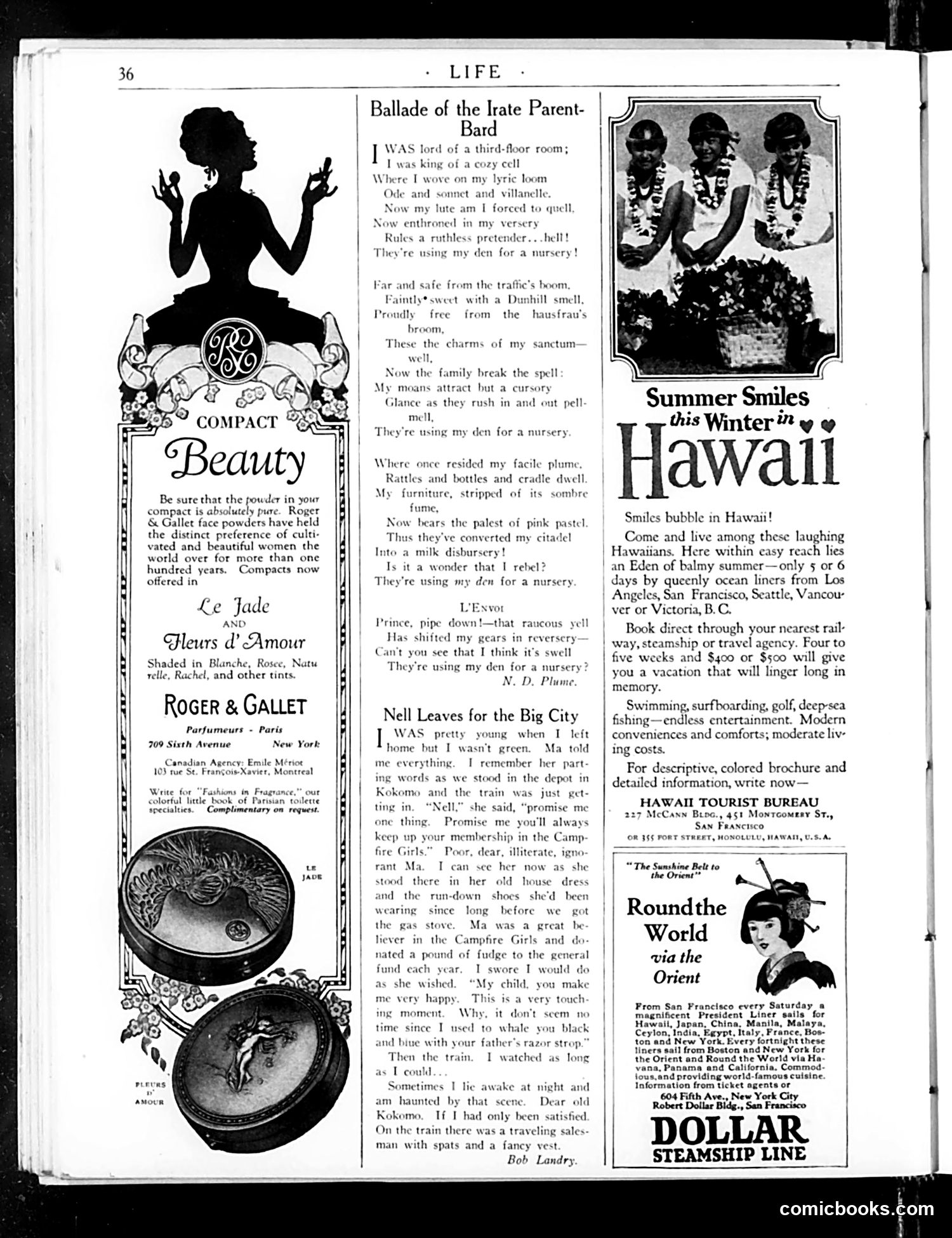
This page mixes advertisements with humorous poetry. The main satirical content is "Ballade of the Irate Parent-Bard"—a poem lamenting how a writer's private study has been converted into a nursery. The joke targets early 20th-century domestic life: a creative intellectual's sacred workspace invaded by family obligations, particularly childcare. The poem uses formal verse structure ironically, as the speaker's literary sanctuary becomes a "milk disbursery" filled with "rattles and bottles." The secondary poem, "Nell Leaves for the Big City," satirizes small-town naiveté—a mother in rural Indiana warns her daughter about urban temptations while ironically recalling beating her with a razor strop. The dark humor contrasts the mother's protective intentions with her brutish methods. The page's advertisements (Roger & Gallet cosmetics, Hawaii tourism, Dollar Steamship Line) represent typical 1920s consumer culture targeting affluent readers.
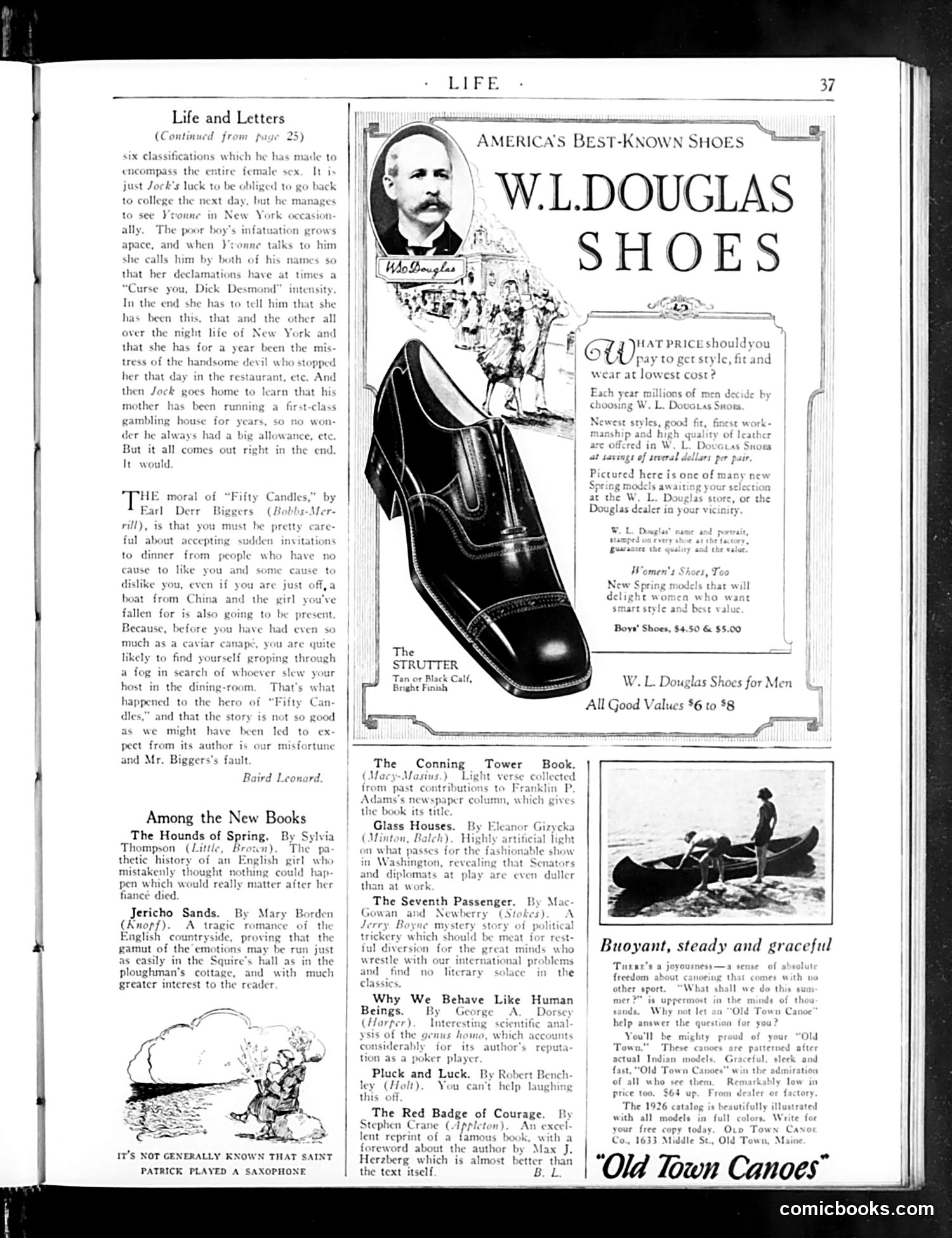
This is a one-line joke caption accompanying a small illustration at the bottom of the page. It's a absurdist humor piece typical of *Life* magazine's satirical style in this era. The joke relies on anachronism and absurdity: Saint Patrick (a 5th-century religious figure) could not have played the saxophone, an instrument invented in the 19th century. The humor comes from the deliberately false, matter-of-fact statement presented as obscure trivia. This reflects *Life*'s comedic tradition of non-sequiturs and surreal humor popular in 1920s American magazines. The joke has no political or social commentary—it's pure comedic absurdism, likely meant to amuse readers amid the page's advertisements and book reviews.
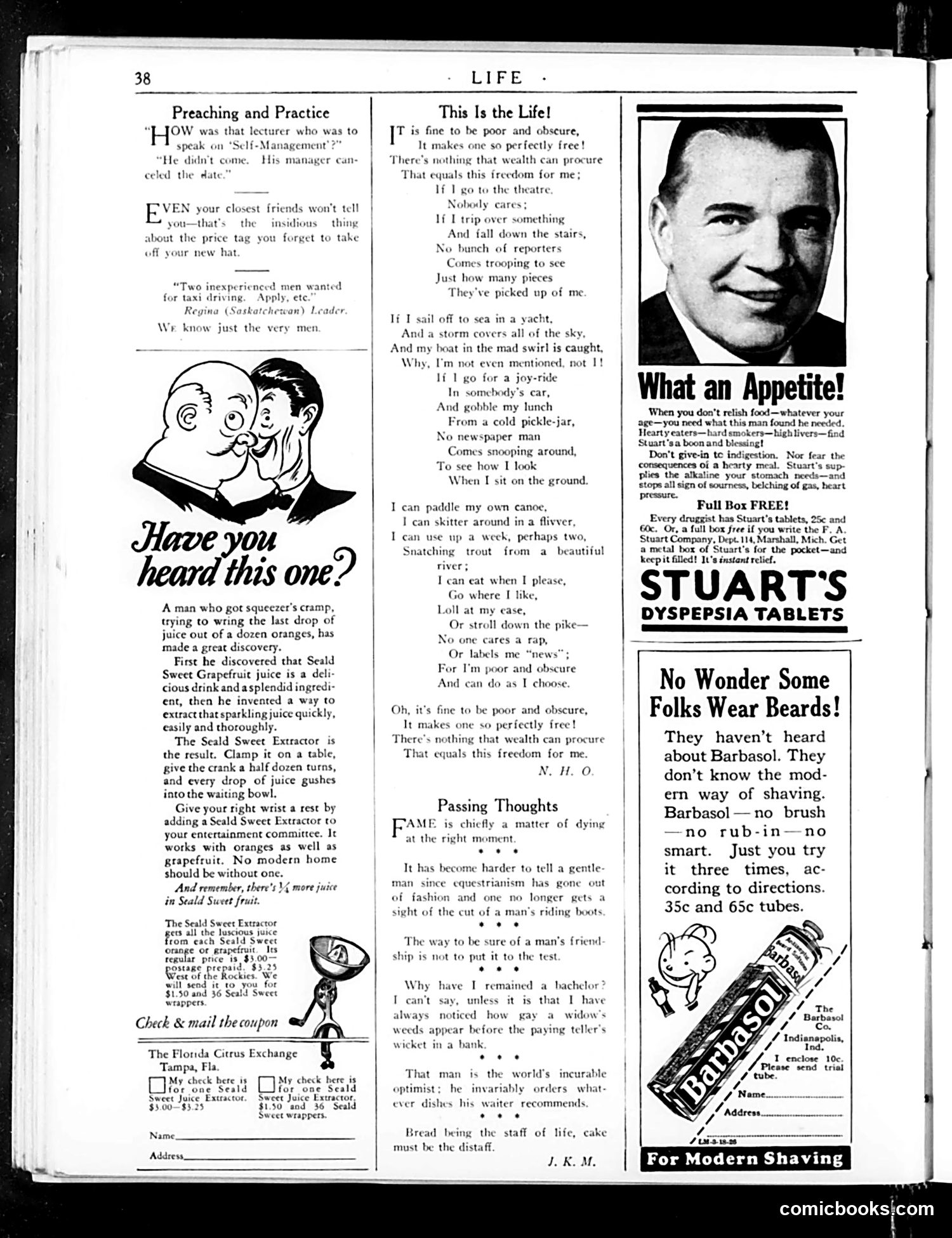
This page from *Life* magazine (undated but early 20th century based on style) contains mostly humorous prose and advertisements rather than political cartoons. The main content includes: **"This is the Life!"** — a poem celebrating the freedom of being poor and obscure, where one can act without scrutiny from reporters or society. The satire is gentle: it mocks celebrity culture and wealthy anxieties by praising anonymity's liberation. **"Passing Thoughts"** — brief witticisms on fame, fashion, and human nature, typical of *Life*'s satirical commentary. **Advertisements** dominate the right side: Stuart's Dyspepsia Tablets (digestive aid) and Barbasol shaving cream. These ads feature period-typical marketing language about modern convenience. The only cartoon visible is a small sketch titled **"Have you heard this one?"** accompanying a joke about a man's grapefruit juice invention. The page reflects *Life*'s focus on social satire and humor rather than hard political commentary—poking fun at modern anxieties (digestion, celebrity, shaving) through advertising parody and lighthearted verse.
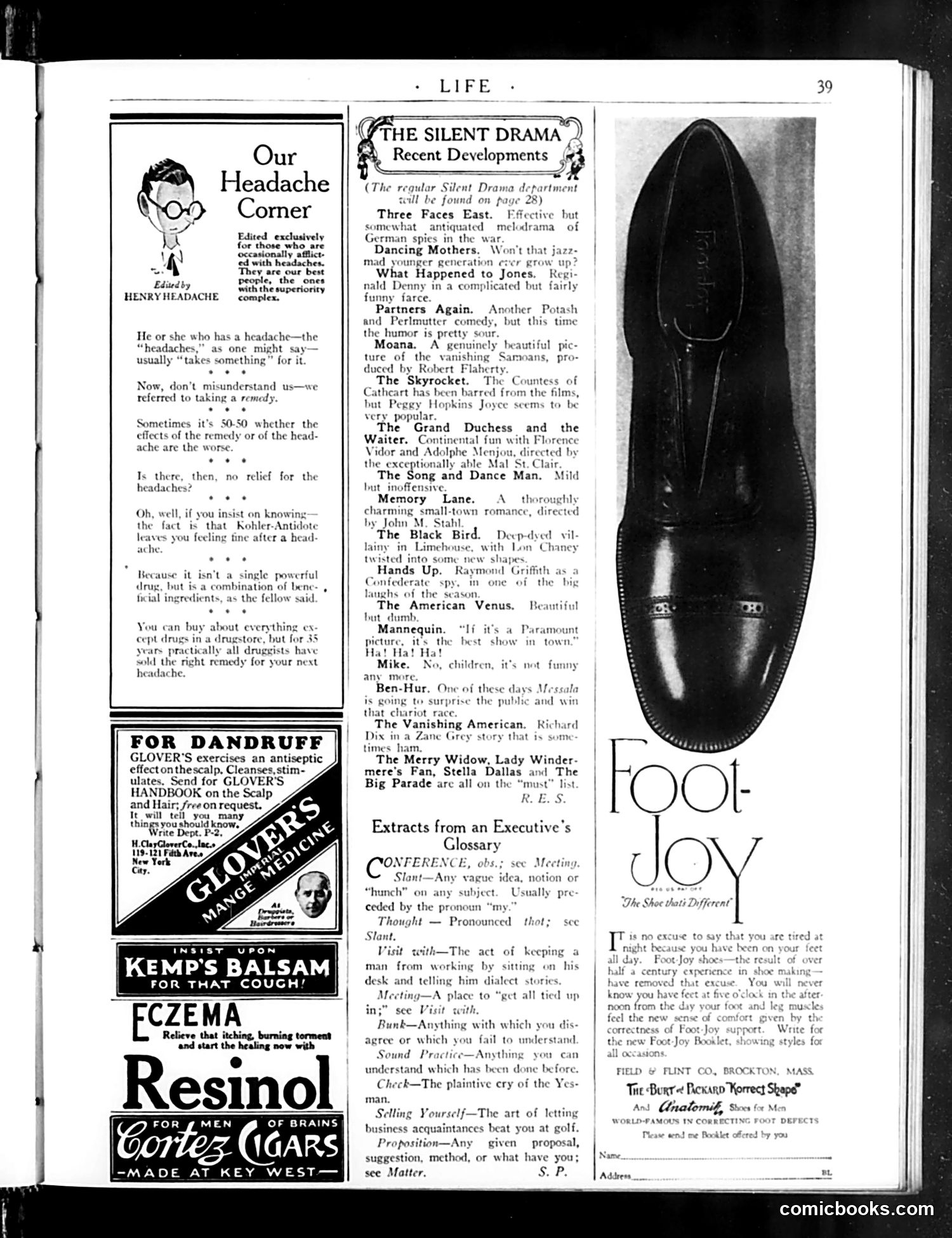
This page features a humorous advice column called "Our Headache Corner," edited by "Henry Headache," addressing readers afflicted with headaches. The satire targets both the ailment itself and the era's patent medicine culture. The column jokes that while headaches are common, the remedies are often as bad as the problem—a 50/50 proposition whether "the effect of the remedy or of the headache are the worse." It mocks the proliferation of drugstore remedies available in 1920s America, where "practically all druggists have sold the right remedy." The column's "Extracts from an Executive's Glossary" section extends the satire, defining business jargon—"Conference," "Thought," "Visit with"—in cynical terms, suggesting corporate life causes its own headaches. The surrounding advertisements (Glover's dandruff remedy, Kemp's Balsam cough syrup, Resinol eczema treatment) underscore the satire: Life magazine's pages are filled with patent medicines promising relief from various complaints.
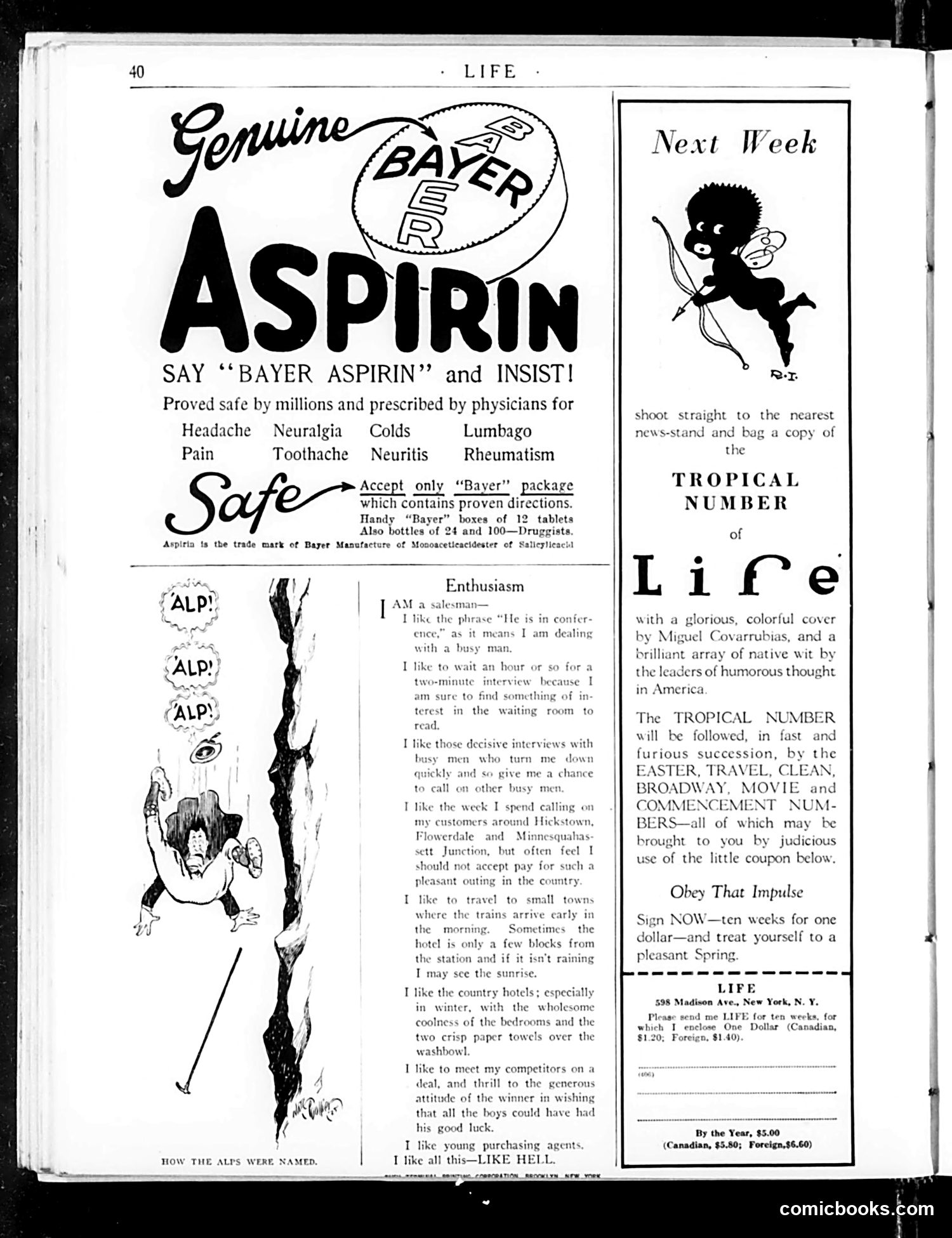
This page is primarily **advertising and promotional content**, not political satire. The dominant feature is a **Bayer Aspirin advertisement** emphasizing the brand name and listing ailments it treats (headache, pain, rheumatism, etc.). The ad stresses buying only genuine "Bayer" packages with proven directions—likely reflecting post-WWI trademark concerns, as aspirin had become a generic term. The **"Enthusiasm" section** appears to be a salesman's testimonial about enjoying business travel and client interactions—standard early-20th-century advertising copy celebrating the salesman's lifestyle. The cartoon labeled **"How the Alps Were Named"** is a visual joke: it shows figures exclaiming "ALP!" while apparently tumbling down a mountainside, punning on the mountain range's name through their exclamations. The **right column advertises Life's "Tropical Number"** with cover art by Miguel Covarrubias, promoting magazine subscriptions. This section includes actual satirical content from Life's editorial side, though the specifics aren't detailed here. Overall, this is a **magazine page mixing commercial ads with light humor and self-promotion**.
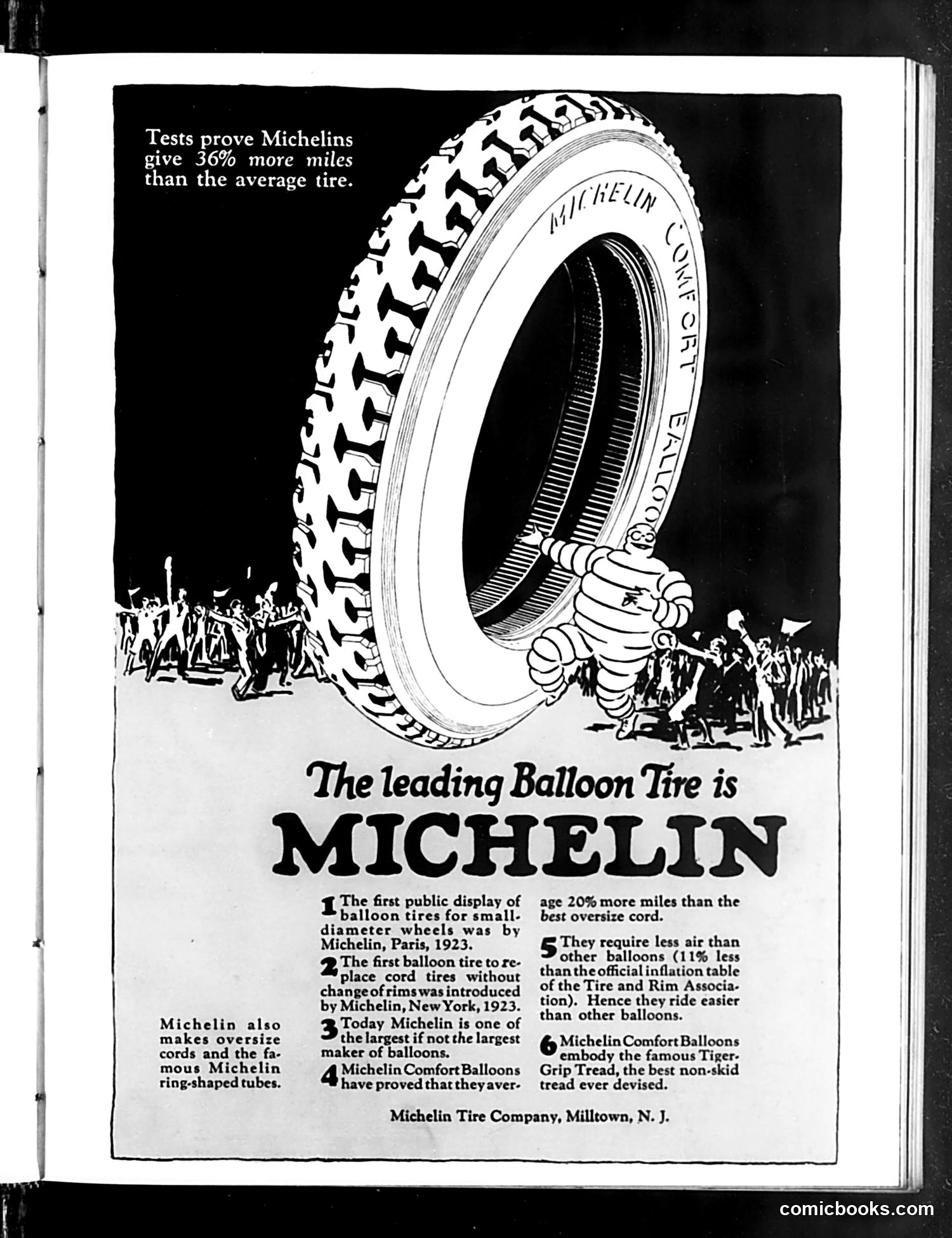
This is a **Michelin tire advertisement**, not political satire. It promotes Michelin's "balloon tires"—a 1920s automotive innovation that replaced rigid cord tires with pneumatic (air-filled) designs offering better comfort and durability. The giant tire held by a stylized figure (possibly the Michelin Man, though not clearly depicted here) is meant to impress viewers with the product's scale and importance. Tiny crowds gather around it, emphasizing the tire's dominance. The advertisement makes performance claims: 36% more mileage than average tires, 20% more than competitor balloon tires, and superior grip. It establishes Michelin's innovation credentials by dating key "firsts" to 1923. For modern readers: balloon tires were a genuine technological advance of the era, comparable to radial tire adoption decades later. This ad reflects 1920s consumer marketing strategy—emphasizing technical superiority and brand innovation leadership.
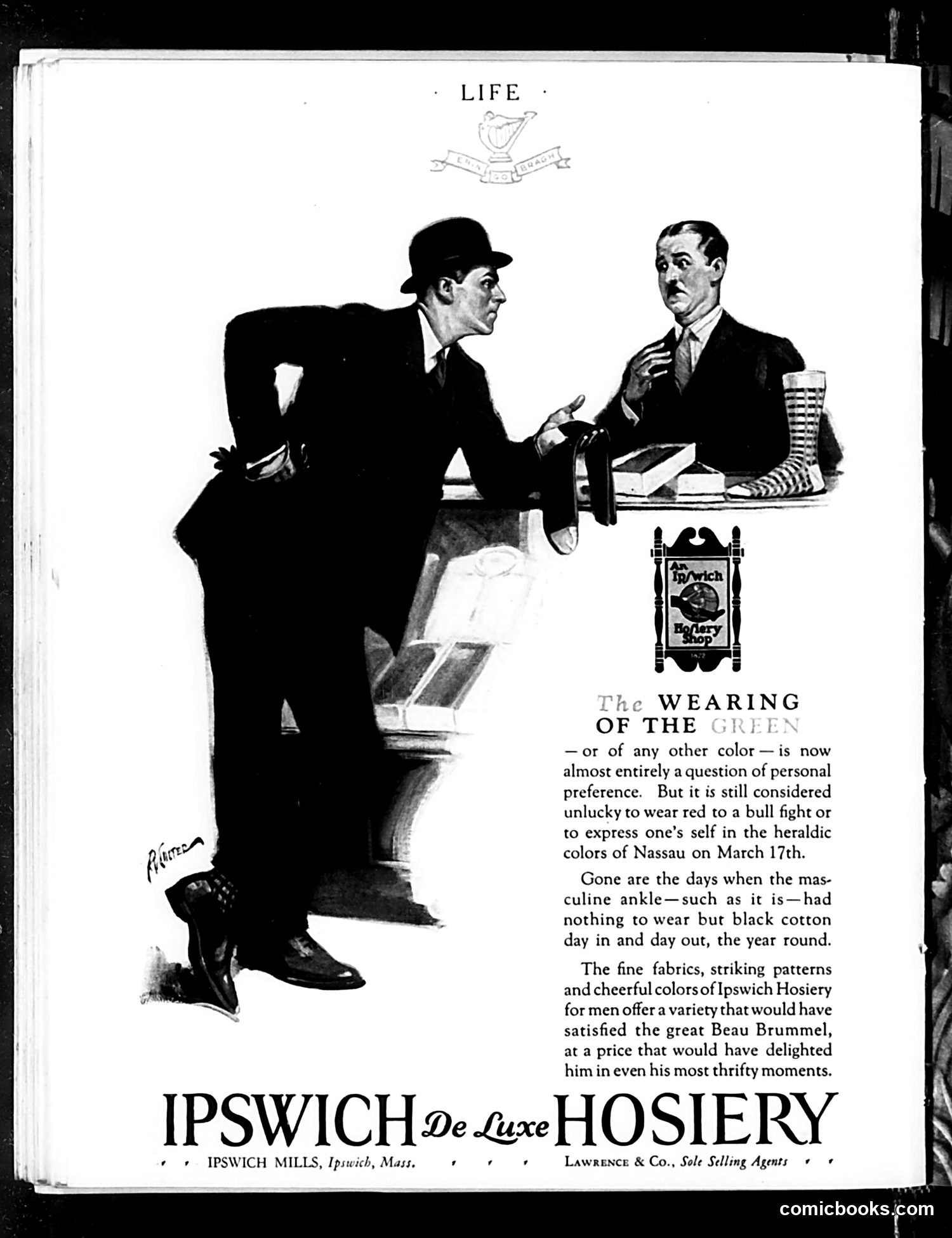
This is primarily an **advertisement for Ipswich hosiery**, not political satire. The illustration shows two well-dressed men in business attire discussing socks/stockings at a desk. The text's humor references **St. Patrick's Day** (March 17th), joking that wearing "Nassau colors" (orange and green—Irish heraldic colors) on that date is considered unlucky, similar to wearing red at a bullfight. This is satirizing Irish-American cultural pride and superstitions. The advertisement positions men's colorful socks as a modern luxury, contrasting with the past when men only wore plain black cotton. It references **Beau Brummel**, the famous 19th-century British dandy known for fashionable dress, suggesting that stylish hosiery was previously unaffordable but is now accessible. The cartoon's tone is lighthearted—essentially selling colored socks by mocking outdated masculine fashion restrictions and appealing to readers' desire for variety and sophistication.