
Life, 1926-03-18 · page 24 of 44
Life — March 18, 1926 — page 24: what you’re looking at
What you’re looking at
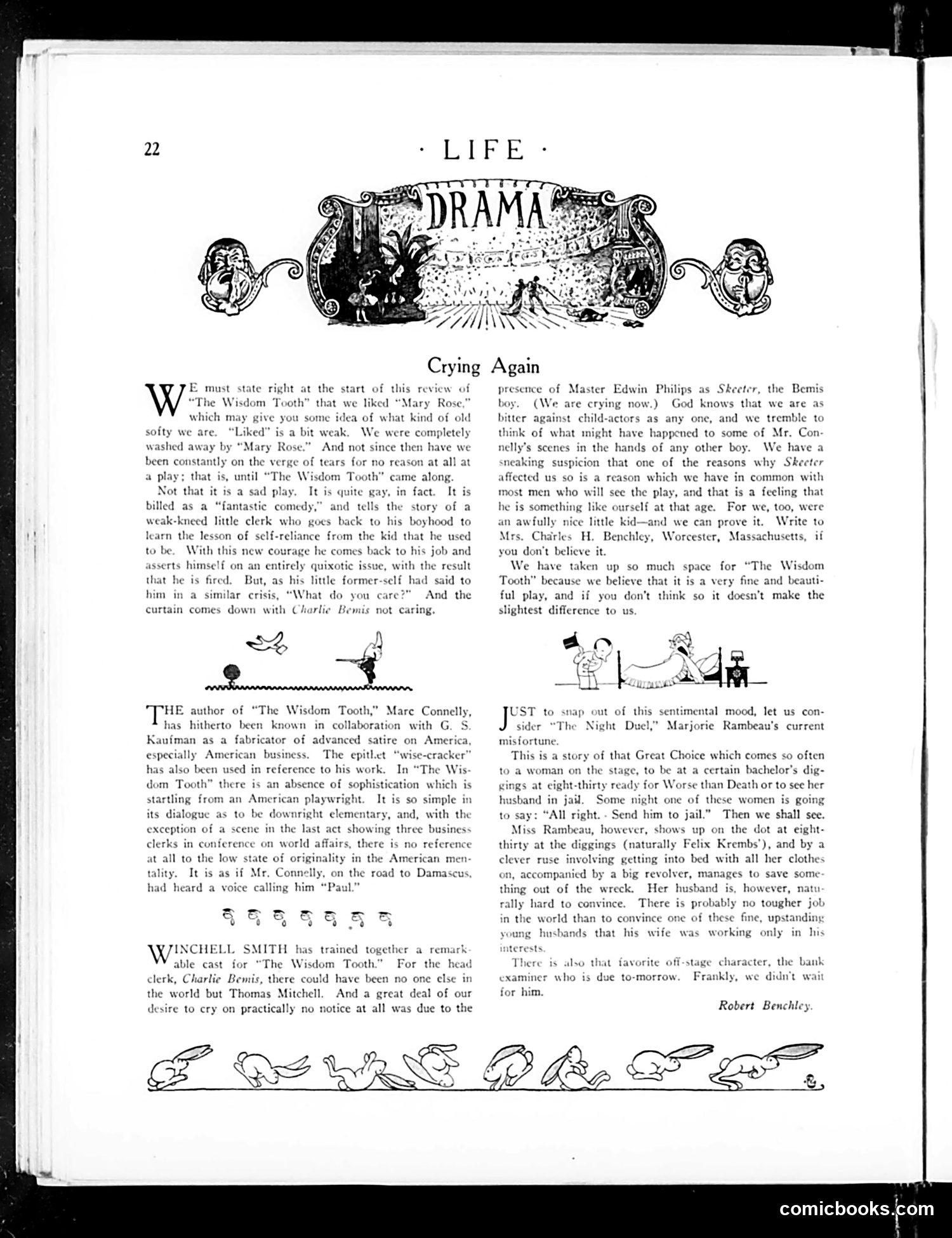
This page reviews Marc Connelly's play "The Wisdom Tooth," a "fantastic comedy" about a timid office clerk (played by Thomas Mitchell) who regresses to childhood to learn self-reliance from his younger self, then returns to work with newfound confidence—only to be fired for his quixotic stance. The reviewer (Robert Benchley, bylined at bottom) praises the play's unusual simplicity and emotional impact, particularly crediting child actor Edwin Philips as "Skeeter" for moving audiences to tears. The piece also briefly dismisses Marjorie Rambeau's current vehicle, "The Night Duel," as melodramatic fluff about a woman choosing between a bachelor's apartment and her husband's jail sentence. The decorative header and rabbit illustrations are typical Life magazine ornamental design elements.
📄 Transcribed text from this page (OCR, searchable)
Machine-transcribed from the original scan — historical spelling and the odd misread are preserved.
Crying Again E must state right at the start of this review of WW The Wisdom Tooth” that we liked “Mary Rose,” which may give you some idea of what kind of old softy we are. ked” is a bit weak. We were completely washed away by “Mary Rose.” And not since then have we been constantly on the verge of tears for no reason at all at a play; that is, until “The Wisdom Tooth” came along ot that it is a sad play. It is quite gay, in fact. It is billed a “fantastic comedy,” and tells the story of a weak-kneed little clerk who ‘k to his boyhood to learn the lesson of self-reliance from the kid that he used to be. With this new ec ‘omes back to his job and asserts himself on an entirely quixotic issue, with the result that he is fired, But, as his little former-self had said to him in a similar crisis, “What do you care?” And the curtain comes down with Charlie Bemis not cari ‘TH author of “The Wisdom Toc Mare Connelly, s hitherto been known in collaboration with G. S. Kaufman as a fabricator of advanced satire on America, especially American business, The epithet “wise-cracker” has also been used in reference to his work. In “The Wis: dom Tooth” there is an absence of sophistication which is startling from an American playwright. It is so simple in its dialogue as to be downright elementary, and, with the exception of a scene in the last act showing three business clerks in conference on world affairs, there is no reference at all to the low state of origina. in the American men tal It is as if Mr. Connelly, on the road to Damascus, had heard a voice calling him ae 6 WINCHELL {ITH has trained tog able cast for “The Wisdom Tooth.” F clerk, Charlie Bemis, there could have been no one else in the world but Thomas Mitchell. And a great deal of our desire to ery on practically no notice at all was due to the presence of Master Edwin Philips as Skeeter, the Bemis boy. (We are crying now.) God knows that we are as inst child-actors a , and we trem! think of what might have happened to some of Mr. Con- nelly’s scenes in the hands of any other boy. We have a neaking suspicion that one of the reasons why Si affected us so is a reason which we have in common with post men who will see the play, and that is a feeling that he is something like ourself at that age. For we, too, were an awfully nice little kid—and we can prove it. Write to Mrs, Charles H. Benchley, Worcester, Massachusetts, if you don't believe it. We have taken up so much space for “The Wisdom Tooth" because we believe that it is a very fine and beauti- ful play, and if you don't think so it doesn’t make the slightest difference to us. UST to snap out of this sentimental mood, let us con- sider “The Night Duel,” Marjorie Rambeau's current misfortune. This is a story of that Great Choice which comes so often to a woman on the stage, to be at a certain bachelor’s dig- gs at cight-thirty ready for Worse than Death or to see her yusband in jail. Some night one of these women is going to say Ml right. - Send him to jail." Then we shall see. Miss Rambeau, however, shows up on the dot at eight- thirty at the diggings (naturally Felix Krembs’), and by clever ruse involving getting into bed with all her clothes on, accompanied by a big revolver, manages to save some thing out of the wreck. Her husband is, however, natu rally hard to convince. There is pr an to convince one of these fine, upstanding ly no tougher job nds that his wife was working only in his hat favorite off-stage character, the bank s due to-morrow. Frankly, we didn’t wait for him. Robert Benchley comicbooks.com 1 )