
Life, 1926-03-18 · page 30 of 44
Life — March 18, 1926 — page 30: what you’re looking at
What you’re looking at
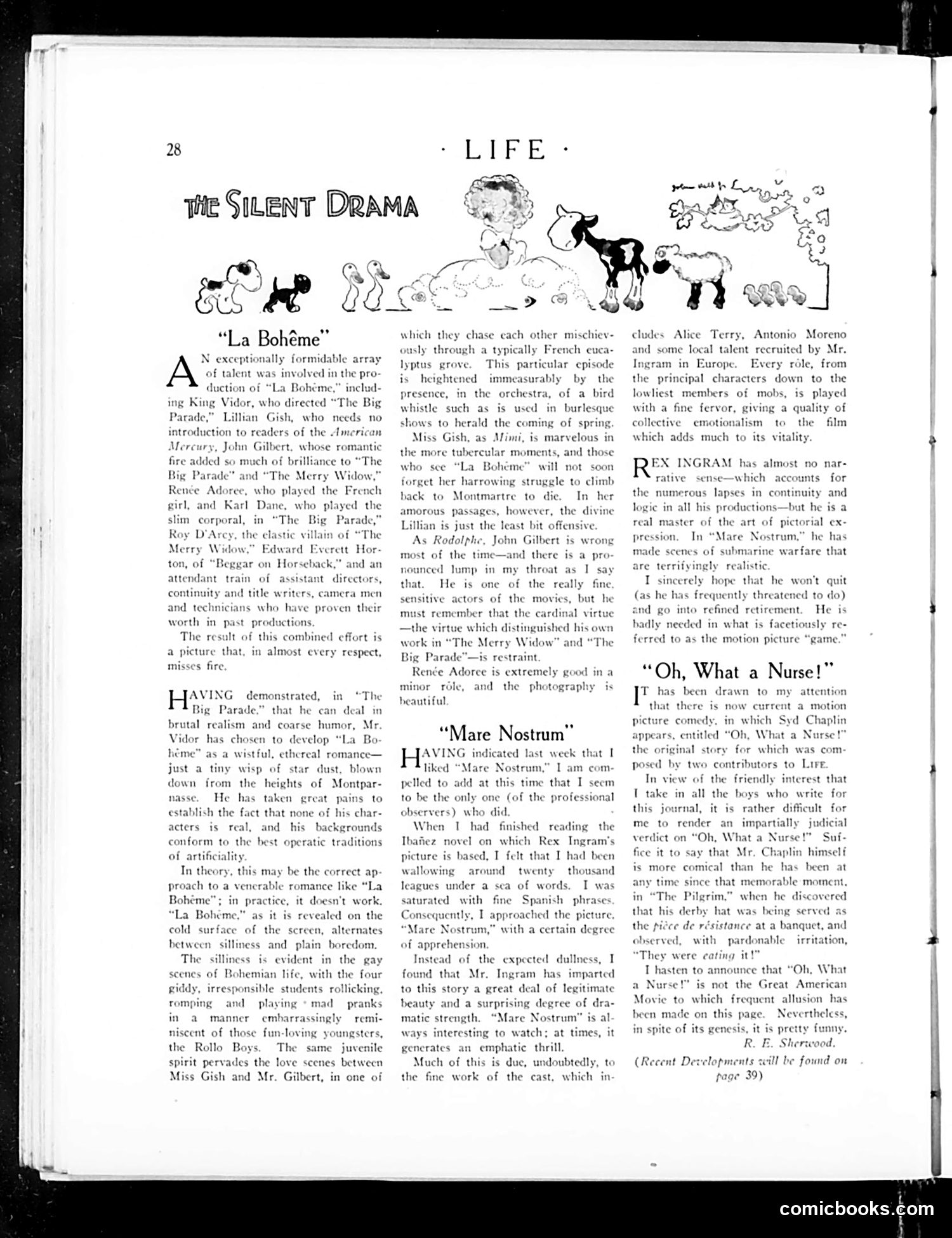
This page contains two film reviews from Life's cinema column, critiquing silent movies of the 1920s. **"La Bohème"** is harshly reviewed despite an impressive cast including Lillian Gish and John Gilbert, directed by King Vidor. The critic praises the production's ambition but argues the film fails by attempting an ethereal, artificial interpretation of the classic romantic story. The humor feels juvenile, the students' antics embarrassingly reminiscent of children's adventures, and even Gish's portrayal—moving in dramatic moments—becomes "offensive" through excess sentimentality. **"Mare Nostrum"** receives more favorable treatment. The reviewer initially approached Rex Ingram's adaptation of the Ibáñez novel with skepticism after struggling through the source material's dense prose. However, Ingram has successfully translated it to screen with "legitimate beauty" and dramatic strength. The cast—including Alice Terry and Antonio Moreno—performs with genuine fervor throughout, elevating even minor roles. Both reviews exemplify early 20th-century film criticism's concern with artistic merit and emotional authenticity in silent cinema.
📄 Transcribed text from this page (OCR, searchable)
Machine-transcribed from the original scan — historical spelling and the odd misread are preserved.
28 qe SILENT DRAMA “La Bohéme” N exceptionally formidable array of talent was involved in the pro- La B ; 1 duction of me,” inch he Big an’ Gish, who needs no ing King Vidor, who directed * L ntroduction to readers of the Ameri fir sig Pa Parade, n Gilbert, whose added so much of brill e te ade” and “The Merry Widow,” Renée Adoree, who played the French girl, and K lim corporal, Roy D'Arcy Merry Widow to rl Dane, who played the in “The Big Parade,” i “The Edward Everett Hor of “Beggar on Horseback,” and an tendant train of ic vi ant directors, continuity and title writers, camera men and technicians who have proven the worth in past prod ns, The result of this combined eff tis a picture that, in almost every respect, misses fire. H AVING demonstrated, “The I i le,” he g that he can deal in brutal realism Vidor has chosen to develop “La Bo nd coarse humor, Mr. em s a wistful, ethereal romance— just a tiny wisp of star dust, blown down from the heights of Montpar- Nasse He has taken grea ains to establish the fact that no: f his char- acters is real, and his backgrounds conform to he peratic traditions of artificial; In theory, this may be the correct ap a ‘actice, it doesn’t work. proach to a venerable romance like Bohéme"; in Boheme. as it is revealed on th cold surface of the screen, alternates between silliness and plain boredom. The sil scenes 0 is evident in the gay with the four Hicking 1 pranks Bohemian lif giddy, irresponsible students re romping and playing in a manner embarrassingly remi- niscent of those fun-loving youngster the Rollo Boys. The same juvenile spirit pervades the love scenes between Miss Gish and Mr. Gilbert, in one « which they chase cach other mischiev- ously through a typically French euc: le is heightened immeasurably by the lyptus grove. This particular epis presence, in the orchestra, of a t th whistle such as is used in burles Miss Gish, as Mimi, is marvelous in he more tubercular moments, and those w sce “La Boheme” will not soon forget her harrowing struggle to climb ‘k to Montmartre to In her amorous »wever, the divine ie Lillian is just the least bit offensive. most of the ert is wrong 1 there is a pro nounced Jump in my throat as I say that. He is one of the really fine s, but sensitive actors of the movi m yer that the cardinal v t ren —the vir which distinguished his own rk in “The Merry Widow” and “The Big Parade”—is restraint w Renée Adoree is extremely minor role, and t 1 ¢ photography is seautiful “Mare Nostrum AVING indicated last week that 1 liked “Mare Nostrum,” [am com pelled to to be the only one (of' the’ professional ) who did When I had finished reading the I seem at this time th: observ Ibaftez novel on which Rex Ingram’s at I had been ds twenty thousand picture is based, I felt th: wallowing ar leagues under a sea of words. I was saturated with fine Sp Consequently, I approached the pict “Mare Nostr of apprehension, nish phrases " with a certain degree 1 of the expected di that Mr, In to this story a great deal of legitimate I am has imparted ju dra- beauty and a surprising matic strength. “Mare N ways interesting to watch; at times, generates an emphatic thrill Much of this is duc, undoubted! the work of the cast, which is al is al fine cludes Alice Terry, Antonio Moreno and some local talent recruited by Mr. Ii Every role, from the principal characters down to the m in Europe lowliest_ members of mobs, is played with a fine fervor, giving a quality of the film tality ive emotionalism hich adds much to its v R =X INGRAM has almost rative sense—which for the numerous lapses in continuity and logic in all real master of the art of pictorial ex- pression. In “Mare Nostrum,” he ade scenes of submar oductions—but he is a ris warfare realistic are terrify I sincerely hope that he won't quit «to do) (as he has frequently threater 1 go into refined retirement. He is adly needed in what is facetiously re- ferred to as the motion picture “game “Oh, What a Nurse!” [ has been drawn to that the ny atten! on eis now ¢ a motion which Syd Chaplin What a N ! ory for which was o ors to Lire picture comedy, i apped the ced by two contrib In view of the friendly interest that I take in all the b this journal, it is rather difficult s who write for impartially me to render verdict on “Oh, What a Nurse!” Suf- fice it to say that Mr. Chaplin himself is more comical than he has been at any time since that mem in “The Pilgrim,” when overed that his derby being served the pidec stance at at mable “They were T hasten to announce that “Oh, What is not the Great American a Movie to which freque this pag in spite of its genesis, it is pretty f R. allusion hy verthe been made i L comicbooks.com