
A complete issue · 40 pages · 1925
Life — November 19, 1925
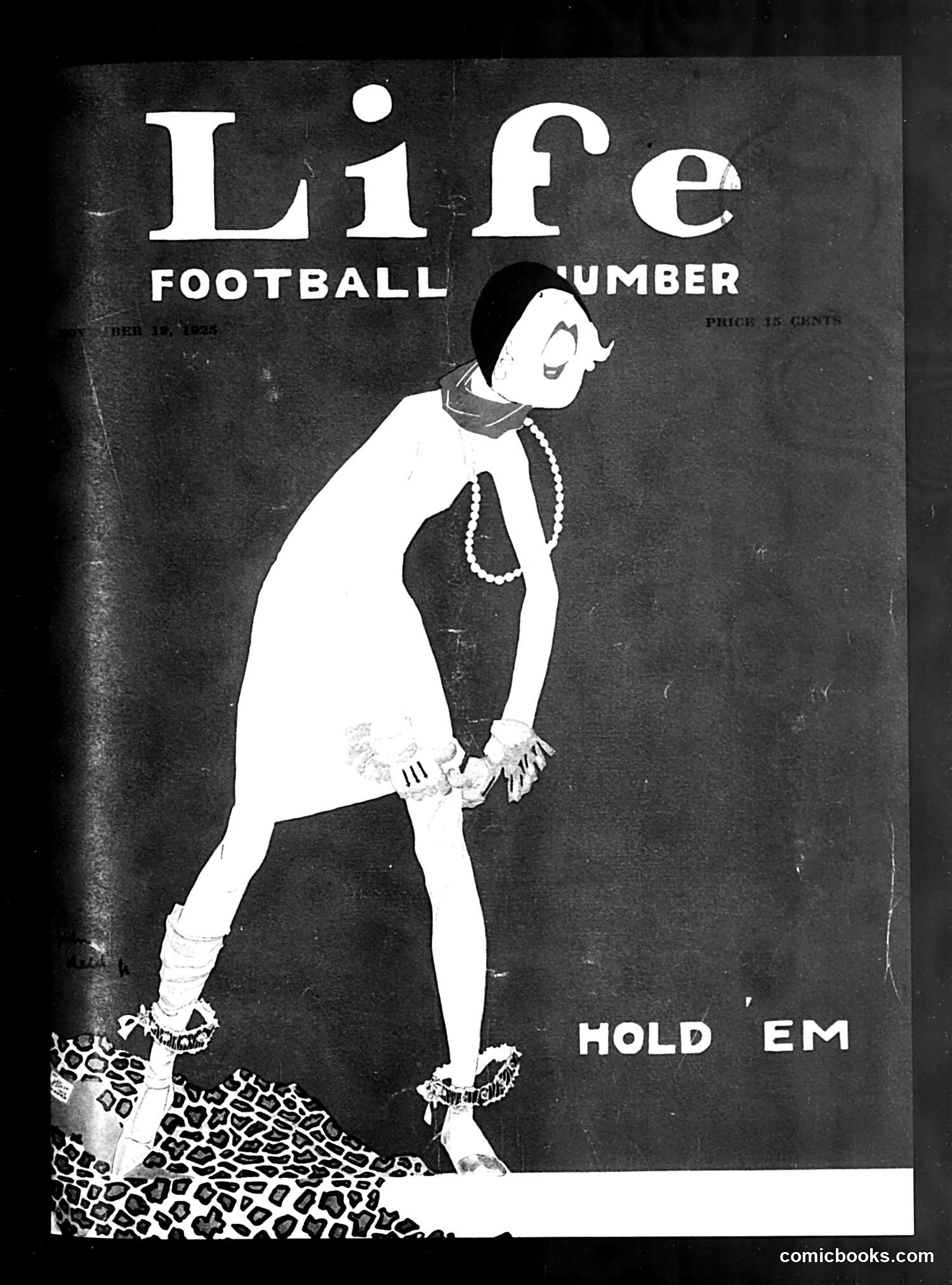
This is Life magazine's Football Number issue (price 15 cents), dated what appears to be September 18, 1925. The cover features a stylized illustration of a woman in 1920s flapper attire—short dress, pearl necklace, and decorative footwear—in a football stance with the caption "HOLD 'EM." The satire plays on the era's cultural collision: the "New Woman" of the Jazz Age (represented by the fashionable flapper) invading traditionally masculine sports culture. The juxtaposition of high fashion and football suggests either mockery of women entering sports or commentary on how even serious athletic competition had become entertainment spectacle during the Roaring Twenties. The flapper's exaggerated pose and styling underscore the absurdity of this cultural crossover.
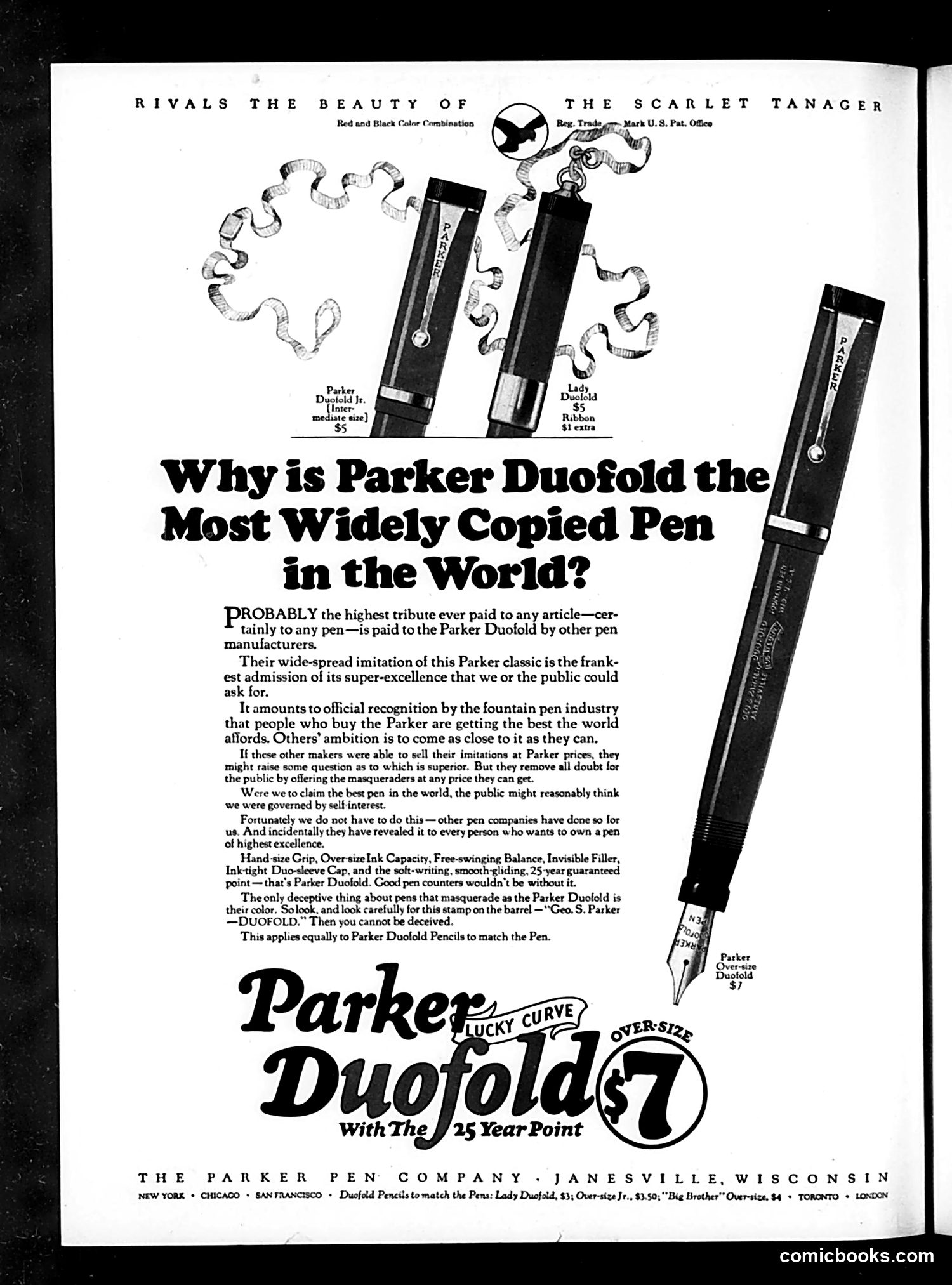
This is a **commercial advertisement**, not satire or political commentary. The Parker Pen Company uses competitive marketing rhetoric to position the Duofold as the market leader. The ad's main claim—"Why is Parker Duofold the Most Widely Copied Pen in the World?"—frames imitation as proof of superiority. The company argues that competitors' attempts to replicate the Duofold constitute "official recognition" of its excellence. The page displays three pen models with prices ($3-$5 range) and emphasizes features like "25-year guaranteed point" and "Invisible Filler." The scarlet tanager imagery at top appears purely decorative. The underlying message: buying Parker means owning the original, not a knockoff—a straightforward appeal to status-conscious consumers of that era.
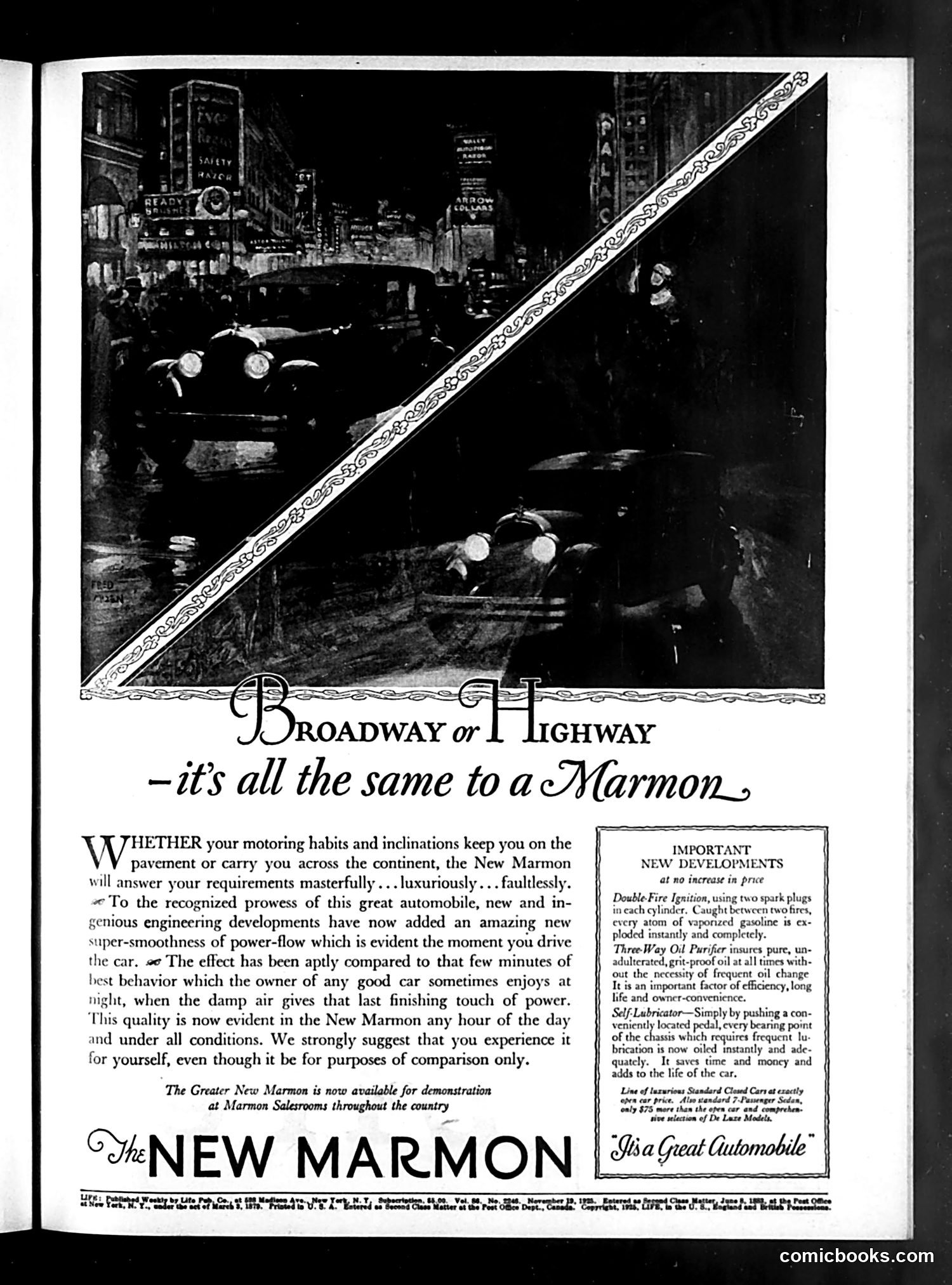
This page is primarily **advertising, not satire**. It's a full-page advertisement for the "New Marmon" automobile, published in *Life* magazine. The ad shows a split image: the upper half depicts a nighttime Broadway street scene with theater marquees and traffic; the lower half shows a similar highway scene. The headline claims "Broadway or Highway—it's all the same to a Marmon," arguing the car performs equally well in urban and rural settings. The accompanying text emphasizes the vehicle's engineering sophistication, smooth power-flow, and new features like double-fire ignition and self-lubrication. A sidebar lists "Important New Developments" as selling points. This is straightforward product marketing with no political or satirical content—just early automotive advertising rhetoric emphasizing reliability and luxury features.
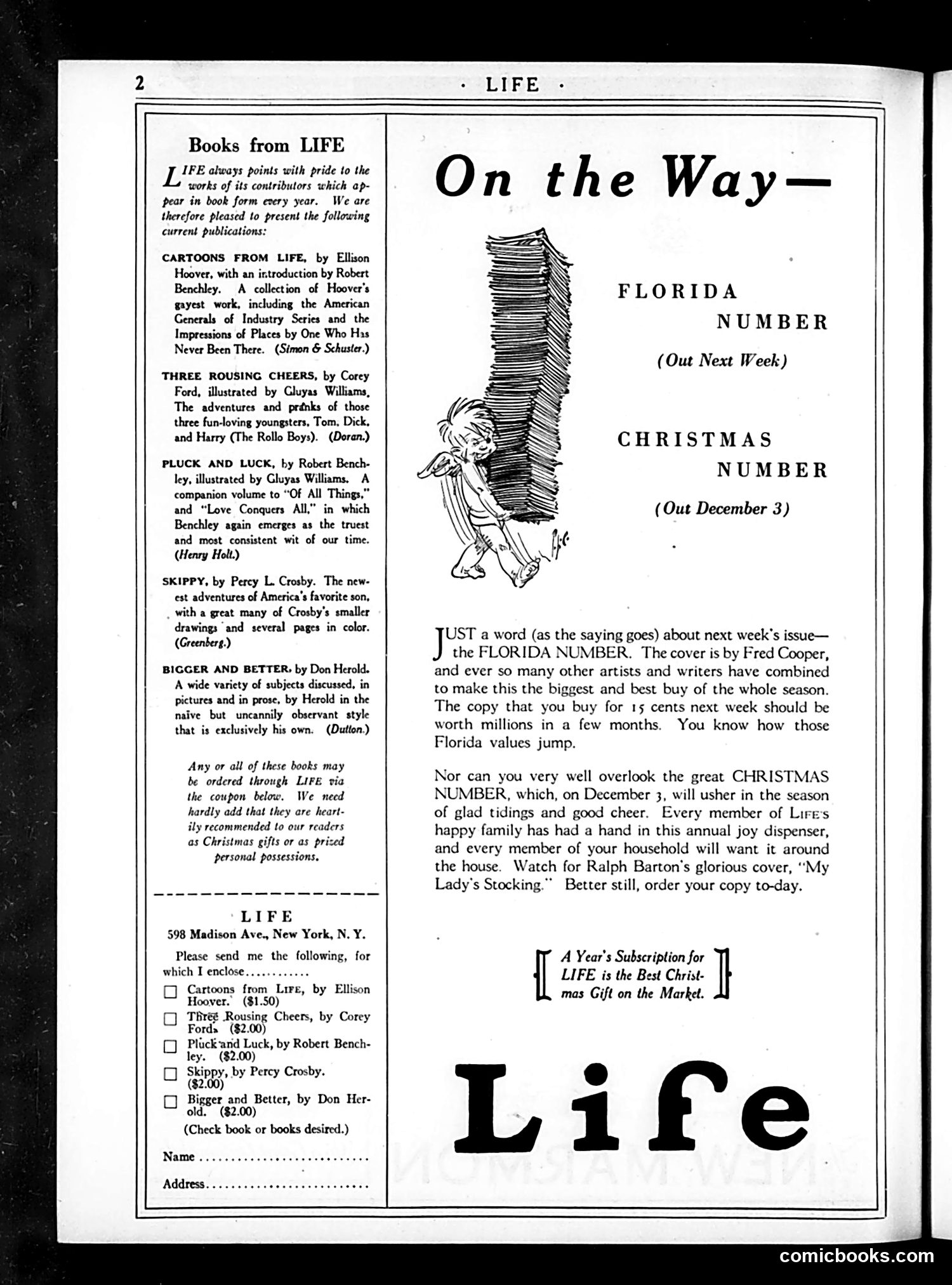
This page is primarily **advertising and promotional content** for Life magazine's upcoming issues, rather than political satire or editorial cartoons. The main illustration shows a figure struggling to carry an enormous stack of papers or magazines, captioned "On the Way—" This appears to be a humorous visual pun promoting Life's upcoming **Florida Number** (next week) and **Christmas Number** (December 3). The joke seems to reference the anticipated popularity and bulk of these special issues. The left column advertises five books available from Life, including works by Ellison Hoover and Robert Benchley. The bottom half contains an order form for these publications. Overall, this is a marketing page designed to encourage subscriptions and book purchases rather than deliver political commentary.
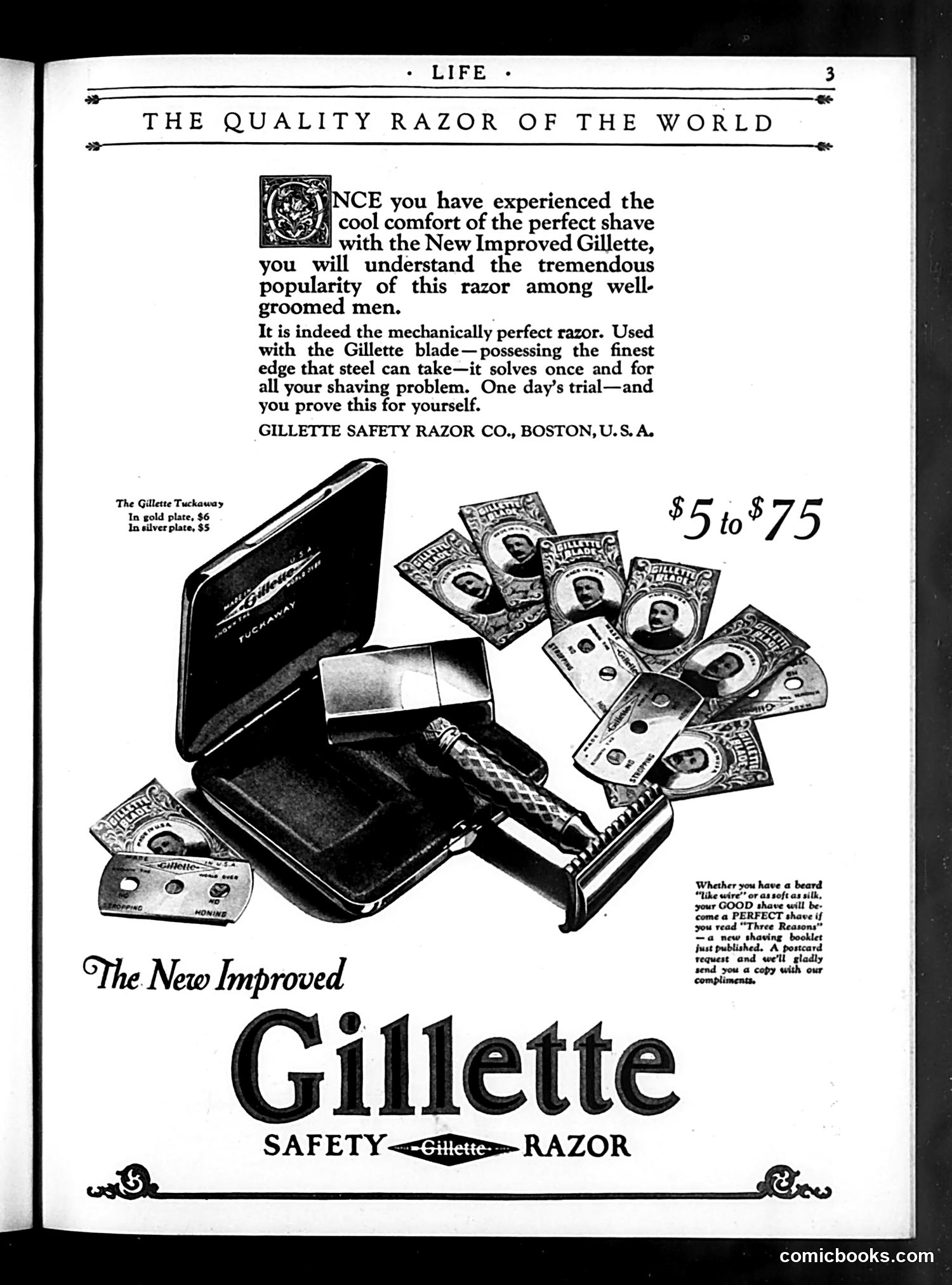
This page is **primarily a Gillette Safety Razor advertisement**, not a political cartoon. There is no satire or political commentary present. The ad promotes the "New Improved Gillette Safety Razor" with a price range of $5 to $75. It features product photography showing the razor in its case alongside Gillette blade packages arranged to resemble currency or coins—a visual metaphor suggesting the razor's value and premium quality. The copy emphasizes the razor as "mechanically perfect" and appeals to "well-groomed men" by promising "the finest edge that steel can take." A small note mentions a booklet called "Three Reasons" available upon request. This is straightforward consumer advertising typical of early-to-mid 20th century magazines, using product display and aspirational messaging rather than humor or political commentary.
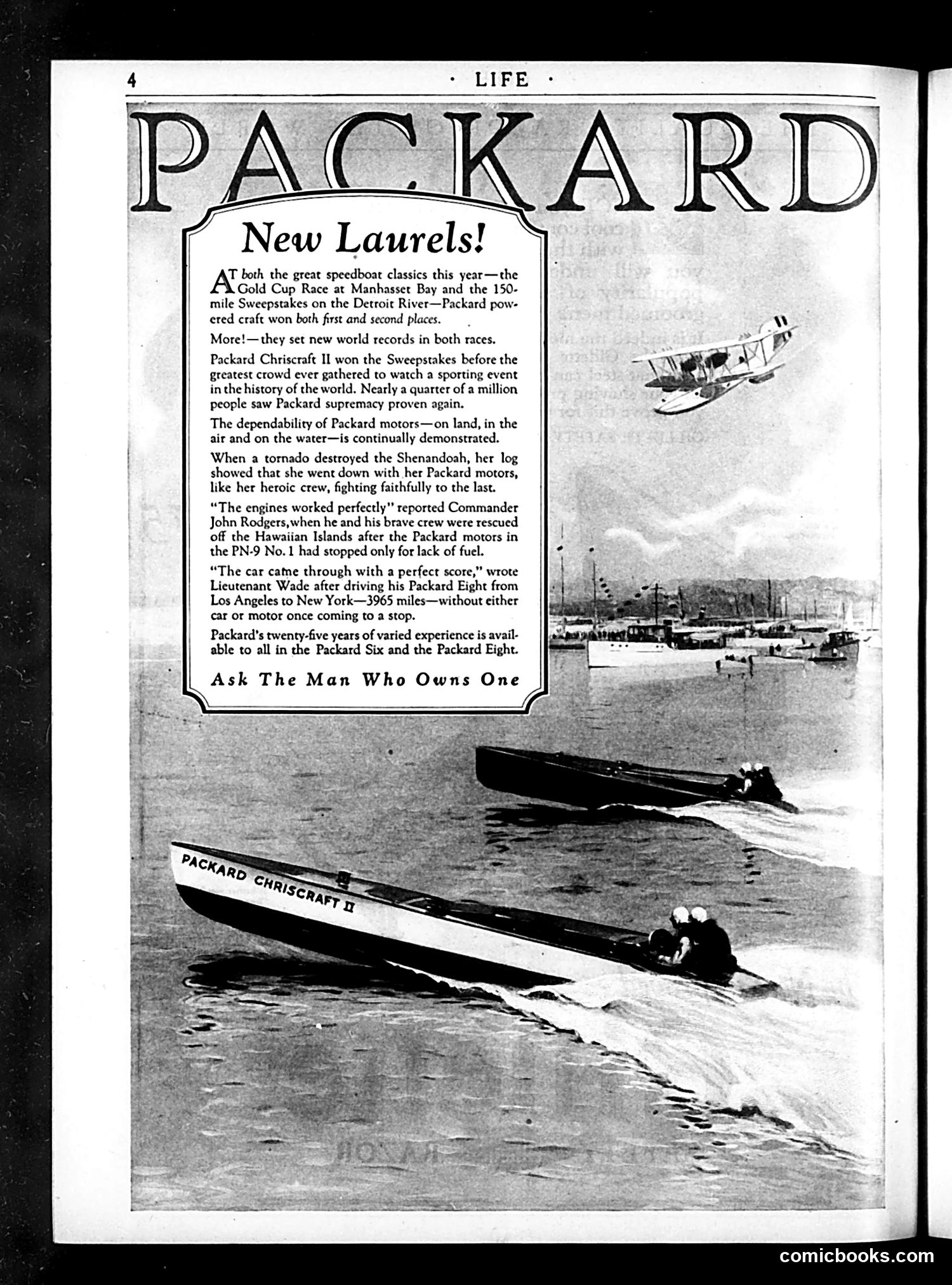
This is **not a political cartoon** but rather a **Packard automobile advertisement** from Life magazine's pages. The ad celebrates Packard motorboats' recent racing victories at two major speedboat competitions: the Gold Cup Race at Manhasset Bay and a 150-mile Sweepstakes on the Detroit River. The text emphasizes that Packard-powered craft won first and second places while setting world records. The advertisement uses dramatic testimonials—including a story about Commander John Rodgers's rescue in Hawaii and Lieutenant Wade's cross-country drive—to demonstrate Packard motor reliability across land, air, and water applications. The photographs show speedboats in action, establishing the brand's performance credentials to potential buyers. The closing tagline "Ask The Man Who Owns One" was Packard's actual advertising slogan.
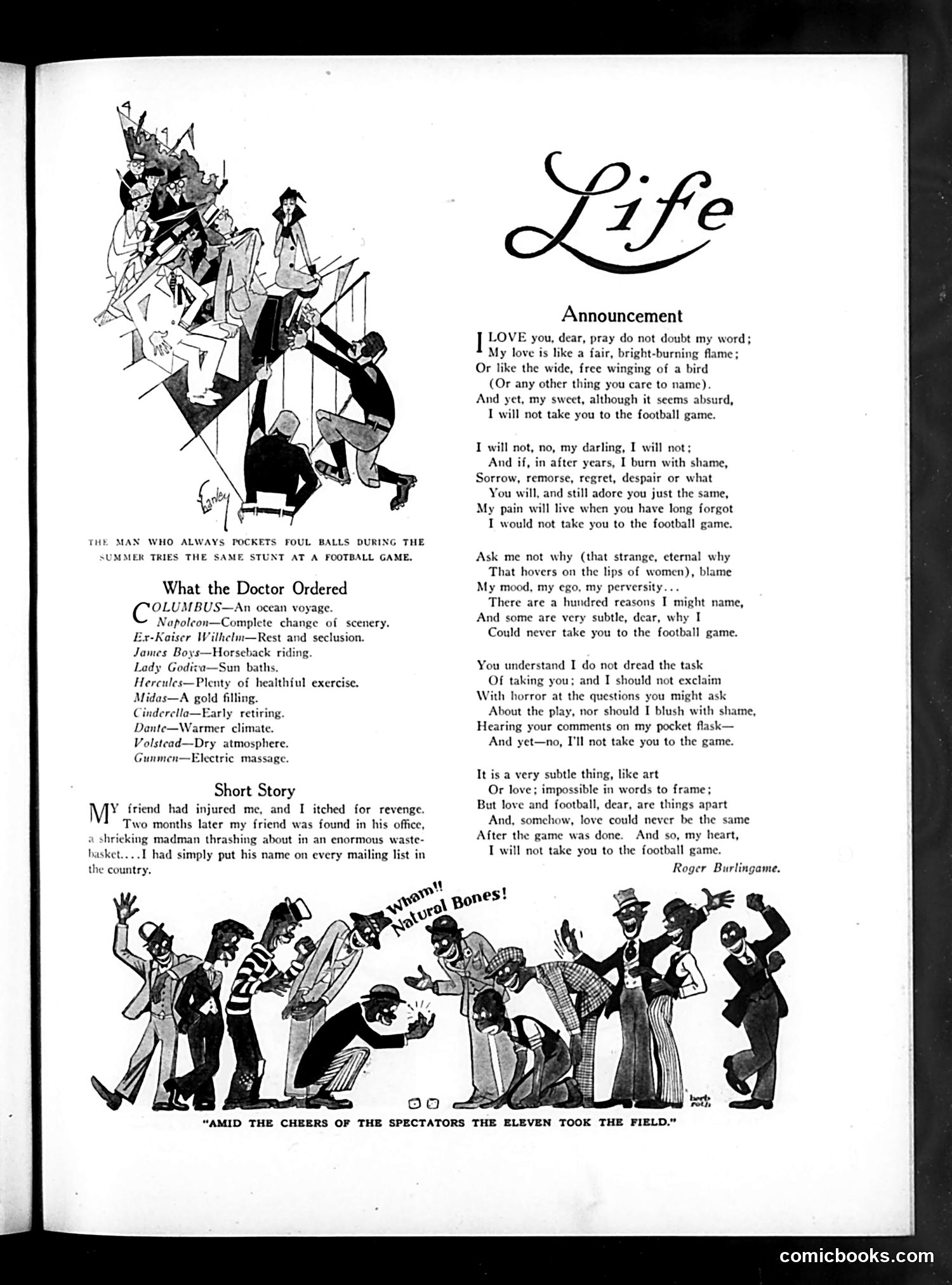
This page from *Life* magazine contains two distinct sections: **"What the Doctor Ordered"** lists humorous "prescriptions" for various ailments using classical/mythological references—Columbus for scenery changes, Napoleon for complete makeovers, etc. This is light satire on popular remedies and cures of the era. **"Announcement"** is a poem by Roger Burlingame addressing someone's refusal to attend a football game, expressing romantic devotion while accepting this boundary. It's sentimental verse about love and compromise. **The cartoons** show exuberant spectators at a football match, with the caption "Amid the cheers of the spectators the eleven took the field." The bottom illustration depicts fans enthusiastically celebrating—typical early 20th-century sports enthusiasm satire. The page overall humorously addresses social customs, romance, and popular leisure activities of the period.
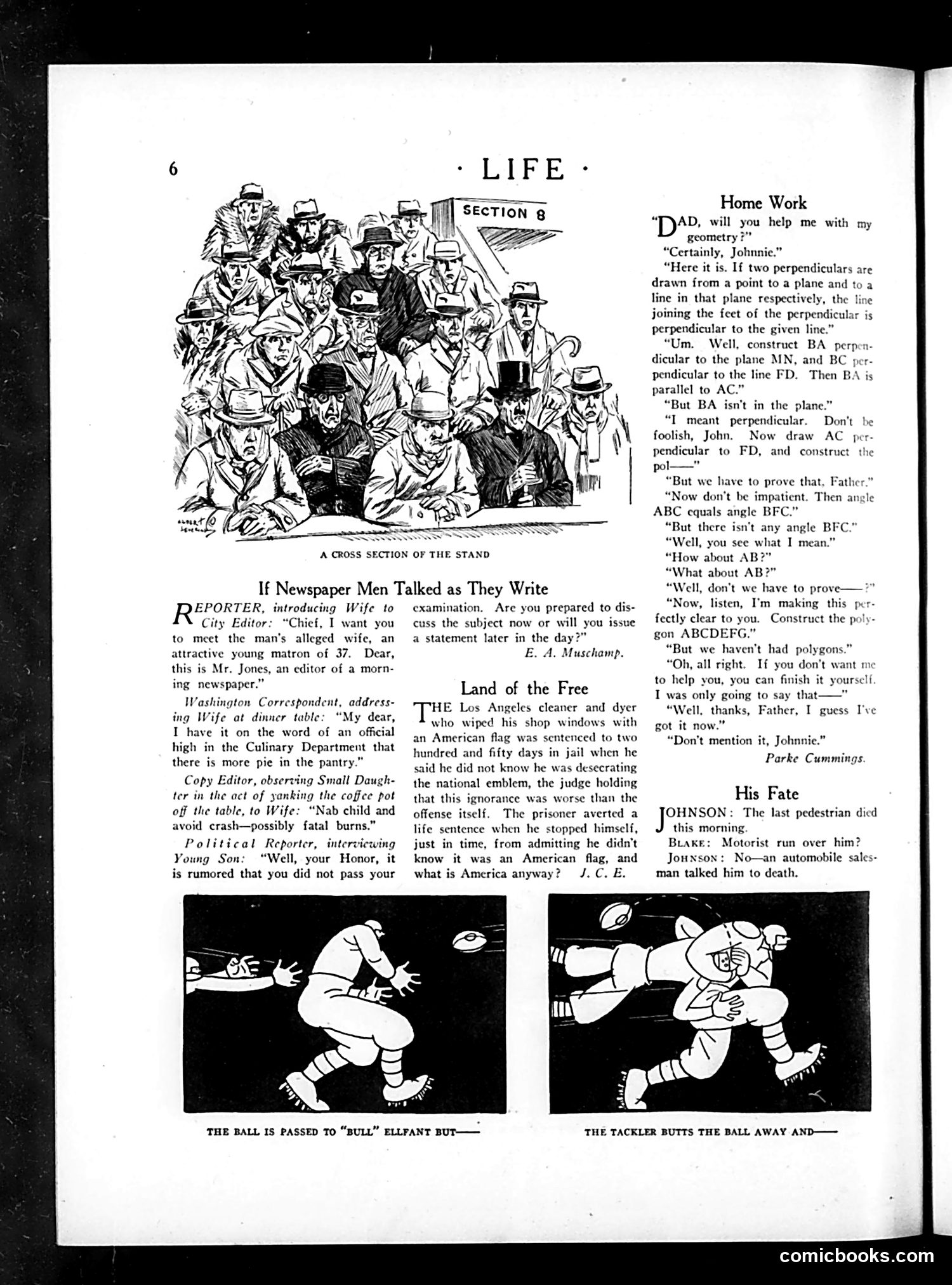
This page contains satirical commentary and humor pieces typical of early 20th-century Life magazine: **"If Newspaper Men Talked as They Write"** mocks journalistic clichés through exaggerated dialogue between reporters and editors, poking fun at overwrought newspaper writing conventions. **"Land of the Free"** criticizes judicial hypocrisy: a Los Angeles cleaner/dyer desecrated an American flag but received a lighter sentence than someone imprisoned for not knowing he was disrespecting the flag. The satire questions whether America truly deserves its "land of the free" reputation when enforcement is inconsistent. **"His Fate"** presents a dark joke about a pedestrian's death, with one character sarcastically attributing it to an automobile salesman's persuasive pitch. The football cartoons below appear unrelated humor. The page represents Life's typical blend of political/social satire with lighter comedic pieces.
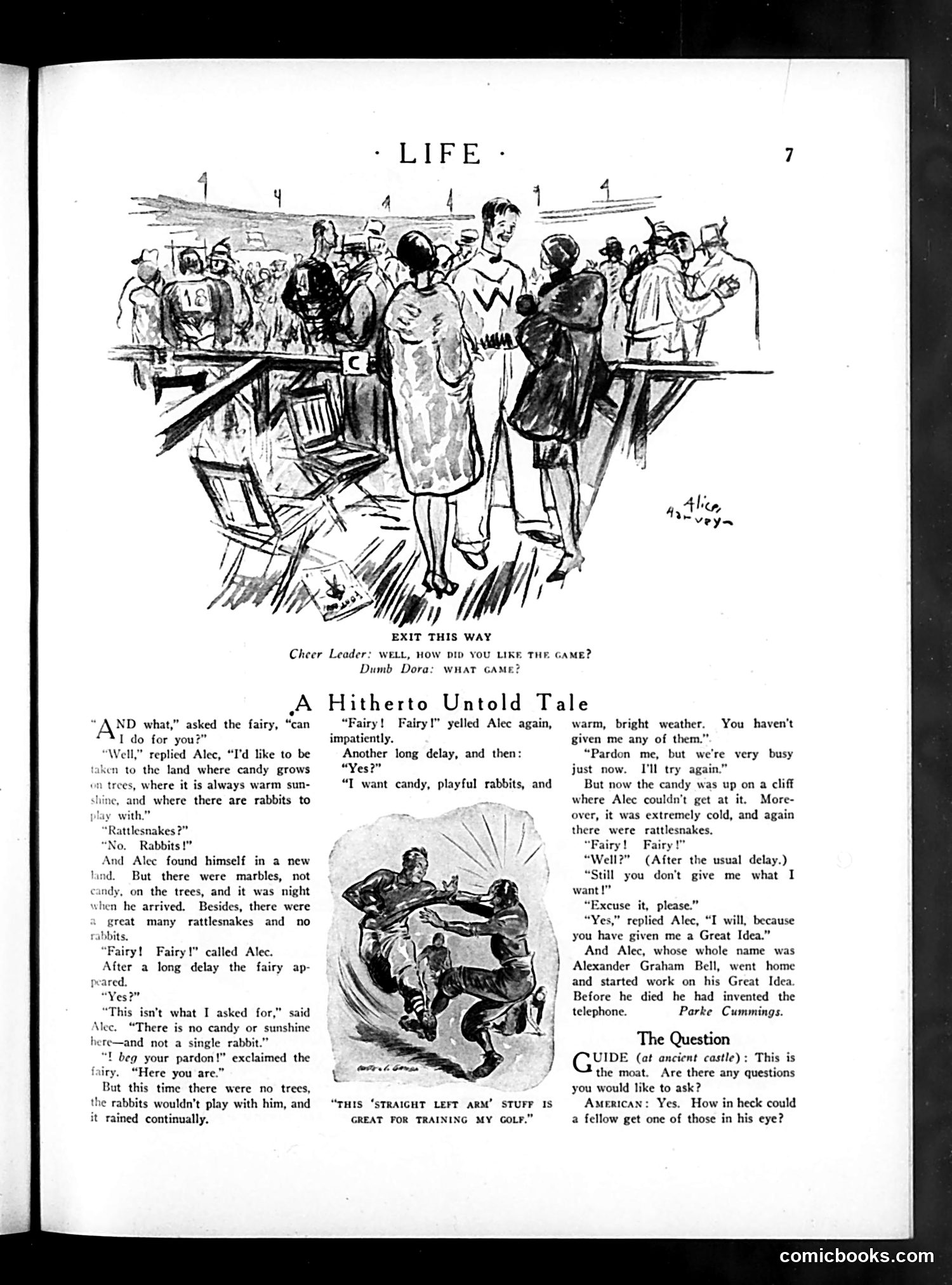
This page from *Life* magazine contains two distinct pieces: **Top cartoon**: A sketch of a crowded social scene (appears to be at a sporting event or public gathering) with the caption "EXIT THIS WAY" and dialogue between a "Cheer Leader" and "Dumb Dora" — a character type popular in 1920s humor representing a foolish young woman. The joke plays on her literal confusion about what "game" was being discussed. **"A Hitherto Untold Tale"**: A fairy-tale parody about a character named Alec who, frustrated with a fairy's delays in granting wishes, invents the telephone himself instead of waiting. This appears to be satirizing either inventor ambition or American impatience with traditional methods. **"The Question"**: A brief joke about an American tourist asking a guide at an ancient castle how someone acquired an eye injury—likely mocking American bluntness or naïveté. The overall tone reflects early 20th-century American humor conventions.
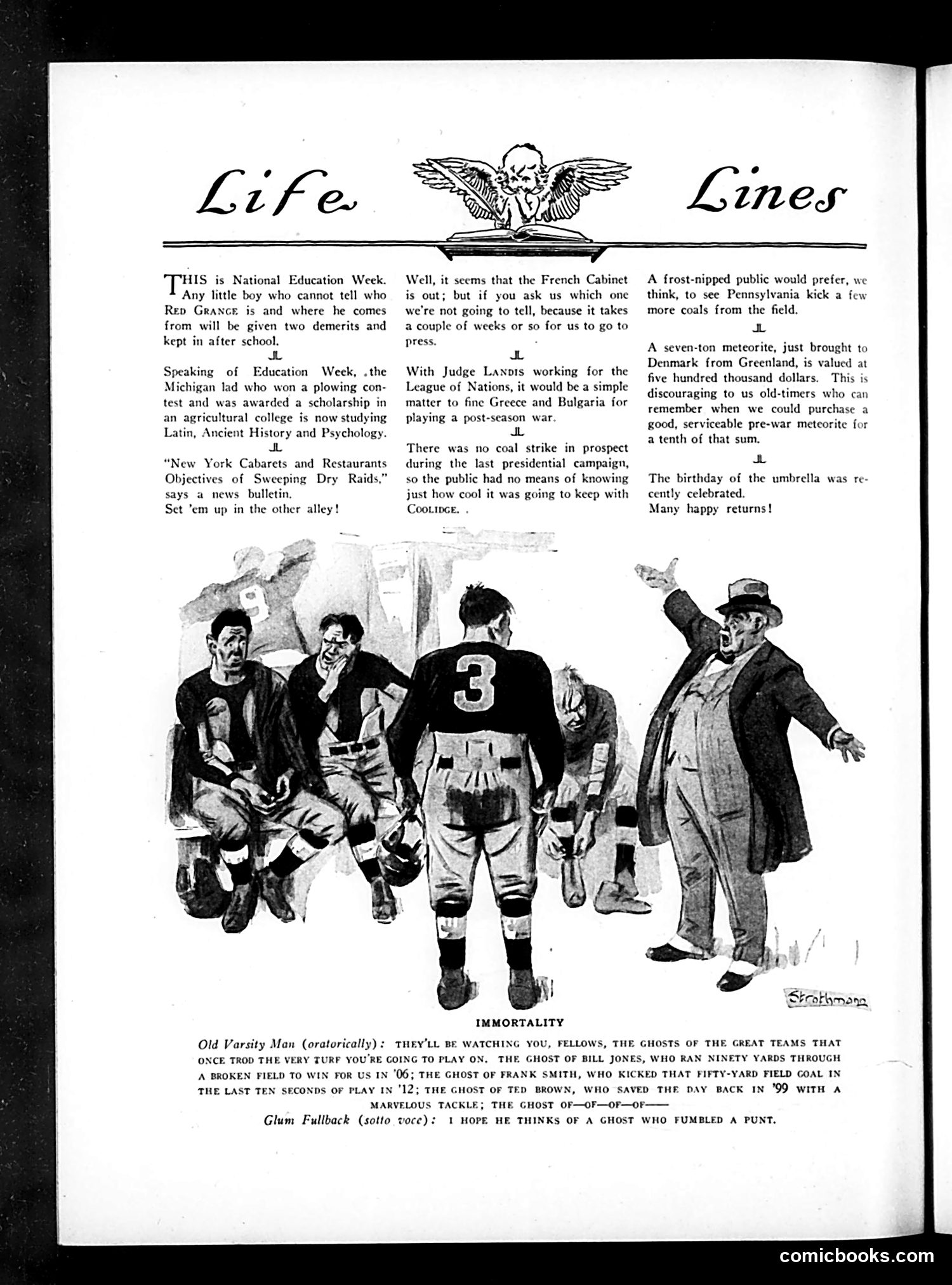
This cartoon satirizes college football nostalgia through an "Old Varsity Man" addressing a football player wearing jersey #3. The elderly man claims that famous players' "ghosts"—including Bill Jones, Frank Smith, and Ted Brown—will watch over the current team, referencing specific historical plays (a fifty-yard field goal, a game-winning tackle). The humor lies in the absurdity of invoking dead legends to inspire present performance. The caption's punchline mocks this sentimentality: the old man hopes the ghost who fumbled a punt will somehow help win games—a contradiction suggesting that past glory doesn't guarantee future success and that nostalgic appeals to tradition are ultimately foolish.
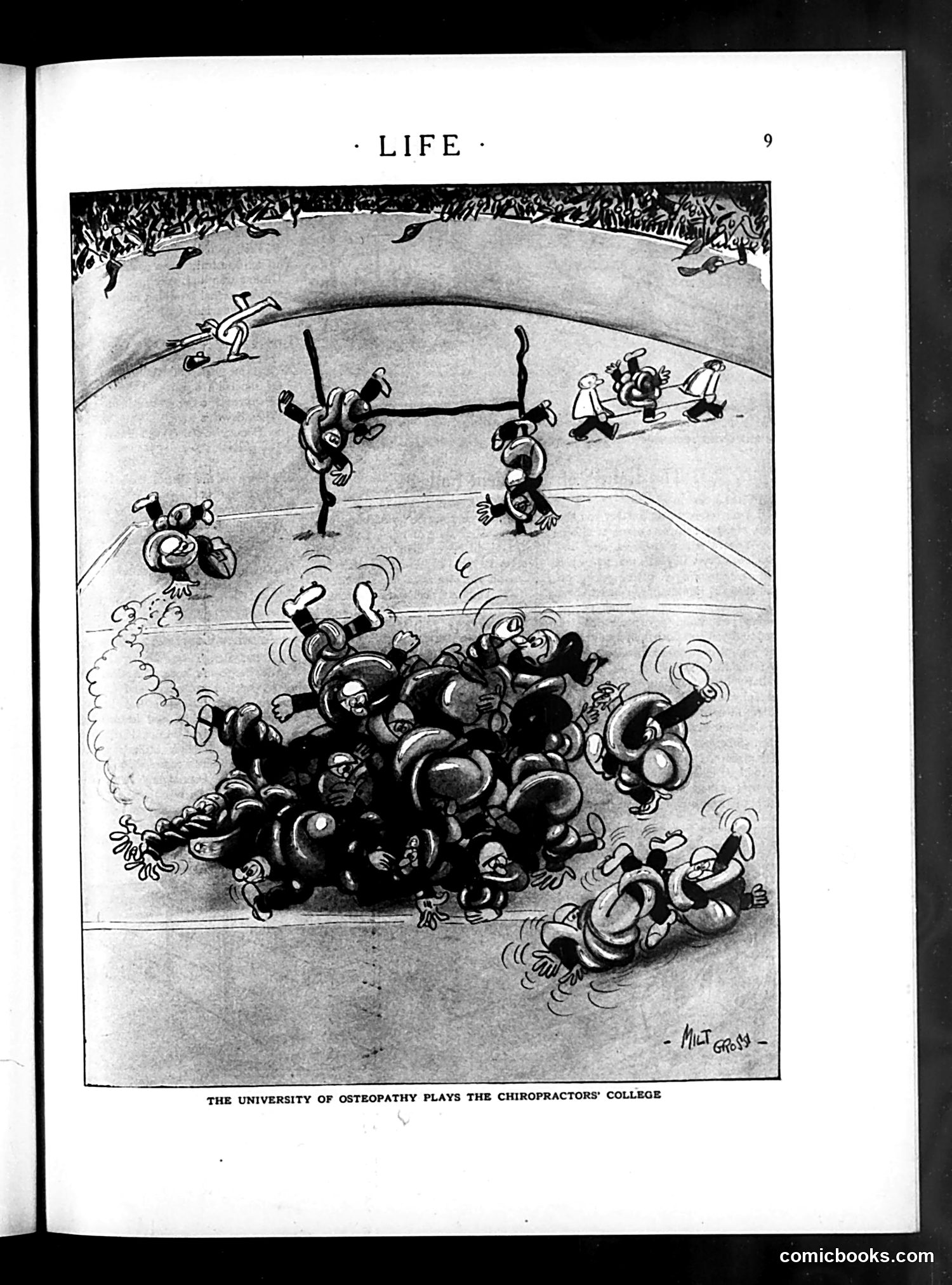
This satirical cartoon depicts a violent football game between two alternative medical schools. The massive pile of tangled, contorted figures at the bottom represents the brutal collision—players literally twisted into knots, with limbs at impossible angles. The satire targets both osteopathy and chiropractic medicine, which were emerging, controversial professions in early 20th-century America. Mainstream medicine viewed them as pseudoscience or quackery. The cartoon suggests these practitioners are literally "playing rough" with bodies—that their methods involve violent manipulation and twisting of patients. The joke works on multiple levels: it's a pun on spinal manipulation (their core practice) shown as literal physical violence, while the title mimics legitimate college sports competitions, mocking these institutions' attempts at professional legitimacy.
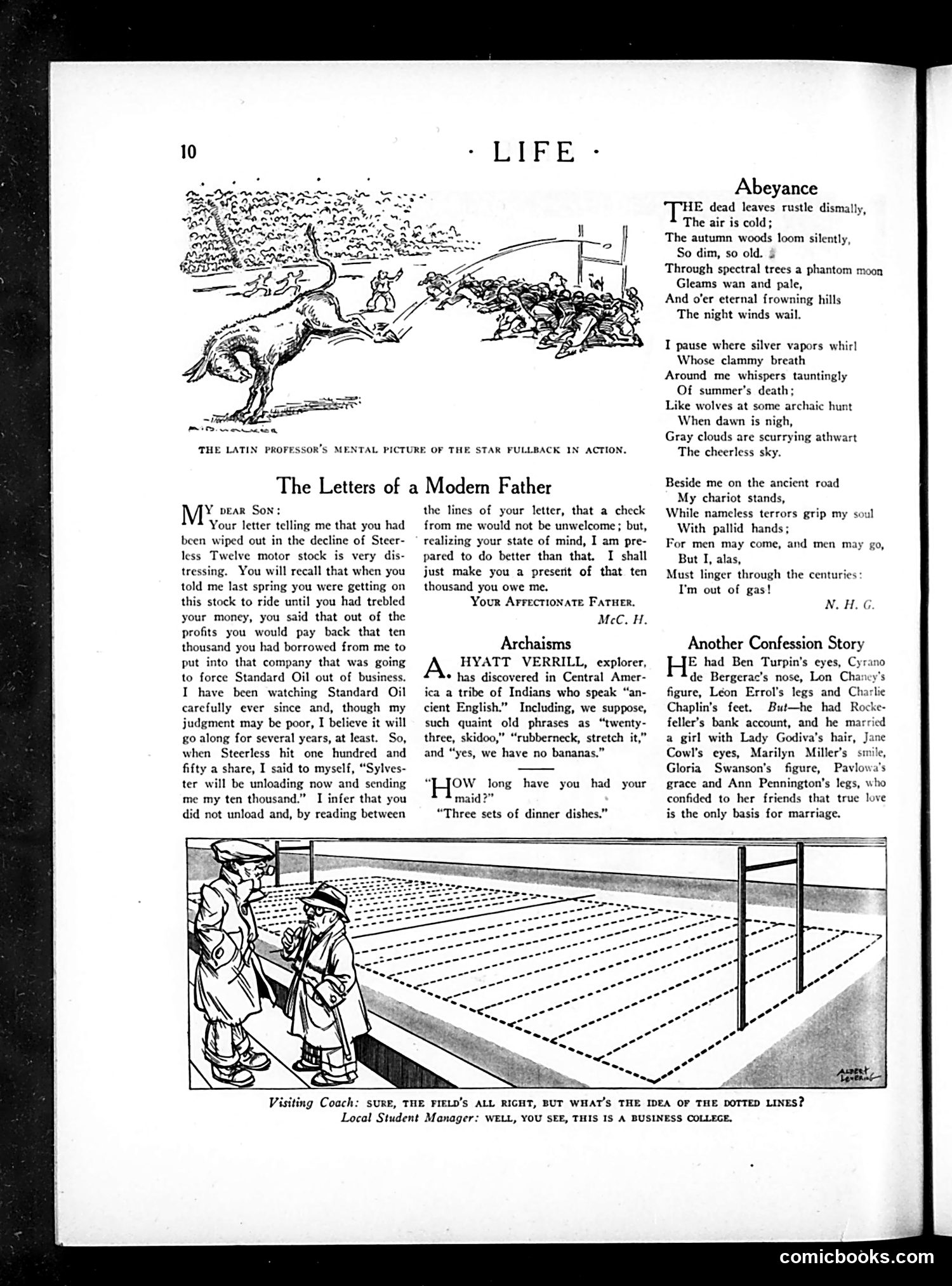
This page contains three unrelated satirical pieces typical of *Life* magazine's format: 1. **"Abeyance"** - A melancholic poem about autumn and death, illustrated with a small engraving of a hunt scene. 2. **"The Letters of a Modern Father"** - A humorous letter from a father to his son about finances, specifically regarding Standard Oil stock. The father ironically offers to forgive a $10,000 debt his son owes, using sarcasm to critique the son's financial irresponsibility. 3. **"Archaisms"** - A brief, absurdist anecdote about an explorer discovering Native Americans speaking "ancient English" with outdated phrases. 4. **Bottom cartoon** - Shows a visiting coach questioning a local college manager about "dotted lines" on a football field. The punchline: the manager explains they're necessary because it's a "business college"—satirizing how American colleges prioritize commerce over athletics or academics.
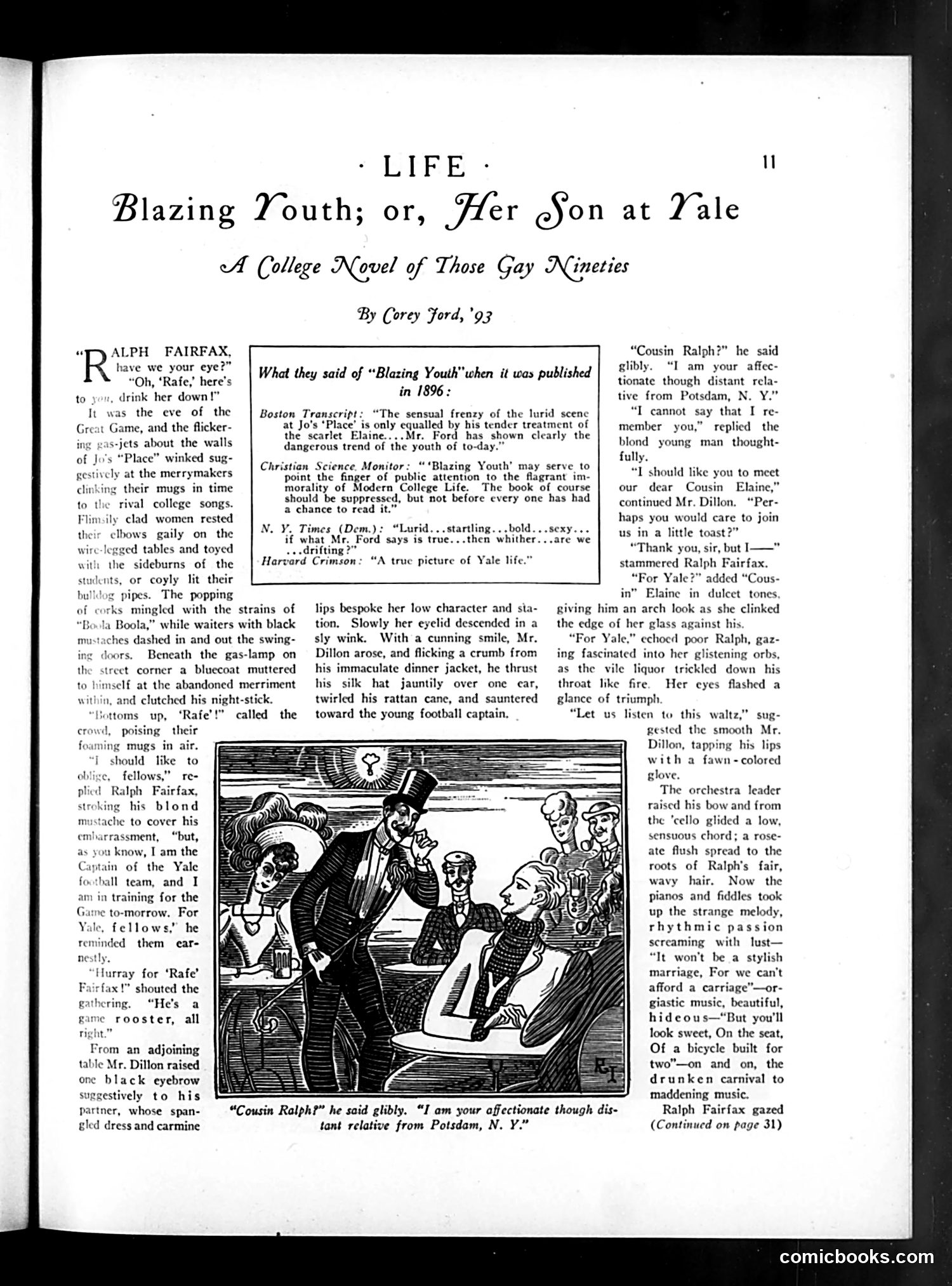
This is a literary review page featuring a college novel by Corey Ford ('93) about Yale student life in the 1890s. The central illustration depicts a formal college dance or social event with well-dressed young men in top hats and tuxedos with female companions. The satire targets the "gay nineties" college culture—using "gay" in its period sense meaning carefree/fashionable. The quoted reviews mock the novel's portrayal of sensual excess, wild behavior, and moral laxity among elite college students. Critics sarcastically praise Ford's "clear" depiction of "dangerous trends" in youth morality. The illustration and text together satirize upper-class undergraduate excess, formal social pretense, and concerns about modern youth degeneracy—themes that resonated with 1890s audiences anxious about changing social mores.
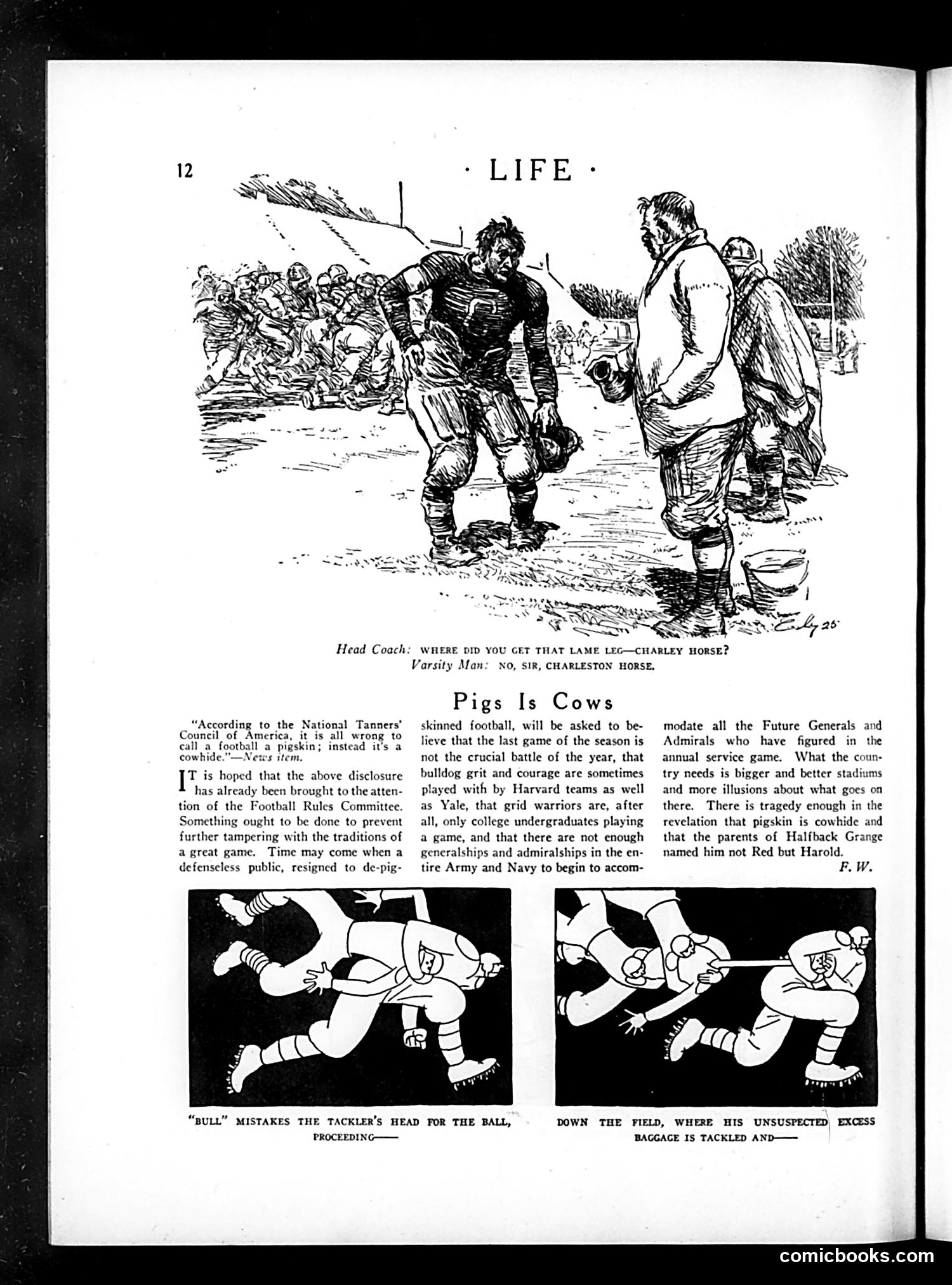
This page satirizes the Football Rules Committee's attempt to regulate college football after concerns about brutality and tampering with athletic traditions. The top cartoon shows a coach confronting a player about a "lame leg," with the joke being that injuries are inevitable in the sport. The main article criticizes the notion that football represents military preparedness, arguing that pigskin football—not the "crucial battle of the year"—is what college students actually play. It mocks the idea that football develops future generals and military officers, suggesting this justification masks the sport's real nature as a rough, injury-prone game played by undergraduates rather than serious preparation for Army/Navy service.
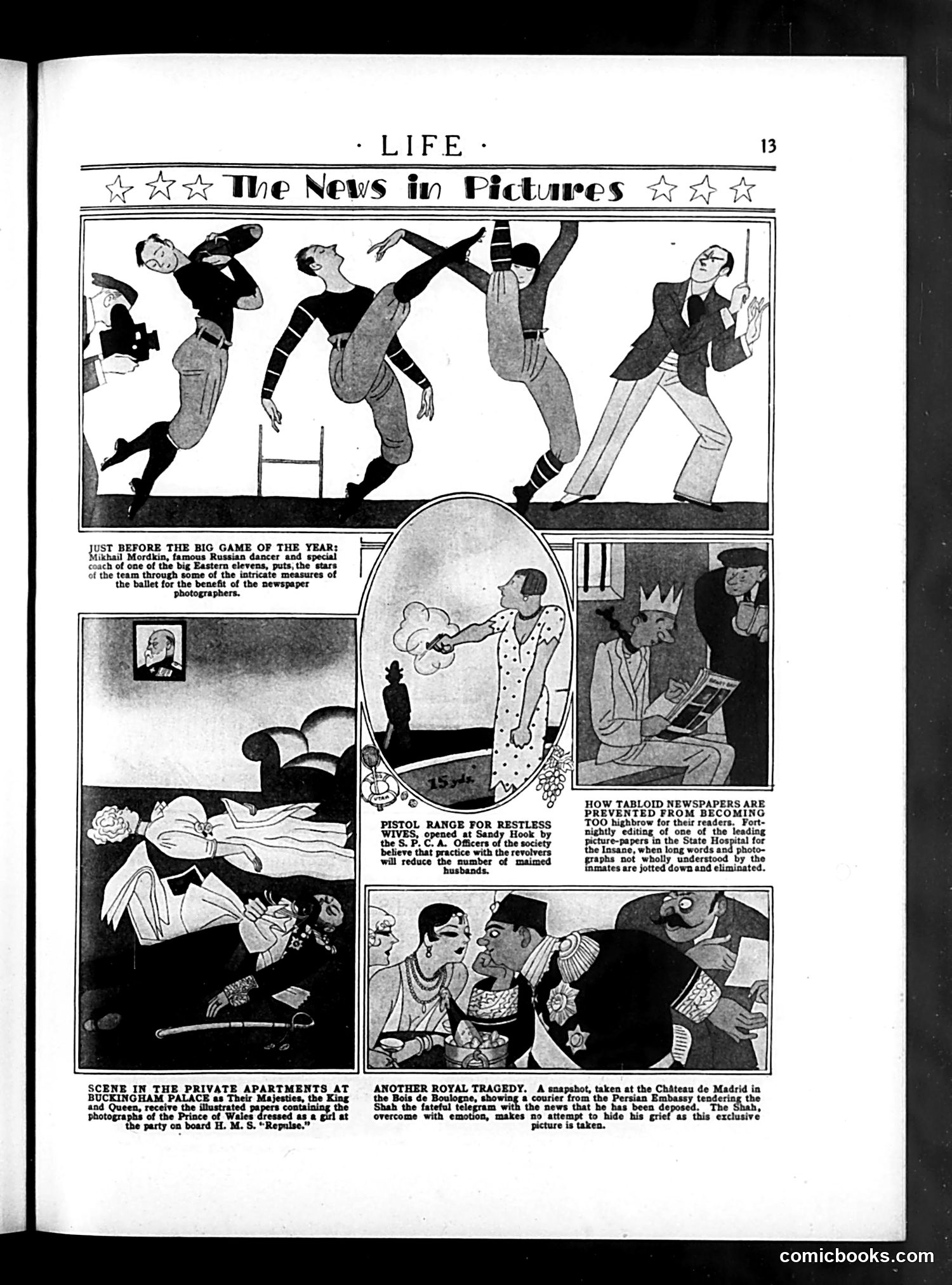
This page presents satirical illustrations of contemporary events. The top panel shows athletes performing acrobatic football moves, captioned as occurring "just before the big game of the year," likely referencing a major sporting event and the elaborate training or showmanship involved. Lower panels depict: - A pistol range for "restless wives" at Sandy Hook, suggesting satirical commentary on women's leisure activities and marital discontent - A scene at Buckingham Palace showing the King and Queen receiving illustrated papers - An apparent diplomatic incident at the Château de Madrid involving Persian Embassy officials and news of a deposed Shah The humor relies on exaggeration of social circumstances and contemporary news events, typical of Life's satirical approach to American and international affairs of the period.
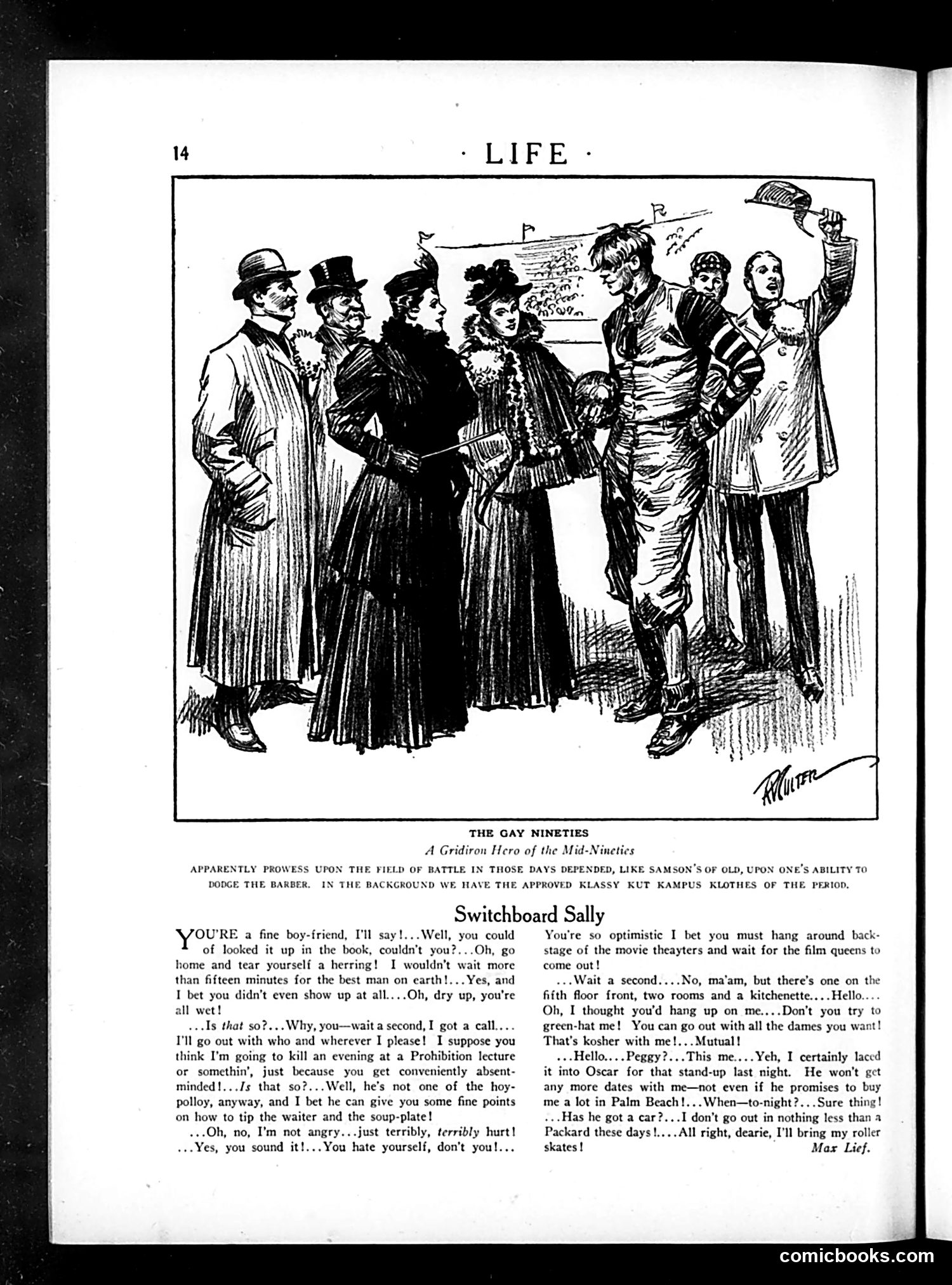
This page features a satirical cartoon titled "The Gay Nineties" depicting what appears to be a social scene from that era. The caption notes it shows "A Gridiron Hero of the Mid-Nineties" and references prowess "upon the field of battle" and ability to "dodge the barber." Below is a humorous dialogue titled "Switchboard Sally" between two characters—apparently a young man and woman—engaging in flirtatious banter about dating, theater, and social activities. The woman (Sally) playfully critiques the man's romantic overtures and boasts about her own popularity and independence, mentioning dates, movie theaters, and roller skating. The satire appears to mock youthful courtship rituals and social pretensions of the 1890s period being referenced, with particular emphasis on modern women's newfound social freedom and assertiveness in dating.
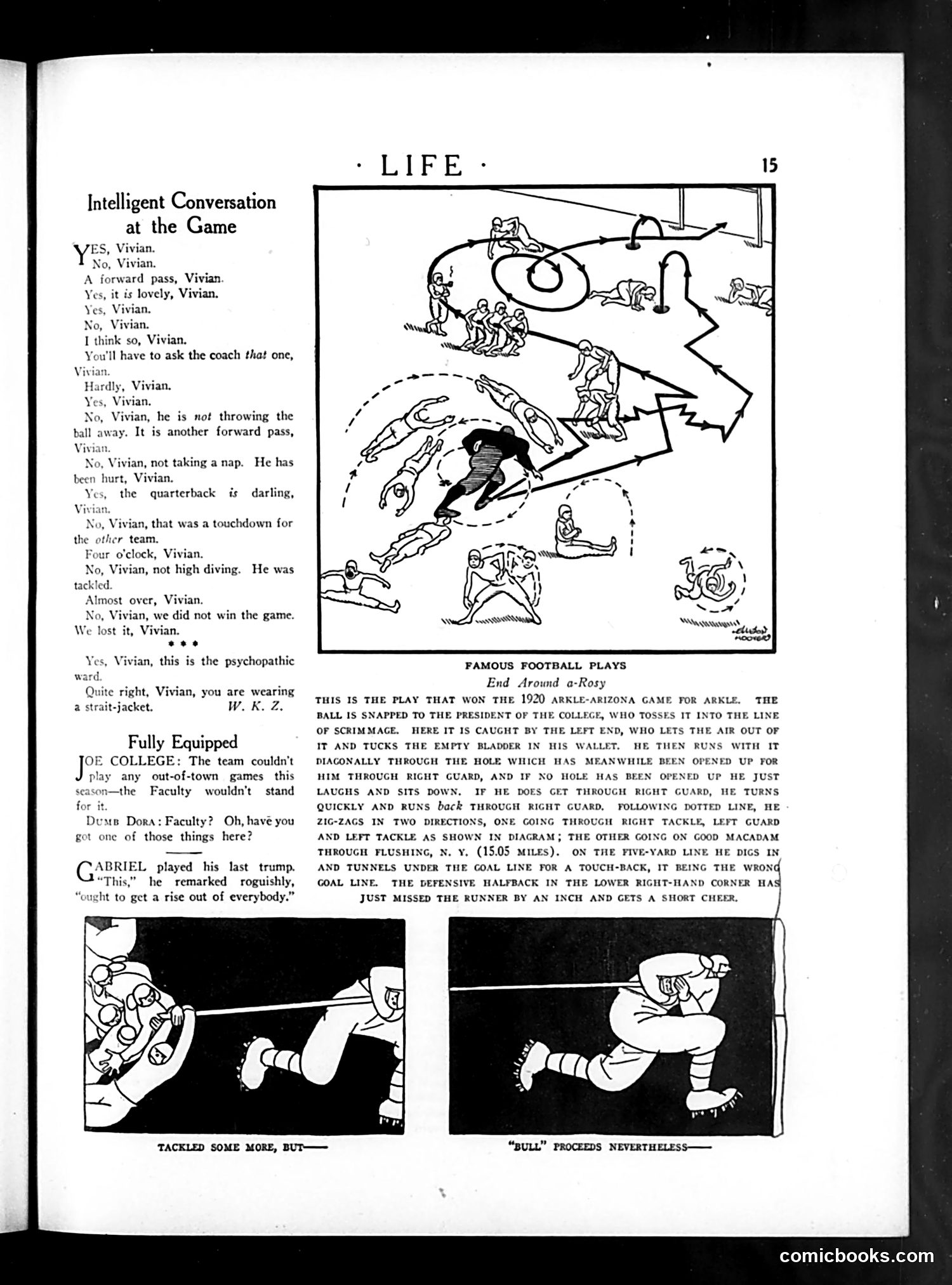
This page satirizes spectators at a college football game having a banal conversation while supposedly discussing strategy. The dialogue between characters named Vivian shows repetitive, substance-free banter—one person keeps saying "Yes, Vivian" and "No, Vivian" while barely understanding what's happening on the field. The main cartoon illustrates "End Around-a-Rory," a famous 1920 Arkle-Arizona football play. It depicts the complex maneuvering involved: a runner evading multiple defenders by threading through gaps, with exaggerated motion lines showing the zigzagging path to the goal line. The bottom vignettes show tackle attempts during the play's execution. The satire mocks both clueless game-goers and celebrates the genuine complexity of football strategy that casual spectators miss.
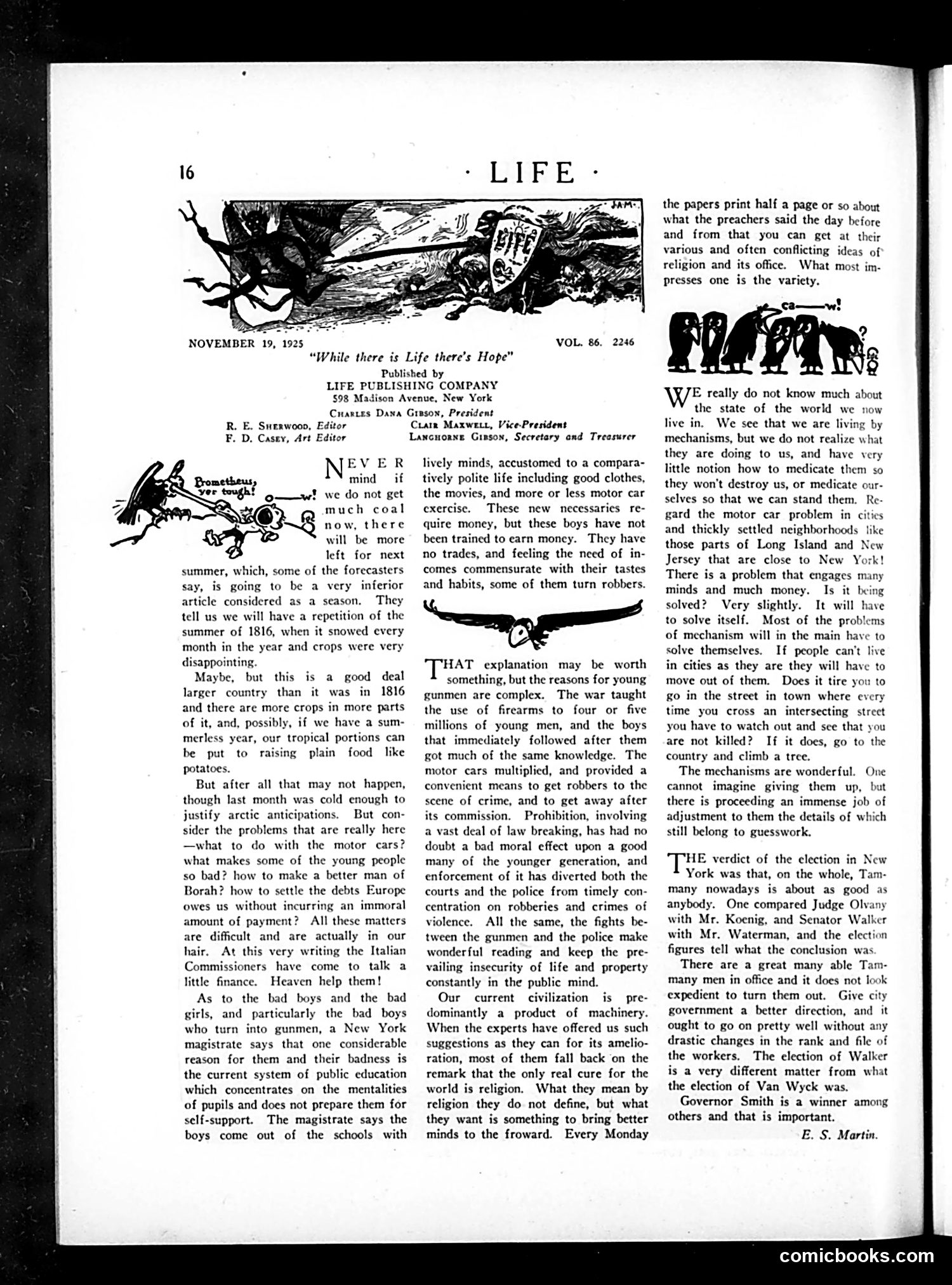
This page contains editorial commentary rather than cartoons. The main illustration shows a simplified figure labeled "Prometheus" chained to a rock—a classical reference to the mythological titan punished for giving fire to humanity. The editorial discusses young men turning to crime, attributing this partly to post-WWI social upheaval and the unintended consequences of Prohibition. The writer argues that "mechanism" (industrialization and modern society) has created urban crime problems, and that religion—not stricter law enforcement—offers the true solution. The piece also critiques New York's recent elections, praising Governor Smith while dismissing other candidates. The Prometheus reference suggests civilization itself creates the conditions for moral decline.
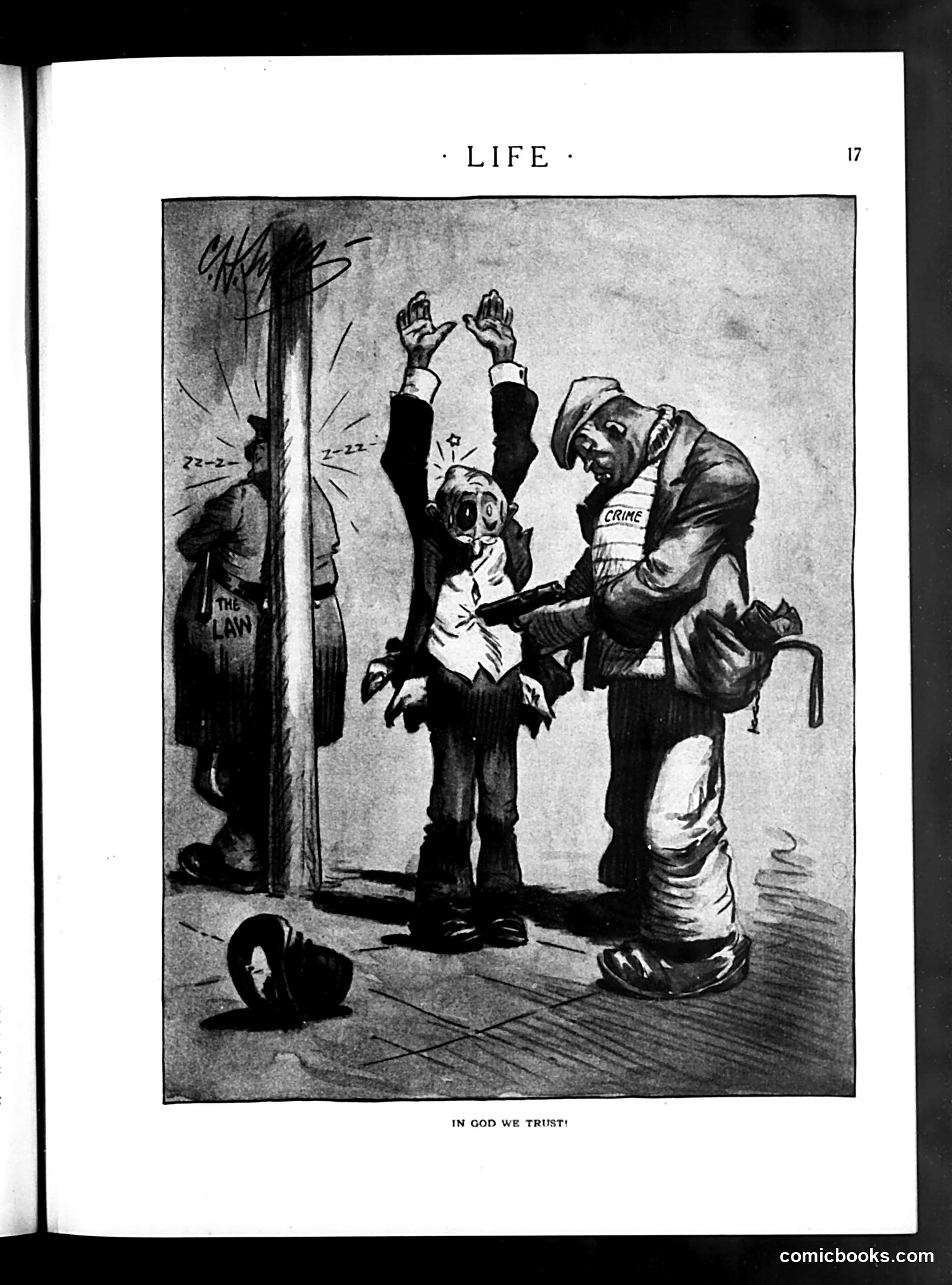
This is a satirical cartoon from *Life* magazine depicting a scene of law enforcement and crime. On the left, a figure labeled "THE LAW" appears to be sleeping or inactive (marked "zzz"). In the center, a character labeled "CRIME" stands triumphantly with arms raised in victory. On the right, another figure in formal dress seems to be assisting or encouraging the criminal figure. A discarded hat lies on the ground. The cartoon's message is clear: despite the motto "IN GOD WE TRUST," the law is ineffectual (sleeping) while crime flourishes openly, possibly with assistance from corrupt officials or authorities. This critiques failures in law enforcement and suggests systemic corruption or negligence in addressing criminal activity—a common theme in early 20th-century American satirical commentary on urban crime and institutional failure.
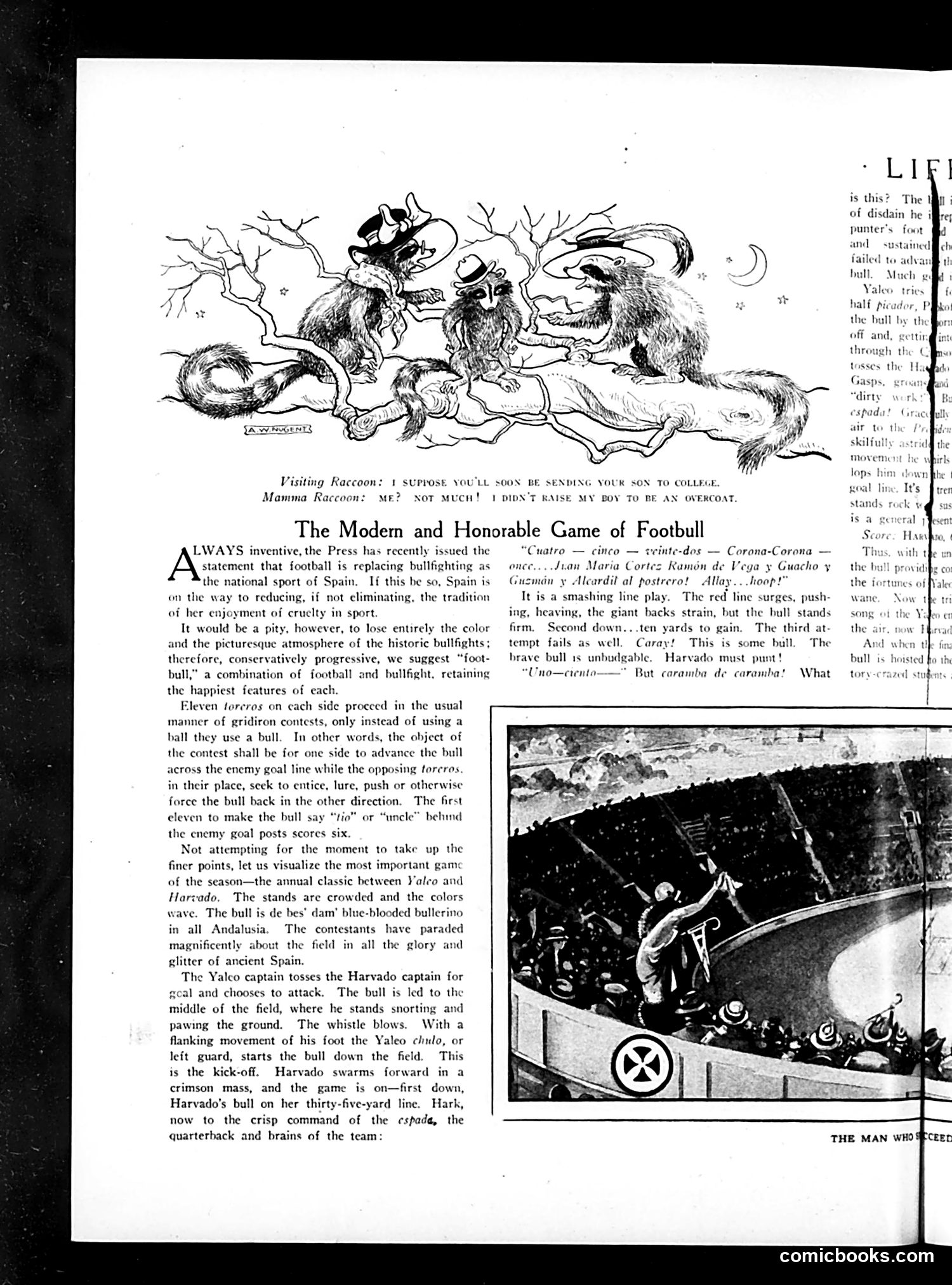
This satirical piece proposes a fictional hybrid sport combining American football with Spanish bullfighting. The joke addresses a real contemporary concern: that Spain was abandoning bullfighting for football, seen as cultural loss. The top cartoon shows raccoons discussing sending a son to college—a separate, unrelated joke about avoiding military service ("overcoat" likely refers to a soldier's uniform). The main article invents "football" using an actual bull instead of a ball, with Spanish bullfighting terminology ("foreros," "chulo," "espada"). It describes a mock game between fictional teams "Yaleo" and "Harvado" in Andalusia, complete with play-by-play action. The satire's point: Life magazine suggests this absurd hybrid would preserve Spain's "picturesque atmosphere" and tradition while appearing "progressively" modern. It's mock-serious mockery of both cultural conservation and the era's assumptions about national character.
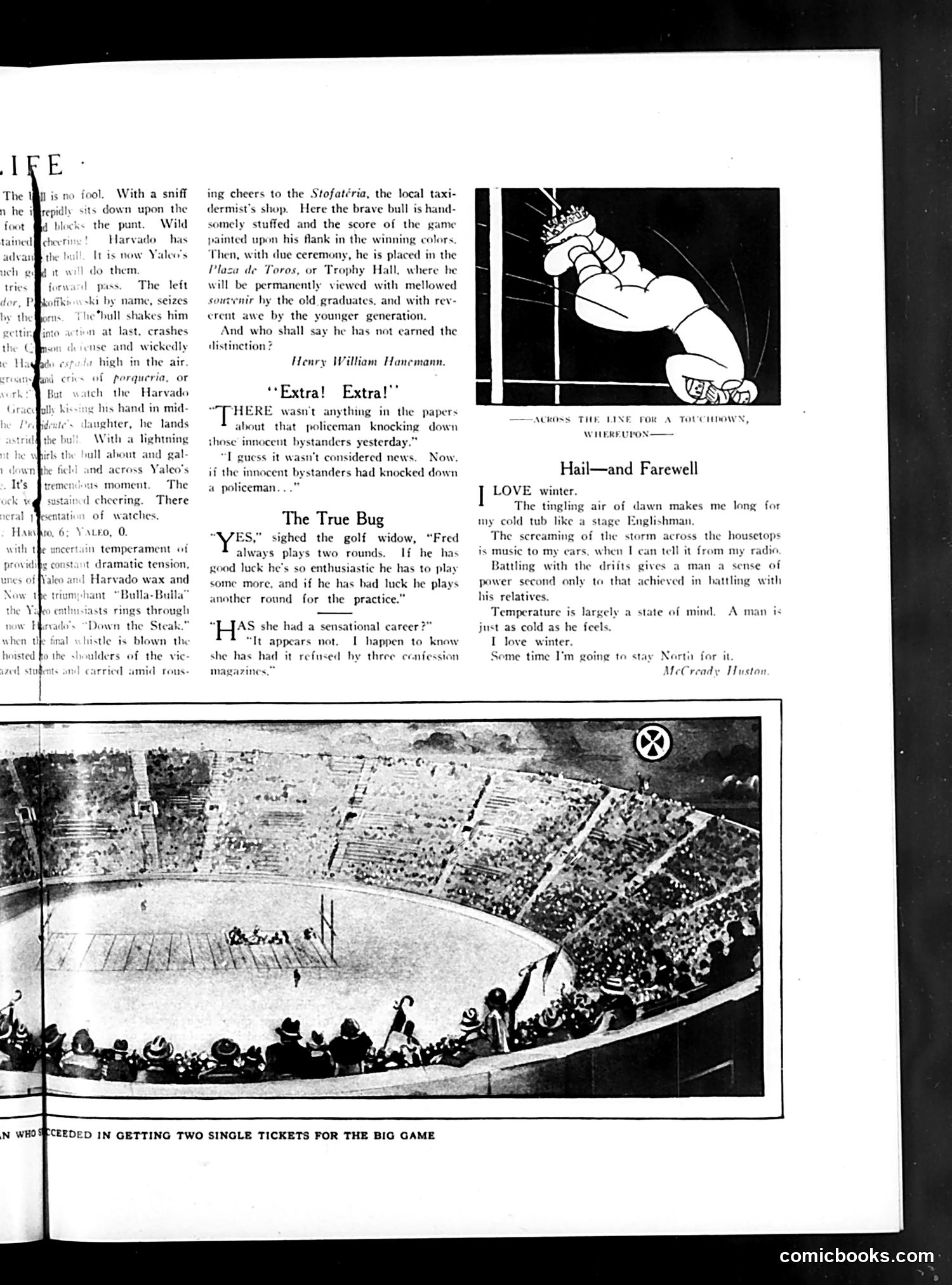
This page contains three distinct humor pieces typical of early 20th-century Life magazine satire: **"The Bull" (top illustration):** A narrative about a bull at what appears to be a Spanish bullfighting event, celebrated as a trophy and preserved in a "Plaza de Toros" (Trophy Hall). The satire mocks the glorification of bullfighting and the treatment of the animal as a heroic specimen worthy of taxidermy and permanent display. **"Extra! Extra!" and "The True Bug":** Brief comedic vignettes. The first jokes about a policeman's brutality being unreportable as "news," satirizing either police misconduct or media standards. The second ridicules a golf-obsessed husband ("Fred") who plays excessively regardless of outcome. **"Hail—and Farewell":** An essay praising winter's hardships, written with tongue-in-cheek romanticism—suggesting that cold, storms, and domestic struggles build character. **Large photograph (bottom):** Appears to show a crowded stadium or arena, likely related to the bullfighting narrative above, showing spectators in the stands. The page exemplifies Life's style: satirizing human folly, social pretension, and absurd behaviors through humor and illustration.
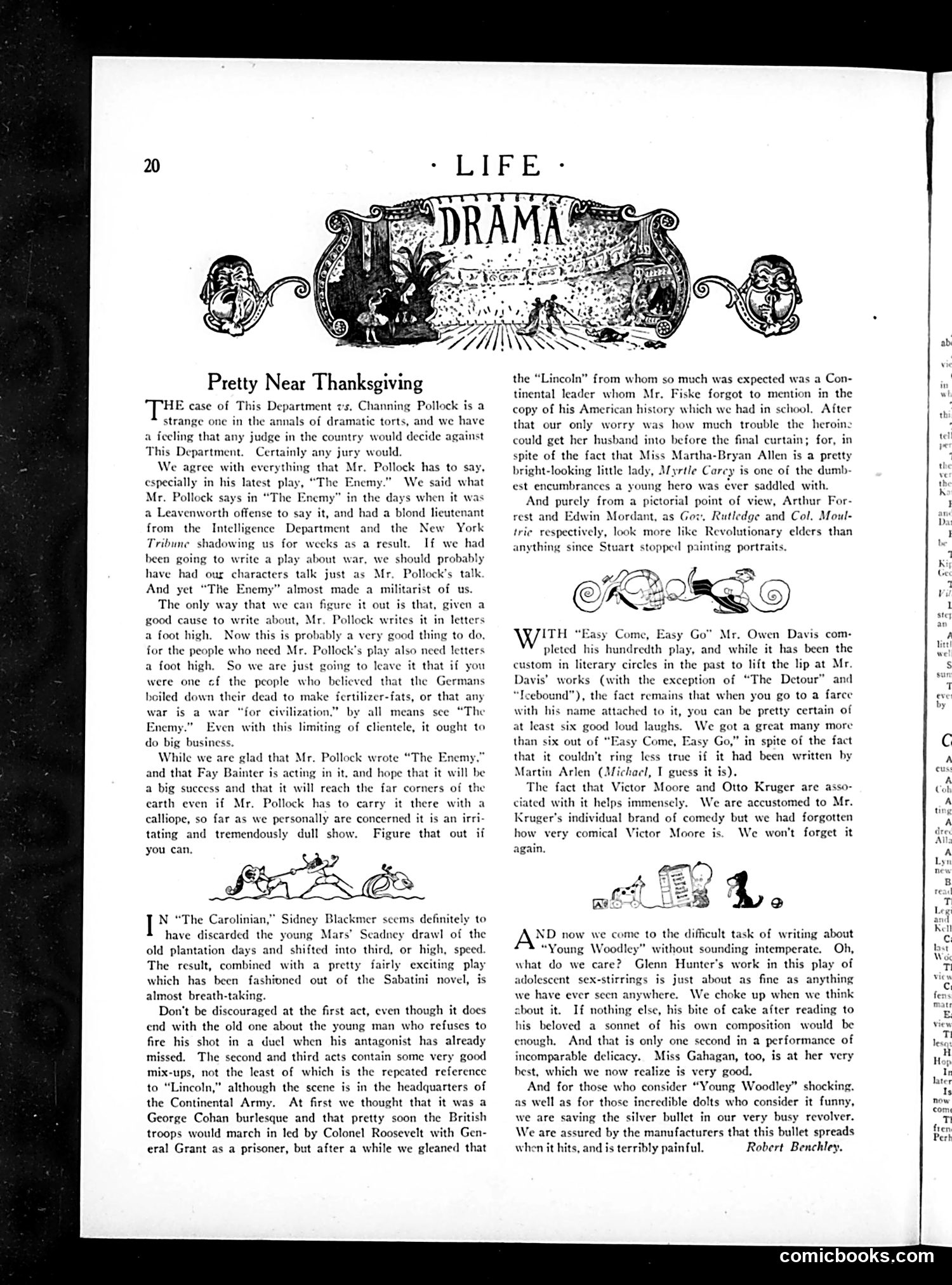
This page reviews three theatrical productions. The critic praises Channing Pollock's play "The Enemy"—which apparently presents anti-war arguments—while admitting finding it tediously written. The reference to "Leavenworth offense" suggests the critic themselves faced government scrutiny for expressing similar pacifist views during World War I. "The Carolinian," adapted from a Sabatini novel and featuring Sidney Blackmer, receives moderate praise for exciting action, though the critic mocks its confused historical setting (Continental Army scenes with mysterious references to "Lincoln"). Finally, Owen Davis's latest farce receives acknowledgment—apparently his hundredth play—with backhanded compliments about his comedic reliability despite critical dismissal of his other works. The reviews are characteristic of Life's satirical, irreverent theater criticism, mixing praise with pointed mockery of pretension and poor execution.
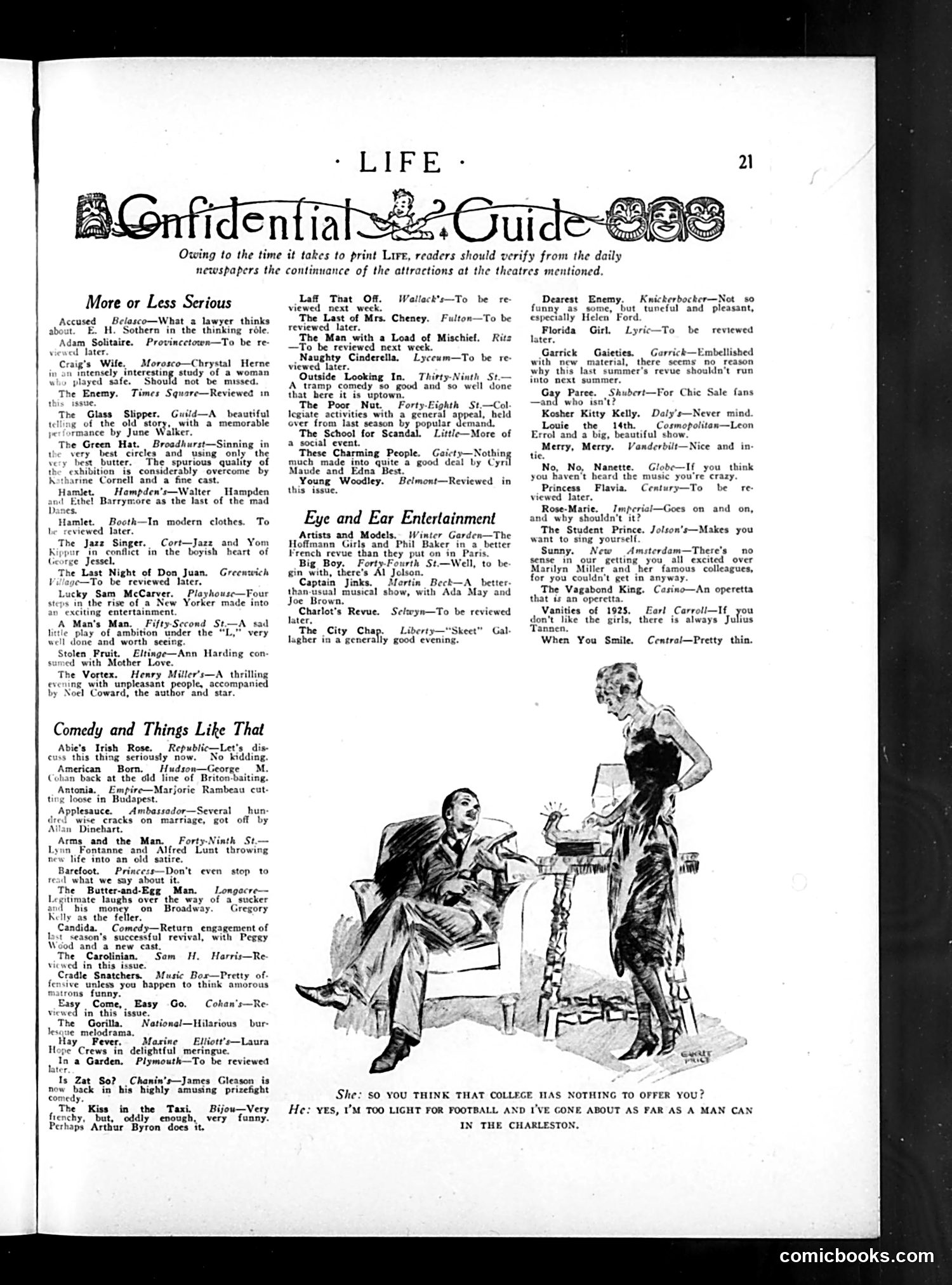
This is a **theater and entertainment review page** from Life magazine, circa mid-1920s. The main content lists current Broadway productions with brief critical assessments. The **cartoon illustration** at bottom depicts a social commentary scene: a young man in casual clothes addresses a seated, well-dressed older man, saying he's "too light for football" and finds college offers nothing compared to "a man can do in the Charleston." **The satire**: This mocks the era's youth culture obsession with the Charleston (a wildly popular dance craze of the 1920s) over traditional collegiate pursuits. The "light for football" detail suggests the young man prioritizes fashionable social dancing over athletic achievement—reflecting broader 1920s anxieties about generational values and the flappers'/youth's perceived rejection of older institutions. The page itself demonstrates Life's dual purpose: sophisticated theater criticism alongside social satire targeting contemporary fads and attitudes.
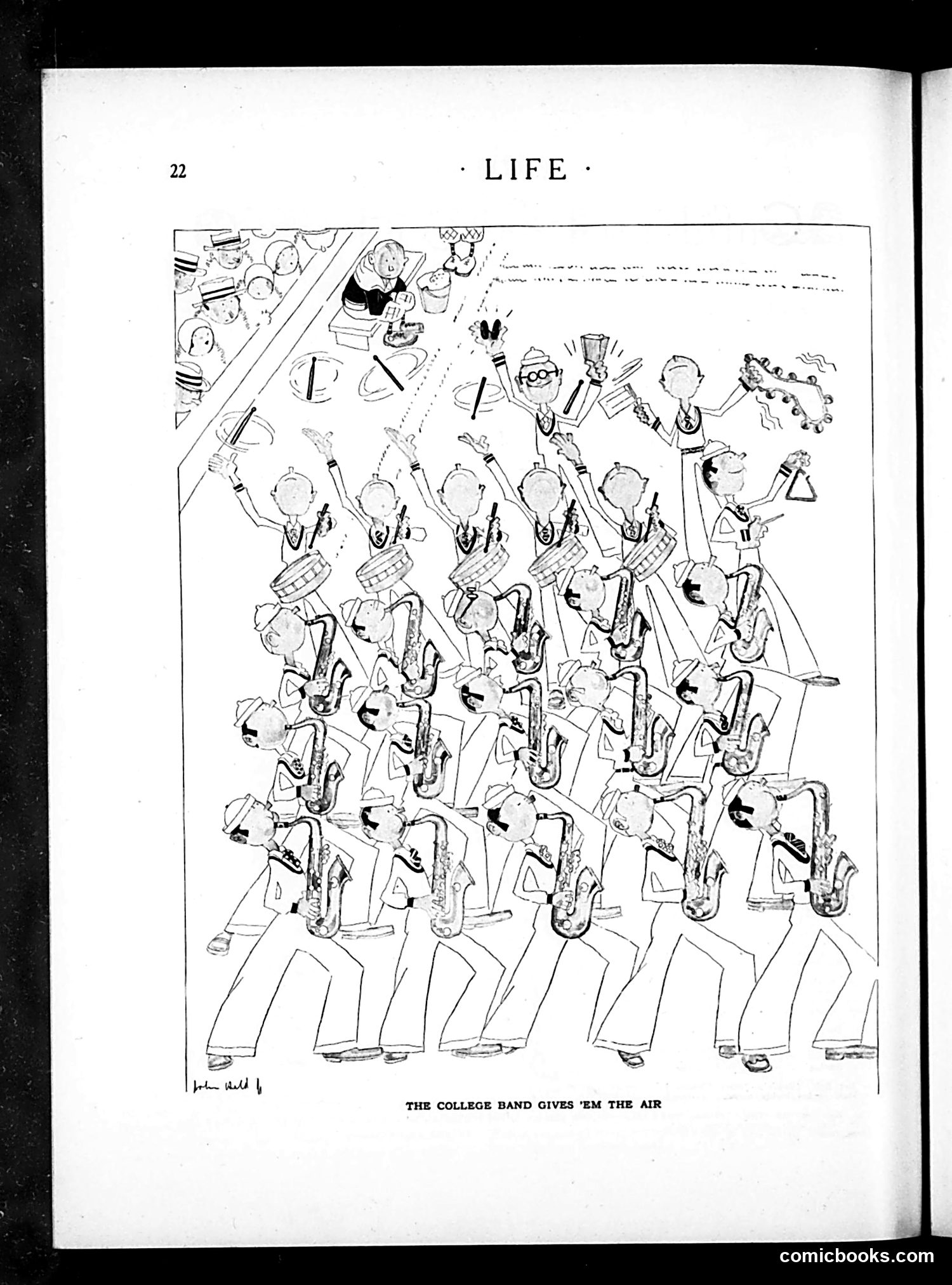
This cartoon depicts a large college marching band performing with saxophones. The humor appears to satirize the spectacle and uniformity of college band culture—rows of identically-dressed musicians playing in synchronized formation. The phrase "gives 'em the air" is a colloquial expression meaning to dismiss or snub someone, playing on the double meaning of a musical band literally producing "air" (sound). The cartoon likely mocks the pretentiousness of college musical performances or the conformity demanded of band members. The exaggerated scale and mechanical precision of the performers, combined with the casual phrase in the caption, creates satirical commentary on institutional structure and the individual's loss of identity within organized groups—common targets of Life magazine's social satire.
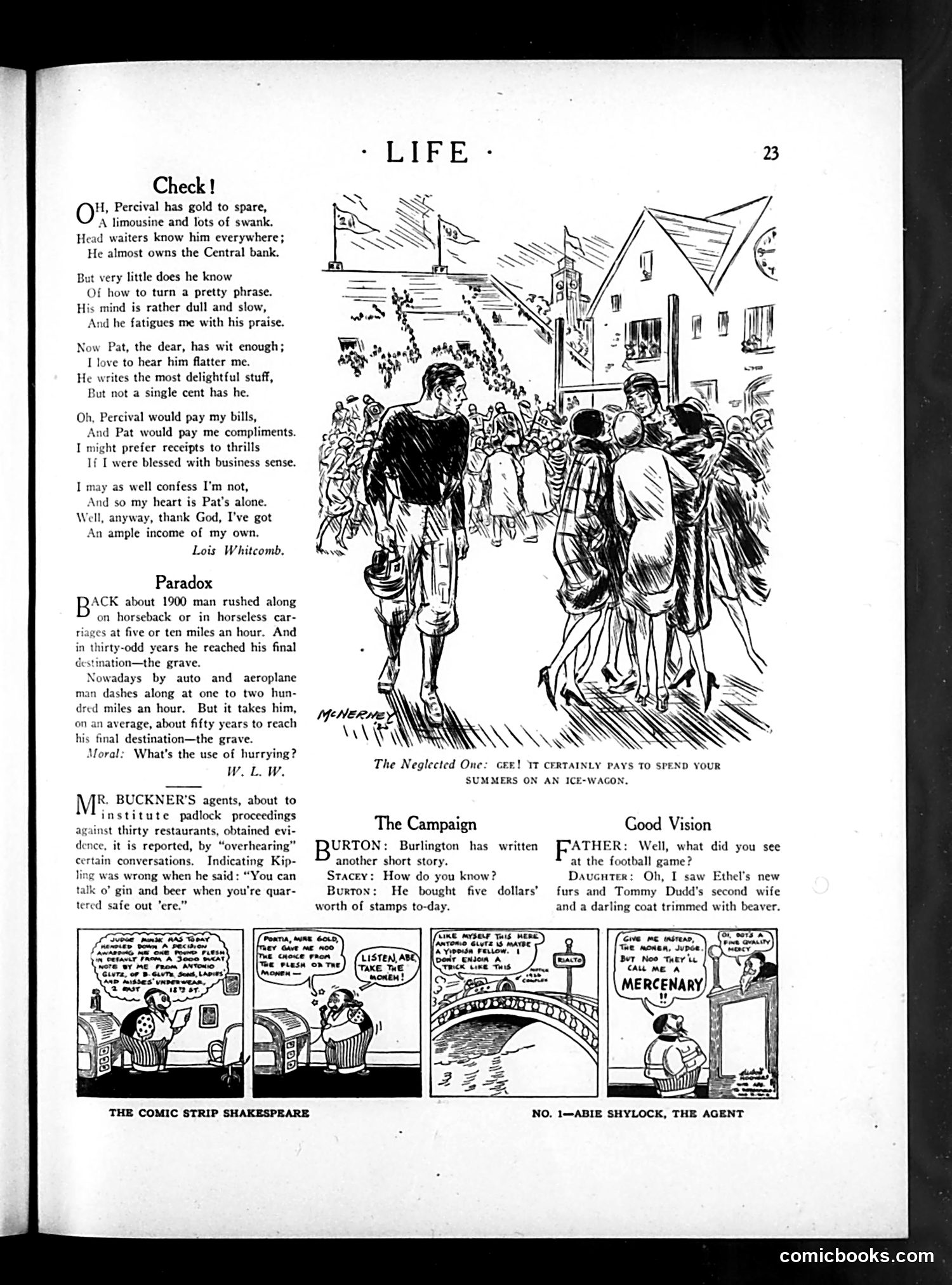
This page contains three distinct satirical pieces: **"Check!"** - A poem mocking the common dilemma of choosing between wealth and wit. A woman must decide between "Percival" (rich but dull) and "Pat" (charming but broke). The satire targets both wealthy men lacking intellect and the mercenary calculations of romance, ultimately resolving that she has her own income—a progressive joke about female financial independence for the era. **"Paradox"** - Satirizes the paradox of modern speed. Around 1900, people traveled slowly but reached death eventually; now they travel at 100-200 mph yet still take fifty years to die. The moral mocks society's obsession with speed and efficiency—we rush constantly but achieve no real time savings. **The comic strips** mock literary pretension ("Shakespeare") and appear to feature ethnic stereotyping common to the period (the "Abie Shylock" title references Jewish stereotypes). The overall theme: satirizing social vanity, economic inequality, and the gap between modern aspirations and actual human progress.
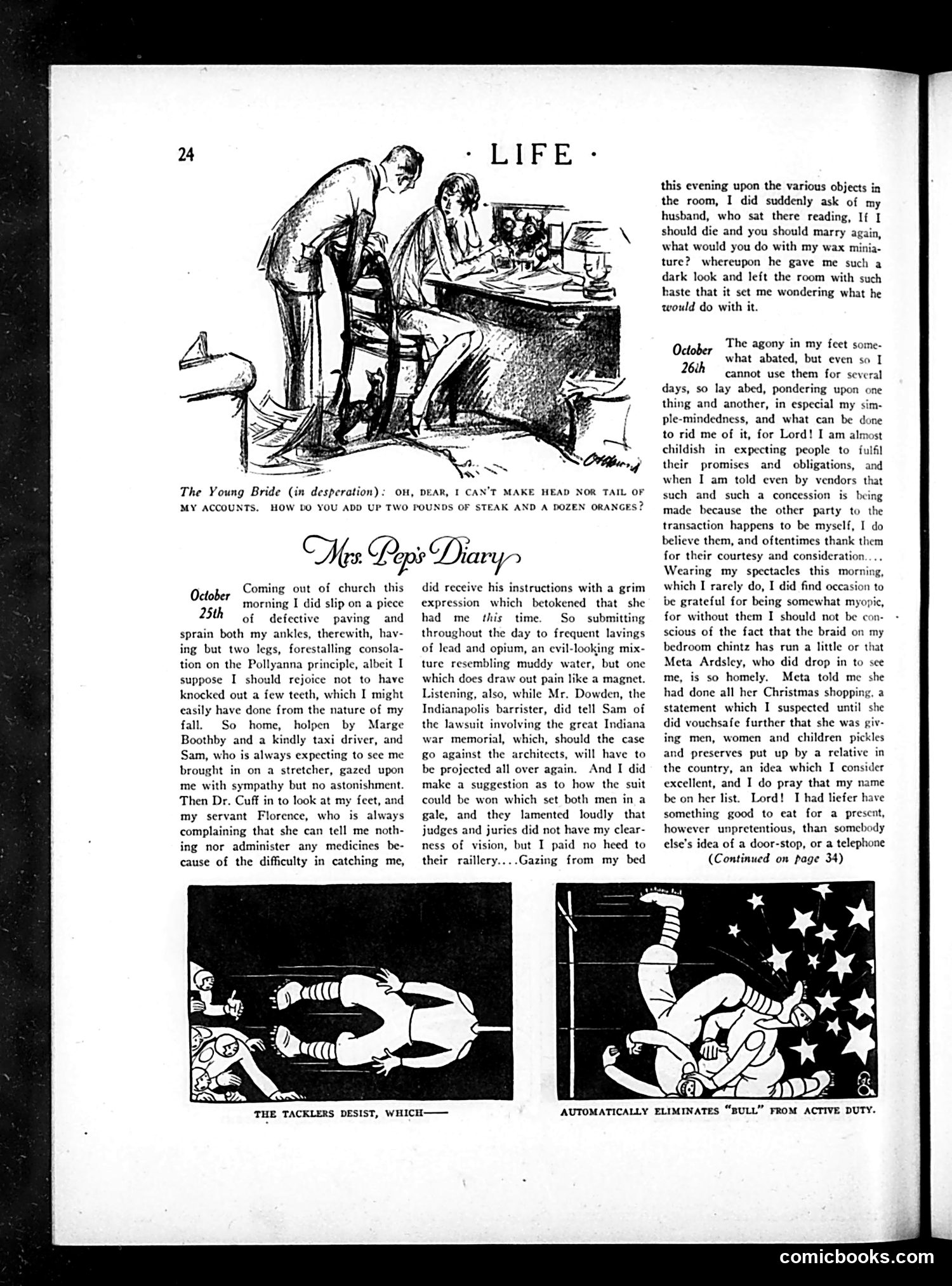
**The Top Cartoon:** "The Young Bride" depicts a newly married woman overwhelmed by household finances—she literally cannot balance basic grocery accounts (adding "two pounds of steak and a dozen oranges"). The satire mocks young wives' supposed incompetence with money management, a common early-20th-century stereotype. **Mrs. Peps' Diary:** This humorous diary column follows a gossipy socialite recounting her sprained ankles, domestic servants, and social observations. The tone is satirically self-aware—the narrator admits her own "simple-mindedness" while observing others. **Bottom Cartoons:** These appear to show military or athletic figures, with captions referencing "tacklers" and "bull from active duty"—likely satirizing sports or military discipline, though context is unclear without seeing page 34's continuation. The page exemplifies Life magazine's satirical approach: gentle mockery of contemporary social conventions, particularly regarding women, class hierarchies, and domestic life in what appears to be the 1910s-1920s era.
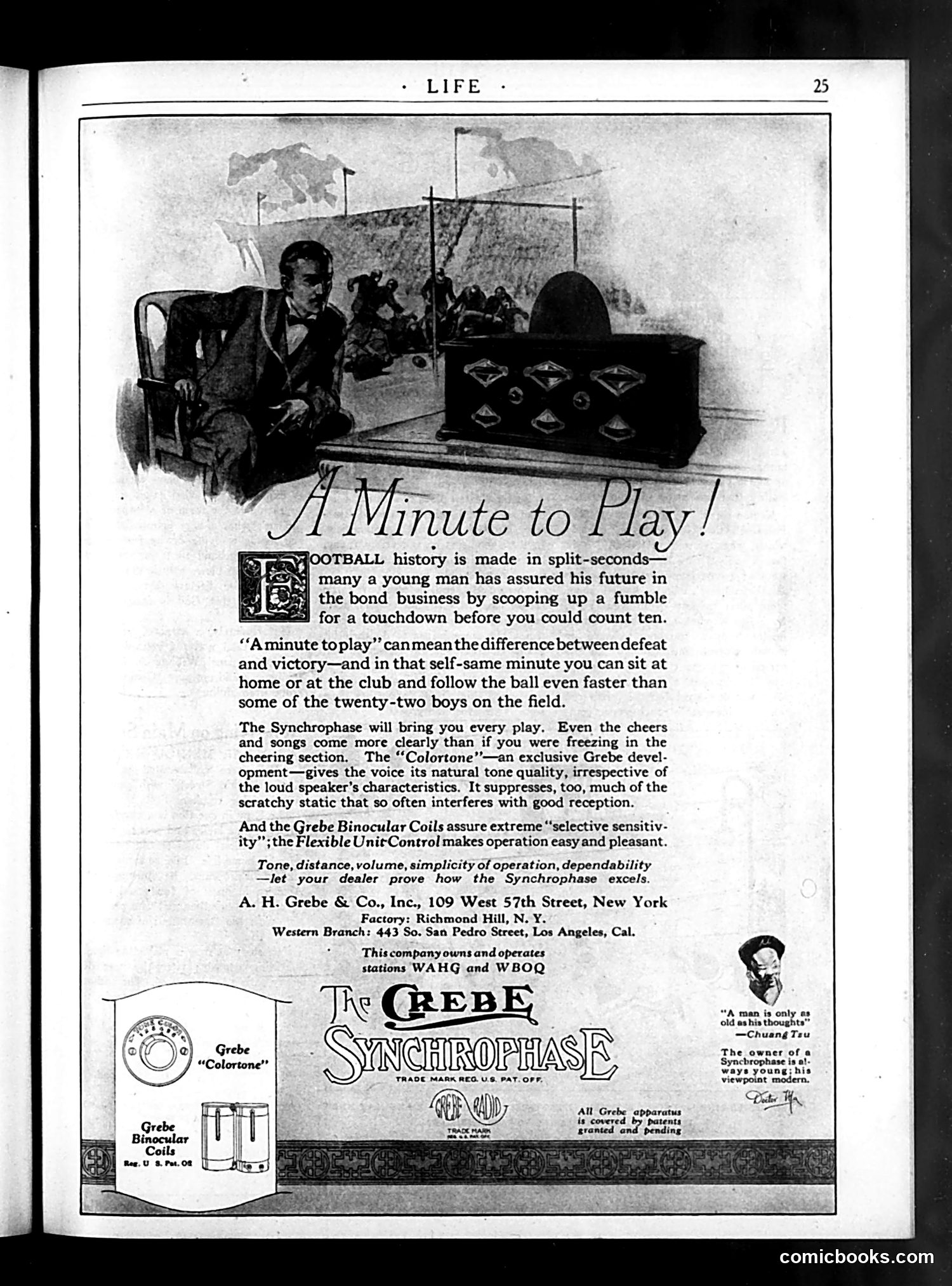
This is primarily a **radio advertisement**, not political satire. It promotes the Grebe Synchrophase radio receiver. The cartoon shows a man at home listening to a football game via radio while simultaneously following the action better than spectators freezing in the stadium. The joke is that radio technology allows him to experience the game faster and more comfortably than being physically present—he can follow plays "even faster than some of the twenty-two boys on the field." The ad emphasizes the radio's technical superiority: the "Colortone" feature provides natural sound quality, reduces static interference, and the "Binocular Coils" offer selective sensitivity. The Confucius quote about youth and modernity reinforces the message that owning this modern radio receiver is a progressive, youthful choice. This reflects 1920s-30s enthusiasm for radio as transformative consumer technology that could replace or improve upon traditional experiences.
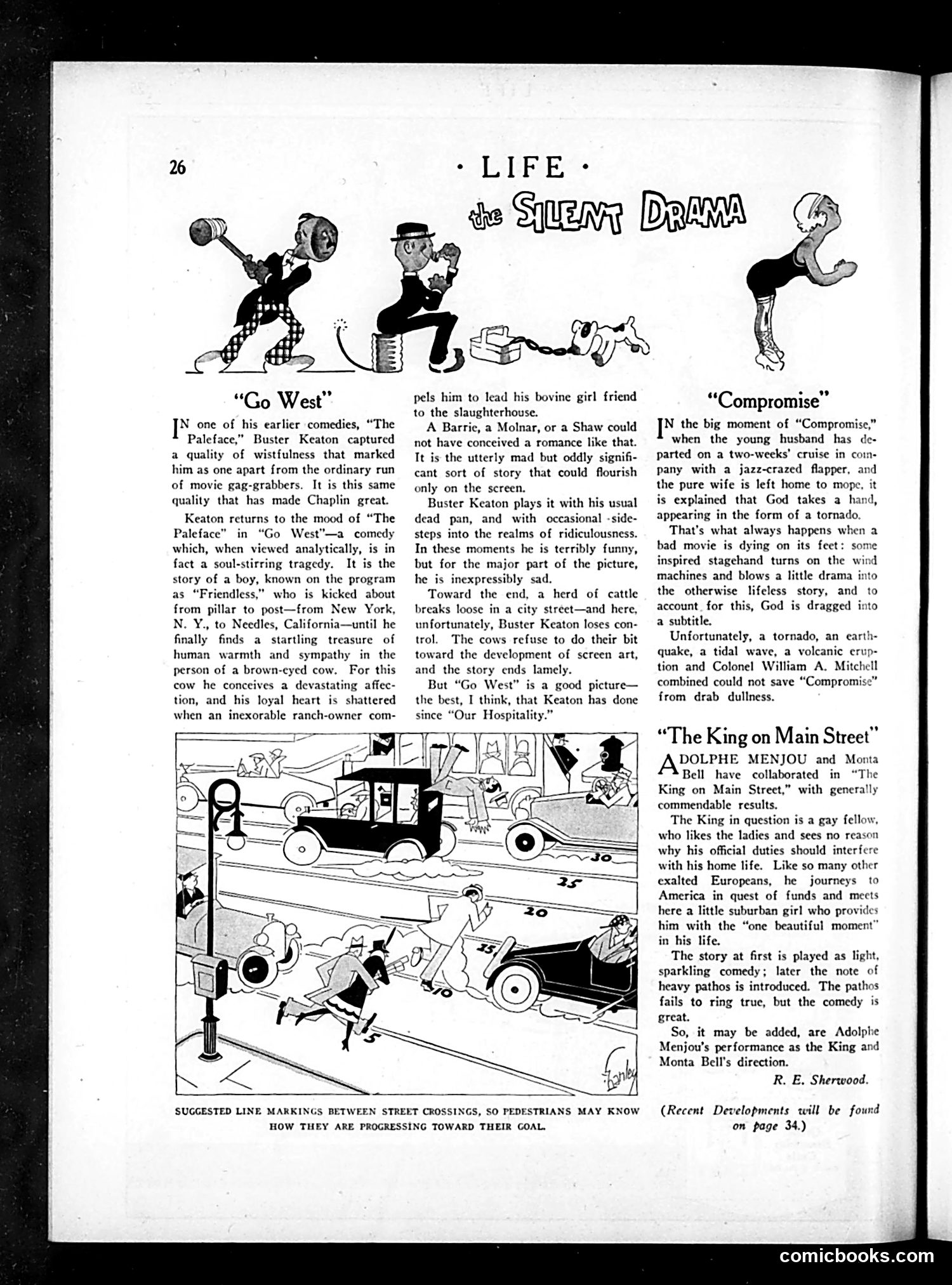
This page reviews three silent films. The top cartoon satirizes pedestrian safety in chaotic streets—suggesting line markings so walkers can track progress toward their destination amid traffic chaos, a humorous commentary on urban congestion. Below are three film critiques: **"Go West"** (Buster Keaton): The reviewer praises Keaton's emotional restraint, noting he plays a friendless boy who bonds with a cow before she's sent to slaughter. It's described as unexpectedly tragic for a comedy, though the cattle stampede scene loses control. **"Compromise"**: Dismissed as dull melodrama where a tornado (literally "God") artificially injects drama into a lifeless story about a husband's cruise while his wife waits home. **"The King on Main Street"** (Adolphe Menjou, Monta Bell): A European monarch visits America seeking funds and romance with a suburban girl. Praised for comedy but criticized for unconvincing pathos, though Menjou's performance is commended. The reviewer is R.E. Sherwood.
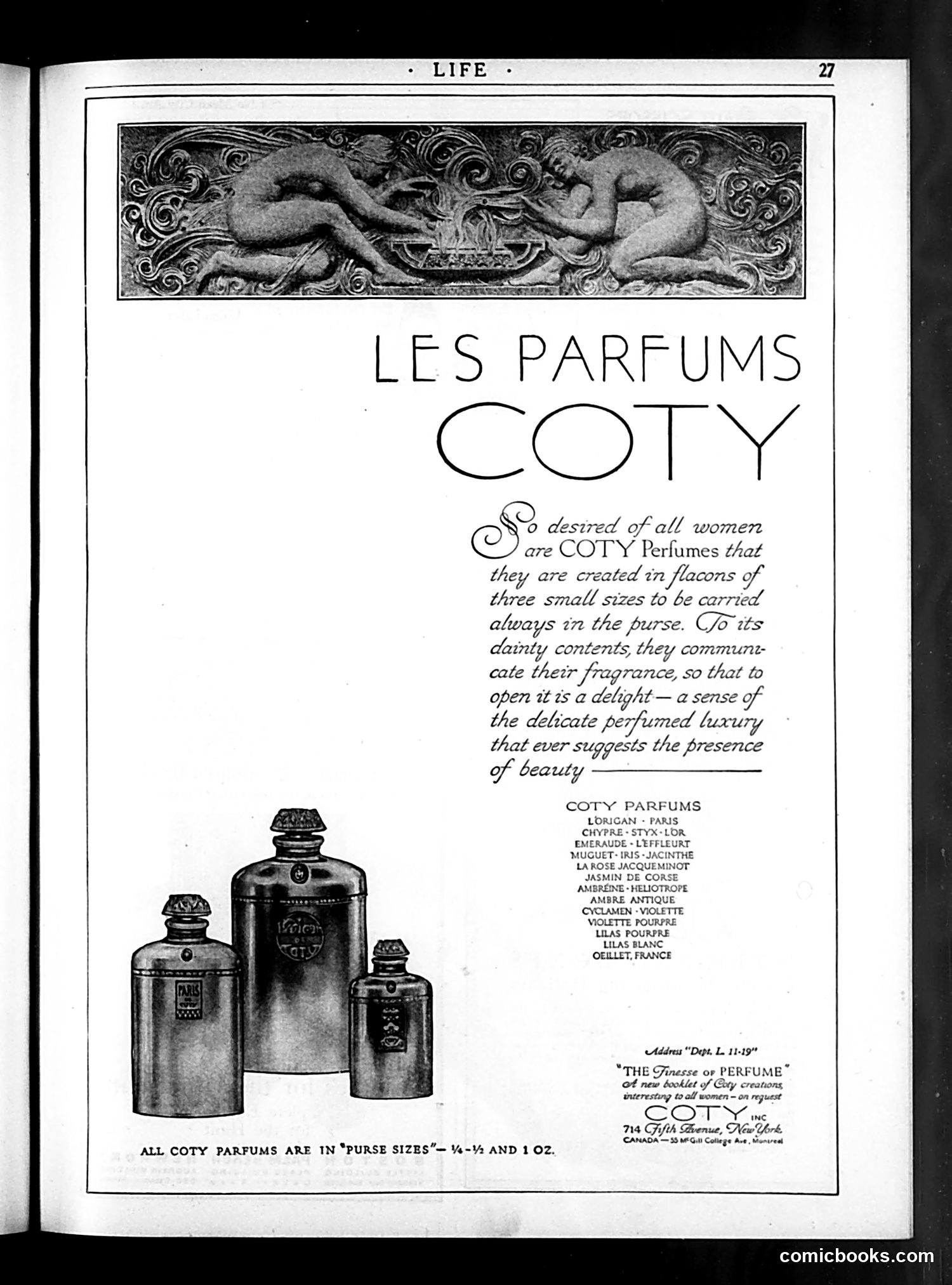
This is a **perfume advertisement**, not a political cartoon or satire. It's a full-page ad for Coty Perfumes from what appears to be the 1920s-1930s era. The page features: - **Ornamental header**: Decorative classical imagery of cherubs/putti (cherub figures) - **Three perfume bottles** in descending sizes, demonstrating the "purse sizes" mentioned - **Marketing copy** emphasizing luxury and femininity: perfumes are "desired of all women" and evoke "delicate perfumed luxury" and "beauty" - **Product list**: Multiple fragrance varieties (L'Origan, Chypre, Emeraude, Muguet, etc.) from the Paris-based Coty company - **Distribution information**: Available in three sizes (¾, ½, and 1 oz) for convenient carrying The advertisement targets female consumers by emphasizing portability, elegance, and refined taste. There is no satirical commentary or political content—this is straightforward luxury goods marketing from the early 20th century.
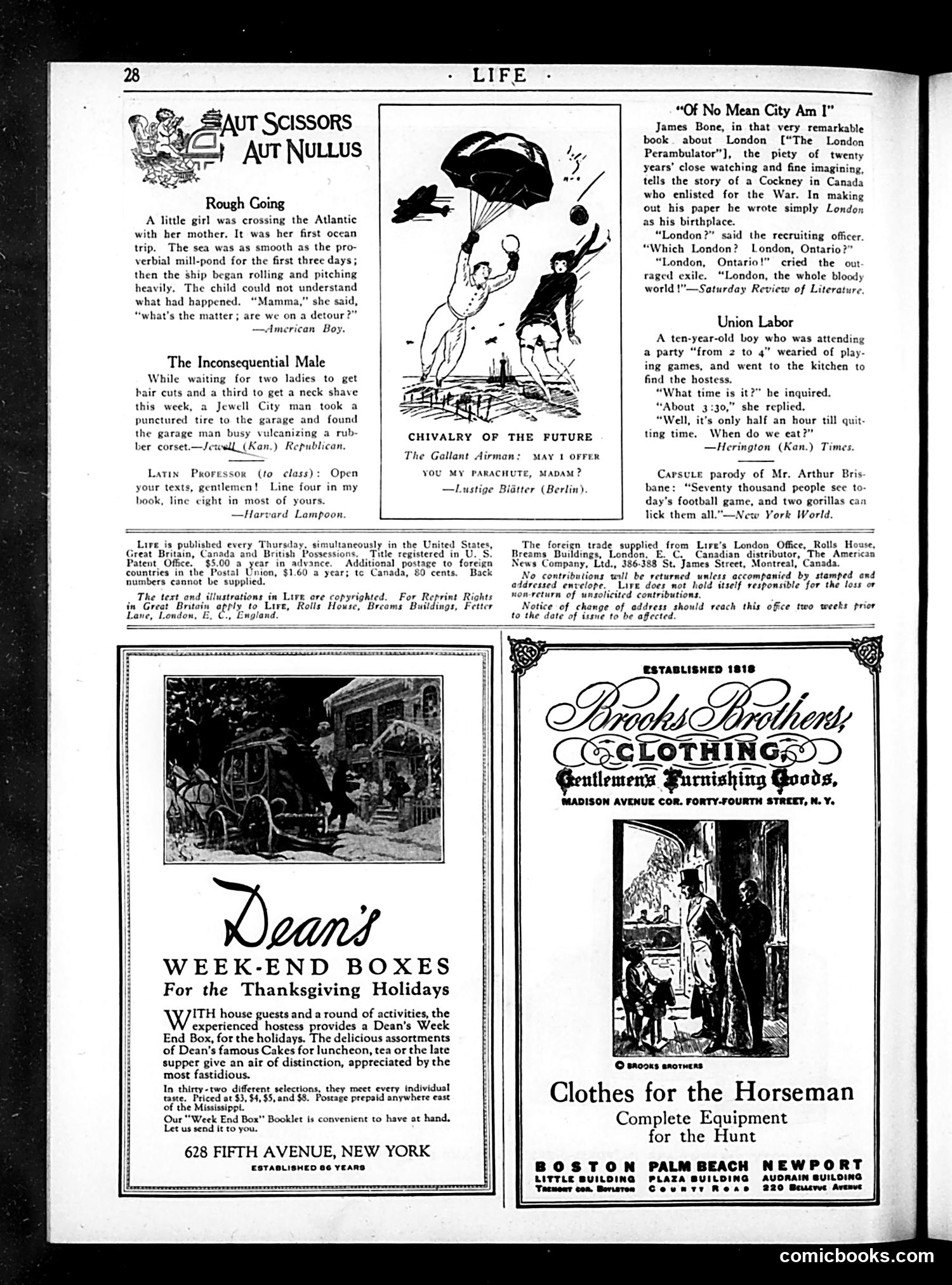
The main cartoon, titled "Chivalry of the Future," depicts two aviators parachuting from the sky, with one asking the other "May I offer you my parachute, madam?" The attribution to *Lustige Blätter* (a Berlin publication) indicates this is satirizing World War I–era chivalry as absurdly outdated. The joke: During aerial combat, an aviator maintains formal courtly manners by offering his parachute to a female—an obviously impractical gallantry when both pilots face immediate danger. It mocks how traditional "chivalrous" behavior becomes ridiculous in modern warfare's chaos. The German source suggests this was satirizing both sides' romantic notions about combat. The page also includes brief humorous items about wartime realities and civilian confusion, fitting Life magazine's role as a satirical publication commenting on contemporary American life and the ongoing World War.
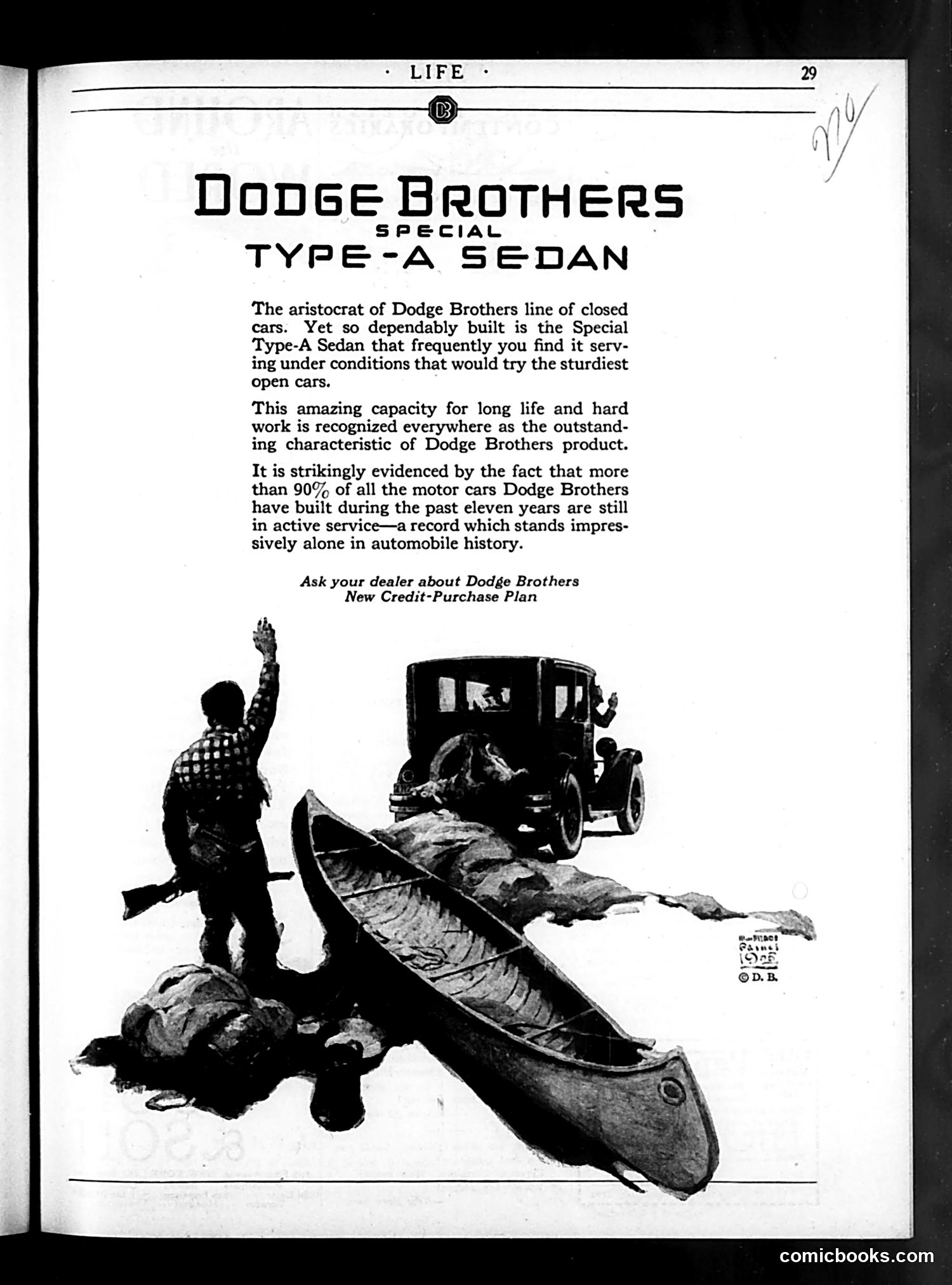
This is primarily a **Dodge Brothers automobile advertisement**, not political satire. The page promotes the Special Type-A Sedan by claiming exceptional durability and reliability. The illustration depicts a triumphant outdoorsman with raised fist beside a canoe, with a Dodge sedan visible in the background. This imagery contrasts rugged outdoor adventure with the car's dependability—suggesting the vehicle is as tough and reliable as wilderness equipment. The advertisement's central claim is that over 90% of Dodge cars built in the previous eleven years remain in active service, positioning this as an unmatched industry record. The pitch emphasizes the car's ability to withstand harsh conditions "that would try the sturdiest open cars." The page also mentions a "New Credit-Purchase Plan," indicating financing options were becoming a sales tool during this automotive era.
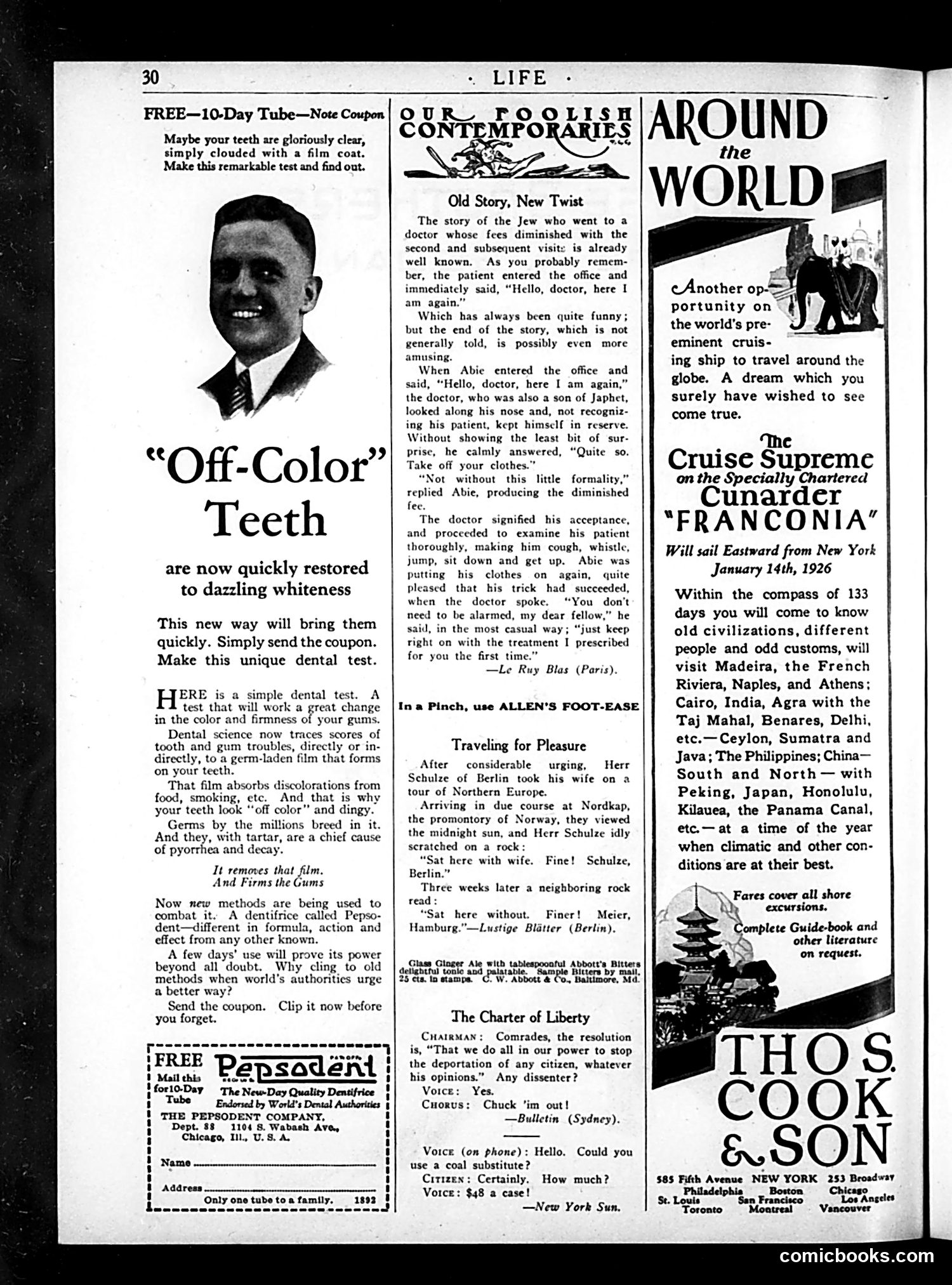
This page is primarily **advertising**, dominated by a Pepsodent toothpaste ad featuring a man's face promoting "Off-Color" Teeth restoration. The ad appeals to consumers worried about tooth discoloration caused by germs and tartar. Below this are three brief **satirical anecdotes** under "Our Contemporaries" (reprints from other publications): 1. **"Old Story, New Twist"**: A Jewish patient's trick—pretending to be a repeat customer to get reduced medical fees—backfires when the doctor (also Jewish) doesn't recognize him and charges full price anyway. 2. **"Traveling for Pleasure"**: A German couple visits Norway; the husband inscribes "Sat here with wife"; weeks later, another visitor writes on a nearby rock "Sat here without. Finer!"—a crude marital infidelity joke. 3. **"The Charter of Liberty"**: A labor/political meeting votes on preventing citizen deportation; when asked if anyone dissents, one voice says yes, and the group votes to expel the dissenter—satirizing mob rule and hypocrisy. The humor relies on ethnic stereotypes and wordplay typical of 1920s satire.
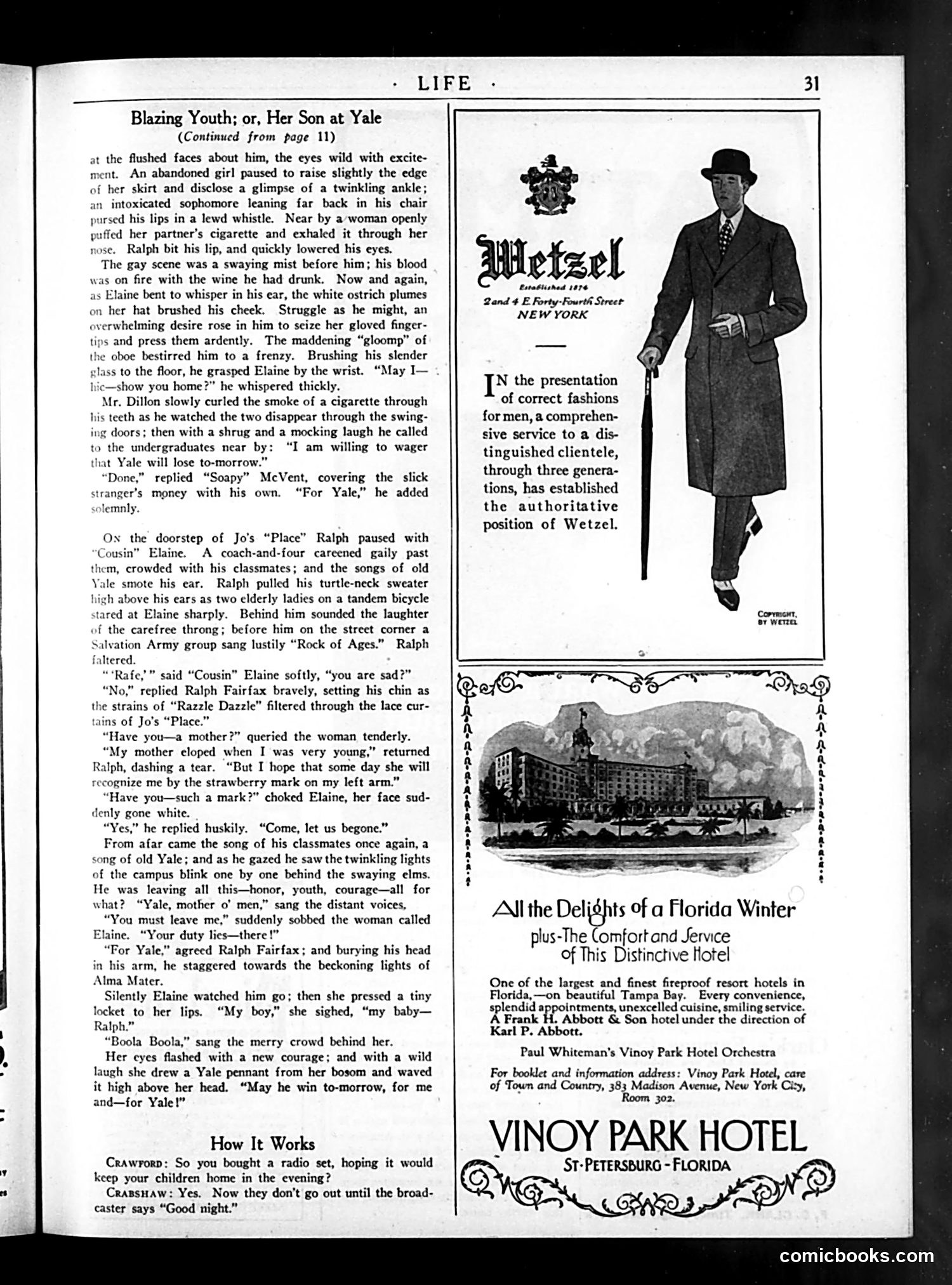
This serialized story satirizes the perceived moral decay of 1920s youth culture, particularly at elite universities like Yale. The narrative follows Ralph Fairfax, a sheltered young man encountering a morally loose social scene at a dance hall called Jo's "Place." The satire targets: - **Jazz Age excess**: abandoned girls, intoxicated students, women smoking openly—all scandalous behaviors for the era - **Youthful weakness**: Ralph succumbs to temptation and wine despite his innocence - **Class anxiety**: elderly ladies stare disapprovingly at Ralph with a woman of questionable virtue The melodramatic plot (mysterious strawberry birthmark, the woman's self-sacrifice) mocks sentimental Victorian morality tales, suggesting they're inadequate guides for navigating modern degeneracy. The story implies even prestigious institutions cannot protect youth from urban corruption. The page also carries advertisements for Wetzel (men's fashion) and Vinoy Park Hotel, typical of *Life*'s satirical-yet-commercial format.
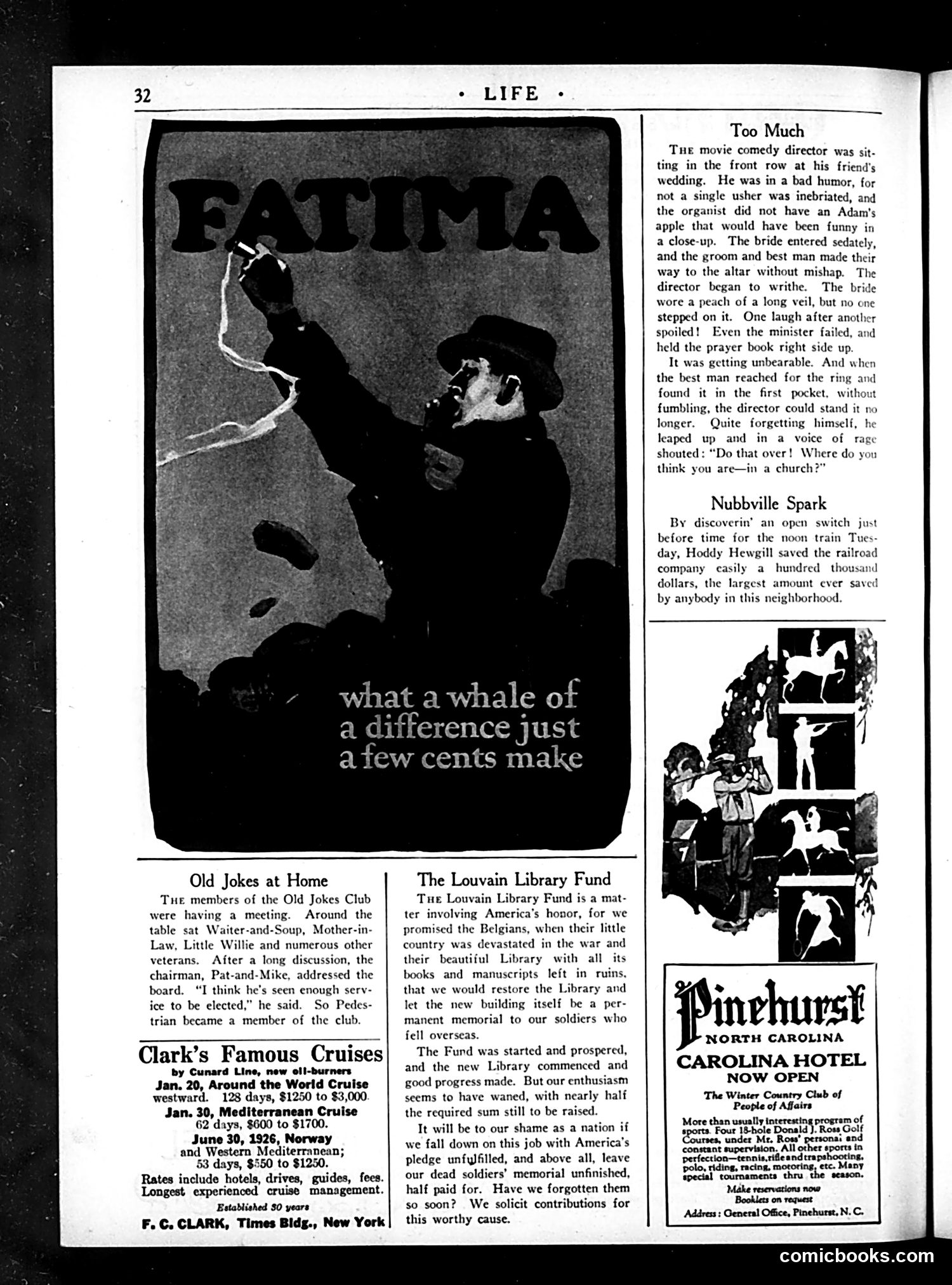
This page contains three humorous short stories typical of Life's satirical humor circa the 1920s: **"Too Much"** mocks a film comedy director attending a wedding who is frustrated that nothing goes wrong—no drunk ushers, no physical mishaps, no comic timing failures. He's so conditioned to expect slapstick that a dignified ceremony offends his sensibilities. The joke satirizes how entertainment industry professionals view real life through the lens of manufactured comedy. **"Old Jokes at Home"** is a meta-joke about a club dedicated to recycling tired jokes (represented by stock characters like "Mother-in-Law" and "Little Willie"). They vote to admit "Pedestrian" as a member—the humor being that pedestrian, worn-out jokes belong in a club for old jokes. **"Nubbville Spark"** is a small-town tall tale about a man who discovers a railroad switch problem and supposedly saves "a hundred thousand dollars"—the joke being the absurd exaggeration typical of rural boasting. The page also contains period advertisements and fundraising appeals, including one for Belgian war relief, reflecting post-WWI American concerns.
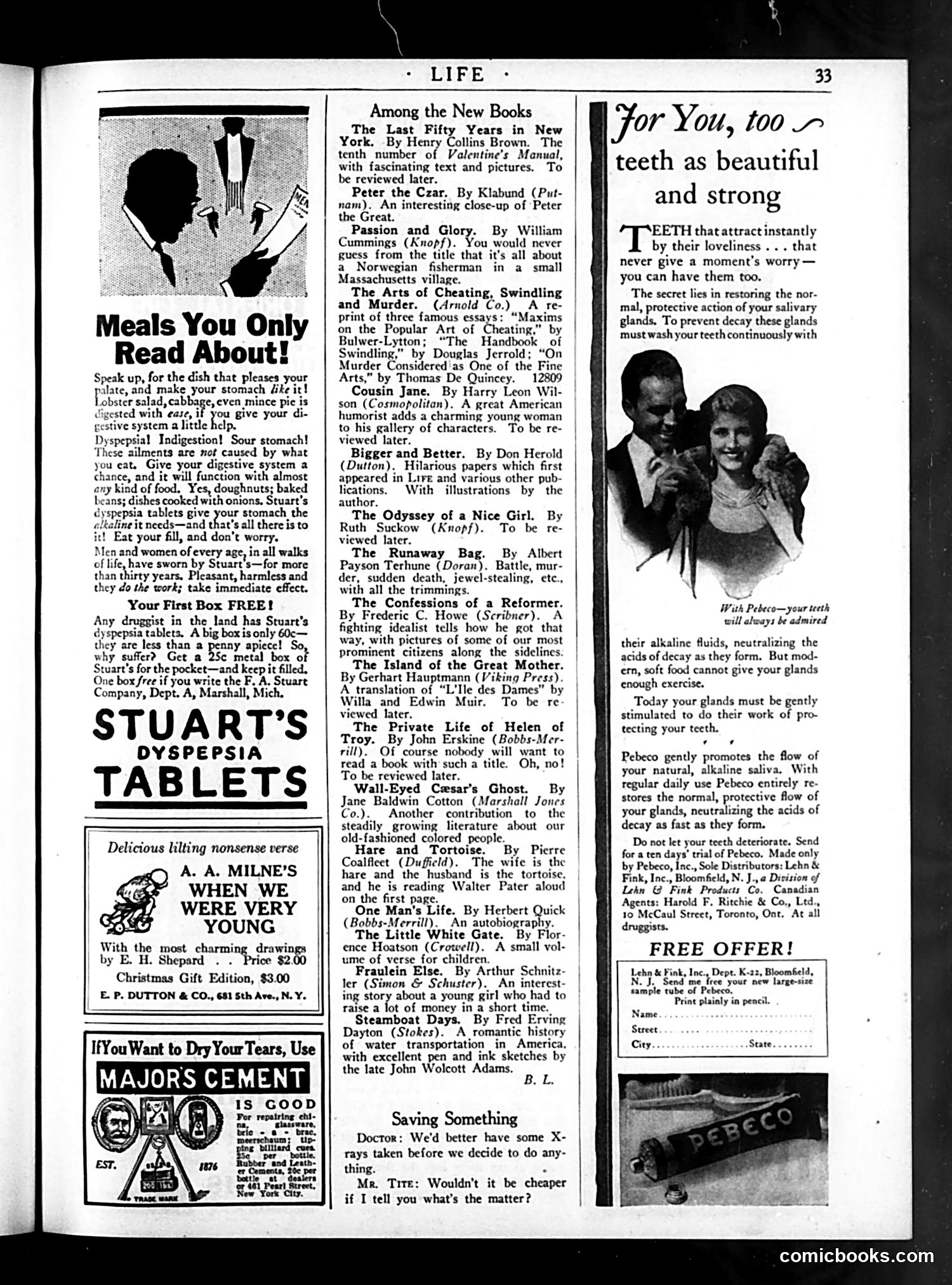
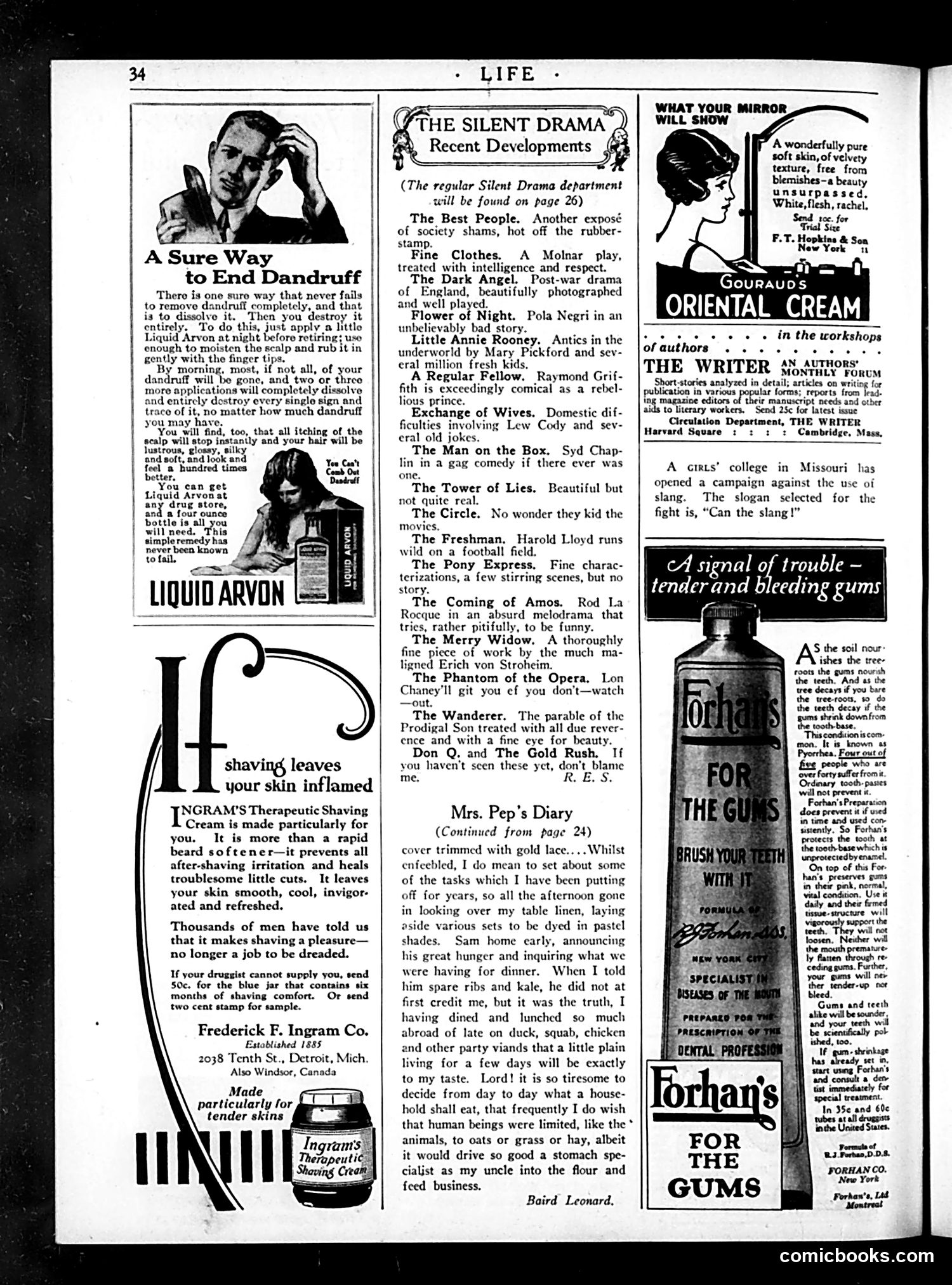
This page is primarily **advertising and entertainment content**, not political satire. The main elements are: **Advertisements:** Three product ads dominate—Liquid Arvon (dandruff treatment), Ingram's Therapeutic Shaving Cream, and Forhan's For The Gums (dental product). These reflect 1920s consumer anxieties about grooming and hygiene. **"The Silent Drama" section:** Brief, sardonic reviews of recent silent films. The commentary is caustic—dismissing "The Circle" as mockery-worthy, calling "Flower of Night" "unbelievably bad," and noting "The Freshman" lacks story. This represents *Life* magazine's characteristic irreverent film criticism. **"Mrs. Pep's Diary":** A society humor column describing domestic life—the diarist mentions weakness from illness, organizing linens, and serving spare ribs to her hungry husband. It's gentle satire of upper-middle-class domesticity. The page reflects 1920s preoccupations: consumer products, motion pictures as major entertainment, and genteel social comedy rather than hard-hitting political commentary.
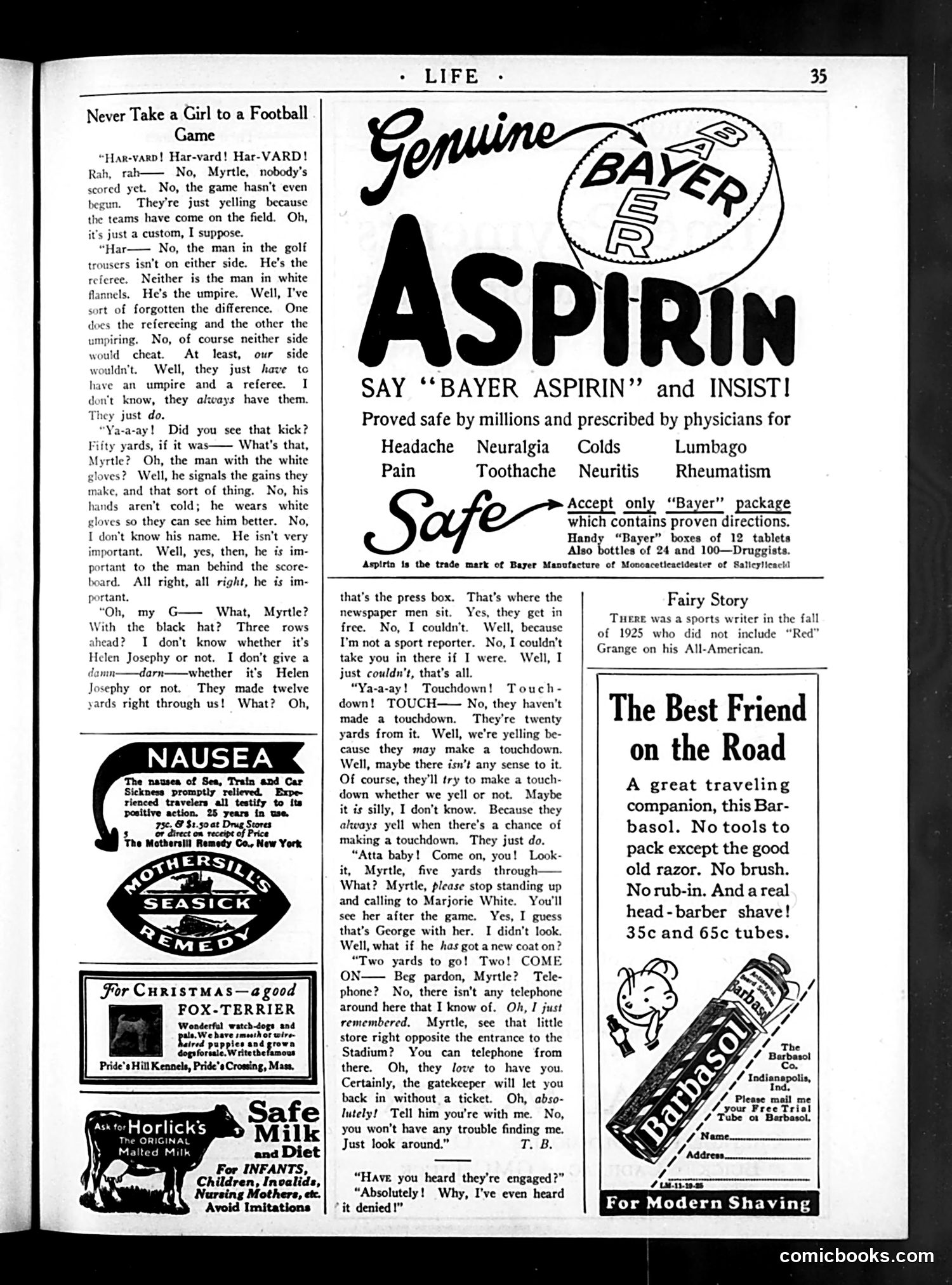
This page satirizes the experience of taking a woman to a college football game (apparently Harvard, based on the opening cheers). The main comic article is a dialogue between an exasperated male companion and his date, "Myrtle," who asks naive questions throughout the game: she doesn't understand why fans yell before play begins, confuses the referee and umpire, and asks why players would cheat. The satire targets both Myrtle's ignorance of sports and the male companion's condescending, increasingly frustrated explanations. The humor relies on period gender stereotypes—the assumption that women find football incomprehensible and tedious, caring more about socializing (mentioning Marjorie White and George's new coat) than the game itself. The page is otherwise dominated by advertisements (Bayer Aspirin, Barbosol shaving cream, Horlick's milk), typical of Life magazine's format.
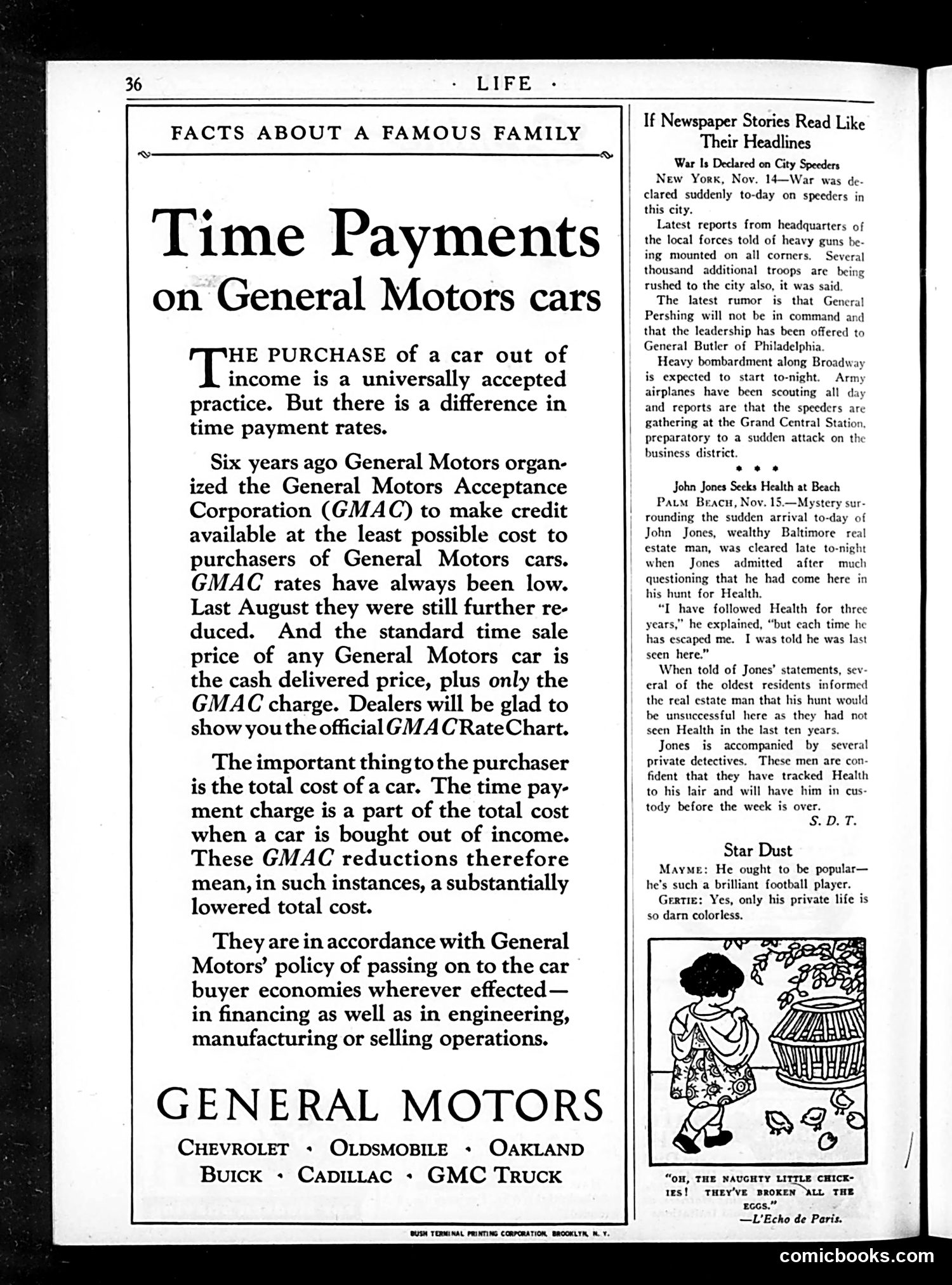
This page is primarily **General Motors advertising** for GMAC (General Motors Acceptance Corporation), their financing division. The ad emphasizes that GM's time-payment rates for cars are lower than competitors', positioning financing as a benefit to buyers. The right side contains **humorous satirical pieces** mocking sensationalist newspaper headlines: 1. **"War Is Declared on City Speeders"** — satirizes how newspapers use war/military language to describe mundane civic enforcement (traffic enforcement), treating parking violations like military combat with "heavy guns," "troops," and "bombardment." 2. **"John Jones Seeks Health at Beach"** — parodies missing-person stories by treating "Health" as a person Jones is literally hunting, with detectives tracking it. The joke: locals haven't "seen Health" in ten years—a grim social commentary on the area's wellness. 3. **"Star Dust"** — a brief joke about a football player being popular professionally but having a colorless private life. The small cartoon (credited to *L'Echo de Paris*) shows children breaking eggs—a lighthearted visual gag unrelated to the other content.
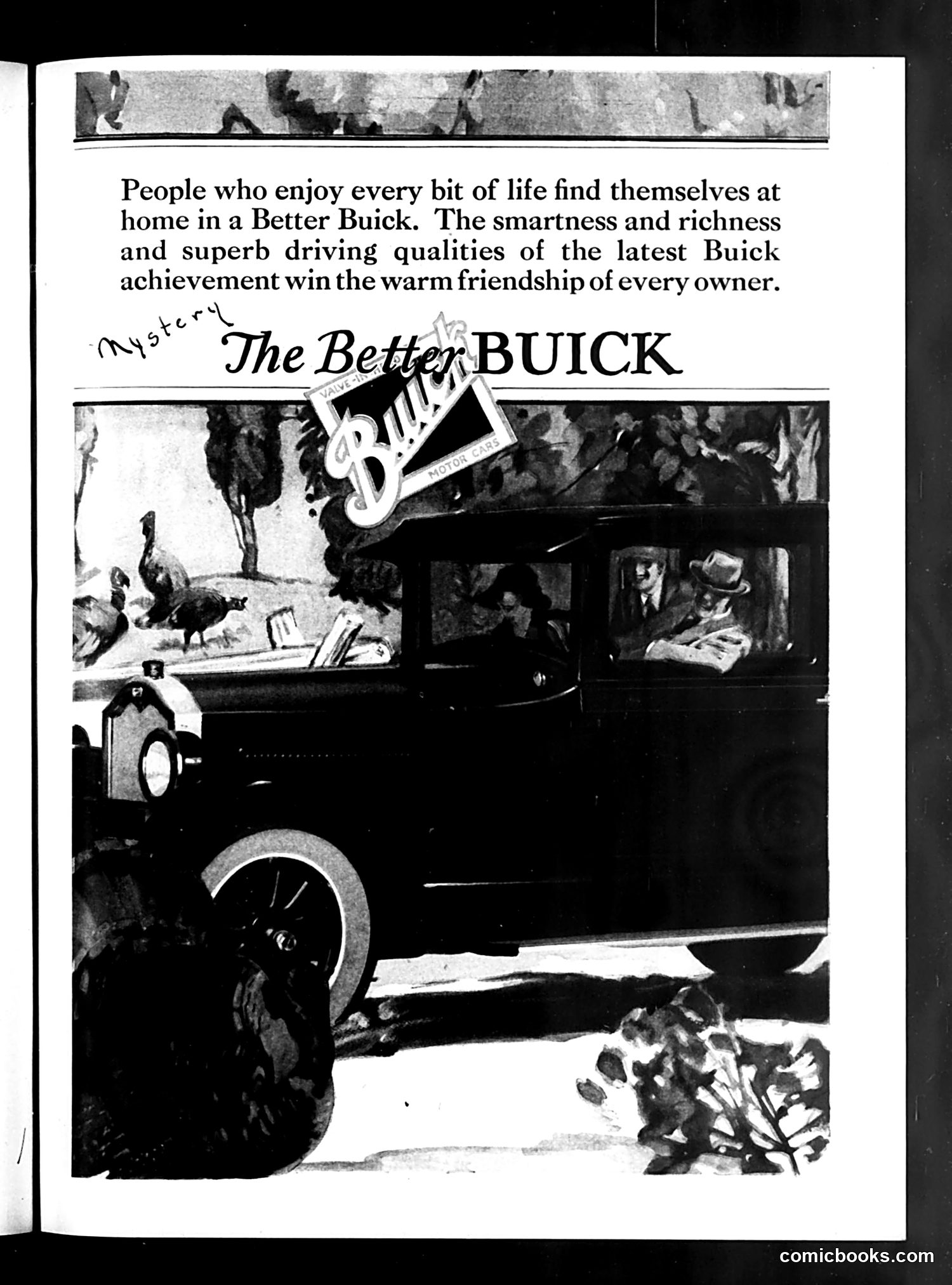
This is a **Buick automobile advertisement**, not political satire. The ad promotes the "Better Buick" by depicting a well-dressed couple in an elegant car enjoying leisure activities—they're shown observing birds and scenery during what appears to be a pleasant country drive. The tagline appeals to affluent consumers by suggesting that owning a Buick signals both social sophistication ("smartness and richness") and practical quality ("superb driving qualities"). The illustration emphasizes leisure, refinement, and the car as a status symbol that provides social belonging ("warm friendship of every owner"). This represents typical 1920s-era luxury automobile marketing targeting middle and upper-class readers of *Life* magazine.
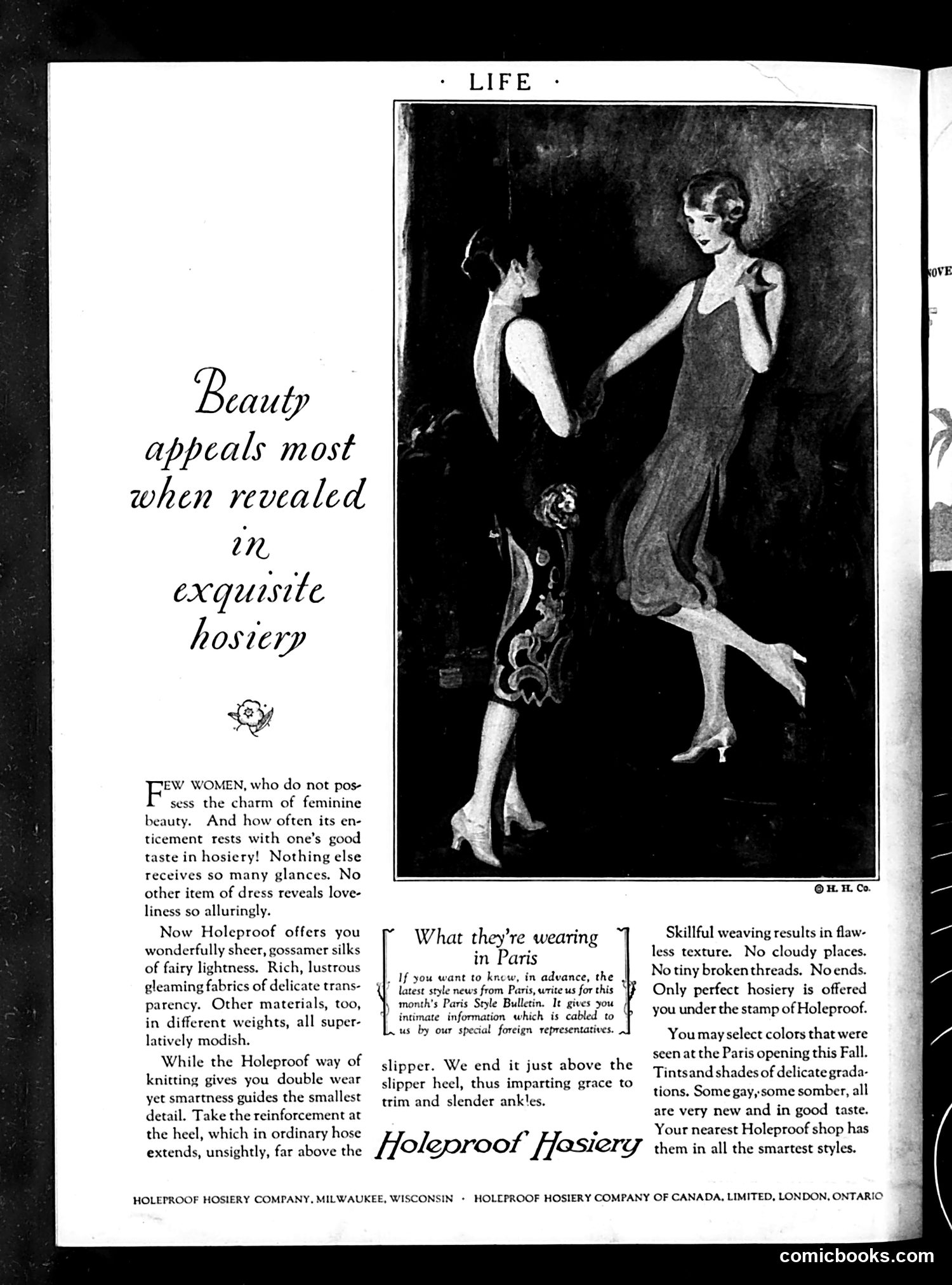
This is a **Holeproof Hosiery advertisement**, not political satire. The illustration depicts two women in 1920s-style dress and heels, showcasing women's stockings—the product being sold. The ad's rhetorical strategy appeals to women's vanity and social awareness: it argues that hosiery, more than any other garment, reveals feminine beauty and receives constant scrutiny ("receives so many glances"). The text emphasizes quality (sheer fabrics, reinforced heels, flawless weaving) and fashion-consciousness, including a promotion for a "Paris Style Bulletin" to establish trendiness. The phrase "Beauty appeals most when revealed in exquisite hosiery" frames stockings as essential to feminine attractiveness—a common advertising approach of the era. The reference to Paris fashion signals aspirational, modern femininity. This reflects 1920s consumer culture targeting women's appearance and desire for fashionable products.