
Life, 1925-11-19 · page 28 of 40
Life — November 19, 1925 — page 28: what you’re looking at
What you’re looking at
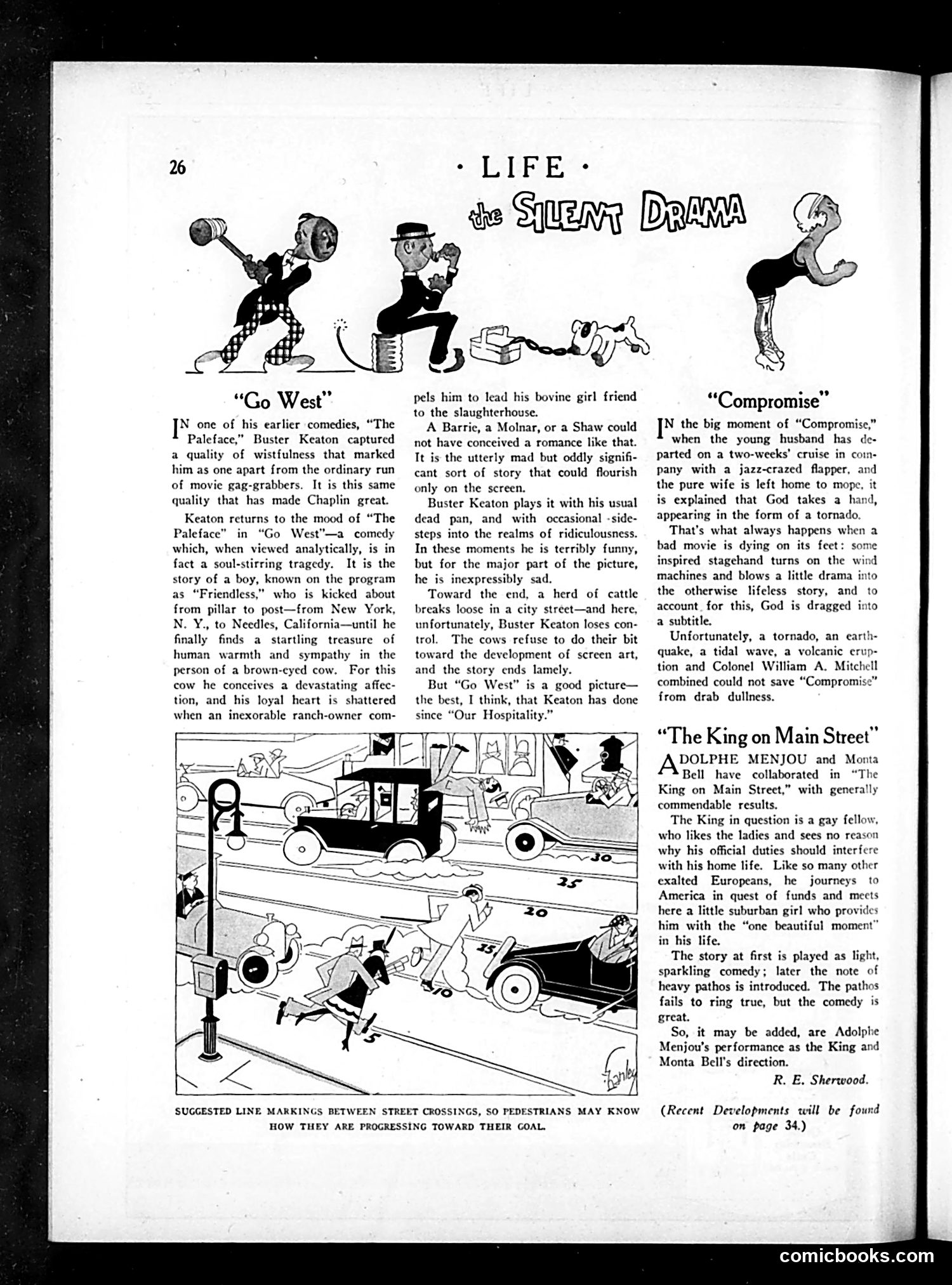
This page reviews three silent films. The top cartoon satirizes pedestrian safety in chaotic streets—suggesting line markings so walkers can track progress toward their destination amid traffic chaos, a humorous commentary on urban congestion. Below are three film critiques: **"Go West"** (Buster Keaton): The reviewer praises Keaton's emotional restraint, noting he plays a friendless boy who bonds with a cow before she's sent to slaughter. It's described as unexpectedly tragic for a comedy, though the cattle stampede scene loses control. **"Compromise"**: Dismissed as dull melodrama where a tornado (literally "God") artificially injects drama into a lifeless story about a husband's cruise while his wife waits home. **"The King on Main Street"** (Adolphe Menjou, Monta Bell): A European monarch visits America seeking funds and romance with a suburban girl. Praised for comedy but criticized for unconvincing pathos, though Menjou's performance is commended. The reviewer is R.E. Sherwood.
📄 Transcribed text from this page (OCR, searchable)
Machine-transcribed from the original scan — historical spelling and the odd misread are preserved.
N one of his earlier comedies, “The Paleface,” Buster Keaton captured a quality of wistfulness that marked him as one apart from the ordinary run of movie gag-grabbers. It is this same quality that has made Chaplin great. Keaton returns to the mood of “The Paleface” in “Go West"—a comedy which, when viewed analytically, is in fact a soul-stirring tragedy. It is the story of a boy, known on the program as “Friendless,” who is kicked about from pillar to post—from New York, N. Y., to Needles, California—until he finally finds a startling treasure of human warmth and sympathy in the person of a brown-cyed cow. For this cow he conceives a devastating affec- tion, and his loyal heart is shattered when an inexorable ranch-owner com- pels him to lead his bovine girl friend to the slaughterhouse. A Barrie, a Molnar, or a Shaw could not have conceived a romance like that. It is the utterly mad but oddly signifi- cant sort of story that could flourish only on the screen. Buster Keaton plays it with his usual dead pan, and with occasional -side- steps into the realms of ridiculousness. In these moments he is terribly funny, but for the major part of the picture, he is inexpressibly sad. Toward the end, a herd of cattle breaks loose in a city street—and here, unfortunately, Buster Keaton loses con- trol. The cows refuse to do their bit toward the development of screen art, and the story ends lamely. But “Go West” is a good picture— the best, I think, that Keaton has done since “Our Hospitality.” SUGGESTED LINE MARKINGS BETWEEN STREET CROSSINGS, SO PEDESTRIANS MAY KNOW HOW THEY ARE PROGRESSING TOWARD THEIR GOAL. iN “Compromise” 8 the big moment of “Compromise,” when the young husband has de- parted on a two-weeks’ cruise in coin- pany with a jazz-crazed flapper, and the pure wife is left home to mope, it is explained that God takes a hand, appearing in the form of a tornado. That's what always happens when a bad movie is dying on its feet: some inspired stagehand turns on the wind machines and blows a little drama into the otherwise lifeless story, and to account for this, God is dragged into a subtitle. Unfortunately, a tornado, an earth- quake, a tidal wave, a volcanic erup- tion and Colonel William A. Mitchell combined could not save “Compromise” from drab dullness. “The King on Main Street” DOLPHE MENJOU and Monta Bell have collaborated in “The King on Main Street,” with generally commendable results. The King in question is a gay fellow, who likes the ladies and sees no reason why his official duties should interfere with his home life. Like so many other exalted Europeans, he journeys to America in quest of funds and mects here a little suburban girl who provides him with the “one beautiful moment” in his life. The story at first is played as light, sparkling comedy; later the note of heavy pathos is introduced. The pathos fails to ring true, but the comedy is great. So, it may be added, are Adolphe Menjou’s performance as the King and Monta Bell's direction. R. E. Sherwood. (Recent Developments will be fourd on page 34.) comicbooks.com