
Life, 1925-11-19 · page 22 of 40
Life — November 19, 1925 — page 22: what you’re looking at
What you’re looking at
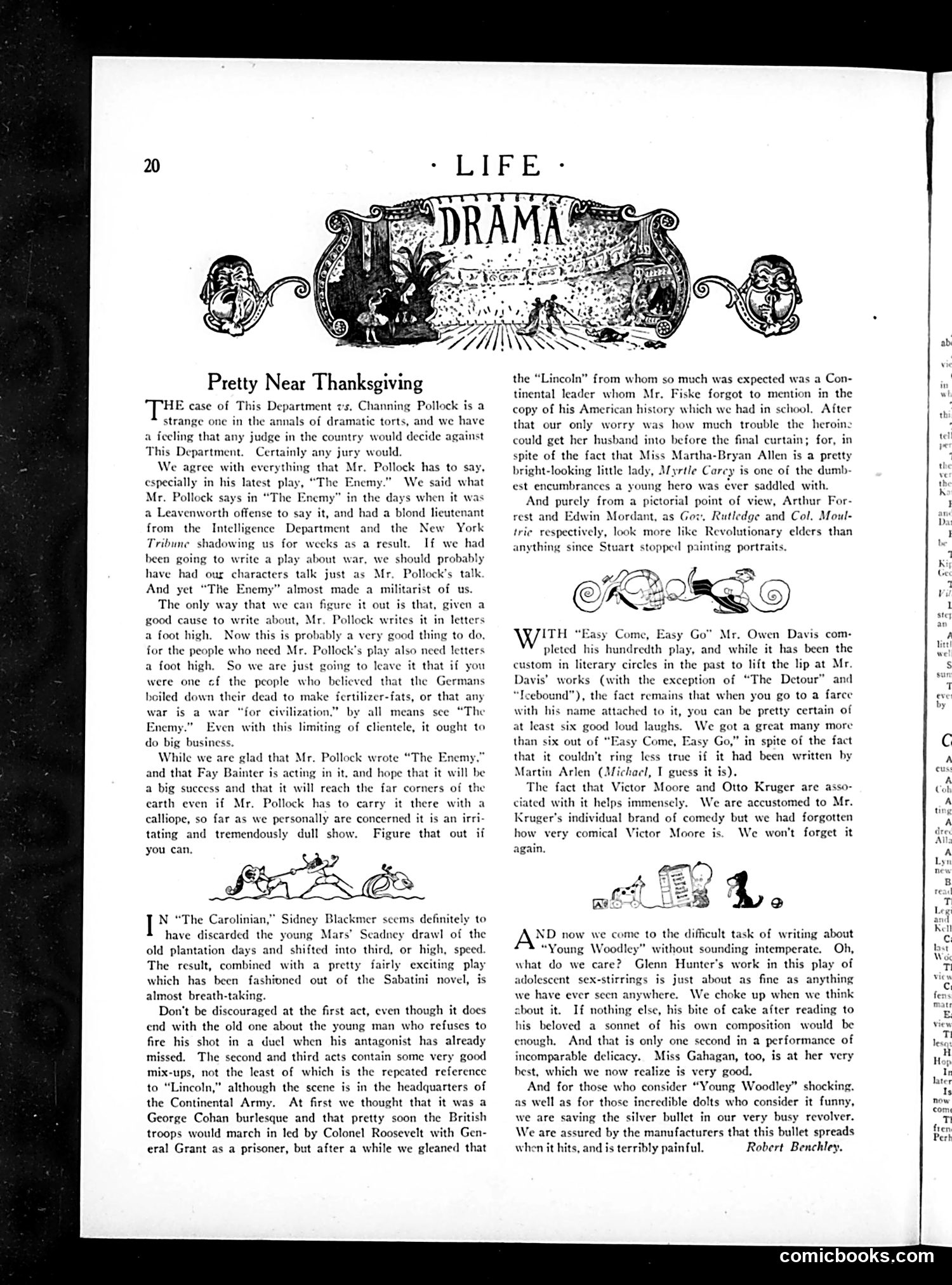
This page reviews three theatrical productions. The critic praises Channing Pollock's play "The Enemy"—which apparently presents anti-war arguments—while admitting finding it tediously written. The reference to "Leavenworth offense" suggests the critic themselves faced government scrutiny for expressing similar pacifist views during World War I. "The Carolinian," adapted from a Sabatini novel and featuring Sidney Blackmer, receives moderate praise for exciting action, though the critic mocks its confused historical setting (Continental Army scenes with mysterious references to "Lincoln"). Finally, Owen Davis's latest farce receives acknowledgment—apparently his hundredth play—with backhanded compliments about his comedic reliability despite critical dismissal of his other works. The reviews are characteristic of Life's satirical, irreverent theater criticism, mixing praise with pointed mockery of pretension and poor execution.
📄 Transcribed text from this page (OCR, searchable)
Machine-transcribed from the original scan — historical spelling and the odd misread are preserved.
Pretty Near Thanksgiving 'HE case of This Department vs. Channing Pollock is a strange one in the annals of dramatic torts, and we have feeling that any judge in the country would decide against This Department. Certainly any jury would. We agree with everything that Mr. Pollock has to say, especially in his latest play, “The Enemy.” We said what Mr. Pollock says in “The Enemy” in the days when it was a Leavenworth offense to say it, and had a blond lieutenant from the Intelligence Department and the New York Tribune shadowing us for weeks as a result. If we had been going to write a play about war, we should probably have had our characters talk just as Mr, Pollock's talk. And yet “The Enemy” almost made a militarist of us. The only way that we can figure it out is that, given a good cause to write about, Mr. Pollock writes it in letters a foot high, Now this is probably a very good thing to do, for the people who need Mr. Pollo a foot high. So we are just going to leave it that if you <'s play also need letters were one cf the people who believed that the Germans boiled down their dead to make fertilizer-fats, or that any war is a war “for civilization.” by all means sce “The Enemy.” ven with this limiting of clientele, it ought to do big business. While we are glad that Mr. Pollock wrote “The Enemy,” and that Fay Bainter is acting in it, and hope that it will be a big success and that it will reach the far corners of the earth even if Mr. Pollock has to carry it there with a calliope, so far as we personally are concerned it is an irri- tating and tremendously dull show. Figure that out if you can, N “The Carolinian,” Sidney Blackmer seems definitely to have discarded the young Mars’ Seadney drawl of the old plantation days and shifted into third, or high, speed. The result, combined with a pretty fairly exciting play which has been fashioned out of the Sabatini novel, is almost breath-taking. Don't be discouraged at the first act, even though it does end with the old one about the young man who refuses to fire his shot in a ducl when his antagonist has already missed. The second and third acts contain some very good mix-ups, not the least of which is the repeated reference to “Lincoln,” although the scene is in the headquarters of the Continental Army. At first we thought that it was a George Cohan burlesque and that pretty soon the Briti troops would march in led by Colonel Roosevelt with Gen- eral Grant as a prisoner, but after a while we gleaned that the “Lincoln” from whom so much was expected was a Con- tinental leader whom Mr. Fiske forgot to mention in the copy of his American history which we had in school. After that our only worry was how much trouble the heroine could get her husband into before the final curtain; for, in spite of the fact that Miss Martha-Bryan Allen is a pretty bright-looking little lady, Myrtle Car one of the dumb. est encumbrances a young hero was ever saddled with. And purely from a pictorial point of view, Arthur For- rest and Edwin Mordant, as Gov, Rutledge and Col. Moul- trie respectively, look more like Revolutionary elders than anything since Stuart stopped painting portraits. ITH “Easy Come, Easy Go" Mr. Owen is com- pleted his hundredth play, and while it has been the custom in literary circles in the past to lift the lip at Mr. Davis’ works (with the exception of “The Detour” and “Icebound”), the fact remains that when you go to a farce with his name attached to it, you can be pretty certain of at least six good loud laughs. We got a great many more than six out of “Easy Come, Easy Go,” in spite of the fact that it couldn't ring less true if it had been written by Martin Arlen (Michael, T guess it is). The fact that Victor Moore and Otto Kruger are asso- ciated with it helps immensely. We are accustomed to Mr. Kruger’s individual brand of comedy but we had forgotten how very comical or Moore is. We won't forget it again. _ 738 %, @ ND now we come to the difficult task of writing about “Young Woodley” without sounding intemperate. Oh, what do we care? Glenn Hunter's work in this play of adolescent sex-stirrings is just about as fine as anything we have ever seen anywhere. We choke up when we think cbout it. If nothing else, his bite of cake after reading to his beloved a sonnet of his own composition would be enough, And that is only one second in a performance of incomparable delicacy. Miss Gahagan, too, is at her very hest, which we now realize is very good. And for those who consider “Young Woodley” shocking. as well as for those incredible dolts who consider it funny, we are saving the silver bullet in our very busy revolver. We are assured by the manufacturers that this bullet spreads when it hits, and is terribly painful. Robert Benchley. comicbooks.com