
A complete issue · 41 pages · 1925
Life — November 12, 1925
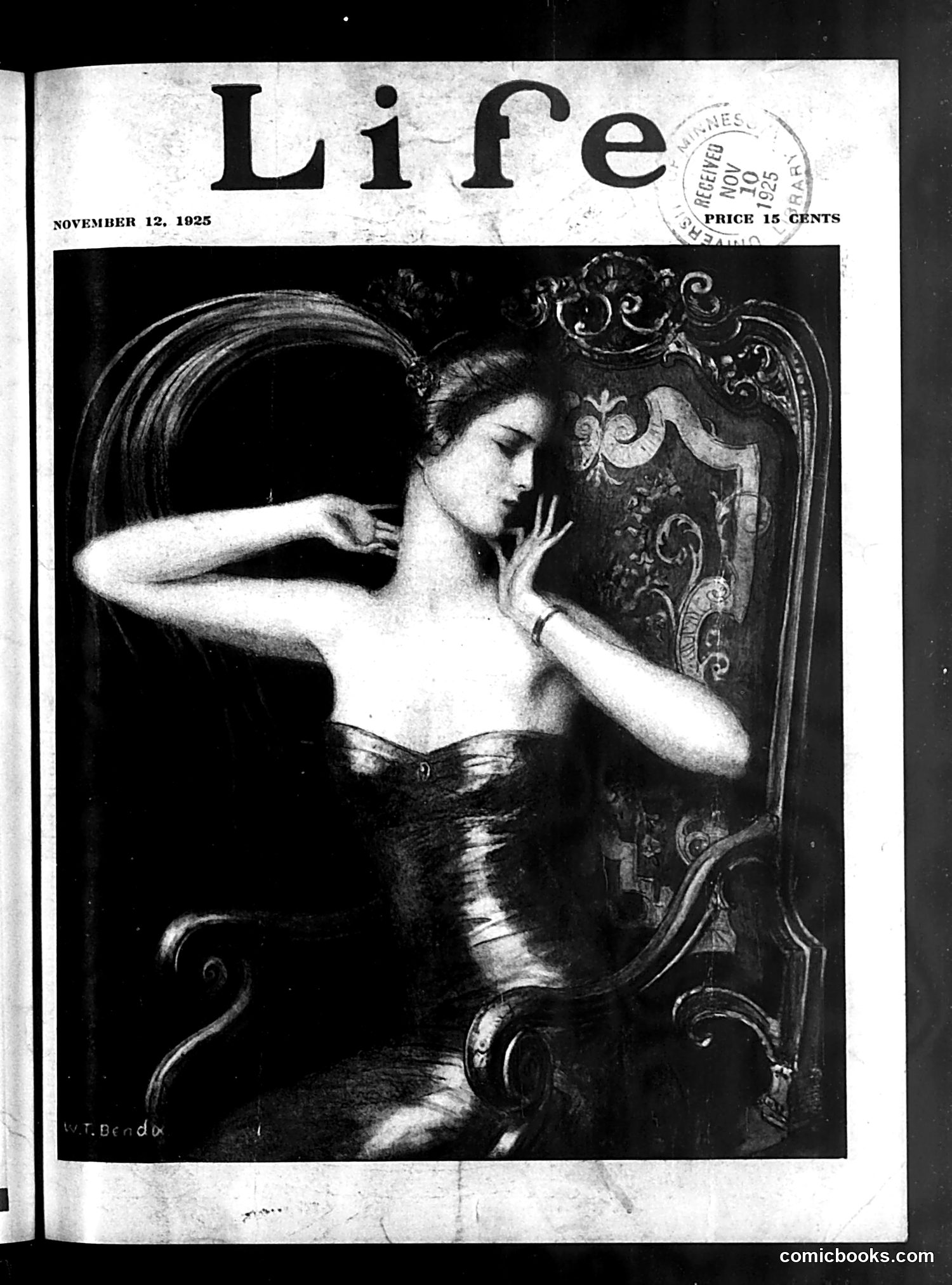
This appears to be a *Life* magazine cover from November 12, 1925, priced at 15 cents. The image shows a stylized portrait of a woman in an elegant pose, seated before an ornate mirror, adjusting her hair. She wears a draped garment and displays the fashionable aesthetic of the 1920s Jazz Age. The artwork is signed "W.T. Benda," a prominent illustrator of the era. Rather than political satire, this appears to be a glamour illustration typical of *Life*'s cover content during this period—celebrating fashionable femininity and modern womanhood. The sophisticated styling reflects 1920s beauty standards and the emerging consumer culture surrounding women's appearance and fashion magazines of that decade.
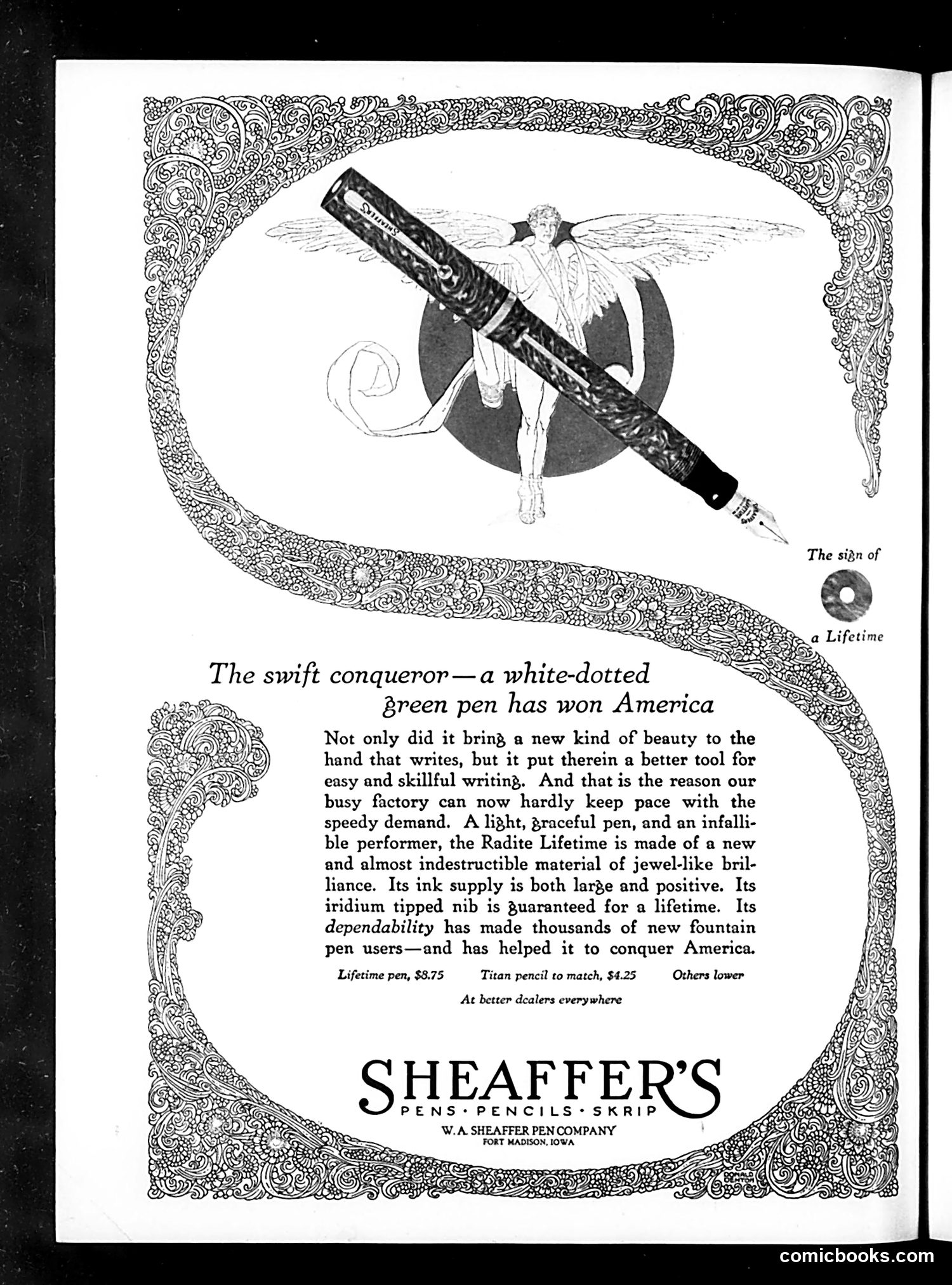
This is **not a political cartoon** but rather a **vintage advertisement** for Sheaffer fountain pens, circa early 20th century. The imagery depicts an allegorical winged figure (representing victory or progress) wielding an oversized fountain pen like a sword or conqueror's weapon. The text claims the "white-dotted green pen has won America," using militaristic language to describe commercial success. The advertisement emphasizes the pen's reliability and quality—its iridium-tipped nib, durable construction, and "lifetime" guarantee. The ornate decorative border frames the ad in the style typical of Life magazine's aesthetic during this period. This reflects early 1900s marketing that used grandiose, nationalistic rhetoric to sell consumer goods, portraying a fountain pen as instrumental to American achievement and progress.
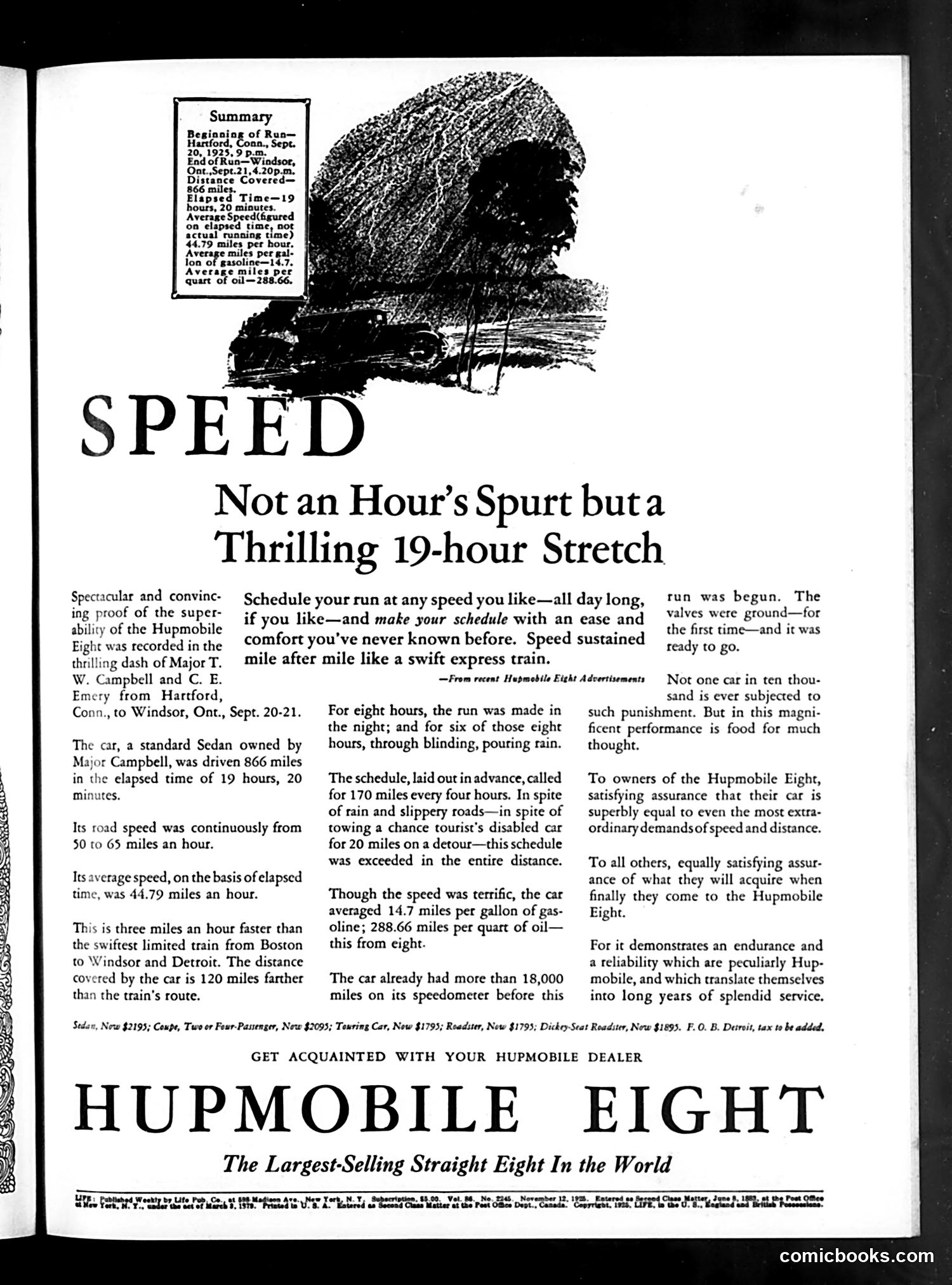
This is **not satire or political commentary** — it's a straightforward automobile advertisement for the Hupmobile Eight, a car manufactured in the 1920s. The page promotes a real endurance run completed September 20-21, 1925, from Hartford, Connecticut to Windsor, Ontario. A standard sedan driven by Major T.W. Campbell and C.E. Emery covered 866 miles in 19 hours, 20 minutes, averaging 44.79 miles per hour. The dramatic illustration (upper right) depicts the car speeding through challenging conditions — likely the rain and "slippery roads" mentioned in the text. The advertisement emphasizes the vehicle's reliability, fuel efficiency (14.7 miles per gallon), and superior performance compared to competing cars and trains.
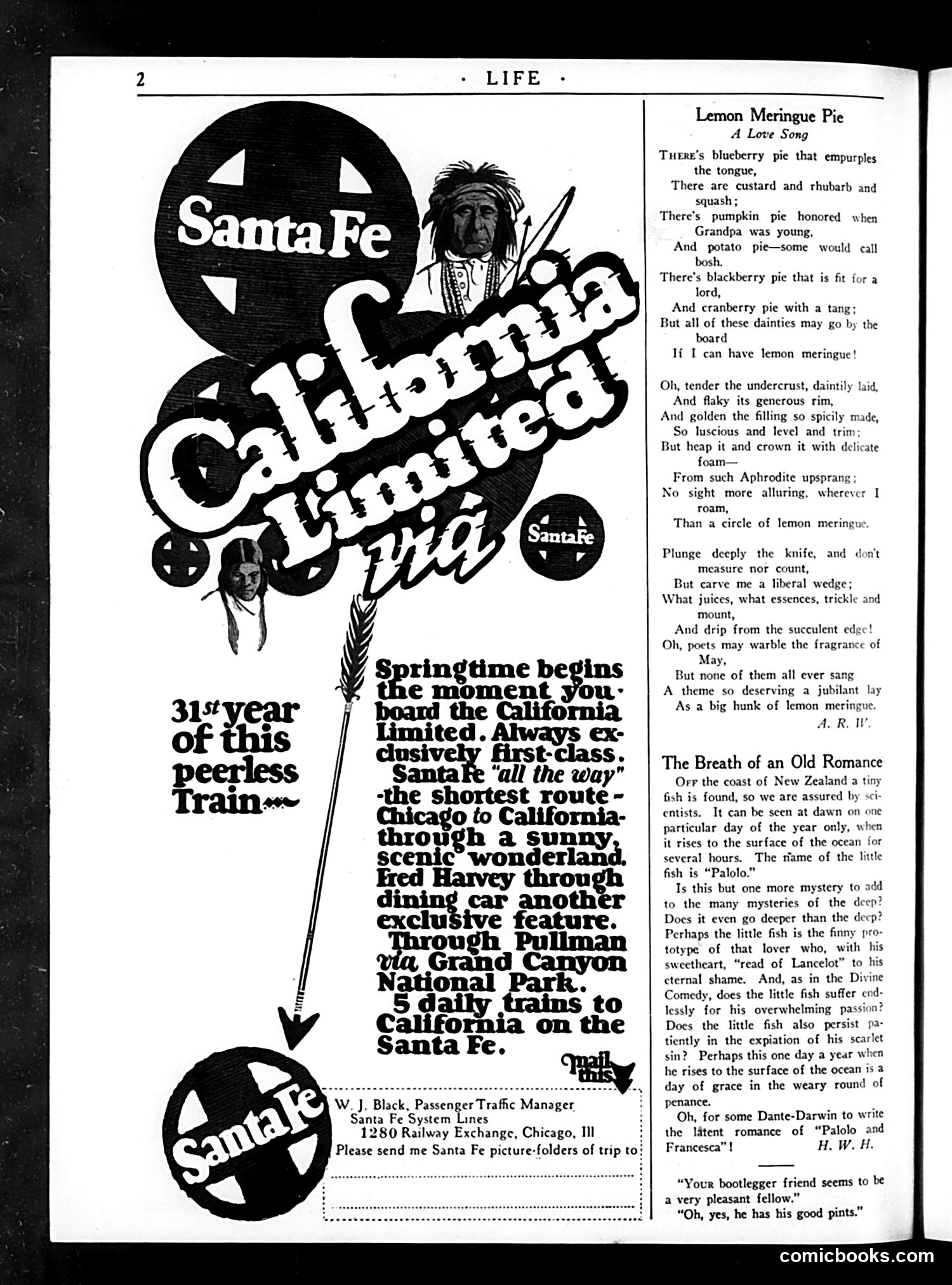
This page is primarily a **Santa Fe Railway advertisement** celebrating the train line's 31st year of service. The left side features bold graphic advertising promoting the California Limited as "the shortest route" from Chicago to California, highlighting exclusive features like dining car service and passage through the Grand Canyon. The Native American imagery (headdress, feathered design) appears decorative rather than satirical—typical of early 20th-century railway marketing that exoticized the American West to appeal to travelers. The right side contains unrelated literary content: poems about lemon meringue pie and a mysterious fish called "Palolo," suggesting this is a miscellaneous magazine page combining ads with feature content. There's no apparent political satire or commentary here—just commercial promotion and light entertainment typical of Life magazine's format.
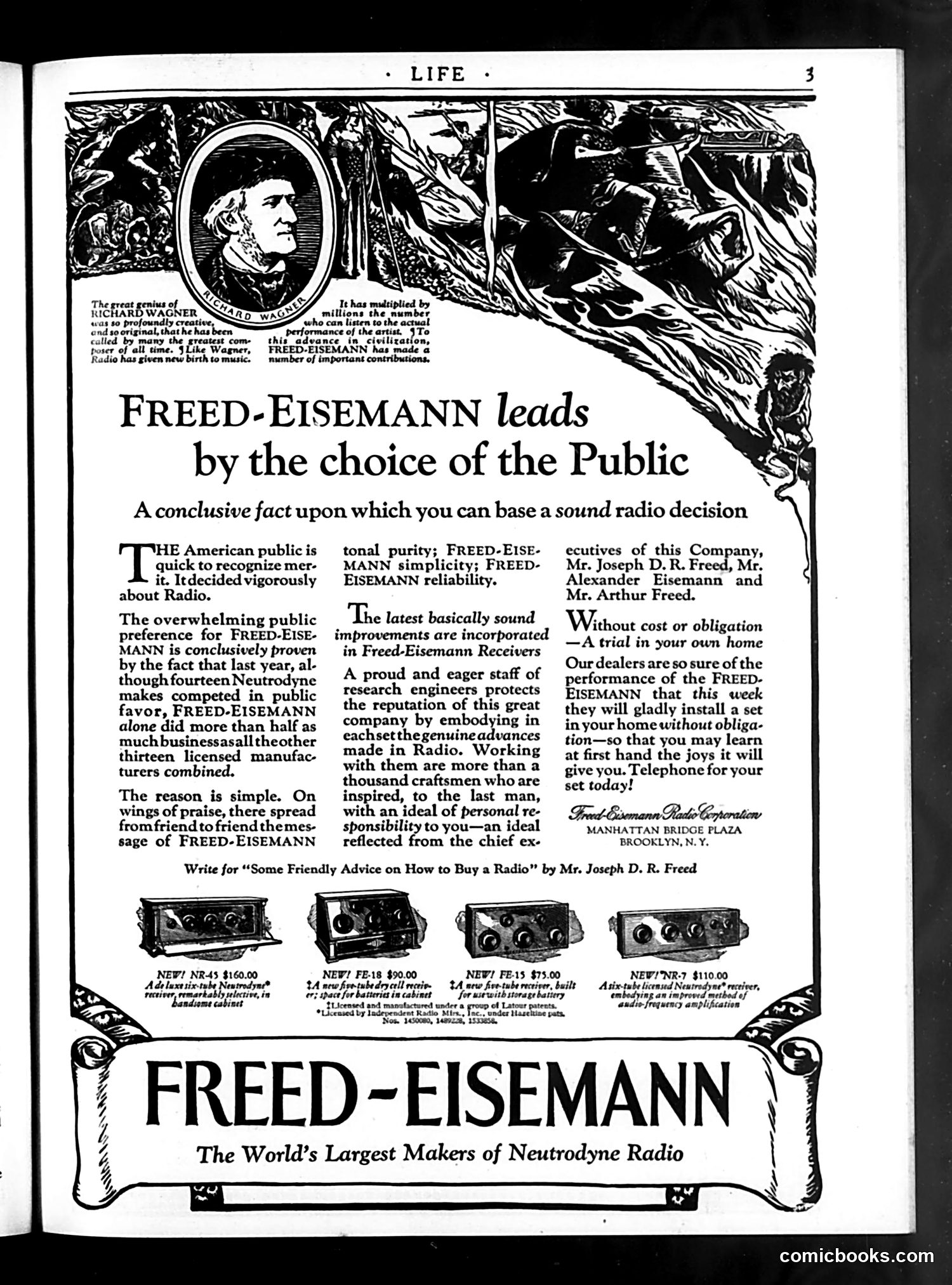
This is primarily a **Freed-Eisemann radio advertisement**, not political satire. The page features a portrait of **Richard Wagner** (the 19th-century composer) at top left, with decorative illustrations. The ad compares Wagner's genius and influence to Freed-Eisemann's market leadership in radio manufacturing. The text claims that just as Wagner "profoundly changed" music, Freed-Eisemann has similarly advanced civilization through radio technology. It references the company's research engineers and touts the reliability of their "Neutrodyne" receivers. Four radio models are displayed at bottom with prices ranging from $75-$160. This represents early 1920s radio industry marketing—using cultural authority (Wagner) to legitimize a consumer product. The "public preference" claim likely reflects genuine market success during radio's rapid early adoption period.
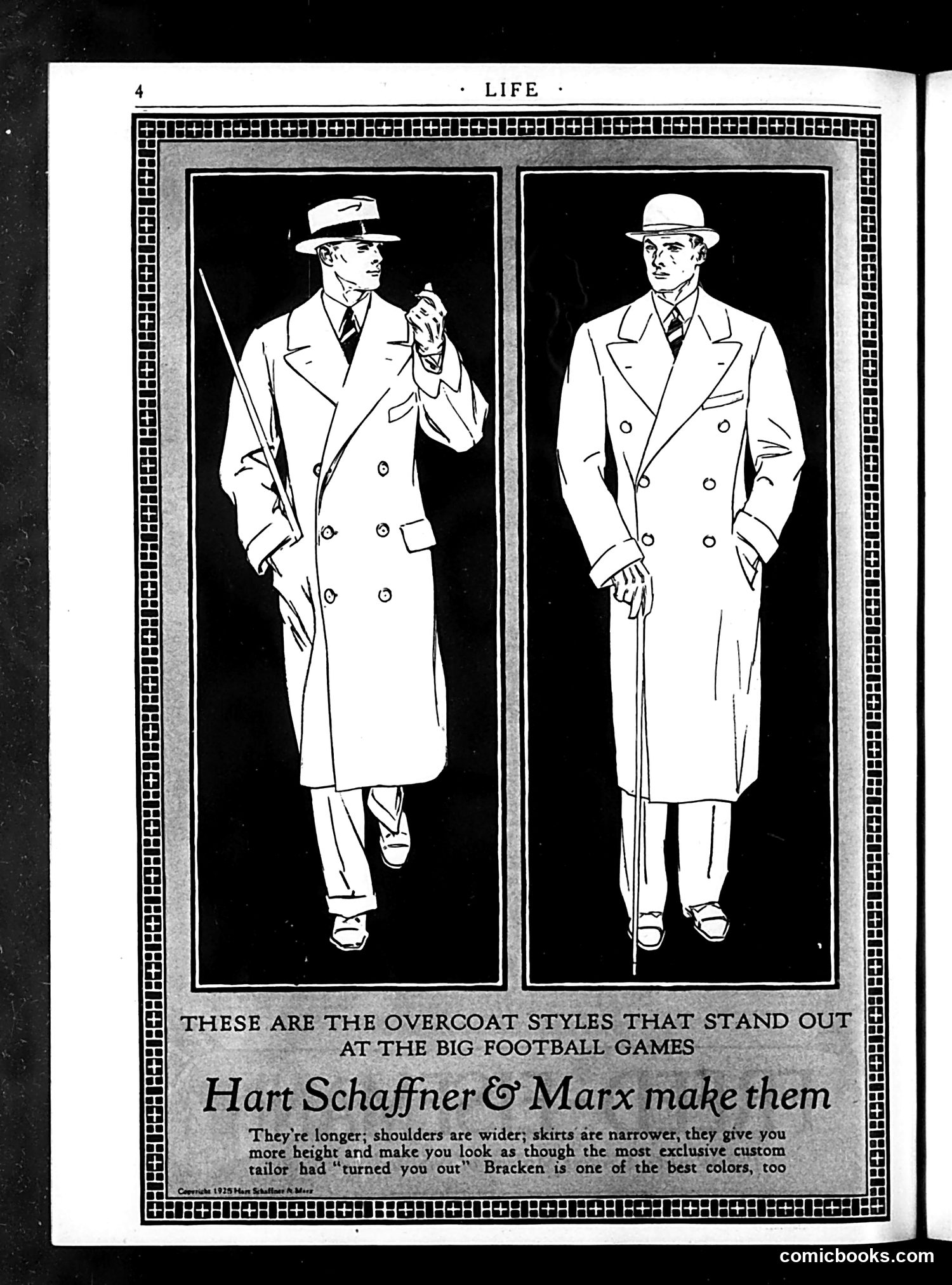
This is an **advertisement, not political satire**. It promotes overcoats by Hart Schaffner & Marx, a menswear company. The page depicts two men wearing double-breasted overcoats, presented as fashionable styles suitable for attending "big football games." The ad emphasizes the coats' distinguishing features: they're longer, have wider shoulders, and narrower skirts (the lower portion of the coat), creating an elongated silhouette that "make[s] you look as though the most exclusive custom tailor had 'turned you out.'" Bracken is mentioned as "one of the best colors too." This reflects 1920s menswear fashion norms—the era when Life magazine was primarily a humor and lifestyle publication alongside carrying advertisements. The "big football games" reference suggests these coats were aspirational attire for social events of that period.
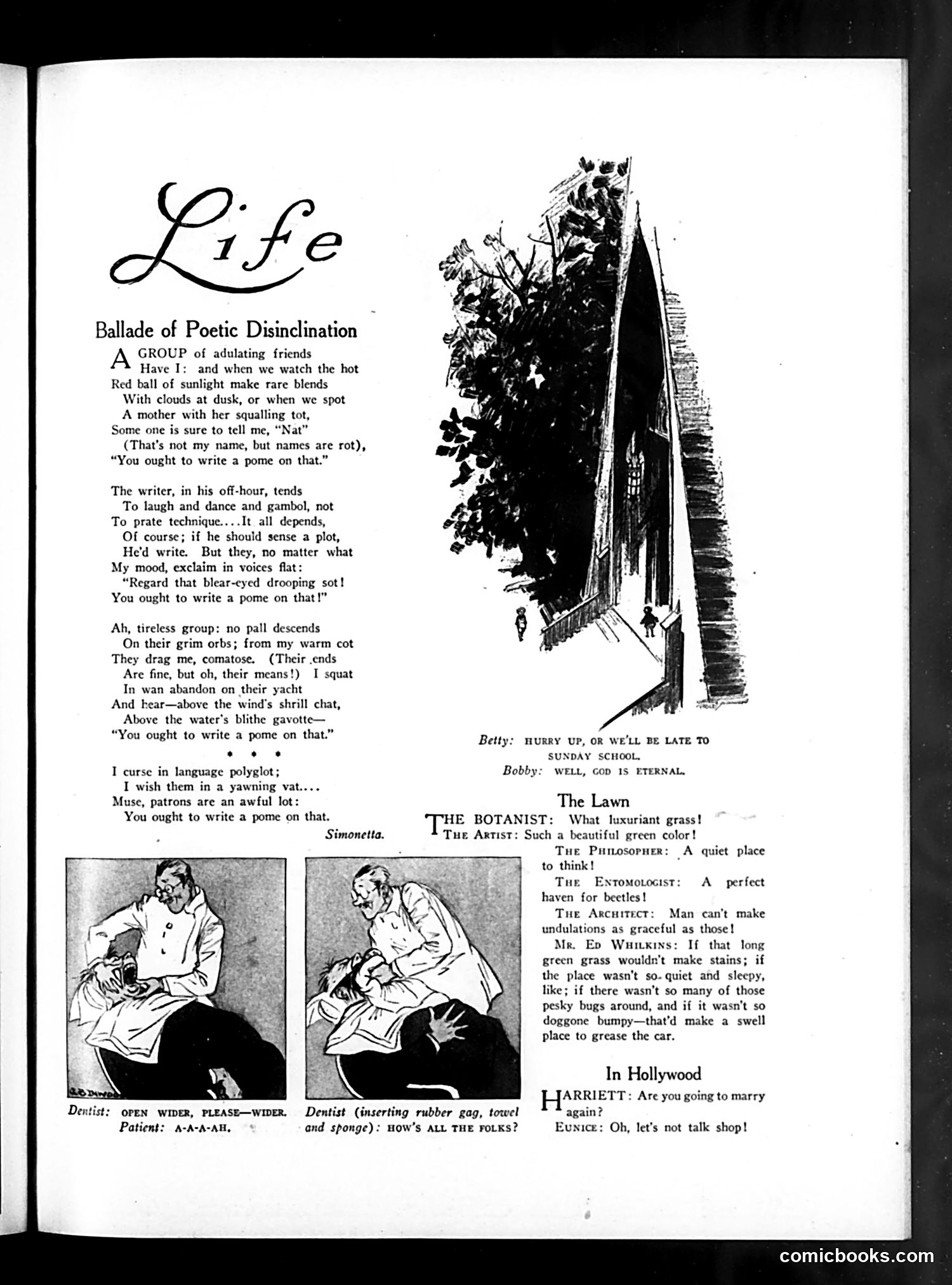
This page contains literary satire rather than political cartoons. The main piece, "Ballade of Poetic Disinclination," mocks writers who receive constant pressure from friends to compose poetry. The poem humorously portrays exasperated writers cursed by acquaintances demanding verses about trivial subjects—a yacht, the wind, romance. The cartoon below shows a dentist performing oral surgery, with caption humor playing on the patient's distressed expression ("A-A-A-AH"). The subsequent sections—"The Lawn" and "In Hollywood"—appear to be brief satirical dialogues. These mock different social circles' pretensions: the lawn section ridicules how various professionals romanticize a simple yard differently, while "In Hollywood" jokes about superficial celebrity relationships and shop-talk avoidance. The humor targets mid-century American social affectations and conversational clichés.
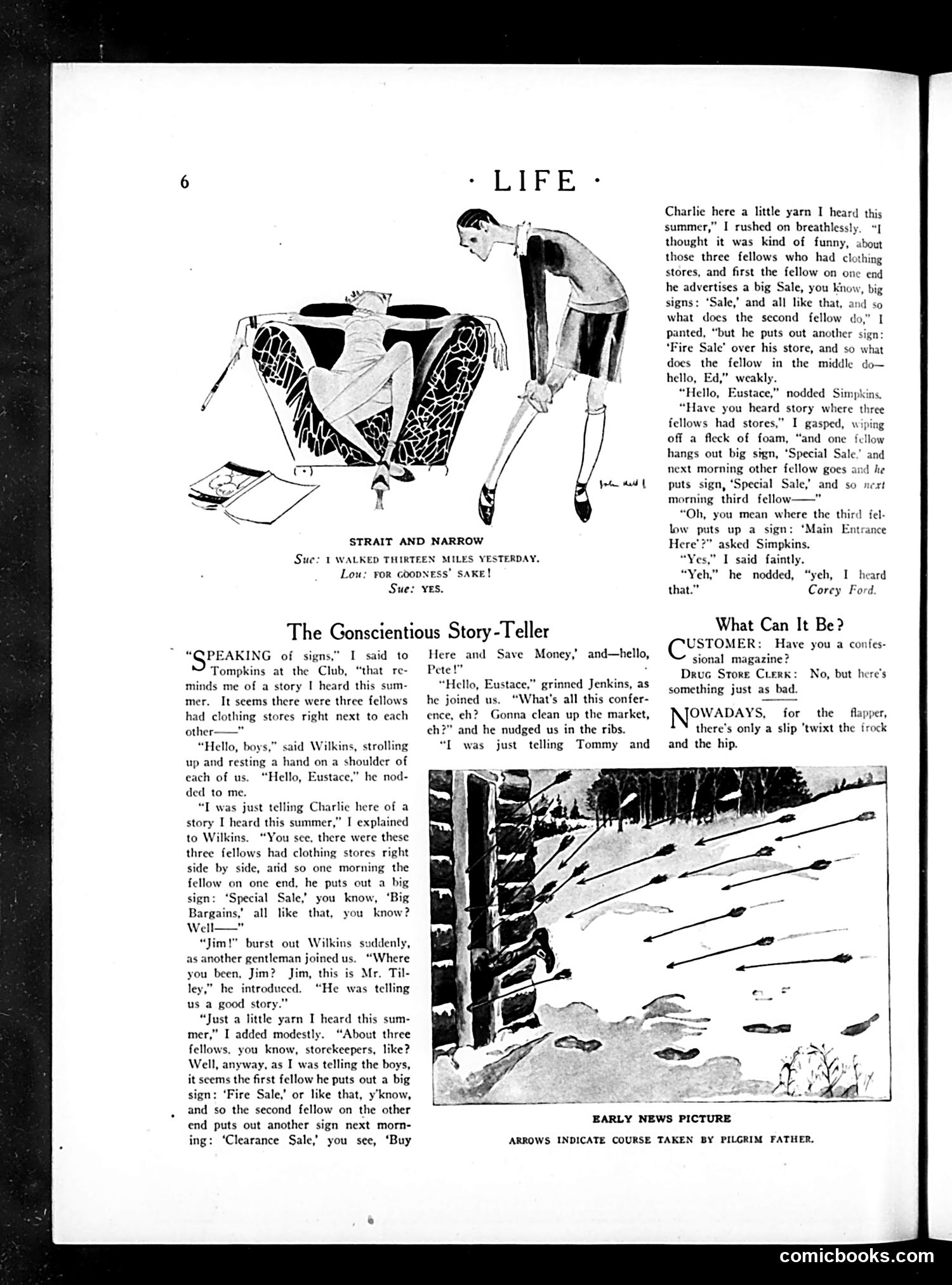
This page contains two distinct pieces: **"The Conscientious Story-Teller"** is a humorous anecdote about competitive retail marketing. The joke centers on three clothing store owners engaged in escalating "Sale" sign warfare—each trying to outdo the others with increasingly dramatic promotions ("Fire Sale," "Clearance Sale," etc.). The satire mocks both the stores' desperate competitive tactics and the narrator's breathless retelling of this commercial arms race. **"What Can It Be?"** is a brief joke about a customer asking a drug store clerk for a confessional magazine, with the clerk joking it's "just as bad"—likely satirizing popular magazines' sensational content. The top illustration depicts the physical exhaustion caused by walking, relating to the "Strait and Narrow" caption about daily exertion. The bottom image, captioned "Arrows Indicate Course Taken by Pilgrim Father," appears to be unrelated satirical content about historical routes or movements.
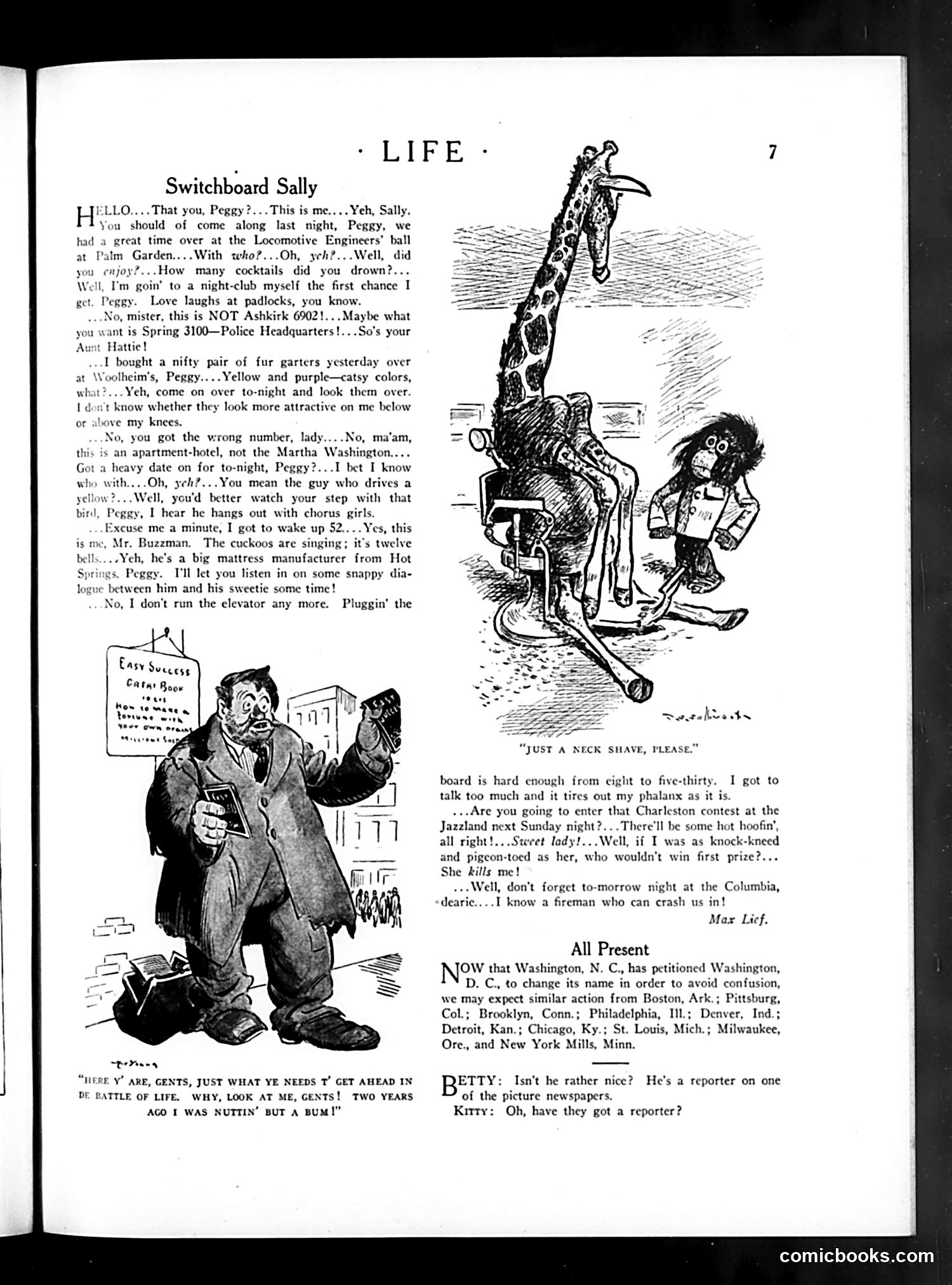
This page contains two satirical pieces. The top cartoon shows a giraffe being groomed by a barber with the caption "Just a Nick Shave, Please" — a visual pun playing on the animal's long neck. The lower cartoon depicts a disheveled man labeled "Easy Success Caterers" struggling with building blocks, captioned with a complaint about needing to "get ahead in de battle of life." This appears to satirize failed business ventures or get-rich-quick schemes. The "Switchboard Sally" dialogue piece is a comedic conversation involving confused phone numbers and social misadventures at clubs and hotels. The "All Present" section notes various U.S. cities considering name changes to avoid confusion with other municipalities (referencing Washington, D.C.'s petition). Overall, the page combines wordplay, physical comedy, and observations on American urban life and business culture.
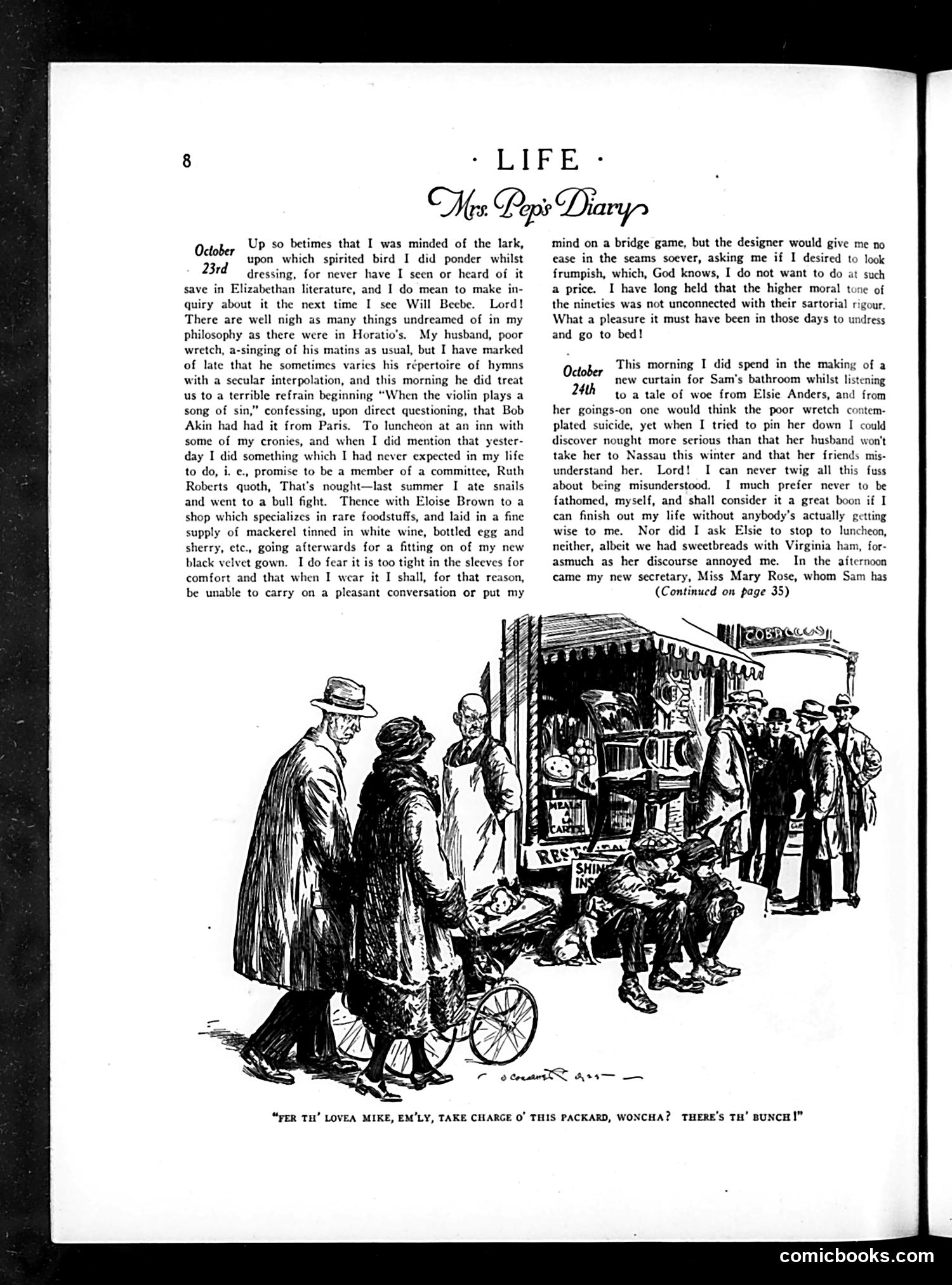
This page from *Life* magazine's "Mrs. Peps's Diary" column (dated October 23rd-24th) combines personal diary entries with a satirical illustration. The diary discusses social observations—bridge games, moral concerns about suicide, and domestic life with her husband and secretary. The cartoon below depicts a street scene with working-class figures, including what appears to be a street vendor or hawker with a cart. A man addresses someone named "Mike" or "Woncha," asking them to take charge of a "package" while referencing "the bunch"—likely depicting street-level commerce or petty trade. The satire appears to target lower-class street commerce and dialect speech, reflecting early 20th-century class-based humor common in *Life* magazine's approach to urban working-class life.
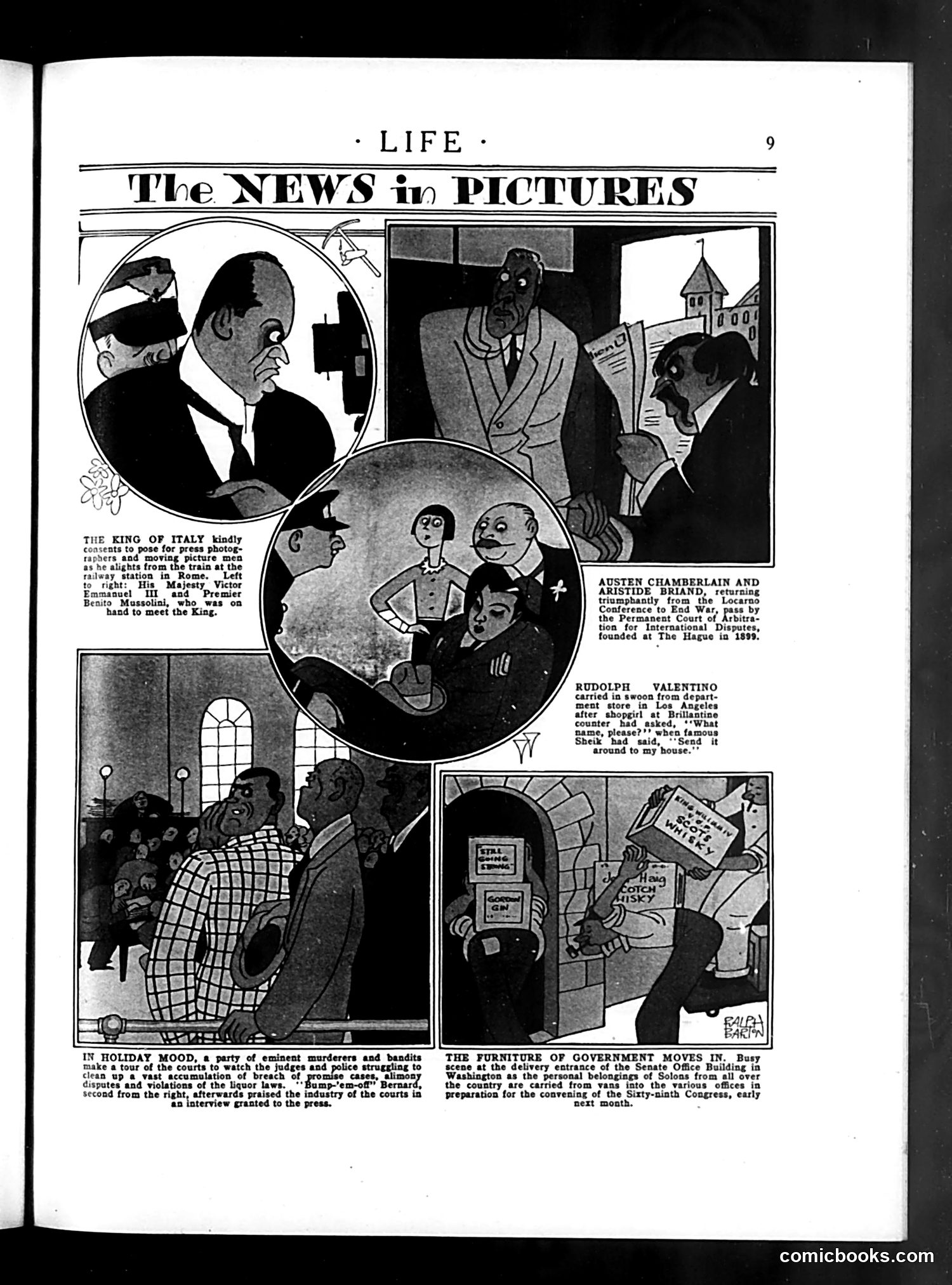
This satirical news-picture page contains four unrelated contemporary vignettes: 1. **Top left**: The King of Italy accommodates press photographers despite traveling by train—a comment on celebrity and media access. 2. **Center circle**: Rudolph Valentino, the famous silent film star, is caught in a department store asking for "Britamine" hair product by name, then requesting anonymity—satirizing celebrity endorsements and vanity. 3. **Bottom left**: "Holiday Mood" depicts wealthy murderers and bandits touring courts to observe judges handling crime cases—darkly mocking how the wealthy treat justice as entertainment. 4. **Bottom right**: Government furniture being moved into the Senate Office Building, preparing for the 67th Congress—straightforward news illustration with mild bureaucratic humor. The page exemplifies Life's blend of celebrity mockery, social satire, and newsworthy reporting typical of 1920s satirical journalism.
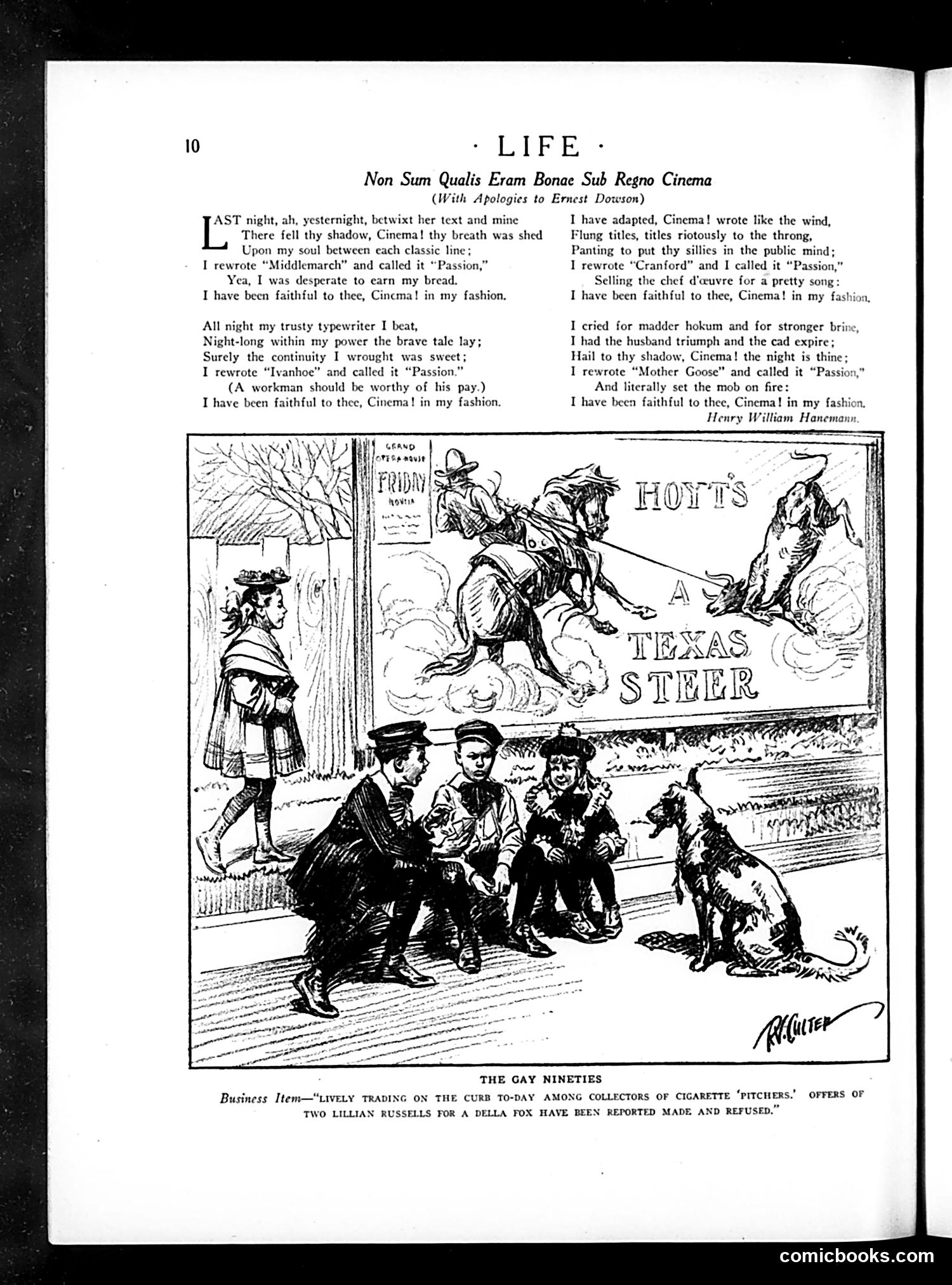
This page combines a poem about cinema ("Cinema") with a satirical cartoon titled "The Gay Nineties." The cartoon depicts what appears to be street children or urchins examining a movie poster advertising "Holt's A Texas Steer" while a well-dressed woman observes from the left. A dog is also present. The satire appears to target the contrast between refined society (represented by the elegant woman) and lower-class street youth fascinated by popular Western films. The caption mentions "lively trading on the curb to-day among collectors of cigarette 'pitchers'" and references to trading Lillian Russell cards. The cartoon likely satirizes both the emerging mass appeal of cinema to working-class audiences and the commodification of entertainment through cigarette card collecting—a popular practice of the era.
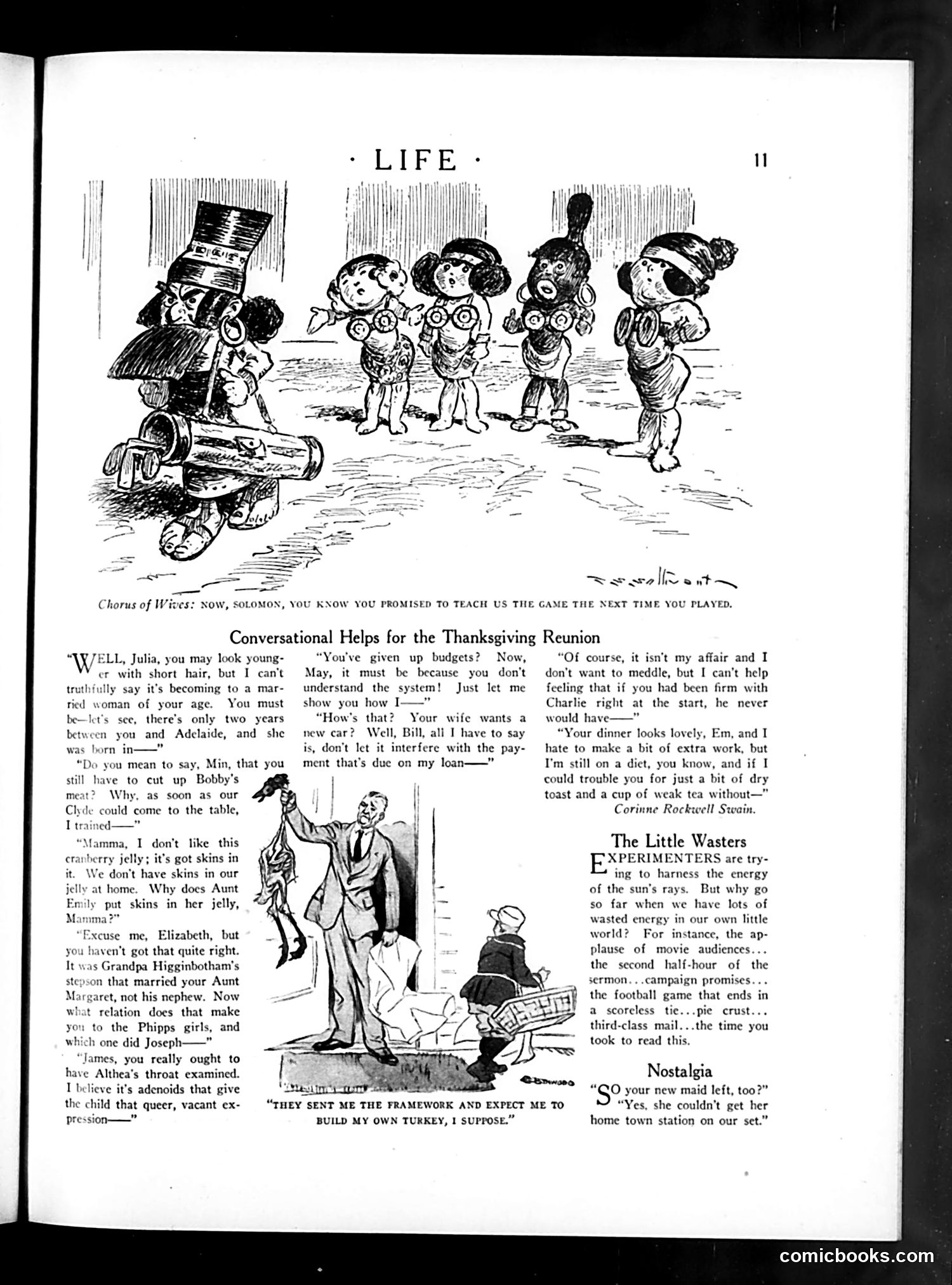
This page contains three separate humor sections: **Top cartoon:** Shows a man in top hat presenting a toy or game to children, with the caption "They sent me the framework and expect me to build my own turkey, I suppose." This satirizes consumer frustration with incomplete or unassembled products—a relatable domestic complaint. **"Conversational Helps for the Thanksgiving Reunion":** Humorous dialogue snippets about family tensions during holidays—criticisms of wives' budgeting, concerns about children's behavior, and dinner etiquette. The satire targets awkward family dynamics and strained relationships during holiday gatherings. **Right column sections** include brief humorous pieces on energy conservation, movie culture, and household staff departures. The overall tone mocks middle-class American domestic life and social pretensions of the era.
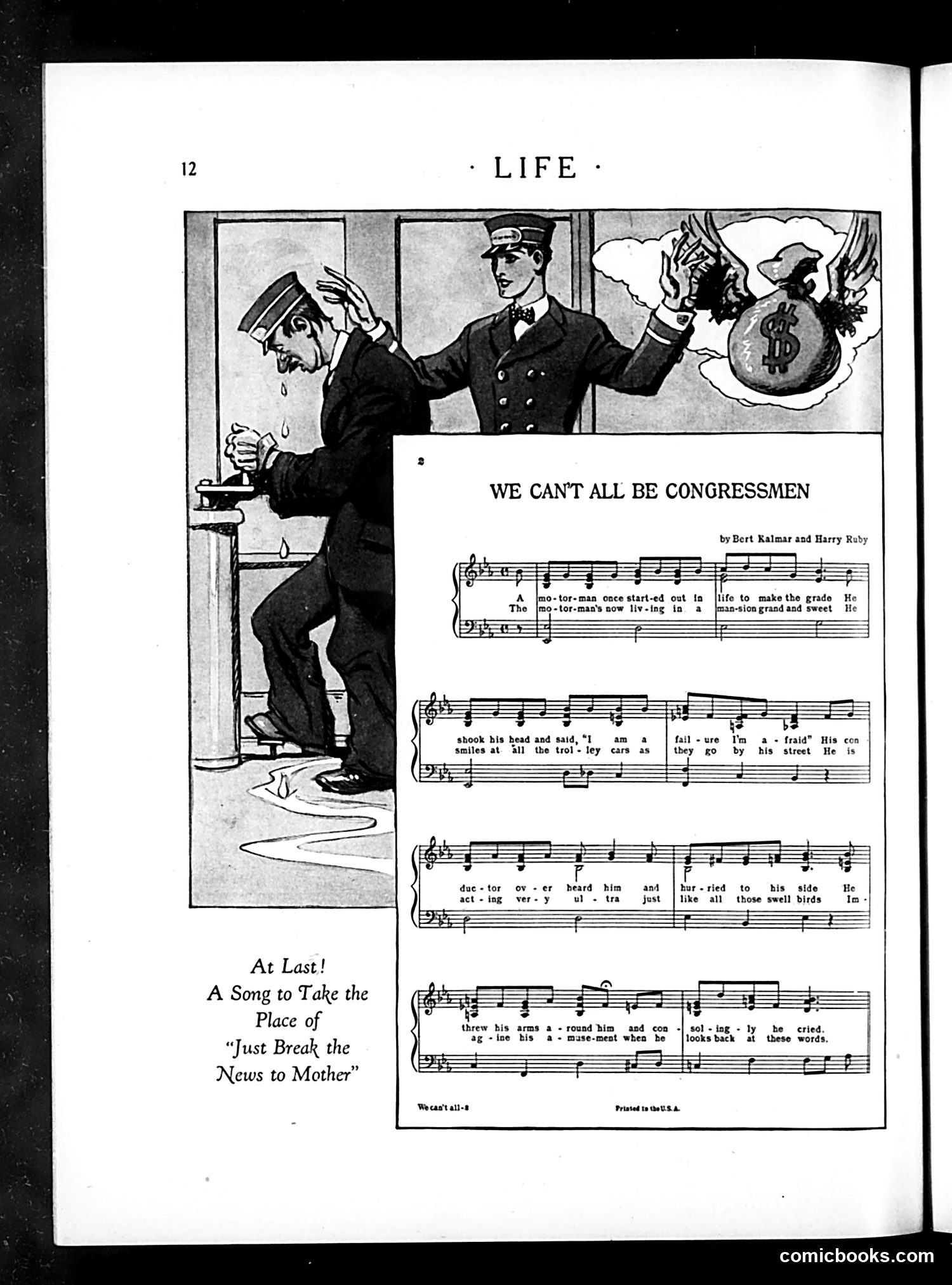
This page from *Life* magazine presents a satirical song by Bert Kalmar and Harry Ruby mocking congressional ambition. **The Cartoon:** A uniformed conductor or porter figure juggles two caricatured heads—one appears to be a politician or laborer, the other labeled with a dollar sign. The conductor tosses money and ambition between them. **The Satire:** The song's title and lyrical content (visible in the sheet music) suggests that working-class men aspire to become congressmen to escape their struggles, but the cartoon implies this is folly. The conductor figure appears to be managing or manipulating these aspirations for profit. **The Point:** The satire critiques both working-class social climbing and the political system's false promises of opportunity—suggesting Congress is unattainable for ordinary laborers and that their ambitions are being exploited or mocked.
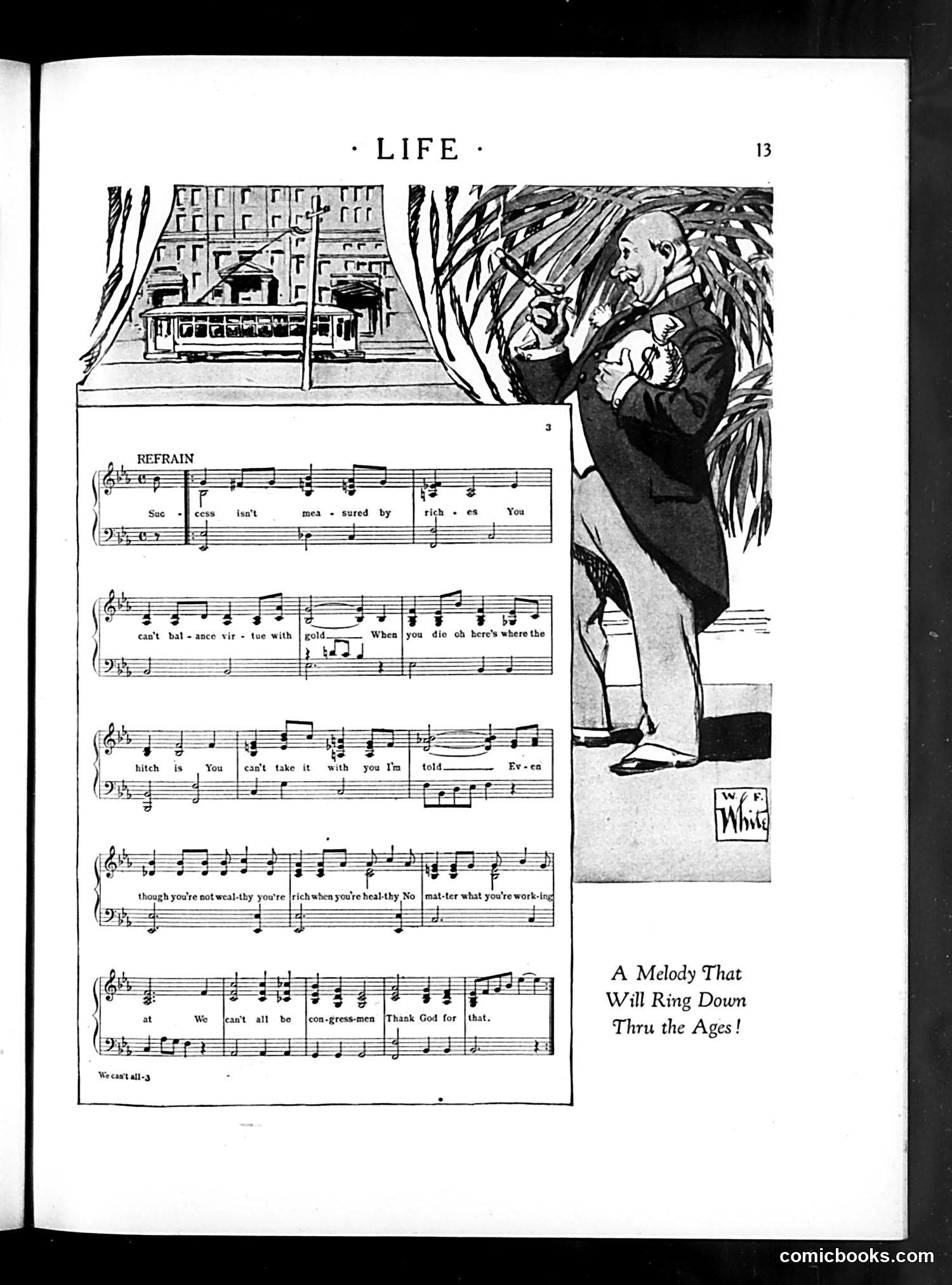
This page from *Life* magazine features sheet music for a song titled "A Melody That Will Ring Down Thru the Ages!" The musical score includes a refrain with lyrics about success, riches, and wealth—phrases like "Success isn't measured by rich-es You" and references to balance, gold, and congressmen. The accompanying illustration shows a well-dressed man in a coat gesturing dramatically while holding what appears to be a small child, positioned against stylized foliage. The cartoon likely satirizes American materialism and capitalist ideology of the era, mocking the notion that wealth and financial success represent true achievement. The juxtaposition of the grand musical proclamation with the satirical lyrics suggests ironic commentary on contemporary values and priorities.
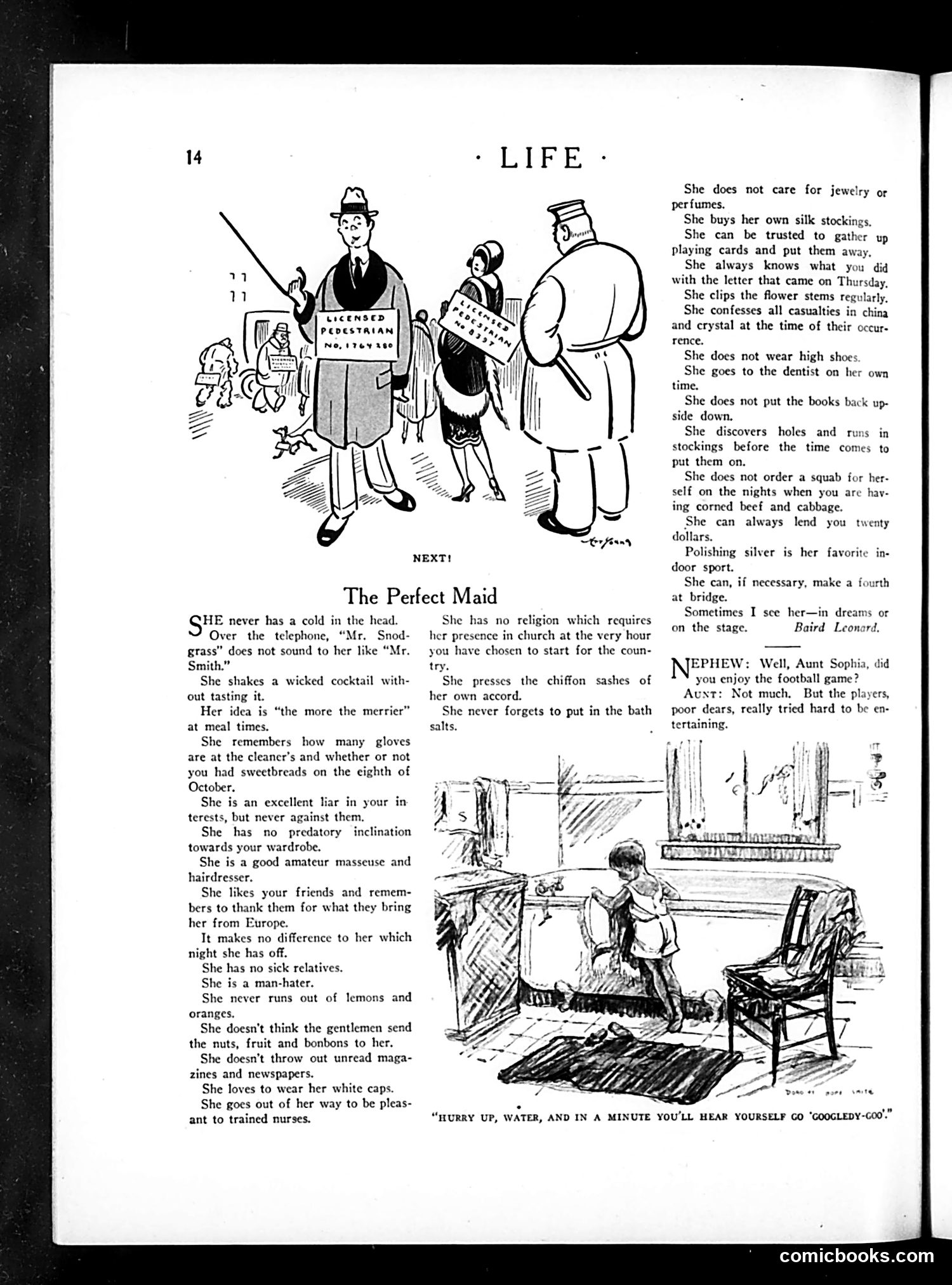
This page satirizes the idealized "perfect maid" through contrasting lists. The top illustration shows a **licensed restaurant** (likely mocking employment agencies), where a well-dressed man presents maids to prospective employers—suggesting the commercialized domestic servant market. The text lists absurdly contradictory expectations: she "never has a cold," handles cocktails without tasting them, remembers glove counts, yet somehow also manages wardrobe, polishes silver, and plays bridge. The satirical point is clear: employers demanded impossible perfection from domestic workers while taking their labor for granted. The bottom illustration shows a woman speaking to her employer, with the caption "HURRY UP, WATER, AND IN A MINUTE YOU'LL HEAR YOURSELF GO 'GOGGLEDYGOO'"—mocking how employers treated maids as nearly invisible servants, rushing them along without acknowledgment.
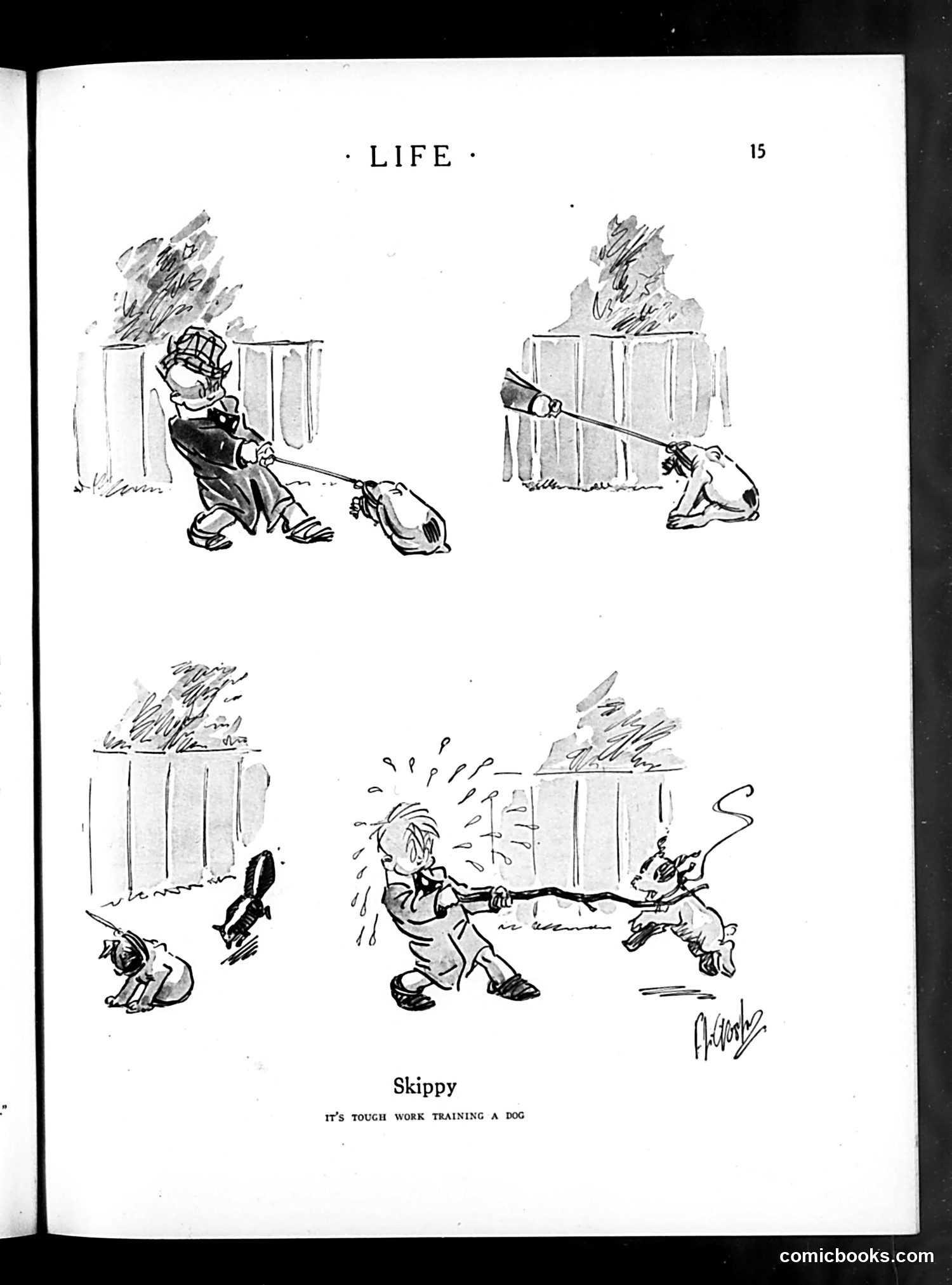
This is a humorous comic strip sequence titled "Skippy" showing a young boy attempting to train a dog. The four-panel narrative depicts escalating chaos: the boy tries progressively more forceful methods with a stick/training tool, ultimately resulting in the dog chasing him wildly while he flails in panic. The joke relies on physical comedy and the ironic reversal of the stated premise—rather than successfully training the dog, the boy loses control entirely. The exaggerated cartoon style, with motion lines indicating frantic movement in the final panel, emphasizes the slapstick humor. "Skippy" was a popular newspaper comic strip of this era featuring a mischievous boy character, and this particular installment plays on the relatable, humorous difficulties of pet training.
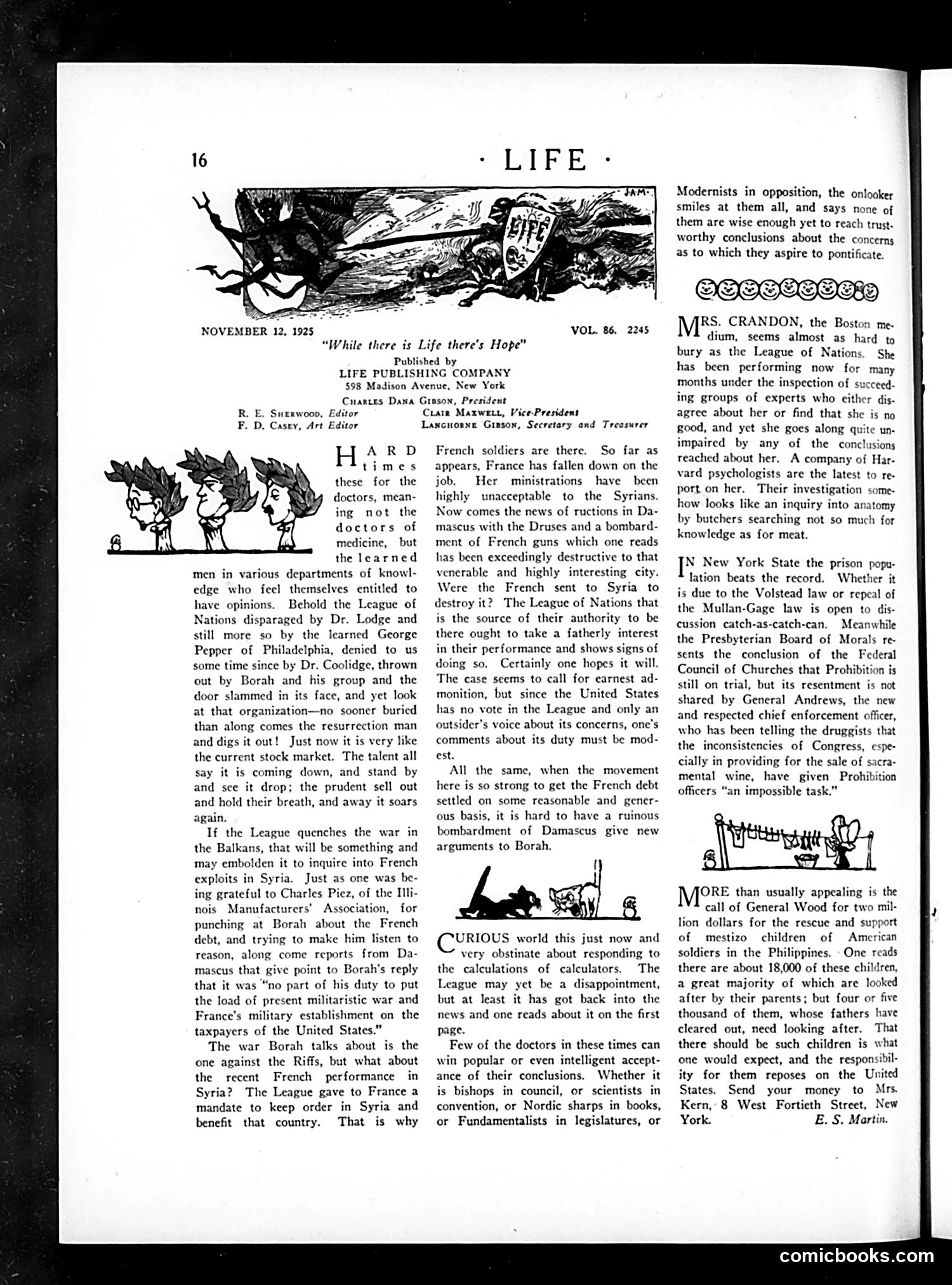
The main cartoon depicts three figures labeled "Hard Times" - appearing to represent economic hardship or recession. The editorial discusses the League of Nations' ineffectiveness, particularly regarding French debt settlement and Syrian instability following World War I. The text criticizes the League for lacking enforcement power, noting the U.S. isn't a member and can only offer "outsider's voice." It mocks various professional groups (doctors, scientists, bishops) who confidently voice opinions on League matters despite limited expertise. A secondary item concerns spiritualism medium "Mrs. Crandon" of Boston, whom Harvard psychologists were investigating - apparently controversial in this period. The final section appeals for donations to support mestizo children of American soldiers in the Philippines, framing it as national responsibility.
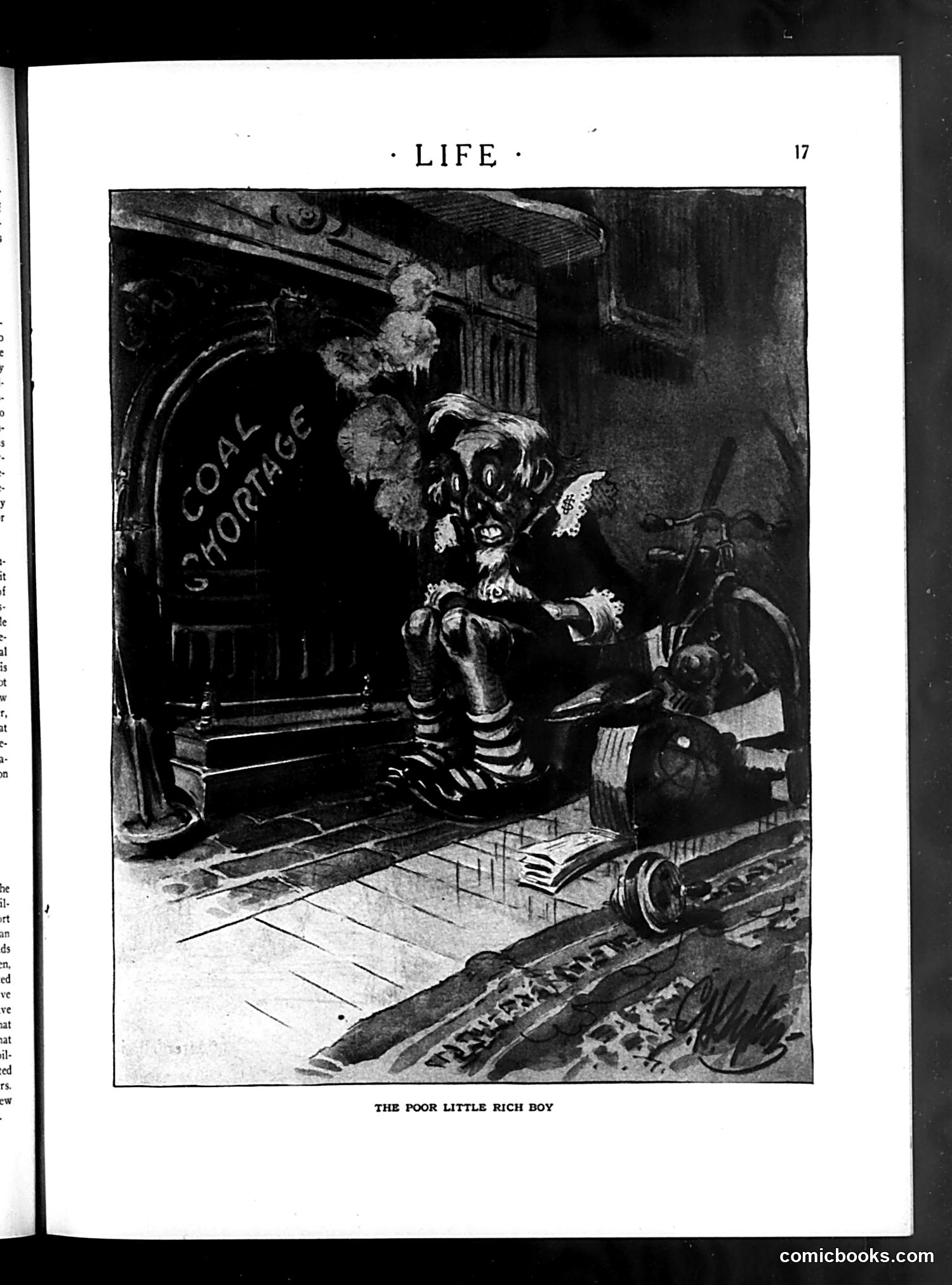
This satirical illustration depicts a wealthy child in ornate clothing entering what appears to be a "Coal Shortage" storage area or bunker (visible text on the door). The image contrasts the child's expensive dress and accessories with the grim circumstances of coal scarcity—a reference to energy shortages that affected American households. The satire critiques economic inequality: while wealthy families struggled with inconveniences during shortages, working-class families faced genuine hardship. The "poor little rich boy" title uses irony—the child lacks nothing materially, yet faces the same resource constraints as everyone else, highlighting how even privilege cannot insulate the wealthy from broader societal crises. This likely references early 20th-century fuel shortages in America.
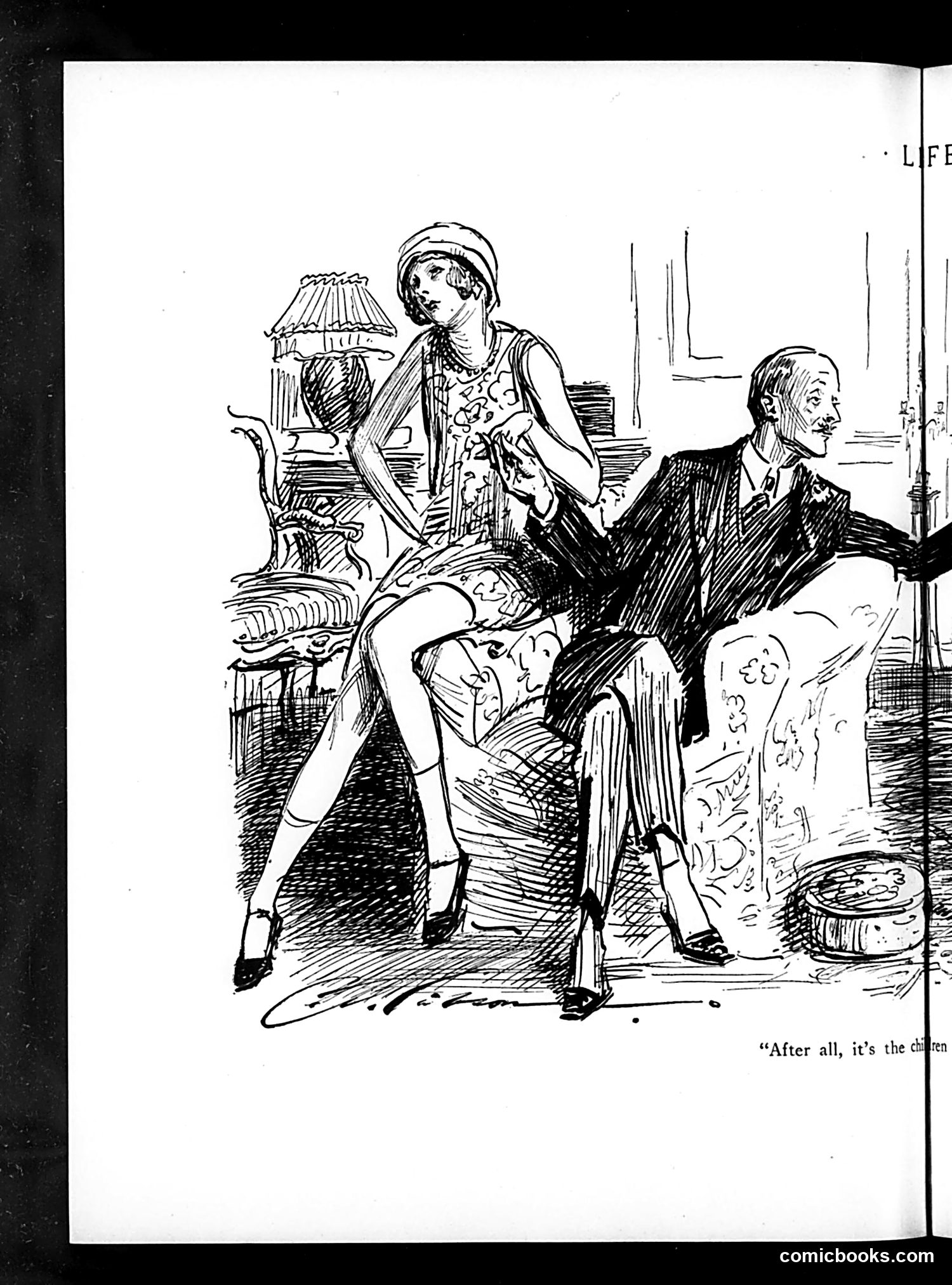
This appears to be a satirical illustration from *Life* magazine depicting a domestic scene. A woman in 1920s-style dress sits prominently on furniture, while a man in formal attire sits beside her. The caption reads: "After all, it's the c[h]ildren" (OCR partially garbled). The satire likely critiques marital dynamics or domestic priorities of the era. The woman's prominent, confident pose and the man's somewhat subordinate positioning suggest commentary on shifting gender roles or who controls household decisions. The incomplete caption frustrates full interpretation, but the "it's the children" reference likely satirizes how one partner justifies domestic choices or lifestyle decisions by invoking parental responsibility—a common rhetorical device in early 20th-century marriage discourse.
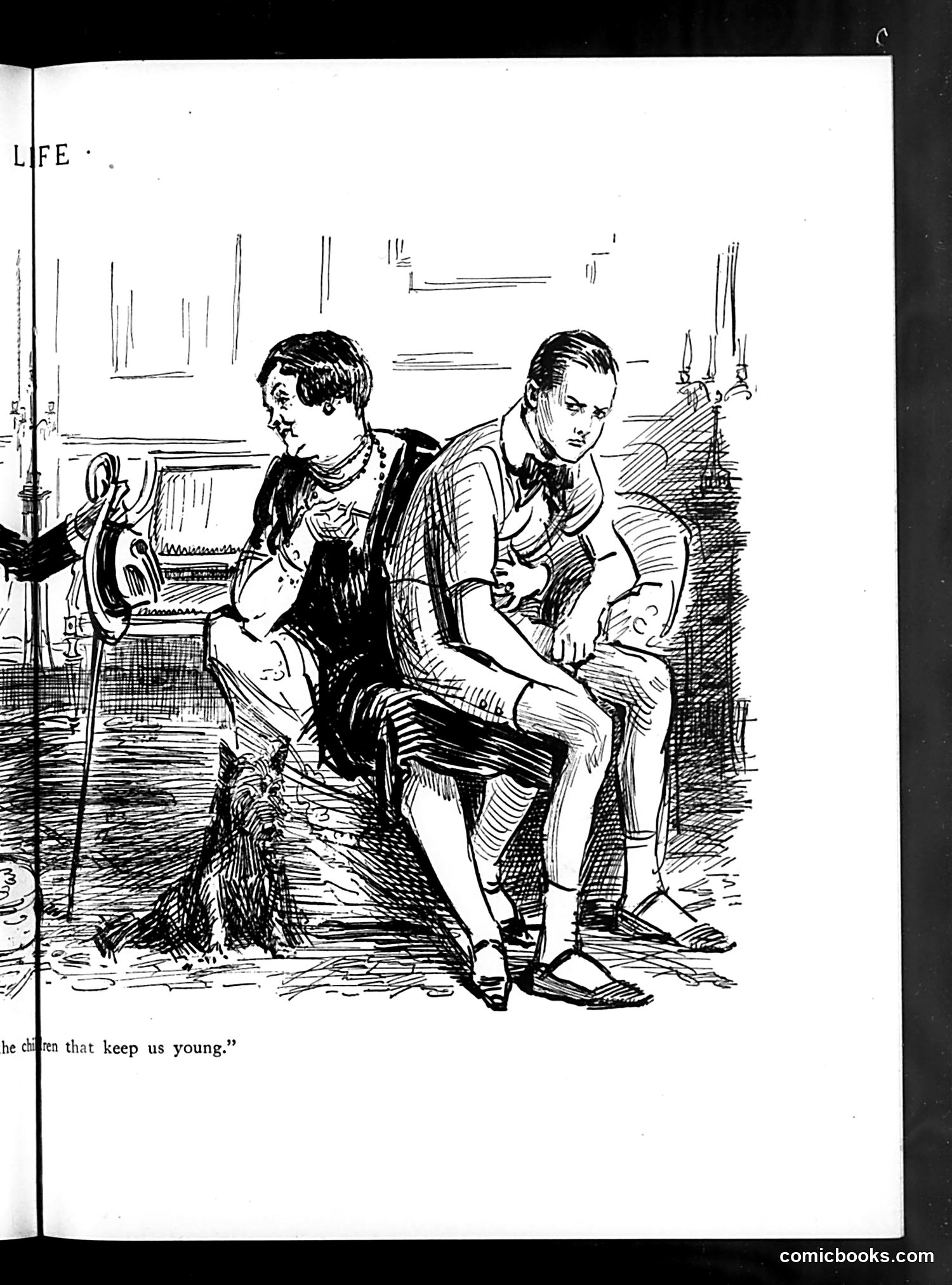
This satirical illustration from *Life* magazine depicts two adult men in what appears to be a domestic interior, interacting with children. The partially visible caption reads "...the children that keep us young." The cartoon's humor likely satirizes the common social claim that parenthood or childcare keeps adults youthful and energetic. The exaggerated, somewhat disheveled appearance of the men—contrasted with their engagement with the children—suggests ironic commentary on this notion. The actual physical toll or chaos of child-rearing appears to contradict the sentimental idea being mocked. Without additional context or visible date, the specific historical reference remains unclear, though the artistic style suggests late 19th or early 20th-century publication.
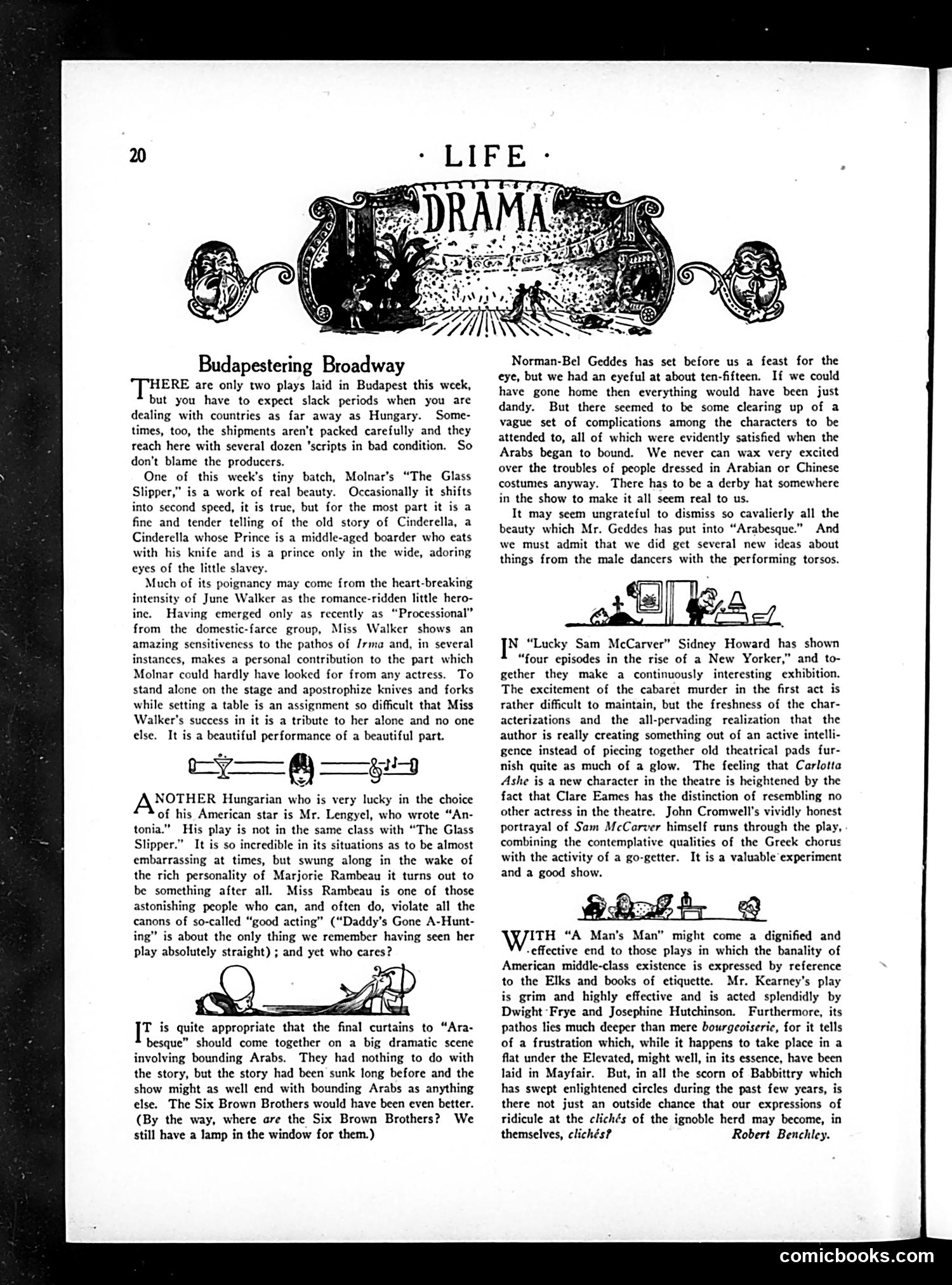
This page reviews recent Broadway plays, primarily Hungarian imports—a satirical jab at theater's fascination with exotic European material. The critic's tone is gently mocking: he quips that Budapest shipments arrive "with several dozen 'scripts in bad condition," suggesting American producers' indiscriminate appetite for foreign plays. The reviews praise **June Walker** in Molnar's "The Glass Slipper" (a Cinderella retelling) and **Marjorie Rambeau** in "Antonia," though the critic notes the latter is "incredible" yet salvaged by the actress's charisma—implying stars compensate for weak material. The most biting satire targets Norman-Bel Geddes's "Arabesque": the critic dismisses its elaborate visual spectacle, complaining the story "had been sunk long before" and suggesting random "bounding Arabs" conclude it. He sarcastically wishes the "Six Brown Brothers" (a vaudeville act) had performed instead—mocking both the production's visual excess and its narrative bankruptcy. The underlying point: decoration cannot save a hollow play.
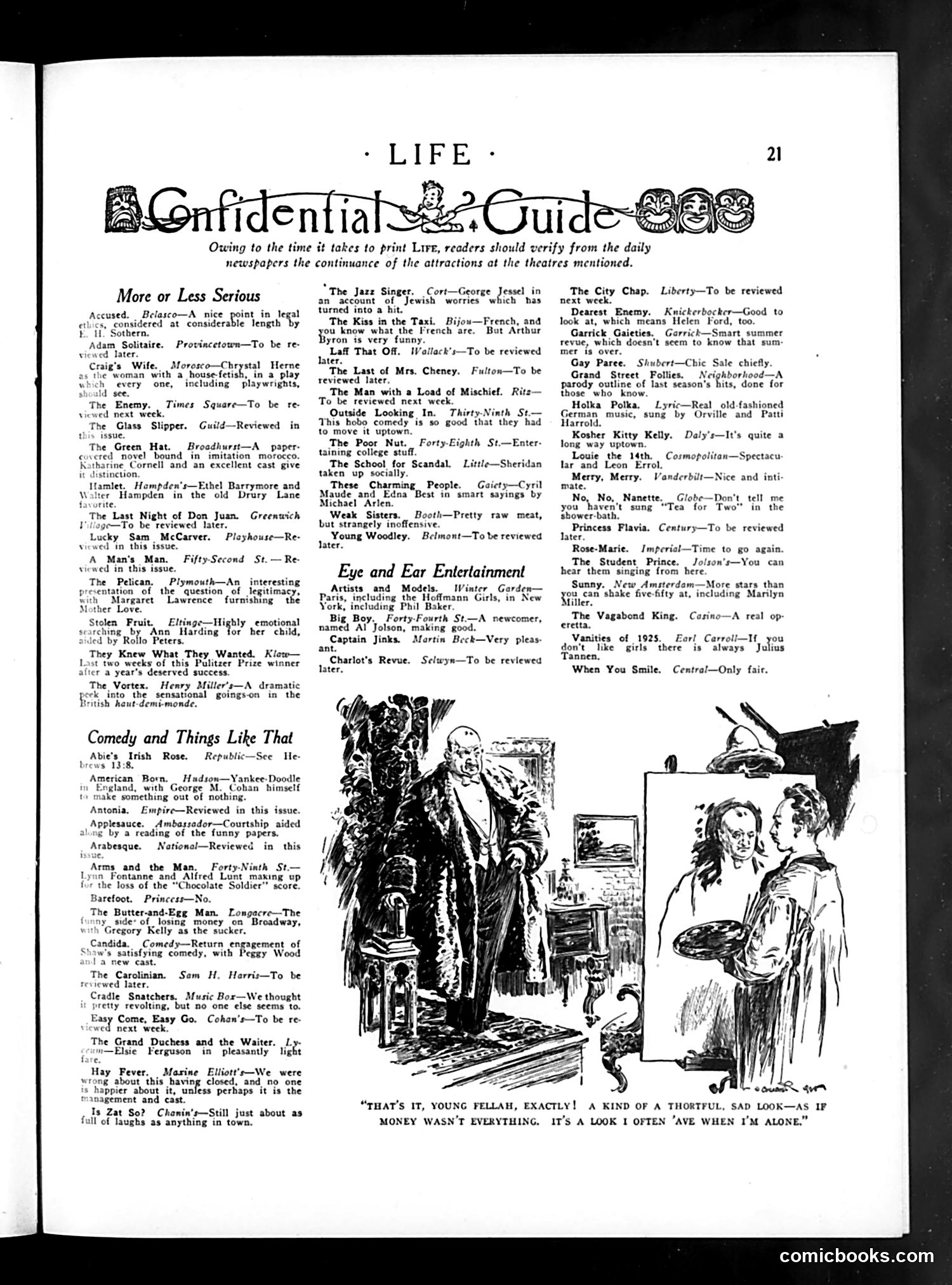
This page is a **theater review and entertainment guide** from Life magazine, listing current Broadway productions with brief critical assessments. It's organized by tone: "More or Less Serious," "Comedy and Things Like That," and "Eye and Ear Entertainment." The reviews are satirical one-liners mocking plot summaries. For example, *Craig's Wife* is described as featuring "a woman with a house-fetish"; *The Green Hat* is dismissed as a "paper-backed novel bound in imitation morocco" (cheap binding). The large illustration below shows a dramatic scene: an older man in formal dress confronting two younger figures, with the caption about a "shortful, sad look" when "money wasn't everything." This likely critiques materialistic attitudes in Jazz Age society. The page reflects 1920s entertainment culture, with references to popular stars like George M. Cohan and Ethel Barrymore. Overall, it's a guide helping readers choose theater while poking fun at contemporary dramatic trends and social preoccupations.
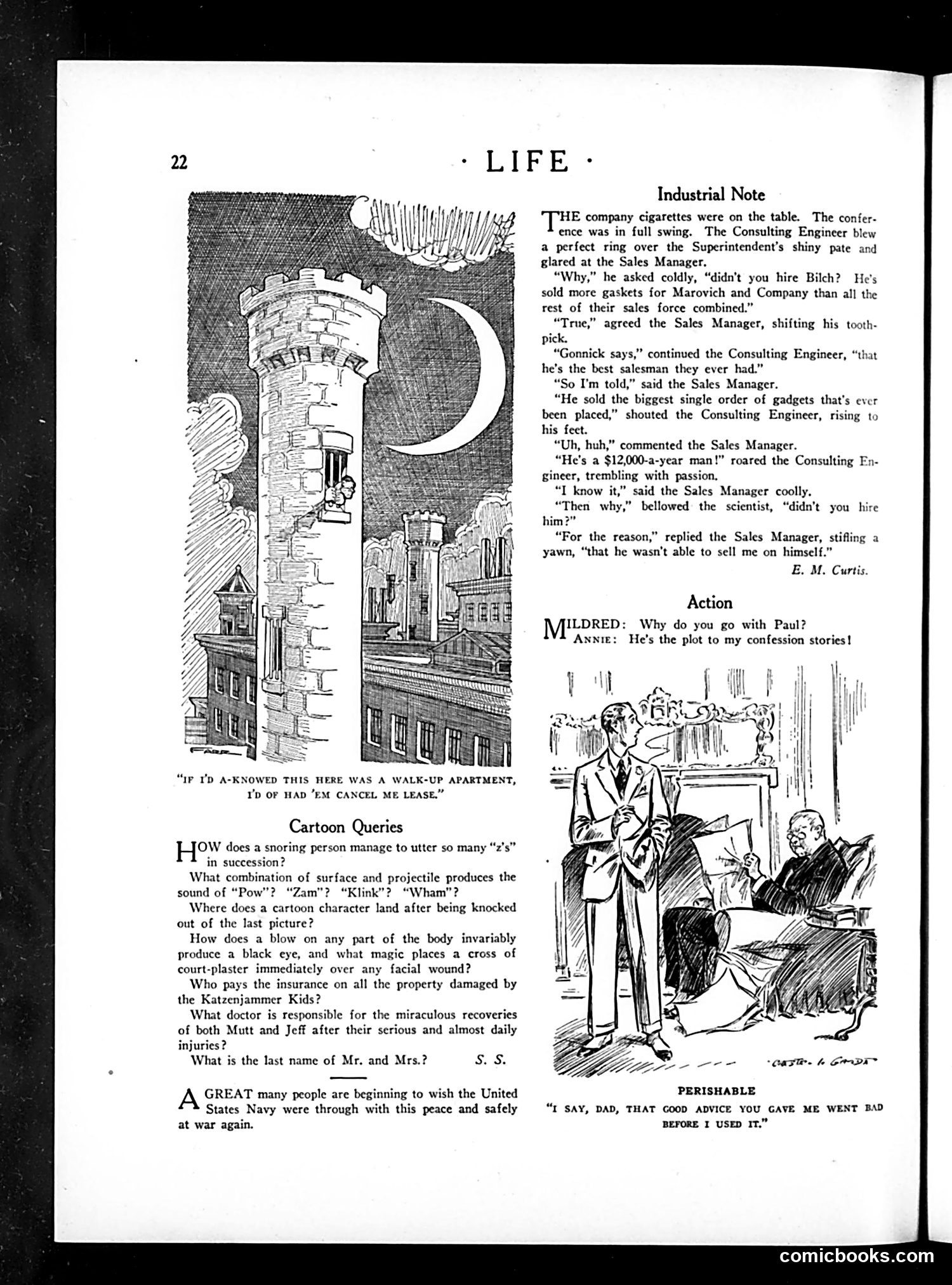
This page contains three distinct satirical pieces from an early 20th-century American humor magazine: **"Industrial Note"** mocks corporate hiring practices. A Consulting Engineer passionately argues that a highly successful salesman named Bilch should have been hired, citing his sales records and high salary ($12,000/year). The Sales Manager's calm reply—that Bilch "wasn't able to sell me on himself"—satirizes the irony that an excellent salesman failed at self-promotion, suggesting corporate decision-making is often irrational or personality-driven rather than merit-based. **"Action"** and **"Perishable"** are brief comic quips about romantic and domestic situations, typical of the magazine's humor style. **"Cartoon Queries"** humorously examines the absurd physics and logic of comic strips—how characters survive impossible injuries, produce cartoon sound effects, and recover instantly. This meta-commentary pokes fun at cartoon conventions' internal inconsistencies. The page reflects Life's focus on satirizing American business culture, social conventions, and popular entertainment through witty observation rather than political commentary.
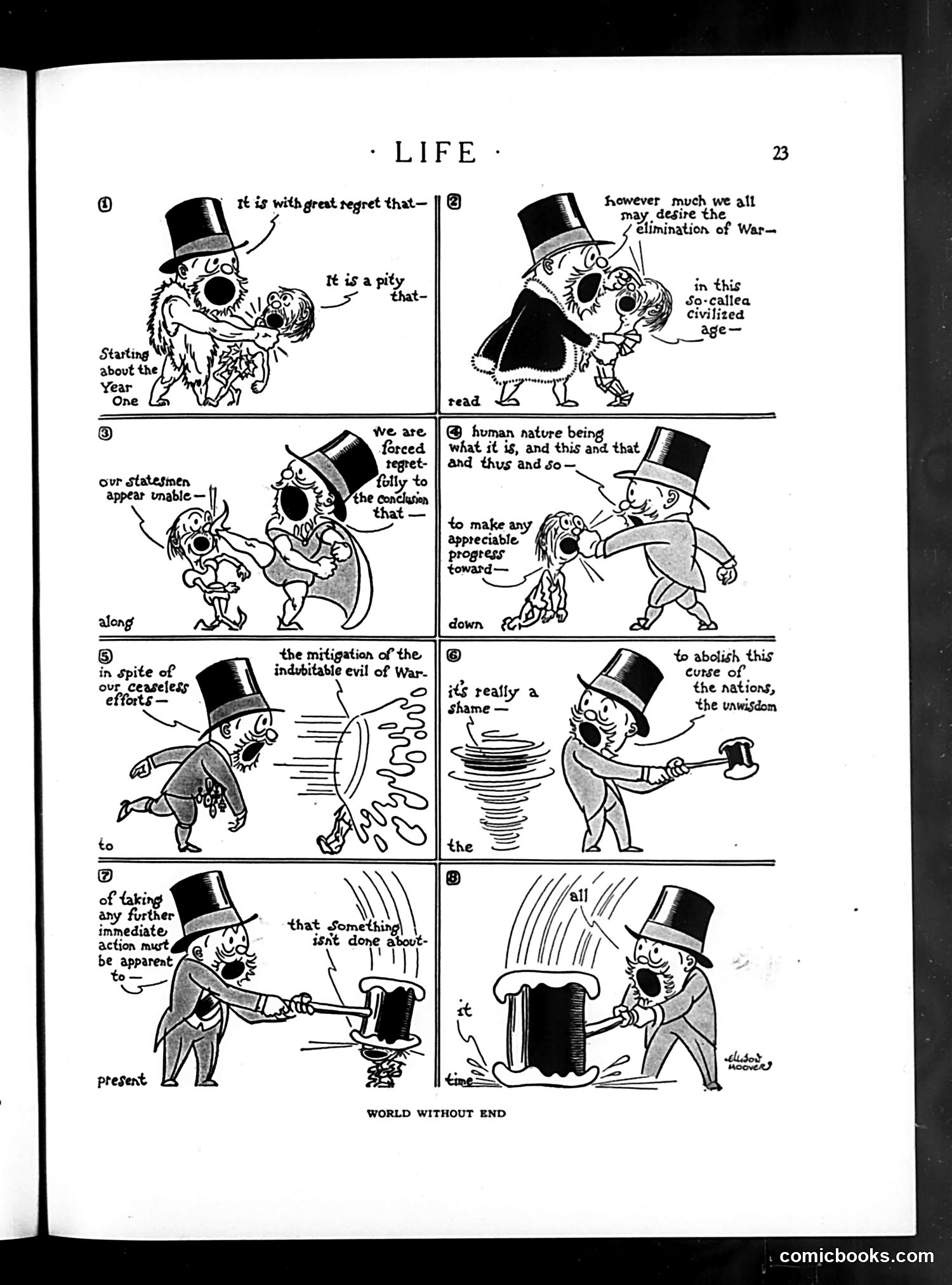
This page satirizes the futility of efforts to eliminate war through diplomacy and reform. A top-hatted statesman (likely representing a politician or diplomat) repeatedly attempts various solutions—from negotiation to legislation to direct action—to end warfare, which is personified as a persistent, inevitable force. The cartoon's structure shows escalating frustration: each panel depicts the statesman trying a different approach, only to fail. The title "World Without End" sarcastically suggests that war, like a religious phrase, will continue indefinitely. The satire targets the gap between idealistic rhetoric about achieving peace in a "civilised age" and the reality that "human nature being what it is" makes conflict inevitable. The repeated failure suggests the cartoonist's skepticism about whether political solutions can truly eliminate war—a pointed commentary on post-WWI peace efforts and the League of Nations era, when such optimism about eliminating warfare was widespread but ultimately proven naive.
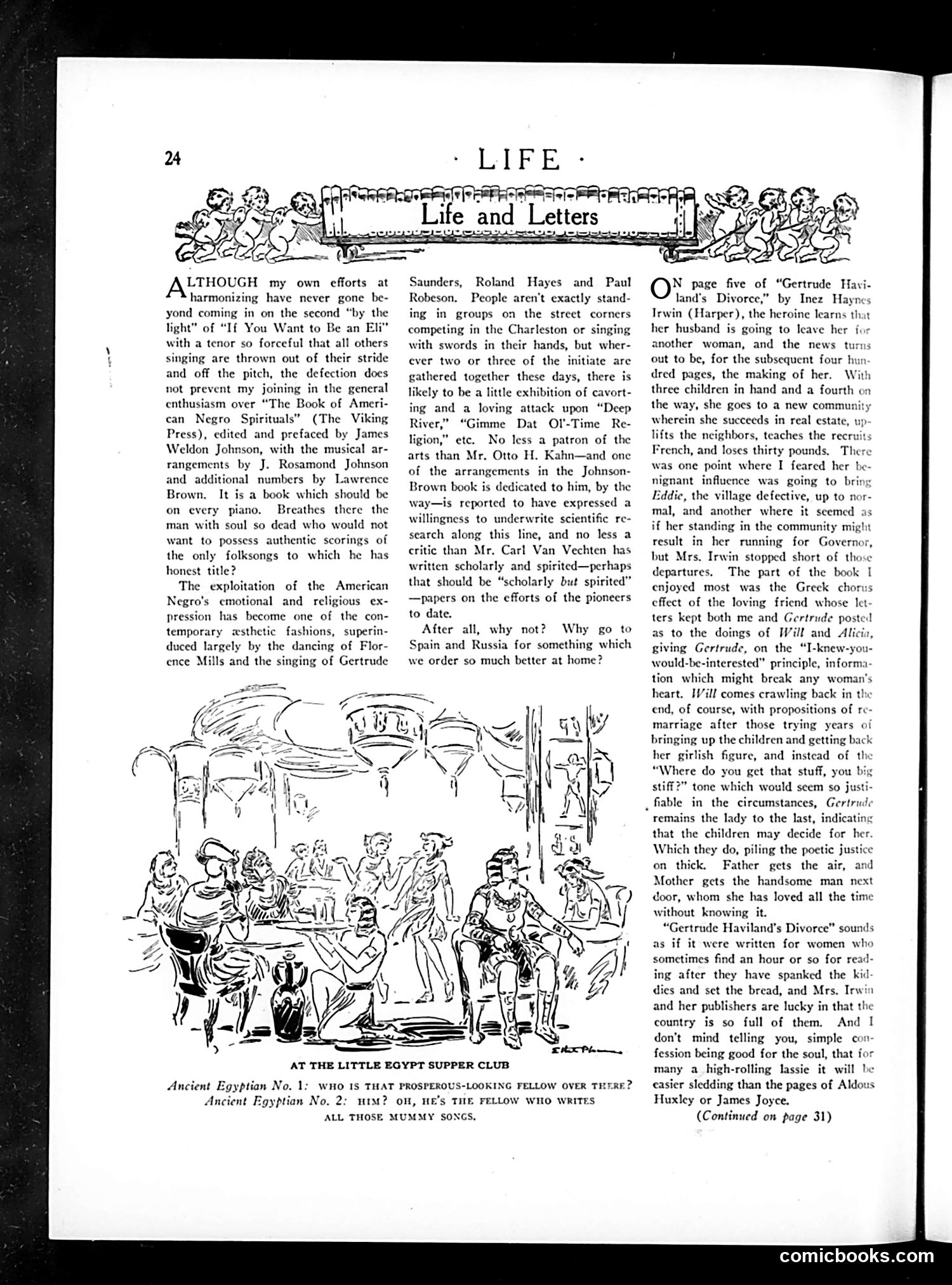
This page contains two distinct pieces of literary criticism and satire from Life magazine's "Life and Letters" section. **The Main Article** discusses the fashionable enthusiasm for African American spirituals, particularly James Weldon Johnson's newly published collection. The author notes that appreciation for Black musical and cultural expression has become trendy among white society, citing performers like Florence Mills, Roland Hayes, and Paul Robeson as catalysts. The piece gently mocks this "contemporary esthetic fashion," observing that wealthy patrons like Otto Kahn now fund research into spirituals. The final question—"why not order so much better at home?"—suggests Americans should support their own cultural treasures rather than romanticizing foreign art. **The Cartoon** titled "At the Little Egypt Supper Club" satirizes this same trend: two ancient Egyptians discuss a "prosperous-looking fellow" who "writes all those mummy songs"—clearly mocking white society's consumption of Black culture as exotic entertainment, with the "mummy songs" implying stereotypical exoticization. **The Book Review** briefly discusses Gertrude Haviland's Divorce, praising its portrayal of female resilience and independence.
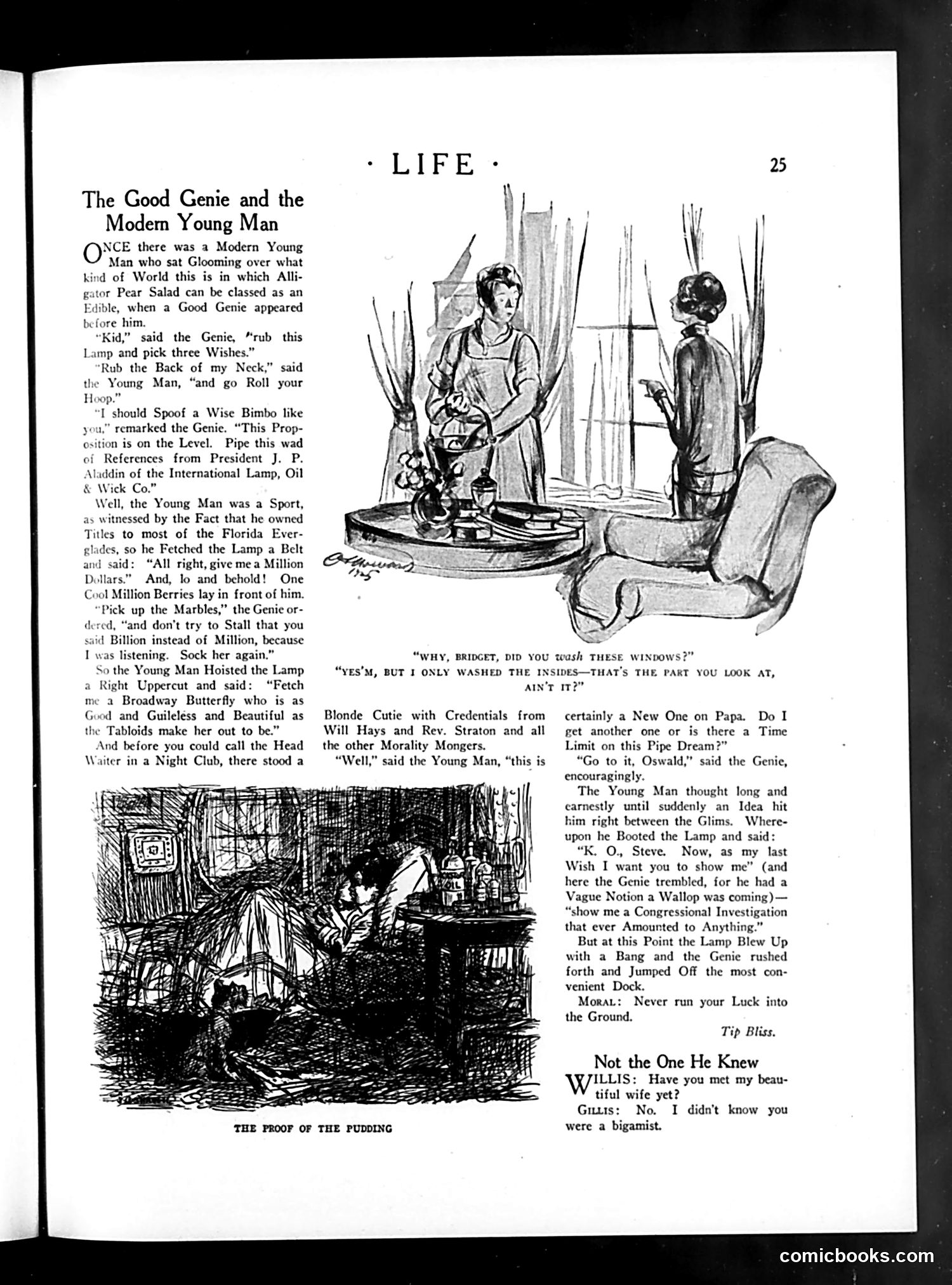
This page contains two satirical pieces from Life magazine (appears to be 1920s-era based on references). **"The Good Genie and the Modern Young Man"** mocks wealth and desire through a fairy-tale framework. A young man with Florida real estate wishes for a million dollars, then a "Broadway Butterfly" (a glamorous showgirl/flapper). His final wish—to see a Congressional Investigation that "amounted to anything"—causes the genie to flee and the lamp to explode. The satire: Congressional investigations were so notoriously ineffective and corrupt that even magic cannot produce one. The moral warns against pushing luck too far. **"The Proof of the Pudding"** shows a maid who washed only the *inside* of windows, reasoning that's the part you see. It's a joke about lazy shortcuts and faulty logic. **"Not the One He Knew"** is a brief joke implying a man has two wives without knowing it—calling him a "bigamist" unknowingly. The cartoons reflect 1920s cynicism about government effectiveness, consumer culture, and domestic humor.
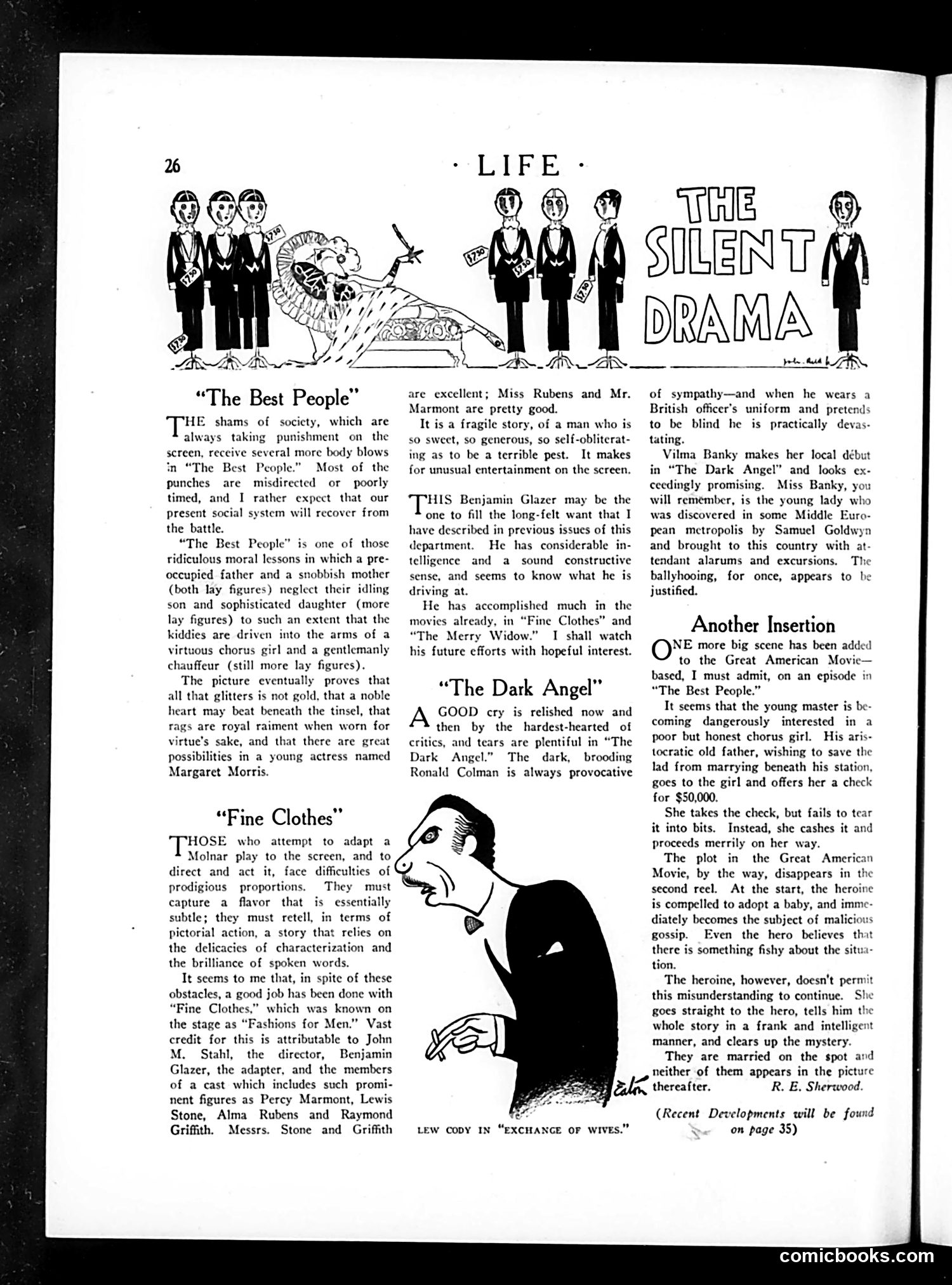
This page contains film criticism for three silent movies from the 1920s. The top cartoon illustrates a common plot device: wealthy, neglectful parents whose idle children are "driven into the arms of a virtuous chorus girl and a gentlemanly chauffeur." The reviewer critiques "The Best People" as a moralistic tale teaching that "a noble heart may beat beneath the tinsel" — mocking how films reduce class commentary to sentimental platitudes. Similarly, "Fine Clothes" adapts a delicate stage play about an excessively generous man into screen entertainment. "The Dark Angel" features Ronald Colman (noted for his sympathetic performances) and introduces Vilma Banky, a European actress Samuel Goldwyn brought to Hollywood with publicity fanfare that the reviewer suggests was finally justified. The satirical aside about "the Great American Movie" mocks how cinema reduces complex narratives to crude moralizing: a wealthy father bribes a chorus girl to leave his son, but she takes the money anyway—the plot apparently disappearing by reel two. The tone reflects period cynicism toward both film sentimentality and Hollywood's star-building machinery.
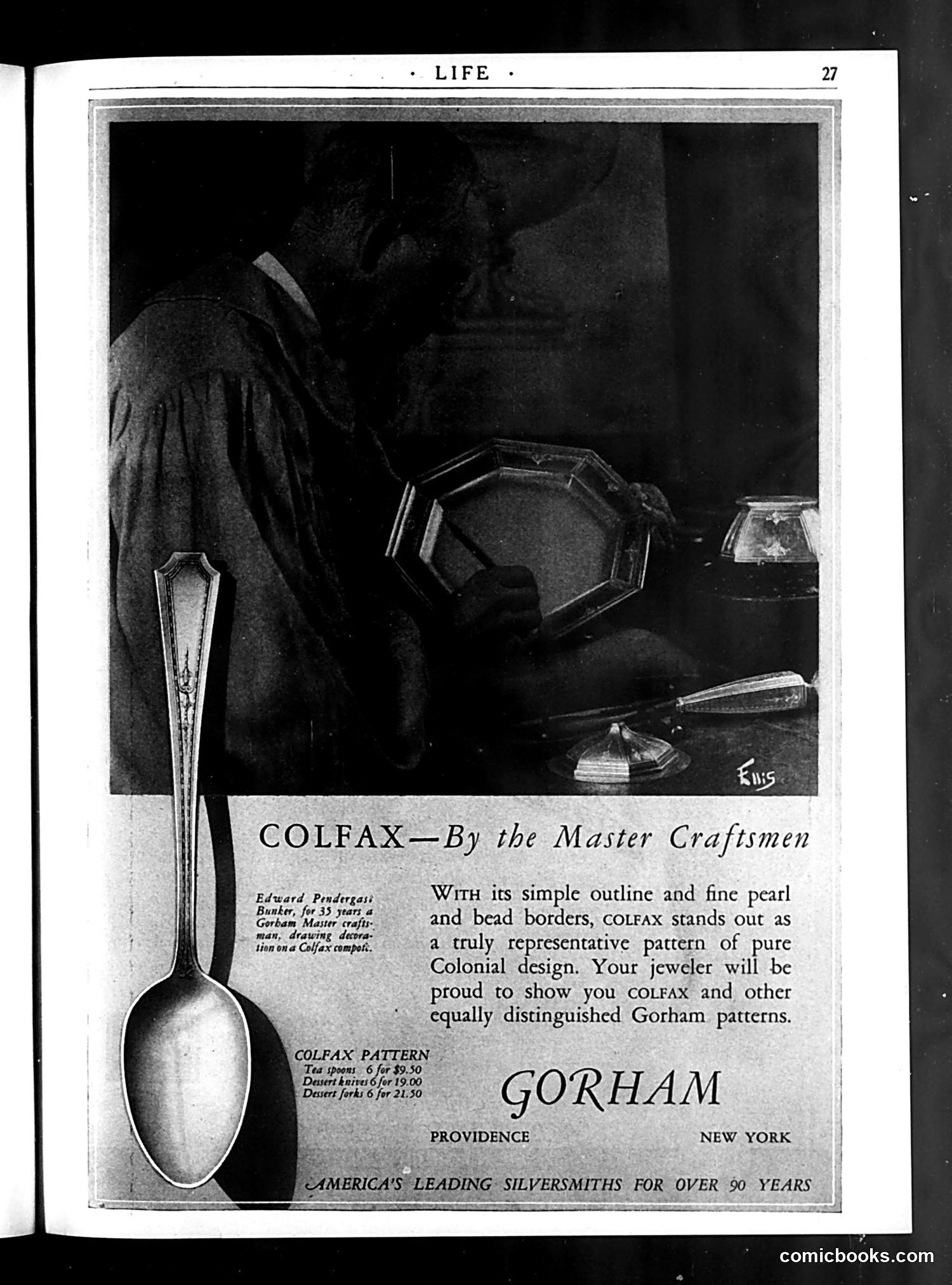
This is **not a cartoon or satire page**, but rather a **full-page advertisement** for Gorham silverware, the prominent American manufacturer. The image shows a craftsman (identified as Edward Pendergast Bunker, a 35-year Gorham artisan) at work decorating a serving piece in the "Colfax" pattern. The ad emphasizes Colonial design aesthetics and handcrafted quality, positioning Gorham as "America's Leading Silversmiths for over 90 years." The pricing shown (tea spoons 6 for $9.50, dessert knives/forks 6 for $19-21.30) reflects 1920s-era luxury goods pricing. This represents typical *Life* magazine content of the period—upscale advertisements targeting affluent readers, not satirical or political commentary.
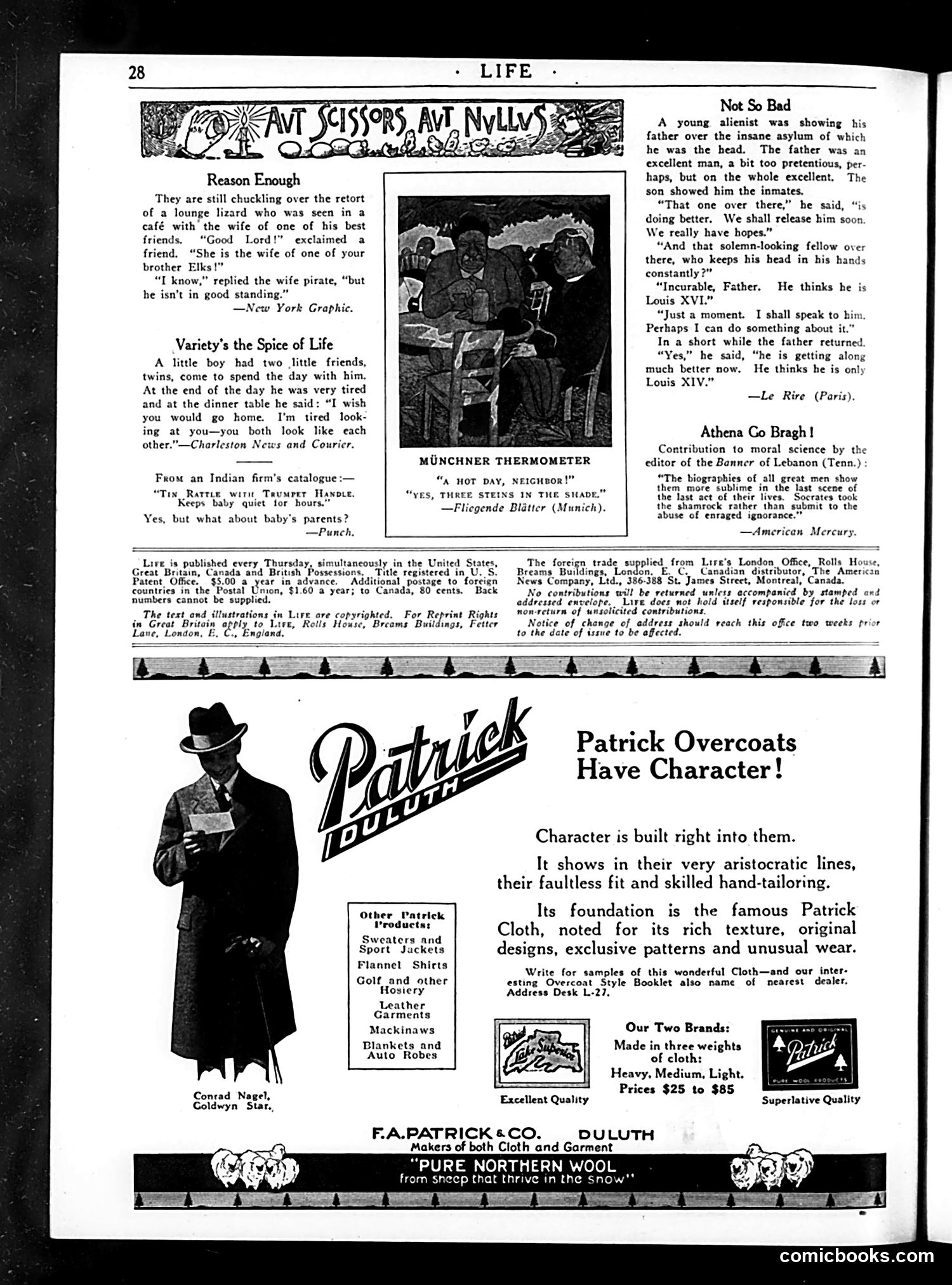
This page from *Life* magazine contains several short humorous anecdotes and one prominent advertisement. **The Cartoons/Jokes:** The page features five brief satirical pieces mocking social pretension and absurdity: 1. A "lounge lizard" (a dissolute man) caught with a friend's wife claims he isn't worried because the husband "isn't in good standing" at their Elks lodge—mocking hollow social hierarchies. 2. A tired child wishes his twin visitors would leave because they look alike—humor from childish bluntness. 3. An Indian product advertisement claims to keep babies quiet for hours; *Punch* magazine responds asking what about the parents' suffering. 4. A Bavarian thermometer joke about hot weather. 5. A satirical piece where a psychiatric director's father "cures" a patient believing he's Louis XVI by convincing him he's Louis XIV instead—mocking therapy and aristocratic pretension. **Advertisement:** The lower half is a full Patrick Overcoats advertisement featuring actor Conrad Nagel, emphasizing quality cloth and hand-tailoring. The page is primarily advertising with brief satirical content typical of *Life*'s format.
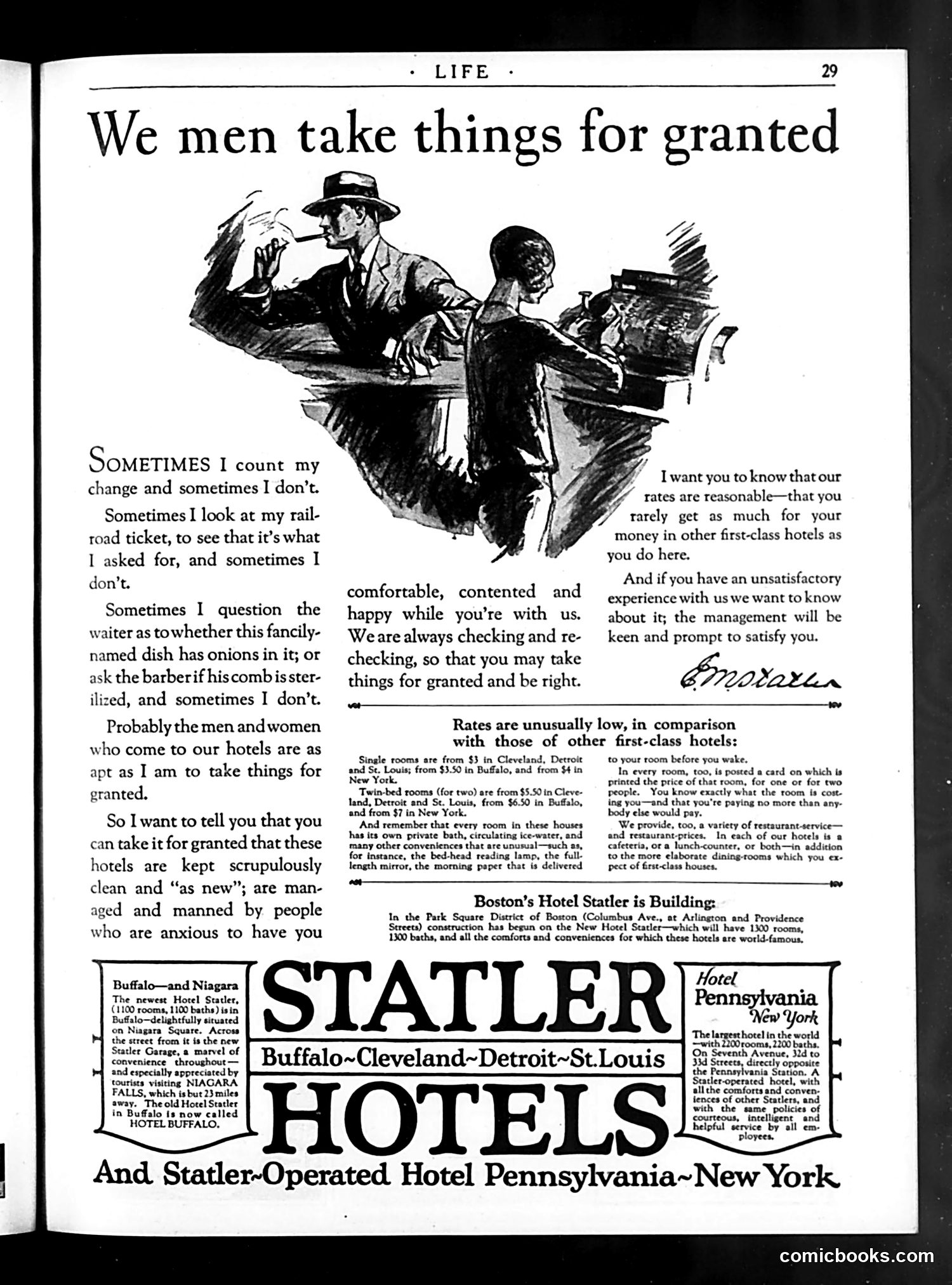
This page is primarily a **Statler Hotels advertisement** with an accompanying editorial message, not a political cartoon. The illustration shows a man with multiple arms juggling various items (railroad ticket, dish, comb, toolbox), visualizing the concept stated in the headline: "We men take things for granted." The figure appears to be an everyman character, not a specific caricature. **The Message:** The Statler Hotels chain uses this relatable premise to argue that their hotels warrant trust without constant verification. The accompanying text promises scrupulous cleanliness, fair pricing, attentive management, and readily available information about room costs—assuring guests they needn't constantly "check and recheck" like the busy man in the illustration. **Social Context:** This reflects early-20th-century concerns about consumer trust and hotel quality standards, suggesting many travelers were indeed suspicious about hidden costs, cleanliness, and fair dealing. The advertisement positions Statler as the reliable alternative to such anxieties. The page is substantially advertising copy rather than satirical content.
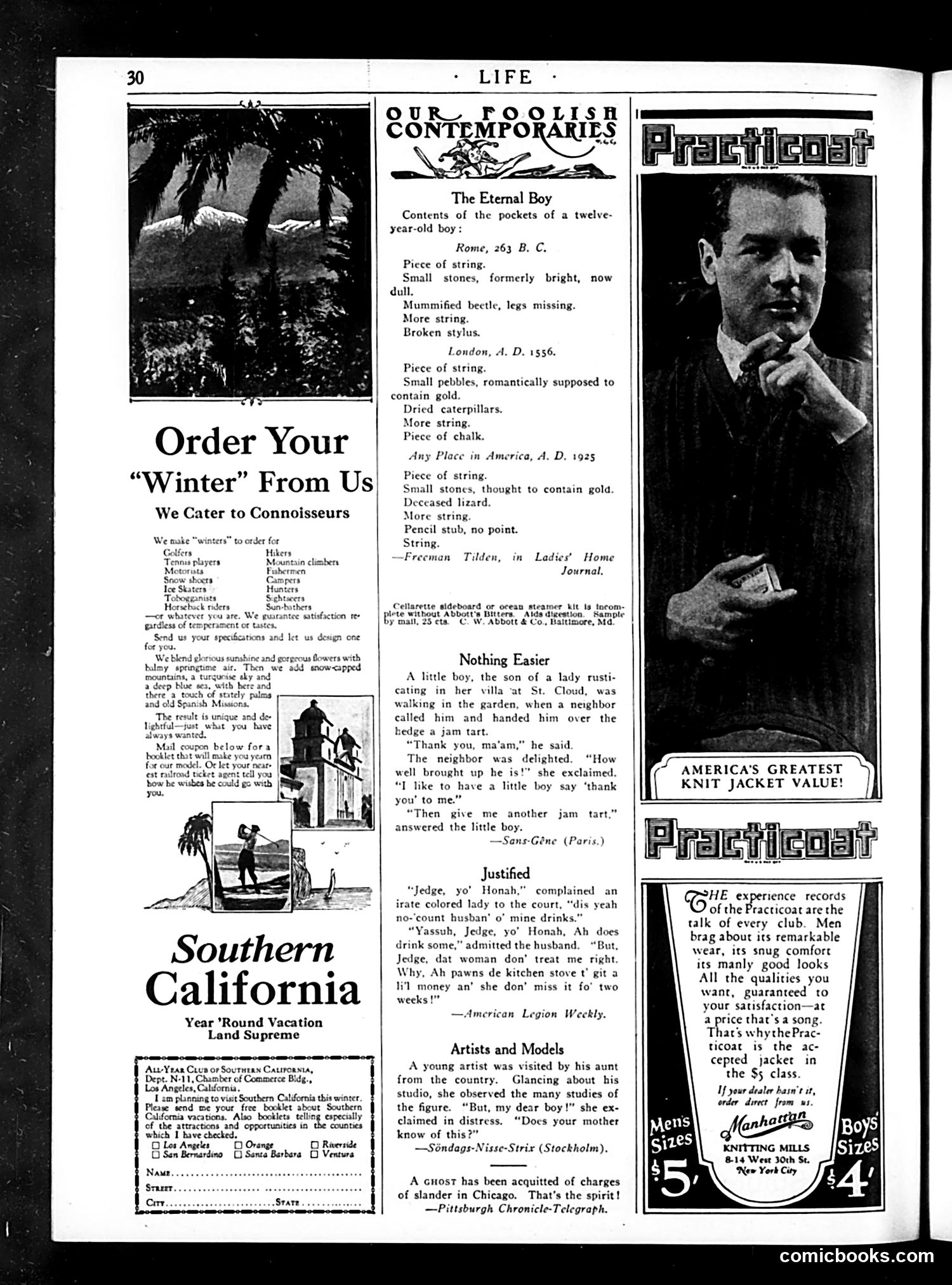
This page is primarily **advertising and humor content** rather than political satire. The main feature, "The Eternal Boy" by Freeman Tilden, is a humorous essay comparing what twelve-year-old boys carry in their pockets across three historical periods: ancient Rome (263 B.C.), Renaissance London (1556 A.D.), and contemporary America (1925). The joke's point: **boys' pockets remain unchanged across centuries**—always containing string, stones, and small dead creatures. It's gentle social satire about the unchanging nature of boyhood itself, suggesting that despite civilization's progress, boys are eternally the same. The surrounding content includes lighthearted anecdotes about children's politeness and marital discord, plus advertisements for Practicoat jackets and Southern California tourism. The page reflects 1920s Life magazine's mix of domestic humor, advertising, and gentle social observation aimed at middle-class readers.
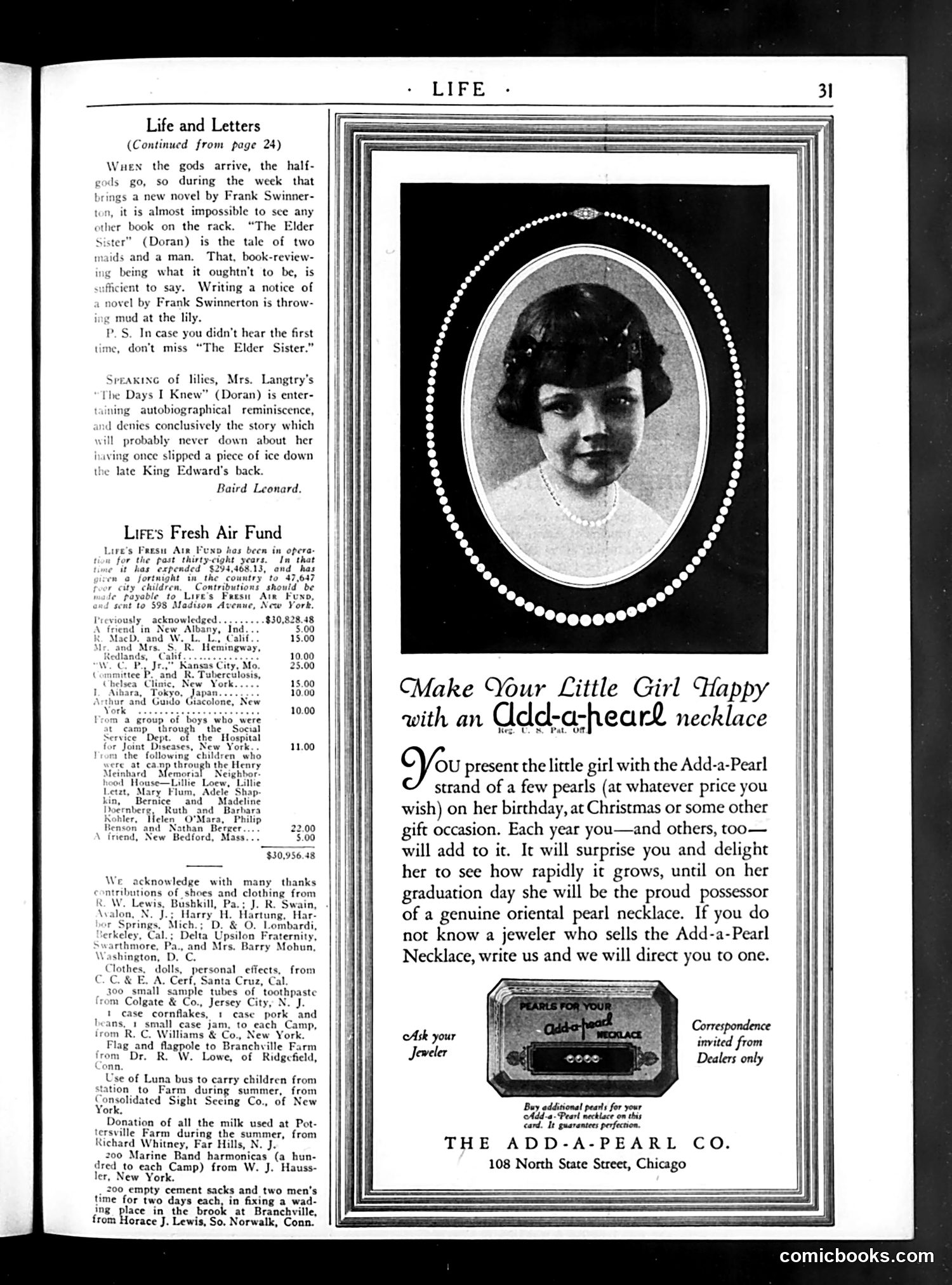
This page contains **no cartoons or satire**—it's primarily editorial content and advertising from *Life* magazine. The left column features book reviews praising Frank Swinnerton's novel "The Elder Sister" and mentions Mrs. Langtry's autobiography "The Days I Knew," which apparently debunks a rumor about her placing ice down King Edward's back. The bulk of the page reports on **Life's Fresh Air Fund**, a charitable program (operating 38 years at publication) that had sent nearly 48,000 children to the countryside. It lists donors contributing money, clothing, and services—ranging from shoes and harmonicas to use of buses and farm facilities. The right side is a **product advertisement** for the "Add-a-Pearl Necklace"—a marketing concept where parents give a child a few pearls as a gift, then relatives add pearls annually until graduation, creating a complete pearl necklace. The advertisement targets jewelry dealers. No political satire or caricature is present; this is straightforward editorial, charity reporting, and consumer advertising typical of early 20th-century *Life* magazine content.
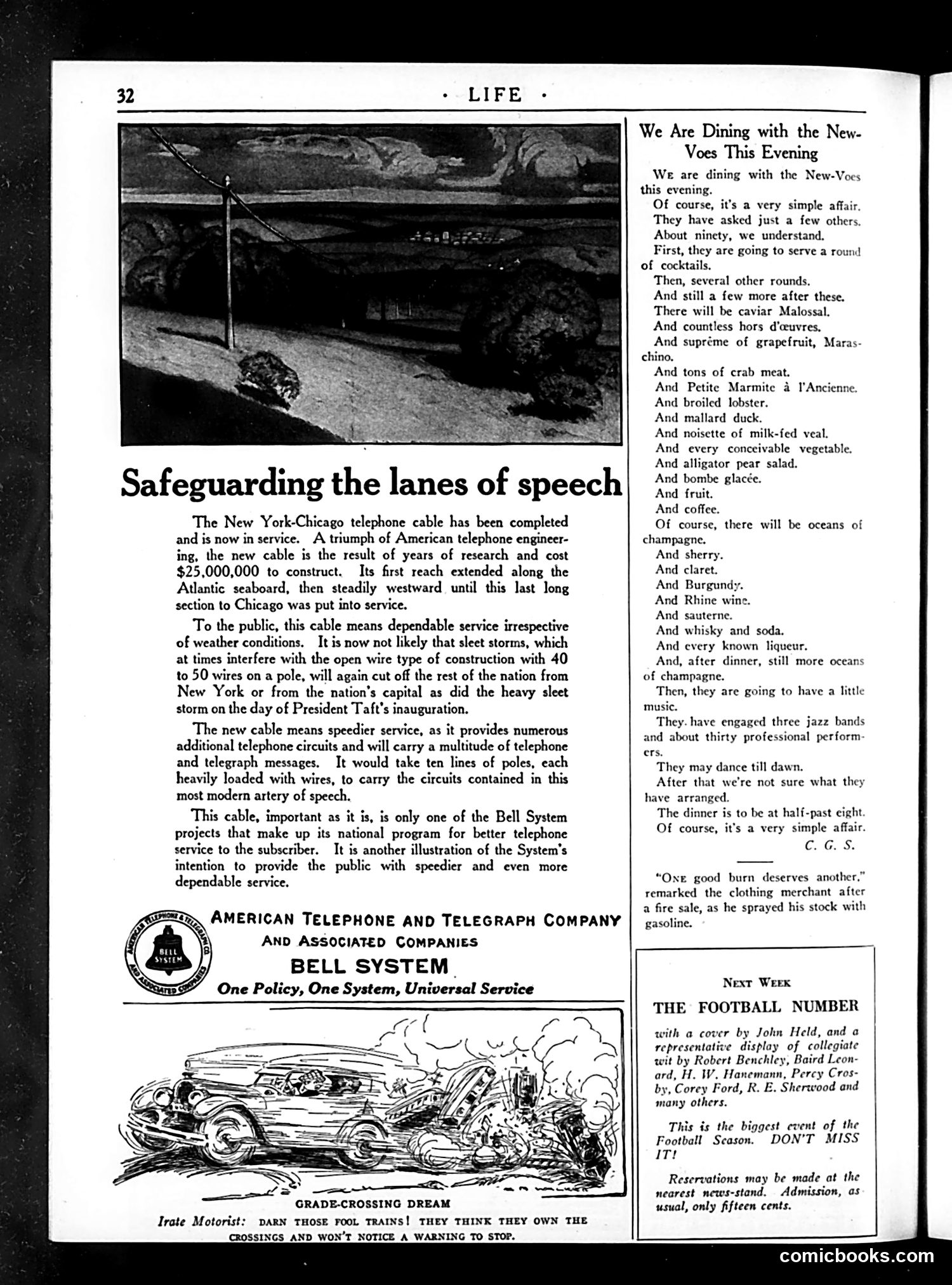
This page contains two distinct pieces of content: **"Safeguarding the Lanes of Speech"** is a Bell System advertisement celebrating the completed New York-Chicago telephone cable ($25 million, references President Taft's inauguration). The phrase "lanes of speech" metaphorically describes telephone transmission capacity. It emphasizes reliability during weather and superior service—framed as essential infrastructure. **"Grade-Crossing Dream"** is a satirical cartoon depicting an irate motorist cursing at trains at railroad crossings, complaining that trains ignore warning signals. This mocks the motorist's delusional belief that trains should stop for cars—when clearly the opposite is true. The joke exposes the motorist's absurd entitlement and ignorance of rail safety hierarchy. **"We Are Dining with the New-Voes This Evening"** humorously catalogs an extravagant dinner party with excessive food, drinks (champagne mentioned repeatedly), music, and dancing—sarcastically called "a very simple affair." The humor lies in the contrast between understated language and ostentatious excess, likely mocking wealthy social pretension.
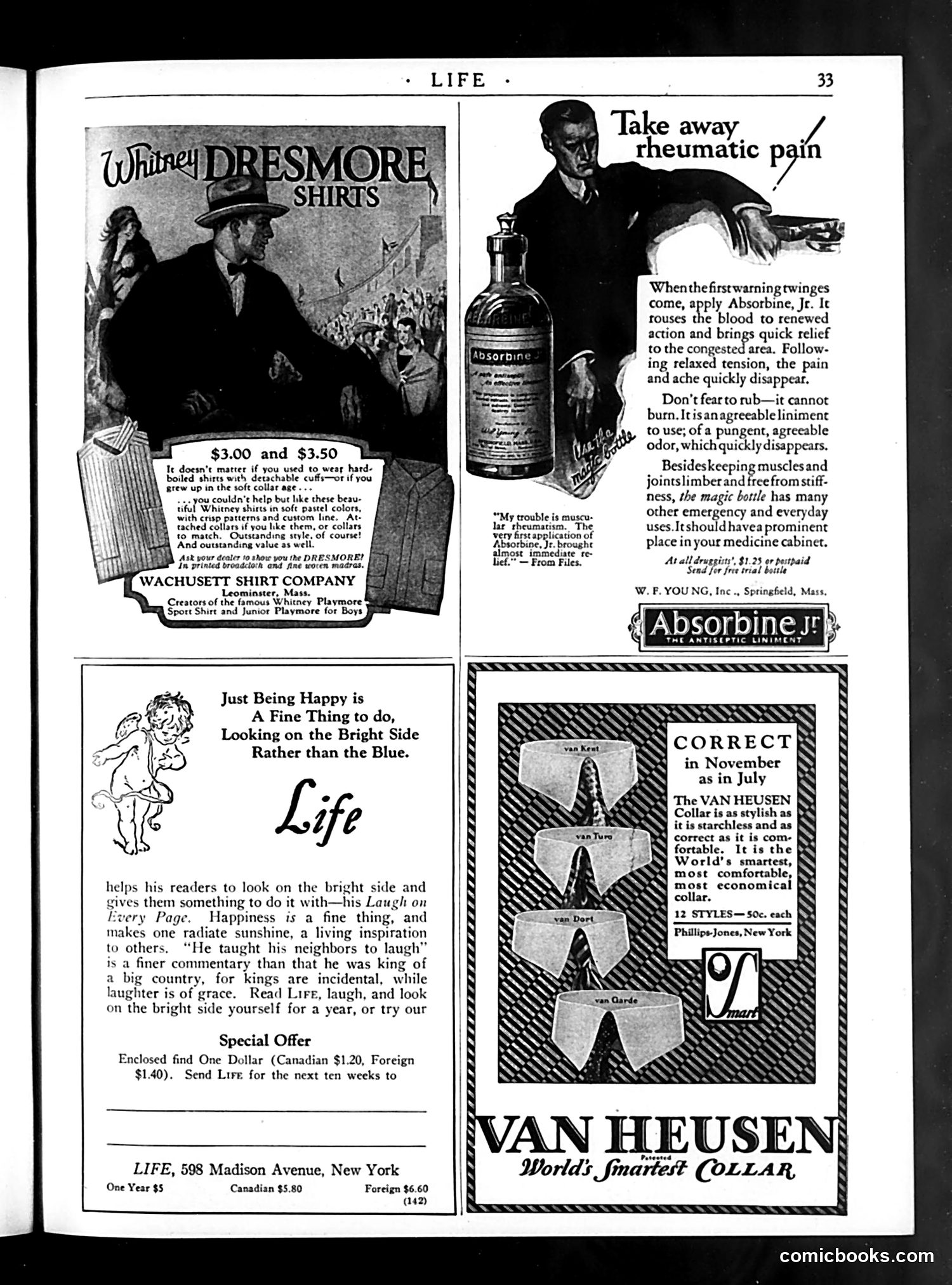
This page is primarily **advertising**, not political satire. It contains four commercial advertisements typical of early-20th-century magazines: 1. **Whitney Dresmore Shirts** ($3.00-$3.50): Markets soft pastel dress shirts with customizable collars to men abandoning old "hard-boiled" starched styles. 2. **Absorbine Jr. liniment**: Advertises pain relief for "muscular rheumatism" (likely arthritis), featuring a testimonial from a satisfied user. The product promises quick relief when applied to affected joints. 3. **Life Magazine self-promotion**: The magazine pitches subscriptions by emphasizing its philosophy of promoting happiness and laughter as moral goods—readers should "look on the bright side" rather than despair. 4. **Van Heusen Collar**: Promotes "starchless" collars as stylish, comfortable, and economical year-round. The page reflects **1920s consumer culture**: marketing comfort, modernity, and practical solutions to everyday problems. No political figures or satire are present.
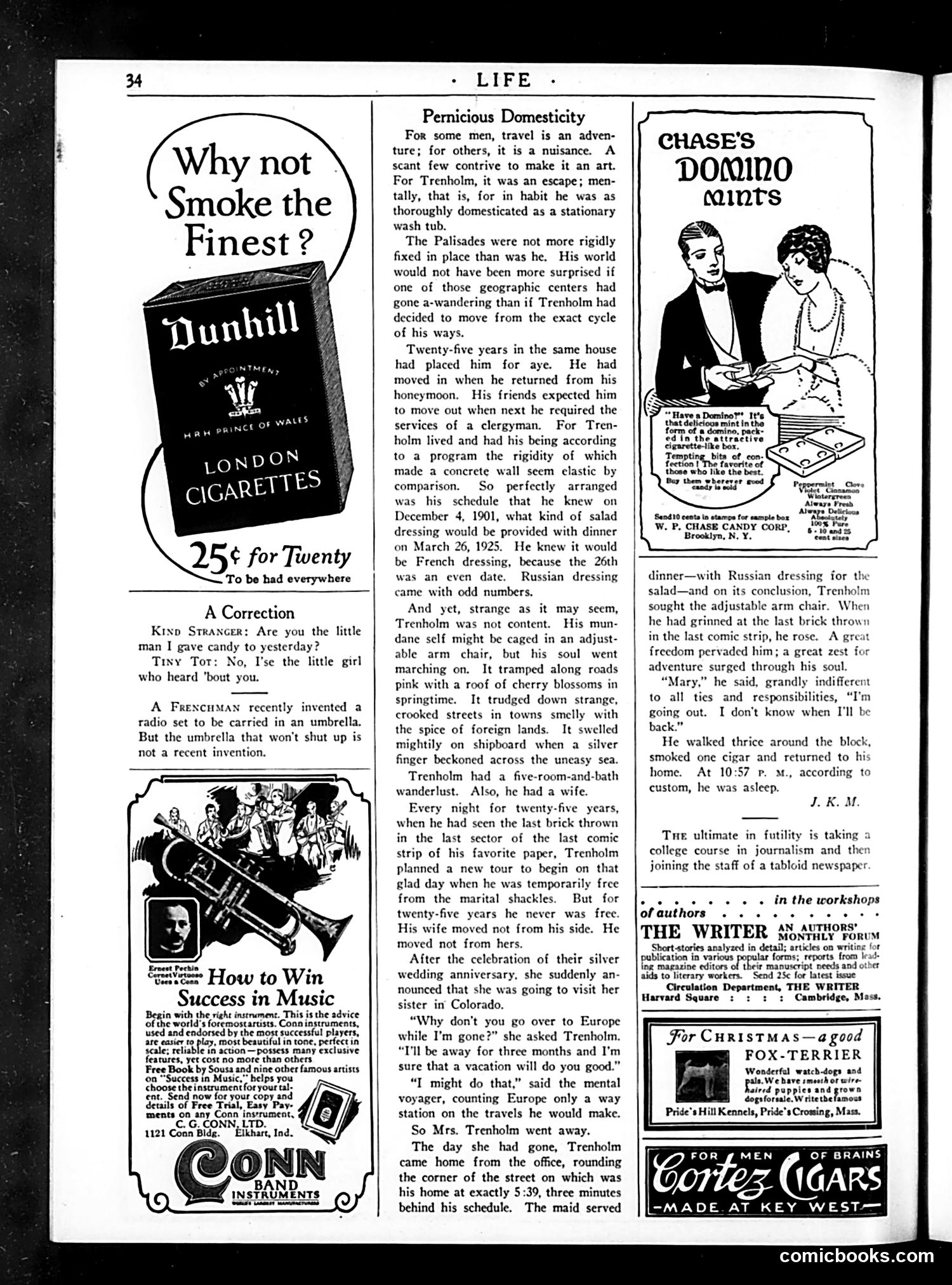
This story satirizes the suffocating grip of married domesticity on a man's spirit. **Trenholm** is a meticulously routine-bound husband who has lived the identical schedule for 25 years—so predictable he knows what salad dressing he'll eat on specific dates in 1925. His soul yearns for travel and adventure, but his wife keeps him literally and figuratively bound to home. The satire's point: middle-class marriage transforms a man into a fixture as immobile as the Palisades cliffs. When his wife finally leaves for Colorado and offers him Europe, he plans escape—yet the narrative's final detail reveals he arrives home *three minutes late*, suggesting even freedom cannot break his domesticated habit. The piece mocks both rigid conformity and the woman's role in enforcing it, reflecting 1920s anxieties about marriage as entrapment.
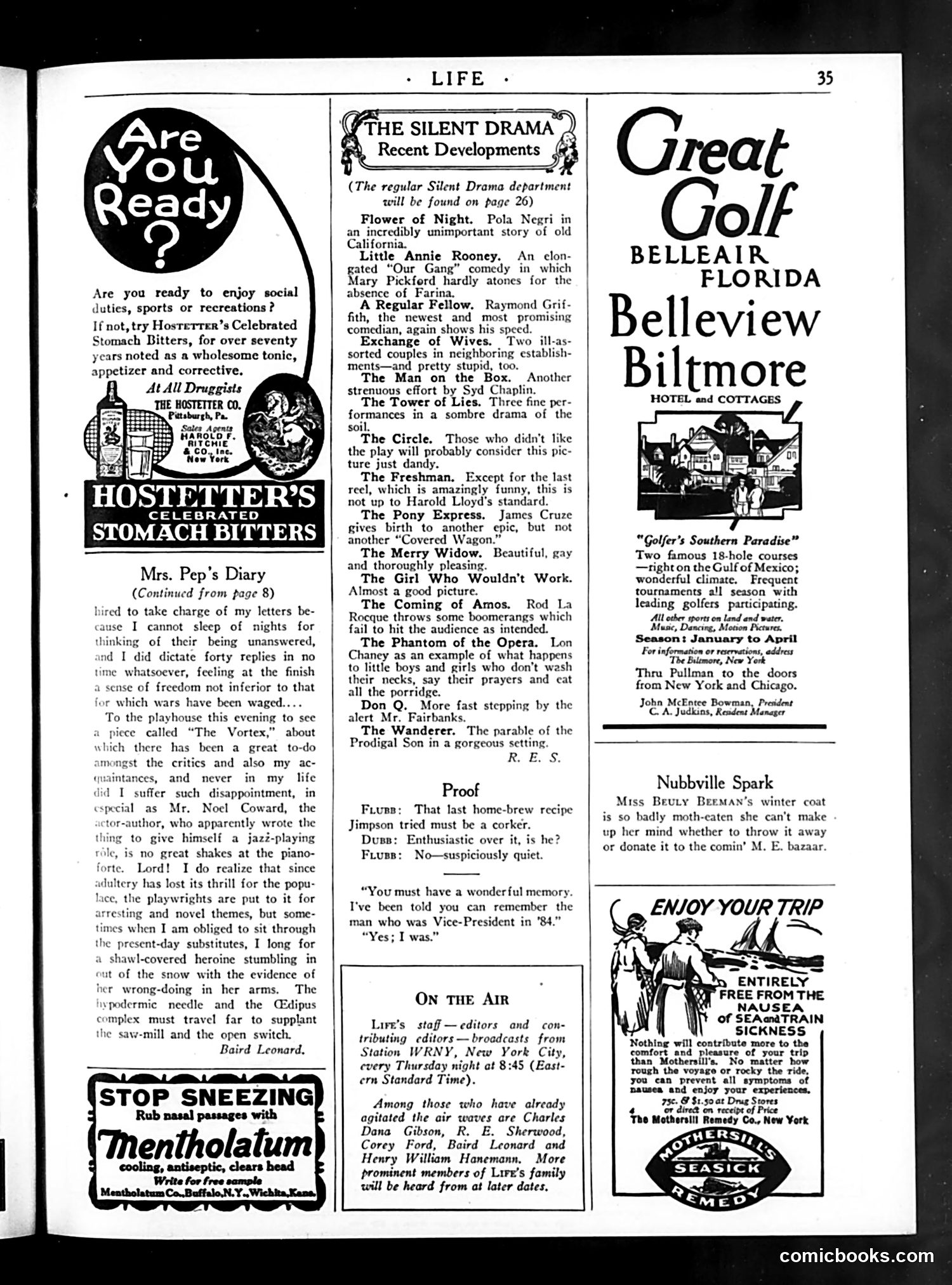
This page is primarily **advertisements and miscellaneous magazine content** rather than political cartoons. The main elements are: **"Mrs. Pep's Diary"** — A society columnist's humorous observations about attending Noel Coward's play "The Vortex," which had scandalized critics. The author jokes that modern playwrights lack the melodramatic scandals (seduction, illegitimate children) that once thrilled audiences, resorting instead to Freudian psychology ("Oedipus complex") as their subject matter. **"The Silent Drama" section** — Brief reviews of contemporary silent films featuring major stars (Pola Negri, Mary Pickford, Harold Lloyd, etc.). **"Proof"** — A brief joke about home-brew liquor during Prohibition. **Advertisements** — Hostetter's Stomach Bitters, Mentholatum, and Florida resort promotions dominate the page. The page reflects 1920s concerns: Prohibition-era humor, the popularity of cinema, and modernist theater's challenge to traditional morality.
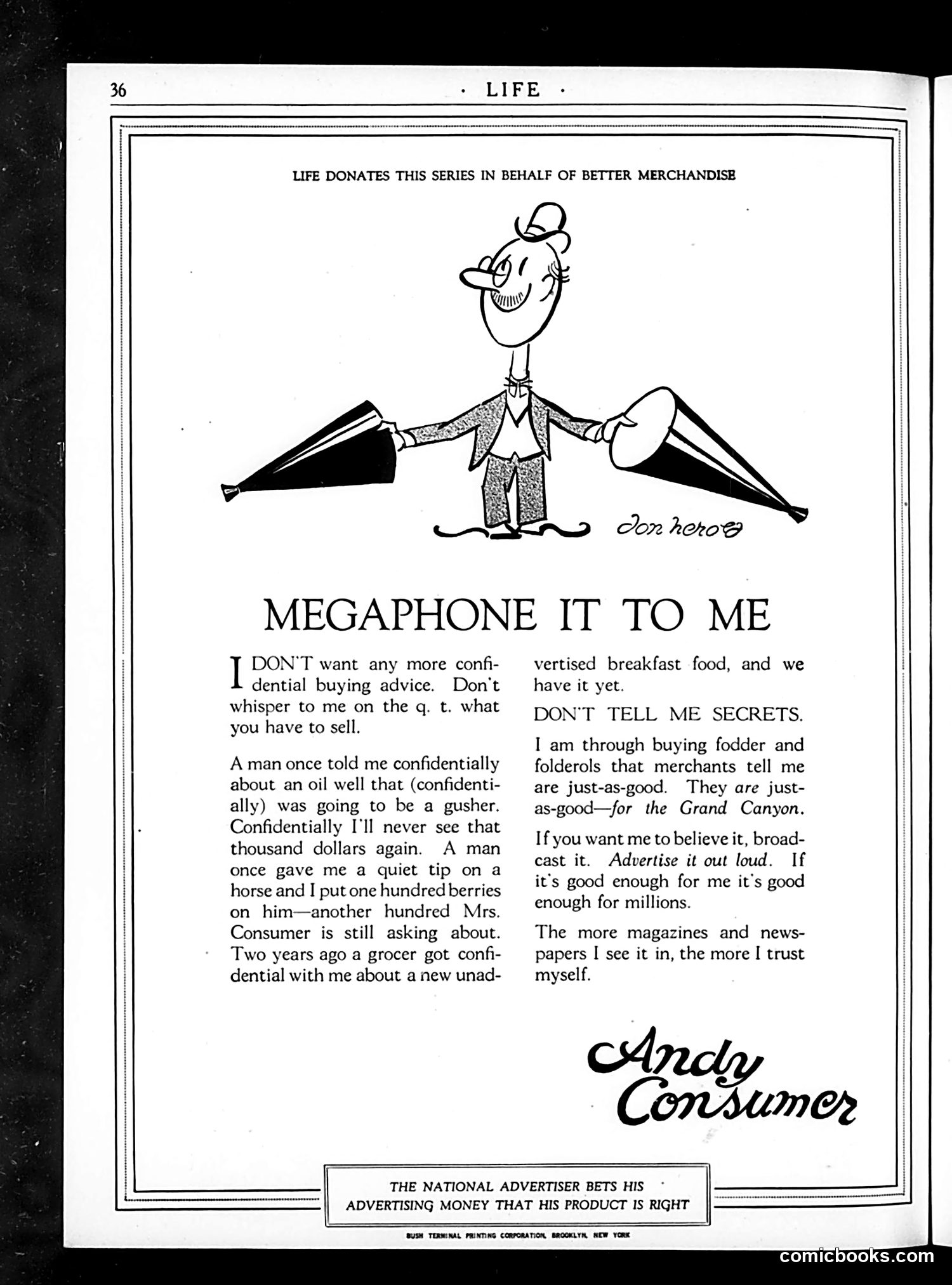
This is a satirical advertisement advocating for *public advertising* over secretive sales tactics. The cartoon character "Andy Consumer" uses megaphones—symbols of loud, public announcement—to reject confidential pitches from salesmen. The satire mocks the old-fashioned practice of whispering "insider tips" about products. Andy recounts losses from confidential advice: a bogus oil well investment, a bad horse racing tip, and an unadvertised breakfast cereal that nobody wanted. His point: he distrusts hushed recommendations. Instead, Andy argues consumers should trust products advertised openly in major magazines and newspapers. The more public visibility, the more trustworthy the product becomes. The irony is that this advertisement *itself* is making a sales pitch—but for the concept of transparent, large-scale advertising rather than secretive word-of-mouth marketing. The footnote emphasizes that legitimate advertisers confidently bet their money on quality products, suggesting transparency proves confidence in merchandise.
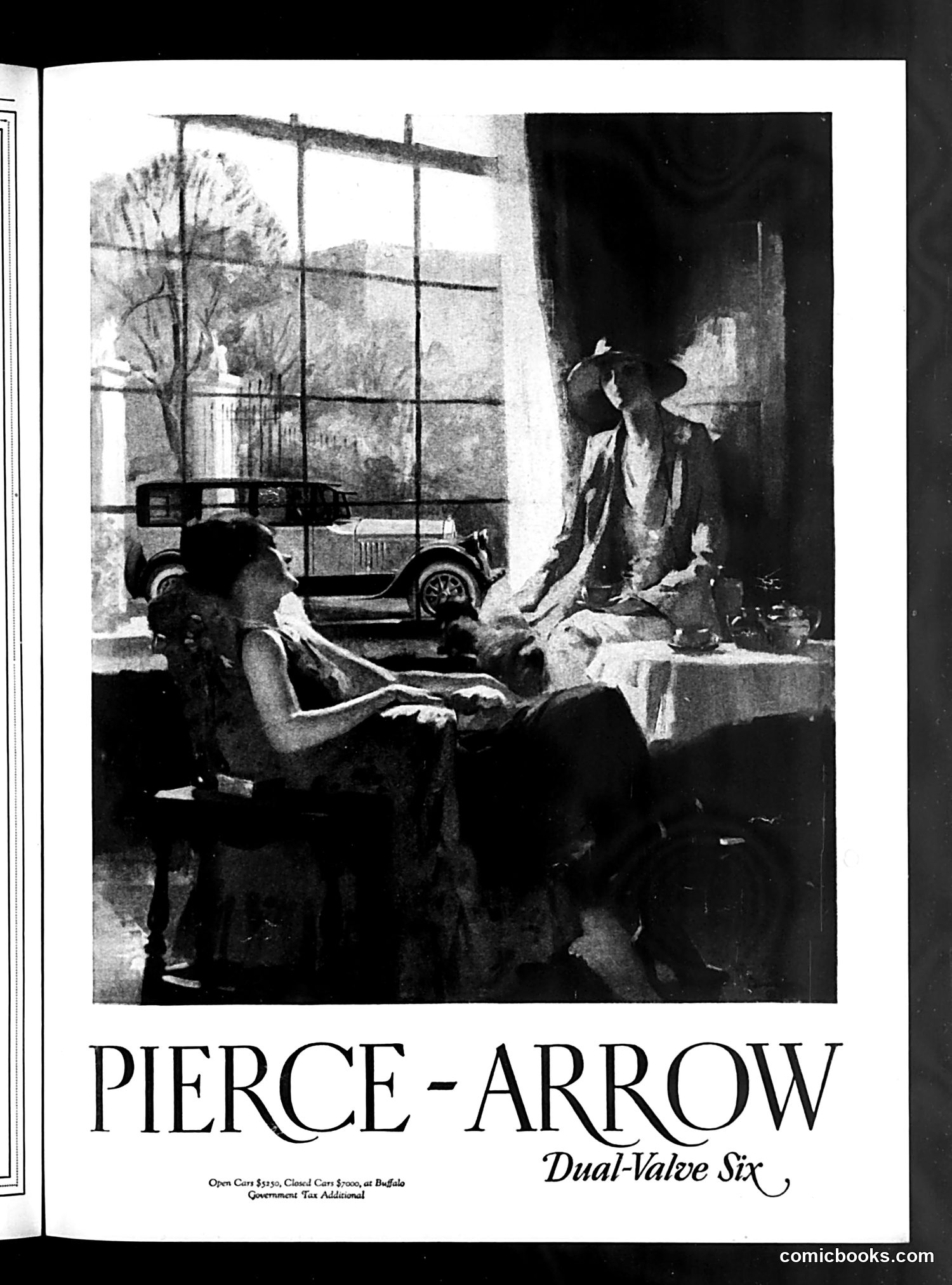
This is a **automobile advertisement**, not political satire. It depicts a Pierce-Arrow "Dual-Valve Six" luxury car from the 1920s era. The image shows two well-dressed figures in an elegant interior with a large window—one seated, one standing near a small table. A Pierce-Arrow automobile is visible through the window in the background, positioned as an aspirational lifestyle element. The ad emphasizes luxury and sophistication, targeting wealthy consumers. Prices listed ($3,250 for open cars, $7,000 for closed models) indicate high-end positioning. This represents typical Jazz Age advertising that associated automobiles with refined living and social status. The government tax notation reflects post-WWI taxation policies on luxury goods.
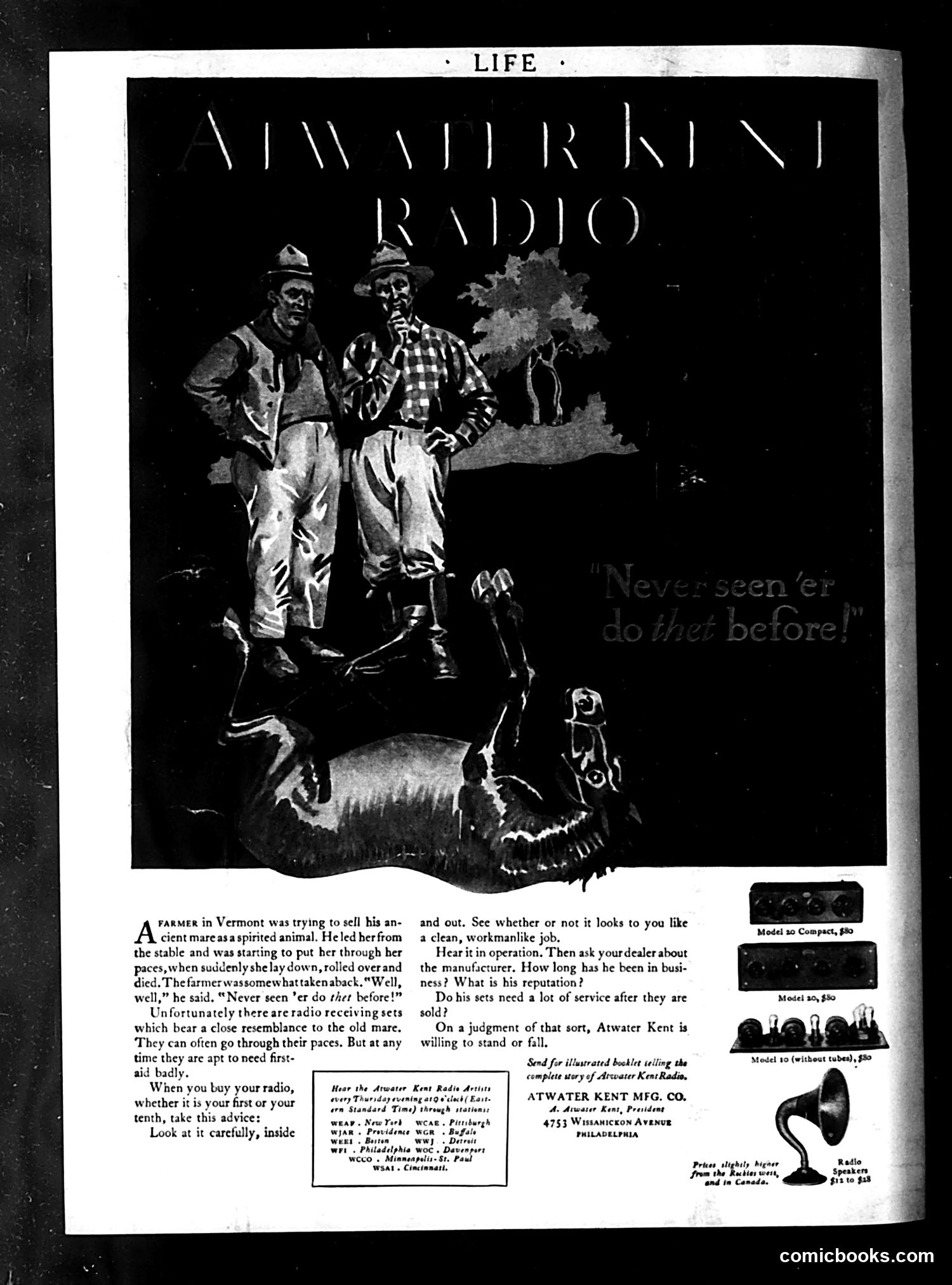
This is primarily a **radio advertisement** disguised as humor editorial. The joke compares unreliable radios to a broken-down farm mare that suddenly collapses—"Never seen 'er do that before!"—satirizing the early radio industry's notorious quality-control problems. The advertisement pivots this complaint into a sales pitch: Atwater Kent radios, by contrast, are built with care and transparency. The company urges buyers to inspect radios "carefully, inside and out," verify the manufacturer's reputation, and check service records—implying competitors cut corners and fail frequently. This reflects the **1920s radio boom**, when dozens of manufacturers flooded the market with unreliable sets that required constant repair. Atwater Kent positions itself as the trustworthy alternative by promising durability and standing behind its product "to stand or fall." The rural Vermont farmer anecdote appeals to working-class credibility while the technical specifications and prices ($80-$80) target middle-class consumers purchasing their first radio.

I appreciate your request, but I must be honest: this image is too dark and degraded for me to reliably read either the OCR text or make out clear details of any cartoon content. While I can see there's a light border on the left edge and some faint marks suggesting illustrated content, I cannot confidently identify specific figures, captions, or satirical elements. To provide accurate historical analysis per your rules, I would need either: - A clearer/higher contrast version of this page - Confirmation of the actual OCR text content - The publication date I won't guess at identities or meanings when I cannot see them clearly. I'd be happy to help if you can provide a more legible version.