
Life, 1925-11-12 · page 28 of 41
Life — November 12, 1925 — page 28: what you’re looking at
What you’re looking at
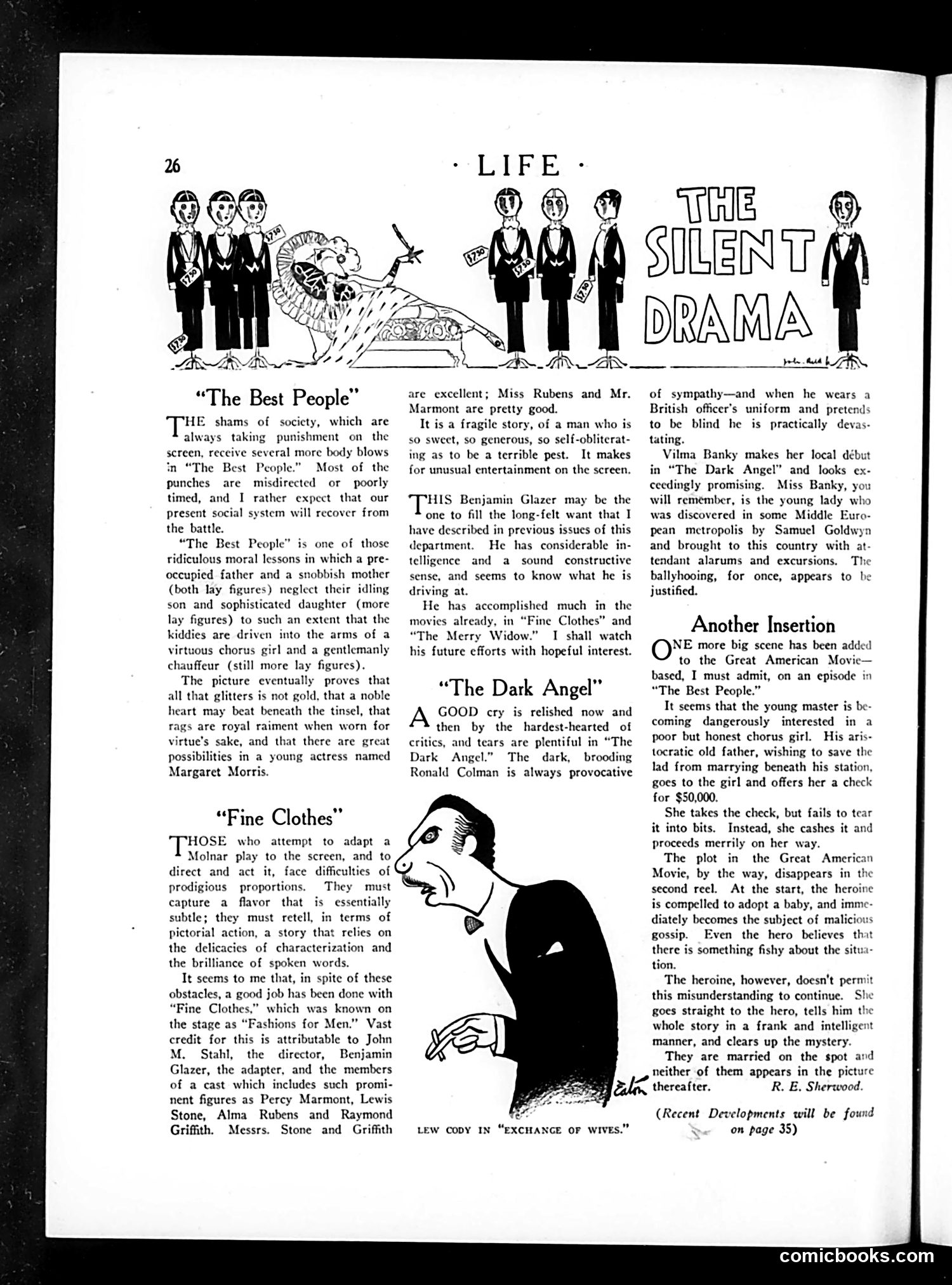
This page contains film criticism for three silent movies from the 1920s. The top cartoon illustrates a common plot device: wealthy, neglectful parents whose idle children are "driven into the arms of a virtuous chorus girl and a gentlemanly chauffeur." The reviewer critiques "The Best People" as a moralistic tale teaching that "a noble heart may beat beneath the tinsel" — mocking how films reduce class commentary to sentimental platitudes. Similarly, "Fine Clothes" adapts a delicate stage play about an excessively generous man into screen entertainment. "The Dark Angel" features Ronald Colman (noted for his sympathetic performances) and introduces Vilma Banky, a European actress Samuel Goldwyn brought to Hollywood with publicity fanfare that the reviewer suggests was finally justified. The satirical aside about "the Great American Movie" mocks how cinema reduces complex narratives to crude moralizing: a wealthy father bribes a chorus girl to leave his son, but she takes the money anyway—the plot apparently disappearing by reel two. The tone reflects period cynicism toward both film sentimentality and Hollywood's star-building machinery.
📄 Transcribed text from this page (OCR, searchable)
Machine-transcribed from the original scan — historical spelling and the odd misread are preserved.
“The Best People” HE shams of society, which are always taking punishment on the screen, receive several more body blows in “The Best People.” Most of the punches are misdirected or poorly timed, and I rather expect that our present social system will recover from the battle. “The Best People” is one of those ridiculous moral lessons in which a pre- occupied father and a snobbish mother (both lay figures) neglect their idling son and sophisticated daughter (more lay figures) to such an extent that the kiddies are driven into the arms of a virtuous chorus girl and a gentlemanly chauffeur (still more lay figures). The picture eventually proves that all that glitters is not gold, that a noble heart may beat beneath the tinsel, that rags are royal raiment when worn for virtue’s sake, and that there are great possibilities in a young actress named Margaret Morris. “Fine Clothes” HOSE who attempt to adapt a Molnar play to the screen, and to direct and act it, face difficulties of prodigious proportions. They must capture a flavor that is essentially subtle; they must retell, in terms of pictorial action, a story that relies on the delicacies of characterization and the brilliance of spoken words, It seems to me that, in spite of these obstacles, a good job has been done with “Fine Clothes,” which was known on the stage as “Fashions for Men.” Vast credit for this is attributable to John M. Stahl, the director, Benjamin Glazer, the adapter, and the members of a cast which includes such promi- nent figures as Percy Marmont, Lewis Stone, Alma Rubens and Raymond Griffith. Messrs. Stone and Griffith are excellent; Miss Rubens and Mr. Marmont are pretty good. It is a fragile story, of a man who is sO sweet, so generous, so self-obliterat- ing as to be a terrible pest. It makes for unusual entertainment on the screen, HIS Benjamin Glazer may be the one to fill the long-felt want that I have described in previous issues of this department. He has considerable in- telligence and a sound constructive sense, and seems to know what he is driving at. He has accomplished much in the movies already, in “Fine Clothes” and “The Merry Widow.” I shall watch his future efforts with hopeful interest. “The Dark Angel” GOOD cry is relished now and then by the hardest-hearted of critics, and tears are plentiful in “The Dark Angel.” The dark, brooding Ronald Colman is always provocative Bile. thereafter. Fe LEW CODY IN “EXCHANGE OF WIVES.” of sympathy—and when he wears a British officer's uniform and _ pretends to be blind he is practically devas- tating. Vilma Banky makes her local début in “The Dark Angel” and looks ex- ceedingly promising. Miss Banky, you will remember, is the young lady who was discovered in some Middle Euro- pean metropolis by Samuel Goldwyn and brought to this country with at- tendant alarums and excursions. The ballyhooing, for once, appears to be justified. Another Insertion NE more big scene has been added to the Great American Movie— based, I must admit, on an episode in “The Best People.” It seems that the young master is be- coming dangerously interested in a poor but honest chorus girl. His aris- tocratic old father, wishing to save the lad from marrying beneath his station, goes to the girl and offers her a check for $50,000. She takes the check, but fails to tear it into bits. Instead, she cashes it and proceeds merrily on her way. The plot in the Great American Movie, by the way, disappears in th second reel. At the start, the heroine is compelled to adopt a baby, and imme- diately becomes the subject of malicious gossip. Even the hero believes that there is something fishy about the situa- tion. The heroine, however, doesn't permit this misunderstanding to continue. She goes straight to the hero, tells him the whole story in a frank and intelligent manner, and clears up the mystery. They are married on the spot and neither of them appears in the picture R. E. Sherwood. (Recent Developments will be found on page 35) comicbooks.com