
Life, 1925-11-12 · page 26 of 41
Life — November 12, 1925 — page 26: what you’re looking at
What you’re looking at
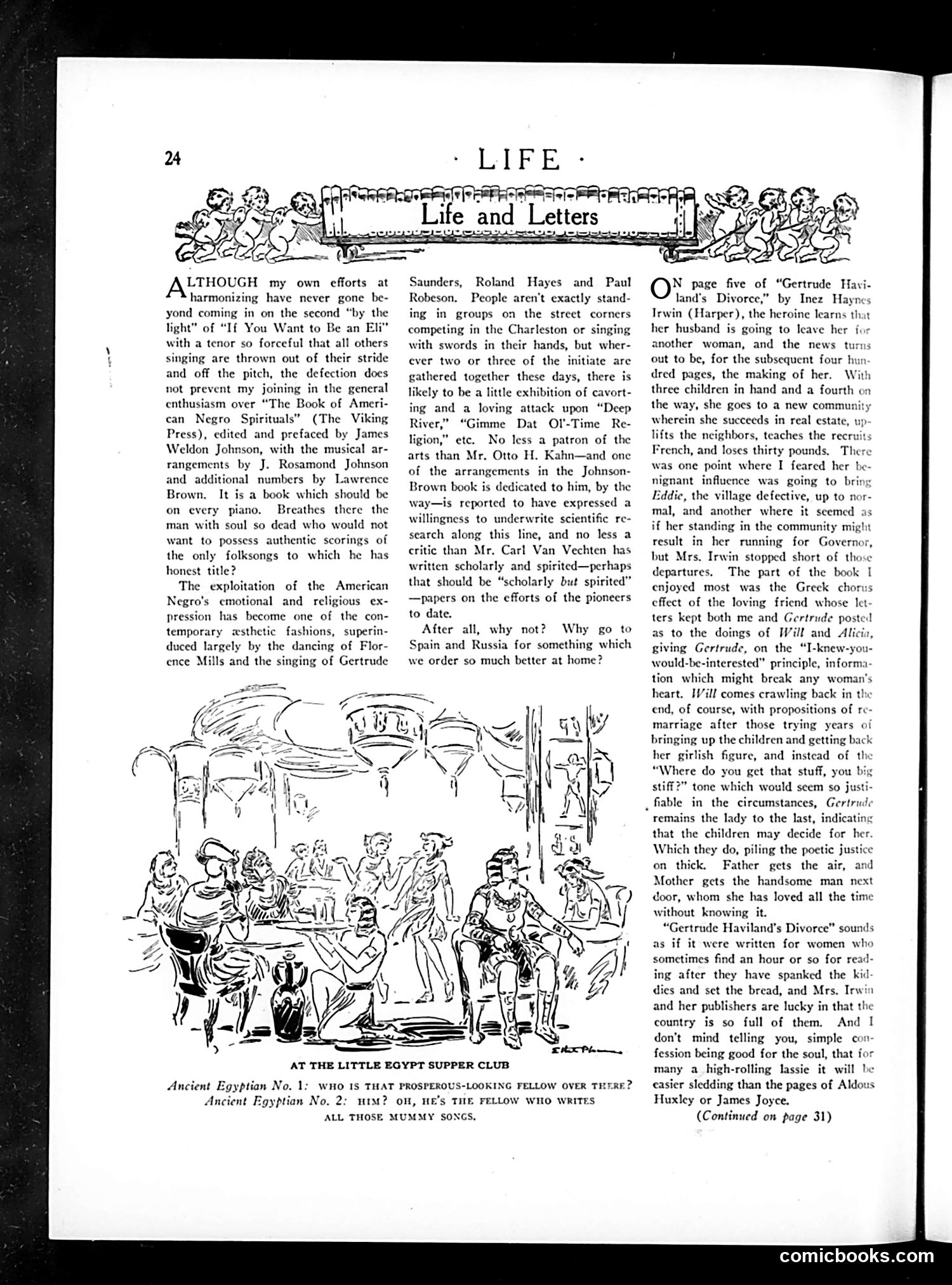
This page contains two distinct pieces of literary criticism and satire from Life magazine's "Life and Letters" section. **The Main Article** discusses the fashionable enthusiasm for African American spirituals, particularly James Weldon Johnson's newly published collection. The author notes that appreciation for Black musical and cultural expression has become trendy among white society, citing performers like Florence Mills, Roland Hayes, and Paul Robeson as catalysts. The piece gently mocks this "contemporary esthetic fashion," observing that wealthy patrons like Otto Kahn now fund research into spirituals. The final question—"why not order so much better at home?"—suggests Americans should support their own cultural treasures rather than romanticizing foreign art. **The Cartoon** titled "At the Little Egypt Supper Club" satirizes this same trend: two ancient Egyptians discuss a "prosperous-looking fellow" who "writes all those mummy songs"—clearly mocking white society's consumption of Black culture as exotic entertainment, with the "mummy songs" implying stereotypical exoticization. **The Book Review** briefly discusses Gertrude Haviland's Divorce, praising its portrayal of female resilience and independence.
📄 Transcribed text from this page (OCR, searchable)
Machine-transcribed from the original scan — historical spelling and the odd misread are preserved.
At THOUGH my own efforts at harmonizing have never gone be- yond coming in on the second “by the light” of “If You Want to Be an Eli” with a tenor so forceful that all others singing are thrown out of their stride and off the pitch, the defection does not prevent my joining in the general enthusiasm over “The Book of Ameri- can Negro Spirituals” (The Viking Press), edited and prefaced by James Weldon Johnson, with the musical ar- rangements by J. Rosamond Johnson and additional numbers by Lawrence Brown. It is a book which should be on every piano. Breathes there the man with soul so dead who would not want to possess authentic scorings of the only folksongs to which he has honest title? The exploitation of the American Negro's emotional and religious ex- pression has become one of the con- temporary esthetic fashions, superin- duced largely by the dancing of Flor- ence Mills and the singing of Gertrude Saunders, Roland Hayes and Paul Robeson. People aren't exactly stand- ing in groups on the street corners competing in the Charleston or singing with swords in their hands, but wher- ever two or three of the initiate are gathered together these days, there is likely to be a little exhibition of cavort- ing and a loving attack upon “Deep River,” “Gimme Dat O!'-Time Re- ligion,” etc. No less a patron of the arts than Mr. Otto H. Kahn—and one of the arrangements in the Johnson- Brown book is dedicated to him, by the way—is reported to have expressed a willingness to underwrite scientific re- search along this line, and no less a critic than Mr. Carl Van Vechten has written scholarly and spirited—perhaps that should be “scholarly but spirited” —papers on the efforts of the pioneers to date. After all, why not? Why go to Spain and Russia for something which we order so much better at home? AT THE LITTLE EGYPT SUPPER CLUB Ancient yptian No, 1: WHO 1S THAT PROSPEROUS-LOOKING FELLOW OVER THERE? Ancient Egyptian No, 2: wim? on, He's THE FELLOW WHO WRITES ALL THOSE MUMMY SONGS, N page five of “Gertrude Havi- land's Divorce,” by Inez Haynes Irwin (Harper), the heroine learns that her husband is going to leave her for another woman, and the news te out to be, for the subsequent four hy dred pages, the making of her. W three children in hand and a fourth on the way, she goes to a new communi wherein she succeeds in real estate, up- lifts the neighbors, teaches the recruit French, and loses thirty pounds. There vas one point where I feared her be- mant influence was going to bring Eddie, the village defective, up to nor- mal, and another where it seemed as if her standing in the community migl result in her running for Governor, but Mrs. Irwin stopped short of those departures, The part of the book I enjoyed most was the Greek chorus effect of the loving friend whose let ters kept both me and Gertrude posted as to the doings of Will and Alic giving Gertrude, on the “I-knew-you- would-be-interested” principle, informa- tion which might break any woman's heart. IWill comes crawling back in the end, of course, with propositions of re- marriage after those trying years bringing up the children and getting back her girlish figure, and instead of the “Where do you get that stuff, you big stiff?” tone which would seem so justi- _fiable in the circumstances, Gertrude remains the lady to the last, indicating that the children may decide for her. Which they do, piling the poetic justice on thick. Father gets the air, and Mother gets the handsome man next door, whom she has loved all the time without knowing it. “Gertrude Haviland’s Divorce” sounds as if it were written for women who sometimes find an hour or so for read- ing after they have spanked the ki dies and set the bread, and Mrs. Irwin and her publishers are lucky in that the country is so full of them. And I don’t mind telling you, simple con fession being good for the soul, that f many a high-rolling lassie it will be easier sledding than the pages of Aldous Huxley or James Joyce. (Continued on page 31) comicbooks.com