
Life, 1925-11-12 · page 22 of 41
Life — November 12, 1925 — page 22: what you’re looking at
What you’re looking at
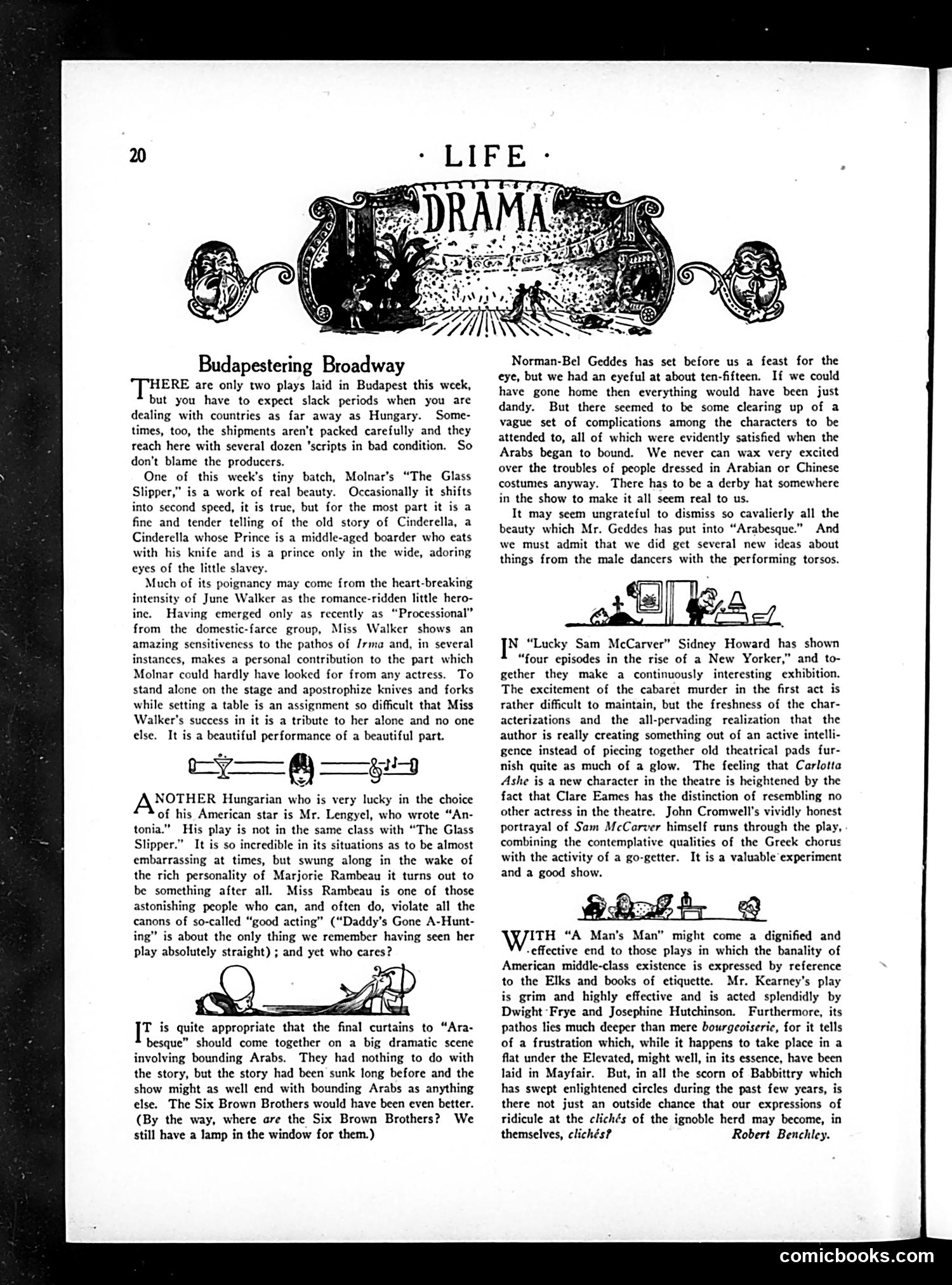
This page reviews recent Broadway plays, primarily Hungarian imports—a satirical jab at theater's fascination with exotic European material. The critic's tone is gently mocking: he quips that Budapest shipments arrive "with several dozen 'scripts in bad condition," suggesting American producers' indiscriminate appetite for foreign plays. The reviews praise **June Walker** in Molnar's "The Glass Slipper" (a Cinderella retelling) and **Marjorie Rambeau** in "Antonia," though the critic notes the latter is "incredible" yet salvaged by the actress's charisma—implying stars compensate for weak material. The most biting satire targets Norman-Bel Geddes's "Arabesque": the critic dismisses its elaborate visual spectacle, complaining the story "had been sunk long before" and suggesting random "bounding Arabs" conclude it. He sarcastically wishes the "Six Brown Brothers" (a vaudeville act) had performed instead—mocking both the production's visual excess and its narrative bankruptcy. The underlying point: decoration cannot save a hollow play.
📄 Transcribed text from this page (OCR, searchable)
Machine-transcribed from the original scan — historical spelling and the odd misread are preserved.
Budapestering Broadway “THERE are only two plays laid in Budapest this week, but you have to expect slack periods when you are dealing with countries as far away as Hungary. Some- times, too, the shipments aren't packed carefully and they reach here with several dozen ’scripts in bad condition. So don't blame the producers. One of this week's tiny batch, Molnar’s “The Glass Slipper,” is a work of real beauty. Occasionally it shifts into second speed, it is true, but for the most part it is a fine and tender telling of the old story of Cinderella, a Cinderella whose Prince is a middle-aged boarder who cats with his knife and is a prince only in the wide, adoring eyes of the little slavey. Much of its poignancy may come from the heart-breaking intensity of June Walker as the romance-ridden little hero- ine. Having emerged only as recently as “Processional” from the domestic-farce group, Miss Walker shows an amazing sensitiveness to the pathos of Jrma and, in several instances, makes a personal contribution to the part which Molnar could hardly have looked for from any actress. To stand alone on the stage and apostrophize knives and forks while setting a table is an assignment so difficult that Miss Walker's success in it is a tribute to her alone and no one else. It is a beautiful performance of a beautiful part. yo — & —g9 ANOTHER Hungarian who is very lucky in the choice of his American star is Mr. Lengyel, who wrote “An- tonia.” His play is not in the same class with “The Glass Slipper.” It is so incredible in its situations as to be almost embarrassing at times, but swung along in the wake of the rich personality of Marjorie Rambeau it turns out to be something after all. Miss Rambeau is one of those astonishing people who can, and often do, violate all the canons of so-called “good acting” (“Daddy’s Gone A-Hunt- ing” is about the only thing we remember having seen her play absolutely straight) ; and yet who cares? Ir is quite appropriate that the final curtains to “Ara- besque” should come together on a big dramatic scene involving bounding Arabs. They had nothing to do with the story, but the story had been sunk long before and the show might as well end with bounding Arabs as anything else. The Six Brown Brothers would have been even better. (By the way, where are the Six Brown Brothers? We still have a lamp in the window for them.) Norman-Bel Geddes has set before us a feast for the eye, but we had an eyeful at about ten-fifteen. If we could have gone home then everything would have been just dandy. But there seemed to be some clearing up of a vague set of complications among the characters to be attended to, all of which were evidently satisfied when the Arabs began to bound. We never can wax very excited over the troubles of people dressed in Arabian or Chinese costumes anyway. There has to be a derby hat somewhere in the show to make it all seem real to us. It may seem ungrateful to dismiss so cavalierly all the beauty which Mr. Geddes has put into “Arabesque.” And we must admit that we did get several new ideas about things from the male dancers with the performing torsos. “ N “Lucky Sam McCarver” Sidney Howard has shown “four episodes in the rise of a New Yorker,” and to- gether they make a continuously interesting exhibition. The excitement of the cabaret murder in the first act is rather difficult to maintain, but the freshness of the char- acterizations and the all-pervading realization that the author is really creating something out of an active intelli- gence instead of piecing together old theatrical pads fur- nish quite as much of a glow. The feeling that Carlotta Ashe is a new character in the theatre is heightened by the fact that Clare Eames has the distinction of resembling no other actress in the theatre. John Cromwell's vividly honest portrayal of Sam McCarver himself runs through the play, combining the contemplative qualities of the Greek chorus with the activity of a go-getter. It is a valuable experiment and a good show. ITH “A Man’s Man” might come a dignified and -effective end to those plays in which the banality of American middle-class existence is expressed by reference to the Elks and books of etiquette. Mr. Kearney’s play is grim and highly effective and is acted splendidly by Dwight “Frye and Josephine Hutchinson. Furthermore, its pathos lies much deeper than mere bourgeoiseric, for it tells of a frustration which, while it happens to take place in a flat under the Elevated, might well, in its essence, have been laid in Mayfair. But, in all the scorn of Babbittry which has swept enlightened circles during the past few years, is there not just an outside chance that our expressions of ridicule at the clichés of the ignoble herd may become, in themselves, clichés? Robert Benchley. comicbooks.com