
A complete issue · 36 pages · 1925
Life — October 15, 1925
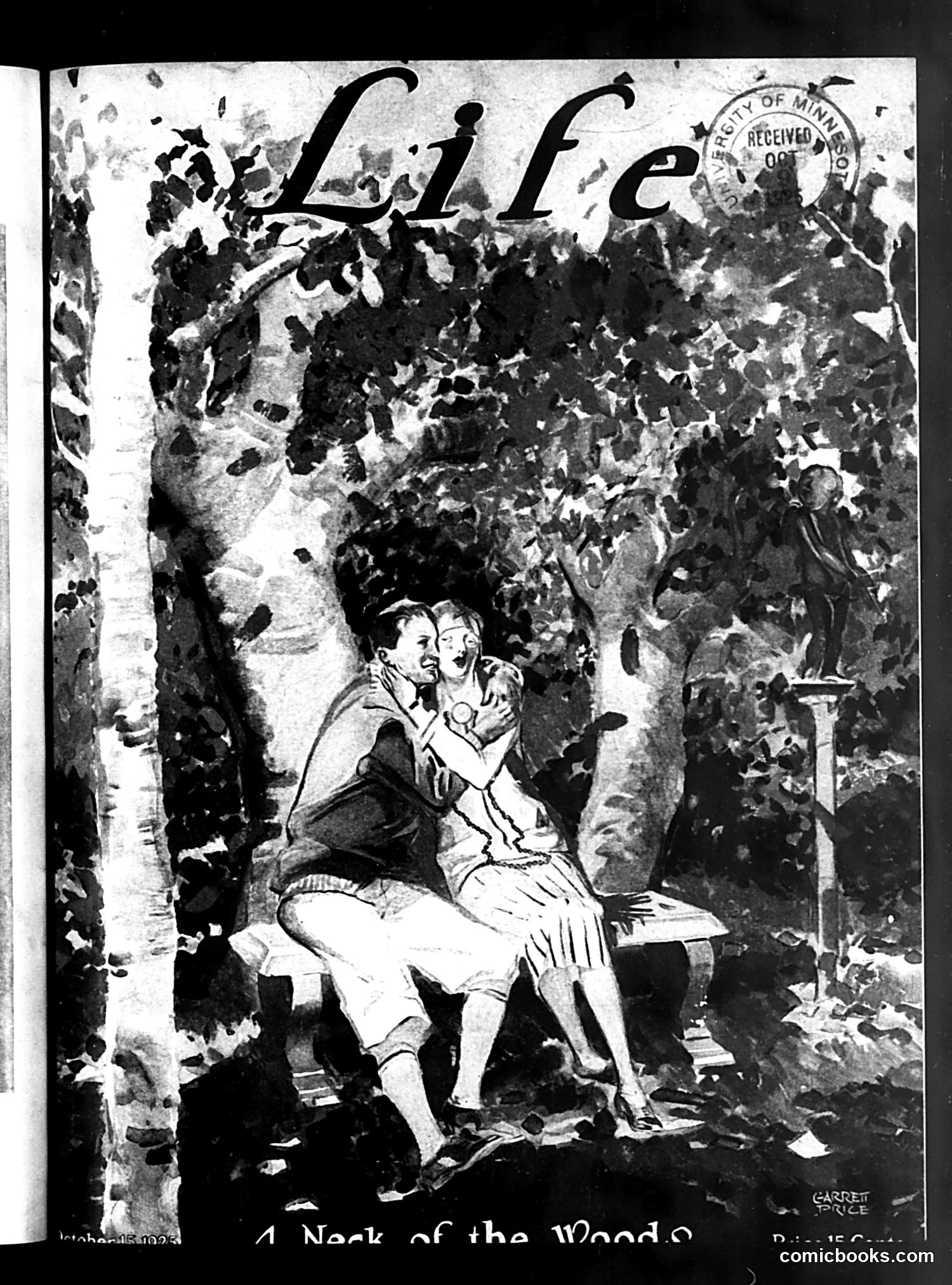
This appears to be a romantic or comedic illustration rather than political satire. The image shows a couple in an intimate moment seated in a wooded setting—the man embracing a woman on a bench surrounded by ivy-covered trees and classical garden elements (a pedestal visible on the right). The title "A Nook of the Woods" suggests a play on words about privacy or romantic seclusion in nature. The artist is credited as "Garrett Price." Without additional context about the specific issue's date or accompanying text, the satire's exact target remains unclear, though it may be commenting on courtship customs, romantic conventions, or leisure activities of its era. The illustration's style and tone suggest lighthearted social commentary rather than serious political critique.
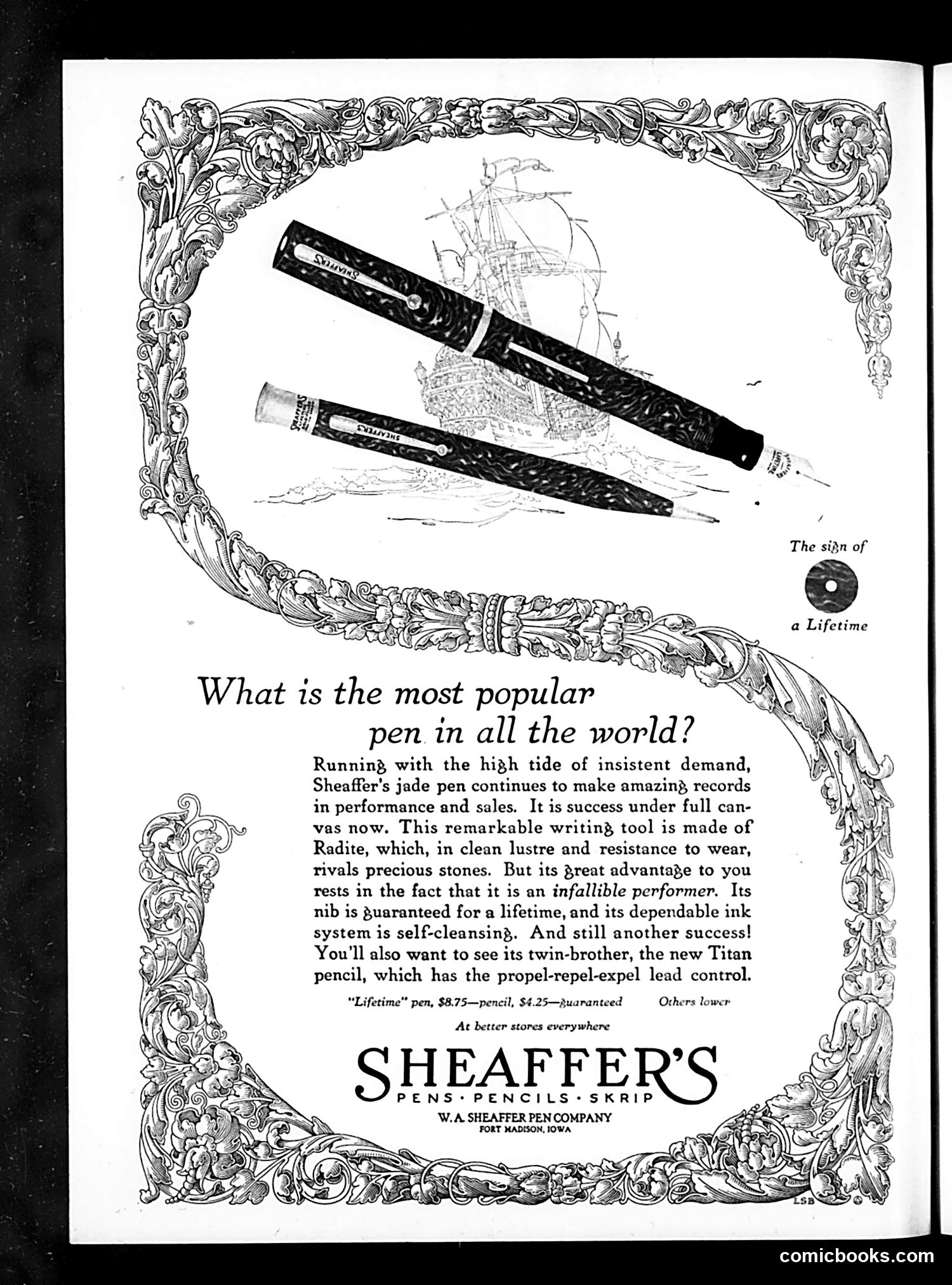
This page is primarily a **advertisement**, not satire or political commentary. It's a Sheaffer pen company ad from the early 20th century promoting their "Jade pen" as "the most popular pen in all the world." The ornate decorative border frames two black fountain pens with detailed illustrations of a sailing ship. The ad emphasizes the pen's features: an "infallible nib" guaranteed for lifetime use, self-cleansing ink system, and Radite material (claimed to rival precious stones in durability). There is no cartoon or political content here—this is straightforward vintage advertising designed to showcase product superiority and build brand prestige through luxury imagery and technical claims. The ship illustration likely symbolizes reliability and global reach.
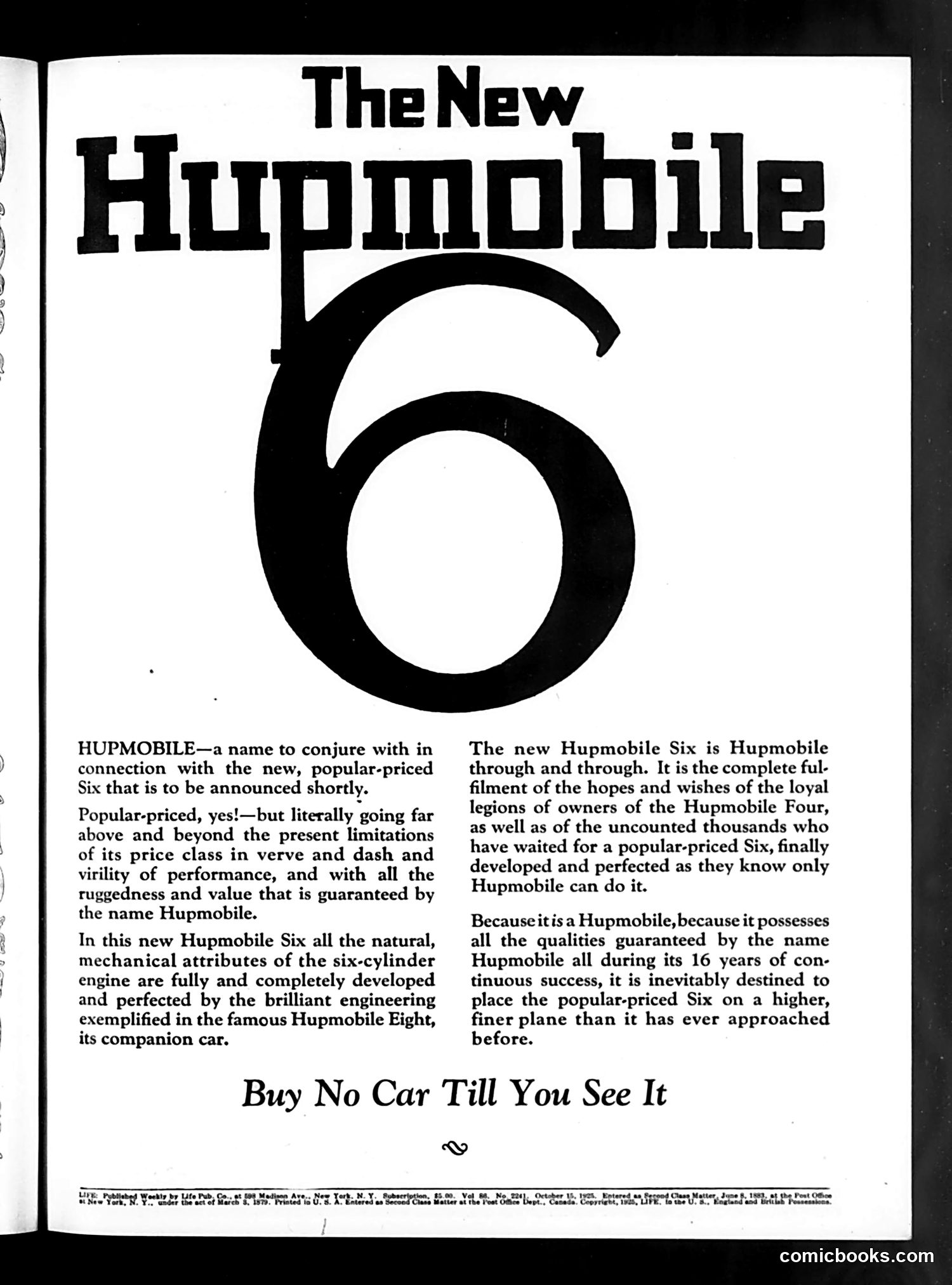
This is primarily **advertising content**, not satire or political commentary. It's a full-page advertisement for the Hupmobile Six automobile, published in *Life* magazine. The large numeral "6" is the car's key selling point—it features a six-cylinder engine. The ad emphasizes this as a "popular-priced" vehicle combining performance with affordability, positioning it as superior to competing models. The copy references the "Hupmobile Eight" as a companion car and claims sixteen years of company success. The headline "Buy No Car Till You See It" is a marketing slogan encouraging potential buyers to wait for this model's announcement. There is **no political satire or cartoon humor** on this page—it's straightforward early-20th-century automobile marketing emphasizing mechanical specifications and brand reputation.
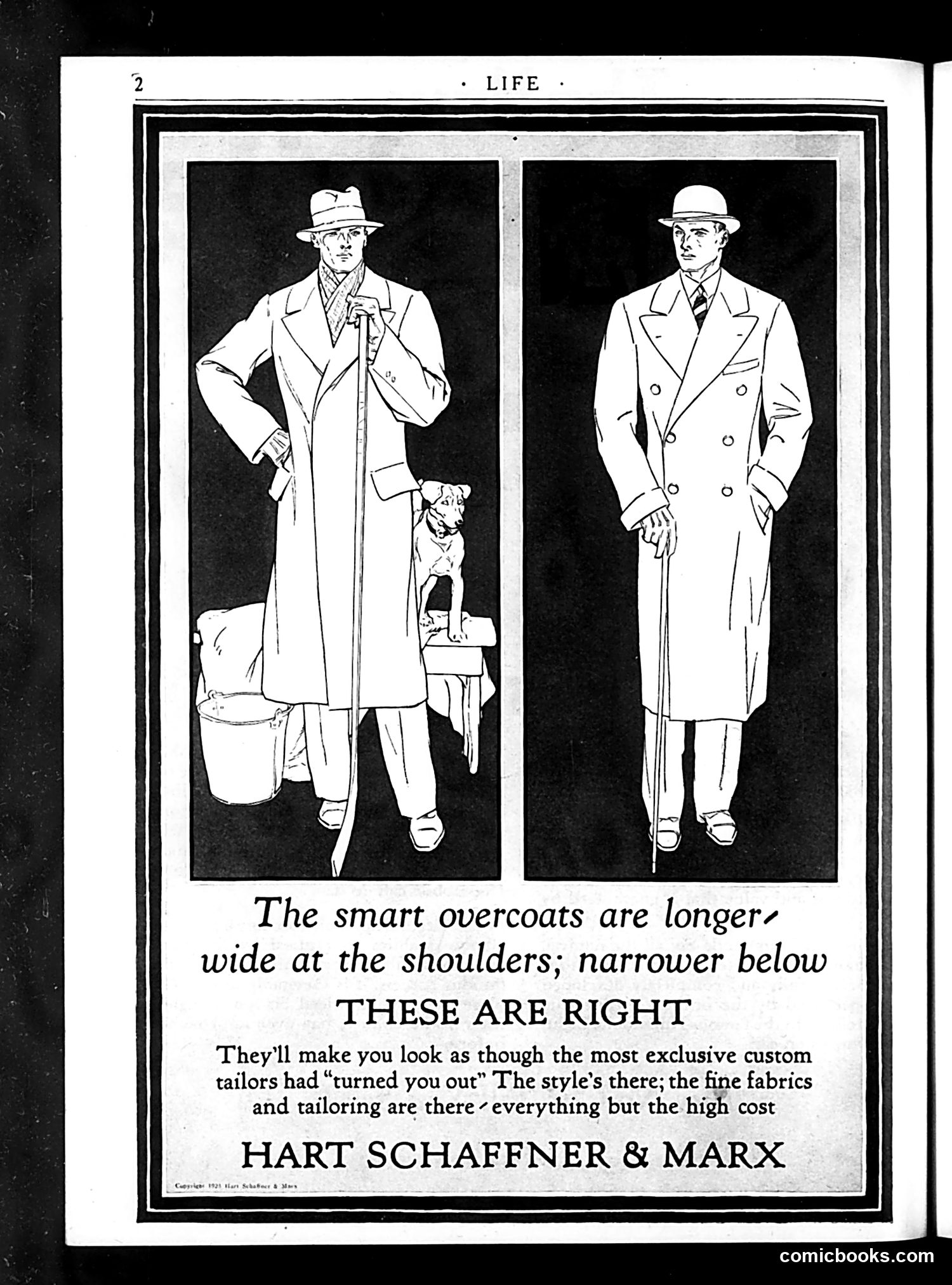
This is a **fashion advertisement**, not political satire. Hart Schaffner & Marx, a menswear company, is promoting their overcoats to male consumers in what appears to be the 1920s. The ad presents two side-by-side illustrations showing proper overcoat styling: longer length, wide shoulders, and narrower cut below the waist. The copy claims these garments offer "fine fabrics and tailoring" while delivering "the style's there" without "the high cost" of custom tailoring from exclusive shops. The appeal is to aspirational middle-class men wanting to appear well-dressed and fashionable without paying premium prices. The ad uses comparative styling to educate readers about current fashion standards, making the garments seem both sophisticated and accessible.
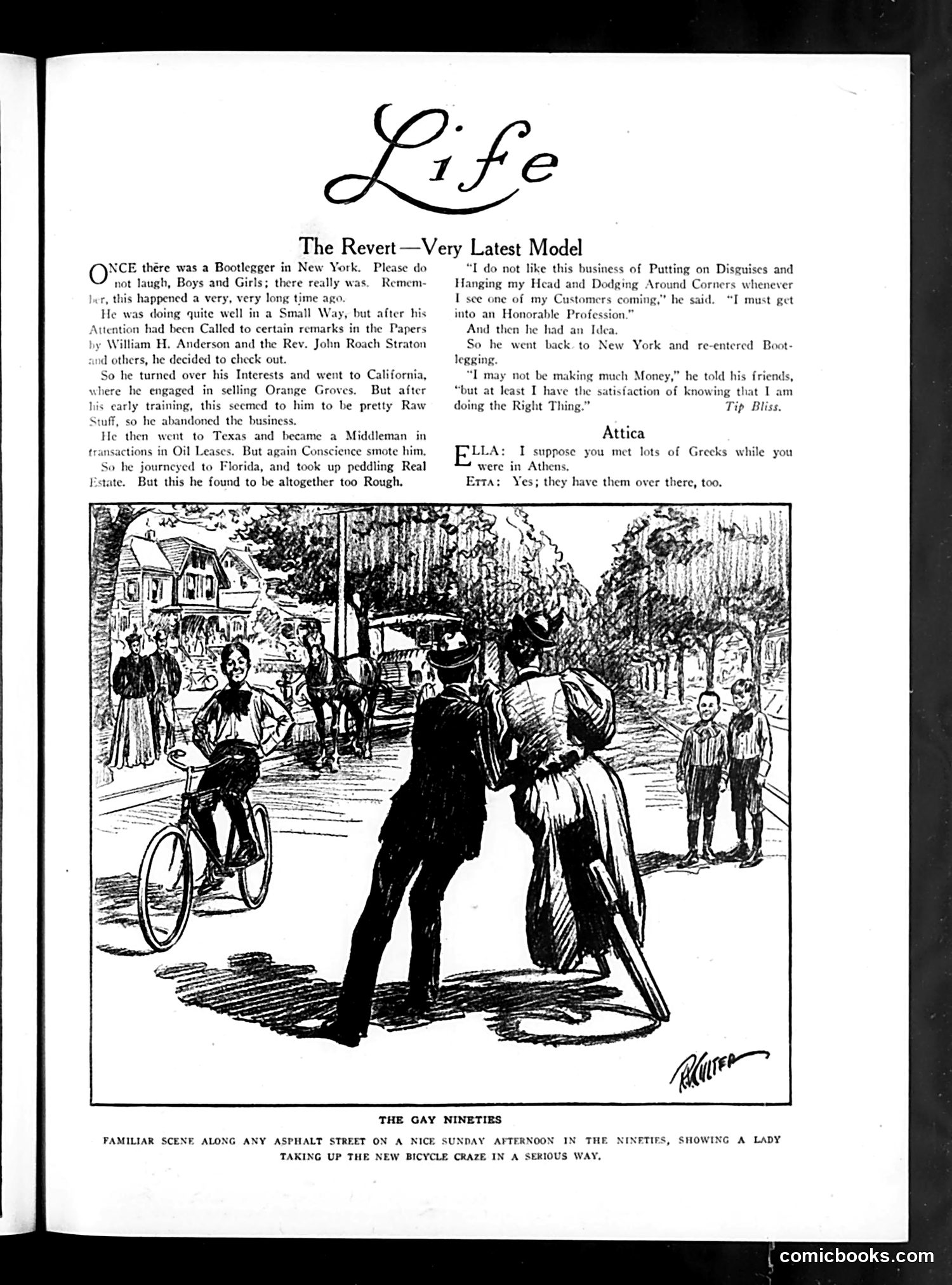
This page contains two distinct sections: **"The Revert" story** (upper text) describes a bootlegger in New York who reinvents himself multiple times—attempting various legitimate businesses (orange groves, oil leases, real estate) before returning to bootlegging, finding it the only profession where he can claim to be "doing the Right Thing." This satirizes Prohibition-era hypocrisy: bootlegging was illegal yet morally rebranded by its practitioners. **"Attica" dialogue** and illustration below depict 1890s bicycle culture. The cartoon shows a woman enthusiastically taking up the bicycle "craze"—a major social phenomenon of that decade. The caption notes this was a "familiar scene" on city streets, suggesting the bicycle's popularity among women was notable enough to warrant satirical commentary on gender and modern recreation. Both sections mock contemporary social phenomena with gentle irony.
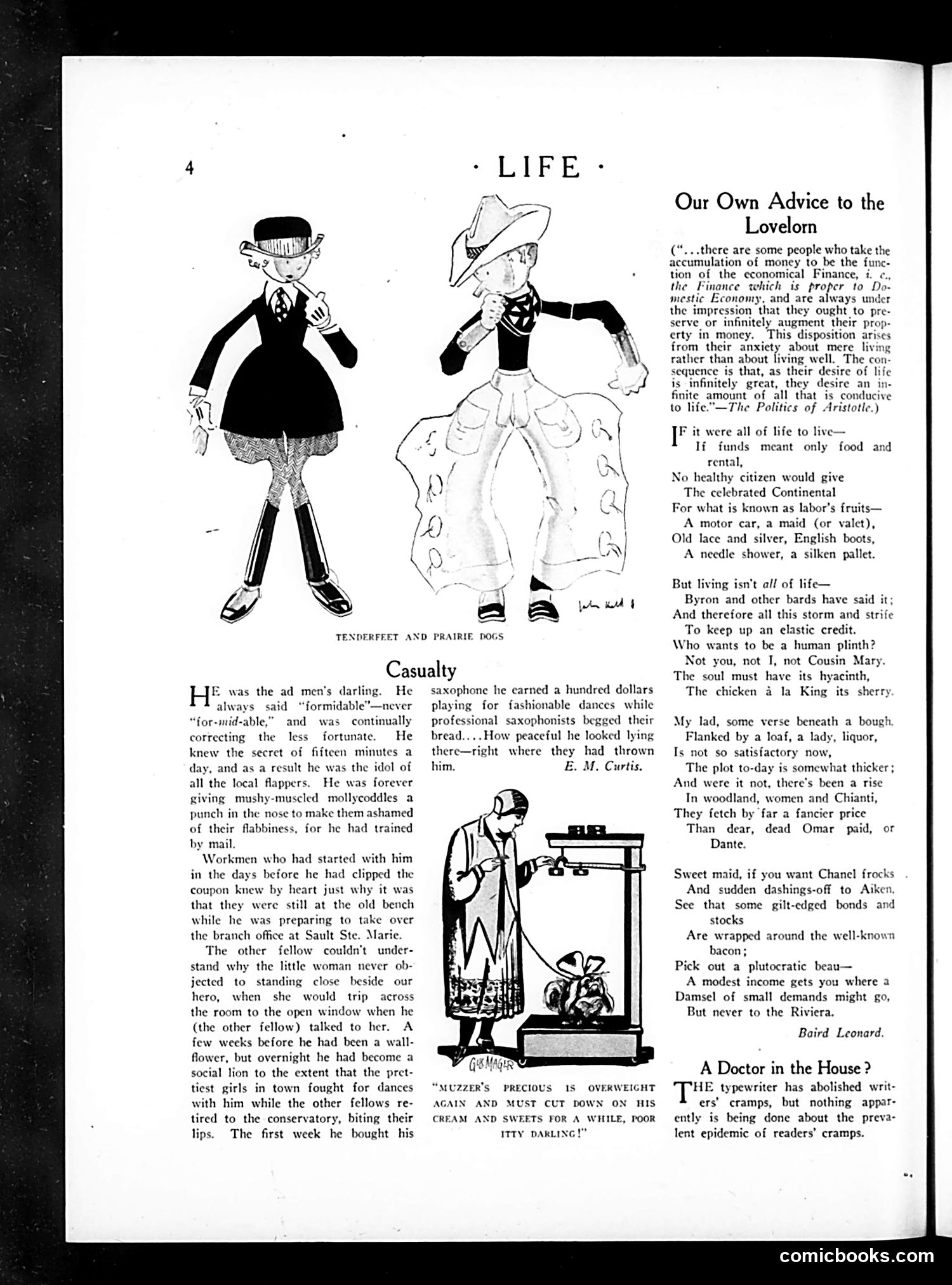
This page contains three distinct pieces of social satire: 1. **"Tenderfoot and Prairie Dogs"**: Two fashion illustrations mocking women's fashions—likely exaggerating the silhouettes of the era with elongated legs and peculiar proportions. 2. **"Casualty"**: A humorous story about an "ad man's darling" who was a saxophone player at fashionable dances. The narrative mocks his pretensions and romantic misadventures with working women. The illustration shows a man at what appears to be a weighing scale, accompanying the caption about reducing cream and sweets—likely satirizing vanity or health fads. 3. **"Our Own Advice to the Lovelorn"**: A poetry column offering tongue-in-cheek romantic and financial advice to readers, referencing literature (Aristotle, Byron) while maintaining a humorous tone about love, money, and social climbing. The overall tone critiques fashion obsession, social pretension, and romantic folly.
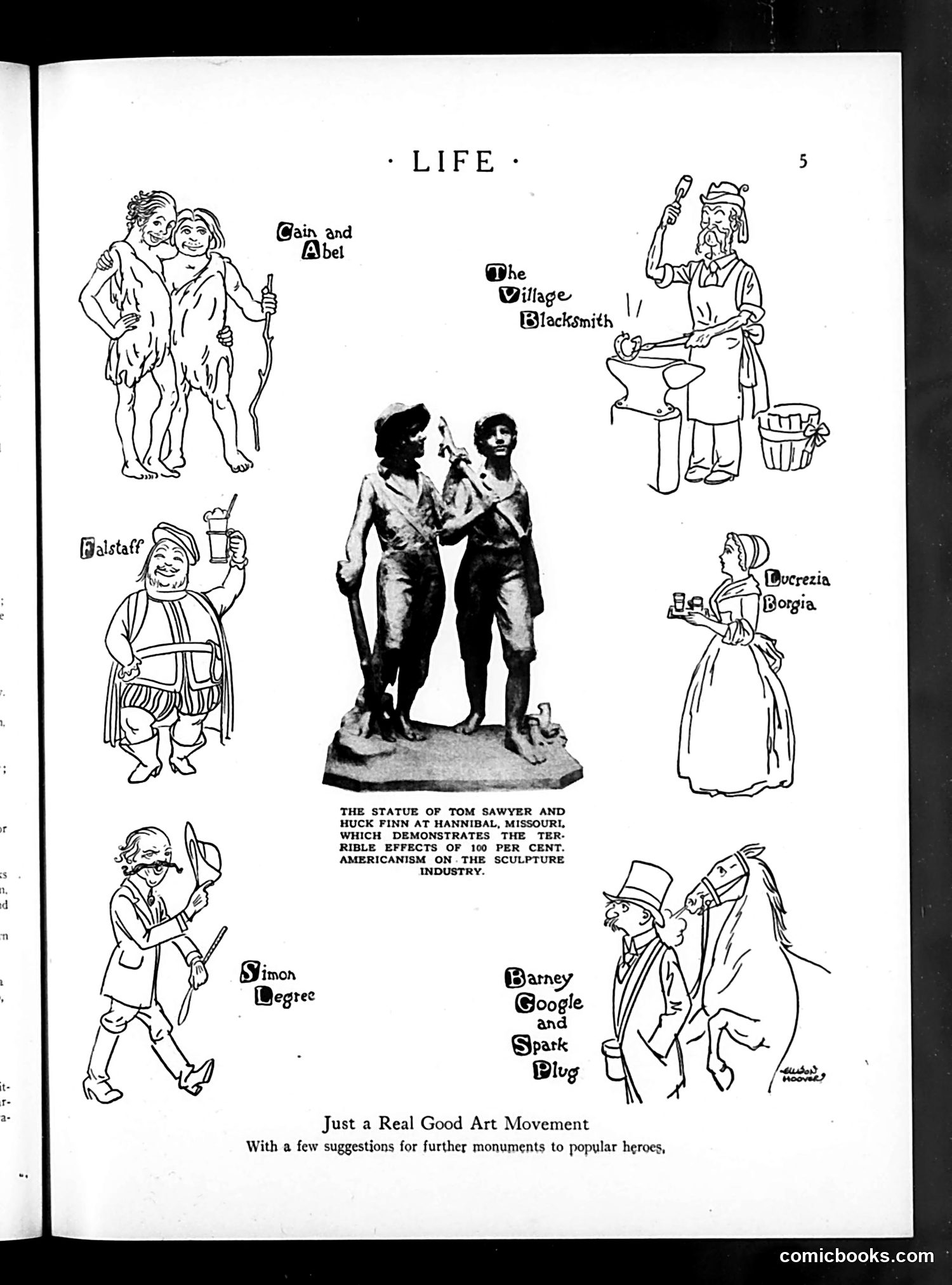
This page satirizes American sculpture and public monuments through fictional character proposals. The central photograph shows a bronze sculpture of two figures, captioned as demonstrating "100 per cent Americanism" effects on sculpture. The surrounding sketches propose humorous monuments to popular cultural figures: Cain and Abel, Falstaff (Shakespeare's drunk character), Simon Legree (the villain from *Uncle Tom's Cabin*), The Village Blacksmith, Lucrecia Borgia, and Barney Google with Spark Plug (a comic strip character). The satire mocks contemporary American public art—suggesting that America's sculptural monuments lack sophistication, instead commemorating either biblical characters, literary figures, or lowbrow comic strips rather than serious historical subjects. The subtitle, "Just a Real Good Art Movement," indicates sardonic criticism of American artistic taste.
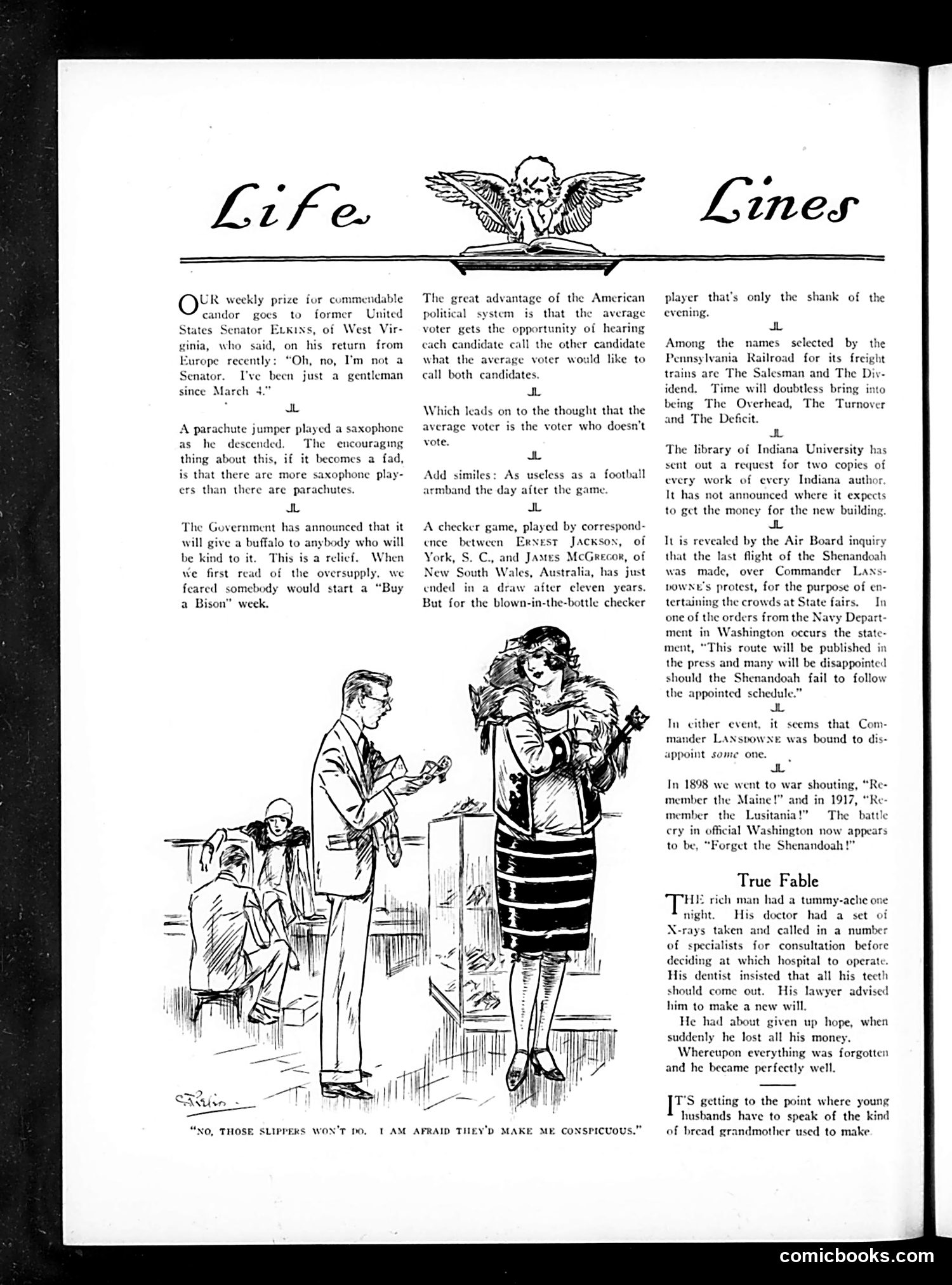
This page contains satirical commentary and a cartoon. The main cartoon depicts a woman in 1920s attire speaking to men, with the caption: "No, those slippers won't do. I am afraid they'd make me conspicuous." The joke satirizes women's fashion and social conventions of the era. The woman appears to be rejecting modest slippers, suggesting she wants footwear that will make her *more* conspicuous—reflecting the "Roaring Twenties" trend of women adopting bolder, less conservative styles that shocked traditional society. The surrounding text includes unrelated commentary on American politics, trains, and a brief anecdote titled "True Fable" about a wealthy man's tummy-ache. The overall page demonstrates Life's characteristic mix of topical humor and social observation.
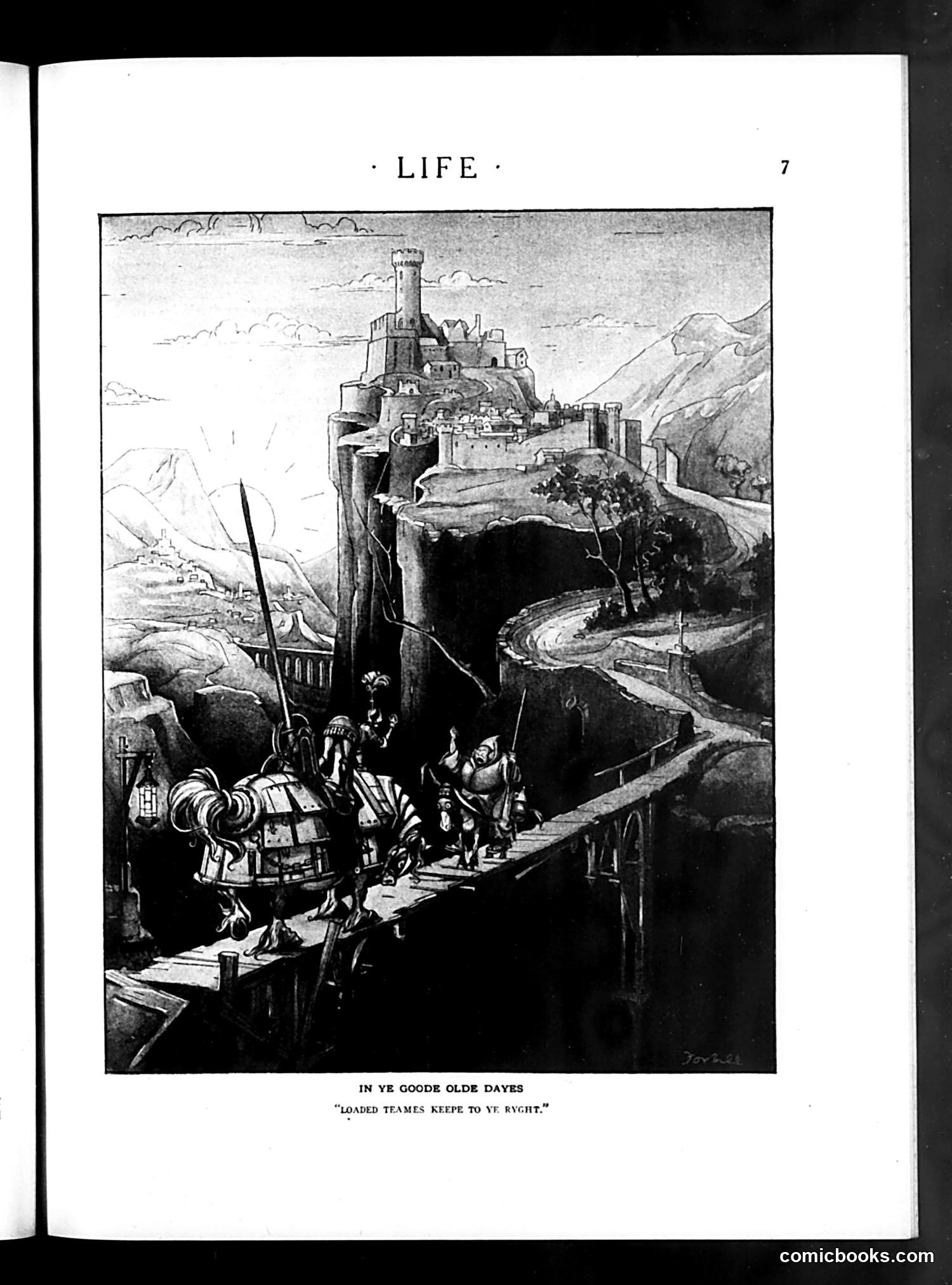
This is a historical illustration titled "IN YE GOODDE OLDE DAYES" with the caption "LOADED TEAMES KEEPE TO YE RIGHT." The image depicts a medieval or Renaissance-era fortified castle/fortress perched on a rocky cliff, with armed knights and soldiers with laden pack animals approaching on a narrow mountain road below. The "ye olde" spelling and archaic language parody old English. The satire appears to target contemporary traffic or congestion issues by humorously transposing them into a historical setting. The caption about "loaded teams" keeping to the right suggests the cartoon is making fun of modern traffic rules and etiquette—implying that even in "the good old days," managing heavy traffic on narrow passages was a persistent problem. This is gentle, nostalgic satire about urban/transportation challenges.
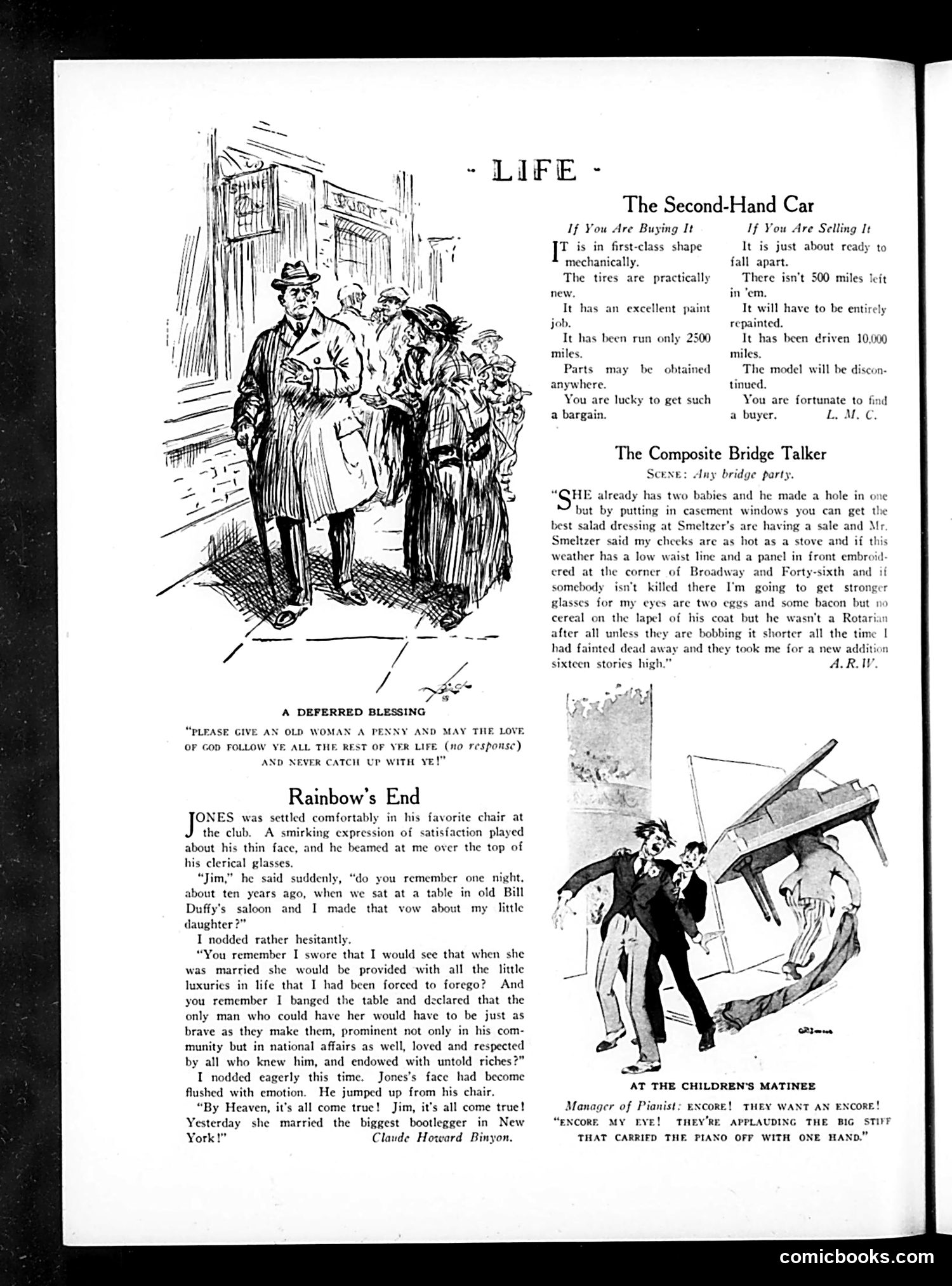
This page contains several satirical pieces mocking everyday American life circa early 20th century. **"The Second-Hand Car"** contrasts buyer vs. seller perspectives on used automobiles—a familiar con where salesmen misrepresent condition while buyers rationalize poor purchases. The humor lies in the transparent dishonesty from both sides. **"The Composite Bridge Talker"** satirizes a specific social type: the bore at social gatherings who dominates conversation with lengthy, tangential anecdotes mixing bragging, complaints, and irrelevant details. The "composite" suggests this character combines annoying traits of multiple people. **"Rainbow's End"** tells a sentimental story about a man recalling his promise to provide luxuries for his daughter—now fulfilled through her advantageous marriage. **"At the Children's Matinee"** humorously depicts a theater pianist's frustration when children applaud loudly, drowning out the performance.
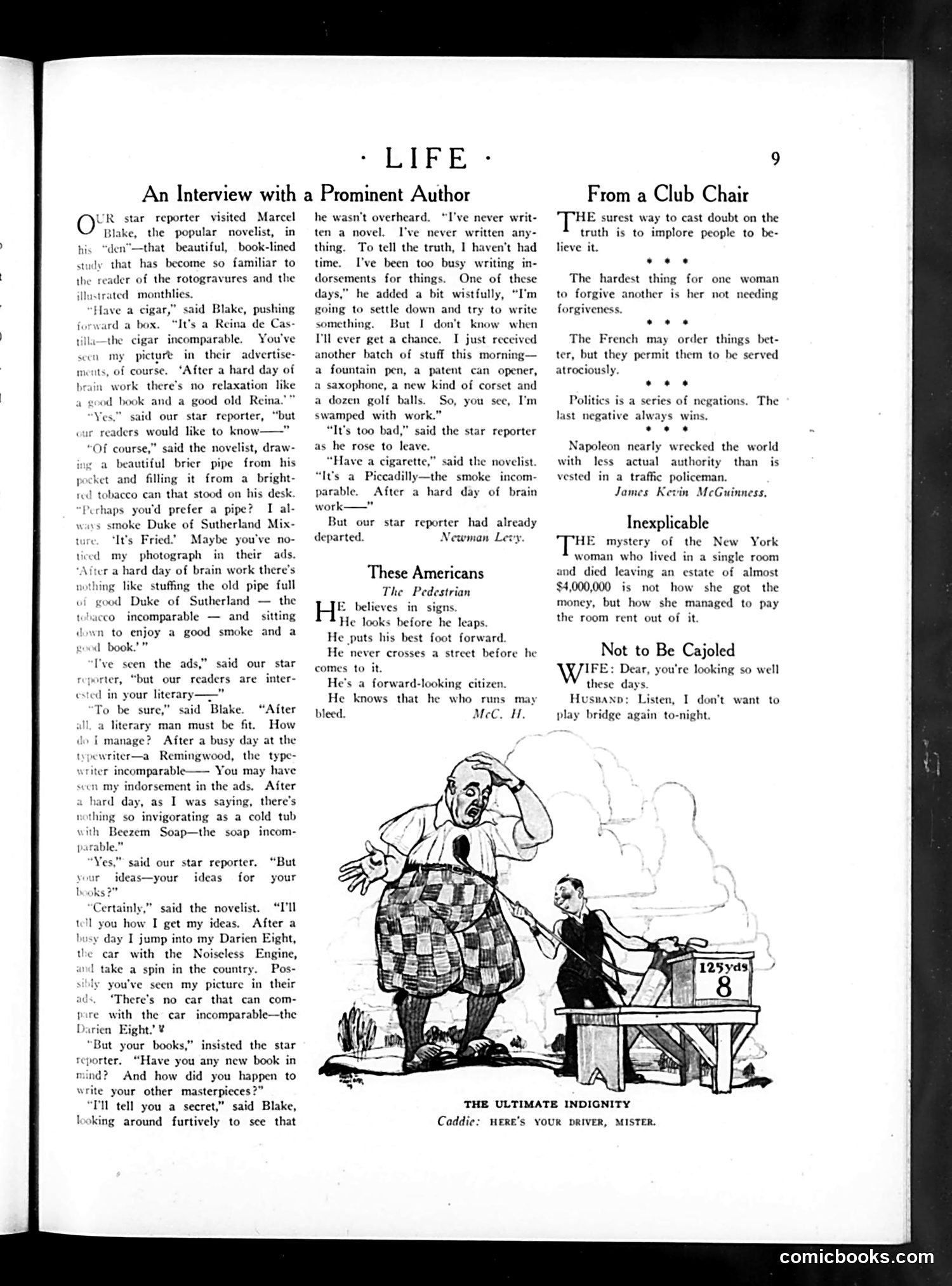
The cartoon depicts a golf caddie presenting a driver to an angry, poorly-dressed golfer at what appears to be a public golf course (marked "125 yds 8"). The caption reads: "HERE'S YOUR DRIVER, MISTER." The satire targets class anxiety and social humiliation. The caddie's smug expression and the golfer's apparent rage suggest the indignity of being served by a working-class employee, or conversely, the golfer's embarrassment at his own shabby appearance on a golf course—traditionally an upper-class venue. The humor plays on 1920s-era social sensitivities about public golf access and class mixing, portraying either the awkwardness of social mobility or the comic failure of a working-class person attempting to participate in elite leisure activities. The joke's specific sting is now somewhat obscure without period context.
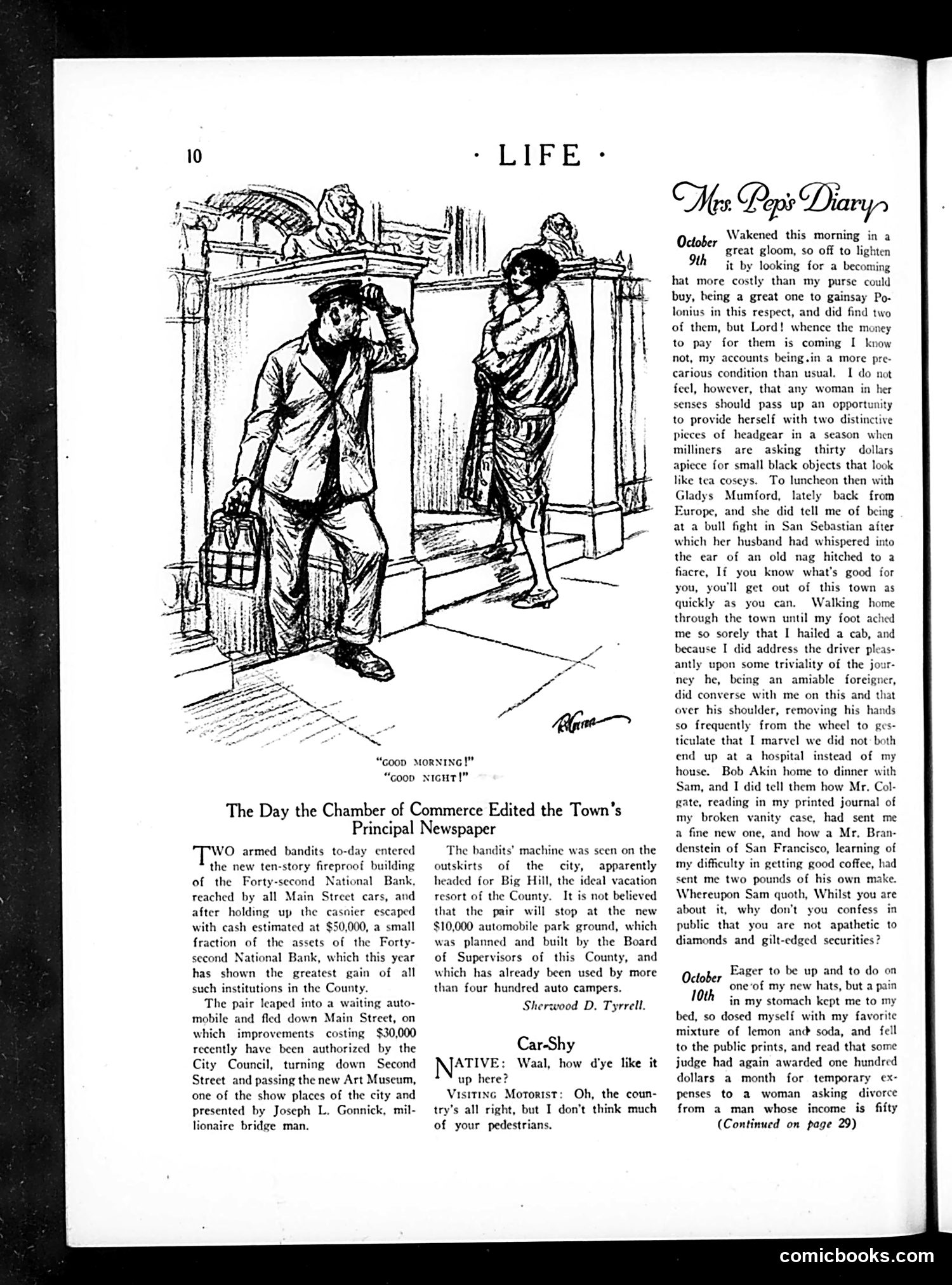
The cartoon depicts two figures meeting on a street — one arriving (left, with luggage), one departing (right, wrapped in cloth). The caption plays on contrasting greetings: "Good Morning!" versus "Good Night!" The satire likely comments on the transient nature of early 20th-century urban life, or perhaps the experience of travelers/immigrants in a bustling city. One figure appears to be arriving hopefully while the other seems worn down or defeated by their stay, suggesting the town's harsh realities. The visual contrast between their conditions (fresh vs. bedraggled) underscores the joke about what cities do to newcomers — you arrive optimistic but leave exhausted or disillusioned.
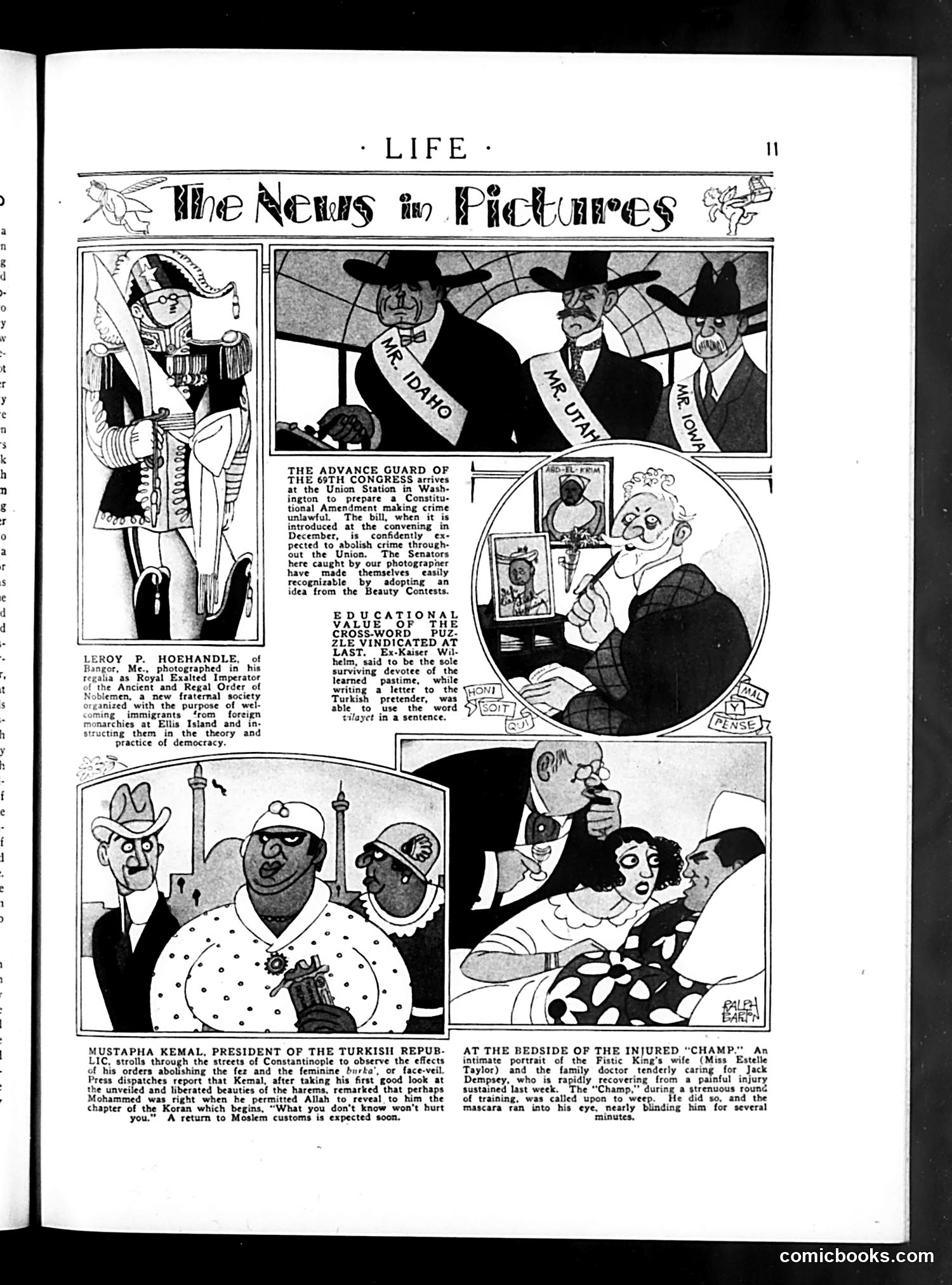
This satirical page contains several political cartoons mocking current events: **Top image**: Three men wearing sashes labeled "Mr. Idaho," "Mr. Charity," and "Mr. Good" appear to reference beauty pageant winners or contest contestants being presented as political figures—likely satirizing the superficiality of public figures. **Middle cartoon**: A crossword puzzle enthusiast, captioned as learning pastime value, jokes about wordplay in leisure activities. **Bottom image**: Shows Mustapha Kemal, President of the Turkish Republic, referenced in text about abolishing Islamic customs (the fez and feminine burka). The cartoon mocks Turkey's modernization efforts under Kemal's secular reforms. **Right panel**: Depicts bedside care for an injured "Champ," appearing to reference celebrity or sports news. The page exemplifies *Life* magazine's approach: satirizing political leaders, social trends, and public figures through illustrated commentary.
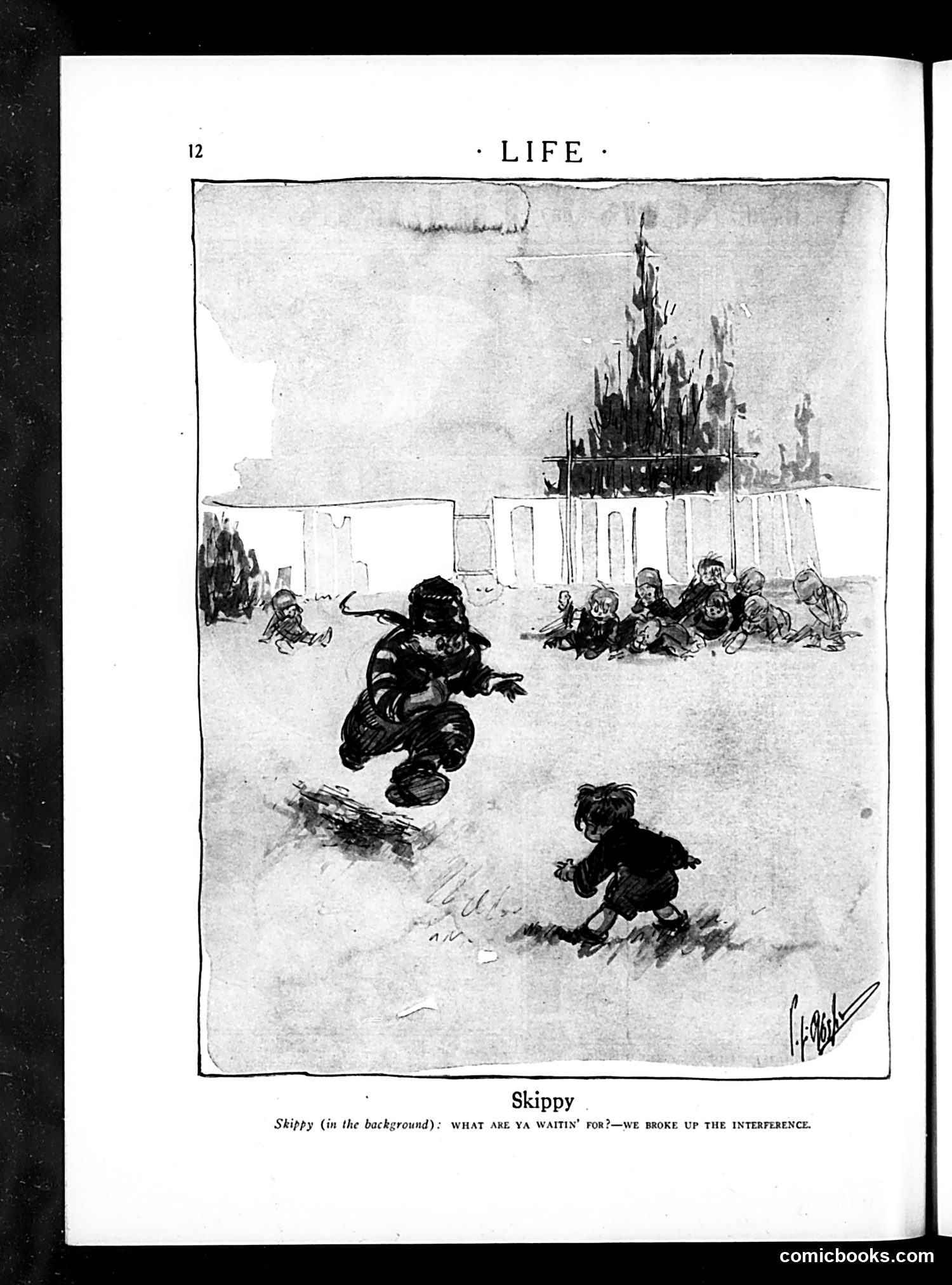
This is a comic strip titled "Skippy" depicting a child's game or confrontation. The caption reads: "Skippy (in the background): WHAT ARE YA WAITIN' FOR?—WE BROKE UP THE INTERFERENCE." The cartoon shows a small boy in the foreground facing off against what appears to be a larger figure, while other children watch from behind. The "interference" referenced suggests this depicts children's street games or play—likely a game involving running or chasing where other kids were blocking the action. The humor derives from the crude, confrontational nature of childhood games and the colloquial speech ("What are ya waitin' for?"). This reflects early 20th-century urban children's street culture and unstructured play.
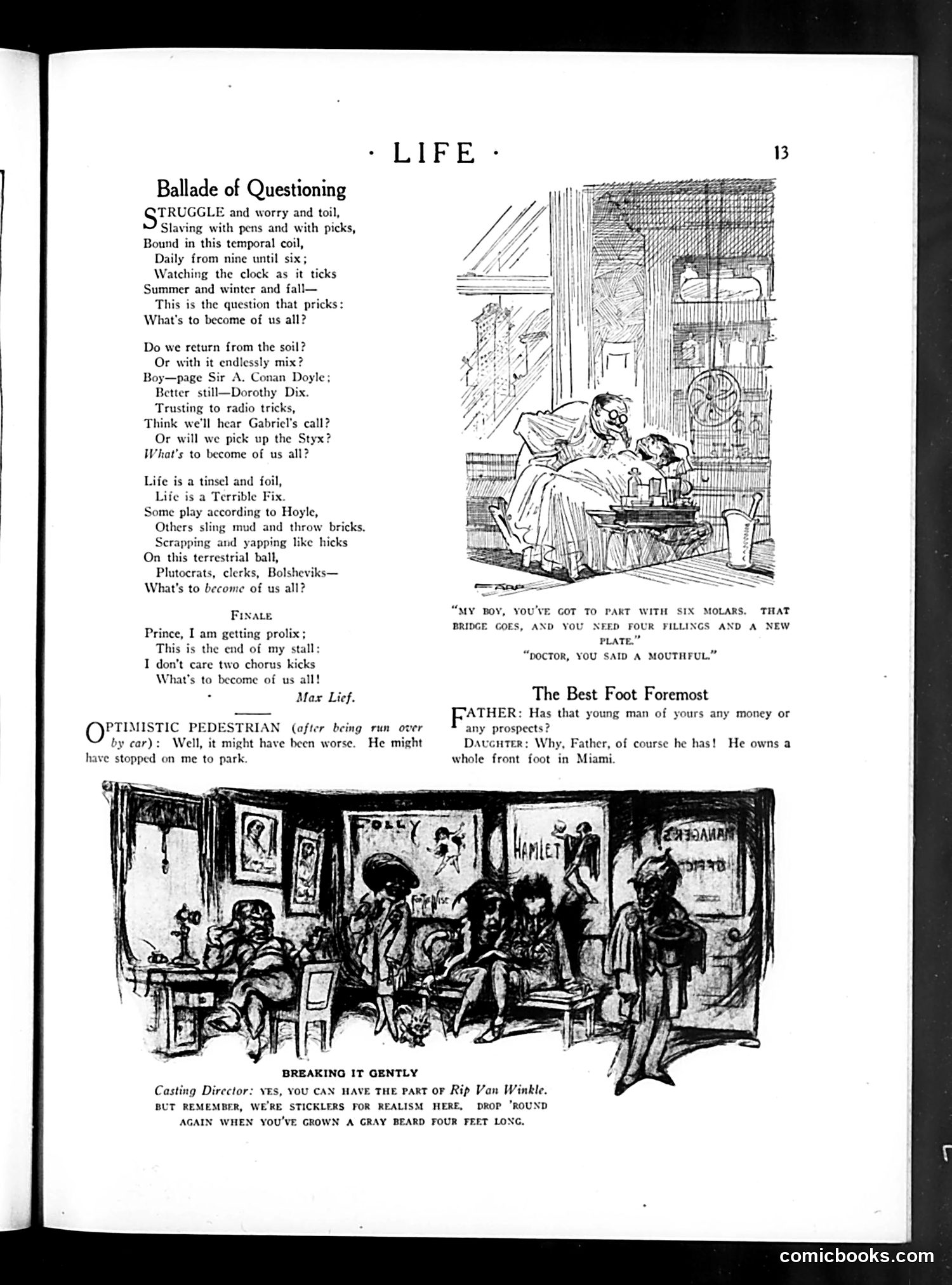
This page contains three distinct satirical pieces: 1. **"Ballade of Questioning"**: A poem mocking the existential anxieties of working-class laborers—the "struggle and worry and toil" from nine to six daily—questioning life's purpose. The refrain "What's to become of us all?" expresses working-class despair. 2. **"The Best Foot Foremost"**: A brief joke where a daughter claims her young suitor owns "a whole front foot in Miami"—satirizing the 1920s Florida real estate boom and nouveau riche pretension about property ownership. 3. **"Breaking It Gently"**: A theater scene where a casting director rejects an actor for a Rip Van Winkle role, telling him to return "when you've grown a gray beard four feet long"—mocking unrealistic theatrical demands and age discrimination in casting. The illustrations use exaggerated line work typical of early 20th-century satirical cartooning.
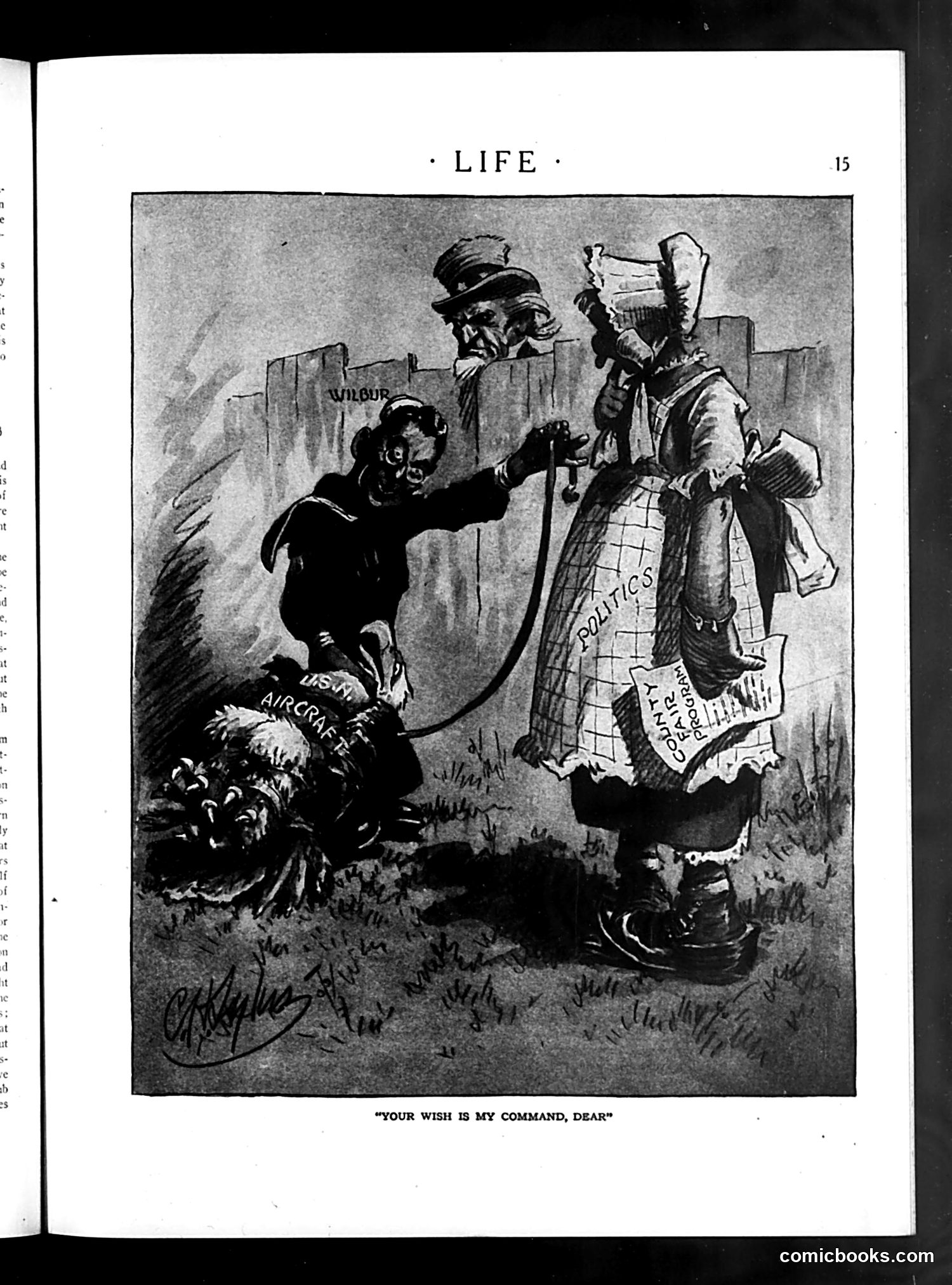
This is a satirical cartoon from *Life* magazine titled "Your Wish Is My Command, Dear." It depicts a genie-like figure emerging from a lamp labeled with references to "Politics," "Aircraft," and other policy areas, speaking to an older man in formal dress (likely representing a political leader or citizen). The genie appears to be offering obedience to the man's wishes. The satire critiques how political leaders or wealthy figures can manipulate government policy—suggesting that political machinery operates as their servant rather than serving the public interest. The caricatured style and exaggerated features were typical of early 20th-century editorial cartooning. Without the magazine's date visible, the specific political figures remain unclear, though the commentary on power and influence is evident.
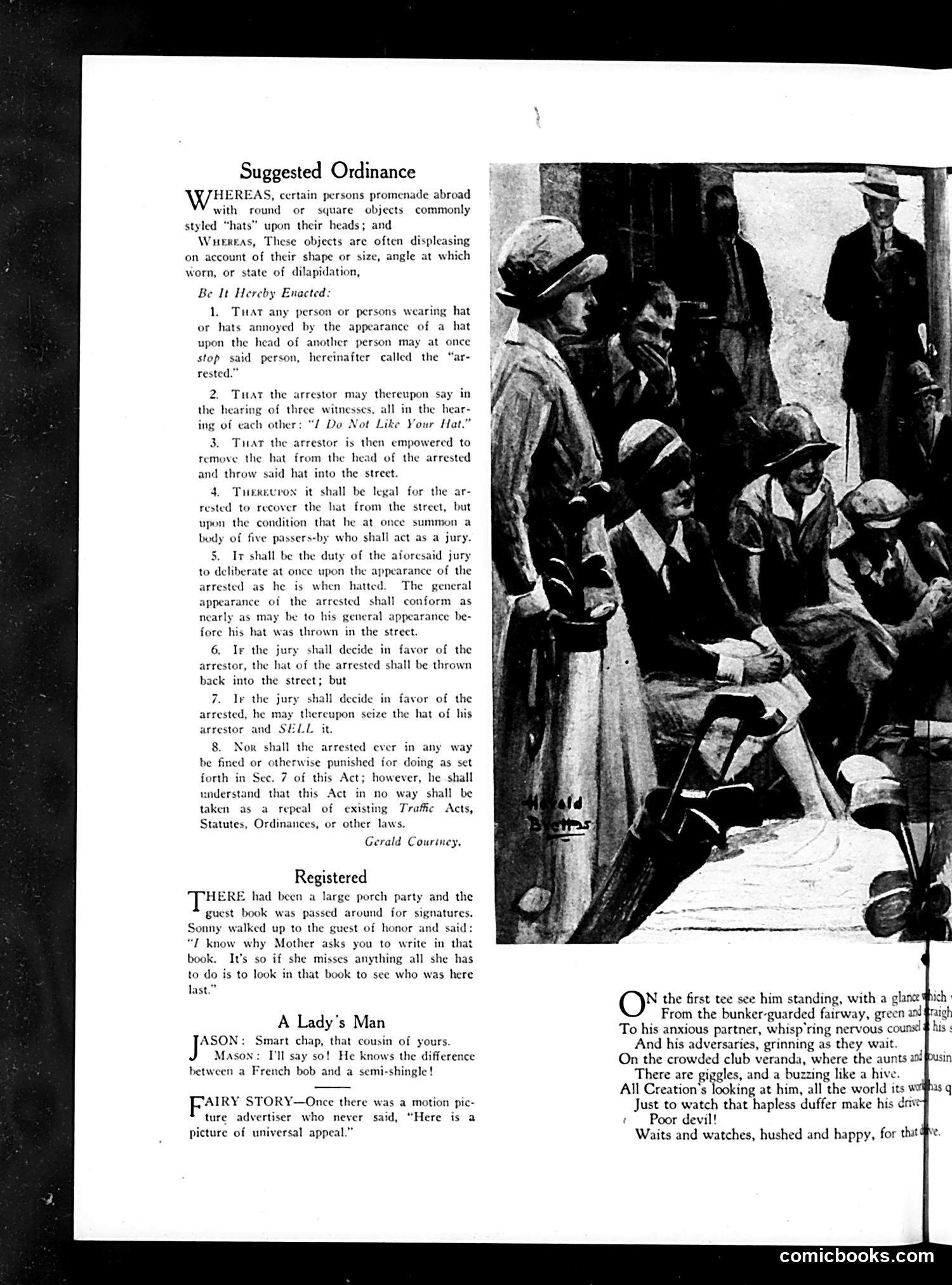
This page satirizes the absurdity of overly-specific municipal legislation. The "ordinance" proposes criminalizing hats that annoy others by their appearance—enabling arrest, public hat removal, and jury trials over hat disputes. The accompanying photograph shows a street scene with multiple pedestrians and various hat styles, illustrating the proposed law's impracticality. The satire mocks two targets: (1) cities passing petty, unenforceable laws, and (2) the fashion anxiety around hat styles during this era. By treating trivial aesthetic complaints as serious legal matters requiring formal procedure and juries, *Life* ridicules both municipal overreach and the social pretension surrounding fashion. The humor relies on readers recognizing the absurdity of criminalizing personal appearance choices.
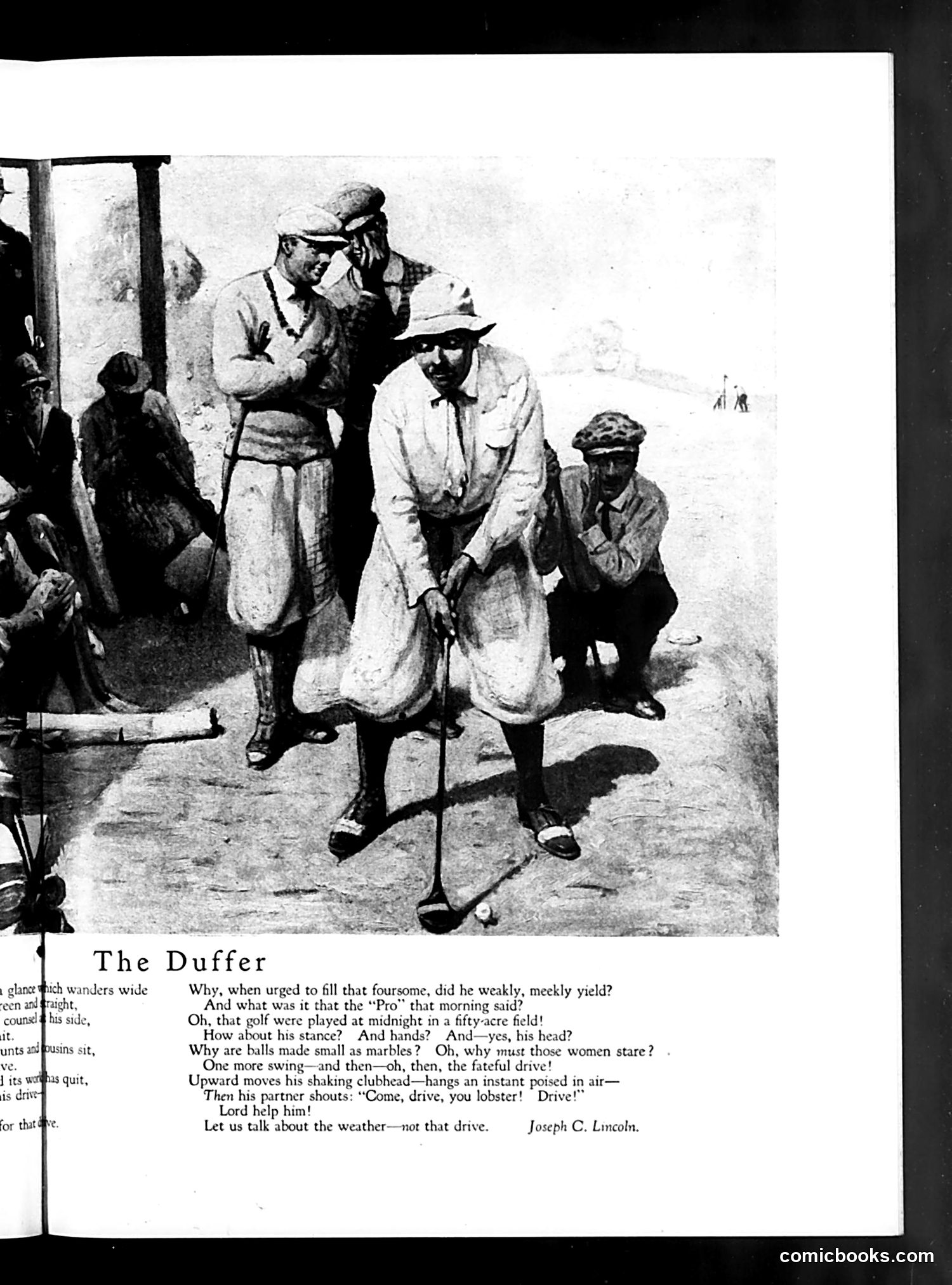
This satirical piece mocks amateur ("duffer") golfers, specifically a nervous, incompetent player pressured into joining a foursome. The accompanying photograph shows men in period golf attire (early 20th century), depicting the anxious golfer's internal monologue. The humor targets the golfer's self-doubt and embarrassment: his poor stance, shaky hands, inability to hit straight drives, and acute awareness of being watched by spectators (including women). His partner's shouted insult—"Come, drive, you lobster!"—adds social humiliation to athletic failure. The closing line, attributing the piece to Joseph C. Lincoln (a humorist writer), pivots to dark comedy: after describing this excruciating moment, the author suggests deflecting with small talk about weather rather than discussing "that drive"—implying the shot was so catastrophically bad that even the golfer wants to forget it immediately.
This page from Life magazine's "Drama" section offers satirical commentary on New York theater openings and recent Broadway productions. The opening critique mocks the myth of glamorous theatrical premieres. The author sarcastically catalogs the actual attendees: 74 movie actors, theater professionals, 307 laymen, and notably "one delicatessen proprietor"—undercutting the notion of exclusivity. The piece nostalgically references "Diamond Jim Brady," a famous Gilded Age financier, suggesting theater openings have become less prestigious. The reviews discuss contemporary shows: "Sunny" (praised despite the author's admitted disappointment), which features Marilyn Miller and music by Jerome Kern; "The Pelican" with Margaret Lawrence; and G. Kaufman's "The Butter-and-Egg Man" with Gregory Kelly. The author regrets seeing comedic actresses like Esther Howard relegated to serious dramatic roles. Small decorative illustrations (dancing figures, theatrical masks) punctuate the text. The tone is sophisticated mockery—pretending disappointment at being unable to criticize "Sunny," while actually praising it for having "no bad spots."
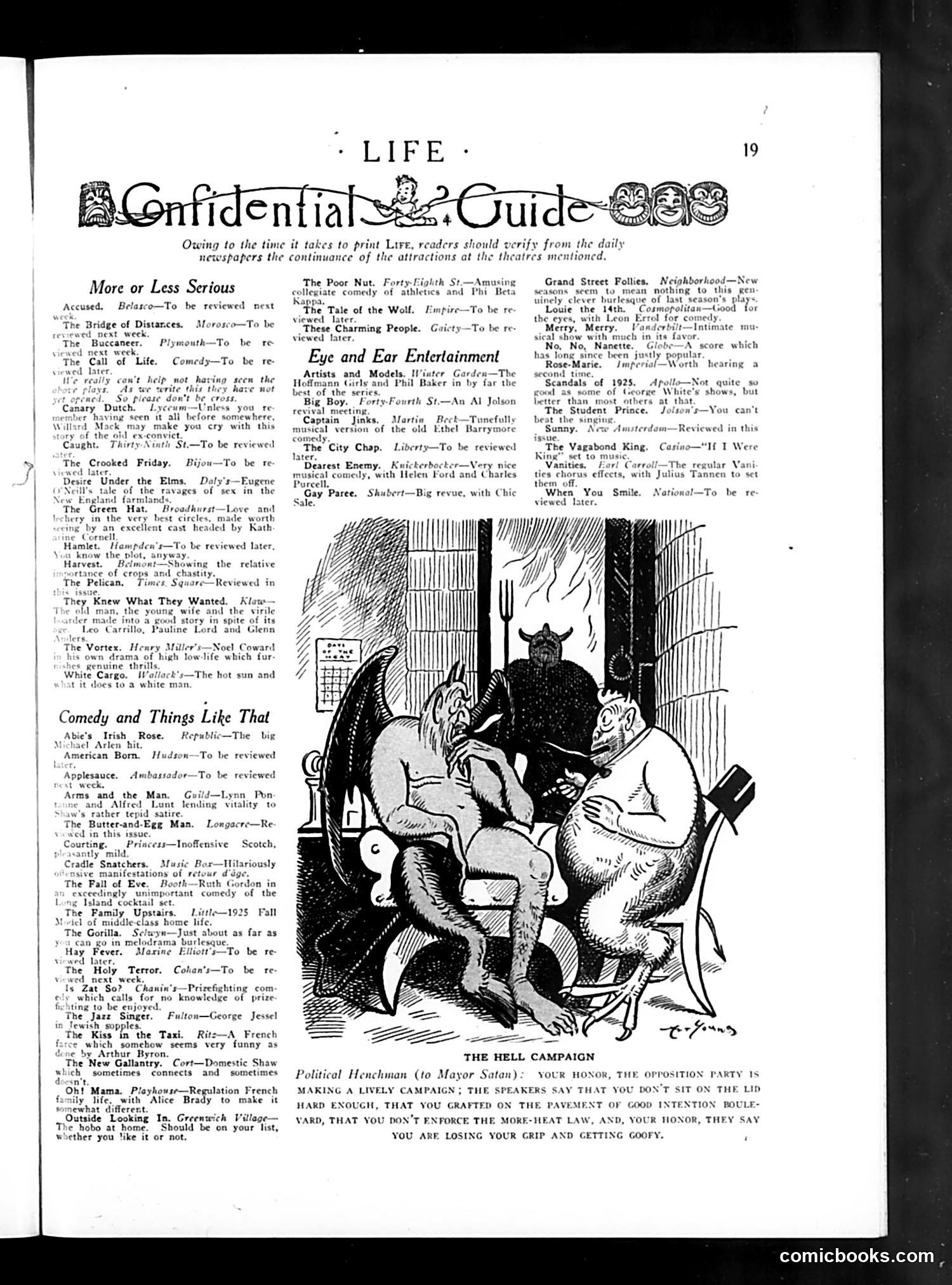
This page contains a satirical political cartoon titled "The Hell Campaign" depicting a confrontation between a political henchman (identified as "to Mayor Solan") and what appears to be an opposition figure. The cartoon illustrates a heated political dispute, likely from a mayoral campaign. The text below mocks the opposition party's campaign tactics, sarcastically suggesting they're making "lively" accusations while the henchman claims the opposing side has engaged in corrupt practices regarding "pavement of good intention boulevard" and enforcement of heat laws. The cartoon's satire targets both sides of a political battle—suggesting mutual accusations of hypocrisy and corruption. The grotesque caricatures and dramatic confrontation style were typical of Life magazine's political commentary in the 1920s, when such visual ridicule was standard editorial practice. Without clearer context about which specific mayoral race or year this references, the exact identities remain unclear, but the satirical intent—mocking political mudslinging and questionable campaign ethics—is evident.
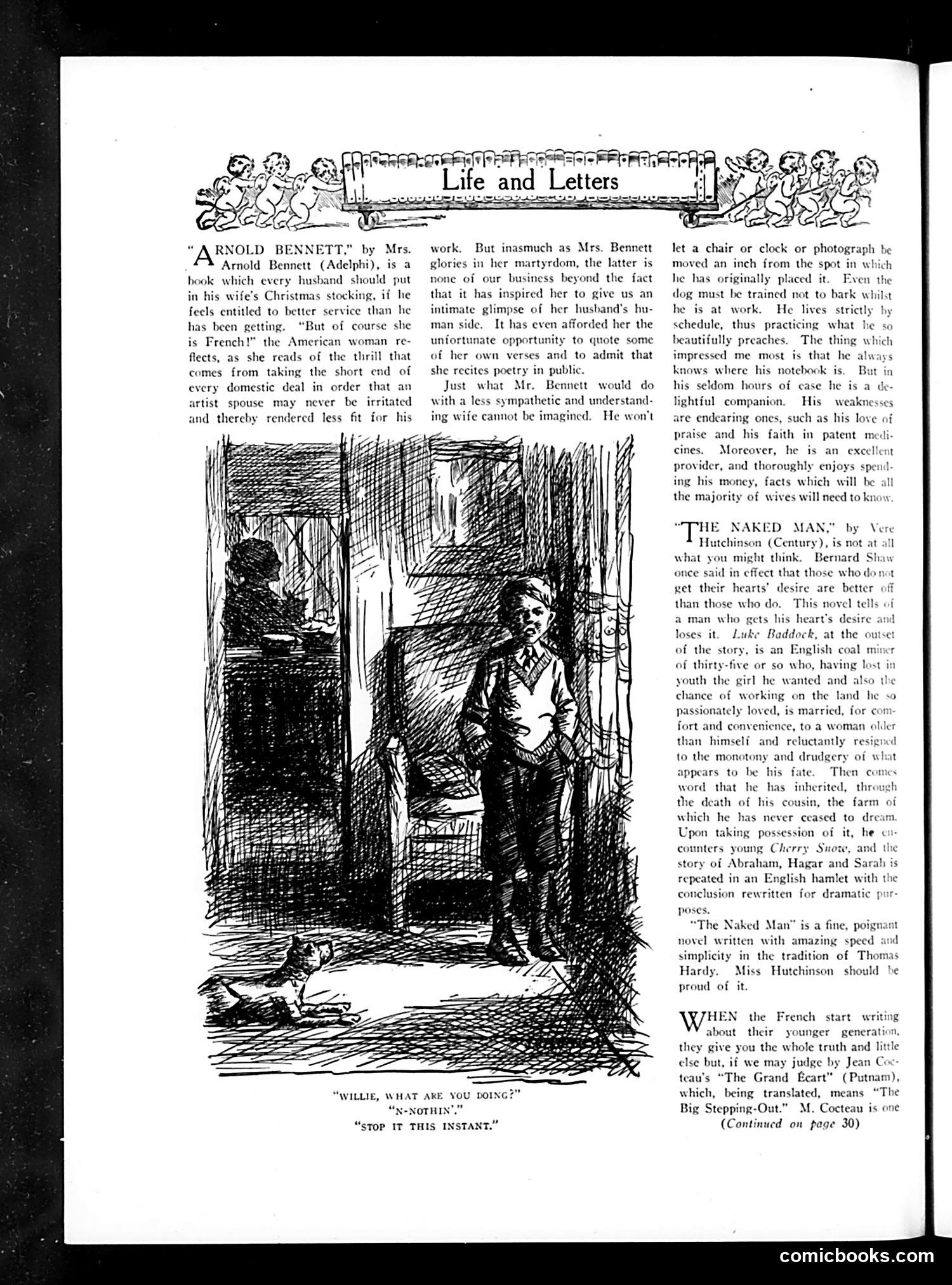
This page from *Life* magazine features literary reviews rather than political cartoons. The main illustration accompanies a review of "Arnold Bennett" by Mrs. Arnold Bennett (published by Adelphi). The sketch depicts a domestic scene with a child and parent, captioned with dialogue: "Willie, what are you doing?" / "Nothin'." / "Stop it this instant." This humorous vignette illustrates the review's satirical point about eccentric artist spouses—specifically Arnold Bennett's obsessive control over his household environment (furniture placement, even the dog's barking) and rigid schedules, contrasted with his wife's patient, self-sacrificing devotion. The page also reviews Vere Hutchinson's novel *The Naked Man* and mentions Jean Cocteau's French work. The satire targets the domestic compromises artistic temperaments demand from their partners, and the peculiar pride some spouses take in enabling such behavior.
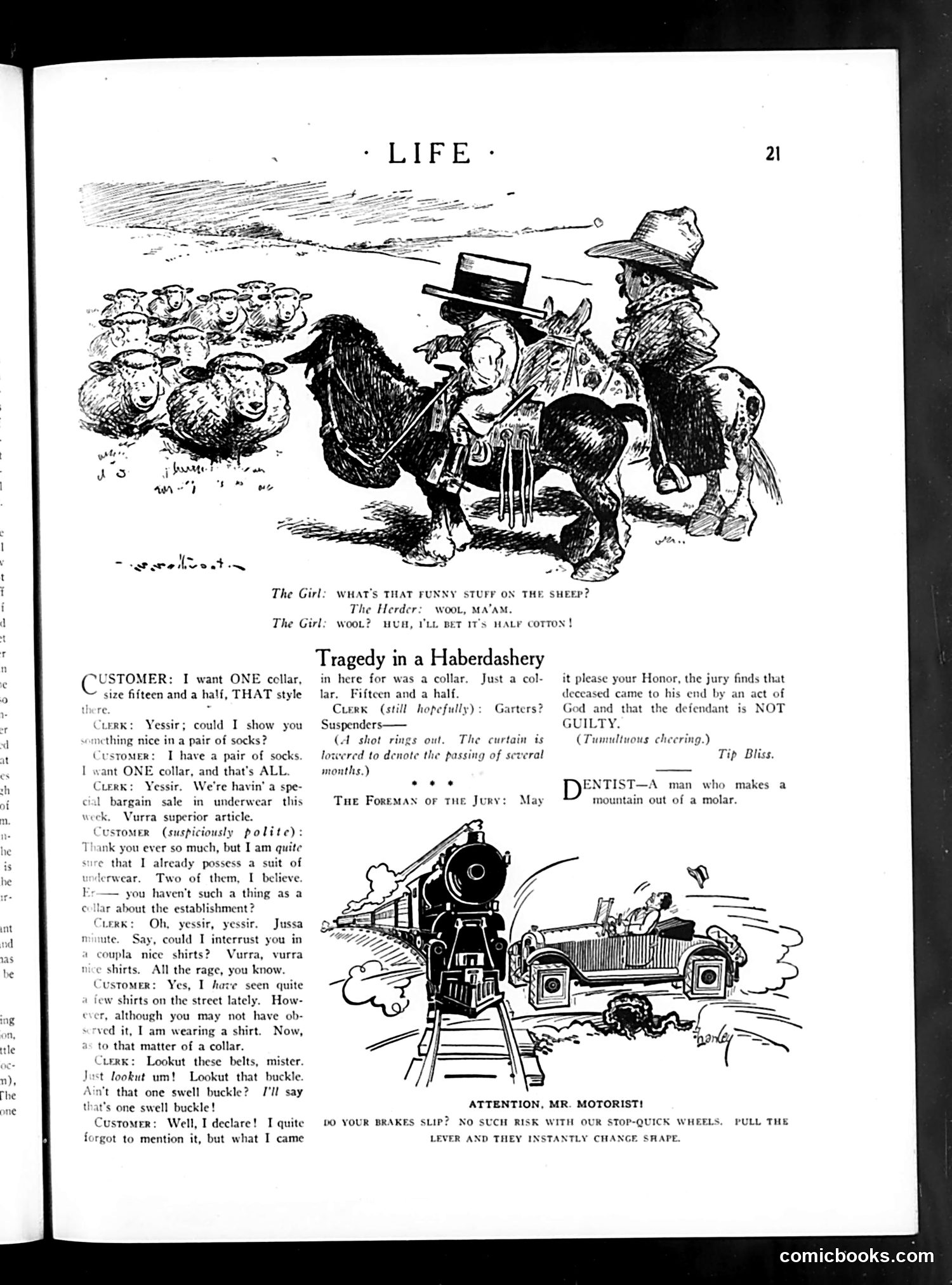
This *Life* magazine page contains two satirical pieces: **"Tragedy in a Haberdashery"** mocks incompetent retail clerks. A customer repeatedly asks for a collar (a detachable shirt collar, common in that era), but the clerk keeps pushing irrelevant items—socks, underwear, shirts, belts—ignoring the specific request. The sketch escalates: a gunshot rings out, months pass, and a jury trial concludes the clerk is "NOT GUILTY," mocking both the clerk's obliviousness and the legal system's absurdity. **The sheep/herder dialogue** is a brief joke about wool versus cotton fabric. **"Attention, Mr. Motorist"** is an advertisement for "Stop-Quick Wheels," claiming instant brake responsiveness. The humor targets early 20th-century retail incompetence and upselling tactics—clerks prioritizing commissions over customer needs—while the mock-trial ending satirizes how trivial matters could balloon into legal proceedings.
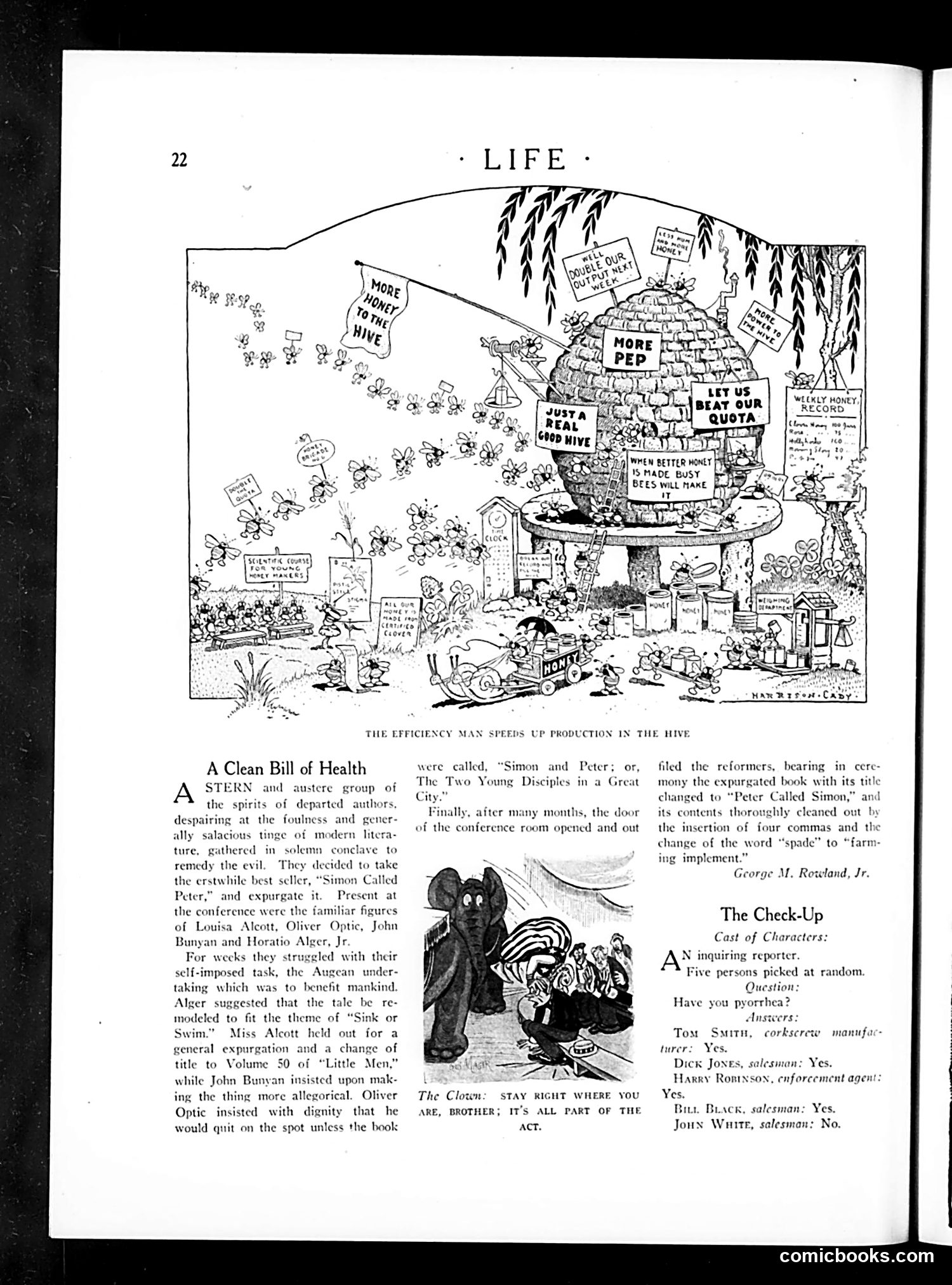
The top cartoon satirizes literary censorship efforts of the early 20th century. A group of famous "moral" authors—Louisa May Alcott, Oliver Optic, John Bunyan, and Horatio Alger Jr.—meet to expurgate (censor) the bestselling novel "Simon Called Peter," which apparently contained sexual or profane content. After weeks of debate, they produce a hilariously over-censored version retitled "Peter Called Simon" with minimal actual changes: just four commas added and the word "spade" replaced with "farming implement." The joke mocks both the absurdity of prudish censorship and the self-importance of Victorian-era moral reformers. The bottom cartoon, "The Check-Up," appears to be a separate health-related piece questioning five random people about pyorrhea (gum disease), with four answering "yes" and one "no"—likely commentary on a public health concern of the era.
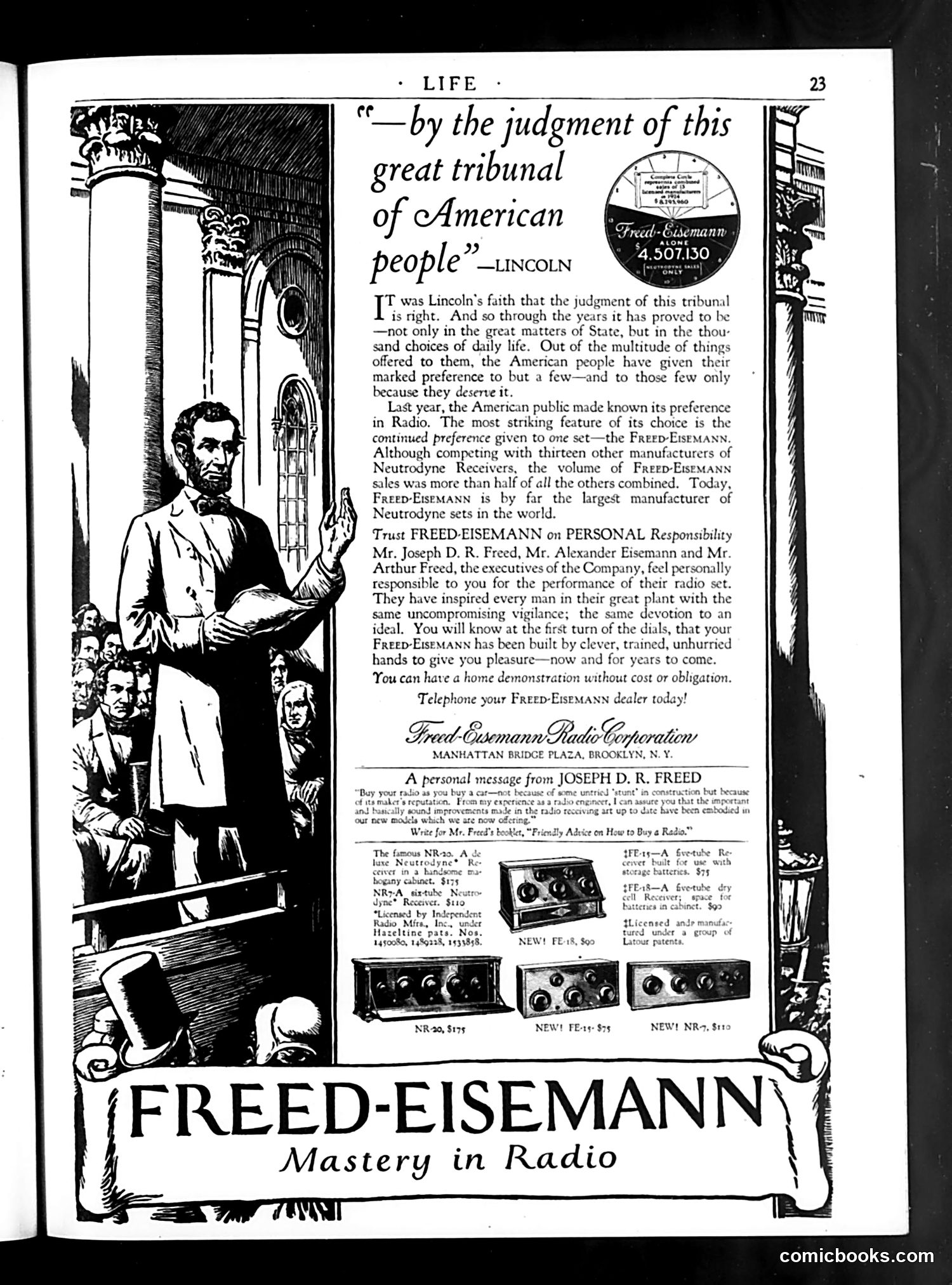
This page is primarily a **commercial advertisement** for Freed-Eisemann radios, not political satire. It uses Lincoln's famous quote about trusting "the judgment of this great tribunal of American people" to market radios as a consumer product endorsed by popular choice. The illustration depicts **Lincoln surrounded by citizens**, invoking his authority and democratic ideals to sell Neutrodyne receivers. The text claims Americans have democratically "chosen" Freed-Eisemann radios—sales allegedly exceeding competitors' combined volume. The advertisement emphasizes **personal responsibility** from company executives (Joseph D. R. Freed, Alexander Eisemann, and Arthur Freed), framing radio manufacturing as a moral enterprise aligned with American values. The lower section displays various radio models with prices ($75-$110). **For modern readers:** This represents how advertisers in the 1920s-30s appropriated patriotic and democratic rhetoric to legitimize commercial products, equating consumer preference with democratic judgment. It's marketing disguised as civic virtue.
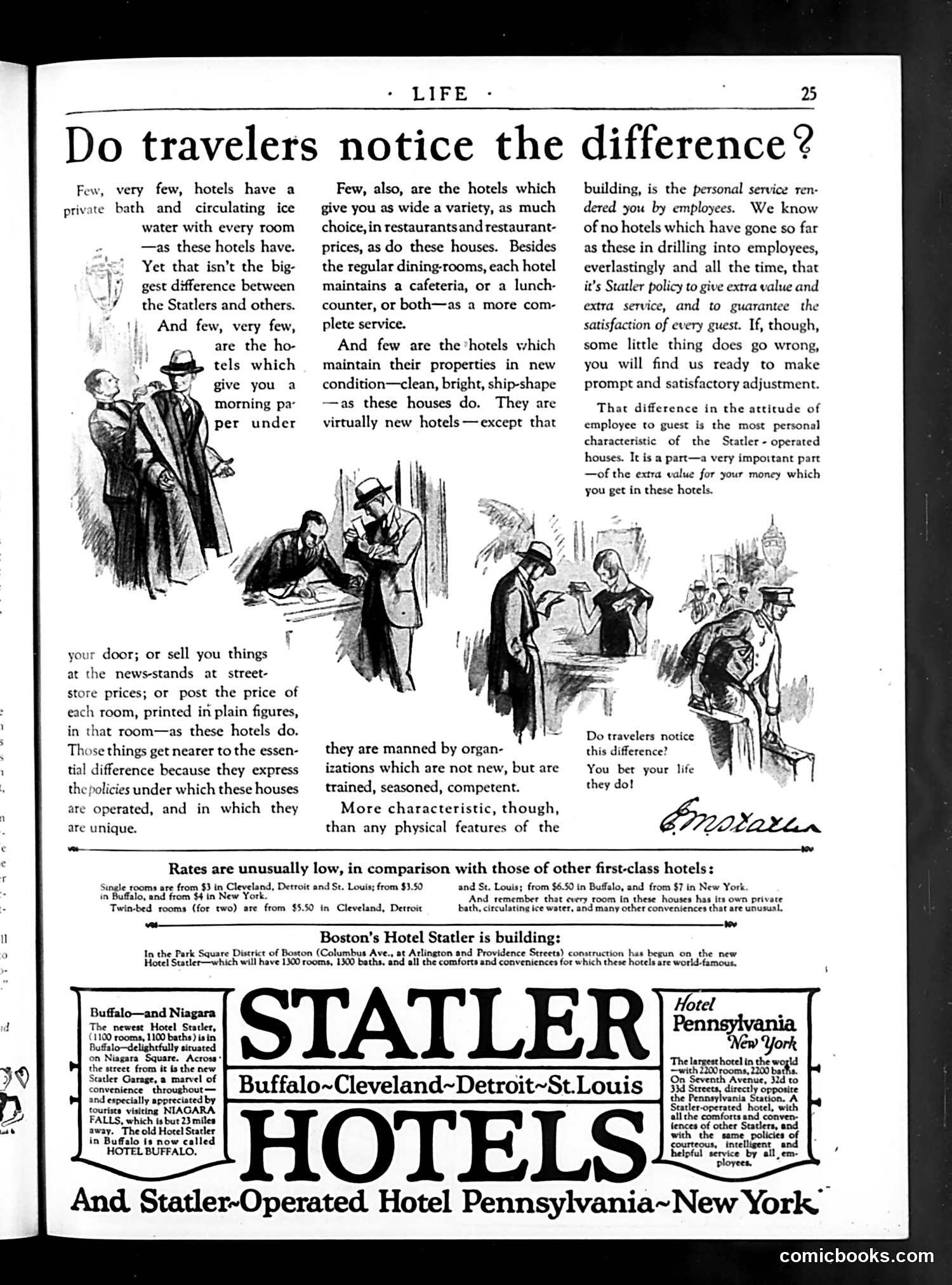
This is primarily **hotel advertising**, not satire or political commentary. The page promotes Statler Hotels' service standards to travelers, emphasizing what distinguishes them from competitors. The sketched vignettes show bellhops, doormen, and hotel staff attending to guests—visualizing the "personal service" the text emphasizes as Statler's key differentiator. The repeated phrase "Do travelers notice this difference?" is rhetorical marketing. The text argues Statler's competitive advantage isn't fancy amenities (private baths, ice water, newspapers) but rather **employee training and attitude**—staff are "drilled" to prioritize guest satisfaction and rectify problems promptly. This reflects early-20th-century hospitality philosophy. The advertised rates ($3–$7 per room) are positioned as unusually affordable for first-class hotels, with locations in Buffalo, Cleveland, Detroit, St. Louis, and New York listed. A new Boston location under construction is announced. This is straightforward commercial messaging, not editorial commentary.
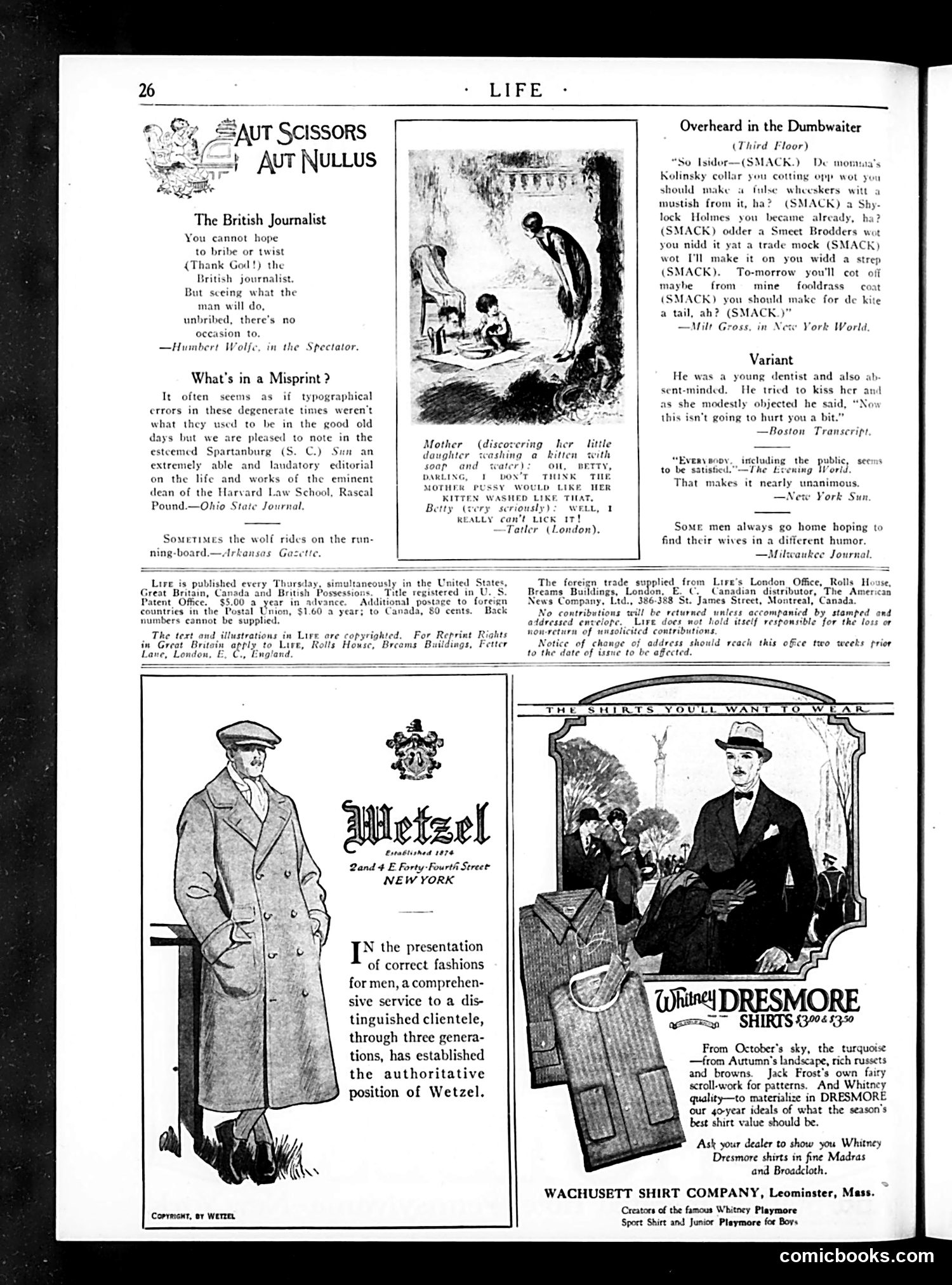
This page from Life magazine contains satirical humor pieces and advertisements typical of early 20th-century American periodicals. **The Cartoons/Humor:** The main content consists of brief satirical quotes and anecdotes: 1. **"The British Journalist"** — A poem mocking British journalists' incorruptibility, suggesting they're dishonest without needing bribes. 2. **"What's in a Misprint?"** — Humorous typographical errors from newspapers, including a Harvard dean called a "Rascal" (likely unintentional). 3. **"Overheard in the Dumbwaiter"** — A comedic dialogue (likely Yiddish-inflected English) between characters discussing tailoring and clothing alterations. 4. **"Variant"** — A brief joke about an absent-minded dentist. The page is primarily **advertising**, featuring clothing companies (Wetzel, Whitney Dresmore Shirts, Wachusett Shirt Company) with period illustrations of men's fashions. The humor relies on wordplay, ethnic dialect comedy (common then, offensive now), and observational jokes about human behavior—typical Life magazine fare of its era.
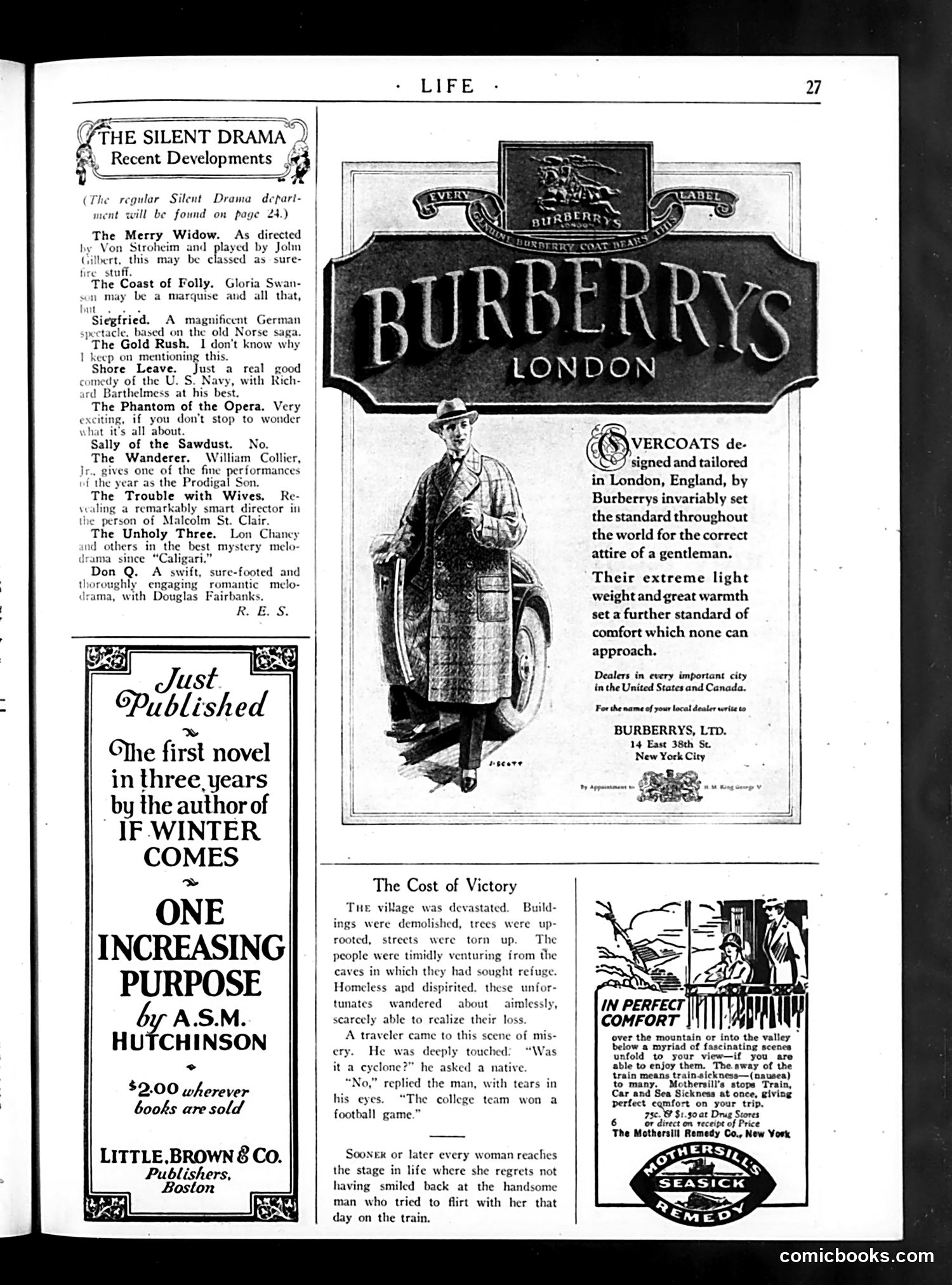
This page is primarily **advertising and entertainment reviews**, not political satire. The top section reviews silent films—including works by famous directors like Erich von Stroheim and notable stars (Gloria Swanson, Lon Chaney, Douglas Fairbanks). The reviewer's tone is casual and dismissive toward some films ("I don't know why I keep on mentioning this"). The main cartoon depicts a devastated post-WWI village. A traveler asks if destruction came from a cyclone; a grief-stricken native reveals the village was actually destroyed because "the college team won a football game." **The satire**: This jokes darkly about American priorities—suggesting that college football generates such passionate, destructive fan behavior that it rivals natural disasters. It's social commentary on Americans' obsession with collegiate sports, presenting it as almost comically disproportionate to actual wartime devastation. The remaining content includes book and product advertising (Burberrys overcoats, Mothersill's seasickness remedy), typical of 1920s magazine layouts.
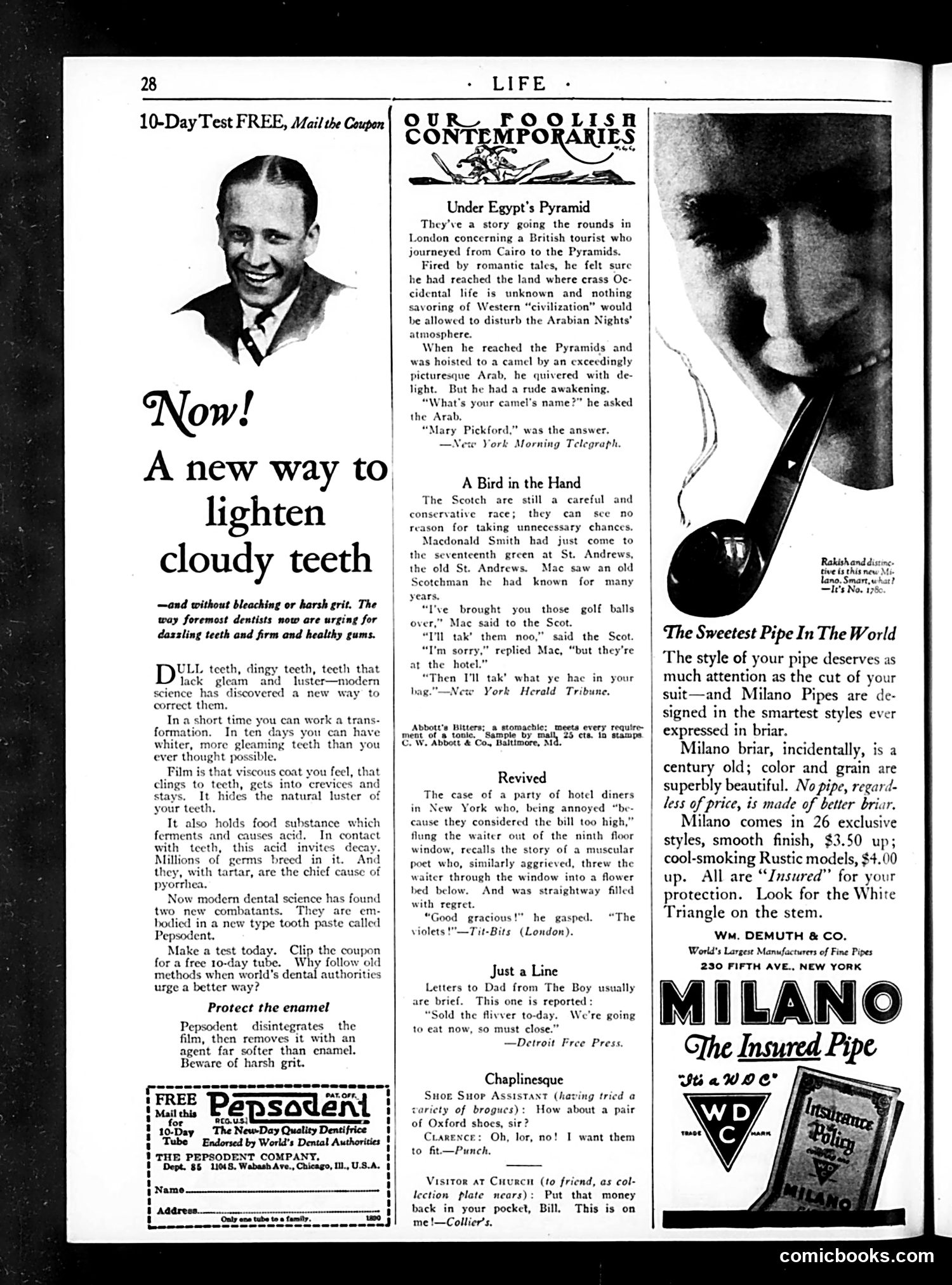
This page is primarily **advertising**, with humorous filler content typical of 1920s Life magazine. **Main Advertisement:** Pepsodent toothpaste dominates the left column, promoting a "new" dental science approach to whitening teeth through film removal rather than harsh bleaching—a genuine marketing innovation for the era. **Humorous Shorts:** The right side contains brief satirical anecdotes: - **"Under Egypt's Pyramid"**: A British tourist seeks "authentic" Egypt but discovers a camel named "Mary Pickford"—mocking Western tourists' romanticized expectations versus modern reality. - **"A Bird in the Hand"**: Scottish golfer stereotype humor about cautious frugality. - **"Revived"**: Dark humor about a poet throwing a waiter from a window, then feeling regret. - **"Chaplinesque"**: Possible reference to Charlie Chaplin's comedic style in a shoe-shop scene. The page reflects 1920s sensibilities: advertising disguised as lifestyle advice, mild class/ethnic humor, and absurdist anecdotes. It's primarily a **commercial vehicle** rather than political satire.
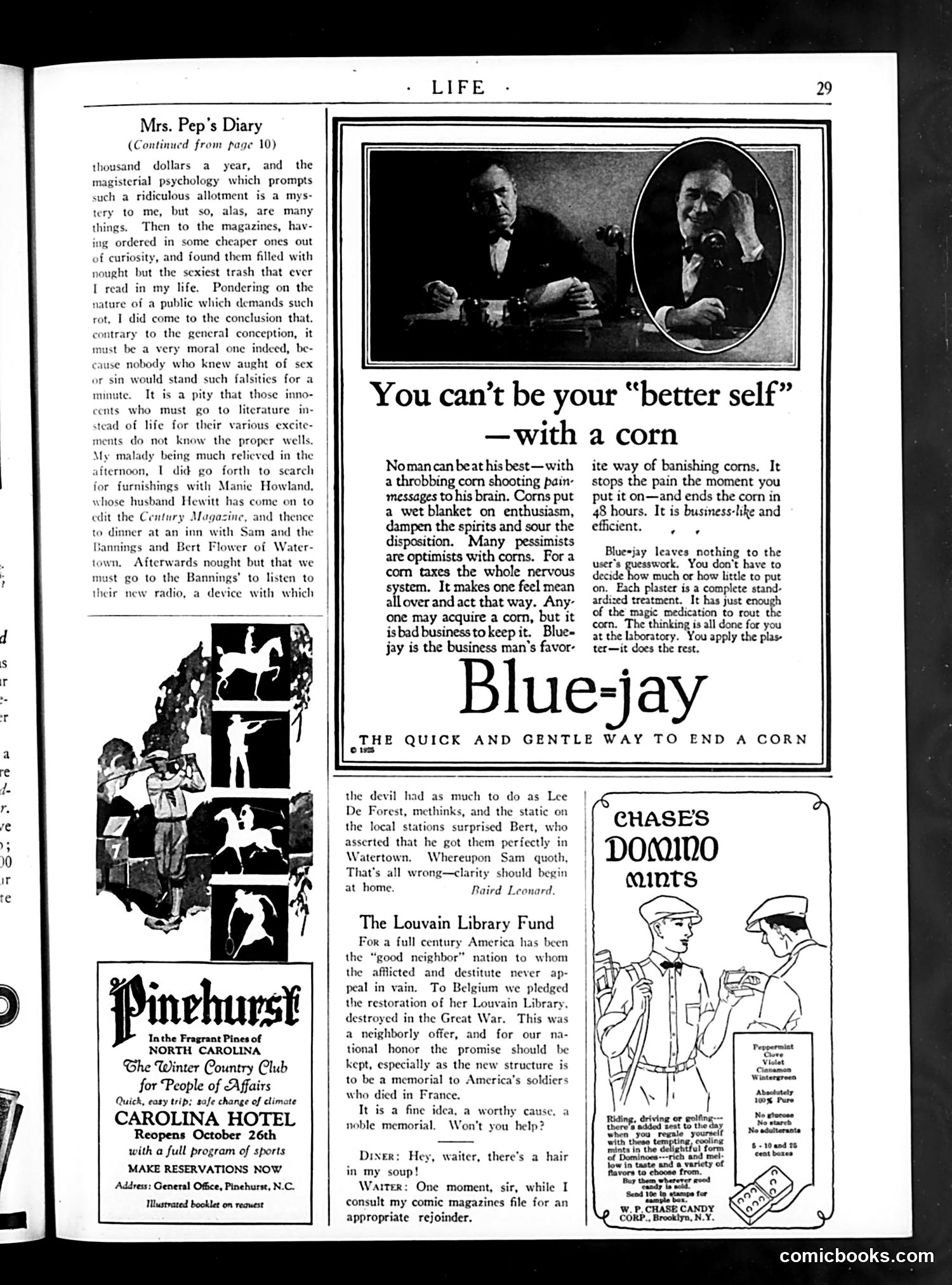
This page mixes editorial content with advertising. The main satirical piece is the **Blue-jay corn plaster advertisement**, which uses humor to mock business culture. The ad's joke is that corns literally prevent a man from being his "better self"—playing on contemporary self-improvement rhetoric while suggesting that physical discomfort (not moral failing) explains pessimism and poor behavior. The ad cleverly positions the product as offering standardized, foolproof relief, reflecting early 20th-century advertising's emphasis on scientific efficiency. **"Mrs. Pep's Diary"** (a regular column) offers genteel social satire about upper-middle-class life, including commentary on risqué magazines and early radio technology. The **Louvain Library Fund appeal** references post-World War I reconstruction efforts in Belgium—a genuine philanthropic cause. A minor joke at bottom mocks newspaper "advice column" conventions. The page is primarily **advertising-driven**, typical of Life's revenue model circa 1920s.
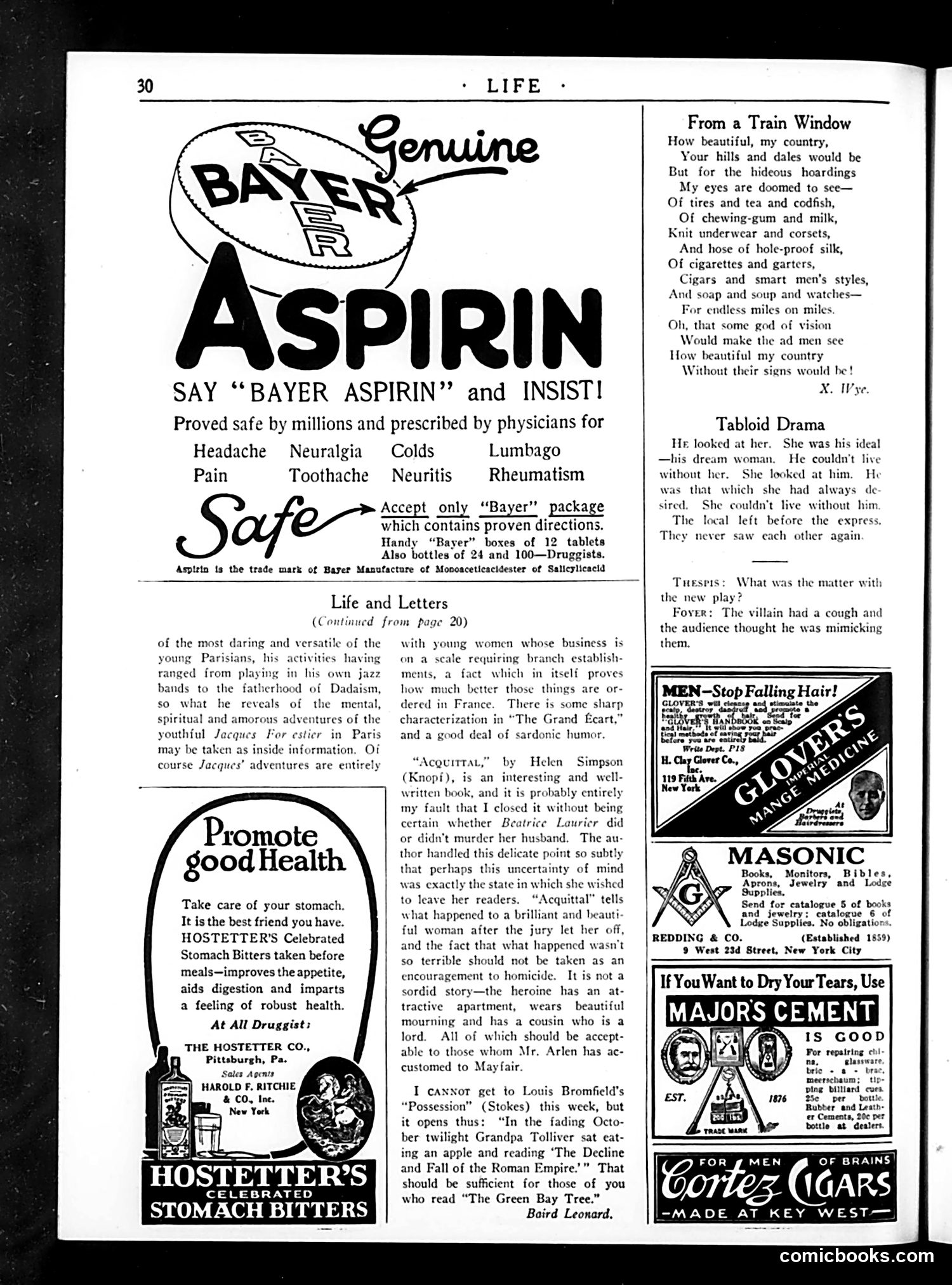
This page is primarily **advertising-heavy**, typical of 1920s American magazines. The dominant content includes: **Major Advertisements:** - **Bayer Aspirin** (top): Emphasizes the branded product's safety and physician endorsement for common ailments—reflecting post-WWI marketing of this newly accessible painkiller - **Hostetter's Stomach Bitters**: Patent medicine advertising typical of the era - Smaller ads for Glover's Mange Medicine, Masonic supplies, Majors Cement, and Cortez Cigars **Editorial Content:** The "Life and Letters" section reviews recent books, including Helen Simpson's *Acquittal* (about a woman acquitted of murdering her husband) and references to works by Jacques Forestier and Louis Bromfield. **Poetry:** "From a Train Window" satirizes American roadside billboard advertising—a contemporary complaint about commercialization despoiling the landscape. **Humor Section:** Brief satirical pieces mocking theatrical conventions and melodrama. The page reflects 1920s concerns: commercialism's visual pollution, accessible pharmaceuticals, and literary modernism.
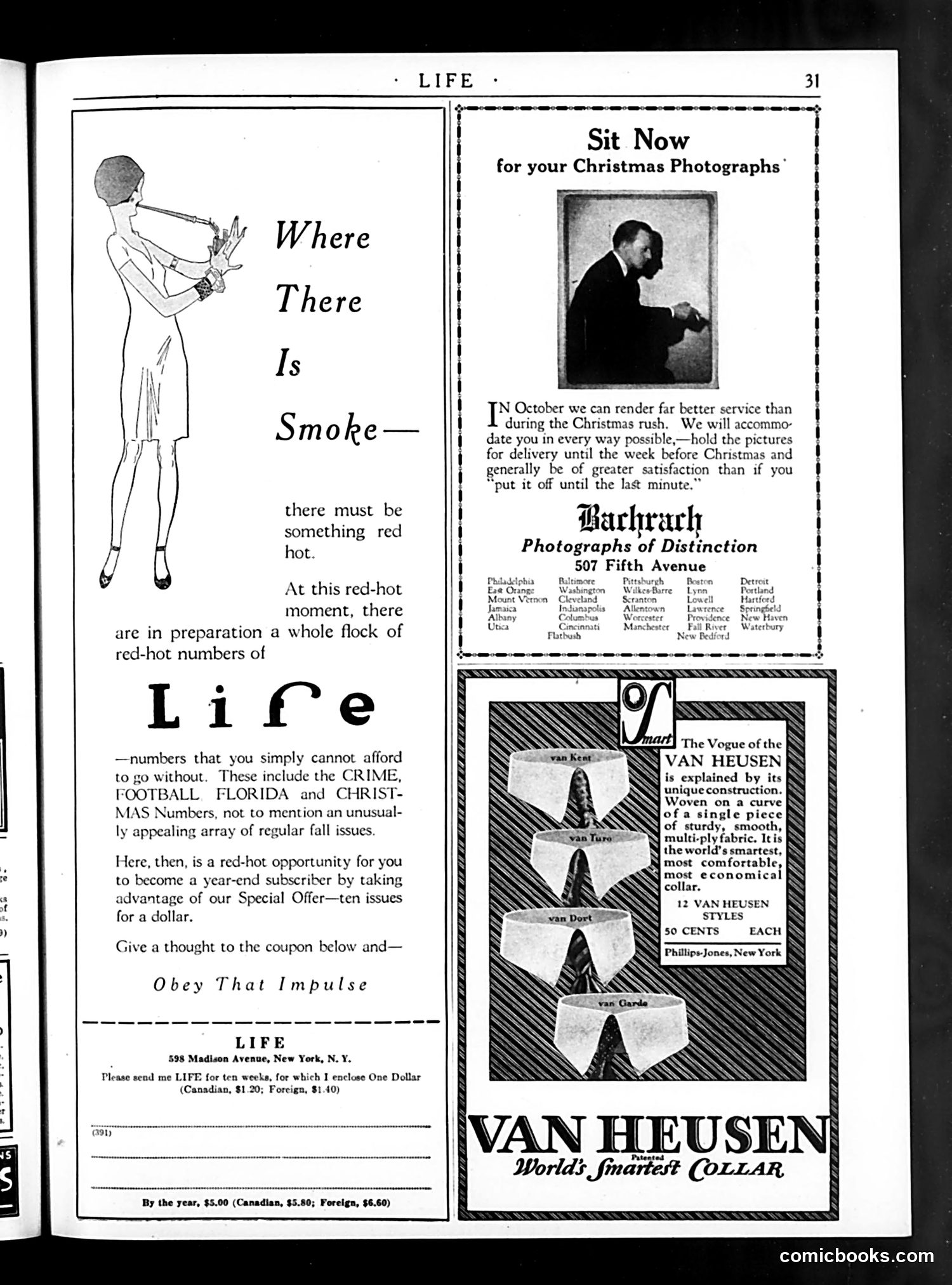
This page is primarily **advertising and subscription promotion** rather than satirical content. The left side promotes Life magazine subscriptions using a playful "where there's smoke, there's fire" metaphor to create urgency around upcoming special issues (Crime, Football, Florida, Christmas numbers). The pitch encourages readers to subscribe now at ten issues for one dollar—a promotional offer. The right side contains two unrelated advertisements: **Bachrach photography studios** encouraging holiday portrait sittings in October to avoid Christmas rush delays, and **Van Heusen collar advertisements** promoting their "world's smartest collar" with product variations displayed. There is no political cartoon or satirical commentary on this page—it's a straightforward commercial page using period advertising language and layout conventions typical of 1920s magazine publishing.
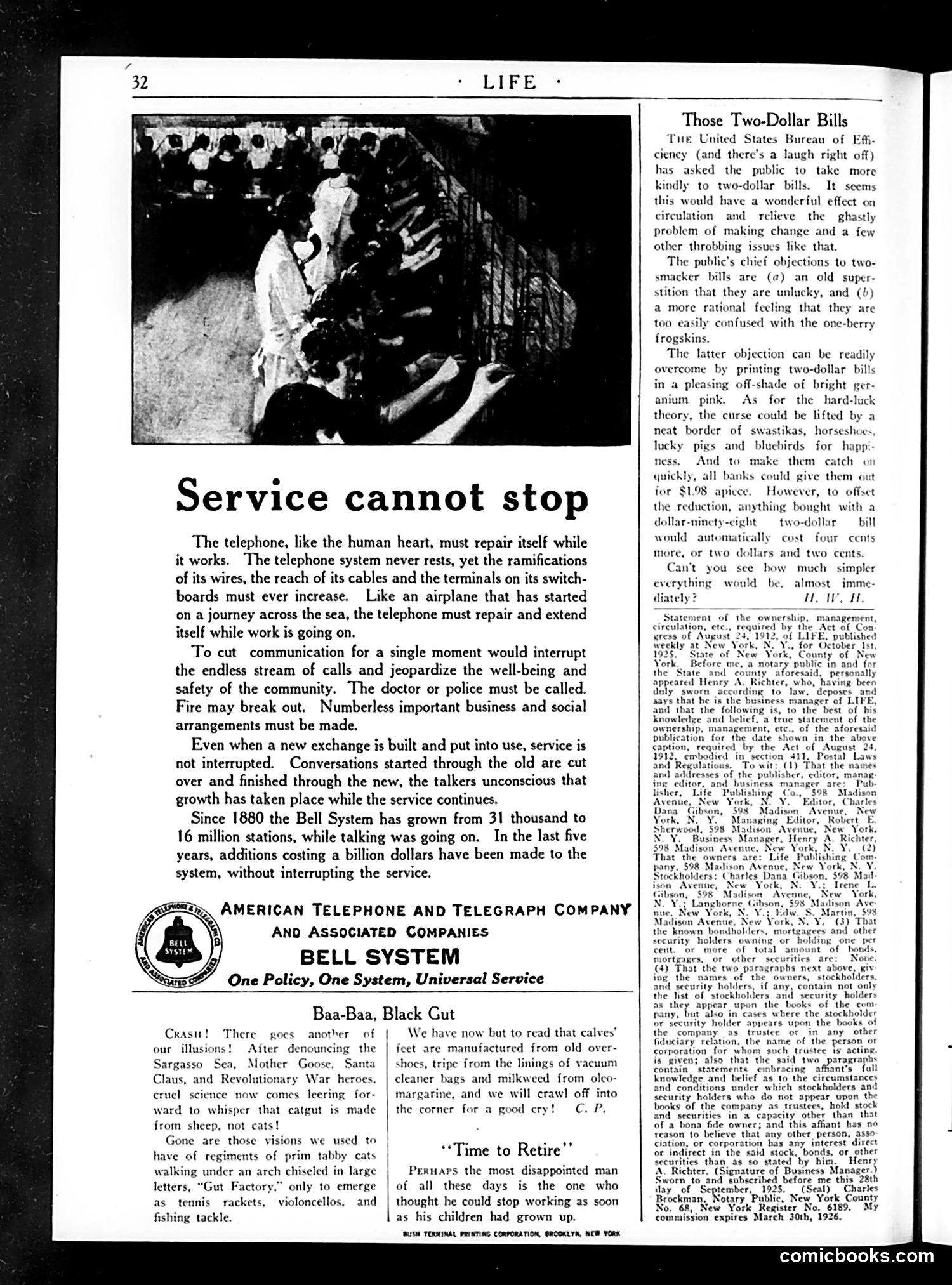
This page contains **two distinct pieces of content**: ## Main Advertisement: Bell System Telephone Service The large central article and image promote the telephone system's reliability during ongoing infrastructure expansion. The text emphasizes that telephone service cannot be interrupted—even during repairs and upgrades—because emergencies (fires, police calls) depend on continuous availability. It's a corporate PR piece celebrating the Bell System's growth from 31,000 to 16 million stations since 1880 without service interruption. The image appears to show telephone operators at work. ## Satirical Column: "Those Two-Dollar Bills" This mocks a U.S. Bureau of Efficiency campaign encouraging public use of $2 bills. Life satirizes Americans' superstitions (considering them unlucky) and practical confusion with $1 bills. The satire proposes absurd solutions: printing them in "geranium pink" with lucky symbols (swastikas, horseshoes, bluebirds), or selling them for $1.98—which the author notes would paradoxically cost more than face value. The humor targets both bureaucratic inefficiency and American irrationality about currency.
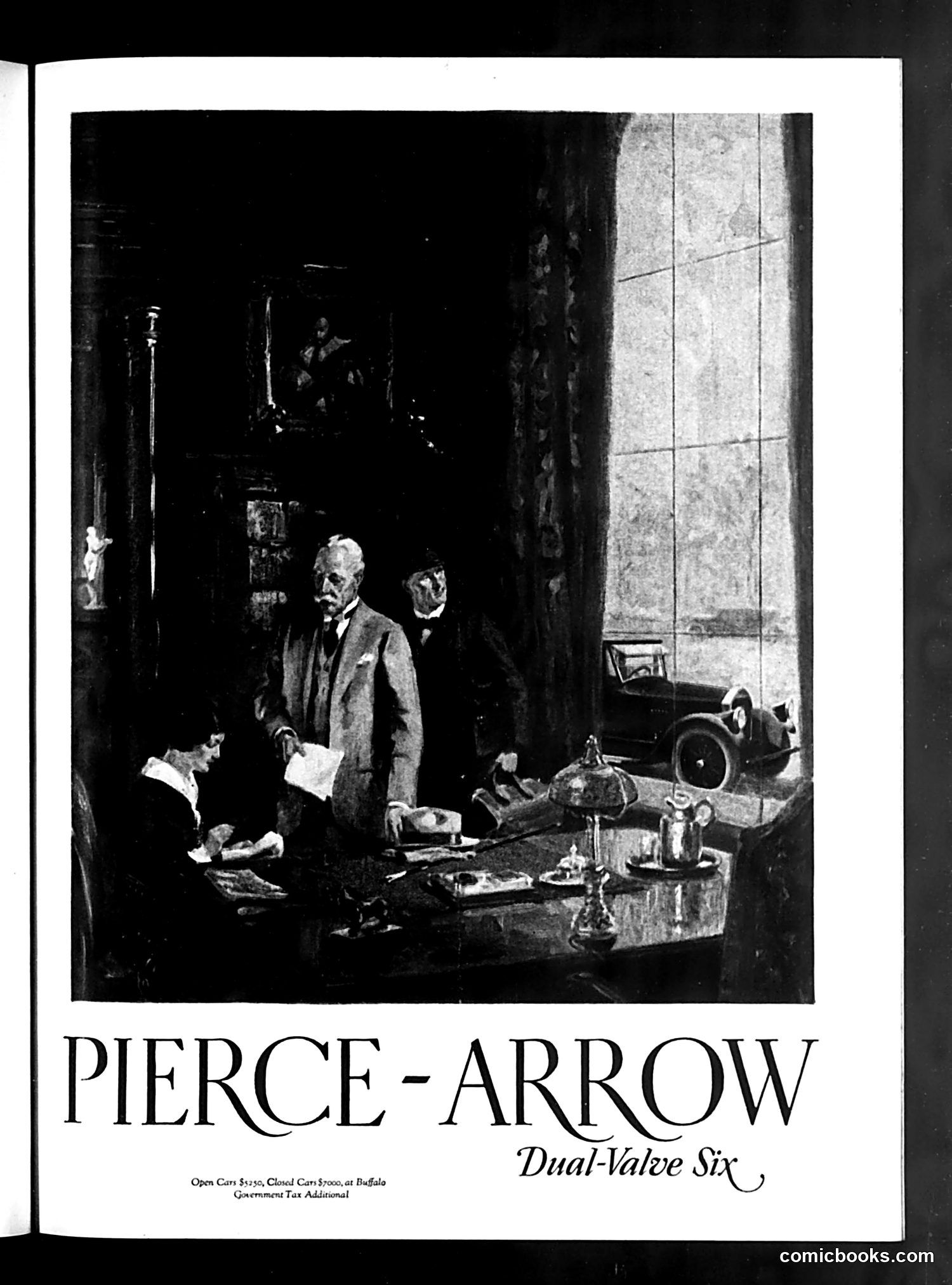
This is a **luxury automobile advertisement**, not political satire. The page promotes the Pierce-Arrow "Dual-Valve Six" car, a high-end vehicle of the early 20th century. The illustration depicts an affluent businessman at his desk—likely a wealthy industrialist or financier—with two other figures present. A Pierce-Arrow automobile is visible through the window, positioned as a status symbol befitting the executive's refined setting. The ornate office, quality furnishings, and well-dressed figures emphasize luxury and success. The advertisement's message: owning a Pierce-Arrow signals wealth, sophistication, and achievement. The small text references pricing and government tax information. This represents typical early automotive advertising targeting the wealthy elite market.
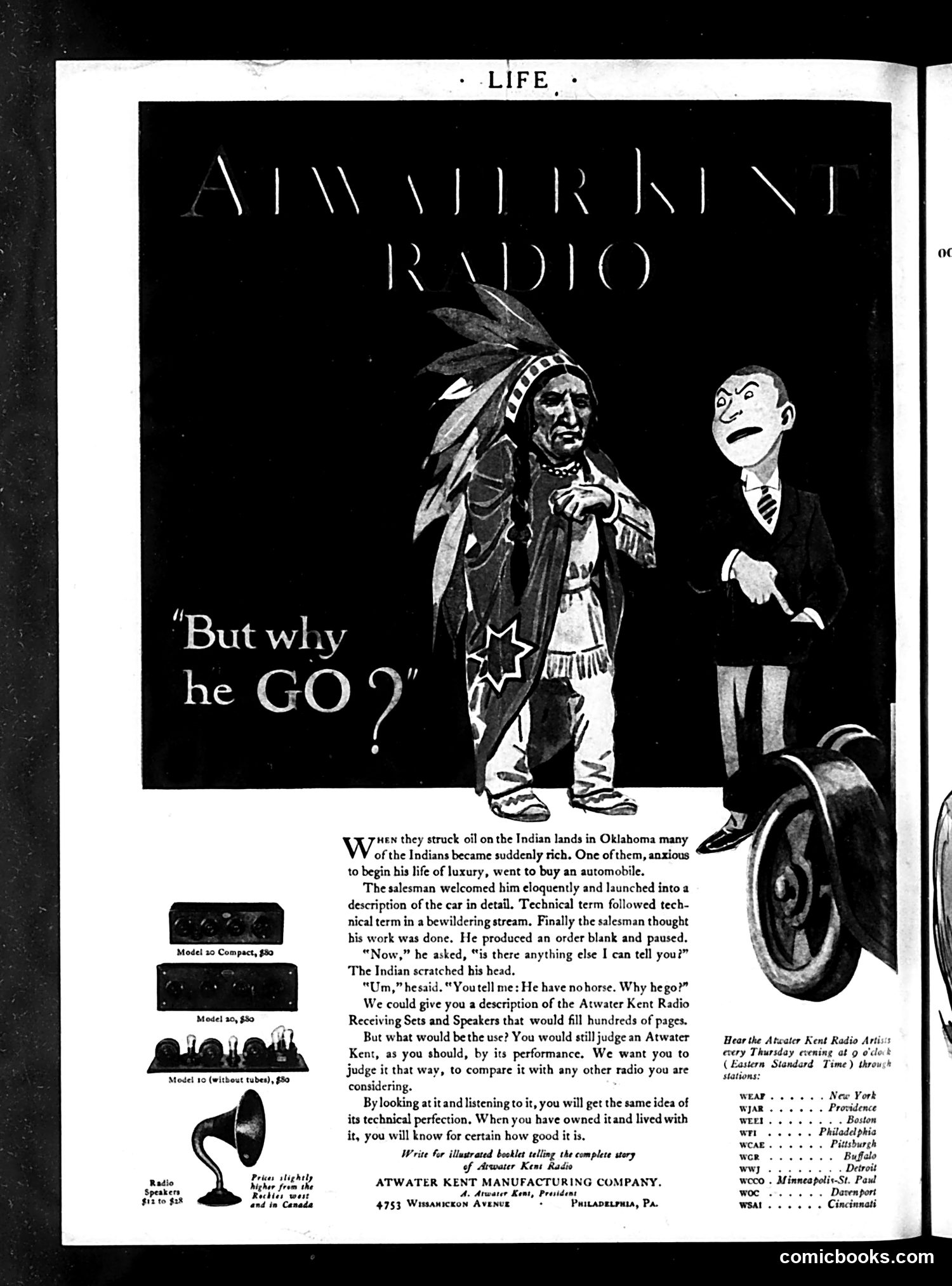
This is primarily an **advertisement for Atwater Kent radios** disguised as satire. The cartoon depicts a newly wealthy Native American—made suddenly rich from oil discovered on Oklahoma Indian lands—asking a car salesman why a horseless automobile is necessary. The salesman's inability to explain appeals to the Indian's practical logic. The ad uses this joke to make its sales pitch: like the Indian, consumers shouldn't need technical jargon to appreciate the radio. "Judge it that way," the copy urges—by listening and performance, not specifications. **The satire's target** appears to be overly complicated sales talk and technical specifications themselves, not Native Americans specifically, though the cartoon employs offensive stereotyping typical of 1920s advertising. The "newly rich Indian" was a stock figure in period humor, often used to mock materialism and conspicuous consumption. The message: Atwater Kent radios don't need elaborate explanation—their quality speaks for itself.