
Life, 1925-10-15 · page 20 of 36
Life — October 15, 1925 — page 20: what you’re looking at
What you’re looking at
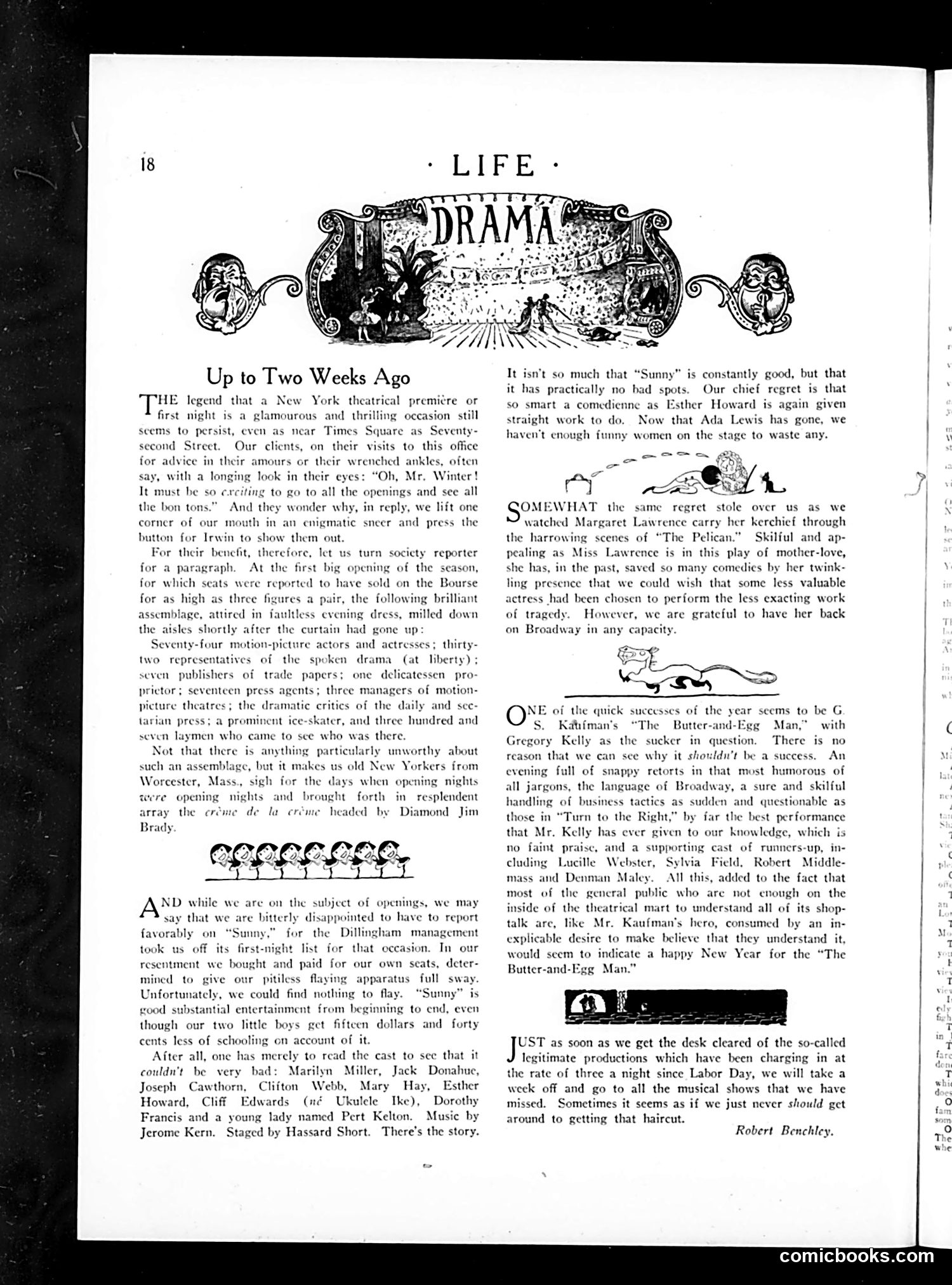
This page from Life magazine's "Drama" section offers satirical commentary on New York theater openings and recent Broadway productions. The opening critique mocks the myth of glamorous theatrical premieres. The author sarcastically catalogs the actual attendees: 74 movie actors, theater professionals, 307 laymen, and notably "one delicatessen proprietor"—undercutting the notion of exclusivity. The piece nostalgically references "Diamond Jim Brady," a famous Gilded Age financier, suggesting theater openings have become less prestigious. The reviews discuss contemporary shows: "Sunny" (praised despite the author's admitted disappointment), which features Marilyn Miller and music by Jerome Kern; "The Pelican" with Margaret Lawrence; and G. Kaufman's "The Butter-and-Egg Man" with Gregory Kelly. The author regrets seeing comedic actresses like Esther Howard relegated to serious dramatic roles. Small decorative illustrations (dancing figures, theatrical masks) punctuate the text. The tone is sophisticated mockery—pretending disappointment at being unable to criticize "Sunny," while actually praising it for having "no bad spots."
📄 Transcribed text from this page (OCR, searchable)
Machine-transcribed from the original scan — historical spelling and the odd misread are preserved.
Up to Two Weeks Ago HE legend that a New York theatrical premi¢re or first night is a glamourous and thrilling occasion still scems to persist, even as near Times Square as Seventy- second Street. Our clients, on their visits to this office for advice in their amours or their wrenched ankles, often with a longing look in their eyes: “Oh, Mr, Winter! It must be so all citing to go to all the openings and And they wonder why, in reply, we lift one the bon to corner of our mouth in an enigmatic sneer and press the n to show them out. For their benefit, therefore, let us turn society reporter for a paragraph. At the first big opening of the season, for which seats were reported to have sold on the Bourse for as high as three figures a pair, the following brilliant assemblage, attired in i, ss evening dress, milled down the fter the cur: Seventy-four motion-picture actors and actresses; thirty- ives of the spoken drama (at liberty); button for Irw isles shortly in had gone up: two represer seven publishers of trade papers: one delicatessen pro- prictor; seventeen press agents; three managers of motion- picture theatres; the dramatic critics of the daily and sce- tarian press; a prominent ice-skater, and three hundred and seven laymen who came to sce who was there. Not that there is anything particularly unworthy about such an assemblage, but it makes us old New Yorkers from Worcester, Mass., sigh for the days when opening nights shts and brought forth in’ resplendent de headed by Diamond Jim re opening ni crém array the er AX» while we are on the subject of openings, we may say that we are bitterly disappointed to have to report Brady the Dillingham) management om. In our favorably on “Sunny,” took us off its first-ni resentment we bought and paid for our own seats, deter- mined to give our pitiless flaying apparatus full sw Unfortunat we could find nothing to fla “Sunny” is good substantial entertainment from beginning to end, even though our two little boys get fifteen dollars and forty cents less of schooling on account of it. After all, one has merely to read the cast to see that it couldn't be very bad: Marilyn Miller, Jack Donahue, Joseph Cawthorn, Clifton Webb, Mary Hay, Esther Howard, Cliff. Edwards (né Ukulele Ike), Dorothy Francis and a young lady named Pert Kelton. Music by Jerome Kern. Staged by Hassard Short. There’s the story. ht list for that occasi It isn’t so much that “Sunny” is constantly good, but that it has practically no bad spots. Our chief regret is that so smart a comedienne as Esther Howard is again given straight work to do. Now that Ada Lewis has gone, we haven't enough funny women on the stage to waste any. Py ns OMEWHAT the same regret stole over us as we watched Margaret Lawrence carry her kerchief through the harrowing scenes of “The Pelican.” Skiliul and ap- pealing as Miss Lawrence is in this play of mother-lov she has, in the past, saved so many comedies by her twin! ling presence that we could wish that some less valuable actress had been chosen to perform the less exacting work of tragedy. However, we are grateful to have her back on Broadway in any capacity. VE of the quick successes of the year seems to be G Kaufman's “The Butter-and-Egg Man,” with Gregory Kelly as the sucker in question. There is no reason that we can see why it shouldn't be a success. An evening full of snappy retorts in that most humorous of all jargons, the language of Broadway, a sure and skilful as sudden and questionable as handling of business tactic those in “Turn to the Right,” by far the best performance that Mr. Kelly has ever given to our knowledge, which is no faint praise, and a supporting cast of runners-up, in- cluding Lucille Webster, Sylvia Field, Robert Middle- mass and Denman Maley. All this, added to the fact that most of the general public who are not enough on the inside of the theatrical mart to understand all of its shop- talk are, like Mr. Kaufman's hero, consumed by an in- explicable desire to make believe that they understand it, would seem to indicate a happy New Year for the “The Butter-and-Egg Man.” UST as soon as we get the desk cleared of the so-called legitimate productions which have been charging in at the rate of three a night since Labor Day, we will take a week off and go to all the musical shows that we have missed. Sometimes it seems as if we just never should get around to getting that haircut. Robert Benchley. comicbooks.com