
Life, 1925-10-15 · page 26 of 36
Life — October 15, 1925 — page 26: what you’re looking at
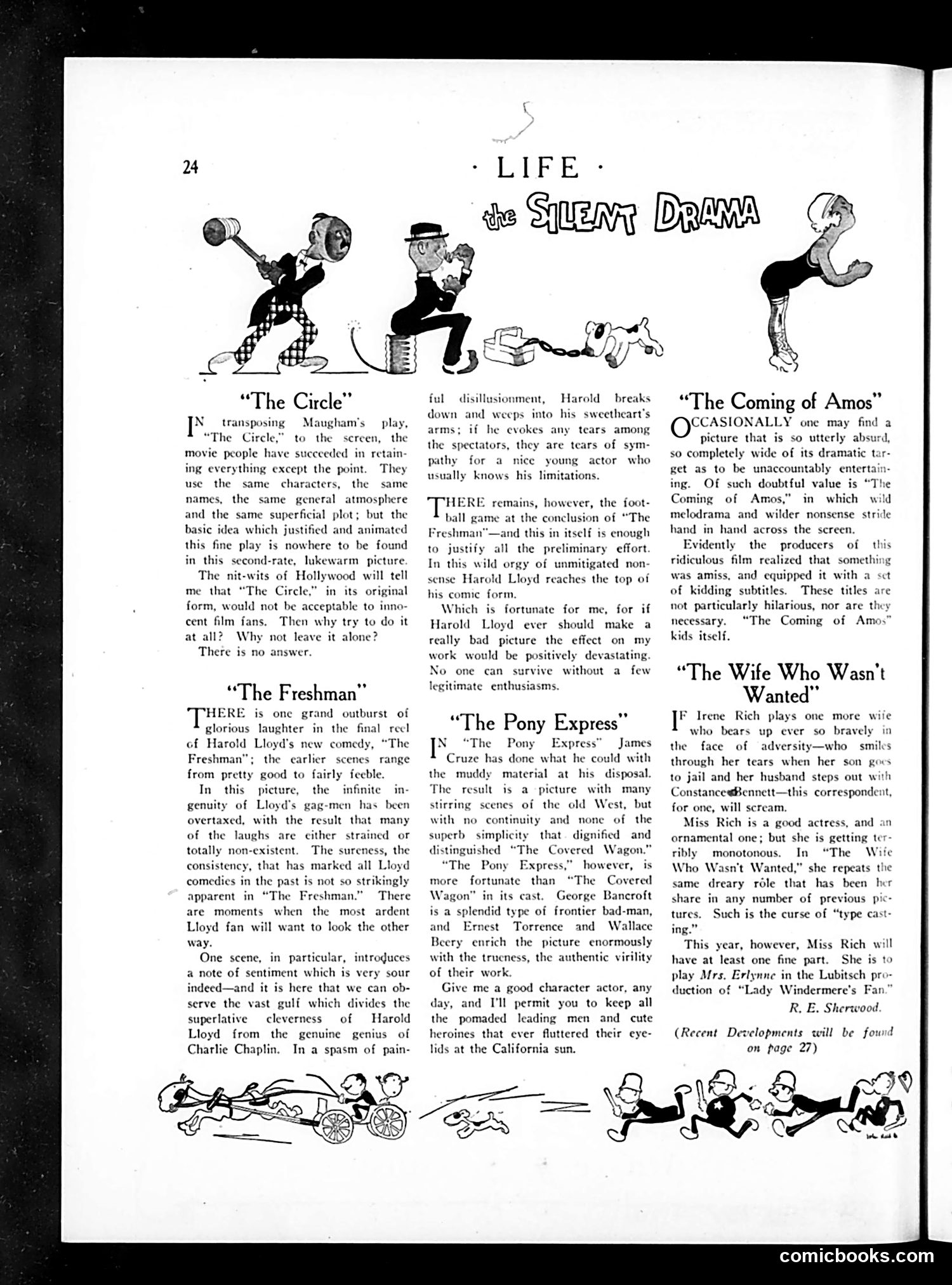
A restored page from Life, 1925-10-15. Page through the whole issue in the reader above.
📄 Transcribed text from this page (OCR, searchable)
Machine-transcribed from the original scan — historical spelling and the odd misread are preserved.
“The Circle” I transposing | Maugham’s “The Circle,” to the sereen, the movie people have succeeded in retain- ing everything except the point. They use the same characters, the same names, the same general atmosphere and the same superficial plot; but the basic idea which justified and animated this fine play is nowhere to be found in this second-rate, lukewarm picture. The nit-wits of Hollywood will tell me that “The Circle,” in its original form, would not be acceptable to inno- cent film fans. Then why try to do it at all? Why not leave it alone? There is no answer. play, “The Freshman” HERE is one grand outburst of glorious laughter in the final reel of Harold Lloyd's new comedy, “The Freshman”; the earlier scenes range from pretty good to fairly feeble. In this picture, the infinite in- genuity of Lloyd's gag-men has been overtaxed, with the result that many of the laughs are cither strained or totally istent. The sureness, the consistency, that has marked all Lloyd comedies in the past is not so striking’ apparent in “The Freshman.” There are moments when the ardent Lloyd fan will want to look the other way. One scene, in particular, introduces a note of sentiment which is very sour indeed—and it is here that we can ob- serve the vast gulf which divides the superlative cleverness of Harold Lloyd from the genuine genius of Charlie Chaplin. In a spasm of pain- non-e: most Harold down and weeps into his sweetheart’s arms; if he evokes any tears among the spectators, the: pathy for ful disillusionment, breaks are tears of sym- young actor usually knows his limitations. who HERE remains, however, the foc ball the conclusion of “The Freshman”—and this in itself is enough to justify all the preliminary effort In this wild orgy of unmitigated non- sense Harold Lloyd reaches the top of his come form. Which is fortunate for me, for if Harold Lloyd ever should make a really bad picture the effect on my work would be positively devastating. No one can survive without a few legitimate enthusiasms. “The Pony Express” N “The Pony Express” James Cruze has done what he could with the muddy The material at his disposal. a picture with many stirring scenes of the old West, but with no continuity and none of the superb that and distinguished “The Covered Wagon.” “The Pony Expres: more fortunate than “The Covered Wagon” in its cast. George Bancroft is a splendid type of frontier bad-man, and Ernest Torrence and Wallace Beery enrich the picture enormously with the trucness, the authentic virility of their work Give me a good character actor, any day, and I'll permit you to keep all the pomaded leading men and cute heroines that ever fluttered their eye- lids at the California sun. Deed result is simplicit dignified however, is — “The Coming of Amos” CCASIONALLY one may find a picture that is so utterly absurd, so completely wide of its dramatic tar- get as to be unaccountably entertain- ing. Of such doubtful value is “The Coming of Amos,” in’ which wild melodrama and wilder nonsense stride hand in hand across the screen. dently the producers of this ridiculous film realized that something was amiss, and equipped it with a set of kidding subtitles. These titles are not particularly hilarious, nor are they necessary. “The Coming of Amos” kids itself. “The Wife Who Wasn't Wanted” [F Irene Rich plays one more wife who bears up ever so bravely in the face of adversity—who smiles through her tears when her son gocs to jail and her husband steps out with ConstanceeBennett—this correspondent, for one, will scream. Miss Rich is a good actress, and an ornamental one; but she is getting ter- ribly monotonous. In “The Wile Who Wasn't Wanted,” she repeats the same dreary role that has been her share in any number of previous pic- tures. Such is the curse of “type cast- ing.” This year, however, Miss Rich will have at least one fine part. She is to play Mrs. yane in the Lubitsch pro- duction of “Lady Windermere’s Fan.” R, E. Sherwood. (Recent Developments will be fowid on page 27) o ele, comicbooks.com