
Life, 1925-10-15 · page 16 of 36
Life — October 15, 1925 — page 16: what you’re looking at
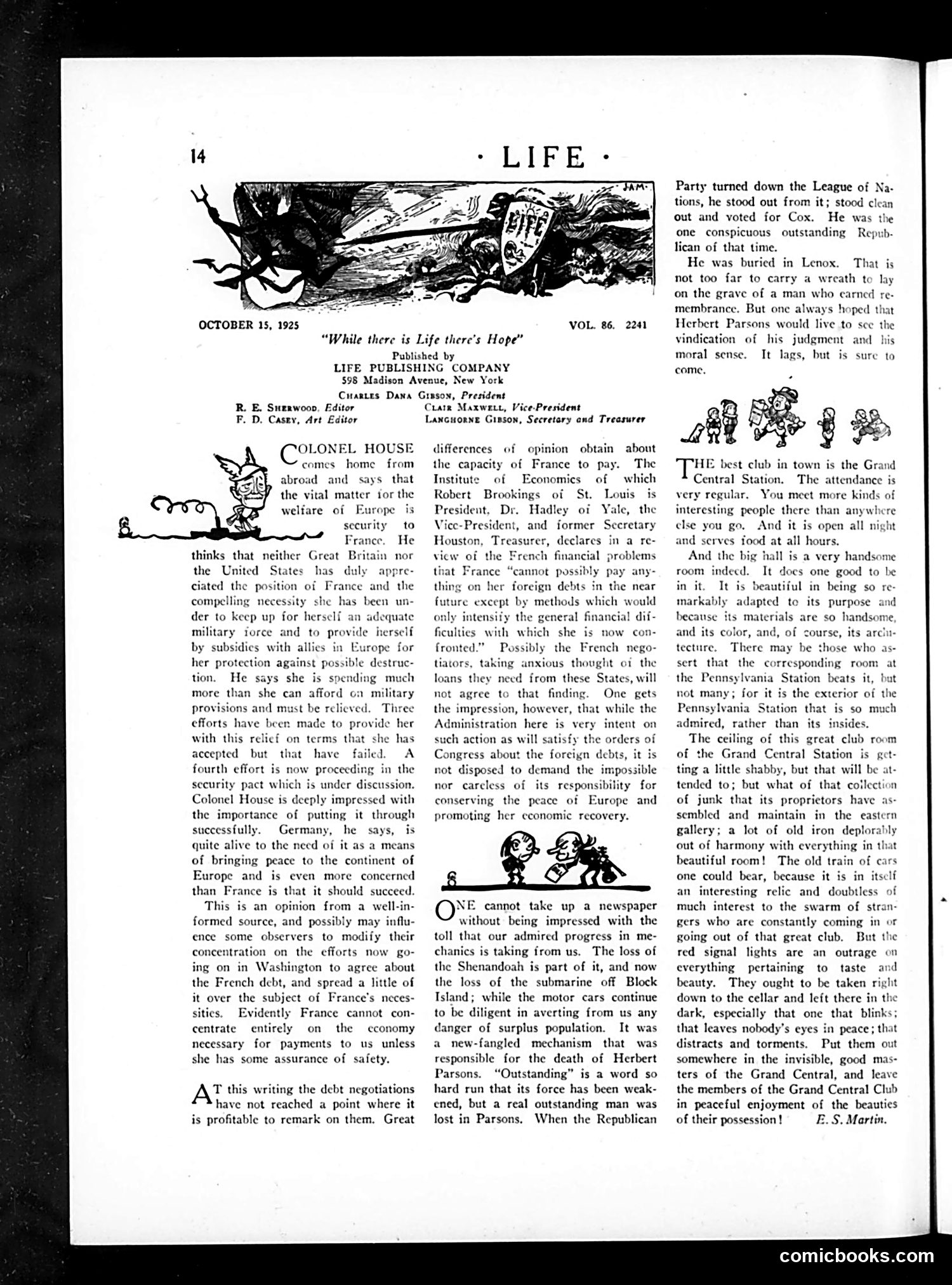
A restored page from Life, 1925-10-15. Page through the whole issue in the reader above.
📄 Transcribed text from this page (OCR, searchable)
Machine-transcribed from the original scan — historical spelling and the odd misread are preserved.
OCTOBER 15, 1925 “While there is Life there’s Hope” Published by LIFE PUBLISHING COMPANY $98 Madison Avenue, New York Curartes Dana Grason, President R. E. Suerwoop, Editor F. D. Casey, Art Editor COEONER HOUSE home from abroad and that the vital matter tor the welfare of Europe is security to France. He thinks that neither Great Britain nor the United States has duly appre- ciated position of France and the comes says has been un- compelling necessity der to keep up for herself av military force and to provide adequate by subsidies with allies in E her protection against possible destruc- tion. He says she is spending much more than she can afford on military provisions and must be relieved. T efforts have beer. made to provide her with this relief on terms that she has accepted but that have f. fourth effort is now proceedit security pact which is under discussion. Colonel House is deeply impressed with the importance of putting it through successfully. Germany, he says, is quite alive to the need of it as a means of bringing peace to the continent of Europe and is even more concerned than France is that it should succeed. This is an opinion from a well-in- formed source, and possibly may influ- ence some observers to modify their concentration on the efforts now go- ing on in Washington to agree about the French debt, and spread a little of it over the subject of France's neces- sities. Evidently France cannot con- centrate entirely on the economy necessary for payments to us unless she has some assurance of safety. T this writing the debt negotiations have not reached a point where it is profitable to remark on them. Great Cratr Maxwatt, Vice-President Lancuorne Ginsox, Secretory ond Treasurer differences of opinion obtain about the capacity of France to p The Institute of Economics of — which Robert Brookings oi St. Louis is President, Dr. Hadley of Yale, the Vice-President, and former Sceretary Houston, Tri in a re- view of the F that France thing on her foreign debts future except by methods which y only intensify the general financia ficulties with which she i fronted.” Possibly the French nego- tiators, taking anxious thought oi the loans they need from these States, will not agree to that finding. One gets the impression, however, that while the Administration here is very intent on such action as will satisfy the orders of Congress about the foreign debts, it is not disposed to demand the impossible nor careless of its responsibility for conserving the peace of Europe and promoting her economic recovery. surer, declare: rench financial problems annot possibly pay any- in the near ‘ould dif- now con- NE cannot take up a newspaper without being impressed with the toll that our admired progress in me- chanics is taking from us. The loss of the Shenandoah is part of it, and now the loss of the submarine off Block Island; while the motor cars continue to be diligent in averting from us any danger of surplus population. It was a new-fangled mechanism that was responsible for the death of Herbert Parsons. “Outstanding” is a word so hard run that its force has been weak- ened, but a real outstanding man was lost in Parsons. When the Republican Party turned down the League of Na- tions, he stood out from it; stood clean out and voted for Cox. He was the one conspicuous outstanding Repub- lican of that time. He was buried in Lenox. That is not too far to carry a wreath to lay on the grave of a man who earned membrance. But one always hoped that Herbert Parsons would live to sce the vindication of his judgment and moral sense. It lags, but is sure HE best club in town is the Gra Central Station. The attendance is very regular, You mect more kinds of interesting people there than anywh else you go. And it is open all nig! and serves food at all hou And the big hall is a very handsome room indecd. It docs one good to be in it. It is beautiful in being so re- markably adapted to its purpose and because its materials are so handsome, and its color, and, of course, its arch- tecture. There may be those who as- sert that the corresponding room at the Pennsylvania Station beats it, but not many; for it is the exterior of the Pennsylvania Station that is so m admired, rather than its insides. The ceiling of this great club room of the Grand Central Station ting a little shabby, but that will be at- tended to; but what of that coilection of junk that its proprietors have as- sembled and maintain in the east gallery; a lot of old iron deplora out of harmony with everything in 1 beautiful room! The old train of cars one could bear, because it is in itself an interesting relic and doubtless of much interest to the swarm of stran- gers who are constantly coming in « going out of that great club. Bui red signal lights are an outrage on everything pertaining to taste and beauty. They ought to be taken right down to the cellar and left there in the dark, especially that one that blinks; that leaves nobody’s eyes in peace; that distracts and torments. Put them out somewhere in the invisible, good mas- ters of the Grand Central, and leave the members of the Grand Central Club in peaceful enjoyment of the beauties of their possession! E. S. Martin. comicbooks.com