
A complete issue · 36 pages · 1925
Life — August 13, 1925
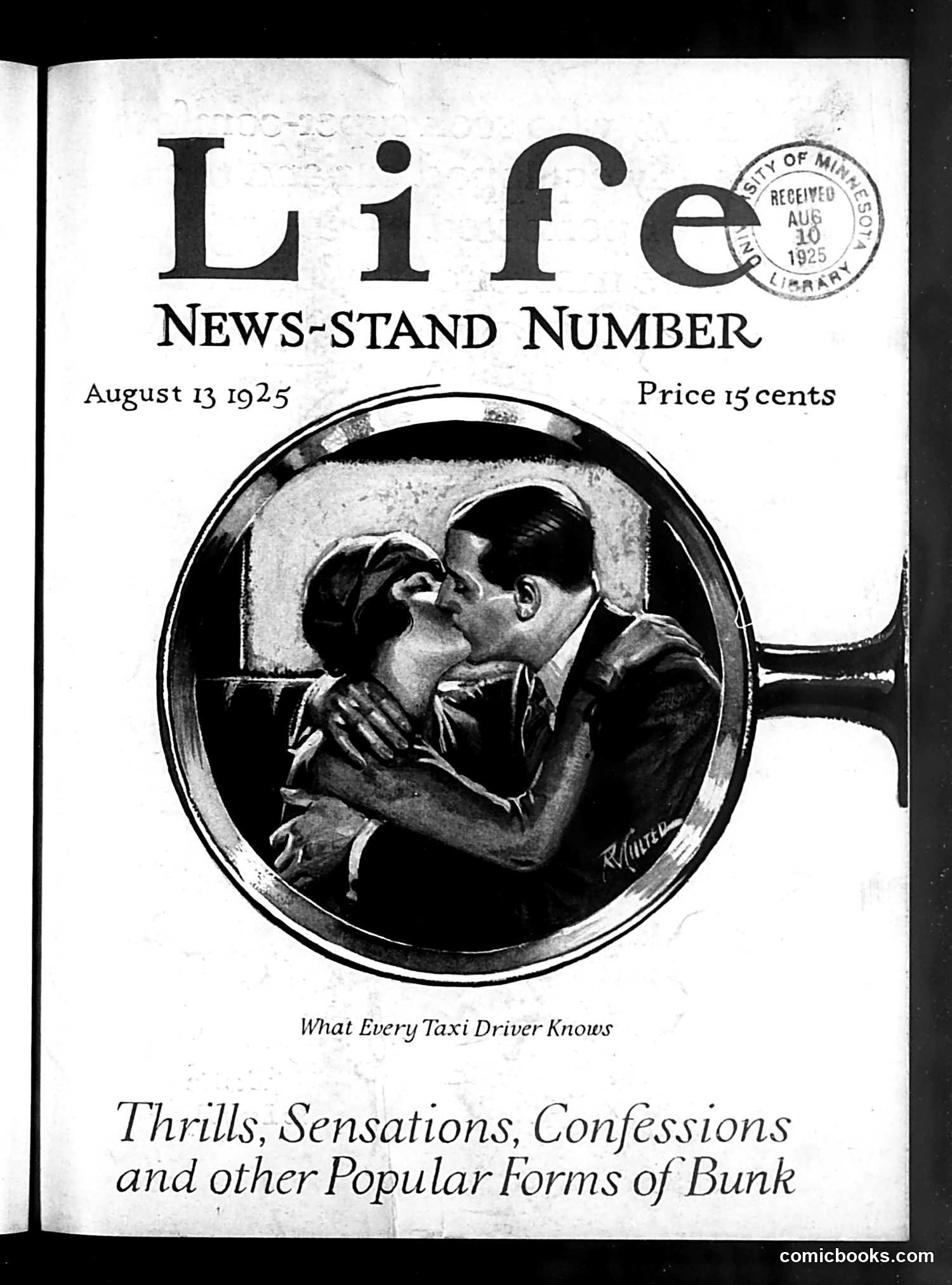
This cover satirizes taxi drivers' reputation for witnessing romantic encounters. The circular vignette depicts a couple kissing in what appears to be a car's back seat, with the caption "What Every Taxi Driver Knows." The subheading promises "Thrills, Sensations, Confessions and other Popular Forms of Bunk." The satire works on two levels: it mocks both the stereotypical taxi driver as a voyeur of passengers' private moments, and simultaneously suggests that such "thrills and sensations" are exaggerated gossip—mere "bunk." The 1925 dating places this during the Jazz Age, when automobiles enabled young people to escape parental supervision, creating new anxieties about morality that magazines like Life playfully lampooned.
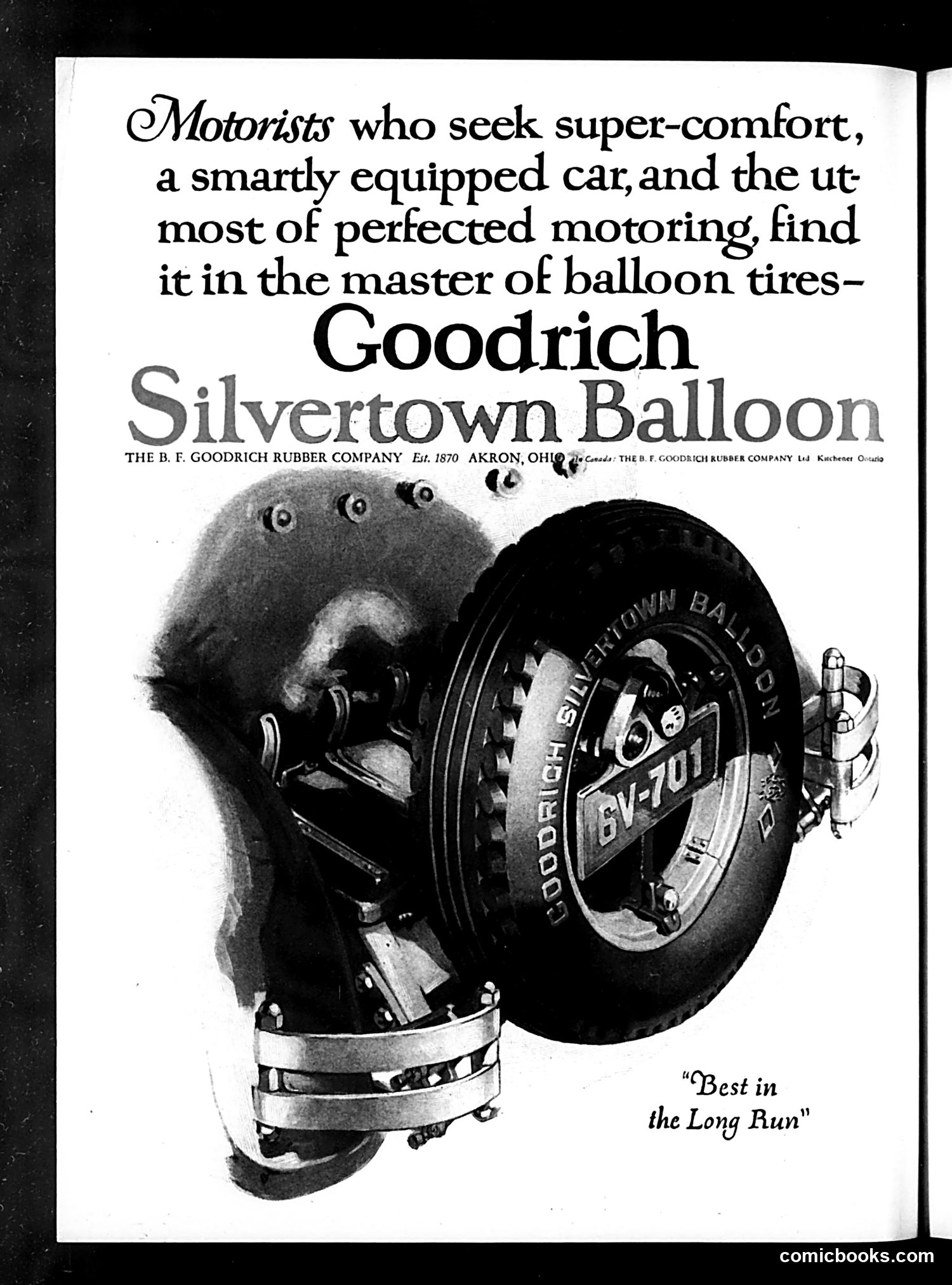
This is **advertising, not satire or political content**. It's a Goodrich Silvertown Balloon tire advertisement from The B.F. Goodrich Rubber Company (established 1870, based in Akron, Ohio). The ad uses an anthropomorphized balloon tire character (depicted as a rotund figure) holding or presenting a large Goodrich tire marked "GV-701." The messaging targets motorists seeking comfort and quality—the "master of balloon tires" claims superiority in cushioning and long-distance driving performance ("Best in the Long Run"). The whimsical balloon-shaped character cleverly reinforces the product name while the advertisement emphasizes reliability for early-20th-century automobile owners concerned with ride quality and tire durability.
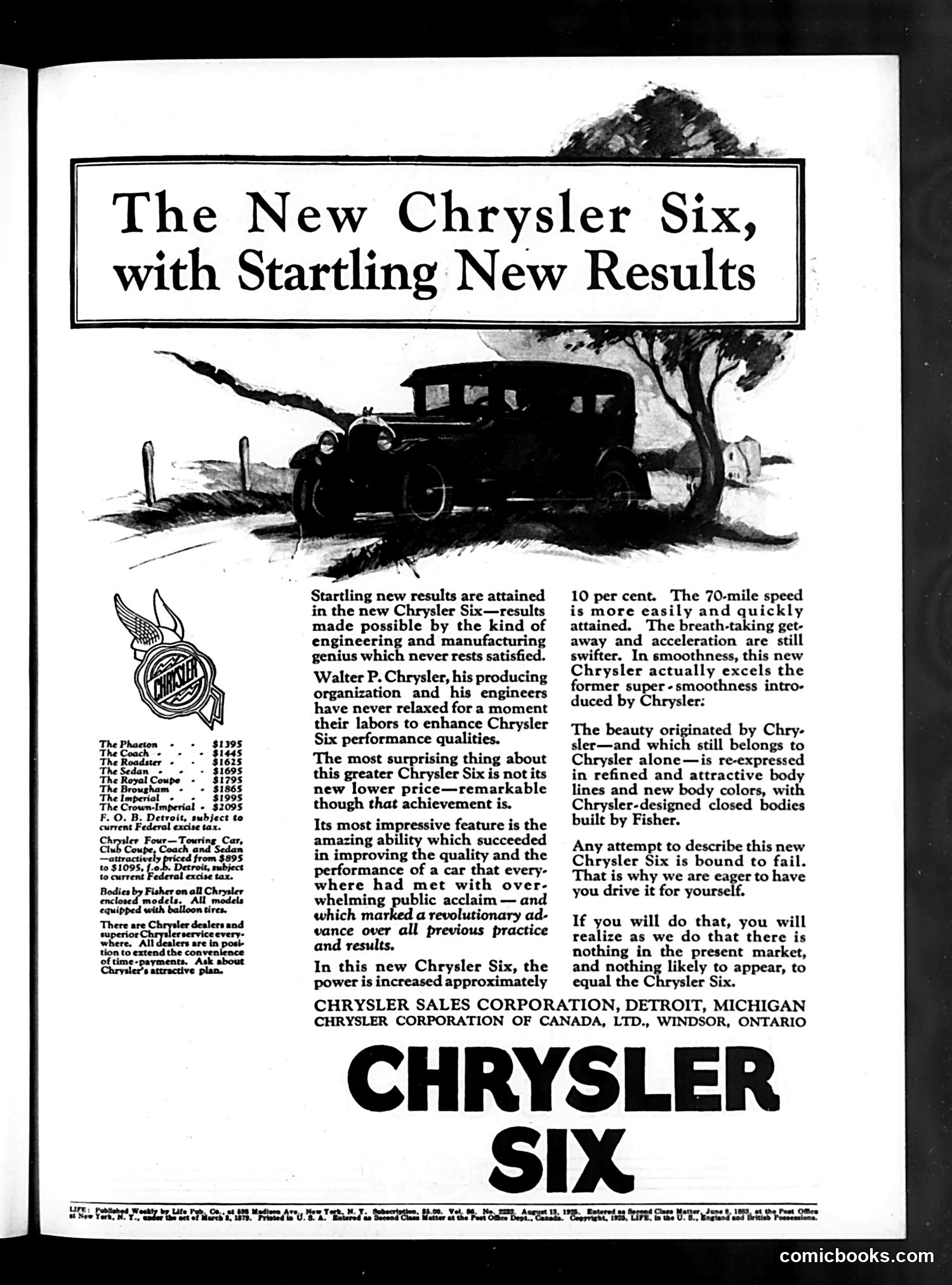
This is **not a cartoon or satire page** — it's a straightforward automobile advertisement for the Chrysler Six, published in *Life* magazine (which was primarily a humor and satire publication, but carried advertising). The page promotes the new Chrysler Six model with claims about engineering improvements, increased power (approximately 10% more), higher speed capability (70 mph), and acceleration. It emphasizes Walter P. Chrysler's commitment to quality and manufacturing excellence. The image shows a silhouetted car in a desert landscape — a common advertising motif of the era used to suggest freedom, adventure, and reliable transportation. The advertisement invites readers to test-drive the vehicle themselves to verify its superiority. This is a period automobile advertisement, not political or social satire.
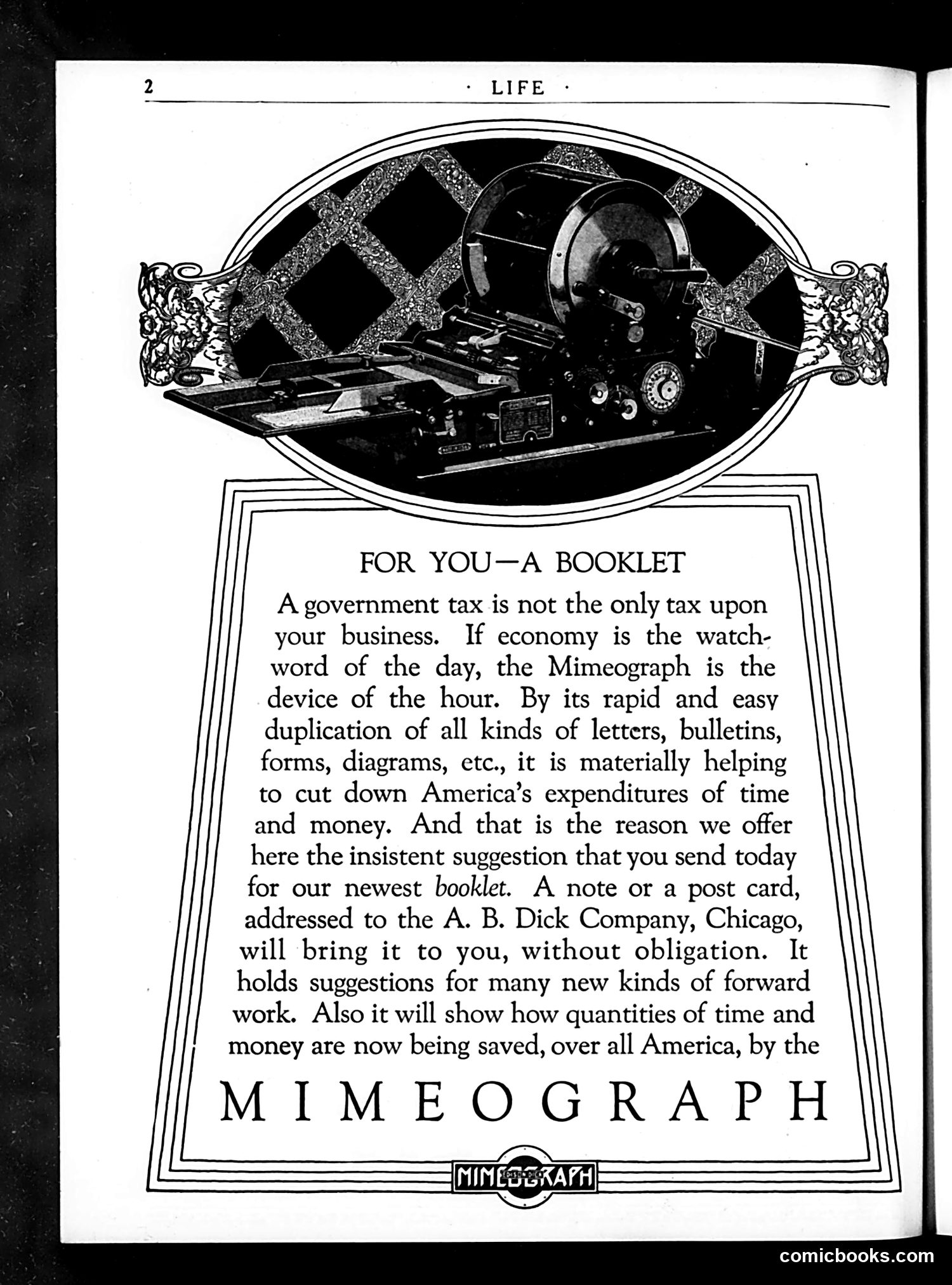
This is primarily **advertisement, not satire or cartoon content**. The page shows a Mimeograph machine in an ornate oval frame, promoting the device to business owners. The ad's messaging reflects early 20th-century concerns about **operational efficiency and cost-cutting**. It positions the Mimeograph as a solution to reduce "America's expenditures of time and money" by enabling rapid duplication of business documents—letters, forms, bulletins, diagrams. The rhetoric is patriotic ("America") and appeals to business economy. The A.B. Dick Company (Chicago manufacturer) offers a free booklet describing the machine's applications and documented savings nationwide. There is **no political satire** here—merely period business marketing emphasizing the labor-saving and financial benefits of copying technology.
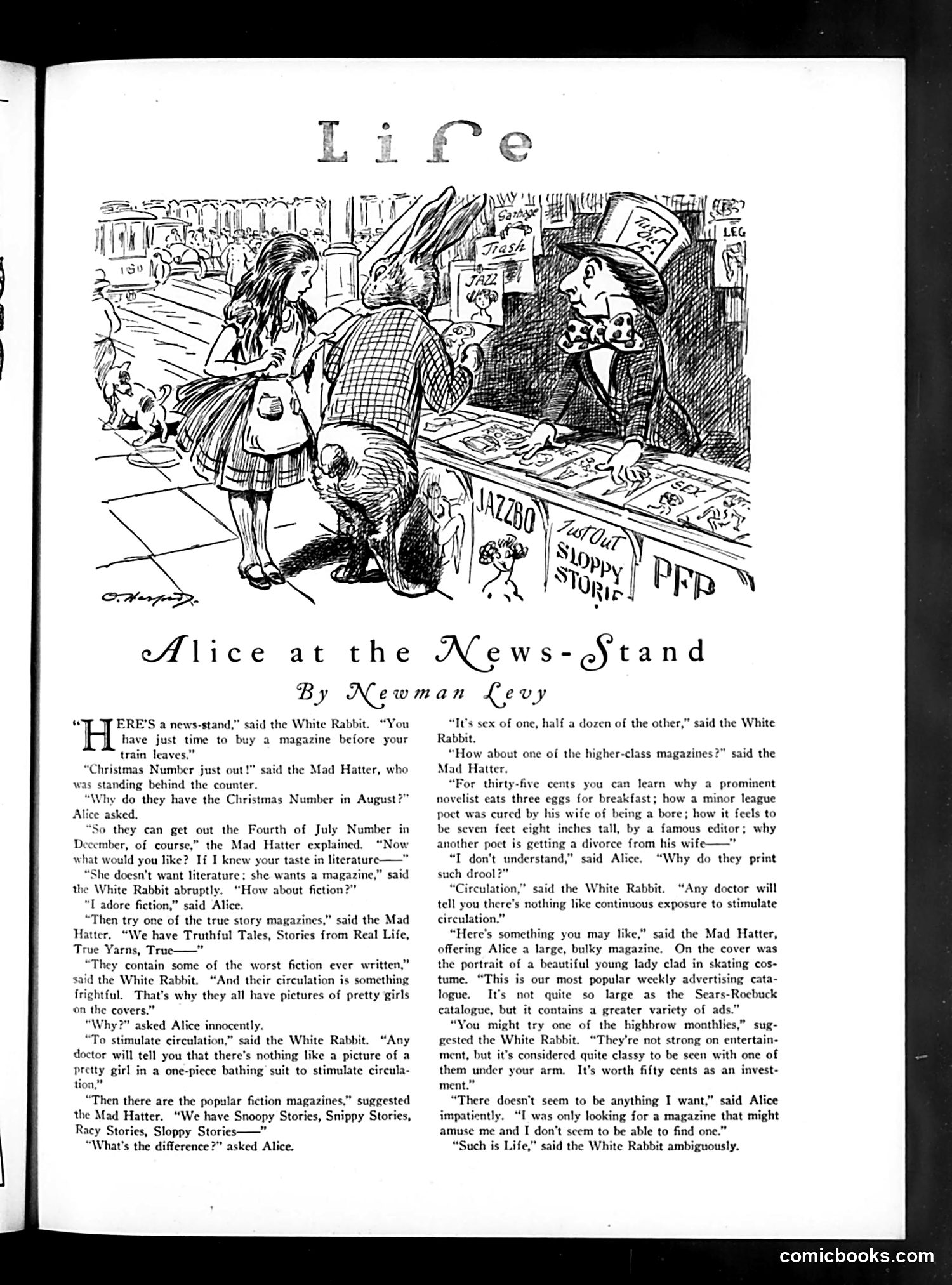
This is a satirical piece where Alice (from *Alice in Wonderland*) encounters the White Rabbit and Mad Hatter at a magazine stand. The satire targets popular magazine genres and their editorial strategies of the era. The White Rabbit promotes magazines with sensationalist content—"Sloppy Stories," "Racy Stories," "Snippy Stories"—designed to attract readers through lurid covers featuring "pretty girls in a one-piece bathing suit." When Alice asks what distinguishes these magazines, the characters reveal the satire: magazines stimulate circulation through provocative imagery and questionable fiction rather than literary merit. The piece mocks both the magazine industry's cynical marketing tactics and readers' shallow preferences, using the familiar Carroll characters to frame critiques of American popular culture's descent into sensationalism.
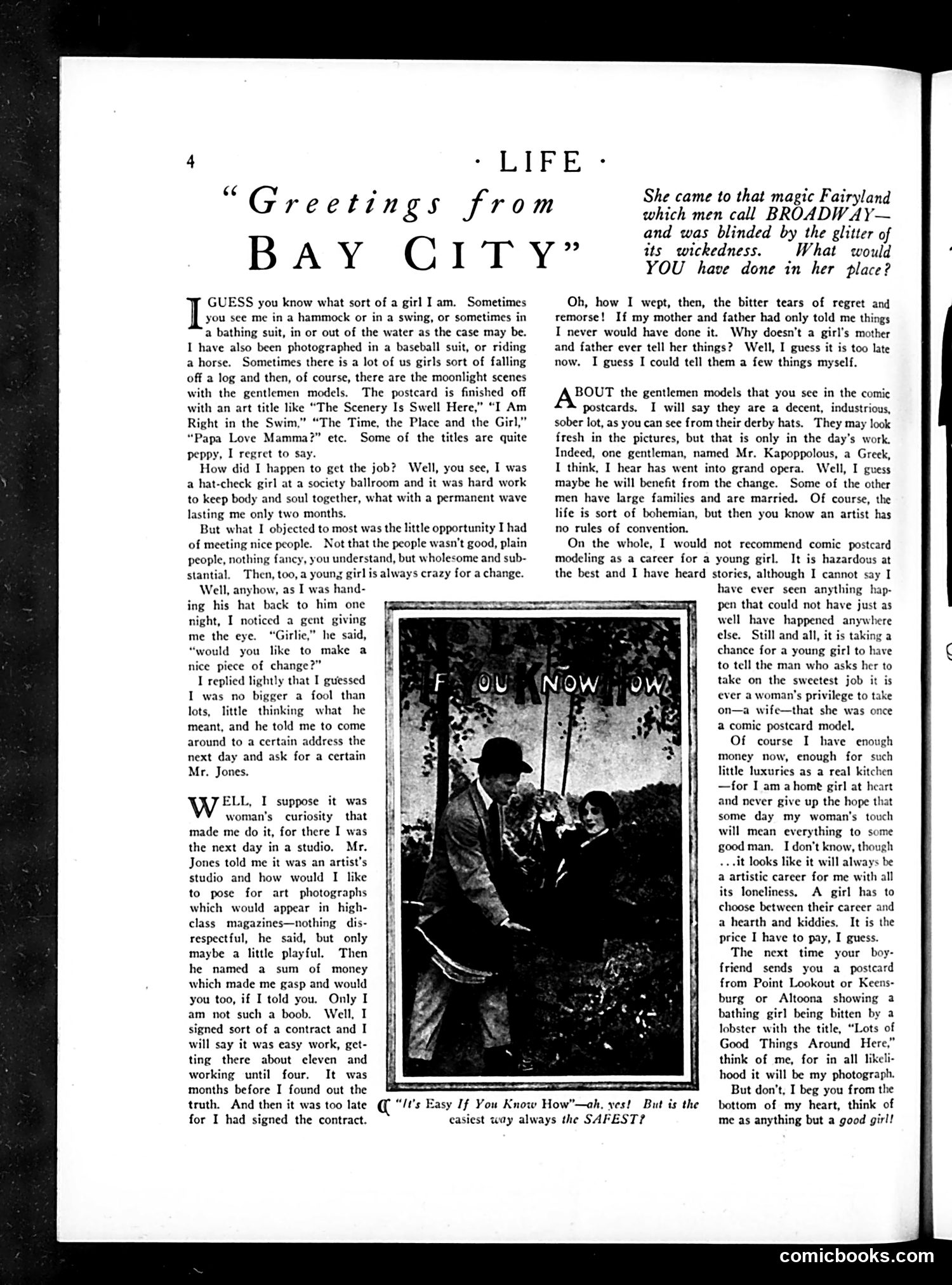
This page from *Life* magazine features a first-person account titled "Greetings from Bay City" by a young woman describing her experience as a comic postcard model. The accompanying photograph shows a man posing with a woman in what appears to be a staged, humorous scene—likely representing the type of comic postcard imagery being discussed. The text critiques the postcard modeling industry, warning young women against it as a career path. The author describes being hired to pose for "art photographs" in studio settings, eventually discovering she'd unknowingly signed a contract for commercial postcard reproduction. The satire targets both the exploitative nature of the postcard industry and the false promises made to aspiring young women seeking work. The piece advocates for marriage and domesticity as preferable alternatives to such precarious employment.
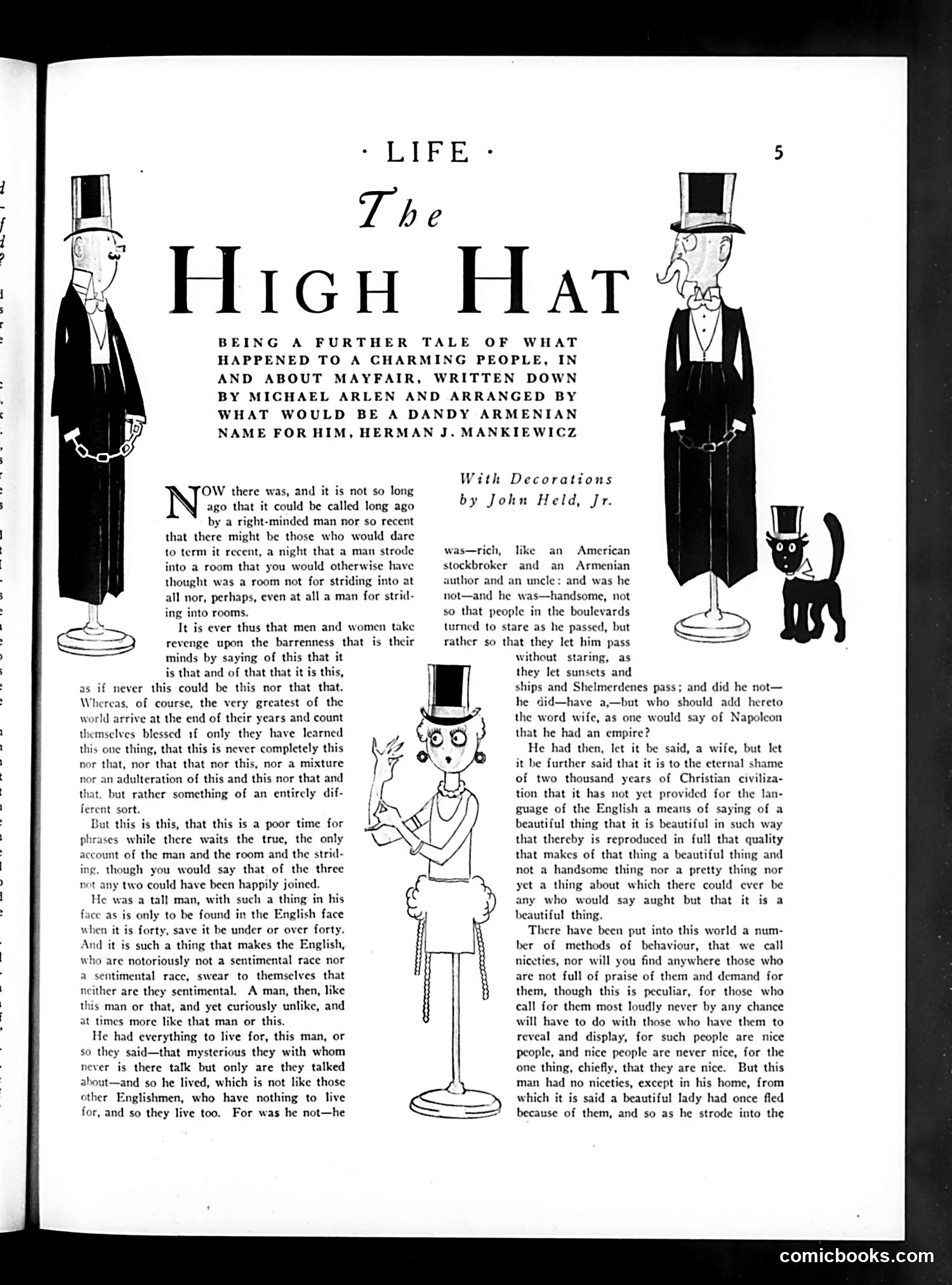
This page introduces a satirical story about a wealthy man characterized by his top hat and formal dress. The narrative mocks the English upper class and their pretensions—specifically their obsession with maintaining appearances and social status while being fundamentally hollow or uninteresting. The illustrations depict a tall, thin gentleman in formal attire, accompanied by decorative drawings of a cat in a top hat (echoing the classic "Puss in Boots" imagery). The text satirizes how such men live merely to be seen and talked about in fashionable circles, lacking genuine substance or meaningful accomplishment. The satire targets snobbish social climbers and the emptiness of aristocratic vanity during the early 20th century.
This page contains two literary pieces rather than political cartoons: 1. **"Simple Confession"** by Baird Leonard — a prose poem about a soldier confessing to another officer about an encounter with a woman ("that lady") the previous night. The narrative suggests romantic or scandalous behavior, with the confessor expressing both shame and bravery about his actions. 2. **"Avowal of Inadequacy"** — a brief philosophical piece critiquing intellectuals' inability to explain fundamental questions ("why they ever go there in the first place"), followed by a specific observation that carrying a wife's picture in one's watch doesn't prove she's "the only woman in the case." Both pieces use satire to mock masculine pretense, romantic rationalization, and intellectual pomposity characteristic of early 20th-century Life magazine's humor.
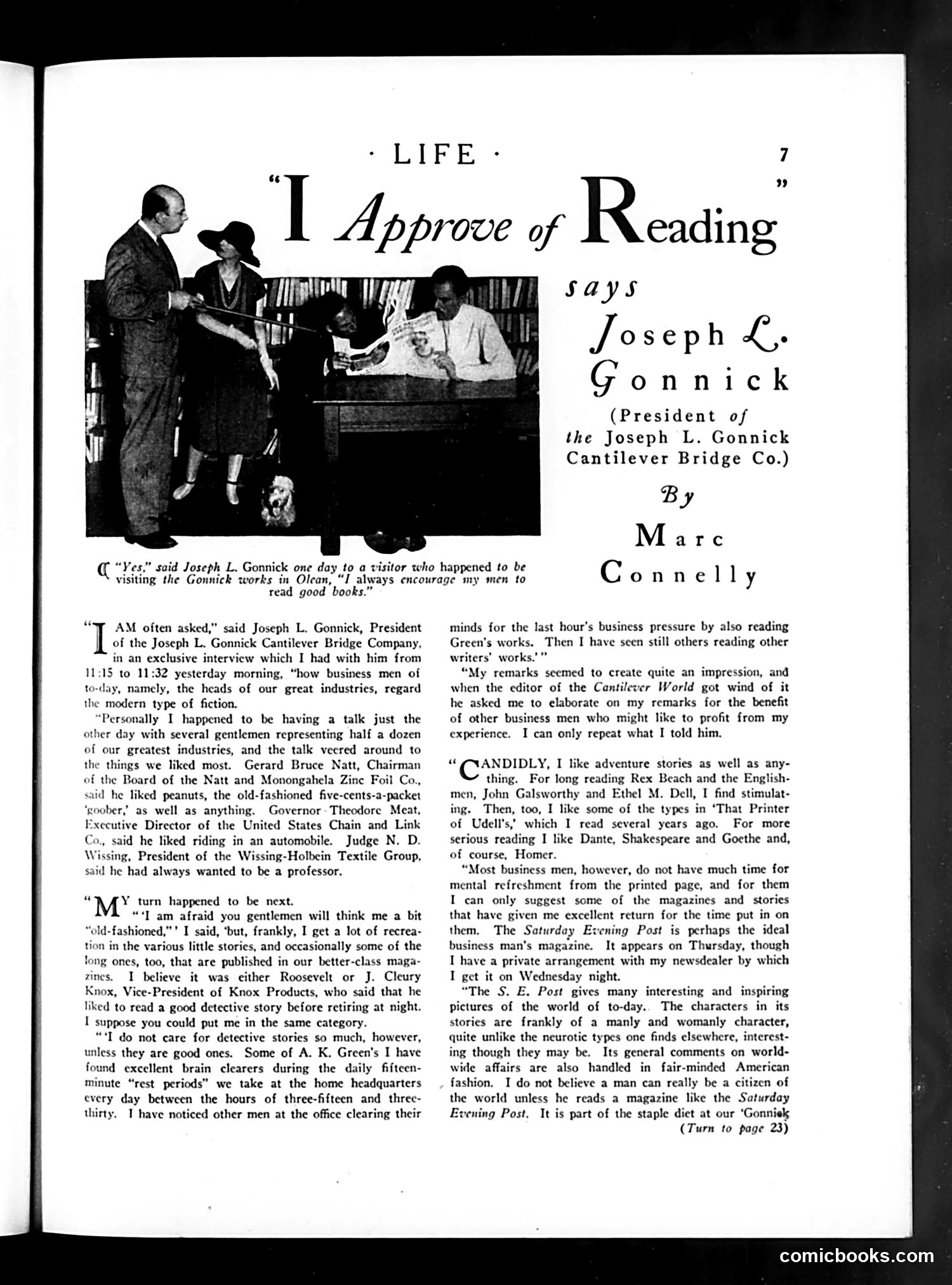
This page is primarily an **interview/article**, not a political cartoon. It features Joseph L. Gonnick, President of the Joseph L. Gonnick Cantilever Bridge Company, discussing his reading habits with author Marc Connelly. The accompanying photograph shows Gonnick at his desk with visitors, illustrating his quote about encouraging employees to read good books. The content is **not satirical**—it's a straightforward "Approve of Reading" feature where a successful businessman endorses literature as mental refreshment for busy professionals. Gonnick recommends detective stories, adventure tales, and magazines like the *Saturday Evening Post* as practical reading for men with limited leisure time. This reflects early 20th-century Life magazine's interest in business leaders and self-improvement culture, not political commentary.
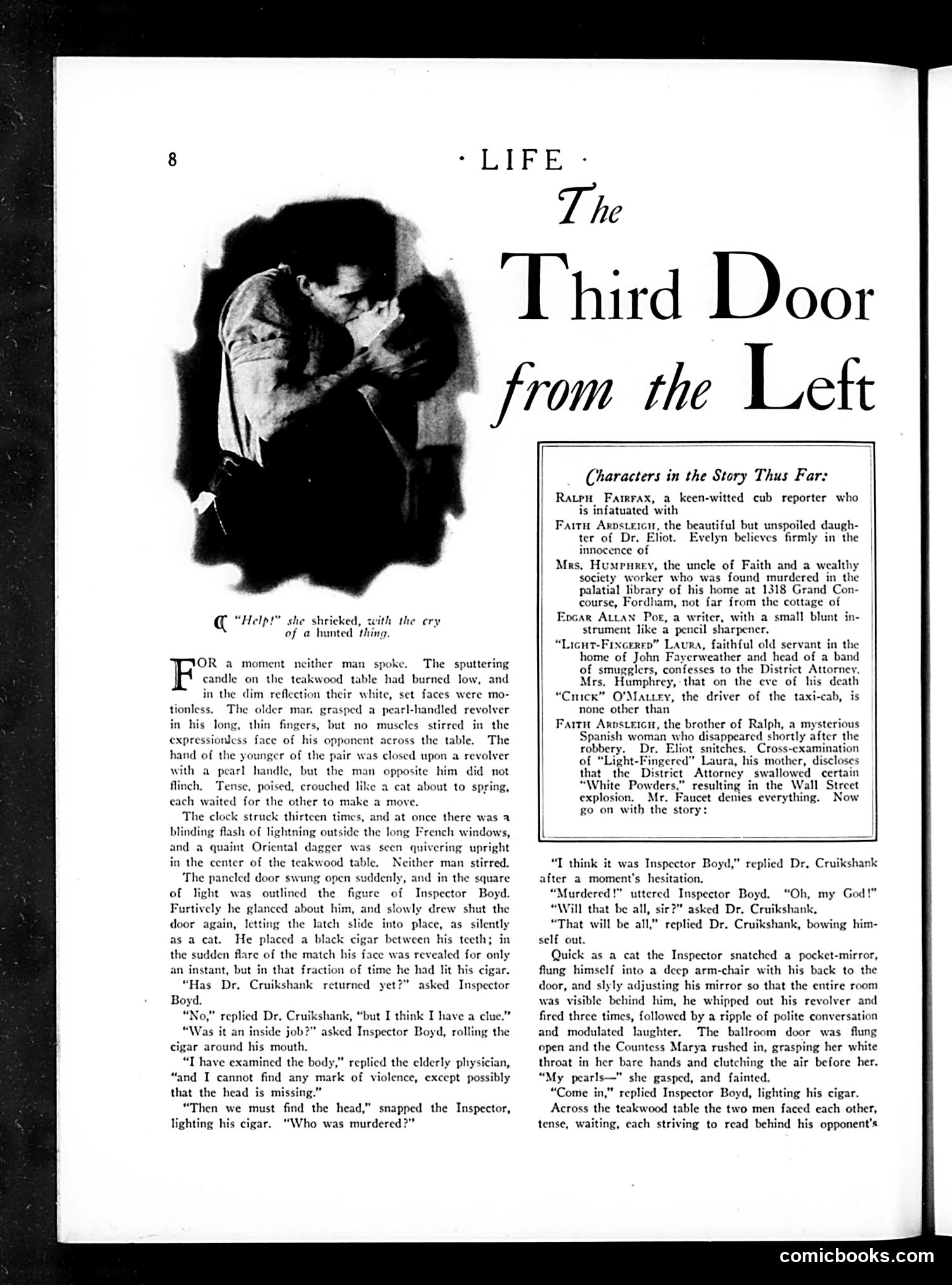
This page opens a serialized mystery story in *Life* magazine. The illustration shows two figures in an intense dramatic moment—one person appears distressed or threatened while another figure looms nearby, consistent with the cry "Help!" mentioned in the caption. The story concerns a murder investigation led by Inspector Boyd. The setup involves society figures: Ralph Fairfax (a reporter), Faith Abersleigh (a wealthy young woman), her uncle Mrs. Humphrey (found murdered in his library), and various suspects including a taxi driver and a mysterious Spanish woman. This appears to be a standard mystery fiction serialization—common entertainment in early 20th-century magazines—rather than political satire or social commentary.
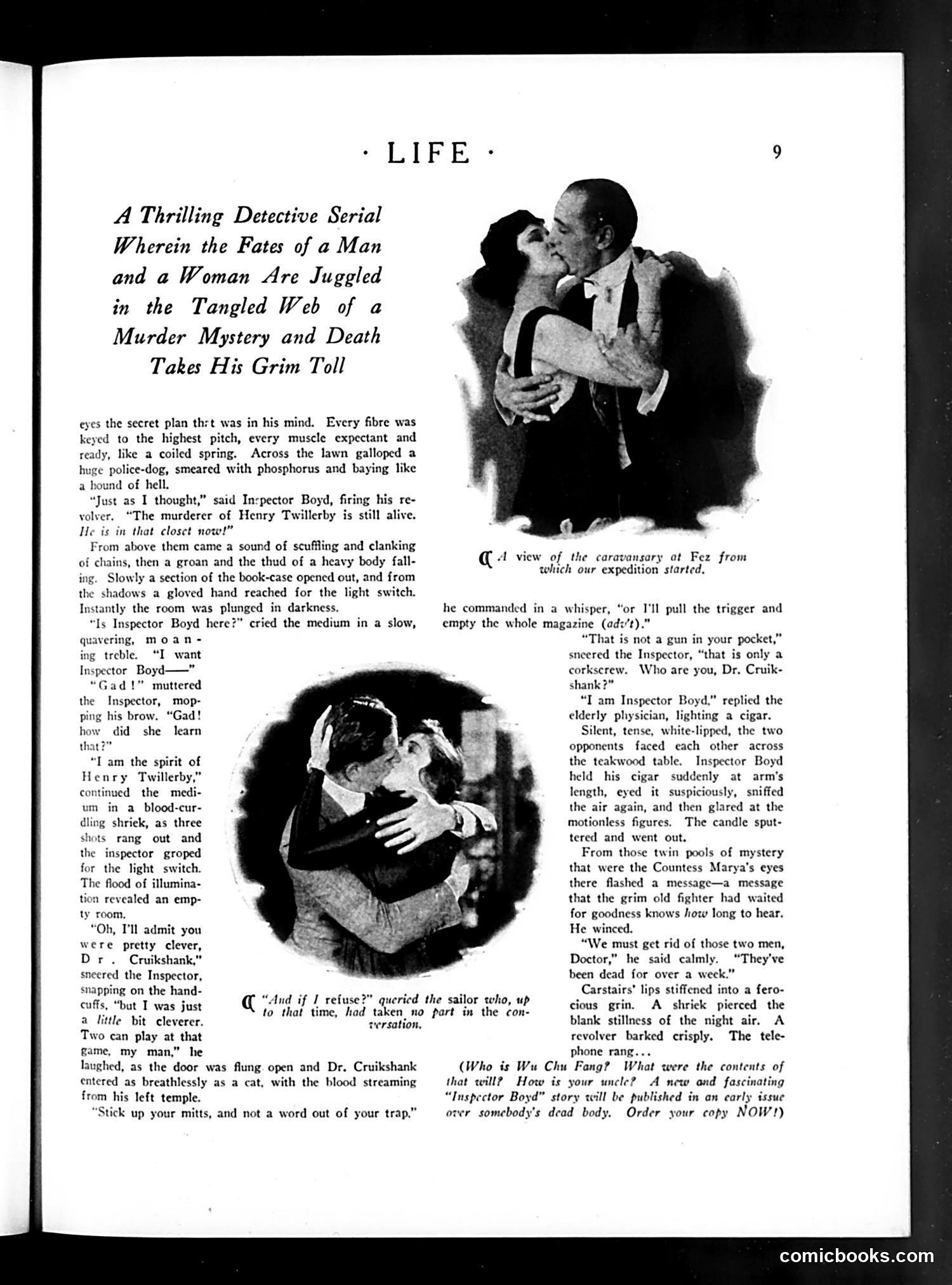
This page features a serialized detective story titled "A Thrilling Detective Serial" about a murder mystery involving Inspector Boyd. The two illustrations show dramatic scenes: the top depicts a man and woman in an embrace or struggle, while the bottom shows what appears to be a confrontation between two men. The text describes Inspector Boyd investigating "the murderer of Henry Twillerby," with dialogue involving a medium claiming to be the spirit of the deceased and a Dr. Cruikshank. The narrative involves supernatural elements and mystery-novel tropes typical of early 20th-century pulp fiction. This appears to be entertainment content rather than satire—*Life* magazine published serialized fiction alongside humor and social commentary. The specific detective and murder case referenced appear to be fictional creations for this serial rather than references to actual events or persons.
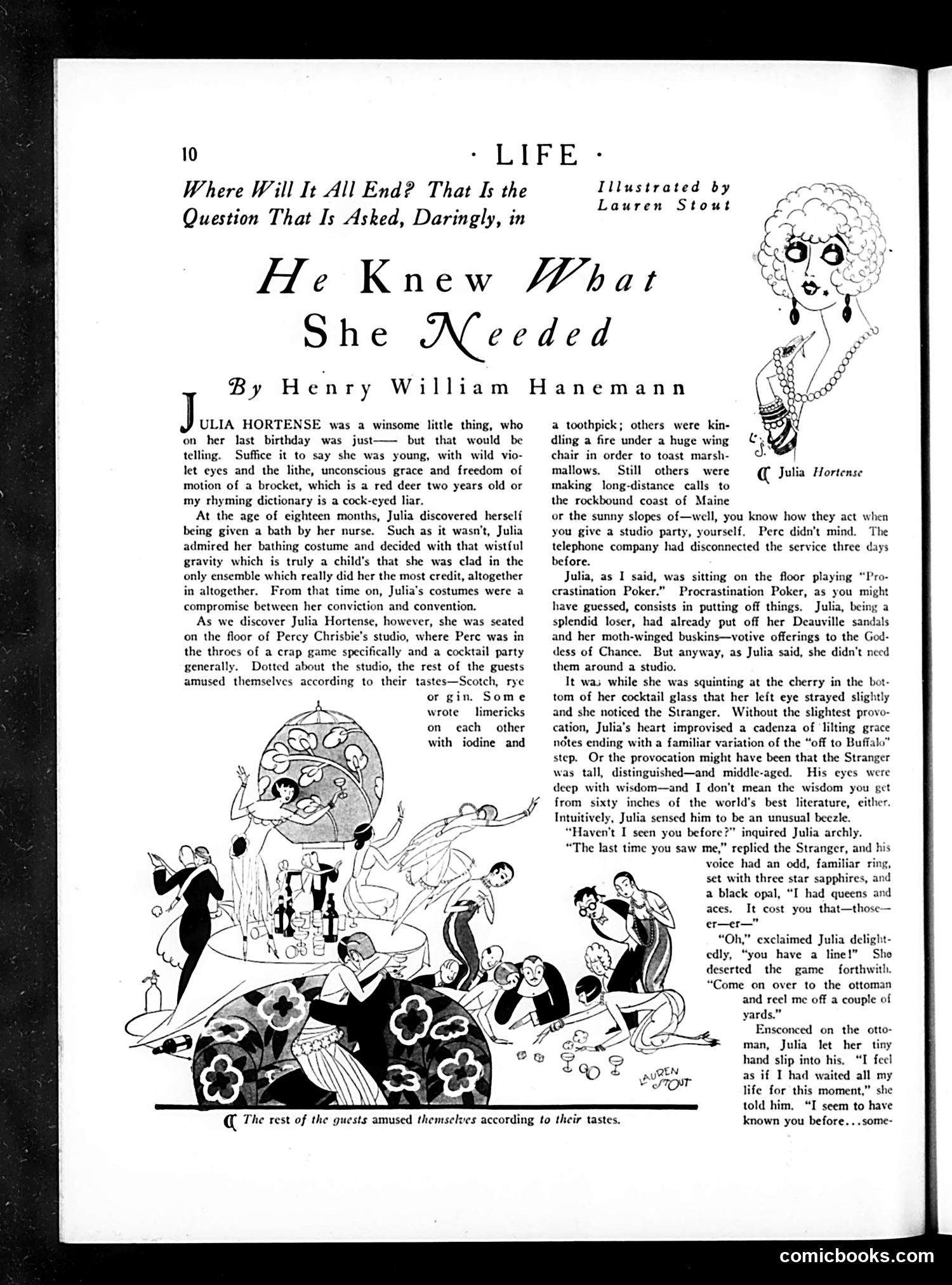
This story illustrates early 20th-century gender dynamics and upper-class social life. Julia Hortense, a wealthy young woman, attends a studio party where guests indulge according to their tastes—drinking, gambling, and socializing. The narrative centers on her encounter with "the Stranger," a mysterious man who appears to understand her deeply. The illustration shows a lavish, chaotic party scene with dancing, drinking, and gaming. The satire likely mocks the superficiality of high-society gatherings and suggests romantic/sexual intrigue beneath social pretense. The "Stranger's" cryptic comments about queens, aces, and sapphires hint at his mysterious past connection to Julia, playing on period themes of fate and romantic destiny among the wealthy elite.
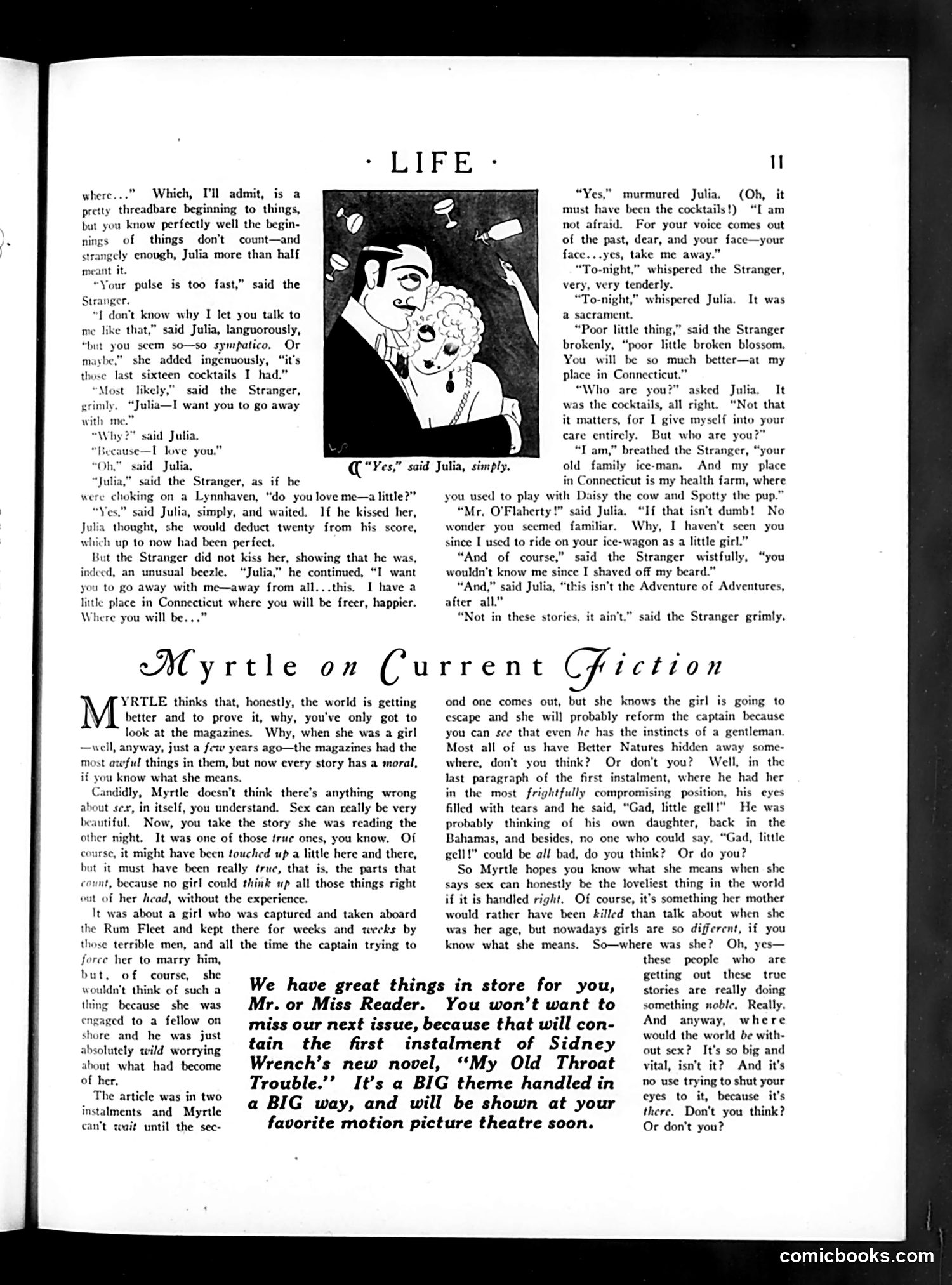
This page contains a serialized romantic fiction story titled "Life," featuring an illustration of a man and woman in an intimate embrace. The narrative depicts a romantic encounter between "the Stranger" and "Julia," with dialogue about love and separation. Below the story is an editorial section called "Myrtle on Current Fiction," where the magazine's editor (personified as "Myrtle") discusses contemporary fiction trends. Myrtle argues that modern stories require moral substance and should handle serious themes responsibly. She critiques the tendency toward "true" but sensational stories, advocating instead for thoughtful treatment of adult subjects. The page also contains an advertisement for Sidney Wrench's forthcoming novel, promoting it as a significant work addressing important themes.
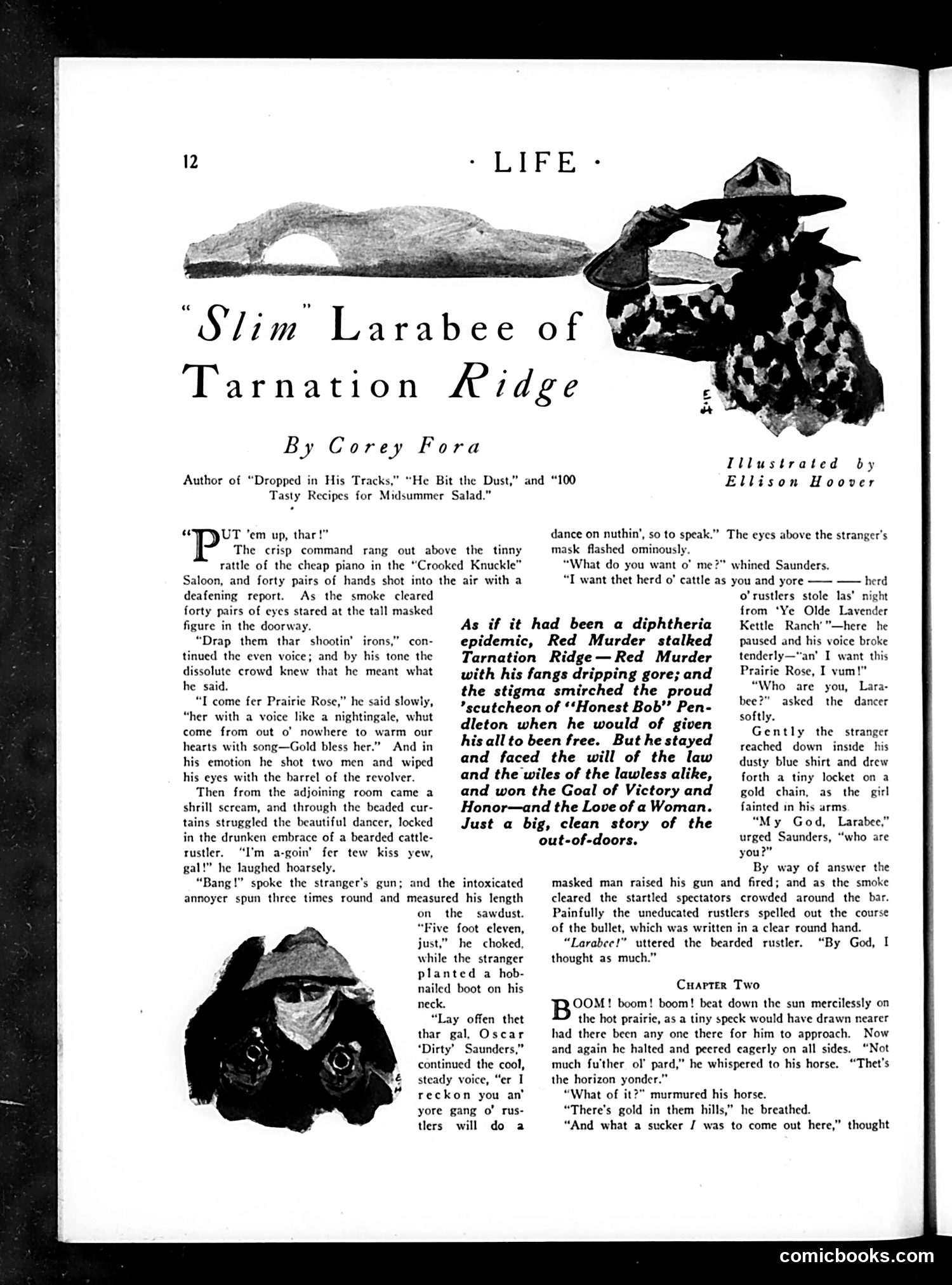
This page presents the opening of a Western fiction story by Corey Fora, illustrated by Ellison Hoover. The narrative depicts a violent confrontation in a saloon called the "Crooked Knuckle," where a character named Red Murder is shot dead by an unnamed masked man. The story emphasizes frontier justice and lawlessness—Red Murder apparently terrorized the region ("Red Murder stalked Tarnation Ridge"), and his killer is portrayed sympathetically as restoring order. The illustrations show the masked gunman and a bearded rustler, establishing the Wild West setting. This appears to be entertainment fiction rather than satire—typical of Life magazine's lighthearted serialized stories from this era, not political commentary.
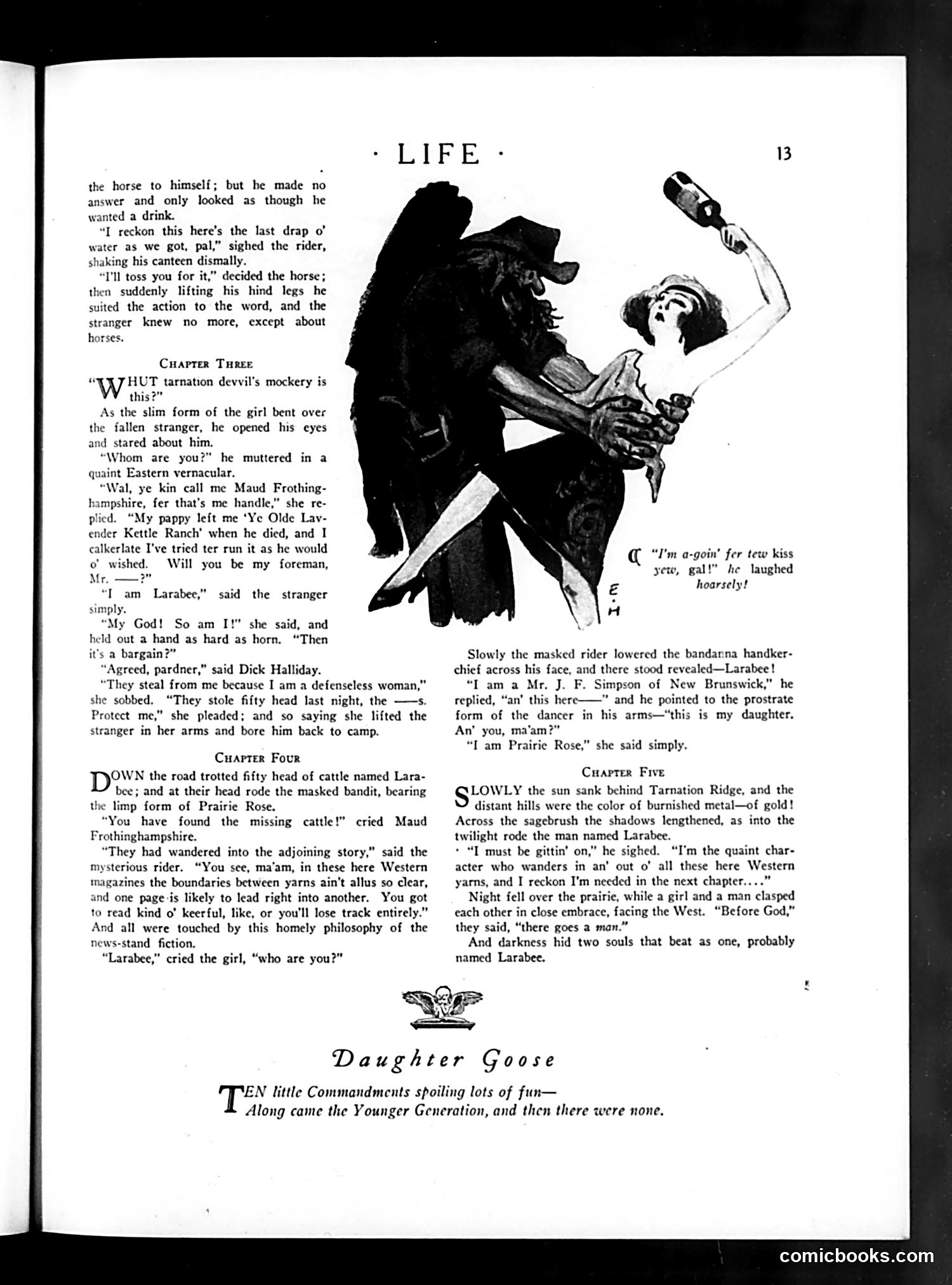
This page contains serialized fiction rather than political satire or cartoons. It shows chapters three through five of what appears to be a Western adventure story featuring characters named Larabee, Maud Frothinghamshire, Dick Halliday, and Prairie Rose. The narrative involves a masked bandit, stolen cattle, and romance on the frontier. The only illustrative content is a dramatic image of a masked rider on horseback with a woman, accompanying the text's dialogue about their meeting. At the bottom, there's a brief heading titled "Daughter Goose" with text beginning "TEN little Commandments spoiling lots of fun—" but the cartoon or content itself is not visible on this page. This appears to be a regular fiction feature in Life magazine rather than political commentary.
This editorial by Robert Benchley uses extended metaphors to critique professional attitudes and self-interest. The opening anecdote about selling buttercups illustrates how people misunderstand intentions through self-centered perspectives. Benchley's main argument concerns "interest" (both attention and financial gain). He defends people who take financial interest in their money, citing biblical figures like Ezra and St. Paul as precedent. The editorial then shifts to a street-level observation: among healthy trees stands one bare, dead specimen—which turns out to be a *hydrant*, not a tree at all. The hydrant metaphor warns against being a non-productive element disguised as something useful within a community or organization. The piece advocates practical self-awareness over pretense.
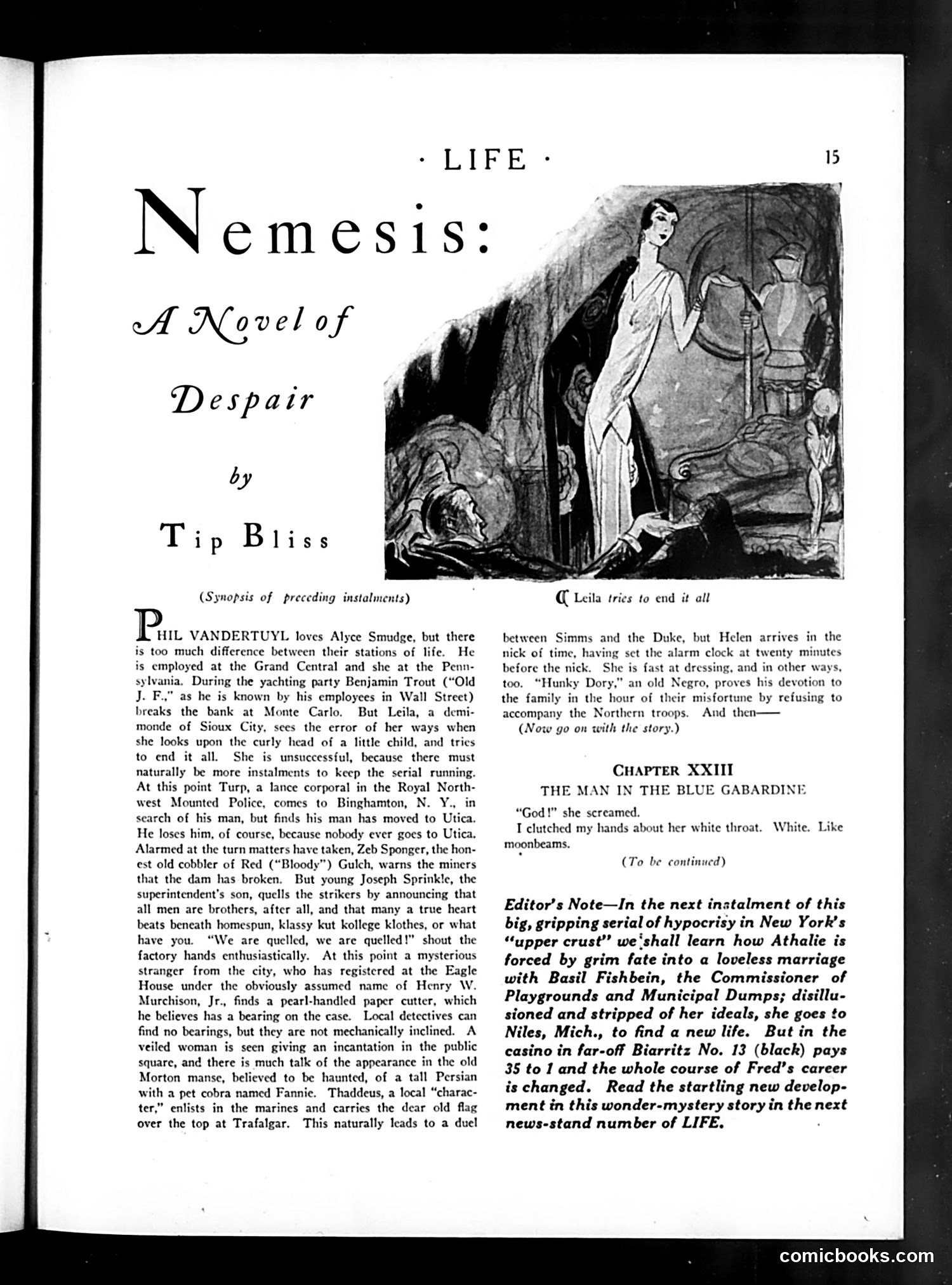
This page announces a serialized novel called "Nemesis: A Novel of Despair" by Tip Bliss, running in Life magazine. The illustration shows a dramatic scene with a woman in white standing over what appears to be a distressed or fallen figure, with other characters in the background—typical melodramatic imagery for serialized fiction of this era. The accompanying text describes the plot: a woman named Leila, caught in a difficult marriage due to class differences, attempts suicide but is thwarted. The editor's note promises future installments will reveal how the protagonist "Adahelle is forced by grim fate into a loveless marriage" and travels to Michigan seeking a new life, with plot twists involving someone named Basil Fishbein and a casino gamble. This is primarily a literary serial announcement rather than political satire.
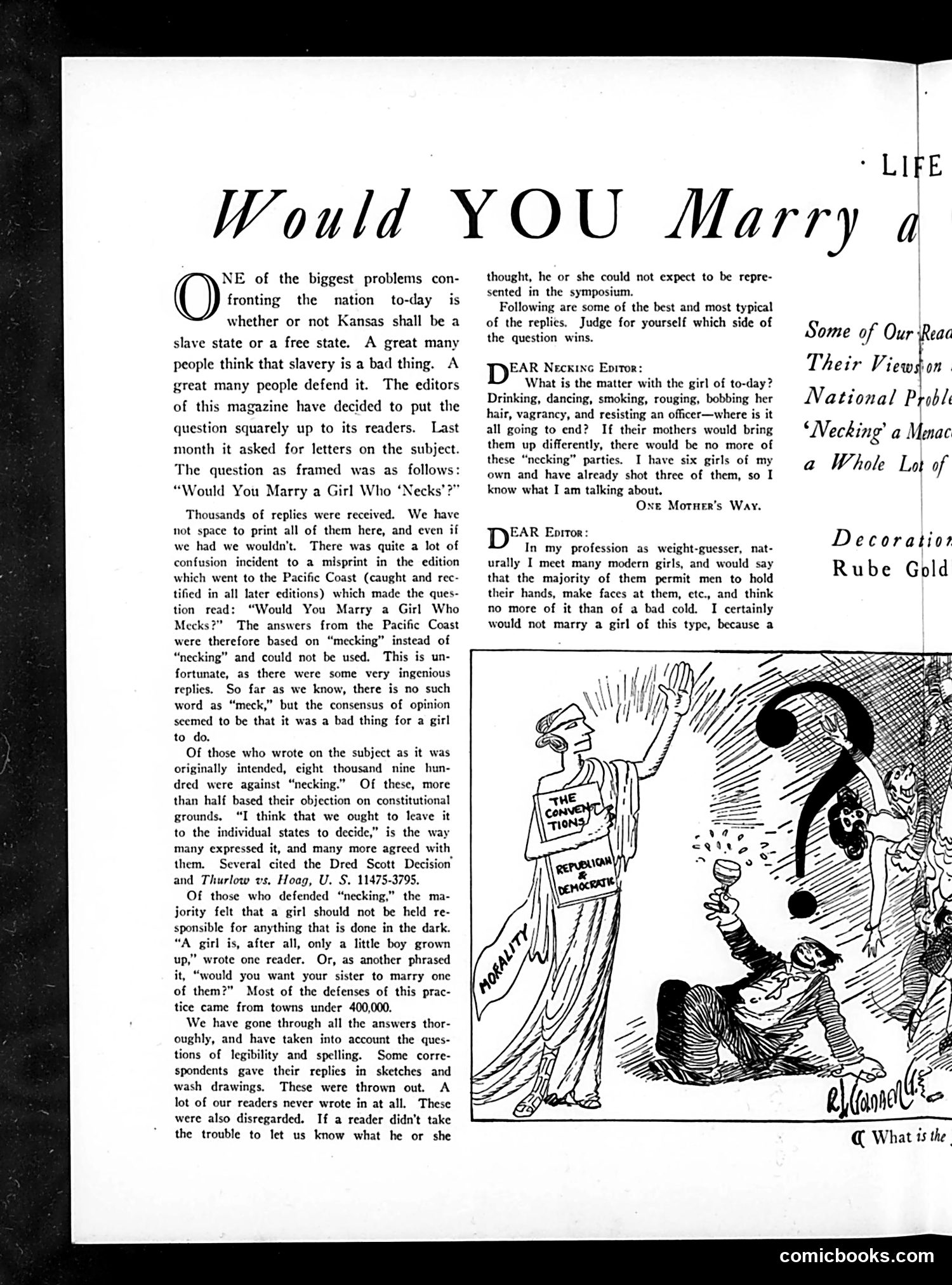
This Life magazine article satirizes American social and political discourse by framing the contemporary moral panic over "necking" (kissing and petting) as equivalent to serious national debates. The satire operates on multiple levels: The magazine deliberately conflates the trivial question of dating behavior with weightier issues like slavery and the Dred Scott Decision, deliberately citing fake legal precedents ("Thurlow vs. Hoag"). It mocks both moralists condemning "necking" and those defending it with absurd reasoning. The cartoon (artist: R. Cannell) illustrates the hypocrisy—showing a figure labeled with constitutional and moral objections while simultaneously engaging in the condemned behavior. Responses reveal period attitudes: one writer admits shooting three daughters over the practice; another suggests girls bear no responsibility for dark-place behavior. The humor lies in readers taking this frivolous "survey" with unwarranted seriousness, exposing how Americans project constitutional language onto personal morality.
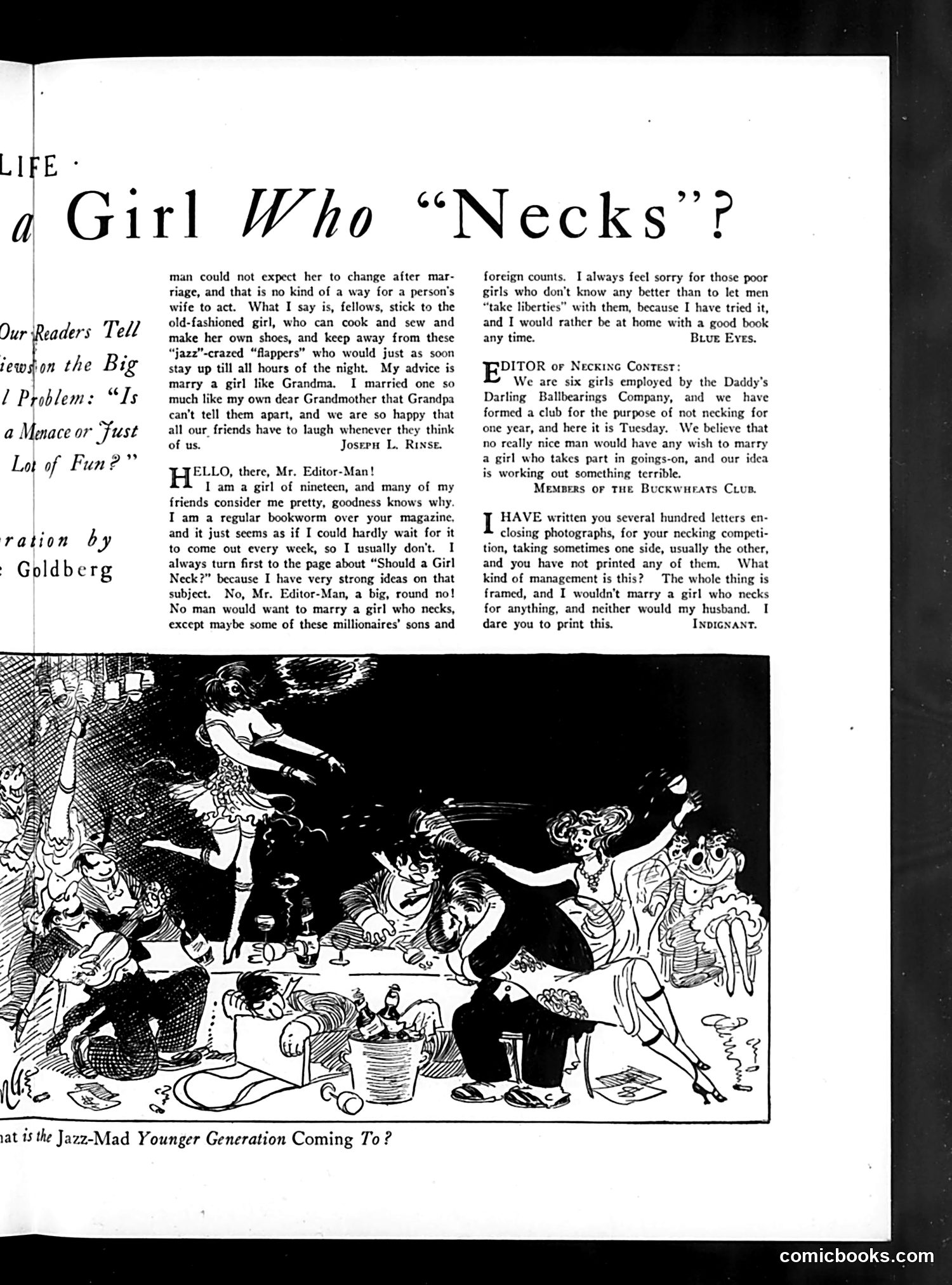
This page presents reader responses to a Life magazine debate about whether young women should engage in "necking" (kissing/physical affection), framed around the anxieties of the 1920s "Jazz Age." The illustration depicts a wild party scene with flippers dancing and socializing—representing the modern younger generation that concerned traditionalists. The letters reveal generational conflict: conservative readers (Joseph L. Rinse, Blue Eyes) advocate for old-fashioned girls who cook, sew, and avoid physical intimacy. They moralize that "nice" girls don't neck. Other readers mock this prudishness—the Buckwheats Club ironically reports their anti-necking pledge is "working out something terrible," while the final letter sarcastically claims to oppose necking while admitting personal experience. The satire critiques both sides: moralistic elders clinging to outdated courtship norms, and hypocritical letter-writers claiming virtue while actually engaging in the very behavior they condemn. The cartoon emphasizes how Jazz Age youth were rejecting Victorian sexual restraint.
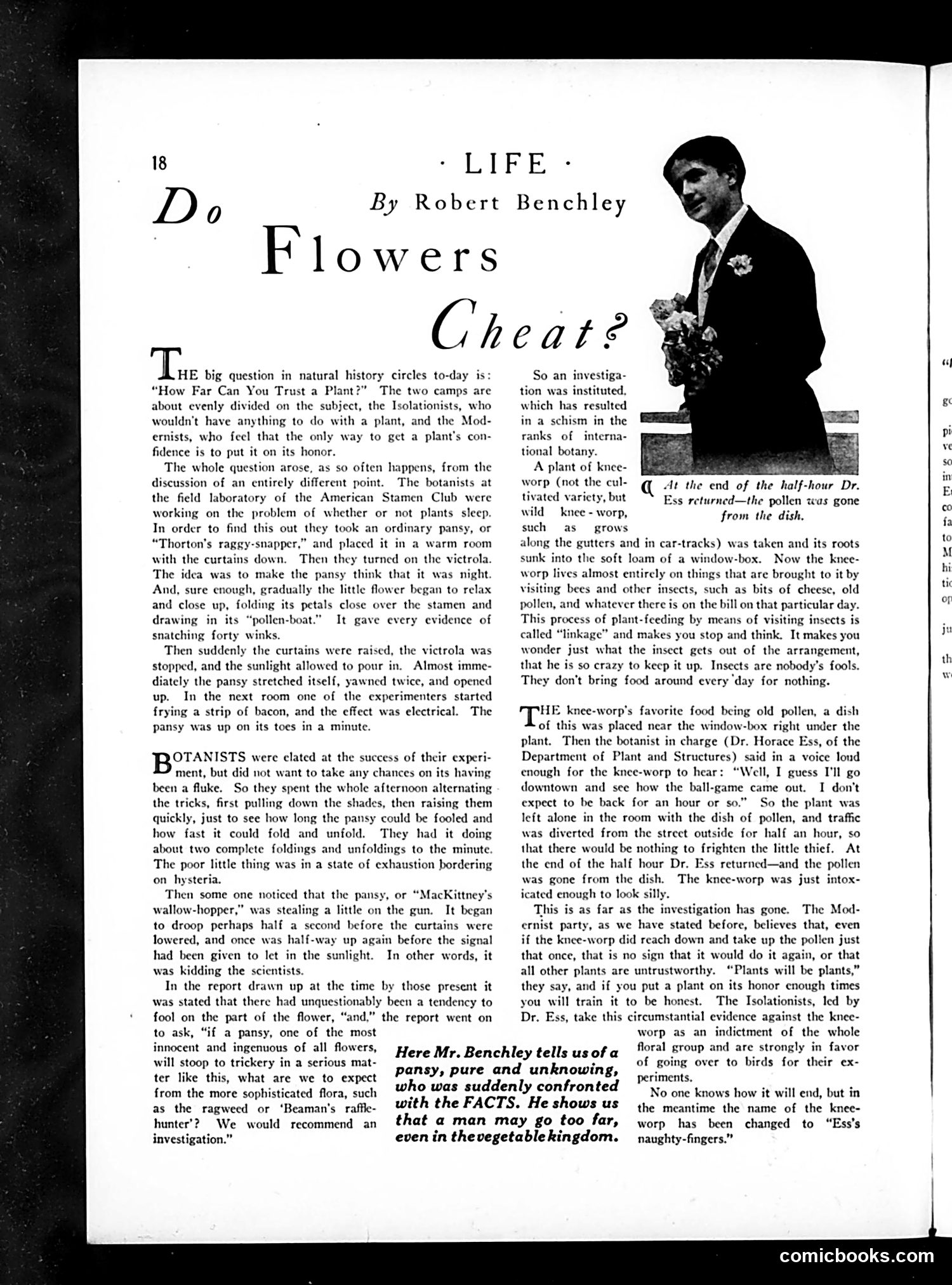
This is a humorous essay by Robert Benchley satirizing scientific overconfidence and anthropomorphism. The piece mocks botanists debating whether plants can be "trusted" and whether they "sleep." The satire escalates absurdly: scientists test a pansy by manipulating light and sound, eventually concluding the flower is deliberately **cheating**—anticipating their tricks by drooping before curtains close. This obvious projection of human deception onto a plant represents the essay's target: scientists attributing intentional behavior to non-conscious organisms. The follow-up experiment with a "knee-worp" plant and pollen dish continues the joke, treating the missing pollen as evidence of plant agency rather than natural insect activity. Benchley's point: even educated people—here, botanists—can become so invested in their theories that they abandon reason and attribute consciousness and moral qualities (honesty, dishonesty) to inanimate nature. The humor lies in watching "serious" scientists construct elaborate explanations for simple botanical processes.
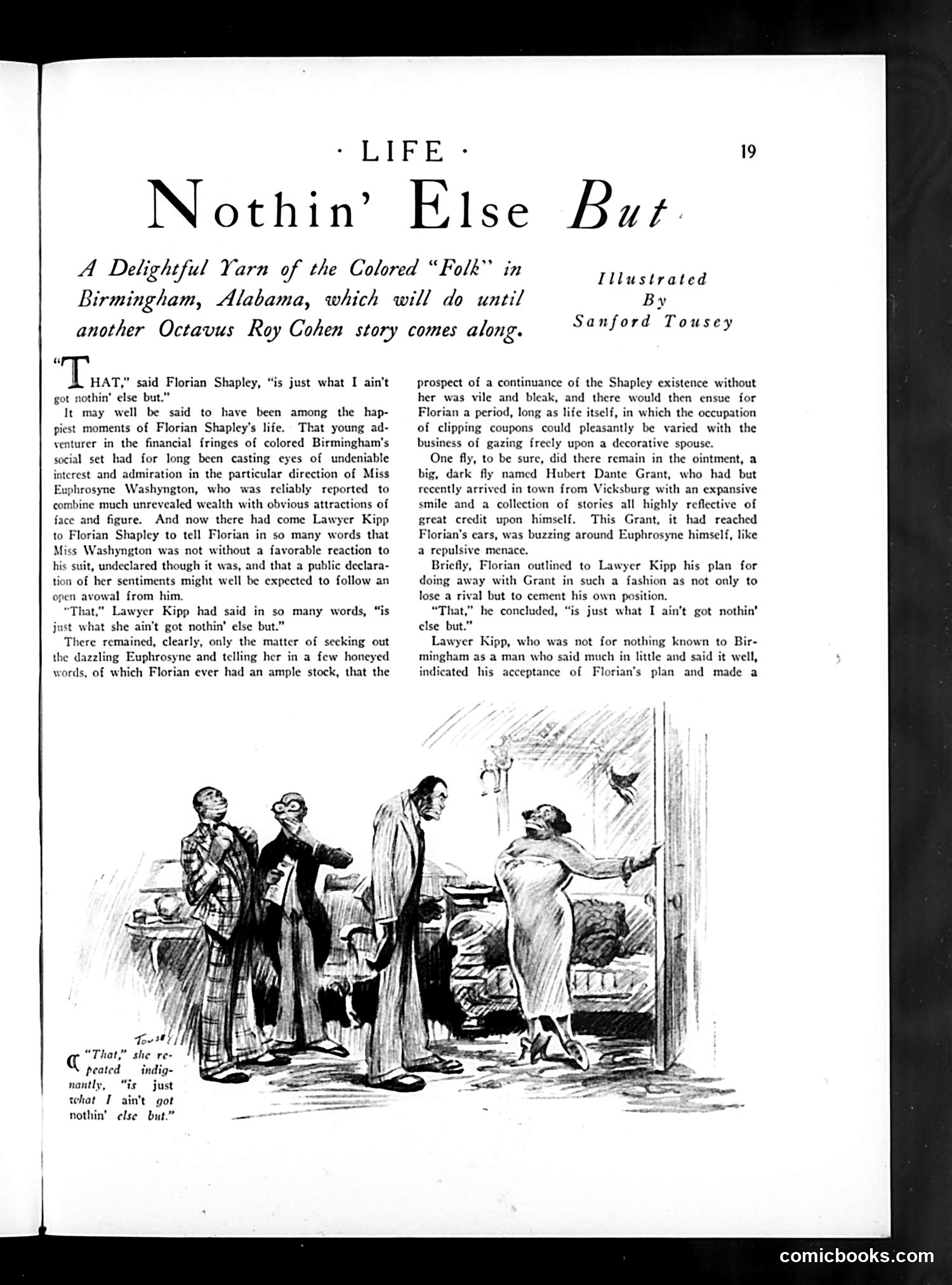
This is a 1920s-era *Life* magazine story by Octavus Roy Cohen, a white author known for dialect fiction featuring African American characters. The piece employs racial stereotypes common to the era: it presents Black Birminghamites using exaggerated dialect ("ain't got nothin' else but") and frames their social ambitions and romantic schemes as comedic material for white readers. The illustration shows what appears to be a domestic scene with several figures in conversation. The story concerns Florian Shapley's pursuit of the wealthy Euphrosyne Washington, with a rival named Hubert Dante Grant complicating matters. The satire relies on minstrelsy conventions: depicting African Americans as amusing, foolish, or morally compromised. Cohen's repetitive catchphrase and dialect-heavy prose were considered entertaining to the magazine's white audience, treating Black social life as exotic spectacle rather than depicting authentic human experience.
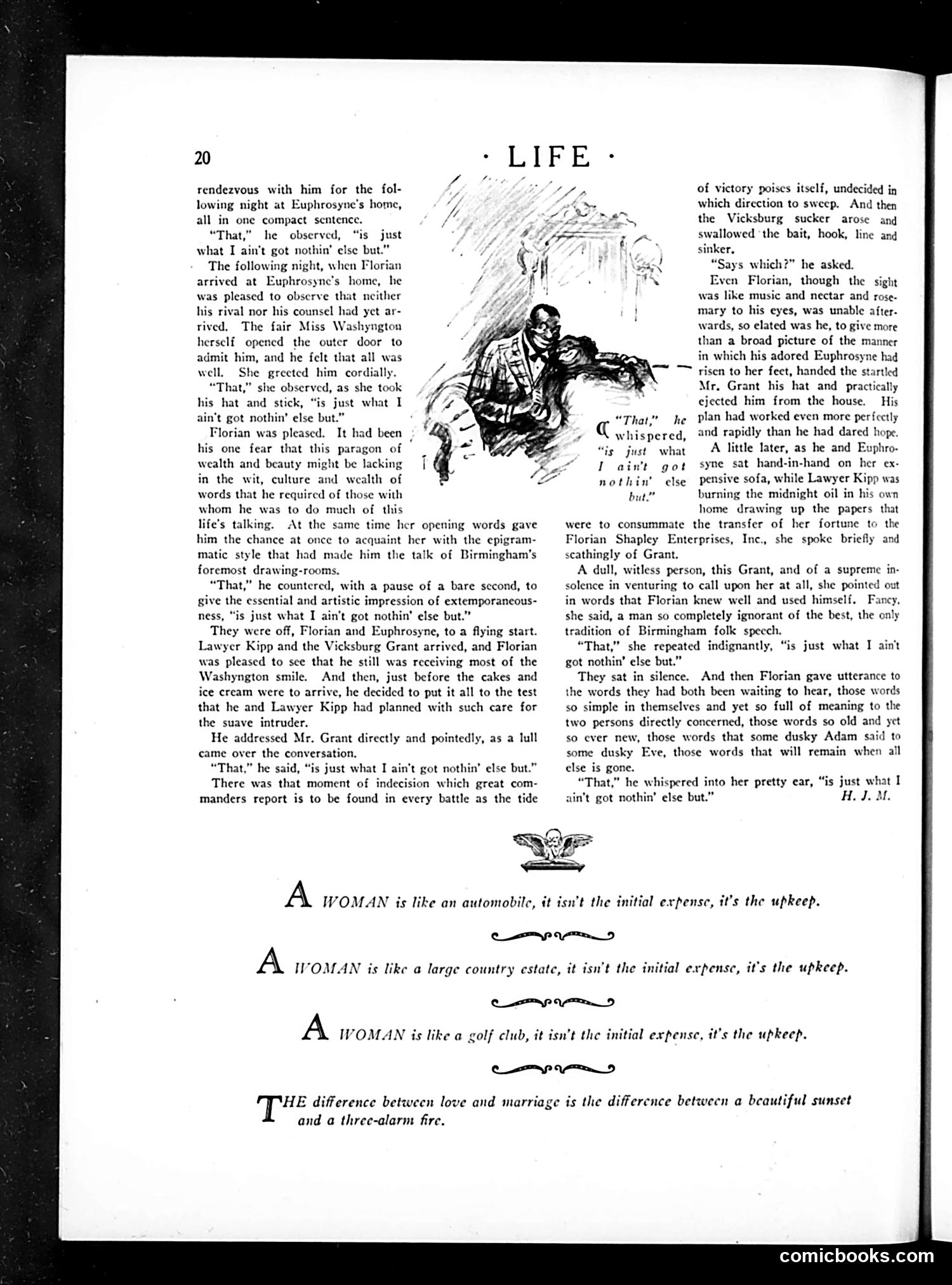
This page presents a humorous short story about Florian, a social-climbing con artist from Birmingham, who pursues the wealthy Miss Euphrosyne Washington. The satire centers on **empty wit and social pretension**: Florian believes he's charmed Birmingham's elite with the repeated catchphrase "That is just what I ain't got nothin' else but"—a grammatically poor statement he treats as profound epigram. The joke is that Euphrosyne, despite her wealth and supposed sophistication, finds this meaningless phrase equally clever and repeats it back to him. When a rival suitor (the "Vicksburg sucker") falls for the trap and questions it, Florian "wins" Euphrosyne by having her eject the man. The story mocks **pretentious social climbers** and the shallow materialism of the wealthy—Florian is clearly after her fortune (his business ventures absorb her wealth), yet both mistake vacuous repetition for wit. The closing aphorisms about women's "upkeep" reinforce the cynical tone about marriage and class.
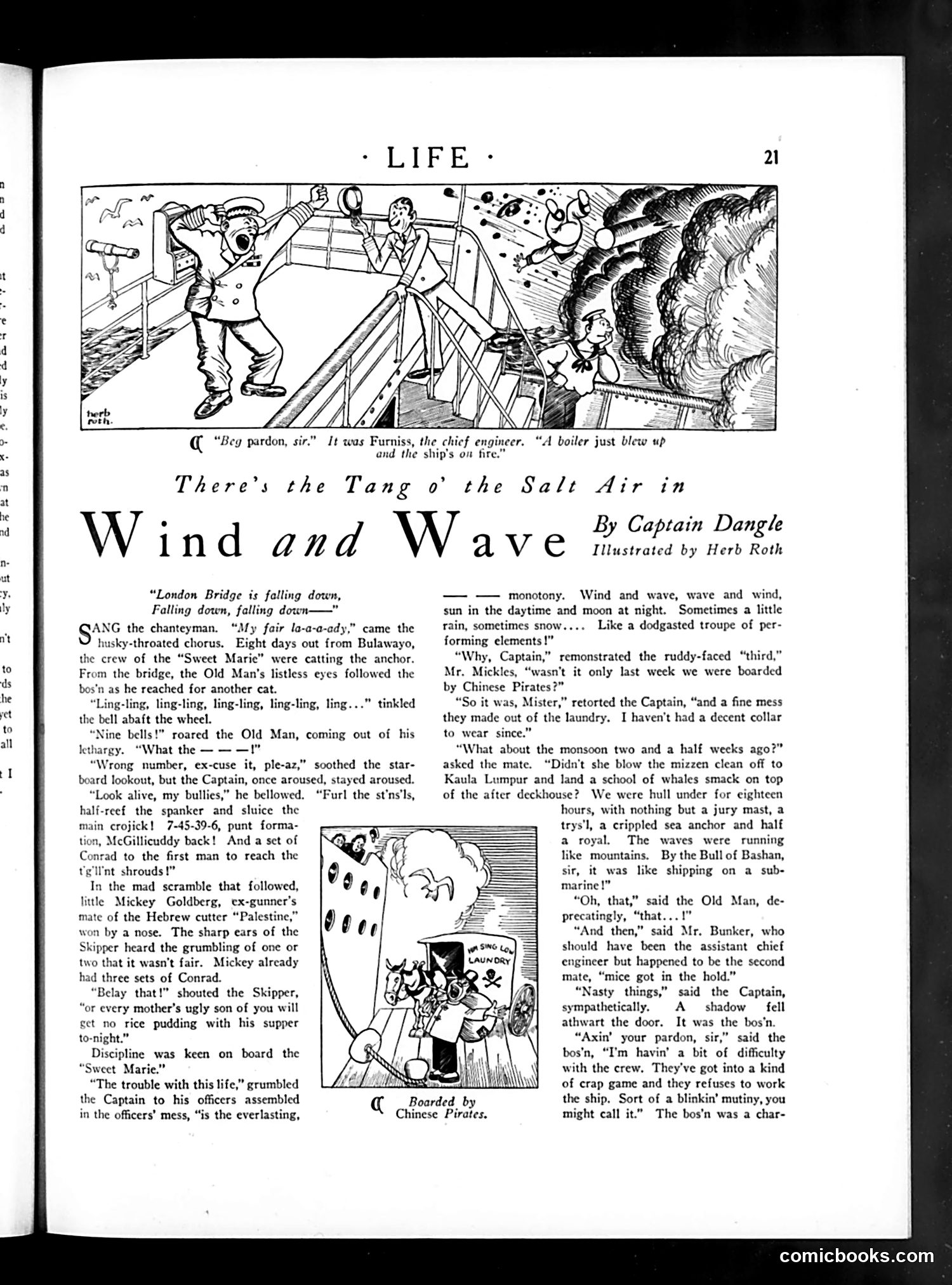
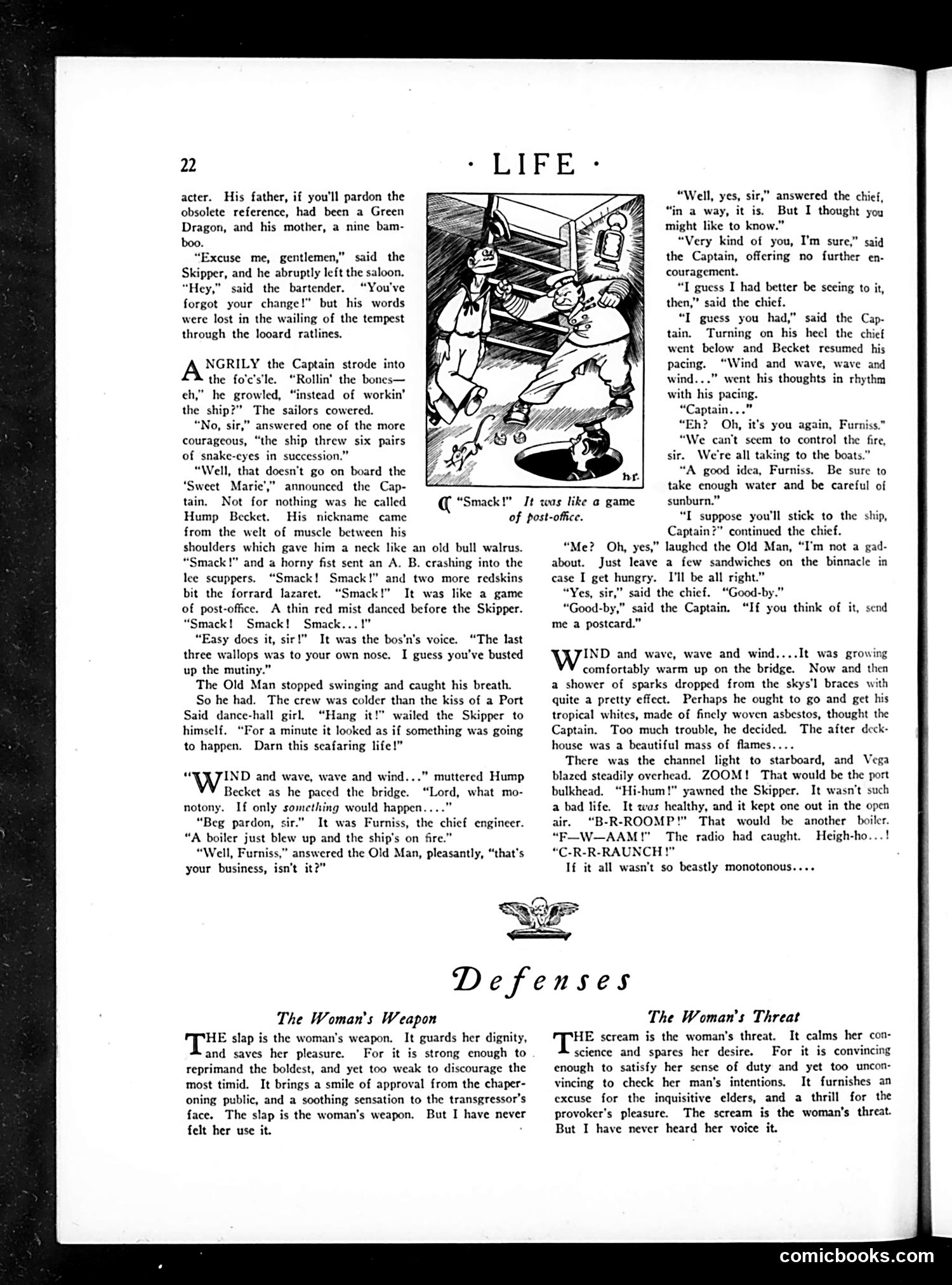
This is a serialized adventure story by Captain Dangle, illustrated by Herb Roth, not political satire. It depicts life aboard a merchant ship called the "Sweet Marie." The narrative humorously contrasts the Captain's complaint about monotonous sea life with his officers' reminders of recent dramatic incidents: Chinese pirate attacks, severe monsoons with damage to rigging, whales crashing onto deck, and mice infesting the hold. The joke is ironic—the Captain claims endless tedium while his crew catalogs genuine maritime disasters. The opening cartoon shows a boiler explosion during these chaotic events. The story concludes with the bosun reporting the crew has abandoned work for an illegal gambling game, threatening mutiny. This appears to be light entertainment fiction typical of Life magazine's content during this era, featuring nautical adventure and comedic exaggeration rather than social commentary.
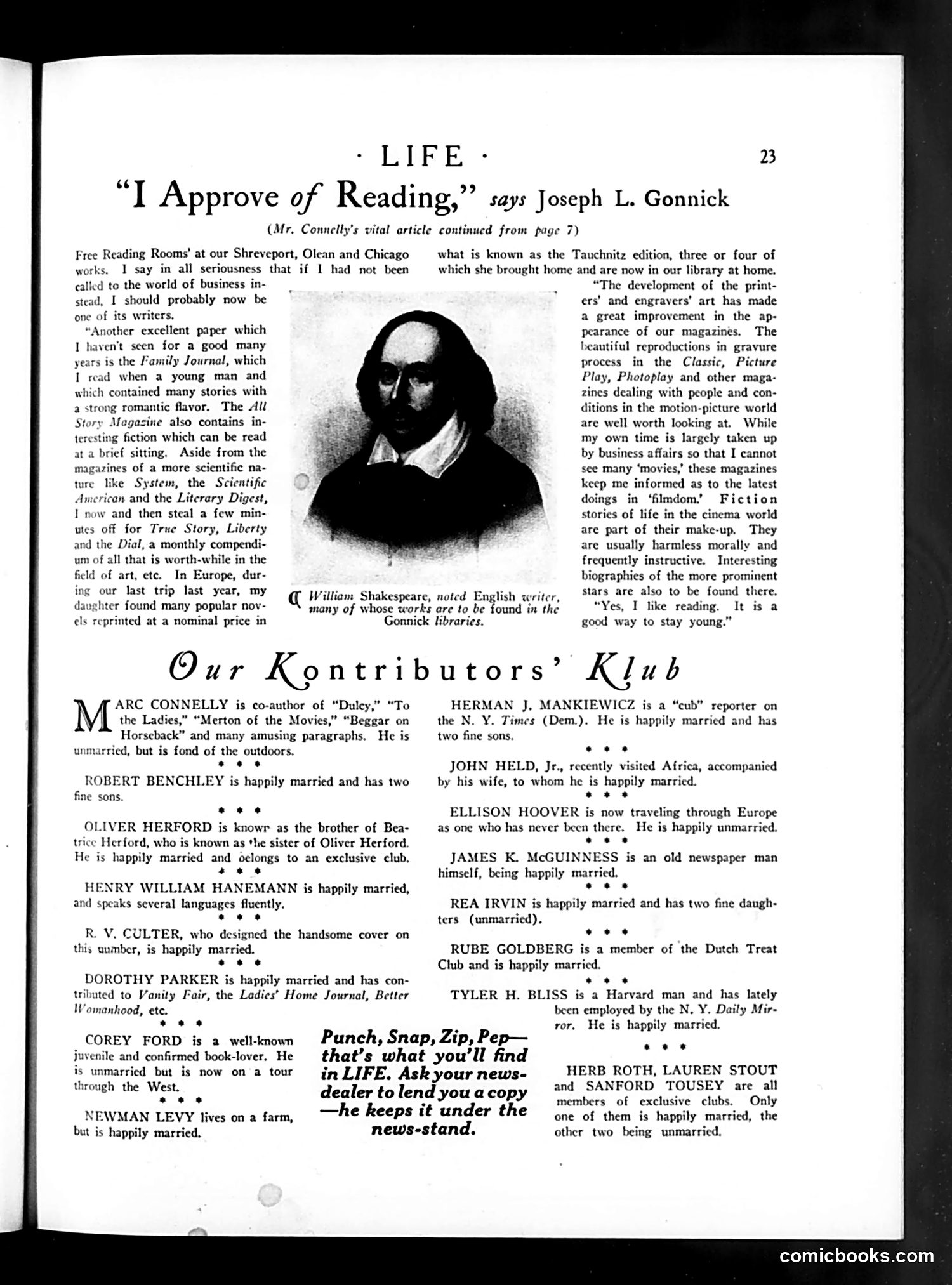
This page from *Life* magazine contains two distinct elements: **The Main Article:** Joseph L. Gonnick, a businessman, endorses reading various magazines and journals. The accompanying portrait shows William Shakespeare, presenting this as literary authority—a humorous touch suggesting even great writers would approve of modern magazine culture. Gonnick discusses *Family Journal*, *True Story*, and cinema magazines, positioning reading as both intellectually respectable and practically entertaining for busy professionals. **The "Contributors' Klub":** Below is satirical biographical notes about the magazine's writers. The joke is the relentless repetition of "happily married" (or occasionally "happily unmarried")—appearing after nearly every contributor's entry regardless of relevance. This mocks conventional biographical filler and social conventions of the era that treated marital status as defining personal identity. The absurdity builds through repetition, poking fun at both the writers and magazine publishing conventions.
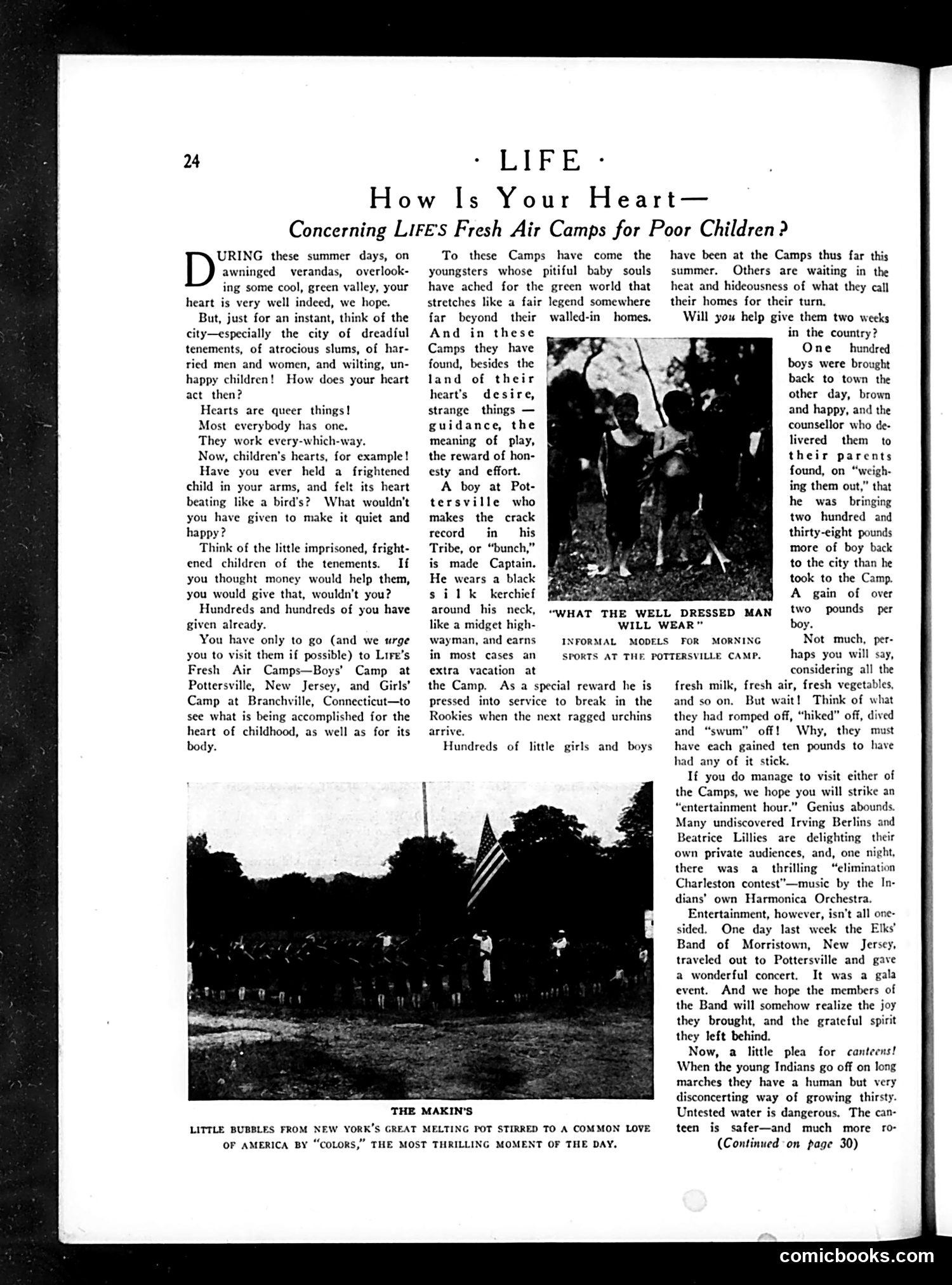
This page is a charitable appeal—not satire—urging wealthy readers to support Life magazine's Fresh Air Camps for poor urban children. The publication ran these camps in New Jersey and Connecticut to give impoverished tenement kids summer relief. The text uses emotional rhetoric, asking readers to imagine frightened children in city slums, then contrasting this with descriptions of camps where poor children gain weight, receive guidance, and experience nature. The two photographs show a flagpole ceremony (likely a patriotic "colors" ritual) and children at sports activities. The appeal includes success metrics (one group gained 238 pounds collectively) and mentions entertainment, suggesting the camps offered not just physical recovery but cultural enrichment and Americanization—common Progressive-era goals for immigrant and poor children. This represents Life's philanthropic mission during the early 20th century.
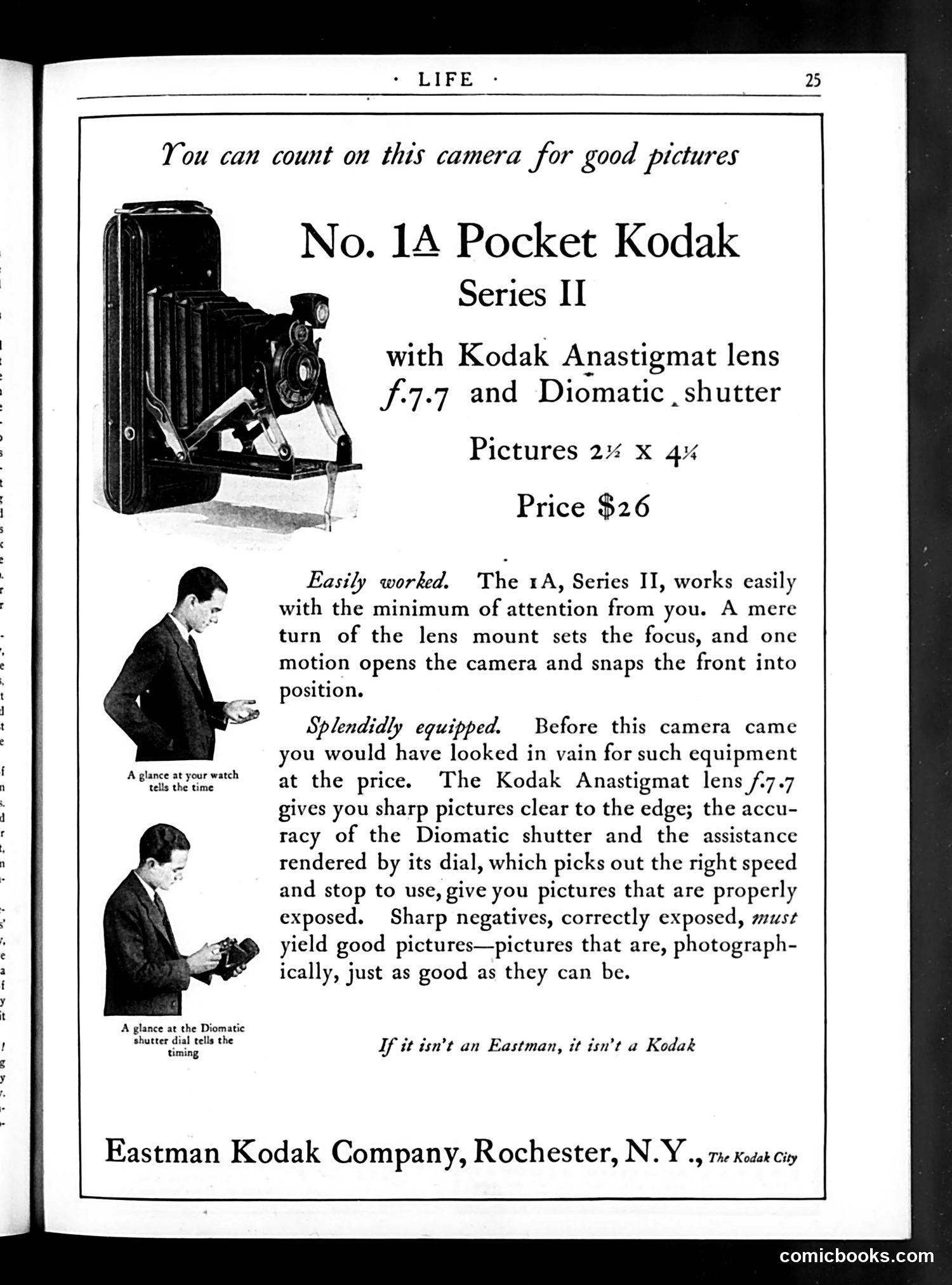
This is **not a cartoon or satire page**—it's a straightforward **product advertisement** for the Kodak No. 1A Pocket camera, priced at $26. The page features three photographs of a man in business attire demonstrating the camera's ease of use: checking his watch, holding the compact camera, and operating the Diomatic shutter dial. The copy emphasizes convenience and reliability for amateur photographers—no technical expertise required. The famous tagline "If it isn't an Eastman, it isn't a Kodak" appears at the bottom, positioning Kodak as the only trustworthy camera brand. For modern readers, this represents early 20th-century marketing that equated one brand name with an entire product category, much like "Kleenex" for tissues today. There is no political or social satire present on this page.
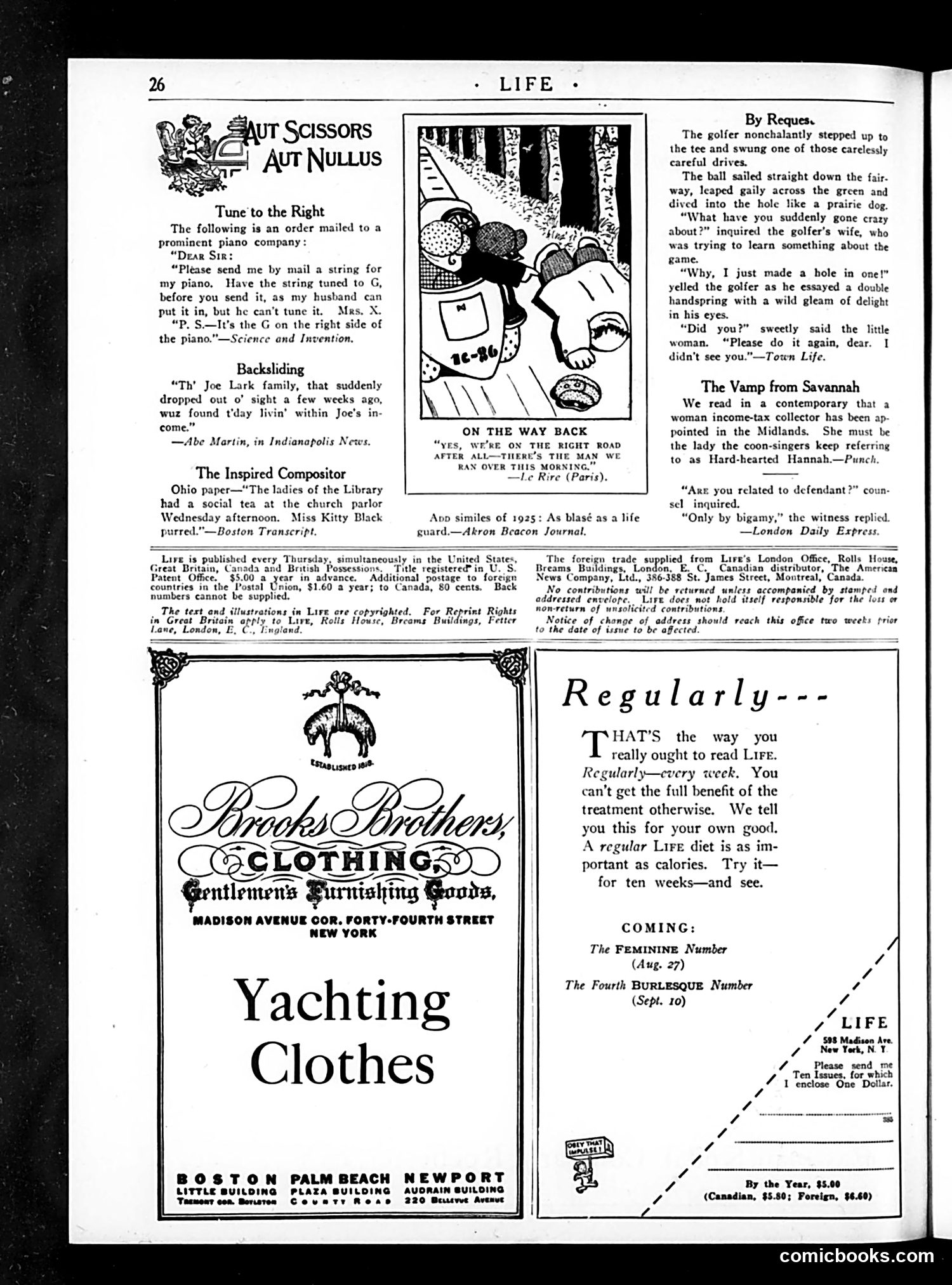
This page contains miscellaneous humor pieces and advertisements rather than a unified political cartoon. The jokes reflect 1920s domestic life and social attitudes: **"Tune to the Right"** satirizes women's mechanical incompetence—a wife requests a piano string pre-tuned because her husband cannot tune it himself, then specifies "the G on the right side" as if pianos have directional orientation. **"Backsliding"** jokes about the Joe Lark family living within their means—presented as an embarrassing regression, implying that overspending was normal or socially expected. **"On the Way Back"** (French cartoon) appears to reference a traffic accident with dark humor about hitting someone. **"The Vamp from Savannah"** uses period slang ("vamp," "coon-singers") to joke about a female tax collector being harsh. The page's overall tone reflects 1920s gender stereotypes, consumerism anxiety, and casual racism typical of the era. The Brooks Brothers advertisement for "Yachting Clothes" targets wealthy readers.
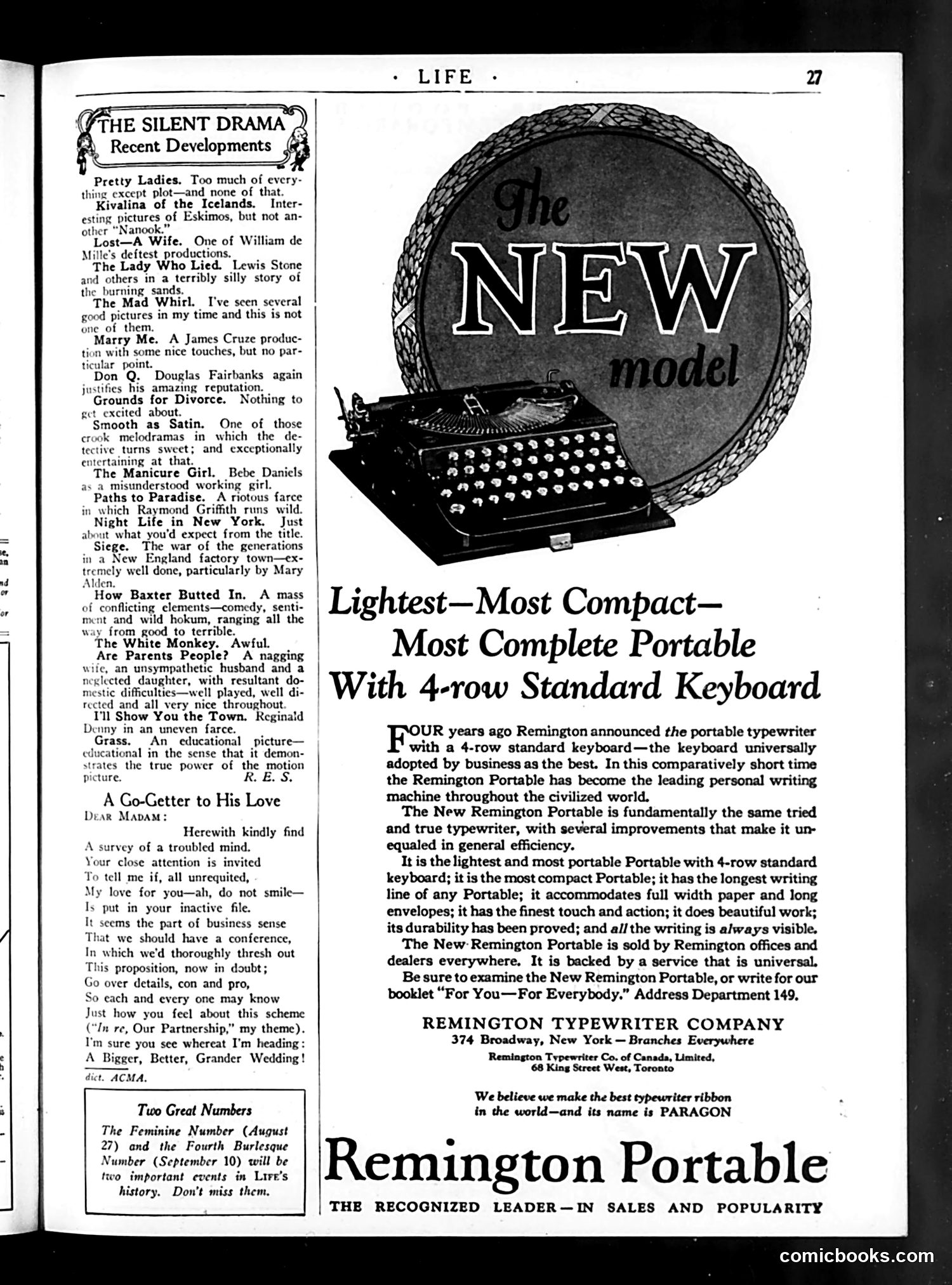
This page is primarily **advertising-driven**, featuring a full-page Remington Portable typewriter advertisement alongside a film review section titled "The Silent Drama: Recent Developments." **The Film Reviews** are brief, dismissive critiques of silent films from approximately 1924-1925, mentioning actors like Douglas Fairbanks, Bebe Daniels, and Mary Alden. The reviewer (R.E.S.) is notably unimpressed, using cutting remarks like "Awful" and "Nothing to get excited about." **The Advertisement** dominates the right side, promoting Remington's new portable typewriter with a 4-row standard keyboard. It emphasizes portability, compactness, and durability—marketing it as the leading personal writing machine "throughout the civilized world." **The Humor Section** includes a letter-to-the-editor parody ("A Go-Getter to His Love") written in business jargon, where someone uses corporate language to propose marriage—a satire on how commercialism invades personal life. The page reflects 1920s concerns: silent cinema as entertainment, typewriters as essential modern technology, and the comedy of applying business methodology to romance.
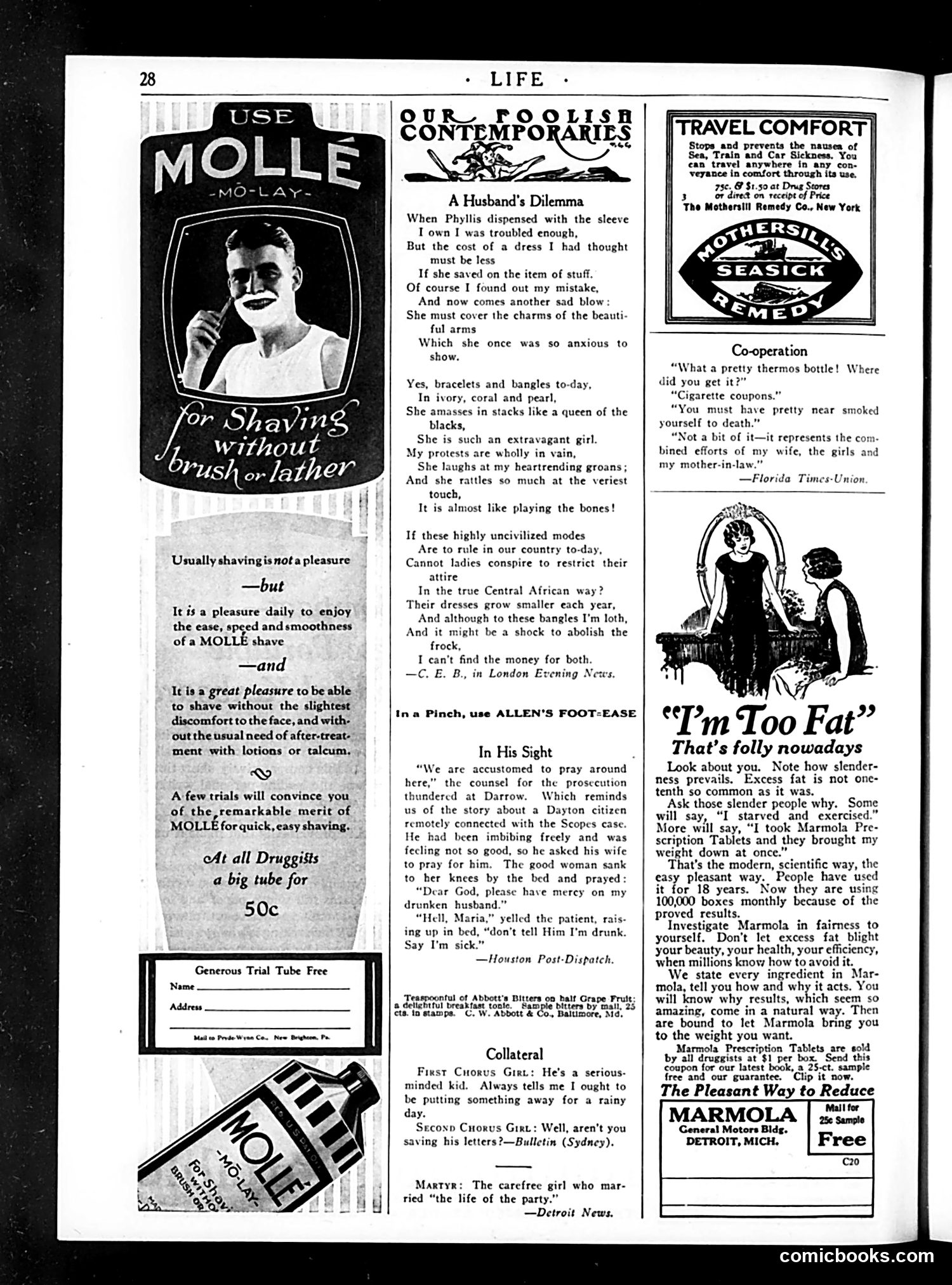
This page from *Life* magazine (undated but likely 1920s based on references) contains primarily **advertisements and light humor columns** rather than political satire. The main content includes: **"A Husband's Dilemma"** — A humorous poem about a husband complaining that his wife removed her dress sleeves (fashionable at the time) to save fabric, then spent the savings on bangles and bracelets. The satire targets women's fashion trends and domestic financial negotiations rather than politics. **"In His Sight"** — A joke referencing the famous Scopes "Monkey Trial" in Dayton, Tennessee (implying 1925), mocking both religious prosecution and a drunk man's priorities. The remaining items are **commercial advertisements** for shaving cream (Mollé), foot powder, seasickness remedy, weight-loss tablets (Marmola), and other products. The page reflects 1920s consumer culture and gender dynamics but contains no significant political cartoons or satire requiring historical context beyond understanding period fashion and the Scopes trial reference.
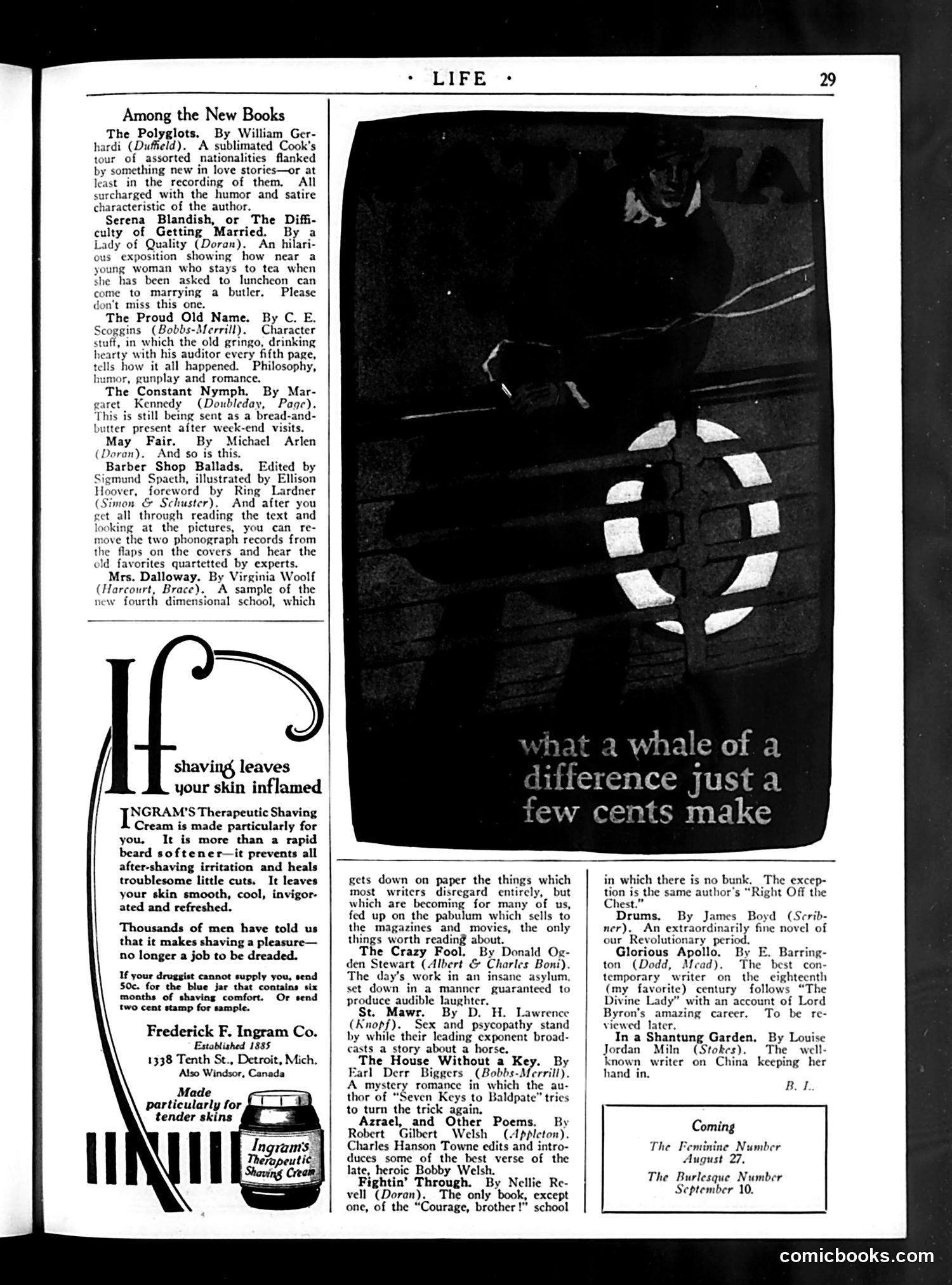
This page is primarily a **book review section** ("Among the New Books") with an **advertisement** for Ingram's Therapeutic Shaving Cream. **The Book Reviews:** The text discusses popular 1920s literary releases, including Virginia Woolf's modernist *Mrs. Dalloway* (described as "fourth dimensional"), D.H. Lawrence's *St. Mawr*, and James Boyd's *Drums*. The reviews use witty, satirical language typical of Life magazine's literary commentary—mocking commercial fiction while praising experimental or serious works. **The Advertisement:** The shaving cream ad features humorous text claiming the product prevents post-shave irritation and makes shaving "a pleasure—no longer a job to be dreaded." It appeals to male vanity and comfort. **The Photograph:** The large image shows hands holding what appears to be a steering wheel or circular object—likely illustrating the advertisement's message about masculine grooming or lifestyle improvements, though the specific connection is unclear from context. This is a typical 1920s magazine page mixing literary commentary with consumer advertising.
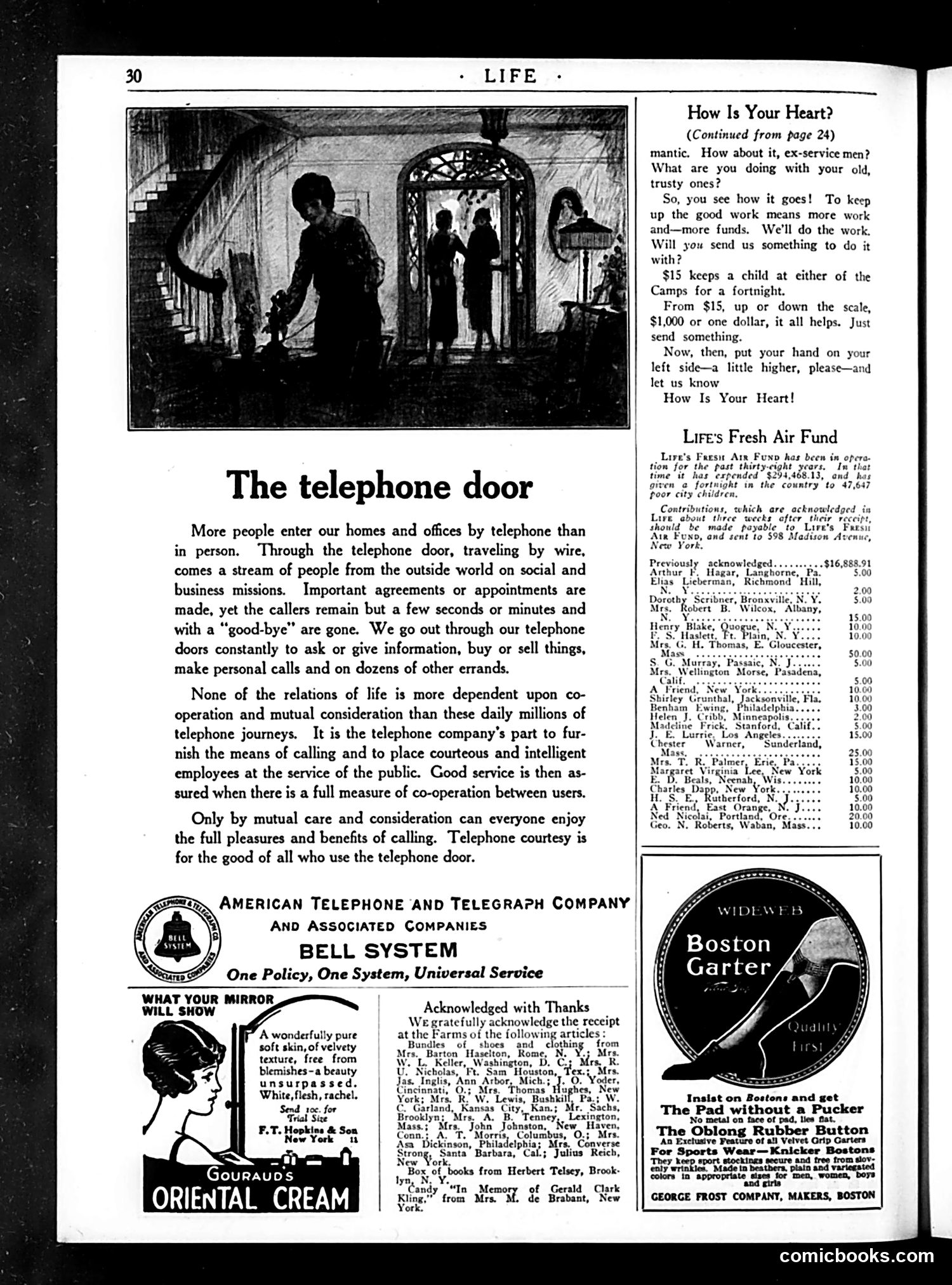
This page features an advertisement disguised as social commentary from Bell System (AT&T). The illustration shows silhouetted figures entering a home through a doorway labeled "the telephone door," representing how telephone calls bring the outside world into private spaces. The text argues that telephone use depends on mutual courtesy and cooperation between callers and operators. It frames the telephone company's role as providing "courteous and intelligent employees" to serve the public. The "joke" is subtle: the ad presents telephone etiquette as a moral obligation, appealing to readers' sense of civic responsibility. By emphasizing that "good service is assured when there is a full measure of co-operation between users," Bell System positions itself as facilitating social harmony while promoting widespread telephone adoption and use. The page also includes fundraising appeals for charitable causes (Life's Fresh Air Fund), mixing commercial messaging with philanthropy—a common editorial practice of the era.
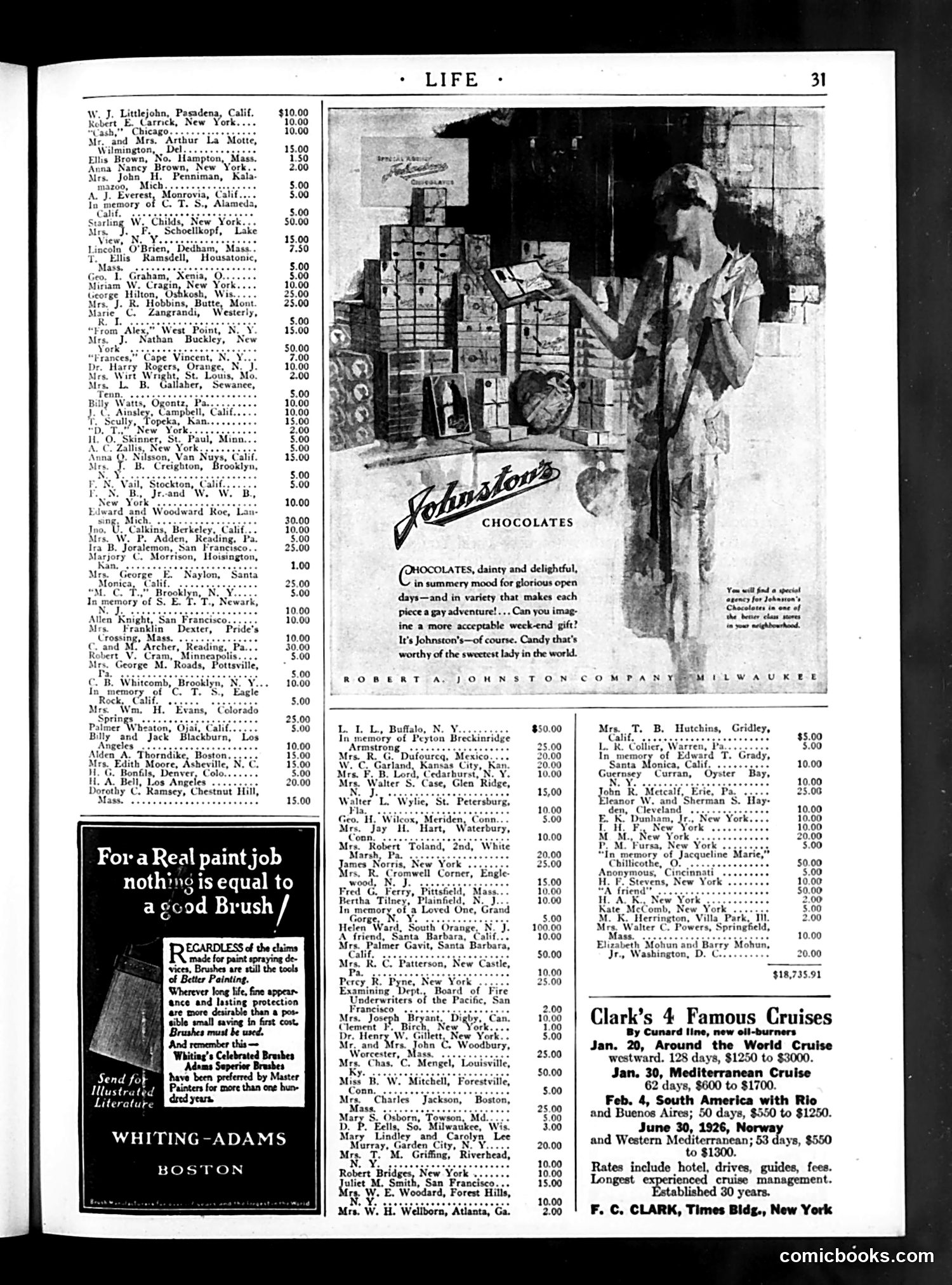
This page is primarily **advertising and donor listings**, not satirical content. It contains: 1. **Johnston's Chocolates ad** (center): Features a woman admiring an elaborate gift box of chocolates. The pitch emphasizes chocolates as an ideal "week-end gift" for "the sweetest lady in the world"—typical 1920s gendered marketing appealing to male gift-givers. 2. **Whiting-Adams paint brush ad** (lower left): A straightforward product advertisement claiming quality brushes are essential for "better painting." 3. **Clark's Cruise Line ad** (lower right): Promotes luxury ocean voyages, including around-the-world and Mediterranean cruises—appealing to wealthy Americans in the prosperous 1920s. 4. **Extensive donor/subscription list** (left and right margins): Names and donation amounts, suggesting this page acknowledges contributors to Life magazine's operations or a charitable cause. The page reflects **1920s consumer culture and leisure travel** rather than political satire.
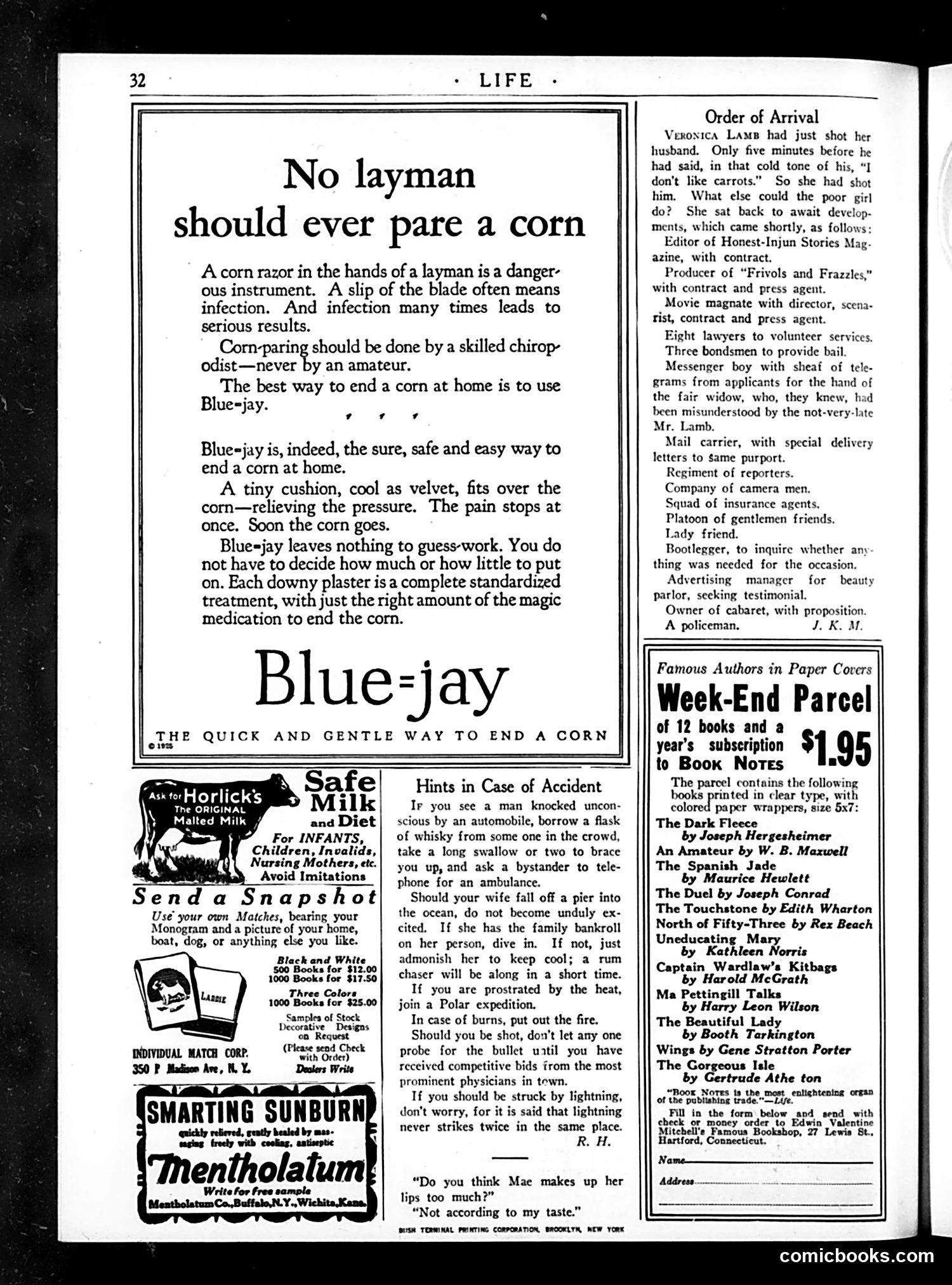
This page contains satirical humor typical of early 20th-century Life magazine, mixing practical advertisements with comedic short pieces. **Main Content:** The large Blue-Jay corn plaster advertisement dominates, presenting itself seriously as medical advice—warning that only professionals should treat corns, then promoting their product as the safe home alternative. **Satire:** The "Hints in Case of Accident" section mocks absurd upper-class behavior. It suggests drinking whisky when witnessing accidents, diving into the ocean only if your wife has money, seeking competitive bids from doctors before bullet removal, and other ridiculous "solutions" to emergencies. The humor targets wealthy people's priorities and casual indifference to danger. **"Order of Arrival"** satirizes the media circus around crime. When a woman named Veronica Lamb shoots her husband (over his criticism of carrots), the piece hilariously catalogs who arrives first—editors seeking stories, film producers, lawyers, insurance agents, even bootleggers and beauty parlor owners wanting testimonials. It mocks how sensational crimes attract opportunists and how the wealthy criminal can monetize notoriety. Both pieces employ exaggeration to critique social absurdities of the era.
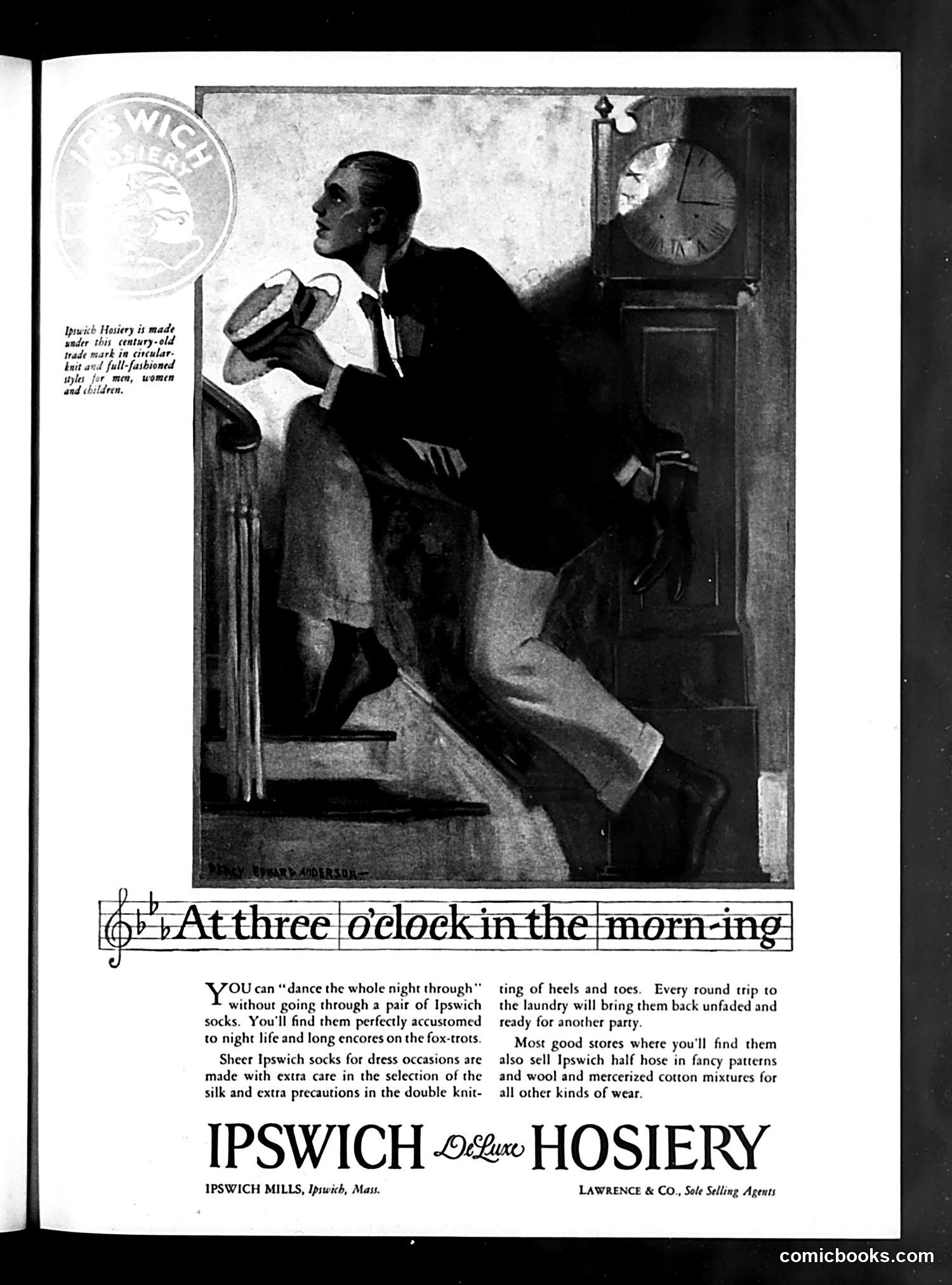
This is a **product advertisement**, not political satire. It promotes Ipswich brand socks and hosiery, emphasizing durability for active nightlife. The illustration depicts a well-dressed man at 3 AM, checking the time on a grandfather clock while holding Ipswich socks. The image supports the advertising claim that these socks withstand "dancing the whole night through" without wearing out—they survive "fox-trots" and repeated laundry cycles while remaining undamaged. The advertisement targets middle-class consumers during what appears to be the Jazz Age (based on the "dance the whole night through" language and fox-trot reference), positioning Ipswich hosiery as practical luxury goods for socialites. The century-old trade mark and claims about careful silk selection appeal to quality-conscious buyers. This is straightforward commercial messaging, not editorial commentary.
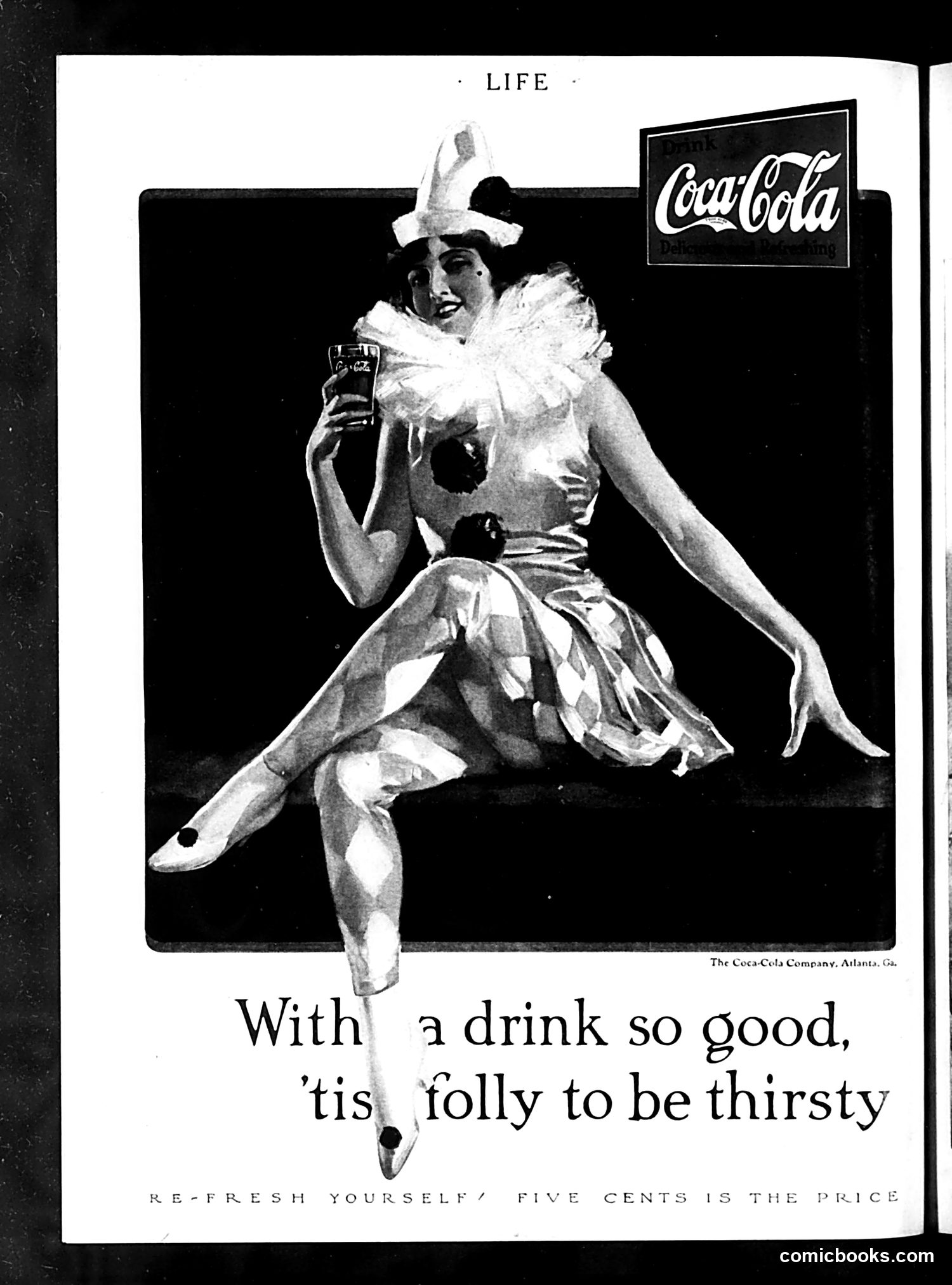
This is a **Coca-Cola advertisement**, not political satire. It features a woman in 1920s flapper attire—short skirt, decorative headpiece, and exaggerated pose—holding a Coca-Cola bottle. The ad uses the catchphrase "With a drink so good, 'tis folly to be thirsty," playing on the idea that Coca-Cola is so desirable one should always have one available. The imagery appeals to modernity and youth culture of the Jazz Age era. The woman's fashionable dress and animated posture represent the "new woman" of the 1920s. The price advertised ("FIVE CENTS") emphasizes affordability. This is straightforward commercial marketing using popular contemporary aesthetics to sell the product—no hidden political message or satirical critique is intended.