
Life, 1925-08-13 · page 8 of 36
Life — August 13, 1925 — page 8: what you’re looking at
What you’re looking at
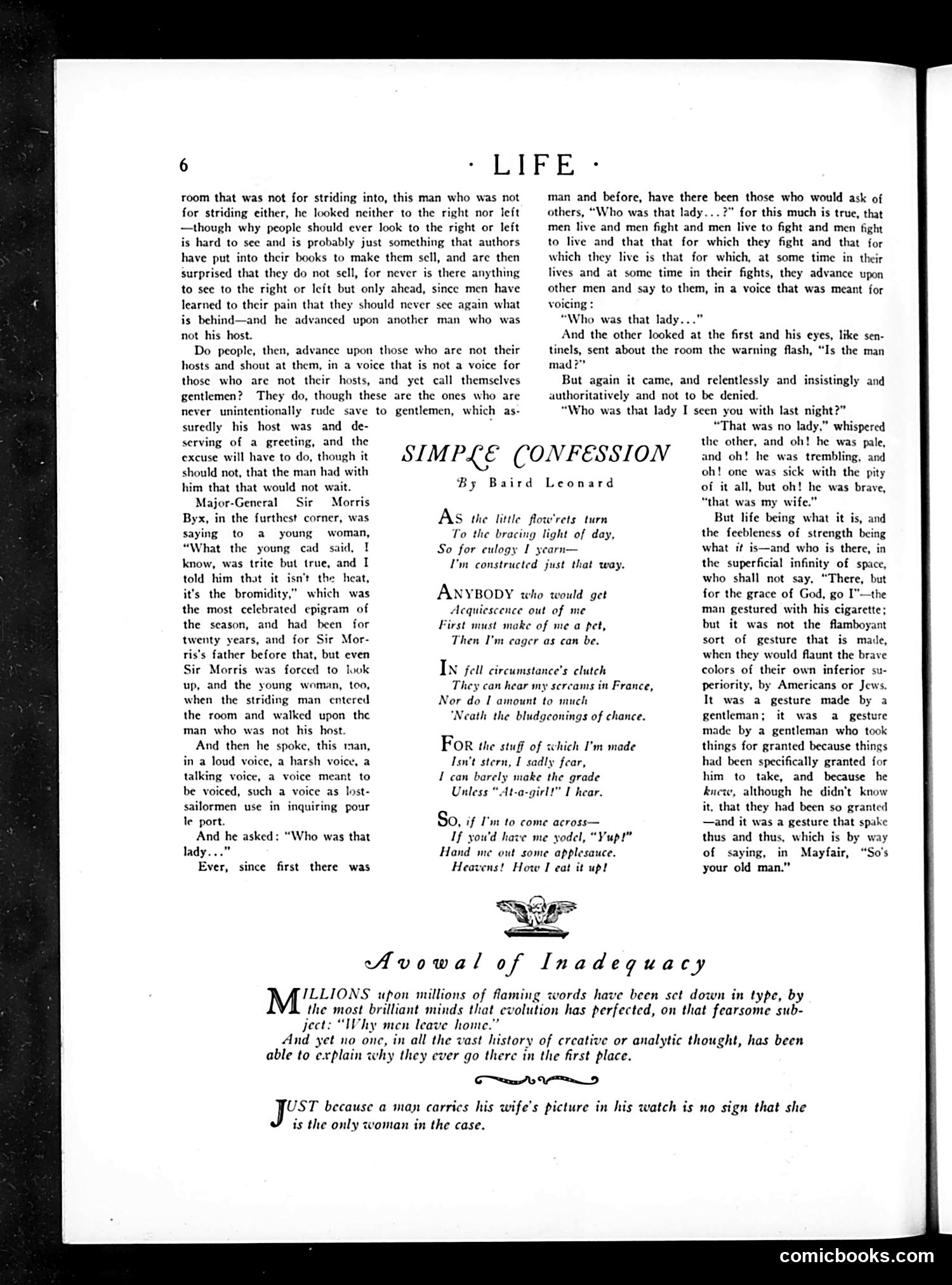
This page contains two literary pieces rather than political cartoons: 1. **"Simple Confession"** by Baird Leonard — a prose poem about a soldier confessing to another officer about an encounter with a woman ("that lady") the previous night. The narrative suggests romantic or scandalous behavior, with the confessor expressing both shame and bravery about his actions. 2. **"Avowal of Inadequacy"** — a brief philosophical piece critiquing intellectuals' inability to explain fundamental questions ("why they ever go there in the first place"), followed by a specific observation that carrying a wife's picture in one's watch doesn't prove she's "the only woman in the case." Both pieces use satire to mock masculine pretense, romantic rationalization, and intellectual pomposity characteristic of early 20th-century Life magazine's humor.
📄 Transcribed text from this page (OCR, searchable)
Machine-transcribed from the original scan — historical spelling and the odd misread are preserved.
6 LIFE, « room that was not for striding into, this man who was not for striding either, he looked neither to the right nor left —though why people should ever look to the right or left is hard to see and is probably just something that authors have put into their books to make them sell, and are then surprised that they do not sell, for never is there anything to see to the right or leit but only ahead, since men have learned to their pain that they should never see again what is behind—and he advanced upon another man who was not his host. Do people, then, advance upon those who are not their hosts and shout at them, in a voice that is not a voice for those who are not their hosts, and yet call themselves gentlemen? They do, though these are the ones who are never unintentionally rude save to gentlemen, which as- suredly his host was and de- . serving of a greeting, and the excuse will have to do, though it should not, that the man had with him that that would not wait. Major-General Sir Morris Byx, in the furthest corner, was saying to a young woman, “What the young cad said, 1 SIMPLE CONFESSION By Baird Leonard As the little flow'rets turn To the bracing light of day, So for eulogy I yearn— man and before, have there been those who would ask of others, “Who was that lady... ?” for this much is true, that men live and men fight and men live to fight and men fight to live and that that for which they fight and that for which they live is that for which, at some time in their lives and at some time in their fights, they advance upon other men and say to them, in a voice that was meant for voicing : “Who was that lady...” And the other looked at the first and his eyes, like sen- tinels, sent about the room the warning flash, “Is the man mad?” But again it came, and relentlessly and insistingly and authoritatively and not to be denied. “Who was that lady I seen you with last night?” “That was no lady,” whispered the other, and oh! he was pale, and oh! he was trembling, and oh! one was sick with the pity of it all, but oh! he was brave, “that was my wife.” But life being what it is, and the feebleness of strength being what it is—and who is there, in know, was trite but true, and I told him thot it isn’t the heat, it's the bromidity,” which was the most celebrated epigram of the season, and had been for twenty years, and for Sir Mor- ris's father before that, but even Sir Morris was forced to look up, and the young woman, too, when the striding man centered the room and walked upon the man who was not his host. And then he spoke, this tnan, in a loud voice, a harsh voice, a talking voice, a voice meant to be voiced, such a voice as lost- sailormen use in inquiring pour le port. And he asked: “Who was that lady...” Ever, since first there was I'm constructed just that way. ANYBODY who would get Acquiescence out of me First must make of mea pet, Then I’m cager as can be. IN fell circumstance's clutch They can hear my sercams in France, Nor do I amount to much ‘Neath the bludgconings of chance. For the stuff of which I'm made Isn't stern, 1 sadly fear, I can barely make the grade Unless “At-a-girl!” [ hear. So, if i'm to come across— If you'd have me yodel, “Yup!” Hand me out some applesauce. Heavens! How I eat it up! the superficial infinity of space, who shall not say, “There, but for the grace of God, go I"—the man gestured with his cigarette; but it was not the flamboyant sort of gesture that is made, when they would flaunt the brave colors of their own inferior su- periority, by Americans or Jews. It was a gesture made by a gentleman; it was a_ gesture made by a gentleman who took things for granted because things had been specifically granted for him to take, and because he knew, although he didn’t know it, that they had been so granted —and it was a gesture that spake thus and thus, which is by way of saying, in Mayfair, your old man.” Avowal of Inadeqguacy ILLIONS upon millions of flaming words have been sct down in type, by the most brilliant minds that evolution has perfected, on that fearsome sub- ject: “Why men leave home.” And yet no one, in all the vast history of creative or analytic thought, has been able to explain why they ever go there in the first place. Ca WD UST because a man carrics his wife’s picture in his watch is no sign that she is the only woman in the case. comicbooks.com