
Life, 1925-08-13 · page 16 of 36
Life — August 13, 1925 — page 16: what you’re looking at
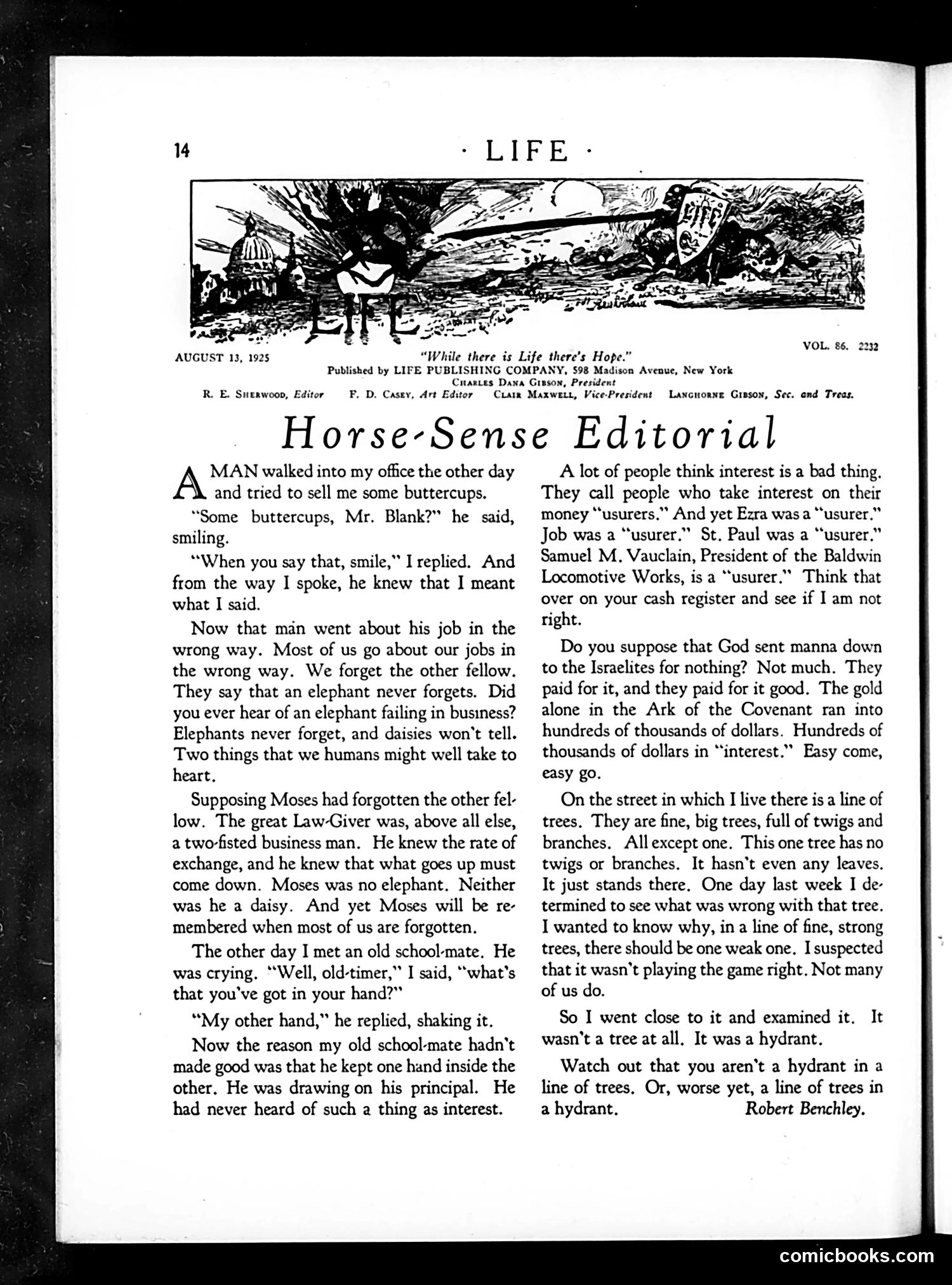
What you’re looking at
This editorial by Robert Benchley uses extended metaphors to critique professional attitudes and self-interest. The opening anecdote about selling buttercups illustrates how people misunderstand intentions through self-centered perspectives. Benchley's main argument concerns "interest" (both attention and financial gain). He defends people who take financial interest in their money, citing biblical figures like Ezra and St. Paul as precedent. The editorial then shifts to a street-level observation: among healthy trees stands one bare, dead specimen—which turns out to be a *hydrant*, not a tree at all. The hydrant metaphor warns against being a non-productive element disguised as something useful within a community or organization. The piece advocates practical self-awareness over pretense.
📄 Transcribed text from this page (OCR, searchable)
Machine-transcribed from the original scan — historical spelling and the odd misread are preserved.
~ hs AUGUST 13, 1925 VOL, 86. 2232 “While there is Life there's Hope.” Published by LIFE PUBLISHING COMPANY, $98 Madison Avenue, New York Cranes Dana Ginsox, President R. E. Suerwoop, Editor F. D. Casey, Art Editor Ciatr Maxweit, Vice-President Lancnorne Giason, Sec. ond Treas. Horse-Sense Editorial MAN walked into my office the other day and tried to sell me some buttercups. “Some buttercups, Mr. Blank?” he said, smiling. “When you say that, smile,” I replied. And from the way I spoke, he knew that I meant what I said. Now that man went about his job in the wrong way. Most of us go about our jobs in the wrong way. We forget the other fellow. They say that an elephant never forgets. Did you ever hear of an elephant failing in business? Elephants never forget, and daisies won't tell. Two things that we humans might well take to heart. Supposing Moses had forgotten the other fel- low. The great Law-Giver was, above all else, a two-fisted business man. He knew the rate of exchange, and he knew that what goes up must come down. Moses was no elephant. Neither was he a daisy. And yet Moses will be re- membered when most of us are forgotten. The other day I met an old school-mate. He was crying. ‘Well, old-timer,” I said, “what's that you've got in your hand?” “My other hand,” he replied, shaking it. Now the reason my old school-mate hadn't made good was that he kept one hand inside the other. He was drawing on his principal. He had never heard of such a thing as interest. A lot of people think interest is a bad thing. They call people who take interest on their money “usurers,”* And yet Ezra was a “usurer.” Job was a “usurer.” St. Paul was a “usurer.” Samuel M. Vauclain, President of the Baldwin Locomotive Works, is a “usurer.’’ Think that over on your cash register and see if I am not right. Do you suppose that God sent manna down to the Israelites for nothing? Not much. They paid for it, and they paid for it good. The gold alone in the Ark of the Covenant ran into hundreds of thousands of dollars. Hundreds of thousands of dollars in “interest.” Easy come, easy go. On the street in which I live there isa line of trees. They are fine, big trees, full of twigs and branches. Allexcept one. This one tree has no twigs or branches. It hasn't even any leaves. It just stands there. One day last week I de- termined to see what was wrong with that tree. I wanted to know why, in a line of fine, strong trees, there should be one weak one. I suspected that it wasn’t playing the game right. Not many of us do. So I went close to it and examined it. It wasn't a tree at all, It was a hydrant. Watch out that you aren't a hydrant in a line of trees. Or, worse yet, a line of trees in a hydrant. Robert Benchley. comicbooks.com