
Life, 1925-08-13 · page 20 of 36
Life — August 13, 1925 — page 20: what you’re looking at
What you’re looking at
This is a humorous essay by Robert Benchley satirizing scientific overconfidence and anthropomorphism. The piece mocks botanists debating whether plants can be "trusted" and whether they "sleep." The satire escalates absurdly: scientists test a pansy by manipulating light and sound, eventually concluding the flower is deliberately **cheating**—anticipating their tricks by drooping before curtains close. This obvious projection of human deception onto a plant represents the essay's target: scientists attributing intentional behavior to non-conscious organisms. The follow-up experiment with a "knee-worp" plant and pollen dish continues the joke, treating the missing pollen as evidence of plant agency rather than natural insect activity. Benchley's point: even educated people—here, botanists—can become so invested in their theories that they abandon reason and attribute consciousness and moral qualities (honesty, dishonesty) to inanimate nature. The humor lies in watching "serious" scientists construct elaborate explanations for simple botanical processes.
📄 Transcribed text from this page (OCR, searchable)
Machine-transcribed from the original scan — historical spelling and the odd misread are preserved.
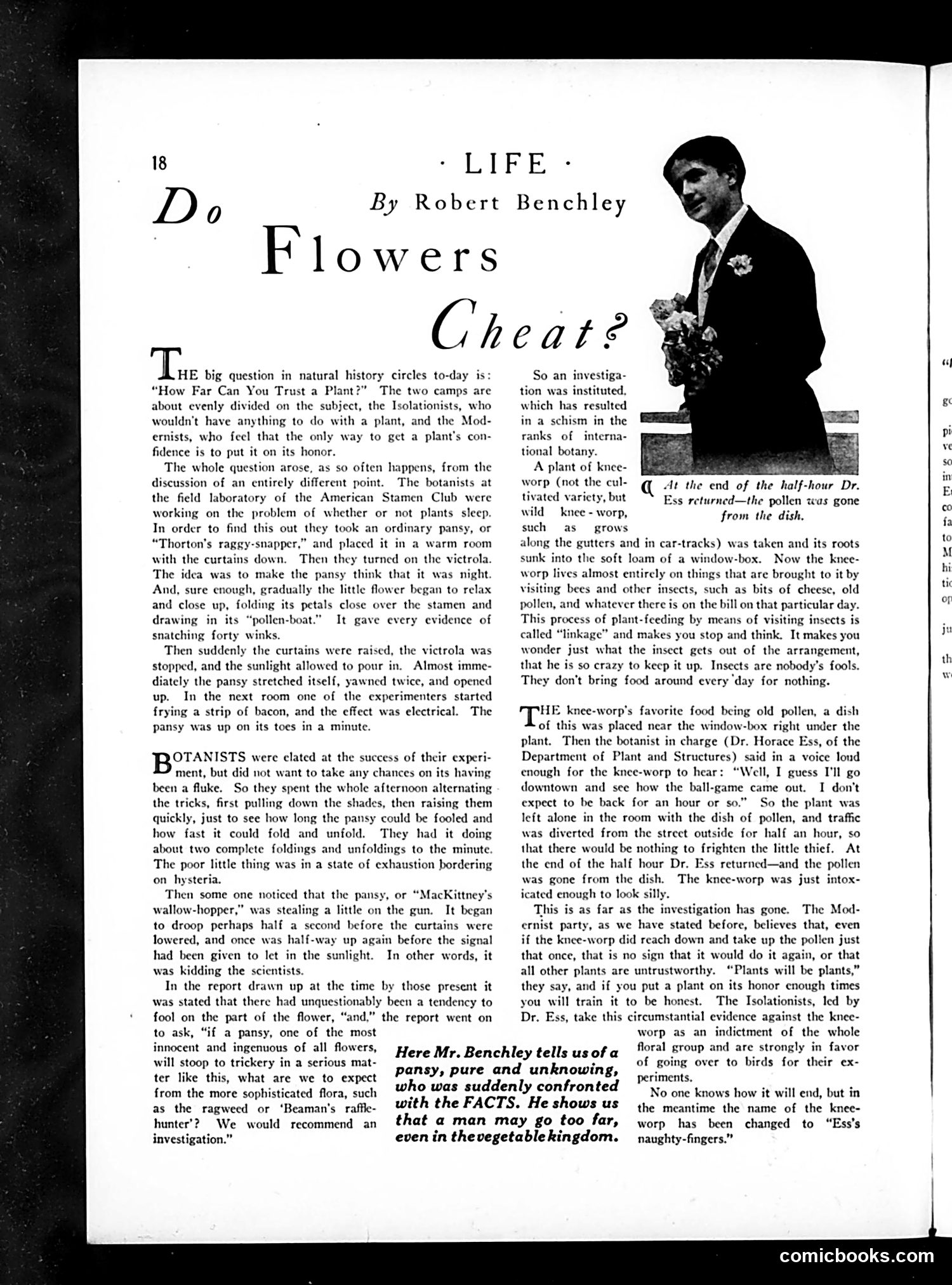
- LIFE - By Robert Benchley Flowers Cheat? Te. big question in natural history circles to-day is: “How Far Can You Trust a Plant?” The two camps are about evenly divided on the subject, the Isolationists, who wouldn't have anything to do with a plant, and the Mod- ernists, who feel that the only way to get a plant's con- fidence is to put it on its honor. The whole question arose, as so often happens, from the discussion of an entirely different point. The botanists at the field laboratory of the American Stamen Club were working on the problem of whether or not plants sleep. In order to find this out they took an ordinary pansy, “Thorton'’s raggy-snapper,” and placed it in a warm room with the curtains down. Then they turned on the victrola. The idea was to make the pansy think that it was night And, sure enough, gradually the little flower began to relax and close up, folding its petals close over the stamen and drawing in its “pollen-boat.” It gave every evidence of snatching forty winks. Then suddenly the curtains were raised, the victrola was stopped, and the sunlight allowed to pour in. Almost imme- diately the pansy stretched itself, yawned twice, and opened up. In the next room one of the experimenters started frying a strip of bacon, and the effect was electrical. The pansy was up on its toes in a minute. BOTANISTS were clated at the success of their expe: ment, but did not want to take any chances on its having been a fluke. So they spent the whole afternoon alternating the tricks, first pulling down the shades, then raising them quickly, just to see how long the pansy could be fooled and how fast it could fold and unfold. They had it doing about two complete foldings and unfoldings to the minute. The poor little thing was in a state of exhaustion bordering on hysteria. Then some one noticed that the pansy, or “MacKittney’s wallow-hopper,” was stealing a little on the gun. It began to droop perhaps half a second before the curtains were lowered, and once was half-way up again before the signal had been given to let in the sunlight. was kidding the scientists. In the report drawn up at the time by those present it was stated that there had unquestionably been a tendency to fool on the part of the flower, “and,” the report went on to ask, “if a pansy, one of the most innocent and ingenuous of all flowers, In other words, it So an investiga- tion was instituted, which has resulted in a schism in the ranks of interna- tional botany. A plant of knee- worp (not the cul- tivated variety, but wild — knee - worp, such as grows along the gutters and in car-tracks) was taken and its roots sunk into the soft loam of a window-box. Now the knee- worp lives almost entirely on things that are brought to it by visiting bees and other insects, such as bits of cheese, old pollen, and whatever there is on the bill on that particular day. This process of plant-feeding by means of visiting insects is called “linkage” and makes you stop and think. It makes you wonder just what the insect gets out of the arrangement, that he is so crazy to keep it up. Insects are nobody's fools. They don't bring food around every ‘day for nothing. At the end of the half-hour Dr. Ess returned—the pollen was gone from the dish. HE knee-worp's favorite food being old pollen, a dish of this was placed near the window-box right under the plant. Then the botanist in charge (Dr. Horace Ess, of the Department of Plant and Structures) said in a voice loud enough for the knee-worp to hear: “Well, I guess I'll go downtown and see how the ball-game came out. I don't expect to be back for an hour or so.” So the plant was left alone in the room with the dish of pollen, and traffic was diverted from the strect outside for half an hour, so that there would be nothing to frighten the little thief. At the end of the half hour Dr. Ess returned—and the pollen was gone from the dish. The knee-worp was just intox- icated enough to look silly. This is as far as the investigation has gone. The Mod- ernist party, as we have stated before, believes that, even if the knee-worp did reach down and take up the pollen just that once, that is no sign that it would do it again, or that all other plants are untrustworthy. “Plants will be plants,” they say, and if you put a plant on its honor cnough times you will train it to be honest. The Isolationists, led by Dr. Ess, take this circumstantial evidence against the knee- worp as an indictment of the whole floral group and are strongly in favor will stoop to trickery in a serious mat- ter like this, what are we to expect from the more sophisticated flora, such as the ragweed or ‘Beaman's raffk- hunter’? We would recommend an investigation.” Here Mr. Benchley tells us of a pansy, pure and unknowing, who was suddenly confronted with the FACTS. He shows us that a man may go too far, even in thevegetablekingdom. of going over to birds for their ex- periments, No one knows how it will end, but in the meantime the name of the knee- worp has been changed to “Ess’s naughty-fingers.” comicbooks.com