
A complete issue · 37 pages · 1925
Life — June 25, 1925
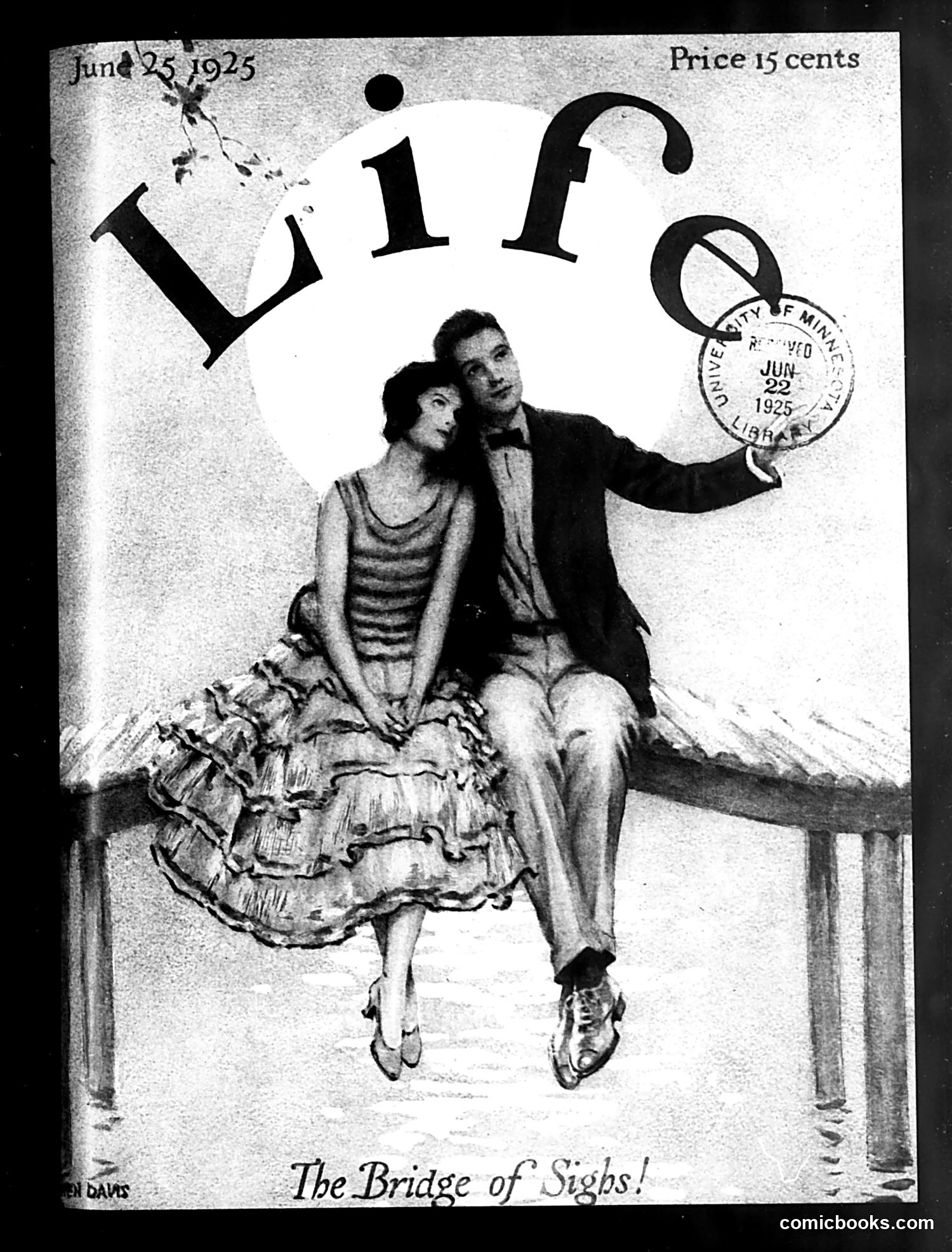
This cover illustrates the romantic notion of a couple in love, seated together on what appears to be a wooden bridge or railing overlooking a scenic landscape. The title "The Bridge of Sighs" is a literary reference to romantic longing and melancholy affection—traditionally associated with Venice's famous bridge. The satire likely mocks sentimental romance or the idealized couple, popular in 1920s culture. The man gazes upward dreamily while holding the large "LIFE" text overhead like the moon or a romantic symbol. This playfully critiques either excessive sentimentality in love or contemporary dating customs of the Jazz Age era. The 15-cent price and June 1925 date anchor this as period commentary on romance and courtship conventions.
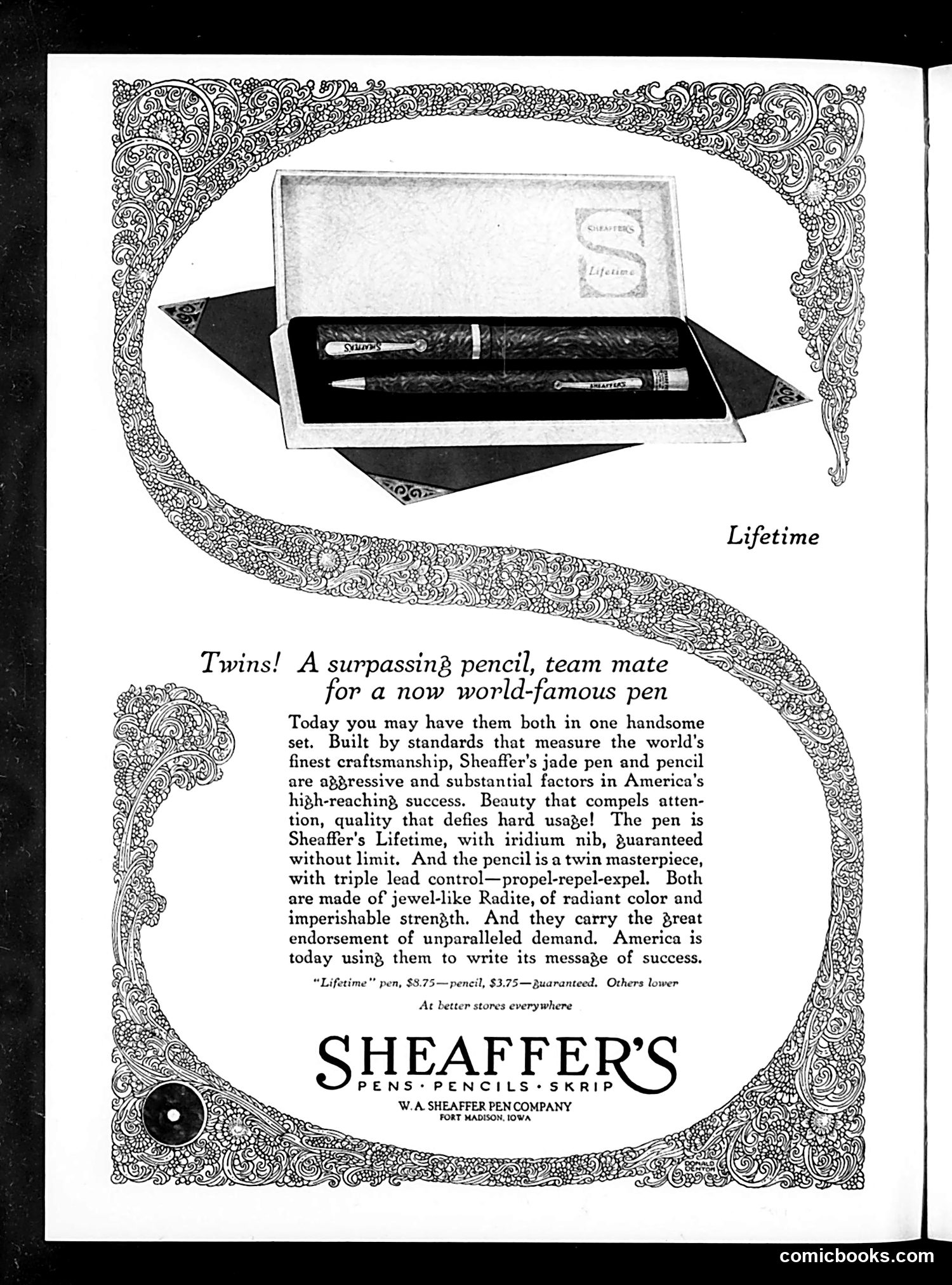
This is **not a cartoon or satirical content** — it's a straightforward **advertisement** for Sheaffer pens and pencils from the W.A. Sheaffer Pen Company of Fort Madison, Iowa. The ad promotes a "Lifetime" product set containing both a fountain pen and mechanical pencil sold together. It emphasizes quality craftsmanship, durability ("guaranteed without limit"), and uses aspirational language about success ("America's high-reaching success"). The ornate decorative border is typical of early-to-mid 20th century advertising design. Pricing is listed as "$3.75" for the pen and "$1.75" for the pencil. There are no political references, caricatures, or satire present. This is purely commercial marketing in Life magazine's advertising section.
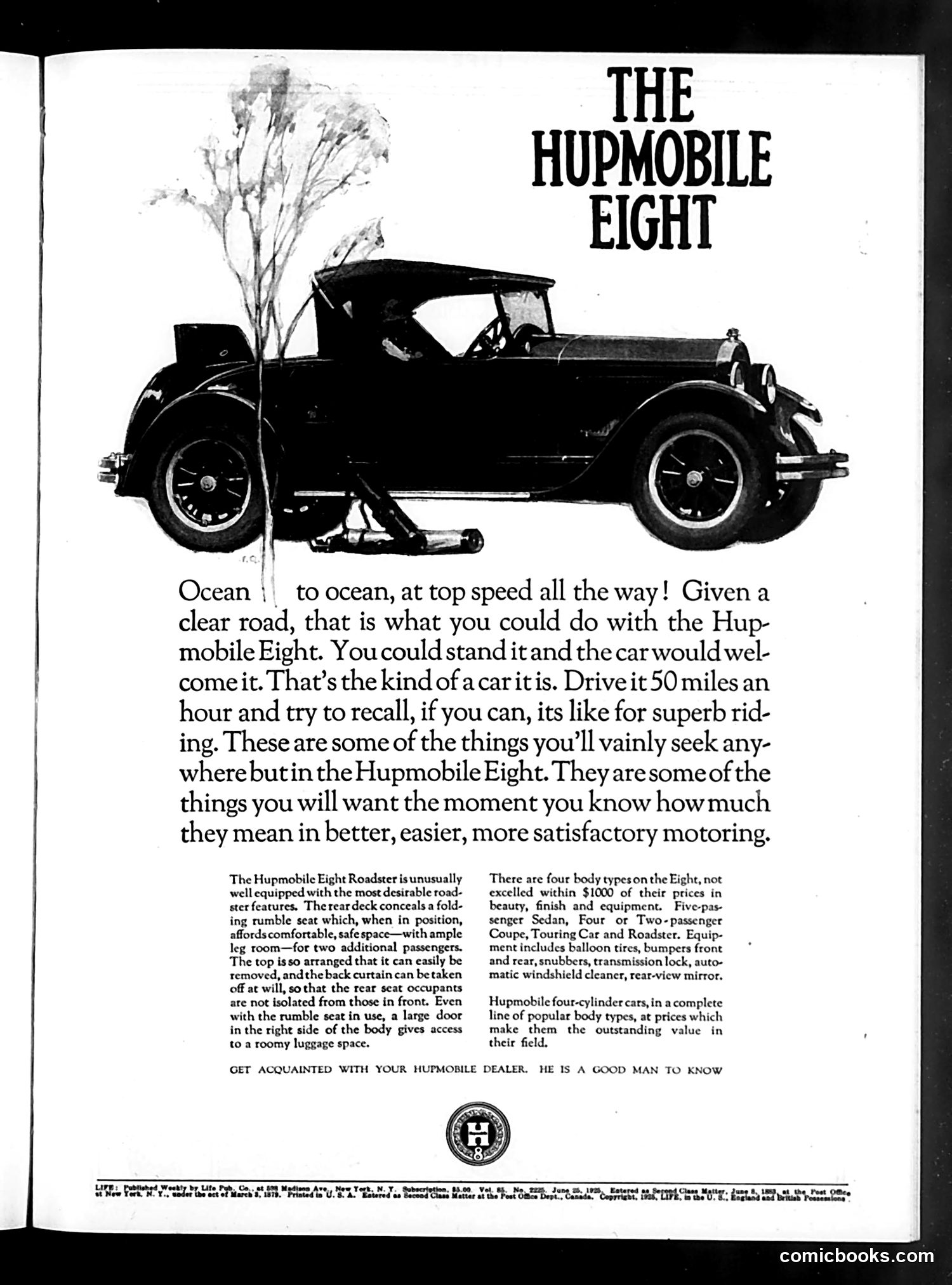
This is **not a political cartoon or satire**—it's a **straightforward automobile advertisement** for the Hupmobile Eight, a luxury car from the 1920s-1930s era. The ad emphasizes the car's superior performance and comfort features: it can achieve "top speed" on clear roads, offers a smooth 50 mph ride, includes a rumble seat and spacious luggage area, and comes in four body styles under $1000. The illustration shows the open roadster model with characteristic period styling. The copy appeals to buyers seeking reliability and "satisfactory motoring"—typical marketing language for upscale automobiles of this era. There is no satire, political commentary, or caricature present. This represents standard Life magazine advertising content from the early automotive age.
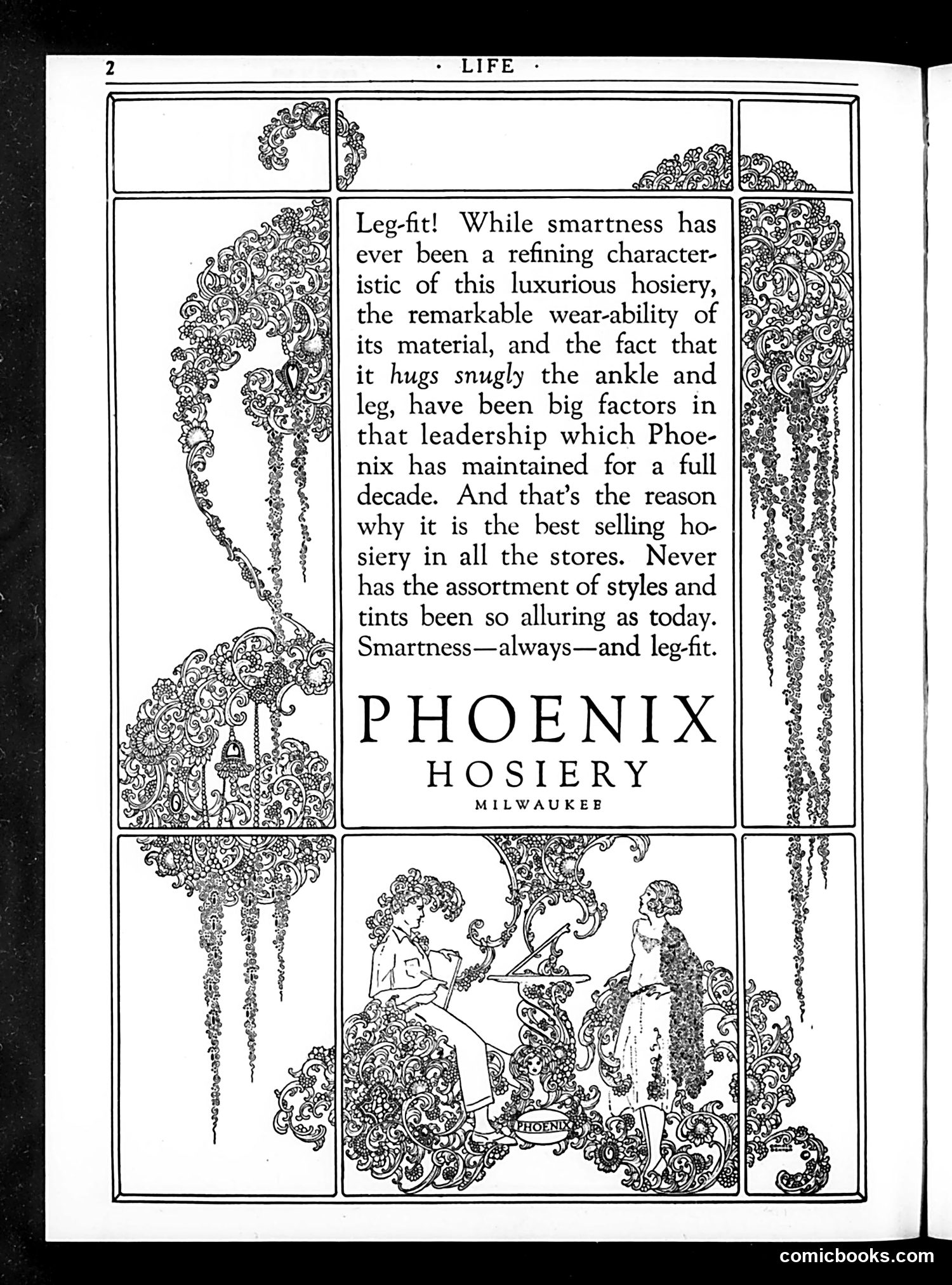
This page is primarily an **advertisement for Phoenix Hosiery** from Milwaukee, not satire or political commentary. The ad emphasizes the product's "smartness" and practical "leg-fit" qualities—features that apparently distinguished Phoenix hosiery in the marketplace. The ornamental Art Deco borders frame images of women's legs and a classical scene depicting figures in a garden setting, typical of 1920s advertising aesthetics. The "joke" or selling point is that Phoenix hosiery combines refinement with durability and comfort. The ad claims it's the "best selling hosiery in all the stores" due to its snug fit and variety of styles and colors. This is straightforward commercial messaging, not political satire—it reflects early twentieth-century marketing approaches to women's fashion products.
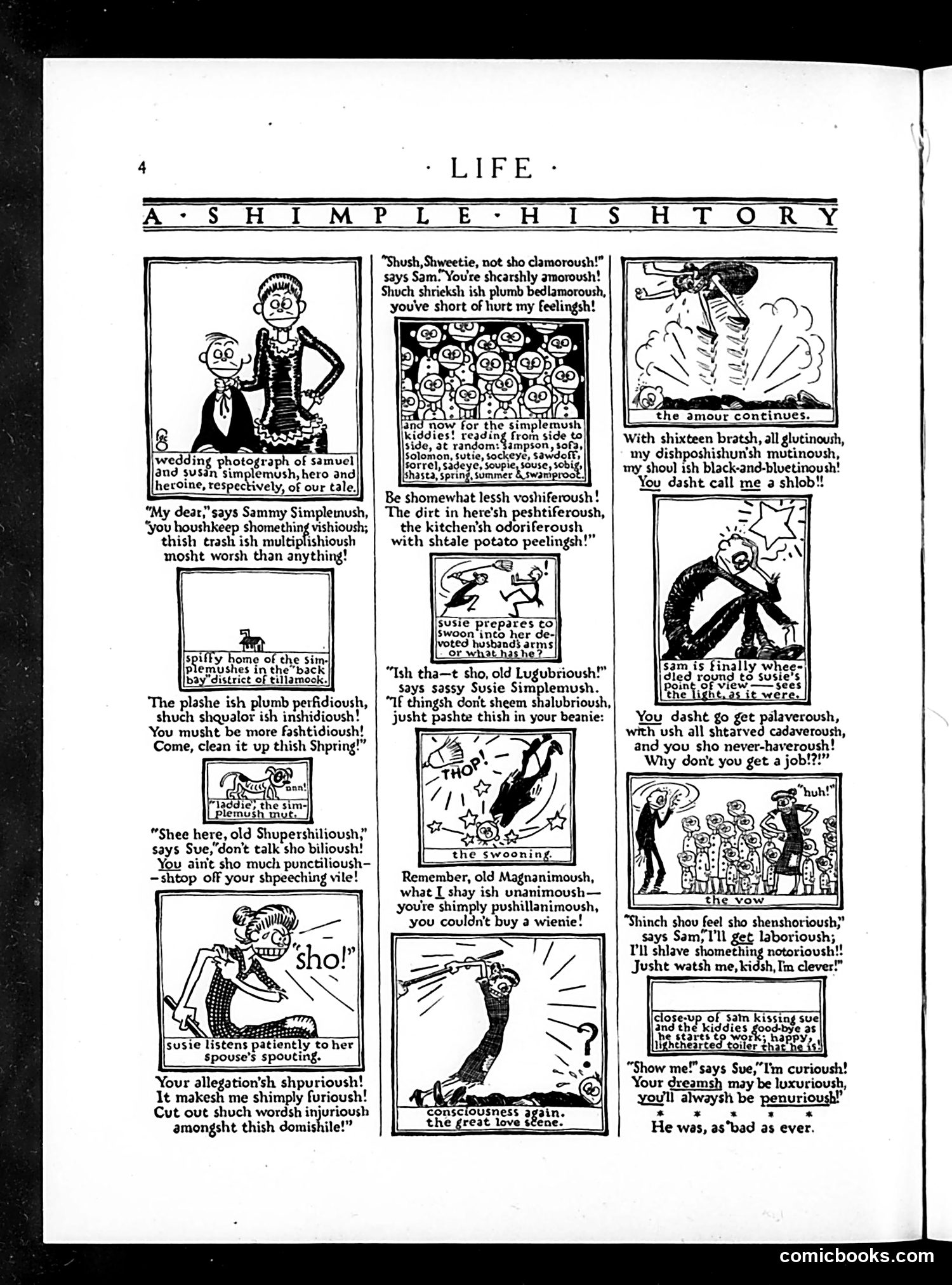
This is a humorous comic strip titled "A Simple History" that appears to satirize nouveau riche or socially ambitious characters named Sammy and Susie Simplemush. The narrative mocks their pretensions through exaggerated malapropisms and mispronunciations—deliberately mangling words like "glamorous" into "glamorousth" and "vicious" into "voshiferous." The strip follows their social climbing: a wedding photograph, Susie's attempts at sophisticated entertaining (reading "high-brow" literature), household management struggles, and ultimately Sam being rejected for employment. The satire targets social climbers who adopt affected speech patterns while remaining fundamentally crude and unsuccessful. The heavy reliance on written dialogue with theatrical spelling-out of mispronunciations was typical early-20th-century American humor mocking working-class aspirations toward gentility.
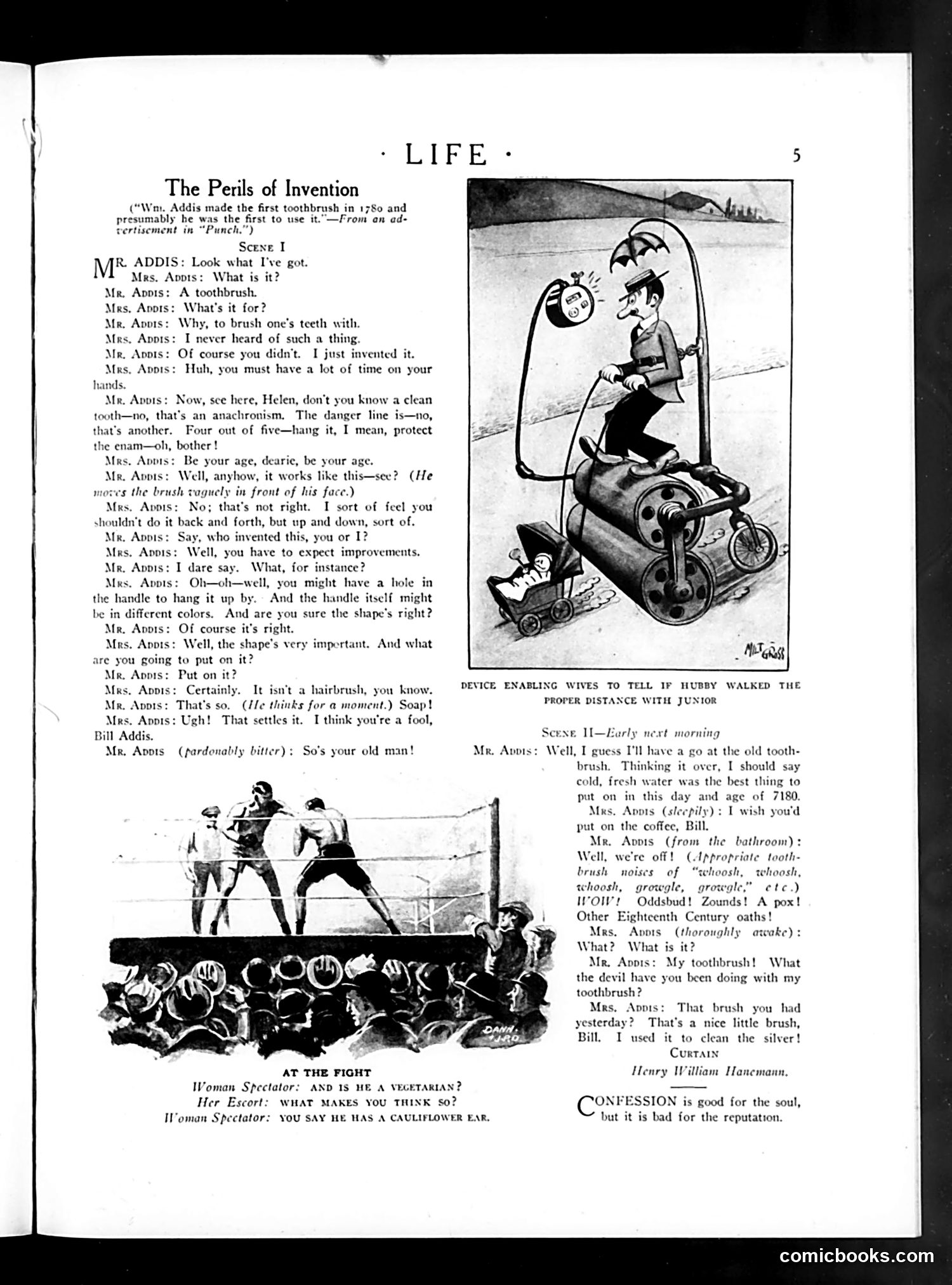
This page satirizes the unintended consequences of new inventions through two comic scenarios: **Top cartoon**: Mr. Addis, who invented the toothbrush in 1780, demonstrates it to his wife. The joke centers on her absurd "improvements"—suggesting a hole to hang it by, different handle colors, and even applying it like a hairbrush or soap. The satire mocks how inventors' simple ideas spawn ridiculous elaborations and over-engineering by others. **Bottom cartoon**: Shows boxing spectators debating whether a fighter is vegetarian based on his cauliflower ear. This satirizes people's tendency to draw silly conclusions from superficial details. Both sketches humorously critique human nature: our impulse to "improve" functional inventions unnecessarily, and our habit of making unfounded assumptions. The tone is lighthearted domestic comedy rather than serious social commentary.
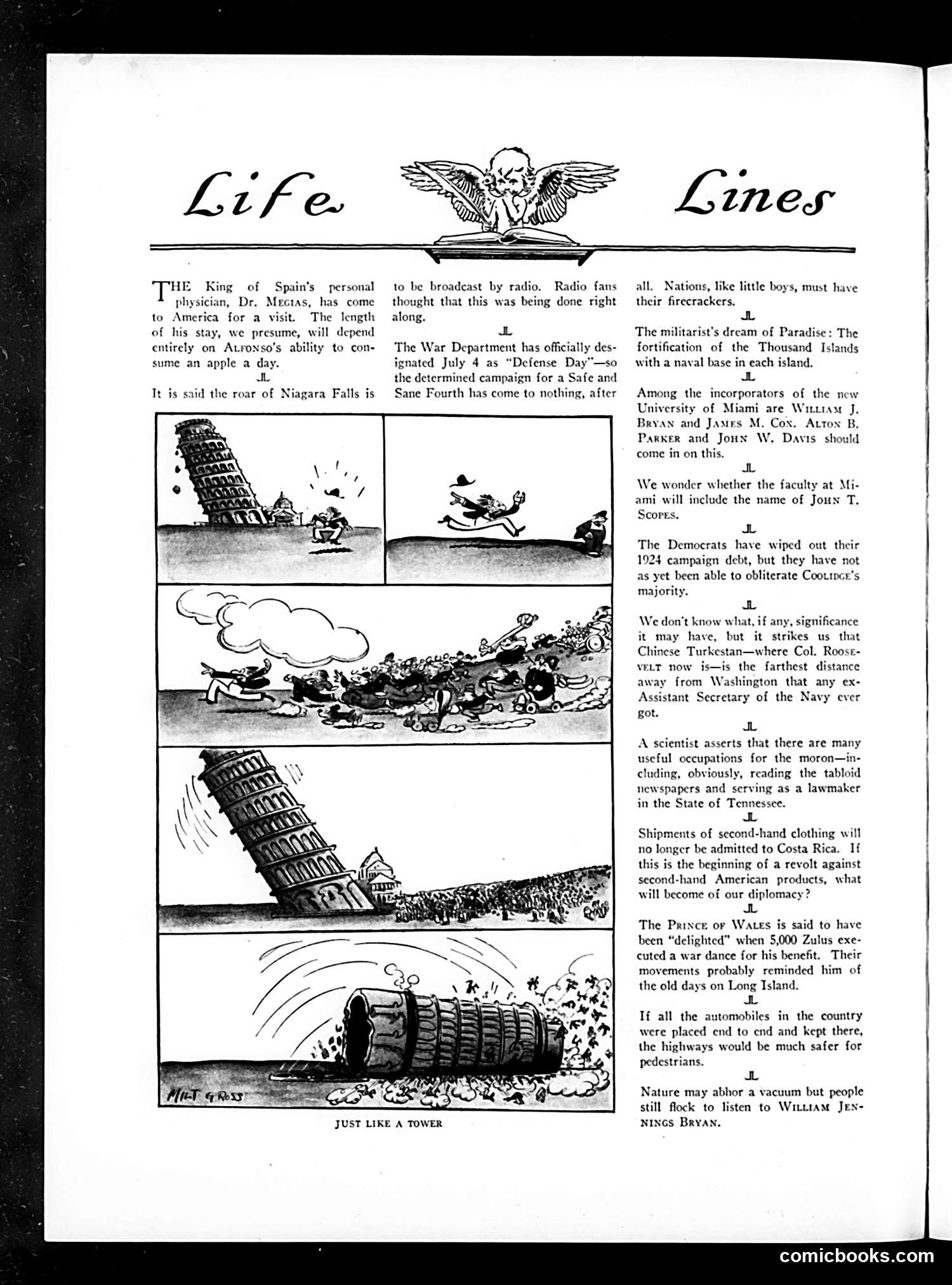
This page features a four-panel cartoon titled "Just Like a Tower" depicting the **Leaning Tower of Pisa progressively falling over**. The sequence shows the famous Italian landmark tilting further with each panel until it crashes completely in the final frame. The satire likely comments on **Italian political or military instability** during this era (appears to be 1920s based on references). The accompanying "Life Lines" column contains brief topical jokes about American politics, including references to Democratic campaign debt and the Prince of Wales. The tower cartoon uses the famous structure as a metaphor for collapse—possibly critiquing Mussolini's Italy or broader European political deterioration of the period.
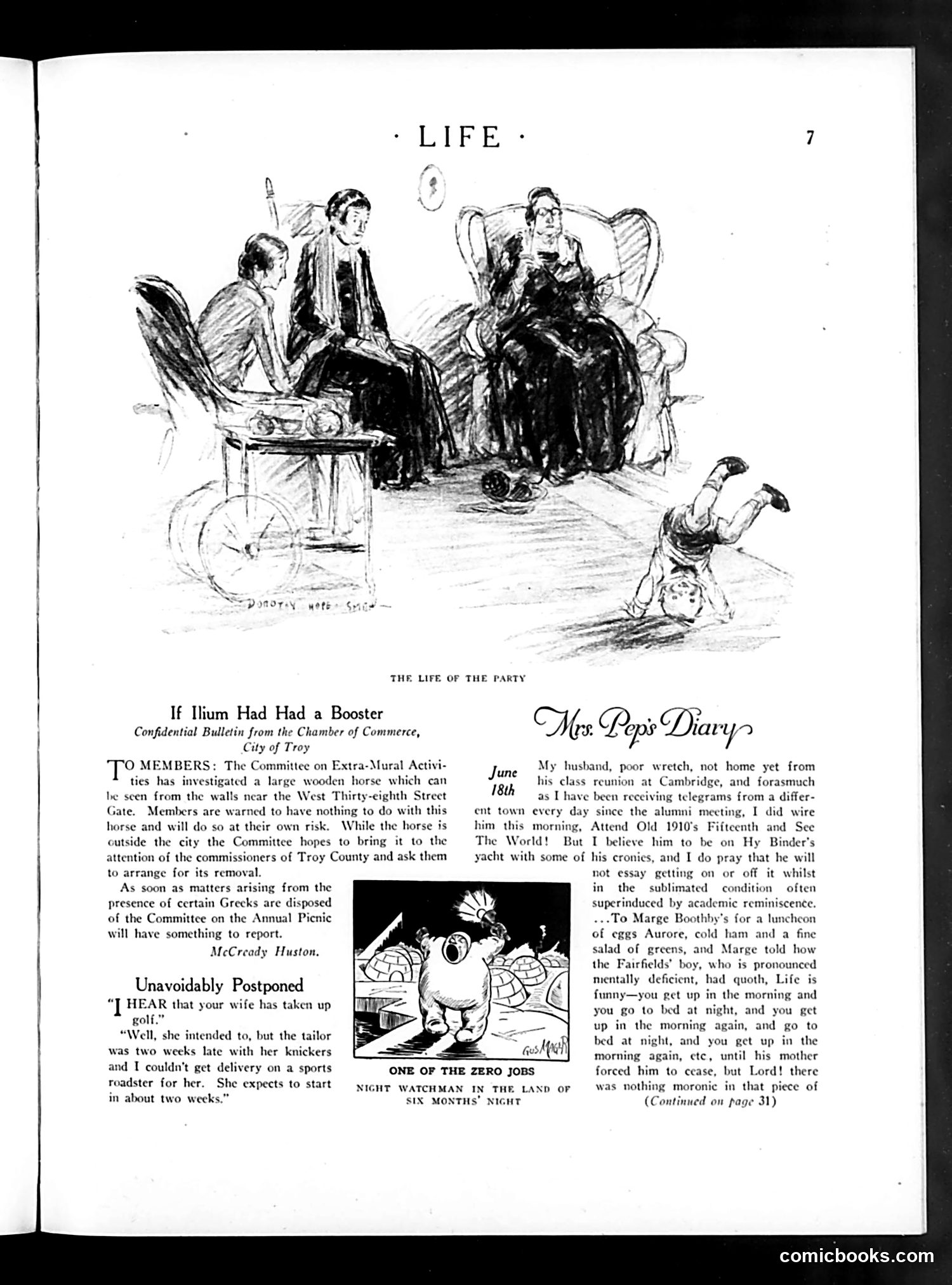
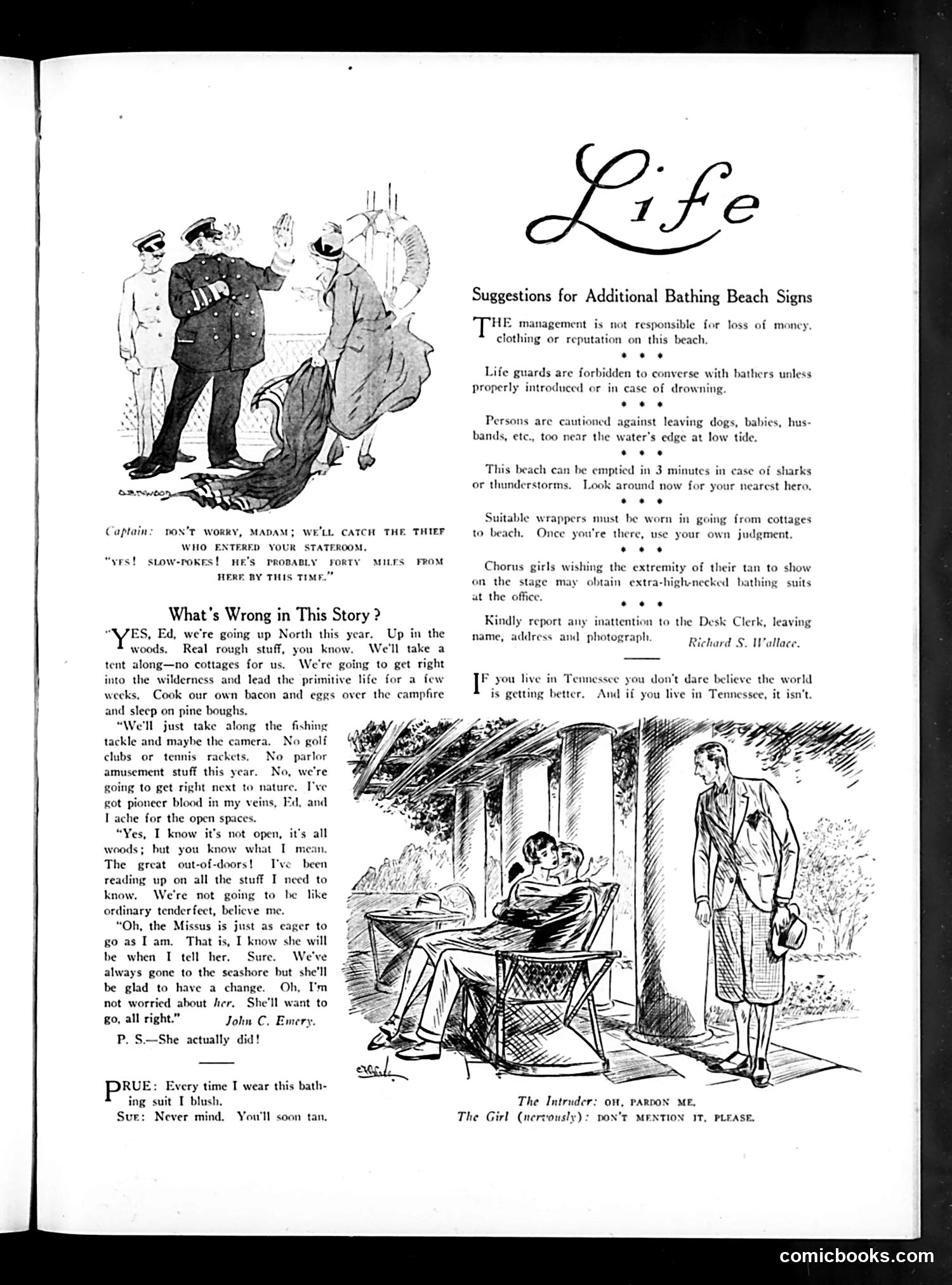
This page contains three separate pieces of humor: 1. **"The Life of the Party"** (top sketch): Shows adults gathered indoors while a child performs a headstand outside—visual satire on how children often entertain themselves more genuinely than adult social gatherings. 2. **"If Ilium Had Had a Booster"**: A humorous "confidential bulletin" from Troy's Chamber of Commerce, satirizing modern booster clubs and civic promotion by imagining ancient Troy with such contemporary promotional tactics. 3. **"Unavoidably Postponed"**: A domestic joke about a wife's delayed errand—the tailor's delivery took two weeks, preventing her from getting a sports roadster. 4. **"One of the Zero Jobs"**: A cartoon about night watchmen, with the caption indicating tedious, purposeless work (likely six months of inactivity). 5. **"Mrs. Pops Diary"**: A dated social commentary entry about Cambridge alumni and domestic life.
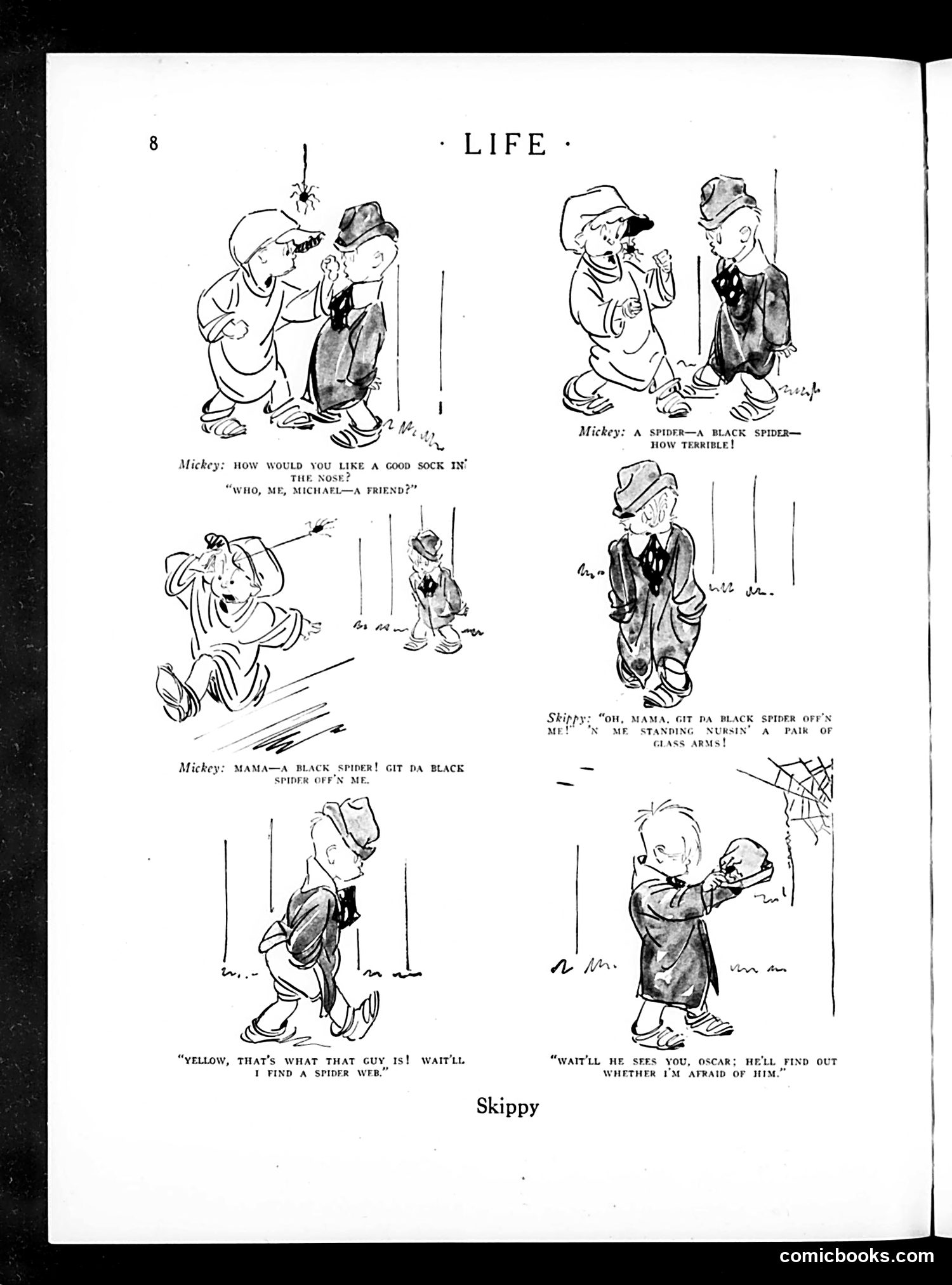
This page presents a multi-panel comic strip titled "Skippy" featuring a young boy character and his interactions with spiders. The humor relies on children's fear of spiders and misunderstandings of language. The strip's joke centers on Skippy attempting to punch a spider ("sock in the nose") after mishearing a friend's offer of friendship. Subsequent panels show Skippy's mother alarmed by spiders, and Skippy trying to locate one to prove his bravery or resolve the situation. The final panel features another character (Shiffy) discussing spider webs with comic misunderstandings about fear. The satire gently mocks childhood logic, miscommunication, and exaggerated reactions to common household pests. No specific political reference is evident—this appears to be straightforward humor about children's behavior and anxieties.
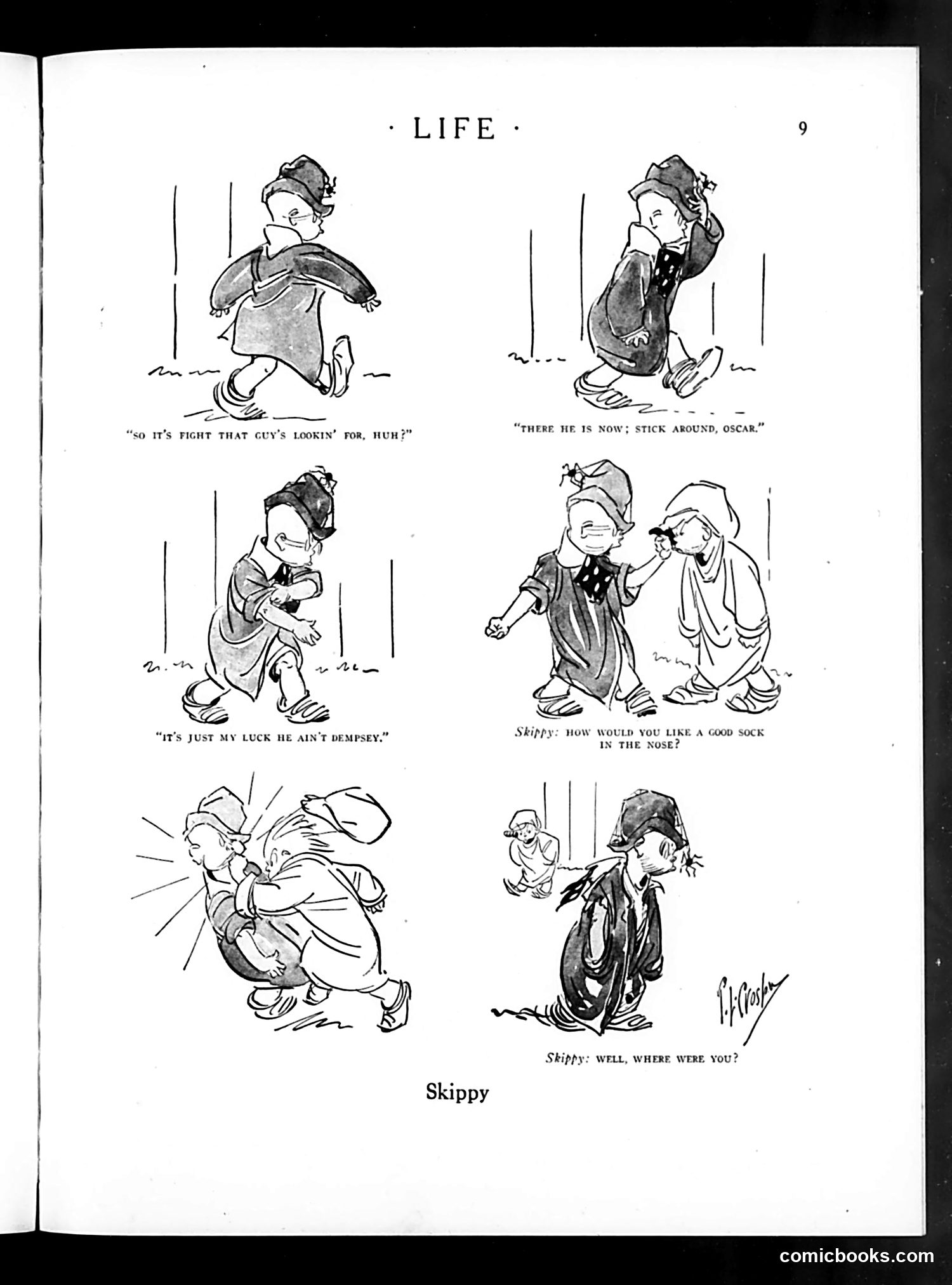
This is a comic strip titled "Skippy" depicting a young boy's misadventures. The six-panel sequence shows Skippy searching for someone (apparently a friend named Oscar or possibly "that guy"), encountering various characters, and ultimately getting into trouble—culminating in what appears to be a physical altercation where he's hit or struck. The humor relies on slapstick and wordplay typical of 1920s-30s children's comics. References include "Dempsey" (likely boxer Jack Dempsey, used as a comparison), and the dialogue captures period-appropriate slang ("sock in the nose"). The strip's appeal lay in depicting relatable childhood scenarios—searching for friends, mischief, and unexpected consequences—without deeper political or social commentary.
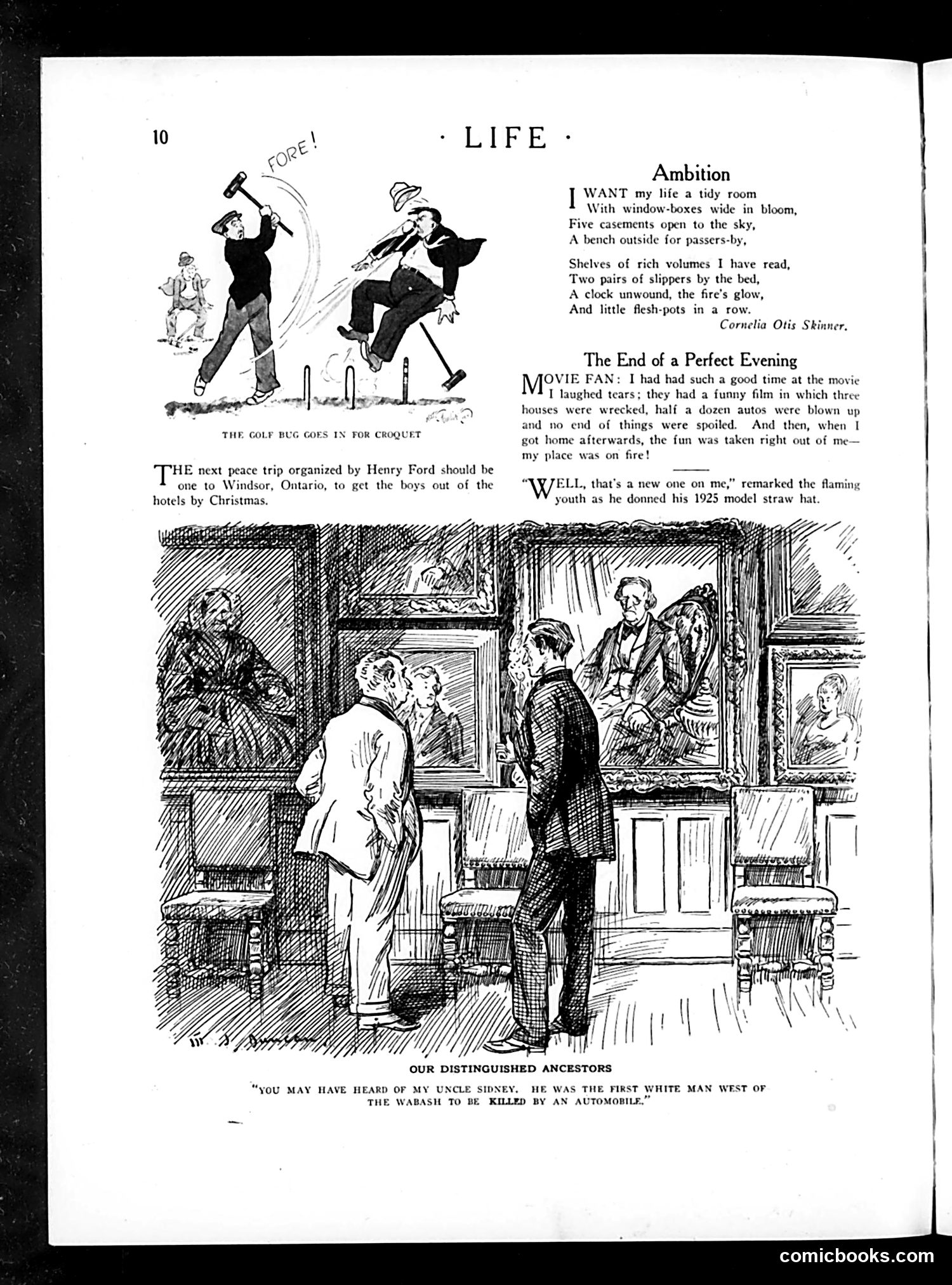
This page contains three distinct pieces of humor content: **Top cartoon ("The Golf Bug Goes In for Croquet"):** Shows a golfer obsessively practicing golf using croquet equipment, depicting how recreational enthusiasts become consumed by their hobbies. **Middle text sections:** Include a poem titled "Ambition" listing modest domestic desires, and "The End of a Perfect Evening," a humorous anecdote about a moviegoer whose evening is ruined when their house catches fire—satirizing the unpredictability of fate and modern anxieties. **Bottom cartoon ("Our Distinguished Ancestors"):** Depicts people in an art gallery discussing ancestry. The caption reveals dark humor: a speaker boasts his uncle was "the first white man west of the Wabash to be killed by an automobile," satirizing both family pride and the novel danger automobiles posed in early 20th-century America.
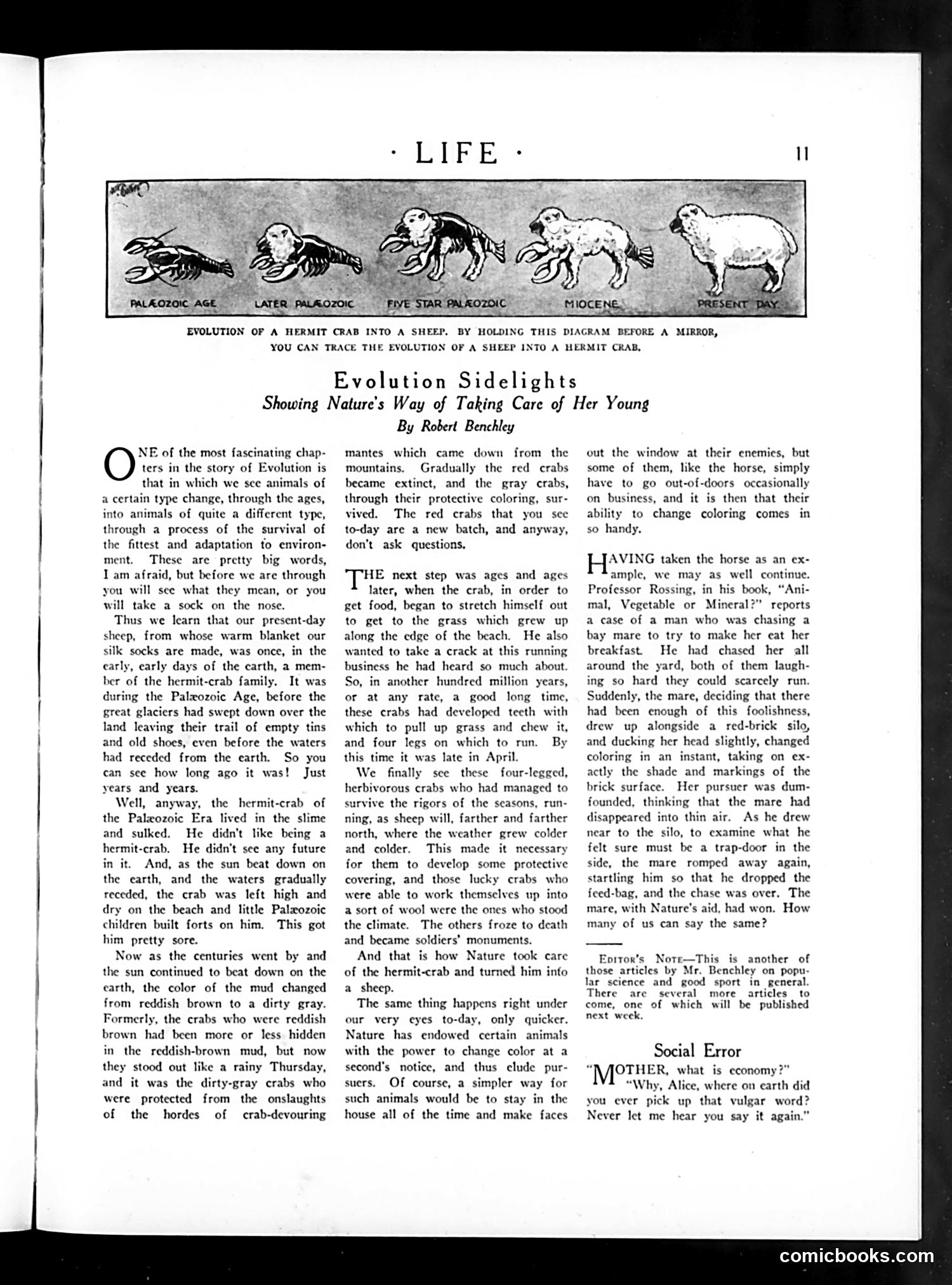
This page contains **two unrelated pieces** from *Life* magazine: 1. **"Evolution Sidelights"** - A humorous essay by Robert Benchley about evolutionary adaptation, using hermit crabs and sheep as examples. The diagram at top shows the reverse process: "Evolution of a Hermit Crab into a Sheep." The satire mocks both evolutionary theory and human pretension—Benchley suggests that observing the diagram in a mirror reveals how humans similarly "evolved" from lower creatures. It's gentle mockery of popular misunderstandings of Darwin, presenting evolution as whimsical rather than scientific. 2. **"Social Error"** - A brief joke where a mother corrects her daughter Alice for using the word "economy," calling it "vulgar." This satirizes upper-class affectation and the arbitrary social rules governing "proper" speech among the wealthy. Both pieces are light social satire typical of *Life's* 1920s-era humor.
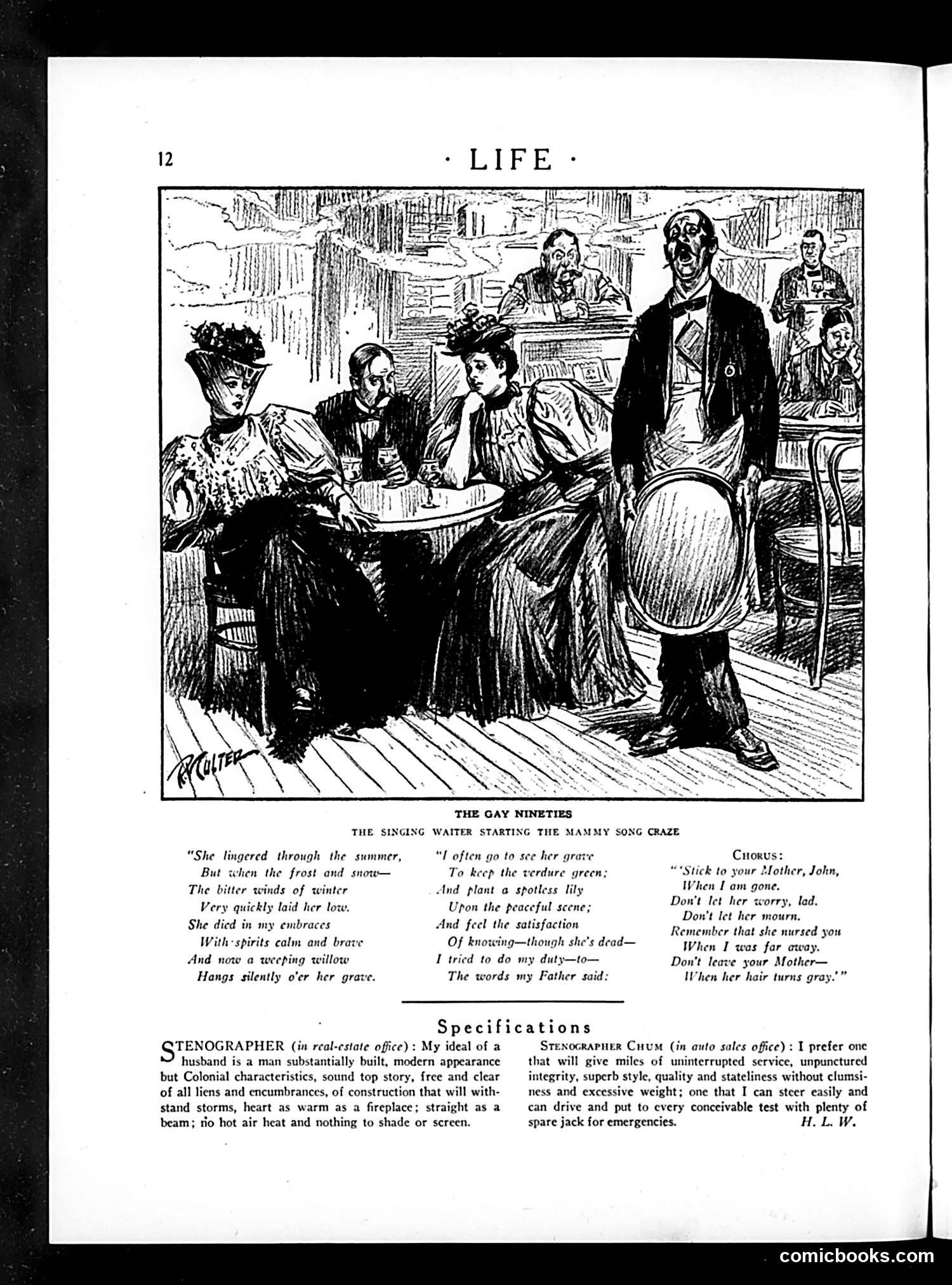
This illustration depicts a sentimental Victorian-era scene where a waiter performs a popular song in what appears to be a restaurant or café. The sketch satirizes the commercial nostalgia and sentimentality of 1890s popular culture—specifically the "mammy song" craze, which romanticized antebellum Southern life through emotionally manipulative ballads. The lyrics shown deal with lost love and mourning, presented as tearjerking entertainment. The cartoon mocks how such performances became fashionable spectacles for urban audiences seeking manufactured emotional experiences. The "specifications" section below appears to contain period advertisements, suggesting the page documents both entertainment trends and consumer culture of the era.
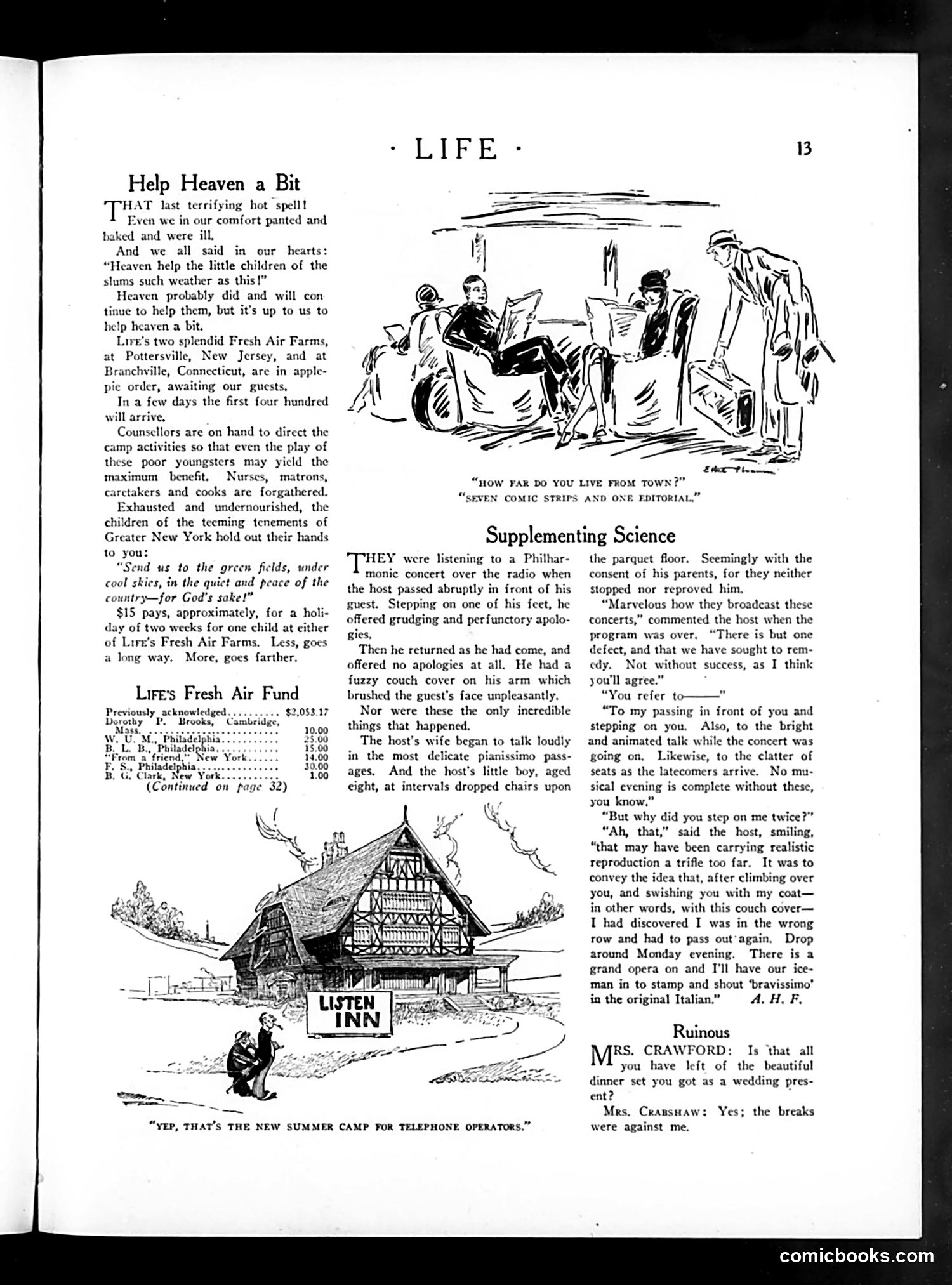
This page contains two cartoons and short stories satirizing early 20th-century American social issues. The top cartoon depicts wealthy urbanites asking poor children from the city slums, "How far do you live from town?" and "Seven comic strips and one editorial." It mocks how comic strips and newspapers had become the primary entertainment and education for impoverished urban children—suggesting this constituted their entire world. The lower cartoon shows "Listen Inn," a summer camp facility, captioned "Yep, that's the new summer camp for telephone operators." This satirizes the growing professionalization of women's labor and the expansion of corporate summer camps, poking fun at how even leisure time was becoming commercialized and job-focused. Both cartoons critique consumerism and industrialization's impact on working and poor Americans.
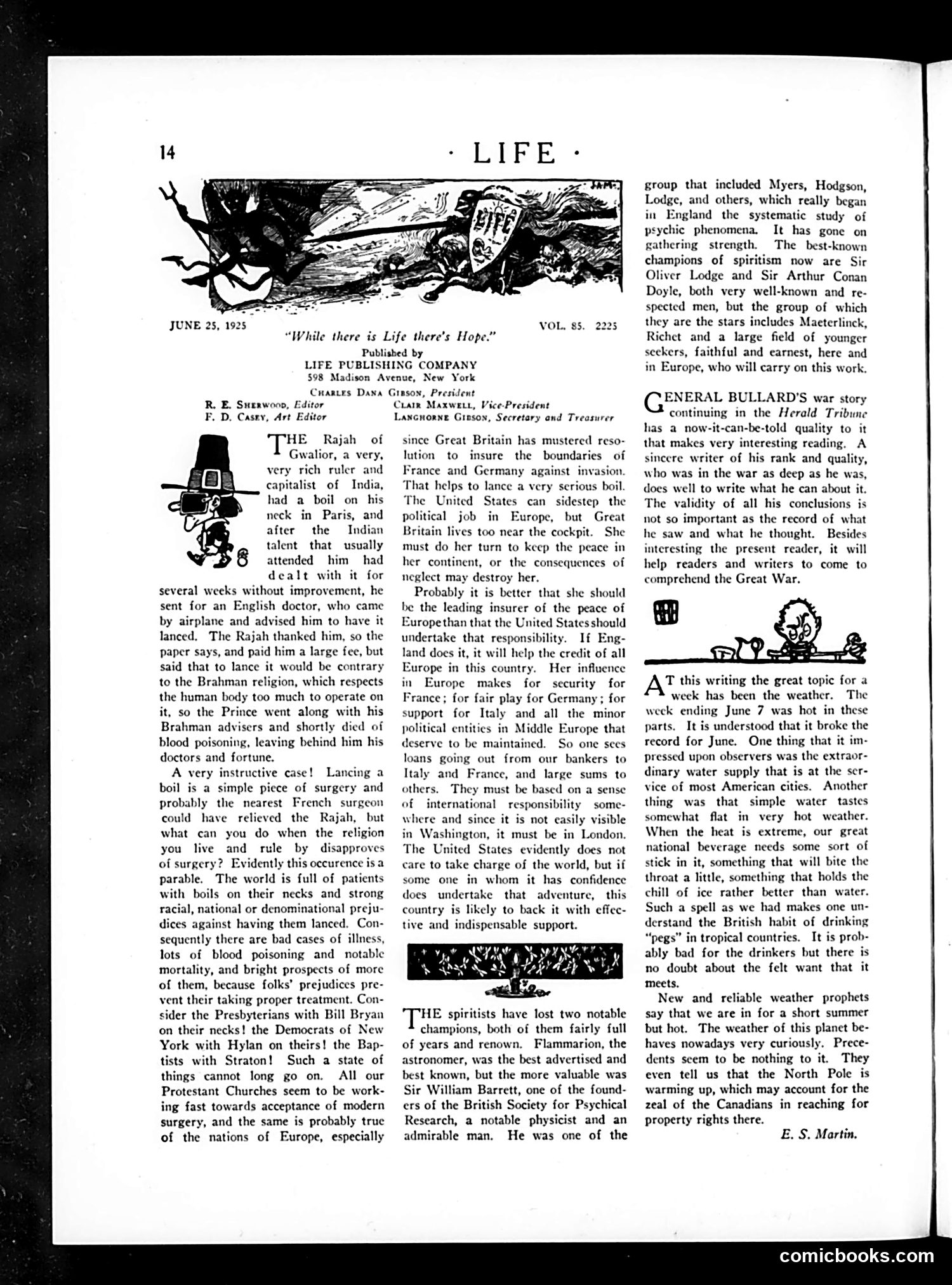
The main cartoon depicts **the Rajah of Indore**, a wealthy Indian ruler, receiving medical treatment in Paris. The satire criticizes British imperial policy: the Rajah's wealth from India allows him to afford expensive European doctors, while the text notes he required surgery for a boil—suggesting that despite his riches, modern medicine couldn't solve a simple problem. The cartoon mocks both **the Rajah's excessive spending abroad** and **British colonial extraction of wealth** from India. It questions whether religious prohibitions (the Brahman faith) should govern medical treatment, implying superstition hinders progress. The broader point: Britain's colonial relationship with India enriches Indian rulers but leaves fundamental problems unresolved, while wealth flows to European centers.
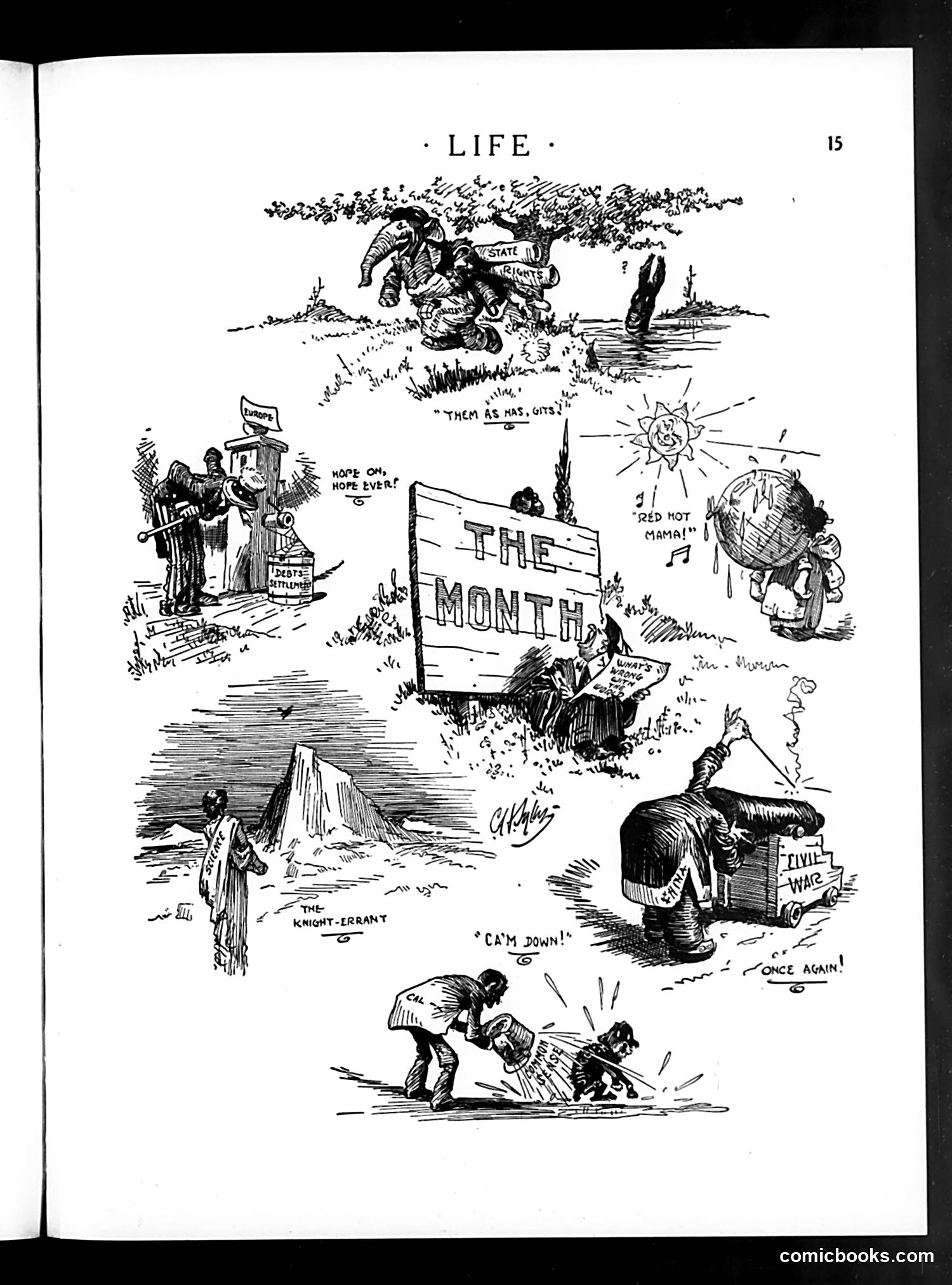
This is a satirical collection addressing early 20th-century American concerns. The central panel "THE MONTH" organizes vignettes around current events: - **"Hope on hope ever!"** (upper left): Shows figures at what appears to be a charitable or political institution, likely mocking optimism about social reform - **"The Knight-Errant"** (lower left): References chivalric idealism, possibly critiquing naive interventionism - **"'Cam down!'"** and **"Once again!"** (bottom): Depicts conflict or domestic discord - **"'Red hot mama!'" and "I'd hot"** (right): References popular culture - **"Civil War"** (lower right): Shows figures fighting over a box, likely satirizing partisan political conflict The overall effect mocks various American social pretensions, political divisions, and cultural trends of the period through exaggerated caricature and situational humor.
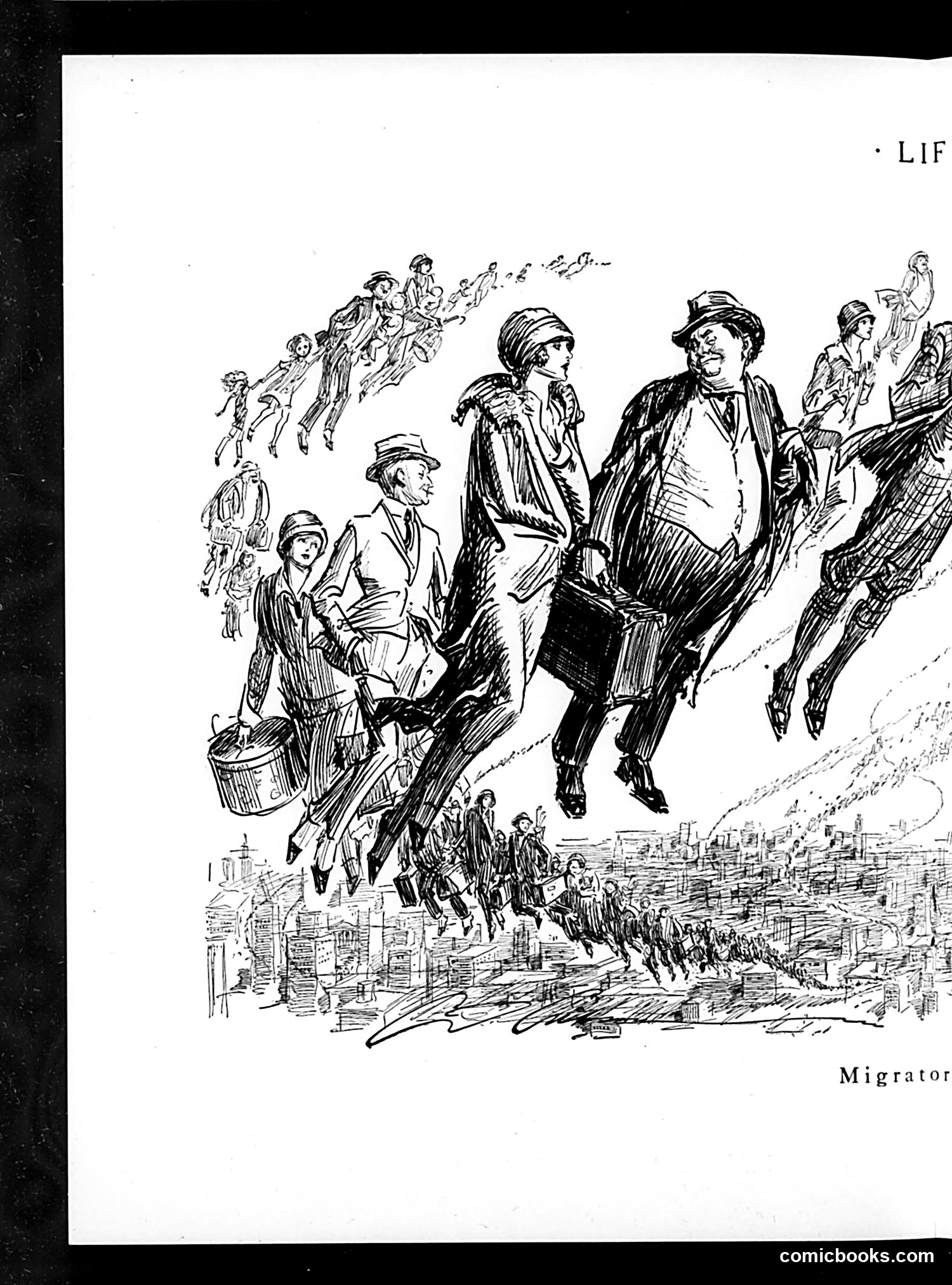
This satirical illustration depicts a group of people flying over a cityscape, labeled "Migrator." The cartoon appears to critique internal migration patterns—likely referencing rural Americans moving to urban centers during industrialization or economic shifts. The figures are depicted as birds in flight, a visual metaphor suggesting these migrants are transient, moving en masse without stability. The composition shows them abandoning the city below, implying commentary on either labor movement, economic desperation, or seasonal work patterns. The style and subject matter suggest this is early-to-mid 20th century social commentary on American migration, possibly related to the Great Depression era or dust bowl migrations. The "migrator" label emphasizes the transient nature of these populations.
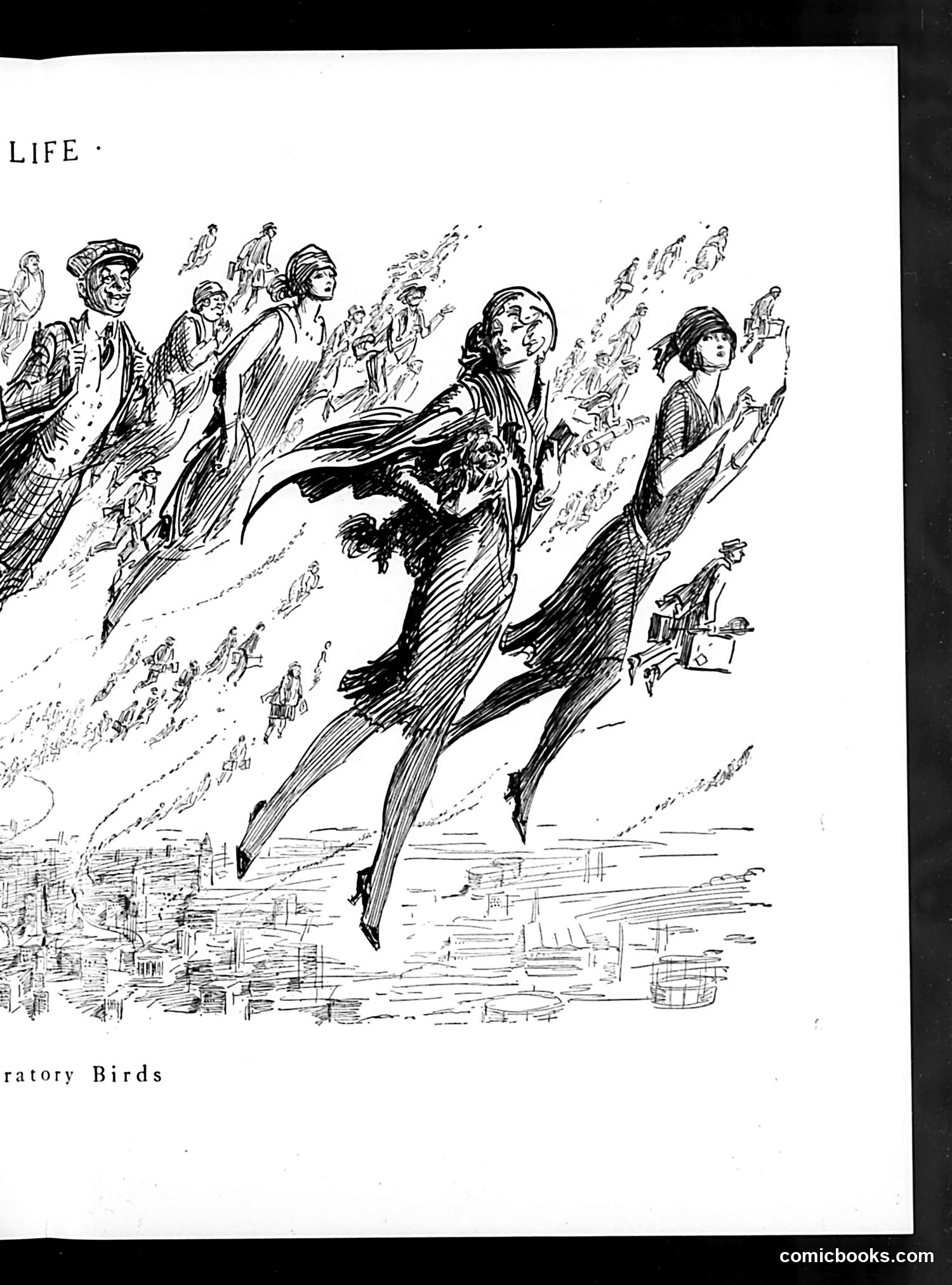
This page from *Life* magazine shows a satirical cartoon titled "Migratory Birds." The illustration depicts well-dressed figures (appearing to be businessmen and society people) flying upward like migrating birds above a cityscape. The metaphor suggests these are wealthy urbanites departing the city—likely fleeing to seasonal retreats or vacation destinations, as birds migrate. The satire appears to mock the leisure habits of the affluent upper class, who "migrate" seasonally just as birds do naturally. By comparing fashionable city dwellers to migratory birds, the cartoon humorously reduces their behavior to animal instinct, suggesting their movements are as predictable and instinctive as nature itself. The specific historical context—which season or event prompted this particular exodus—remains unclear from the visible text.
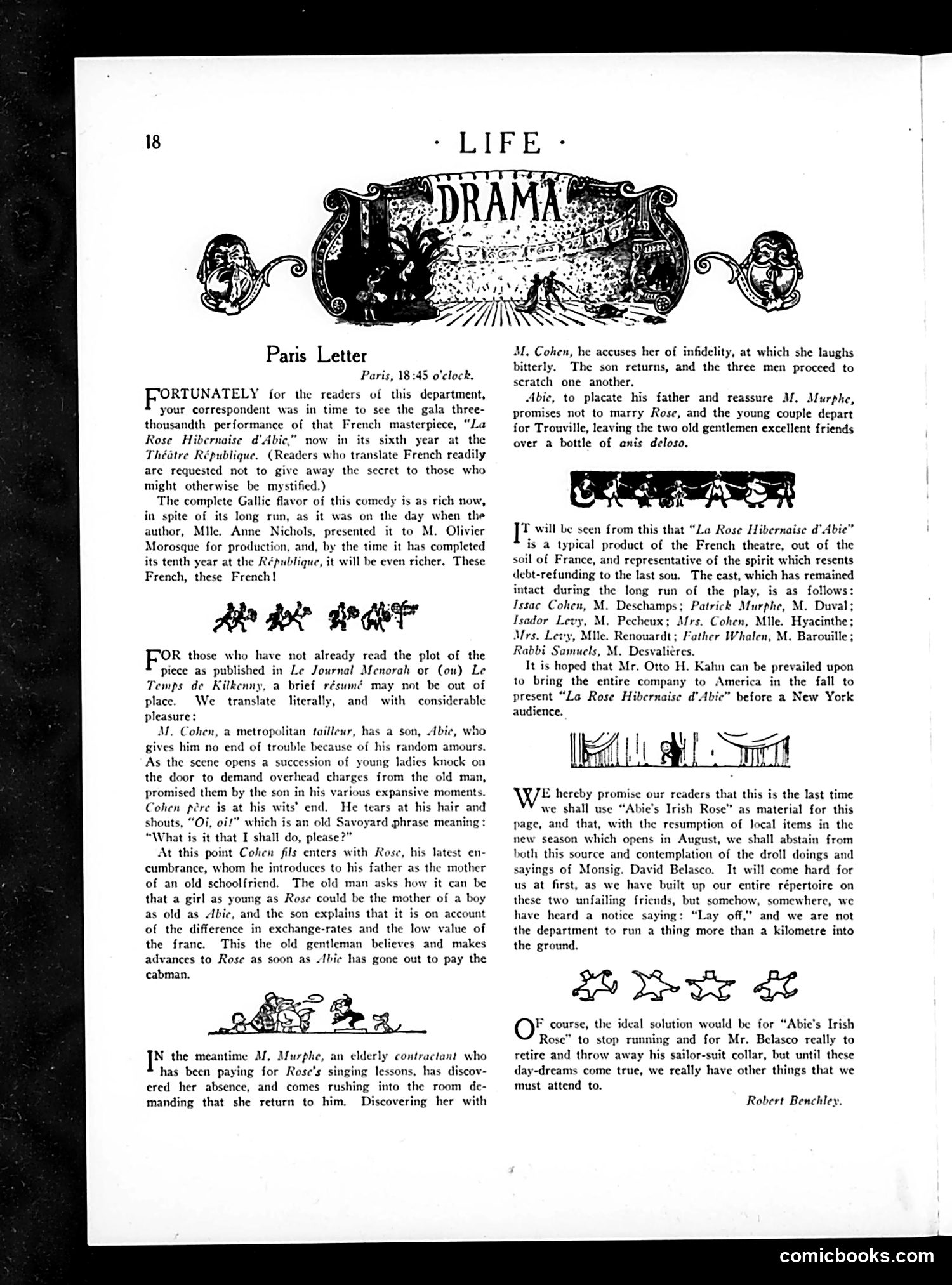
This is a satirical "Paris Letter" mocking the phenomenal success of "Abie's Irish Rose," a Broadway play by Anne Nichols that was running continuously with enormous popularity. The joke pretends the play has become a French masterpiece in its sixth year at a Paris theater, with a fabricated three-thousandth performance. The satire works by: 1. **Renaming it** as "La Rose Hibernaise d'Abie" (The Irish Rose of Abie) and crediting it to a fictional French production, treating it as authentic French theater rather than American commercial entertainment. 2. **Mocking the plot's absurdity**—the contrived romantic entanglements and the ridiculous explanation that a young woman could be an old boy's mother due to "exchange-rates and the low value of the franc." 3. **The final admission** that Life has exhausted this material for satire and promises readers they're done using "Abie's Irish Rose" as source material, suggesting the play's cultural dominance had become tiresome even for satirists. The piece lampoons both the play's unlikely success and American culture's obsession with it.
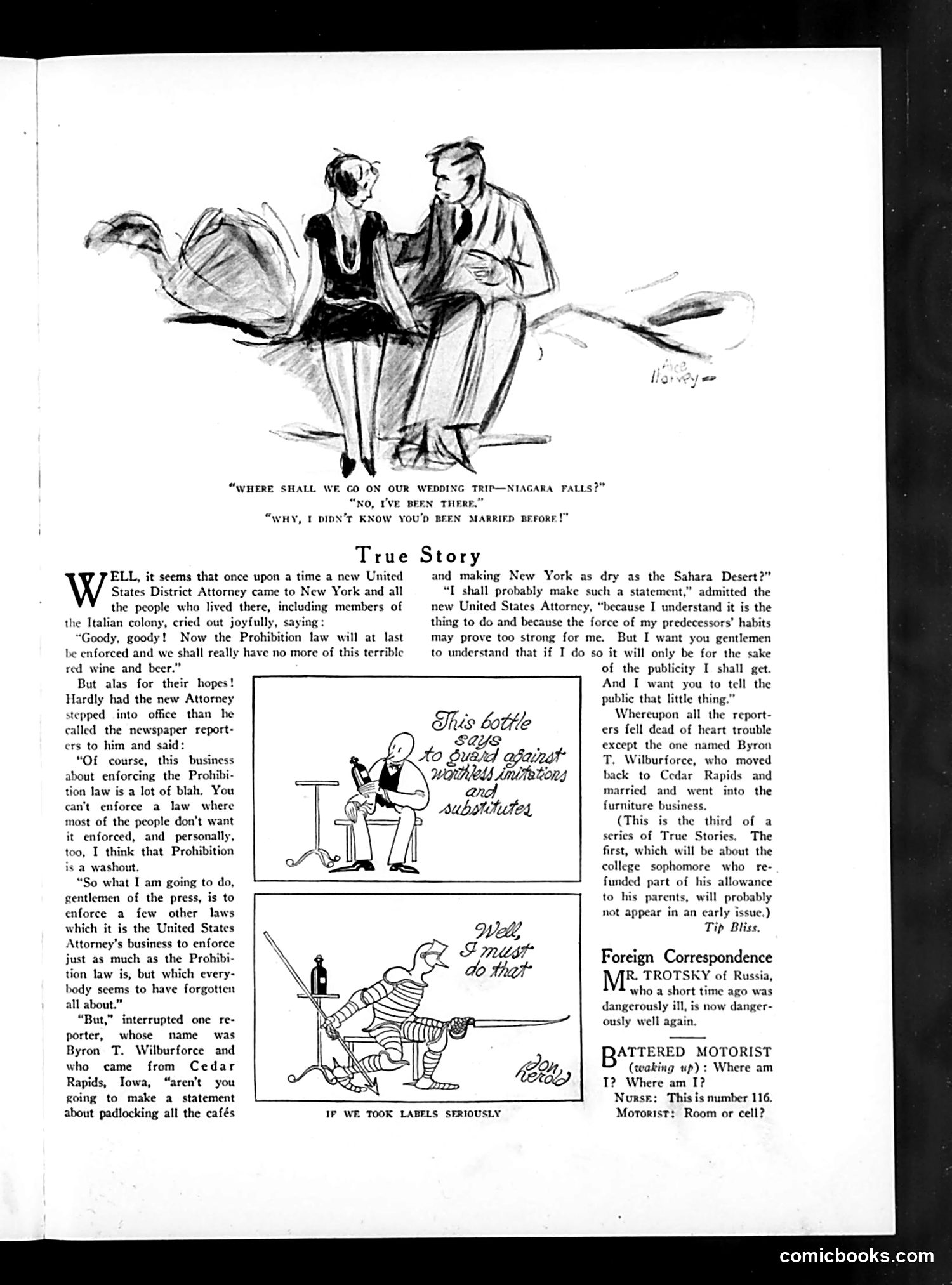
This 1920s *Life* magazine page satirizes the failure of Prohibition enforcement. A new U.S. District Attorney arrives in New York promising strict enforcement, but immediately admits to reporters it's all "blah"—he won't actually enforce it, only *claim* to for publicity purposes. The joke hinges on hypocrisy: the Attorney cynically acknowledges Prohibition is unenforceable (most people oppose it) yet plans to performatively raid cafés anyway for media attention. Reporter Byron T. Wilburforce, the only one not shocked, represents the cynical press complicit in this charade. The cartoons above illustrate the absurdity: one about a honeymoon couple at Niagara Falls with a suggestive punchline; another about taking labels "seriously." These reinforce the theme that nobody—not officials, not the public—takes Prohibition seriously. The piece mocks the law's fundamental failure and the corruption of law enforcement during Prohibition's early years.
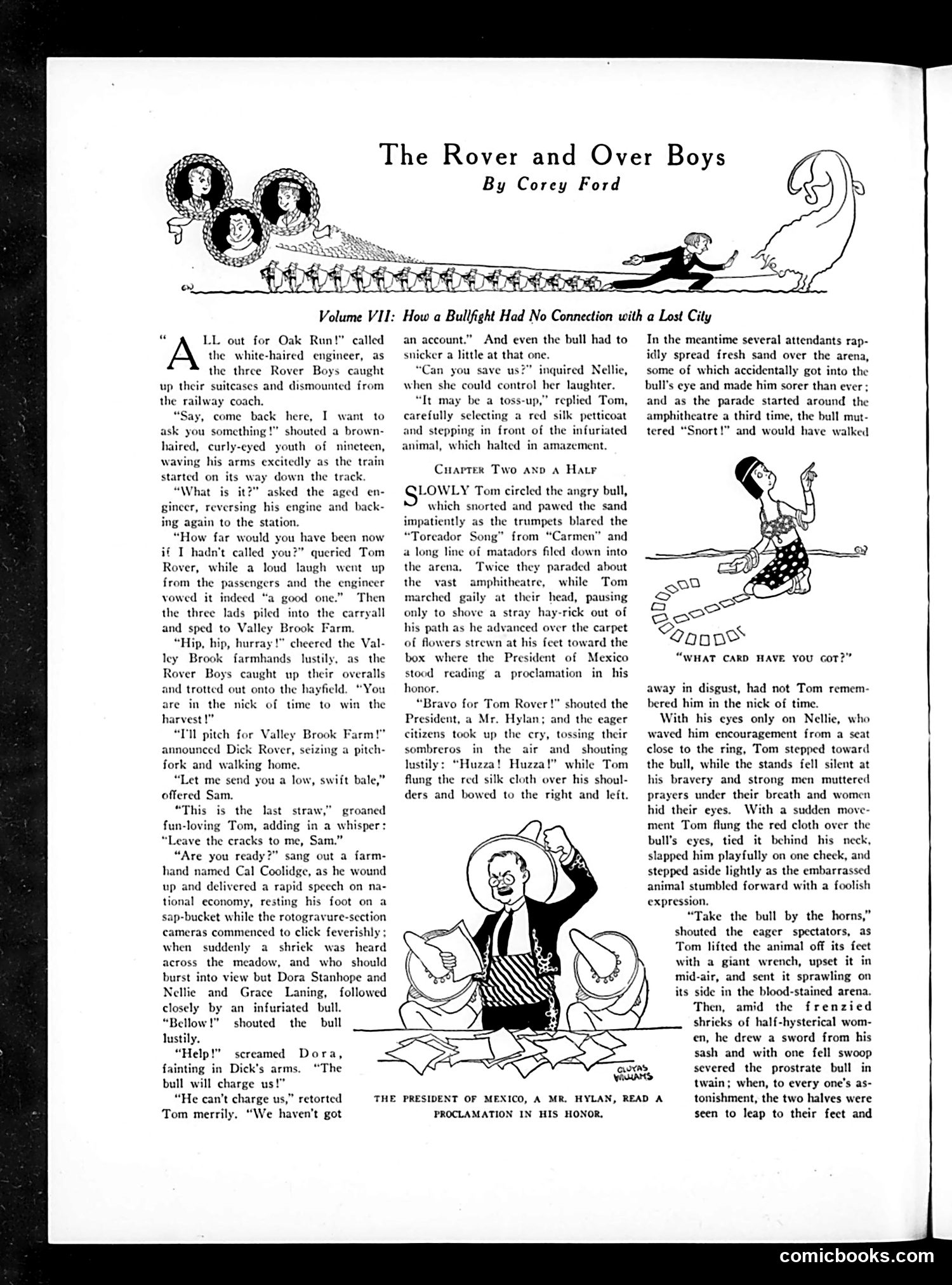
This is a satirical story parodying the popular "Rover Boys" adventure novels. The humor targets contemporary political figures through absurdist hijinks. **Key figures**: "Cal Coolidge" is President Calvin Coolidge, depicted as a farmhand delivering speeches on "national economy" while standing on a bucket—mocking his dry, formal demeanor. "Mr. Hylan" (the President of Mexico) appears to be Mayor Jimmy Walker of New York, sarcastically repositioned. **The satire**: The story ridicules 1920s political figures by inserting them into an intentionally ridiculous narrative where they perform incongruous roles (Coolidge as farmhand, a NYC mayor as Mexican president presiding over a bullfight). The absurd plot—farm boys becoming bullfighters, bulls responding to comedy—parodies both the implausible adventure tales and the perceived incompetence of contemporary politicians. **The point**: This reflects 1920s skepticism toward political leadership through humorous displacement, suggesting these figures belong in absurd, trivial situations rather than positions of actual power.
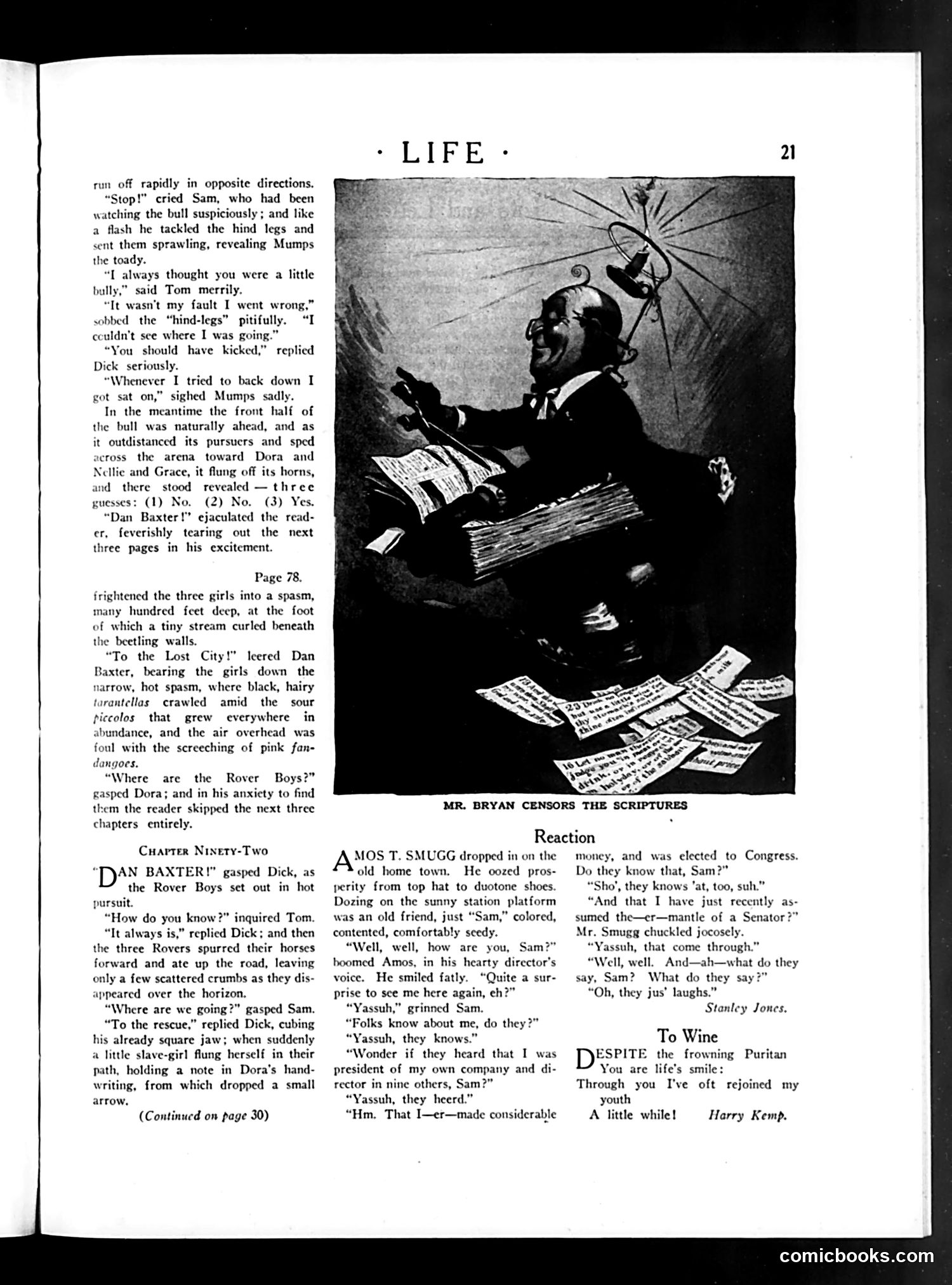
This page contains two distinct satirical pieces from Life magazine: **Top: "Mr. Bryan Censors the Scriptures"** A caricature mocking William Jennings Bryan (the three-time presidential candidate and public figure known for religious conservatism). The cartoon shows Bryan examining and censoring religious texts—satirizing his perceived attempt to impose strict moral/religious standards on American society. The humor targets his self-righteousness and cultural influence. **Middle: Adventure Story Parody** The lengthy text is a deliberate mockery of cheap serialized fiction (likely "Rover Boys" style adventure novels popular in early 1900s). It absurdly exaggerates melodramatic tropes: evil villains, imperiled heroines, contrived cliffhangers, and improbable plot twists. The joke is that readers were so eager for the next installment they'd "skip three chapters entirely" to find out what happens next—satirizing popular culture's low-quality sensationalism. **Bottom: "To Wine"** A brief poem by Harry Kemp celebrating wine as life's pleasure—a mild jab at Puritanical abstinence movements of the era.
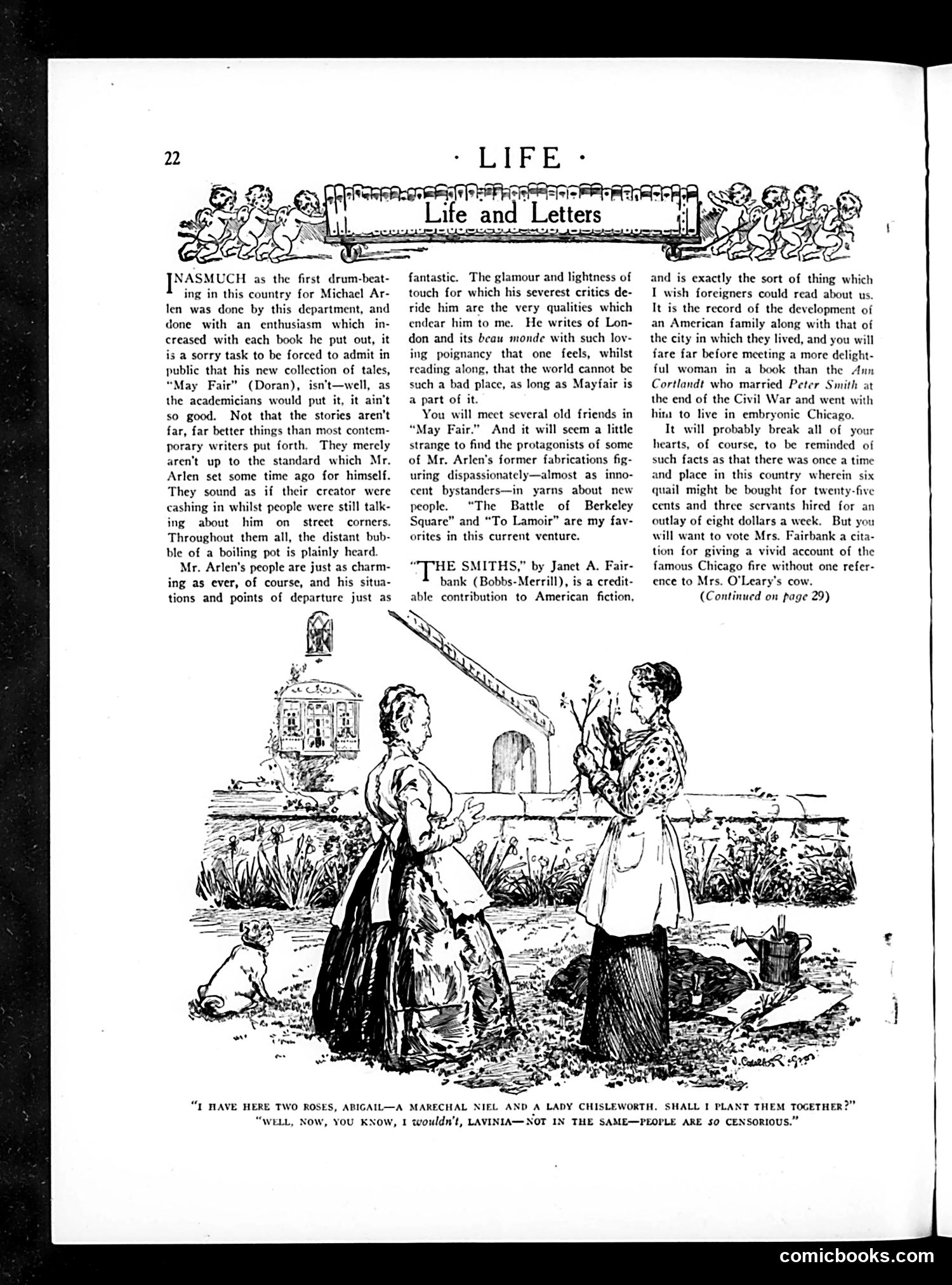
This page contains literary reviews rather than political cartoons. The main text critiques Michael Arlen's short story collection "May Fair" and Janet Fairbank's novel "The Smiths." The single illustration at the bottom is a social satire showing two women in a garden. One proposes planting two rose varieties together; the other demurs, saying "people are so censorious." The joke targets upper-class propriety and gossip—the women treat rose-planting as a matter of social scandal, anthropomorphizing the flowers as if they were people whose proximity would cause scandal. This mocks the era's rigid social conventions and tendency toward petty censoriousness among the wealthy. The reviews themselves praise Arlen's glamorous depictions of London's "beau monde" (high society) while gently noting his latest work lacks his earlier brilliance, and commend Fairbank's historical novel about Chicago's development.
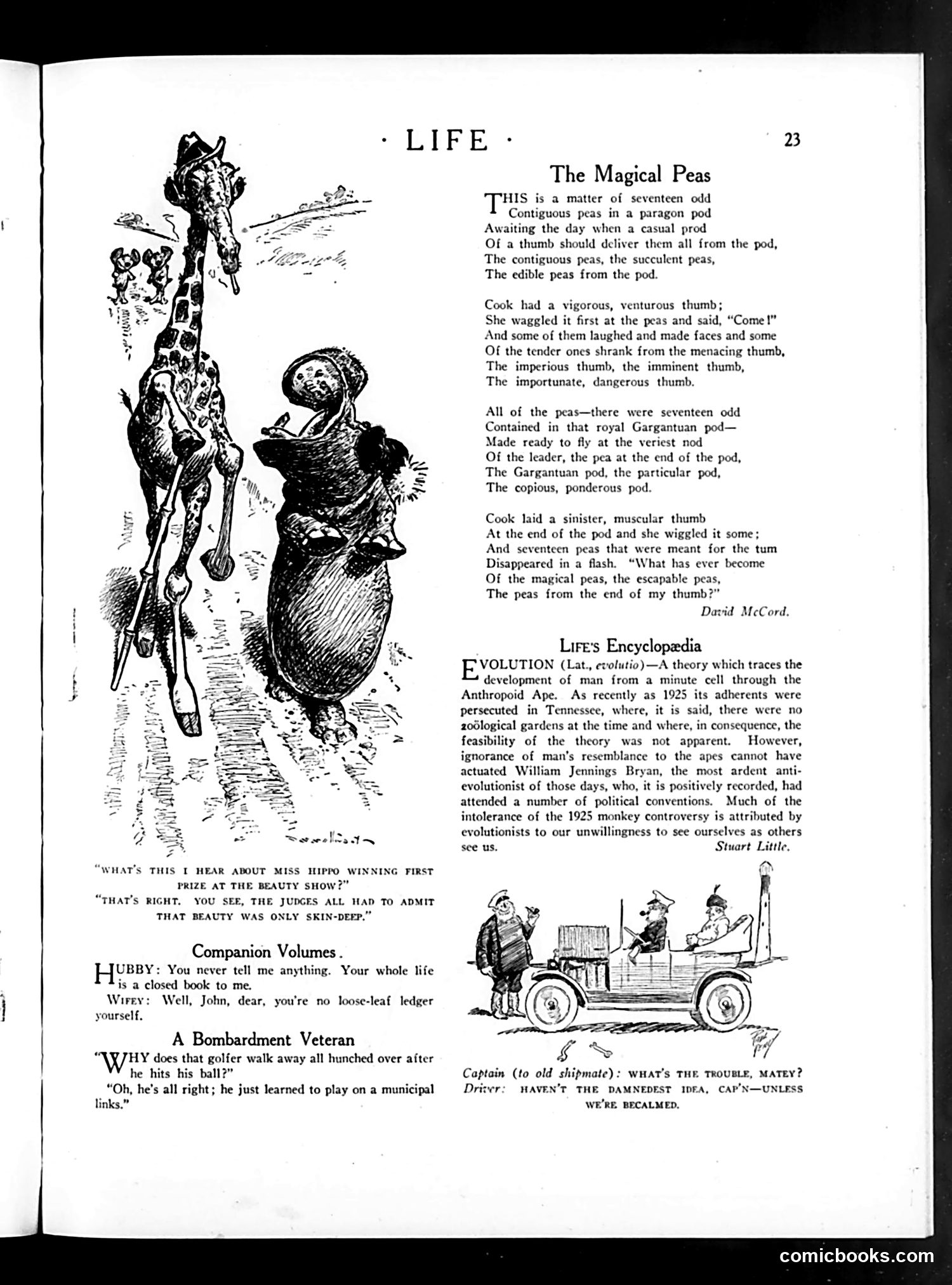
This page contains several satirical pieces typical of Life's humor: **"The Magical Peas"** is a whimsical poem by David McCord about Cook attempting to shell peas from a pod. The humor lies in personifying the peas as characters reacting with fear to her "imperious thumb," then mysteriously disappearing—likely eaten by the Cook herself, creating an absurdist joke about the peas' sudden "escape." **The encyclopedia entry on "Evolution"** sarcastically references the 1925 Scopes Monkey Trial in Tennessee, where teaching evolution was prosecuted. Life mocks William Jennings Bryan (who prosecuted the case) by suggesting his attendance at political conventions proves humans resemble apes—a backhanded jab at anti-evolutionists' apparent lack of self-awareness. **Minor jokes** include a "beauty show" pun ("beauty is only skin-deep"), a married couple's banter about secrecy, and a golf joke referencing "municipal links" (likely a WWI bombardment reference—soldiers hunched from shell shock). The cartoons throughout use exaggerated animal characters and situations for comedic effect.
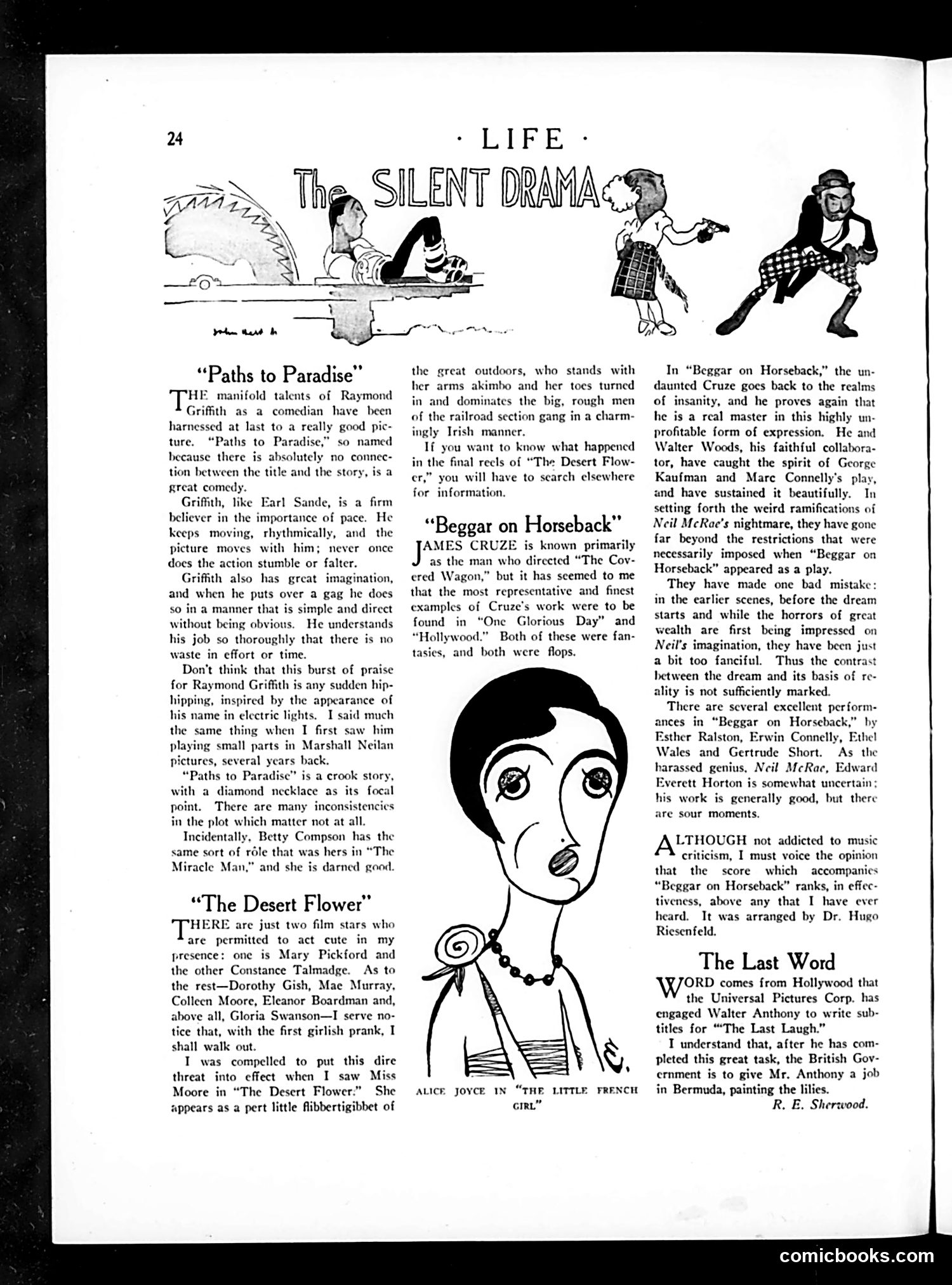
This page contains reviews of three silent films from the early 1920s. The critic praises Raymond Griffith's comedic timing in "Paths to Paradise" (a crime caper), then sharply criticizes Colleen Moore's performance in "The Desert Flower," threatening to walk out on actresses who "act cute" except for Mary Pickford and Constance Talmadge—revealing period attitudes about acceptable female screen behavior. The main review covers "Beggar on Horseback," directed by James Cruze, adapted from a George Kaufman-Marc Connelly play. The critic appreciates Cruze's fantasy sequences depicting a character's nightmare, noting the film surpasses the original stage production's limitations. Edward Everett Horton stars as the protagonist. The illustration shows a stylized female face, identified as Alice Joyce from "The Little French Girl." The reviews reflect 1920s film criticism standards, emphasizing pacing, imagination, and performers' control of expression in silent cinema.
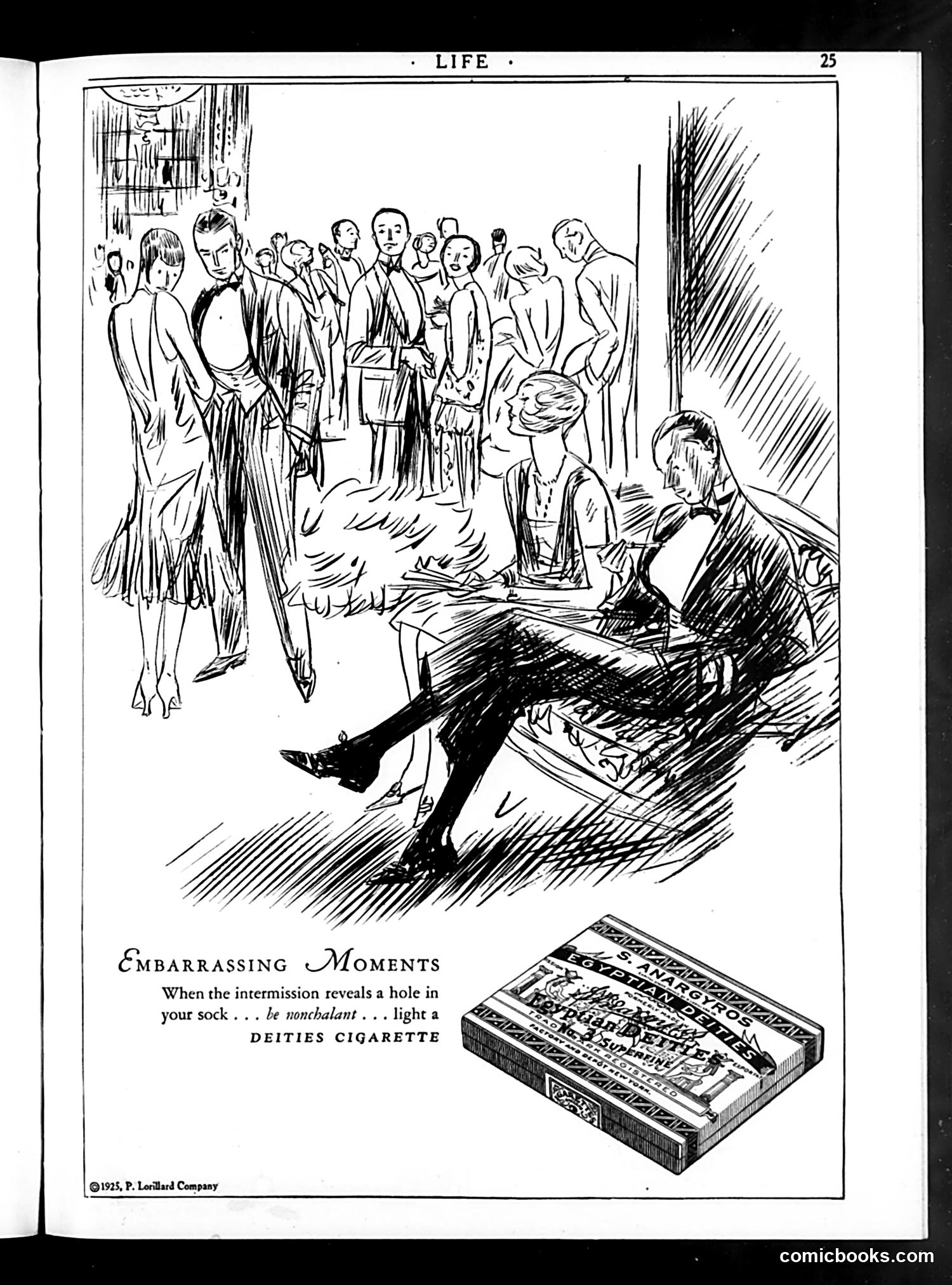
This is a 1925 advertisement disguised as humor. The cartoon depicts a social scenario: at what appears to be a theater intermission, a man sitting down has exposed a hole in his sock to nearby onlookers. The "solution" offered is absurdly impractical—simply light a cigarette and act casual (nonchalant) rather than address the actual embarrassment. The joke relies on the period's social anxiety about maintaining appearances in public settings. The advertisement exploits this relatable embarrassment to promote Deities cigarettes as a prop for seeming sophisticated and unbothered. This exemplifies early 20th-century advertising's use of aspirational behavior and social insecurity to sell products, particularly tobacco.
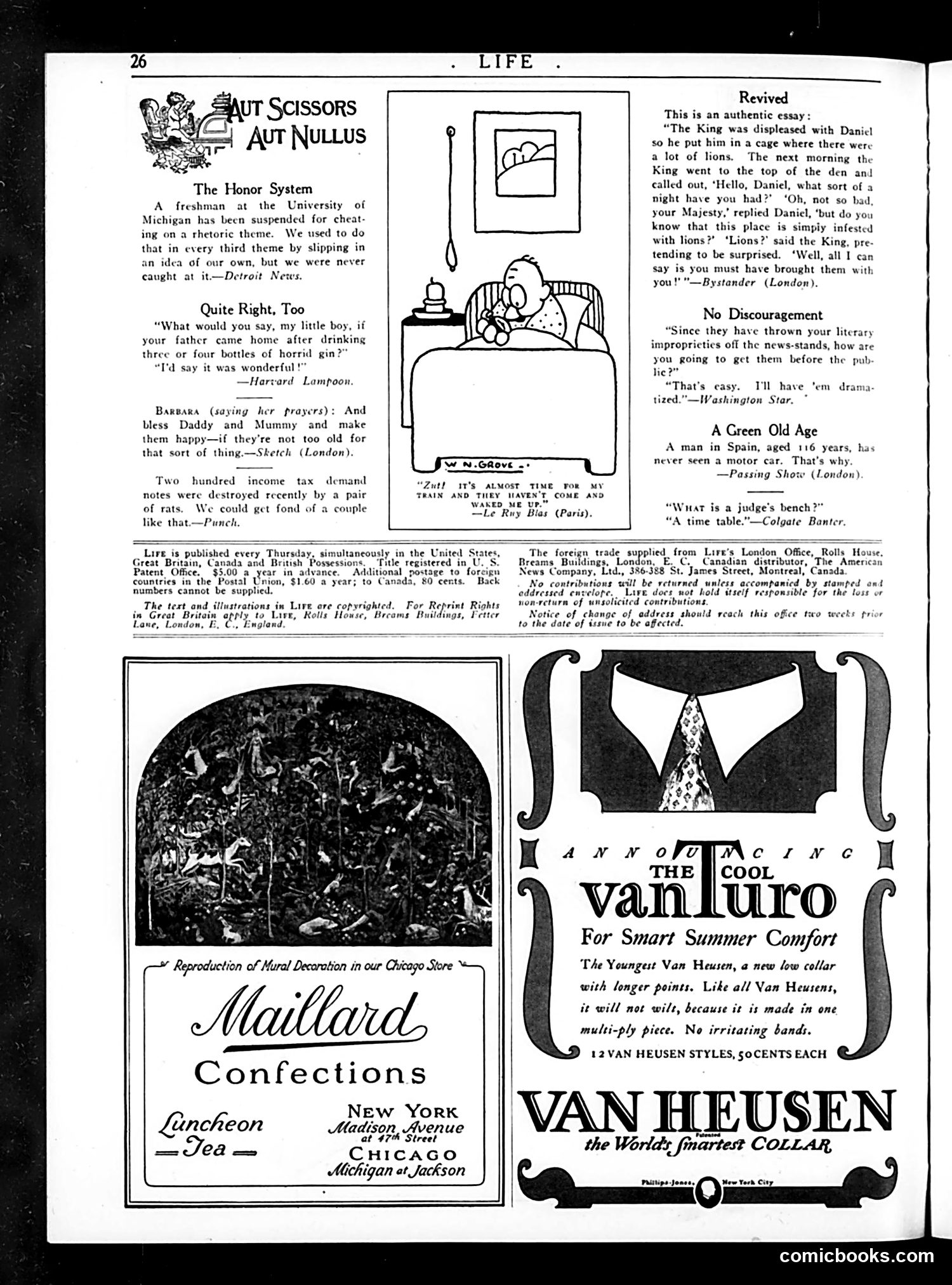
This page is primarily **advertisements and humor reprints** rather than original satirical cartoons. The main visual element is a W.N. Grove cartoon showing a child in bed, illustrating a French joke about bedtime ("it's almost time for my train and they haven't come and woken me up yet"). The text consists of humorous anecdotes reprinted from other publications (Detroit News, Harvard Lampoon, Punch, etc.), poking fun at: - **Academic dishonesty** (cheating at university) - **Parental drinking** (a child's innocent response to gin) - **Child innocence** (prayer requests, misunderstandings) - **Tax evasion** (rats destroying income tax notices) - **Censorship** (how banned books circulate anyway) - **Age and modernity** (a 116-year-old Spaniard avoiding cars) The advertisements promote **Maillard Confections** and **Van Heusen collars**, typical period merchandise. The page reflects early-20th-century Life magazine's format: light satire on domestic life, bureaucracy, and social customs, assembled from various humor sources rather than featuring distinctive political commentary.
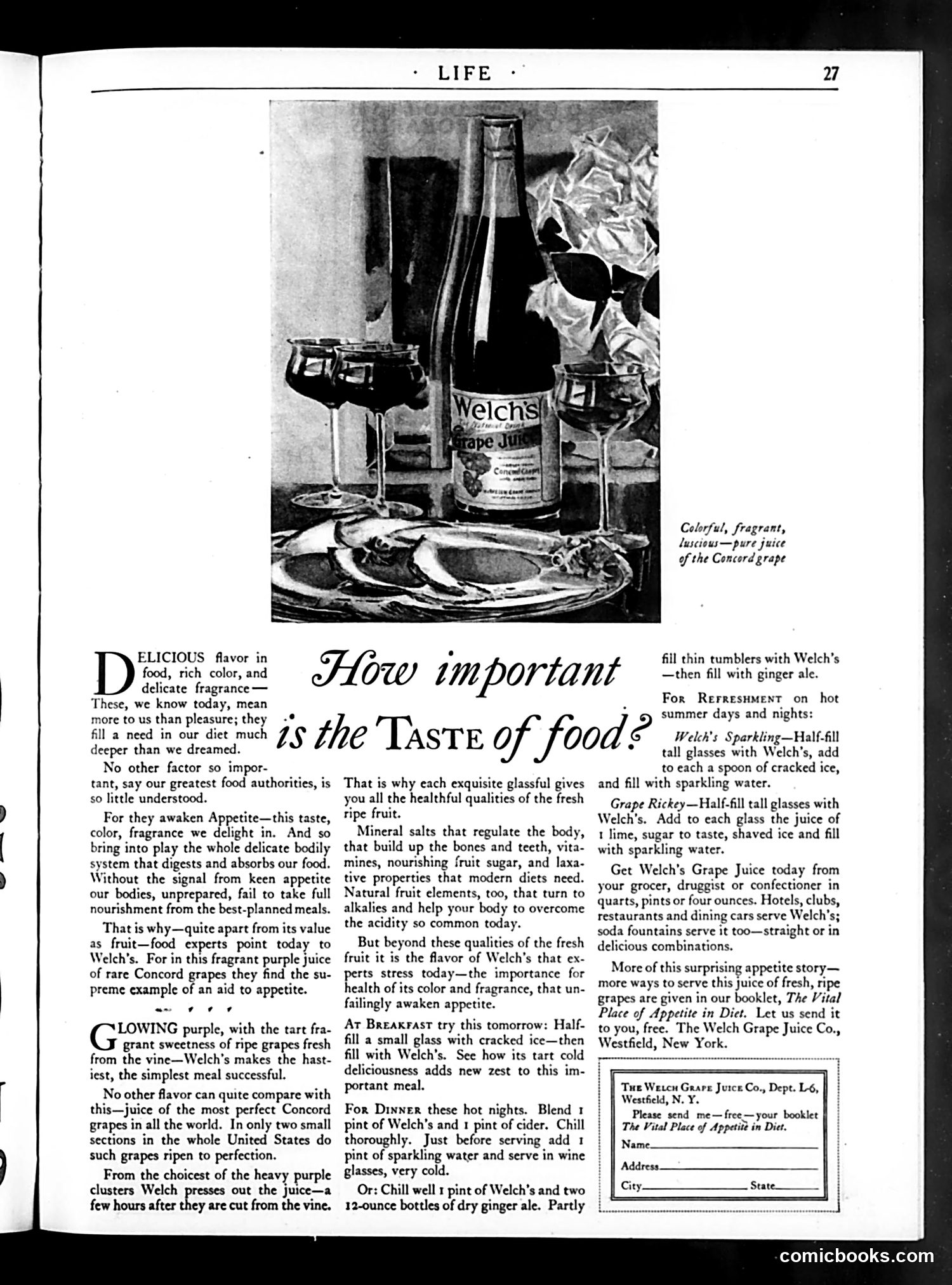
This is not a political cartoon but a full-page **advertisement for Welch's Grape Juice** from Life magazine. There is no satire or cartoon content here. The ad uses the rhetorical strategy of appealing to contemporary nutritional science—claiming that taste and aroma stimulate appetite, which aids digestion and absorption of nutrients. It emphasizes the juice's "mineral salts," vitamins, and "laxative properties" as health benefits aligned with modern dietary needs. The ad promotes various serving suggestions (breakfast, dinner, mixed drinks) and encourages readers to request a free booklet, *The Vital Place of Appetite in Diet*. This represents early 20th-century food marketing that linked consumer products to scientific health claims—a practice now heavily regulated.
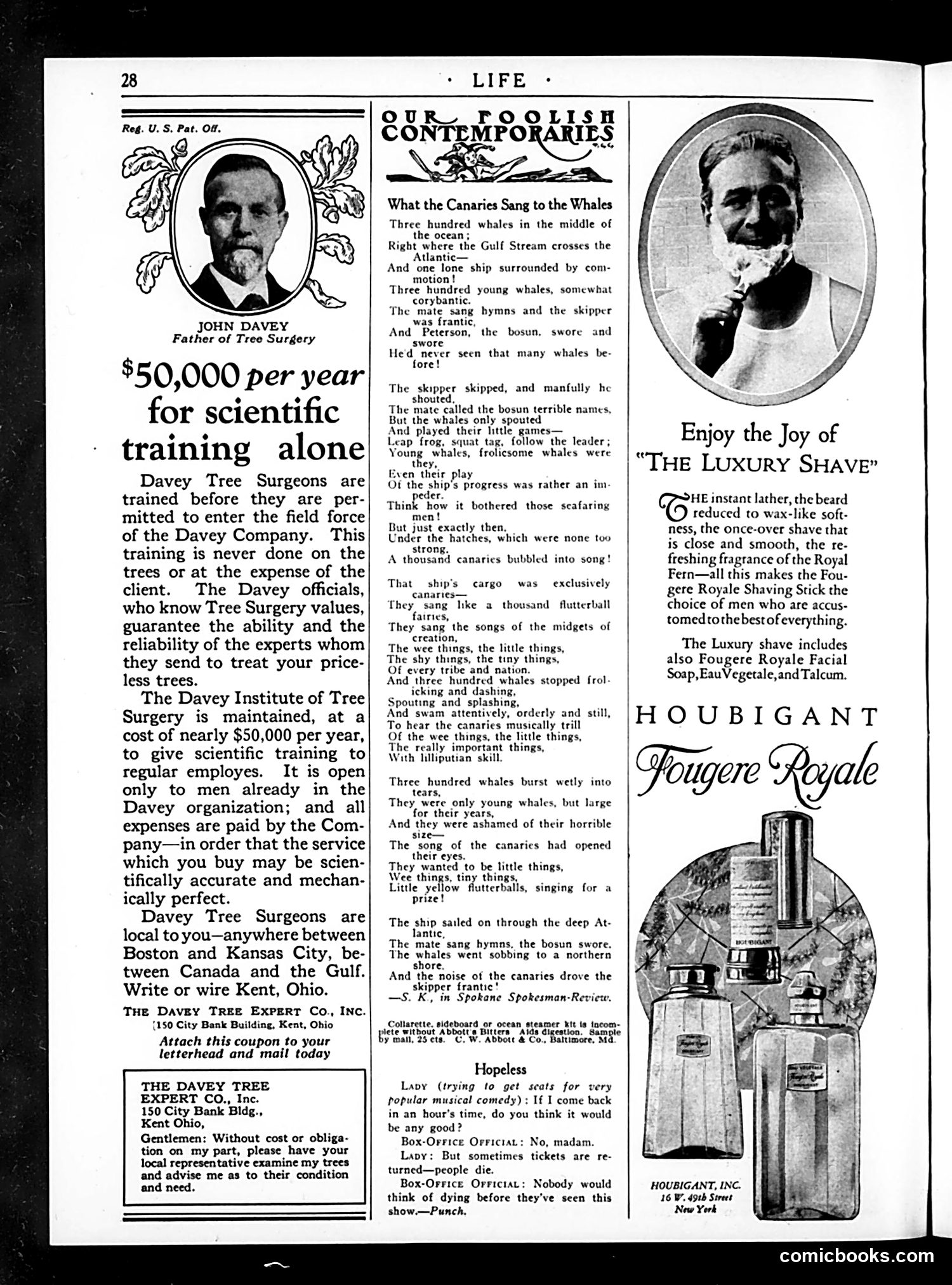
This page is primarily **advertising** mixed with light satirical content, typical of early 20th-century Life magazine. The main advertisement promotes **John Davey and the Davey Tree Expert Company**, emphasizing their $50,000-annual investment in scientific training for tree surgeons—a pitch to wealthy homeowners that their trees deserve expert, professional care rather than amateur treatment. The center features a whimsical poem, "What the Canaries Sang to the Whales," a fanciful tale where young whales cease their boisterous play when hearing canaries sing about "wee things"—making the whales ashamed of their size. The satire appears gentle and allegorical rather than pointedly political. The bottom includes a brief humor sketch about theater tickets: a lady asks if seats might become available in an hour; the box-office official replies "nobody would think of dying before they've seen this show"—dark comedy about the show's popularity. The page also advertises **Houbigant Fougère Royale** shaving products, emphasizing luxury grooming.
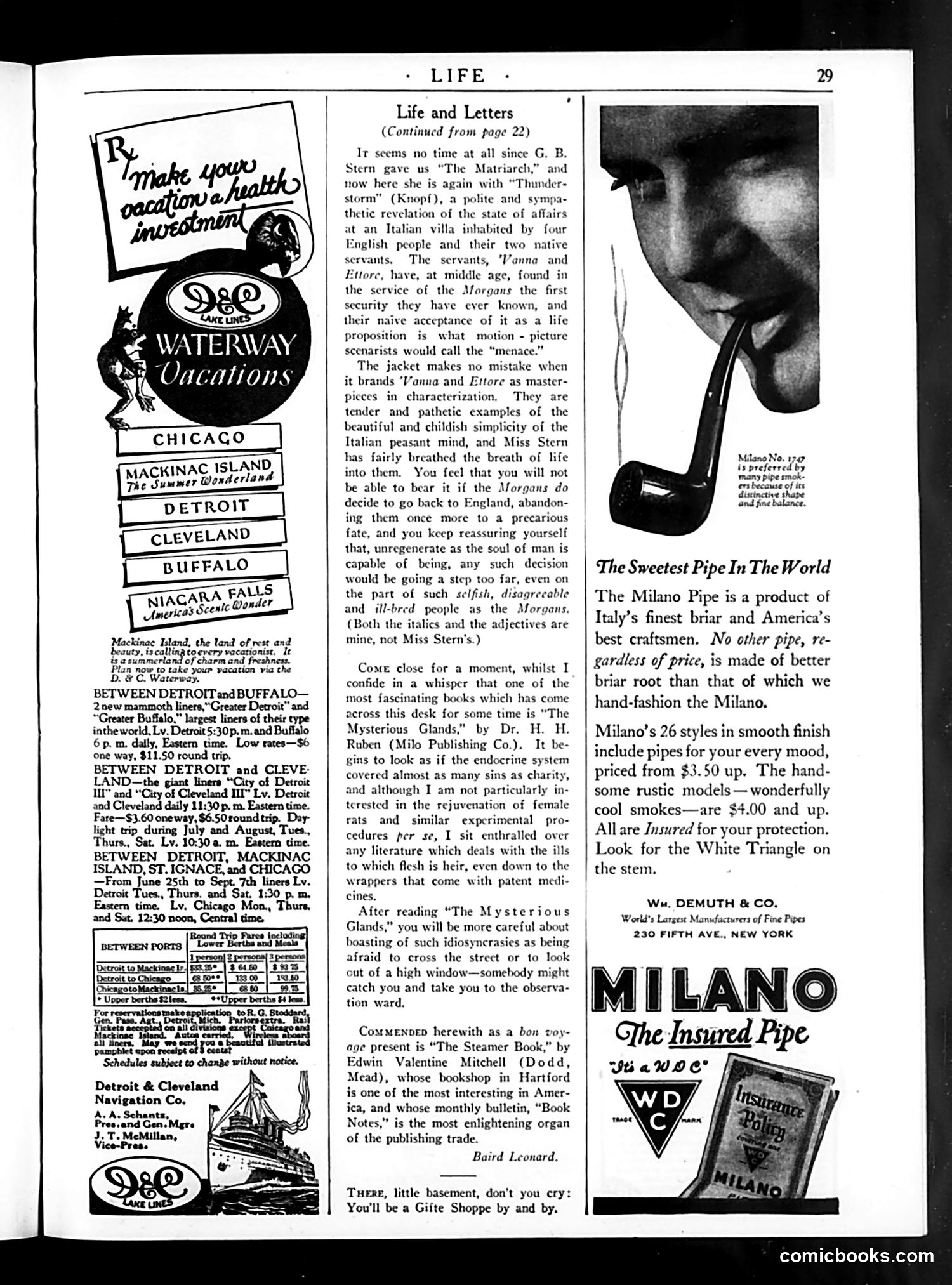
This page is primarily **advertising and literary content**, not political satire. The left side features **travel advertisements** for the Detroit & Cleveland Navigation Company, promoting Great Lakes steamship vacations to destinations like Mackinac Island, Buffalo, and Chicago—typical leisure marketing for the era. The center contains **book reviews** by Baird Leonard discussing G.B. Stern's novel "Thunderstorm" and Dr. H.H. Ruben's "The Mysterious Glands," offering literary criticism for educated readers. The right side advertises the **Milano pipe**, marketed as "The Sweetest Pipe in the World" and "The Insured Pipe"—emphasizing quality briar construction and insurance protection as selling points. The small verse at bottom ("There, little basement, don't you cry: / You'll be a Gifte Shoppe by and by") appears to be a humorous reference to commercial real estate conversion, likely tongue-in-cheek commentary on changing urban spaces. **No significant political satire or caricature is present** on this page.
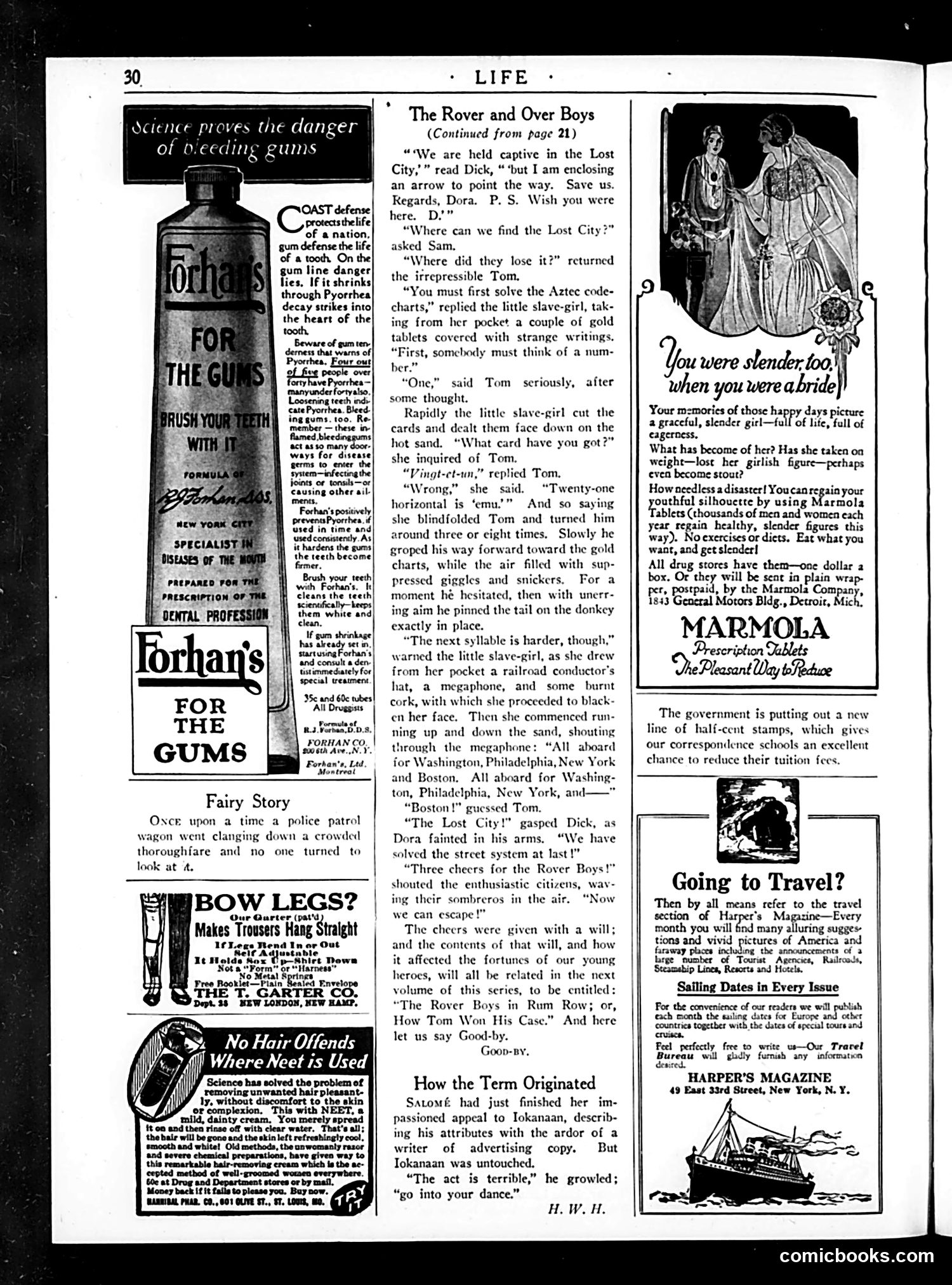
This page contains a serialized adventure story ("The Rover and Over Boys"), several product advertisements, and satirical content typical of Life magazine's format. **Main Content - "The Rover and Over Boys":** A parody of popular adventure serials (likely the "Rover Boys" series), this absurdist narrative mocks overwrought plot devices through nonsensical logic: characters solve an "Aztec code" by playing card tricks, blindman's bluff, and a charades game involving a conductor's hat. The humor derives from how ridiculous problem-solving replaces actual mystery-solving—a satire of pulp adventure fiction's contrived plotting. **Advertisements:** The page includes typical period ads (Forhan's toothpaste, bow-leg garters, hair cream) alongside satirical product placement. **"How the Term Originated":** A brief joke mocking Oscar Wilde's *Salome*, suggesting theatrical drama is merely "advertising copy"—a jab at pretentious theater. The overall tone ridicules popular entertainment conventions and consumer culture through absurdist humor.
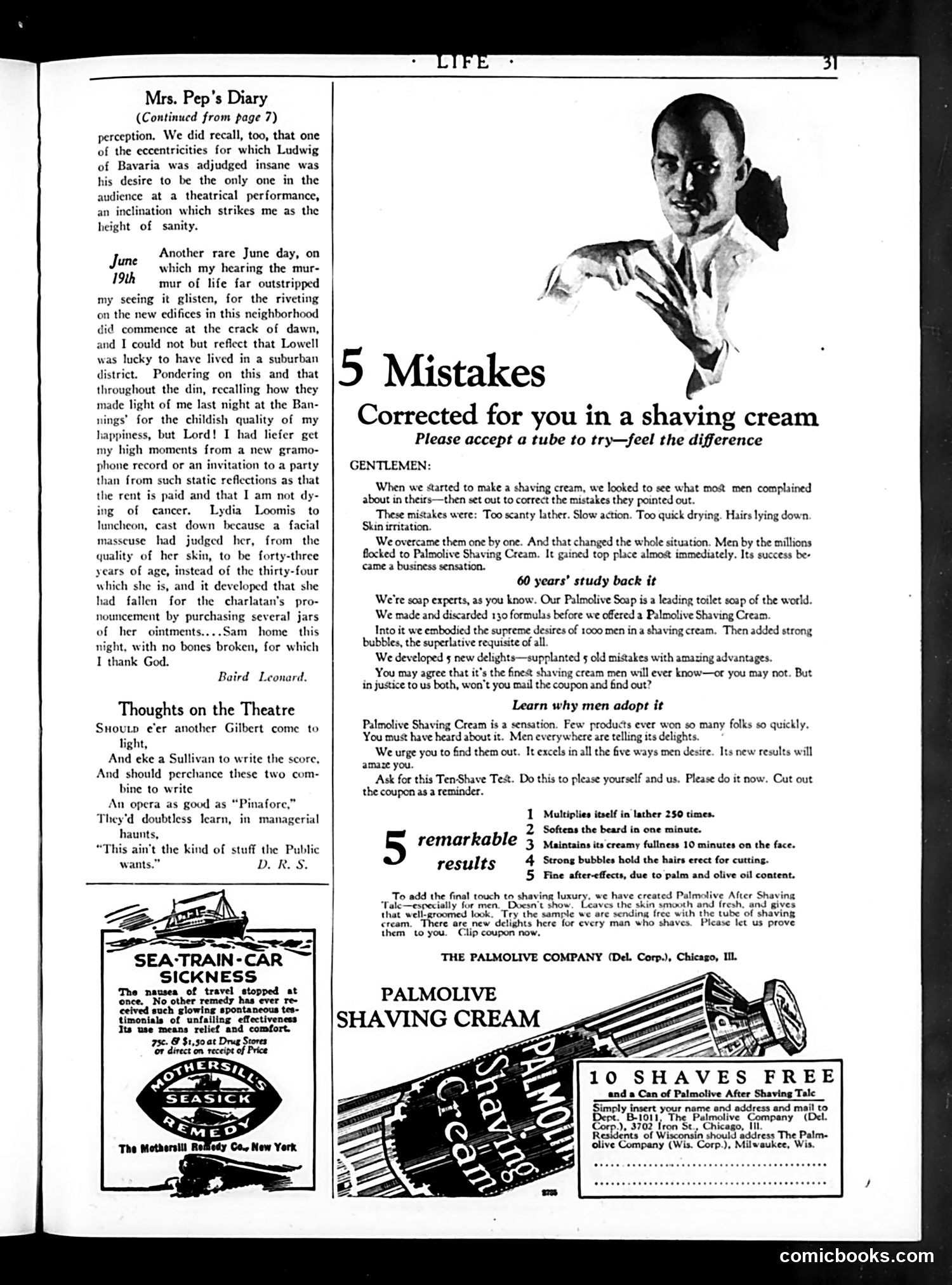
This page consists primarily of **advertisements and miscellaneous editorial content**, not political satire. The main features are: 1. **"Mrs. Pep's Diary"** — A humorous society column by Baird Leonard chronicling upper-class domestic life and social observations (complaints about construction noise, a woman deceived about her age by a facial masseuse). 2. **"Thoughts on the Theatre"** — A brief satirical poem (by D.R.S.) lamenting that modern audiences won't support high-quality opera like Gilbert and Sullivan's "Pinafore," suggesting public taste has declined. 3. **Advertisements** — A Sea-Train-Car Sickness remedy and a large **Palmolive Shaving Cream advertisement** claiming to correct five common shaving mistakes, supported by pseudo-scientific claims about soap formulation. The page reflects early 20th-century consumer culture and upper-class concerns. There are no political cartoons or identifiable caricatures of public figures. The satire is gentle and domestic rather than political.
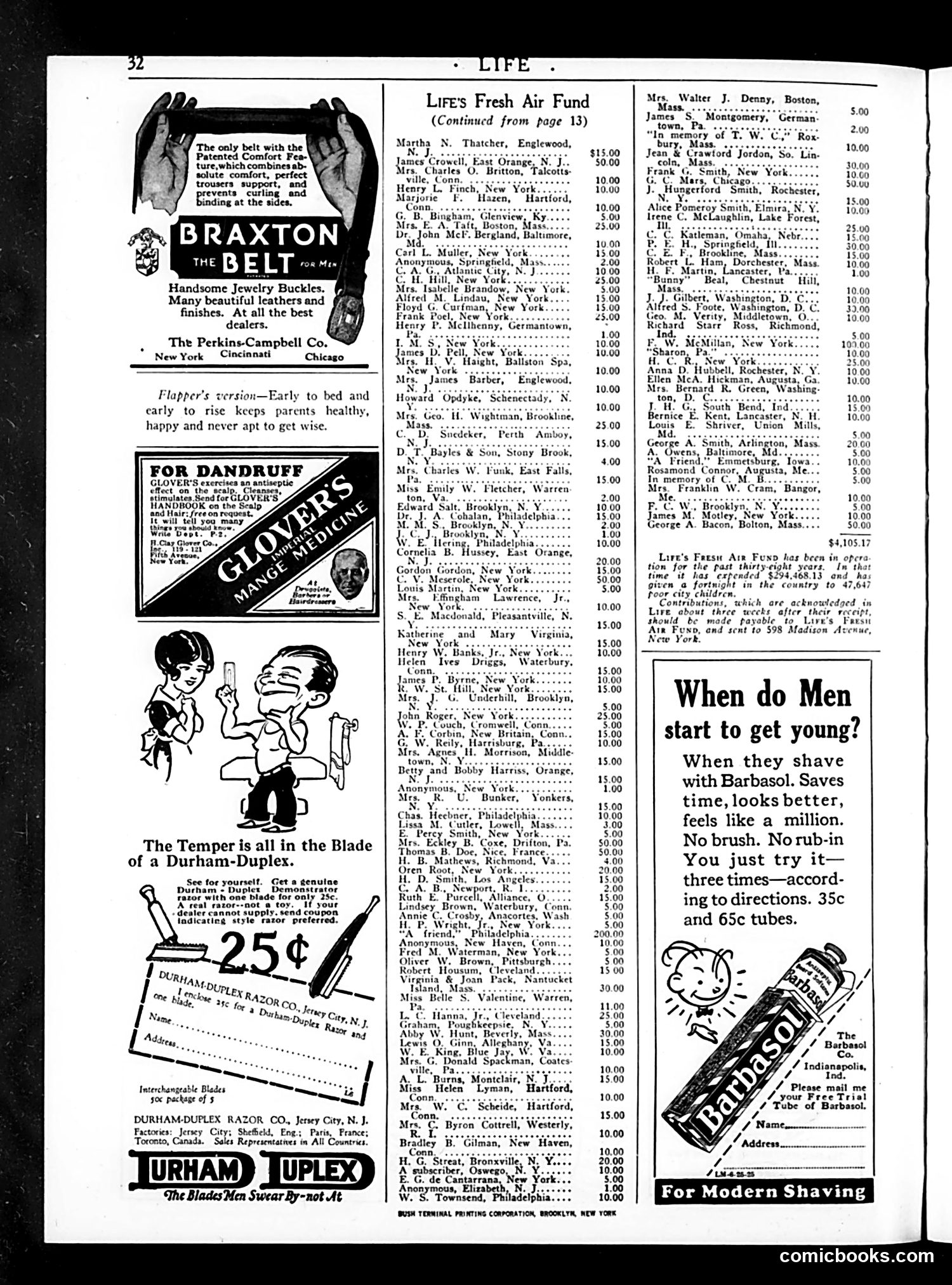
This is primarily an **advertising page** from an undated Life magazine (likely 1920s based on the styling and cultural references). The notable humor appears in the **"Flapper's version"** mini-cartoon beneath the Braxton Belt ad. It presents a punchy, satirical take on the familiar saying "Early to bed and early to rise keeps a man healthy, wealthy, and wise." The flapper's twist—that this schedule "keeps parents healthy, happy and never apt to get wise"—satirizes the youth culture and generational gap of the 1920s. Flappers were known for late-night entertainment and rejecting their parents' values, so the joke is that rigid bedtimes would prevent young people from enjoying their modern lifestyle. The illustration above showing a young woman seemingly cajoling or manipulating an older male figure likely reinforces this theme of youthful independence and changing social norms. The rest of the page consists of small advertisements for men's grooming products (razors, dandruff treatment) and donations to Life's Fresh Air Fund.
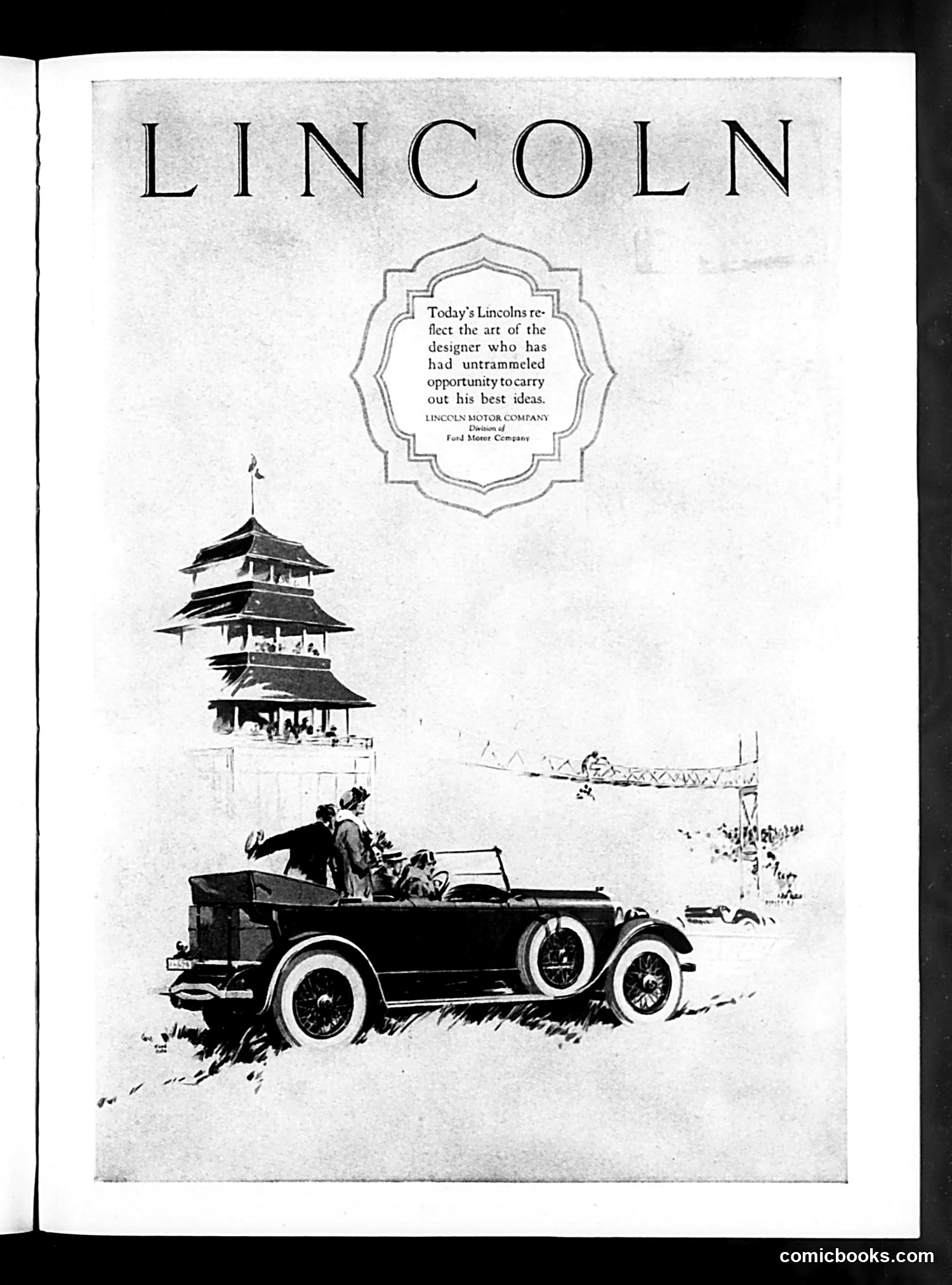
This is a **Lincoln automobile advertisement**, not political satire. The page shows a luxury car positioned before a pagoda-style structure, with a well-dressed driver. The ad's tagline claims that modern Lincolns "reflect the art of the designer who has had untrammeled opportunity to carry out his best ideas"—a marketing claim emphasizing design freedom and artistic excellence. The "Lincoln" title plays on the American president's name for brand prestige. The exotic architecture (the pagoda) suggests sophistication and worldly refinement, appealing to wealthy consumers during the automobile's golden age. This is straightforward commercial promotion by Ford Motor Company's luxury division, not commentary on politics or society.
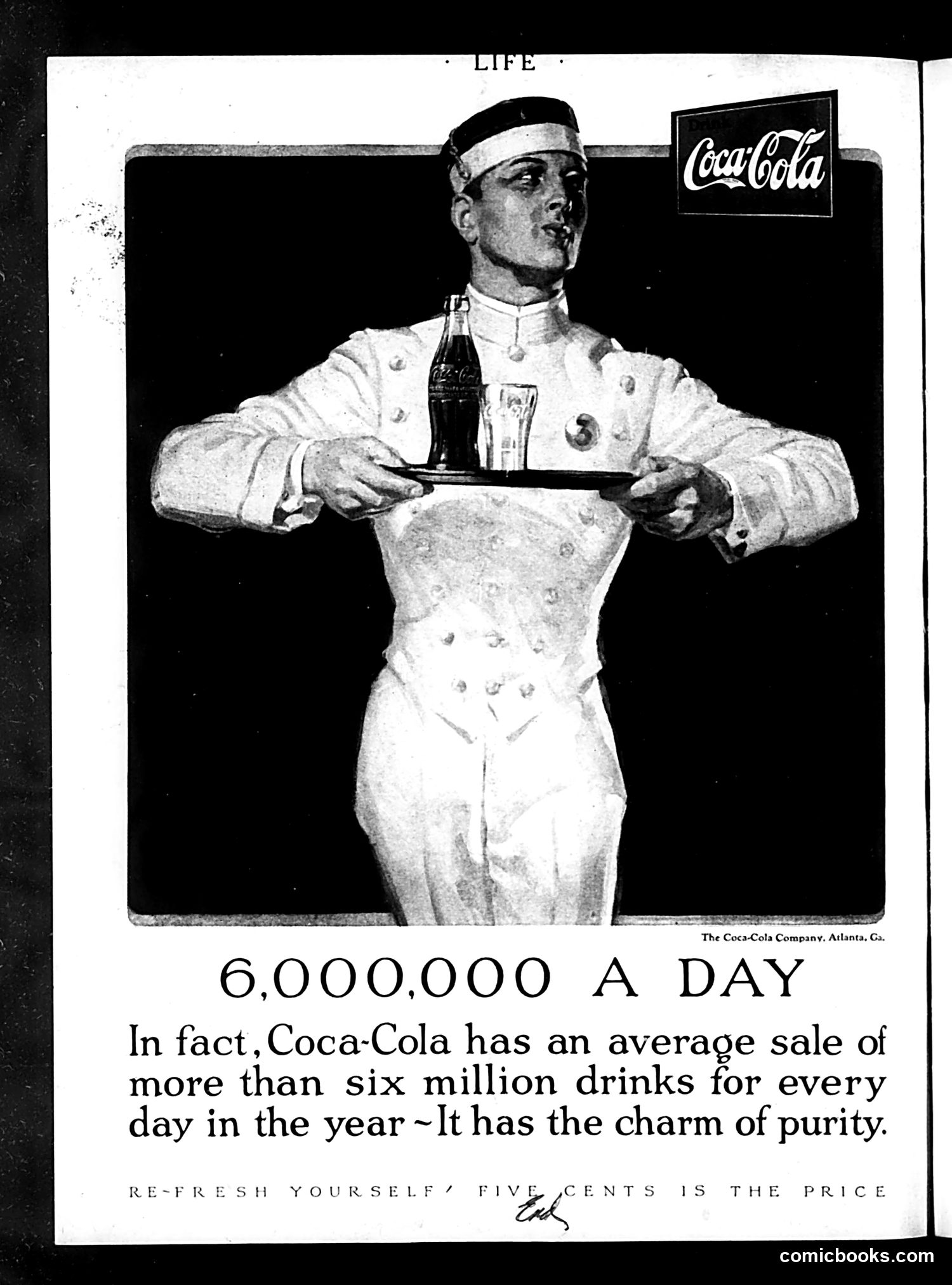
This is a straightforward **product advertisement**, not satire or political commentary. It appears in *Life* magazine and promotes Coca-Cola's sales volume and purity. The image shows a server or waiter in white uniform and headband holding a serving tray with a Coca-Cola bottle and glass. The advertisement claims the company sells over 6 million drinks daily, emphasizing the product's "charm of purity"—a significant marketing angle for the era, when consumers worried about food and beverage safety and quality. The price is listed as five cents. This represents early 20th-century brand-building through mass-market advertising, emphasizing both popularity (high sales numbers) and product integrity (purity) to reassure potential customers.

I can see this is a blank or nearly blank page from what appears to be a Life magazine issue, with only a watermark reading "comicbooks.com" visible at the bottom. There is no discernible cartoon, illustration, text content, or satirical material present on this page to analyze. Without visible content—whether political cartoons, comic strips, articles, or advertisements—I cannot identify any figures, caricatures, historical references, or satirical commentary that would require historical context for a modern reader. This appears to be either a blank page from the magazine's interior, a scanning artifact, or an advertisement page without visible imagery.