
Life, 1925-06-25 · page 16 of 37
Life — June 25, 1925 — page 16: what you’re looking at
What you’re looking at
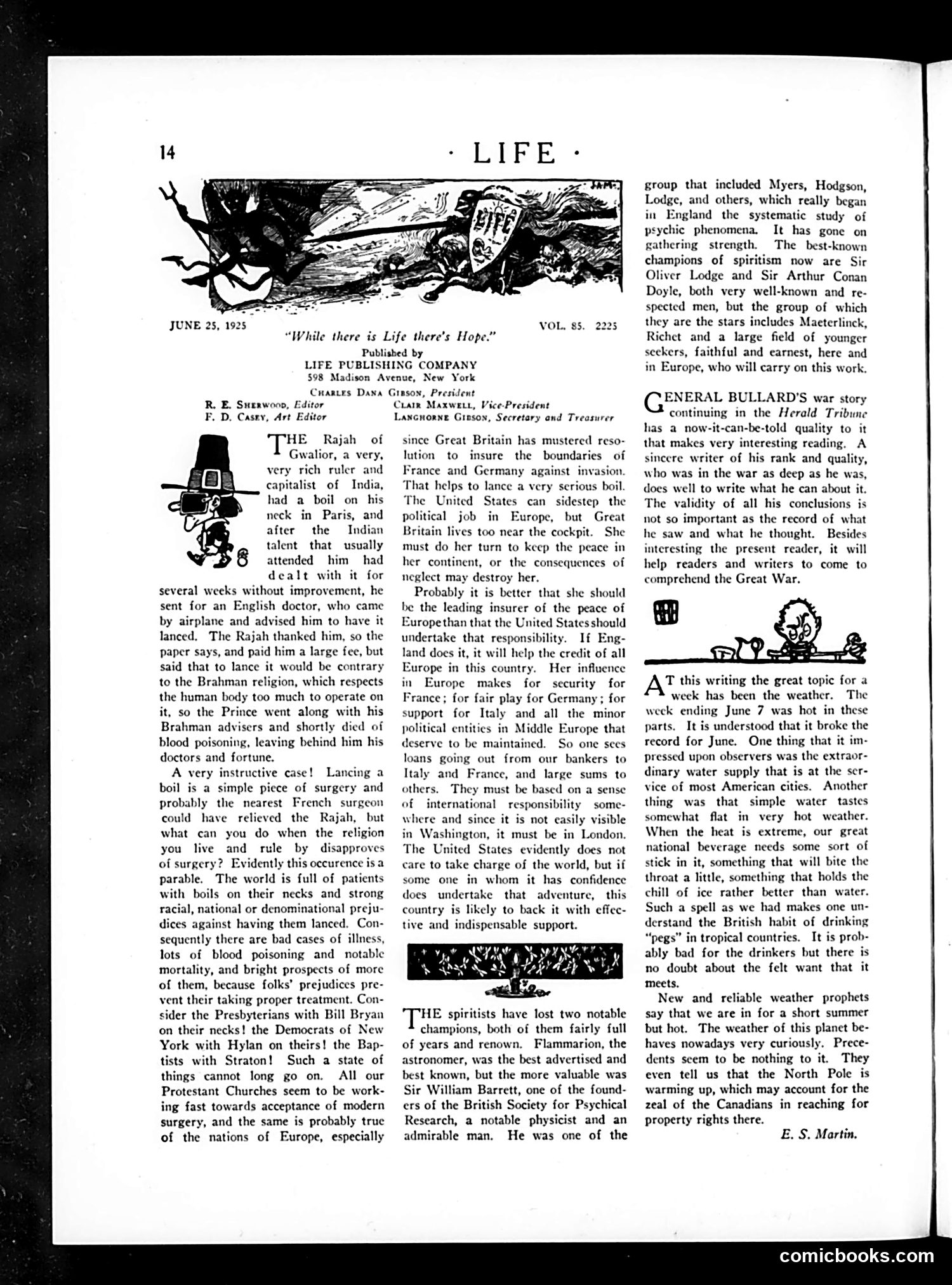
The main cartoon depicts **the Rajah of Indore**, a wealthy Indian ruler, receiving medical treatment in Paris. The satire criticizes British imperial policy: the Rajah's wealth from India allows him to afford expensive European doctors, while the text notes he required surgery for a boil—suggesting that despite his riches, modern medicine couldn't solve a simple problem. The cartoon mocks both **the Rajah's excessive spending abroad** and **British colonial extraction of wealth** from India. It questions whether religious prohibitions (the Brahman faith) should govern medical treatment, implying superstition hinders progress. The broader point: Britain's colonial relationship with India enriches Indian rulers but leaves fundamental problems unresolved, while wealth flows to European centers.
📄 Transcribed text from this page (OCR, searchable)
Machine-transcribed from the original scan — historical spelling and the odd misread are preserved.
JUNE 25, 1925 “While there is Life there's Hope.” Published by LIFE PUBLISHING COMPANY $98 Madison Avenue, New York Cuaates Dana Grason, President R. E. Sutawooo, Editor F, D. Casry, Art Editor THE Rajah of Gwalior, a very, very rich ruler and capitalist of India, had a boil on his neck in Paris, and after the Indian talent that usually attended him had dealt with it for several weeks without improvement, he sent for an English doctor, who came by airplane and advised him to have it lanced. The Rajah thanked him, so the paper says, and paid him a large fee, but said that to lance it would be contrary to the Brahman religion, which respects the human body too much to operate on it, so the Prince went along with his Brahman advisers and shortly died of blood poisoning, leaving behind him his doctors and fortune. A very instructive case! Lancing a boil is a simple piece of surgery and probably the nearest French surgeon could have relieved the Rajah, but what can you do when the religion you live and rule by disapproves of surgery? Evidently this occurence is a parable. The world is full of patients with boils on their necks and strong racial, national or denominational preju- dices against having them lanced, Con- sequently there are bad cases of illness, lots of blood poisoning and notable mortality, and bright prospects of more of them, because folks’ prejudices pre- vent their taking proper treatment. Con- sider the Presbyterians with Bill Bryan on their necks! the Democrats of New York with Hylan on theirs! the Bap- tists with Straton! Such a state of things cannot long go on. All our Protestant Churches seem to be work- ing fast towards acceptance of modern surgery, and the same is probably truce of the nations of Europe, especially Cram Maxweit, Vice-President Lancnorne Ginson, Secretary ond Treasurer since Great Britain has mustered reso- lution to insure the boundaries of France and Germany against invasion. That helps to lance a very serious boil. The United States can sidestep the political job in Europe, but Great Britain lives too near the cockpit. She must do her turn to keep the peace in her continent, or the consequences of neglect may destroy her. Probably it is better that she should be the leading insurer of the peace of Europe than that the United States should undertake that responsibility. If Eng- land does it, it will help the credit of all Europe in this country. Her influence in Europe makes for security for France; for fair play for Germany ; for support for Italy and all the minor political entities in Middle Europe that deserve to be maintained. So one sees loans going out from our bankers to Italy and France, and large sums to others. They must be based on a sense of international responsibility some- where and since it is not easily visible in Washington, it must be in London. The United States evidently does not care to take charge of the world, but if some one in whom it has confidence does undertake that adventure, this country is likely to back it with effee- tive and indispensable support. Cn US ae THE spiritists have lost two notable champions, both of them fairly full of years and renown. Flammarion, the astronomer, was the best advertised and best known, but the more valuable was Sir William Barrett, one of the found- ers of the British Society for Psychical Research, a notable physicist and an admirable man. He was one of the group that included Myers, Hodgson, Lodge, and others, which really began in England the systematic study of psychic phenomena. It has gone on gathering strength. The best-known champions of spiritism now are Sir Oliver Lodge and Sir Arthur Conan Doyle, both very well-known and re- spected men, but the group of which they are the stars includes Maeterlinck, Richet and a large field of younger seekers, faithful and earnest, here and in Europe, who will carry on this work. G ENERAL BULLARD'S war story continuing in the Herald Tribune has a now-it-can-be-told quality to it that makes very interesting reading. A sincere writer of his rank and quality, who was in the war as deep as he was, does well to write what he can about it. The validity of all his conclusions is not so important as the record of what he saw and what he thought. Besides interesting the present reader, it will help readers and writers to come to comprehend the Great War. At this writing the great topic for a week has been the weather. The week ending June 7 was hot in these parts. It is understood that it broke the record for June. One thing that it im- pressed upon observers was the extraor- dinary water supply that is at the ser- vice of most American cities. Another thing was that simple water tastes somewhat flat in very hot weather. When the heat is extreme, our great national beverage needs some sort of stick in it, something that will bite the throat a little, something that holds the chill of ice rather better than water. Such a spell as we had makes one un- derstand the British habit of drinking “pegs” in tropical countries. It is prob- ably bad for the drinkers but there is no doubt about the felt want that it meets. New and reliable weather prophets say that we are in for a short summer but hot. The weather of this planct be- haves nowadays very curiously. Prece- dents scem to be nothing to it. They even tell us that the North Pole is warming up, which may account for the zeal of the Canadians in reaching for property rights there. E. S. Martin. comicbooks.com