
Life, 1925-06-25 · page 26 of 37
Life — June 25, 1925 — page 26: what you’re looking at
What you’re looking at
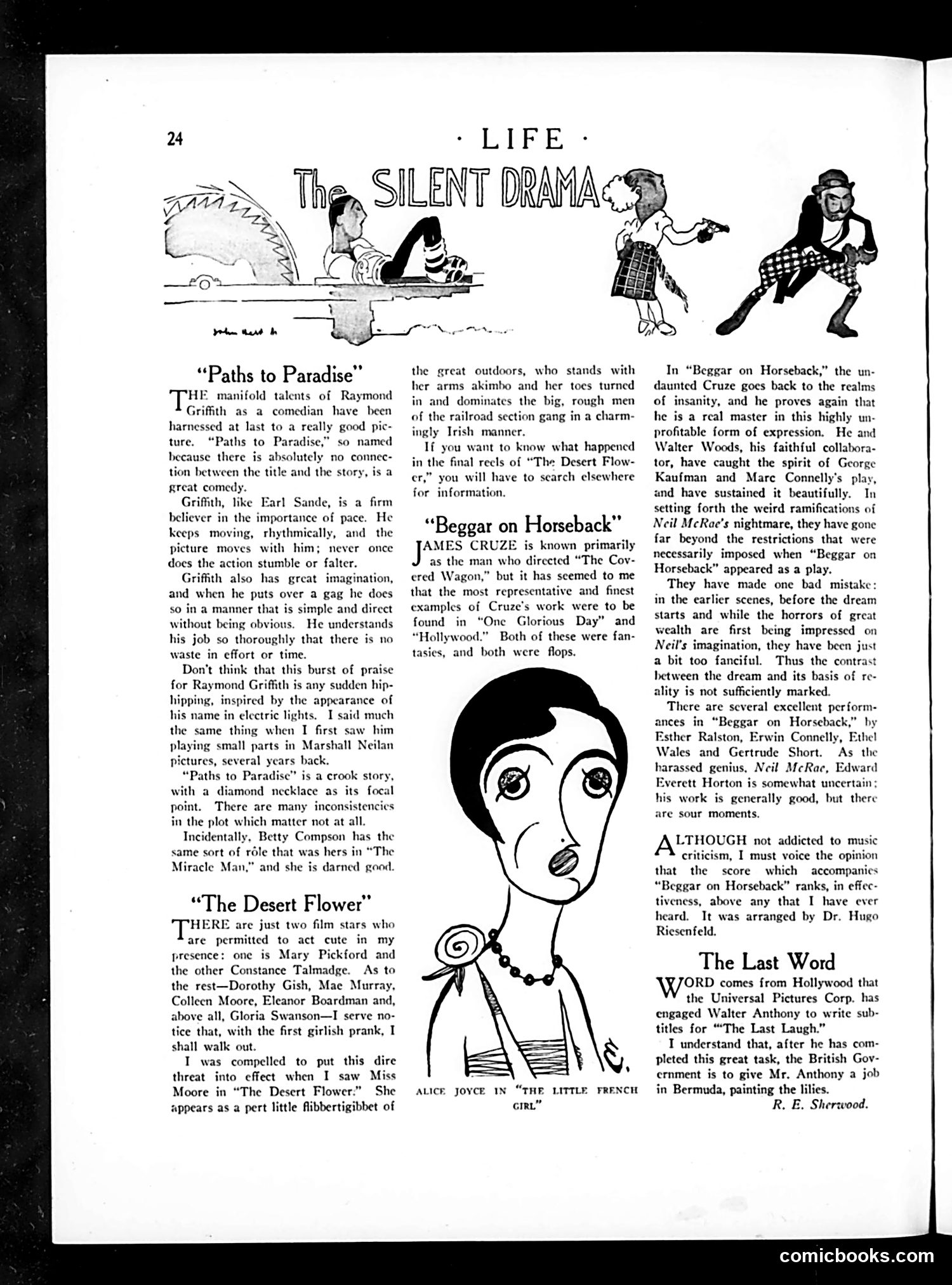
This page contains reviews of three silent films from the early 1920s. The critic praises Raymond Griffith's comedic timing in "Paths to Paradise" (a crime caper), then sharply criticizes Colleen Moore's performance in "The Desert Flower," threatening to walk out on actresses who "act cute" except for Mary Pickford and Constance Talmadge—revealing period attitudes about acceptable female screen behavior. The main review covers "Beggar on Horseback," directed by James Cruze, adapted from a George Kaufman-Marc Connelly play. The critic appreciates Cruze's fantasy sequences depicting a character's nightmare, noting the film surpasses the original stage production's limitations. Edward Everett Horton stars as the protagonist. The illustration shows a stylized female face, identified as Alice Joyce from "The Little French Girl." The reviews reflect 1920s film criticism standards, emphasizing pacing, imagination, and performers' control of expression in silent cinema.
📄 Transcribed text from this page (OCR, searchable)
Machine-transcribed from the original scan — historical spelling and the odd misread are preserved.
SI “Paths to Paradise” HE manifold talents of Raymond Griffith as a comedian have been harnessed at last to a really good pic- ture. “Paths to Paradise,” so named because there is absolutely no connec- tion between the title and the story, is a great comedy. Griffith, like Earl Sande, is a firm er in the importance of pace. He keeps moving, rhythmically, and the picture moves with him; never once does the action stumble or falter. Griffith also has great imagination, and when he puts over a gag he docs so in a manner that is simple and direct without being obvious. He understands his job so thoroughly that there is no waste in effort or time. Don't think that this burst of praise for Raymond Griffith is any sudden hip- hipping, inspired by the appearance of his name in electric lights. I said much the same thing when I first saw him playing small parts in Marshall Neilan pictures, several y back. “Paths to Paradise” is a crook story, with a diamond necklace as its focal point. There are many inconsistencies in the plot which matter not at all. Incidentally, Betty Compson has the same sort of role that was hers in “The Miracle Man,” and she is darned good. “The Desert Flower” "THERE are just two film stars who are permitted to act cute in my presence: one is Mary Pickford and the other Constance Talmadge. As to the rest—Dorothy Gish, Mae Murray, Colleen Moore, Eleanor Boardman and, above all, Gloria Swanson—I serve no- tice that, with the first girlish prank, I shall walk out. I was compelled to put this dire threat into effect when I saw Miss Moore in “The Desert Flower.” She appears as a pert little flibbertigibbet of bel ‘ LIFE + ENT DRAMA a the great outdoors, who stands with her arms akimbo and her toes turned in and dominates the big, rough men of the railroad section gang in a charm- ingly Irish manner. If you want to know what happened in the final reels of “The Desert Flow- er,” you will have to search elsewhere for information. ” “Beggar on Horseback AMES CRUZE is known primarily as the man who dirceted “The Cov- ered Wagon,” but it has scemed to me that the most representative and finest examples of Cruze’s work were to be found in “One Glorious Day” and “Hollywood.” Both of these were fan- tasies, and both were flops. &. ALICE JOYCE IN “THE LITTLE FRENCH Gir.” Ts y In “Beggar on Horseback,” the un- daunted Cruze goes back to the realms of insanity, and he proves again that he is a rcal master in this highly un- profitable form of expression. He and Walter Woods, his faithful collabora- tor, have caught the spirit of George Kaufman and Mare Connelly's play, and have sustained it beautifully. In setting forth the weird ramifications of Neil McRae’s nightmare, they have gone far beyond the restrictions that were necessarily imposed when “Beggar on Horseback” appeared as a play. They have made one bad mistake: in the earlier scenes, before the dream starts and while the horrors of great wealth are first being impressed on Neil's imagination, they have been just a bit too fanciful. Thus the contrast between the dream and its basis of re- ality is not sufficiently marked. There are several excellent perform- ances in “Beggar on Horseback,” by Esther Ralston, Erwin Connelly, Ethel Wales and Gertrude Short. As the harassed genius, Neil McRac, Edward Everett Horton is somewhat uncertain; his work is generally good, but there are sour moments. LTHOUGH not addicted to music criticism, I must voice the opinion that the score which accompanics “Beggar on Horseback” ranks, in effec- tiveness, above any that I have ever heard. It was arranged by Dr. Hugo Riesenfeld. The Last Word Word comes from Hollywood that the Universal Pictures Corp. has engaged Walter Anthony to write sub- titles for “The Last Laugh.” I understand that, after he has com- pleted this great task, the British Gov- ernment is to give Mr. Anthony a job in Bermuda, painting the lilies. R. E, Sherwood. comicbooks.com