
Life, 1925-06-25 · page 24 of 37
Life — June 25, 1925 — page 24: what you’re looking at
What you’re looking at
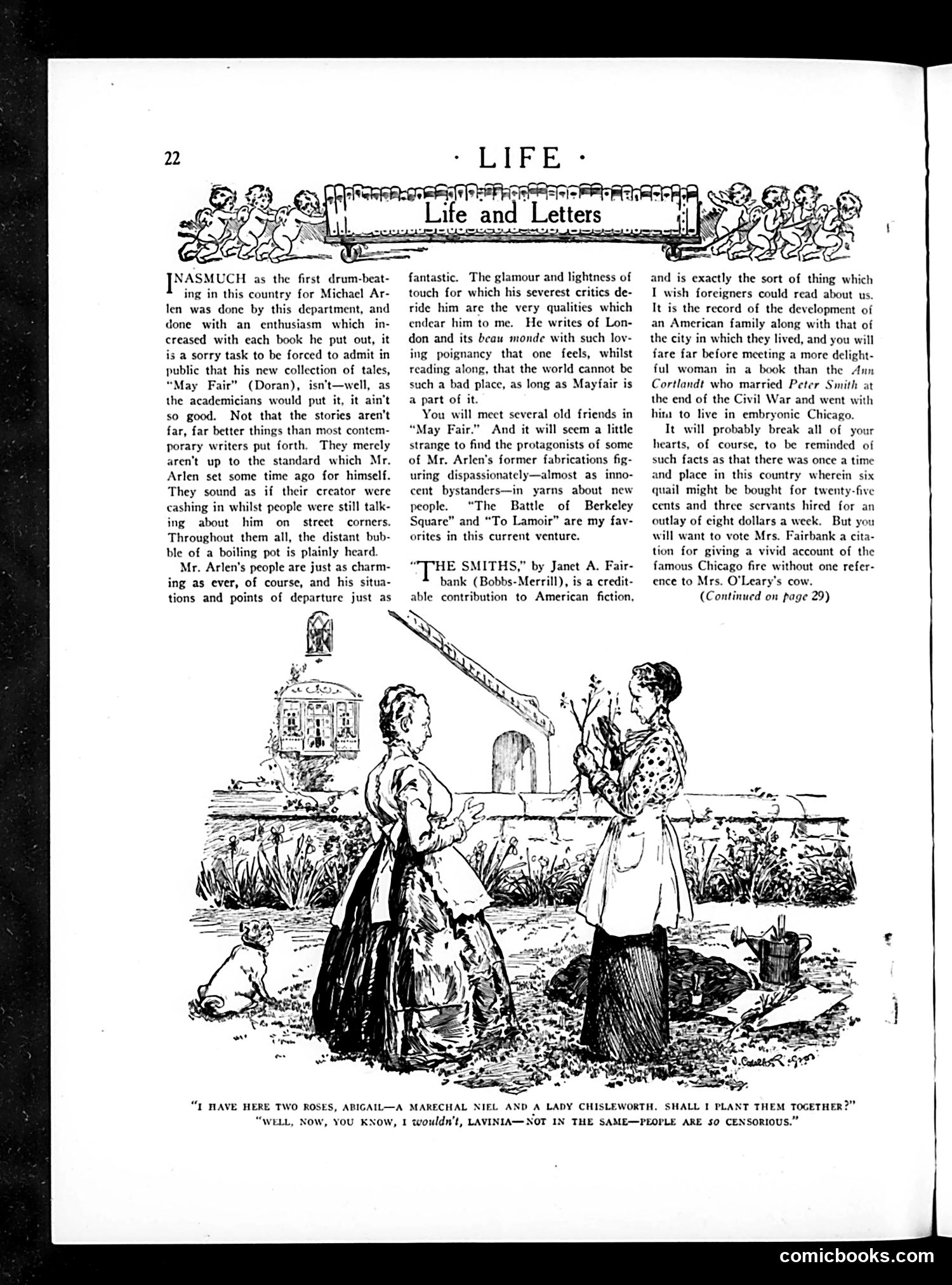
This page contains literary reviews rather than political cartoons. The main text critiques Michael Arlen's short story collection "May Fair" and Janet Fairbank's novel "The Smiths." The single illustration at the bottom is a social satire showing two women in a garden. One proposes planting two rose varieties together; the other demurs, saying "people are so censorious." The joke targets upper-class propriety and gossip—the women treat rose-planting as a matter of social scandal, anthropomorphizing the flowers as if they were people whose proximity would cause scandal. This mocks the era's rigid social conventions and tendency toward petty censoriousness among the wealthy. The reviews themselves praise Arlen's glamorous depictions of London's "beau monde" (high society) while gently noting his latest work lacks his earlier brilliance, and commend Fairbank's historical novel about Chicago's development.
📄 Transcribed text from this page (OCR, searchable)
Machine-transcribed from the original scan — historical spelling and the odd misread are preserved.
[NASMUCH as the first drum-beat- ing in this country for Michael Ar- len was done by this department, and done with an enthusiasm which in- creased with each book he put out, it is a sorry task to be forced to admit in public that his new collection of tales, “May Fair” (Doran), isn't—well, as the academicians would put it, it ain't so good. Not that the stories aren't far, far better things than most contem- porary writers put forth. They merely aren't up to the standard which Mr. Arlen set some time ago for himself. They sound as if their creator were cashing in whilst people were still talk- ing about him on street corners. Throughout them all, the distant bub- ble of a boiling pot is plainly heard. Mr. Arlen’s people are just as charm- ing as ever, of course, and his situa- tions and points of departure just as * LIFE » Life and fantastic. The glamour and lightness of touch for which his severest critics de- ride him are the very qualities which endear him to me. He writes of Lon- don and its beau monde with such lov- ing poignancy that one feels, whilst reading along, that the world cannot be such a bad place, as long as Mayfair is a part of it. You will mect several old friends in “May Fair.” And it will scem a little strange to find the protagonists of some of Mr. Arlen’s former fabrications fig- uring dispassionately—almost as inno- cent bystanders—in yarns about new people. “The Battle of Berkeley Square” and “To Lamoir” are my fav- orites in this current venture. ““CHE SMITHS,” by Janet A. Fair- bank (Bobbs-Merrill), is a credit- able contribution to American fiction, and is exactly the sort of thing which I wish foreigners could read about us. It is the record of the development of an American family along with that of the city in which they lived, and you will fare far before meeting a more delight- ful woman in a book than the Ann Cortlandt who married Peter Smith at the end of the Civil War and went with hima to live in embryonic Chicago. It will probably break all of your hearts, of course, to be reminded of such facts as that there was once a time and place in this country wherein six quail might be bought for twenty-five cents and three servants hired for an outlay of eight dollars a week. But you will want to vote Mrs. Fairbank a cita- tion for giving a vivid account of the famous Chicago fire without one refer- ence to Mrs. O'Leary's cow. (Continued on page 29) “I HAVE HERE TWO ROSES, ABIGAIL—A MARECHAL NIEL AND A LADY CHISLEWORTH. SHALL I PLANT THEM TOGETHER?” “WELL, Now, YOU KNOW, I wouldn't, LAVINIA—NOT IN THE SAME—PEOPLE ARE $0 CENSORIOUS.” comicbooks.com