
Life, 1925-06-25 · page 13 of 37
Life — June 25, 1925 — page 13: what you’re looking at
What you’re looking at
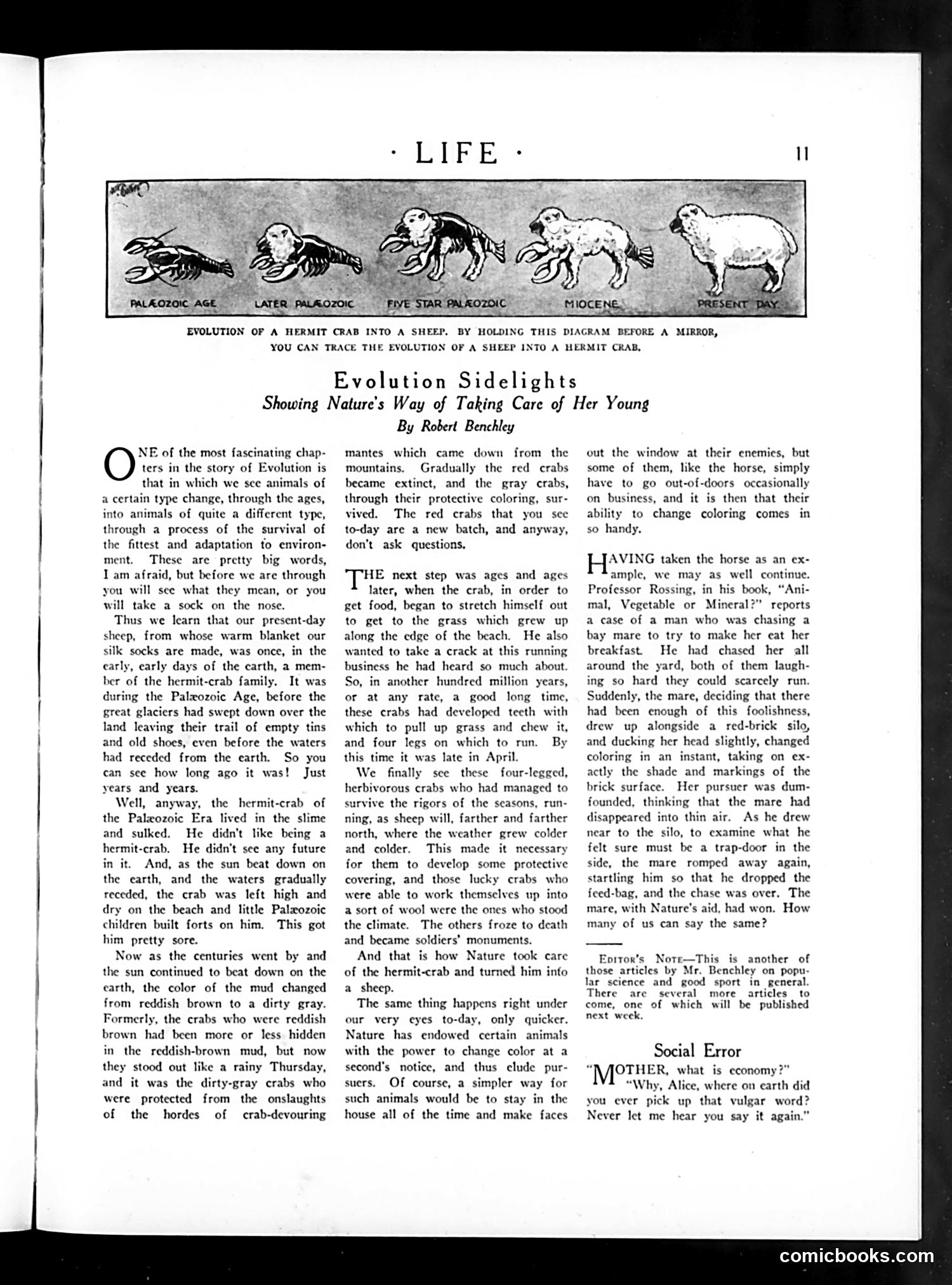
This page contains **two unrelated pieces** from *Life* magazine: 1. **"Evolution Sidelights"** - A humorous essay by Robert Benchley about evolutionary adaptation, using hermit crabs and sheep as examples. The diagram at top shows the reverse process: "Evolution of a Hermit Crab into a Sheep." The satire mocks both evolutionary theory and human pretension—Benchley suggests that observing the diagram in a mirror reveals how humans similarly "evolved" from lower creatures. It's gentle mockery of popular misunderstandings of Darwin, presenting evolution as whimsical rather than scientific. 2. **"Social Error"** - A brief joke where a mother corrects her daughter Alice for using the word "economy," calling it "vulgar." This satirizes upper-class affectation and the arbitrary social rules governing "proper" speech among the wealthy. Both pieces are light social satire typical of *Life's* 1920s-era humor.
📄 Transcribed text from this page (OCR, searchable)
Machine-transcribed from the original scan — historical spelling and the odd misread are preserved.
EVOLUTION OF A HERMIT CRAB INTO A SHEEP. BY HOLDING THIS DIAGRAM BEFORE A MIRROR, YOU CAN TRACE THE EVOLUTION OF A SHEEP INTO A HERMIT CRAB, Evolution Sidelights Showing Nature's Way of Taking Care of Her Young NE of the most fascinating chap- O ters in the story of Evolution is that in which we sce animals of a certain type change, through the ages, into animals of quite a different type, through a process of the survival of the fittest and adaptation to environ- ment. These are pretty big words, lam afraid, but before we are through you will sce what they mean, or you will take a sock on the nose. Thus we learn that our present-day sheep, from whose warm blanket our silk socks are made, was once, in the early, early days of the carth, a mem- ber of the hermit-crab family. It was during the Palzozoic Age, before the great glaciers had swept down over the land leaving their trail of empty tins and old shoes, even before the waters had receded from the earth. So you can see how long ago it was! Just years and years. Well, anyway, the hermit-crab of the Palxozoic Era lived in the slime and sulked. He didn't like being a hermit-crab. He didn't see any future in it. And, as the sun beat down on the carth, and the waters gradually receded, the crab was left high and dry on the beach and little Palxozoic children built forts on him. This got him pretty sore. Now as the centuries went by and the sun continued to beat down on the carth, the color of the mud changed from reddish brown to a dirty gray. Formerly, the crabs who were reddish brown had been more or less hidden in the reddish-brown mud, but now they stood out like a rainy Thursday, and it was the dirty-gray crabs who were protected from the onslaughts of the hordes of crab-devouring By Robert Benchley mantes which came down from the mountains. Gradually the red crabs became extinct, and the gray crabs, through their protective coloring, sur- vived. The red crabs that you see to-day are a new batch, and anyway, don’t ask questions, HE next step was ages and ages later, when the crab, in order to get food, began to stretch himself out to get to the grass which grew up along the edge of the beach. He also wanted to take a crack at this running business he had heard so much about So, in another hundred million years, or at any rate, a good long time, these crabs had developed teeth with which to pull up grass and chew it, and four legs on which to run. By this time it was late in April. We finally sce these four-legged, herbivorous crabs who had managed to survive the rigors of the seasons, run- ning, as sheep will, farther and farther north, where the weather grew colder and colder. This made it necessary for them to develop some protective covering, and those lucky crabs who were able to work themselves up into a sort of wool were the ones who stood the climate. The others froze to death and became soldiers’ monuments. And that is how Nature took care of the hermit-crab and turned him info a_ sheep. The same thing happens right under our very eyes to-day, only quicker. Nature has endowed certain animals with the power to change color at a second’s notice, and thus elude pur- suers. Of course, a simpler way for such animals would be to stay in the house all of the time and make faces out the window at their enemies, but some of them, like the horse, simply have to go out-of-doors occasionally on business, and it is then that their ability to change coloring comes in so handy. AVING taken the horse as an ex- ample, we may as well continue. Professor Rossing, in his book, “Ani- mal, Vegetable or Mineral?” reports a case of a man who was chasing a bay mare to try to make her eat her breakfast. He had chased her all around the yard, both of them laugh- ing so hard they could scarcely run. Suddenly, the mare, deciding that there had been enough of this foolishness, drew up alongside a red-brick silo, and ducking her head slightly, changed coloring in an instant, taking on ex- actly the shade and markings of the brick surface. Her pursuer was dum- founded, thinking that the mare had disappeared into thin air. As he drew near to the silo, to examine what he felt sure must be a trap-door in the side, the mare romped away again, startling him so that he dropped the feed-bag, and the chase was over. The mare, with Nature's aid, had won. How many of us can say the same? Epitor’s Note—This is another of those articles by Mr. Benchley on popu- lar science and good sport in general. There are several more articles to come, one of which will be published next week. Social Error “\ OTHER, what is economy?” “Why, Alice, where on earth did you ever pick up that vulgar word? Never let me hear you say it again.” comicbooks.com