
Life, 1925-06-25 · page 20 of 37
Life — June 25, 1925 — page 20: what you’re looking at
What you’re looking at
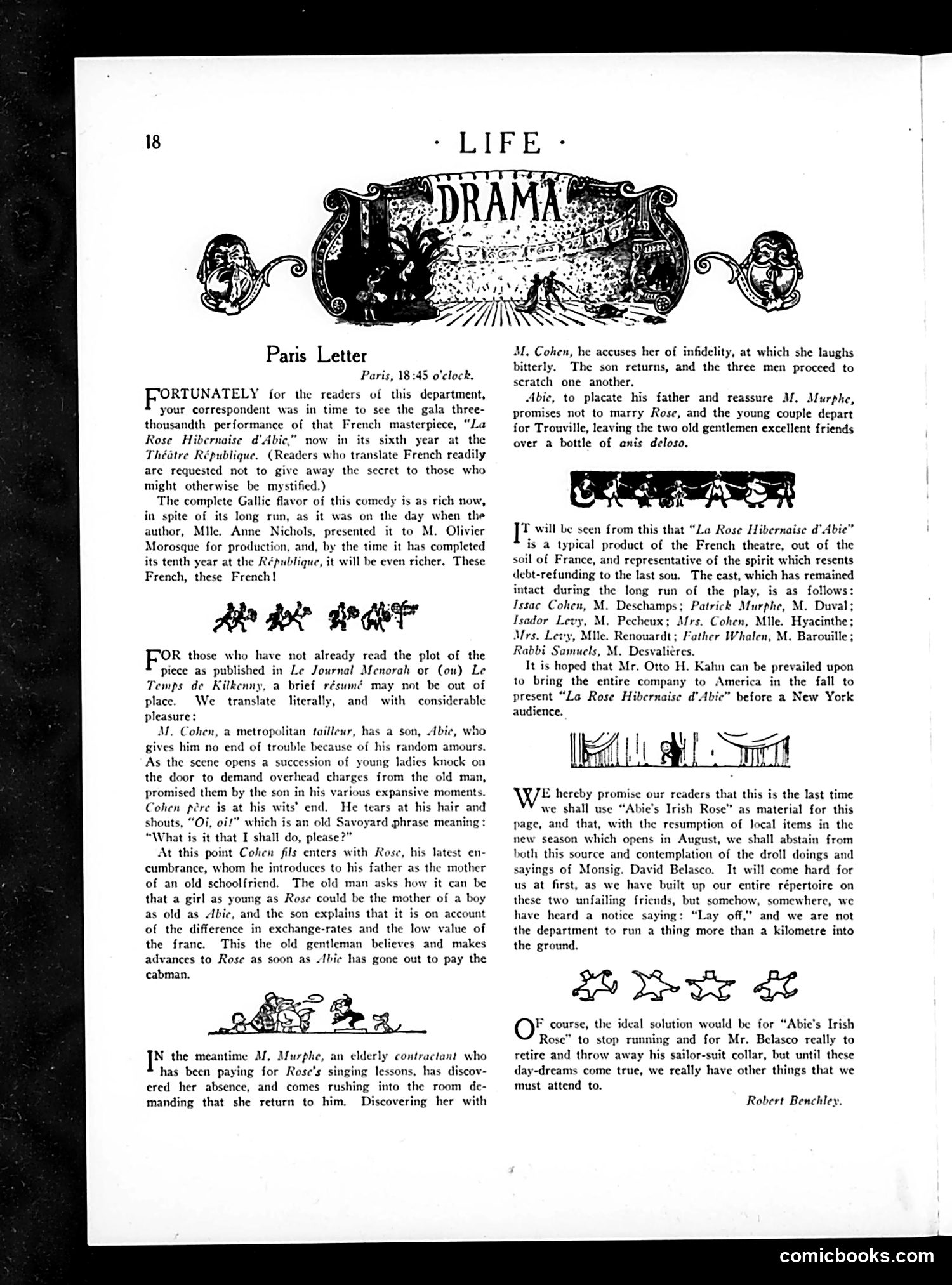
This is a satirical "Paris Letter" mocking the phenomenal success of "Abie's Irish Rose," a Broadway play by Anne Nichols that was running continuously with enormous popularity. The joke pretends the play has become a French masterpiece in its sixth year at a Paris theater, with a fabricated three-thousandth performance. The satire works by: 1. **Renaming it** as "La Rose Hibernaise d'Abie" (The Irish Rose of Abie) and crediting it to a fictional French production, treating it as authentic French theater rather than American commercial entertainment. 2. **Mocking the plot's absurdity**—the contrived romantic entanglements and the ridiculous explanation that a young woman could be an old boy's mother due to "exchange-rates and the low value of the franc." 3. **The final admission** that Life has exhausted this material for satire and promises readers they're done using "Abie's Irish Rose" as source material, suggesting the play's cultural dominance had become tiresome even for satirists. The piece lampoons both the play's unlikely success and American culture's obsession with it.
📄 Transcribed text from this page (OCR, searchable)
Machine-transcribed from the original scan — historical spelling and the odd misread are preserved.
18 Paris Letter Paris, 18:45 o'clock. 'ORTUNATELY for the readers of this department, your correspondent was in time to see the gala three- thousandth performance of that French masterpiece, “La Rose Hibernaise d'Abiec,” now in its sixth year at the Thédtre République. (Readers who translate French readily are requested not to give away the secret to those who might otherwise be mystified.) The complete Gallic flavor of this comedy is as rich now, in spite of its long run, as it was on the day when the author, Mlle. Anne Nichols, presented it to M. Olivier Morosque for production, and, by the time it has completed its tenth year at the République, it will be even richer. These French, these French! AR Be ReGT For those who have not already read the plot of the piece as published in Le Journal Menorah or (ou) Le Temps de Kilkenny, a brief résumé may not be out of place. We translate literally, and with considerable pleasure: AM. Cohen, a metropolitan tailleur, has a son, Abie, who gives him no end of trouble because of his random amours. As the scene opens a succession of young ladies knock on the door to demand overhead charges from the old man, promised them by the son in his various expansive moments. Cohen pére is at his ’ end. He tears at his hair and ” which is an old Savoyard phrase meaning : “What is it that I shall do, please?’ At this point Cohen fils enters with Rose, his latest en- cumbrance, whom he introduces to his father as the mother of an old schoolfricnd. The old man asks how it can be that a girl as young as Rose could be the mother of a boy as old as dbic, and the son explains that it is on account of the difference in exchange-rates and the low value of the franc. This the old gentleman believes and makes advances to Rose as soon as hie has gone out to pay the cabman. N the meantime Mf. Murphe, an elderly contractant who has been paying for Rose's singing lessons, has discov- ered her absence, and comes rushing into the room de- manding that she return to him. Discovering her with M. Cohen, he accuses her of infidelity, at which she laughs bitterly. The son returns, and the three men proceed to scratch one another, Abie, to placate his father and reassure M. Murphe, promises not to marry Rose, and the young couple depart for Trouville, leaving the two old gentlemen excellent friends over a bottle of anis deloso. Rea T will be seen from this that “La Rose Hibernaise d’Abie” is a typical product of the French theatre, out of the soil of France, and representative of the spirit which resents debt-refunding to the last sou. The cast, which has remained intact during the long run of the play, is as follows: Issac Cohen, M. Deschamps; Patrick Murphe, M. Duval; Isador Levy, M. Pecheux; Mrs. Cohen, Mile. Hyacinth Mrs. Le {lle. Renouardt; Father Whalen, M. Barouille; Rabbi Samuels, M. Desvaliéres. It is hoped that Mr. Otto H. Kahn can be prevailed upon to bring the entire company to America in the fall to present “La Rose Hibernaise d’Abic” before a New York audience. oe wed | mg } W hereby promise our readers that this is the last time we shall use “Abie's Irish Rose” as material for this page, and that, with the resumption of local items in the new season which opens in August, we shall abstain from both this source and contemplation of the droll doings and sayings of Monsig. David Belasco. It will come hard for us at first, as we have built up our entire répertoire on these two unfailing friends, but somehow, somewhere, we have heard a notice saying: “Lay off,” and we are not the department to run a thing more than a kilometre into the ground. ah Yeue at F course, the ideal solution would be for “Abie’s Irish Rose” to stop running and for Mr. Belasco really to retire and throw away his sailor-suit collar, but until these day-dreams come true, we really have other things that we must attend to. Robert Benchley. comicbooks.com