
A complete issue · 37 pages · 1925
Life — April 23, 1925
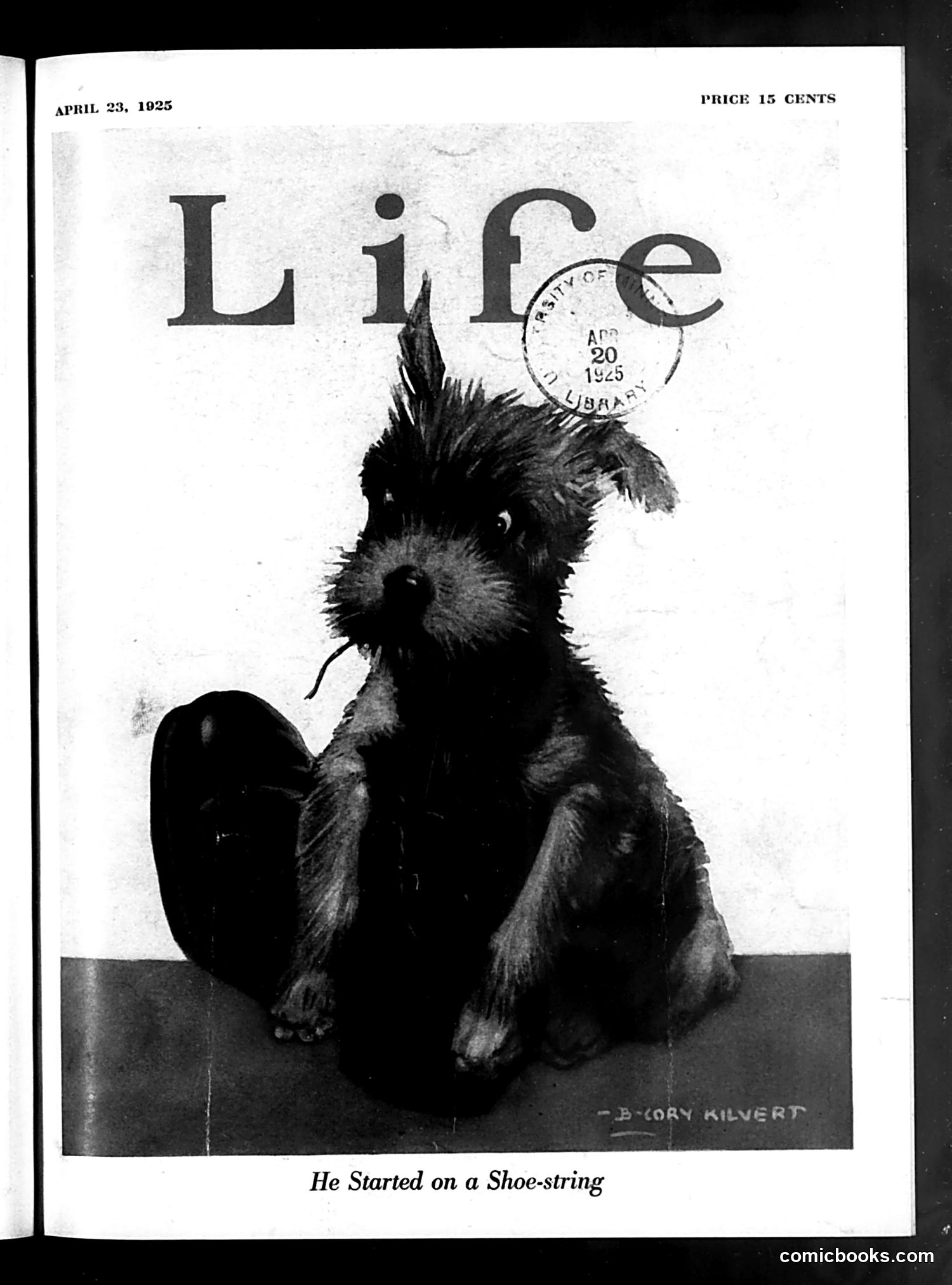
This cover features a small, scrappy dog holding a shoe in its mouth, with the caption "He Started on a Shoe-string." The title "Life" appears above the dog's head. The image is a visual pun on the common business idiom "started on a shoestring," meaning to begin an enterprise with minimal capital or resources. By literally depicting a dog with an actual shoe-string, Life presents a humorous illustration of this phrase. The dog's determined, upright posture and intense expression suggest ambition or scrappy determination despite humble beginnings. This appears to be a satirical commentary on business success stories or entrepreneurship, though the specific reference—whether to a particular public figure or business venture—remains unclear from the image alone.

This is a **Goodrich Silvertown Balloons tire advertisement**, not political satire. The page shows a large balloon tire mounted in a mechanical holding frame, presented as a product endorsement. The tagline "Master among Balloon Tires" and "Best in the Long Run" promote durability and economy for automobile drivers. The text emphasizes practical benefits: fuel efficiency, smooth ride quality, and reliable performance. The mechanical presentation—with the tire displayed like an industrial product—appeals to early 20th-century consumers' interest in automotive technology and engineering. This represents standard commercial advertising from Life magazine's era, when balloon tires were relatively new automotive innovations marketed to the expanding car-owning public. No satire or political commentary is present.
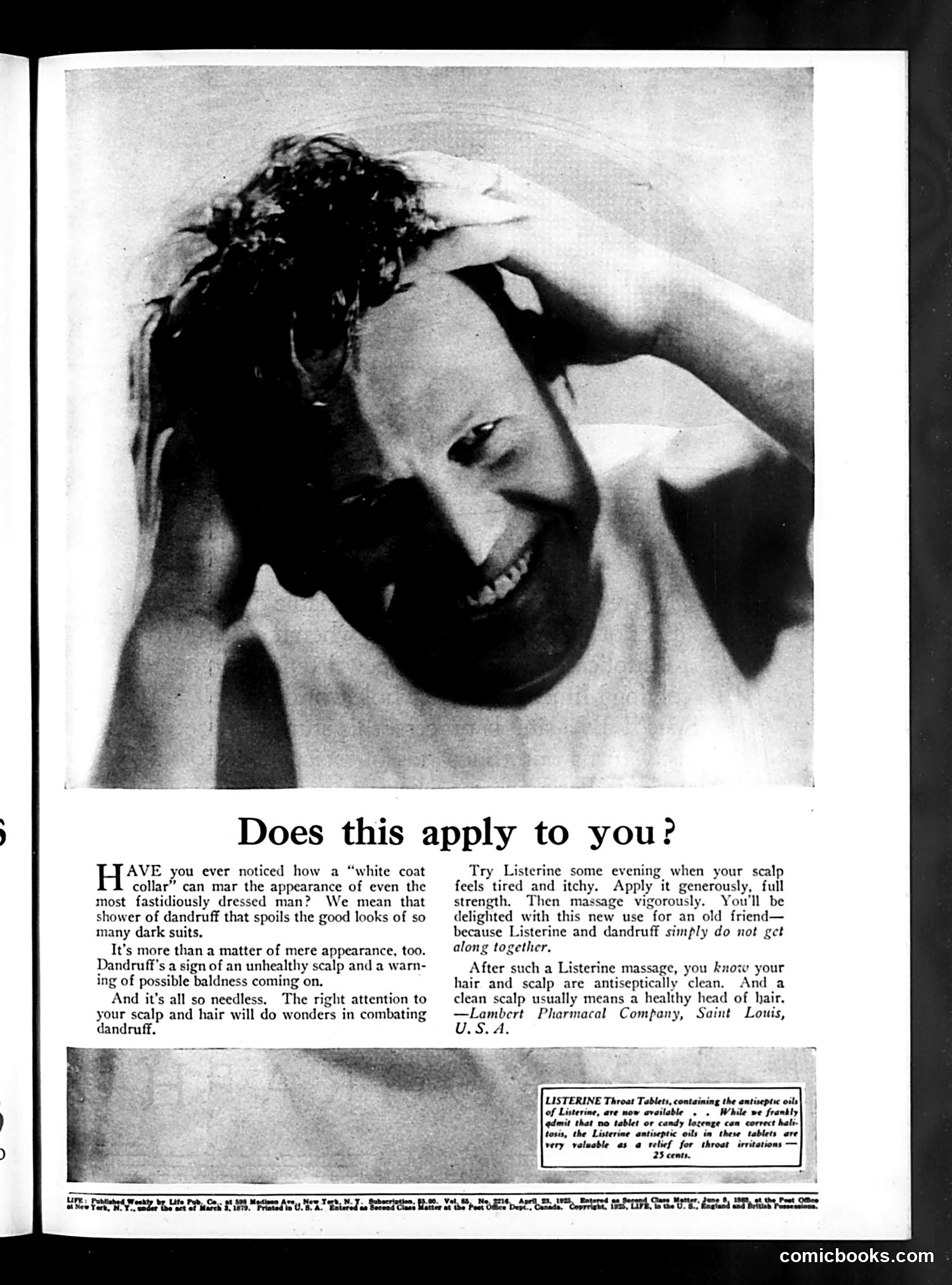
This page is primarily **advertising, not political satire**. It's a Listerine advertisement promoting the product as a dandruff treatment and scalp cleanser. The image shows a person with styled hair running their hand through their hair, appearing satisfied or relieved. The ad's headline "Does this apply to you?" addresses readers concerned about dandruff—described as both an appearance problem ("spoils the good looks") and a sign of "possible baldness coming on." The advertisement promises that Listerine massages and antiseptic properties will combat dandruff effectively, claiming users will have "a healthy head of hair." A footnote mentions Listerine Throat Tablets are also available. This reflects early 20th-century consumer advertising targeting male grooming anxieties.
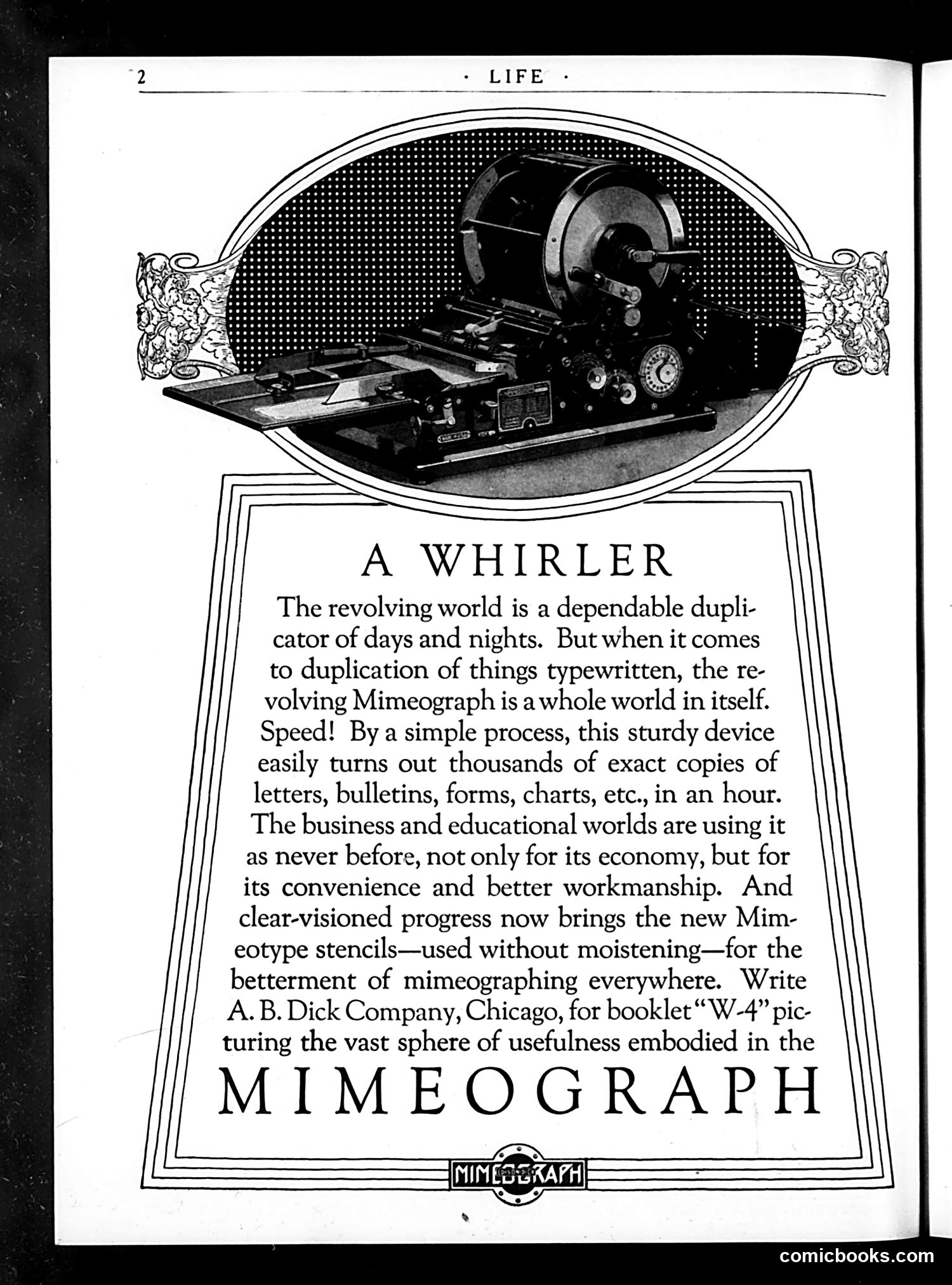
This is **not a cartoon or satire page** — it's a straightforward **advertisement** for the Mimeograph machine, published in *Life* magazine. The ad promotes the Mimeograph as a revolutionary duplicating device for businesses and schools. The image shows the mechanical apparatus itself. The text emphasizes speed ("thousands of exact copies...in an hour") and practicality for offices and educational institutions. The only notable element is the framing device: decorative Art Nouveau-style borders with cherub figures, giving the ad an elegant, aspirational tone typical of early 20th-century advertising design. This represents how *Life* magazine — though satirical — also accepted commercial advertisements to fund publication. There is no political or social satire present on this particular page.
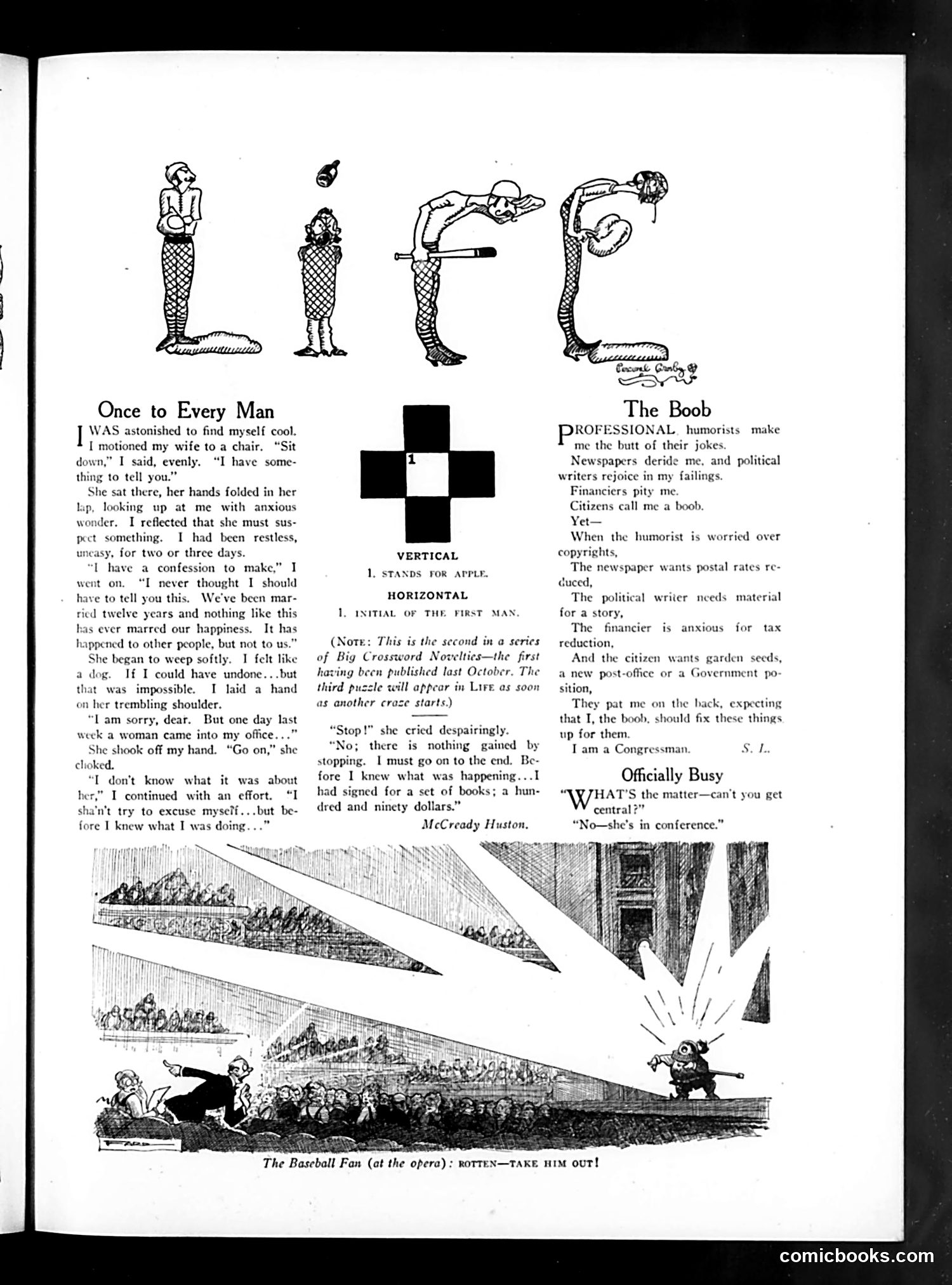
This page contains three distinct pieces of humor satire: **"Once to Every Man"** presents a domestic comedy where a husband confesses something unspecified to his wife, building nervous tension. The joke hinges on the reader's expectation of serious confession versus mundane reality. **"The Boob"** critiques a man ridiculed by professionals, newspapers, politicians, and financiers—all taking advantage of him while he remains oblivious ("the boob"). The crossword puzzle and accompanying notes suggest this is part of an ongoing series. **"Officially Busy"** mocks bureaucratic evasion: when asked why someone's unavailable, the response is simply "she's in conference"—implying important work that's actually meaningless busy-work. **The Baseball Cartoon** satirizes disruptive fans at the opera, showing audience members ejecting an enthusiastic baseball fan, highlighting class tensions and cultural clash between popular and elite entertainment.
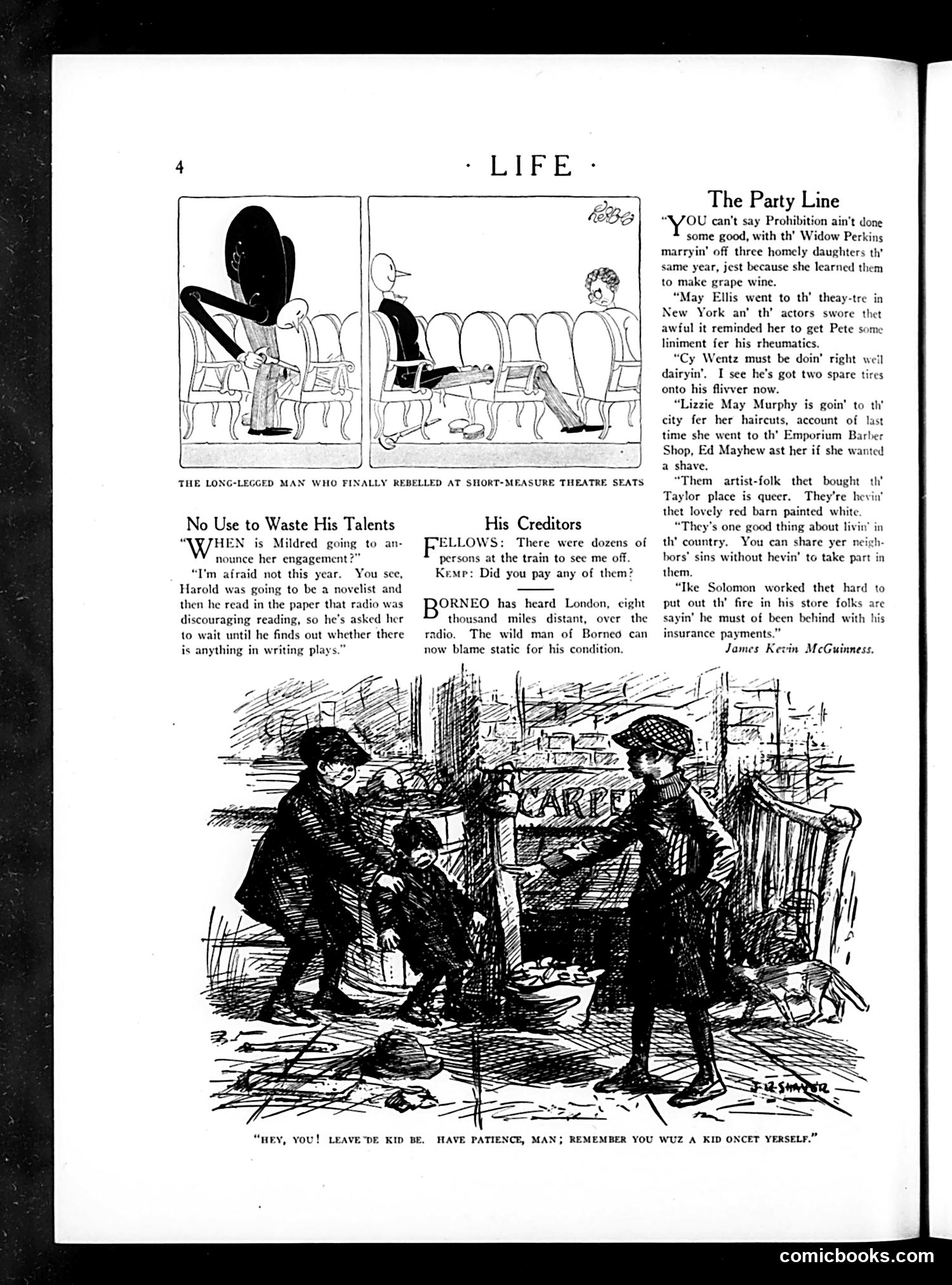
This page contains three distinct humor pieces from an early 20th-century Life magazine issue: **"The Long-Legged Man"** (top cartoon) satirizes theater etiquette—specifically men wearing their legs extended into neighboring seats, annoying other patrons. **"No Use to Waste His Talents"** and **"His Creditors"** (middle section) appear to be brief humorous anecdotes about a character named Harold who wanted to be a novelist but lacked talent, and about someone from Borneo dealing with creditors via radio. **"The Barber Shop" cartoon** (bottom) depicts street children, with one adult telling a boy to be patient, remembering "you wuz a kid oncet yerself"—social commentary on class attitudes toward poor children. The overall page reflects Life's focus on genteel social satire mixed with working-class humor typical of the era.
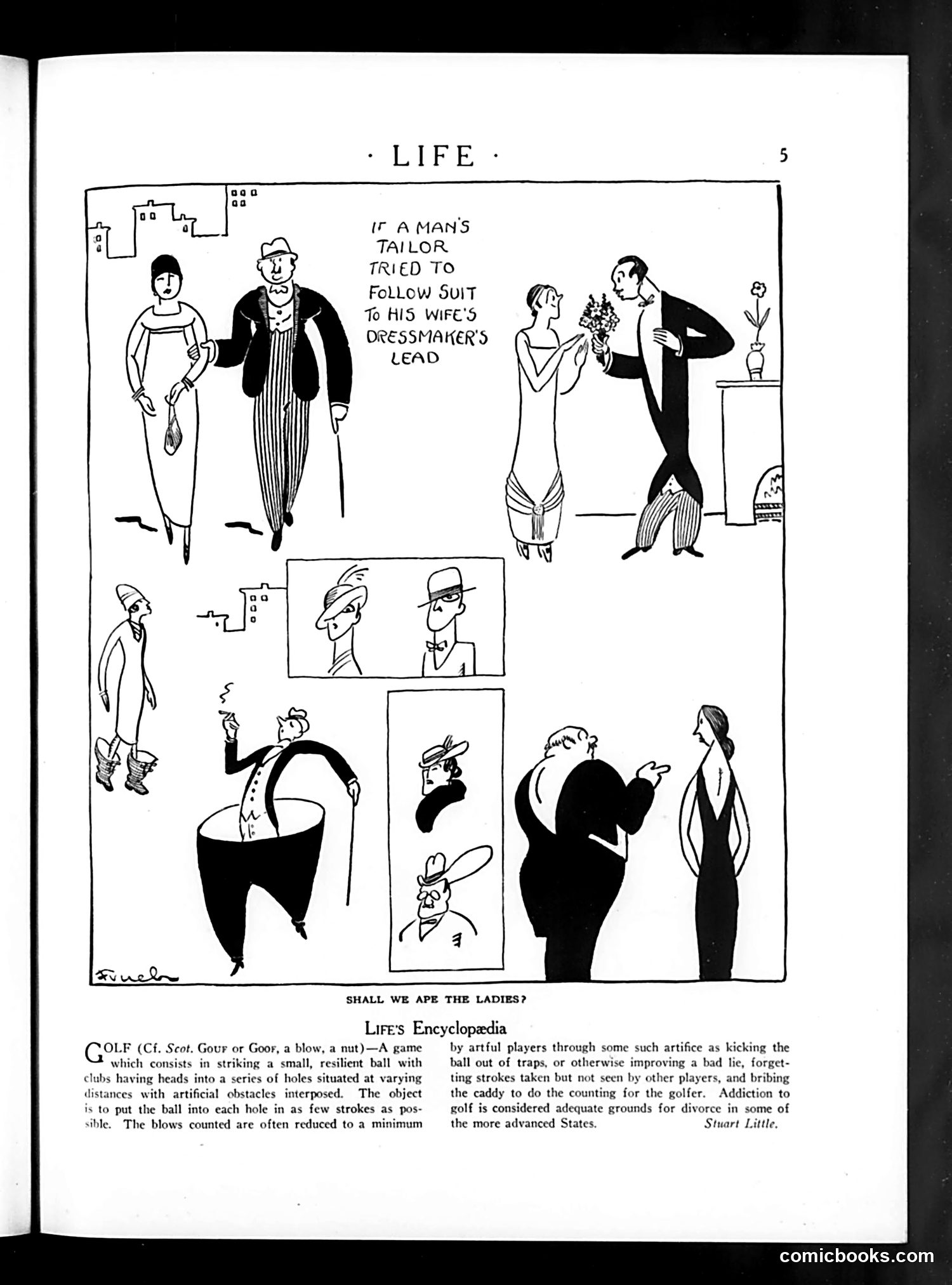
This satirical cartoon mocks the perceived fashion competition between husbands and wives, particularly regarding tailors versus dressmakers. The joke's premise: if men's tailors followed women's dressmakers' lead in design trends, men would adopt equally extreme and ridiculous fashions. The sequential panels show increasingly absurd male clothing—oversized silhouettes, exaggerated proportions, and impractical styles mirroring 1920s women's fashion extremes. The final panel asks "Shall We Ape the Ladies?"—directly questioning whether men should blindly imitate women's fashion choices. The satire targets both fashion's rapid changes and gender anxieties about masculine identity during the flapper era, when women's fashions had become noticeably more daring and less restrictive than traditional styles.
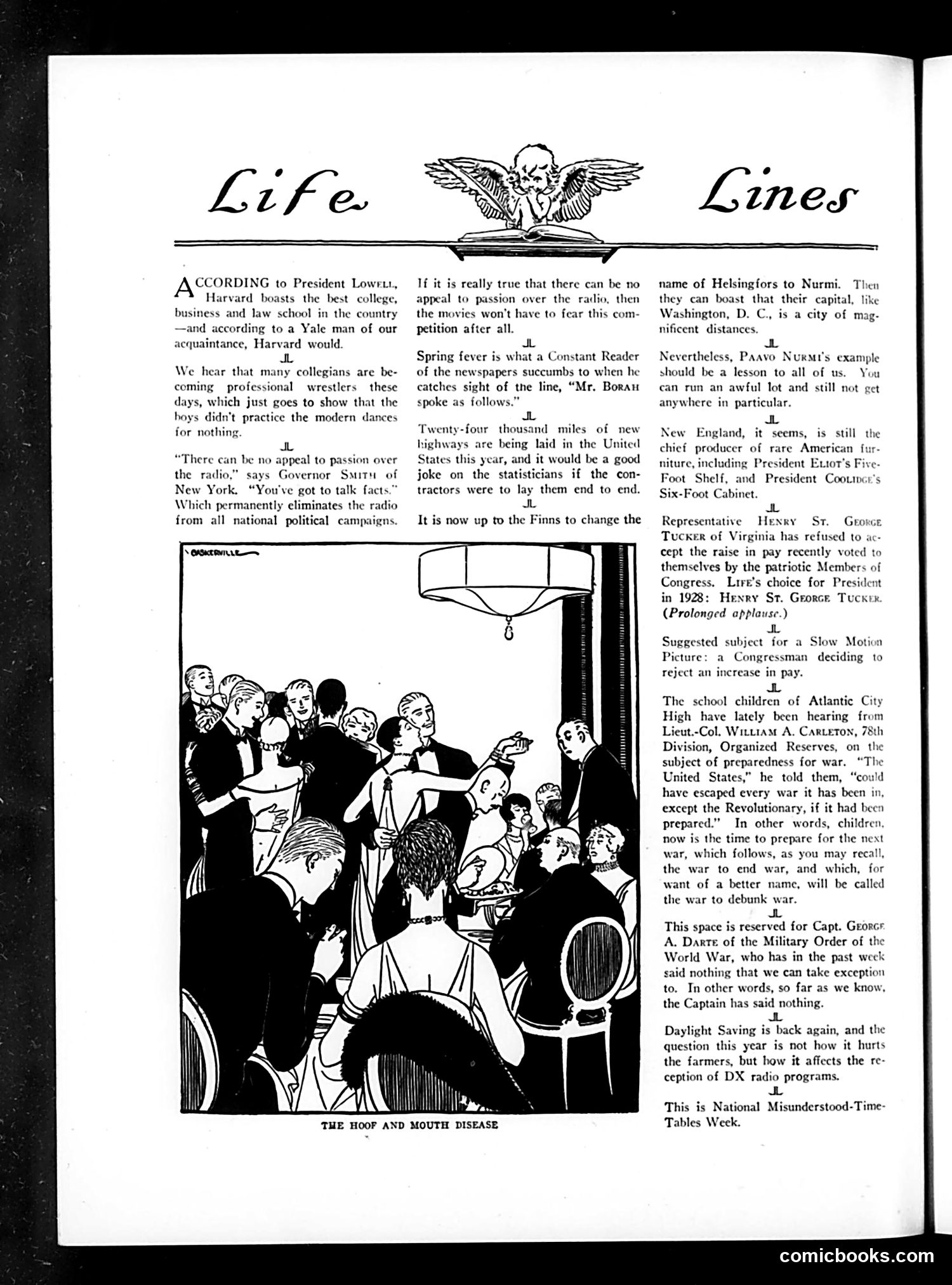
This political cartoon satirizes radio as a contagious affliction spreading among the general public. The crowded scene depicts ordinary citizens—men, women, and children—apparently infected and suffering from excessive radio enthusiasm, depicted as a literal disease. The cartoon directly references Governor Smith of New York's quoted statement: "There can be no appeal to passion over the radio." The satire suggests radio itself promotes unchecked emotional manipulation and irrational behavior in audiences. "Hoof and mouth disease" is a real livestock illness; using it metaphorically implies radio-induced mass hysteria reduces people to animal-like status, unthinking and contagious in their enthusiasm. This reflects 1920s anxieties about new mass media technology's power to influence public opinion dangerously.
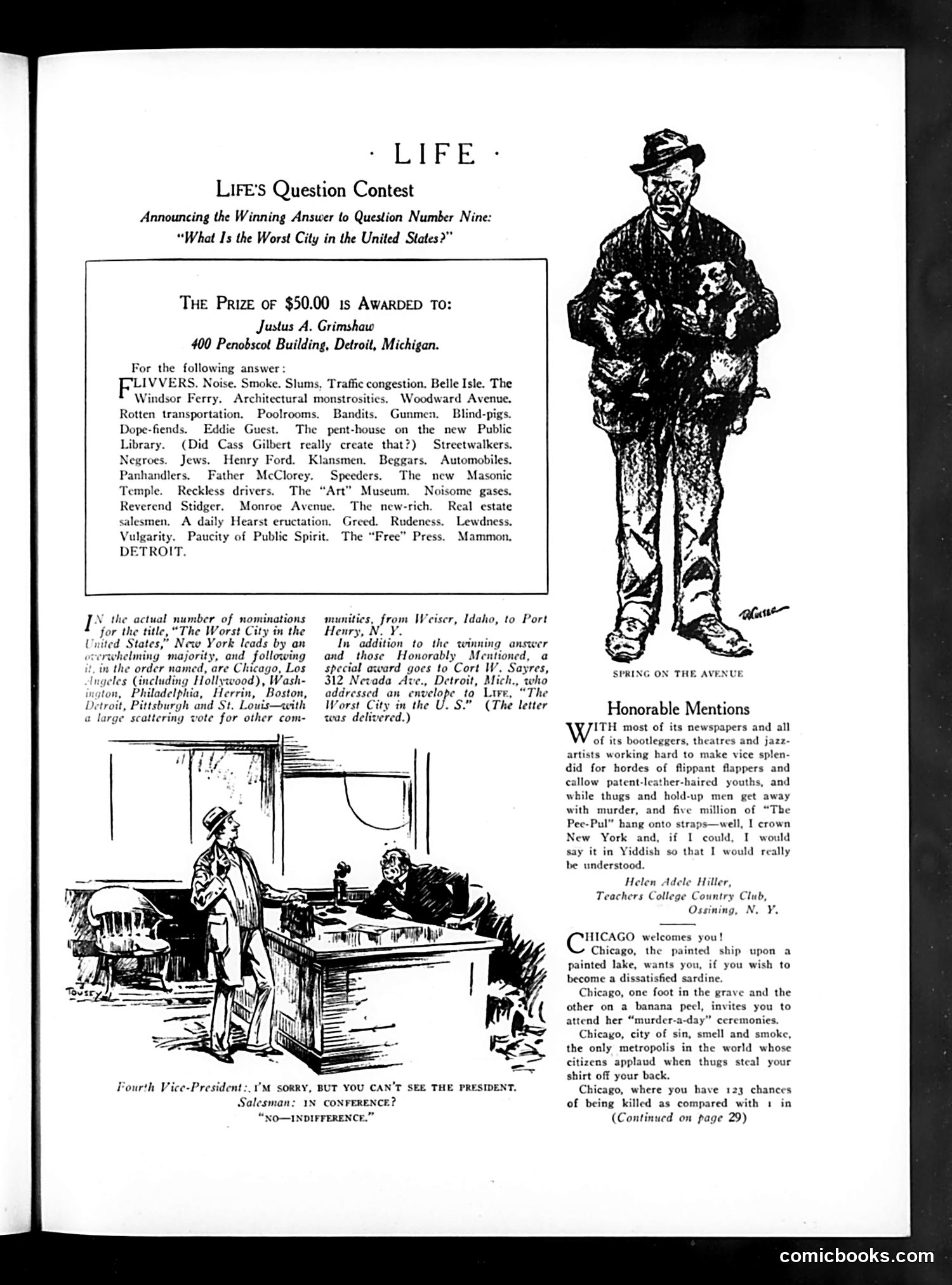
This page announces the winner of Life's "Question Contest" asking readers to identify the worst city in the United States. The winner, Justus A. Grimshaw of Detroit, receives $50 for listing Detroit's problems: fires, slums, traffic congestion, architectural eyesores, and moral failings. The cartoon below depicts a Fourth Vice-President meeting a Salesman, with dialogue suggesting bureaucratic indifference ("I'm sorry, but you can't see the President. Salesman: in conference? No—indifference"). This satirizes corporate leadership's detachment from employees' concerns. The "Honorable Mentions" section on the right includes sardonic jabs at Chicago's crime and corruption, suggesting widespread public cynicism about major American cities' governance and conditions during this period.
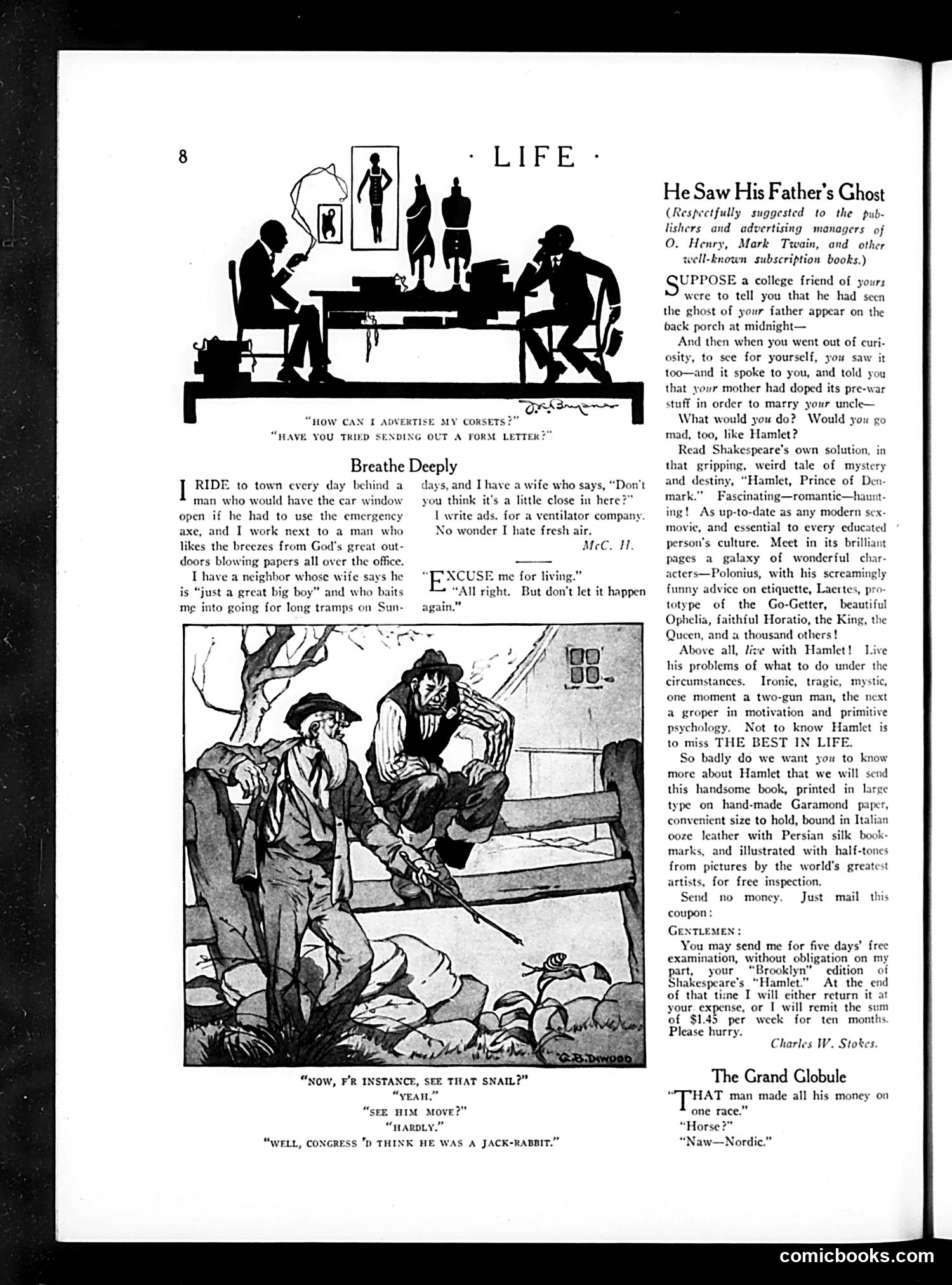
This page from *Life* magazine contains two distinct pieces: **"Breathe Deeply"** (left): A humorous complaint about commuting. The speaker rides to town daily, dealing with crowded trains, smoky cars, and office air pollution. He jokes that a neighbor calls fresh air a "ventilation company," satirizing urban industrial life's poor air quality—a relatable complaint for early 20th-century city commuters. **"He Saw His Father's Ghost"** (right): An advertisement for a special edition of Shakespeare's *Hamlet*, marketed to modern readers. The copy humorously frames the play as contemporary—comparing it to modern "sex-movies" and "Go-Getters," and emphasizing its relevance to educated people's culture. It's pitched as essential reading for anyone claiming cultural sophistication. Both pieces use humor to comment on contemporary life and reading habits.
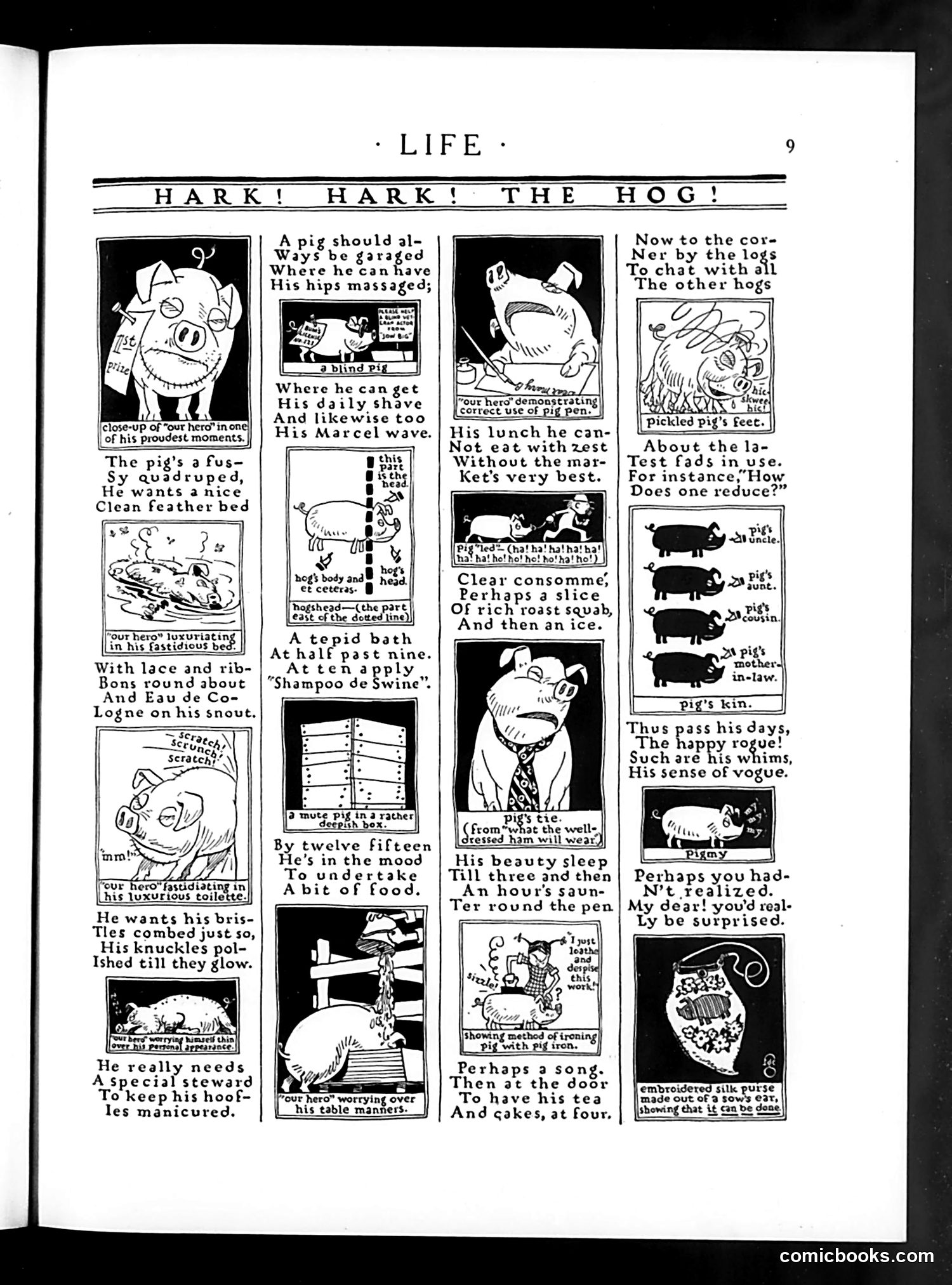
This page presents a satirical comic strip about an excessively pampered pig—"our hero"—treated like wealthy aristocracy. The humor mocks the absurd indulgence of the wealthy during this era. The pig receives luxurious treatment including: hip massages, daily shaves, elaborate bedding, a decorated tie, and formal dining with roast squash and ice. Captions describe his leisure activities—sleeping until afternoon, discussing table manners, and receiving beauty treatments. The satire targets class excess and materialism: this animal lives better than working-class humans. The repeated phrase "our hero" ironically elevates a pig to mock how society worships wealth and consumption. The detailed parody of upper-class rituals (grooming, dining etiquette, leisurewear) highlights their perceived frivolousness.
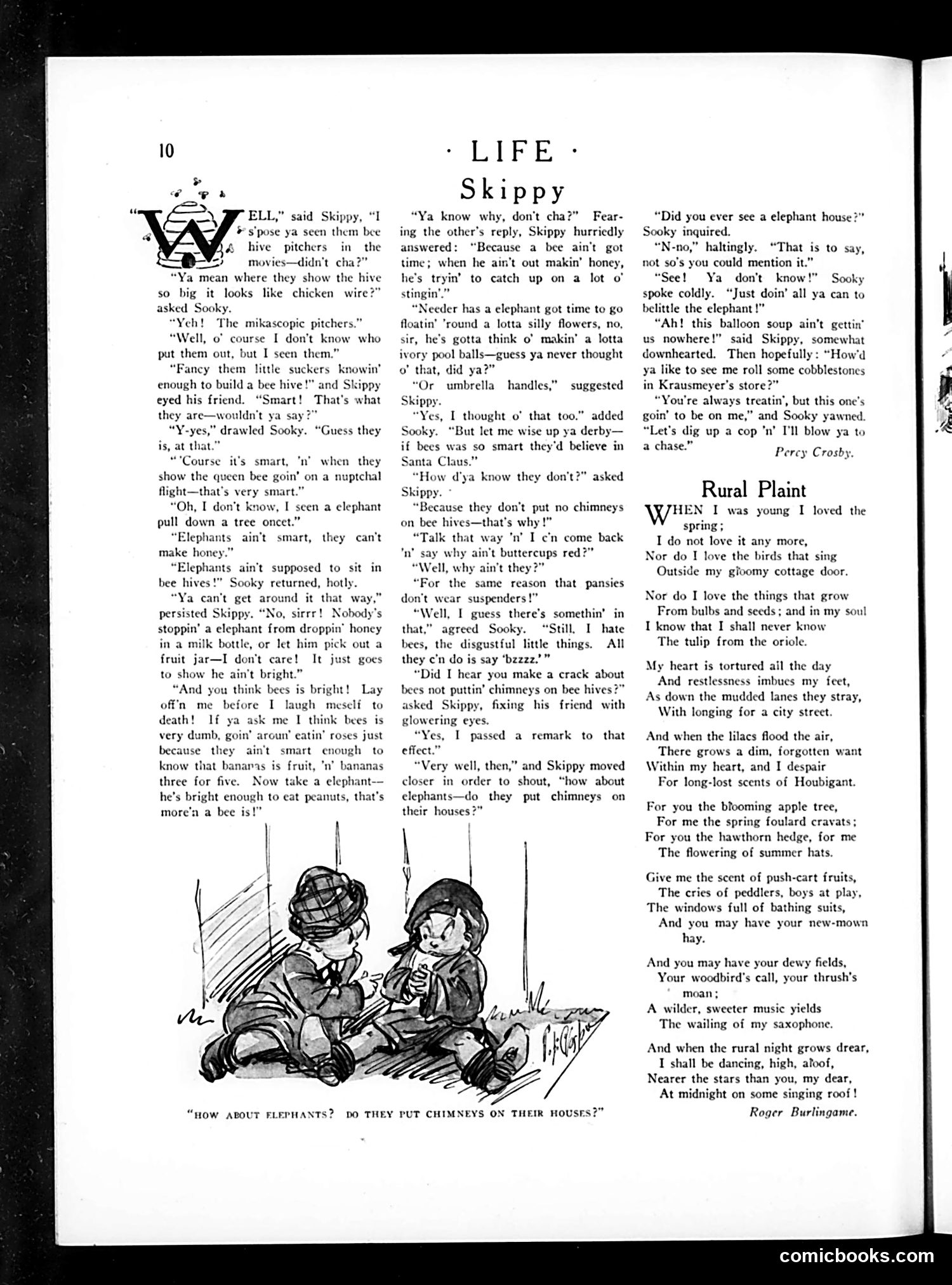
This page contains two distinct pieces: a humorous children's dialogue called "Skippy" and a poem titled "Rural Plaint." **"Skippy"** is a comic dialogue between two children debating whether elephants are intelligent. One child (Sooky) insists elephants can't think, while the other (Skippy) argues they're smart enough to believe in Santa Claus. The joke hinges on circular logic: if elephants were truly intelligent, they wouldn't believe in Santa—but they do, so they must be foolish. The accompanying illustration shows two young children in casual discussion. **"Rural Plaint"** is a nostalgic poem by Roger Burlingame about lost childhood pleasures—spring flowers, country sounds, and rural landscapes—contrasted with present urban life. The speaker longs for sensory experiences of nature (lilacs, hawthorn, woodbirds) rather than city living. Both pieces are lighthearted, aimed at general Life magazine readers seeking humor and sentimental reflection.
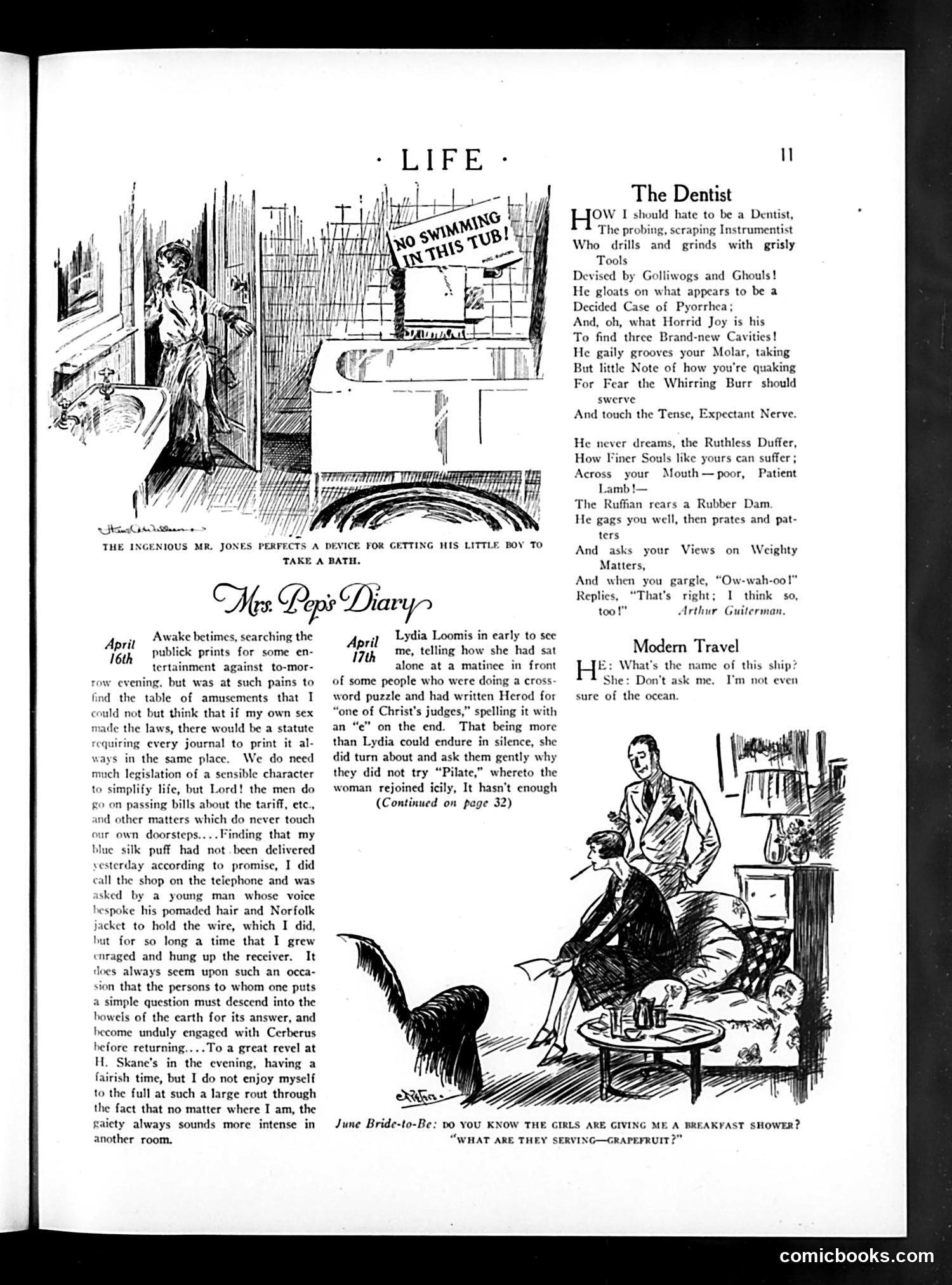
This page contains three distinct pieces: 1. **"The Ingenious Mr. Jones" cartoon**: Shows a man devising a bathing contraption with a "No Swimming in This Tub!" sign—satirizing creative solutions to household inconveniences, likely Depression-era resourcefulness. 2. **"The Dentist" poem**: A humorous verse mocking dental anxiety, describing the dentist's tools and the patient's terror during examination. It's gentle satire on a universal experience of fear in the dentist's chair. 3. **"Modern Travel" cartoon and "Mrs. Pep's Diary"**: The diary entry describes social awkwardness at events and frustrations with domestic life. The cartoon shows a man and woman with a rooster, captioning a joke about a bride's breakfast shower—light domestic humor. Overall, the page showcases typical Life magazine satire targeting everyday middle-class anxieties and social situations.
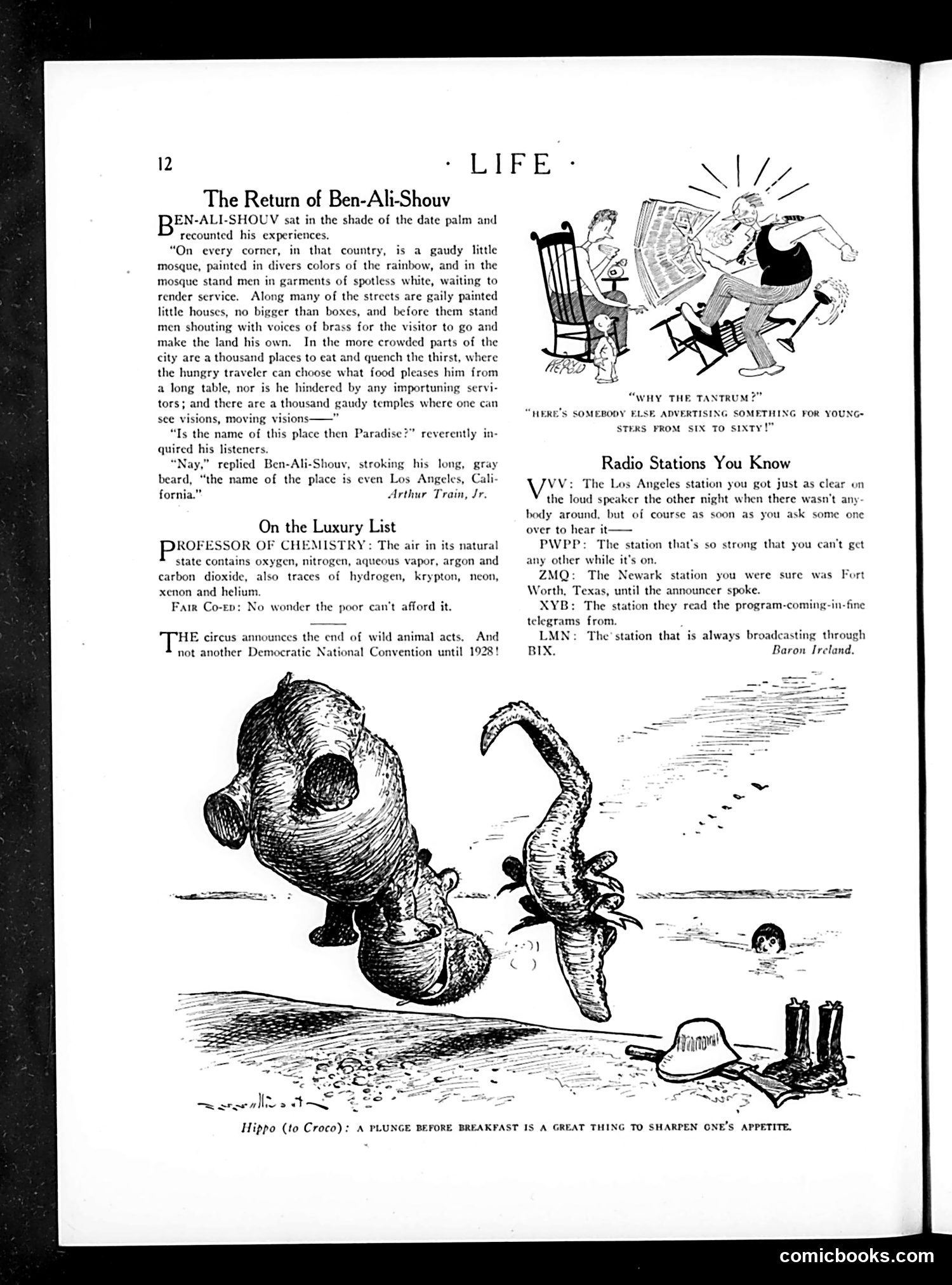
This page contains humor pieces rather than political cartoons. "The Return of Ben-Ali-Shouv" describes an imaginary Middle Eastern locale resembling Los Angeles, satirizing American tourism and cultural appropriation. The cartoon "Why the Tantrum?" depicts what appears to be a child or young person throwing a fit about radio advertising, mocking youth culture and advertising's invasive reach into domestic life. Below is a humorous illustration titled "Hippo (to Croco)" showing a hippopotamus and crocodile in playful interaction, with the caption joking about diving as appetite stimulation—simple animal humor. The "Radio Stations You Know" section parodies well-known radio stations with exaggerated descriptions of their broadcast strength and reliability, poking fun at radio culture's prominence in 1920s American life.
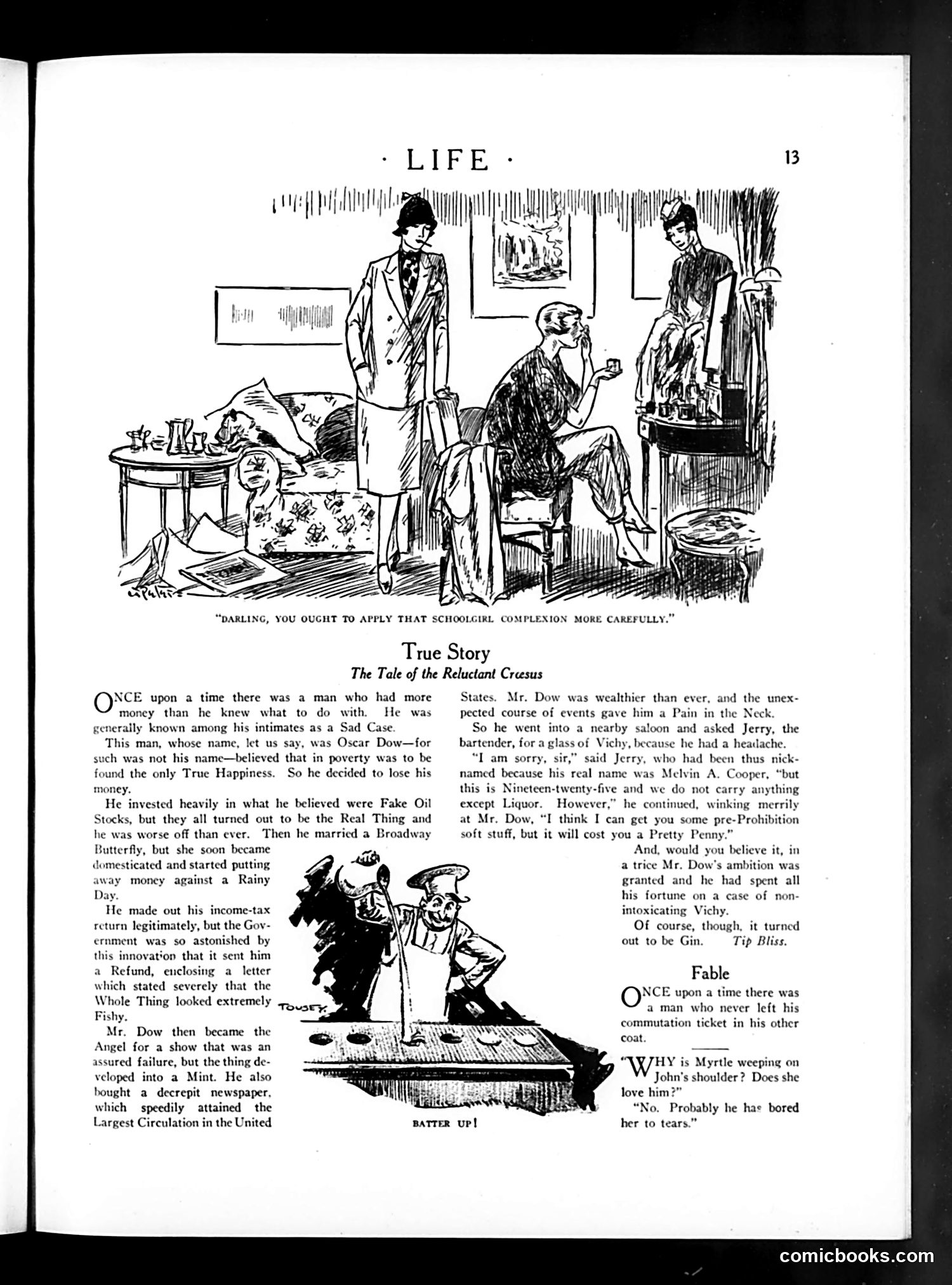
The main cartoon depicts a drawing-room scene where a woman applies makeup while three fashionable visitors observe. The caption reads: "Darling, you ought to apply that schoolgirl complexion more carefully." This satirizes the popular "Schoolgirl Complexion" beauty product marketed to adult women—mocking the contradiction of mature women attempting to artificially achieve youthful appearance. The joke suggests the woman's makeup application is so heavy or obvious that her effort to look young appears foolish. Below are two brief comic stories: "The Tale of the Reluctant Croesus" about a wealthy man named Dow who becomes generous; and a "Fable" about a man never removing his commutation ticket. These appear to be brief satirical tales commenting on wealth, social behavior, and human nature—typical of Life's humorous content from this era.
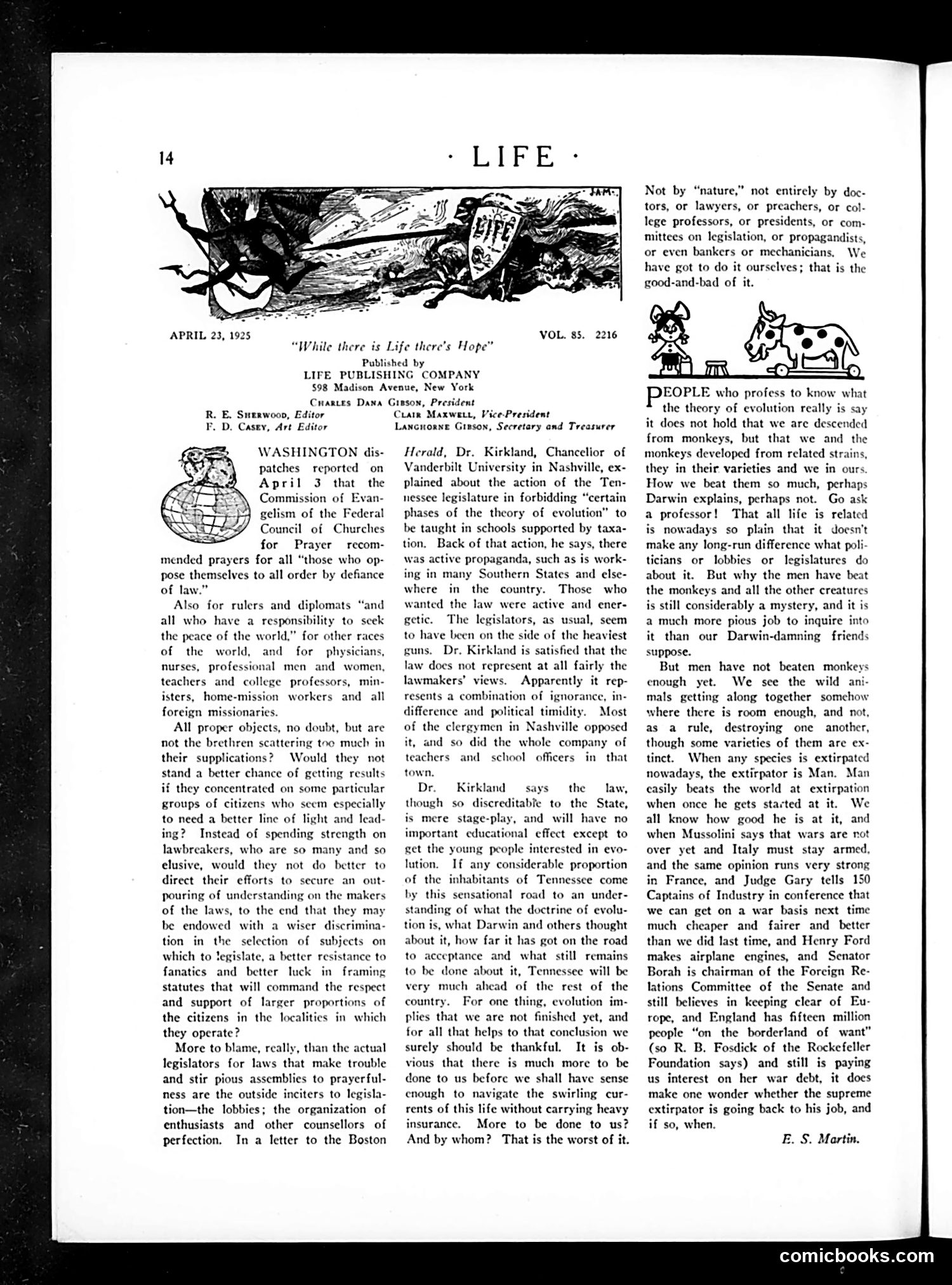
The page contains editorial commentary on a Washington dispute about teaching evolution in schools. Dr. Kirkland of Vanderbilt University reported (April 3) that Tennessee's Commission on Evangelism pressured schools to forbid teaching evolution phases, claiming active propaganda existed in Southern states. The article satirizes religious interference in education, arguing that lawmakers opposing evolution lack scientific understanding. It mocks the "sensational road" leading to evolution acceptance and questions whether religion should dictate curriculum. The cartoon at top (left) appears to show a figure with evolution-related imagery, though details are unclear—likely criticizing anti-evolution activists. The piece advocates for secular education free from religious and political pressure, positioning evolutionists as rational against religiously-motivated legislators.
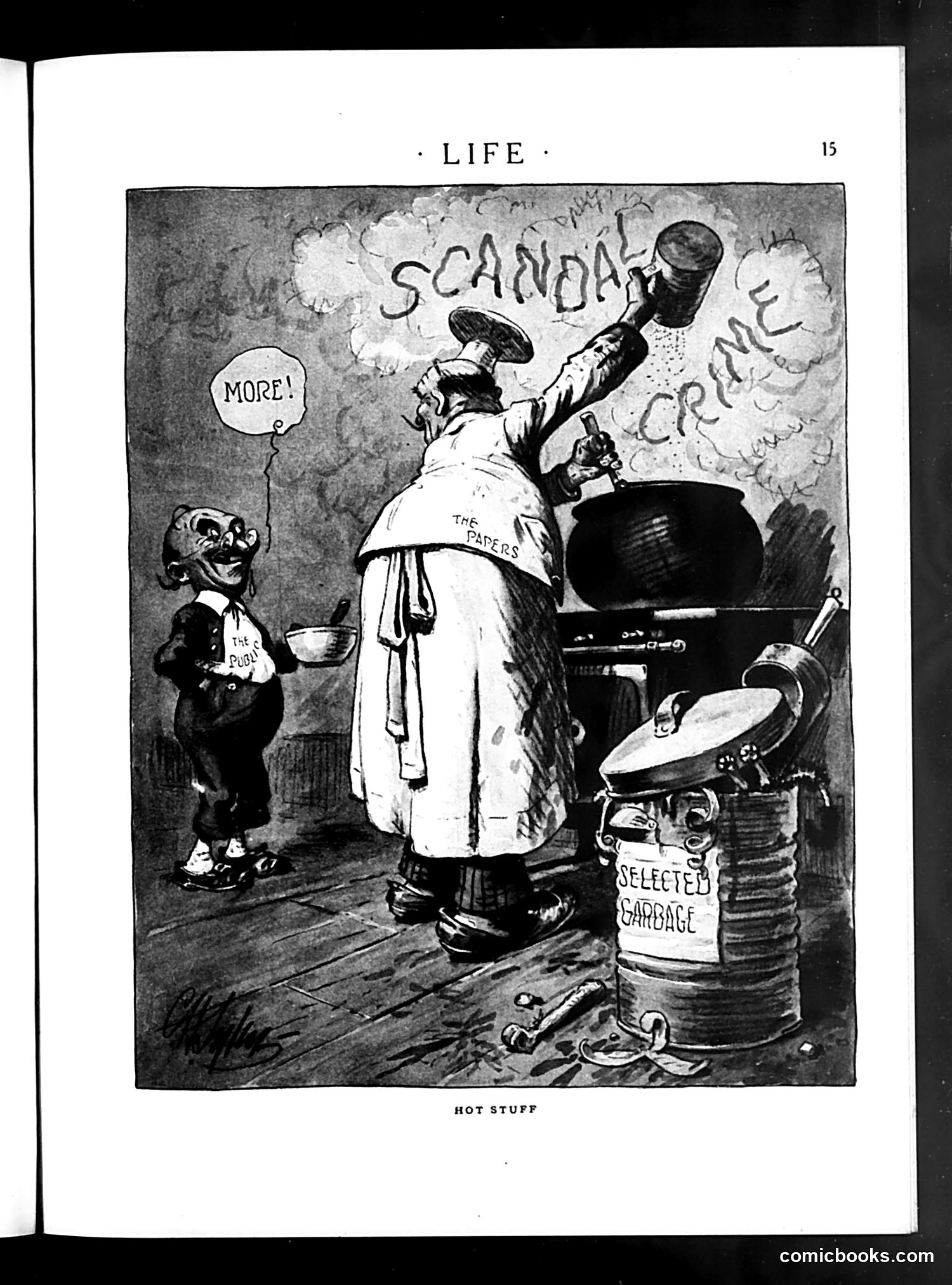
This Life magazine cartoon satirizes a cook or chef figure stirring a large pot labeled "Selected Garbage" while explosions labeled "Scandal" and "Crime" burst overhead. A small figure labeled "The Public" watches from the left, saying "More!"—suggesting public appetite for sensational news. The cartoon appears to critique either: 1. Media outlets sensationalizing crime and scandal for public consumption, or 2. Government/institutional figures cooking up or manufacturing scandals "The Papers" written on the chef's apron suggests press involvement. The satire suggests the public demands increasingly outrageous content, while someone (media or officials) supplies it from disreputable sources. The title "Hot Stuff" reinforces the sensational nature being mocked.
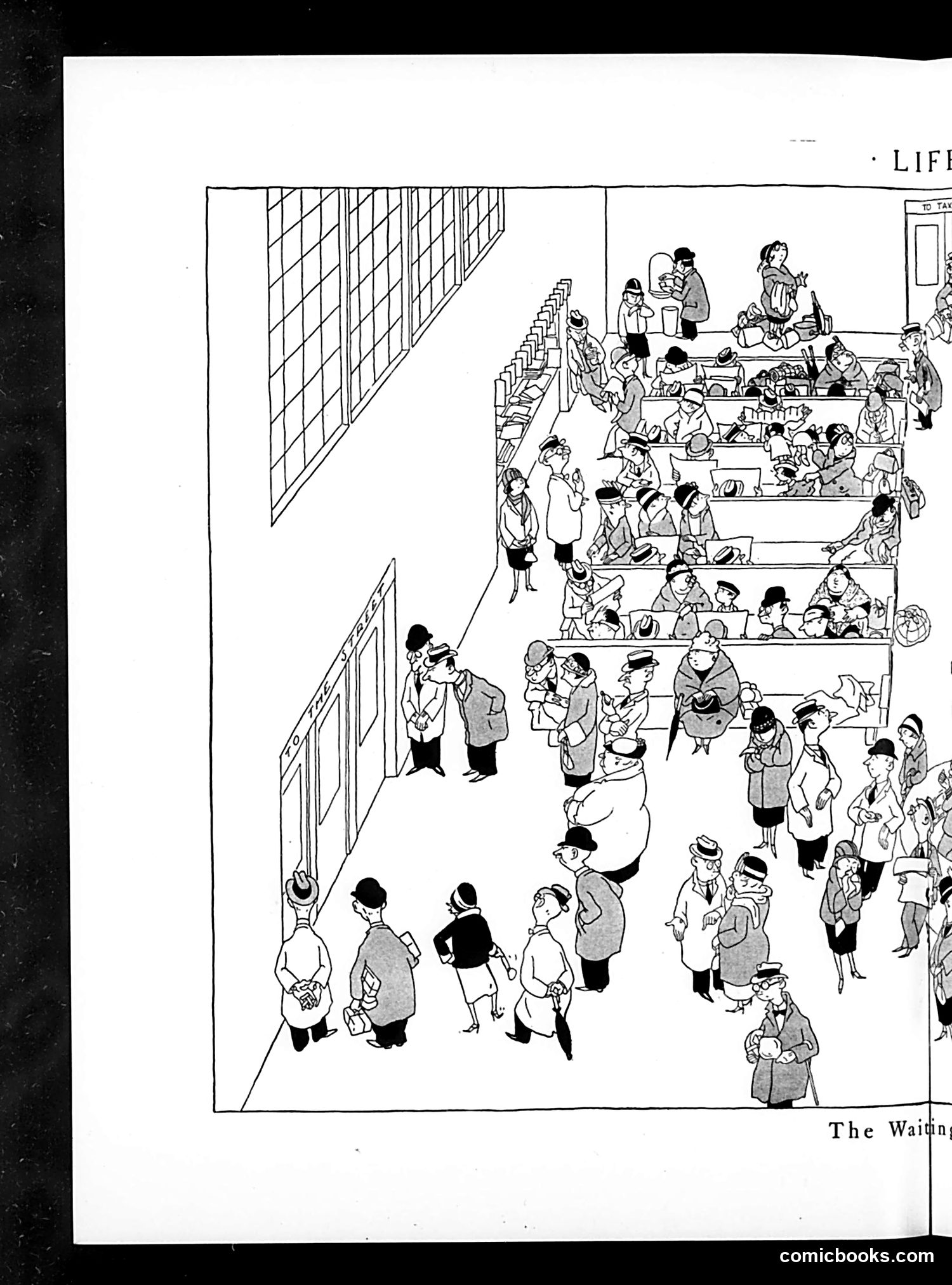
This cartoon depicts a crowded public waiting area, likely a government office, train station, or similar civic institution. The scene shows dozens of ordinary citizens standing, sitting on tiered benches, and milling about—conveying the tedium and frustration of bureaucratic waiting. The satire targets the common experience of waiting in crowded public spaces, a universal frustration of early 20th-century urban life. The title "The Waiting Room" and the densely packed composition emphasize themes of inefficiency, overcrowding, and the public's patience being tested by institutional systems. The cartoon likely critiques either government services, transportation infrastructure, or public administration—reflecting Life magazine's satirical commentary on American civic institutions and their failures to accommodate growing urban populations efficiently.
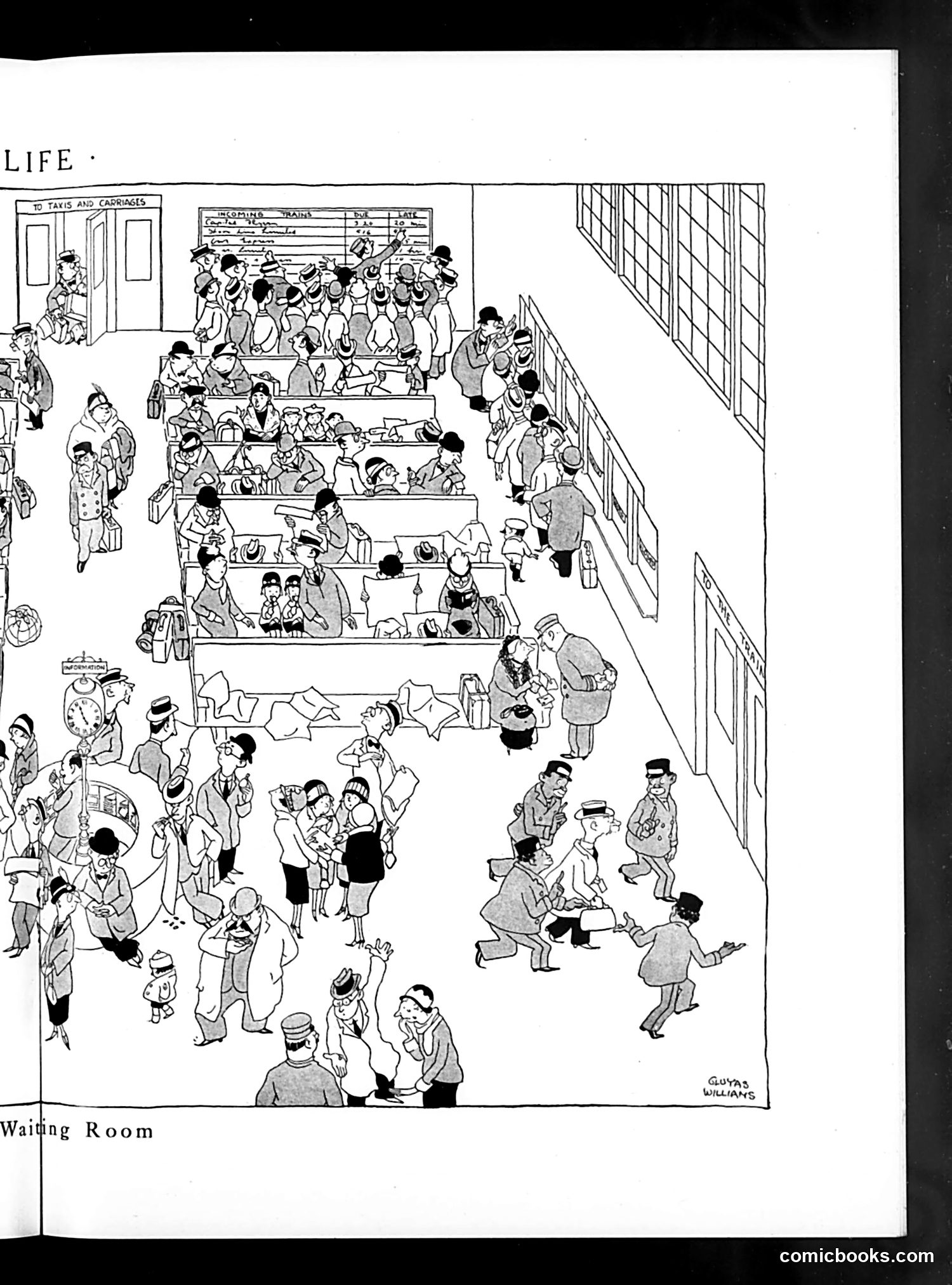
This cartoon depicts a chaotic waiting room, likely at a transportation hub (given the "Taxis and Carriages" sign visible at top). The image satirizes the disorganization and crowding of public spaces, with dozens of people in various states of confusion—sitting, standing, arguing, managing luggage and children. The artist (Gluyas Williams, per signature) captures the frustration of modern urban life through visual humor: the packed conditions, scattered belongings, and general disorder suggest inefficiency in public services. This reflects early 20th-century complaints about poorly-managed transportation terminals and waiting areas. The satire lies in the contrast between the orderly scheduling board visible at top and the complete chaos below—a commentary on the gap between administrative systems and actual lived experience.
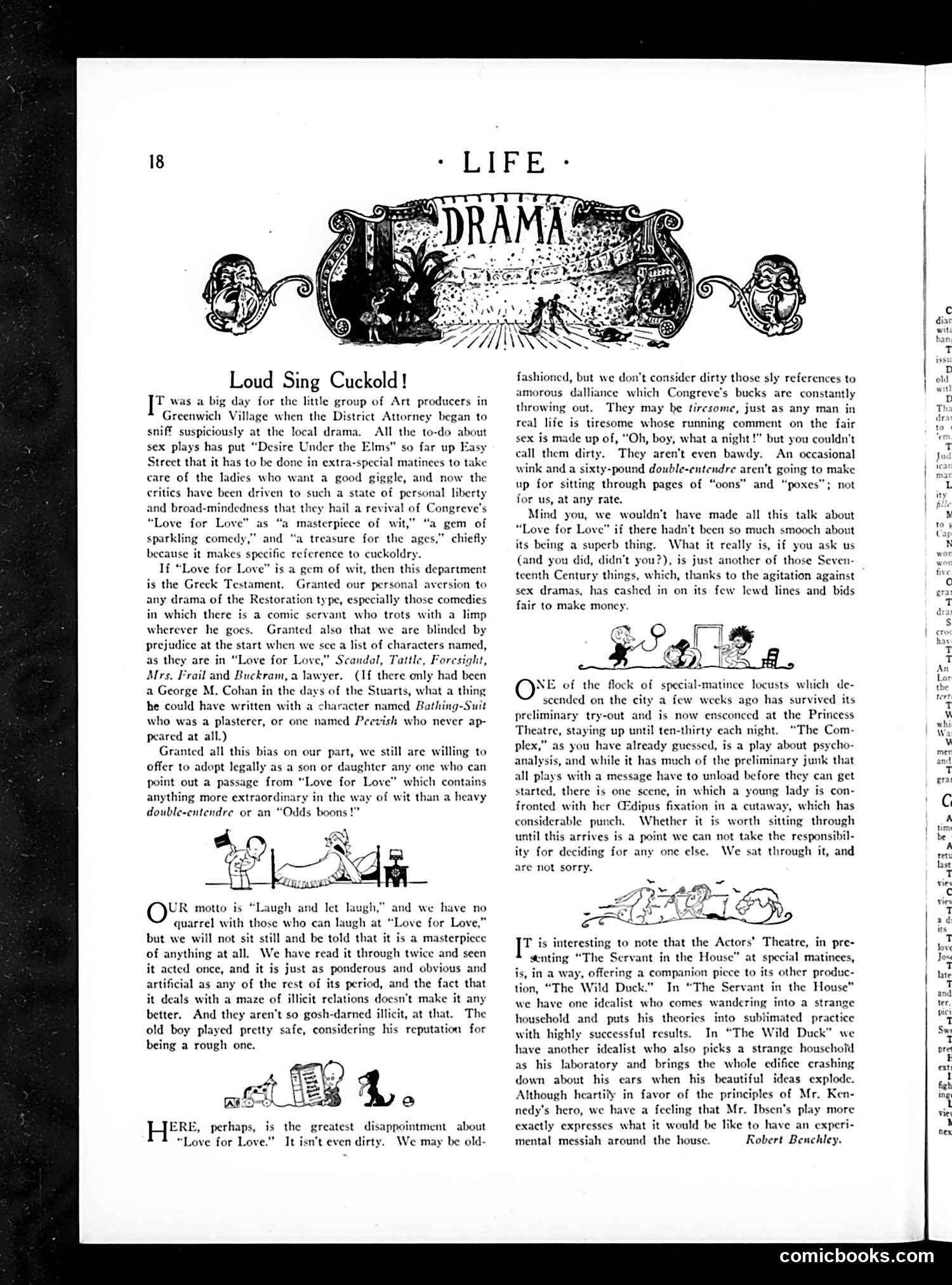
This page critiques the 1920s theatrical revival of William Congreve's 17th-century comedy "Love for Love," alongside commentary on contemporary sex-themed plays like "Desire Under the Elms." The satire targets critics who hail the Restoration comedy as a masterpiece simply because it contains risqué references to cuckolding and sexual dalliance. Life's author argues the play is actually tedious and overrated—its bawdy double-entendres aren't even particularly "dirty" by modern standards, just tiresome. The criticism extends to how sex-play controversies (involving the District Attorney's scrutiny) have created artificial prestige around mediocre dramas. The piece also mocks "The Complex," a psychology-themed play receiving special matinee runs, suggesting audiences are drawn to superficial "message plays" rather than genuine wit. The small cartoons illustrate audience reactions—primarily showing women attending these theatrical events, reflecting the era's debates about women's access to adult theatrical content.
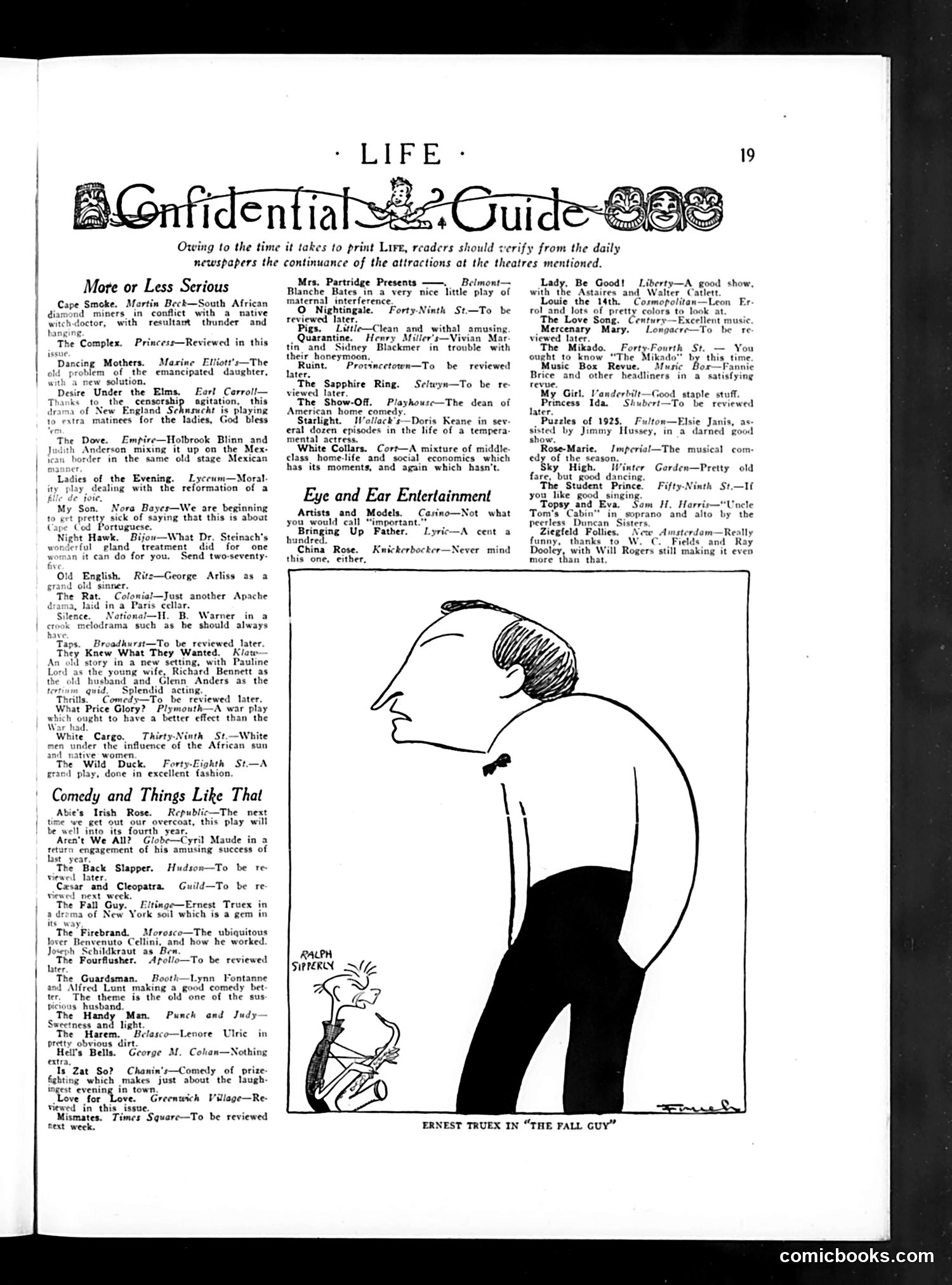
This page from Life magazine presents theatrical reviews and a single cartoon illustration. The main cartoon, titled "Ernest Truex in 'The Fall Guy,'" depicts a caricatured man in profile with an exaggerated nose, shown in a comedic pose—likely illustrating a humorous scene from the play. The page itself is primarily a **theater guide** listing Broadway productions with brief critical commentary. The reviews are organized by tone ("More or Less Serious," "Comedy and Things Like That," "Eye and Ear Entertainment") and include shows like *Abie's Irish Rose*, *What Price Glory?*, and *The Guardsman*—popular Broadway hits of the era. The tone is witty and dismissive by turns. For instance, *Abie's Irish Rose* is noted as entering "its fourth year," while *Hell's Bells* is simply "Nothing extra." This reflects Life's role as a satirical publication offering entertainment commentary alongside social criticism for educated, urban American readers.
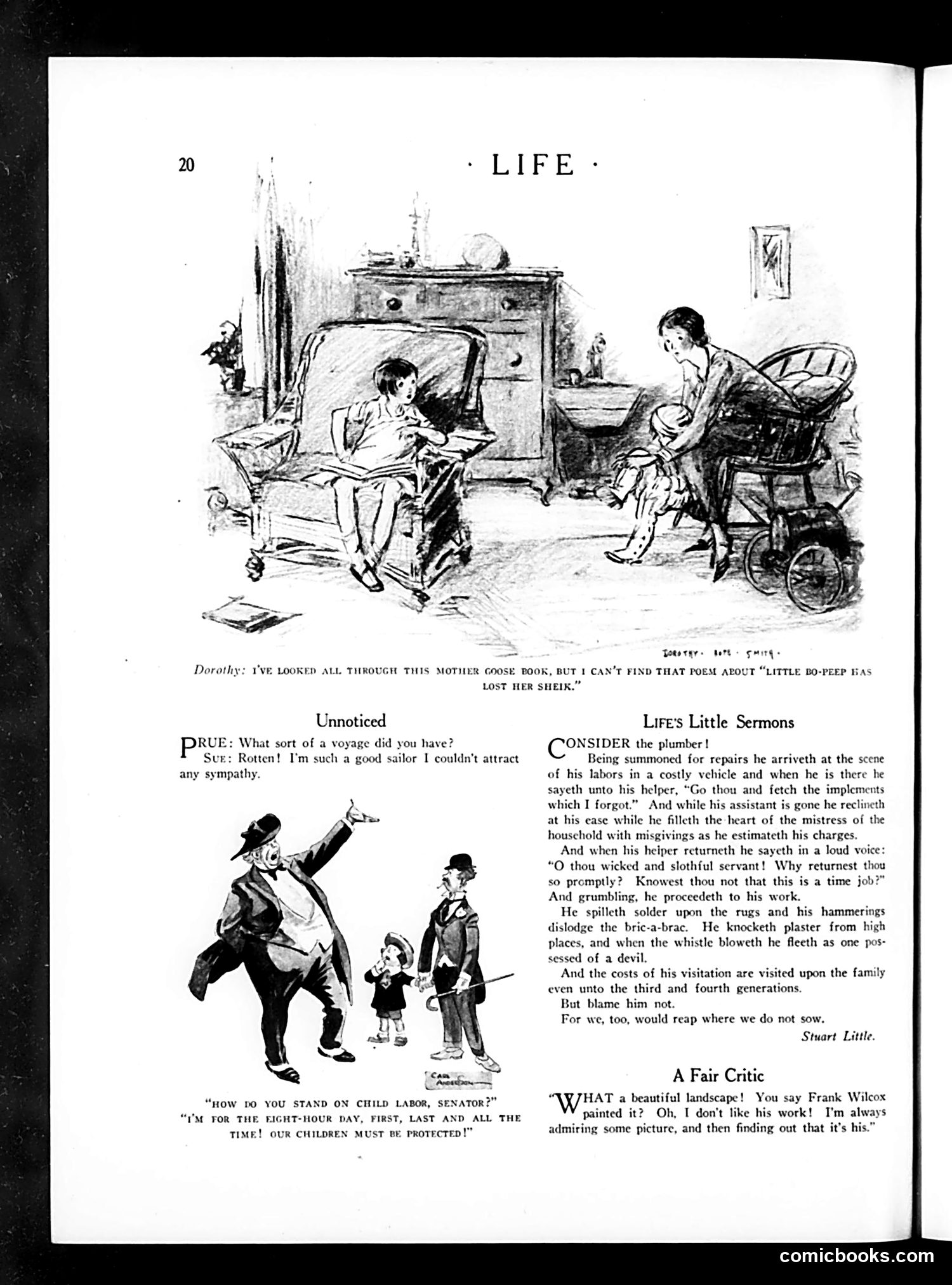
This page contains three satirical pieces typical of early 20th-century American humor: **Top cartoon:** A domestic scene mocking post-WWI slang. Dorothy searches a Mother Goose book for a poem about "Little Bo-Peep has lost her sheik"—a joke about the contemporary "sheik" fad (young men styled after Rudolph Valentino). The humor lies in applying modern slang to nursery rhymes. **Middle section ("Unnoticed"):** A senator boasts about supporting the eight-hour workday and child labor protections, while a sailor claims he's "such a good sailor" he can't attract sympathy—likely mocking politicians who make grand claims about worker protections while workers remain unhelped. **"Life's Little Sermons":** A mock-biblical critique of plumbers' practices—deliberately arriving in expensive vehicles, inflating charges, damaging homes, and rushing away. This satirizes perceived exploitation by tradespeople. **"A Fair Critic":** Points out hypocritical art criticism—admiring paintings by famous artists simply because of their reputation, then discovering the work is actually disappointing. All three pieces target hypocrisy and pretense in American society.
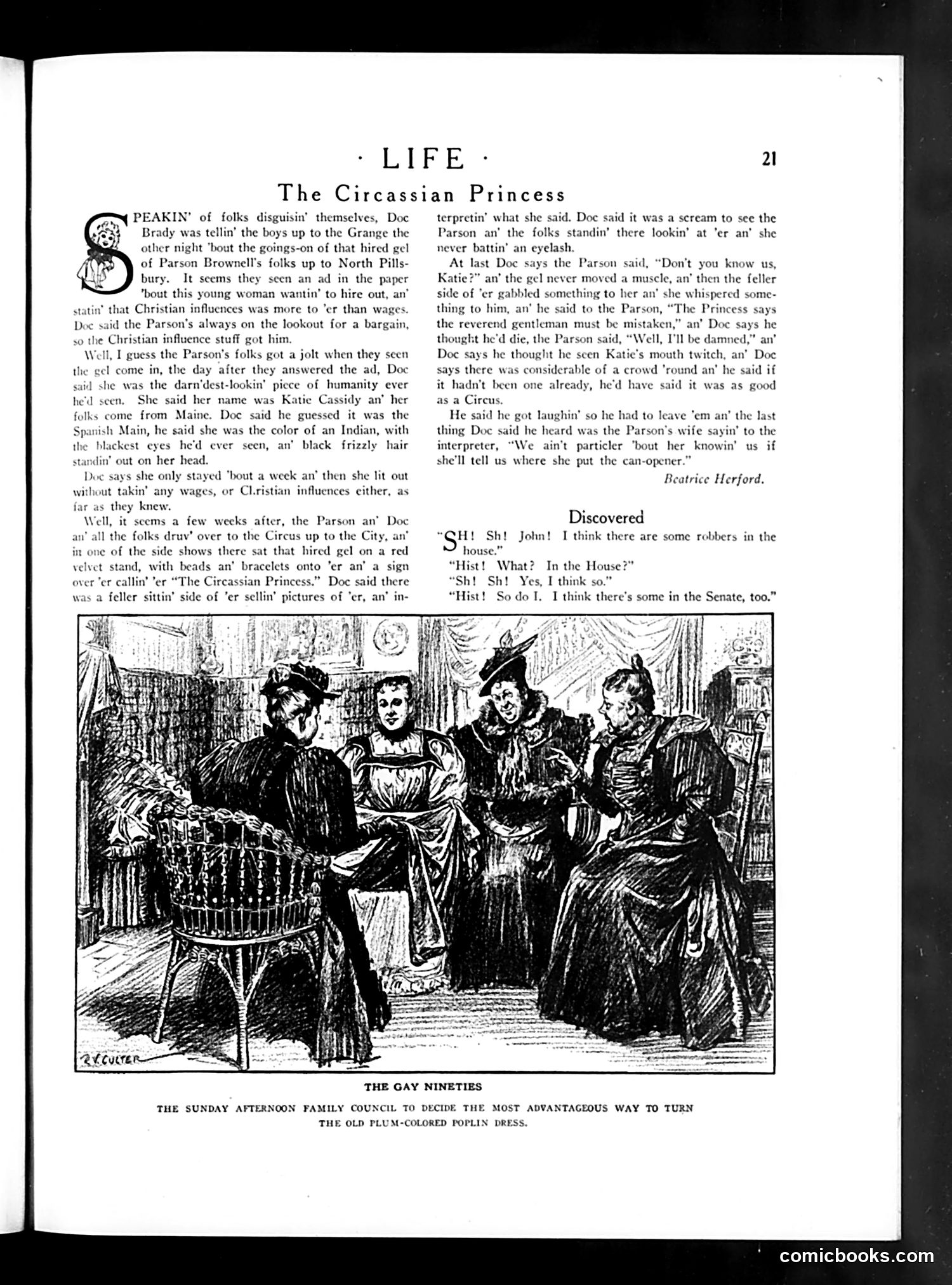
This page contains two distinct pieces of 1890s satire: **"The Circassian Princess"** (main story): A humorous rural anecdote about a hired domestic worker who abandons her job at a parson's house, then reappears as an exotic circus attraction billed as a "Circassian Princess." The joke exploits the era's fascination with "exotic" racial spectacles—circus sideshows marketed foreign or fabricated identities to audiences. The irony is that the parson fails to recognize her while she performs this theatrical role, and she maintains the act throughout their encounter. **"Discovered"** (brief dialogue): Political satire suggesting corruption exists equally in both the home and U.S. Senate, using the genteel anxiety of Victorian ladies about burglars as a vehicle for commentary on governmental dishonesty. **The illustration** depicts a wealthy family's Sunday social gathering, captioning a mundane domestic concern (remaking an old dress), characteristic of Life's satire of upper-class preoccupations. Both pieces mock period class anxieties and social pretensions.
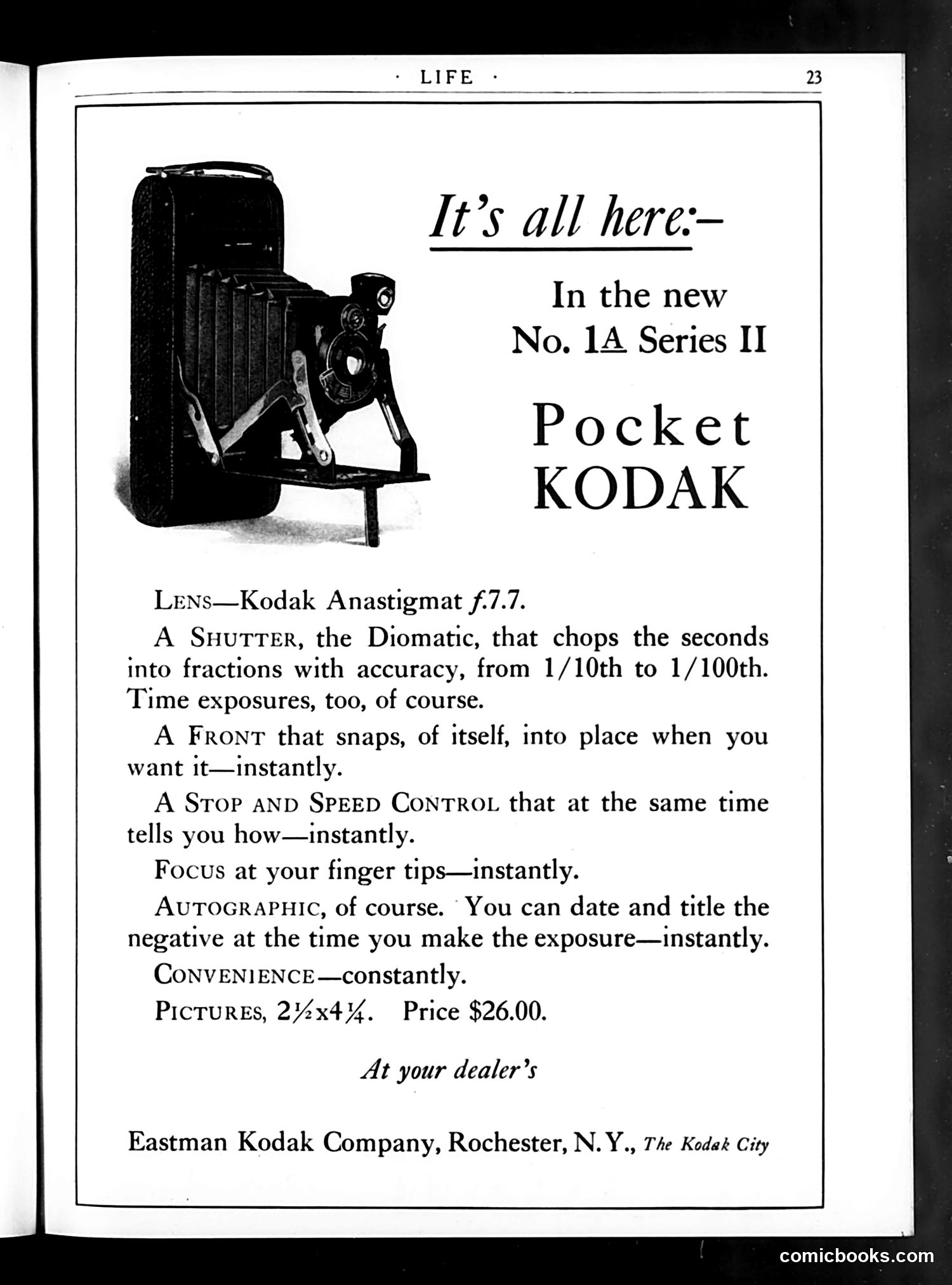
This is a **product advertisement**, not a cartoon or satire. It appears on page 23 of *Life* magazine and promotes the Pocket Kodak camera, Series II model. The page features an image of the folding camera with its bellows extended, alongside marketing copy emphasizing convenience and speed—key selling points for early 20th-century photography. Features highlighted include: - Precise shutter control (1/10th to 1/100th second) - Automatic front mechanism - Built-in focus and exposure controls - "Autographic" capability (dating/titling negatives immediately) - Compact picture size (2½x4¼ inches) - Price: $26.00 The repetition of the word "instantly" is the advertisement's rhetorical strategy, emphasizing how the camera simplifies photography for amateur users. This reflects the era's broader marketing toward convenient consumer technology. There is no political or satirical content on this page.
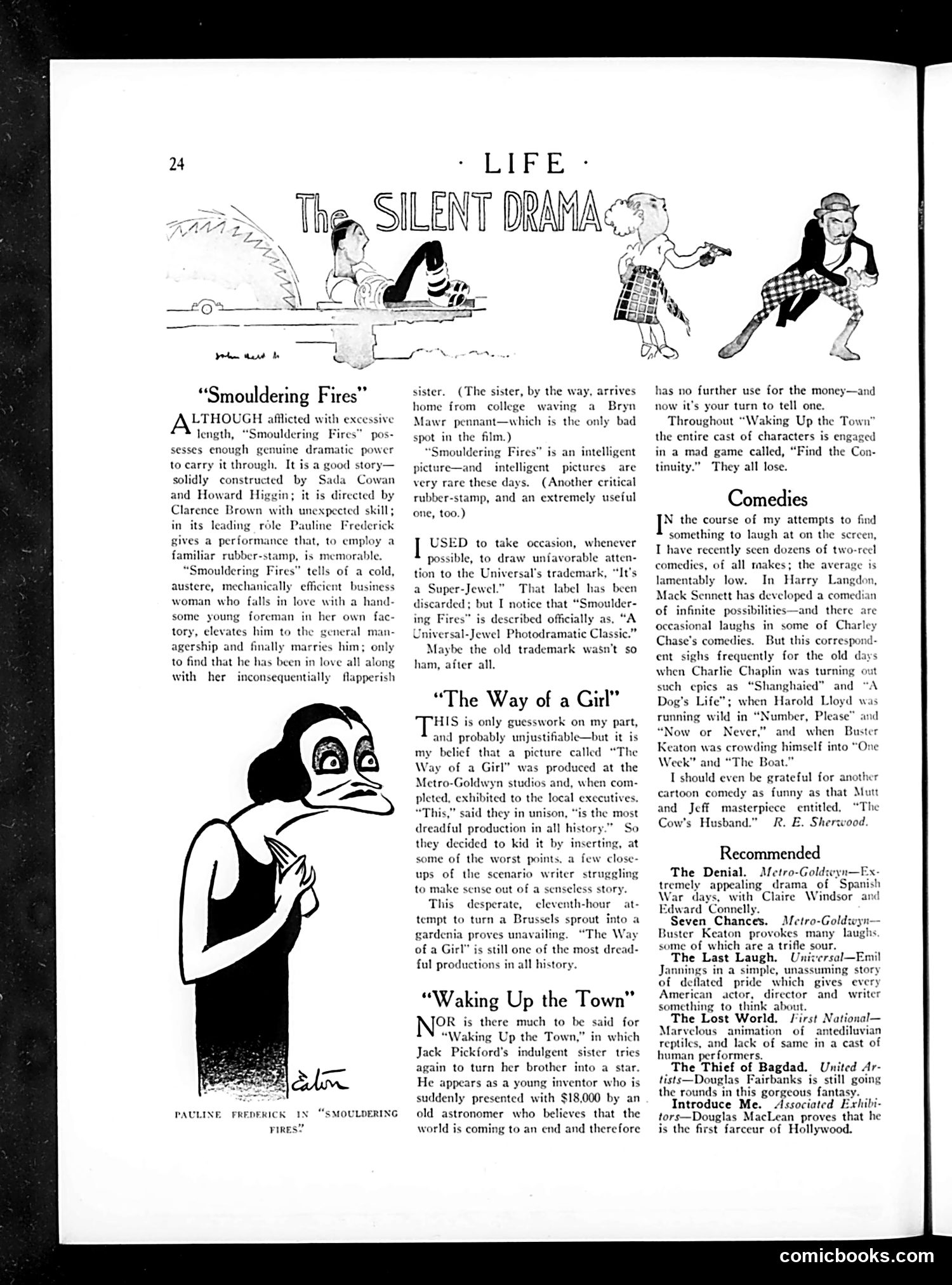
This page reviews three silent films from the 1920s. The critic praises **"Smouldering Fires"** starring Pauline Frederick (pictured), calling it a competent melodrama about a businesswoman who falls for a younger foreman, only to discover he loves her flapper sister instead. **"The Way of a Girl"** is savagely mocked as "one of the most dreadful productions in all history"—so bad the critic suspects the studio inserted close-ups of the struggling screenwriter to mock the senseless plot. **"Waking Up the Town"** features Jack Pickford (Mary Pickford's brother) in an absurd story where a stranger gives him $18,000 believing the world is ending. The critic quips the characters are playing "Find the Continuity" and "all lose." The "Comedies" section laments the decline of film comedy since Chaplin, Lloyd, and Keaton's golden age, though praising Harry Langdon and Mack Sennett's current work. This reflects 1920s nostalgia for earlier silent comedy greats.
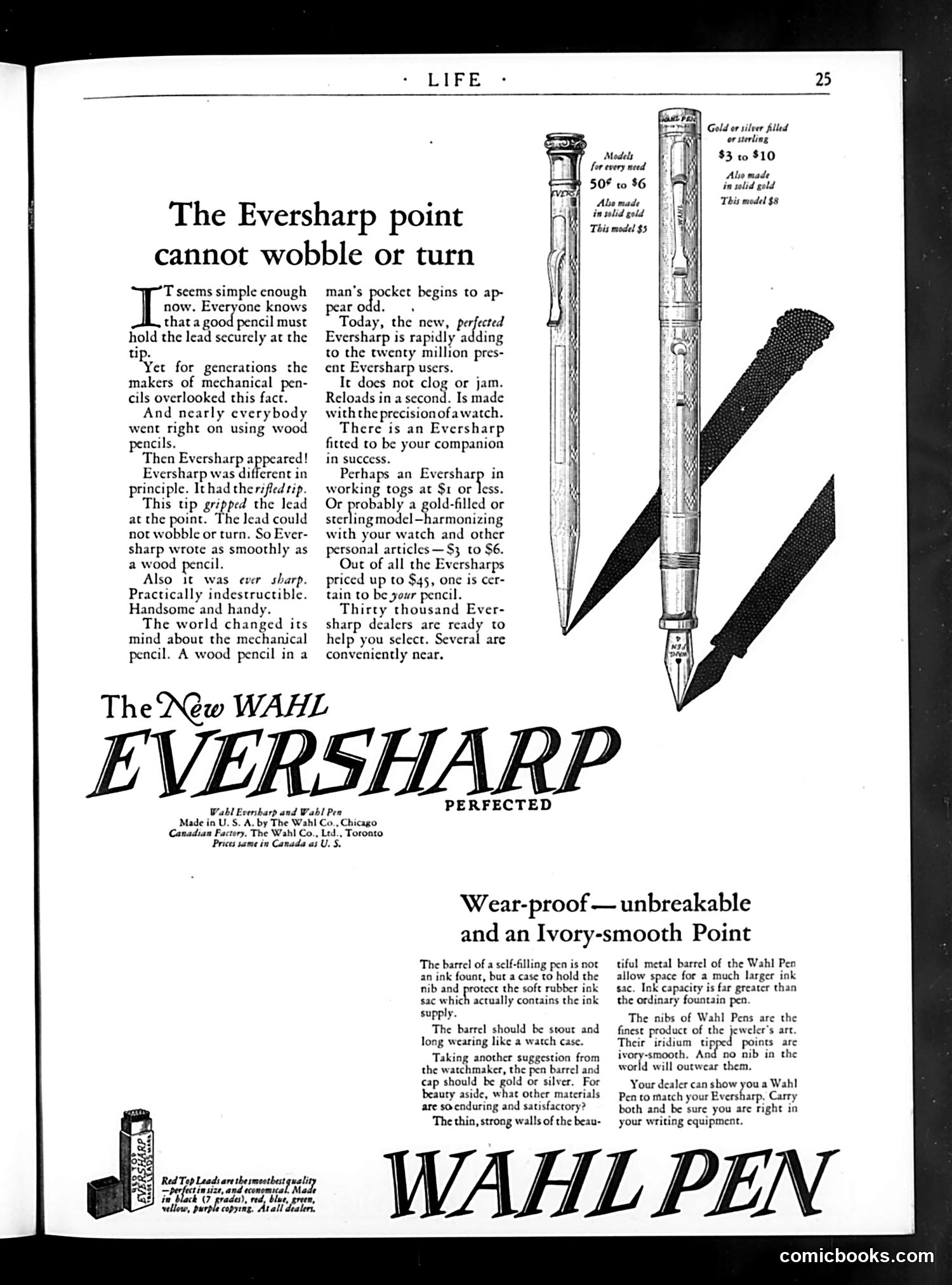
This page is **not a cartoon or satire**—it's a straightforward **product advertisement** for two writing instruments made by the Wahl Company (Chicago and Toronto). The top half advertises the **Eversharp mechanical pencil**, highlighting its innovative design features: a retractable lead mechanism that doesn't clog or jam, precision engineering "like a watch," and durability. Various models are shown ranging from $0.50 to $10 (including gold or silver-filled versions). The bottom half advertises the **Wahl Pen**, emphasizing its self-filling barrel design and durable "ivory-smooth point" with iridium-tipped nib. Both ads emphasize technological advancement and reliability—selling writing instruments as precision instruments comparable to watches. This reflects early-20th-century consumer culture's enthusiasm for innovative mechanical products. There is no political or satirical content.
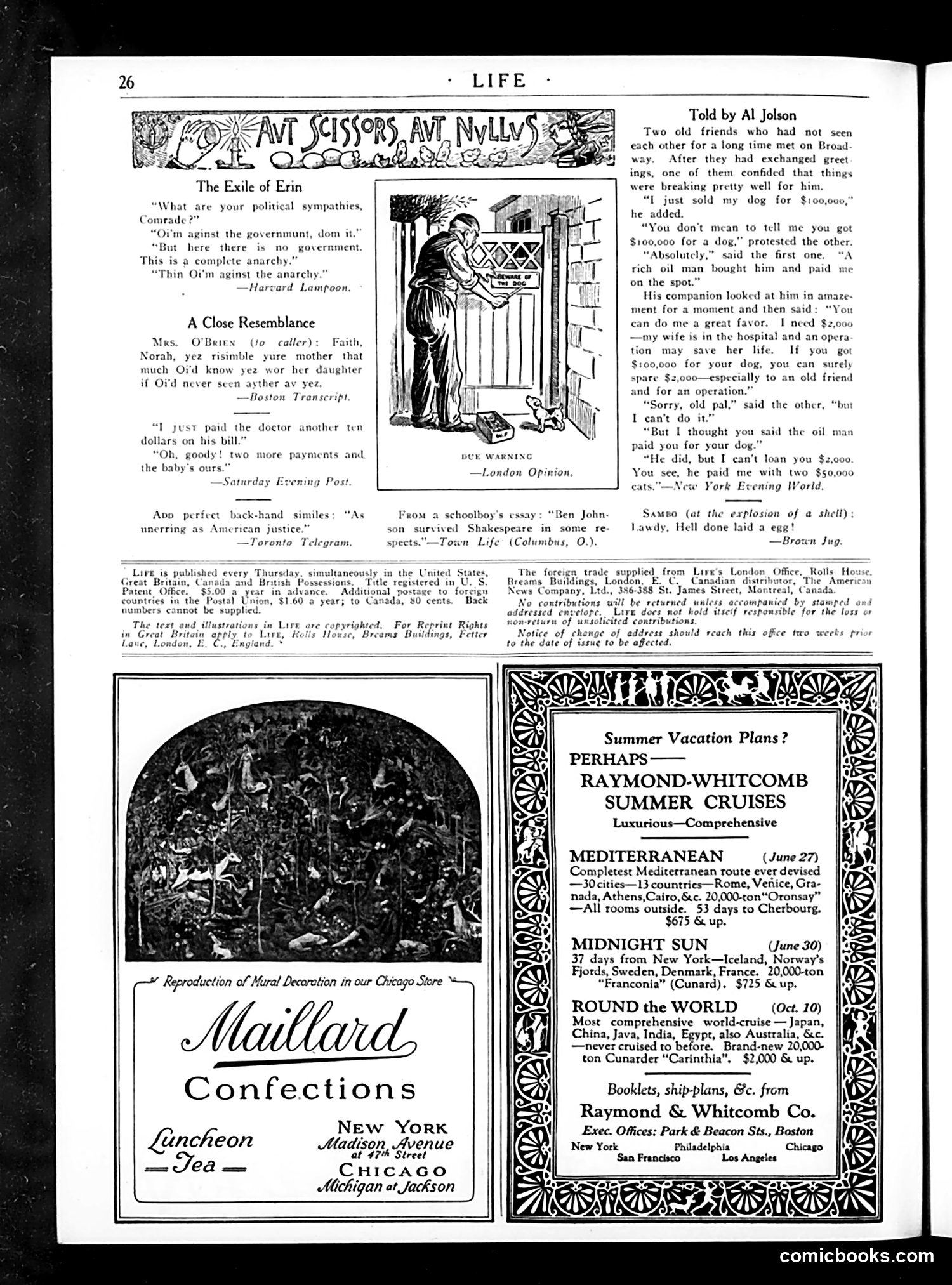
This page contains several brief humorous anecdotes and advertisements rather than political cartoons. The main content includes: **"The Exile of Erin"** and **"A Close Resemblance"**: Short jokes about Irish immigrants, using stereotypical dialect ("Oi'm aginst"). These reflect early 20th-century American humor about Irish identity and assimilation. **Al Jolson anecdote**: A joke about a man who sells his dog for $100,000 to an oil tycoon, then refuses to loan $2,000 to an old friend whose wife needs surgery. The punchline reveals the payment was in "two $50,000 cats"—absurdist humor mocking wealthy oil magnates and the contrast between sudden wealth and human compassion. **Other brief jokes** comment on government/anarchy politics, doctor payments, and American justice. The page is largely **advertisements** for Maillard Confections and Raymond-Whitcomb cruise lines, indicating this is a general-interest satirical magazine mixing humor with commercial content.
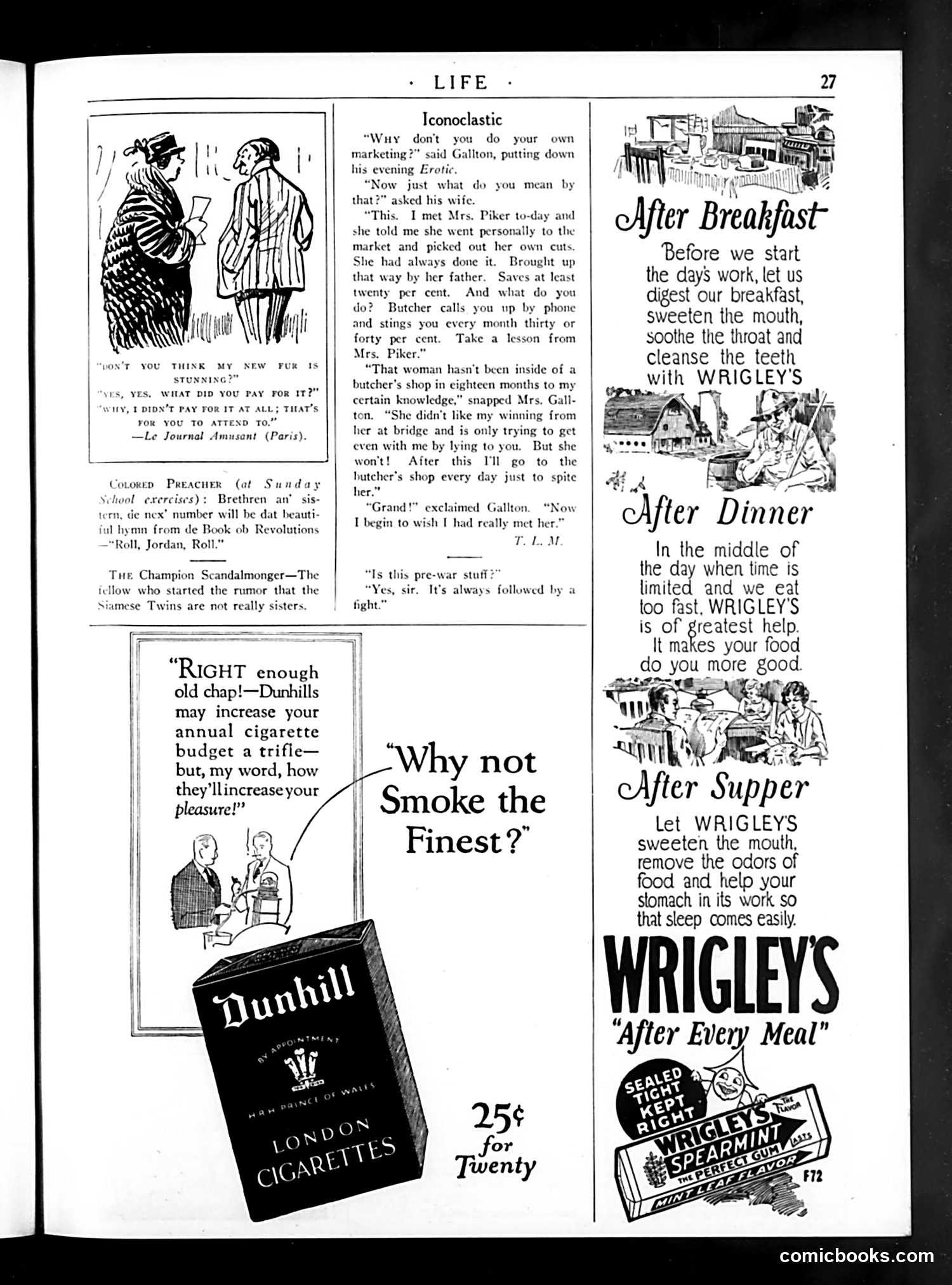
This page combines three satirical cartoons with period advertisements (Dunhill cigarettes and Wrigley's gum). **The cartoons:** 1. **Top left**: A woman flaunts a new fur coat; when asked the price, she reveals her husband paid for it—implying either marital deception or the husband's ignorance. The satire targets both female materialism and marital dishonesty. 2. **Middle**: A "Colored Preacher" makes a verbal error, saying "Book of Revolutions" instead of the Bible's actual book, mocking African American dialect humor common in early 20th-century publications. 3. **Bottom**: "The Champion Scandalmonger" spreads false rumors (specifically about Siamese Twins), satirizing gossip culture. **Historical context:** This appears to be an early-to-mid 20th century issue. The racial caricature reflects now-offensive period conventions. The cartoons mock domestic relations, class pretension, and gossip—typical Life magazine targets. The advertisements sell luxury goods alongside these satirical critiques of consumer excess.
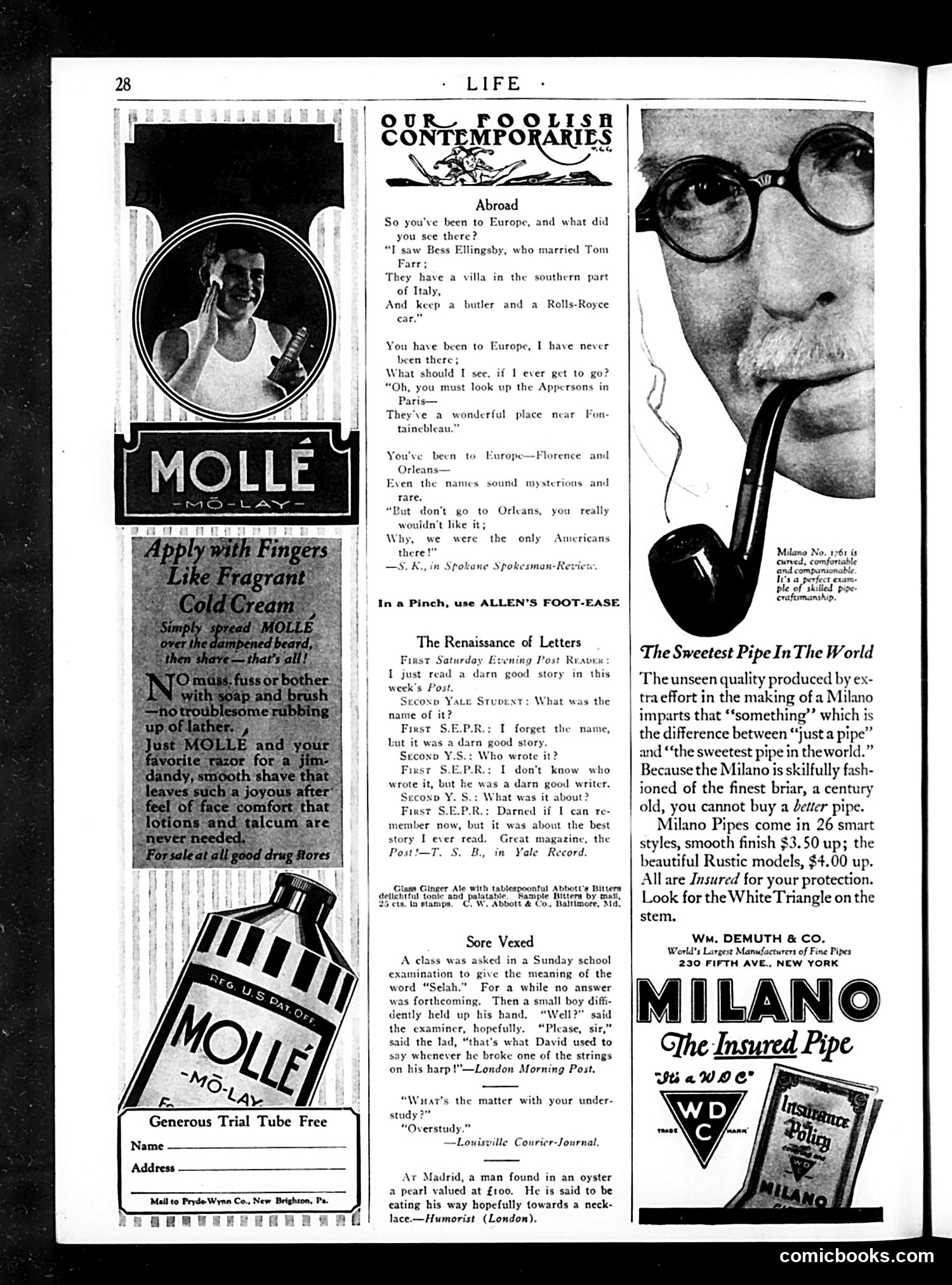
This page combines satirical cartoons with period advertisements (circa 1920s). **"Abroad" Cartoon**: Satirizes American tourists in Europe. The joke mocks wealthy Americans who travel abroad only to socialize with other Americans, then brag about exotic destinations they barely experienced. The punchline—"we were the only Americans there!"—reveals the irony: these travelers seek prestige through European travel while avoiding actual European culture, viewing the continent merely as backdrop for American social networking. **"Renaissance of Letters"**: Mocks readers who discuss books without retaining information. Two people enthusiastically recommend a Post story but cannot recall its title, author, or plot—only that it was "darn good." It satirizes superficial literary discourse and magazine culture. **Minor jokes** include wordplay about "Selah" (biblical term humorously misidentified as David's exclamation when breaking harp strings) and a man eating oysters hoping to find more pearls. The remaining content is primarily **product advertising** for Mollé shaving cream, Allen's Foot-Ease, Milano pipes, and other consumer goods—typical of Life magazine's revenue model.
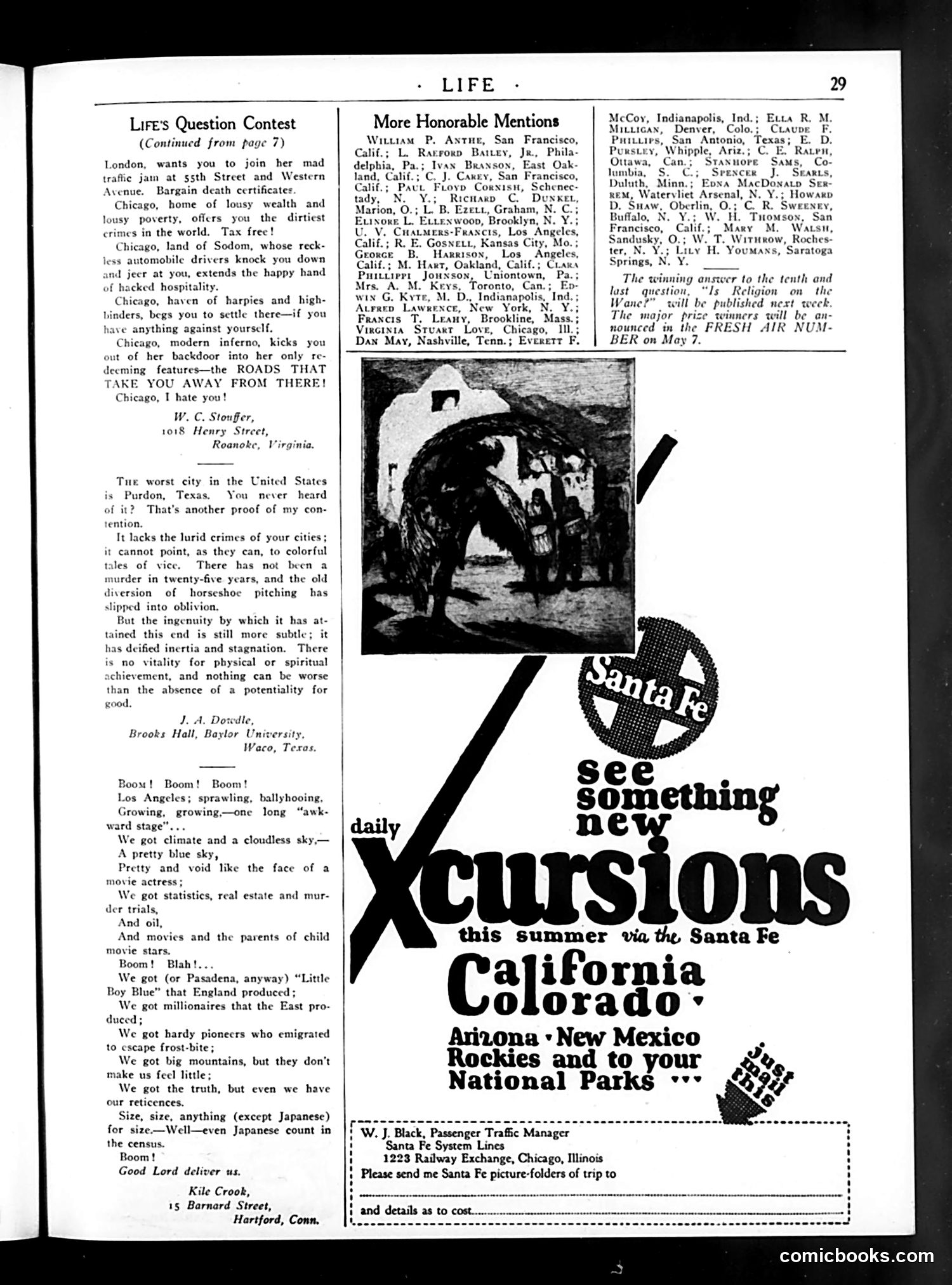
This page combines reader contest responses with advertising. The main content is letters from *Life's* Question Contest, where readers critique American cities. The satirical letters mock urban problems: one attacks Chicago for crime, poverty, dangerous drivers, and corruption—claiming its only virtue is roads *leaving* the city. Another dismissively describes Los Angeles as superficial and materialistic ("void like the face of a movie actress"), obsessed with size and statistics while lacking genuine substance. A third letter sarcastically praises the Texas town of Purdon for having *no* murders or vitality—suggesting stagnation is worse than vice. These responses reflect early 20th-century anxiety about rapid urbanization, automobile culture, and what was seen as the moral and spiritual emptiness of American cities, particularly booming centers like Los Angeles and Chicago. The Santa Fe Railway advertisement on the right offers escape via train excursions to natural destinations—ironically positioned alongside critiques of urban life.
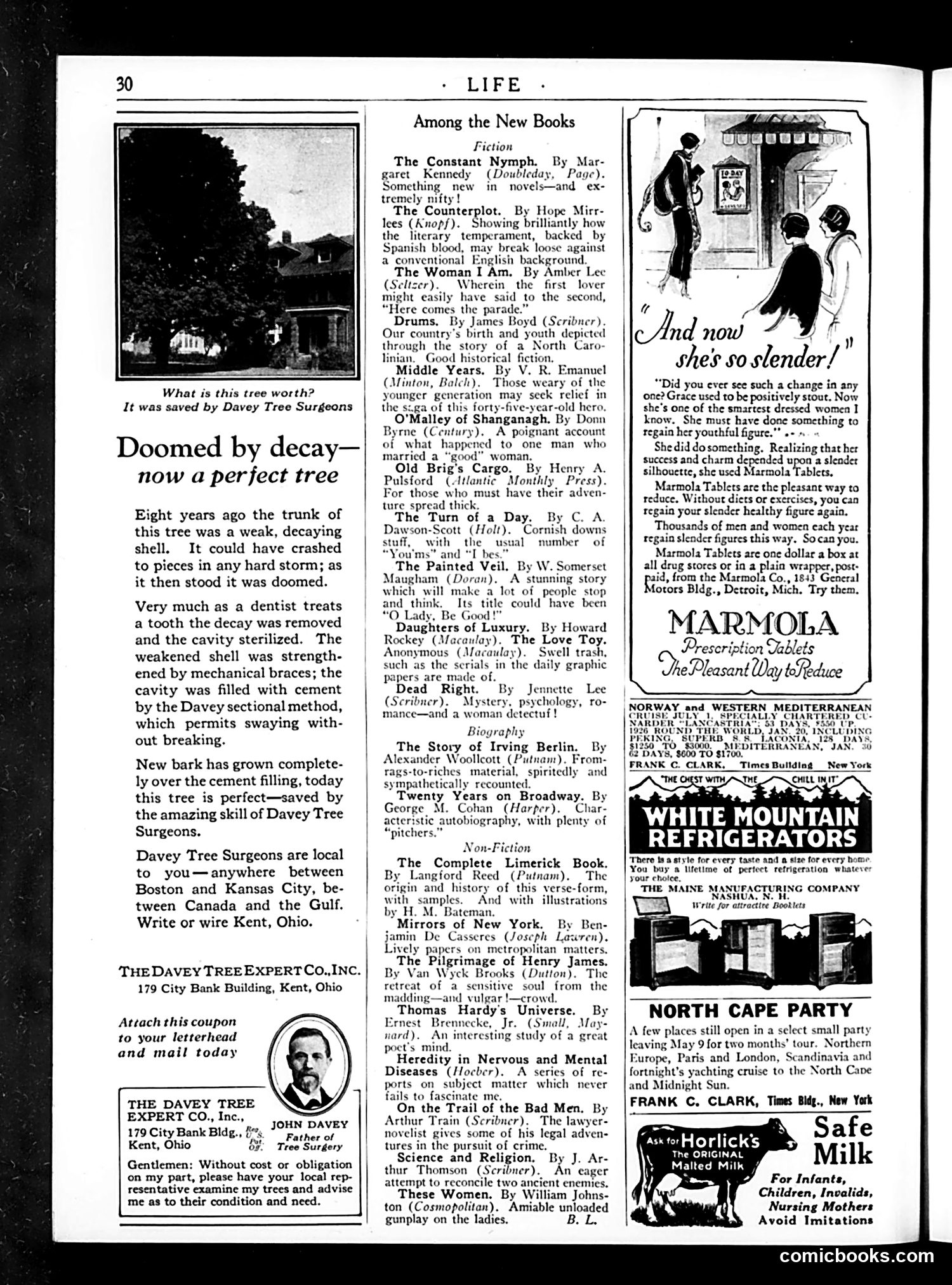
This page is primarily **advertising and book reviews**, not political satire. The main content consists of: 1. **A large advertisement for Davey Tree Surgeons** (left side): Uses a photograph of a restored tree as a before-and-after testimonial. The pitch compares tree surgery to dentistry—removing decay, sterilizing cavities, and filling them with cement. It's a straightforward commercial promoting a tree-care service with branches "between Boston and Kansas City." 2. **"Among the New Books"** (right side): A standard book review section listing contemporary fiction and non-fiction titles from 1924-1925, including works by W. Somerset Maugham and Irving Berlin's biography. 3. **Additional advertisements** (right): For Marmola Tablets (diet pills), White Mountain Refrigerators, a North Cape party cruise, and Horlick's Safe Milk. There is **no political cartoon or satire** on this page. It represents typical Life magazine content from the 1920s: a mix of commercial advertising, product testimonials, and literary coverage aimed at middle-class readers.
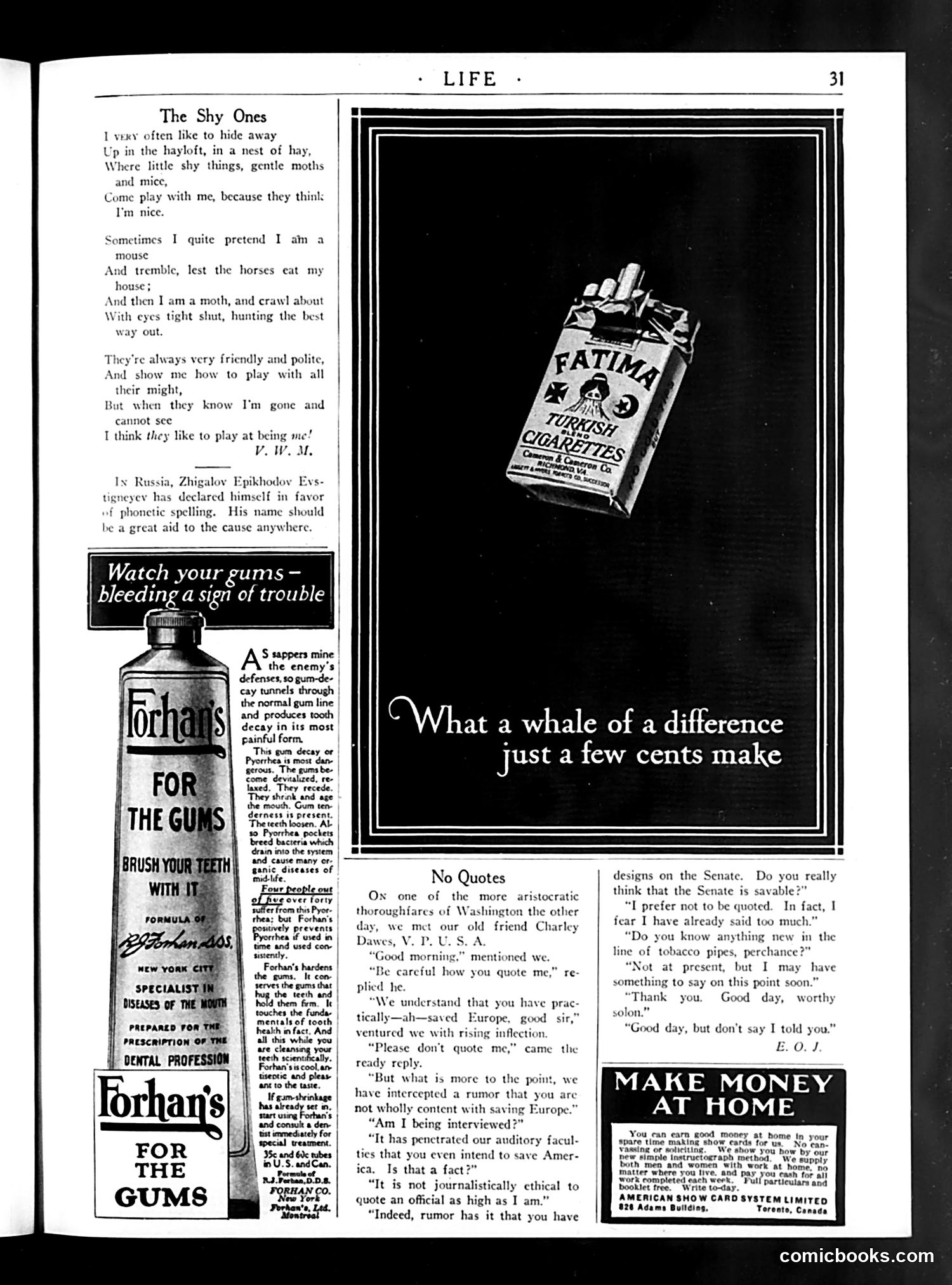
**"The Shy Ones"** is a whimsical children's poem about hiding in haylofts with shy creatures (moths and mice). It has no political content—it's simply sentimental verse about childhood imagination. **"No Quotes"** is the page's satirical centerpiece. It depicts a journalist attempting to interview **Charles Dawes, Vice President of the United States**, who repeatedly refuses to be quoted on any topic—including his role in post-WWI European recovery, potential Senate ambitions, and even tobacco pipes. The humor lies in Dawes's absurd paranoia about quotation, his evasiveness on serious matters, and the interviewer's deadpan persistence. This satirizes the VP's public reticence and the tension between officials and the press. The page also contains period advertisements (Forhan's toothpaste, "Make Money at Home" schemes) typical of 1920s Life magazine content.
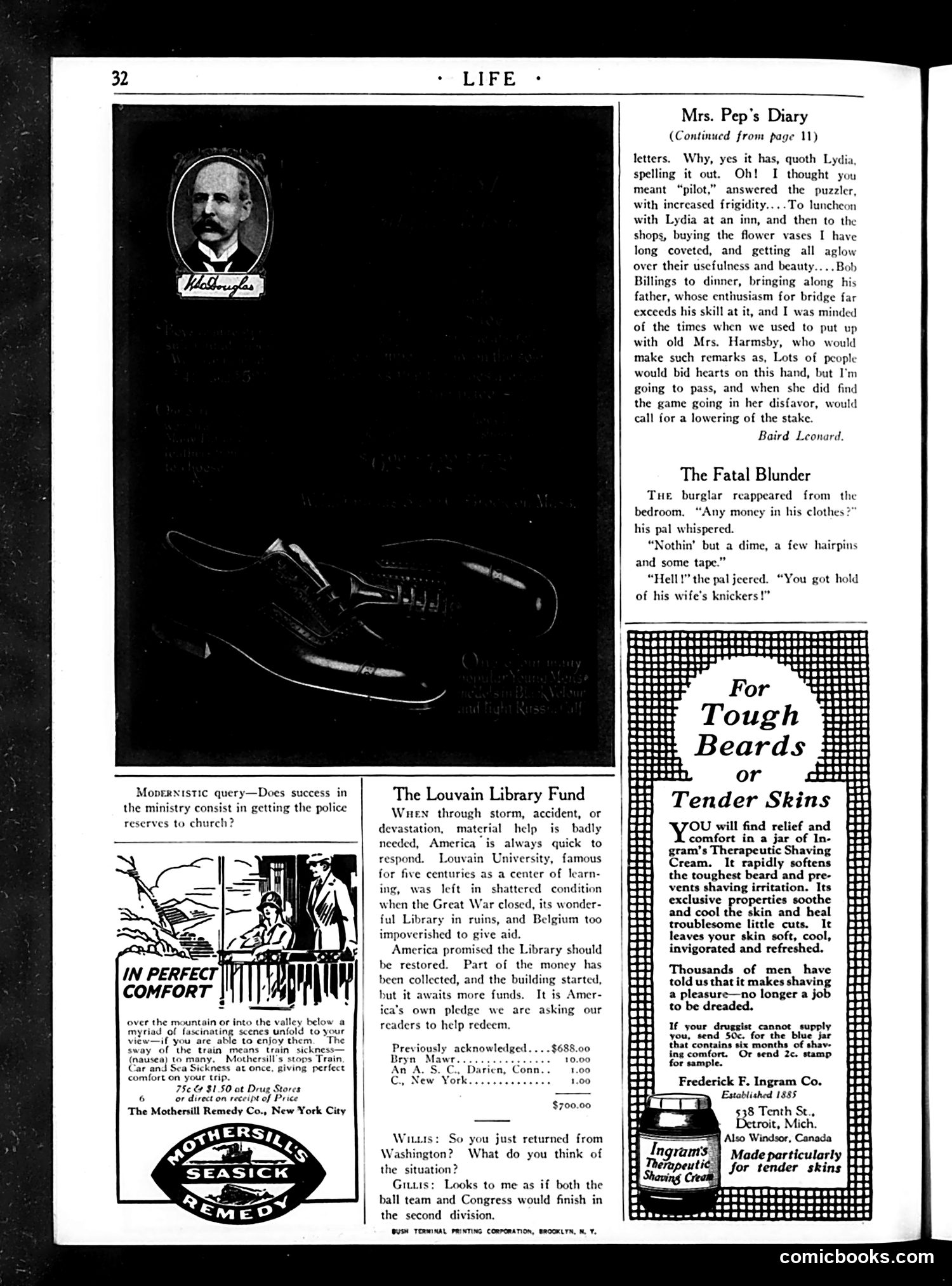
This page contains several satirical pieces and advertisements typical of early 20th-century Life magazine: **"Modernistic Query"** cartoon jokes that success in Christian ministry might be measured by getting police reserves (law enforcement) to attend church—a jab at either clergy who rely on secular authority to boost attendance or at the militarization of religious institutions. **"The Fatal Blunder"** is a brief comic sketch about burglars who steal almost nothing of value from a bedroom, then one jeers at the other for missing "his wife's knickers" (undergarments)—a crude joke playing on the unexpected comedic value of the oversight. **"Willis and Gillis" dialogue** makes a sports reference: comparing both a baseball team and Congress to those finishing "in the second division," suggesting both are performing poorly (unclear which Congress session is meant). **"Mrs. Pep's Diary"** is serialized domestic humor about social calls, shopping, and card games. The remainder consists of advertisements for patent medicines (Mothersill's seasickness remedy) and shaving cream, plus a fundraising appeal for war-damaged Louvain University Library.
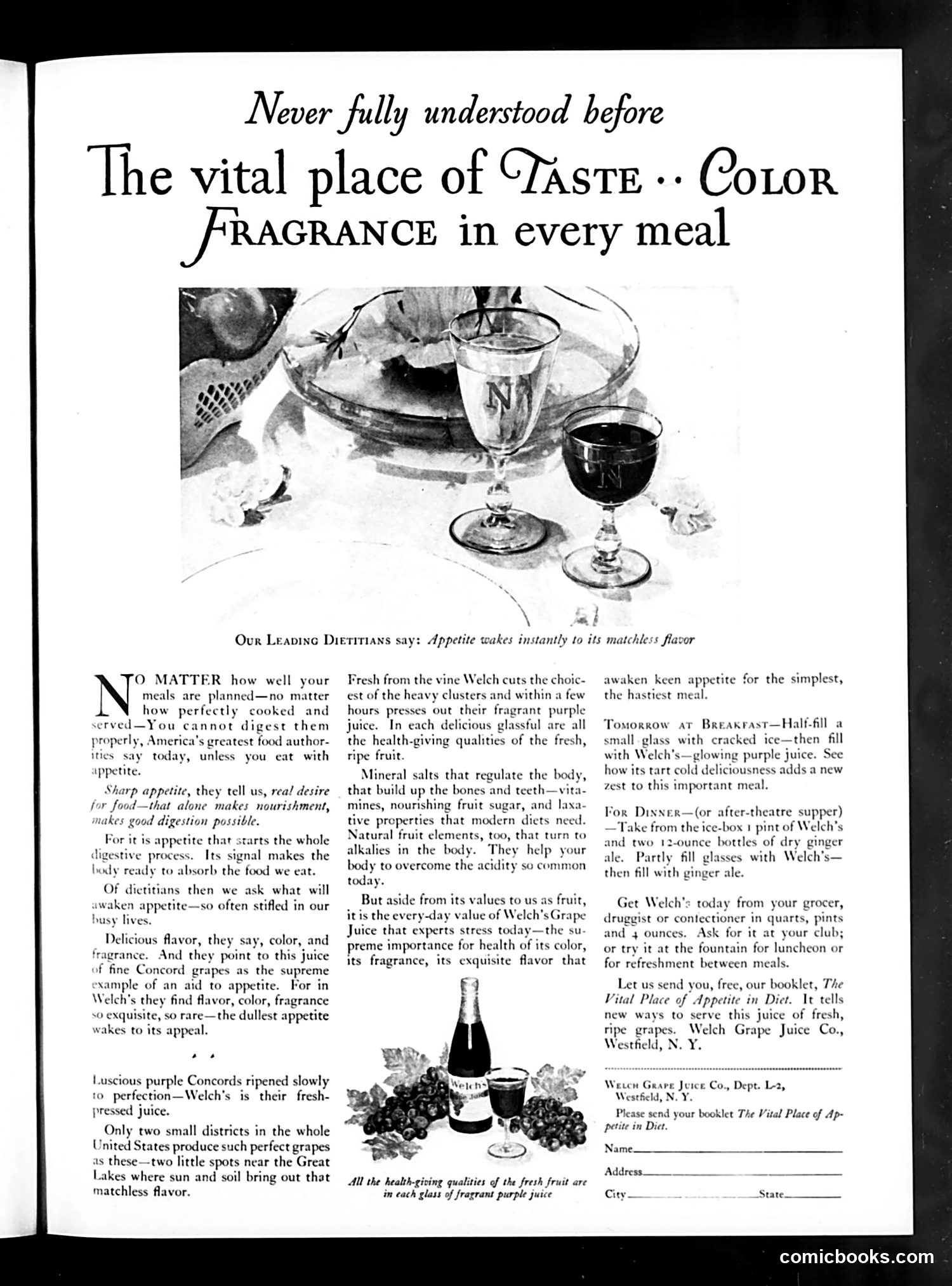
This is **not a political cartoon**—it's a full-page advertisement for Welch's Grape Juice. The page appeals to early 20th-century health consciousness by invoking dietitian authority ("Our Leading Dietitians say") to argue that appetite itself is essential to digestion and nutrition. The pitch centers on sensory appeal: taste, color, and fragrance stimulate appetite, which supposedly enables the body to properly absorb food. Welch's Concord grape juice is positioned as the ideal appetite-stimulant, rich in minerals, vitamins, and natural sugars. The ad includes serving suggestions (breakfast, dinner, after-theatre) and a mail-in coupon for a booklet titled "The Vital Place of Appetite in Diet." This represents early advertising's strategy of pseudo-scientific claims and expert endorsement to market consumer products during an era when such health messaging was largely unregulated.
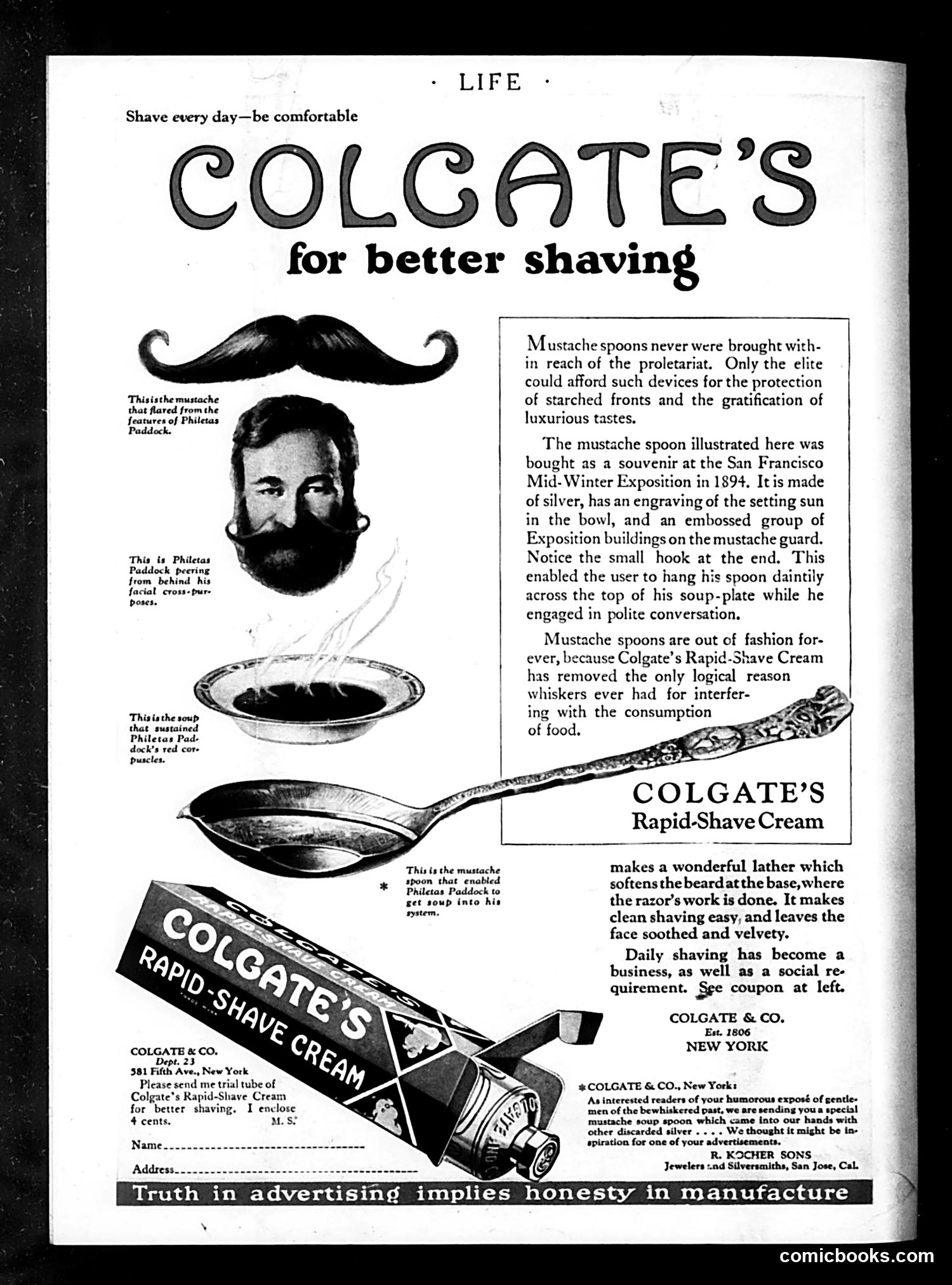
This is primarily a **product advertisement** disguised as humorous editorial content. The "satire" targets outdated grooming customs rather than politics. The joke centers on a **mustache spoon**—a real Victorian-era utensil designed to protect elaborate facial hair from soup while eating. The ad mocks this as an absurd luxury item for the wealthy elite, contrasting it with modern practicality. "Philetas Paddock" appears to be a **fictional character** representing the overly fastidious gentleman of the past whose grand mustache required such elaborate accessories. The images annotate each part of his facial hair and the spoon's function. **The satirical point**: Colgate's Rapid-Shave Cream has made such affectations obsolete by allowing men to shave daily comfortably. The mustache spoon is now a useless relic—modern grooming has eliminated the "only logical reason whiskers ever had for interfering with the consumption of food." This conflates personal hygiene advancement with social progress, a common advertising strategy of the era.

I can see this is a very dark or poorly scanned page from what appears to be a historical publication, with "comicbooks.com" visible as a watermark at the bottom right. However, the image quality is too degraded for me to reliably make out specific cartoon content, text, figures, or caricatures. The page appears mostly black with some barely visible lighter areas that might contain illustrations or text, but I cannot discern enough detail to accurately identify political figures, social references, or the satirical intent of any content. To provide accurate analysis per your guidelines, I would need a clearer version of this image.