
Life, 1925-04-23 · page 26 of 37
Life — April 23, 1925 — page 26: what you’re looking at
What you’re looking at
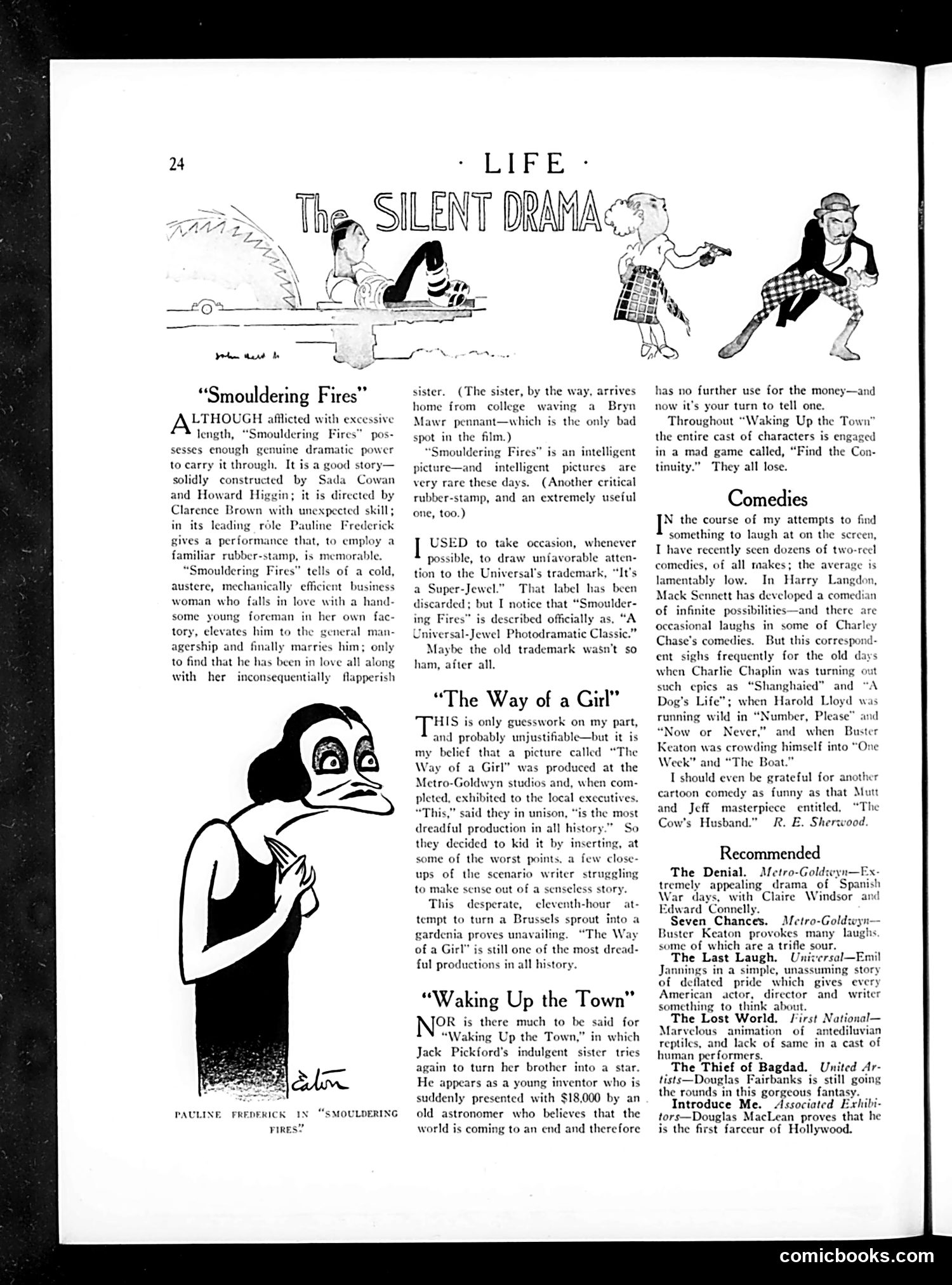
This page reviews three silent films from the 1920s. The critic praises **"Smouldering Fires"** starring Pauline Frederick (pictured), calling it a competent melodrama about a businesswoman who falls for a younger foreman, only to discover he loves her flapper sister instead. **"The Way of a Girl"** is savagely mocked as "one of the most dreadful productions in all history"—so bad the critic suspects the studio inserted close-ups of the struggling screenwriter to mock the senseless plot. **"Waking Up the Town"** features Jack Pickford (Mary Pickford's brother) in an absurd story where a stranger gives him $18,000 believing the world is ending. The critic quips the characters are playing "Find the Continuity" and "all lose." The "Comedies" section laments the decline of film comedy since Chaplin, Lloyd, and Keaton's golden age, though praising Harry Langdon and Mack Sennett's current work. This reflects 1920s nostalgia for earlier silent comedy greats.
📄 Transcribed text from this page (OCR, searchable)
Machine-transcribed from the original scan — historical spelling and the odd misread are preserved.
LIFE - ENT DRAMA “Smouldering Fires” LTHOUGH afflicted with excessive length, “Smouldering Fires” sesses enough genuine dramatic power to carry it through, It is a good story— solidly constructed by Sada Cowan and Howard Higgin; it is directed by Clarence Brown with unexpected skill; in its leading role Pauline Frederick gives a performance that, to employ 4 familiar rubber-stamp, is memorable. “Smouldering Fires” tells of a cold, austere, mechanically efficient business won who falls in love with a hand- some young foreman in her own fac- tory, elevates him to the general man- pos- agership and finally marries him; only to find that he has been in love all along with her inconsequentially flapperish PAULINE FREDERICK IN “SMOULDERING FIRES” sister. (The siste . arrives home from college Bryn Mawr pennant—which is the only bad s” is an intelligent d intelligent pictures are very rare these days. (Another criti rubber-stamp, and an extremely useful ‘one, too.) USED to take occasion, whenever possible, to draw unfavorable atten- tion to the Universal's trademark, “It's a Super-Jewel.”| That label has been discarded; but I notice that “Smoulder- ing Fires” is described officially as, “A. Universal-Jewel Photodramatic Classic.” Maybe the old trademark wasn't so ham, after all, “The Way of a Girl” HIS is only guesswork on my part, and probably unjustifiable—but it is my belicf that a picture called Way of a Girl” was produced at the Metro-Goldwyn studios and, when com- pleted, exhibited to the local executives. “This,” said they in unison, “is the most dreadful production in all history.” they decided to kid it by inserting, at some of the worst points, a few close- ups of the scenario writer struggling to make sense out of a senseless story. This desperate, cleventh-hour — at- tempt to turn a Brussels sprout into a gardenia proves unavailing. “The V of a Girl” is still one of the most dread- ful productions in all history. “Waking Up the Town” OR is there much to be said for “Waking Up the Town,” in which Jack Pickford’s indulgent sister tries again to turn her brother into a star. He appears as a young inventor who is suddenly presented with $18,000 by an old astronomer who believes that the world is coming to an end and therefore has no further use for the money—and now it’s your turn to tell one. Throughout “Waking Up the Town” the entire cast of characters is engaged in a mad game called, ind the Con- tinuity.” They all lose. Comedies N the course of my attempts to fir something to laugh at on the serce! I have recently scen dozens of two-reel comedies, of all rakes; the average is lamentably low. In Harry Langdon, Mack Sennett has developed a comedian of infinite possibilities—and there are occasional laughs in some of Charley Chase's comedies. But this correspor ent sighs frequently for the old days when Charlie Chaplin was turning such epics as “Shanghaied” and Dog's Lif when Harold Lloyd was running wild in “Number, Please” and “Now or and when Buster Keaton was crowding himself into “One Week” and “The Boat.” I should even be grateful for another cartoon comedy as funny as that Mutt and Jeff masterpiece entitled, “The Cow's Husband.” R. E. Sherwood. Never,” Recommended The Denial. Metro-Goldwyn— tremely appealing drama of Spanisl War days, with Claire Windsor and ward Connelly. Seven Chances. Metro-Goldwyn— 3uster Keaton provokes many laughs. some of which are a trifle sour. The Last Laugh. Universal—Emil Jannings in a simple, unassuming story of deflated pride which gives every American actor, director and writer something to think about. The Lost World. First National— Marvelous animation of antediluvian reptiles, and lack of same in a cast of human performers. The Thief of Bagdad. United Ar- tists—Douglas Fairbanks is still going the rounds in this gorgeous fantasy. Introduce Me. Associated E tors—Douglas MacLean proves that he is the first farceur of Hollywood. comicbooks.com