
Life, 1925-04-23 · page 20 of 37
Life — April 23, 1925 — page 20: what you’re looking at
What you’re looking at
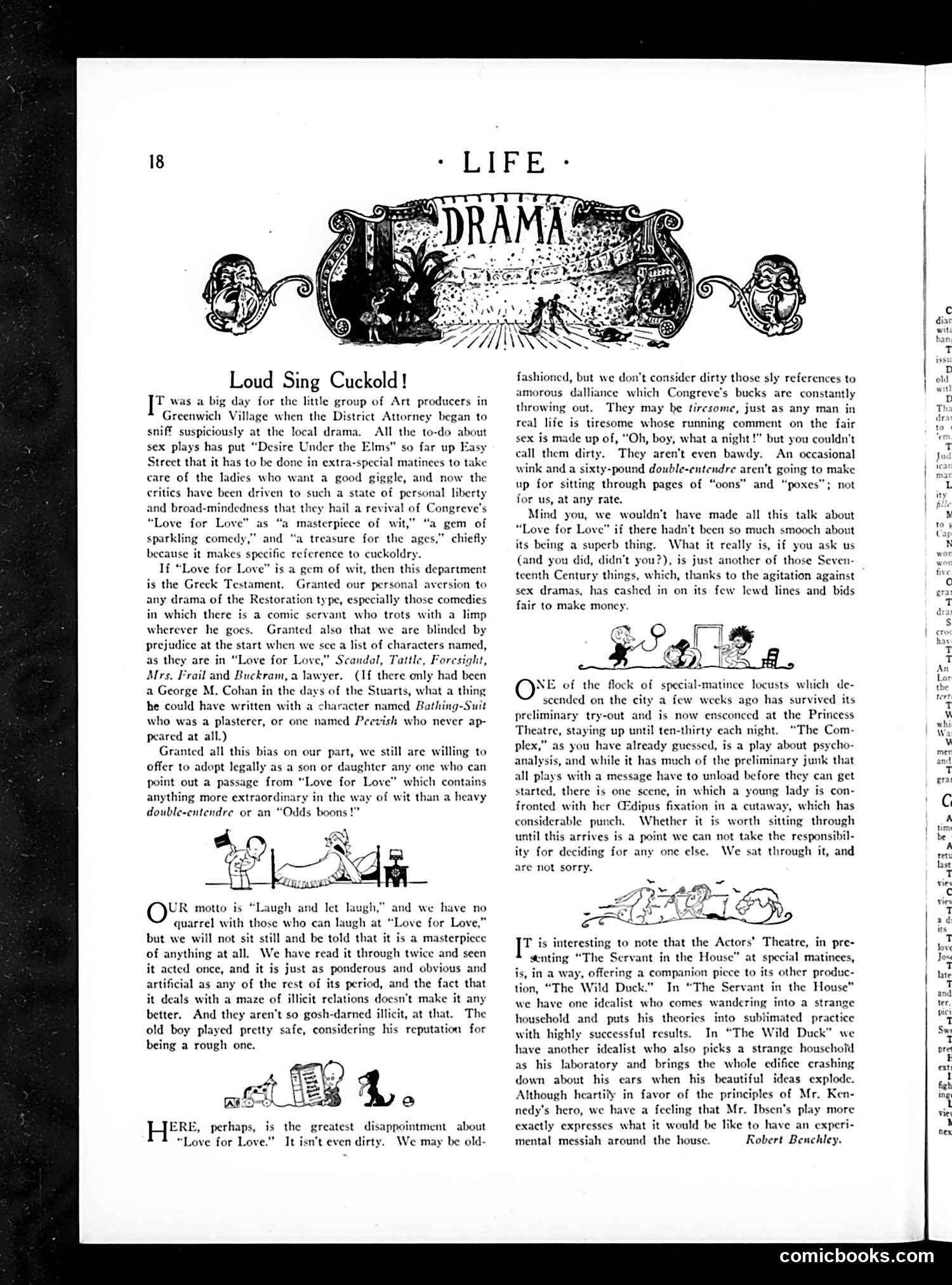
This page critiques the 1920s theatrical revival of William Congreve's 17th-century comedy "Love for Love," alongside commentary on contemporary sex-themed plays like "Desire Under the Elms." The satire targets critics who hail the Restoration comedy as a masterpiece simply because it contains risqué references to cuckolding and sexual dalliance. Life's author argues the play is actually tedious and overrated—its bawdy double-entendres aren't even particularly "dirty" by modern standards, just tiresome. The criticism extends to how sex-play controversies (involving the District Attorney's scrutiny) have created artificial prestige around mediocre dramas. The piece also mocks "The Complex," a psychology-themed play receiving special matinee runs, suggesting audiences are drawn to superficial "message plays" rather than genuine wit. The small cartoons illustrate audience reactions—primarily showing women attending these theatrical events, reflecting the era's debates about women's access to adult theatrical content.
📄 Transcribed text from this page (OCR, searchable)
Machine-transcribed from the original scan — historical spelling and the odd misread are preserved.
Loud Sing Cuckold! T was a big day for the little group of Art producers in Greenwich Village when the District Attorney began to sniff suspiciously at the local drama. All the to-do about sex plays has put “Desire Under the Elms” so far up Easy Street that it has to be done in extra-special matinees to take care of the ladies who want a good gi critics have been driven to such a state of personal liberty and broad-mindedness that they hail a revival of Congreve's “Love for Love” as “a masterpiece of wit,” “a gem of sparkling comedy,” and “a treasure for the ages,” chiefly because it makes specific reference to cuckoldry. If “Love for Love” is a gem of wit, then this department is the Greek Testament. Granted our personal aversion to any drama of the Restoration type, especially those comedies in which there is a comic servant who trots with a limp wherever he gocs. Granted also that we are blinded by prejudice at the start when we sce a list of characters named, as they are in “Love for Love,” Scandal, Tattle, Foresight, Mrs. Frail and Buckram, a lawyer. (If there only had been a George M. Cohan in the days of the Stuarts, what a thing he could have written with a character named Bathing-Suit who was a plasterer, or one named Peevish who never ap- peared at all.) Granted all this bias on our part, we still are willing to offer to adopt legally as a son or daughter any one who can point out a passage from “Love for Love” which contains anything more extraordinary in the v of wit than a heavy double-entendre or an “Odds boons ! UR motto is “Laugh and let laugh,” and we have no quarrel with those who can laugh at “Love for Love,” but we will not sit still and be told that it is a masterpiece of anything at all. We have read it through twice and seen it acted once, and it is just as ponderous and obvious and artificial as any of the rest of its period, and the fact that it deals with a maze of illicit relations doesn’t make it any better. And they aren't so gosh-darned illicit, at that. The old boy played pretty safe, considering his reputation for being a rough one. RE, perhaps, is the greatest disappointment about “Love for Love.” It isn't even dirty. We may be old- fashioned, but we don't consider dirty those sly references to amorous dalliance which Congreve’s bucks are constantly throwing out. They may be tiresome, just as any man in real life is tiresome whose running comment on the fair sex is made up of, “Oh, boy, what a night!” but you couldn't call them dirty. They aren't even bawdy. An occasional wink and a sixty-pound double-entendre aren't going to make up for sitting through pages of “oons” and “poxes”; not for u it any rate. Mind you, we wouldn't have made all this talk about “Love for Love” if there hadn't been so much smooch about its being a superb thing. What it really is, if you ask us (and you did, didn’t you?), is just another of those Seven- teenth Century things, which, thanks to the agitation against sex dramas, has cashed in on its few lewd lines and bids fair to make moncy. NE of the flock of special-matince locusts which de- scended on the city a few weeks ago has survived its preliminary try-out and is now ensconced at the Princess Theatre, staying up until ten-thirty cach night. “The Com- plex,” as you have already guessed, is a play about psycho- analysis, and while it has much of the preliminary junk that all plays with a message have to unload before they can get started, there is one scene, in which a young lady is con- fronted with her GEdipus fixation in a cutaway, which has considerable punch. Whether it is worth sitting through until this arrives is a point we can not take the responsibil- ity for deciding for any one else. We sat through it, and are not sorry. T is interesting to note that the Actors’ Theatre, in pre- nting “The Servant in the House” at special matinees, is, in a way, offering a companion pi to its other produc- tion, “The Wild Duck.” In “The Servant in the House” we have one idealist who comes wandering into a strange household and puts his theories into sublimated practice with highly successful results. In “The Wild Duc! have another idealist who also picks a strange houschold as his laboratory and brings the whole edifice crashing down about his cars when his beautiful ideas explode. Although heartily in favor of the principles of Mr. Ken- nedy’s hero, we have a feeling that Mr. Ibsen's play more exactly expresses what it would be like to have an experi- mental messiah around the house. Robert Benchley. we comicbooks.com ext vie a