
Life, 1925-04-23 · page 16 of 37
Life — April 23, 1925 — page 16: what you’re looking at
What you’re looking at
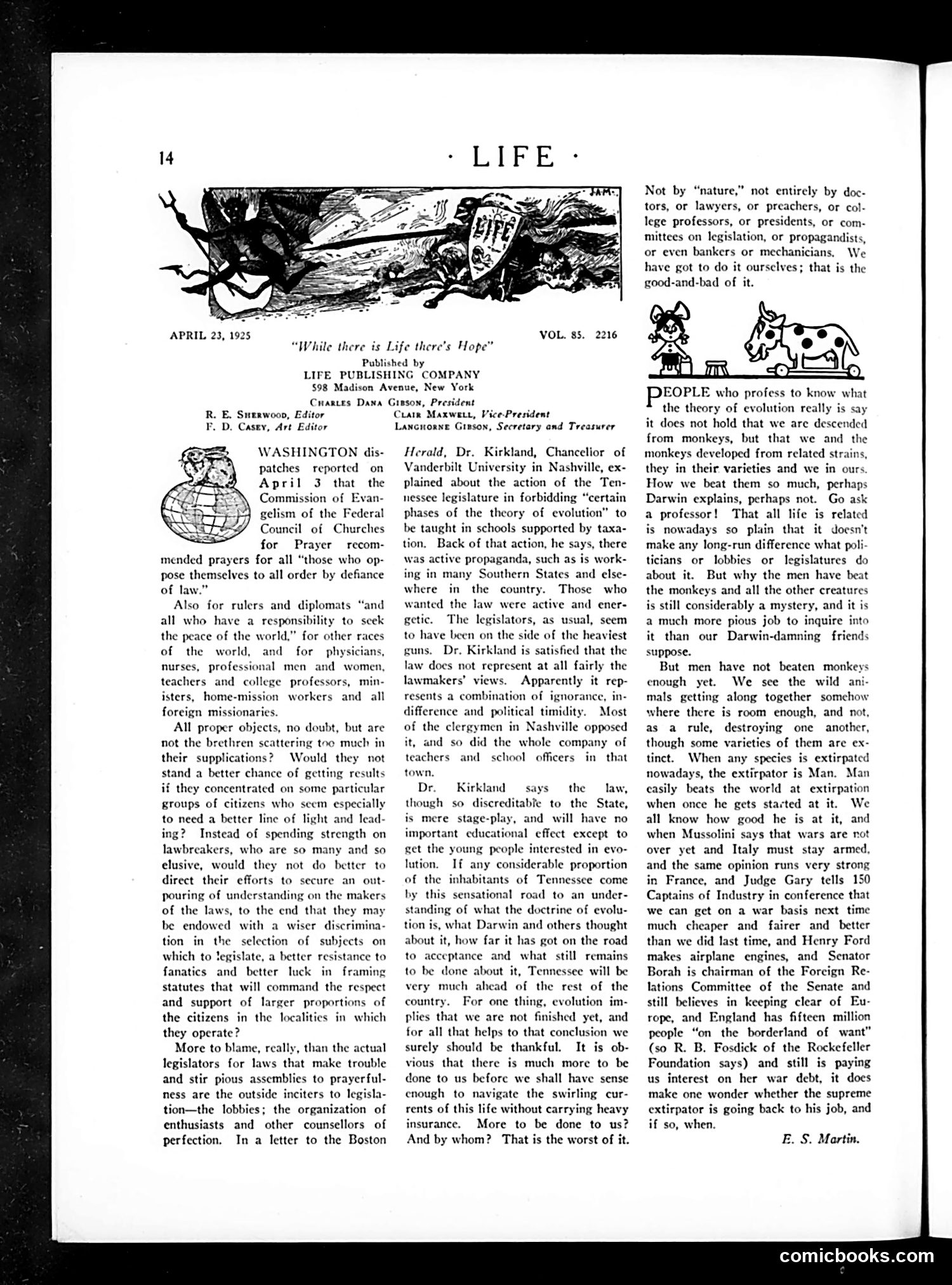
The page contains editorial commentary on a Washington dispute about teaching evolution in schools. Dr. Kirkland of Vanderbilt University reported (April 3) that Tennessee's Commission on Evangelism pressured schools to forbid teaching evolution phases, claiming active propaganda existed in Southern states. The article satirizes religious interference in education, arguing that lawmakers opposing evolution lack scientific understanding. It mocks the "sensational road" leading to evolution acceptance and questions whether religion should dictate curriculum. The cartoon at top (left) appears to show a figure with evolution-related imagery, though details are unclear—likely criticizing anti-evolution activists. The piece advocates for secular education free from religious and political pressure, positioning evolutionists as rational against religiously-motivated legislators.
📄 Transcribed text from this page (OCR, searchable)
Machine-transcribed from the original scan — historical spelling and the odd misread are preserved.
APRIL 23, 1925 VOL. 85. 2216 “While there is Life there's Hope” Published by LIFE PUBLISHING COMPANY $98 Madison Avenue, New York Cmaates Dana Ginson, President R. E. Surrwoop, Editor F. D. Casey, Art Editor WASHINGTON dis- patches reported on April 3 that the Commission of Evan- gelism of the Federal Council of Churches for Prayer recom- mended prayers for all “those who op- pose themselves to all order by defiance of law.” Also for rulers and diplomats “and all who have a responsibility to seek the peace of the world,” for other races of the world, and for physicians, nurses, professional men and women, teachers and college professors, min- isters, home-mission workers and all foreign missionaries. All proper objects, no doubt, but are not the brethren scattering too much in their supplications Would they not stand a better chance of getting results if they concentrated on some particular groups of citizens who scem especially to need a better line of light and lead- ing? Instead of spending strength on lawbreakers, who are so many and so elusive, would they not do better to direct their efforts to secure an out- pouring of understanding on the makers of the laws, to the end that they may be endowed with a wiser discrimina- tion in the selection of subjects on which to tegislate, a better resistance to fanatics and better luck in framing statutes that will command the respect and support of larger proportions of the citizens in the localities in which they operate? More to blame, really, than the actual legislators for laws that make trouble and stir pious assemblies to prayerful- ness are the outside inciters to legisla- tion—the lobbies; the organization of enthusiasts and other counsellors of perfection. In a letter to the Boston Cuate Maxwett, Vice-President Lancorne Gtnsox, Secretary and Treasurer Herald, Dr. Kirkland, Chancelior of Vanderbilt University in Nashville, ex- plained about the action of the Ten- nessee legislature in forbidding “certain phases of the theory of evolution” to be taught in schools supported by taxa- tion, Back of that action, he says, there was active propaganda, such as is work- ing in many Southern States and else- where in the country. Those who wanted the law were active and ener- getic. The legislators, as usual, seem to have been on the side of the heaviest guns. Dr, Kirkland is satisfied that the law does not represent at all fairly the lawmakers’ views. Apparently it rep- resents a combination of ignorance, in- difference and political timidity. Most of the clergymen in Nashville opposed it, and so did the whole company of teachers and school officers in that town. Dr. Kirkland the law, though so discreditable to the State, is mere stage-play, and will have no important educational effect except to get the young people interested in evo- lution. If any considerable proportion of the inhabitants of Tennessee come hy this sensational road to an under- standing of what the doctrine of evolu- tion is, what Darwin and others thought about it, how far it has got on the road to acceptance and what still remains to be done about it, Tennessee will be very much ahead of the rest of the country. For one thing, evolution im- plies that we are not finished yet, and for all that helps to that conclusion we surely should be thankful. It is ob- vious that there is much more to be done to us before we shall have sense enough to navigate the swirling cur- rents of this life without carrying heavy insurance. More to be done to us? And by whom? That is the worst of Not by “nature,” not entirely by doc- tors, or lawyers, or preachers, or col- lege professors, or presidents, or com- mMittees on legislation, or propagandists, or even bankers or mechanicians, We have got to do it ourselves; that is the good-and-bad of it. PEOPLE who profess to know what the theory of evolution really is say it does not hold that we are descended from monkeys, but that we and the monkeys developed from related strains, they in their varieties and we in ours. How we beat them so much, perhaps Darwin explains, perhaps not. Go ask a professor! That all life is related is nowadays so plain that it doesn’t make any long-run difference what poli ticians or lobbies or legislatures do about it. But why the men have beat the monkeys and all the other creatures is still considerably a mystery, and it is a much more pious job to inquire into it than our Darwin-damning friends suppose. But men have not beaten monkeys enough yet. We sce the wild ani- mals getting along together somchow where there is room enough, and not, as a rule, destroying one another, though some varieties of them are ex- tinct. When any species is extirpated nowadays, the extirpator is Man. Man easily beats the world at extirpation when once he gets started at it. We all know how good he is at it, and when Mussolii ys that wars are not over yet and Italy must stay armed, and the same opinion runs very strong in France, and Judge Gary tells 150 Captains of Industry in conference that we can get on a war basis next time much cheaper and fairer and_ better than we did last time, and Henry Ford makes airplane engines, and Senator Borah is chairman of the Foreign Re- lations Committee of the Senate and still believes in keeping clear of - rope, and England has fifteen million people “on the borderland of want” (so R. B. Fosdick of the Rockefeller Foundation says) and still is paying us interest on her war debt, it does make one wonder whether the supreme extirpator is going back to his job, and if so, when. E. S. Martin. comicbooks.com