
A complete issue · 36 pages · 1925
Life — March 19, 1925
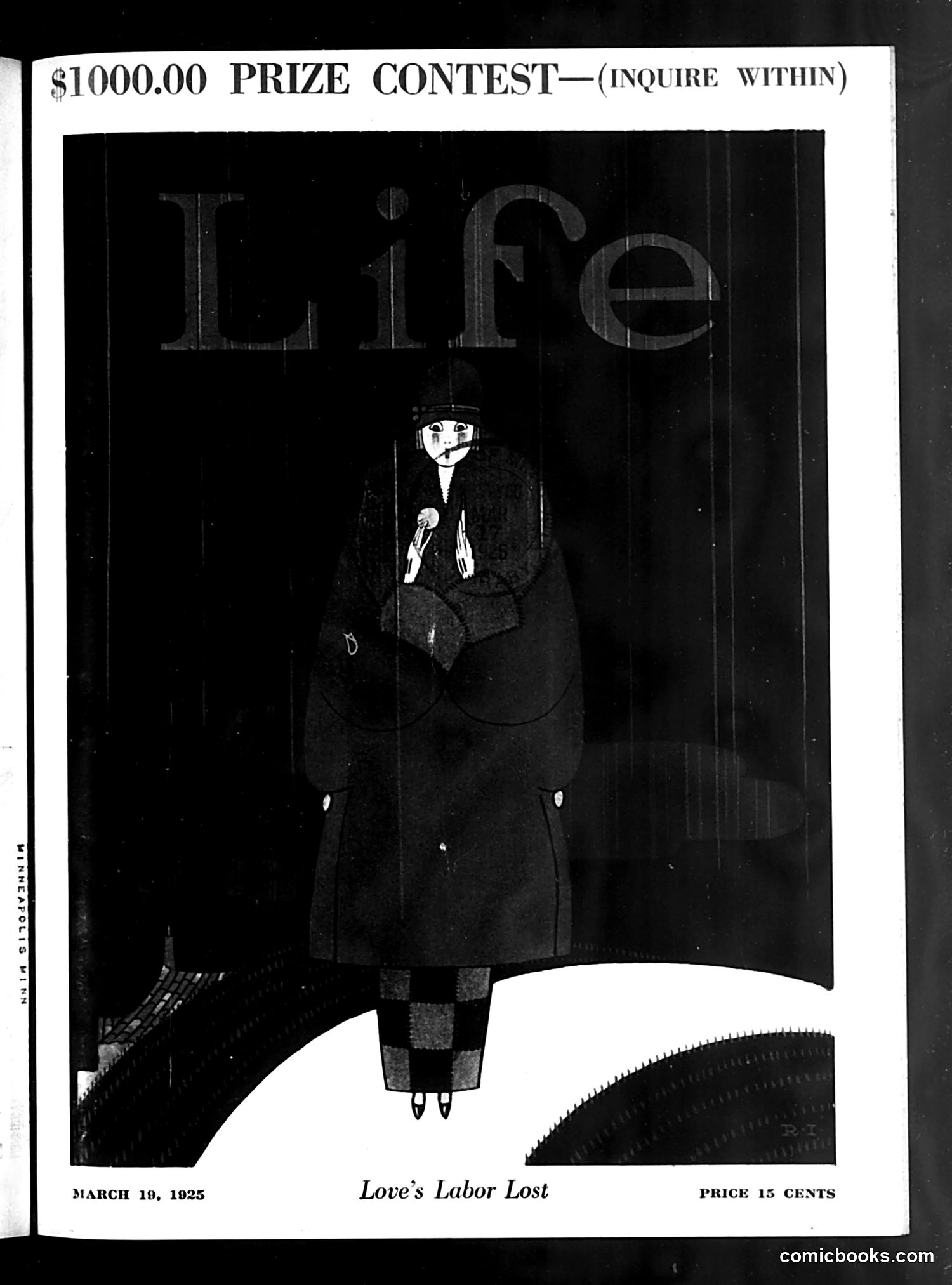
This satirical illustration depicts a figure standing in a prison or jail cell, with the large word "Life" looming above. The title "Love's Labor Lost" references Shakespeare's comedy about romantic pursuit ending in failure. The cartoon appears to satirize romantic entanglement or marital commitment as a form of imprisonment. The figure, rendered in dark clothing within confining bars, suggests that love or marriage represents a loss of freedom—a "labor" that results not in happiness but in confinement. Without additional context about 1925 social commentary, the exact target remains somewhat unclear, though the image likely reflects period anxieties about romantic relationships constraining individual liberty, a common satirical theme of the era.
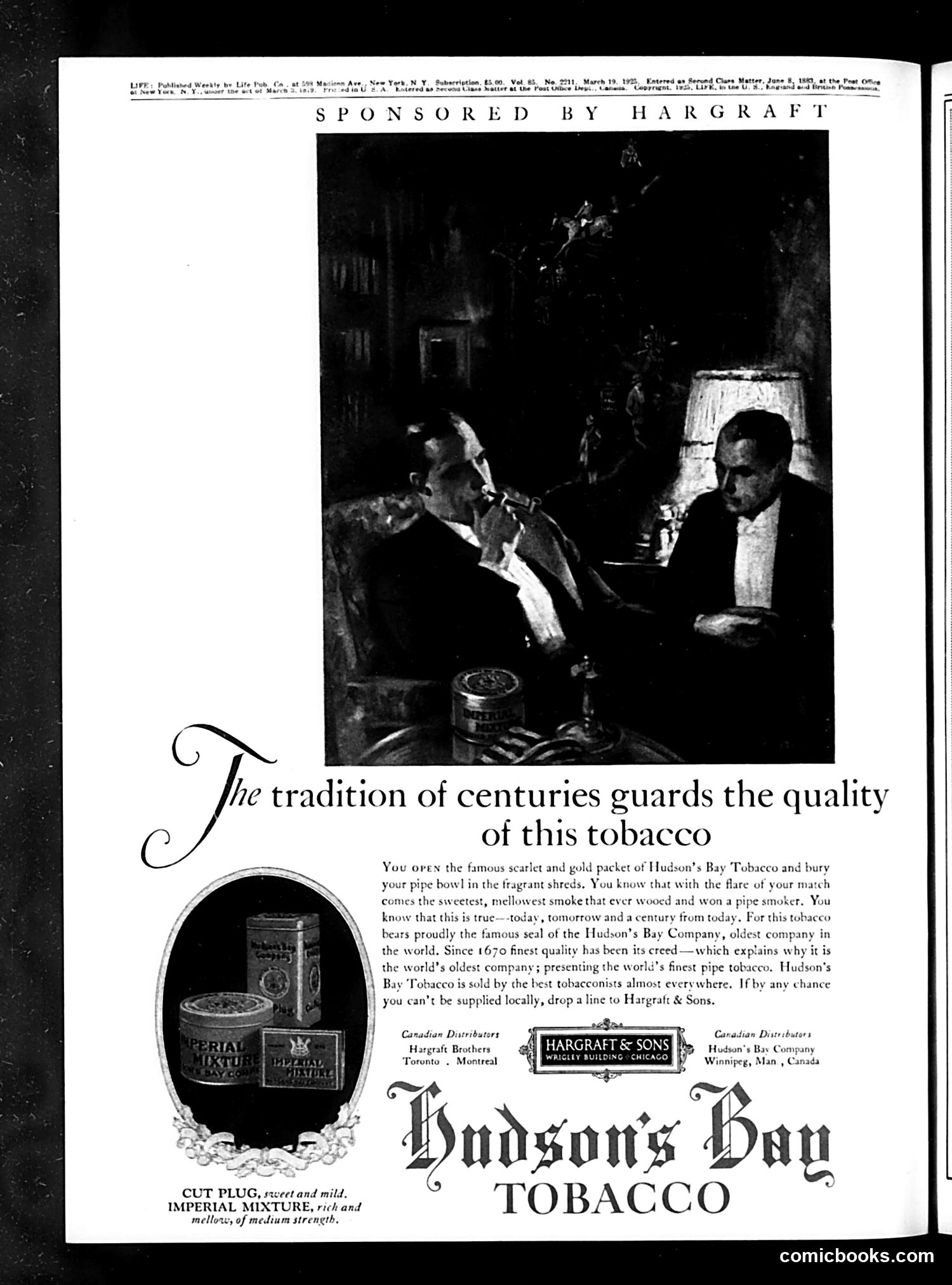
This page is primarily a **tobacco advertisement**, not political satire. It's a full-page ad for Hudson's Bay Tobacco, "Sponsored by Hargraft," placed in Life magazine. The advertisement features: - A dramatic photograph of two men in formal dress in what appears to be an elegant interior, establishing upscale product positioning - Marketing copy emphasizing the Hudson's Bay Company's historical prestige (established 1676) and quality tradition - Product details: "Cut Plug" and "Imperial Mixture" varieties in different strengths - Distribution information for Canadian and American markets The phrase "tradition of centuries guards the quality" is the advertisement's central claim—positioning Hudson's Bay Tobacco as legitimized by institutional longevity and heritage. **This is commercial content, not editorial commentary or satire.**
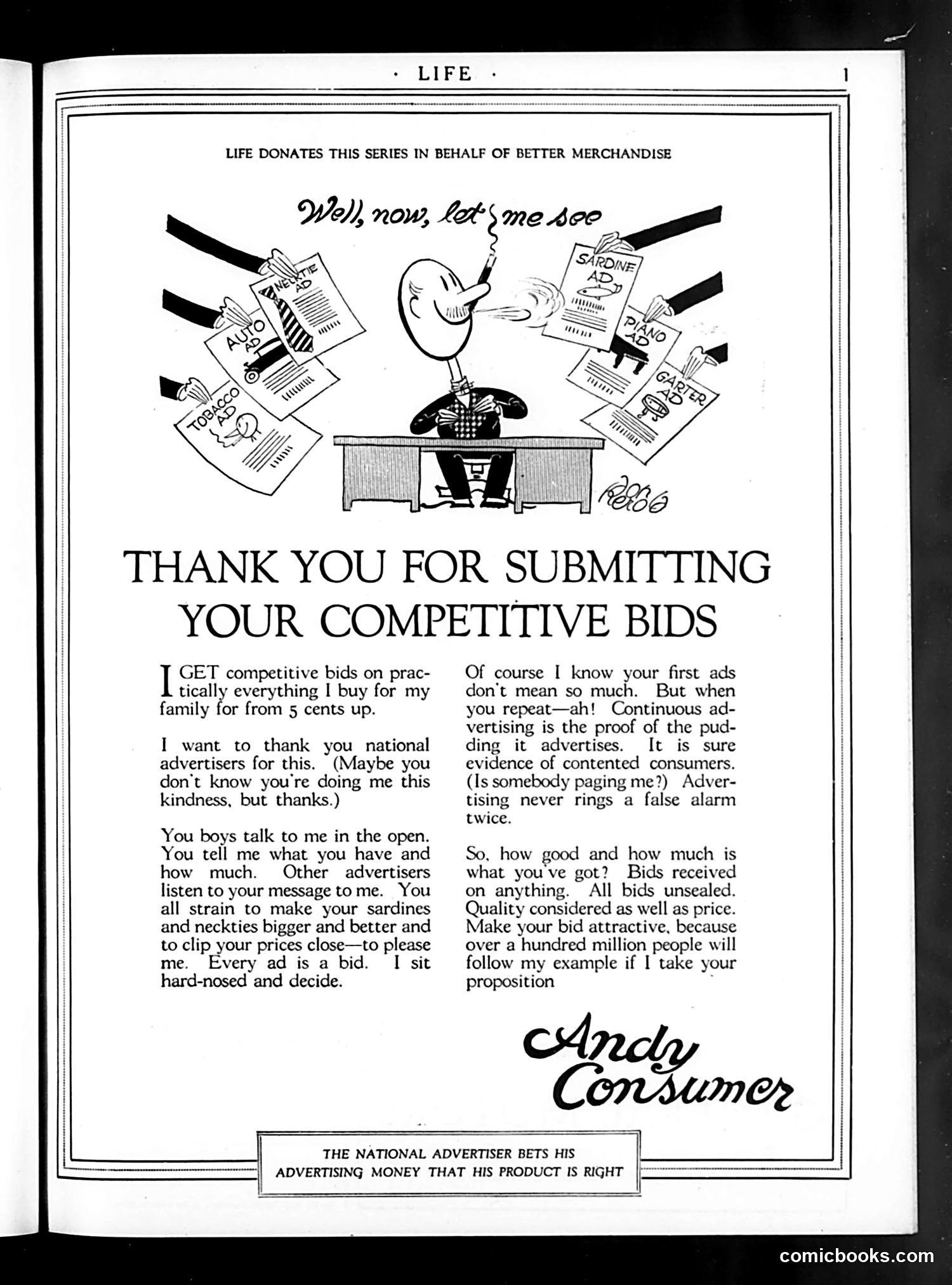
This satire by the cartoonist (signed "REBO") mocks competitive advertising practices. The central figure labeled "Andy Consumer" sits at a desk reviewing product bids, surrounded by floating advertisements for items like "AUTOS," "TOBACCO," "SARDINE," and "PIANO." The joke: advertisers submit "competitive bids" by constantly repeating their ads, assuming repetition proves product quality. Andy Consumer sardonically thanks them, noting that continuous advertising actually signals a good product—though he recognizes this logic is circular. The satire targets early 20th-century advertising's aggressive use of repetition as a marketing strategy, mocking both advertisers' faith in frequency and consumers' tendency to equate visibility with reliability. The cartoon suggests advertising has become a competitive bidding war where sheer volume replaces substantive product claims.
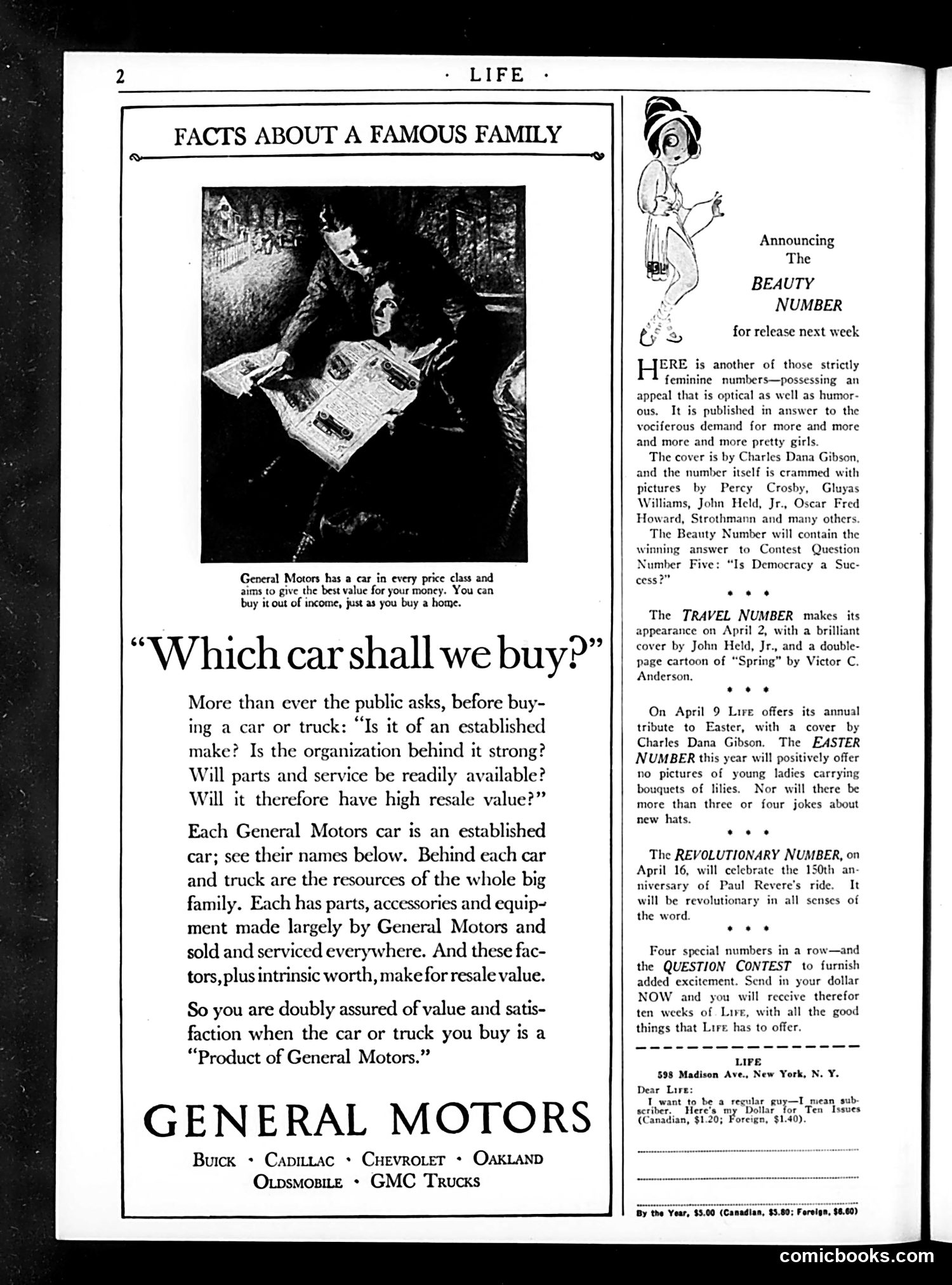
This page is primarily **advertising**, not political satire. The left side features a General Motors advertisement promoting their automobile brands (Buick, Cadillac, Chevrolet, Oakland, Oldsmobile, GMC Trucks). The ad uses a photograph of people reading newspapers to argue that General Motors cars represent established, reliable "value"—they're backed by a strong organization with readily available parts and service. The right side announces upcoming special issues of *Life* magazine, including a "Beauty Number" and "Easter Number." There is **no political cartoon or satirical commentary** on this page. It's a straightforward commercial advertisement from what appears to be the 1920s-1930s era, when *Life* magazine regularly featured such promotional content alongside editorial announcements.
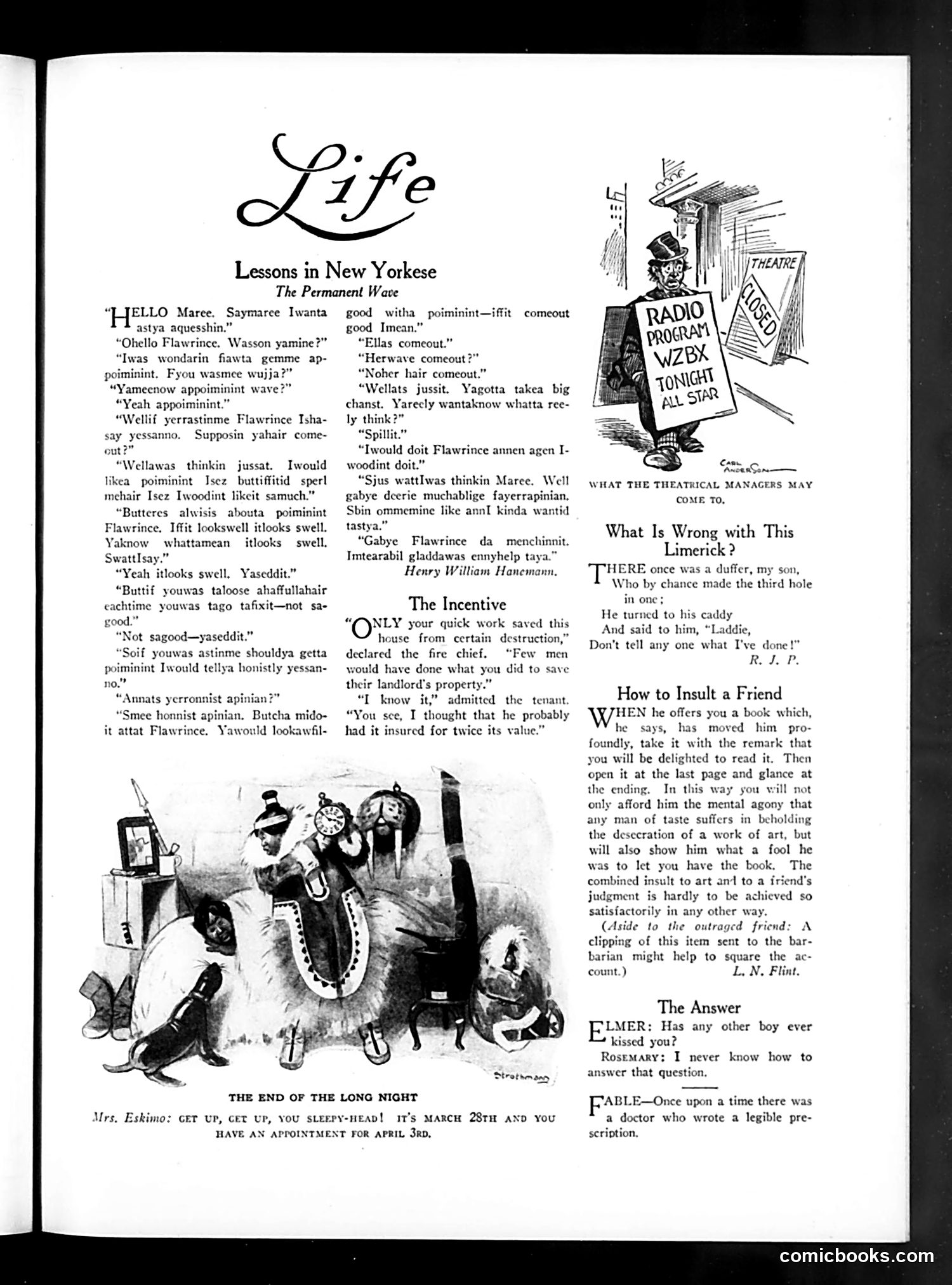
**"The End of the Long Night"** cartoon depicts a chaotic nighttime scene with figures in period dress surrounding what appears to be an automobile or mechanical device. The caption references Mrs. Eskimo needing to wake up by March 28th for an April 3rd appointment—likely satirizing either an upcoming social event or referencing a specific news story from the magazine's publication date. The page also features humor columns on various topics: "Lessons in New Yorkese" mocking accent and dialect, "What Is Wrong with This Limerick?", and brief jokes about social situations. These represent typical Life magazine content—light, observational satire targeting urban middle-class readers and their cultural pretensions rather than specific political figures or events.
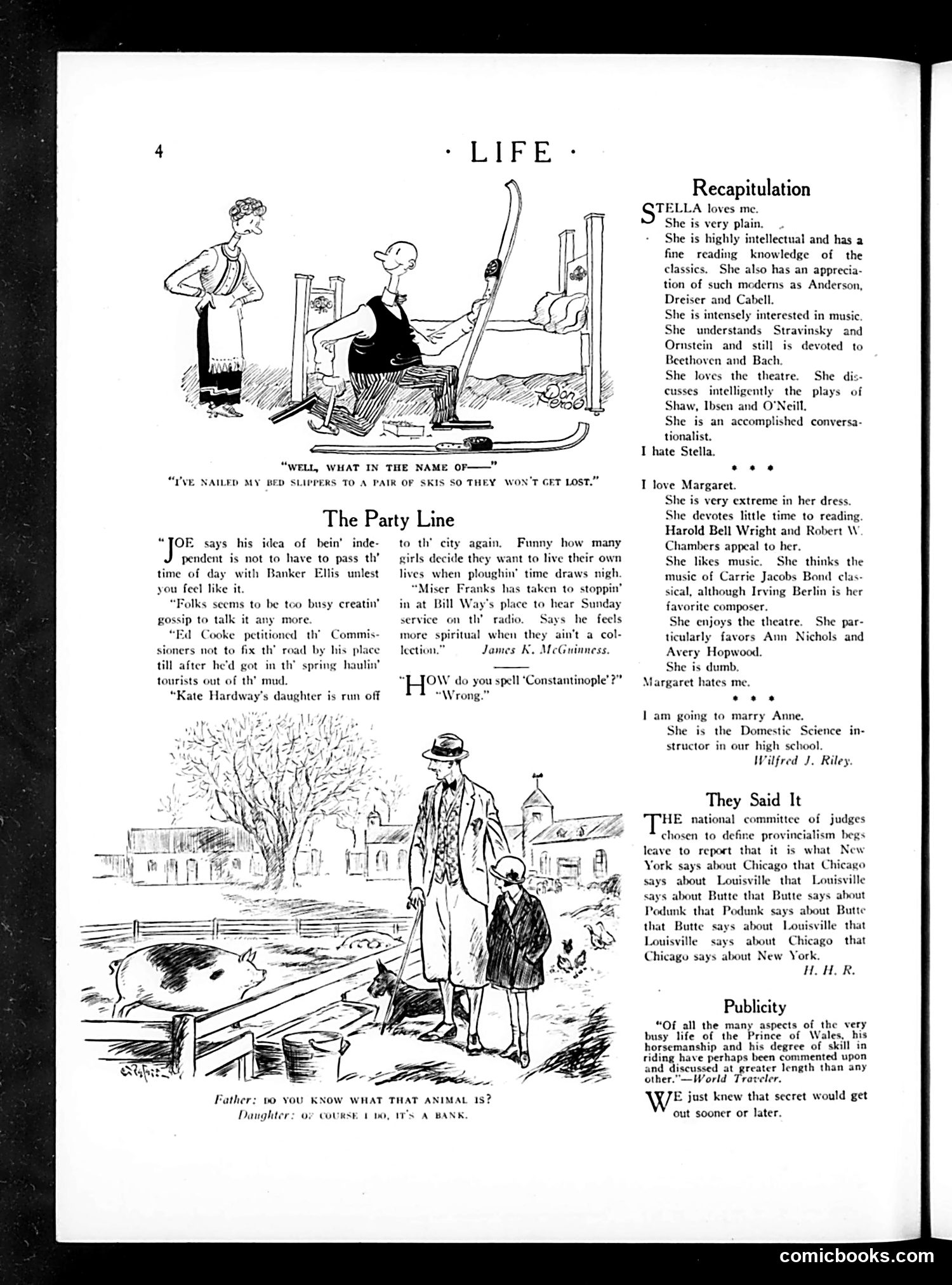
This page from *Life* magazine contains several humor sections typical of the era: **"The Party Line"** features social gossip items about various people's activities and opinions—standard society column satire mocking upper-class chatter and pretension. **"The Party Line" cartoon** shows a father and daughter examining a dead animal, with the caption joking that the daughter has nailed her bed slippers to skis so they won't get lost. This is nonsensical humor typical of the period. **"Recapitulation"** provides character sketches of people named Stella, Margaret, and Anne, offering sardonic personality assessments—likely satirizing how people are evaluated or categorized in social circles. **"They Said It"** is a joke about cities making disparaging remarks about each other (Chicago vs. New York, etc.)—interstate ribaldry. **"Publicity"** contains a brief quip about secrets and exposure. The overall tone is lighthearted, society-focused satire with no apparent political content.
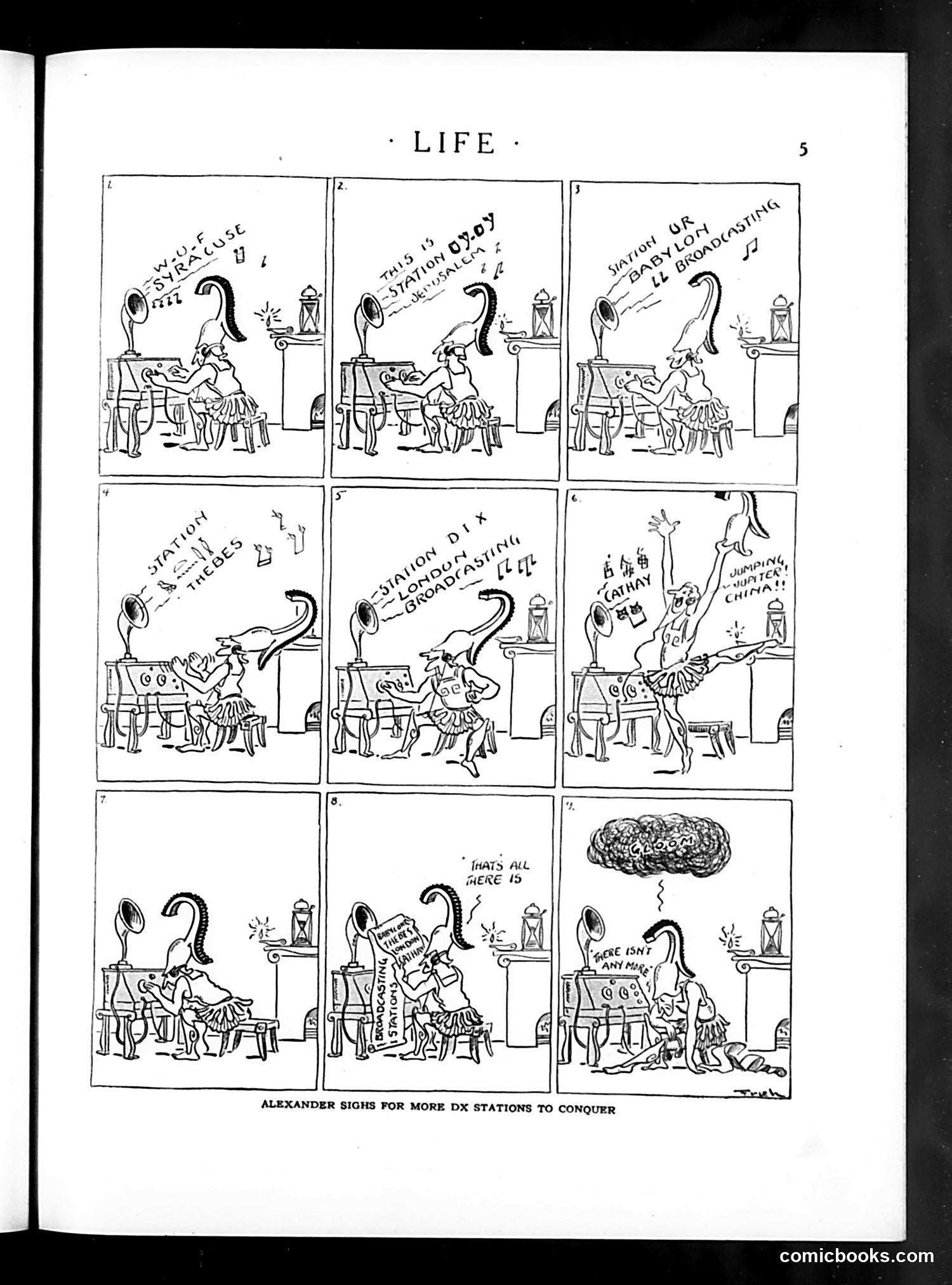
This nine-panel comic strip satirizes Alexander (likely Alexander the Great, shown as a figure in classical dress) attempting to expand his empire through radio broadcasting rather than military conquest. Each panel shows him operating a radio transmitter, announcing conquest of different "stations" and regions—moving from "Station WXYZ" to "Station DIX" to "Cayman" and other locations. The humor escalates when his broadcasts apparently overwhelm his audience: in later panels, listeners appear distressed, and by the final frame, his brain has literally exploded from the effort. The caption reads: "Alexander Sighs for More DX Stations to Conquer." The satire targets either radio expansion ambitions or empire-building ambitions generally, using the absurd juxtaposition of ancient conquest with modern broadcasting technology for comedic effect.
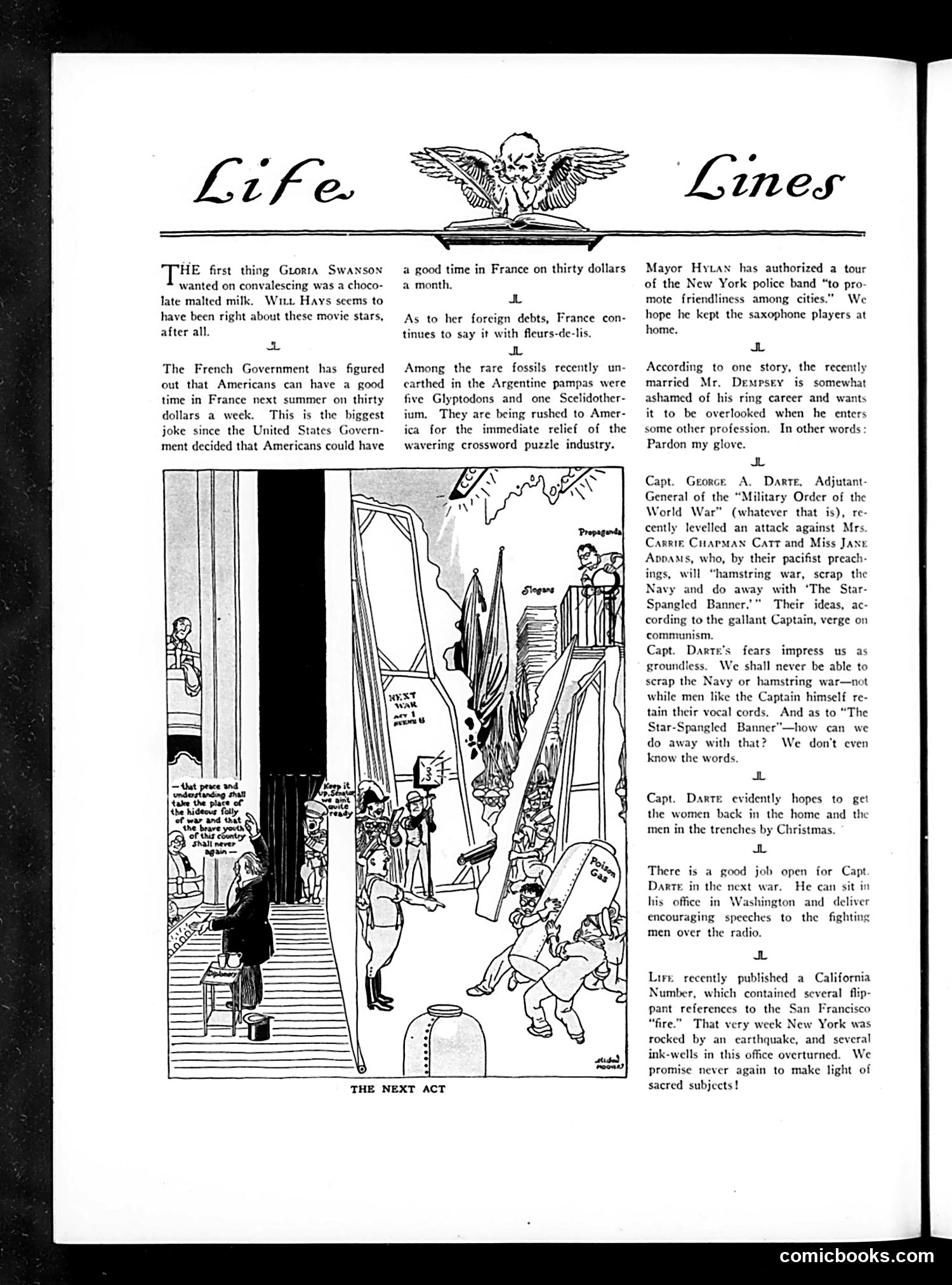
This satirical page from *Life* magazine contains brief humorous items and a cartoon titled "The Next Act." The cartoon depicts a theatrical stage with military/wartime imagery—soldiers, flags, and what appears to be war propaganda or recruitment activity. The surrounding text includes commentary mocking various contemporary figures and situations: Gloria Swanson's movie preferences, French government finances, fossil discoveries, Mayor Hylan's police band, and criticism of Captain George A. Dartie (or similar) regarding pacifist activism against war and military institutions. The overall tone satirizes both war preparations and pacifist opposition to them, using theatrical metaphor ("The Next Act") to suggest ongoing societal conflict. The specific dating and all figures referenced remain unclear without additional historical context.
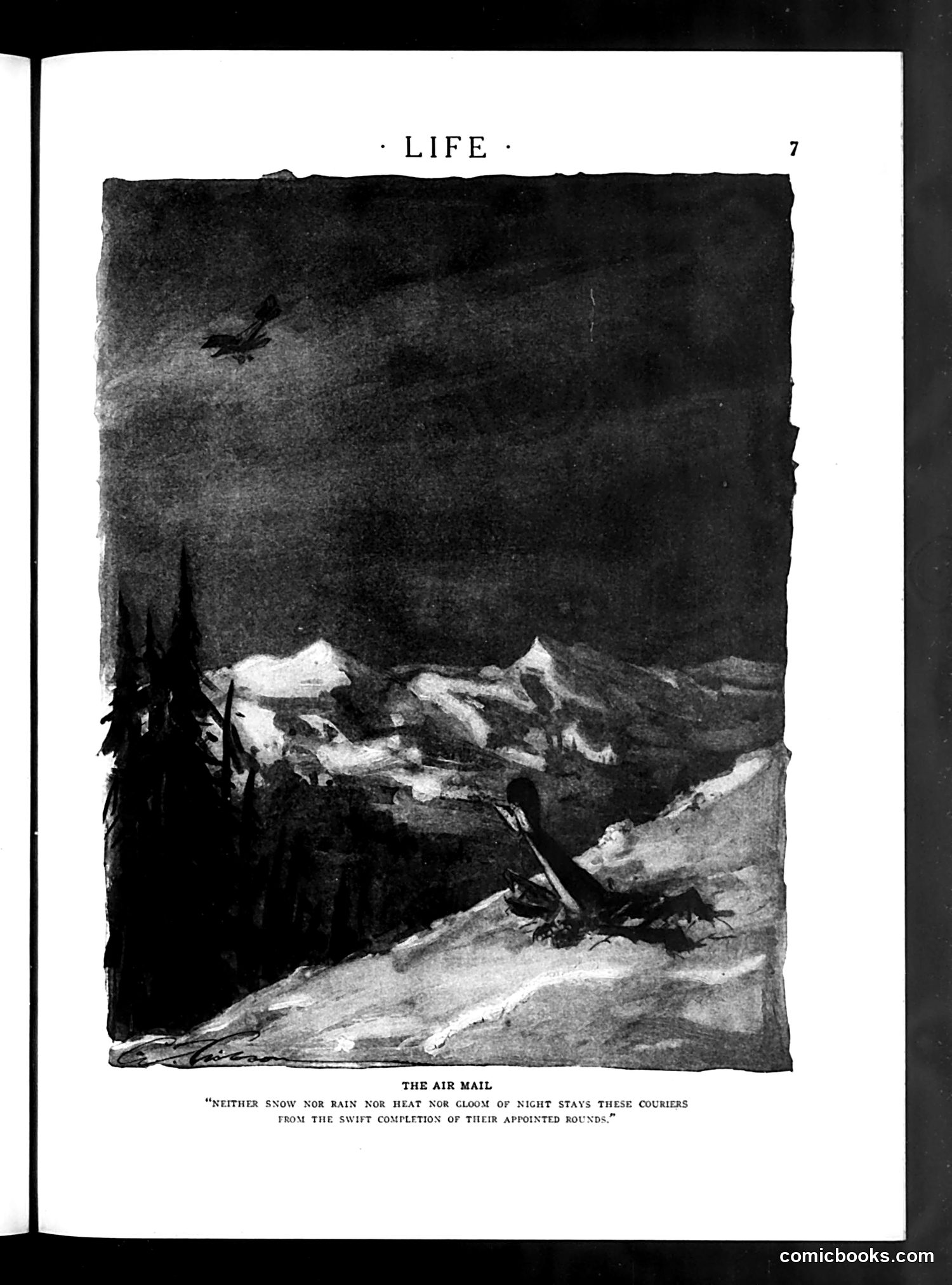
This illustration titled "The Air Mail" depicts an early aviation scene with a small aircraft flying through dark, stormy skies above a desolate, mountainous landscape. The caption quotes the U.S. Postal Service motto about couriers delivering mail regardless of weather conditions. The satire appears to mock the emerging airmail service by applying this grand postal motto to aviation—suggesting that early planes, despite technological limitations and dangerous conditions, were being promoted as reliable mail carriers. The dark, ominous sky and barren landscape emphasize the harsh realities and risks of early flight. This likely critiques either the overconfidence in new aviation technology or the government's overly ambitious airmail program during aviation's experimental era.
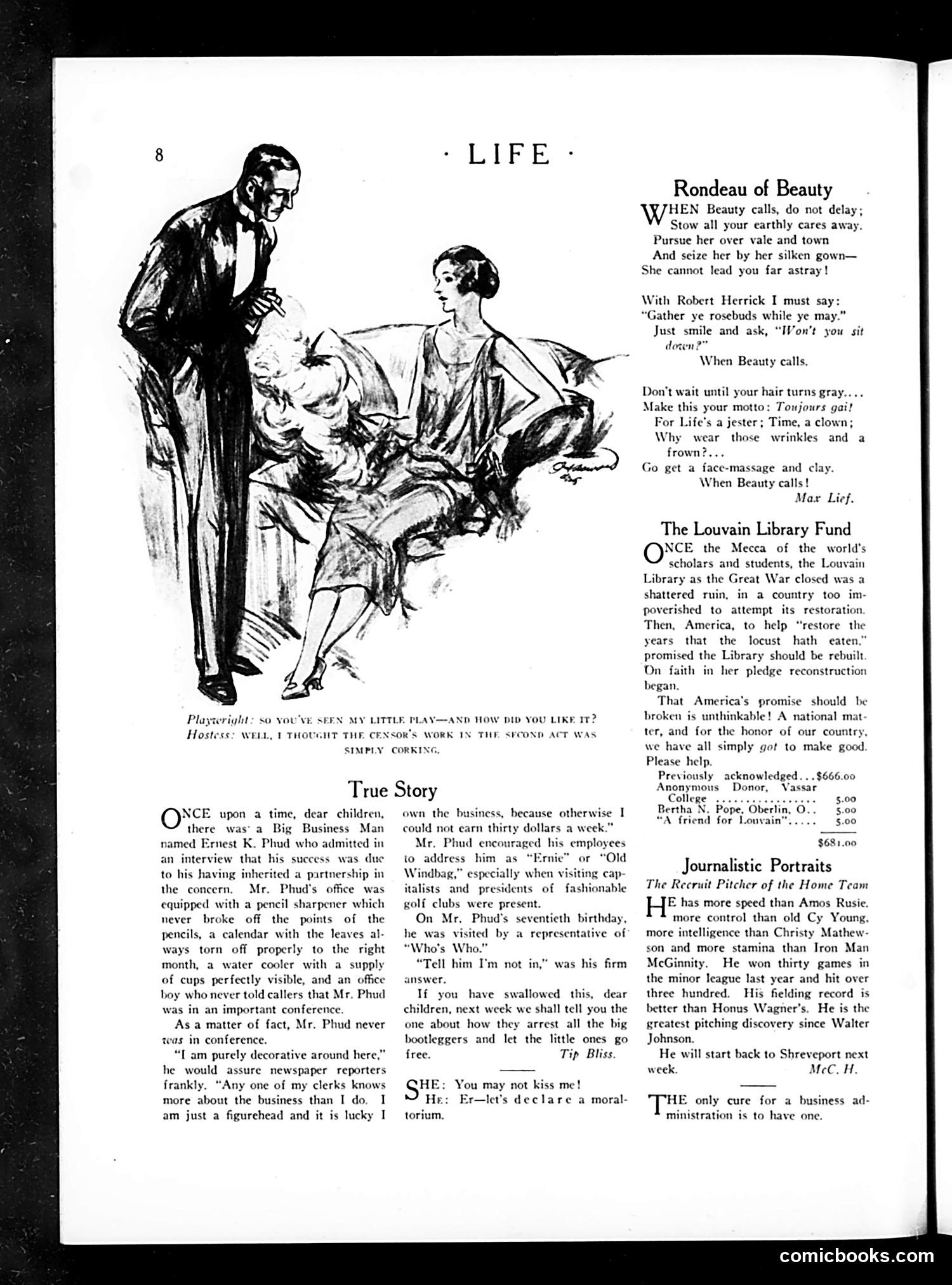
This page contains three distinct pieces: 1. **"Rondeau of Beauty"** - A poem encouraging women to pursue beauty treatments before aging, referencing Robert Herrick's "Gather ye rosebuds while ye may." It promotes facials, massage, and clay treatments. 2. **The main cartoon** shows a playwright and hostess in conversation. The hostess has apparently seen the playwright's work and offers backhanded criticism: she thought the censor's work (removing content) in the second act was "simply corking"—meaning his edits improved it. This satirizes censorship and suggests the original play was flawed. 3. **"True Story"** and other brief items follow, including fundraising for the Louvain Library and sports commentary. The overall page reflects early 20th-century concerns: beauty standards, theatrical censorship, and post-WWI reconstruction efforts.
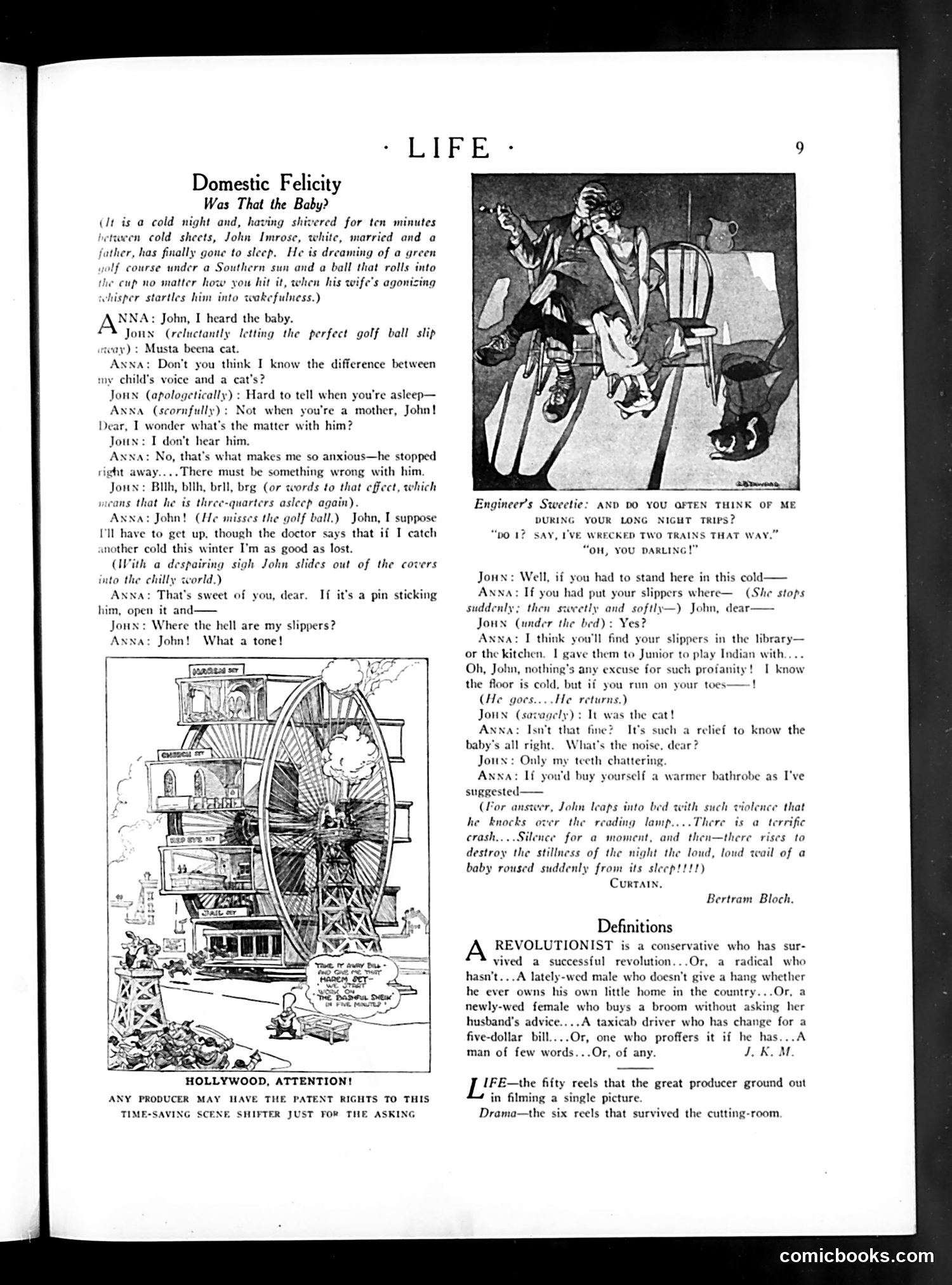
This page presents a comedic domestic sketch by Bertram Bloch about a married couple, John and Anna, during a cold night. John has been sleeping and fails to recognize their baby's cries, while Anna grows anxious about his indifference. The humor derives from their contrasting perspectives: Anna interprets every sound as significant trouble, while John remains oblivious and self-absorbed (complaining about his slippers, his golf game). The satire targets both spouses: husbands who ignore household responsibilities and wives prone to exaggeration and anxiety. The lower cartoon with its technical diagram appears to be a separate Hollywood patent notice. This reflects early 20th-century domestic humor conventions mocking marriage dynamics and gender roles.
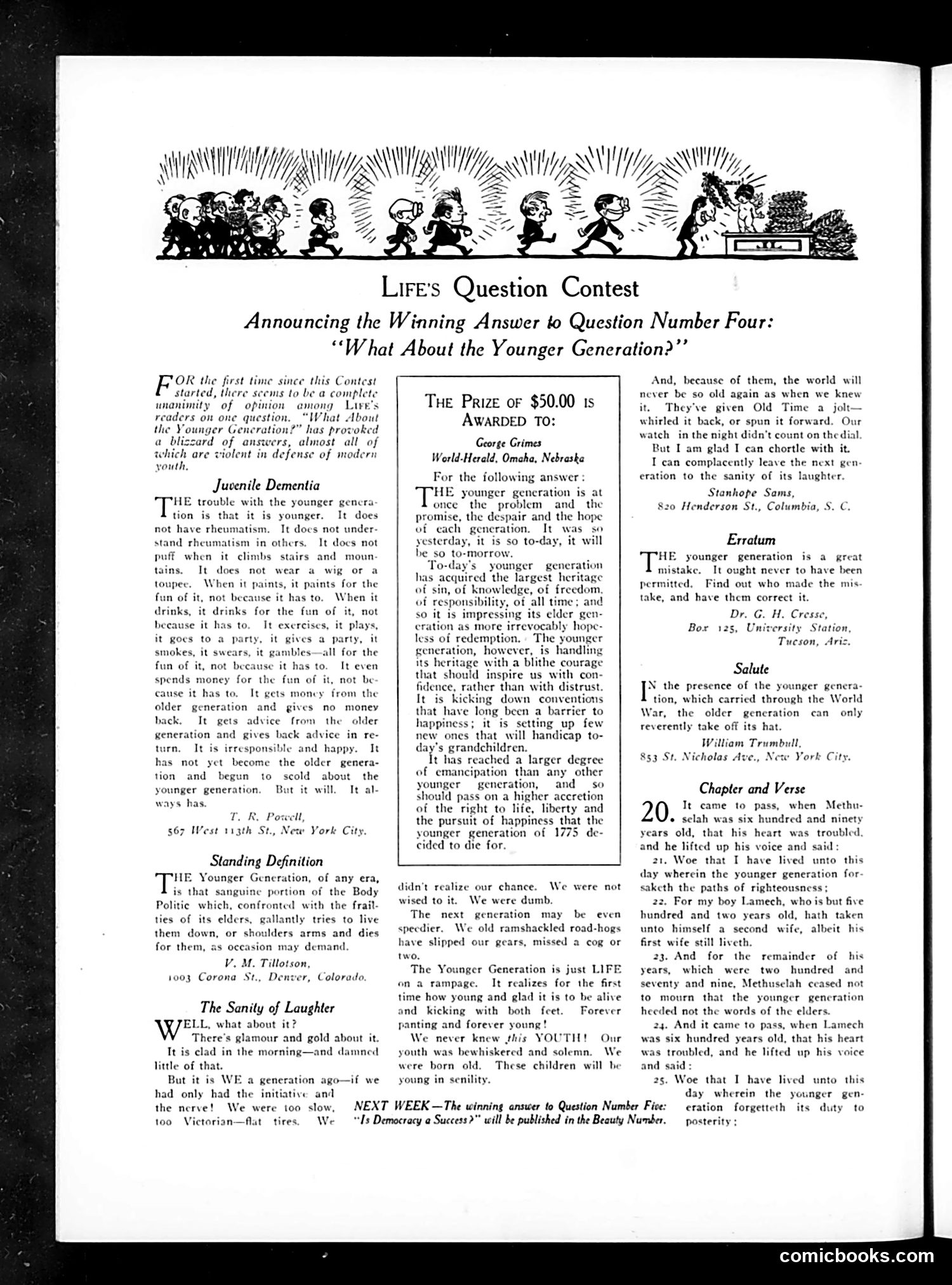
This page announces winners of "Life's Question Contest," specifically the answer to "What About the Younger Generation?" The winning $50 prize went to George Grimes of Omaha, Nebraska. The cartoon header shows a procession of young people of various ages running leftward, appearing energetic and chaotic—illustrating the "younger generation" topic. The page's content reflects early 20th-century anxiety about youth. Multiple responses debated whether young people represented progress or moral decline. Contributors discuss generational differences regarding responsibility, propriety, and social values. Some entries ("Juvenile Dementia," "Standing Definition") criticize youth as frivolous and undisciplined; others ("The Sanity of Laughter," "Salute") defend them as vital and hopeful. This reflects genuine cultural debate of the era about generational conflict and modernization.
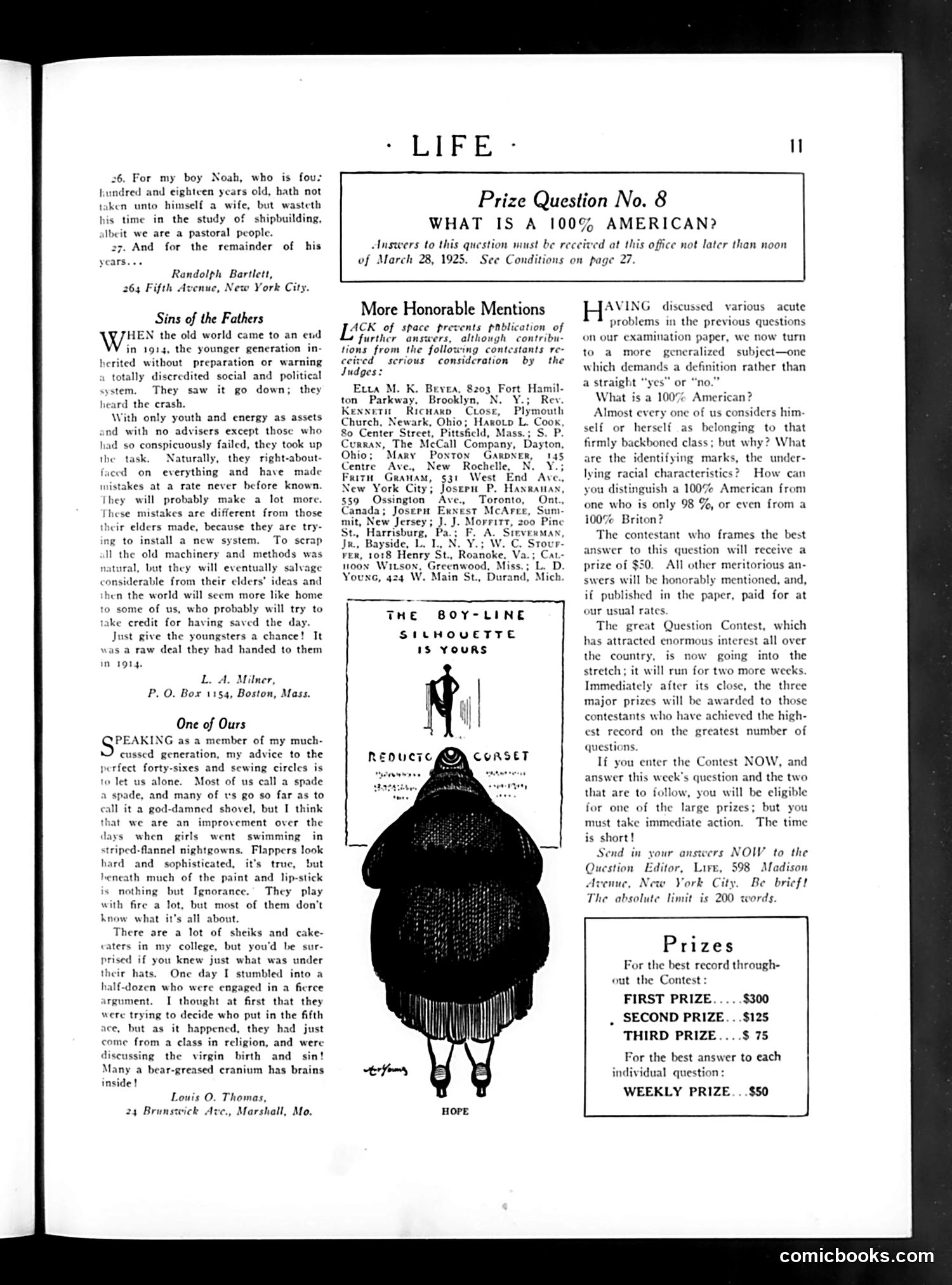
This page contains reader letters, a contest announcement, and an advertisement rather than political cartoons. The main visual element is "The Boy-Line Silhouette" — a corset advertisement featuring a woman in silhouette wearing a reducing corset labeled "HOPE." The image satirizes 1920s fashion ideals: the corset promises to reshape the female body into the fashionable "boyish" silhouette popular during the flapper era, when women rejected Victorian curves for a slimmer, more androgynous appearance. The contest asks "What is a 100% American?" — reflecting 1920s anxieties about immigration and national identity during a period of restrictive immigration legislation and nativist sentiment. The letters discuss generational differences and social change, typical concerns of the Jazz Age.
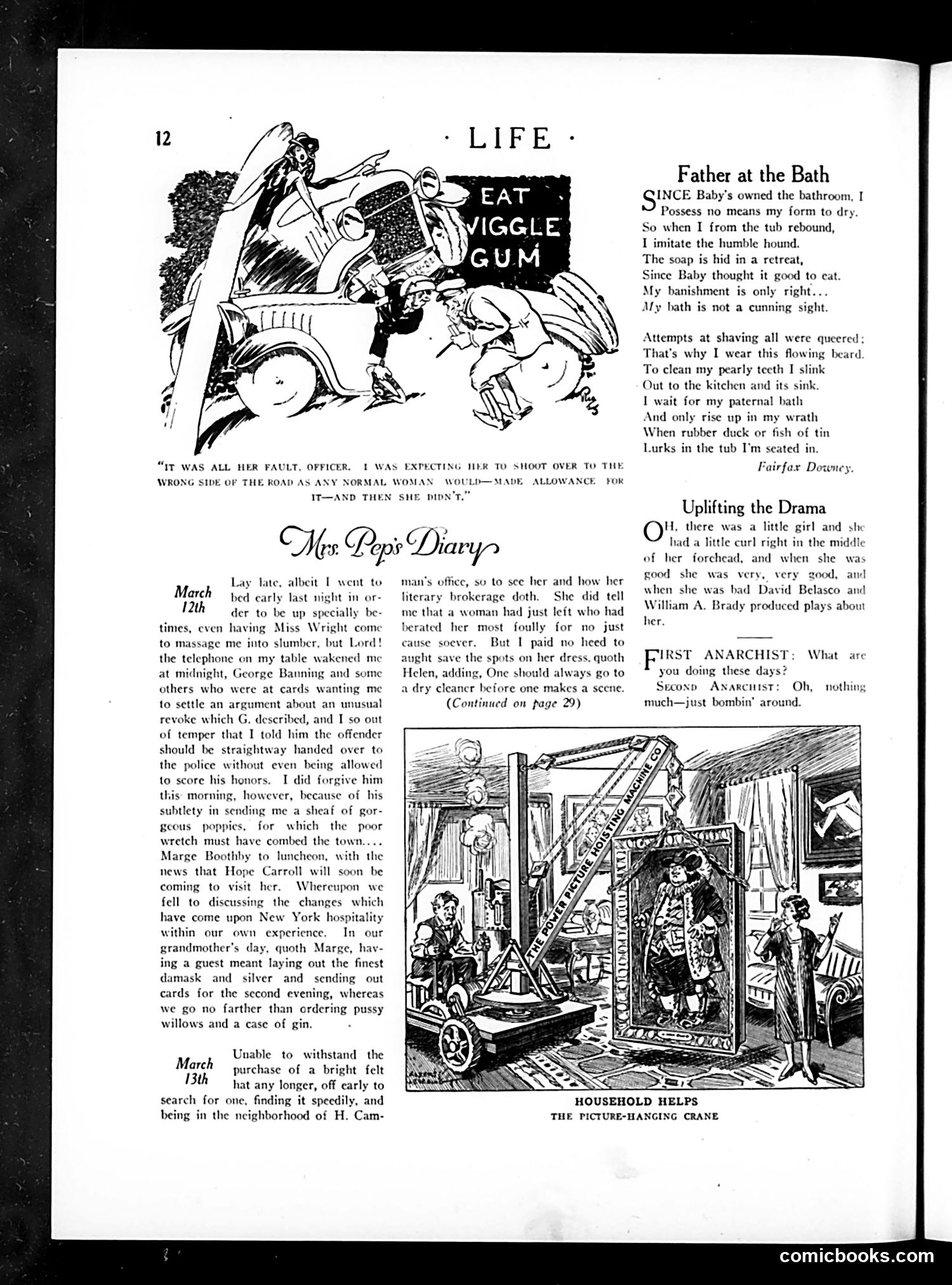
This page contains three distinct pieces of satire: 1. **"Eat Viggle Gum" Advertisement Parody**: A chaotic illustration mocking consumer culture, showing an exaggerated, disheveled figure amid product chaos—satirizing aggressive advertising and gum marketing to children. 2. **"Father at the Bath"**: A humorous poem about a father displaced from the bathroom by his baby's ownership of it. The joke relies on domestic role-reversal and the indignity of a grown man relegated to kitchen-sink washing. 3. **"Mrs. Pops' Diary"**: A satirical diary entry (dated March 12th-13th) depicting upper-class social anxieties—dinner parties, social climbing, and the arrival of visiting celebrities like Hope Carroll. It mocks pretentious society behavior and the performative nature of wealthy domestic life. 4. **"Household Helps - The Picture-Hanging Crane"**: A comedic illustration showing an absurdly oversized industrial crane used for hanging household pictures—satirizing over-mechanization of simple domestic tasks.
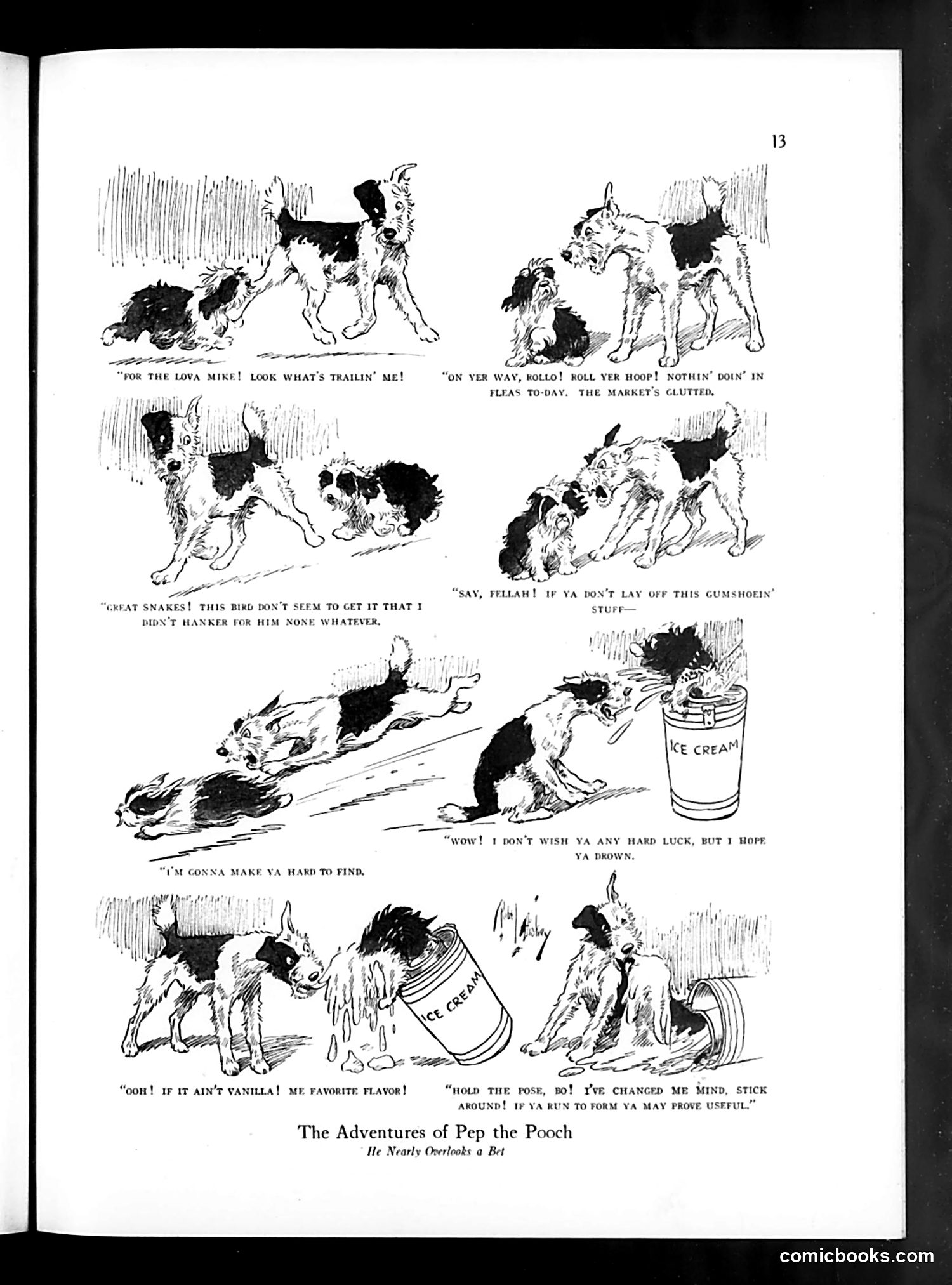
This is a humorous comic strip about a mischievous dog named Pep who gets into various scrapes. The strip depicts Pep: - Trailing through a market, causing chaos among other dogs - Chasing a bird and annoying a dog who cares about his nose - Pursuing fleas and encountering an ice cream vendor - Spilling ice cream and then deciding vanilla is his favorite flavor - Finally being cornered by his owner with a hose The humor is straightforward slapstick involving a dog's antics and misadventures. There's no apparent political satire—it's simply entertainment featuring animal characters in comedic situations, reflecting early 20th-century comic strip conventions. The dialect in speech bubbles ("fer the lova Mike," "gumshoes' stuff") reflects period-appropriate casual speech patterns.
The header cartoon depicts a skeletal figure labeled "LIFE" emerging from or associated with what appears to be wreckage or debris, with the caption "While there is Life there's Hope." The page primarily contains editorial text rather than satire. The articles criticize Dr. Fosdick (a Presbyterian minister) for his pacifist sermons, and debate American naval strength. One piece mocks heretics and the "Middle West" for doubting earthquakes and navy readiness. Another defends Admiral Phelps's call for a stronger navy against potential British competition, arguing Americans shouldn't underestimate England despite post-WWI relations. The overall tone reflects 1920s isolationist anxiety about international naval competition and domestic religious/political division following World War I.
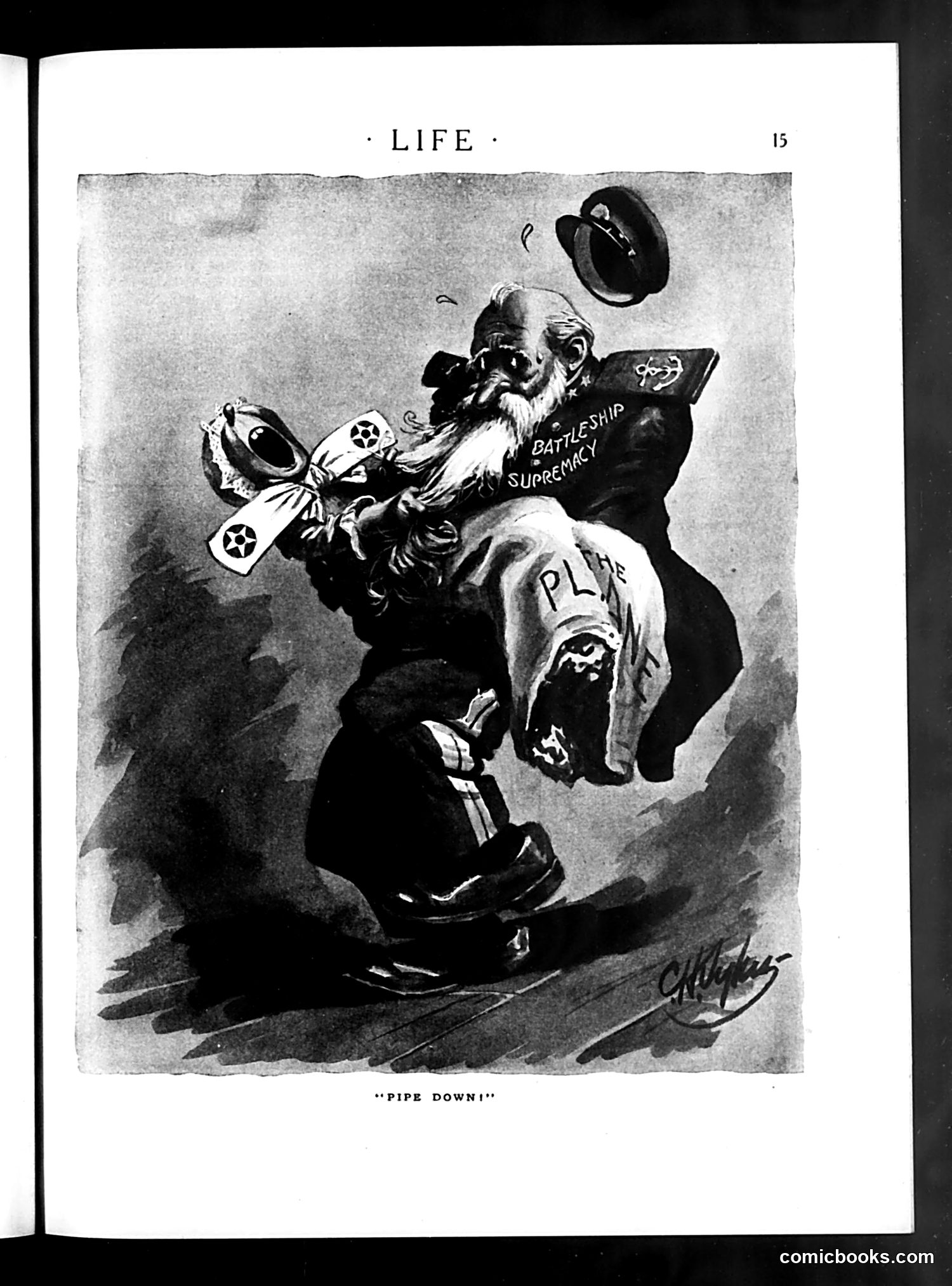
This Life magazine cartoon satirizes naval leadership during what appears to be an early 20th-century military debate. The central figure—an elderly bearded man in military dress with insignia reading "Battleship Supremacy"—is depicted juggling or fumbling various naval flags and hats, losing control of them as they scatter upward. The satire targets someone advocating for battleship dominance in naval strategy. The "pipe down" caption suggests he should stop loudly promoting this outdated view. The chaotic imagery of dropping symbols implies his position is unstable or losing credibility, possibly reflecting contemporary debates about naval modernization and whether battleships remained strategically relevant. The cartoon's style and subject matter suggest this addresses an early-1900s naval policy controversy, though the specific figure remains unclear from the image alone.
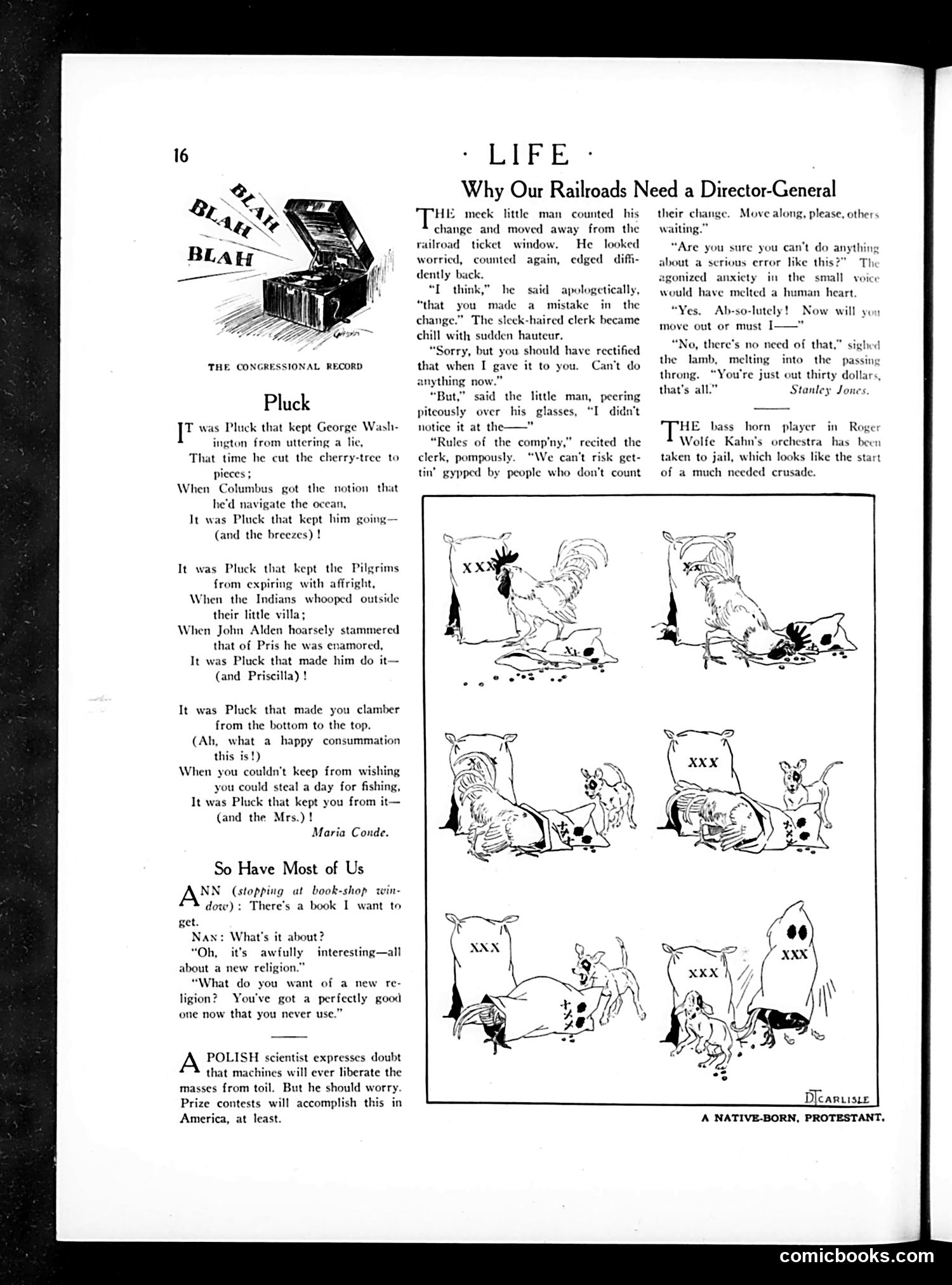
This page contains three satirical pieces critiquing American society: **"Pluck"** is a humorous poem celebrating the American virtue of determination, using historical figures (Washington, Columbus, the Pilgrims, John Alden) to show how "pluck" (perseverance) built the nation—though the final stanza jokes that pluck also keeps ordinary people from taking fishing days off. **"So Have Most of Us"** is a joke about religious hypocrisy: a woman wants a book about a new religion while admitting she never practices the religion she already has. **"Why Our Railroads Need a Director-General"** is the main cartoon critique. It depicts a railroad clerk callously refusing to correct a customer's thirty-dollar change shortage, hiding behind company rules and bureaucratic indifference. The accompanying cartoon shows various figures repeatedly making the same mistake with "XXX" (likely representing drunkenness). The satire argues that railroads need centralized leadership to fix such incompetence and poor customer service—a topical reference to debates about railroad regulation and monopoly practices.
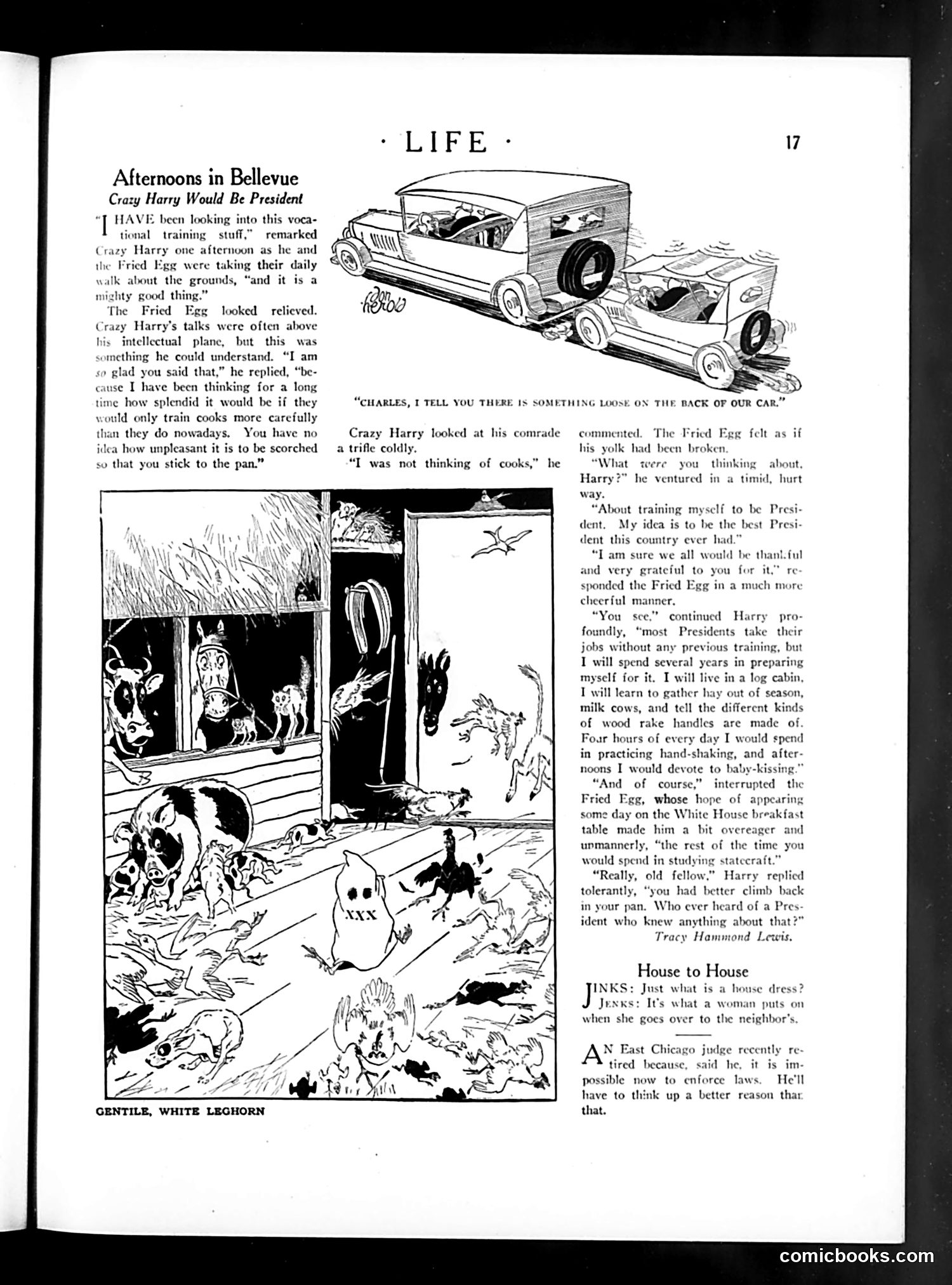
This page contains two separate satirical pieces from Life magazine: **"Afternoons in Bellevue: Crazy Harry Would Be President"** mocks political ambition and incompetence. "Crazy Harry" and "The Fried Egg" (anthropomorphic characters, apparently inmates at Bellevue psychiatric hospital) discuss presidential training. Harry's plan—living in a log cabin, learning to milk cows, practicing handshakes and baby-kissing—satirizes the shallow, performative nature of American political campaigns. The joke is that actual statecraft knowledge is unnecessary or even unwelcome for presidential success, critiquing both politicians' lack of substance and voters' acceptance of empty gestures over genuine qualification. **"House to House"** is a brief joke about women's fashion and social calls—a "house dress" being informal wear worn when visiting neighbors, implying women prioritize appearance even for casual socializing. The page also includes an illustration labeled "Gentile, White Leghorn" depicting chickens and farm animals.
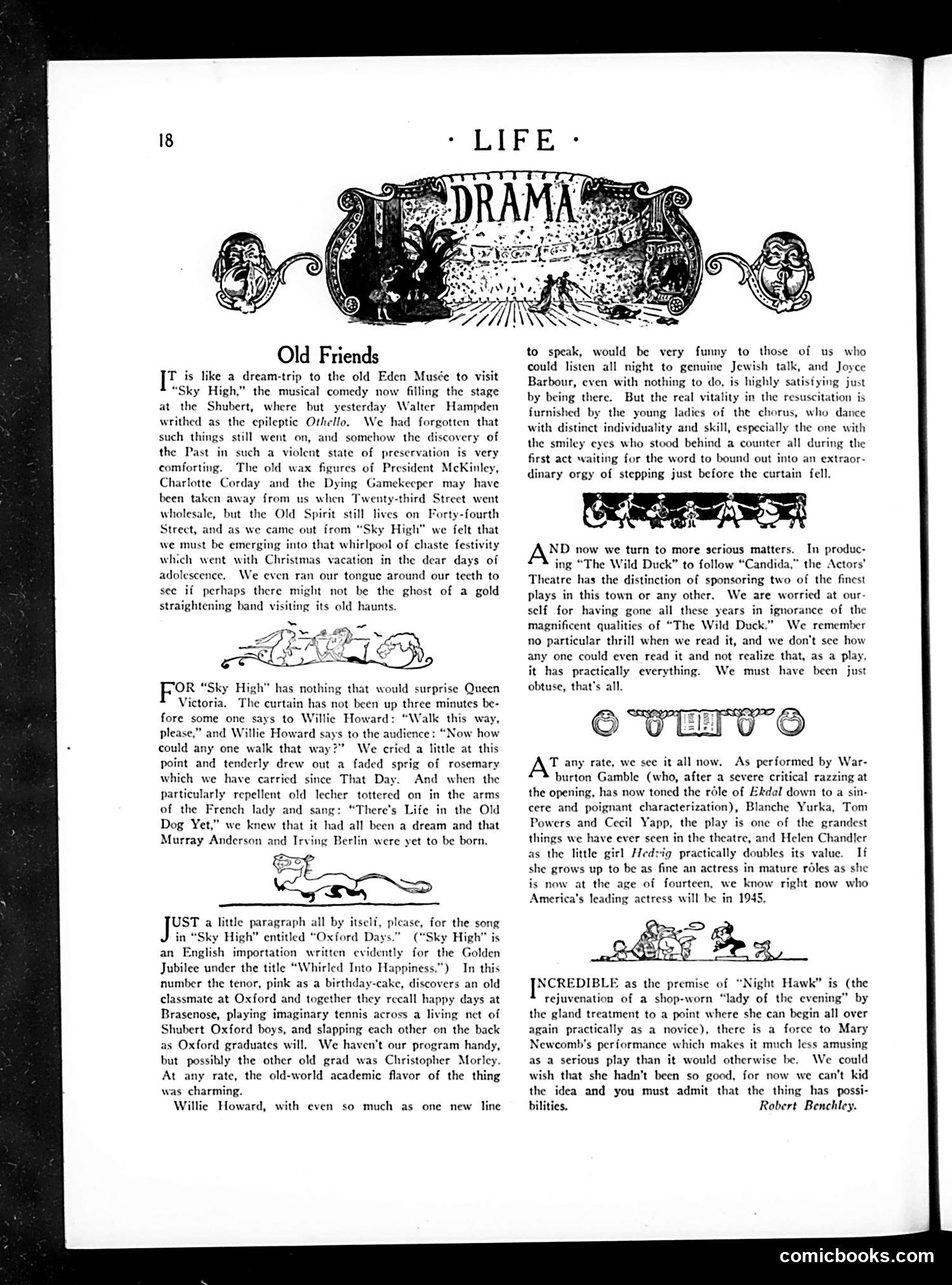
This theater criticism page reviews three Broadway productions. The writer nostalgically compares "Sky High" (a musical comedy at the Shubert) to the old Eden Musée wax museum, suggesting the show feels antiquated—like discovering President McKinley's wax figure still on display. The humor targets the production's old-fashioned sensibility and Willie Howard's comedic timing in "Jewish talk." The piece praises young chorus dancers for their energy and individuality. It then shifts to "The Wild Duck," an Ibsen play the Actors' Theatre is producing after "Candida," calling it one of the finest plays in town. The writer admits personal blindness to the play's merits upon previous reading, praising the current cast—particularly Warburton Gamble's nuanced performance as Ekdal and Blanche Yurka's acting. The tone is sophisticated yet self-deprecating, typical of early 20th-century theater criticism.
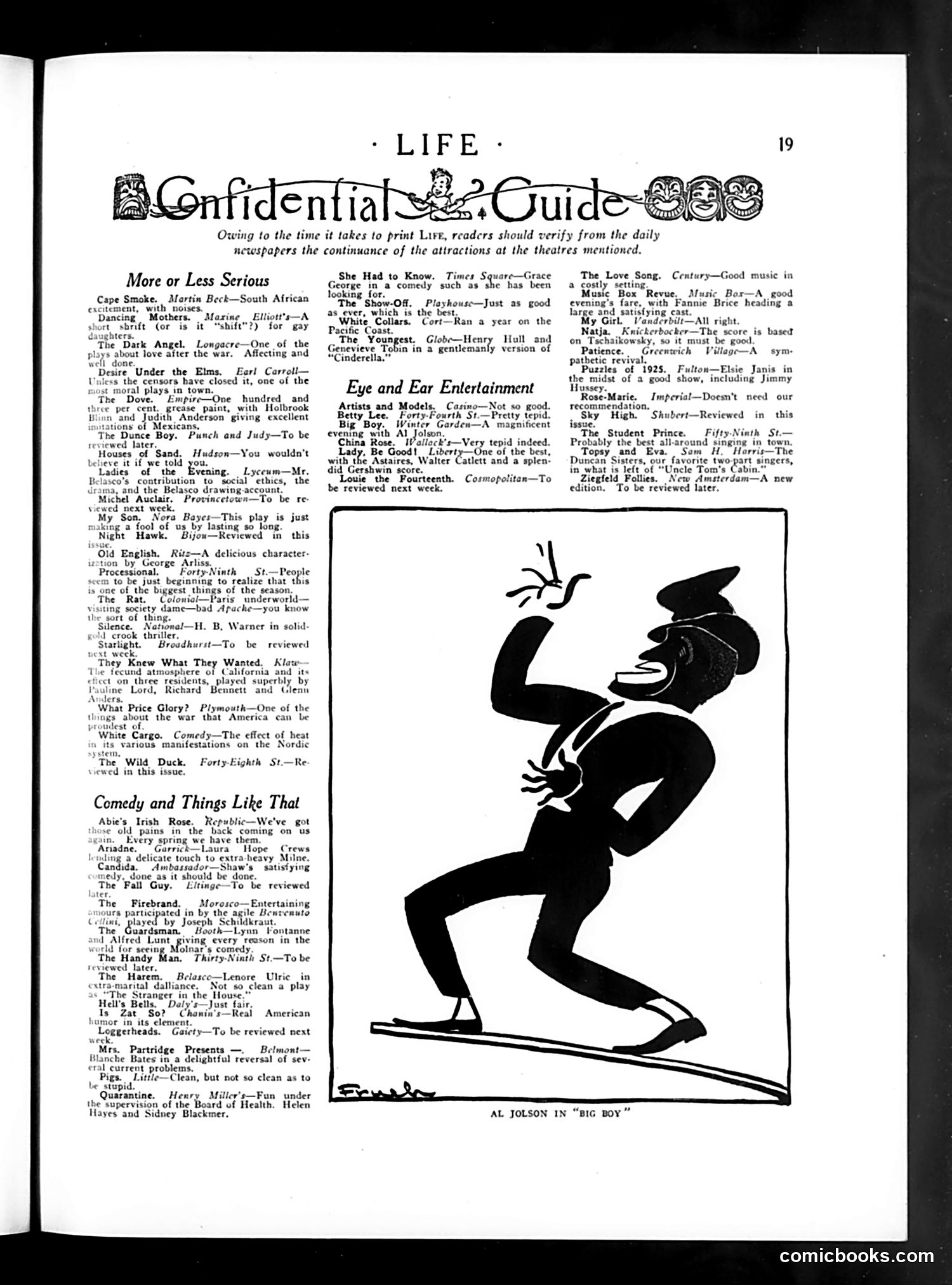
This page presents a **theater guide** with brief, witty reviews of Broadway shows circa the 1920s. The text is notably cynical—reviewers dismiss productions as "tepid," morally questionable, or absurdly long-running ("just making a fool of us by lasting so long"). The **cartoon** by Cesare Sivieri depicts **Al Jolson** in "Big Boy" at the Winter Garden Theatre. The silhouette shows a performer in blackface makeup (standard for Jolson's act), striking an exaggerated theatrical pose—one hand raised dramatically, legs splayed in vaudeville showmanship. The caption identifies this as entertainment, though modern readers would recognize blackface as a deeply racist performance practice that was mainstream in 1920s popular entertainment but is now condemned. The juxtaposition captures the era's theatrical culture: Jolson was a major star, and the guide reviews him neutrally as "magnificent," reflecting period attitudes that accepted such performances uncritically.
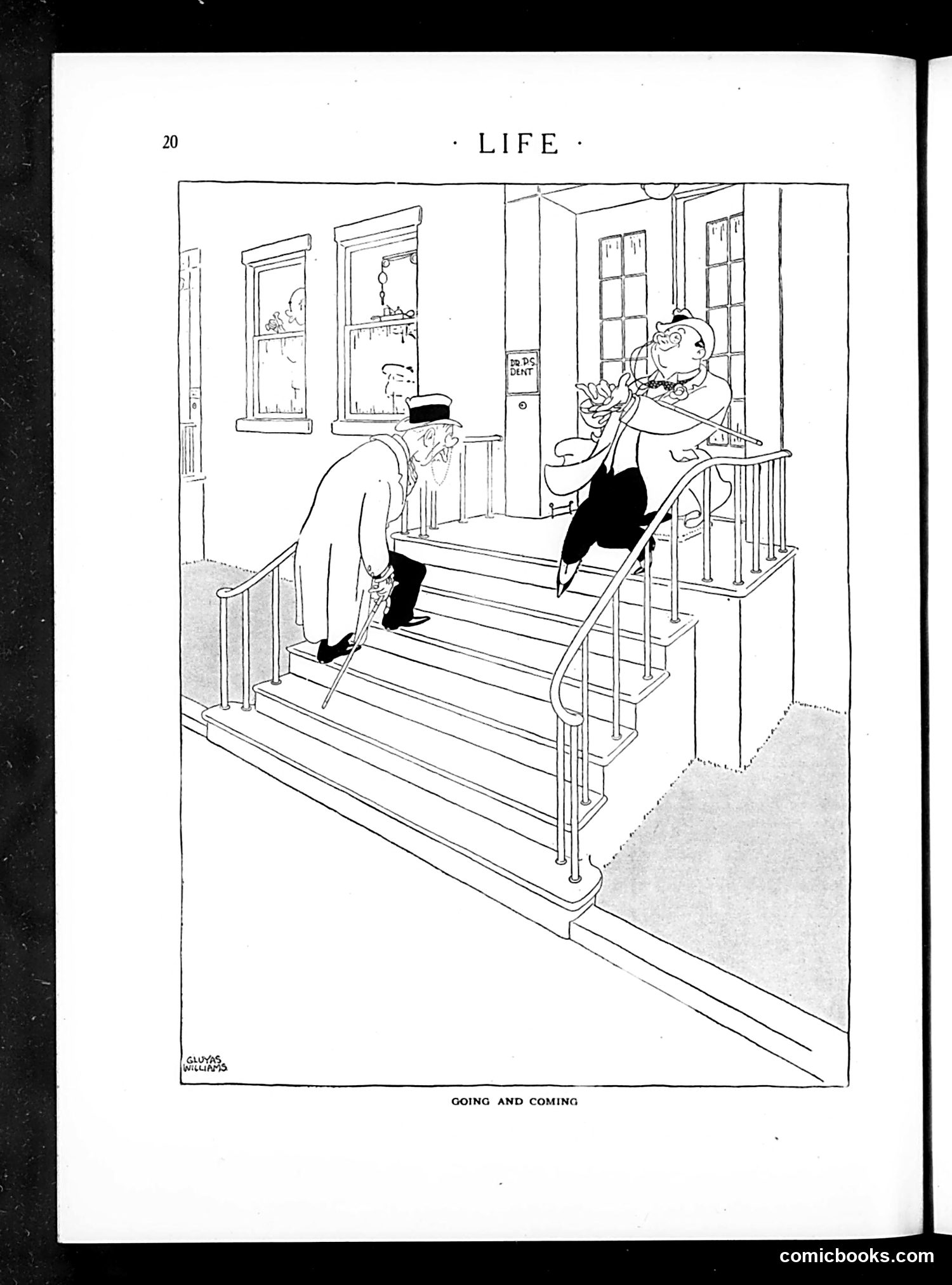
This cartoon by Gluyas Williams depicts two men on the steps of what appears to be a dentist's office (a sign reading "DENT" is visible on the door). The humor relies on a visual contrast: one man is entering the office with a composed, upright posture, while the other is leaving in a dramatically hunched, pained posture—teeth apparently clenched, leaning heavily on the railing. The joke is straightforward satire about dental visits: the contrast between a patient's demeanor before and after dental work. This reflects common anxieties about dentistry that were likely universal in this era. The cartoon title "Going and Coming" emphasizes this before-and-after transformation, playing on the physical toll of dental procedures as experienced by ordinary people.
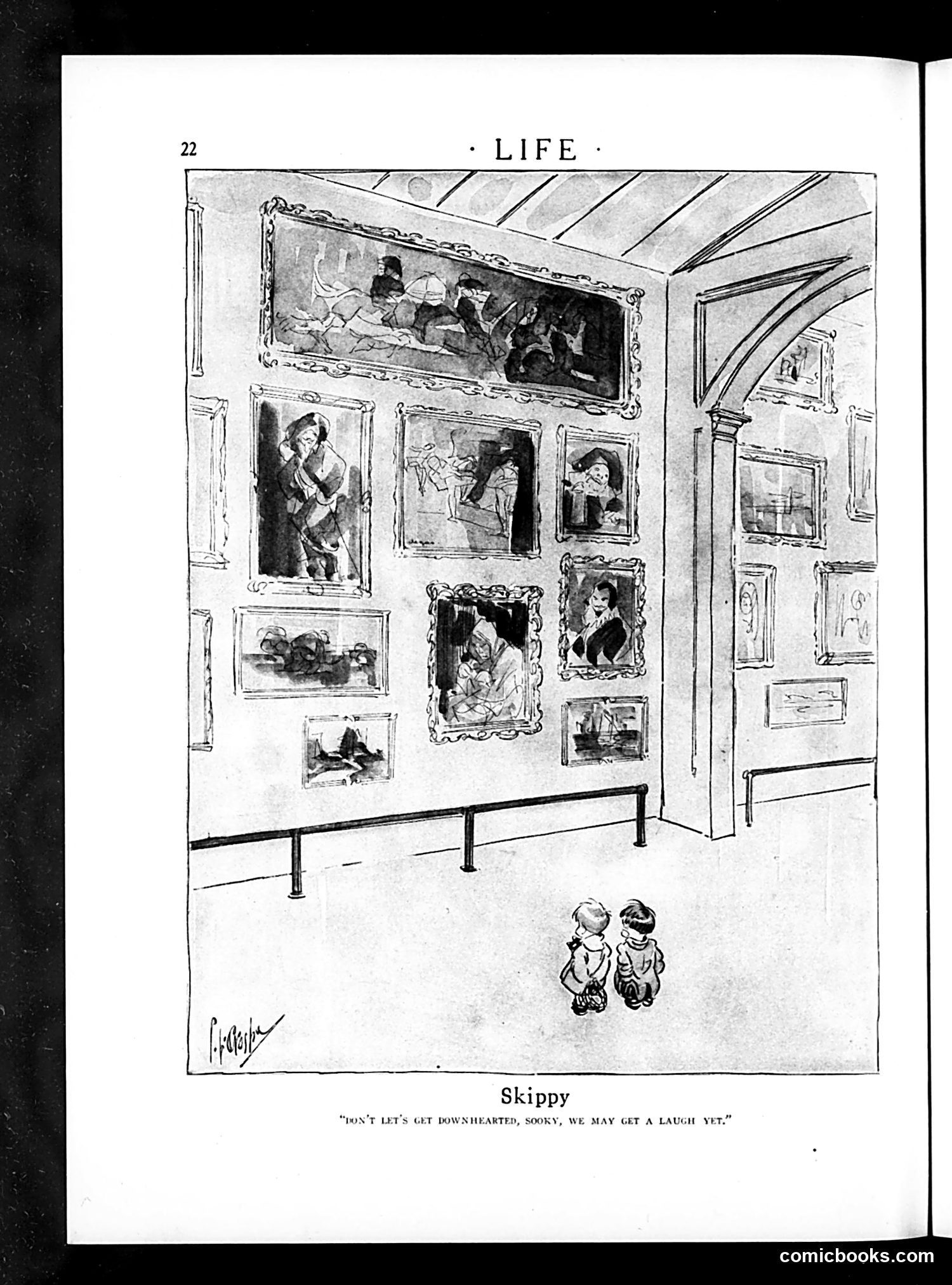
This is a comic strip titled "Skippy" showing two small children standing in an art gallery viewing various framed paintings and artworks on the walls. The caption reads: "Don't let's get downhearted, Sooky, we may get a laugh yet." The humor is straightforward: the children are viewing what appears to be serious, highbrow fine art—portraits, landscapes, and classical paintings—but they're hoping to find something funny among the "serious" artwork. This satirizes the contrast between children's simple sense of humor and adult cultural pretension around fine art. The joke mocks the stuffiness of art appreciation while gently poking fun at how children see the world differently than adults do. "Skippy" was a popular comic strip of the early-to-mid twentieth century.
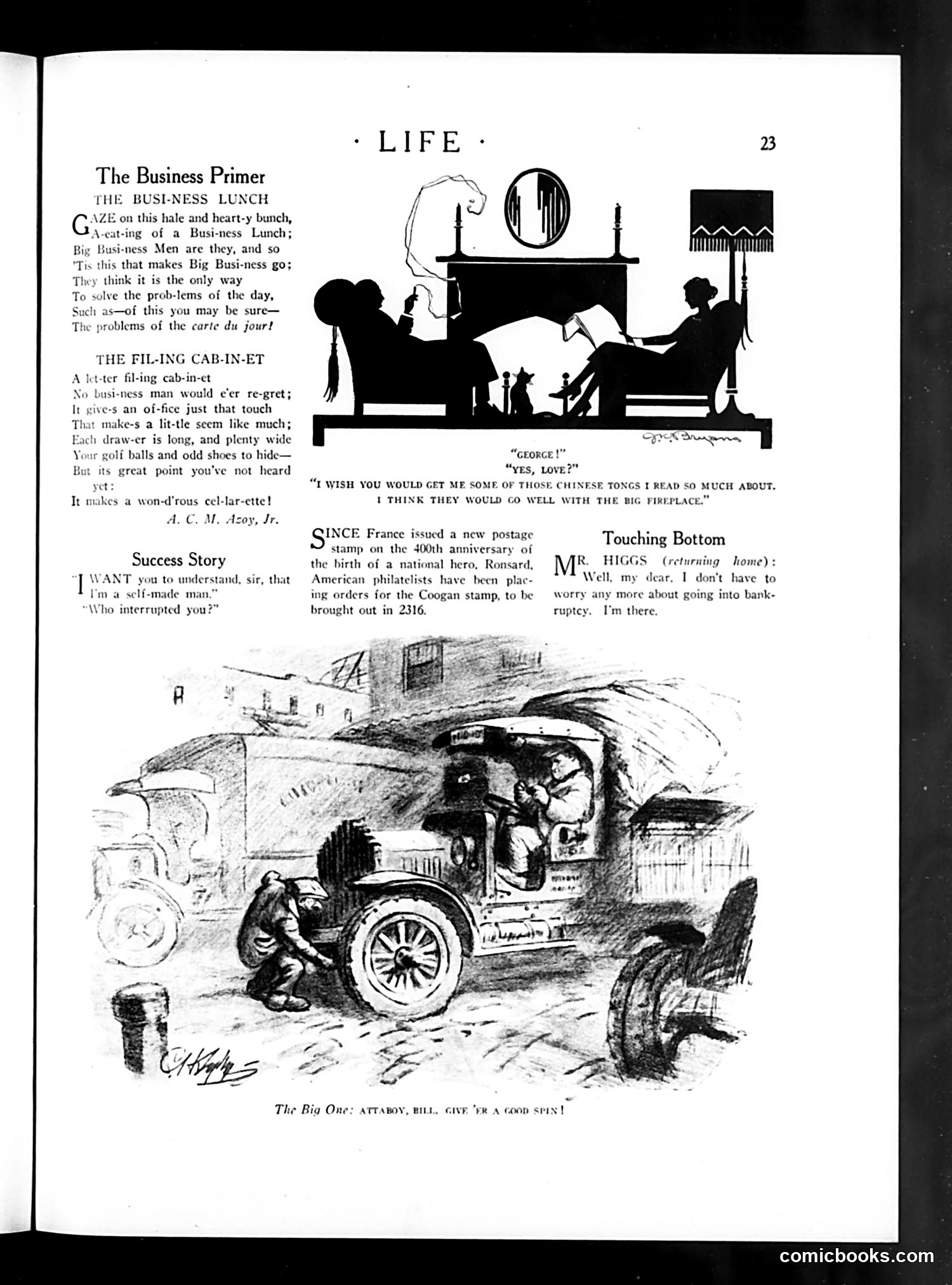
This page mocks early 20th-century American business culture through several comic pieces: **"The Business Primer"** parodies corporate life—executives believe expensive business lunches solve all problems, and filing cabinets secretly function as liquor cabinets (Prohibition-era joke). **"The Big One"** cartoon shows a wealthy couple where the wife asks her husband for "Chinese tongs" for decoration, completely oblivious to their cost or purpose. The satire targets nouveau riche materialism and conspicuous consumption among the wealthy. **"Success Story"** mocks self-made millionaires with a quick joke about interruptions. **"Touching Bottom"** features a man declaring bankruptcy cheerfully because he's "there"—already at rock bottom, so financial ruin no longer threatens him. The Coogan stamp reference appears to be a satirical aside about celebrity culture (likely Jackie Coogan, the child actor). Overall, the page satirizes 1920s business excess, wealth obsession, and economic anxiety through humor.
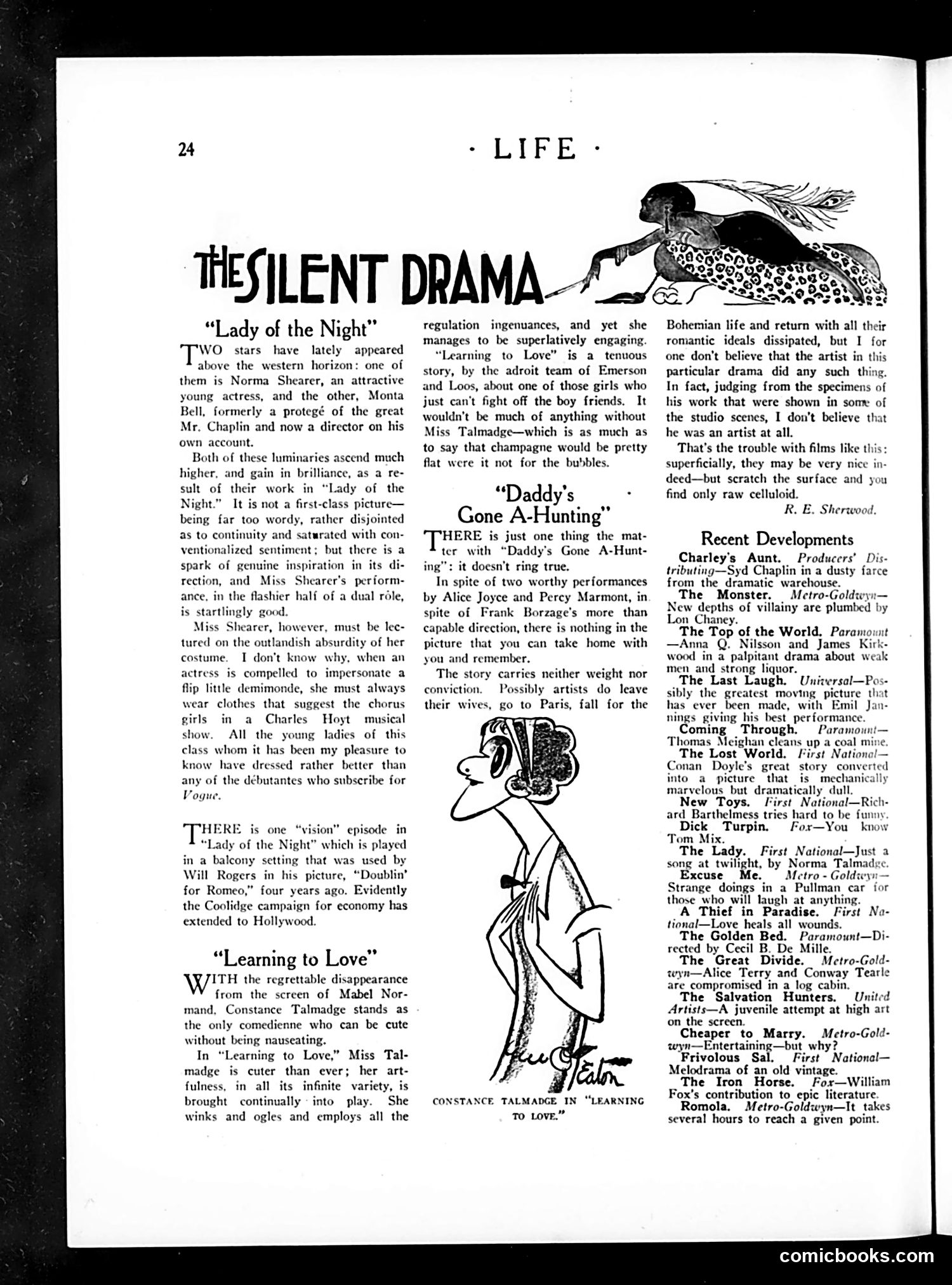
This page reviews several silent films from the mid-1920s. The main criticism concerns **Norma Shearer** in "Lady of the Night": the reviewer praises her acting but mocks her costume as absurdly immodest for playing a demimonde (courtesan), noting that actual women in that profession dressed better than the theatrical exaggeration suggests. The cartoon depicts **Constance Talmadge** in "Learning to Love"—a comedienne the reviewer considers uniquely "cute without being nauseating," capable of charming audiences through exaggerated expressions and gestures. A secondary review criticizes "Daddy's Gone A-Hunting" as superficially pleasant but hollow—"scratch the surface and you find only raw celluloid"—a pointed metaphor for films lacking substance. The "Recent Developments" section lists new releases, including praise for "The Last Laugh" (Emil Jannings) as "possibly the greatest moving picture that has ever been made." The reference to the "Coolidge campaign for economy" jokes that Hollywood was reusing old set pieces from years prior.
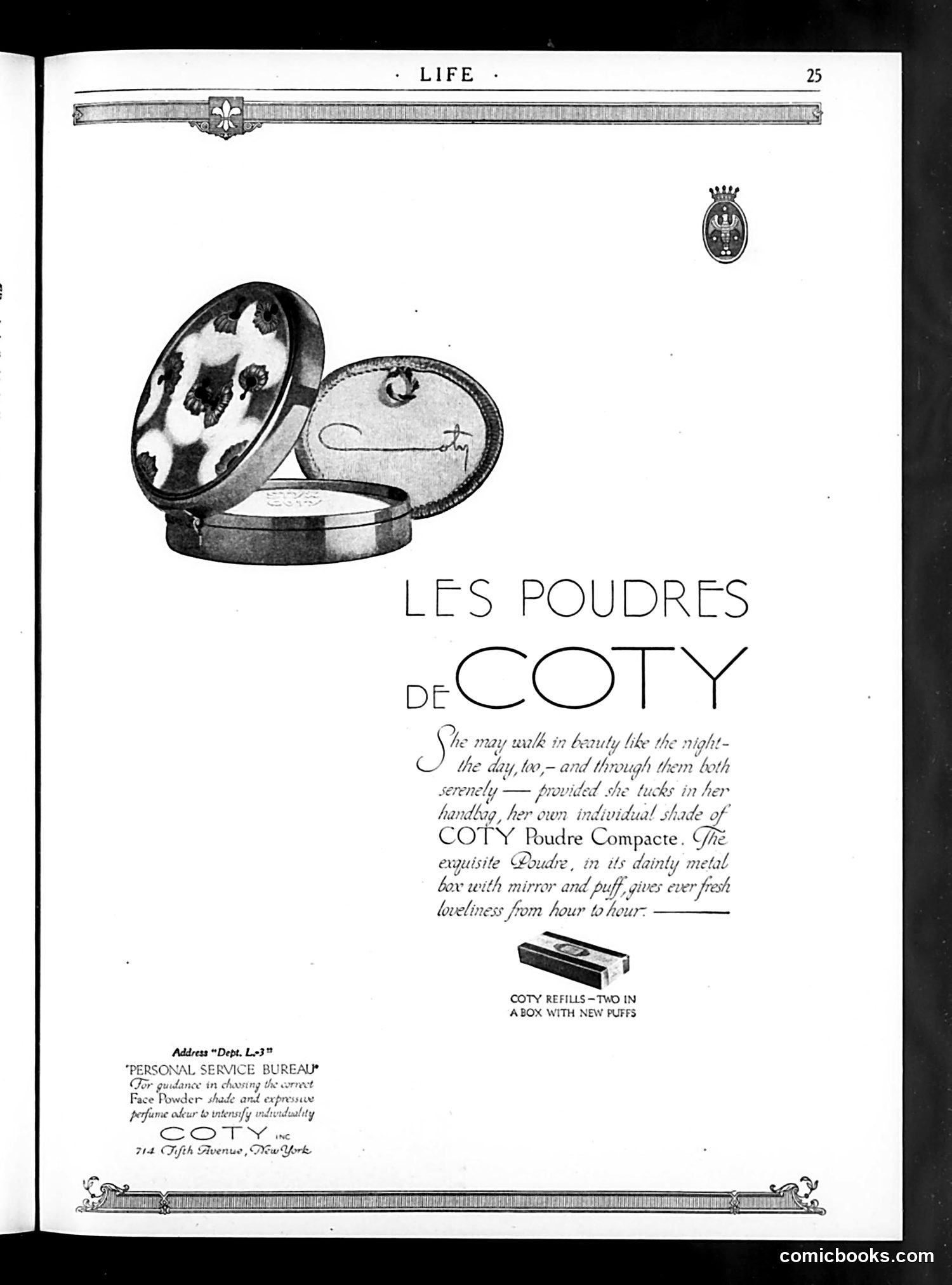
This is not a political cartoon but a **full-page advertisement** for Coty face powder, a cosmetics brand. The page features an elegantly illustrated compact powder case with mirror and puff, shown open from multiple angles. The ad uses romantic, aspirational language targeting women consumers, promising that Coty powder allows a woman to maintain beauty "from hour to hour" throughout day and night. The French title "Les Poudres de Coty" (The Powders of Coty) appeals to sophistication and luxury. The "Personal Service Bureau" contact information at bottom offered guidance on shade selection, a early form of customer service marketing. This reflects **1920s consumer advertising culture**, when beauty products were heavily marketed to women as essential for social success and attractiveness. The compact's portability—fitting in a handbag—emphasizes modern, mobile femininity of the era.
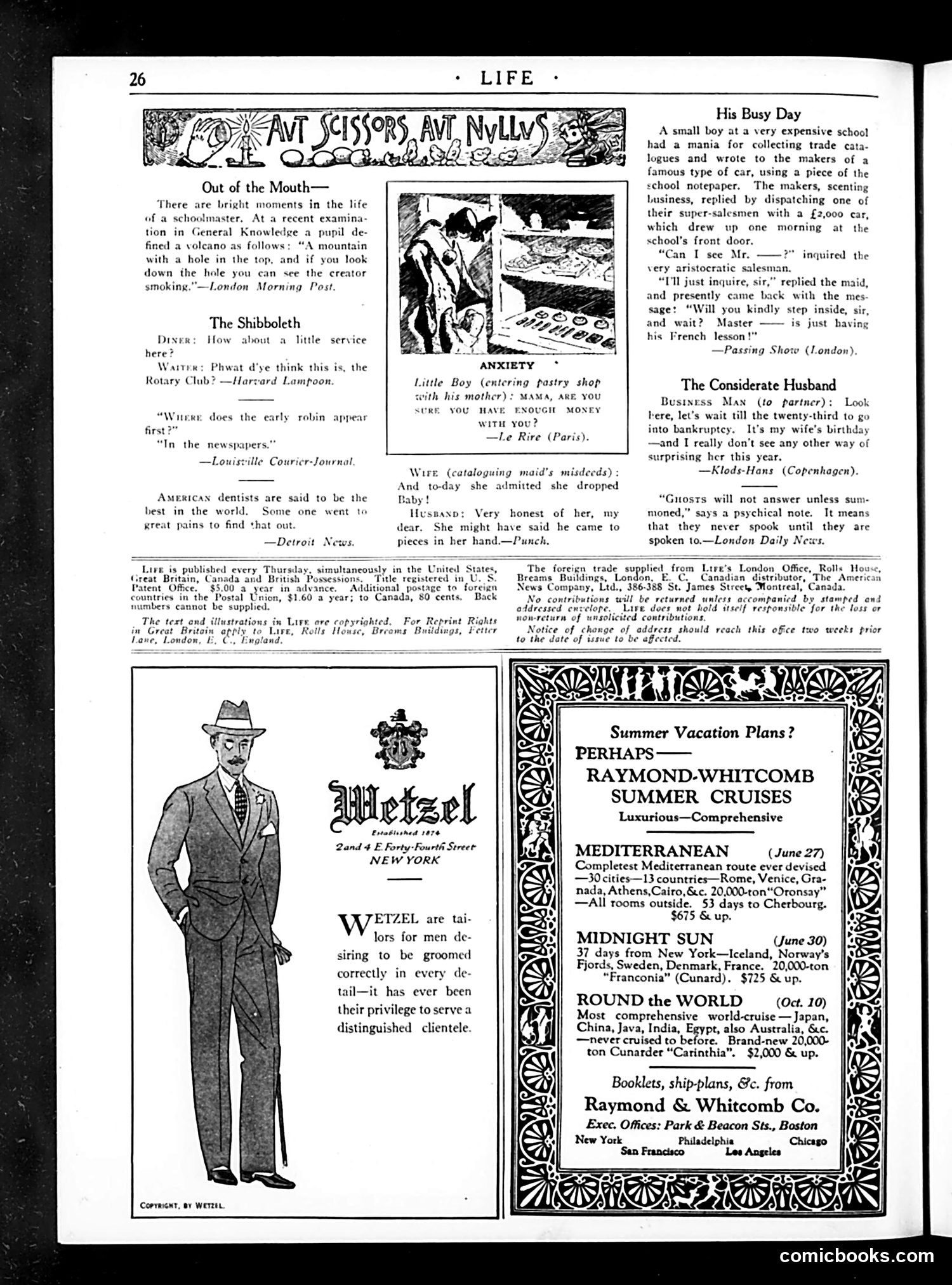
This page contains several short humorous anecdotes typical of Life's satirical format, plus advertisements. **Key Content:** The cartoons and jokes mock social pretension and human foibles. "The Shibboleth" ridicules affected speech patterns. "Anxiety" depicts a boy asking his mother for money at a pastry shop—satirizing parental indulgence. "His Busy Day" humorously shows how a schoolboy's casual letter to a car manufacturer results in an expensive sales visit, only to be interrupted by French lessons. "The Considerate Husband" darkly jokes that a man delays bankruptcy filing until after his wife's birthday, presenting financial ruin as a "gift." These jokes rely on class-based humor (servants, wealthy families, businessmen) and domestic situations common to early 20th-century middle-class readership. **Advertisements:** The page features Wetzel tailors and Raymond-Whitcomb luxury cruise lines—targeting affluent readers. The overall tone reflects Life's role as satirical commentary on contemporary manners and society.
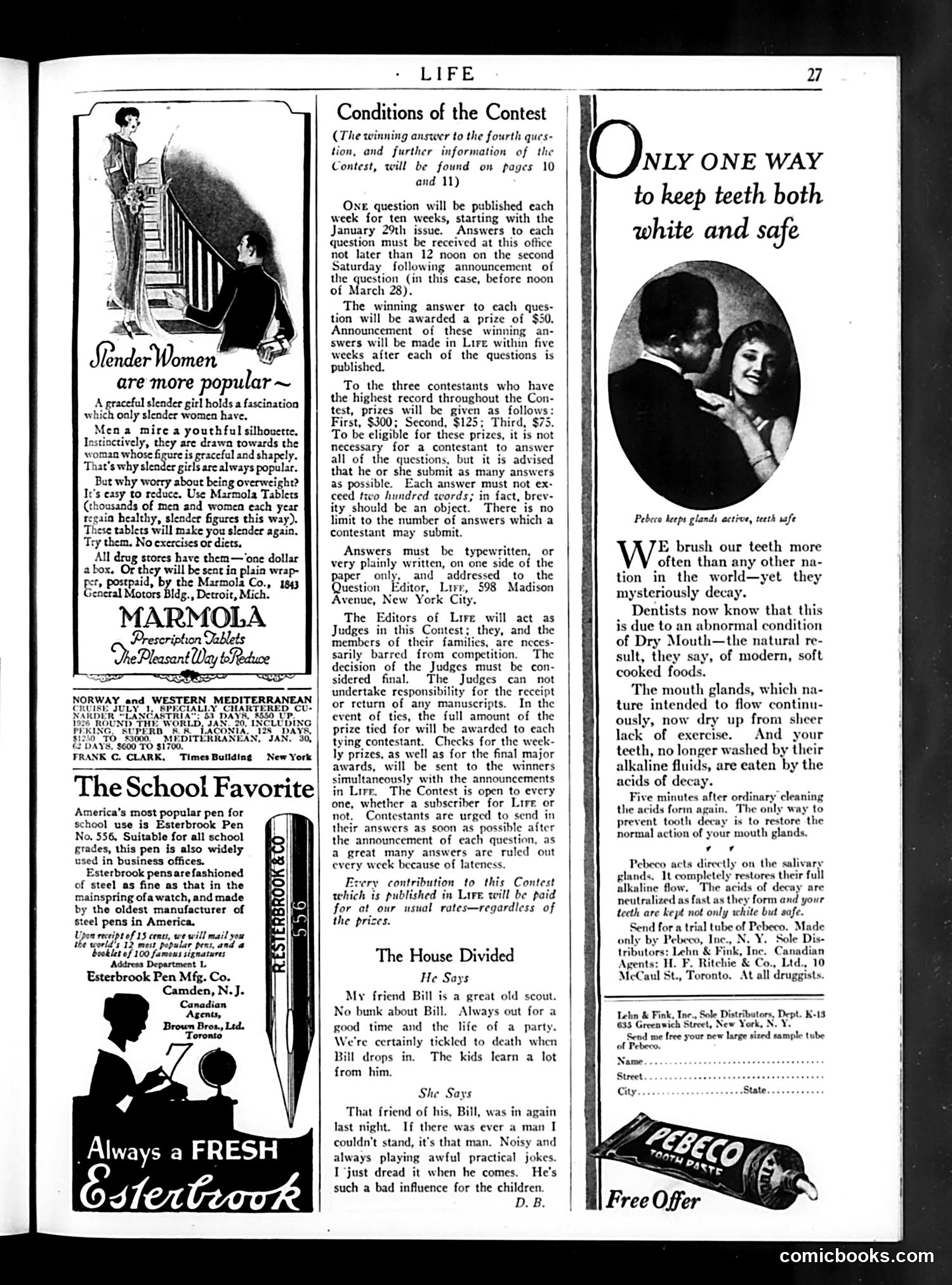
This page is primarily **advertising and contest information**, not political satire. The notable content includes: **"Slender Women are more popular"** — A Marmola diet tablet advertisement reflecting 1920s beauty standards emphasizing thin, "graceful" female silhouettes. The text explicitly states men are "drawn towards the woman whose figure is graceful and shapely," revealing period attitudes about women's bodies and their social value. **The House Divided** — A brief humor piece contrasting two perspectives on a scout named Bill: "He Says" praises Bill as a great scout, while "She Says" criticizes him as noisy and a bad influence on children. This appears to be gentle domestic satire about differing viewpoints within marriage. **Contest Rules** — Life announces a ten-week reader contest with weekly $50 prizes and grand prizes up to $300, requiring typewritten answers of no more than 200 words. The page also advertises **Esterbrook Pens** and **Pebeco toothpaste**, featuring typical product endorsements of the era.
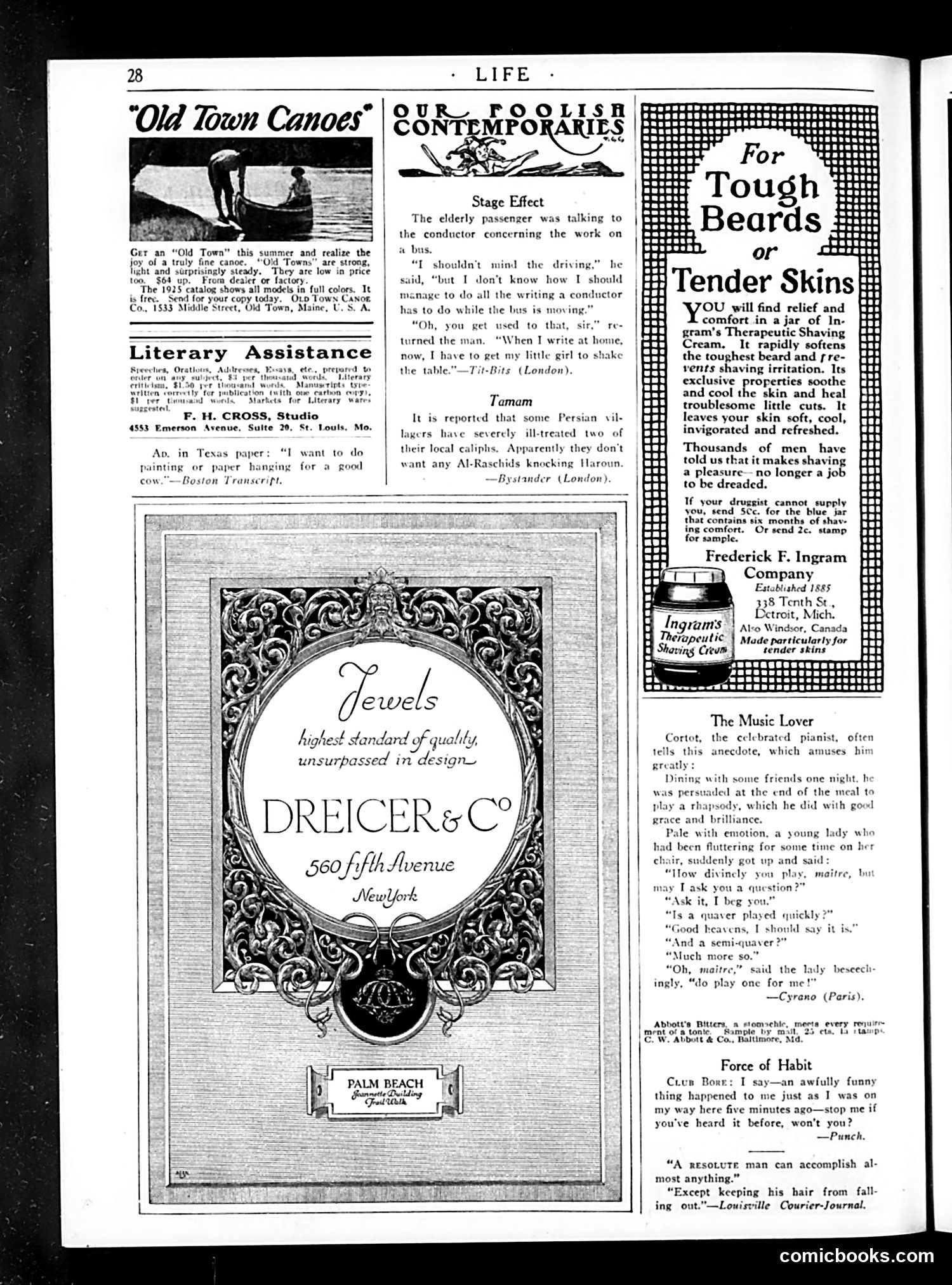
This page is primarily **advertising and filler content**, not political satire. The main elements are: **Advertisements:** - Old Town Canoes (top left) - Dreicer & Co. jewelers (center, ornate full-page ad) - Ingram's Therapeutic Shaving Cream (right side) **Humor Columns:** The text sections labeled "Literary Assistance," "Stage Effect," "Tamam," "The Music Lover," and "Force of Habit" are brief, non-political jokes and anecdotes—typical Life magazine filler. They're conversational humor: a conductor writing while driving a bus, Persian villagers mistreating caliphs, a pianist's admirer, someone repeating an anecdote. **No political cartoons appear** on this page. The humor is purely social/domestic rather than satirical. This reflects Life's mixed-content format: advertisements subsidized the magazine while short humorous pieces filled space between ads and actual editorial content.
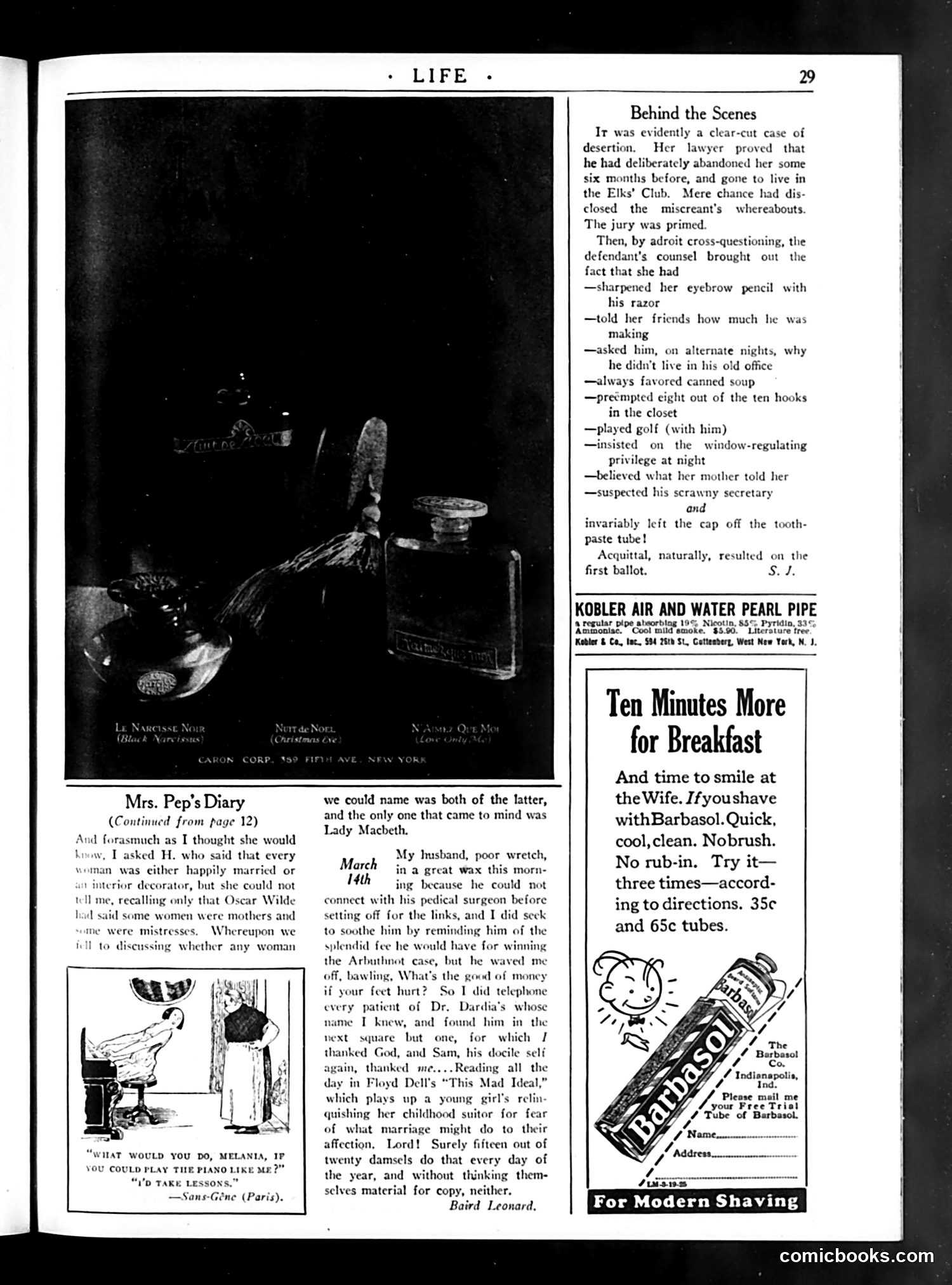
This page contains satirical humor typical of 1920s Life magazine, mixing editorial cartoons with advertisements. **"Mrs. Pep's Diary"** is a gossipy society column mocking upper-class domestic life. The small cartoon illustrates a Paris bon mot: a woman asks her friend "Melania" what she'd do if she could play piano as well as the speaker; Melania replies she'd "take lessons"—a joke about female vanity and one-upmanship among society women. **"Behind the Scenes"** is a courtroom satire about a marital desertion case. The humor lies in the twist: the wife's seemingly innocent habits (leaving toothpaste caps off, monopolizing closet space, favoring canned soup, etc.) are revealed through cross-examination as grounds for the husband's departure. The jury acquits him anyway. The joke mocks both the triviality of marital complaints and the legal system's absurdity in handling divorce cases. The remainder consists of period advertisements for smoking pipes and shaving cream—typical commercial content for the magazine.
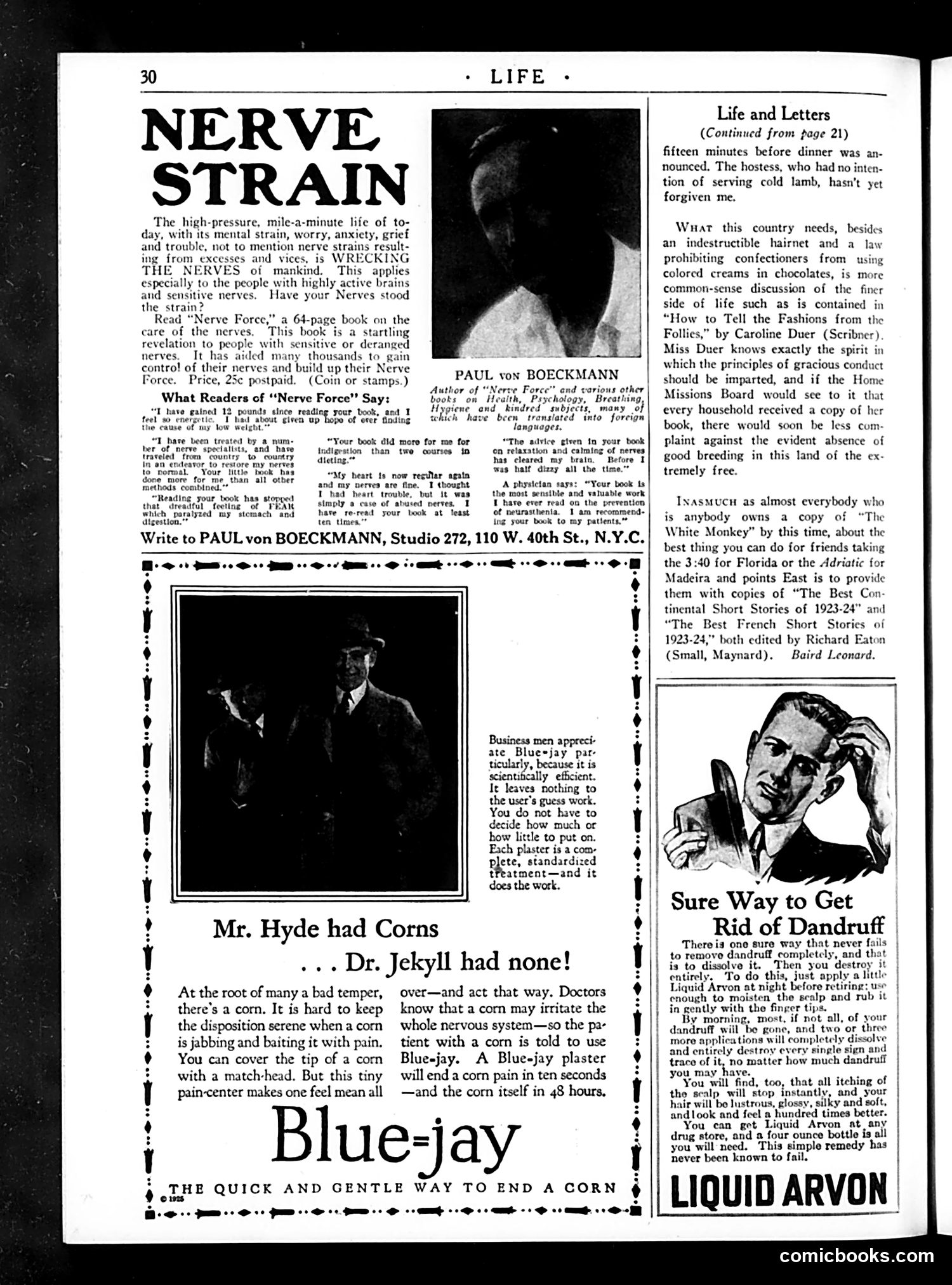
This page combines advertisements with light social satire typical of Life magazine's format. **Main Content:** The page features three advertisements: "Nerve Strain" (promoting a self-help book by Paul von Boeckmann addressing modern anxiety), and "Blue-jay" (a corn plaster). **The Blue-jay Advertisement's Satire:** The Blue-jay ad uses a clever Jekyll-and-Hyde reference. "Mr. Hyde had Corns...Dr. Jekyll had none!" alludes to Robert Louis Stevenson's *The Strange Case of Dr. Jekyll and Mr. Hyde* (1886)—the dual-personality story where emotional turmoil manifests as physical transformation. The joke: a painful corn causes irritability and bad temper, turning someone into their "Mr. Hyde." Remove the corn with Blue-jay, and you restore your genteel "Dr. Jekyll" self. The ad claims the plaster eliminates corn pain in ten seconds and the corn itself in 48 hours, appealing to businessmen's need for efficient, standardized solutions. **Context:** This reflects early 20th-century advertising psychology: linking physical ailments to personality and social acceptability—a common sales tactic of the era.
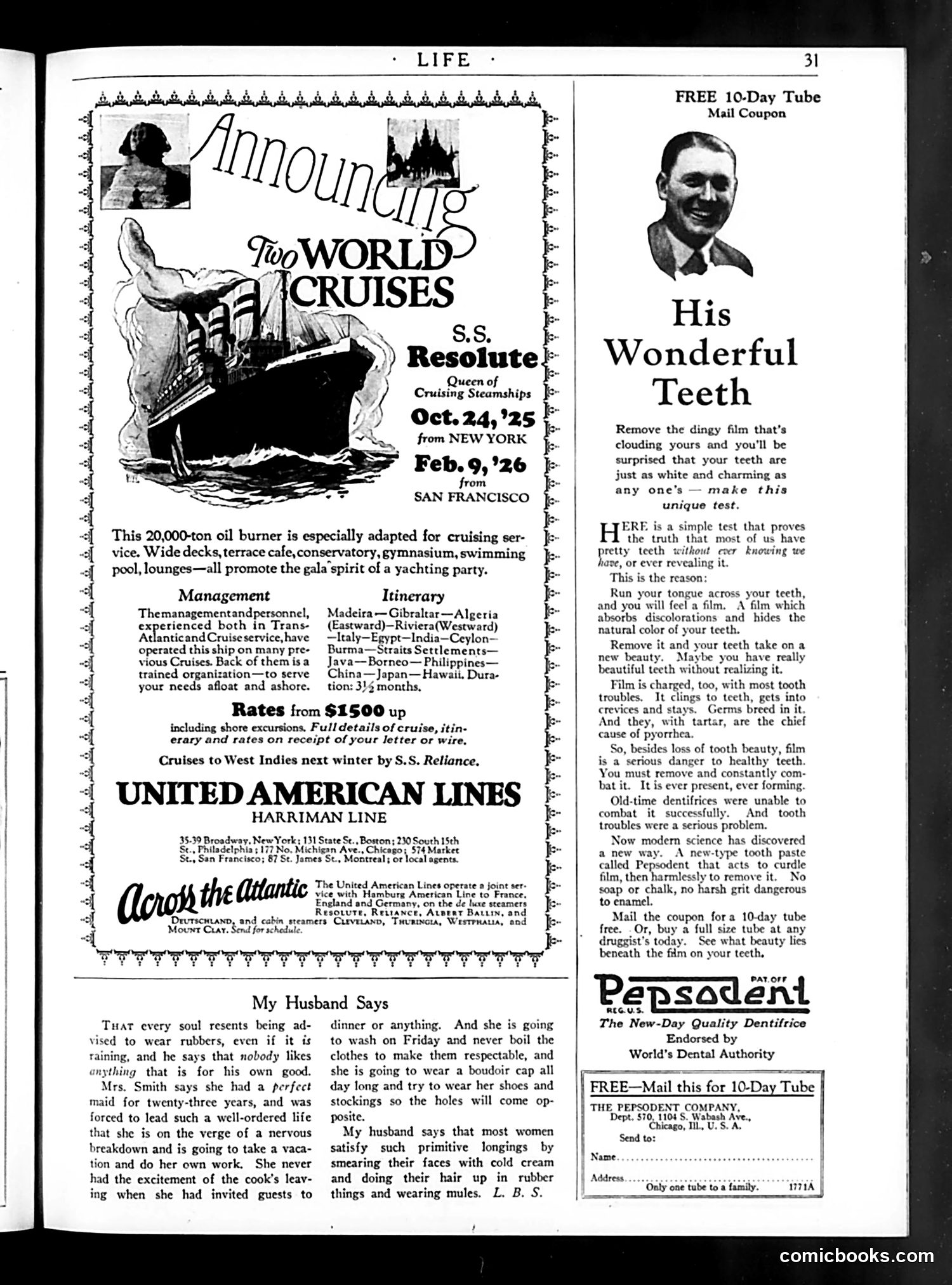
This page contains primarily **advertisements** rather than political satire. The main content includes: **Cruise Advertisement**: A large ad for the S.S. *Resolute*, promoting "Two World Cruises" departing October 1925 and February 1926 from New York and San Francisco respectively. It emphasizes luxury amenities for wealthy travelers. **Pepsodent Toothpaste Advertisement**: A prominent ad claiming the product removes "dingy film" from teeth, presenting tooth film as a serious health hazard caused by germs and tartar. This represents early 20th-century consumer marketing using pseudo-scientific claims about dental hygiene. **"My Husband Says" Column**: A humorous piece mocking social conventions—specifically how people resent unsolicited advice about practical matters (wearing rubbers in rain) and describing a woman whose overly-orderly life with a perfect maid has left her desperate for domestic chaos. The page reflects 1920s consumer culture and genteel humor targeting middle-to-upper-class readers.
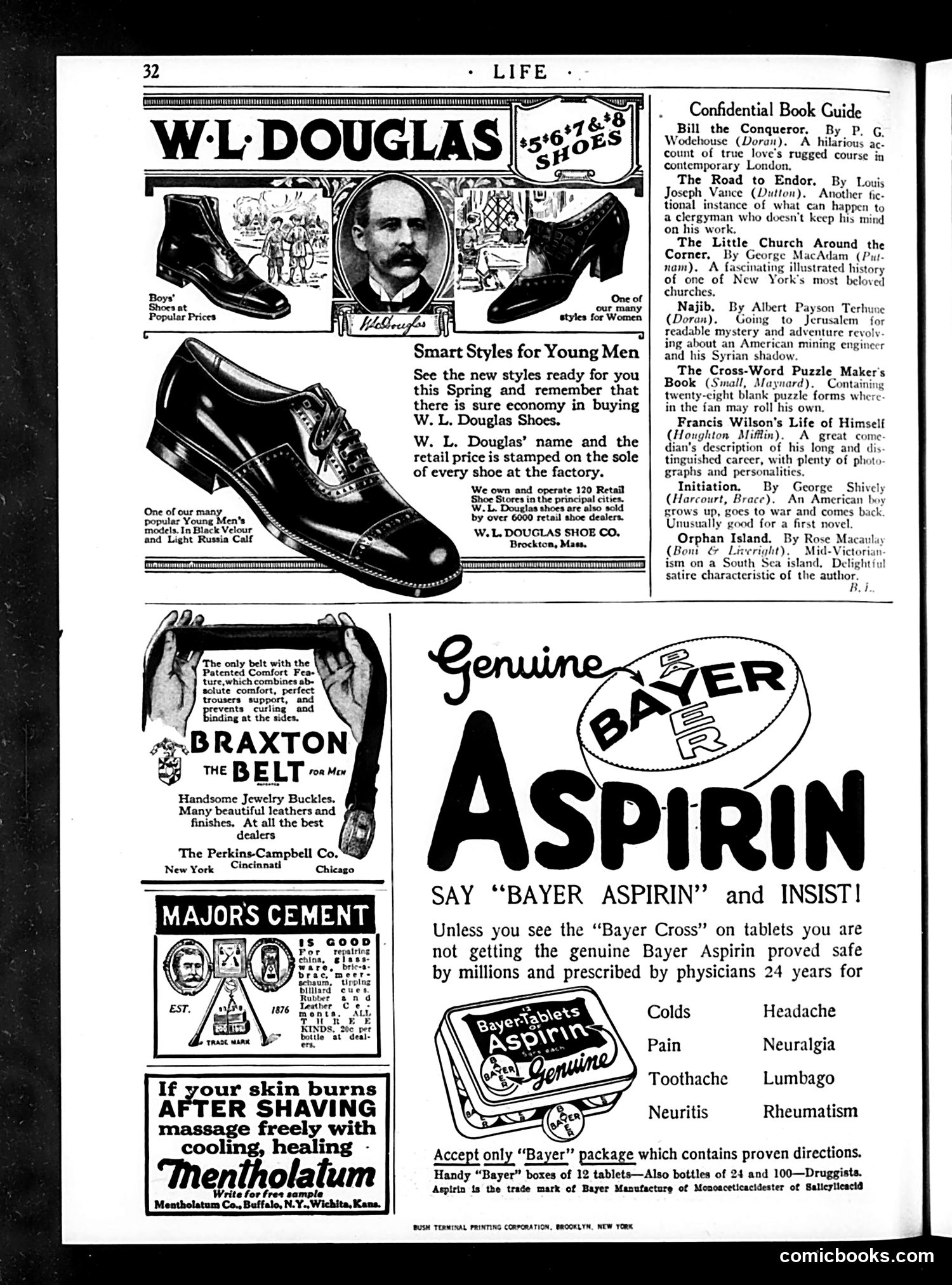
This page is primarily **advertising and book recommendations**, not political satire. The top features a **W.L. Douglas Shoes advertisement** highlighting spring styles for young men, emphasizing economy and the brand's direct retail presence. The right column contains a "Confidential Book Guide"—brief reviews of contemporary literature including works by P.G. Wodehouse and Louis Joseph Vance, typical of the era's middlebrow reading recommendations. Lower advertisements promote the **Braxton Belt** (with jewelry buckles), **Major's Cement**, and notably, **Bayer Aspirin**—which explicitly warns consumers to verify the "Bayer Cross" trademark, reflecting early 20th-century pharmaceutical marketing emphasizing brand authenticity and medical credibility. A **Mentholatum shaving balm ad** completes the page. The page reflects 1920s consumer culture: brand loyalty, mail-order availability, and growing pharmaceutical self-medication.
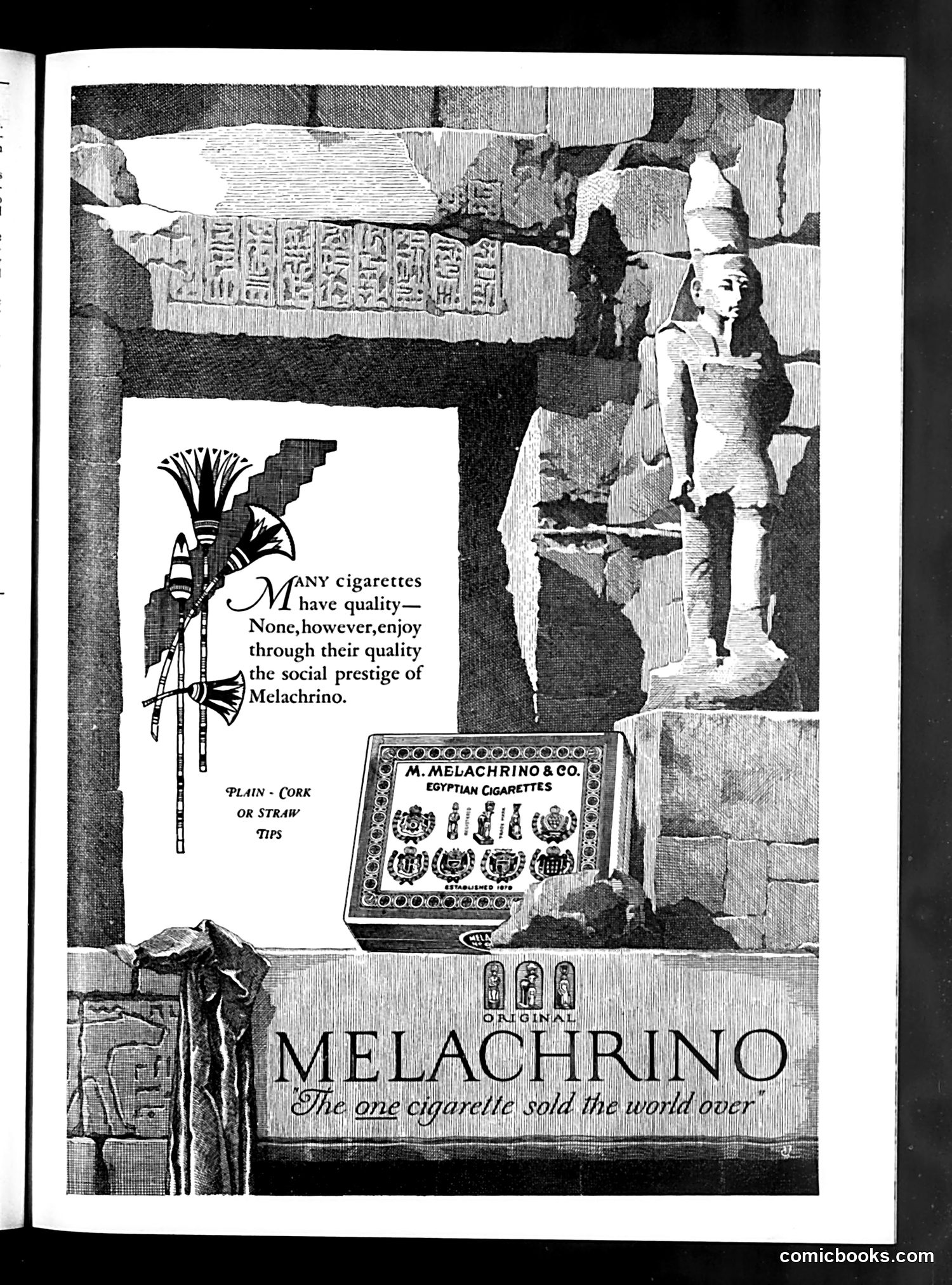
This is a **cigarette advertisement**, not political satire. It features an Egyptian-themed aesthetic with hieroglyphics and an Egyptian statue, positioning Melachrino cigarettes as a luxury product with "social prestige." The ad's central claim—that many cigarettes have quality, but only Melachrino enjoys social prestige—relies on aspirational marketing common in early 20th-century advertising. The Egyptian imagery suggests exoticism and sophistication, appeals to wealthy consumers. The text mentions "Plain, Cork or Straw Tips," indicating different cigarette styles available. M. Melachrino & Co. is identified as an Egyptian cigarette maker. The tagline "The one cigarette sold the world over" emphasizes global reach as a marker of superiority. This reflects an era when tobacco companies freely advertised luxury and status without health warnings.
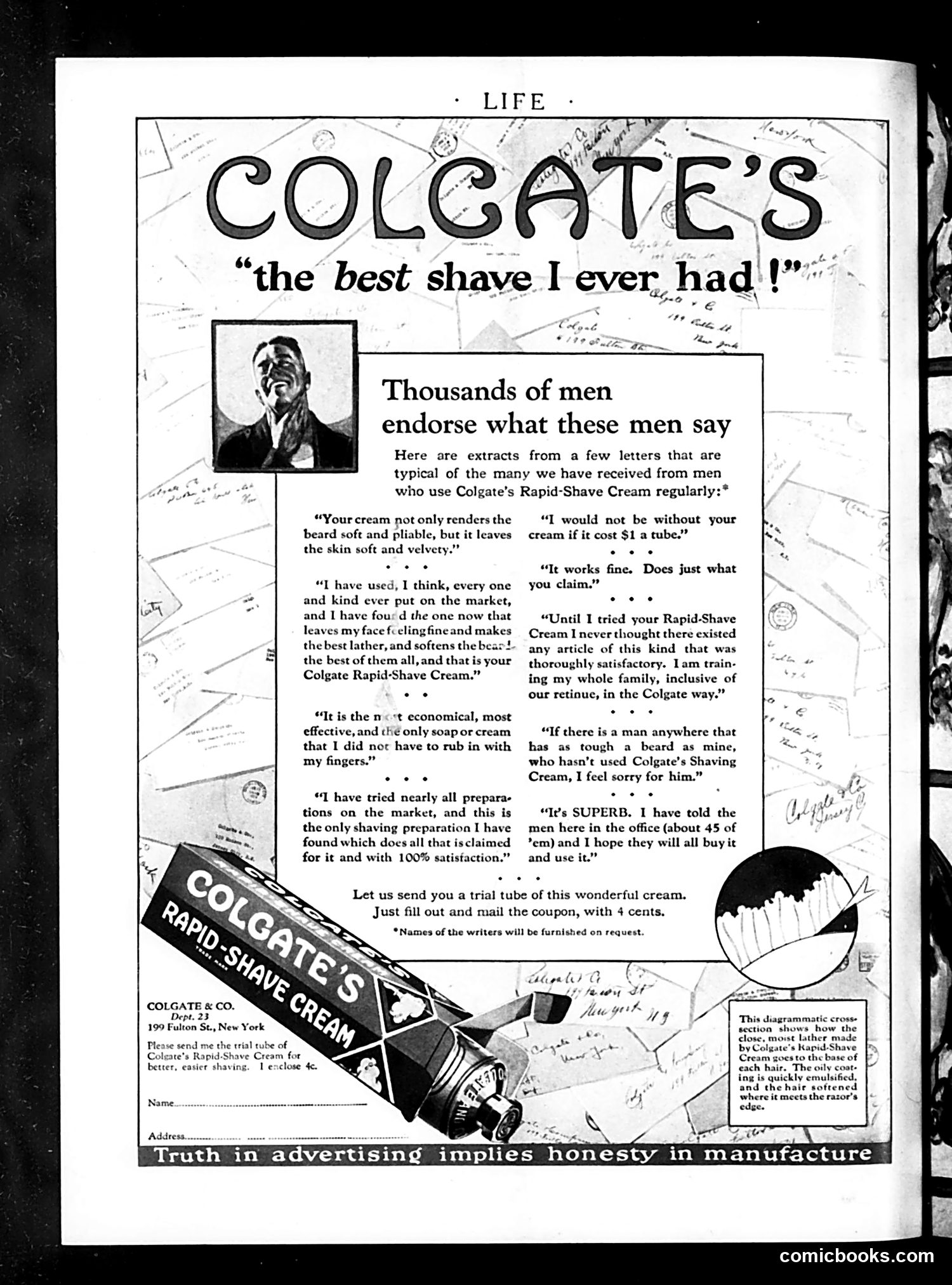
This is a straightforward product advertisement, not satire or political content. It promotes Colgate's Rapid-Shave Cream by presenting testimonial letters from satisfied male customers praising the cream's softening qualities, lathering ability, and value. The page includes a portrait of an unnamed satisfied user and a cross-sectional diagram showing how the cream emulsifies around beard hair to prepare it for shaving. The tagline "Truth in advertising implies honesty in manufacture" suggests the company is emphasizing reliability. There is no cartoon, caricature, or satirical commentary here—this is standard early-20th-century consumer advertising using customer testimonials as a persuasion technique. The "Life" magazine masthead indicates this appeared in what was primarily a humor publication, but this particular page is commercial advertising rather than editorial content.