
Life, 1925-03-19 · page 20 of 36
Life — March 19, 1925 — page 20: what you’re looking at
What you’re looking at
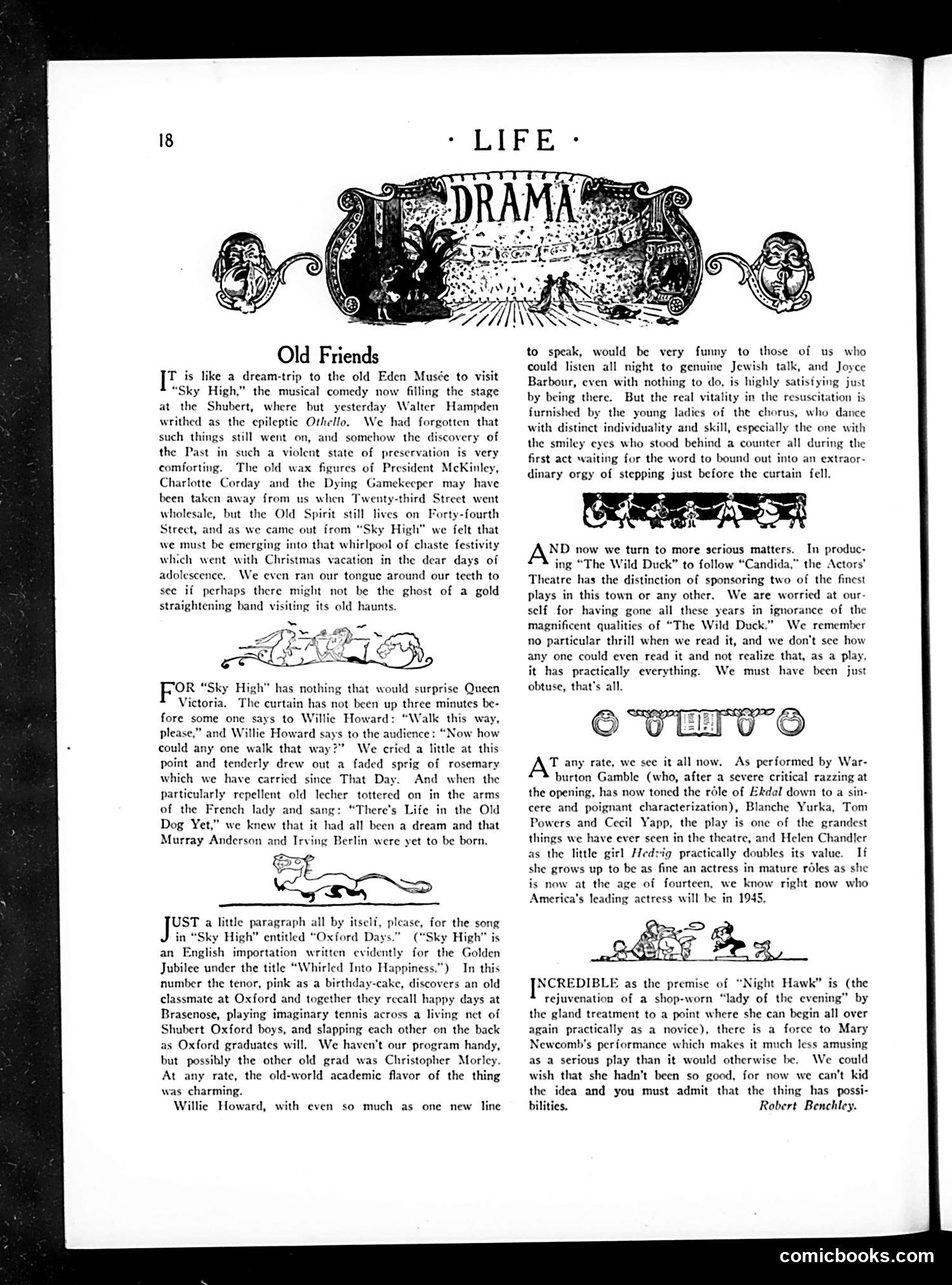
This theater criticism page reviews three Broadway productions. The writer nostalgically compares "Sky High" (a musical comedy at the Shubert) to the old Eden Musée wax museum, suggesting the show feels antiquated—like discovering President McKinley's wax figure still on display. The humor targets the production's old-fashioned sensibility and Willie Howard's comedic timing in "Jewish talk." The piece praises young chorus dancers for their energy and individuality. It then shifts to "The Wild Duck," an Ibsen play the Actors' Theatre is producing after "Candida," calling it one of the finest plays in town. The writer admits personal blindness to the play's merits upon previous reading, praising the current cast—particularly Warburton Gamble's nuanced performance as Ekdal and Blanche Yurka's acting. The tone is sophisticated yet self-deprecating, typical of early 20th-century theater criticism.
📄 Transcribed text from this page (OCR, searchable)
Machine-transcribed from the original scan — historical spelling and the odd misread are preserved.
Old Friends i is like a dream-trip to the old Eden Musée to visit “Sky High,” the musical comedy now filling the stage at the Shubert, where but yesterday Walter Hampden writhed as the epileptic Othello. We had forgotten that such things still went on, and somehow the discovery of the Past in such a violent state of preservation is very comforting. The old wax figures of President McKinley, Charlotte Corday and the Dying Gamekeeper may have been taken away from us when Twenty-third Street went wholesale, but the Old Spirit still lives on Forty-fourth Strect, and as we came out from “Sky High” we felt that we must be emerging into that whirlpool of chaste festivity which went with Christmas vacation in the dear days of adolescence. We even ran our tongue around our teeth to see if perhaps there might not be the ghost of a gold Straightening band visiting its old haunts. ‘OR “Sky High” has nothing that would surprise Queen Victoria. The curtain has not been up three minutes be- fore some one s to Willie Howard: “Walk this v please,” and Willie Howard says to the audience: “Now how could any one walk that wa: We cried a little at this point and tenderly drew out a faded sprig of rosemary which we have carried since That Da And when the particularly repellent old lecher tottered on in the arms of the French lady and sang: “There's Life in the Old Dog Yet,” we knew that it had all been a dream and that Murray Anderson and Irving Berlin were yet to be born. UST a little paragraph all by itseli, please, for the song in “Sky High” entitled “Oxford Days.” (“Sky High" is an English importation written evidently for the Golden Jubilee under the title “Whirled Into Happiness.”) In this number the tenor, pink as a birthday-cake, discovers an old classmate at Oxford and together they recall happy days at Brasenose, playing imaginary tennis across a living net of Shubert Oxford boys, and slapping each other on the back as Oxford graduates will. We haven't our program handy, but possibly the other old grad was Christopher Morley. At any rate, the old-world academic flavor of the thing was charming. Willie Howard, with even so much as one new line to speak, would be very funny to those of us who could listen all night to genuine Jewish talk, and Joyce Barbour, even with nothing to do, is highly satisfying just by being there. But the real vitality in the resuscitation is furnished by the young ladies of tht chorus, who dance with distinct individuality and skill, especially the one with the smiley eyes who stood behind a counter all during the first act waiting for the word to bound out into an extraor- dinary orgy of stepping just before the curtain fell. D now we turn to more serious matters. In produc- ing “The Wild Duck” to follow “Candida,” the Actors’ Theatre has the distinction of sponsoring two of the finest plays in this town or any other. We are worried at our- self for having gone all these years in ignorance of the magnificent qualities of “The Wild Duck.” We remember no particular thrill when we read it, and we don't see how any one could even read it and not realize that, as a play, it has practically everything. We must have been just obtuse, that’s all. T any rate, we see it all now. As performed by War- burton Gamble (who, after a severe critical razzing at the opening, has now toned the role of Ekdal down to a sin- cere and poignant characterization), Blanche Yurka, Tom Powers and Cecil Yapp, the play is one of the grandest things we have ever seen in the theatre, and Helen Chandler as the little girl Hedzig practically doubles its value. If she grows up to be as fine an actress in mature roles as she is now at the age of fourteen, we know right now who America’s leading actress will be in 1945. NCREDIBLE as the premise of “Night Hawk” is (the rejuvenation of a shop-worn “lady of the evening” by the gland treatment to a point where she can begin all over again practically as a novice), there is a force to Mary Newcomb’s performance which makes it much less amusing as a serious play than it would otherwise be. We could wish that she hadn't been so good, for now we can't kid the idea and you must admit that the thing has possi- bilities, Robert Benchley. comicbooks.com