
Life, 1925-03-19 · page 16 of 36
Life — March 19, 1925 — page 16: what you’re looking at
What you’re looking at
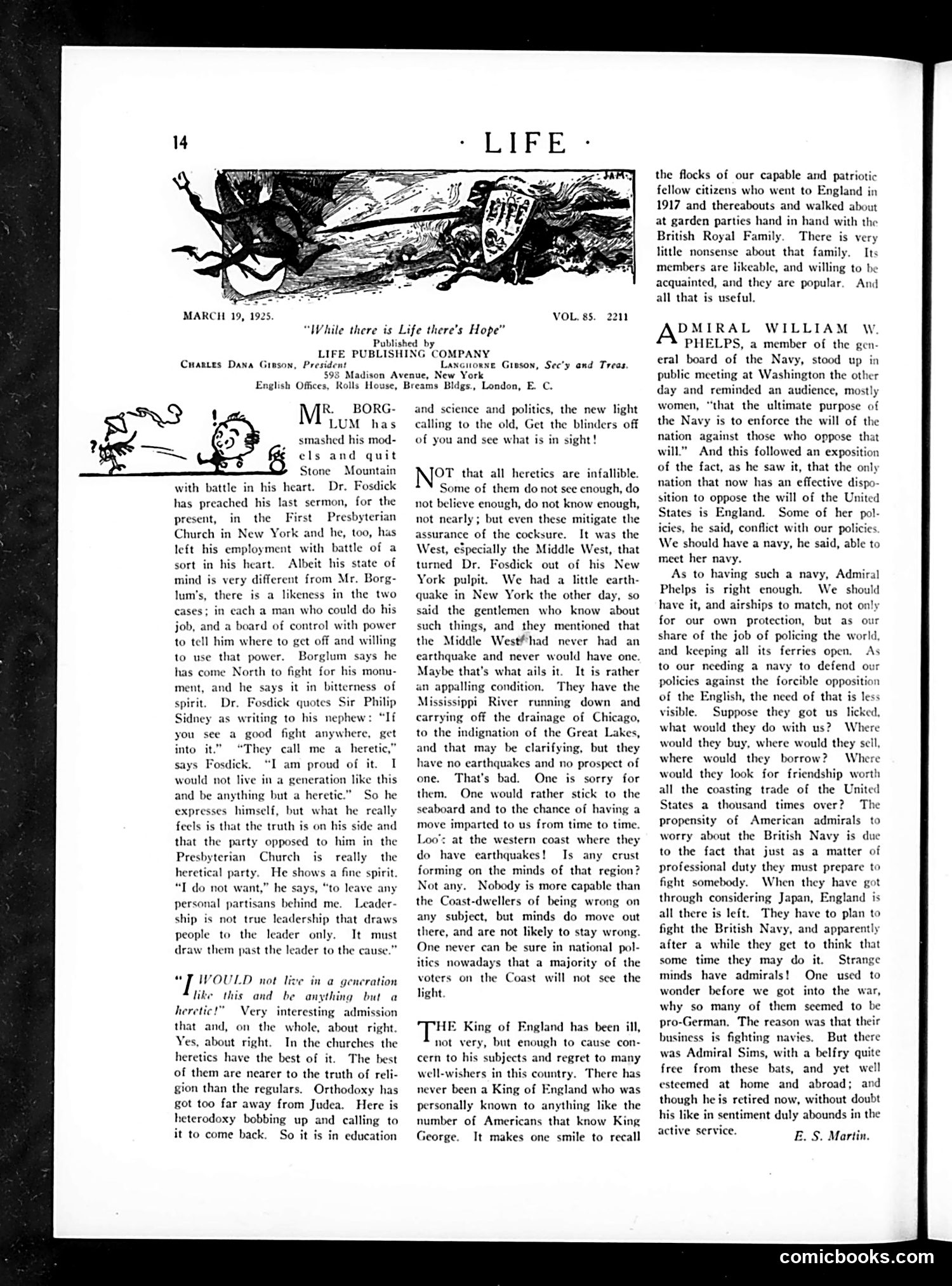
The header cartoon depicts a skeletal figure labeled "LIFE" emerging from or associated with what appears to be wreckage or debris, with the caption "While there is Life there's Hope." The page primarily contains editorial text rather than satire. The articles criticize Dr. Fosdick (a Presbyterian minister) for his pacifist sermons, and debate American naval strength. One piece mocks heretics and the "Middle West" for doubting earthquakes and navy readiness. Another defends Admiral Phelps's call for a stronger navy against potential British competition, arguing Americans shouldn't underestimate England despite post-WWI relations. The overall tone reflects 1920s isolationist anxiety about international naval competition and domestic religious/political division following World War I.
📄 Transcribed text from this page (OCR, searchable)
Machine-transcribed from the original scan — historical spelling and the odd misread are preserved.
MARCH 19, 1925. VOL. 85. 2211 “While there is Life there’s Hope” Published by LIFE PUBLISHING COMPANY Cuantes Dana Ginson, President 39 Lancitorne Greson, Sec’y and Treas, Madison Avenue, New York 9: ish Offices, Rolls House, Breams Bldgs., London, E. C. R. BORG- LUM has smashed his mod- els and quit Stone Mountain with battle in his heart. Dr. Fosdick has preached his last sermon, for the present, in the First Presbyterian Church in New York and he, too, has left his employment with battle of a sort in his heart. Albeit his state of mind is very different from Mr. Borg- lum’s, there is a likeness in the two cases; in each a man who could do his job, and a board of control with power to tell him where to get off and willing to use that power. Borglum says he has come North to fight for his monu- ment, and he says it in bitterness of spirit. Dr. Fosdick quotes Sir Philip Sidney as writing to his nephew: “Ii you see a good fight anywhere, get into it.” “They call me a_hereti says Fosdick. I am proud of it. I would not live in a generation like this and be anything but a heretic.” So he expresses himself, but what he really feels is that the truth is on his side and that the party opposed to him in the Presbyterian Church is really the heretical party. He shows a fine spirit. “I do not want,” he sa personal partisans behind me. ship is not true leadership that draws people to the leader only, It must draw them past the leader to the cause.” “7 WOULD not live in a generation this and be anything but a heretic!” Very interesting admission that and, on the whole, about right. Yes, about right. In the churches the heretics have the best of it. The best of them are nearer to the truth of reli- gion than the regulars. Orthodoxy has got too far away from Judea. Here is heterodoxy bobbing up and calling to it to come back. So it is in education and science and politics, the new light calling to the old, the blinders off of you and see what is in sight! OT that all heretics are infallible. Some of them do not see enough, do not believe enough, do not know enough, not nearly; but even these mitigate the assurance of the cocksure. It was the West, eSpecially the Middle West, that turned Dr. Fosdick out of his New York pulpit. We had a little earth- quake in New York the other day, so said the gentlemen who know about such things, and they mentioned that the Middle Westfhad never had an earthquake and never would have one. Maybe that's what ails it. It is rather an appalling condition. They have the Mississippi River running down and carrying off the drainage of Chi to the indignation of the Great Lakes, and that may be clarifying, but they have no earthquakes and no prospect of one. That's bad. One is sorry for them. One would rather stick to the seaboard and to the chance of having a move imparted to us from time to time. Loo’: at the western coast where they do have earthquakes! Is crust forming on the minds of that region? Not any. Nobody is more capable than the Coast-dwellers of being wrong on any subject, but minds do move out there, and are not likely to stay wrong. One never can be sure in national pol- itics nowadays that a majority of the voters on the Coast will not sce the light any rte King of England has been ill, not very, but enough to cause con- cern to his subjects and regret to many well-wishers in this country. There has never been a King of England who was personally known to anything like the number of Americans that know King George. It makes one smile to recall the flocks of our capable and patriotic fellow citizens who went to England in 1917 and thereabouts and walked about at garden parties hand in hand with the British Royal Family. There is very little nonsense about that family. Its members are likeable, and willing to be acquainted, and they are popular. And all that is useful. DMIRAL WILLIAM W. PHELPS, a member of the gen- eral board of the Navy, stood up in public meeting at Washington the other day and reminded an audience, mostly women, “that the ultimate purpose of the Navy is to enforce the will of the nation against those who oppose that will.” And this followed an exposition of the fact, as he saw it, that the only nation that now has an effective dispo- sition to oppose the will of the United States is gland. Some of her pol- icies, he said, conflict with our poli We should have a navy, he said, able to meet her navy. As to having such a navy, Admiral Phelps is right enough. We should have it, and airships to match, not only for our own protection, but as our share of the job of policing the world, and keeping all its ferries open. As to our needing a navy to defend our policies against the forcible oppos of the English, the need of that is less visible. Suppose they got us licked, what would they do with us? Where would they buy, where would they sell, where would they borrow? Where would they look for friendship worth all the coasting trade of the United States a thousand times over? The propensity of American admirals to worry about the British Navy is due to the fact that just as a matter of professional duty they must prepare to fight somebody. When they have got through considering Japan, England is all there is left. They have to plan to fight the British Navy, and apparently after a while they get to think that some time they may do it. Strange minds have admirals! One used to wonder before we got into the war, why so many of them seemed to be pro-German, The reason was that their business is fighting navies. But there was Admiral Sims, with a belfry quite free from these bats, and yet well esteemed at home and abroad; and though he is retired now, without doubt his like in sentiment duly abounds in the active service: E. S. Martin comicbooks.com