
Life, 1925-03-19 · page 26 of 36
Life — March 19, 1925 — page 26: what you’re looking at
What you’re looking at
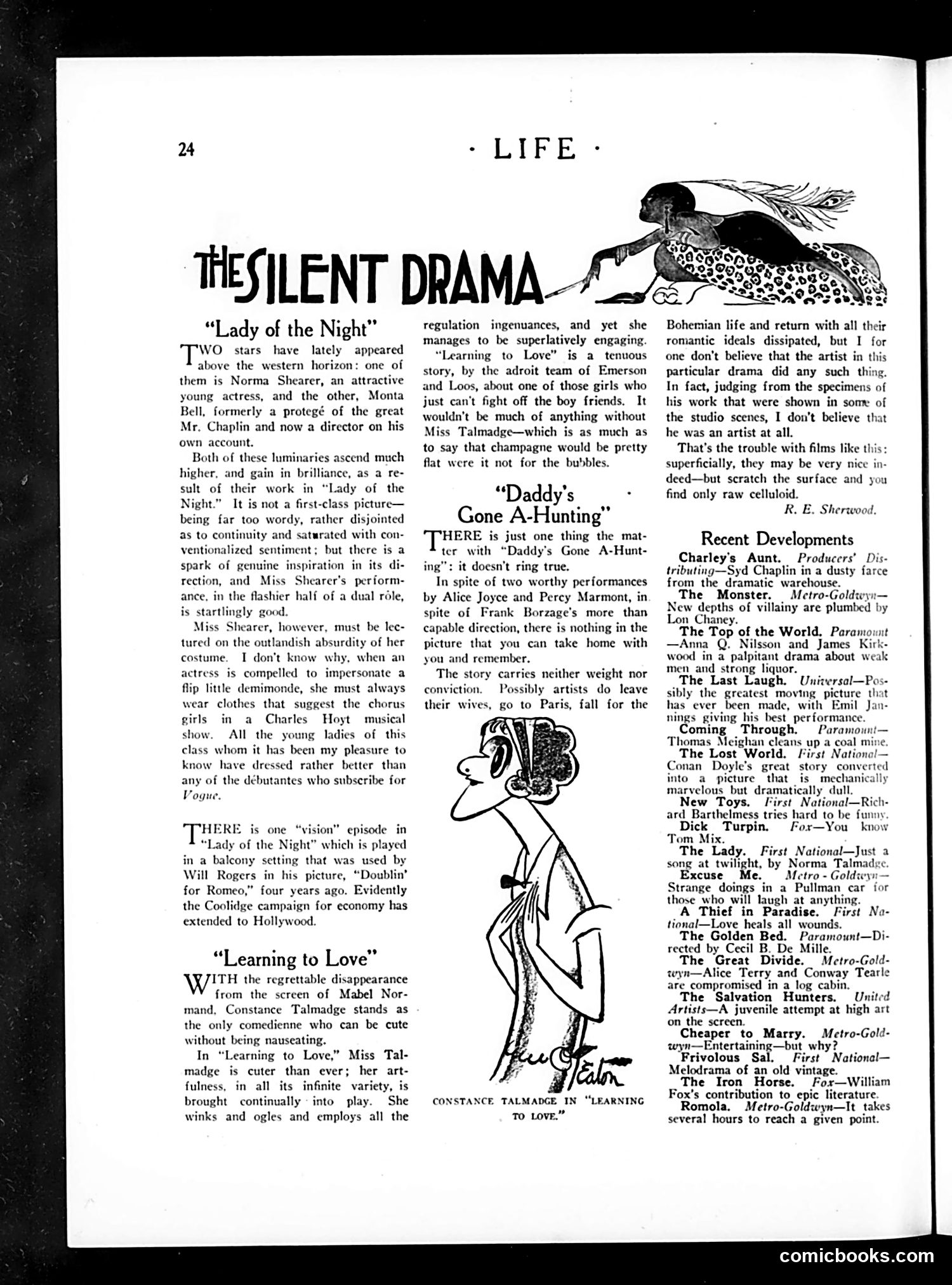
This page reviews several silent films from the mid-1920s. The main criticism concerns **Norma Shearer** in "Lady of the Night": the reviewer praises her acting but mocks her costume as absurdly immodest for playing a demimonde (courtesan), noting that actual women in that profession dressed better than the theatrical exaggeration suggests. The cartoon depicts **Constance Talmadge** in "Learning to Love"—a comedienne the reviewer considers uniquely "cute without being nauseating," capable of charming audiences through exaggerated expressions and gestures. A secondary review criticizes "Daddy's Gone A-Hunting" as superficially pleasant but hollow—"scratch the surface and you find only raw celluloid"—a pointed metaphor for films lacking substance. The "Recent Developments" section lists new releases, including praise for "The Last Laugh" (Emil Jannings) as "possibly the greatest moving picture that has ever been made." The reference to the "Coolidge campaign for economy" jokes that Hollywood was reusing old set pieces from years prior.
📄 Transcribed text from this page (OCR, searchable)
Machine-transcribed from the original scan — historical spelling and the odd misread are preserved.
“Lady of the Night” WO stars have lately appeared above the western horizon: one of them is Norma Shearer, an attractive young actress, and the other, Monta Bell, formerly a protegé of the great Mr. Chaplin and now a director on his own account. Both of these luminaries ascend much higher, and gain in brilliance, as a re- sult of their work in “Lady of the Night.” It is not a first-class picture— being far too wordy, rather disjointed as to continuity and saturated with con- ventionalized sentiment; but there is a spark of genuine inspiration in its di- rection, and Miss Shearer's perform- ance, in the flashier half of a dual role, is startlingly good. Miss Shearer, however, must be lec- tured on the outlandish absurdity of her costume. I don't know why, when an actress is compelled to impersonate a flip little demimonde, she must always wear clothes that suggest the chorus girls in a Charles Hoyt musical All the young ladies of this class whom it has been my pleasure to know have dressed rather better than any of the débutantes who subscribe for Vogue. show. HERE is one “vision” episode in “Lady of the Night” which is played in a balcony setting that was used b Will Rogers in his picture, “Doublin’ for Romeo,” four years ago. Evidently the Coolidge campaign for economy has extended to Hollywood. “Learning to Love” ITH the regrettable disappearance from the screen of Mabel Nor- mand, Constance Talmadge stands as the only comedienne who can be cute without being nauseating. madge is cuter than ever; her art- fulness, in all its infinite variety, is brought continually into play. She winks and ogles and employs all the regulation ingenuances, and yet she manages to be superlatively engaging. “Learning to Love” is a tenuous story, by the adroit team of Emerson and Loos, about one of those girls who just can't fight off the boy friends. It wouldn't be much of anything without Miss Talmadge—which is as much as to say that champagne would be pretty flat were it not for the bubbles. “Daddy's Gone A-Hunting” "THERE is just one thing the mat- ter with “Daddy's Gone A-Hunt- ing’: it doesn’t ring true. In spite of two worthy performances by Alice Joyce and Perey Marmont, in spite of Frank Borzage’s more than capable direction, there is nothing in the picture that you can take home with you and remember, The story carries neither weight nor conviction. Possibly artists do leave their wives, go to Paris, fall for the CONSTANCE TALMADGE IN “LEARNING TO Love.” Bohemian life and return with all their romantic ideals dissipated, but I for one don't believe that the artist in this particular drama did any such thing. In fact, judging from the specimens of his work that were shown in some of the studio scenes, I don’t believe that he was an artist at all. That's the trouble with films like this: superficially, they may be very nice in- deed—but scratch the surface and you find only raw celluloid. R. E. Sherwood, Recent Developments Charley's Aunt. Producers’ Dis- tributing—Syd Chaplin in a dusty farce from the dramatic warehouse. The Monster. Metro-Goldwyn New depths of villainy are plumbed by Lon Chaney. The Top of the World. Paramount —Anna Q. Nilsson and James Kirk: wood in a palpitant drama about weak men and strong liquor. The Last Laugh. Universal—Pos- sibly the greatest moving picture that has ever been made, with Emil Jan- nings giving his best performance. Coming Through. Paramou Thomas Meighan cleans up a coal mine. The Lost World. First Nationol— Conan Doyle's great story converted into a picture that is mechanically marvelous but dramatically dull. New Toys. irst National—Rich- ard Barthelmess tries hard to be funny Dick Turpin. ‘ox—You know Tom Mix. First National—Just a ight, by Norma Talmadge. Metro - Goldwy Strange doings in a Pullman car for those who will laugh at anything. song at t Excuse A Thief in Paradise. First Na- tional—Love heals all wounds. The Golden Bed. Paramount—Di- rected by Cecil B. De Mille. The Great Divide. Metro-Gold- twwyn—Alice Terry and Conway Tearle are compromised in a log cabin. The Salvation Hunters. United Artists—A juvenile attempt at high art on the screen. Cheaper to Marry. Metro-Gold- wyn—Entertaining—but_ why? Frivolous Sal. First National— Melodrama of an old vintage. The Iron Horse. Fox—William Fox's contribution to epic literature. Romola. Metro-Goldwyn—It takes several hours to reach a given point. comicbooks.com